Sample Category Title
ECB Schnabel: No time for monetary policy to pause
ECB Executive Board member Isabel Schnabel said in a speech, "there is no time for monetary policy to pause... We will need to raise rates further, probably into restrictive territory."
"Only a deep recession with a sharp rise in unemployment could be expected to significantly dampen inflation pressure," Schnabel said. "This is currently unlikely, not least due to the robust labour market, large excess savings and the massive fiscal support."
Sunset Market Commentary
Markets
At last! At last a below-consensus US inflation number. At last a below-consensus US inflation number at the right time, coming on the heels of last week’s Fed meeting. Recall how markets initially interpreted the FOMC policy statement as suggesting that last week’s 75 bps rate hike was the final such aggressive one. Recall how FOMC Chair Powell afterwards tried to harden the message, saying the slowdown could just as well only come in February rather than December. It’s a done deal now for markets that the Fed will slow it down to 50 bps in December. Especially with little in the way between now and the early December eco update (ISM’s, ADP & payrolls). Zooming into today’s CPI, the downside surprise wasn’t that big to be honest. Headline inflation stabilized at 0.4% M/M (vs 0.6% M/M expected) with the Y/Y figure decelerating from 8.2% to 7.7% (vs 7.9% expected). Underlying core inflation (the more important one!!) slowed from 0.6% M/M to 0.3% M/M (vs 0.5% expected) with the Y/Y figure down to 6.3% from 6.6% (vs 6.5% expected). The strong market reaction therefore is telling. For the first time, markets actually seem into buy into the story that the Fed could enter the “end phase” of its tightening cycle. We warn not to overinterpret one month’s worth of data though. Details showed only negative M/M-readings coming from gas service (-4.57% M/M) and used cars & trucks (-2.42% M/M). Motor fuel (4.01% M/M), gasoline (3.99% M/M) but also sticky items such as shelter (+0.75% M/M) and food (meat, poultry, fish & eggs; 0.61% M/M) still increased. In any case, US yields sink especially at the front end of the curve. They drop 11.5 bps (30-yr) to 21 bps (2-yr). European stock markets bounced over 2% intraday with main US gauges opening up to 5% stronger for Nasdaq. The dollar lost two big figures immediately after the release with EUR/USD rising from 0.9950 towards an intraday high near 1.0150. We add that the greenback traded stronger going into the release, coming from an open above parity. Some mentioned the ECB’s economic bulletin as main reason, with the ECB stressing upside inflation risks and downside economic risks. From a technical point of view, EUR/USD 1.0198 is final intermediate resistance ahead of the key 1.0350 area. Today’s figure confirms that this year’s downward trend in EUR/USD, which started back in February, is over. Going forward, we look for a more sideways trading pattern between the cycle low of 0.9536 and 1.0350 on the topside. The trade-weighted greenback DXY is on the verge of falling out of a similar upside trend channel, testing the income downside at 109.19 which almost coincides with the July top at 109.29. USD/JPY loses 145 support which is the neckline of a double top formation with final target at around 138. Cable (GBP/USD) is testing the October high at 1.1645. EUR/GBP falls from an open at 0.8815 to currently 0.8726.
News Headlines
Czech inflation stumbled 1.4% m/m in October, bringing the figure on a yearly basis down from 18% to 15.1% vs 17.9% expected. The much-lower-than expected price pressures are overwhelmingly the result of state household support for energy costs. Administered prices tanked 16.9% m/m, reflecting a fall in electricity prices due to the statistical inclusion of the contribution for the energy savings tariff. They also lowered the housing, water, energy & fuel component by 9.4% m/m. The Czech National Bank calculated that without the measures inflation would be 3.5 ppts higher. Core inflation declined only slightly to 14.6%. Today’s numbers are more than 2 ppts lower than the CNB’s autumn forecast because the central bank did not explicitly account for this effect. Czech swap yields collapsed between 37 and 52 bps across the curve as any remaining tightening bets were completely priced out. The Czech koruna dipped from EUR/CZK 24.31 to 24.4 before paring losses to 24.33 currently.
The ECB increased the amount of securities that national central banks in the euro area can lend out against cash collateral. The limit on such transactions will be lifted from €150bn to €250bn the ECB said. Executive Board member Schnabel explained it’s a precautionary measure to ease collateral scarcity, which has been exacerbated by years of ECB bond buying, and support market functioning around the year-end.
BTCUSD Plunges to 2-Year Low Amid Crypto Market Turmoil
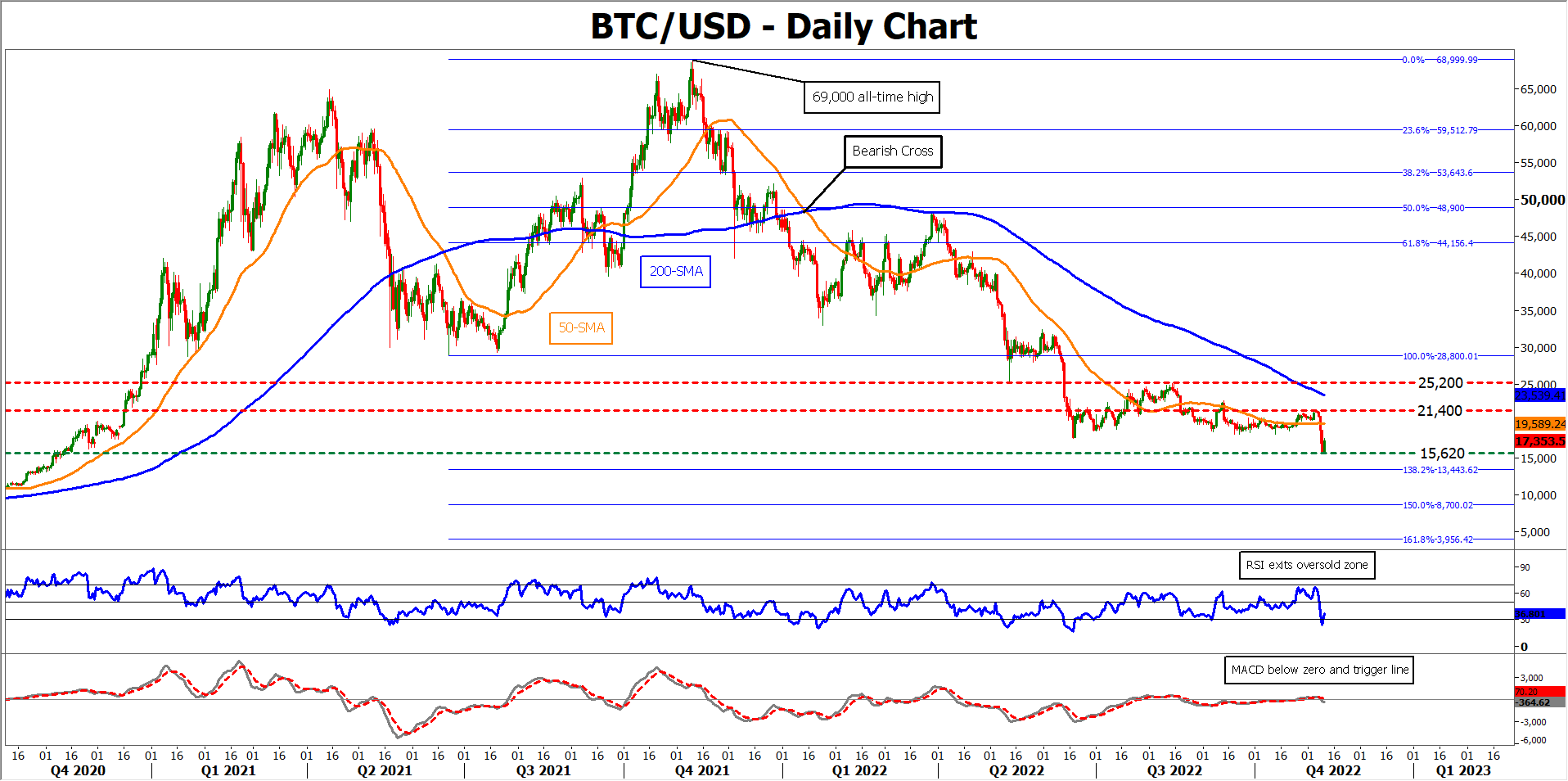
BTCUSD (Bitcoin) has fallen sharply in the last couple of sessions on news that one of the largest crypto exchanges, FTX, is on the brink of default. The king of cryptocurrencies recorded a fresh two-year low of 15,620 before recouping a small part of its losses.
The short-term oscillators are indicating that bearish forces have taken total control. Specifically, the RSI has exited the oversold zone but remains well below its 50-neutral mark, while the MACD histogram is retreating further beneath zero and its red signal line.
To the downside, should the freefall resume, the price could initially test the two-year low of 15,620. Sliding beneath that floor, the bears might then aim at the 13,443 mark, which is the 138.2% Fibonacci extension of the 28,800-68,999 up leg. Failing to halt there, further declines could then encounter support around the 150.0% Fibo of 8,700.
Alternatively, if buyers re-emerge and push the price above its 50-day simple moving average (SMA), immediate resistance could be met at the recent peak of 21,400. A break above the latter may trigger an advance towards the five-month high of 25,200. Even higher, the 28,800 barrier could prove to be a tough one for the price to overcome.
Overall, even though BTCUSD has ceased its decline and is regaining some ground, it is likely to extend its retreat as near-term risks remain tilted to the downside. Nevertheless, a break above the 50-day SMA could revive bulls’ hopes for a sustained rebound.
US Consumer Sentiment and Election Follow-up
Two days after the close of the polls in the US, and officially which party has won control of the Congress is still not known. However, given the trends and projections, the results are pretty much in line with what was expected. That is: Republicans take control of the House, but by a smaller margin than expected. And control of the Senate is still unknown, and will likely come down to a run-off election in Georgia. Again.
The initial reaction from the markets wasn't favorable, likely because of the associated uncertainty. Investors don't like knowing what's coming, and with control of the Senate down to a single race that had less than a percentage point of margin, doesn't inspire confidence. Additionally, Republican control by a small margin means that maintaining consistency will be harder. It only would take convincing a small number of Representatives to change legislative outcomes.
What happens now?
As of writing, Senate results are pending in Arizona and Nevada, both with less than 80% of the vote counted so far. Final tallies aren't expected for days. At the moment, a Republican is leading in Nevada, and a Democrat leading in Arizona. Should either of those trends reverse, then it could confirm that either party controls the Senate. If not, then the Georgia run-off election isn't until December 6.
Control of the Senate is likely to have minimal impact on market outlook, however, since Republican control of just one of the houses allows sufficient leverage to steer the Administration's legislative agenda. In the past, this configuration has coincided with substantial growth in the stock market, and steady economic performance in the medium to long term.
But what about the short term?
The new Congress doesn't take office until January of next year. In the meantime, focus turns to the Fed as inflation remains elevated and Q4 GDP is forecast to come in at an annualized rate of just 0.4%. Republicans are expected to halt large spending by the Government, which could drag on short-term economic growth, but help bring inflation down.
In that sense, the electoral results point towards a shorter rate hike path, with the pivot happening sooner. However, the result was broadly telegraphed, and likely doesn't change expectations for the short term, particularly estimates by the majority of economists forecasting a recession at the start of next year.
The latest data
Tomorrow, the University of Michigan reports a preview of its November survey of consumer sentiment. The survey is on-going, and could be affected by the electoral outcome when the final version comes out later in the month. Currently consumer sentiment is expected to remain broadly healthy at 59.5, a marginal decline from 59.9 in October.
Following the election results, the expectations of what the Fed will do at their next meeting have remained largely unchanged. Only a marginal increase in the number of economists expecting a 25bps hike instead of a 50bps one.
US: Inflation Surprises to the Downside in October, Fed Likely to Start Slowing Pace of Rate Hikes
Consumer price inflation increased by 0.4% month-on-month (m/m) in October, matching the gain in September. On a year-over-year (y/y) basis, headline inflation edged lower by 0.5 percentage points (pp) from September, slowing to 7.7%.
Energy prices increased by 1.8% m/m, as gasoline prices were higher by 4.0% m/m, while energy services declined by 1.2% m/m. Food prices rose 0.6% m/m (following the 0.8% m/m gain in September), and are up 10.9% y/y.
Core inflation (excludes food & energy) rose 0.3% m/m – a meaningful deceleration from September's 0.6% m/m. Relative to last October, core inflation sits at 6.3% – down 0.3 pp from last month's reading of 6.6% y/y.
Price growth across core services (0.5 m/m) moderated from last month's gain of 0.8% m/m. Shelter costs (0.8% m/m) were again a meaningful contributor – accounting for slightly more than two-fifths of October's overall gain – with rent of primary residence (0.8% m/m) and owner's equivalent rent (0.8% m/m) each notching sizeable gains. Prices paid for lodging away from home (4.9% m/m) was also higher, after recording a sizeable pullback (-1.0% m/m) the month prior.
- Other service categories including transportation (0.8% m/m), recreational (0.68% m/m) and education & communication services (0.1% m/m) also rose on the month, while price growth across medical services (-0.6% m/m/) were lower.
Core goods prices declined 0.4% m/m after recording a flat reading the month prior. Declines were seen across used vehicle prices (-2.4% m/m) and apparel (-0.7% m/m). Recreational goods (0.7% m/m) and new vehicle prices (0.4% m/m) were higher, while medical care goods were flat.
Key Implications
It's been a while since CPI has surprised to the downside! This morning's print bucked the trend, with the year-over-year reading of headline inflation easing to a pace not seen since the beginning of the year. The pullback in core goods prices was perhaps the most encouraging development, as it would appear that softening consumer demand is finally manifesting in (some) disinflationary pressure.
Despite market-based measures of rental costs having declined over the last several months, the shelter component of CPI continues to record sizeable gains. As we noted in a recent report, this is because new leases renewed at current market rates are folded in with existing rents which helps to smooth the overall impact. As a result, we are likely to see continued gains in the shelter component of CPI for at least another several months before the lagged effects of lower rents lead to sustained downward pressure on shelter costs.
While we suspect the Fed has reached a point where they'll need to start dialing back on the pace of rate hikes, Chair Powell was explicit in his last press conference that the end-point has likely been revised higher. With inflation still a long way from target and the labor market historically tight, it is entirely possible that the fed funds rate reaches 5% by mid-2023.
AUD/USD Mid-Day Report
Daily Pivots: (S1) 0.6390; (P) 0.6456; (R1) 0.6497; More...
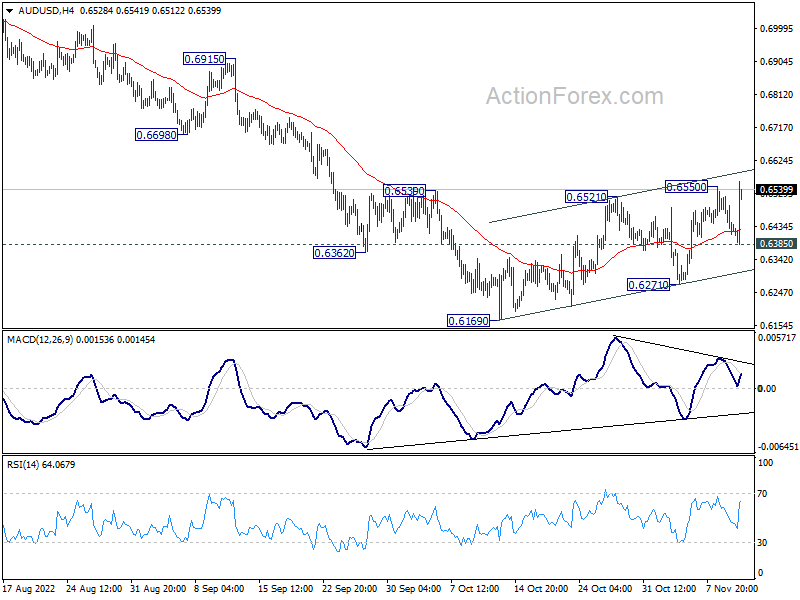
Break of 0.6550 resistance indicate resumption of rise from 0.6169. Intraday bias is back on the upside. Sustained trading above 55 day EMA will be a bullish sign and target 0.6680 support turned resistance. On the downside, break of 0.6385 minor support will turn intraday bias neutral first.
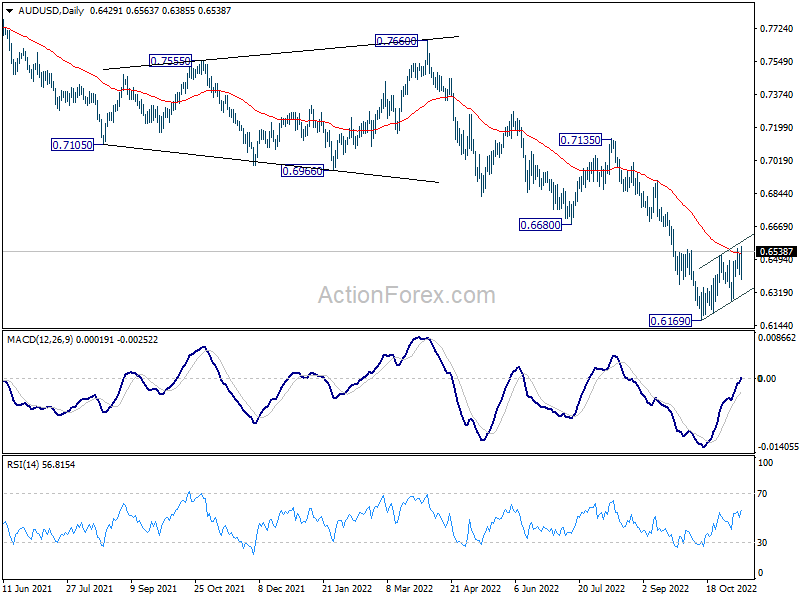
In the bigger picture, down trend from 0.8006 (2021 high) is expected to continue as long as 0.6680 support turned resistance holds. Medium term momentum remains strong and retest of 0.5506 (2020 low) cannot be ruled out. But firm break of 0.6680 will be the first sign of reversal, and bring stronger rebound back to 0.7135 resistance.
USD/CAD Mid-Day Outlook
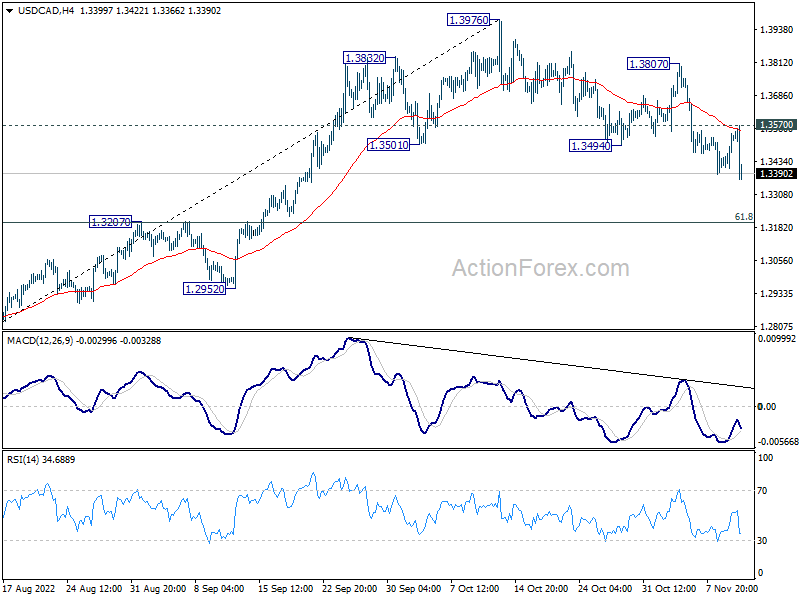
Daily Pivots: (S1) 1.3444; (P) 1.3493; (R1) 1.3575; More....
USD/CAD's decline from 1.3976 resumed after brief recovery and intraday bias is back on the downside. Strong support should be seen at 1.3207 cluster support (61.8% retracement of 1.2726 to 1.3976 at 1.3204) to bring rebound. Break of 1.3570 minor resistance will turn intraday bias neutral first. But sustained break of 1.3204/7 will carry larger bearish implications.
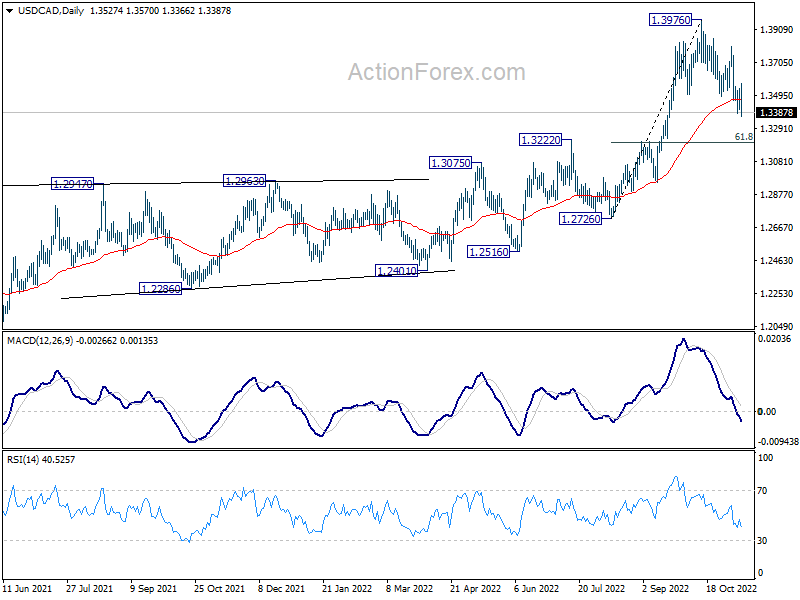
In the bigger picture, as long as 1.3222 resistance turned support holds, larger up trend from 1.2005 (2021 low) is still expected to continue at a later stage. Break of 1.3976 will target 1.4667/89 resistance zone. However, firm break of 1.3222 will be a sign of trend reversal and target 55 week EMA (now at 1.3016).
USD/JPY Mid-Day Outlook
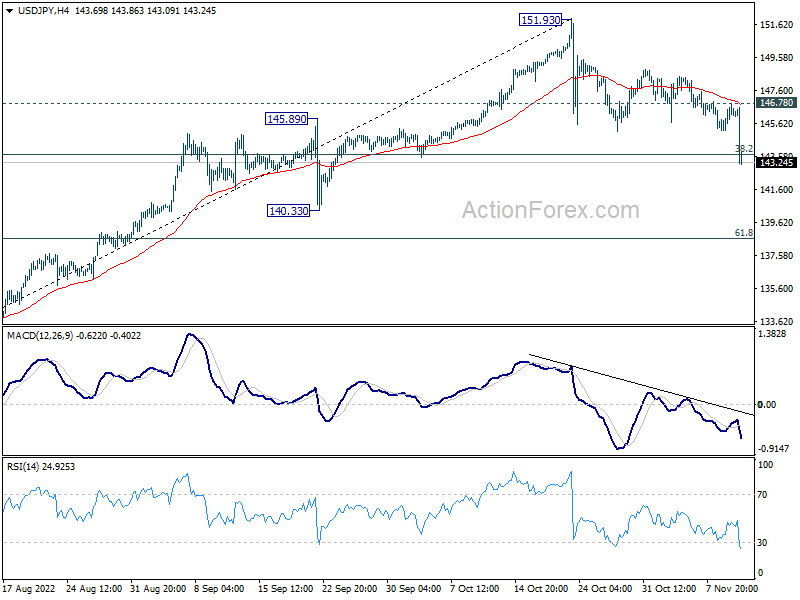
Daily Pivots: (S1) 145.45; (P) 146.12; (R1) 147.07; More...
USD/JPY's decline from 151.93 accelerated lower today Break of 38.2% retracement of 130.38 to 151.93 at 143.69 argues that fall form 151.93 is correcting larger up trend. In this case, deeper decline would be seen to 130.38/139.37 support zone. On the other hand, strong rebound from current level, followed by break of 146.78 resistance, will indicate that such correction has completed, and turn bias back to the upside.
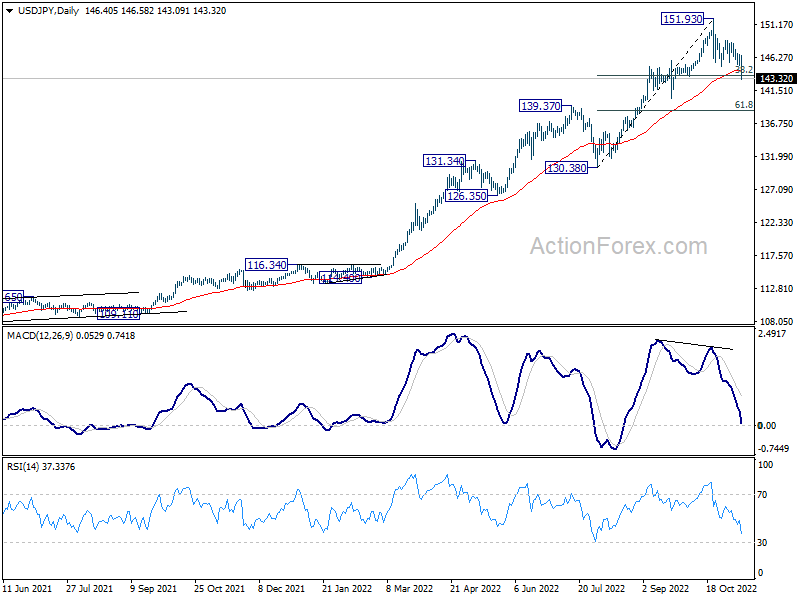
In the bigger picture, sustained trading below 55 day EMA (now at 144.44) will argue that 151.93 is a medium term top. Fall from there is correcting larger up trend from 102.58. While it's too early to call for trend reversal, deeper decline would then be seen to 55 week EMA (now at 130.73).
USD/CHF Mid-Day Outlook
Daily Pivots: (S1) 0.9802; (P) 0.9838; (R1) 0.9876; More...
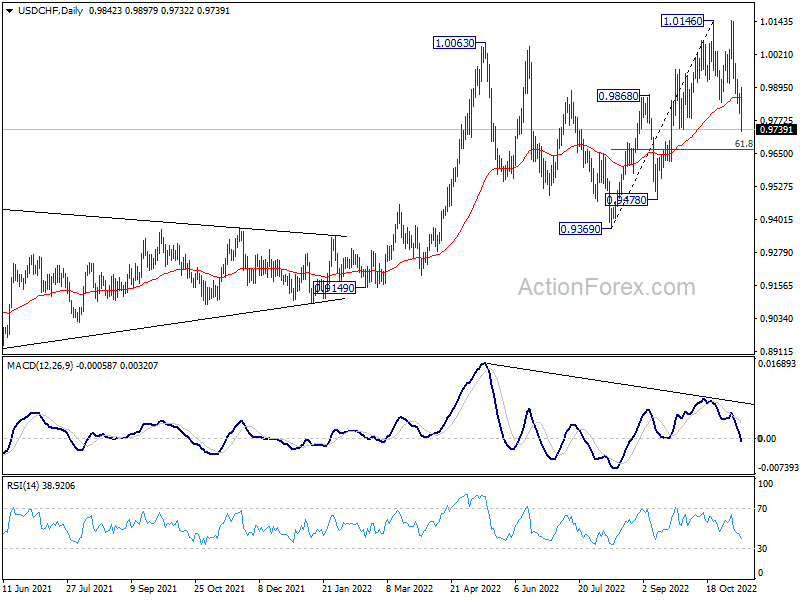
USD/CHF's fall from 1.0146 accelerates lower today and intraday bias stays on the downside. Next target is 61.8% retracement of 0.9369 to 1.0146 at 0.9666. Sustained break there will raise the chance of larger reversal. On the upside, above 0.9897 minor resistance will turn intraday bias neutral first.
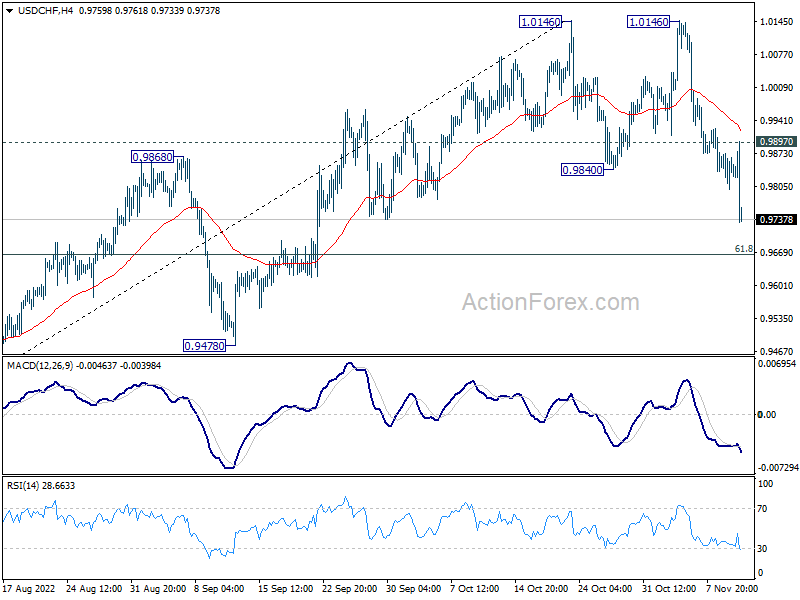
In the bigger picture, a medium term top should be in place at 1.0146 on bearish divergence condition in daily MACD. Fall from 1.0146 support is currently seen as a correction to rise from 0.9369 only. That is, another rise could still be seen through 1.0146. However, sustained break of 61.8% retracement of 0.9369 to 1.0146 at 0.9666 will raise the chance of larger reversal, and target 55 week EMA (now at 0.9578).
GBP/USD Mid-Day Outlook
Daily Pivots: (S1) 1.1272; (P) 1.1420; (R1) 1.1505; More...
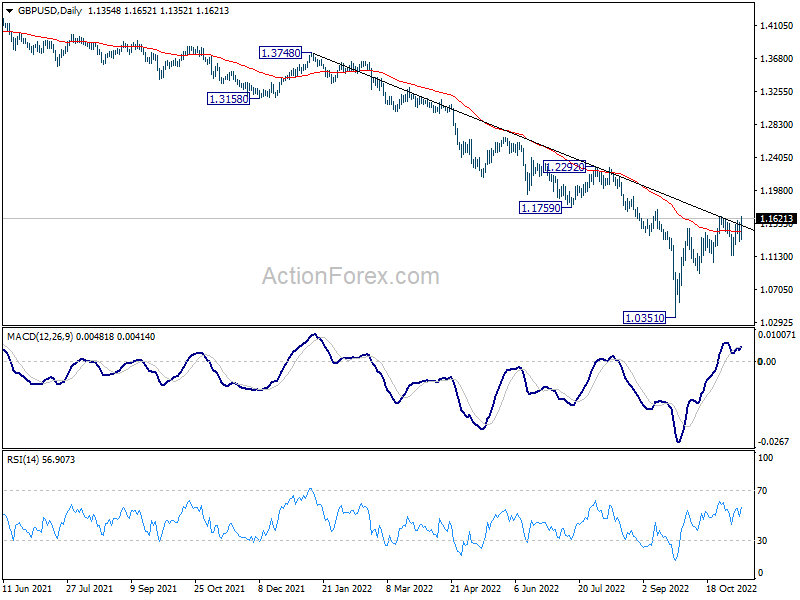
Immediate focus is now on 1.1644 resistance. Decisive break there will resume larger rise from 1.0351. Further break of 1.1759 support turned resistance will carry larger bullish implication and target 1.2292 resistance next. On the downside, break of 1.1145 support will turn bias back to the downside for retesting 1.0351 low instead.
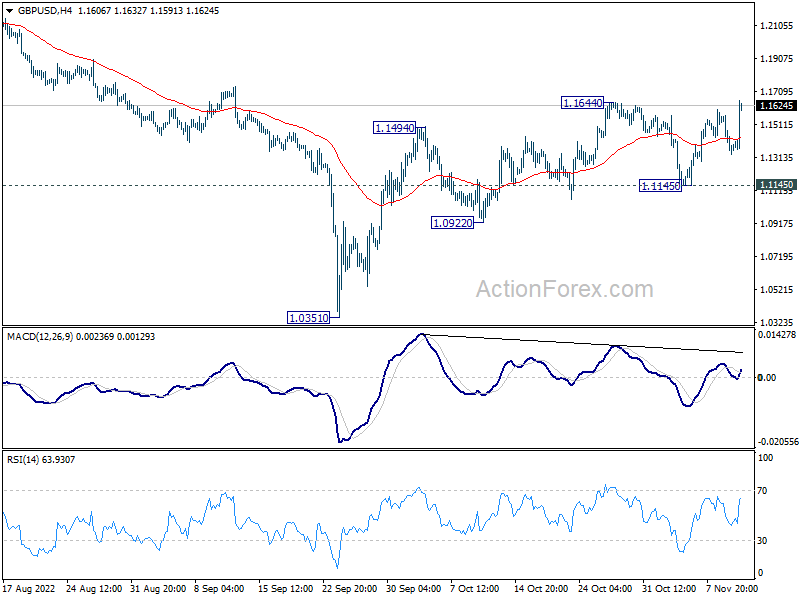
In the bigger picture, fall from 1.4248 (2018 high) is part of the long term down trend from 2.1161 (2007 high). Outlook will stay bearish as long as 1.1759 support turned resistance holds. Parity would be the next target on resumption. Nevertheless, firm break of 1.1759 will confirm medium term bottoming, and open up stronger rise back to 55 week EMA (now at 1.2330).