

Sample Category Title
EUR/USD Daily Outlook
Daily Pivots: (S1) 1.0022; (P) 1.0122; (R1) 1.0308; More...
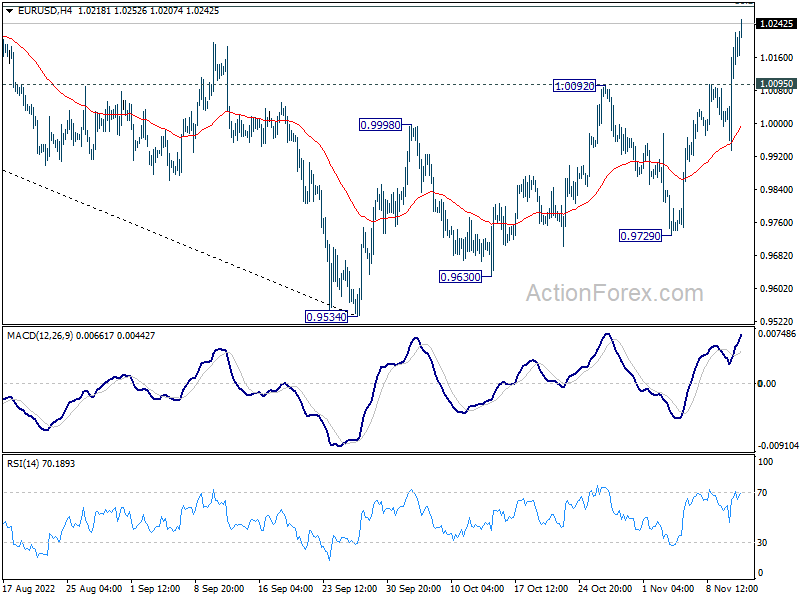
Intraday bias in EUR/USD remains on the upside as rise form 0.9534 is extending. Next target is 38.2% retracement of 1.1494 to 0.9534 at 1.0283. Sustained break there will target 55 week EMA (now at 1.0571). On the downside, below 1.0095 minor support will turn intraday bias neutral and bring consolidations, before staging another rally.
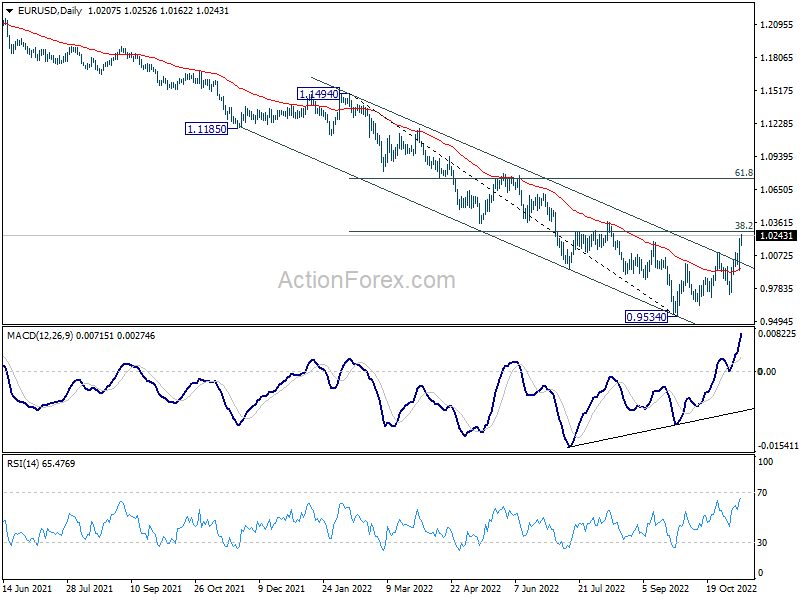
In the bigger picture, break of the medium term channel resistance, bullish convergence condition in daily MACD, as well as some support from 55 day EMA are bullish signs. A medium term bottom should be in place at 0.9534. Stronger rebound should be seen back towards 55 week EMA (now at 1.0567). It's still early to conclude that the medium term trend is reversing, at least until sustained break of 55 week EMA.
GBP/USD Daily Outlook
Daily Pivots: (S1) 1.1467; (P) 1.1600; (R1) 1.1845; More...
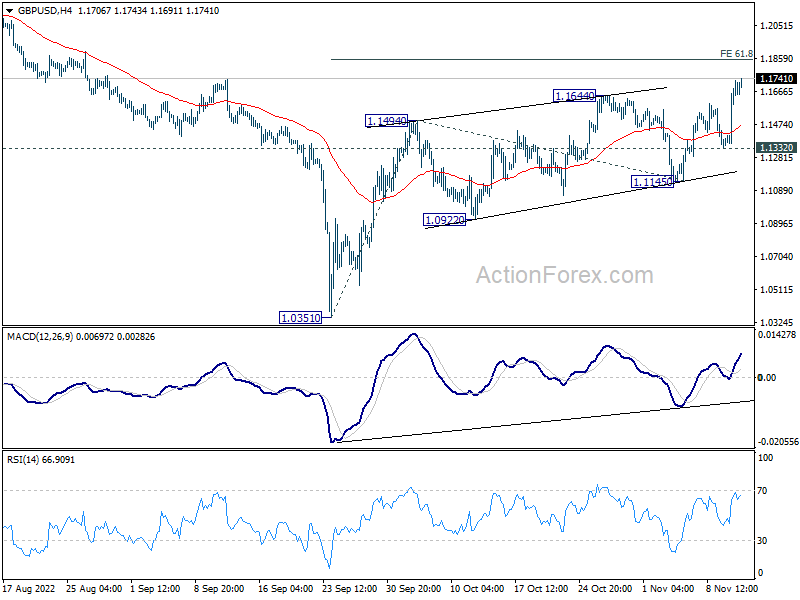
Break of 1.1664 resistance confirmed resumption of rise from 1.0351. Intraday bias in GBP/USD is back on the upside. Further rally would be seen to 61.8% projection of 1.0351 to 1.1494 from 1.1145 at 1.1851. break there will target 100% projection at 1.2288. On the downside, below 1.1332 minor support will turn intraday bias neutral first.
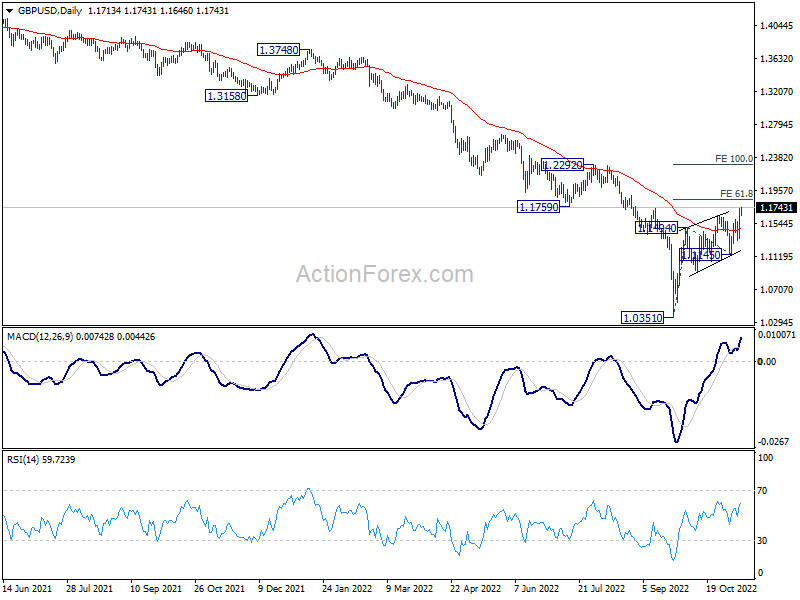
In the bigger picture, current development suggests that rise from 1.0351 is a medium term bottoming. Rise from there is at least correcting whole down trend from 1.4248 (2021 high). Further rise is expected as long as 1.1145 support holds. Firm break of 1.1759 support turned resistance will confirm this case, and target 55 week EMA (now at 1.2330), as possibly above.
USD/CHF Daily Outlook
Daily Pivots: (S1) 0.9545; (P) 0.9722; (R1) 0.9813; More...
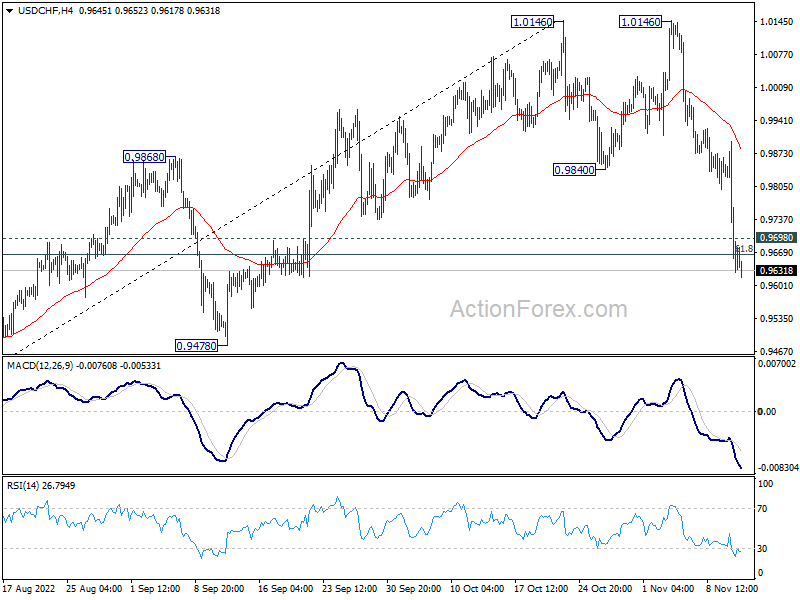
USD/CHF's decline accelerated to as low as 0.9617s so far, and there is no sign of bottoming yet. Sustained trading below 61.8% retracement of 0.9369 to 1.0146 at 0.9666 will raise the chance of larger reversal and target 0.9478 support next. On the upside, above 0.9698 minor resistance will turn intraday bias neutral first.
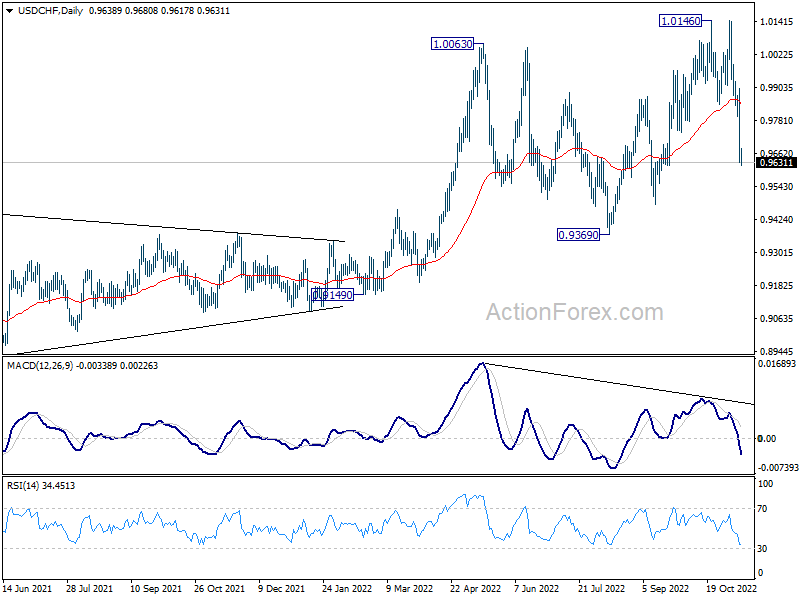
In the bigger picture, a medium term top should be in place at 1.0146 on bearish divergence condition in daily MACD. Fall from 1.0146 support is probably a correction to the whole up trend from 0.8756 (2021 low). Firm break of 55 week EMA (now at 0.9578) will pave the way to 0.9369 support and possibly below.
Aren’t We Overreacting?
The US headline inflation fell to 7.7% in October, versus 8.0% expected by analysts and from 8.2% printed a month earlier.
It is a fairly nice easing.
And more importantly, core inflation fell more than expected as well, printing 6.3% versus 6.5% expected, and 6.6% of last month. Plus, there are hints that both headline and core figures could further cool down in the coming months, including falling housing prices, used car, and apparel prices.
And cherry on top, even inflation concerning services fell more than expected.
And because soft inflation is the only thing that matters to the Federal Reserve (Fed), and to the Fed expectations, we saw a jaw-dropping repositioning in the markets posterior to the release.
Equities skyrocketed, the US yields and the US dollar tanked on the expectation that the Fed may be content with a lower end rate to call victory in its fight against inflation.
The S&P 500 soared 5.50%, Nasdaq roared 7.50, as Dow Jones rallied 3.70%. The US 2-year yield fell more than 5%, the 10-year yield tanked almost 7% to 3.80%, and the US dollar lost more than 2%.
The US dollar index tanked below its 100-DMA for the very first time since June 2021. The EURUSD rose above the 1.02 level, Cable rallied past the 1.17 level, the dollar-yen tanked to 140, gold rallied past the $1760 per ounce, and even Bitcoin gained 10% in the shaky, jittery crypto world hammered and shattered by the FTX collapse.
A bit overreacting?
Investors reacted to the latest US inflation data as if a miracle happened.
But in reality, US inflation remains very high compared to what the Fed is willing to achieve: the 2% target. Therefore, the Fed will certainly hike by 50bp in December, and will probably hike another two times in the first quarter of next year, by 25bp each, to reach the 5% terminal rate.
So, yes, yesterday was a fantastic day, really, but the markets went clearly well ahead of themselves and we will certainly see some correction and consolidation moving forward.
One thing that investors shouldn’t forget is: companies must operate within a high rate environment, into a global economic slowdown, and the pace of earnings downgrades has only accelerated in the US, recording their longest negative streak since the early days of the pandemic in 2020.
The silver lining is that, the earnings downgrades are already in prices, and morose expectations mean a higher probability of a good surprise.
But, it is still too early to pop the champagne.
Anyway, the US is closed today, but there is a last piece of data, the University of Michigan’s consumer sentiment index, that could temper joy into the weekend, as it is expected to have further eased this month.
But who cares, inflation is what matters the most.
US CPI Surprising on the Downside Sparks Risk Rally
Market movers today
The European Commission will publish its autumn forecasts for the European countries today. We will look for the fiscal projections into next year.
Today also brings UK GDP growth for Q3 which we expect will be in negative territory (-0.3% q/q), marking an official start of the recession.
In the US, we get the flash Michigan Consumer Survey for November.
The 60 second overview
US CPI: All eyes were on the US CPI yesterday. The US October inflation figures came out below expectations, with headline CPI rising by 0.4% m/m (consensus 0.6%) and core by 0.3% m/m. Underlying price developments were even weaker than the headline figures suggest, as they were supported by the recent uptick in oil prices, and past rises in house prices continuing to feed into shelter CPI with a lag. Core goods (-0.4%) finally reflected past months' easing in commodity and freight costs, but also included a -2.4% decline in the still elevated used car prices. Notably, services CPI excl. shelter declined by 0.1% (Sep +0.9%), although this was partially explained by an unusually sharp decline in medical care prices. Given that labour market conditions remained tight and wage inflation picked up in October, we think that further upside risks to inflation still persist, but naturally the low print challenges our hawkish view on Fed hiking rates by 75bp in December. See our summary of October inflation figures from Global Inflation Watch, 11 November.
The below consensus US CPI print spark a risk rally across the board with major indices up between 3 and 5%, tighter bond spreads, etc. Markets traded the disappointing CPI figure as the Fed is pivoting. We believe it is still too early to trade the central bank pivot, but yesterday's release reduces the risk of another 75bp hike, where we saw the Dec22 Fed pricing was 11bp lower on the day. The risk rally continued this morning in the Asian session.
A few Fed speakers were on the wires after the release where we highlight Daly and Logan who do not share the same view. Daly said that she would rather do too much than too little while Logan said they may soon be 'appropriate' to slow hiking pace not to overtighten. George said that there is 'more work to do'.
Equities: Equities exploded yesterday with Nasdaq surging 7.4% (!), S&P500 5.5% and Russell 2000 6.1%. This is the biggest one-day-gain since April 2020 and in all fairness it is very seldom we see such moves outside a trough. Growth and quality stocks outperformed massively, with tech, real estate and communication services up 8% (outperforming consumer staples by 6p.p.). All sectors were higher, but worth noting that tech outperformed industrials by 4p.p. so it was mainly a growth rally. Also, VIX only dropped very moderately to 23. Futures are continuing higher today.
FI: The pricing also spilled over to the European rates, not least to a significant risk on move, where notably Italian-German spread tightened 11bp to stand at 200bp on the potential for ECB also ending 'too early' to get QT on the way. The rally was led by the 5-7y area, which was 17bp lower in Germany. US treasuries ended almost 30bp lower on the day 5-7y point.
FX: Commodity prices, including oil, rose more than 1% on the back of the drop in US inflation. We think the bounce owes to the big drop in USD and to us is a sign that a more pronounced Federal Reserve 'pivot' on monetary tightening could fuel a rally in commodity markets. We think it is too early to call. Commodity markets also rose after a similar inflation surprise in August, but that only lasted three days, before prices fell back. That said, EUR/USD has now risen from 0.95 to 1.02 since late September.
Credit: Yesterday, credit markets were initially relatively flat until the US CPI numbers were announced. Lower than expected inflation released an instant and significant risk-on mode with tightening of CDS indices. iTraxx Main was 7.9bp tighter to 99.6bp while Xover was 36.4bp tighter at 488.3bp. On the other hand, the primary markets saw only modest new deal activity across the Eurobond market.
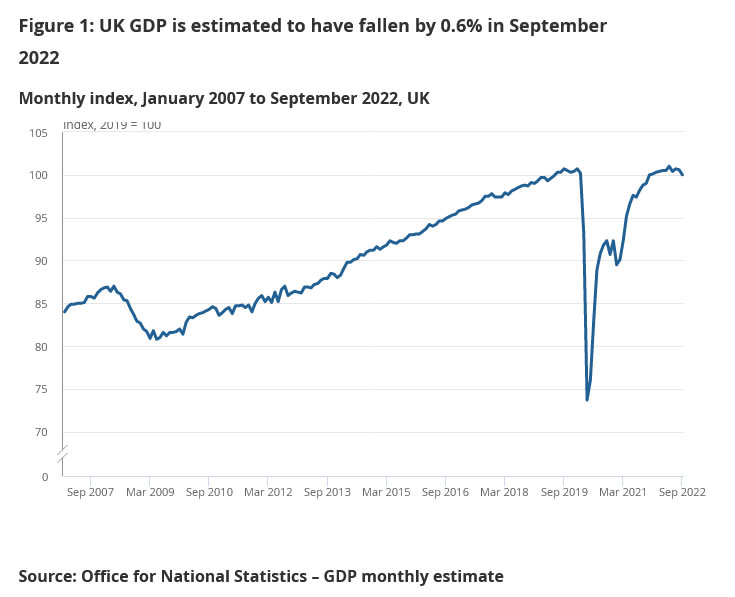
UK GDP contracted -0.6% mom in Sep, worse than expectation
UK GDP contracted -0.6% mom in September, worse than expectation of -0.4% mom. Services dropped -0.8% mom. Production grew 0.2% mom while construction rose 0.4% mom. GDP was then -0.2% below its pre-coronavirus levels in February 2020.
Q3 GDP contracted -0.2% qoq in Q3, versus expectation of -0.5% qoq. Quarterly GDP was -0.4% below pre-coronavirus level in Q4 2019. There was no growth in services during the quarter, while production dropped -1.5%, construction rose 0.6%.
Full monthly GDP release here.
Also released, industrial production came in at 0.2% mom, -3.1% yoy in September, versus expectation of -0.3% mom, -4.3% yoy. Manufacturing production came in at 0.0% mom, -5.8% yoy, versus expectation of -0.4% mom, -6.6% yoy. Goods trade deficit narrowed from GBP -17.2B to GBP -15.7B, smaller than expectation of GBP -18.6B.
USD/JPY Daily Outlook
Daily Pivots: (S1) 138.58; (P) 142.59; (R1) 144.96; More...
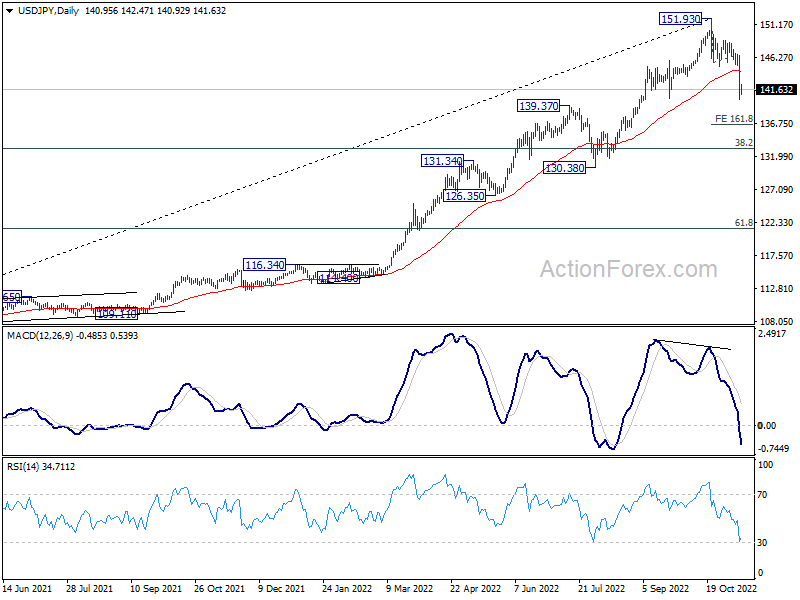
USD/JPY's correction from 151.93 is in progress and intraday bias stays on the downside. Next target is 161.8% projection of 151.93 to 145.53 from 146.78 at 136.42. On the upside, above 143.86 minor resistance will turn bias neutral and bring consolidations first, before staying another fall.
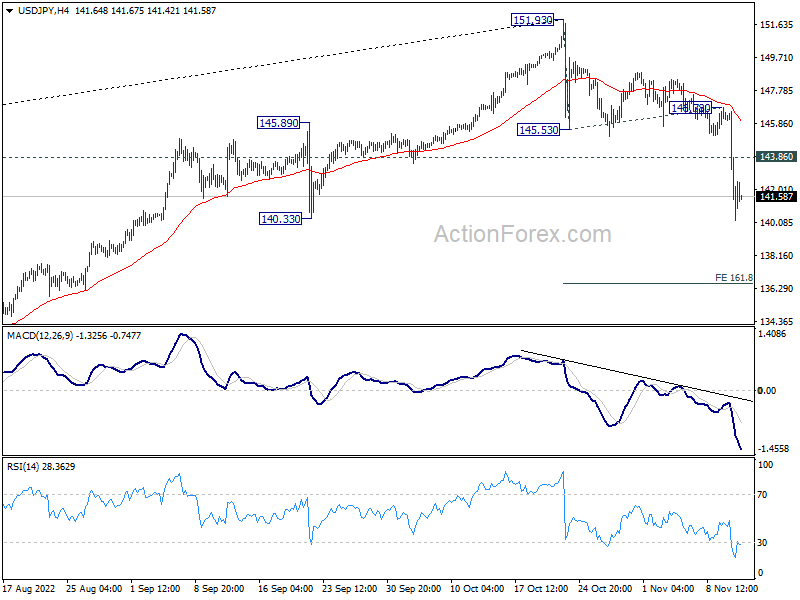
In the bigger picture, a medium term top should be formed at 151.93. Fall from there is correcting larger up trend from 102.58. It's too early to call for bearish trend reversal. But even as a corrective move, such decline should target 38.2% retracement of 102.58 to 151.93 at 133.07, or further to 55 week EMA (now at 130.73).
Yen Shines as Dollar and Yield Nose-dived
Dollar is overwhelmingly the worst performer for the week, after yesterday's post-CPI selloff. Yen is the strongest one, with help from the steep decline in US yields too. European majors follow as next strongest, with Swiss Franc having an upper hand against Euro and Sterling. While US stocks surged and Asia followed, commodity currencies are overall just mixed for the week.
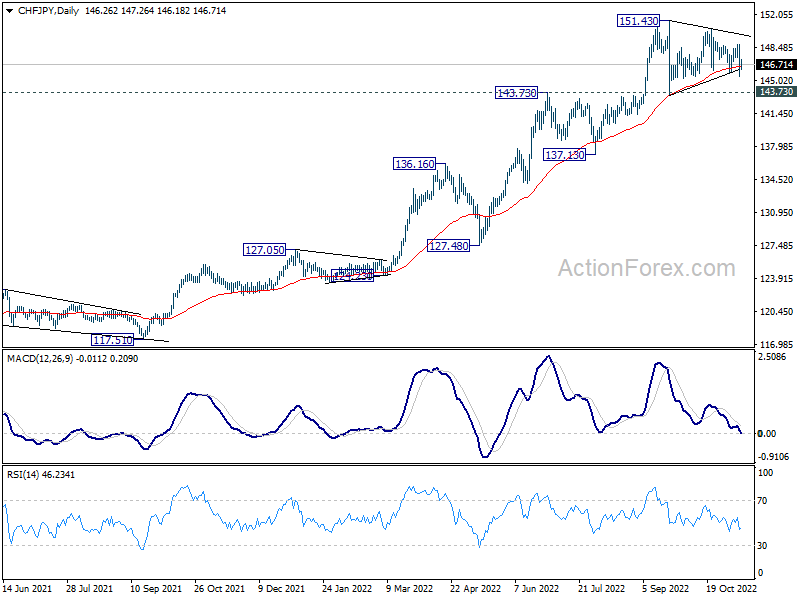
Technically, one question now is whether Yen could build on current rebound to stage a broad-based medium-term rally, even as a corrective move. Some attention could be paid to CHF/JPY to monitor the development. Sustained trading below 55 day EMA (now at 146.50) will be the first sign of a reversal. Firm break of 143.73 resistance turned support should confirm that CHF/JPY is already in a medium term correction, at least, and should that 137.13 support and possibly below. That would be a sign of more Yen strength elsewhere.
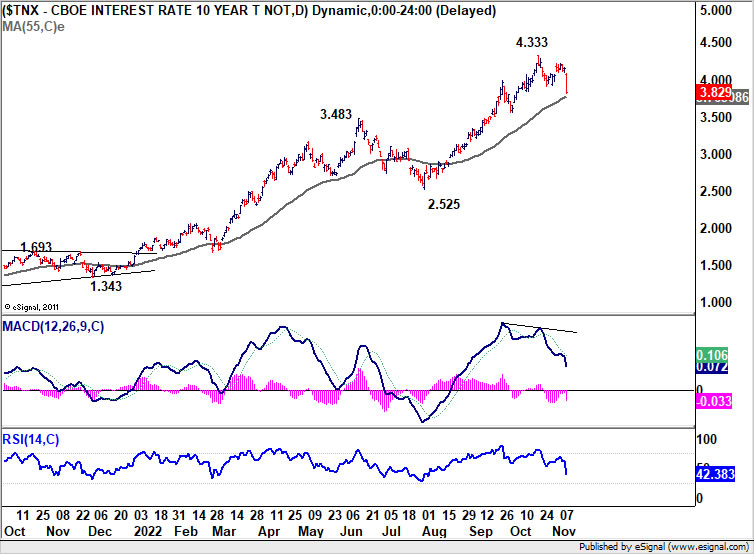
In Asia, Nikkei rose 2.98%. Hong Kong HSI is up 7.25%. China Shanghai SSE is up 2.11%. Singapore Strait Times is up 1.65%. Japan 10-year JGB yield is down -0.0082 at 0.238. Overnight, DOW rose 3.70%. S&P 500 rose 5.54%. Even NASDAQ rose 7.35%. 10-year yield dropped sharply by -0.322 to 3.829.
Fed Daly: One month does not a victory make
San Francisco Fed President Mary Daly said yesterday that the slowdown in inflation was "goods news". Yet, "one month does not a victory make."
"We have to be resolute to bring inflation down; we're united in that commitment," she said. "It's raising the rate and then holding it for a length of time that is sufficient to bring inflation reliably back to 2%."
"I would rather move a little bit higher and have to come back then to move a little bit less high and to then tell people we're going to go higher, because at some point it does seep into inflation expectations," Daly said.
At the same time, she said, "I don't want to be over tightening to the point where we throw the economy into a sharp recession, but if we are talking about a rate hike on either side, I want to fully get inflation sustainably down to 2% on average."
Fed Mester: There continue to be some upside risks to inflation forecast
Cleveland Fed President Loretta Mester yesterday's October CPI report "suggests some easing in overall and core inflation." However, "there continue to be some upside risks to the inflation forecast." She expects to see a "meaningful" decrease in inflationary pressures next year and after, with CPI back to 2% target by 2025.
"Given the current level of inflation, its broad-based nature, and its persistence, I believe monetary policy will need to become more restrictive and remain restrictive for a while in order to put inflation on a sustainable downward path to 2%," she said.
"Despite the moves we have made so far, given that inflation has consistently proven to be more persistent than expected and there are significant costs of continued high inflation, I currently view the larger risks as coming from tightening too little."
Fed George urges steady and deliberate approach to raising policy rate
Kansas City Fed President Esther George said yesterday, "I continue to see several advantages for a steady and deliberate approach to raising the policy rate."
"Without question, monetary policy must respond decisively to high inflation to avoid embedding expectations of future inflation," she said. "A more measured approached to rate increases may be particularly useful as policymakers judge the economy's response to higher rates".
"As the tightening cycle continues, now is a particularly important time to avoid unduly contributing to financial market volatility, especially as volatility stresses market liquidity with the potential to complicate balance sheet run-off plans," George said.
"The degree of tightening necessary will only be determined by observing the dynamics of the economy and inflation and cannot be predetermined by theory or pre-pandemic benchmarks," George said.
BoC Macklem: We need to rebalance the labor market
BoC Governor Tiff Macklem said yesterday, "We need to rebalance the labour market... This will be a difficult adjustment. We want to do this in the best way possible for Canadian workers and businesses."
"The unemployment rate in June hit a record low [of 4.9%] – and while that seems like a good thing, it is not sustainable," he explained. "The tightness in the labour market is a symptom of the general imbalance between demand and supply that is fuelling inflation and hurting all Canadians."
SNB Maechler: Further rate hikes may be necessary
SNB board member Andrea Maechler said an in interview, "it is not out of the question that, based on new figures and developments, further rate hikes may be necessary to ensure price stability in the medium term."
"So it is really important to make an overall assessment with the figures we will have in December," she said.
Regarding inflation, "on the one hand, a single figure will never allow us to claim victory, and on the other hand, it is still 3%, far from the range that we associate with price stability," Maechler said."We will claim victory when inflation settles below 2% on a sustainable basis."
Looking ahead
UK data will take center stage today with GDP, production and trade balance. Germany will release CPI final. US will release U of Michigan consumer sentiment, which could also move the markets.
USD/JPY Daily Outlook
Daily Pivots: (S1) 138.58; (P) 142.59; (R1) 144.96; More...
USD/JPY's correction from 151.93 is in progress and intraday bias stays on the downside. Next target is 161.8% projection of 151.93 to 145.53 from 146.78 at 136.42. On the upside, above 143.86 minor resistance will turn bias neutral and bring consolidations first, before staying another fall.
In the bigger picture, a medium term top should be formed at 151.93. Fall from there is correcting larger up trend from 102.58. It's too early to call for bearish trend reversal. But even as a corrective move, such decline should target 38.2% retracement of 102.58 to 151.93 at 133.07, or further to 55 week EMA (now at 130.73).
Economic Indicators Update
| GMT | Ccy | Events | Actual | Forecast | Previous | Revised |
|---|---|---|---|---|---|---|
| 23:50 | JPY | PPI Y/Y Oct | 9.10% | 8.80% | 9.70% | |
| 07:00 | EUR | Germany CPI M/M Oct F | 0.90% | 0.90% | ||
| 07:00 | EUR | Germany CPI Y/Y Oct F | 10.40% | 10.40% | ||
| 07:00 | GBP | GDP M/M Sep | -0.40% | -0.30% | ||
| 07:00 | GBP | GDP Q/Q Q3 P | -0.50% | 0.20% | ||
| 07:00 | GBP | Industrial Production M/M Sep | -0.30% | -1.80% | ||
| 07:00 | GBP | Industrial Production Y/Y Sep | -4.30% | -5.20% | ||
| 07:00 | GBP | Manufacturing Production M/M Sep | -0.40% | -1.60% | ||
| 07:00 | GBP | Manufacturing Production Y/Y Sep | -6.60% | -6.70% | ||
| 07:00 | GBP | Index of Services 3M/3M Sep | -0.20% | -0.10% | ||
| 07:00 | GBP | Goods Trade Balance (EUR) Sep | 18.6B | -19.3B | ||
| 13:00 | GBP | NIESR GDP Estimate Oct | -0.30% | |||
| 15:00 | USD | Michigan Consumer Sentiment Index Nov P | 59.7 | 59.9 |
SNB Maechler: Further rate hikes may be necessary
SNB board member Andrea Maechler said an in interview, "it is not out of the question that, based on new figures and developments, further rate hikes may be necessary to ensure price stability in the medium term."
"So it is really important to make an overall assessment with the figures we will have in December," she said.
Regarding inflation, "on the one hand, a single figure will never allow us to claim victory, and on the other hand, it is still 3%, far from the range that we associate with price stability," Maechler said."We will claim victory when inflation settles below 2% on a sustainable basis."
BoC Macklem: We need to rebalance the labor market
BoC Governor Tiff Macklem said yesterday, "We need to rebalance the labour market... This will be a difficult adjustment. We want to do this in the best way possible for Canadian workers and businesses."
"The unemployment rate in June hit a record low [of 4.9%] – and while that seems like a good thing, it is not sustainable," he explained. "The tightness in the labour market is a symptom of the general imbalance between demand and supply that is fuelling inflation and hurting all Canadians."