Sample Category Title
EUR/CHF Daily Outlook
Daily Pivots: (S1) 0.9834; (P) 0.9863; (R1) 0.9878; More....
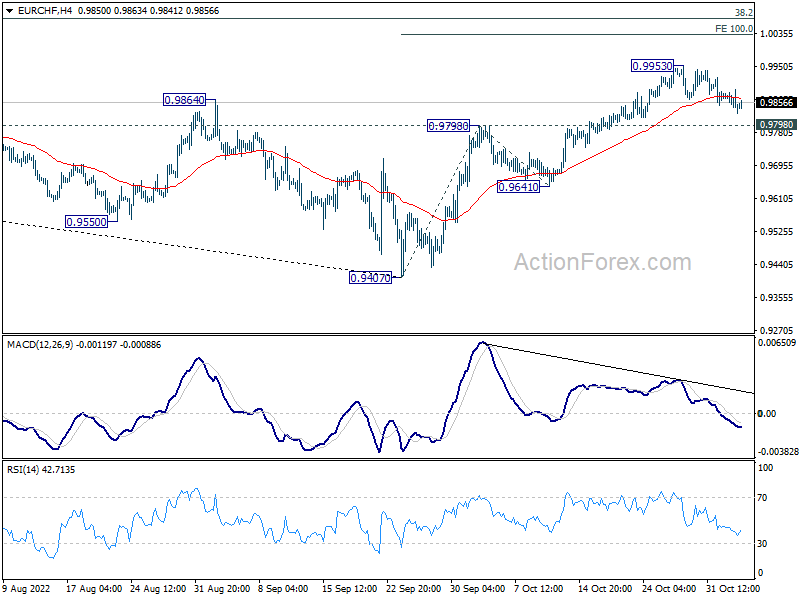
Intraday bias in EUR/CHF remains neutral as consolidation from 0.9953 is extending. In case of deeper retreat, downside should be contained by 0.9798 support to bring rebound. On the upside, break of 0.9953 will resume the rise from 0.9407 to 100% projection of 0.9407 to 0.9798 from 0.9641 at 1.0032.
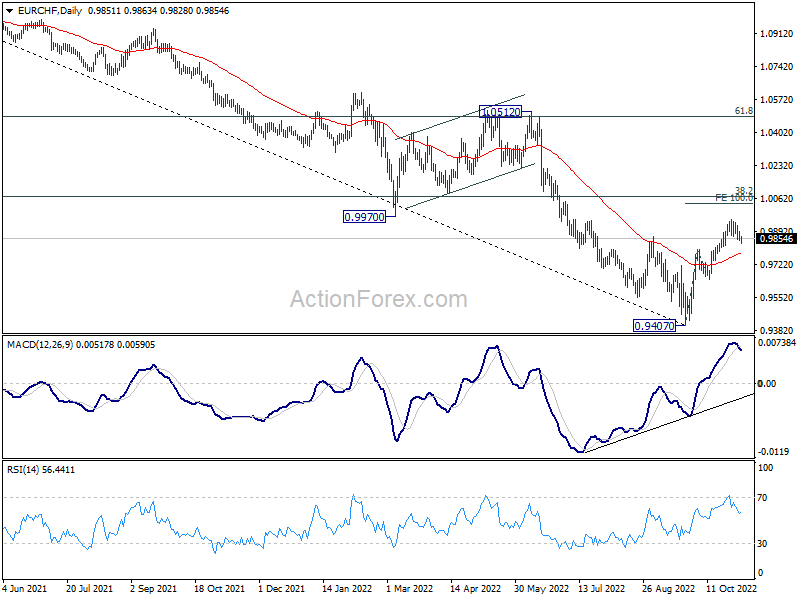
In the bigger picture, a medium term bottom should be in place at 0.9407. Further rally is expected as long as 0.9641 support holds, even as a corrective rebound. Next target 38.2% retracement of 1.1149 to 0.9407 at 1.0072. Reaction from there, as well as 55 week EMA (now at 1.0128) will reveal whether the trend is reversing.
We Now Assume the Peak to be Well Above 5%
Markets
The Fed yesterday raised rates by the expected 75 bps to 3.75-4%. That brings the policy rate further in restrictive territory, meaning that it actively dampens the economy and over time should cool inflation. Further hikes are coming but the statement hinted that this would most likely be at a slower pace (50 bps). A wave of optimism flushed over markets. Equities jumped, the dollar and US bond yields tanked. Enter Powell. The Fed chair confirmed that future hikes could be of a smaller magnitude but maybe not straight away. It may come at the December meeting or the one after that. He also said that incoming data since the last meeting suggests that the terminal rate will be higher than the 4.5-4.75% penciled in in the September dots and that a pause is very premature to think about. We now assume the peak to be well above 5%. Powell’s task was to announce a slowdown without suggesting that it is at the beginning of the end, the hoped-for pivot. The pre-press conference market reaction shows that this would have triggered a furious risk-on rally otherwise, undoing part of the previously delivered tightening. It was a job well done with a straightforward market reaction. Wall Street slipped 1.55% (DJI) to 3.36% (Nasdaq). The US curve became more inverted with a 7.5 bps increase at the front and 4.9 bps (30y) at the long end. The dollar surged. EUR/USD dropped from an intraday high of 0.997 to 0.982. The trade-weighted index erased previous gains and USD/JPY closed just below 148 after having traded as low as 145.7.
Yesterday’s US market moves extend into Asian dealings this morning. US Treasury futures dip (Japanese cash markets are closed for Culture day) and catch German Bunds in a slipstream. Equities are under pressure, most notably in China/Hong Kong (-3%). The country’s NHC yesterday said it adheres to the zero-Covid principle. Earlier, rumours of a potential exit from this economically devastating strategy lingered, boosting market sentiment. A weaker-than-expected Caixin services PMI dipping further in contraction territory (48.4) weighs too (see headline below). The US dollar more or less stabilizes around yesterday’s closing levels.
Today is filled with other central bank meetings, from the Czech Republic (status quo at 7% expected) over Norway (+50 bps to 2.75% expected) to the Bank of England. The latter is seen raising rates by 75 bps to 3%. That would mark a step-up from the 50 bps in previous meetings but is way less than the 150 bps temporarily discounted shortly after Kwarteng’s unfunded minibudget. UK Chancellor Hunt in the meantime tore the budget apart and shifted to fiscal conservatism. It’s not yet clear how this will look in practice since the medium-term fiscal statement has been postponed to November 17. It means the BoE is having its meeting without that input, taking some shine of the central bank’s new forecasts. That makes it tricky to assess the implications for sterling too in a daily perspective. EUR/GBP 0.8559 serves as a first support with 0.8721 marking the first reference to the upside. Longer-term, we stick to our cautious sterling bias.
News Headlines
Chinese Caixin Services PMI for October deteriorated more than expected, dropping from 49.3 to 48.4 further into contraction territory. China’s zero Covid-strategy continued to curb demand and disrupted business activity. On a small bright note, expectations for future activities picked up slightly. The composite PMI more or less stabilized at 48.3 (from 48.5) after Tuesday’s small upward surprise in the manufacturing gauge (49.2 from 48.1 vs 48.5 expected). In other China-related news, the National Health Commission said that official must be committed to Zero-Covid and the work of controlling the virus, striking down rumours that China would relax its overall strategy. The Chinese an remains weak at USD/CNY 7.30.
More Rate Hikes Coming
Equity markets are coming under some pressure on Thursday, with Asia mostly in the red and Europe poised to open almost a percentage point lower.
Chinese stocks are among the worst hit after the National Health Commission sought to quash rumours on social media that the country is studying ways to exit Covid-zero. That sparked a strong rally earlier this week which has only partly been reversed following the clarification.
Perhaps that's a sign of how low stocks have fallen that investors are keen to jump back in on any bullish story, well-founded or not. Maybe there's a view that there's no smoke without fire and the denial is not entirely honest. We'll see over the coming days whether other officials seek to put an end to those rumours but it is interesting how few rejections there have been and a number of days have now passed.
The Fed gives with one hand and takes with the other
Just as investors believed they'd secured the dovish pivot they so craved, Chair Powell stepped up to deliver another crushing blow to the markets. Well, that's how it's been perceived initially but that could change once the dust settles.
The acknowledgment that future decisions will take into account cumulative tightening and policy lags was a strong nod to slowing the pace of tightening in December, barring some frankly terrible data in the interim. That is exactly what investors wanted to hear. What they didn't want was the claim that rates could go higher than they previously thought and they still have some way to go.
This is still a net positive as a slower pace buys them time to see an improvement in the data and ease off the brake ensuring the least economic cost. That's not to say a recession will be avoided but maintaining 75bps makes that job much harder. There are two jobs and inflation reports to come before the December meeting. By that time, things may look a little more promising and less uncertain.
Who'd want to be at the BoE right now?
The Bank of England will likely join the Fed in raising rates by 75bps later today. The central bank has had the unenviable job of fighting soaring inflation amid enormous economic and political uncertainty. In recent months the country has had three Prime Ministers, three very different economic agendas, and no budgets outlining them. Not ideal for a central bank that's fighting double-digit inflation.
It hasn't handled things perfectly this year either, that's clear. It's taken a far more cautious approach than others leaving it in the situation now that it must raise rates aggressively and publish economic forecasts with little insight into government spending and tax plans. The outlook is uncertain enough without that.
Settling in a range
Oil prices are softening a little on Thursday after nudging higher again a day earlier. Brent appears to be settling around the mid-point of the $90-$100 range as traders weigh up the impact of the OPEC+ cut against a bleak global economic outlook.
The zero-Covid rumours in recent days may have given oil another bump higher, as will the crude inventory data that showed a large drawdown. But with those rumours not confirmed and recession talk growing louder, it may be a little premature to be suddenly optimistic.
Not as bad as it seems
Gold bulls thought Christmas had come early on Wednesday when the Fed indicated a slower pace of tightening will be considered next month. But just as quickly as the good news was delivered, the caveat was yet another crushing blow. The prospect of further tightening overall was enough to wipe out the benefits of lower hikes and gold now finds itself trading around the week's lows.
The question is, once the dust settles, will traders continue to view this so negatively? Slower tightening now buys time for the data to improve in a manner that could negate the need for more later, something 75 or 100bps hikes do not. This may not be such bad news after all for gold. But traders may wait for some encouragement from the data before getting too excited again.
A crushing blow
Bitcoin also saw its hopes crushed as Powell took to the stage and spoiled the party. An initial rally to $20,800 was quickly wiped out and the sell-off didn't stop there. Bitcoin ended the day lower but managed to survive a run at $20,000. Whether it can hold above here will depend on tomorrow's jobs data. Another red-hot report could weigh heavily on risk appetite and see bitcoin slip back below $20,000 once more.
Jerome Says Slower, But Higher
Jerome Powell abated the latest risk rally yesterday, saying that the rate hikes will slow down, but the levels will go higher. Equities sold off, the yields jumped, the dollar gained, and hopes of seeing the end of the market turmoil got completely dashed.
I told you
…that Jerome Powell wouldn’t let a rally in the US stock and bond markets develop further because it would be vertically against his goal of slowing inflation in an economy where inflation is not showing signs of abating and the labour market isn’t tightening yet. The latest ADP report released yesterday in the US, again, exceeded analyst estimations, and printed a number above 200’000. 239’000 to be precise.
At 2pm local time yesterday, when the FOMC’s written decision came out, equities first rallied because, the 75bp hike was already fully priced in, and the part of the statement saying that the Federal Reserve (Fed) would ‘take into account the cumulative monetary tightening that has occurred thus far, and the lagged effects of its policies’ has been taking as being relatively dovish.
But Jerome Powell adding that the ‘ultimate level of interest rates will be higher than previously expected’ didn’t please investors.
The US 2-year yield soared to 4.90%. The Dow Jones lost more than 1.50% and slipped below its 200-DMA, the S&P500 dived 2.50% to below 3760, and Nasdaq, the most rate sensitive of the major US indices, dived more than 3% to below the 11000 psychological mark, and is set to extend losses toward 10200 in the continuation of the ABCD pattern building since the end of March, this year.
In the FX, the prospect of higher terminal rate from the Fed boosted the USD appetite. The dollar index gained yesterday, as the EURUSD slipped again below its 50-DMA, Cable slipped below 1.14, the dollar-franc is back above parity, the dollar-yen is set for another advance to 150 on the back of the diverging rate prospects between the Fed that is now set to increase rates slower, but higher, and the Bank of Japan (BoJ), set to do nothing, for now.
Gold is also under the pressure of a stronger US dollar and the higher US yields. The precious metal saw resistance into the 50-DMA yesterday, before diving to around $1630 per ounce this morning. The yellow metal will likely extend losses toward the $1615/1620 support, if broken the $1600 will be the next target.
Bitcoin, on the other hand, is surprisingly resilient to the broad risk selloff. The coin maintains support above the $20K psychological mark, and lost only about 1.60% yesterday, despite a more than 3% selloff in Nasdaq. The lower correlation between Bitcoin and other risk assets, increases Bitcoin’s diversification power, but the risk-off environment remains unideal for a bullish market to develop further.
Oil up despite hawkish Fed
The barrel of American crude rose to $90, as the latest EIA data showed that the US crude inventories fell by more than 3-million-barrel last week, much faster than a 200’000 barrel decline expected by analysts.
Though, the Fed-induced selloff in broader risk assets certainly limited the upside appetite in oil, and we will hardly see the US crude pick up a good momentum above $90, as recession fears should give cold feet to investors who would, otherwise buy oil, at the current prices.
BoE to hike by 75bp as well
The Bank of England (BoE) is also expected to raise rates by 75bp today, but that expectation is down from around 100-150bp hike expected when Liz Truss was busy shaking the financial markets with her crazy mini budget.
Today, the BoE should no longer act twice as aggressively to compensate for the actions of an irresponsible government, but it still must fight the rising inflation in Britain. The latest data showed that British food price inflation soared to a record annual rate of 11.6% in October. Add to that the soaring energy bills, you get a scary picture.
And there is nothing that the BoE could do about it except from… raising the rates hoping that the war in Ukraine would magically end with peace one day.
Only good news from that front, is that Russia agreed to resume the grain deal, pulling wheat futures to levels at which we started the week.
Focus Turns from Hawkish Fed to BoE and Norges Bank
Market movers today
Today we expect a 25bp rate hike from Norges Bank. Markets and analysts are evenly split between 25 and 50bp, see more below.
Later we expect 75bp from Bank of England, which is also fully priced in by the markets. We see it as a close call between 50bp and 75bp, though.
In the US, we will look out for ISM non-manufacturing, which will give us more intelligence on the service sector strength. Consensus sees a decline to 55.5 from 56.7.
The 60 second overview
Fed: The US Federal Reserve hiked rates by 75bp yesterday as widely expected. Powell delivered a hawkish message, emphasizing that financial conditions need to be tightened further, which weighed on equity and bond markets and supported broad USD. In contrast to the recent speculation around a possible Fed pivot, Powell stated clearly that 'it is very premature to be thinking about pausing' even if downside risks to growth are rising. Powell did not give clear signals on the most likely hiking pace for the December meeting, but highlighted that terminal rate and financial conditions are more important than the exact pace of hikes. We think Fed has to continue tightening aggressively in the near-term and adjust our Fed call to include a 50bp hike in February in addition to our earlier forecast of one more 75bp hike in December. Read our full take from: Research US - Fed review: Another hawkish 75bp hike - We now expect 50bp also in February, 2 November.
Bank of England: We expect a rate hike of 75bp from Bank of England at today's meeting bringing it to 3.00%. Market pricing is close to 75bp but in our view it is a close call between 50bp and 75bp. However, we expect the Bank to return to its more dovish stance as recession risks are becoming more pronounced and the growth outlook is becoming increasingly weaker. Likewise, the BoE tends to ear on the side of caution, why we expect a return to smaller increment hikes from here and expect the hiking cycle to end in February next year, leaving the bank rate at 3.75%. See our Bank of England Update - BoE preview: a dovish 75bp hike in store, 31 October.
Russia: Russia's foreign ministry said yesterday that the country fully reaffirms its commitment to prevent a nuclear war under a joint statement by key Western powers, Russia and China in January. Putin repeated that Russia could use nuclear weapons if 'the very existence of their state' came under threat from a conventional attack or if Russia was hit by a nuclear strike first. Yet, he said there was 'no military or political sense' in Russia using a nuclear weapon against Ukraine. According to US officials, tensions seem to have calmed somewhat following a series of consultations between US and Russia defence officials. Meanwhile, Ukraine continues to advance in the southern city of Kherson.
Brazil: In a clear attempt to de-escalate social unrest, on his Wednesday evening remarks on social media, the outgoing President Bolsonaro appealed to his supporters to clear the roads as their actions were harming both the economy and the right to free movement. Since Sunday's election, truck drivers and other bolsonaristas have built hundreds of barricades on highways hampering logistics and risking shortages of critical goods such as medicines.
Equities: Equities down yesterday finishing close to day-low as investors decided to read Powell less dovish or further away from pivoting than previously anticipated. Yields once again setting the tone for equities and no signs yet of the bond vs. equities correlation turning negative again. No surprise to the tech, growth cyclical universe underperforming and the defensive values doing better. In US, Dow -1.6%, S&P 500 -2.5%, Nasdaq -3.4% and Russell 2000 -3.4%. Asian accross markets are lower this morning and European futures the same. US futures are higher.
FI: Yesterday was mostly just waiting for the FOMC meeting in the evening. Fed hiked the policy rates by 75bp as expected, and markets responded with a dovish reaction sending 10y UST 6-7bp lower on expectations of a slower pace to come. During the press conference, Powell was hawkish and emphasized the hawkish bits several times, incl. that they are not ready to talk about even a pause of hikes but also that the peak rates are higher, as ongoing increases are made until rates are 'sufficiently restrictive'. The cycle peak rate jumped 10bp to 5.10% briefly before settling around 5.03%. 10y UST ended 4bp higher at 4.08%. Similar to the ECB as discussed here COTW: Too early to trade the ECB pivot. Market psychology will lead to additional temporary rallies, 28 October, a Fed pivot is not imminent.
FX: USD gained vs rest of G10 currencies yesterday after US interest rates rose on the back of the FOMC meeting. EUR/USD fell close to 0.98 after the FOMC meeting and USD/JPY rebounded back towards 148.
Credit: Credit spreads as measured by CDS indices were little changed yesterday, with iTraxx Main at 111bp (unchanged) and Xover wider by 1bp to 542bp. Several issuers made use of the pre-Fed window to bring deals to the market, which saw both FIG and corporate senior euro deals printed.
Nordic macro
Norway: We expect Norges Bank to hike the policy rate by 25bp to 2.50 %, as indicated in September. High inflation and a strong labour market are arguments for a larger hike, but keep in mind that the policy rate has risen 150bp in three months and is now 50bp above the neutral rate. Additionally, there are now clear signs of growth slowing, and capacity utilisation has fallen. We expect NB to signal another 25bp hike for December.
Sweden: October services PMI is expected to drop in line with the recent downward trend from a decent 55.1 September print. This is a consequence of the deteriorating global business cycle and a recession hitting the manufacturing industries.
Riksbank Governor Ingves speaks about the future of money at 14.30 CET, probably not a market mover.
EUR/USD Daily Outlook
Daily Pivots: (S1) 0.9761; (P) 0.9868; (R1) 0.9924; More...
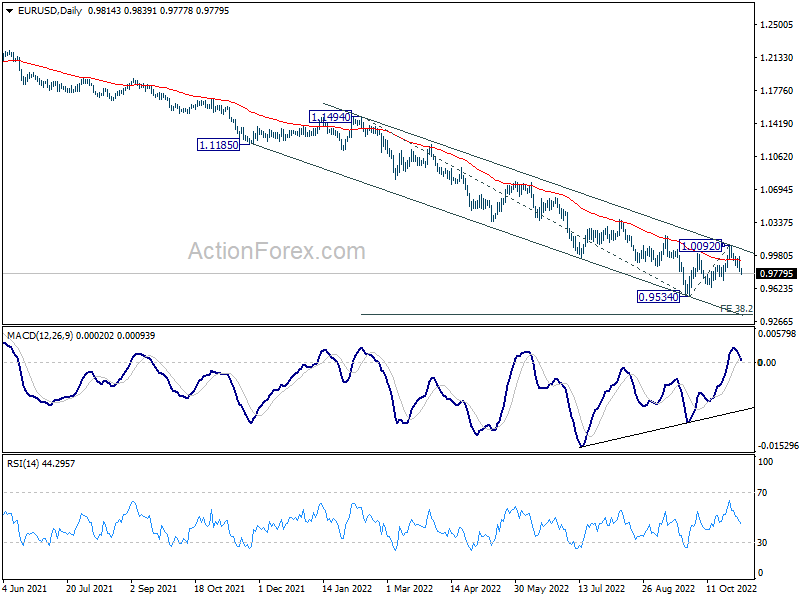
EUR/USD's break of 0.9847 argues that corrective pattern from 0.9534 has completed with three waves up to 1.0092. Such development revives near term bearishness too. Intraday bias is back on the downside for retesting 0.9534/9630 support zone. On the upside, above 0.9975 minor resistance will turn intraday bias neutral again first.
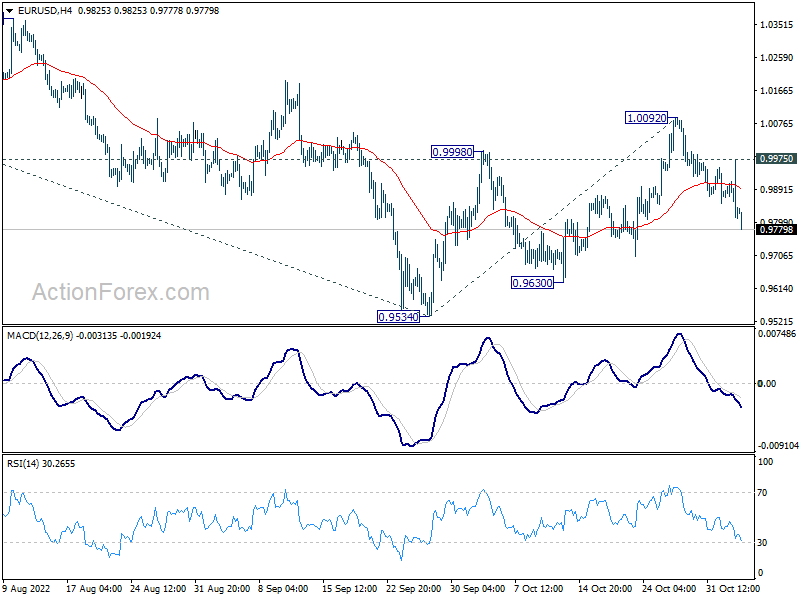
In the bigger picture, medium term term bearishness is retained with failure to sustain above 55 day EMA (now at 0.9930). That is, larger down trend from 1.2348 (2021 high) is still in progress. Firm break of 0.9534 low will confirm this bearish case. For now, risk will stay on the downside as long as 1.0092 resistance holds, in case of recovery.
GBP/USD Daily Outlook
Daily Pivots: (S1) 1.1330; (P) 1.1447; (R1) 1.1507; More...
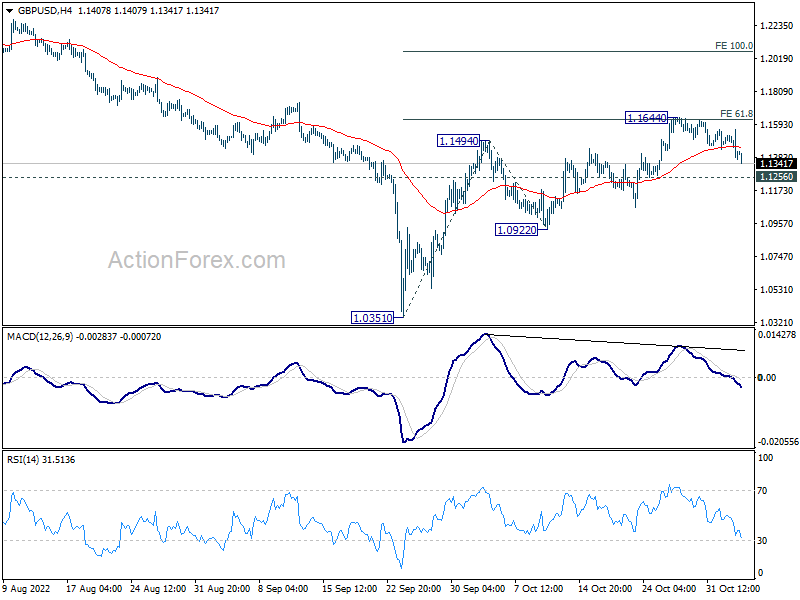
Intraday bias in GBP/USD stays neutral for the moment. With 1.1256 minor support intact, further rally is expected. On the upside, break of 1.1644 will resume rise from 1.0351 to 100% projection of 1.0351 to 1.1494 from 1.0922 at 1.2065. However, break of 1.1256 will turn bias back to the downside for 1.0922 support and below.
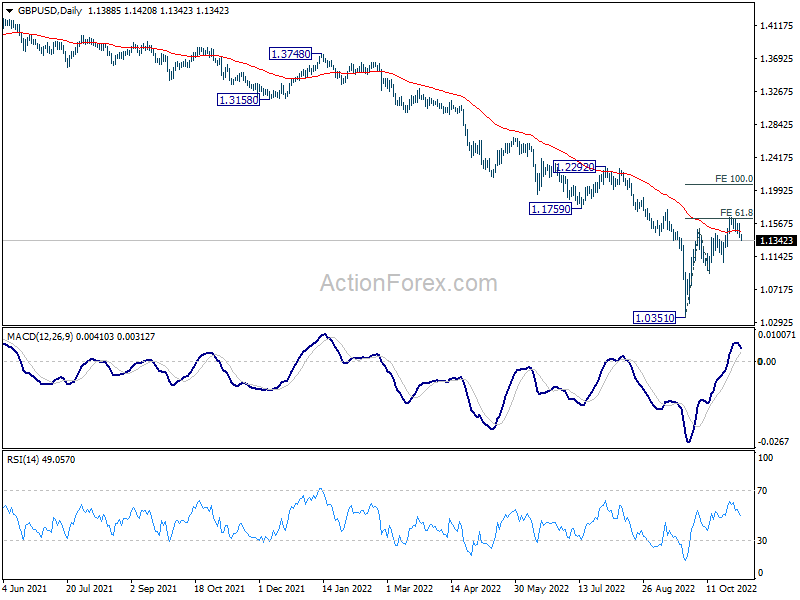
In the bigger picture, fall from 1.4248 (2018 high) is part of the long term down trend from 2.1161 (2007 high). Outlook will stay bearish as long as 1.1759 support turned resistance holds. Parity would be the next target on resumption. Nevertheless, firm break of 1.1759 will confirm medium term bottoming, and open up stronger rise back to 55 week EMA (now at 1.2392).
USD/CHF Daily Outlook
Daily Pivots: (S1) 0.9949; (P) 0.9995; (R1) 1.0079; More...
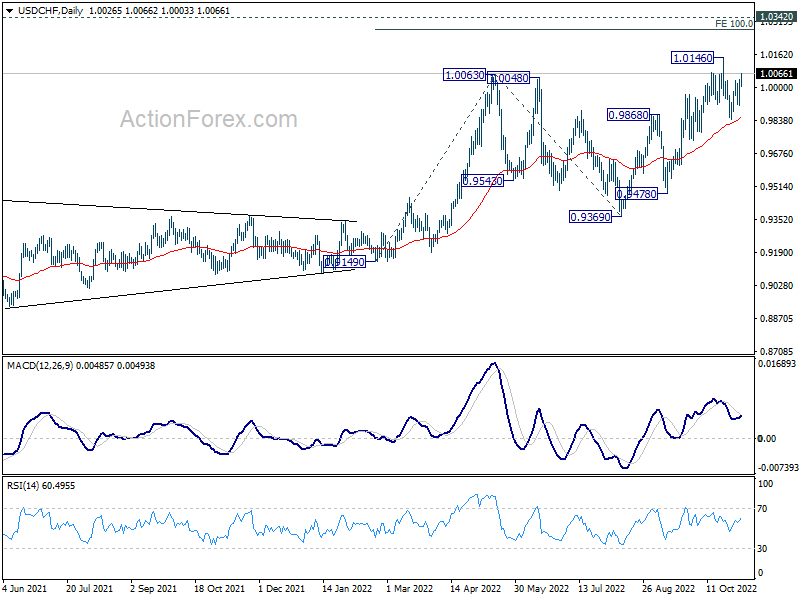
USD/CHF's break of 1.0030 minor resistance indicates that pull back from 1.0146 has completed at 0.9840. Intraday bias is back on the upside for retesting 1.0146 first. Firm break there will resume larger up trend to to 1.0283 projection level. However, break of 0.9840 support will now be a sign of reversal, and bring deeper decline back to 0.9779 support instead.
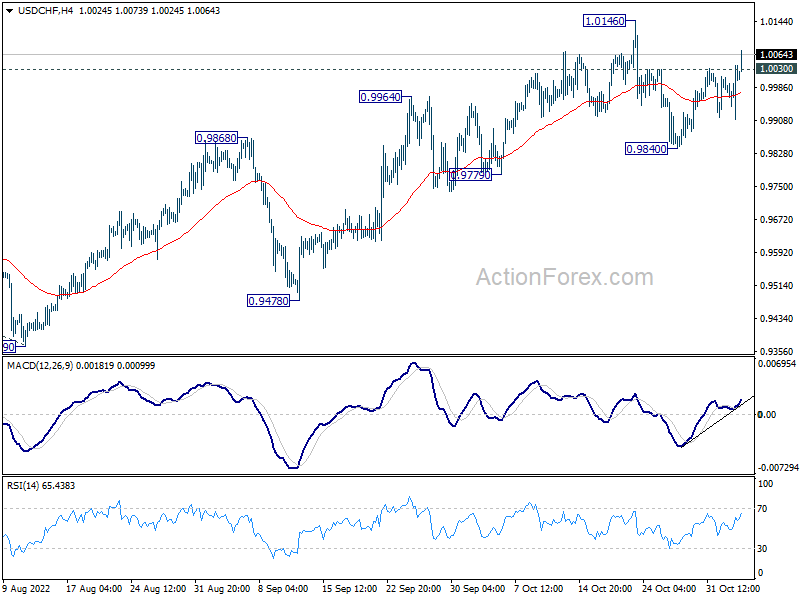
In the bigger picture, current development suggests that up trend from 0.8756 (2021 low) is still in progress. Next target is 100% projection of 0.9149 to 1.0063 from 0.9369 at 1.0283, and then 1.0342 (2016 high). For now, this will remain the favored case as long as 0.9779 support holds, even in case of deep pull back.
USD/JPY Daily Outlook
Daily Pivots: (S1) 146.27; (P) 147.32; (R1) 148.97; More...
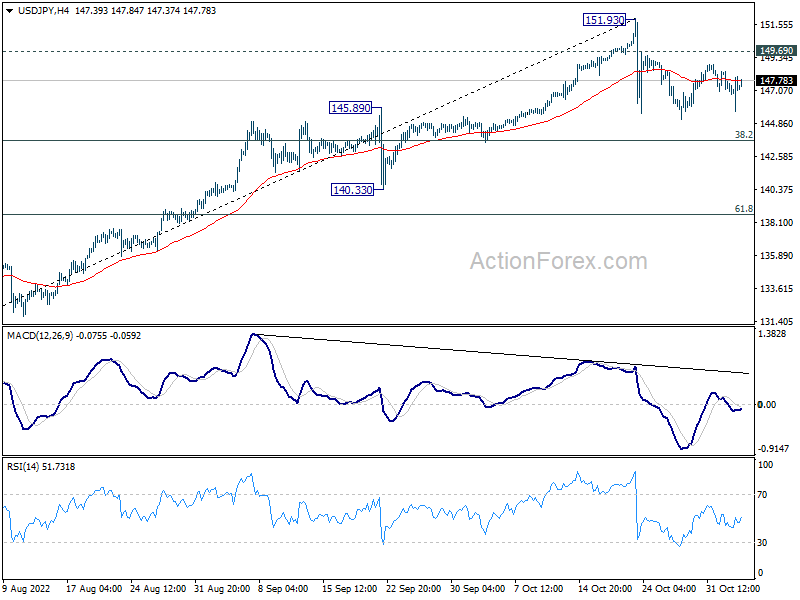
Intraday bias in USD/JPY stays neutral as consolidation from 151.39 is extending. Deeper decline cannot be ruled out, but downside should be contained by 38.2% retracement of 130.38 to 151.93 at 143.69 to bring rebound. On the upside, above 149.69 minor resistance will bring stronger rebound back towards 151.93 high. But upside should be limited there to continue the corrective pattern.
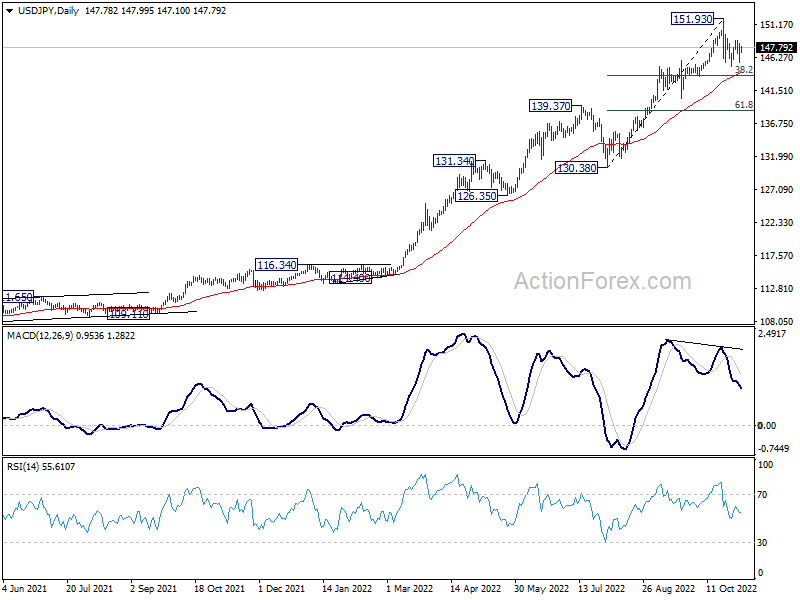
In the bigger picture, up trend from 101.18 is still in progress, as part of the whole up trend from 75.56 (2011 low). 147.68 (1998 high) was already met and there is no clearly sign of topping yet. In any case, break of 140.33 support is needed to be the first sign of medium term topping. Otherwise, further rise is in favor to next target at 160.16 (1990 high).
USD/CAD Daily Outlook
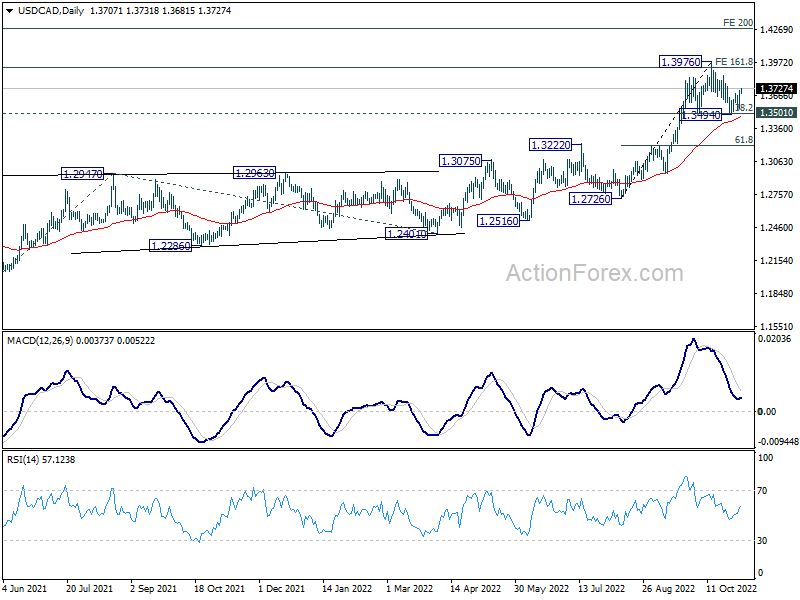
Daily Pivots: (S1) 1.3602; (P) 1.3659; (R1) 1.1.3769; More....
USD/CAD recovered after drawing support from 1.3501 but stays well below 1.3976 resistance. Intraday bias remains neutral first, and further rise in favor as long as 1.3501 support holds. On the upside, decisive break of 1.3976 will resume larger up trend and target 200% projection of 1.2005 to 1.2947 from 1.2401 at 1.4285. On the downside, firm break of 1.3501 will bring deeper correction 55 day EMA (now at 1.3457) and below instead.
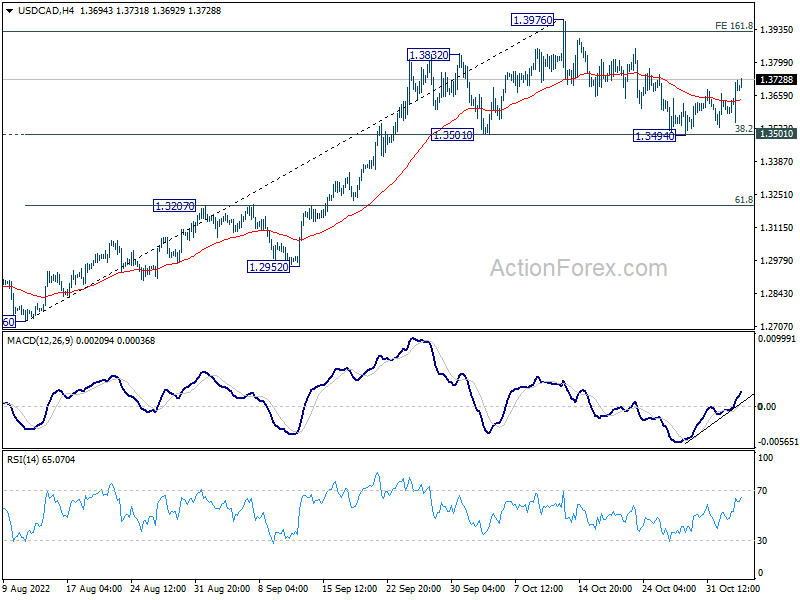
In the bigger picture, up trend from 1.2005 (2021 low) is still in progress. Based on current impulsive momentum, it could be resuming long term up trend from 0.9056 (2007 low). Whether it is or it isn't, retest of 1.4689 (2016 high) should be seen next. This will now remain the favored case as long as 1.3222 resistance turned support holds.