Sample Category Title
EUR/USD Mid-Day Outlook
Daily Pivots: (S1) 0.9833; (P) 0.9894; (R1) 0.9934; More...
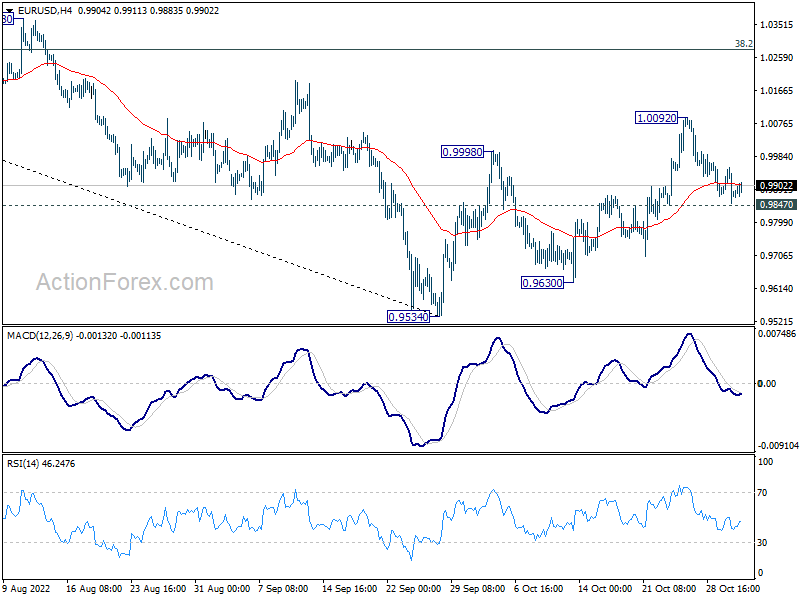
EUR/USD is staying in range of 0.9847/1.0092 and intraday bias remains neutral. Further rise is in favor as long as 0.9847 minor support holds. Break of 1.0092 will target 38.2% retracement of 1.1494 to 0.9534 at 1.0283. However, break of 0.9847 will turn bias back to the downside for 0.9534/9630 support zone instead.
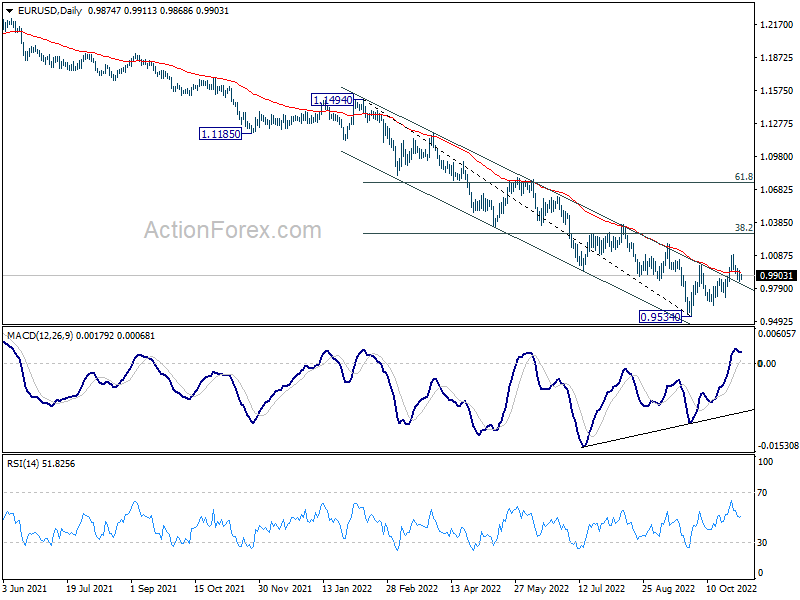
In the bigger picture, the case of medium term bottoming at 0.9534 building up, with bullish convergence condition in daily MACD. While it is too early to call for trend reversal, firm break of 0.9998 opens up stronger rebound back to 55 week EMA (now at 1.0630) even as a corrective rise. However, sustained trading back below 55 day EMA (now at 0.9938) will revive medium term bearishness for another fall through 0.9534 low.
Markets Tread Water ahead of Fed Hike and Guidance
The financial markets are all very steady today, awaiting FOMC rate decision. A 75bps hike a done deal, and the key is whether Fed Chair Jerome Powell would signal slower tightening pace ahead. For now, Dollar is the weaker one for today, followed by Euro and Sterling. On the other hand, Yen is the stronger one together with Aussie and Kiwi. But of course, such picture could change drastically after FOMC.
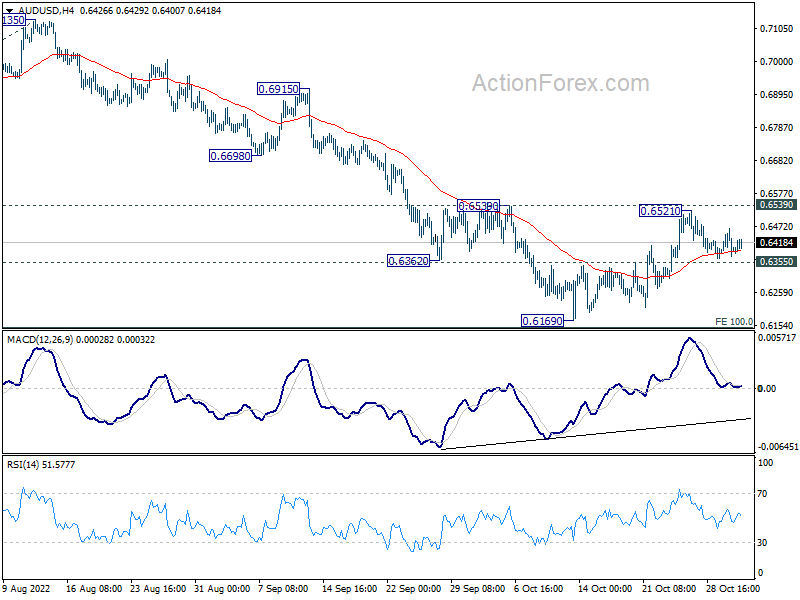
Post FOMC press conference market movements, in stocks, bonds and FX, should largely be driven by risk sentiment. AUD/USD has the potential to have larger moves than other Dollar pairs. Technically, break of 0.6355 minor support will signal that corrective rebound from 0.6169 has completed, and selloff could intensify through this low quickly. On the other hand, firm break of 0.6530 will add to the case of larger reversal, and bring stronger rise to 0.6698/6915 resistance zone.
In Europe, at the time of writing, FTSE is down -0.08%. DAX is flat. CAC is down -0.10%. Germany 10-year yield is up 0.016 at 2.147. Earlier in Asia, Nikkei dropped -0.06%. Hong Kong HSI rose 2.41%. China Shanghai SSE rose 1.15%. Singapore Strait Times rose 0.34%. Japan 10-year JGB yield dropped -0.0052 to 0.247.
US ADP employment grew 239k, strong but not broad-based
US ADP private employment grew 239k in October, above expectation of 198k. Goods-producing jobs decreased -8k but service-providing jobs increased 247k. By company size, small establishments added 25k jobs, medium added 218k, large lost -4k.
"This is a really strong number given the maturity of the economic recovery but the hiring was not broad-based," said Nela Richardson, chief economist, ADP. "Goods producers, which are sensitive to interest rates, are pulling back, and job changers are commanding smaller pay gains. While we're seeing early signs of Fed-driven demand destruction, it's affecting only certain sectors of the labor market."
Eurozone PMI manufacturing finalized at 46.4, moved into a deeper decline
Eurozone PMI Manufacturing was finalized at 46.4 in October, down from September's 48.4. Manufacturing Output Index was finalized at 43.8, down from prior month's 46.3. Both were the lowest reading in 29 months.
Looking at member countries, Ireland PMI manufacturing dropped to 51.4 (2-month low) but stayed in expansion. Greece (48.1, 22-month low), the Netherlands (47.9, 27-month low), France (47.2, 29-month low), Austria (46.6, 28-month low), Italy (46.5, 29-month low), Germany (45.1, 28-month low), and Spain (44.7, 29-month low) were all in contraction.
Joe Hayes, Senior Economist at S&P Global Market Intelligence said: "The eurozone goods-producing sector moved into a deeper decline at the start of the fourth quarter. The PMI surveys are now clearly signalling that the manufacturing economy is in a recession. In October, new orders fell at a rate we've rarely seen during 25 years of data collection – only during the worst months of the pandemic and in the height of the global financial crisis between 2008 and 2009 have decreases been stronger."
Japan Suzuki concerned about gradual weakening of Yen
Japan Finance Minister Shunichi Suzuki told the parliament, "I am very concerned about the gradual weakening of the yen", which could accelerate inflation by increasing import costs.
BoJ Governor Haruhiko Kuroda also said, recent Yen weakness raises uncertainty on the outlook, and is negative for the economy.
Regarding monetary policy, Kuroda said, "If the achievement of our 2% inflation target comes into sight, making yield curve control more flexible could become an option." But for now, he added that the central bank must maintain ultra-low loose monetary policy to support the economy.
Australia AiG manufacturing fell to 49.6, longstanding supply-side problems continue
Australia AiG Performance of Manufacturing Index dropped -0.6 to 49.6 in October. Looking at some details, production dropped -0.1 to 47.6. Employment rose 7.1 to 46.9. New orders dropped -4.0 to 53.8. sales dropped -3.0 to 48.4. Input prices dropped -6.8 to 78.0. Selling prices dropped -2.7 to 67.5. Average wages dropped -5.1 to 71.0.
Innes Willox, Chief Executive of Ai Group said: "Australian manufacturing is in a holding pattern, with three straight months of flat results. Demand conditions in the market remain stable, but longstanding supply-side problems, such as labour and supply chain shortages, continue to drag on the industry."
NZ unemployment rate unchanged at 3.3%, record hourly earning growth
New Zealand employment grew 1.3% in Q3, above expectation of 0.5%. Unemployment rate was unchanged at 3.3%, above expectation of 3.2%. Labor force participation rate rose 0.8% to 71.7%. Underutilization rate dropped -0.2 to 9.0%.
Average ordinary time hourly earnings rose 2.4% qoq, 7.4% yoy. The annual rise was the highest since the series began in 1989. All salary and wage rates (including overtime) index rose 3.7% yoy, second highest annual rate since record began in 1993.
EUR/USD Mid-Day Outlook
Daily Pivots: (S1) 0.9833; (P) 0.9894; (R1) 0.9934; More...
EUR/USD is staying in range of 0.9847/1.0092 and intraday bias remains neutral. Further rise is in favor as long as 0.9847 minor support holds. Break of 1.0092 will target 38.2% retracement of 1.1494 to 0.9534 at 1.0283. However, break of 0.9847 will turn bias back to the downside for 0.9534/9630 support zone instead.
In the bigger picture, the case of medium term bottoming at 0.9534 building up, with bullish convergence condition in daily MACD. While it is too early to call for trend reversal, firm break of 0.9998 opens up stronger rebound back to 55 week EMA (now at 1.0630) even as a corrective rise. However, sustained trading back below 55 day EMA (now at 0.9938) will revive medium term bearishness for another fall through 0.9534 low.
Economic Indicators Update
| GMT | Ccy | Events | Actual | Forecast | Previous | Revised |
|---|---|---|---|---|---|---|
| 21:30 | AUD | AiG Performance of Mfg Index Oct | 49.6 | 50.2 | ||
| 21:45 | NZD | Employment Change Q3 | 1.30% | 0.50% | 0.00% | |
| 21:45 | NZD | Unemployment Rate Q3 | 3.30% | 3.20% | 3.30% | |
| 21:45 | NZD | Labour Cost Index Q/Q Q3 | 1.10% | 1.00% | 1.30% | |
| 23:50 | JPY | Monetary Base Y/Y Oct | -6.90% | -2.00% | -3.30% | |
| 23:50 | JPY | BoJ Minutes | ||||
| 00:01 | GBP | BRC Shop Price Index Y/Y Sep | 6.60% | 5.50% | 5.70% | |
| 00:30 | AUD | Building Permits M/M Sep | -5.80% | -9.00% | 28.10% | 23.10% |
| 07:00 | EUR | Germany Trade Balance (EUR) Sep | 3.7B | 0.5B | 1.2B | |
| 08:45 | EUR | Italy Manufacturing PMI Oct | 46.5 | 46.9 | 48.3 | |
| 08:50 | EUR | France Manufacturing PMI Oct F | 47.2 | 47.4 | 47.4 | |
| 08:55 | EUR | Germany Unemployment Change Oct | 8K | 15K | 14K | |
| 08:55 | EUR | Germany Unemployment Rate Oct | 5.50% | 5.50% | 5.50% | |
| 08:55 | EUR | Germany Manufacturing PMI Oct F | 45.1 | 45.7 | 45.7 | |
| 09:00 | EUR | Eurozone Manufacturing PMI Oct | 46.4 | 46.6 | 46.6 | |
| 12:15 | USD | ADP Employment Change Oct | 239K | 198K | 208K | 192K |
| 14:30 | USD | Crude Oil Inventories | -0.2M | 2.6M | ||
| 18:00 | USD | Fed Interest Rate Decision | 4.00% | 3.25% | ||
| 18:30 | USD | FOMC Press Conference |
NZ Dollar Jumps on Solid Jobs Report
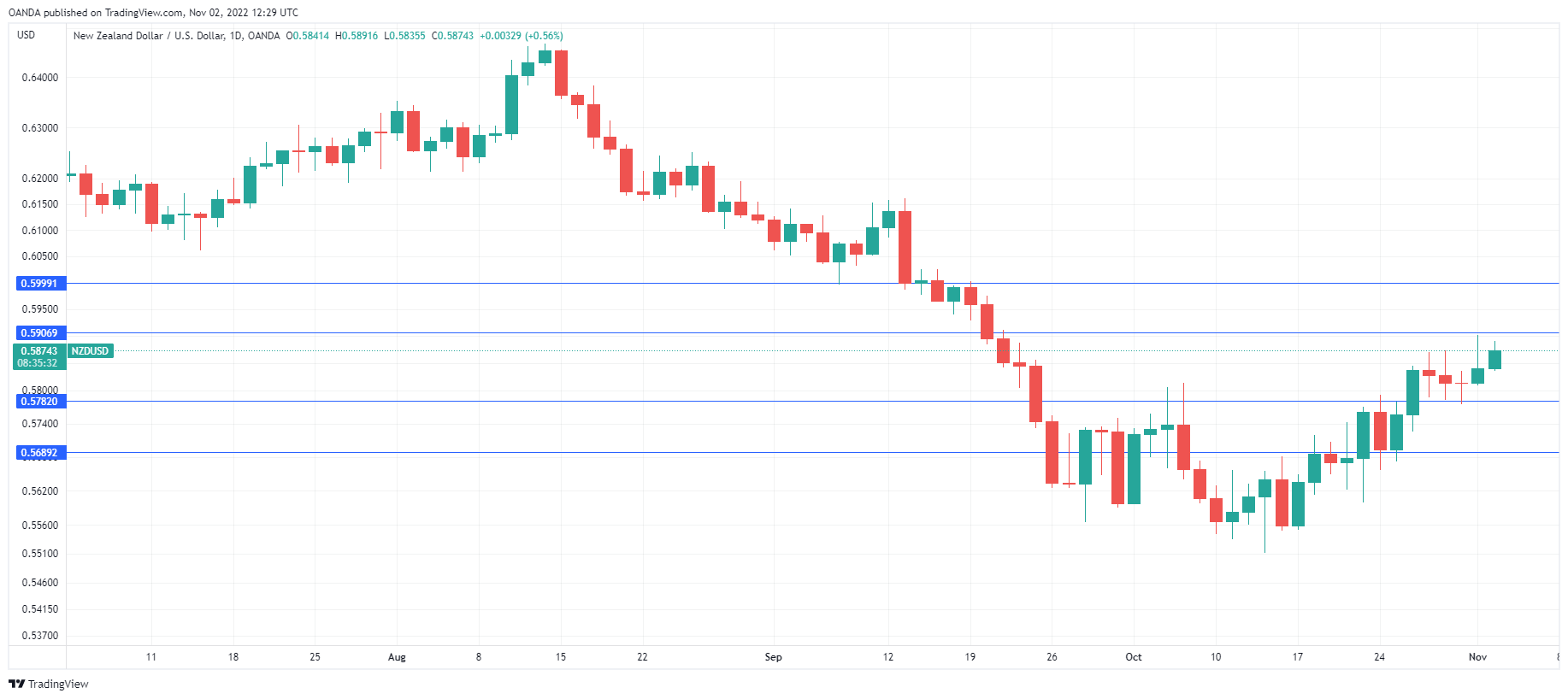
NZD/USD is sharply higher today. In the European session, the New Zealand dollar is trading at 0.5883, up 0.71%.
New Zealand employment data shines
New Zealand posted a strong employment report for the third quarter, indicative of a robust labour market. Employment rose 1.3% QoQ, up from 0.0% in Q2 and above the consensus of 0.5%. The unemployment rate remained at 3.3%, just shy of the consensus of 3.2%. As wage inflation remained unchanged at 3.8% YoY, above the estimate of 3.4%.
The labour market continues to suffer from staff shortages and capacity limits, which has contributed to spiralling inflation. This report will add to the pressure on the Reserve Bank of New Zealand to continue to raise rates. The RBNZ has raised the cash rate to 3.50%, its highest since 2015. Still, the steep tightening has failed to curb inflation, and the central bank is likely to respond with a 75-basis point hike later this month, after five straight hikes of 50 basis points.
Inflation in Q3 came in at 7.2%, and the RBNZ finds itself much further behind inflation than it had anticipated. The hot inflation report has raised expectations that the central bank will raise rates to a peak of 5.0% or even higher in early 2023. This leaves the RBNZ with little choice but to continue with oversize rate hikes, despite the spectre that further oversize rate hikes will tip the economy into a recession.
The spotlight is on the Federal Reserve, which winds up its 2-day policy meeting later today. This would bring the benchmark rate to 4.0%. The question on the minds of investors is what happens next? The final meeting of the year is on December 14th and hopes that the Fed will downshift their tightening pace at that meeting have faded, as inflation has been stickier than the Fed expected. The markets will be listening closely to Fed Chair Powell’s comments today, hopeful for some insights into what the Fed has planned in the next few months.
NZD/USD Technical
- There is resistance at 0.5906 and 0.5999
- There is support at 0.5782 and 0.5689
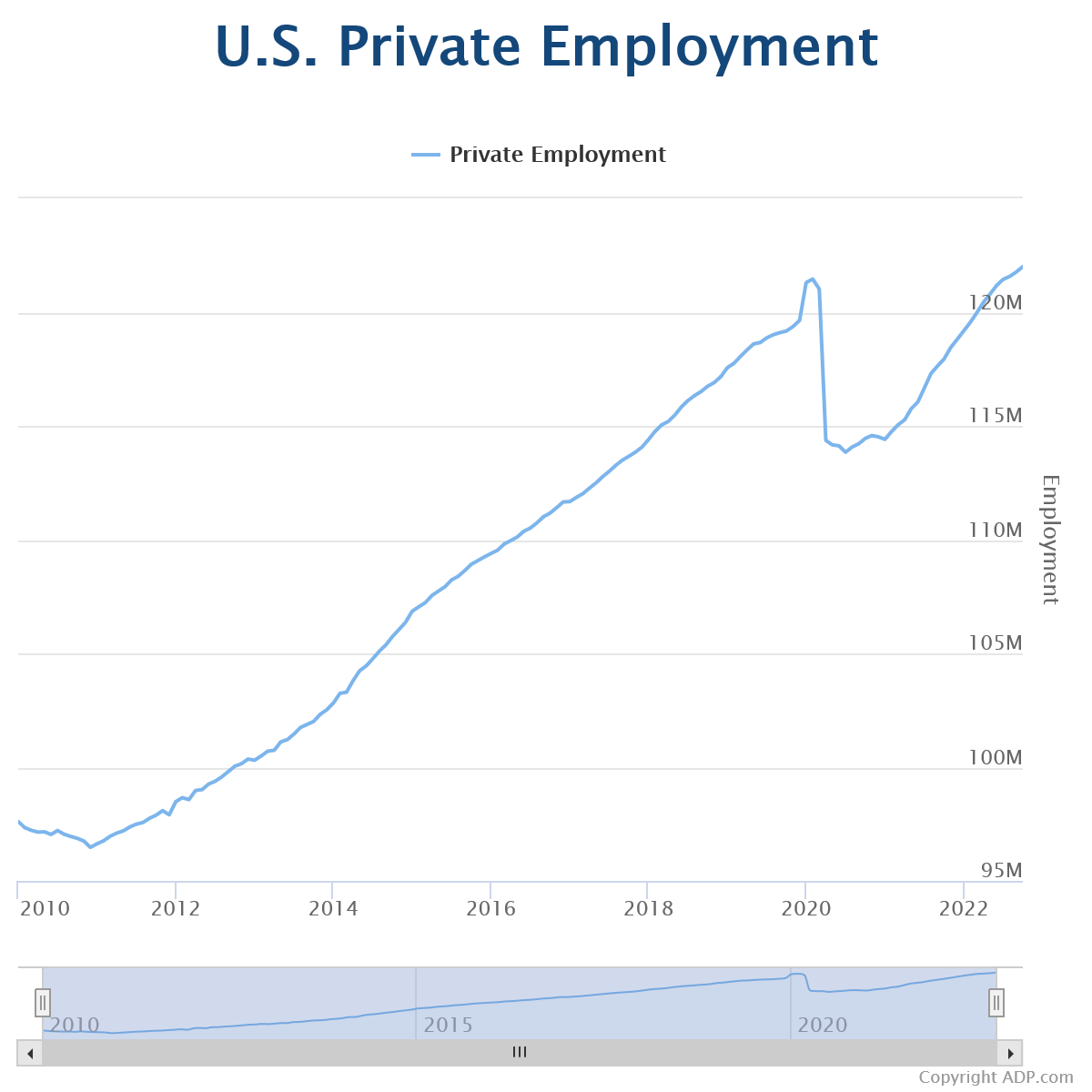
US ADP employment grew 239k, strong but not broad-based
US ADP private employment grew 239k in October, above expectation of 198k. Goods-producing jobs decreased -8k but service-providing jobs increased 247k. By company size, small establishments added 25k jobs, medium added 218k, large lost -4k.
"This is a really strong number given the maturity of the economic recovery but the hiring was not broad-based," said Nela Richardson, chief economist, ADP. "Goods producers, which are sensitive to interest rates, are pulling back, and job changers are commanding smaller pay gains. While we're seeing early signs of Fed-driven demand destruction, it's affecting only certain sectors of the labor market."
Bank of England Might Disappoint Amid Uncertainties about the Budget
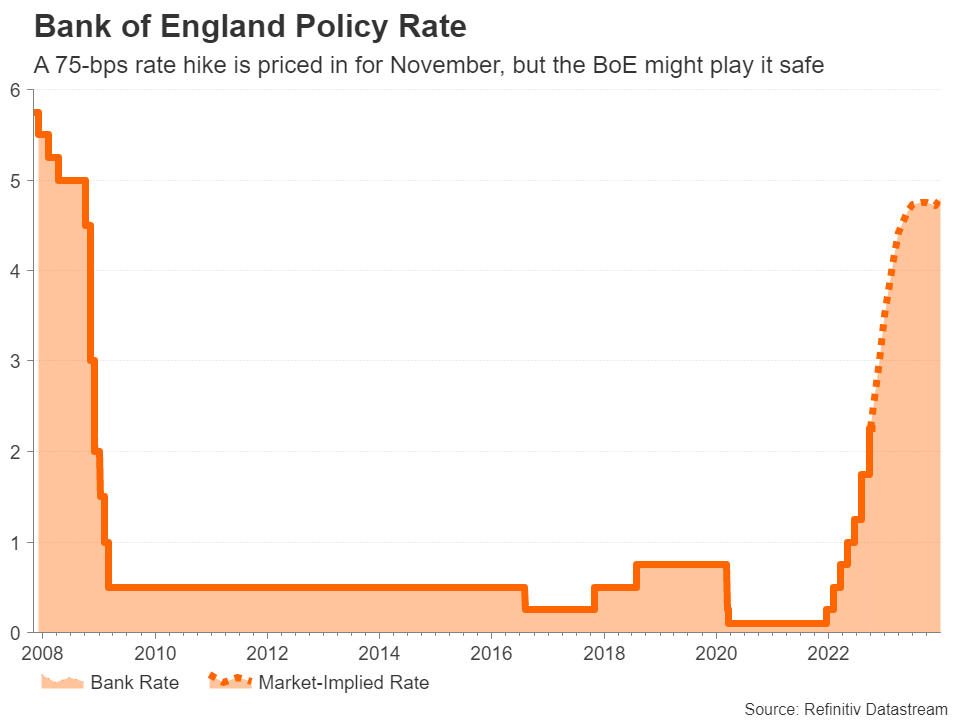
The Bank of England will announce its latest policy decision on Thursday at 12:00 GMT in what will be its first gathering since the mini-budget debacle that sparked turmoil in global financial markets. Expectations of a super-sized rate hike have come down sharply as the panic has receded. Nevertheless, economists as well as investors are still anticipating a big enough move of 75 basis points that would mark the steepest rate increase in 33 years. But is there a chance the Bank will err on the side of caution after the government delayed its Autumn budget statement until after the policy meeting?
Recession risks are rising
By the Bank’s own predictions, the UK economy is expected to be in recession by year-end as rising interest rates and a surge in the cost of living on the back of higher energy as well as broader raw material prices squeeze both consumer and business spending. S&P Global’s PMI survey suggests the economy has already started to contract, with a negative Q3 GDP print looking very likely after a somewhat stronger-than-expected performance in Q2.
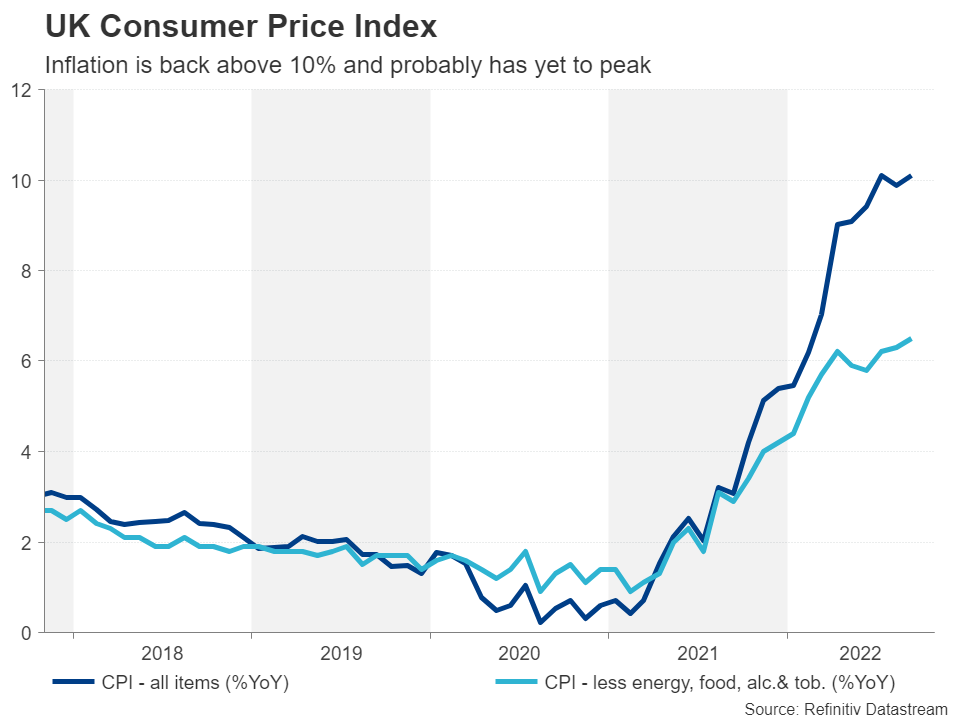
Even more worrying is that inflation poked back above 10% in September and has yet to peak.
Still reeling from the mini-budget turmoil
If the outlook wasn’t gloomy enough, Liz Truss’ short tenure at Number 10 pushed Britain’s economy to the brink of catastrophe. Ironically, it was Truss’ growth plan that spooked investors as it was built entirely on unfunded tax cuts that threatened to balloon the national debt to unsustainable levels.
Although some normality has been restored after the ruling Conservative party dramatically intervened to oust Truss and speedily replace her with former finance minister Rishi Sunak, the uncertainty has not completely dissipated. For one, Sunak and his new chancellor, Jeremy Hunt, have once again shuffled about the date of the fiscal statement, moving it from October 31 to November 17.
Flying blind
This poses quite a significant problem for the Bank of England as policymakers are being kept in the dark as to the details of the government’s tax and spending plans. Although it is clear that the Sunak administration is doing away with irresponsible economics, the Autumn statement will come too late for the Bank to factor it into its quarterly economic projections. Specifically, policymakers won’t be able to make a judgement on whether the net impact of the new budget on growth will be positive or negative, and if the bulk of the anticipated tax rises and spending cuts will take effect before or after the next general election, likely to be in 2024.
This could be one reason that could sway the Monetary Policy Committee (MPC) towards a 50-basis-point rate hike in November in case Jeremey Hunt goes overboard with fiscal prudence, limiting government support to struggling households and businesses. Sterling’s sharp bounce-back against the US dollar also weakens the case of overreacting with a jumbo rate hike, so does the steadying of the gilt market.
BoE at odds with market expectations
But even if the MPC decides not to go against market expectation on Thursday, it will likely flag that further 75-bps moves are not on the cards in the future. Investors got a strong pushback from Deputy Governor Ben Broadbent when the market pricing of the Bank’s terminal rate topped 5% in the aftermath of the mini-budget fiasco, saying that the damage to the economy from such a high rate would be “pretty material”. Market estimates of how high the Bank Rate will peak have since come down to around 4.75%, but even that might be too high.
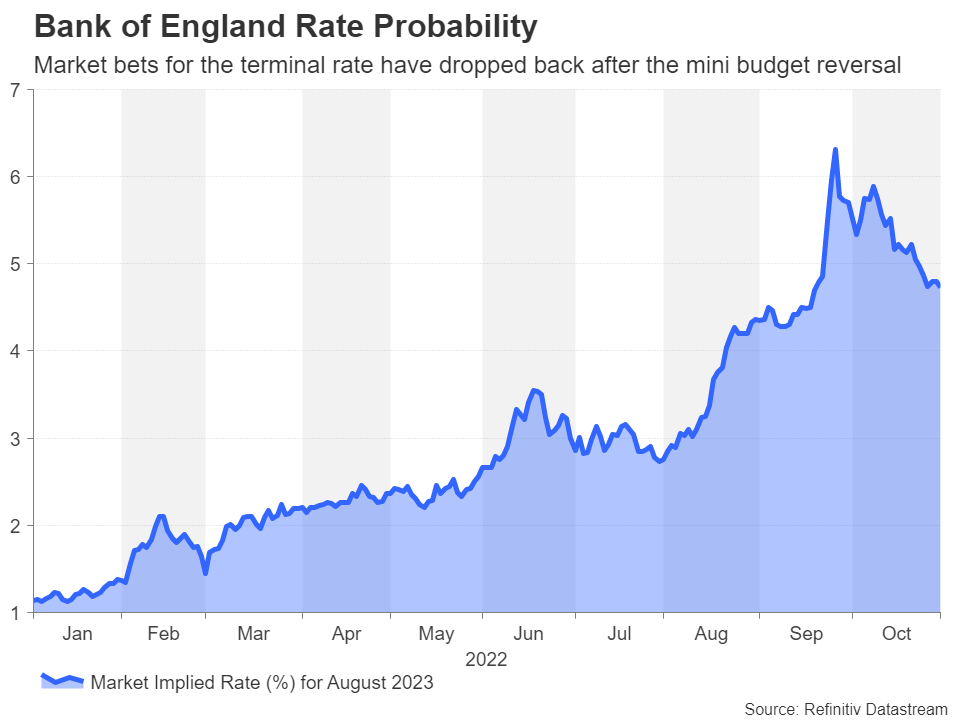
The updated forecast of the rate path in the November Monetary Policy Report will likely therefore attract a lot more attention than usual on Thursday when investors will also get to see whether the inflation projections have been revised lower due to the government announcing a price cap on energy bills.
The energy price cap, not to mention quantitative tightening, are additional considerations for policymakers that lessen the need for aggressive rate hikes. On Tuesday, the Bank finally kicked off the active sale of its government bond holdings, becoming the first major central bank to do so, after its start was delayed following the selloff in gilts in September that nearly caused the collapse in UK pension funds.
Fed not BoE policy more crucial for pound rebound
If on Thursday, Governor Andrew Bailey attempts to guide markets to a lower rate path than what investors have currently priced in, the pound will struggle to extend its rebound beyond the $1.16 handle and may instead turn lower.
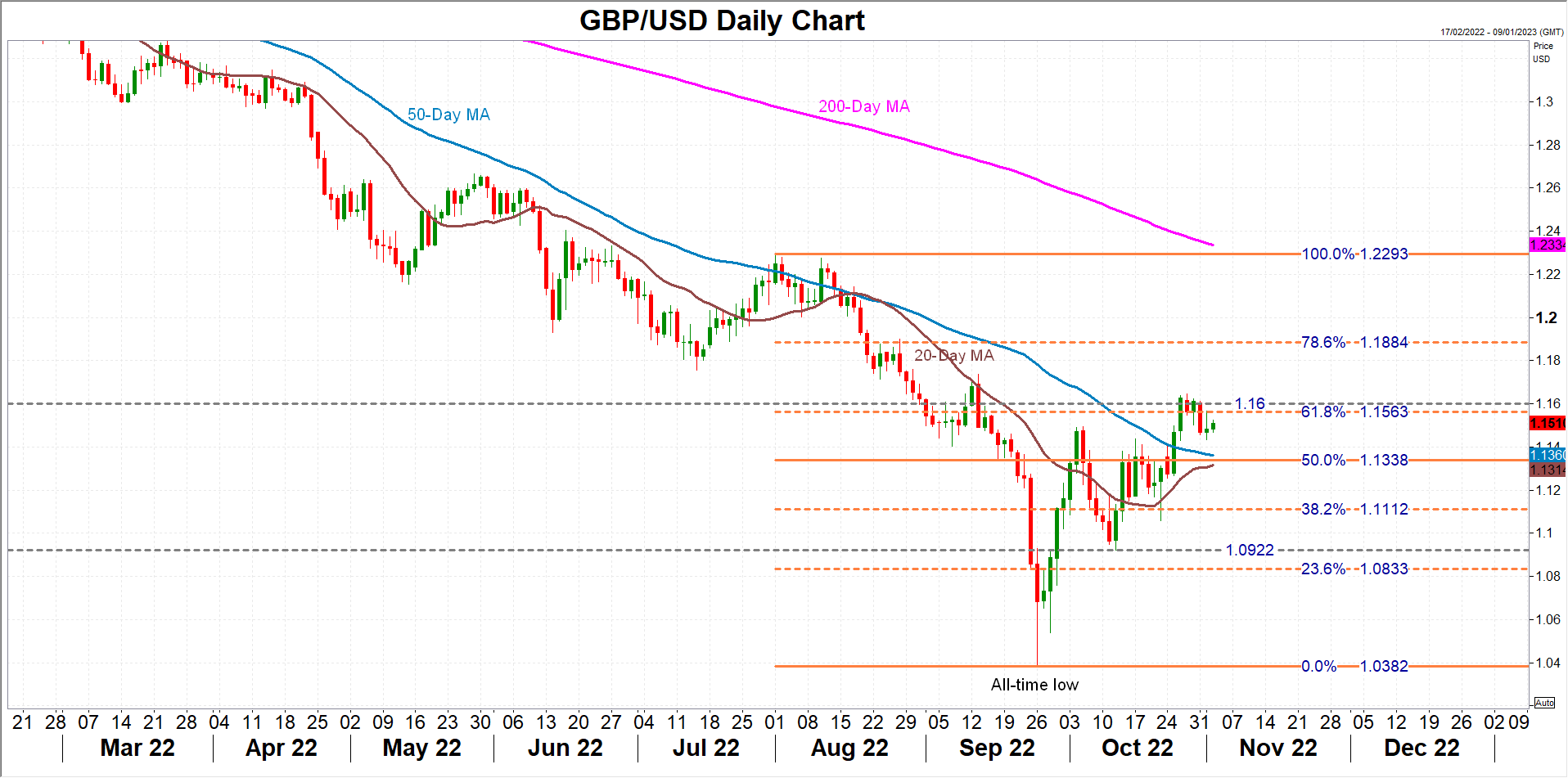
There is a very strong support forming around the 50% Fibonacci retracement of $1.1338 of the August-September downfall, as both the 20- and 50-day moving averages (MA) are converging around this level. If this level is breached, the October trough of $1.0922 would come into scope.
In the unlikely event of a hawkish surprise by the BoE, or a dovish one by the Federal Reserve, which is more probable, the pound could stretch its rebound until the 78.6% Fibonacci of $1.1884.
Aussie Climbs Despite Weak Mfg. Data
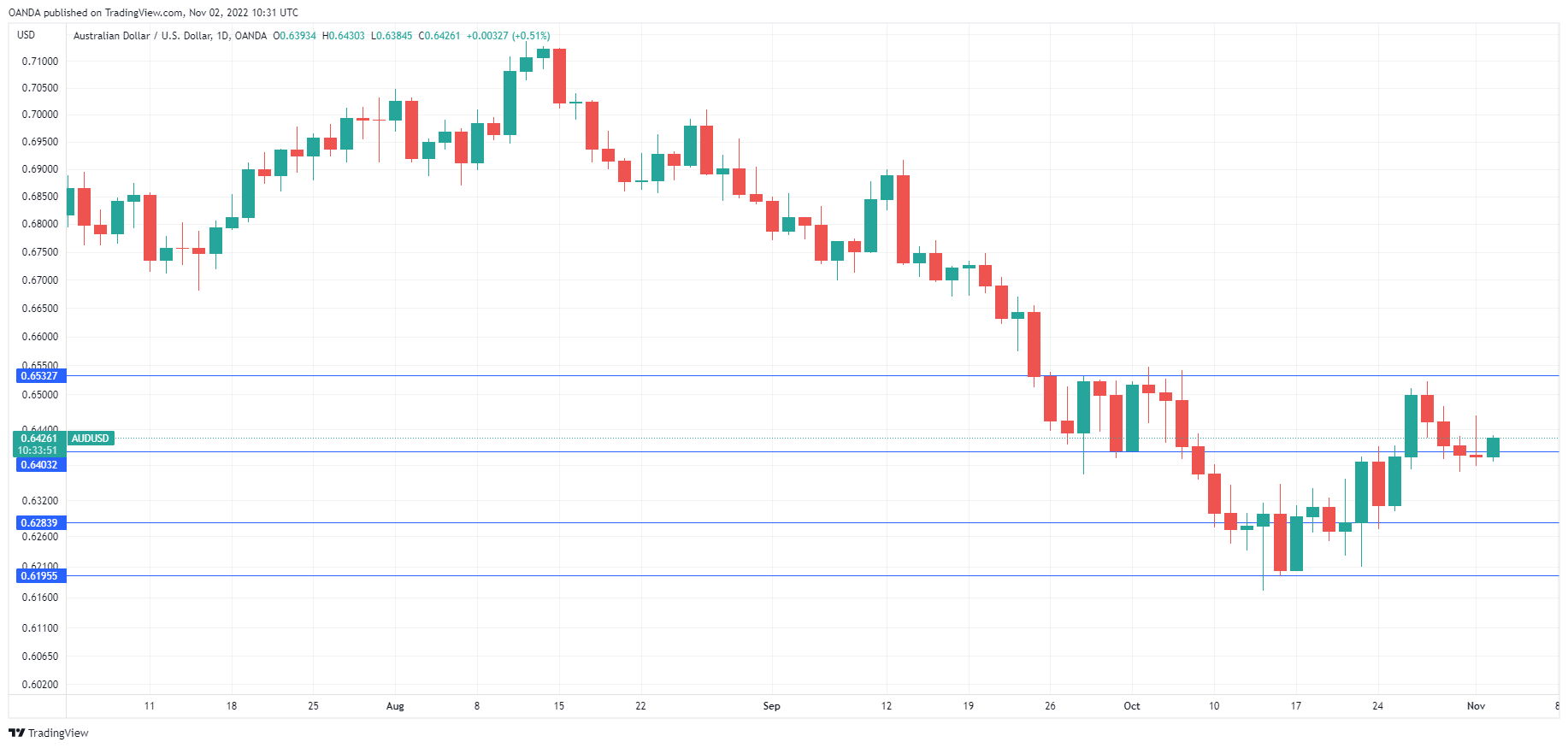
AUD/USD has posted strong gains today. In the European session, the Australian dollar is trading at 0.6424, up 0.48%.
The Australian dollar rose as much as 0.80% after the Reserve Bank of Australia raised rates by 25 basis points on Tuesday, but couldn’t consolidate and ended the day virtually unchanged.
Lowe urges caution
The RBA rate hike raised the cash rate to 2.85%, its highest level since April 2013. The RBA has raised rates by a steep 275 basis points since May but has now downshifted, with small increases of 25 bp in October and November. The slower pace is noteworthy because inflation remains red-hot. Governor Lowe said on Tuesday that he expected to raise rates further in order to tame inflation, and acknowledged that the central bank was on a “narrow path” which required “striking the right balance between doing too much and too little.”
Inflation remains the RBA’s number one priority, even if the price is a recession. At the same time, Lowe is well aware that soaring inflation and high interest rates are taking a toll on businesses and households, and Lowe seems eager to limit rate increases to 0.25% or even pause, if possible. The RBA’s rate policy will be data-dependent, and so far the economy has shown that it can withstand steep tightening. Still, there are signs of a slowdown, such as in manufacturing. The October PMI slowed to 49.6, down from 50.2. This marks a third successive month of flat results, with readings close to 50.0, which separates expansion from contraction.
All eyes are on the Federal Reserve, which winds up its 2-day policy meeting later today. The Fed is widely expected to hike rates by 0.75%, which would bring the benchmark rate to 4.0%. The Fed is likely to raise rates to 5% early next year, which means the tightening cycle will continue into 2023. Investors will be listening closely to Fed Chair Powell’s comments, looking for clues as to whether the Fed plans to ease in December, or will we see another 75 bp hike.
AUD/USD Technical
- AUD/USD continues to test resistance at 0.6403. Above, there is resistance at 0.6532
- There is support at 0.6283 and 0.6196
USDJPY Consolidates after Advance Pauses, Uptrend Intact
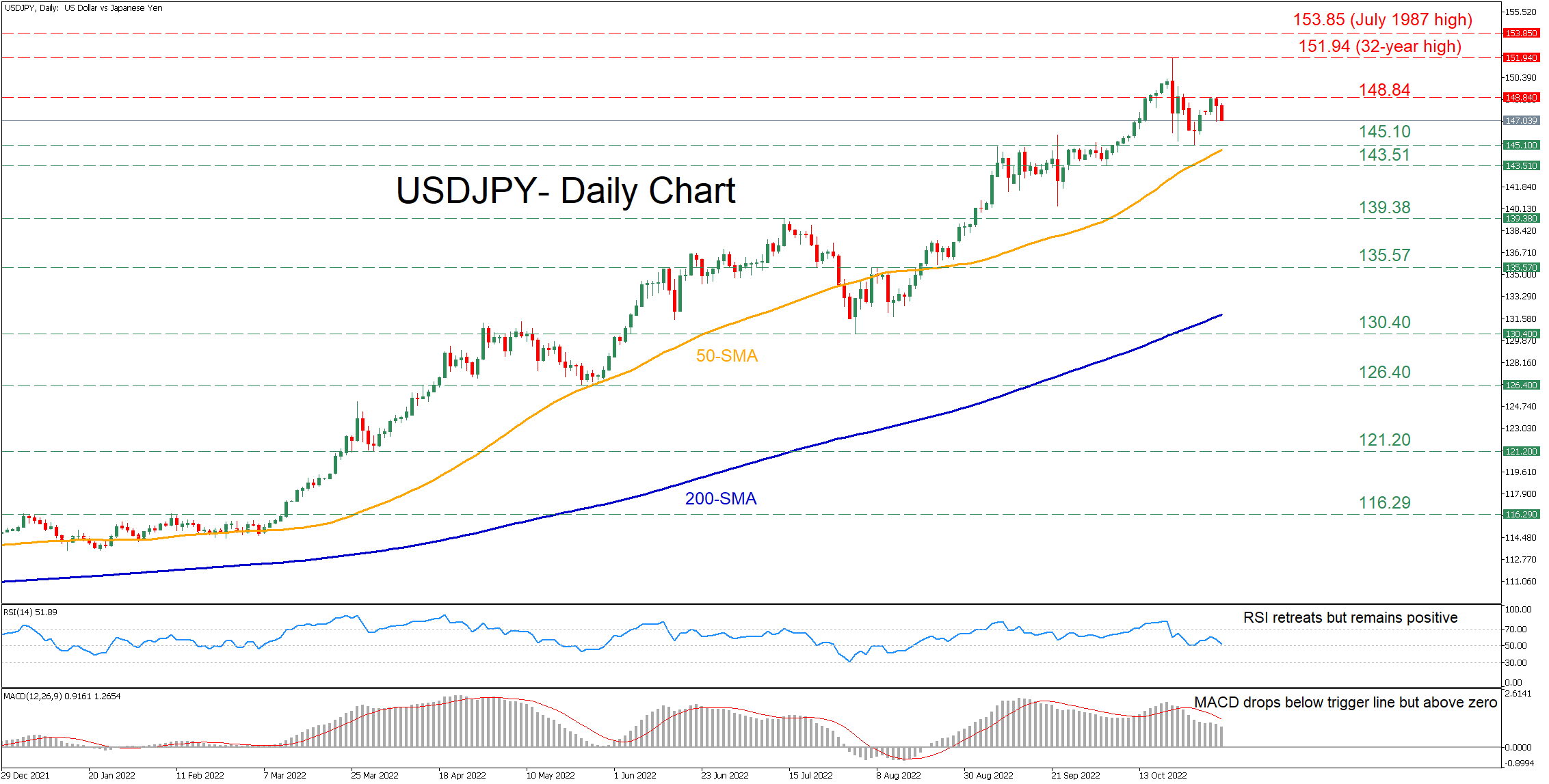
USDJPY has been in a prolonged uptrend for almost two years, crossing above its historical resistance levels to reach consecutive multi-year highs. However, the pair has been trading sideways in the last few daily sessions as its rally appears to be running out of juice.
The short-term oscillators currently suggest that bullish forces are waning but still retain control. Specifically, the RSI is pointing downwards slightly above its 50-neutral mark, while the MACD histogram is softening below its red signal line in the positive territory.
To the upside, bullish actions could initially come to a halt at the recent resistance of 148.84. A break above the latter might set the stage for the 32-year high of 151.94. Failing to halt there, the price could ascend to form fresh multi year highs, where the July 1987 peak of 153.85 may prove to be the next barrier for the price to overcome.
Alternatively, if sellers emerge and regain control, the pair could descend towards its latest support of 145.10. Should that floor collapse, the bears might aim for 143.51 before the 139.38 barrier comes under examination. Any further declines could then cease at 135.57, which has acted both as resistance and support in the previous months.
Overall, even though bullish pressures appear to be subsiding, USDJPY’s uptrend remains intact. Nevertheless, a dive beneath the 145.10 floor could be the starting point of a moderate downside correction.
USD/JPY Pair Moved into a Short-term Bearish Zone Below 149.50
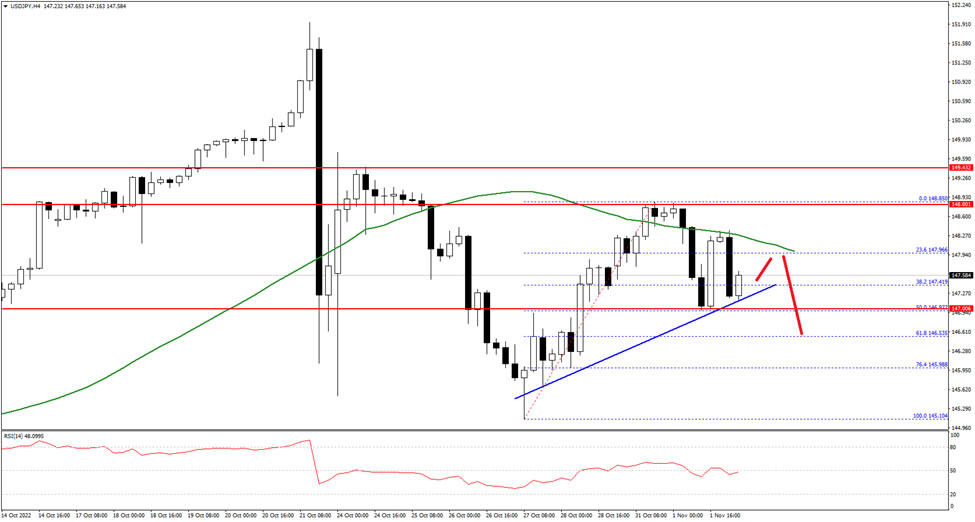
The US Dollar started a fresh decline from well above the 150.00 zone against the Japanese Yen. The USD/JPY pair traded below the 149.50 level to move into a short-term bearish zone.
The pair traded as low as 145.10 and recently started an upside correction. There was a move above the 147.50 resistance zone. It is now eyeing a fresh upside break above the 148.25 resistance and the 50 hourly simple moving average.
The next major resistance is near the 148.85 zone. A clear break above the 148.85 resistance could push the price towards 149.50 on FXOpen. The next major resistance is near the 150.00 level.
On the downside, an initial support is near the 147.30 zone and a connecting bullish trend line on the hourly chart. The next major support sits near the 146.95 level, below which there is a risk of more downsides towards the 146.20 level.
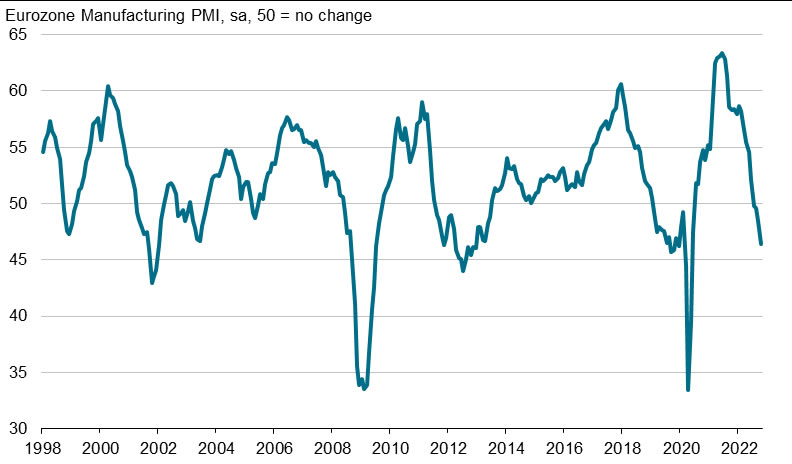
Eurozone PMI manufacturing finalized at 46.4, moved into a deeper decline
Eurozone PMI Manufacturing was finalized at 46.4 in October, down from September's 48.4. Manufacturing Output Index was finalized at 43.8, down from prior month's 46.3. Both were the lowest reading in 29 months.
Looking at member countries, Ireland PMI manufacturing dropped to 51.4 (2-month low) but stayed in expansion. Greece (48.1, 22-month low), the Netherlands (47.9, 27-month low), France (47.2, 29-month low), Austria (46.6, 28-month low), Italy (46.5, 29-month low), Germany (45.1, 28-month low), and Spain (44.7, 29-month low) were all in contraction.
Joe Hayes, Senior Economist at S&P Global Market Intelligence said: "The eurozone goods-producing sector moved into a deeper decline at the start of the fourth quarter. The PMI surveys are now clearly signalling that the manufacturing economy is in a recession. In October, new orders fell at a rate we've rarely seen during 25 years of data collection – only during the worst months of the pandemic and in the height of the global financial crisis between 2008 and 2009 have decreases been stronger."
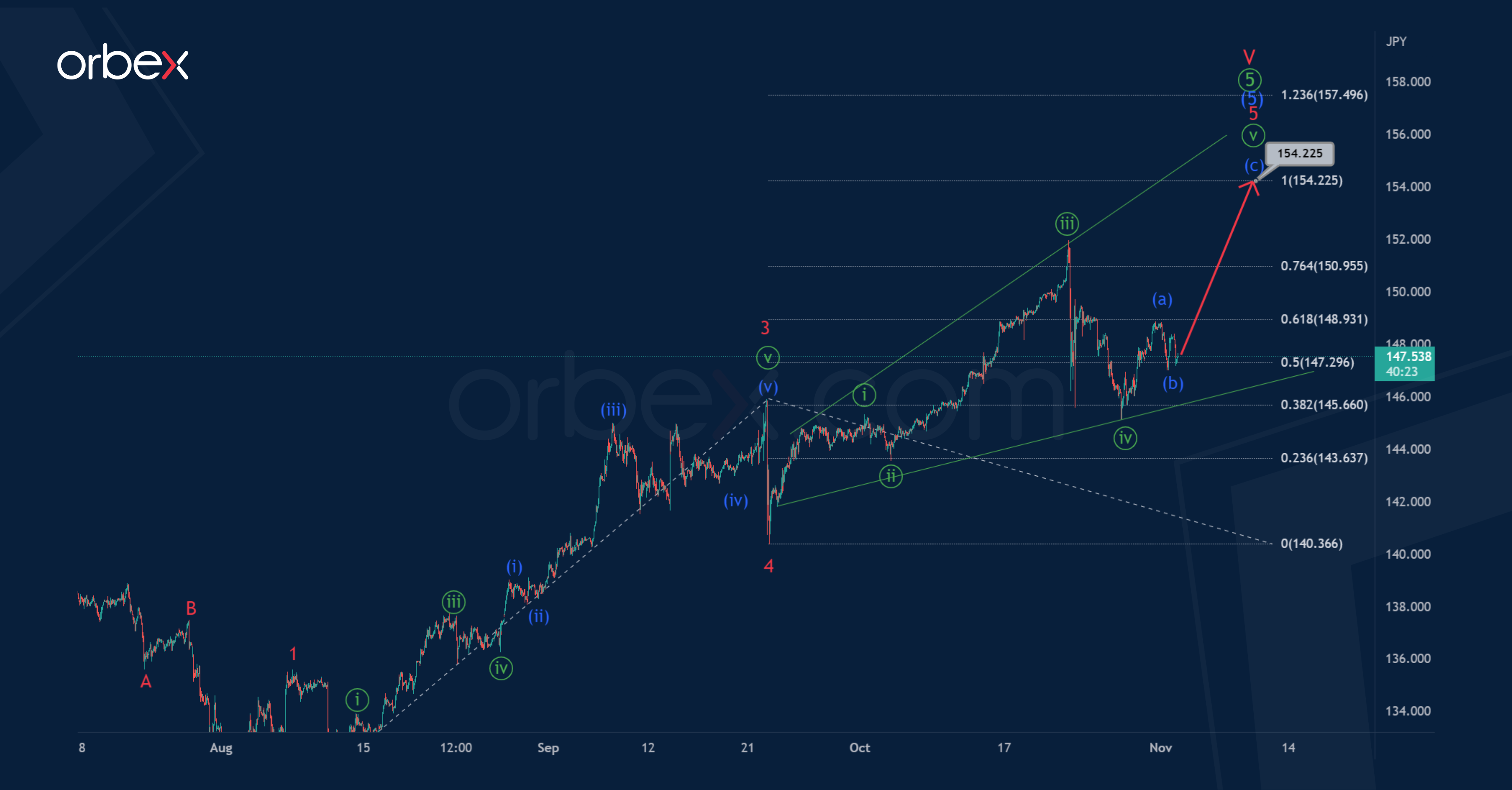
USD/JPY: The Last Leg of the Bullish Impulse is Similar to the Ending Diagonal
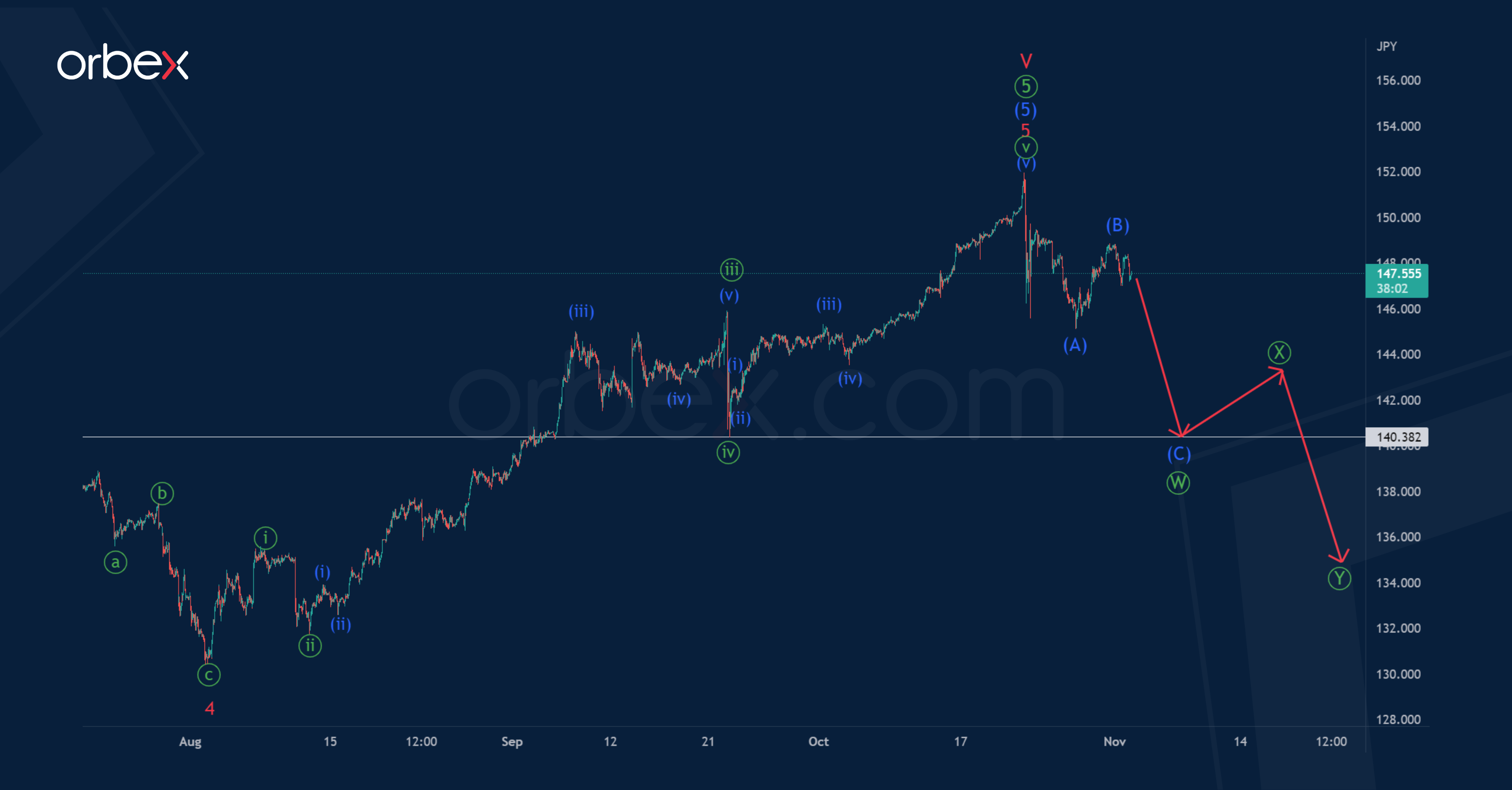
The USDJPY chart shows the formation of a global impulse trend, which consists of cycle waves. In recent months, we have seen the price creeping up in the cycle wave V, more precisely in its final part.
Wave V, apparently, takes the form of a 5-wave impulse of the primary degree ①-②-③-④-⑤. In this impulse, the first four parts are finished.
Currently, we can expect the construction of the primary fifth wave, which takes the form of an intermediate impulse (1)-(2)-(3)-(4)-(5). The price in the final primary wave ⑤ may rise to 154.22.
At that price level, minor wave 5, which is similar to the ending diagonal, will be at 100% of impulse 3.
An alternative scenario shows that the entire cycle wave V has already completely ended in the form of a primary impulse.
Thus, in the next coming trading weeks, we can expect a fall in the exchange rate and the formation of a new bearish trend.
It is assumed that a bearish double zigzag of the primary degree Ⓦ-Ⓧ-Ⓨ may form in the market in the near future.
The upcoming decline in the first wave Ⓦ may reach the area of 140.38, that is, the previous minimum of fluctuations, and then even lower.