Sample Category Title
Fed to hike 75bps, would Powell indicate slower tightening ahead?
Fed is widely expected to raise interest rate by 75bps again today, to 3.75-4.00%. The main question is whether Chair Jerome Powell would signal that tightening pace is going to slow afterwards.
Currently, there are some expectations that Fed would opt for a smaller hike of 50bps in December, then a 25bps hike in February, and probably another 25bps in March, and pause from there.
However, such hope was somewhat dashed as job data released yesterday showed that the job market could have tightened further. Job openings surged to 10.7m in September, rather than a fall to 9.8m. Ratio of openings to unemployed persons also climbed from 1.7 to 1.9. ISM manufacturing employment also improved.
Overall, there could be some negative market reactions if Powell doesn't deliver any firm message of a pivot.
Here are some suggested readings on Fed:
- FOMC Meeting Preview: Fed Expected to Hike 75bps, But is the Pivot Imminent?
- Will the Fed Confirm Hopes of Slower Tightening?
- Fed Preview: Too Early for a Pivot
- Powell and NFP Release Will Crash USD
- November Flashlight for the FOMC Blackout Period: Our Expectations Ahead of the November 2nd FOMC Meeting
NZ unemployment rate unchanged at 3.3%, record hourly earning growth
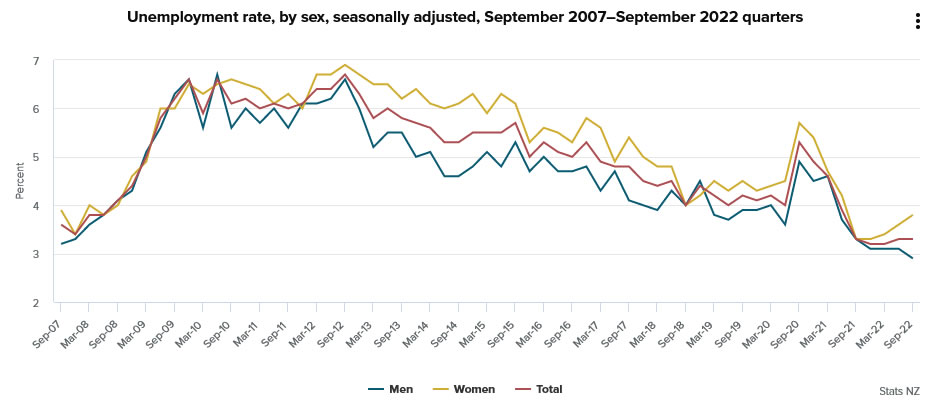
New Zealand employment grew 1.3% in Q3, above expectation of 0.5%. Unemployment rate was unchanged at 3.3%, above expectation of 3.2%. Labor force participation rate rose 0.8% to 71.7%. Underutilization rate dropped -0.2 to 9.0%.
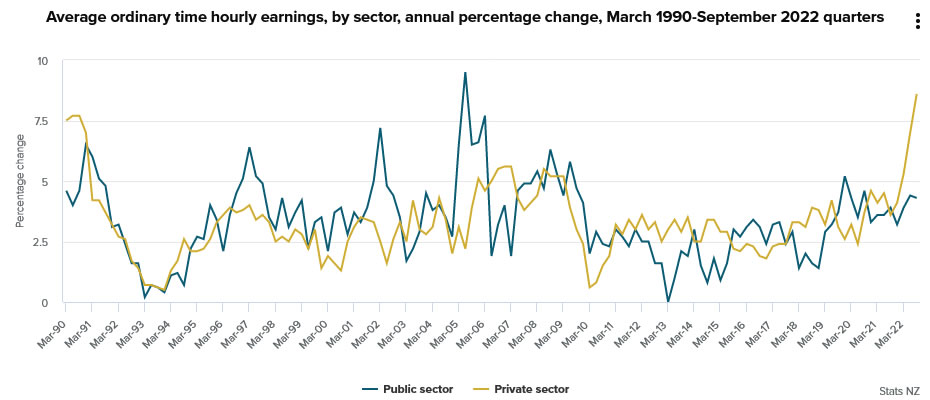
Average ordinary time hourly earnings rose 2.4% qoq, 7.4% yoy. The annual rise was the highest since the series began in 1989. All salary and wage rates (including overtime) index rose 3.7% yoy, second highest annual rate since record began in 1993.
Australia AiG manufacturing fell to 49.6, longstanding supply-side problems continue
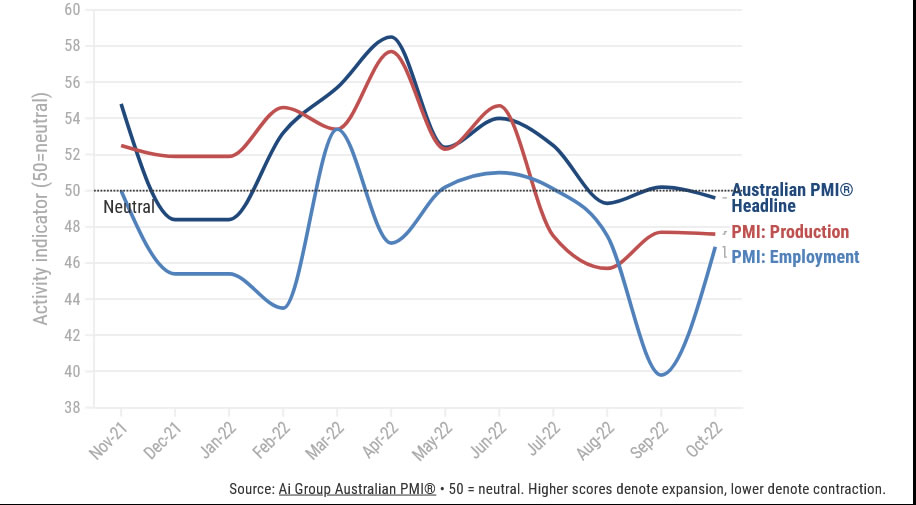
Australia AiG Performance of Manufacturing Index dropped -0.6 to 49.6 in October. Looking at some details, production dropped -0.1 to 47.6. Employment rose 7.1 to 46.9. New orders dropped -4.0 to 53.8. sales dropped -3.0 to 48.4. Input prices dropped -6.8 to 78.0. Selling prices dropped -2.7 to 67.5. Average wages dropped -5.1 to 71.0.
Innes Willox, Chief Executive of Ai Group said: "Australian manufacturing is in a holding pattern, with three straight months of flat results. Demand conditions in the market remain stable, but longstanding supply-side problems, such as labour and supply chain shortages, continue to drag on the industry."
Japan Suzuki concerned about gradual weakening of Yen
Japan Finance Minister Shunichi Suzuki told the parliament, "I am very concerned about the gradual weakening of the yen", which could accelerate inflation by increasing import costs.
BoJ Governor Haruhiko Kuroda also said, recent Yen weakness raises uncertainty on the outlook, and is negative for the economy.
Regarding monetary policy, Kuroda said, "If the achievement of our 2% inflation target comes into sight, making yield curve control more flexible could become an option." But for now, he added that the central bank must maintain ultra-low loose monetary policy to support the economy.
BoC Macklem: We are getting closer, but we are not there yet
BoC Governor Tiff Macklem said in a speech that the central bank is trying to "balance the risks of under- and over-tightening." "The tightening phase will draw to a close," he added. "We are getting closer, but we are not there yet."
BoC is still "far from that goal" of ensuring "low, stable and predictable" inflation. "With inflation so far above our target, we are particularly concerned about the upside risks," he added.
Macklem also said, "We expect growth will stall in the next few quarters—in other words, growth will be close to zero. But once we get through this slowdown, growth will pick up, our economy will grow solidly, and the benefits of low and predictable inflation will be restored."
Crude Oil Price Eyes Fresh Increase, Fed Decision Next
Key Highlights
- Crude oil price started a fresh increase above the $86.50 and $87.20 resistance levels.
- A major bullish trend line is forming with support near $85.60 on the 4-hours chart.
- Gold price might gain pace if it clears the $1,660 resistance zone.
- Today, the Fed could increase interest rates from 3.25% to 4.0%.
Crude Oil Price Technical Analysis
Crude oil price started a fresh increase from the $82.20 zone against the US Dollar. The price gained pace for a move above the $85.00 resistance level.
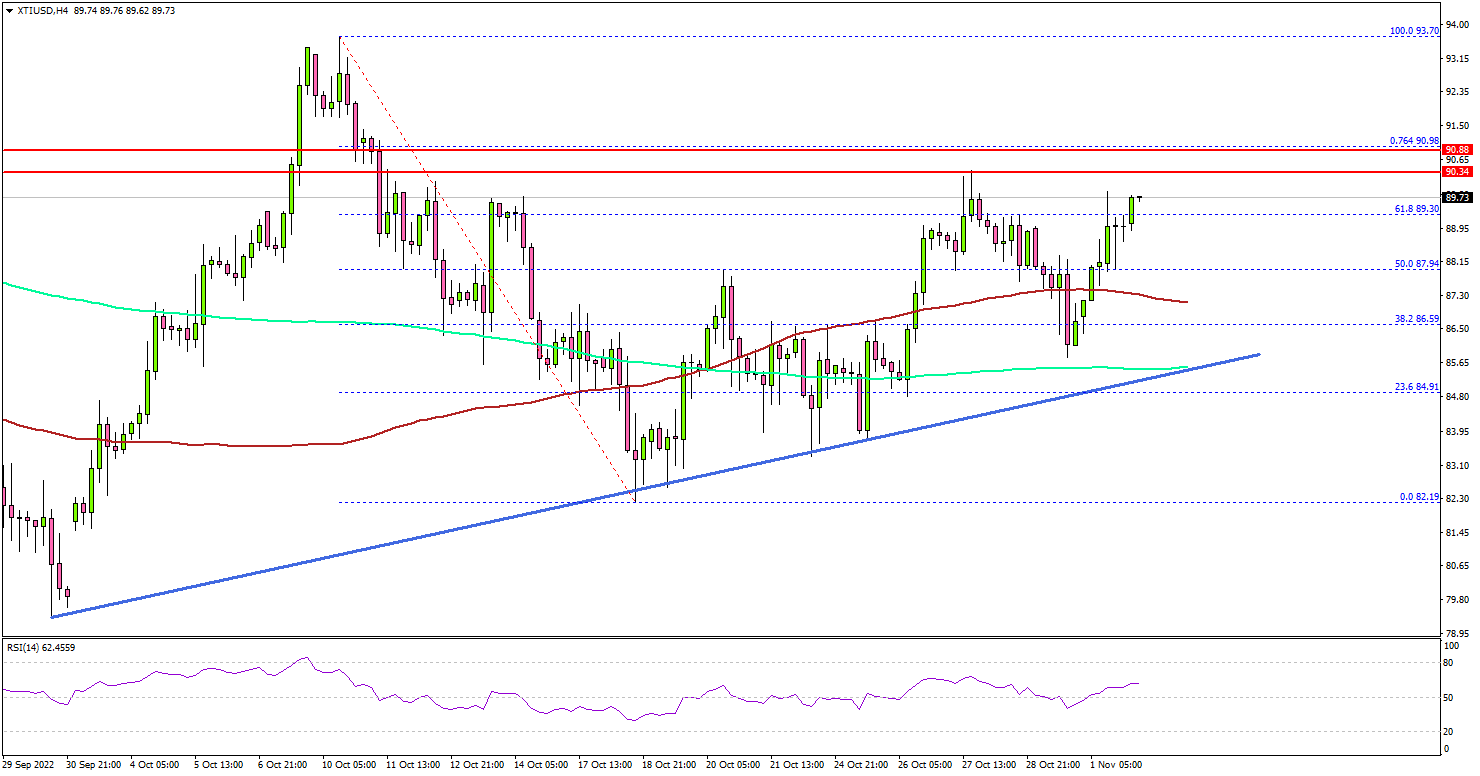
Looking at the 4-hours chart of XTI/USD, there was a break above the $86.50 resistance zone. The price even settled above the $87.20 level, the 100 simple moving average (red, 4-hours), and the 200 simple moving average (green, 4-hours).
The bulls pushed the price above the 61.8% Fib retracement level of the downward move from the $93.70 swing high to $82.19 low.
On the upside, the price might face sellers near the $90.40 zone. The next major resistance is near $91.00, above which the price could accelerate higher towards the $95.00 zone.
If not, there might be a fresh decline below the $87.50 support zone. On the downside, there is a key support forming near the $85.00 zone. There is also a major bullish trend line forming with support near $85.60 on the same chart.
The next major support is near $84.00 zone. Any more losses might call for a test of the $82.20 support zone in the coming days.
Looking at gold price, there was a recovery wave above the $1,640 level, but it must clear $1,660 to set the pace for a steady increase.
Economic Releases to Watch Today
- Germany’s Manufacturing PMI for Oct 2022 - Forecast 45.7, versus 45.7 previous.
- Euro Zone Manufacturing PMI for Oct 2022 – Forecast 46.6, versus 46.6 previous.
- US ADP Employment Change for Oct 2022 - Forecast 193K, versus 208K previous.
- Fed Interest Rate Decision - Forecast 4.0%, versus 3.25% previous.
Gold: Forecasting The Next Move After 5 Waves Decline
In this technical blog we’re going to take a look at some Elliott wave charts of yellow metal (Gold) published in members area of the website. Gold formed a high on October 4, 2022 (1729.46) and started declining. Decline took the form of an impulse, we will explain the internals of this impulsive decline, the bounce which we expected and current forecast.
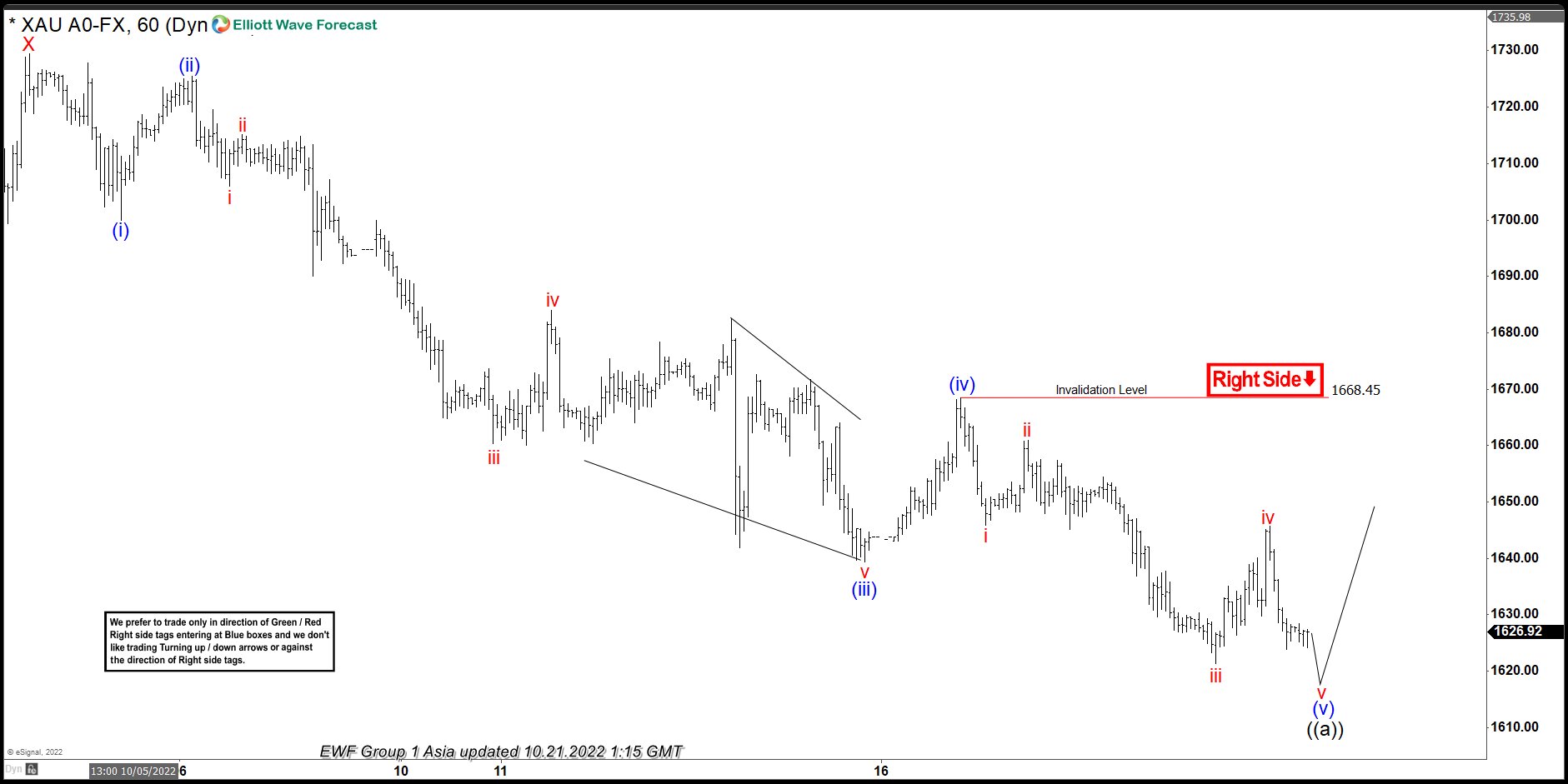
Gold: 21, October 2022: 1 Hour Elliott Wave Analysis
In the chart below we can see Gold is an impulsive 5 waves decline from October 4, 2022 (1729.46) high. Wave (i) ended at $1700, wave (ii) ended at $1725.55, wave i of (iii) ended at $1706, wave ii of (iii) ended at $1715.16, strongest part of the impulse i.e. wave iii of (iii) ended at $1660.30, wave iv of (iii) ended at $1683.94, wave v of (iii) took the form of an Ending Diagonal and ended at $1639.30, wave (iv) ended at $1668.42. We can already see 3 swings down from blue (iv) peak so expecting another low to complete wave (v) and cycle from October 4, 2022 peak before a bounce.
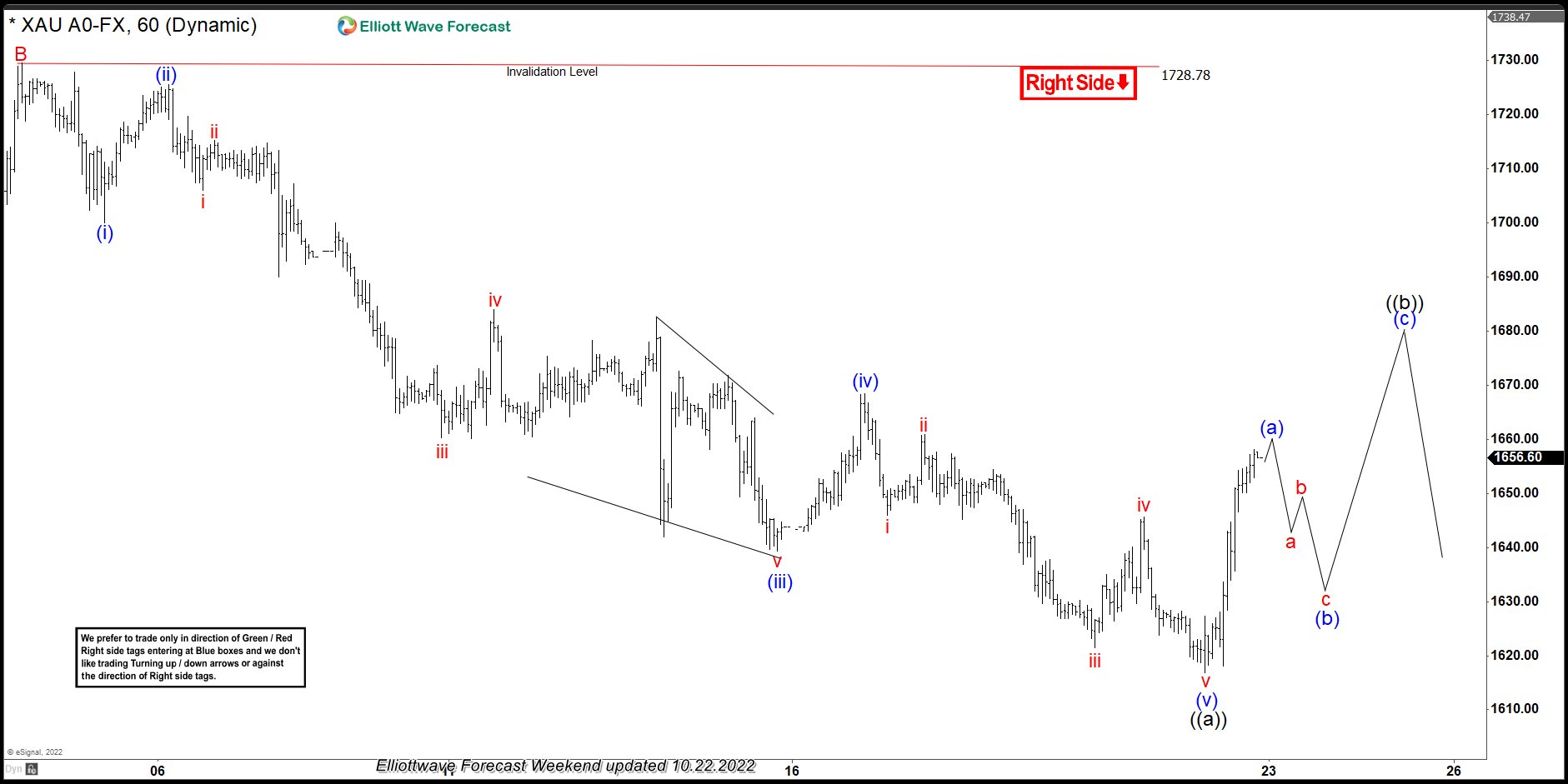
Gold: 22 October, 2022: 1 Hour Elliott Wave Analysis
As per Elliott Wave Theory, after a 5 waves decline, there should be a recovery in minimum 3 waves. In the chart below, we can see Gold made a new low to complete wave (v) at $1616.80 on October 21, 2022 and bounced strongly. First leg of the bounce is close to ending, after which we expect a pull back and one more leg higher to complete three waves bounce before the decline resumes.
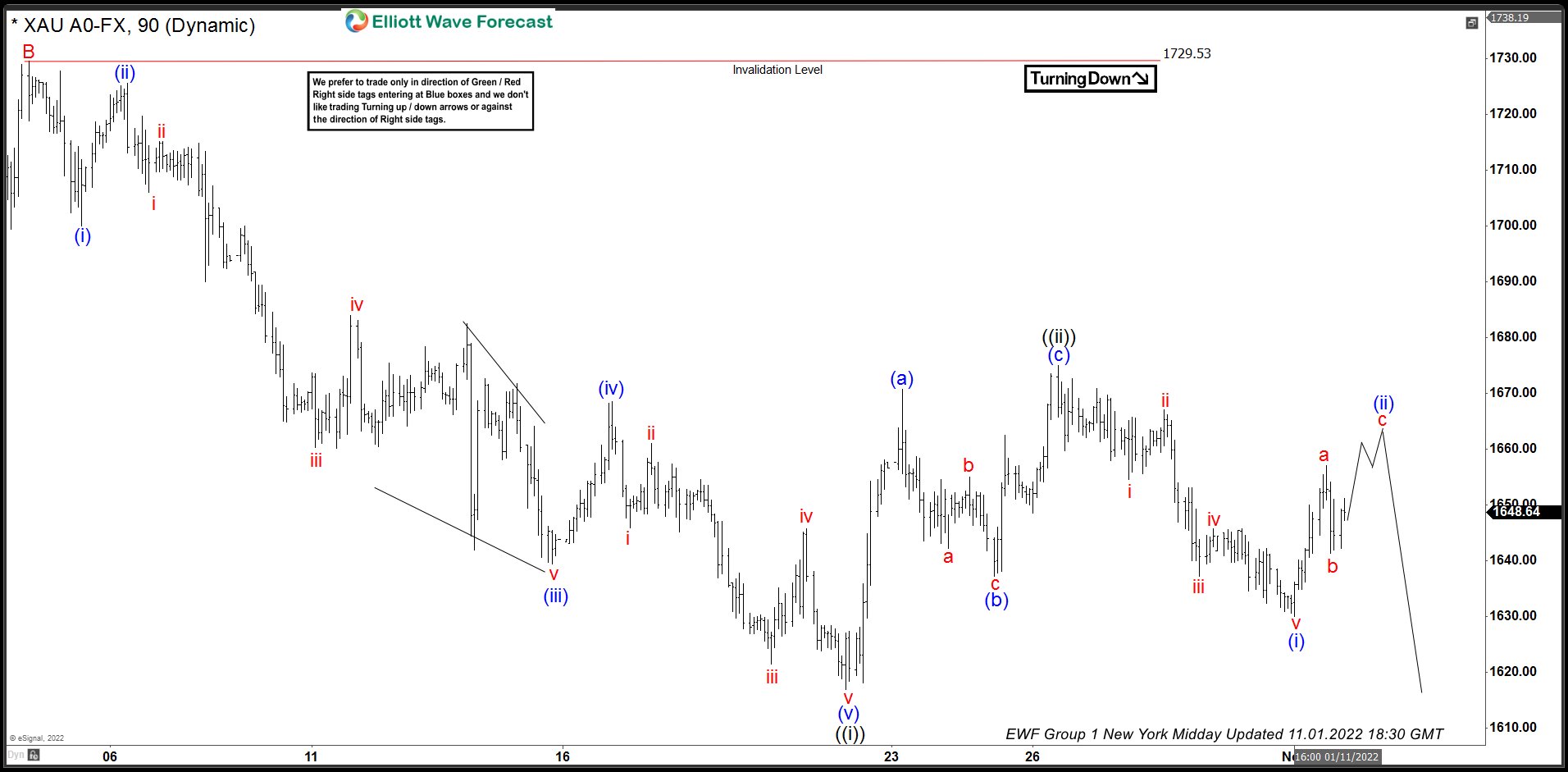
Gold: 1 November, 2022: 1 Hour Elliott Wave Analysis
In the chart below, we can see yellow metal completed 3 waves bounce on October 26, 2022 at $1674.94 and has turned lower again. Since decline from October 4, 2022 peak was an impulse, forecast is for XAUUSD to resume the decline and make a new low below October 21, 2022 ($1616.80) low. Alternate view suggests it can hold the low at October 21 , 2022 for seven swings higher before the decline resumes but as far as October 4, 2022 high remains intact, forecast is for Gold to resume the decline and break below October 21, 2022 low.
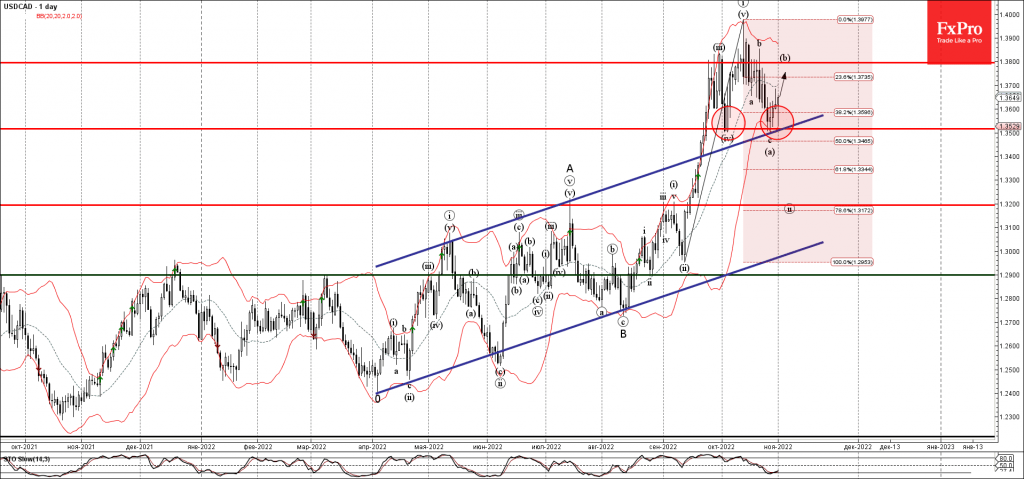
USDCAD Wave Analysis
- USDCAD reversed from support level 1.3530
- Likely to rise to resistance level 1.3795
USDCAD recently reversed up from the support level 1.3530 (low of wave (iv) from the start of October), intersecting with the lower daily Bollinger band, upper trendline of the daily up channel from April and 38.2% Fibonacci correction of the upward impulse from September.
The upward reversal from the support level 1.3530 started the active short-term correction (b).
Given the clear multi-month uptrend, USDCAD can be expected to rise further toward the next resistance level 1.3795 (target for the completion of the active minor correction (b)).
EURNZD Wave Analysis
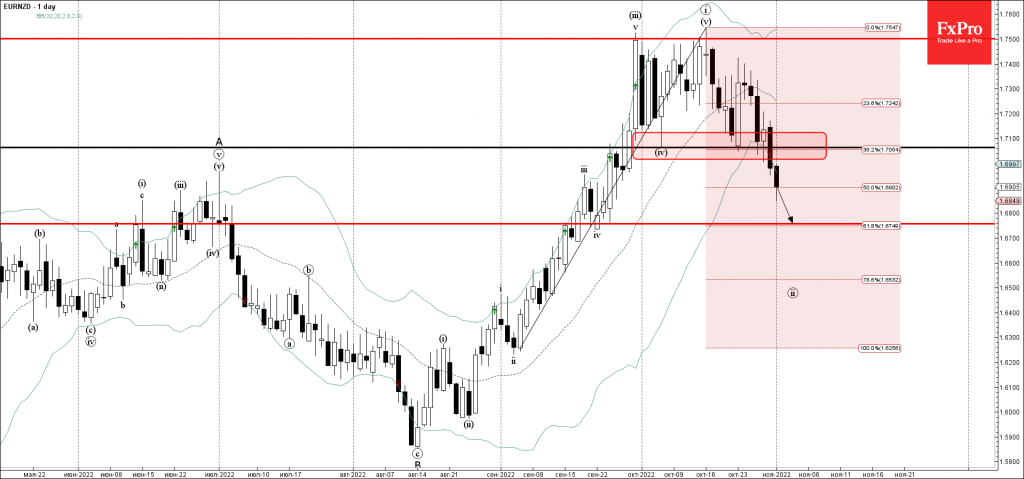
- EURNZD broke key support level 1.7065
- Likely to fall to support level 1.6755
EURNZD recently broke through the key support level 1.7065 (which has been reversing the price from the start of October), intersecting with the 38.2% Fibonacci correction of the upward impulse from September.
The breakout of the support level 1.7065 accelerated the active short-term correction (ii).
EURNZD can be expected to fall further toward the next support level 1.6755 (which stopped wave iv from the middle of September).