Sample Category Title
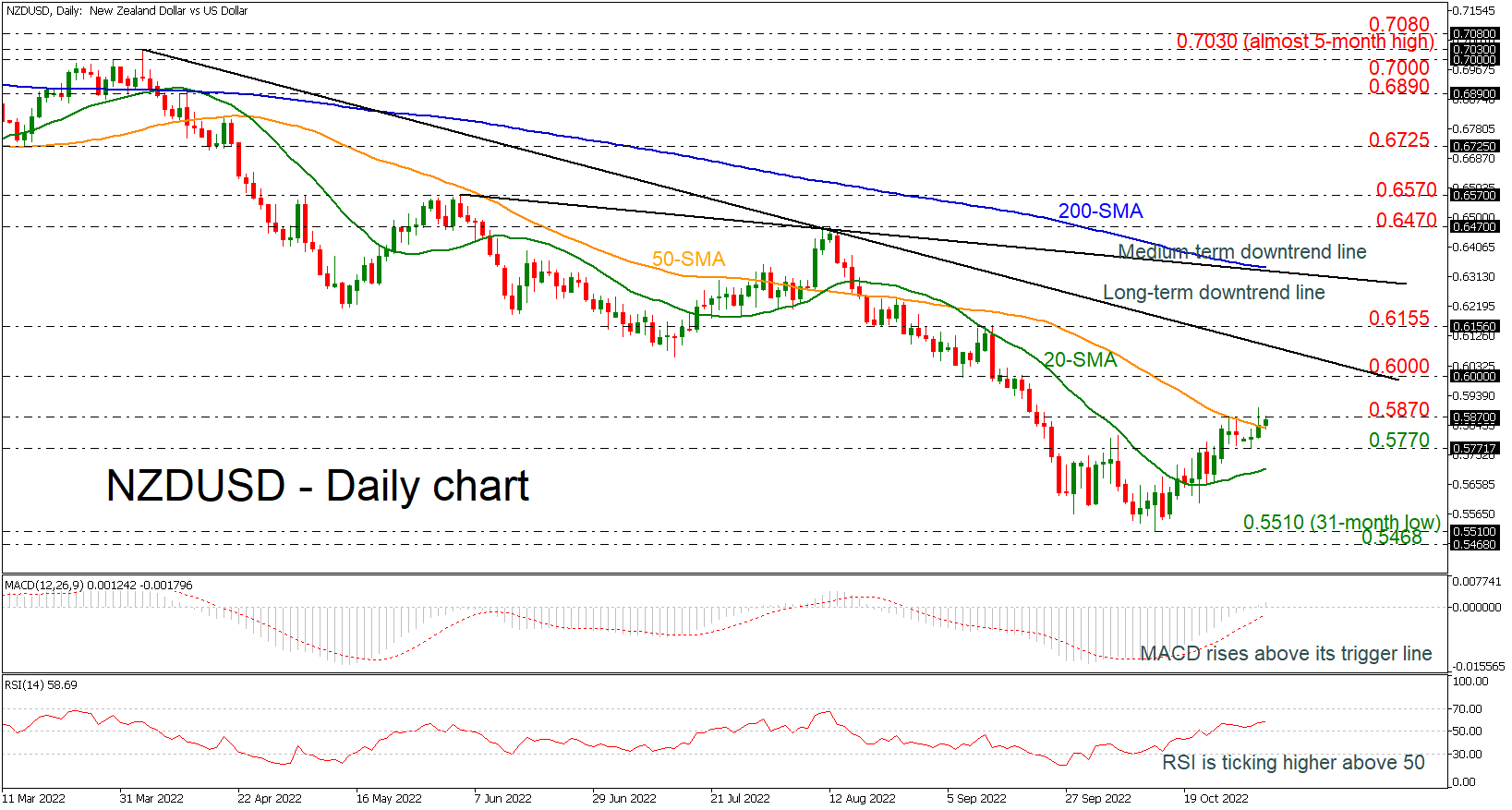
NZDUSD Shows Positive Signs above 50-day SMA in Short-term
NZDUSD rebounded off the 31-month low of 0.5510 in the mid-October. Currently, the market is advancing above the 50-day simple moving average (SMA) with the technical oscillators showing positive signs as well. The MACD is extending the bullish momentum above its trigger and zero lines, while the RSI is standing above the neutral threshold of 50.
More upside pressures could lead the price towards the 0.6000 psychological mark before meeting the long-term downtrend line around 0.6070. If traders continue to buy the pair, the next immediate resistance could be at 0.6155 ahead of the medium-term descending trend line near the 200-day SMA at 0.6340.
On the other hand, a drop back below the 50-day SMA and the 0.5770 support could meet the 20-day SMA at 0.5710. Steeper losses could open the way towards the 31-month of 0.5510 and a lower low near 0.5468.
All in all, NZDUSD appears bullish in the short-term timeframe. However, in the medium- and long-term pictures the price is strongly bearish.
A Fourth 75 bps Rate Hike is a Done Deal
Markets
Asia’s equity scorching rally (HK more than +5%) following unconfirmed social media reports that China is preparing its exit from zero-Covid was met by a lukewarm European response. Stocks rose less than 1%. Wall Street traded opening gains for 0.2-0.9% losses. This came on the back of strong US data, going from a final manufacturing PMI back above 50 to an unexpected jump in JOLTS job openings to 10.7 mln over a slightly better-than-expected manufacturing ISM indicator. They casted doubt over the hoped-for slowdown in Fed tightening after tonight’s meeting. This caused a sharp U-turn in US Treasuries with German Bunds caught in a slipstream. Earlier yield declines of well over 10 bps both in the US and Europe were cut and in some cases more than fully erased. Eventual changes in the US ranged between +6.2 bps (2y) to -7.3 bps (30y). German yields fell 1.1-2.2 bps at the belly of the curve. The dollar on FX markets reversed course and went from EUR/USD 0.995 to 0.987. The trade-weighted index rebounded from support at 110.78 to 111.48. USD/JPY closed at 148.3. Sterling eked out a tiny gain against the euro (EUR/GBP 0.86) and the dollar (GBP/USD 1.148). The Bank of England yesterday sold its first batch of gilts (£750 million) from its QE portfolio.
Stocks in the Asian-Pacific region trade mixed. HK and China continue to outperform though even as the mainland put another area in lockdown. The yuan extends gains to USD/CNY 7.27 with the US dollar generally under a bit of pressure ahead of the Fed meeting later today. Core bonds lose some territory with an interview by Nagel and de Cos published after-market yesterday weighing too. The ECB members stated very clearly that tightening is far from over. Nagel argued for decisive action “as we have done at the past three meetings”. He said QT should start at the beginning of 2023.
Today’s ADP jobs will be overshadowed by the Fed meeting tonight. A fourth 75 bps rate hike is a done deal. That would lift the main policy rate to 3.75%/4%. We argued before that the Fed would slow down the tightening pace in December to 50 bps and we expect Powell to bring some kind of an announcement. The Wall Street Journal article from October 21 solidified our case. It ran a story of the Fed mulling the possibility of going slower after one last supersized hike in November. The journal has close ties to the Fed – it flagged for example the 75 bps decision in June. US bond yields since then have left the multiyear highs and have consolidated instead. But since money markets are still in between 50 and 75 bps for December, especially after yesterday’s strong data, there’s some short-term scope for US yields to the downside after tonight. Together with a better risk sentiment on stock markets, it may also pressure the US dollar.
News Headlines
New Zealand published quarterly labour market data. Employment increased by 1.3% Q/Q in Q3, beating forecasts (0.5% Q/Q). Hours worked rose by 0.9% Q/Q despite higher illness-related absenteeism. The unemployment rate stabilized at 3.3%, marginally above the all-time low of 3.2% in Q4 2022 and Q1 2023. Private sector wages rose by 1.2% Q/Q with the Y/Y figure accelerating to 3.9%, the highest in at least 30-years. The strong labour market report suggests that the kiwi central bank (RBNZ) will continue to part ways with the Australian one. The latter (RBA) yesterday delivered a second consecutive smaller 25 bps rate hike while money markets expect the RBNZ to come up with a 75 bps move at the end of this month. The expected policy rate peak for New Zealand (5.25%) is also around 100 bps higher than the one for Australia. The kiwi dollar is marginally stronger this morning at NZD/USD 0.5865 with NZD swap rates 2 to 3 bps higher across the curve.
Exit polls from Israel’s fifth election in less than four years all suggested a slim parliamentary majority (61-62 out of 120 seats) for the (extreme-right) bloc around ex-PM Netanyahu’s Likud-party. Current PM Lapid’s Yesh Atid party and its allies are predicted to win 54-55 seats with an Arab grouping polling at 4 seats.
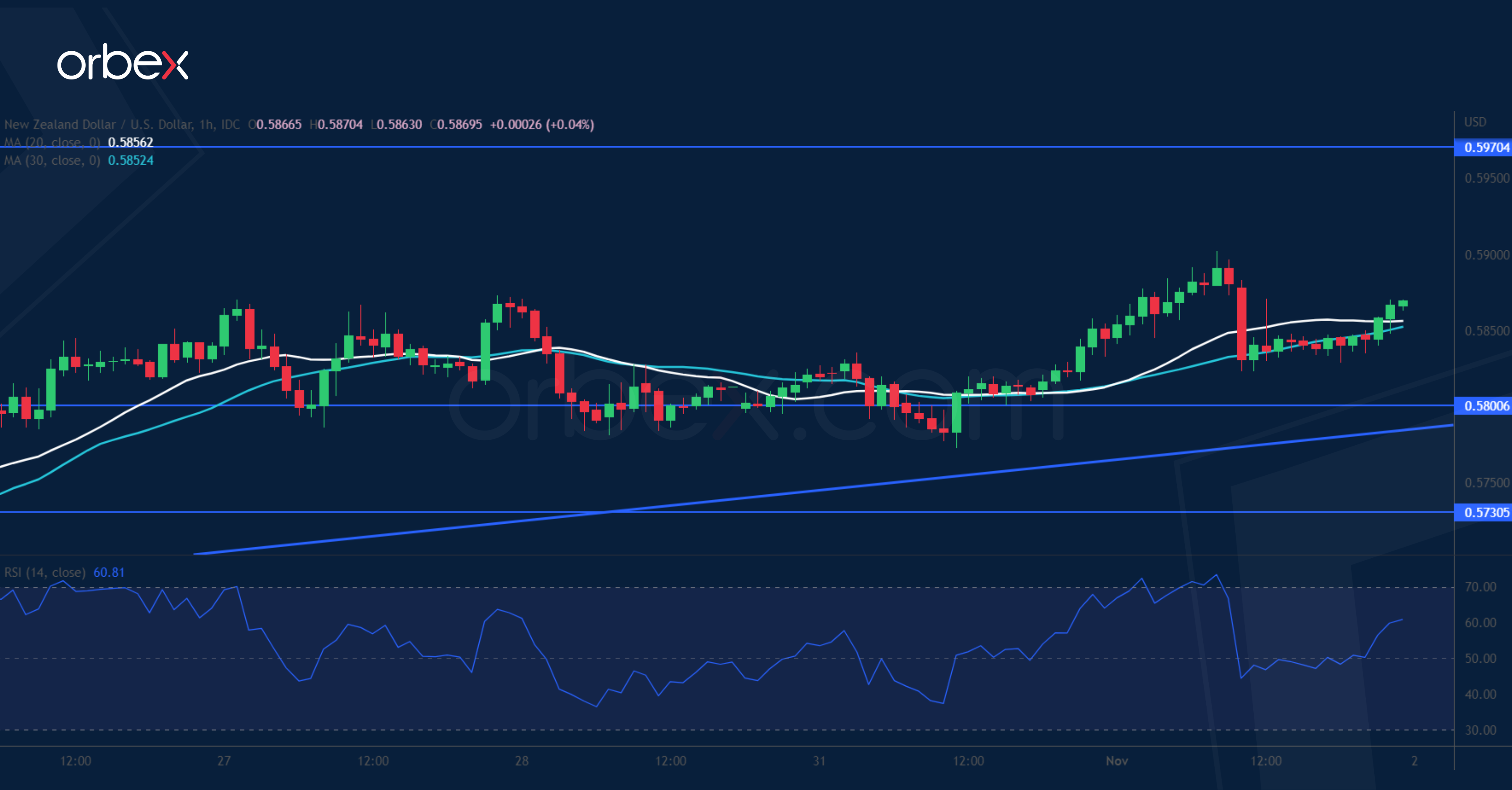
NZD/USD Follows Rising Trend Line
The New Zealand dollar slid after the Q3 unemployment rate fell short of expectations. A rising trend line indicates a strong bullish bias as the kiwi continues to recover. A break above the double top and daily resistance at 0.5790 prompted sellers to cover, easing the downward pressure. The rally then accelerated above 0.5880 after a brief consolidation with 0.5970 as the next target. The RSI’s overbought condition may cause a limited pullback. Buying interests could be expected near 0.5800 over the trend line.
AUD/USD Hits Resistance
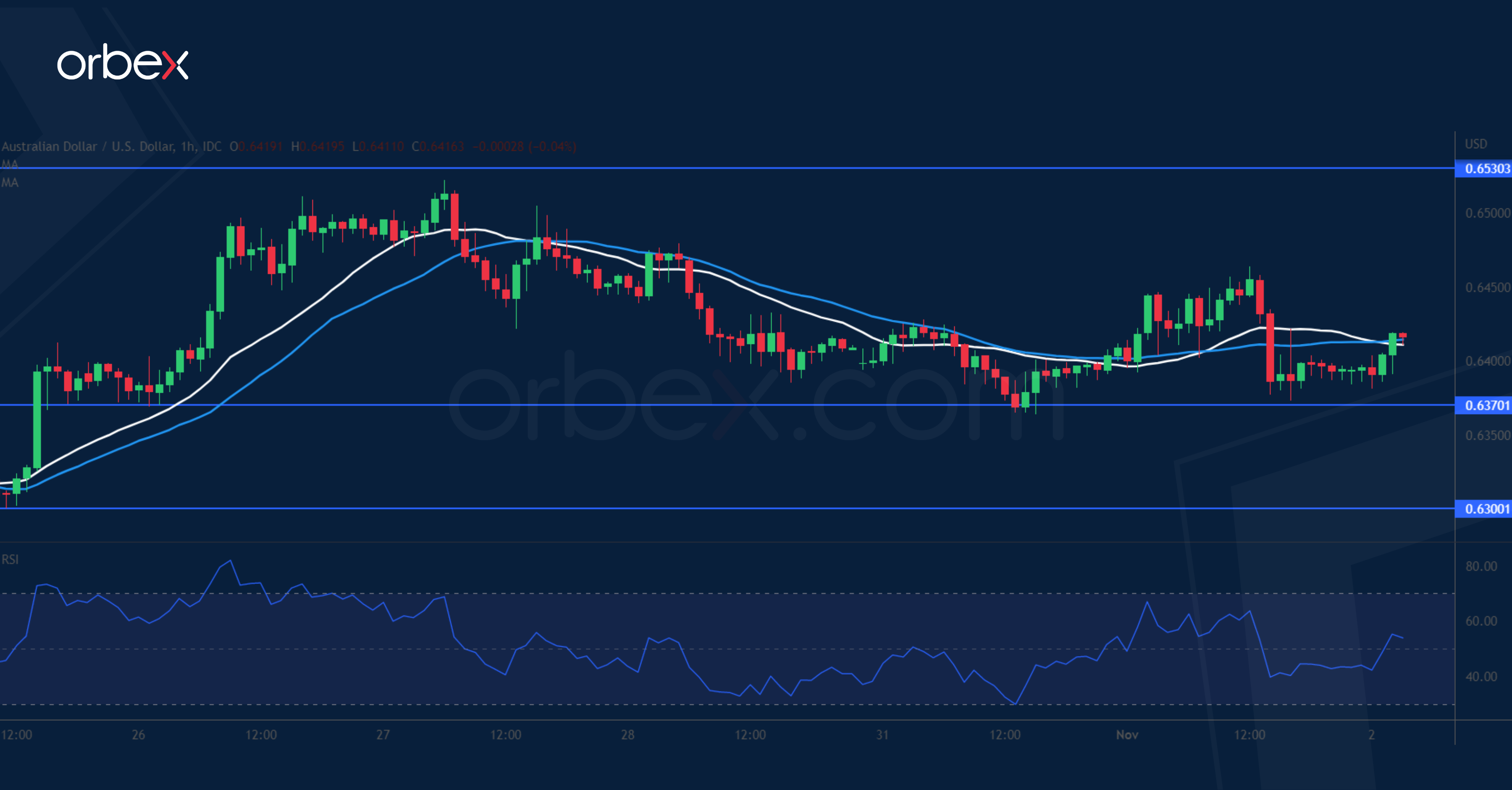
The Australian dollar softened after the RBA stuck with a mere 25 basis point rate hike. The pair has found strong support over 0.6200. Three consecutive failures to break lower by the bears indicate that the path of least resistance could be up. A series of higher lows contributes to the mounting buying pressure. 0.6370 is a fresh support and 0.6300 the bulls’ second layer of defence. October’s high and daily resistance 0.6530 is a key hurdle. Its breach would cause the short side to cover and trigger an extended rally towards 0.6660.
USD/JPY Seeks to Recover
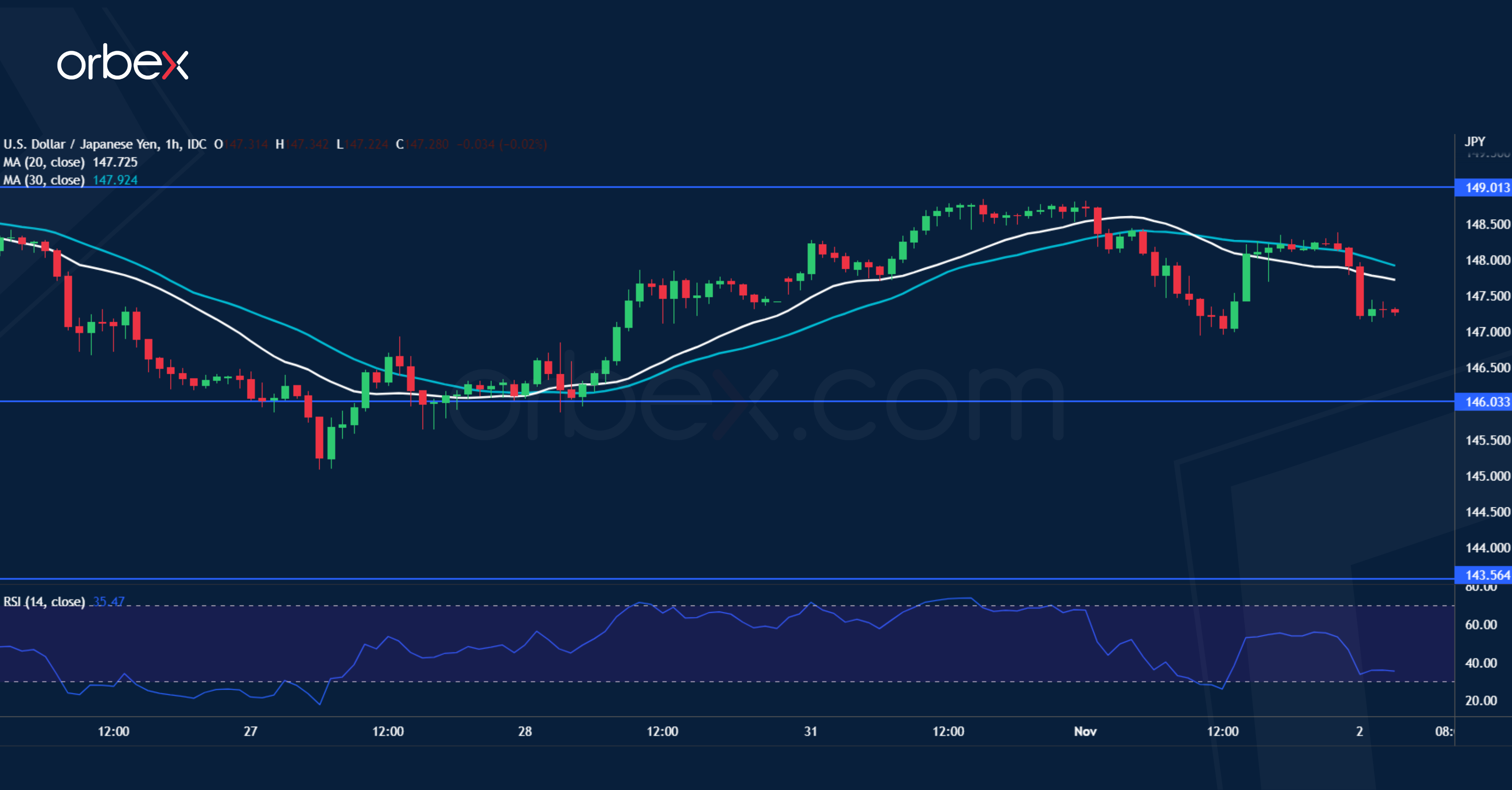
The US dollar consolidates over growing expectations of a slower pace of tightening by the Fed. On the daily chart, the greenback is above the 30-day moving average and may continue to attract trend followers. The latest bounce came under pressure in the supply zone around 149.00, which means that the price action is still in a consolidation mode. 146.00 is the first support as the RSI ventures into oversold territory. Further down, 145.00 is an important level and its breach could trigger a deeper correction towards 143.00.
Don’t Expect Powell to Spark a Risk Rally
Jay Powell will probably hammer the dovish hopes, and the latest risk rally when he speaks following the FOMC decision today.
This is, at least, what the latest economic data from the US suggests.
Last Friday, the US core PCE index showed further advance in consumer prices. Though the rise was slower than analyst expectations, the core PCE in the US advanced above 5% in September. That’s twice the Federal Reserve’s (Fed) 2% policy target.
And yesterday’s job openings report showed another 437’000 vacancies in September, pushing the number of total job openings to 10.72 million jobs.
In summary, for now, the US jobs market is not tightening, and the US inflation is not easing. So, there is no reason for the Fed to announce the end of the tightening cycle, in a way to trigger a positive euphoria across stock and bond markets, which would, in return, boost both inflation and jobs in the US.
Maybe Powell could hint that, with today’s 4th consecutive 75bp hike, the Fed could reduce the size of its rate hikes, but he can certainly not promise, when and where, the tightening will pause.
In preparation for an unpleasantly hawkish Fed statement today, the US 3-month yield spiked above the 4.20% mark, the level it was normally supposed to be in 18 months, the 2-year yield returned above the 4.50% mark, the US dollar index advanced and the US equities sold off, and yields jumped.
Nasdaq, the most sensitive of the major US indices slid more than 1% yesterday and could extend losses toward 10200 level if we see another wave of post-Fed selloff, in the continuation of an ABCD pattern building since March.
The S&P500, on the other hand, fell 0.41% yesterday and could fall another 12% toward the 3400 mark, if Powell remained pitiless in his fight against inflation, even if it means further pain for the economy and the financial markets.
The Dow Jones however is poised to do better in tighter market conditions, as the most awaited reflation trade – you remember, where investors leave growth stocks to migrate to value stocks, is finally in play. The big-cap value stocks, that distribute good dividend is finally attracting investors, which explains why the Dow Jones outperformed in October rally, and why it could continue doing better than its major US
Last but not least for the US, the ADP report is due a couple of hours before the Fed decision, and is expected to have eased below 200’000 in October. Any positive surprise will likely further boost the Fed hawks, and dampen the mood in risk assets.
Elsewhere
In China, stocks extend gains on an unverified social media post that China will end its Covid measures. The Chinese foreign ministry spokesman said he was unaware of the plan. Disneyland in Shanghai was shut with people in it, after a Covid case was found in the park… I wouldn’t cry victory just yet!
In Britain, the first day of bond selling from the Bank of England was a success.. The BoE sold £750 million worth of British government bonds from its QE portfolio yesterday, and is planning to sell £40 billion in the next 12 months.
Two weeks ago, no one would’ve bet that the BoE would become the first major central bank to start selling its bonds, without pushing market into turmoil. This means, Rishi Sunak has been doing good, so far.
Tomorrow, the BoE is expected to hike its interest rates by no more than 75bp, on conviction that the Sunak government would opt for some fiscal austerity, and nothing too crazy to wreak havoc, again.
The US dollar gained some field as investors increased exposure to the greenback on expectation of a potentially more hawkish statement from the Fed. The EURUSD is testing the 50-DMA to the downside, and Powell will be the one to decide whether the pair deserves to remain above that level, and extend beyond parity.
Too Early for a Fed Pivot
Market movers today
Today markets will zoom in on the FOMC meeting. It is too early to turn soft for the Fed, and we look for a 75bp hike and hawkish communication as further tightening in financial conditions is still needed.
We also get October ADP Private Sector Employment out of the US, which might give some indications on where we are heading with the jobs report on Friday.
In Germany, we get October unemployment figures, which has moved somewhat higher recently, largely affected by Ukrainians entering the work force. Consensus is looking for another increase.
In Denmark, October figures will likely show that Danmarks Nationalbank has intervened to floor EUR/DKK ahead of the move to hike by less than the ECB last week.
The 60 second overview
US: A bunch of strong data from the US yesterday confirms our view that it is too early for Fed to turn soft today, see US Research - Fed preview: too early for a pivot, 28 October. The ISM manufacturing for October came out strong and better than expected with the headline index keeping in expansionary territory at 50.2 (cons. 50.0). The better than expected performance was driven by higher new orders and production. Prices paid index declined sharply to 46.8 (from 52.4), but labour market conditions appear to still be quite tight. ISM Employment index recovered to 50 (once again contrasting PMIs), September Job Openings rose and August openings were revised higher. Involuntary layoffs also declined. Overall, yesterday's data does not support the view that US is near a recession.
Denmark election: Denmark's Social Democratic leader Mette Fredriksen is unexpectedly set to win a second four-year term in office in the country's snap election. Her left-leaning red bloc has won 87 seats compared to opposition bloc's 72 seats. The newly emerged center party, the Moderates, led by former prime minister Lars Løkke Rasmussen is about to secure 16 seats. The final result will be available only after Greenland votes are counted. Traditionally, Greenland votes are left-leaning and the red bloc has often won at least 3/4 seats, which this time would secure a majority for Frederiksen in a 179-seated parliament.
Brazil: The outgoing President Jair Bolsonaro finally broke the silence yesterday as he woved to respect constitution after losing the second round in the country's presidential election to Luiz Inácio Lula da Silva. While Bolsonaro stopped short of admitting a defeat or even mentioning his opponent, his two-minute speech was followed by his Chief of Staff saying he had been authorised to formally begin the transition. Bolsonaro's appearance and his appeal to his supporters, some of whom have taken to the streets to protest, that they should remain peaceful, will reduce the risk of social unrest, a scenario feared by many. Driven by Brazil's improved terms of trade, stronger than expected economic growth, pre-emptive monetary policy tightening, and now, reduced political risk, BRL is one of the best performing currencies this year.
Equities: Equity markets in a rollercoaster session yesterday driven by bond yields with the positive correlation between bonds and equities continuing. If anyone questioned the narrative of good news being bad news and vice versa then they got a new strong example of that yesterday. Equities both in Europe and US were higher ahead of the JOLT report but too strong job demand increased the Fed fear, made yields soaring and US equities went from green to read. Long duration growth stocks were beaten down the most together with the most cyclical consumer related stocks. Defensive value outperforming while VIX stayed close to 26. In US, Dow -0.2%, S&P 500 -0.4%, Nasdaq -0.9% and Russell 2000 +0.3%. Asian markets are mixed this morning with China outperforming on back of renewed hope for change in the zero covid policy. European and US futures are solidly in green.
FI: Yesterday's European rates session was a tale of two stories. Initially, EGBs were supported with the spillover from the previous US session driving yields almost 10bp lower as most European countries were closed out for All Saints day. In the afternoon, the US rates jumped on the strong JOLTS report, pulling EGB yields higher. As a result, 10y German yields ended virtually unchanged on the day, a pattern that was broadly representative for the EGBs yesterday as well as the ECB market pricing expectations. The BoE's selling of bonds didn't seem to impact markets materially.
FX: EUR lost out against the rest of G10 currencies yesterday. EUR/USD traded below 0.99 and USD/JPY above 148. EUR/SEK dropped below 10.90 and EUR/NOK fell close to 10.20.
Credit: Credit spreads as measured by iTraxx Main tightened by 3bp to 111bp yesterday, while Xover was tighter by 14bp to 541bp.
GBP/JPY Daily Outlook
Daily Pivots: (S1) 169.47; (P) 170.22; (R1) 170.94; More...
Intraday bias in GBP/JPY remains neutral for consolidation below 172.11. Downside of retreat should be contained above 164.95 support to bring another rally. Break of 172.11 will resume larger up trend and target 100% projection of 148.93 to 165.69 from 159.71 at 176.47 next.
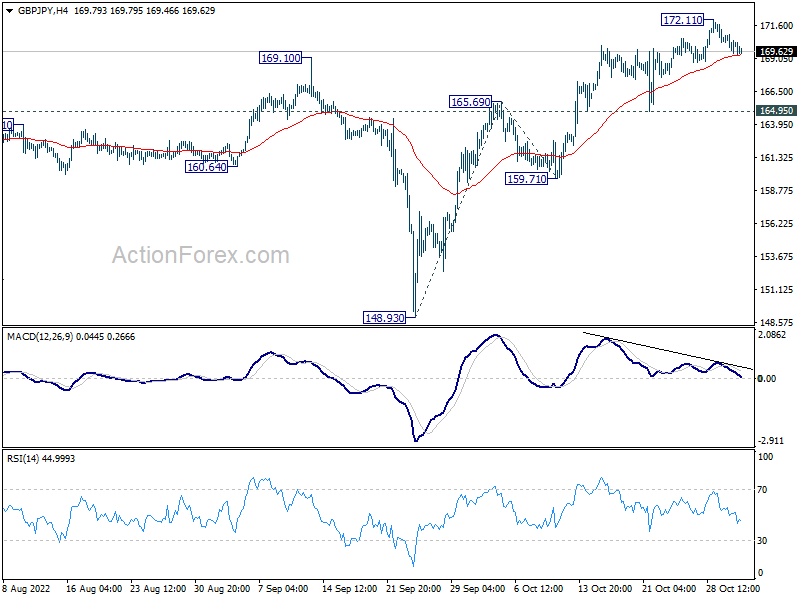
In the bigger picture, up trend from 123.94 (2020 low), as part of the trend from 122.75 (2016 low) is still in progress. Further rise would be seen to 161.8% projection of 122.75 to 156.59 (2018 high) from 123.94 at 178.69. This will now remain the favored case as long as 148.93 support holds.
EUR/JPY Daily Outlook
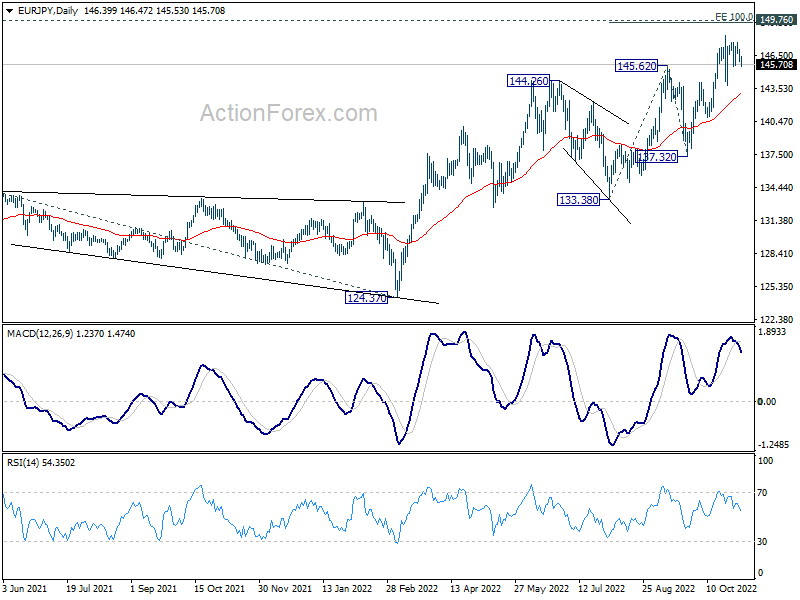
Daily Pivots: (S1) 145.87; (P) 146.49; (R1) 147.02; More....
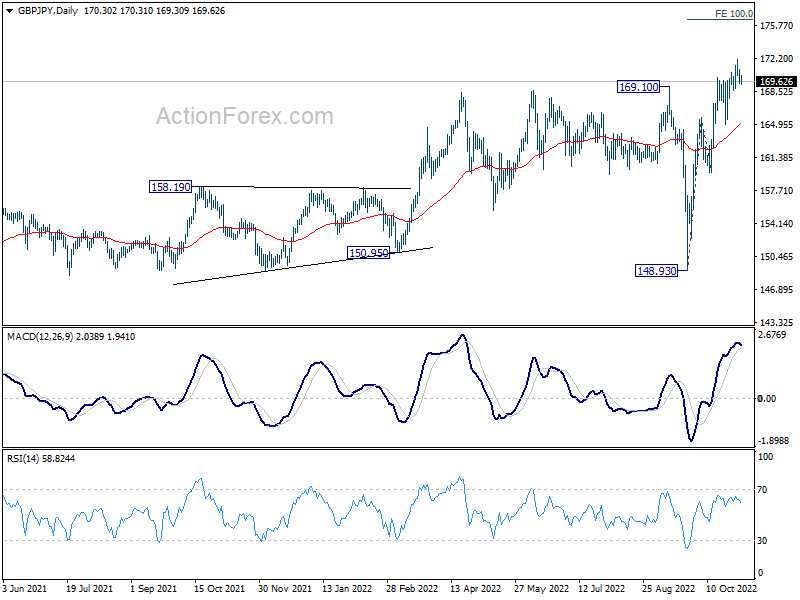
EUR/JPY is extending the consolidation from 148.38 and intraday bias remains neutral. In case of deeper fall, downside should be contained 140.88/144.06 support zone to bring another rally. Break of 148.38 will resume larger up trend to 100% projection of 133.38 to 145.62 from 137.32 at 149.56, which is close to 149.76 long term resistance.
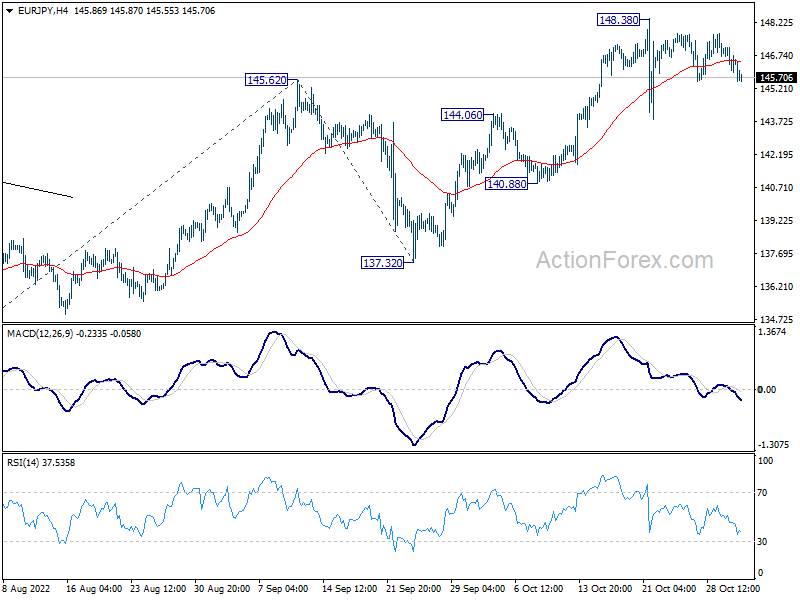
In the bigger picture, the up trend from 114.42 (2020 low) is still in progress for 149.76 (2014 high). Decisive break there will pave the way to 161.8% projection of 114.42 to 134.11 from 124.37 at 156.22. This will now remain the favored case as long as 137.32 support holds.
EUR/GBP Daily Outlook
Daily Pivots: (S1) 0.8590; (P) 0.8607; (R1) 0.8619; More...
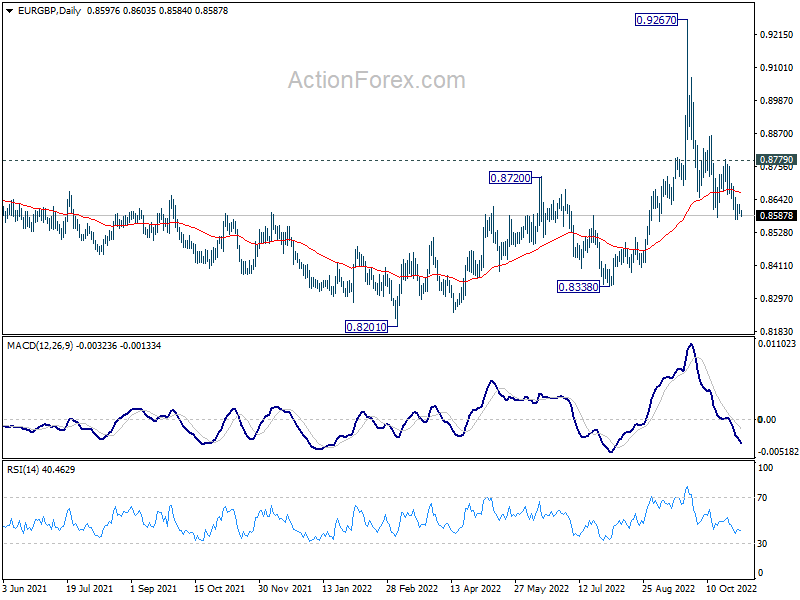
Near term outlook in EUR/GBP stays bearish with 0.8779 resistance intact. Current decline from 0.9267 should target 0.8201/8388 support zone. However, break of 0.8770 will turn bias back to the upside for 0.8869 resistance and above.
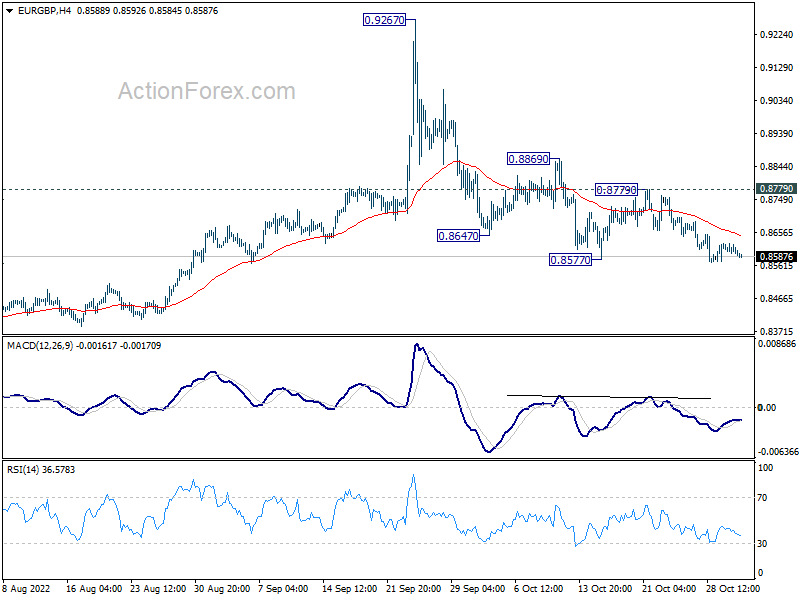
In the bigger picture, current development suggests that fall from 0.9267 is a down leg inside long term range pattern. Deeper fall could be seen towards 0.8201/8338 support zone. But strong support should be seen there to bring reversal.