Sample Category Title
EURJPY Wave Analysis
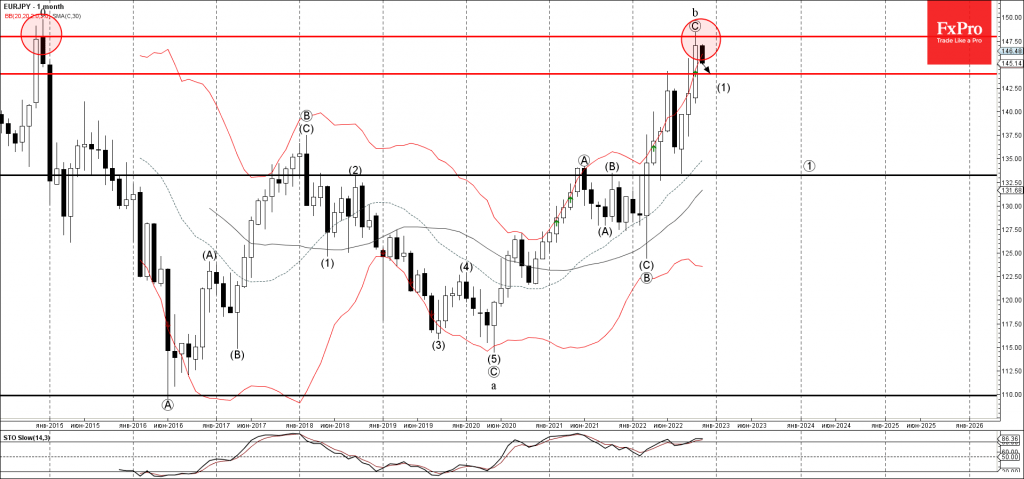
- EURJPY reversed from multi-year resistance level 148.00
- Likely to fall to support level 144.00
EURJPY currency pair recently reversed down from the multi-year resistance level 148.00 (which stopped the sharp uptrend in 2014), standing above the upper weekly Bollinger band.
The downward reversal from the resistance level 148.00 stopped the earlier sharp upward impulse wave (3) from January.
Given the strength of the resistance level 148.00 and the overbought weekly Stochastic, EURJPY can be expected to fall further toward the next support level 144.00 (which reversed the pair in the middle of this year).
FOMC press conference live stream
https://www.youtube.com/watch?v=-yiC8wZvzgQ
Fed hikes 75bps, will consider cumulative tightening and lags to determine next step
Fed hikes by 75bps to 3.75-4.00% as widely expected. Tightening bias is maintained as "the Committee anticipates that ongoing increases in the target range will be appropriate".
However, in the statement, Fed added, "in determining the pace of future increases in the target range, the Committee will take into account the cumulative tightening of monetary policy, the lags with which monetary policy affects economic activity and inflation, and economic and financial developments."
The additional language suggests that Fed might be ready to slow down the pace of tightening ahead.
(FED) Federal Reserve Issues FOMC Statement
Recent indicators point to modest growth in spending and production. Job gains have been robust in recent months, and the unemployment rate has remained low. Inflation remains elevated, reflecting supply and demand imbalances related to the pandemic, higher food and energy prices, and broader price pressures.
Russia's war against Ukraine is causing tremendous human and economic hardship. The war and related events are creating additional upward pressure on inflation and are weighing on global economic activity. The Committee is highly attentive to inflation risks.
The Committee seeks to achieve maximum employment and inflation at the rate of 2 percent over the longer run. In support of these goals, the Committee decided to raise the target range for the federal funds rate to 3-3/4 to 4 percent. The Committee anticipates that ongoing increases in the target range will be appropriate in order to attain a stance of monetary policy that is sufficiently restrictive to return inflation to 2 percent over time. In determining the pace of future increases in the target range, the Committee will take into account the cumulative tightening of monetary policy, the lags with which monetary policy affects economic activity and inflation, and economic and financial developments. In addition, the Committee will continue reducing its holdings of Treasury securities and agency debt and agency mortgage-backed securities, as described in the Plans for Reducing the Size of the Federal Reserve's Balance Sheet that were issued in May. The Committee is strongly committed to returning inflation to its 2 percent objective.
In assessing the appropriate stance of monetary policy, the Committee will continue to monitor the implications of incoming information for the economic outlook. The Committee would be prepared to adjust the stance of monetary policy as appropriate if risks emerge that could impede the attainment of the Committee's goals. The Committee's assessments will take into account a wide range of information, including readings on public health, labor market conditions, inflation pressures and inflation expectations, and financial and international developments.
Voting for the monetary policy action were Jerome H. Powell, Chair; John C. Williams, Vice Chair; Michael S. Barr; Michelle W. Bowman; Lael Brainard; James Bullard; Susan M. Collins; Lisa D. Cook; Esther L. George; Philip N. Jefferson; Loretta J. Mester; and Christopher J. Waller.
Still Strong US Labour Market
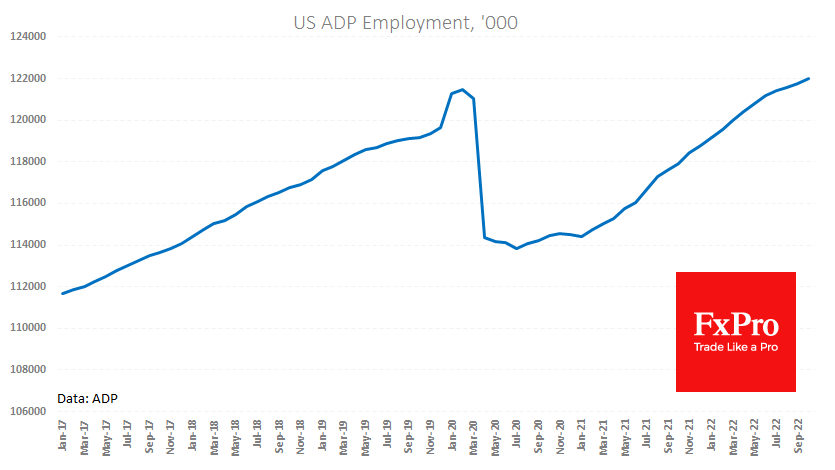
Fresh ADP estimates noted a 239K increase in US employment in October, showing more substantial job growth than in September (192k), contrary to the expected slowdown to 178K. This data primarily guides traders as the most similar indicator before the official release is publicised on Friday.
The ADP estimated that manufacturing cut 20K jobs, the first reaction to higher interest rates and a strong dollar. Meanwhile, mining and construction created jobs (+11K and +1K, respectively). The services sector was producing jobs in recreation (+210K), trade and transportation (+84K), while information (-17K), financial (-10K) and professional services (-14K) declined.
Earlier in the week, there was an unexpected rise in vacancies of 437K in September, the first increase after five months of decline. At the same time, the global vacancy rate remains by a large margin at abnormally high levels.
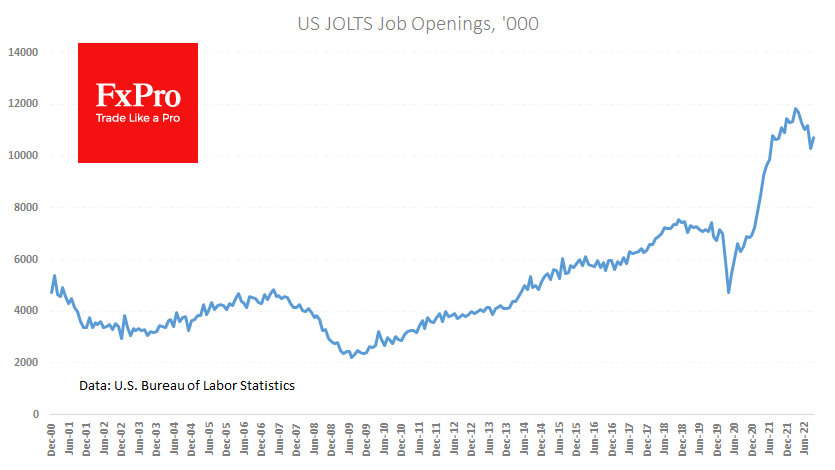
The market reaction, however, was much more subdued than the figures suggested, as all attention is now focused on the Fed’s rate decision and the accompanying commentary later today. However, this data is an indirect and early warning of the labour market’s strength, to which the Fed is now paying so much attention. A solid rise in employment could be an early warning that we should not expect the Fed to soften its tone and slow the pace of rate hikes from the next meeting (the markets fully account for the 75-point hike).
EURGBP Stays Below the Lower Bound of a Range
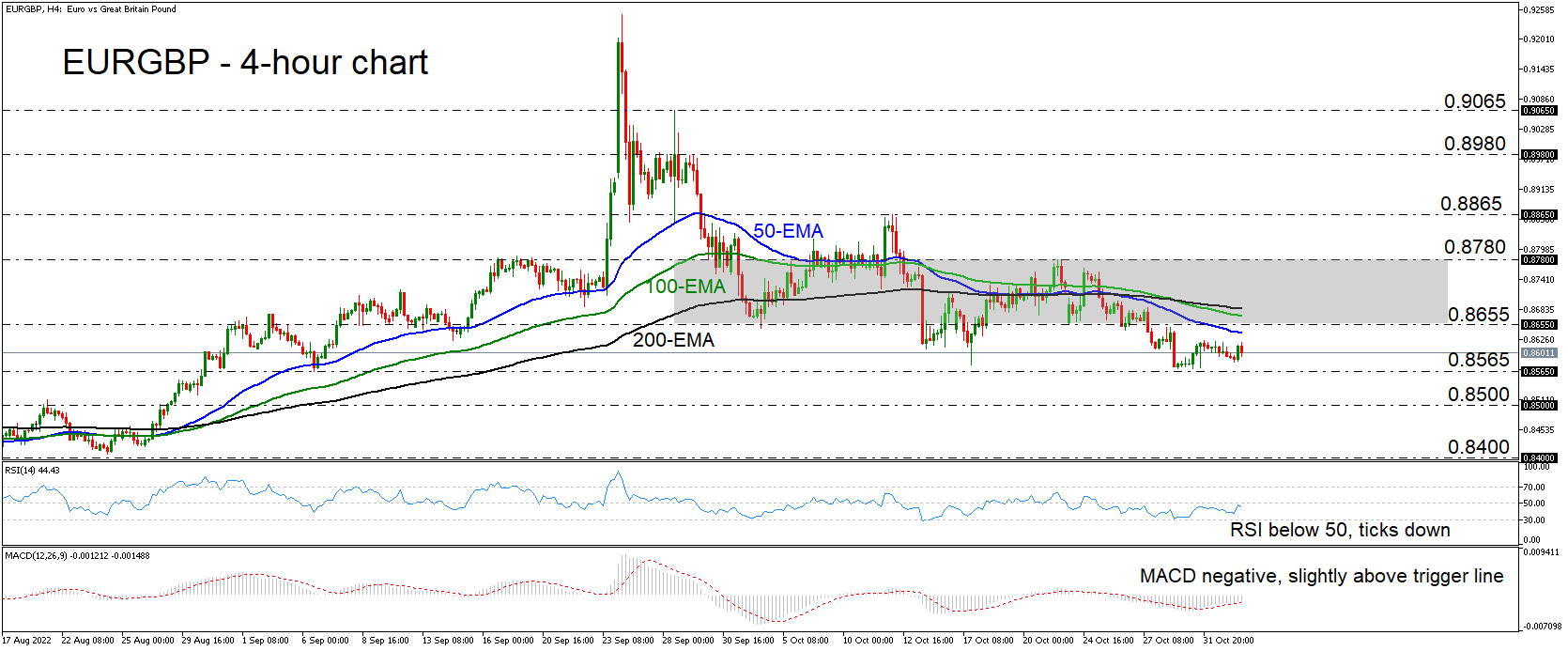
EURGBP has been trading in a consolidative manner recently, staying above the 0.8565 support level, marked by the low of September 6, but also below the lower boundary of the sideways range that contained most of the price action between October 3 and 27. This suggests a cautiously negative short-term outlook and the fact that the pair is trading below all three of the plotted exponential moving averages adds extra credence to that view.
The RSI ticked down after it hit resistance near 50, while the MACD is lying within its negative territory and appears ready to cross below its trigger line soon. Both indicators are pointing to negative momentum and are supporting the notion of renewed selling in EURGBP.
A clear dip below 0.8565 would confirm a lower low on the 4-hour chart and could initially aim for the psychological zone of 0.8500, which is slightly below the inside swing high of August 19. If there are no buyers to be found around there, a break lower could extend the fall towards the 0.8400 territory, which acted as a floor during the whole month of August.
The move signaling that the bulls have stolen all the bears’ swords may be a break above 0.8780, which is the upper boundary of the aforementioned range. In such a case, the pair could advance to the 0.8865 zone, marked by the highs of October 11 and 12, the break of which could set the stage for a rally towards the 0.8980 territory, defined as resistance by the high of September 29.
To wrap up, EURGBP has been trading in a quiet manner recently, staying below the lower bound of a prior sideways range. A break below 0.8565 would confirm a lower low and perhaps the bears’ supremacy.
USD/JPY Mid-Day Outlook
Daily Pivots: (S1) 147.21; (P) 148.02; (R1) 149.04; More...
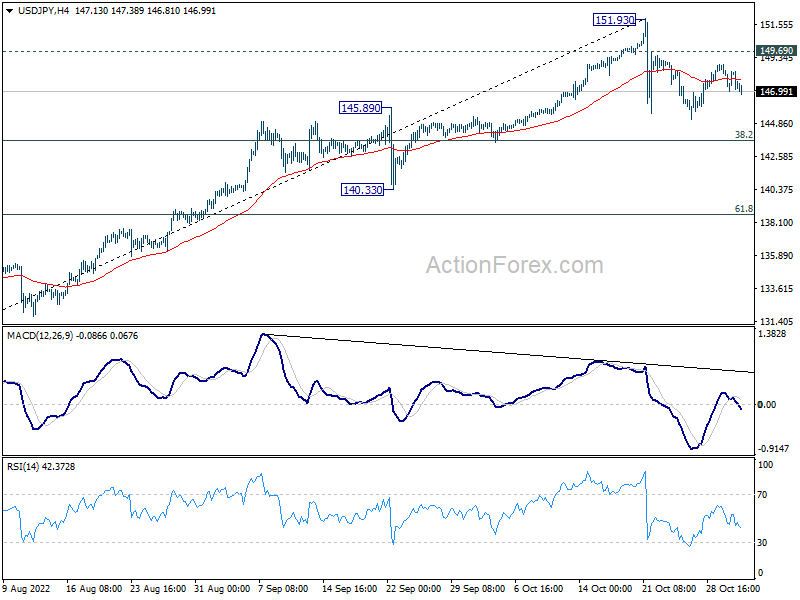
Outlook in USD/JPY is unchanged as consolidation from 151.93 is extending. Intraday bias remains neutral. Deeper decline cannot be ruled out, but downside should be contained by 38.2% retracement of 130.38 to 151.93 at 143.69 to bring rebound. On the upside, above 149.69 minor resistance will bring stronger rebound back towards 151.93 high. But upside should be limited there to continue the corrective pattern.
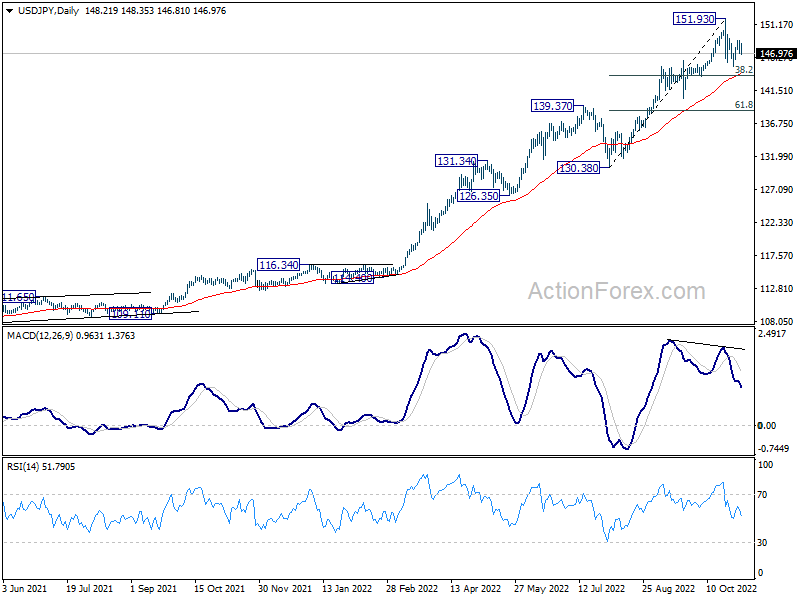
In the bigger picture, up trend from 101.18 is still in progress, as part of the whole up trend from 75.56 (2011 low). 147.68 (1998 high) was already met and there is no clearly sign of topping yet. In any case, break of 140.33 support is needed to be the first sign of medium term topping. Otherwise, further rise is in favor to next target at 160.16 (1990 high).
USD/CHF Mid-Day Outlook
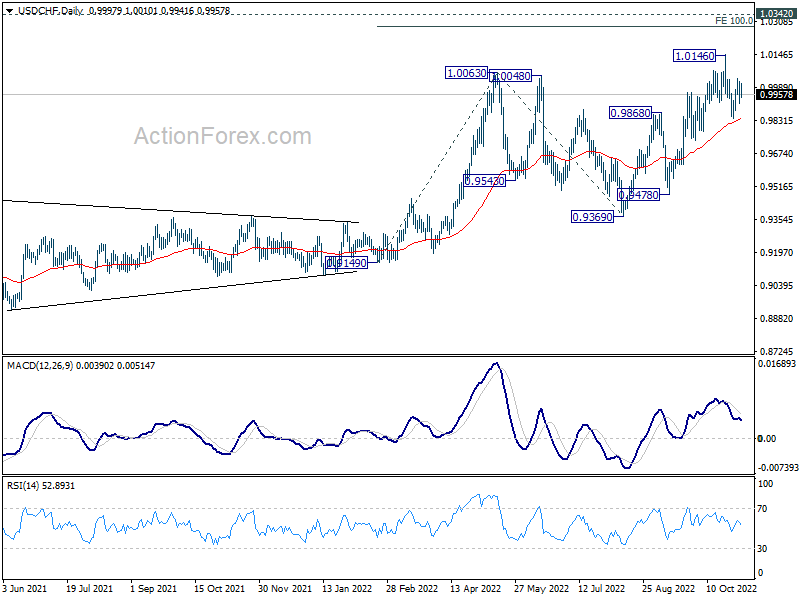
Daily Pivots: (S1) 0.9937; (P) 0.9980; (R1) 1.0044; More...
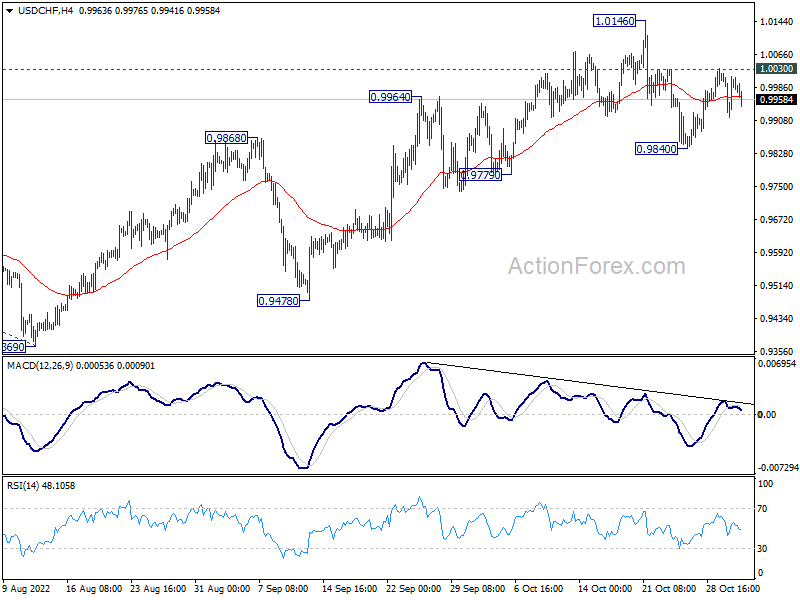
Outlook in USD/CHF is unchanged and intraday bias stays neutral for the moment. On the upside, break of 1.0030 minor resistance will suggest that pull back from 1.0146 has completed at 0.9840. Bias will be back on the upside for retesting 1.0146. Firm break there will resume larger up trend to 1.0283 projection level. However, break of 0.9840 support will now be a sign of reversal, and bring deeper decline back to 0.9779 support instead.
In the bigger picture, current development suggests that up trend from 0.8756 (2021 low) is still in progress. Next target is 100% projection of 0.9149 to 1.0063 from 0.9369 at 1.0283, and then 1.0342 (2016 high). For now, this will remain the favored case as long as 0.9779 support holds, even in case of deep pull back.
GBP/USD Mid-Day Outlook
Daily Pivots: (S1) 1.1425; (P) 1.1495; (R1) 1.1553; More...
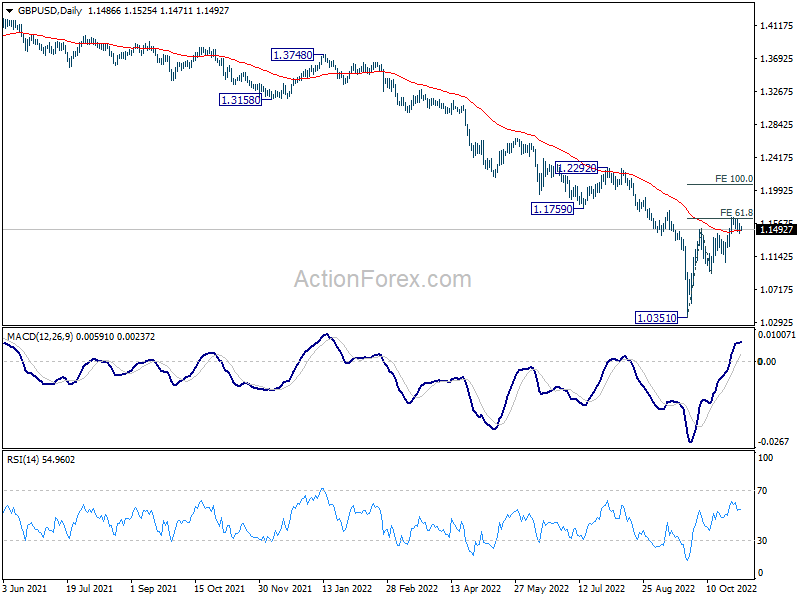
No change in GBP/USD's outlook as consolidation from 1.1664 continues. Intraday bias remains neutral at this point. With 1.1256 minor support intact, further rally is expected. On the upside, break of 1.1644 will resume rise from 1.0351 to 100% projection of 1.0351 to 1.1494 from 1.0922 at 1.2065. However, break of 1.1256 will turn bias back to the downside for 1.0922 support and below.
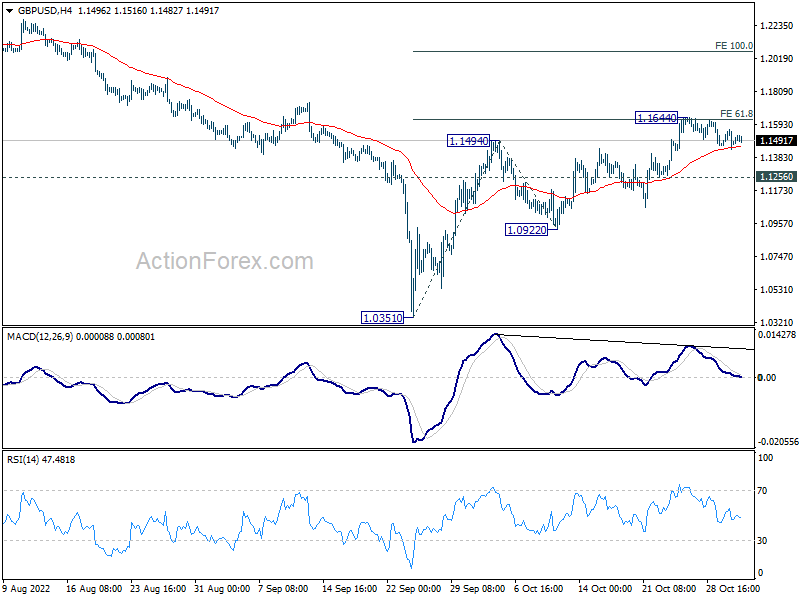
In the bigger picture, fall from 1.4248 (2018 high) is part of the long term down trend from 2.1161 (2007 high). Outlook will stay bearish as long as 1.1759 support turned resistance holds. Parity would be the next target on resumption. Nevertheless, firm break of 1.1759 will confirm medium term bottoming, and open up stronger rise back to 55 week EMA (now at 1.2392).