

Sample Category Title
AUD/USD Daily Report
Daily Pivots: (S1) 0.6301; (P) 0.6396; (R1) 0.6446; More...
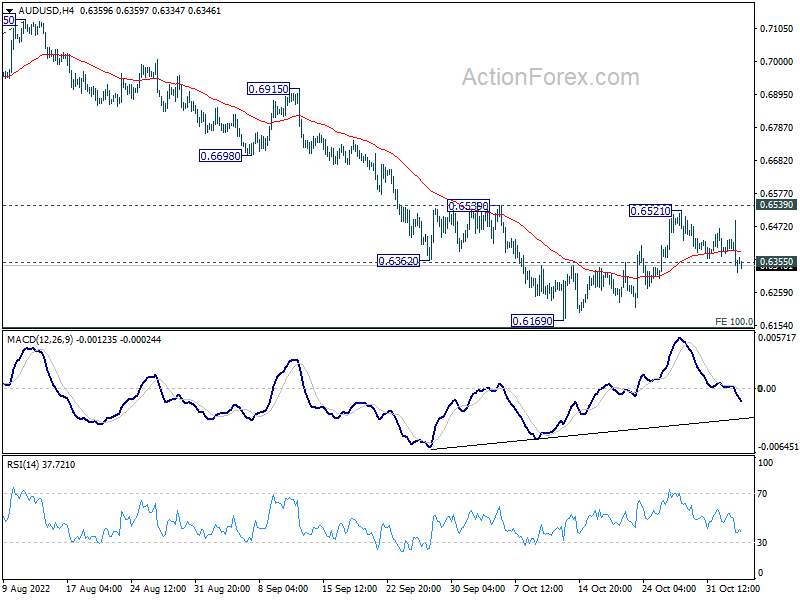
AUD/USD's break of 0.6355 minor support suggests that corrective recovery from 0.6169 has completed at 0.6521, missing 0.6539 resistance. Rejection by falling 55 day EMA maintains near term bearishness. Intraday bias is back on the downside for retesting 0.6169. Firm break there will resume larger down trend to 138.2% projection of 0.7660 to 0.6680 from 0.7135 at 0.5781.For now, risk will stay on the downside as long as 0.6539 resistance holds.
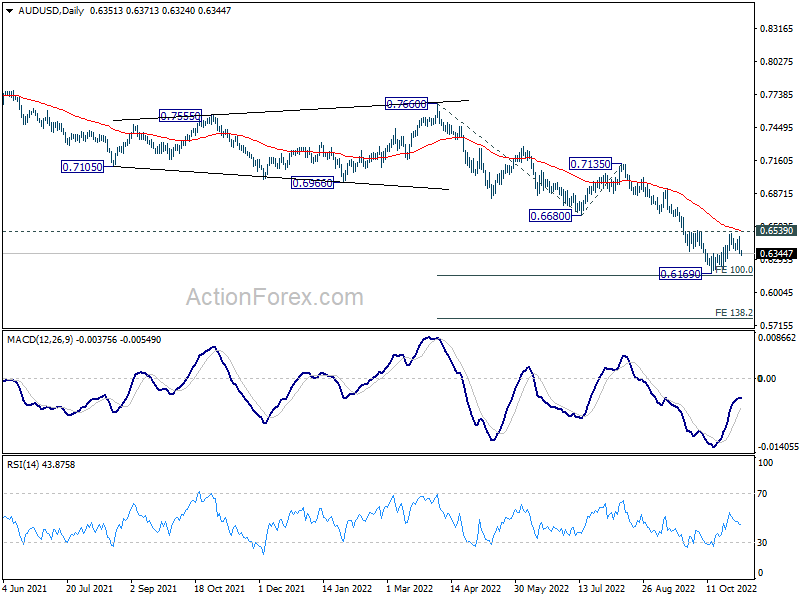
In the bigger picture, down trend form 0.8006 (2021 high) is expected to continue as long as 0.6680 support turned resistance holds. Medium term momentum remains strong and retest of 0.5506 (2020 low) cannot be ruled out. But firm break of 0.6680 will be the first sign of reversal, and bring stronger rebound back to 0.7135 resistance.
Dollar Surged as Fed Powell Indicated Higher Terminal Rate, BoE Next
After initial jitters, Dollar rose broadly overnight as Fed Chair Jerome Powell indicated the possibility of higher terminal rate in the current tightening cycle. US stocks ended notably lower and risk-off sentiment carried on in Asian session. Yen is also rising on risk aversion. Nevertheless, markets are taking a breather for now, with focus firstly turned to BoE rate decision today. Besides, ISM services in US session, as well as non-farm payroll employment data tomorrow has the potential to trigger more volatility.
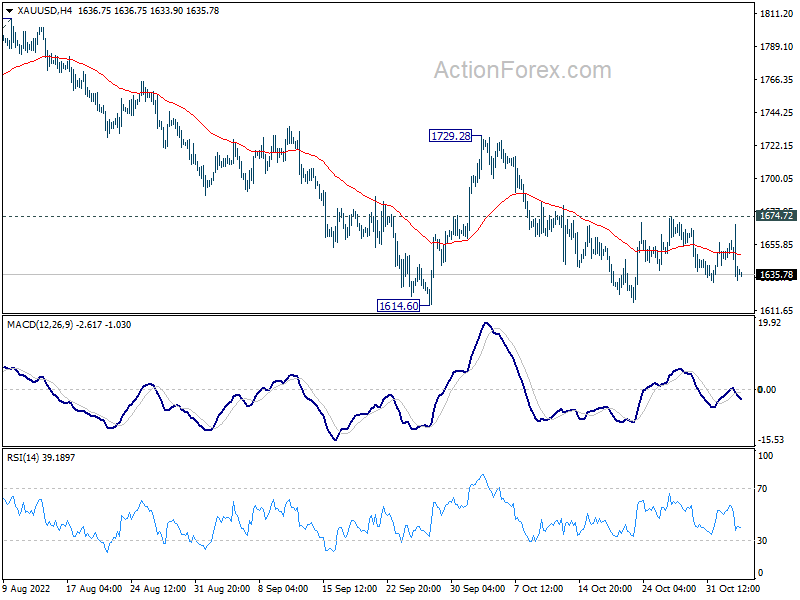
Technically, the breaks of 0.9847 minor support in EUR/USD, 0.6355 minor support in AUD/USD, and 1.0030 minor resistance in USD/CHF suggest Dollar buying in coming back. Gold, too, might be heading back to 1614.60 low as recovery faltered at 1674.72, and even a break there, if Dollar builds up more upside momentum.
In Asia, at the time of writing, Hong Kong HSI is down -2.70%. Chin Shanghai SSE is down -0.10%. Singapore Strait Times is down -1.24%. Japan is on holiday. Overnight, DOW dropped -1.55%. S&P 500 dropped -2.50%. NASDAQ dropped -3.36%. 10-year yield rose 0.007 to 4.059, after dipping to 3.976.
NASDAQ ready for down trend resumption after hawkish Fed Powell
US stocks initially jumped after Fed hinted in the statement that pace of tightening could slow ahead. But sentiment reversed after Fed chair Jerome Powell indicated that slower pace of hikes might come soon, Fed could end up at a higher terminal rate.
In short, comparing to last statement, Fed added, "in determining the pace of future increases in the target range, the Committee will take into account the cumulative tightening of monetary policy, the lags with which monetary policy affects economic activity and inflation, and economic and financial developments." This is clearly an indication that Fed is going to consider adjusting the pace of interest rate increases.
In the post-meeting press conference, Powell acknowledged, "As we come closer to that level and move further into restrictive territory, the question of speed becomes less important. ... And that's why I've said at the last two press conferences that at some point it will be important to slow the pace of increases. So that time is coming, and it may come as soon as the next meeting or the one after that. No decision has been made."
However, "incoming data since our last meeting suggests that the ultimate level of interest rates will be higher than previously expected," indicating the possibility of higher terminal rate. Also, Powell noted, "It is very premature to be thinking about pausing. People when they hear 'lags' think about a pause. It is very premature, in my view, to think about or be talking about pausing our rate hikes. We have a ways to go."
More on Fed:
- Fed Review: Another Hawkish 75bp Hike – We Now Expect 50bp also in February
- FOMC Signals a Slower Pace of Tightening Ahead, Although It Is Not Yet Done
- FOMC Short: Dovish Statement, Hawkish Powell
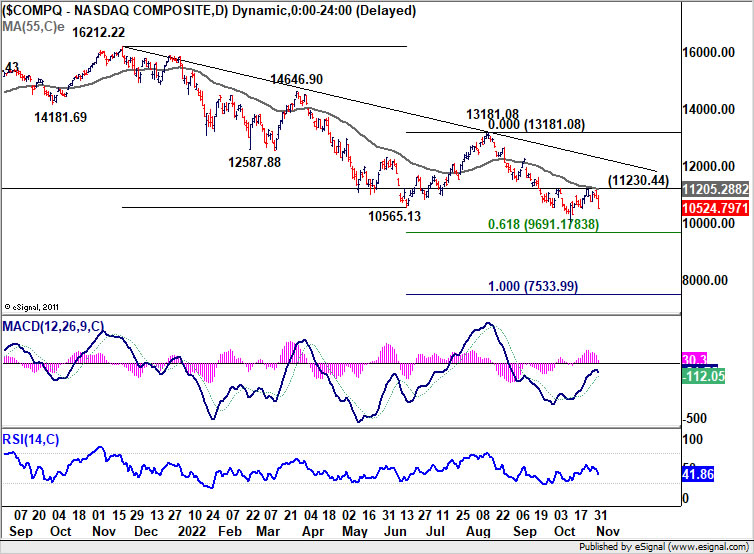
Major US stock indexes closed lower, with development of NASDAQ particularly bearish. Yesterday's decline suggests rejection by 11230.44 resistance, as well ass 55 day EMA. The fall could be setting up resumption of the whole down trend from 16212.22. Next target will be 61.8% projection of 16212.22 to 10565.13 from 13181.08 at 9691.17. Reaction from there, which is close to 10000 psychological level, will be crucial for the development in the early half of next year.
BoE to hike 75bps, some previews
BoE is widely expected to raise interest rate by 75bps to 3.00% today. That would be the eighth consecutive rate rise, and the largest since 1989.
Governor Andrew Andrew Bailey had already indicated earlier that "inflationary pressures will require a stronger response than we perhaps thought in August." Additionally, Deputy Governor Ben Broadbent also indicated that "the government's Energy Price Guarantee has the effect of limiting headline inflation and, to that extent, any related strengthening of second-round (and more persistent) effects on domestic inflation."
There are talks that the Bank Rate would hit 3.50% in December, and tightening will continue to 4.75% next May. Yet, the path forward remains complicated by the uncertainty over the new government's new budget. Prime Minister Rishi Sunak's plan on spending cut and tax hike won't be revealed until a fiscal statement later on November 17. While the new economic projections by BoE may not matter much, the voting today could at least show the bias among MPC members.
Some previews on BoE:
- Bank of England Might Disappoint Amid Uncertainties about the Budget
- BoE Preview: A Dovish 75bp Hike
- Bank of England Preview
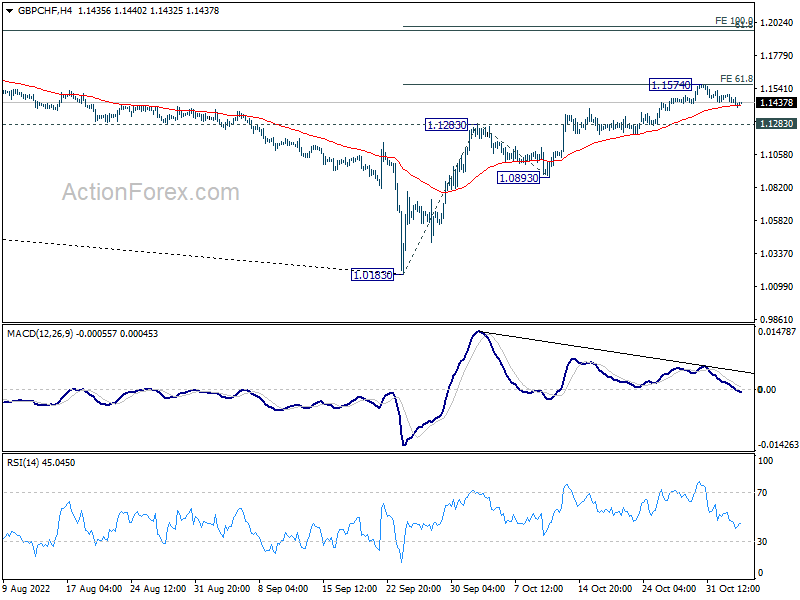
As per market reaction, GBP/CHF would be one to watch. Rise from 1.0183 stalled after hitting 61.8% projection of 1.0183 to 1.1283 from 1.0893 at 1.1574. For now, further rise is expected as long as 1.1283 resistance turned support holds. Firm break of 1.1574 will target 100% projection at 1.1993.
However, sustained break of 1.1283 will argue that whole rebound has completed, and bring deeper fall back to 1.0893 support and possibly below. If happens, that could be a signal of return of Sterling selloff elsewhere.
RBNZ Orr: Significant shocks still arriving through the global economy
RBNZ Governor Adrian Orr told a parliamentary committee that the central bank has "laser-like focus" on bringing inflation down to target. Yet, he admitted that, "the (inflationary) shocks still arriving through the global economy are significant and this is where people need to think about their own ability to weather an enormous amount of unanticipated activities."
"Meanwhile around our confidence of having inflation under control – that is very high, because we control the end outcome through the interest rate environment. So, that's a guessing game. That's about the things we will have to do to achieve low and stable inflation, subject to the continuing buffering of shocks left right and centre. Resilience and humility," he added.
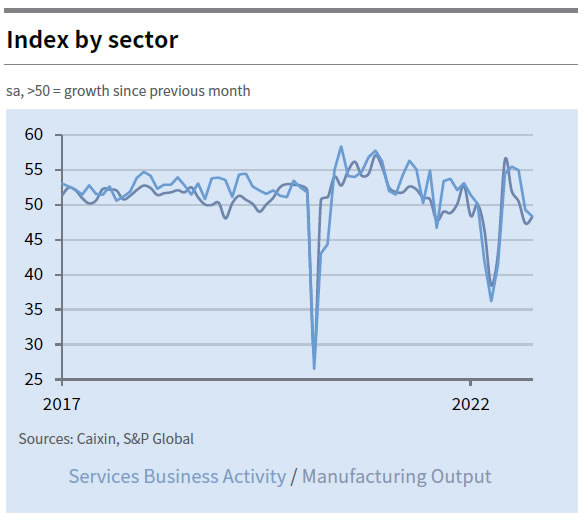
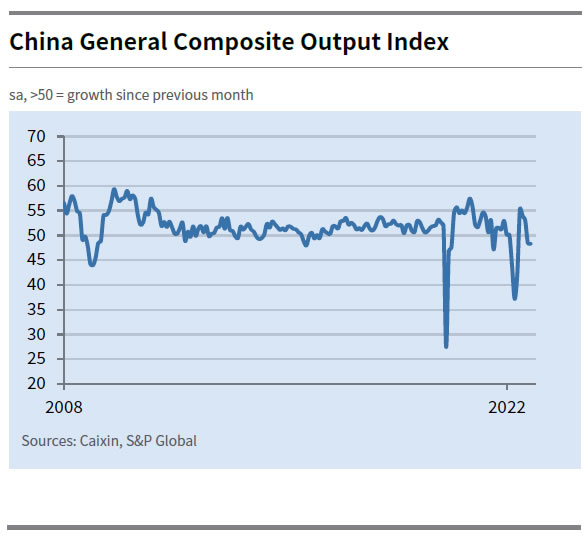
China Caixin PMI services dropped to 48.4, lowest since May
China Caixin PMI Services dropped from 49.3 to 48.4 in October, below expectation of 49.2. PMI Composite dropped from 48.5 to 48.3. Both were the lowest readings since May.
Wang Zhe, Senior Economist at Caixin Insight Group said: "Both supply and demand contracted to different degrees. The overall employment level increased slightly thanks to an expansion in employment of the services sector. Input costs for all surveyed enterprises rose slightly, while prices charged remained stable. Market sentiment improved but was still below the long-term average.
"Overall, the negative impact of Covid controls on the economy lingered, and the economy was faced with increasing downward pressure. In October, activities in the manufacturing and services sectors continued to shrink, while supply and both domestic and overseas demand contracted. Business costs increased. Service providers were in a better position than manufacturers in terms of prices charged and employment."
Looking ahead
Swiss CPI, UK services PMI final, and Eurozone unemployment rate will be released in European session. Canada will release building permits and trade balance. US will release trade balance, jobless claims ISM services and factory orders.
AUD/USD Daily Report
Daily Pivots: (S1) 0.6301; (P) 0.6396; (R1) 0.6446; More...
AUD/USD's break of 0.6355 minor support suggests that corrective recovery from 0.6169 has completed at 0.6521, missing 0.6539 resistance. Rejection by falling 55 day EMA maintains near term bearishness. Intraday bias is back on the downside for retesting 0.6169. Firm break there will resume larger down trend to 138.2% projection of 0.7660 to 0.6680 from 0.7135 at 0.5781.For now, risk will stay on the downside as long as 0.6539 resistance holds.
In the bigger picture, down trend form 0.8006 (2021 high) is expected to continue as long as 0.6680 support turned resistance holds. Medium term momentum remains strong and retest of 0.5506 (2020 low) cannot be ruled out. But firm break of 0.6680 will be the first sign of reversal, and bring stronger rebound back to 0.7135 resistance.
Economic Indicators Update
| GMT | Ccy | Events | Actual | Forecast | Previous | Revised |
|---|---|---|---|---|---|---|
| 00:30 | AUD | Trade Balance (AUD) Sep | 12.44B | 9.00B | 8.32B | 8.66B |
| 01:45 | CNY | Caixin Services PMI Oct | 48.4 | 49.2 | 49.3 | |
| 07:30 | CHF | CPI M/M Oct | 0.20% | -0.20% | ||
| 07:30 | CHF | CPI Y/Y Oct | 3.20% | 3.30% | ||
| 09:30 | GBP | Services PMI Oct F | 47.5 | 47.5 | ||
| 10:00 | EUR | Eurozone Unemployment Rate Sep | 6.60% | 6.60% | ||
| 11:30 | USD | Challenger Job Cuts Y/Y Oct | 67.60% | |||
| 12:00 | GBP | BoE Interest Rate Decision | 3.00% | 2.25% | ||
| 12:00 | GBP | MPC Official Bank Rate Votes | 9--0--0 | 9--0--0 | ||
| 12:30 | CAD | Building Permits M/M Sep | -4.90% | 11.90% | ||
| 12:30 | CAD | Trade Balance (CAD) Sep | 1.1B | 1.5B | ||
| 12:30 | USD | Trade Balance (EU) Sep | -70.3B | -67.4B | ||
| 12:30 | USD | Initial Jobless Claims (Oct 28) | 215K | 217K | ||
| 12:30 | USD | Nonfarm Productivity Q3 P | -0.10% | -4.10% | ||
| 12:30 | USD | Unit Labor Costs Q3 P | 4.00% | 10.20% | ||
| 13:45 | USD | Services PMI Oct F | 46.6 | 46.6 | ||
| 14:00 | USD | ISM Services PMI Oct | 55.2 | 56.7 | ||
| 14:00 | USD | Factory Orders M/M Sep | 0.30% | 0.00% | ||
| 14:30 | USD | Natural Gas Storage | 99B | 52B |
BoE to hike 75bps, some previews
BoE is widely expected to raise interest rate by 75bps to 3.00% today. That would be the eighth consecutive rate rise, and the largest since 1989.
Governor Andrew Andrew Bailey had already indicated earlier that "inflationary pressures will require a stronger response than we perhaps thought in August." Additionally, Deputy Governor Ben Broadbent also indicated that "the government's Energy Price Guarantee has the effect of limiting headline inflation and, to that extent, any related strengthening of second-round (and more persistent) effects on domestic inflation."
There are talks that the Bank Rate would hit 3.50% in December, and tightening will continue to 4.75% next May. Yet, the path forward remains complicated by the uncertainty over the new government's new budget. Prime Minister Rishi Sunak's plan on spending cut and tax hike won't be revealed until a fiscal statement later on November 17. While the new economic projections by BoE may not matter much, the voting today could at least show the bias among MPC members.
Some previews on BoE:
- Bank of England Might Disappoint Amid Uncertainties about the Budget
- BoE Preview: A Dovish 75bp Hike
- Bank of England Preview
As per market reaction, GBP/CHF would be one to watch. Rise from 1.0183 stalled after hitting 61.8% projection of 1.0183 to 1.1283 from 1.0893 at 1.1574. For now, further rise is expected as long as 1.1283 resistance turned support holds. Firm break of 1.1574 will target 100% projection at 1.1993.
However, sustained break of 1.1283 will argue that whole rebound has completed, and bring deeper fall back to 1.0893 support and possibly below. If happens, that could be a signal of return of Sterling selloff elsewhere.
Technical Outlook and Review
USD/JPY:
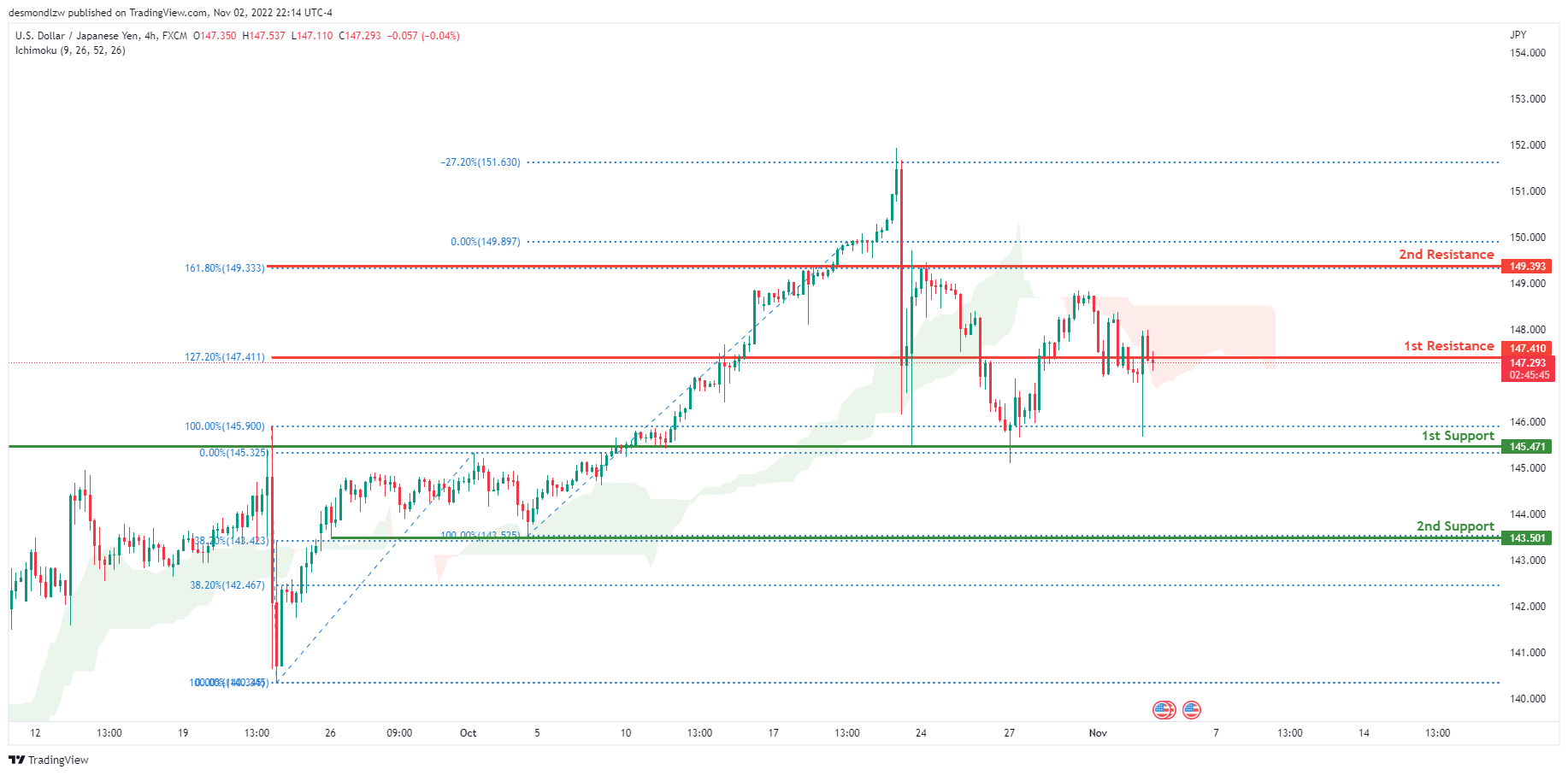
The current general bias for USDJPY on the H4 chart is bearish. Overnight, USDJPY experienced increased volatility due to the FOMC news release at 2am New York time, with price closing under the 1st resistance line at 147.410 where the 127.2% Fibonacci extension line is located. Price is currently trading at 147.256 at time of writing. If this bearish momentum continues, expect USDJPY to possibly head downwards towards the 1st support at 145.751 where the 100% and 0% Fibonacci lines are located.
Areas of consideration:
- H4 time frame, 1st resistance at 147.410
- H4 time frame, 1st support at 145.751
DXY:
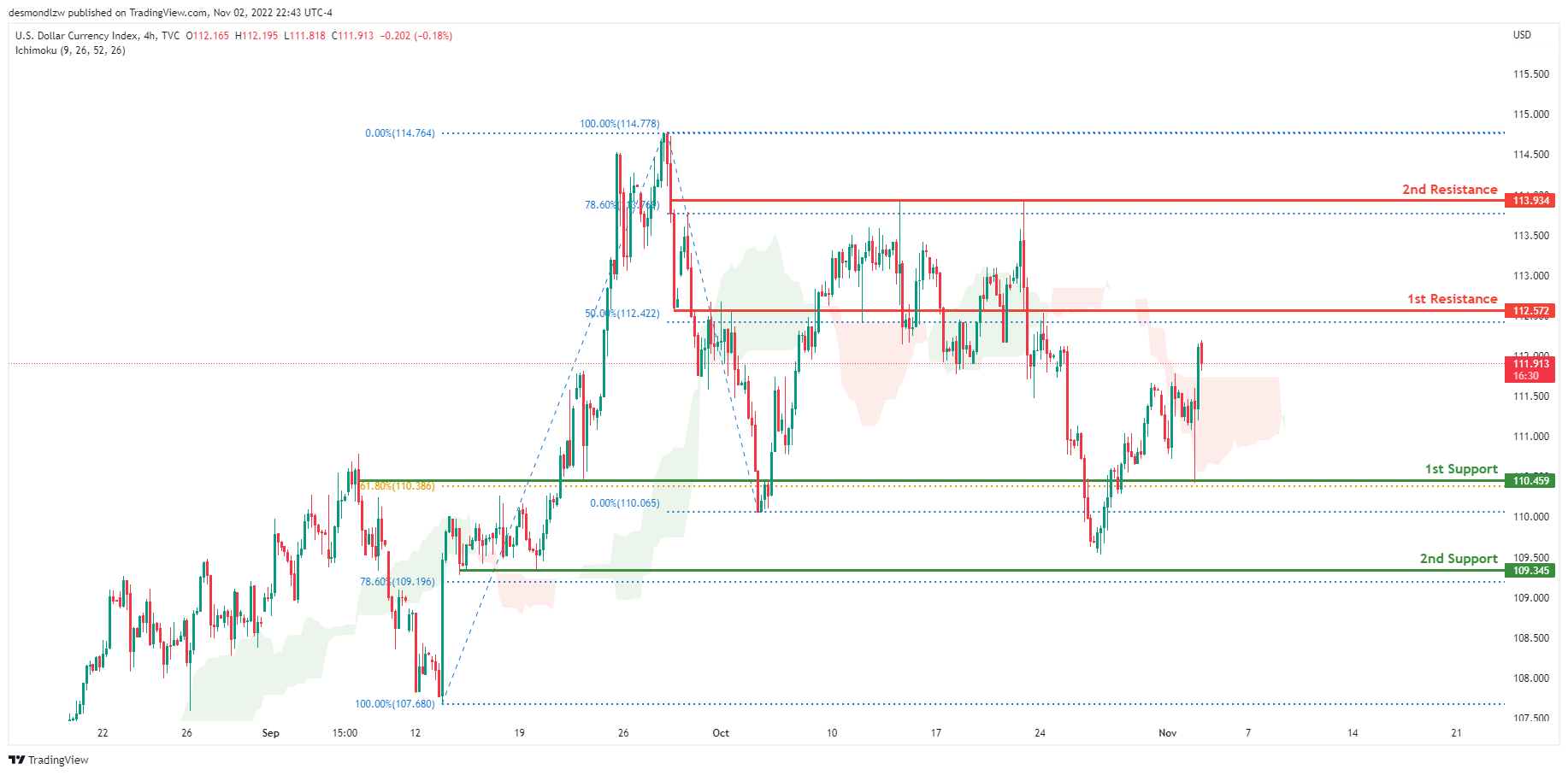
On the H4 chart, the overall bias for DXY is bullish. To add confluence to this, the price is above the Ichimoku cloud which indicates a bullish market. Overnight, price experienced increased volatility due to the release of the FOMC news with price reflecting off the 1st support at 110.459, where the 61.8% Fibonacci line is located strongly. The price is currently trading at 111.931 at time of writing. If this bullish momentum continues, expect price to possibly head towards the 1st resistance level at 112.572 where the 50% Fibonacci line is located.
Areas of consideration:
- H4 time frame, 1st resistance at 112.572
- H4 time frame, 1st support at 110.459
EUR/USD:
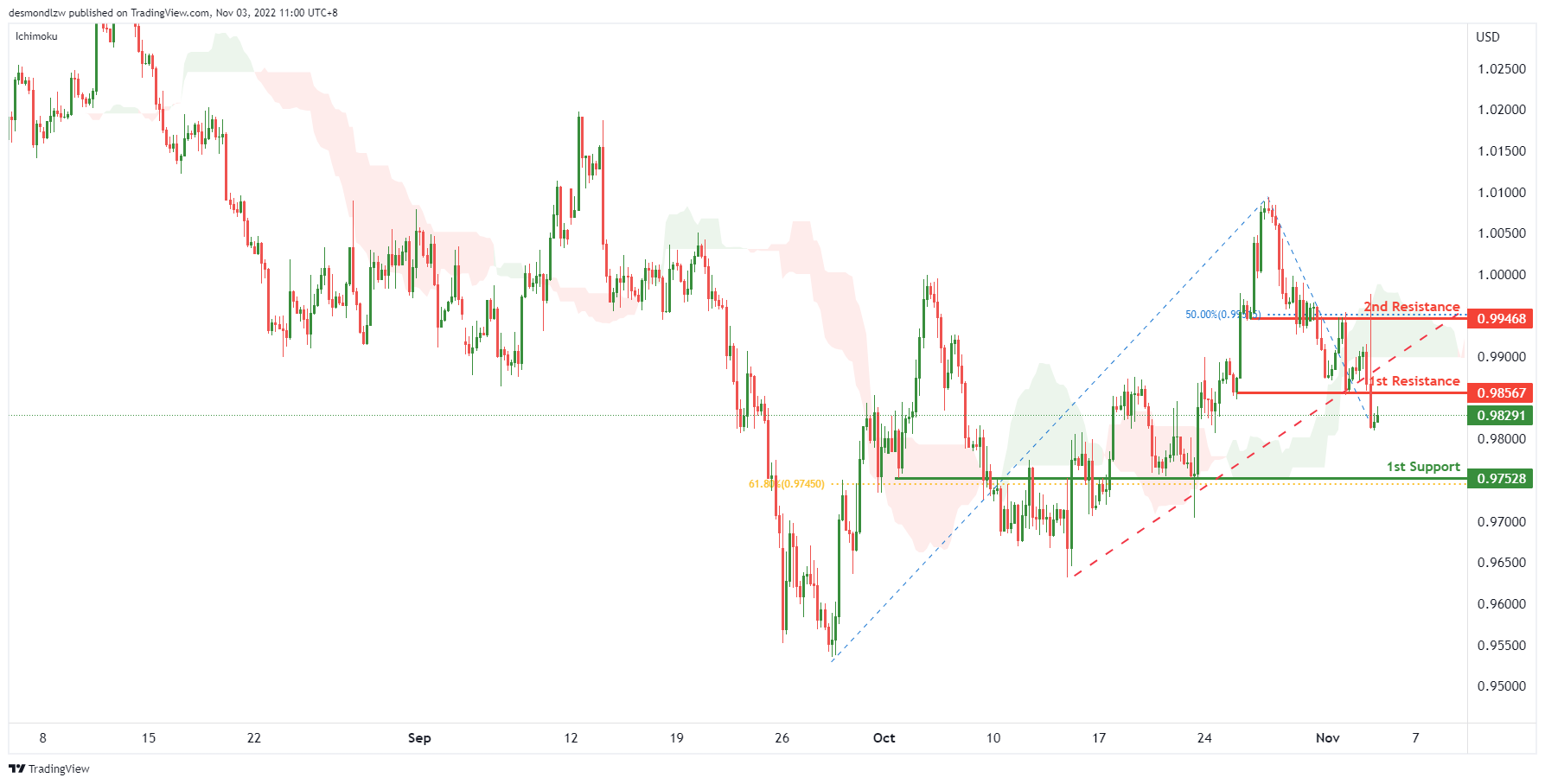
On the H4, with the price breaking the ascending trendline and ichimoku cloud, we have a bearish bias that the price may drop from the 1st resistance at 0.98567, which is in line with the swing lows to the 1st support at 0.97528, where the overlap support and 61.8% fibonacci retracement are. Alternatively, the price may rise to the 2nd resistance at 0.99468, where the 50% fibonacci retracement and overlap resistance are.
Areas of consideration :
- H4 1st resistance at 0.98567
- H4 1st support at 0.97528
GBP/USD:
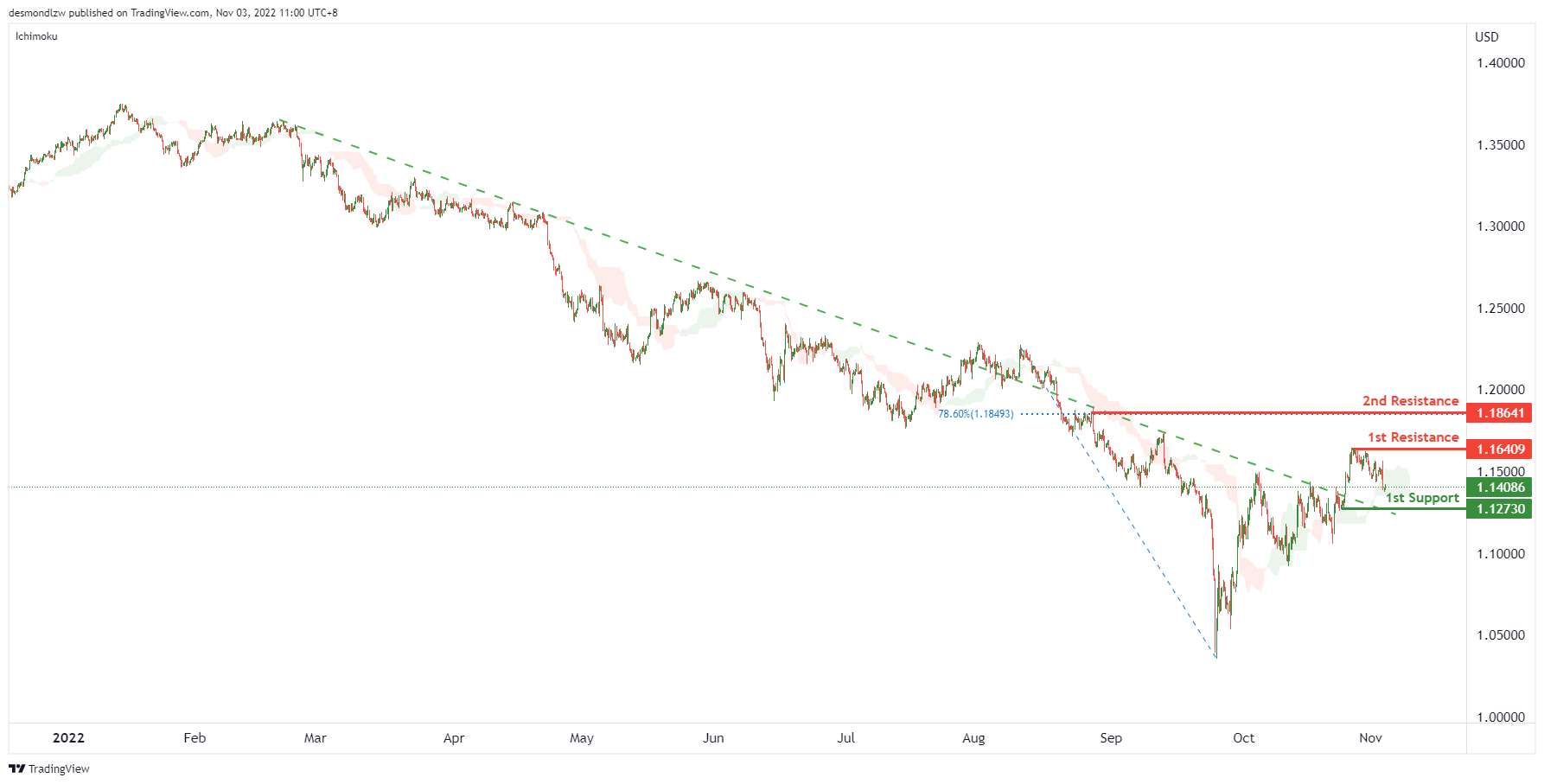
On the H4, price is above the ichimoku cloud and breaking the descending trendline, we have a bullish bias that the price may test the 1st resistance at 1.16409, which is in line with the previous swing high. If the 1st resistance is broken, the 2nd resistance is at 1.18641, where the 78.6% fibonacci retracement sits. Alternatively, the price may drop to the 1st support at 1.12730, where the swing low support is.
Areas of consideration:
- H4 current price
- H4 1st resistance at 1.16409
USD/CHF:
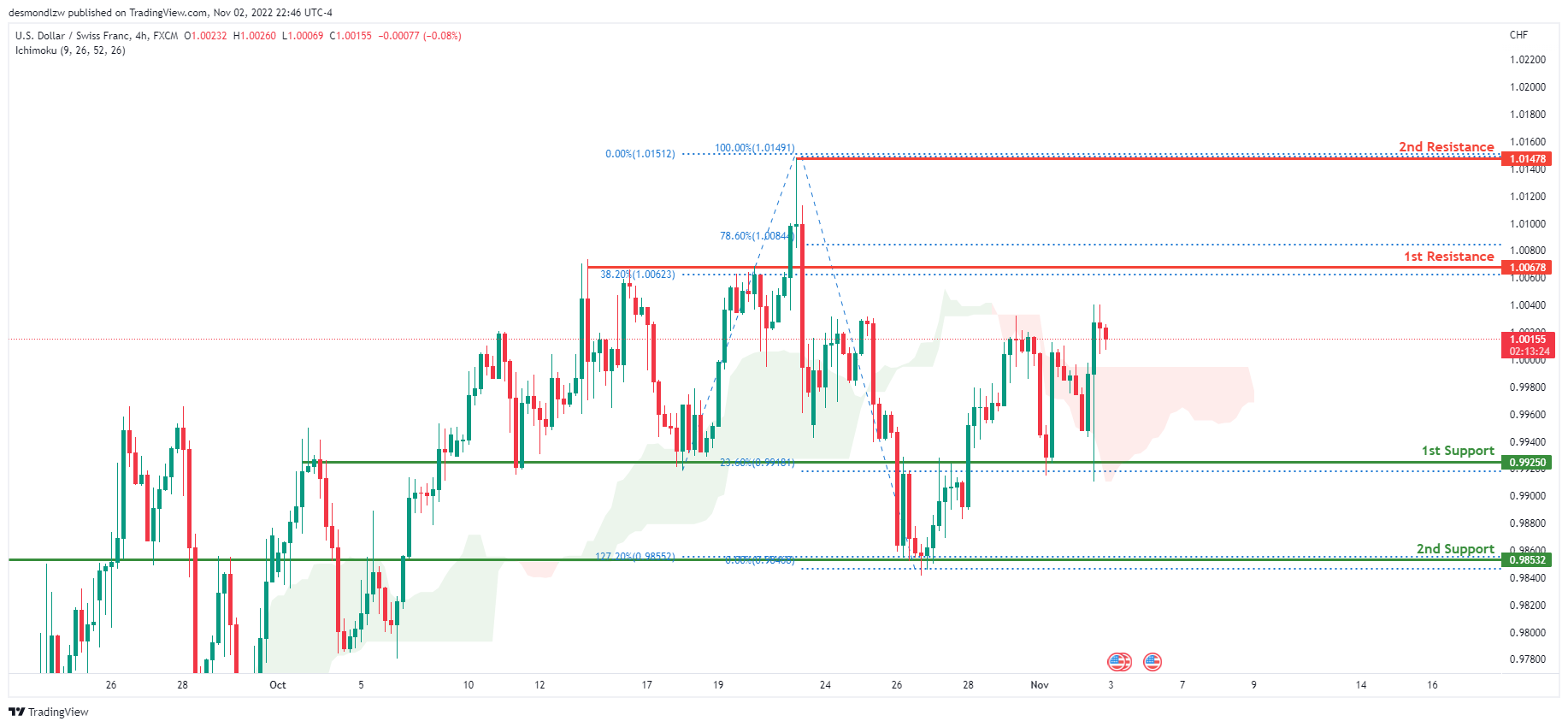
On the H4 chart, the overall bias for USDCHF is bullish. To add confluence to this, the price is above the Ichimoku cloud which indicates a bearish market. Overnight, USDCHF had some bullish momentum upwards with the price reflecting off the 1st support at 0.99250 where the 23.6% Fibonacci line is located. Price is currently trading at 1.00165 at time of writing. Expecting price to possibly head back up to retest the 1st resistance line at 1.00678 where the 38.2% and 78.6% Fibonacci lines are located.
Areas of consideration
- H4 1st support at 0.99250
- H4 1st resistance at 1.00678
XAU/USD (GOLD):
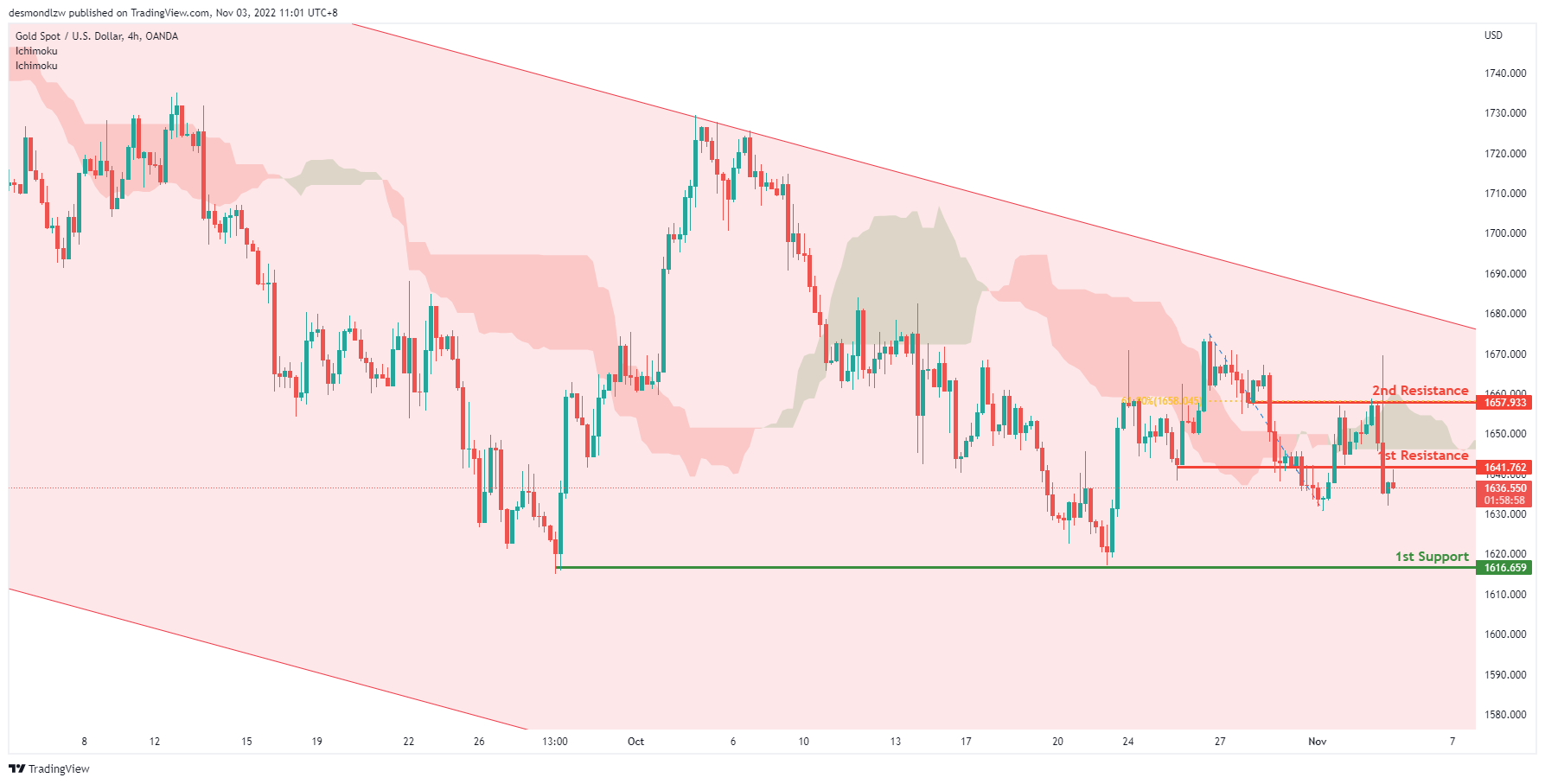
On H4, with the price within the descending channel and crossing ichimoku cloud, we have a bearish bias that the price may drop from the 1st resistance at 1641.762, which is in line with the previous swing low to the 1st support at 1616.659, where the previous swing lows are. Alternatively, the price may rise to retest the 1st resistance and rise to the 2nd resistance is at 1657.331, where the previous swing high and 61.8% fibonacci retracement are.
Areas of consideration:
- H4 time frame, 1st resistance at 1641.762
- H4 time frame, 1st support at 1616.659
AUD/USD:
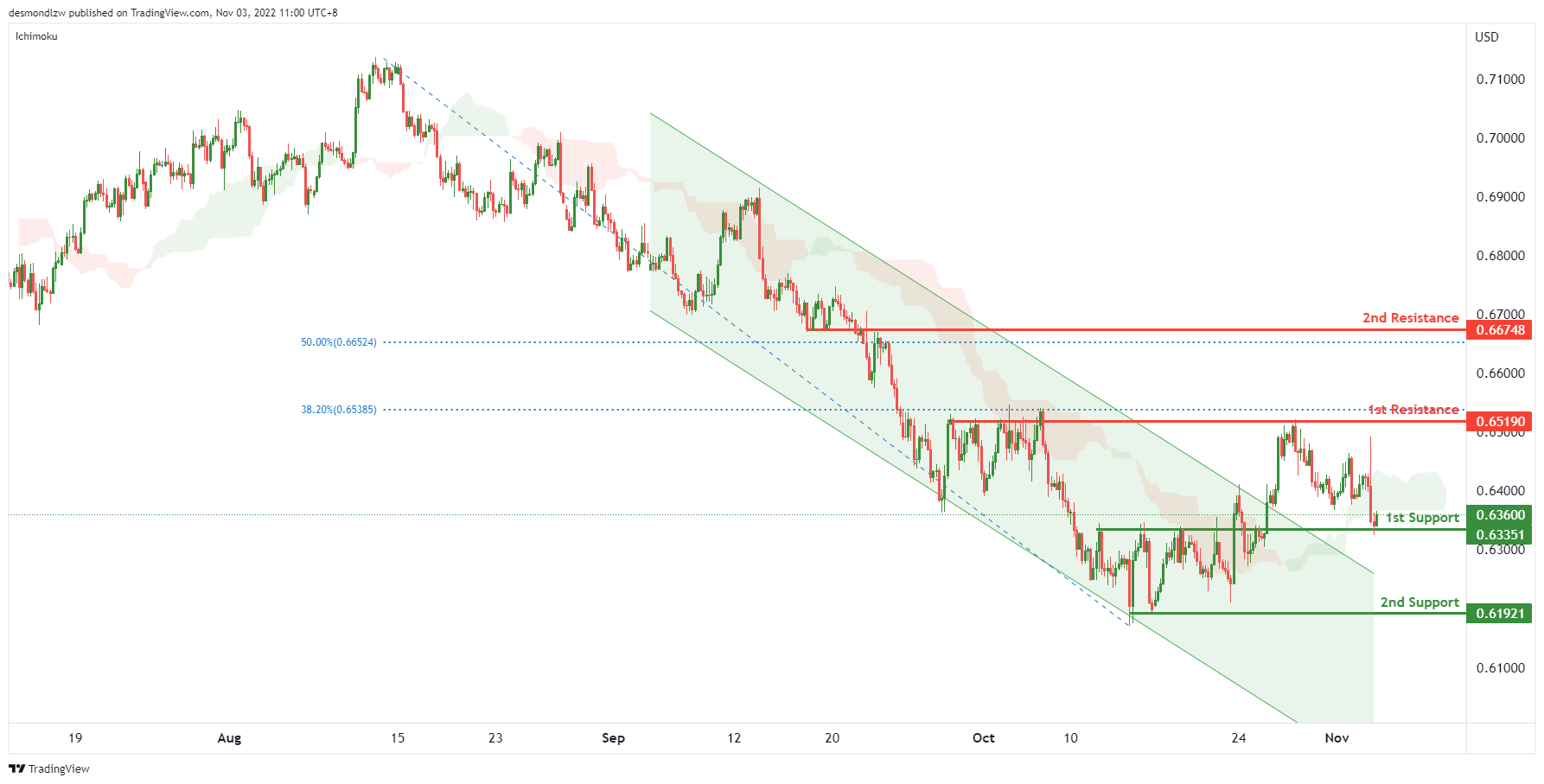
On the H4, with the price crossing the ichimoku cloud and testing the 1st support, we can expect the price break the 1st support and then drop to the 2nd support at 0.61921, which is in line with the swing low. Alternatively, the price may rise to the 1st resistance at 0.65190, which is in line with the overlap resistance and 38.2% fibonacci retracement. If the 1st resistance is broken, the 2nd resistance is at 0.66748, where the 50% fibonacci retracement is.
Areas of consideration
- H4, 1st support at 0.63351
- H4, 2nd support at 0.61921
NZD/USD:
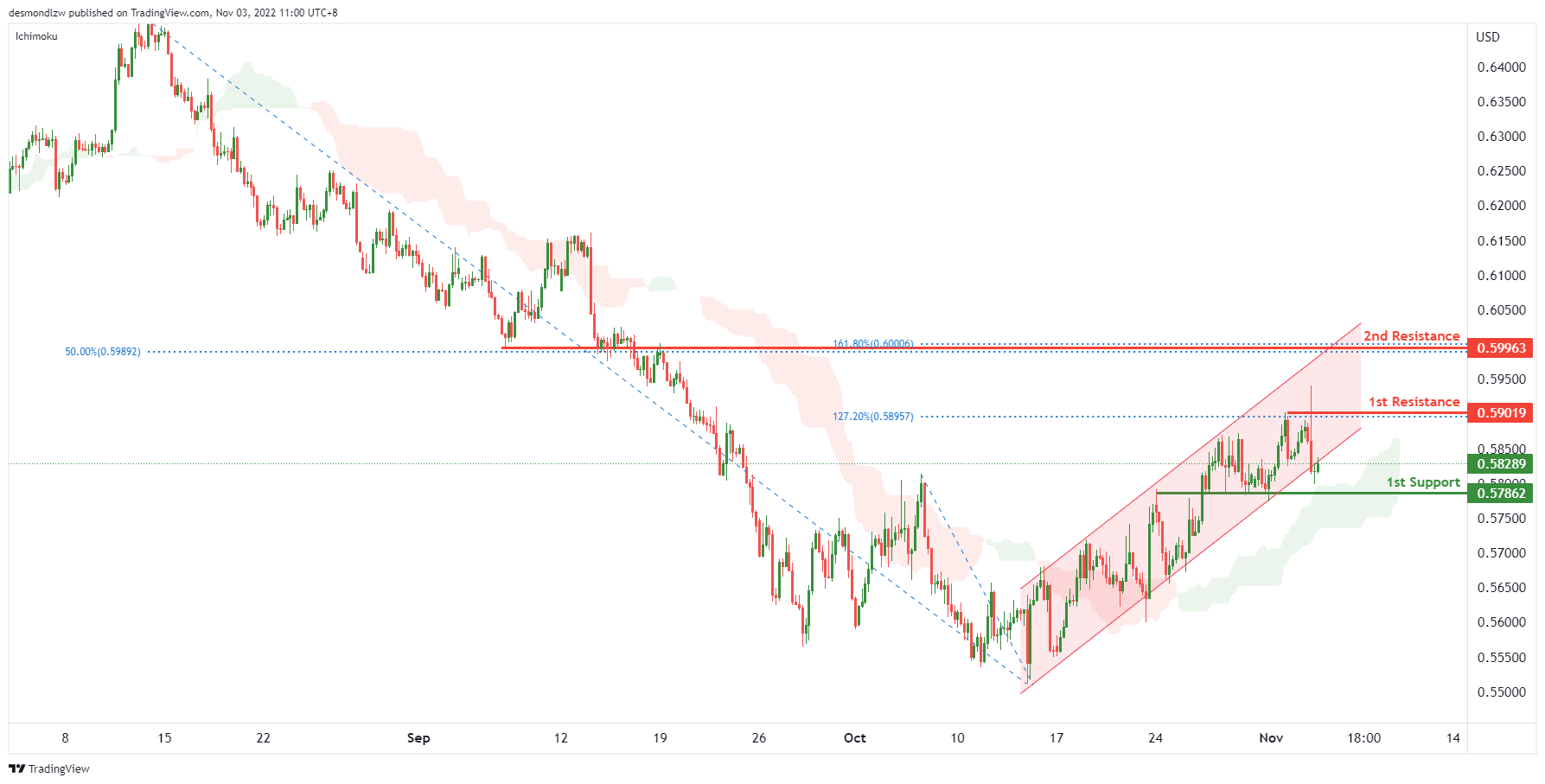
On the H4 chart, as the price is breaking the ascending channel, we have a bearish bias that the price may drop to the 1st support at 0.57862, which is in line with the overlap support. Alternatively, the price may rise to the 1st resistance at 0.59019, where the previous swing high and 127.2% fibonacci extension are. If the 1st resistance is broken, the 2nd resistance is at 0.59963, where the 50% fibonacci retracement and 161.8% fibonacci extension are
Areas of consideration:
- H4 time frame, 1st support at 0.57862
- H4 time frame, 1st resistance at 0.59019
USD/CAD:
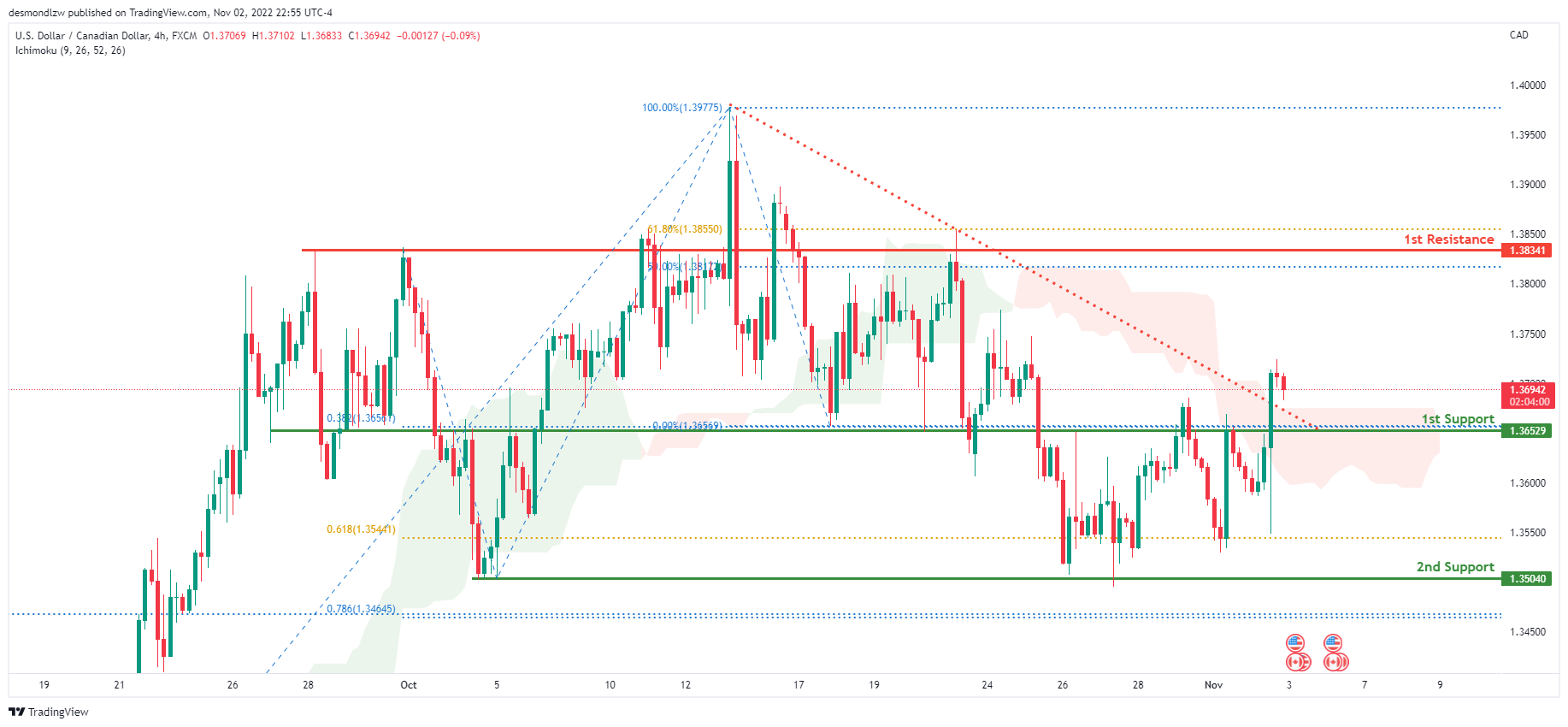
On the H4 chart, the overall bias for USDCAD is bullish. To add confluence to this, the price is above the Ichimoku cloud which indicates a bullish market. Overnight, price had increased volatility due to the release of the FOMC news, with price closing above the 1st support at 1.36529 where the 0% Fibonacci line and 38.2% Fibonacci projection line is located. If this bullish momentum continues, expect price to possibly head towards the 1st resistance line at 1.38341 where the 61.8% and 50% Fibonacci lines are located.
Areas of consideration:
- H4 time frame, 1st resistance at 1.38341
- H4 time frame, 1st support at 1.36529
- H4 time frame, 2nd support at 1.35040
OIL:
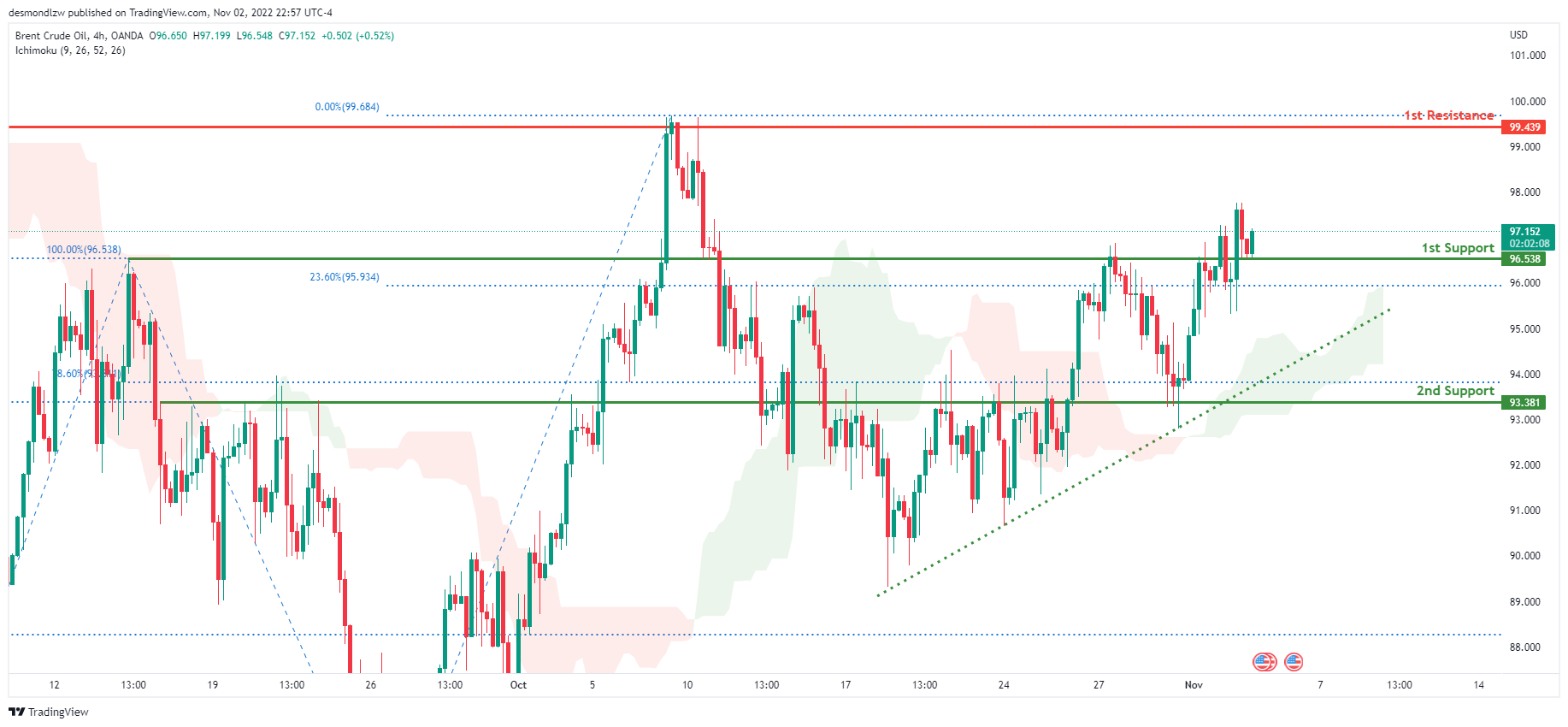
Looking at the H4 chart, the current overall bias for Oil is bullish. To add confluence to this, the price is above the Ichimoku cloud which indicates a bullish market. Overnight, price continued to consolidate along the 1st support line at 96.538 where the 100% and 23.6% Fibonacci lines are located. If this bullish momentum continues, expect price to possibly head towards the 1st resistance at 99.439 where previous swing high and 0% Fibonacci line is located.
Areas of consideration:
- H4 time frame, 1st resistance at 99.439
- H4 time frame, 1st support at 96.538
Dow Jones Industrial Average:
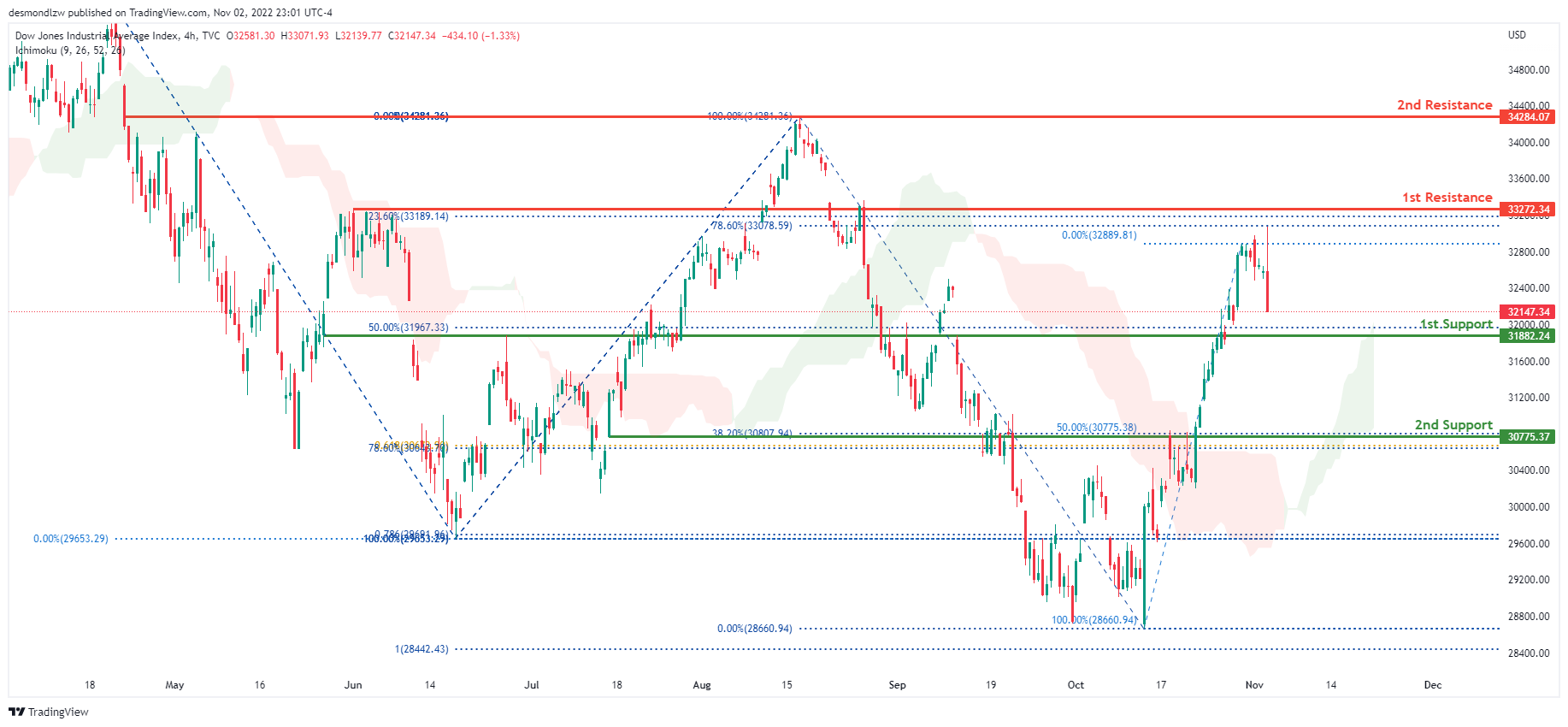
On the H4 chart, the overall bias for DJI is bullish. To add confluence to this, the price is above the Ichimoku cloud which indicates a bullish market. Overnight, had some bearish momentum downwards with the price currently trading at 32147.34 at time of writing. If this bullish momentum continues, expect the price to possibly head towards the 1st resistance at 33272.34 where the 23.6% and 78.6% Fibonacci lines are located.
Areas of consideration:
- H4 time frame, 1st support at 31882.24
- H4 time frame, 1st Resistance at 33272.34
DAX:
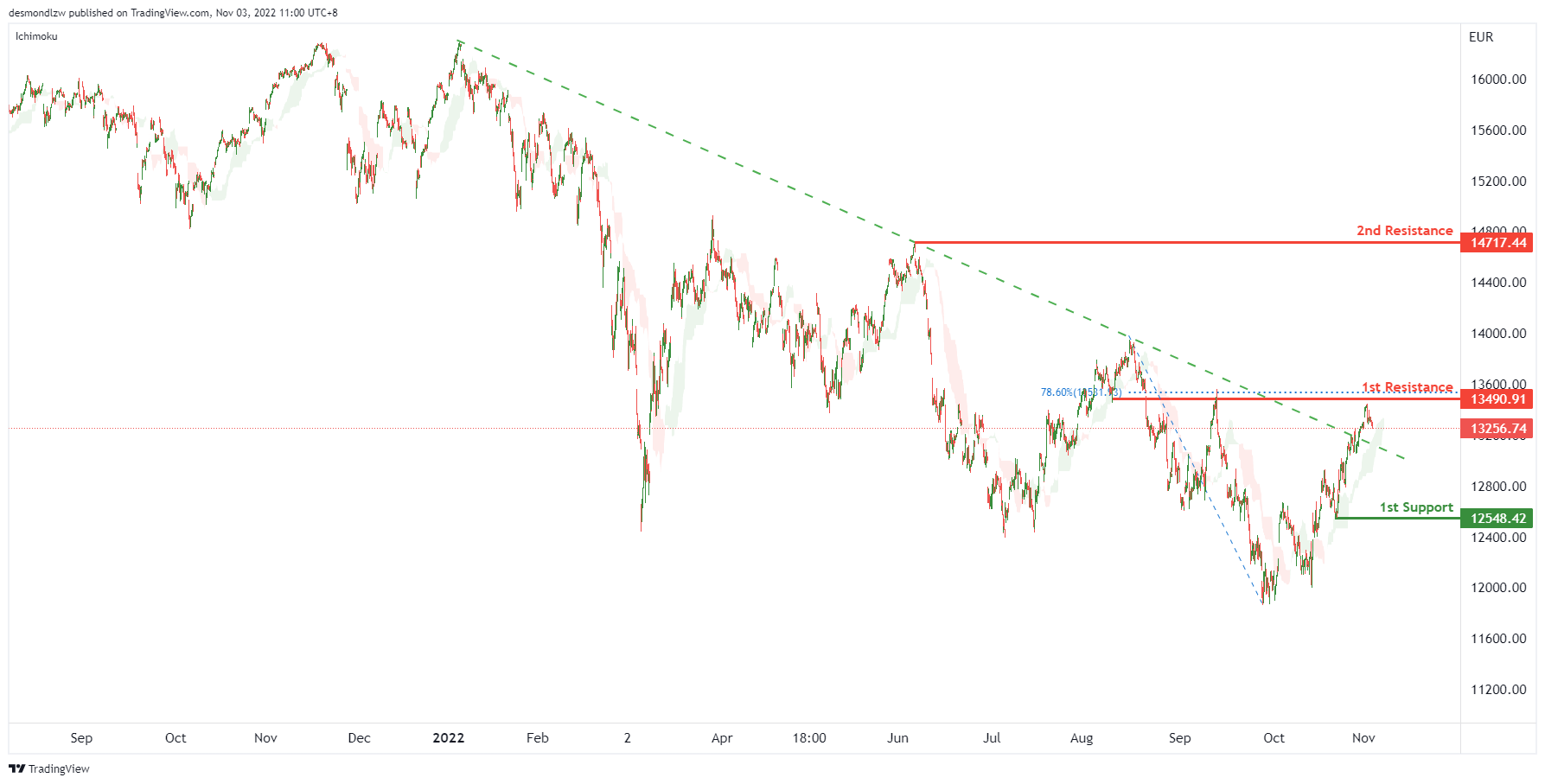
On the H4 chart, the price has now closed above the Ichimoku cloud which indicates a breakout of a descending trendline. Expecting price to possibly continue this bullish momentum and head towards the 1st resistance at 13490.91, where the 78.6% Fibonacci line is located. If the 1st resistance is broken, the 2nd resistance could be at 14717.44, which is in line with the previous swing high. Alternatively, the price may drop to the 1st support at 12548.42, which is in line with the swing low.
Areas of consideration:
- H4 time frame, 1st resistance at 13490.91
- H4 time frame, 2nd resistance at 14717.44
ETHUSD:
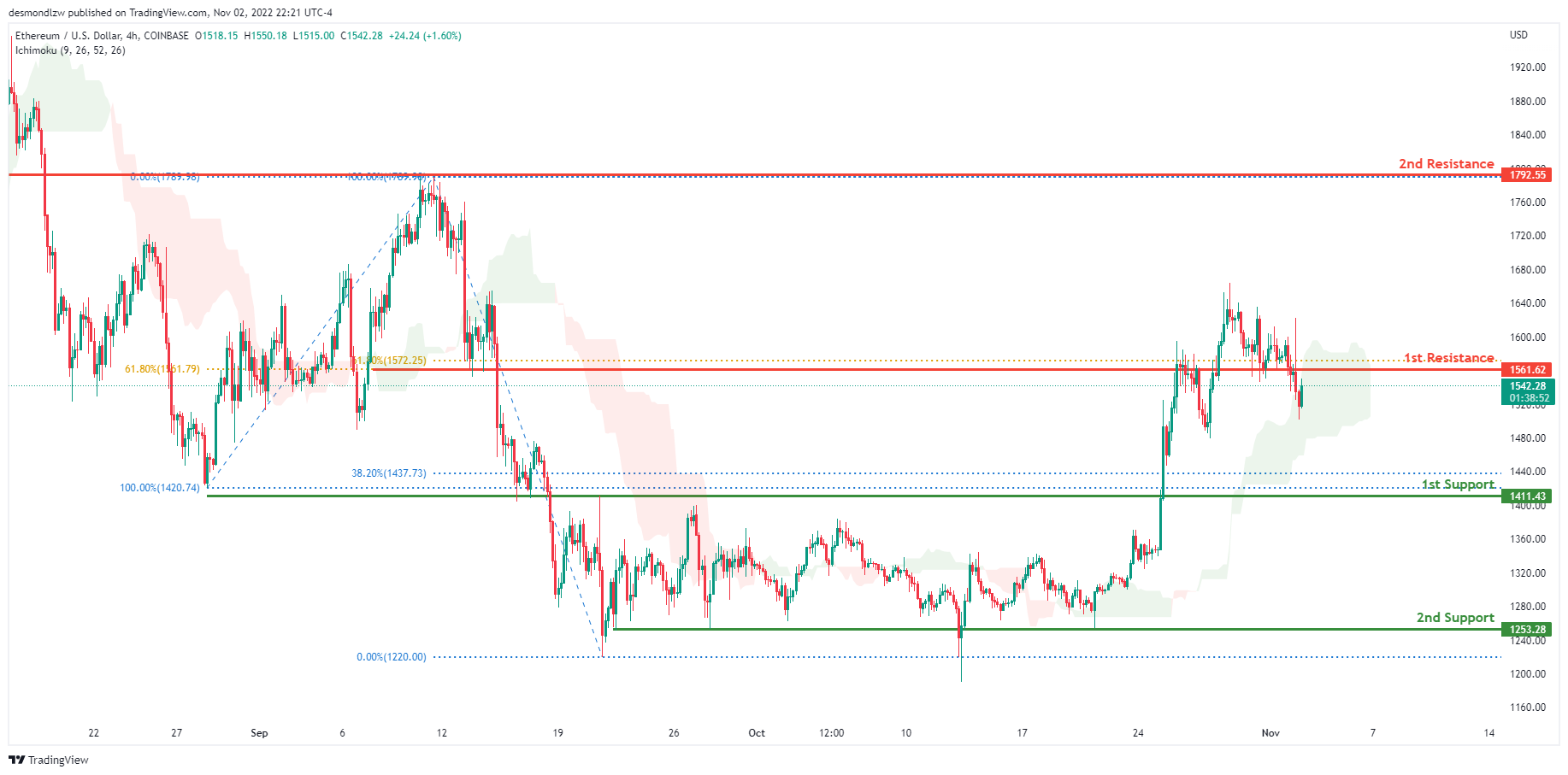
Looking at the H4 chart, the current overall bias for ETHUSD is bullish. Overnight, price experienced increased volatility due to the release of the FOMC news with price closing under the 1st resistance level at 1561.62 where 2 of the 61.8% Fibonacci lines are located. Expecting price to possibly retrace back up and retest the 1st resistance level.
Areas of consideration:
- H4 time frame, 1st resistance of 1561.62
- H4 time frame, 1st support at 1411.43
BTCUSD:
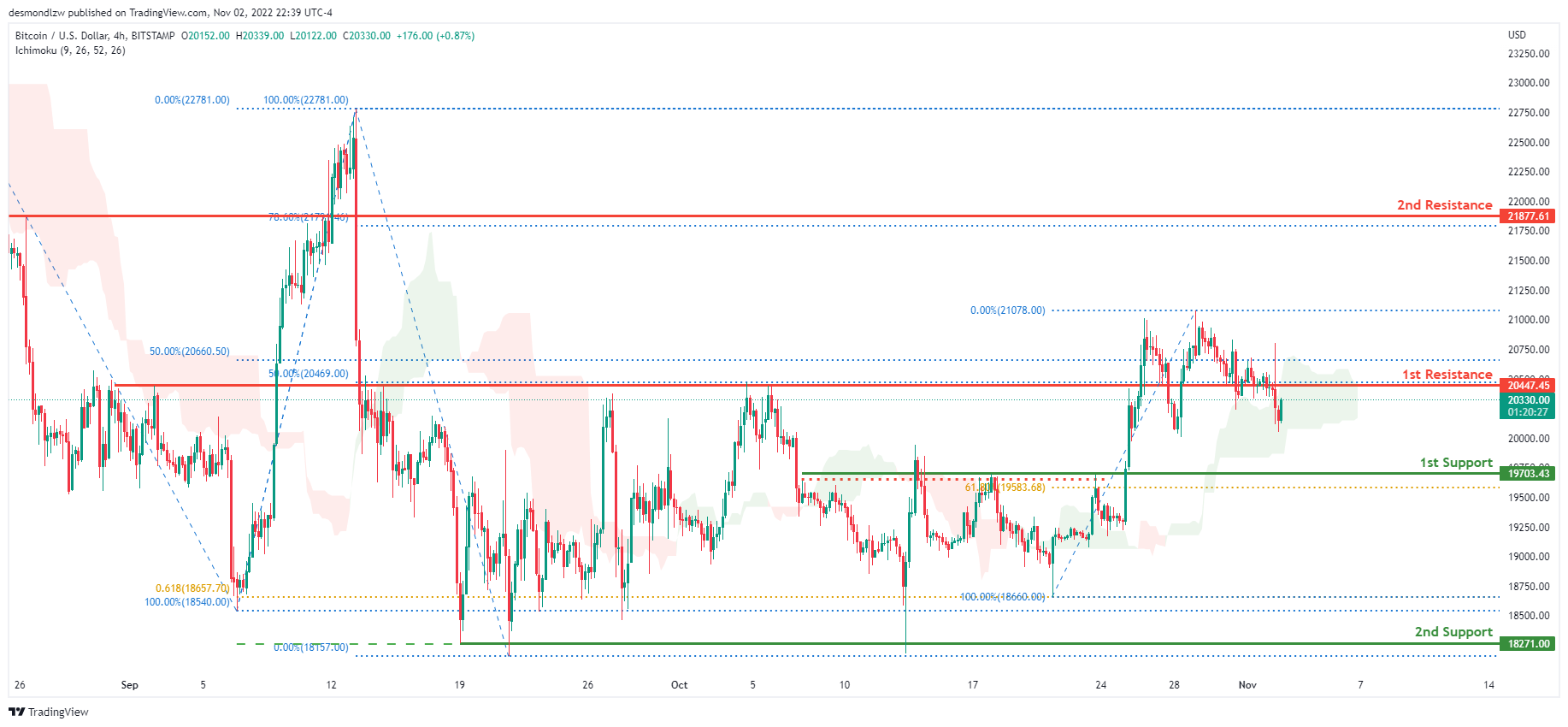
On the H4 chart, the overall bias for BTCUSD is bullish. Overnight, price experienced increased volatility due to the release of the FOMC news with the price closing under the 1st support at 20440.00 where the 2 of the 50% Fibonacci lines are located. Expecting price to possibly retrace back up to retest the 1st resistance level.
Areas of consideration:
- H4 time frame, 1st resistance 20447.45
- H4 time frame, 1st support at 19703.43
S&P 500:
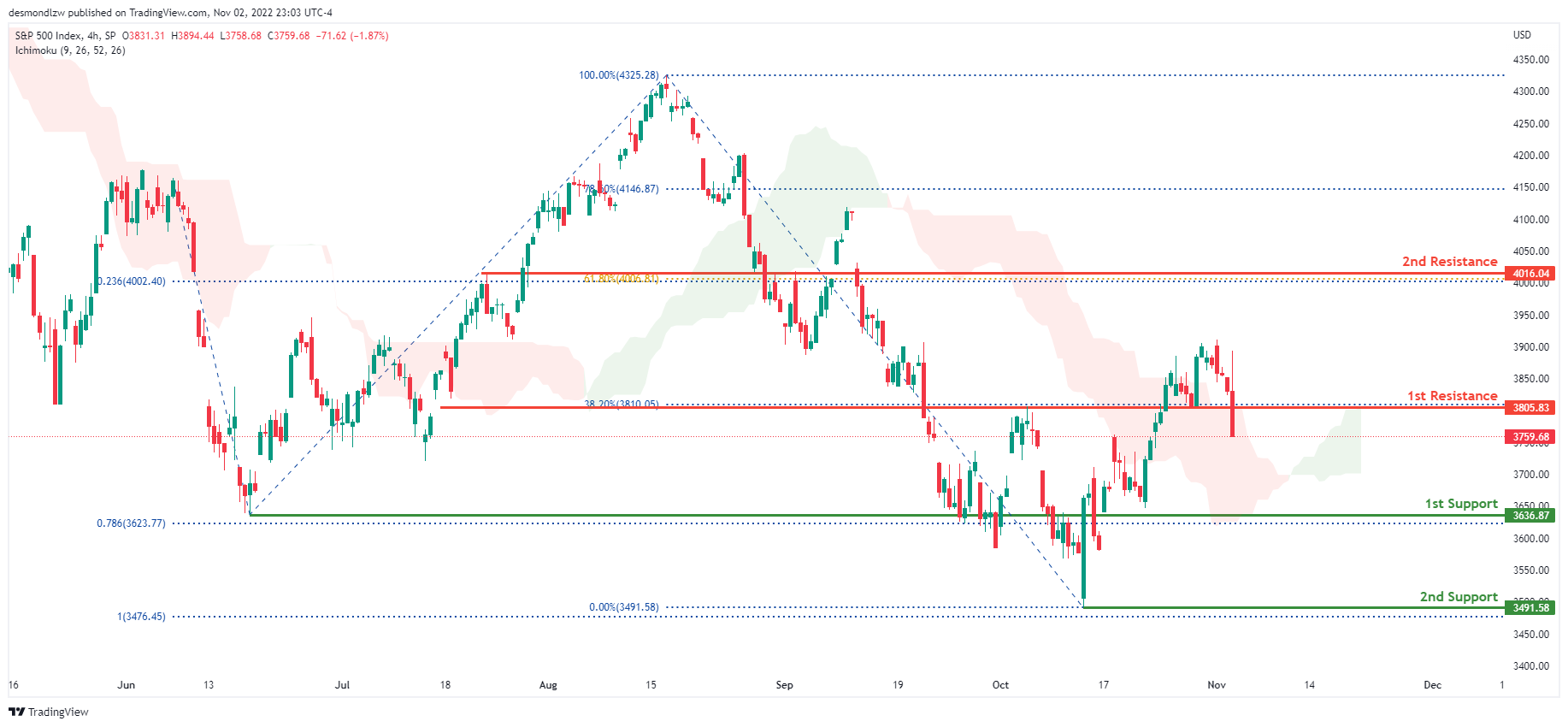
On the H4 chart, the overall bias for S&P500 is bearish . Overnight, price had bearish momentum downwards with the release of the FOMC news with price closing under the 1st resistance at 3805.83 where the 38.2% Fibonacci line is located. The price is currently trading at 3759.68 at time of writing. If this bearish momentum continues, expect price to possibly head towards the 1st support at 3636.87 where the previous swing low and 78.6% Fibonacci projection line is located.
Areas of consideration:
- H4 time frame, 1st support at 3636.87
- H4 time frame, 1st resistance at 3805.83
China Caixin PMI services dropped to 48.4, lowest since May
China Caixin PMI Services dropped from 49.3 to 48.4 in October, below expectation of 49.2. PMI Composite dropped from 48.5 to 48.3. Both were the lowest readings since May.
Wang Zhe, Senior Economist at Caixin Insight Group said: "Both supply and demand contracted to different degrees. The overall employment level increased slightly thanks to an expansion in employment of the services sector. Input costs for all surveyed enterprises rose slightly, while prices charged remained stable. Market sentiment improved but was still below the long-term average.
"Overall, the negative impact of Covid controls on the economy lingered, and the economy was faced with increasing downward pressure. In October, activities in the manufacturing and services sectors continued to shrink, while supply and both domestic and overseas demand contracted. Business costs increased. Service providers were in a better position than manufacturers in terms of prices charged and employment."
RBNZ Orr: Significant shocks still arriving through the global economy
RBNZ Governor Adrian Orr told a parliamentary committee that the central bank has "laser-like focus" on bringing inflation down to target. Yet, he admitted that, "the (inflationary) shocks still arriving through the global economy are significant and this is where people need to think about their own ability to weather an enormous amount of unanticipated activities."
"Meanwhile around our confidence of having inflation under control – that is very high, because we control the end outcome through the interest rate environment. So, that's a guessing game. That's about the things we will have to do to achieve low and stable inflation, subject to the continuing buffering of shocks left right and centre. Resilience and humility," he added.
NASDAQ ready for down trend resumption after hawkish Fed Powell
US stocks initially jumped after Fed hinted in the statement that pace of tightening could slow ahead. But sentiment reversed after Fed chair Jerome Powell indicated that slower pace of hikes might come soon, Fed could end up at a higher terminal rate.
In short, comparing to last statement, Fed added, "in determining the pace of future increases in the target range, the Committee will take into account the cumulative tightening of monetary policy, the lags with which monetary policy affects economic activity and inflation, and economic and financial developments." This is clearly an indication that Fed is going to consider adjusting the pace of interest rate increases.
In the post-meeting press conference, Powell acknowledged, "As we come closer to that level and move further into restrictive territory, the question of speed becomes less important. ... And that's why I've said at the last two press conferences that at some point it will be important to slow the pace of increases. So that time is coming, and it may come as soon as the next meeting or the one after that. No decision has been made."
However, "incoming data since our last meeting suggests that the ultimate level of interest rates will be higher than previously expected," indicating the possibility of higher terminal rate. Also, Powell noted, "It is very premature to be thinking about pausing. People when they hear 'lags' think about a pause. It is very premature, in my view, to think about or be talking about pausing our rate hikes. We have a ways to go."
More on Fed:
- Fed Review: Another Hawkish 75bp Hike – We Now Expect 50bp also in February
- FOMC Signals a Slower Pace of Tightening Ahead, Although It Is Not Yet Done
- FOMC Short: Dovish Statement, Hawkish Powell
Major US stock indexes closed lower, with development of NASDAQ particularly bearish. Yesterday's decline suggests rejection by 11230.44 resistance, as well ass 55 day EMA. The fall could be setting up resumption of the whole down trend from 16212.22. Next target will be 61.8% projection of 16212.22 to 10565.13 from 13181.08 at 9691.17. Reaction from there, which is close to 10000 psychological level, will be crucial for the development in the early half of next year.
Bitcoin Price Could Resume Upside, Fed Hikes Again By 0.75 bps
Key Highlights
- Bitcoin price climbed above $20,000 but struggled near $21,000.
- It broke a key bearish trend line with resistance near $19,370 on the 4-hours chart.
- The price could resume upside if it clears the $20,700 and $21,000 levels.
- EUR/USD and GBP/USD slowly moved lower after facing hurdles.
Bitcoin Price Technical Analysis
Bitcoin price started a steady increase from the $18,500 zone against the US dollar. BTC/USD climbed above the $19,500 and $20,000 resistance levels to move into a positive zone.
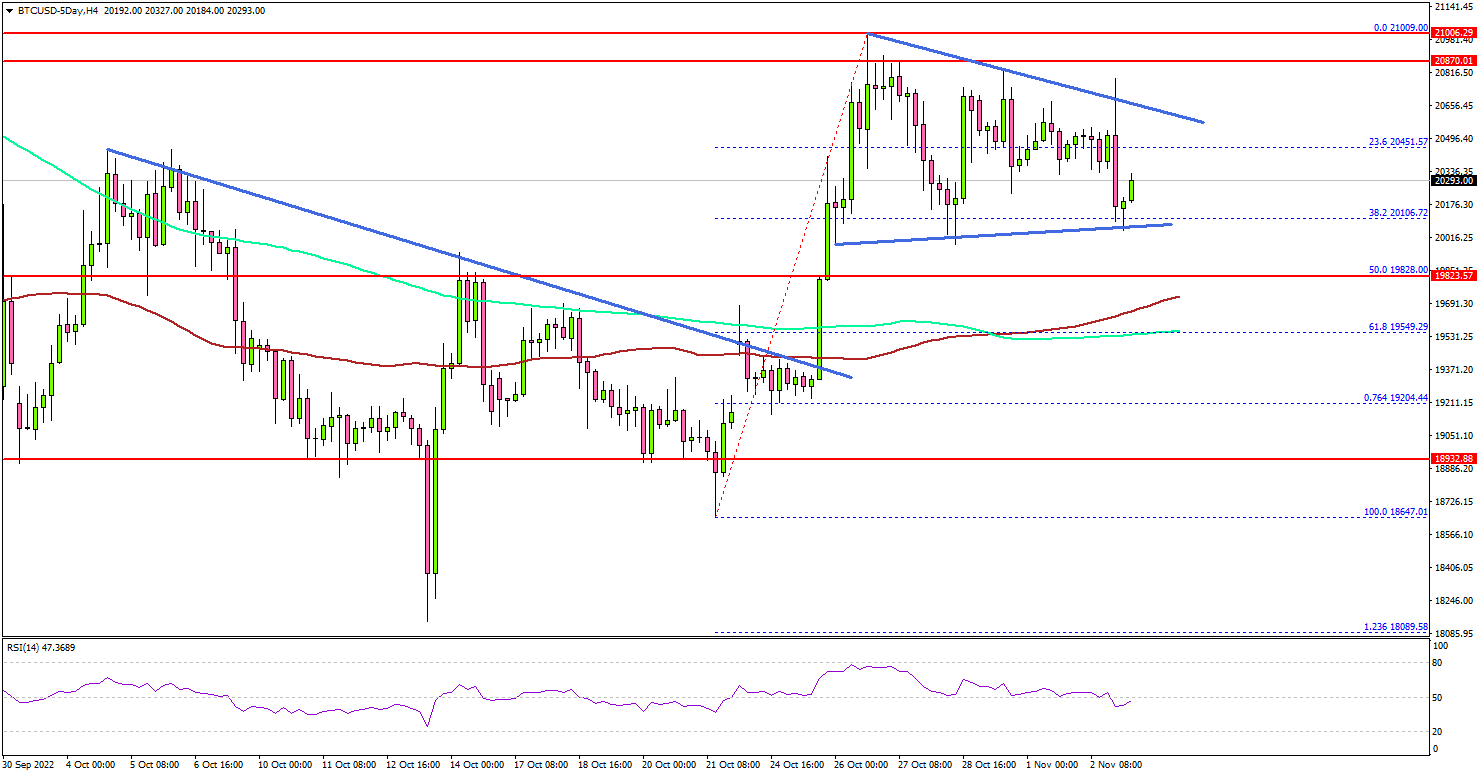
Looking at the 4-hours chart, the pair settled above the $20,000 level, the 100 simple moving average (red, 4-hours), and the 200 simple moving average (green, 4-hours).
During the increase, the price broke a key bearish trend line with resistance near $19,370 on the same chart. Finally, it tested the $21,000 resistance zone. A high was formed near $21,009 before there was a downside correction.
On the downside, an initial support sits near the $20,150 level. The main breakdown support sits near the $19,800 zone. If there is a downside break, bitcoin might decline towards the $19,000 support in the coming days.
On the upside, the price is facing a significant resistance at $19,700. The main resistance sits near the $21,000 level. A close above the $21,000 level may perhaps start another steady increase in the coming days.
In the stated case, the price could rise towards the $22,000 level. Any more gains could set the pace for a move towards the $22,500 level.
Economic Releases
- BoE Interest Rate Decision - Forecast 3.00%, versus 2.25% previous.
- US Initial Jobless Claims - Forecast 220K, versus 217K previous.
- US ISM Services PMI for Oct 2022 – Forecast 55.5, versus 56.7 previous.
Fed Review: Another Hawkish 75bp Hike – We Now Expect 50bp also in February
Fed Review: Another Hawkish 75bp Hike - We Now Expect 50bp also in February
- Fed hiked rates by 75bp as broadly expected. Powell delivered a hawkish message, emphasizing the need to tighten financial conditions further. We have not seen Fed make significant progress towards its goals over the past month.
- Thus, we adjust our Fed call and expect a 50bp hike in February in addition to our earlier forecast for one more 75bp hike in December.
- Markets took the FOMC statement dovishly, but the move faded during the press conference and EUR/USD declined below pre-meeting levels while 2y UST yield rose around 6bp. We maintain our forecast for EUR/USD at 0.93 in 12M.
Fed hiked rates by 75bp in its October meeting as widely expected. There was no updated 'dot plot' or economic forecasts. While Powell did acknowledge the downside risks to the economy, he also emphasized that "is is very premature to be thinking about pausing".
While there is uncertainty around the lag on how monetary policy tightening impacts the real economy, Powell emphasized that Fed is closely monitoring the development in overall financial conditions. As we highlighted in our Fed preview: Too early for a pivot, 28 October, we have not seen real financial conditions tightening over the past month, and instead inflation expectations have ticked slightly higher. Thus, Fed has not made any progress on its goals despite realized inflation continuing to surprise to the upside. We adjust our Fed call and now see the terminal rate at 5.00 - 5.25% after a 75bp hike in December and a 50bp hike in February.
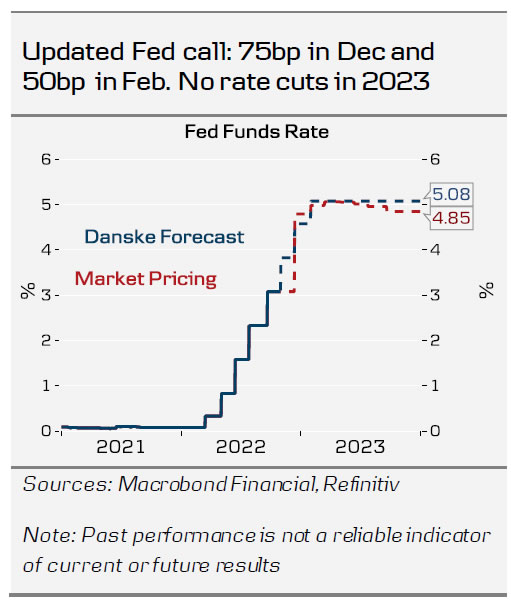
Powell did not hint if there is a bias towards hiking either 50 or 75bp in December, but also noted that the terminal rate matters more than the exact pace of hikes. We agree, but also note that market is already pricing a decent (around 50%) probability for the 75bp hike, and from the perspective of maintaining financial conditions restrictive, Fed most likely does not want surprise markets dovishly in the current situation.
Powell was also clear on the asymmetric balance of risks in terms of policy tightening, which was already flagged in the September minutes. If Fed ends up tightening too much and causing a recession, it can very quickly also reverse its policy stance to more accommodative. But tightening too little risks inflation pressures becoming increasingly entrenched. Prolonged period of high inflation, tight monetary policy and constant need to push the terminal rate higher will eventually increase the risk of unnecessarily deep recession and a clear rise in unemployment. In other words, Fed prefers a short recession over years of stagflation.
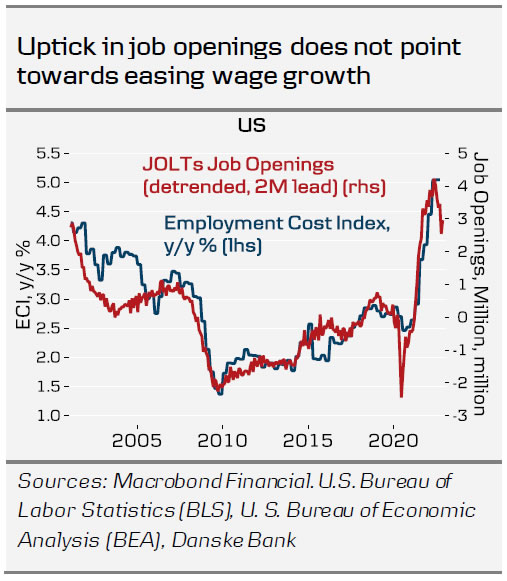
While Powell did not see a wage-price spiral right now, he also added that when it is evident, Fed has already failed. US wage inflation has remained above Fed's target, and the JOLTs Job Openings (which is among the best leading indicators for wage growth) surprised once again to the upside in September. Fed is still faced with aggregate demand remaining too high especially in the labour markets, which leads to persistent and broad-based inflation. Fed needs to continue tightening financial conditions further, and it simply does not have the luxury of giving up on the hawkish stance to achieve this.
FOMC Signals a Slower Pace of Tightening Ahead, Although It Is Not Yet Done
Summary
- The FOMC raised its target range for the federal funds rate by 75 bps today, which was widely expected.
- Today's statement was very similar to the one that was released after the last meeting on September 21. That said, the FOMC noted for the first time that it will consider the cumulative degree of tightening and the lags inherent in monetary policy changes when deciding on future rate moves.
- These changes to the statement indicate to us that the Committee is prepared to slow the pace of tightening at future meetings. But Chair Powell suggested in his post-meeting press conference that the FOMC is not yet done tightening policy. Moreover, the Committee may need to raise rates higher than most members thought in September.
- In our view, the bar for another 75 bps rate hike at the December 14 meeting is fairly high. Today's events strengthens our conviction that the Committee will deliver a 50 bps rate hike in December.
- But there are two more employment reports and two more CPI reports that will be released between now and December 14. The outcome of the December 14 meeting will depend crucially on what those data releases tell the FOMC about the state of the U.S. economy.
Source: Federal Reserve Board and Wells Fargo Economics
FOMC Is Not Yet Done, Although Pace of Future Tightening May Slow
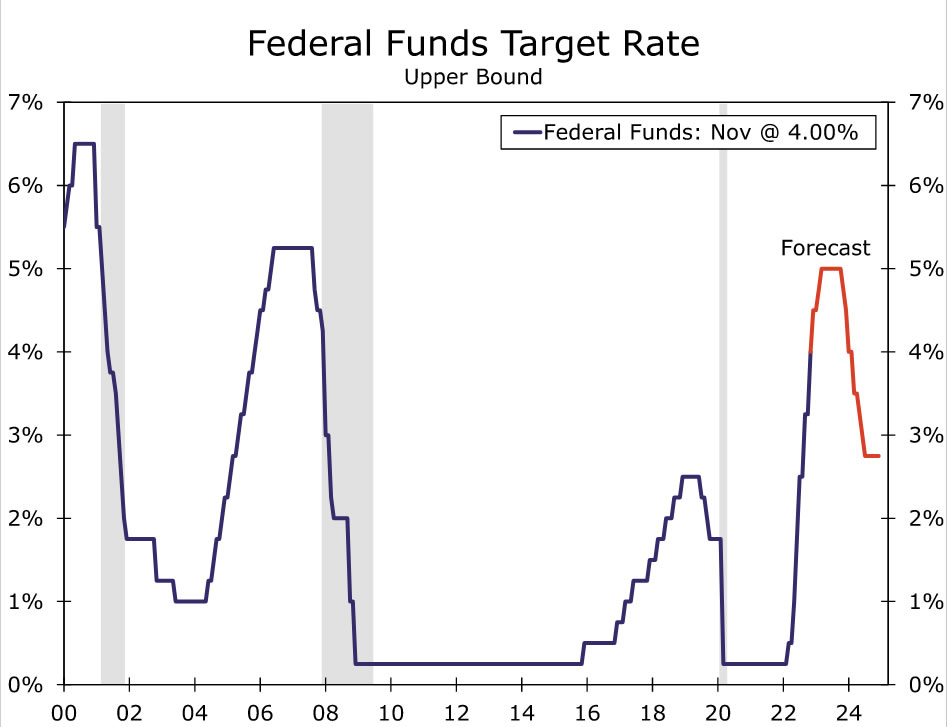
As universally expected, the Federal Open Market Committee (FOMC) hiked rates by another 75 bps at its meeting today, bringing the target range for the federal funds rate to 3.75%-4.00%. The Committee has increased the target range by 375 bps since March, the fastest pace of tightening since the early 1980s when, much as today, inflation was viewed as Public Enemy #1.
As is customary for the first FOMC meeting of the fourth quarter, the Committee did not release a Summary of Economic Projections (SEP), in which the FOMC details its macroeconomic forecasts including the so-called "dot plot." (The next SEP will be published at the conclusion of the December 14 meeting.) Consequently, market participants need to infer the Committee's expectations regarding future policy moves from the published statement and Chair Powell's press conference. In that regard, the statement that was issued today read very much like the September 21 policy statement. Specifically, the FOMC said "recent indicators point to modest growth in spending and production," and that "job gains have been robust in recent months." The Committee continued to describe the inflation rate as "elevated," and it continues to anticipate that further increases in the target range for the federal funds rate will be "appropriate." Indeed, Chair Powell noted in his post-meeting press conference that the FOMC still has "some ways to go" on tightening policy, and that the terminal fed funds rate may be higher than the 4.50%-4.75% target range that was shown by the median "dot" in the September SEP.
But the FOMC made one meaningful change to the statement, which we anticipated in our recent FOMC "Flashlight" report. Specifically, the Committee stated for the first time that it will "take into account the cumulative tightening of monetary policy, the lags with which monetary policy affects economic activity and inflation, and economic and financial developments." As noted above, the FOMC has now raised rates by 375 bps since March. But rate hikes do not have an instantaneous effect, and the effects of previous tightening are still filtering into the economy. Moreover, the current target range for the fed funds rate is now at a level that most observers would consider to be "restrictive." That is, rates are now exerting headwinds on the pace of economic activity. The economy could decelerate significantly, if not begin to contract, if the FOMC continues to tighten policy aggressively.
In our view, the use of this new clause in the statement signals that the Committee is prepared to slow the pace of tightening at future meetings. We have been forecasting that the FOMC will raise the target range for the fed funds rate by 50 bps at its December 14 meeting. Today's developments reinforces our conviction regarding this forecast. And markets seem to agree. Market pricing prior to the news was consistent with a 40% probability of a 75 bps rate hike on December 14. As of this writing, that probability now stands at only 25%.
The FOMC does not need to make another rate decision for six weeks, which is why it mentioned "economic and financial developments" in the statement. Notably, the employment report for October is slated for release on Friday, November 4 with the November report scheduled for December 2. We will also get two more CPI reports between now and December 14 (November 10 and December 13). Continued strength in payrolls and/or higher-than-expected inflation outturns could lead the Committee to reconsider on December 14. That is, the FOMC could very well determine at that meeting that another 75 bps rate hike is "appropriate" if growth remains strong and/or inflation remains elevated.
The Committee clearly thinks it needs to tighten further and, in our view, December will not be the last meeting in this cycle at which the FOMC hikes rates. We currently look for the Committee to increase the target range for the fed funds rate by 25 bps on February 1 and by a final 25 bps on March 22. But we think the bar is currently high for another 75 bps rate hike on December 14. Although individual FOMC members will have different opinions on the appropriate pace of tightening going forward, we believe the "consensus" thinks that 50 bps on December 14 would be more appropriate than 75 bps, at least at the present conjuncture. Stay tuned.