Sample Category Title
Dollar Dragged Down by Falling Yields, Kiwi Extends Rally
Dollar is back under some selling pressure today as 10-year yield dips back below 4% handle. Broad risk sentiment is also mildly positive. European majors are generally weaker too, together with Canadian. Yen rebounds on falling yields, but it's outshone by New Zealand Dollar. Kiwi is supported additionally by buying against Aussie, which is also firm after today's RBA rate hike.
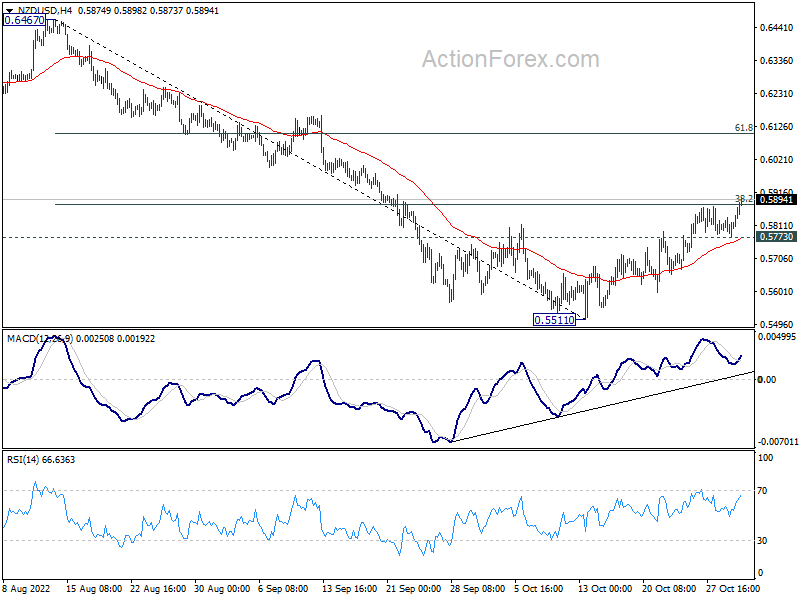
Technically, NZD/USD's rebound from 0.5511 short term bottom resumed by breaking through 0.5872 temporary top. The break of 38.2% retracement of 0.6467 to 0.5511 at 0.5876 is another near term bullish sign. Further rally is expected as long as 0.5773 minor support holds. Next target is 61.8% retracement at 0.6102. Such development could be an early signal of stronger rebound in AUD/USD too.
In Europe, at the time of writing, FTSE is up 1.48%. DAX is up 1.32%. CAC is up 1.62%. Germany 10-year yield is down -0.105 at 2.039. Earlier in Asia, Nikkei rose 0.33%. Hong Kong HSI rose 5.23%. China Shanghai SSE rose 2.62%. Singapore Strait Times rose 1.21%. Japan 10-year JGB yield rose 0.0073 to 0.252.
ECB Lagarde: We are not done with tightening yet
ECB President Christine Lagarde said in an interview, "Inflation is still far too high in the euro area as a whole... Higher energy and food prices are still the main drivers of price increases. We are increasingly seeing that these higher energy costs are feeding through to more and more sectors in the economy."
"We expect to raise interest rates further to make sure that inflation returns to our medium-term target of 2% in a timely manner," she added.
"Since July we have raised interest rates by 200 basis points – the fastest increase in the history of the euro," she said. "But we are not done yet. We will decide on future policy steps meeting by meeting, each time assessing how the outlook for the economy and inflation has evolved, also considering how the measures we have taken so far are working."
She admitted that the "likelihood of a recession has increased and uncertainty remains high." But ultimately, "persistently high inflation rates are more damaging to society because they make everybody poorer."
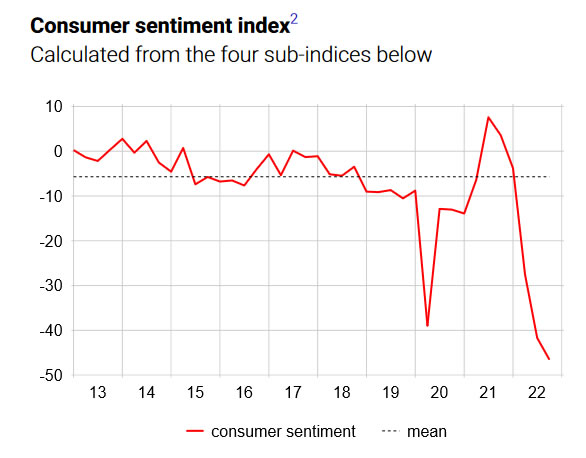
Swiss SECO consumer confidence fell to fresh record low at -47
Swiss SECO Consumer Confidence fell further from -42 to -47 in Q4, below expectation of -43. That's the record low level since the survey began in 1972.
Looking at some details, expected economic development dropped from -53.5 to -57.2, far below long-term average of -9. Past financial situation dropped from -35.1 to -39.7, a historic low. Expected financial situation dropped sharply from -34.8 to -46.9, also a new low. Major purchases improved slightly from -43.3 to -42.4.
UK PMI manufacturing finalized at 46.2, suffered a further decline
UK PMI Manufacturing was finalized at 46.2 in October, down from September's 48.4. That's the lowest level in 29 months, and the reading has been below 50 mark for three consecutive months.
S&P Global noted that output, new orders and new export business all declined. Job cuts were registered for the first time in almost two years. Input cost and selling price inflation eased slightly.
Rob Dobson, Director at S&P Global Market Intelligence, said: "UK manufacturing production suffered a further decline at the start of the fourth quarter, with the sector buffeted by weak demand, high inflation, supply-chain constraints and heightened political and economic uncertainties.... The darkening situation also knocked business optimism down to a two-and-a-half year low... On current form manufacturing is in no position to help prevent the broader UK economy from sliding into recession."
RBA Lowe: We need to strike the right balance between doing too much and too little
RBA Governor Philip Lowe said in a speech that the earlier large 50bps rate hikes were to "move interest rates quickly away from their pandemic levels to address the rapidly emerging inflation problem."
As interest rates moved back to "more normal levels", the board judged that it's "appropriate to move at a slower pace", with 25bps hike today, and at last meeting.
"We are conscious that interest rates have been increased by a large amount in a very short period of time and that higher interest rates affect the economy with a lag," he added. "If we are to stay on that narrow path, we need to strike the right balance between doing too much and too little."
Lowe also noted that RBA is "not on a pre-set path". "If we need to step up to larger increases again to secure the return of inflation to target, we will do that," he added. "Similarly, if the situation requires us to hold steady for a while, we will do that.
RBA hikes 25bps, rates to rise further over the period ahead
RBA raises cash rate target by 25bps to 2.85% as widely expected. It maintains tightening bias and expects to "increase interest rates further over the period ahead". The size and timing of future rate hikes will be determined by incoming data and the outlook for inflation and labor market.
The central bank expects inflation to "further increase" over the months ahead and peak at around 8% this year. CPI inflation is forecast to be around 4.75% over 2023 and a little above 3% over 2024. GDP growth forecast was "revised down a little" to 3% this year, 1.50% in 2023 and 2024. Unemployment rate is forecast to rise gradually from current 3.5% to a little above 4% in 2024 as economic growth slow.
China Caixin PMI manufacturing recovered to 49.2, impact of Covid controls lingered
China Caixin PMI Manufacturing rose from 48.1 to 49.2 in October, above expectation of 49.0. Caixin noted that output and new orders fell again as COVID-19 containment measures continued. Selling prices fell for the sixth consecutive month. Business confidence edged up slightly.
Wang Zhe, Senior Economist at Caixin Insight Group said: "Overall, the negative impact of Covid controls on the economy lingered. In October, supply, domestic and overseas demand, and employment in the manufacturing sector all contracted, but the rates of contraction slowed from the previous month. Costs rose slightly, and cuts to output prices were still common. Logistics and transportation were still sluggish, and companies' purchases and inventories rose slightly. Market sentiment improved, but optimism remained limited from a long-term perspective.
Japan PMI manufacturing finalized at 50.7, but business remained optimistic
Japan PMI Manufacturing was finalized at 50.7 in October, slightly down from September's 50.8. That's the lowest level in 21 months. S&P Global noted that inflationary pressure remained severer. Business remained optimistic with sentiment at nine-month high.
Laura Denman, Economist at S&P Global Market Intelligence, said: "Sluggish markets and weaker demand conditions, on both a domestic and international level, became a recurring trend throughout the report and were seemingly the driving forces behind the slower sector performance... Meanwhile, inflationary pressures remained severe..
"Japanese manufacturing firms increased their selling prices more aggressively, as signalled by a near-record rate of output cost inflation.... Despite this, firms seem unfazed by the challenges that the sector is currently facing remaining optimistic towards their 12-month outlook on growth in October. In fact, the degree of confidence accelerated from September and reached a nine-month high."
GBP/USD Mid-Day Outlook
Daily Pivots: (S1) 1.1414; (P) 1.1514; (R1) 1.1567; More...
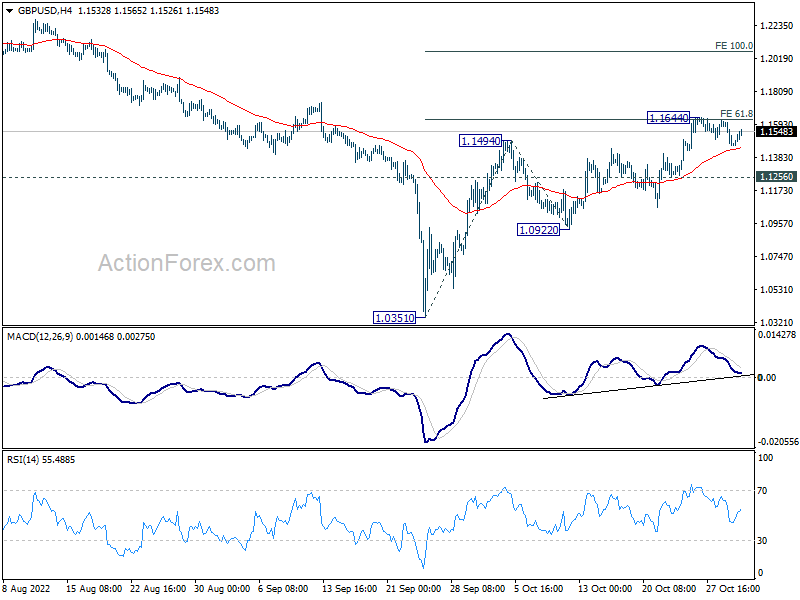
Intraday bias in GBP./USD stays neutral and outlook is unchanged. Consolidation from 1.1664 could extend but overall, further rise is expected as long as 1.1256 minor support holds. On the upside, break of 1.1644 will resume rise from 1.0351 to 100% projection of 1.0351 to 1.1494 from 1.0922 at 1.2065. However, break of 1.1256 will turn bias back to the downside for 1.0922 support and below.
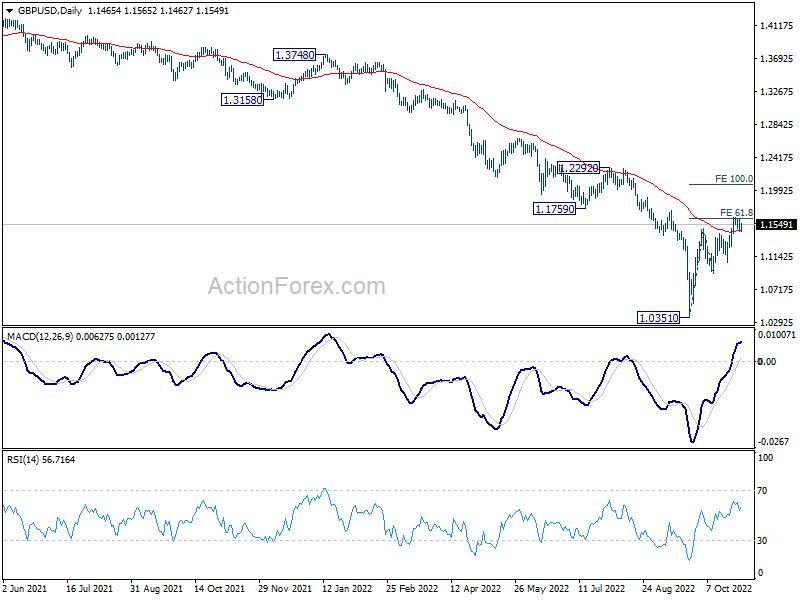
In the bigger picture, fall from 1.4248 (2018 high) is part of the long term down trend from 2.1161 (2007 high). Outlook will stay bearish as long as 1.1759 support turned resistance holds. Parity would be the next target on resumption. Nevertheless, firm break of 1.1759 will confirm medium term bottoming, and open up stronger rise back to 55 week EMA (now at 1.2392).
Economic Indicators Update
| GMT | Ccy | Events | Actual | Forecast | Previous | Revised |
|---|---|---|---|---|---|---|
| 21:45 | NZD | Building Permits M/M Sep | 3.80% | -1.60% | ||
| 00:30 | JPY | Manufacturing PMI Oct F | 50.7 | 50.7 | 50.7 | |
| 01:45 | CNY | Caixin Manufacturing PMI Oct | 49.2 | 49 | 48.1 | |
| 03:30 | AUD | RBA Interest Rate Decision | 2.85% | 2.85% | 2.60% | |
| 07:00 | EUR | Germany Import Price Index M/M Sep | -0.90% | 0.60% | 4.30% | |
| 08:00 | CHF | SECO Consumer Climate Q4 | -47 | -43 | -42 | |
| 08:30 | CHF | SVME PMI Oct | 54.9 | 56 | 57.1 | |
| 09:30 | GBP | Manufacturing PMI Oct F | 46.2 | 45.8 | 45.8 | |
| 13:30 | CAD | Manufacturing PMI Oct | 49.2 | 49.8 | ||
| 13:45 | USD | Manufacturing PMI Oct F | 49.9 | 49.9 | ||
| 14:00 | USD | ISM Manufacturing PMI Oct | 50 | 50.9 | ||
| 14:00 | USD | ISM Manufacturing Prices Paid Oct | 53 | 51.7 | ||
| 14:00 | USD | ISM Manufacturing Employment Index Oct | 48.7 | |||
| 14:00 | USD | Construction Spending M/M Sep | -0.50% | -0.70% |
GBP/USD: Cable Regains Traction on Improved Risk Mode, All Eyes are on Fed
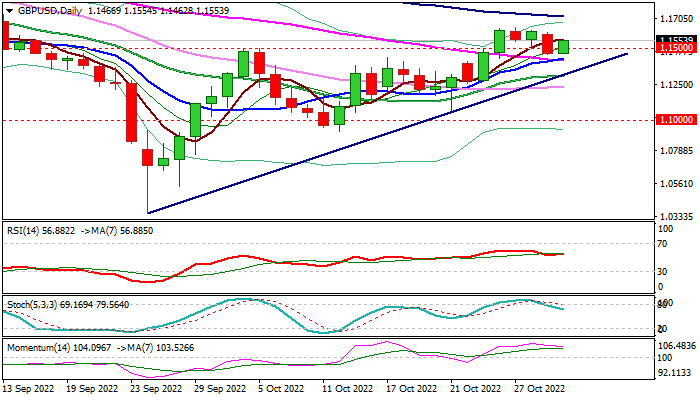
Cable regained traction on Tuesday on renewed risk appetite and returned back above 1.15 handle, signaling that a shallow pullback from new multi-week high (1.1645) might be over.
Quick changes in a view of Fed’s near-future actions, continues to move markets in opposite directions, as Monday’s optimism that the US central bank will stick to its aggressive mode, started to fade on Tuesday.
Markets are quite sure that the Fed will raise its interest rate by 75 basis points on Wednesday, but again see risk of softer approach in meetings in coming months, with prevailing expectations for 50 basis points hike in December that would be negative signal for dollar.
Cable is firmer on Tuesday, but still without significant change in near-term direction, as the downside is for now protected and the action underpinned by 10/55DMA bull-cross.
However, daily studies are mixed, as bullish momentum is weakening and stochastic is heading south, but MA’s (10/20/30/55) are in bullish configuration.
Expect initial bullish signal on close above 1.15 which would require confirmation on lift above 5DMA (1.1563) though a minimum requirement to signal bullish continuation will be sustained break above recent tops at 1.1645 that would expose next pivot at 1.1721 (100DMA).
Conversely, failure to hold gains above 1.15 would soften near-term structure and risk attack at converged 10/55DMA’s.
Market will focus on signals from Fed which is likely going to be a key driver in coming sessions.
Res: 1.1613; 1.1645; 1.1732; 1.1752.
Sup: 1.1459; 1.1429; 1.1339; 1.1308.
Market Mood Improves Ahead Of Fed Decision
The next few days promise to be eventful and potentially volatile for financial markets thanks to key economic reports from major economies, corporate earnings, and crucial central bank meetings.
November has already kicked off on a positive note with European markets trading firmly higher, led by mining shares and robust earnings from British Petroleum which posted its second-highest quarterly profits ever. In Asia, shares flashed green amid the improving risk sentiment while US futures pointed to a positive start as traders looked ahead to the Fed rate decision on Wednesday. In the currency space, the dollar fell along with Treasury yields while sterling wobbled around 1.1500. Although gold has taken the opportunity to shine this morning as the greenback declines, the Fed meeting and US jobs report are likely to set the tone for direction in November.
In other news, the Reserve Bank of Australia hiked interest rates by 25bp for a second consecutive month while revising up its inflation forecast and downgrading its growth projections for 2022 and 2023. While the fierce war against inflation fuels recession fears, RBA doves are back in the building as the central bank steps away from aggressive rate hikes. This could hit the AUD which has weakened against almost every single G10 currency this quarter.
All eyes on the Fed meeting
The FOMC rate decision on Wednesday could rock financial markets.
Markets widely expect the central bank to raise interest rates by 75 basis points. Given how such a move has already been priced into markets, much attention will be on the language in the statement and the press conference for clues on future monetary policy. Should the central bank strike a cautious tone and signal that future rate hikes could be smaller, this could weaken the dollar as doves enter the scene. We have already seen some central banks switch into a slower gear on rate rises with the Bank of Canada and Reserve Bank of Australia two prime examples. A similar step down by the Fed would hit the mighty dollar as bets of aggressive rate hikes beyond November rapidly diminish. Traders will also have to contend with Friday’s monthly non-farm payrolls report which is expected to show solid job gains and still-low unemployment.
Talking technicals, the DXY remains in a healthy uptrend on the daily charts, but some cracks are forming. Another breakdown below 110.00 could signal a selloff towards 109.00 and lower. If prices can push back above 112.50, bulls could target 113.50.
Currency spotlight – Pound waits on BoE decision
Watch this space. GBPUSD could turn explosively volatile this week thanks to the Federal Reserve and Bank of England meetings.
On Thursday, the Bank of England is likely to deliver what would be the biggest UK rate hike since 1989. With inflation at 10.1% and hitting levels not seen in 40 years, market players expect the central bank to join the 75bp hike club. However, sentiment towards the UK economy remains fragile with recent economic data including retail sales and manufacturing reports among others showing signs of a slowing economy. On top of this, the recent political drama over ex-Prime Minister Liz Truss’s controversial mini-budget has left a sour aftertaste with the new government on a mission to restore the UK’s fiscal credibility.
In which light, markets think the bank will hike rates by 75bp but signal that this is a one-off move. Such a development could fuel speculation around less aggressive hikes from December and into 2023. There is a possibility that the MPC disappoints markets with a 50bp hike given the state of the UK economy and fears that the country may already be in recession. Whatever the outcome on Thursday, it will certainly have a lasting impact on sterling.
Looking at GBPUSD, prices are trading above 1.1500 as of writing. Should this level prove to be reliable support, a move back towards 1.1750 and 1.1850 could be on the cards. Weakness below 1.1500 may open a path towards 1.1400 and 1.1200 respectively.
Commodity spotlight - Gold
Gold drew strength from a weaker dollar and falling Treasury yields on Tuesday as investors braced themselves for the Federal Reserve meeting.
Although the central bank is widely expected to raise rates, gold could come out of this meeting smiling if the Fed hints of a slowdown in monetary policy in the future. Given how such a pivot could provide more room for gold bugs to fight back, prices would head north in the near term. Looking at technical levels, a breakout above $1655 could trigger a rise toward $1680 and $1700. Weakness below $1655 may open a path towards $1615 and $1600, respectively.
US 500 Seeks Next Bullish Breakout
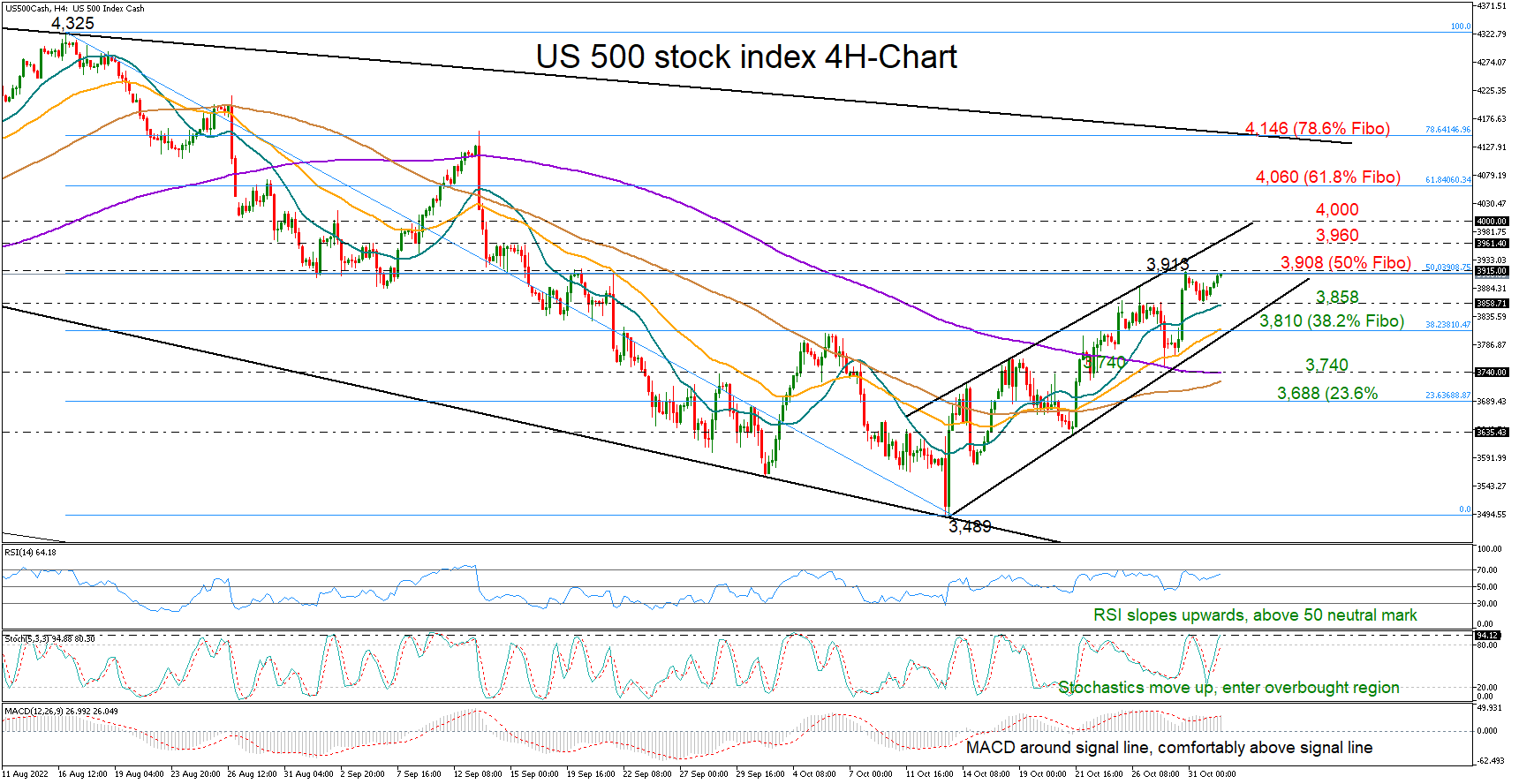
The US 500 stock index (cash) has been building a pattern of higher highs and higher lows since its 2021 downtrend stalled at an almost two-year low of 3,489 in mid-October.
With the price trading above its simple moving averages (SMAs) on the four-hour chart and the momentum indicators fluctuating within the bullish territory, buying interest could persist in the short term.
October’s high of 3,913, which coincides with the 50% Fibonacci retracement of the 4,325-3,489 downleg, is currently under examination. The bulls will need to crawl above it to gain access to the key resistance line around 3,960. The 4,000 round level could be the next barrier, while higher, the bulls may target the 61.8% Fibonacci of 4,060.
Moving to the downside, the index could take some rest around the resistance-turned-support region of 3,858 before heading for the 38.2% Fibonacci of 3,810. The protective 50-period SMA and the key ascending trendline drawn from the 3,489 low could cement that floor, preventing a depreciation towards the 200-period SMA at 3,740.
All in all, the US 500 index is eyeing another bullish breakout, with traders waiting for a confirmation above the 3,913 resistance.
GBPUSD Battles with Descending Trendline
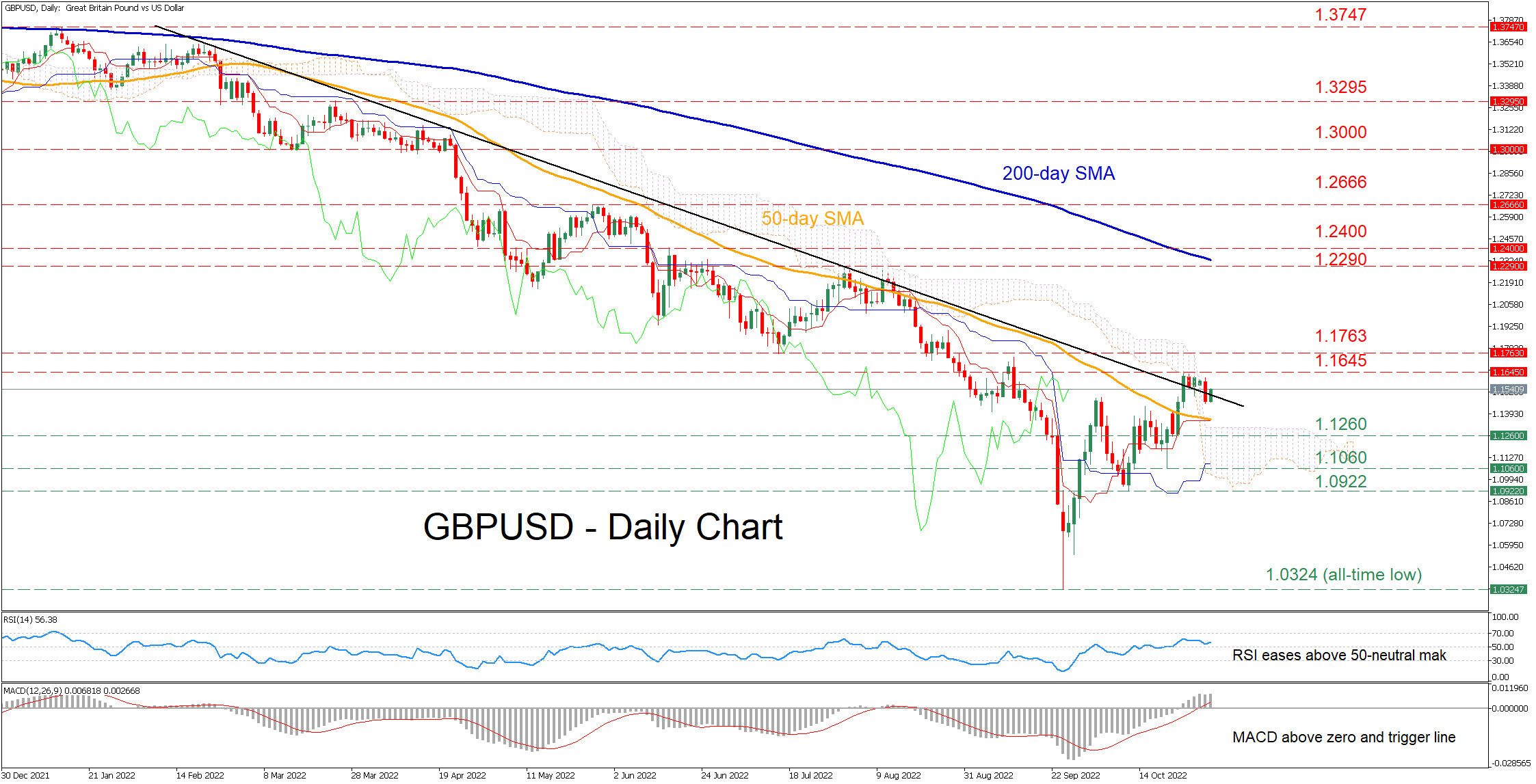
GBPUSD has been in a prolonged downtrend since the beginning of the year, plummeting to an all-time low of 1.0324 in mid-September. Although the pair has been in a recovery mode since then and lately crossed above its descending trendline, its latest advance failed to strengthen further, with the pair retracing back to its bearish pattern.
The short-term oscillators are currently indicating a cautiously bullish near-term tone. Specifically, the RSI is hovering slightly above its 50-neutral mark, while the MACD histogram is softening above both zero and its red signal line.
To the upside, bullish actions could propel the price towards the recent resistance of 1.1645. Piercing through this region, the price could challenge the June support of 1.1763, which could now act as resistance. Even higher, the July peak of 1.2290 could curb any further advances before 1.2400 comes under examination.
Alternatively, should the positive momentum fade and the price reverse downwards, initial support could be met at 1.1260. Sliding beneath that floor, the bears might target 1.1060 before the spotlight turns to the October low of 1.0922. A violation of the latter could open the door for the all-time low of 1.0324.
Overall, GBPUSD appears to be losing steam after managing to break above its long-term restrictive trendline. Therefore, if the price falls again below the latter, the pair will most likely extend its downtrend, while a bounce to the upside could increase bulls’ bets for a sustained rebound.
UK PMI manufacturing finalized at 46.2, suffered a further decline
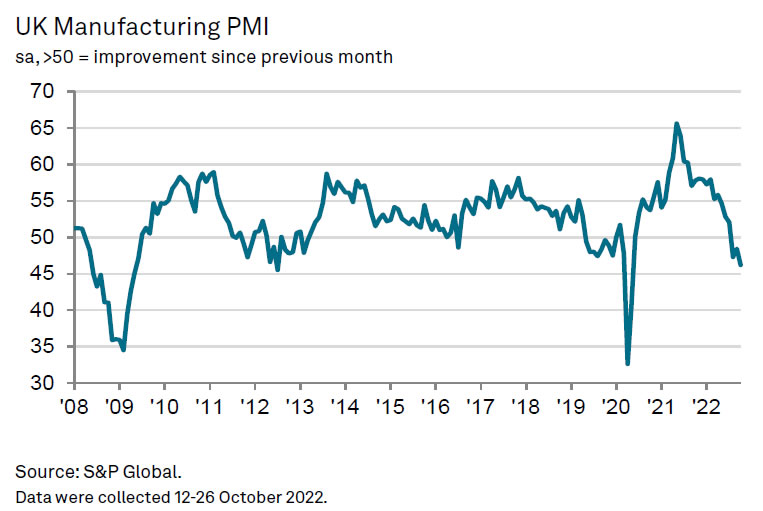
UK PMI Manufacturing was finalized at 46.2 in October, down from September's 48.4. That's the lowest level in 29 months, and the reading has been below 50 mark for three consecutive months.
S&P Global noted that output, new orders and new export business all declined. Job cuts were registered for the first time in almost two years. Input cost and selling price inflation eased slightly.
Rob Dobson, Director at S&P Global Market Intelligence, said: "UK manufacturing production suffered a further decline at the start of the fourth quarter, with the sector buffeted by weak demand, high inflation, supply-chain constraints and heightened political and economic uncertainties.... The darkening situation also knocked business optimism down to a two-and-a-half year low... On current form manufacturing is in no position to help prevent the broader UK economy from sliding into recession."
RBA Lowe: We need to strike the right balance between doing too much and too little
RBA Governor Philip Lowe said in a speech that the earlier large 50bps rate hikes wereto "move interest rates quickly away from their pandemic levels to address the rapidly emerging inflation problem."
As interest rates moved back to "more normal levels", the board judged that it's "appropriate to move at a slower pace", with 25bps hike today, and at last meeting.
"We are conscious that interest rates have been increased by a large amount in a very short period of time and that higher interest rates affect the economy with a lag," he added. "If we are to stay on that narrow path, we need to strike the right balance between doing too much and too little."
Lowe also noted that RBA is "not on a pre-set path". "If we need to step up to larger increases again to secure the return of inflation to target, we will do that," he added. "Similarly, if the situation requires us to hold steady for a while, we will do that.
Swiss SECO consumer confidence fell to fresh record low at -47
Swiss SECO Consumer Confidence fell further from -42 to -47 in Q4, below expectation of -43. That's the record low level since the survey began in 1972.
Looking at some details, expected economic development dropped from -53.5 to -57.2, far below long-term average of -9. Past financial situation dropped from -35.1 to -39.7, a historic low. Expected financial situation dropped sharply from -34.8 to -46.9, also a new low. Major purchases improved slightly from -43.3 to -42.4.
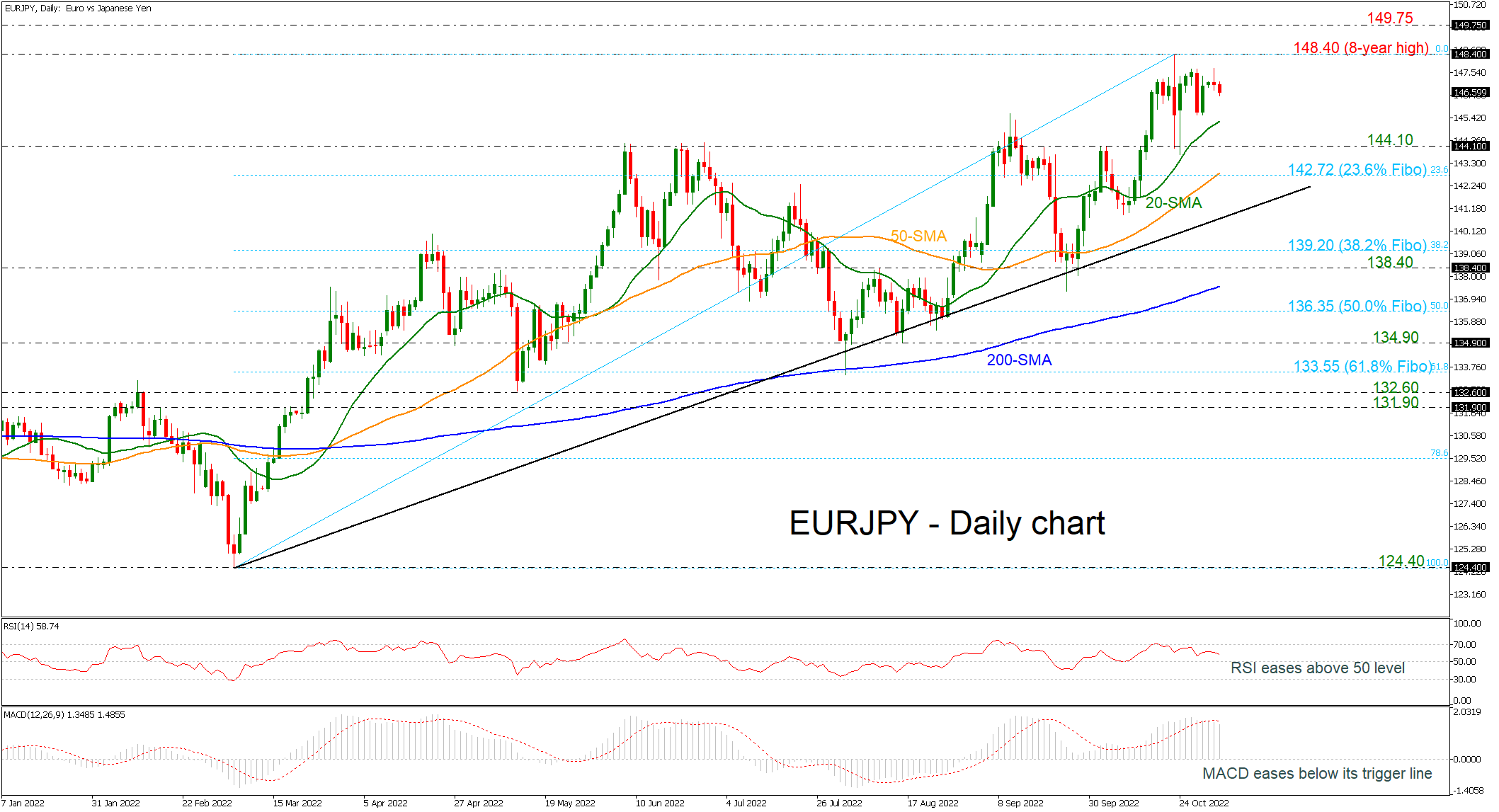
EURJPY Pauses Near 8-Year High; Neutral Bias in Near Term
EURJPY is moving sideways after the jump to the eight-year high of 148.40, failing to endorse the bullish outlook in the long-term. The RSI indicator is moving lower in the positive region, while the MACD oscillator dived beneath its trigger line above the zero level. The 20- and 40-day simple moving averages (SMAs) are still moving north and are acting as strong support lines.
Should selling forces strengthen, the 20-day SMA at 145.25 will come under the spotlight ahead of the 144.10 support. Moving lower, the 23.6% Fibonacci retracement level of the upward wave from 124.40 to 148.40 at 142.75 could next add some footing, overlapping with the 50-day SMA. A break lower could open the way for the long-term uptrend line near 141.10 and would put the recent upside tendency under examination.
Alternatively, a close above the multi-year high of 148.40 will brighten the broader outlook, pushing the price towards the 149.75 barrier registered in December 2014. Beyond that, the rally may gear up to the inside swing low from March 2008 at 151.70
In brief, EURJPY is facing a weaking bullish bias, where a drop below the ascending trend line around 141.40 is expected to enhance selling interest.
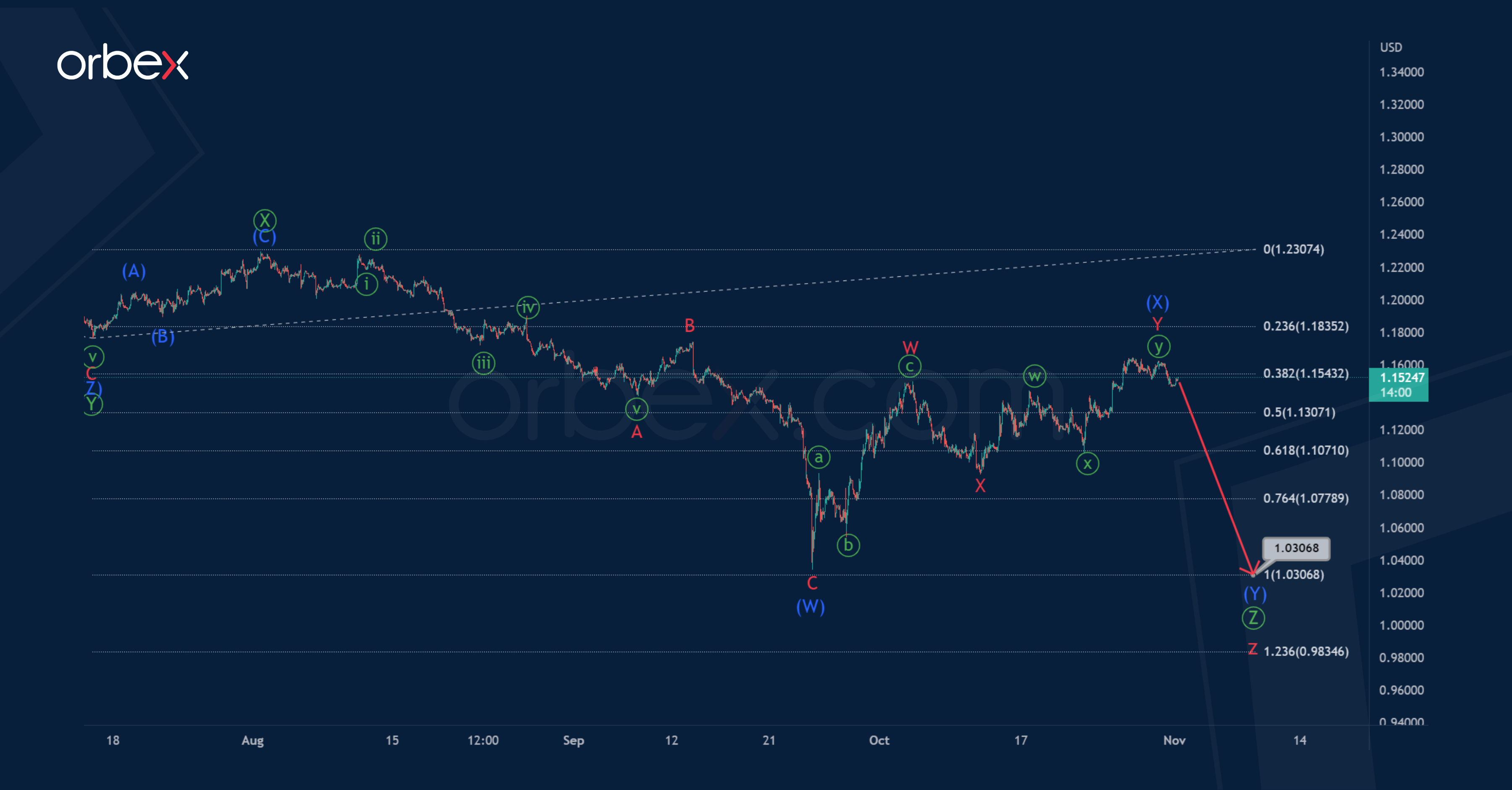
GBP/USD: Bearish Trend Likely to Complete Near 1.030
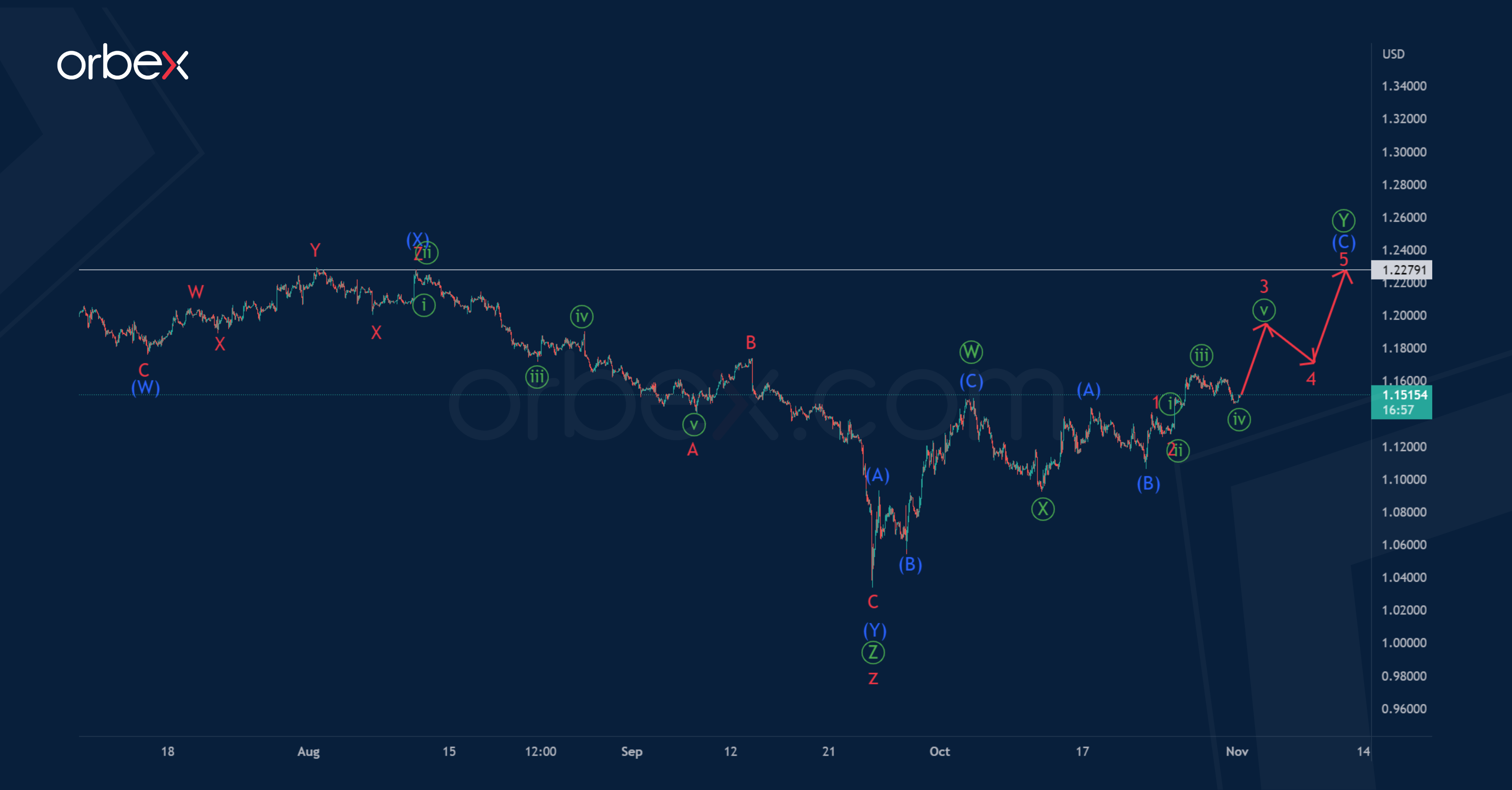
The structure of the GBPUSD currency suggests the formation of a global corrective trend – a triple zigzag w-x-y-x-z. On the 1H timeframe, we see the final actionary wave z of the cycle degree.
The wave z most likely takes the form of a primary triple zigzag Ⓦ-Ⓧ-Ⓨ-Ⓧ-Ⓩ. Perhaps at the beginning of August of this year, the bullish price movement ended within the small primary intervening wave Ⓧ, it took the form of an intermediate zigzag (A)-(B)-(C).
After that, the bearish trend continued to develop in the primary wave Ⓩ, which can complete its intermediate double zigzag pattern (W)-(X)-(Y) near 1.030.
At that level, wave Ⓩ will be at the 100% Fibonacci extension of previous actionary wave Ⓨ.
In the second variant, it is assumed that the cycle wave z could be fully completed, it has the form of a primary triple zigzag, as assumed above.
Thus, in the last section of the chart, we see that the bulls have started to move the price into a new trend.
Perhaps the formation of the primary double zigzag Ⓦ-Ⓧ-Ⓨ occurs, where the first two parts have already been formed. The last zigzag wave Ⓨ, consisting of intermediate sub-waves (A)-(B)-(C), is currently under development.
The end of the intermediate impulse wave (C) is possible near the maximum of 1.227, which was marked by the sub-wave (X).