Sample Category Title
China Caixin PMI manufacturing recovered to 49.2, impact of Covid controls lingered
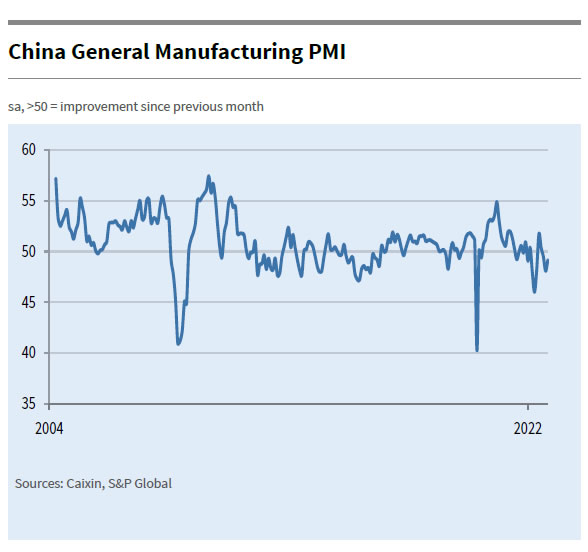
China Caixin PMI Manufacturing rose from 48.1 to 49.2 in October, above expectation of 49.0. Caixin noted that output and new orders fell again as COVID-19 containment measures continued. Selling prices fell for the sixth consecutive month. Business confidence edged up slightly.
Wang Zhe, Senior Economist at Caixin Insight Group said: "Overall, the negative impact of Covid controls on the economy lingered. In October, supply, domestic and overseas demand, and employment in the manufacturing sector all contracted, but the rates of contraction slowed from the previous month. Costs rose slightly, and cuts to output prices were still common. Logistics and transportation were still sluggish, and companies' purchases and inventories rose slightly. Market sentiment improved, but optimism remained limited from a long-term perspective.
Japan PMI manufacturing finalized at 50.7, but business remained optimistic
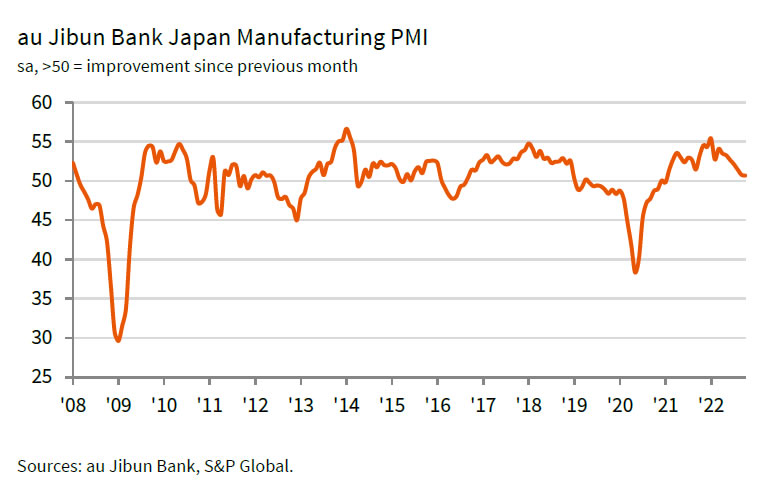
Japan PMI Manufacturing was finalized at 50.7 in October, slightly down from September's 50.8. That's the lowest level in 21 months. S&P Global noted that inflationary pressure remained severer. Business remained optimistic with sentiment at nine-month high.
Laura Denman, Economist at S&P Global Market Intelligence, said:
"The latest survey data signalled that Japan's manufacturing sector lost further momentum in October. Sluggish markets and weaker demand conditions, on both a domestic and international level, became a recurring trend throughout the report and were seemingly the driving forces behind the slower sector performance. Anecdotal evidence suggested that worsening conditions in China and South Korea were specifically detrimental to Japan's exports this month.
"Meanwhile, inflationary pressures remained severe in October. Japanese manufacturing firms increased their selling prices more aggressively, as signalled by a near-record rate of output cost inflation. Given the current conditions in some of Japan's key export markets, and with inflationary pressures displaying limited signs of easing, demand is likely to remain subdued in the coming months.
"Despite this, firms seem unfazed by the challenges that the sector is currently facing remaining optimistic towards their 12-month outlook on growth in October. In fact, the degree of confidence accelerated from September and reached a nine-month high."
GBP/USD Consolidates Gains, Why The Bulls Remain In Control
Key Highlights
- GBP/USD gained pace and tested the 1.1650 zone.
- It broke a major bearish trend line with resistance near 1.1400 on the 4-hours chart.
- EUR/USD corrected gains from 1.0090 and might find bids near 0.9820.
- The US ISM Manufacturing Index could decline from 50.9 to 50.0 in Oct 2022.
GBP/USD Technical Analysis
The British Pound gains pace after it broke the 1.1400 resistance against the US Dollar. GBP/USD even cleared the 1.1500 zone to move into a positive zone.
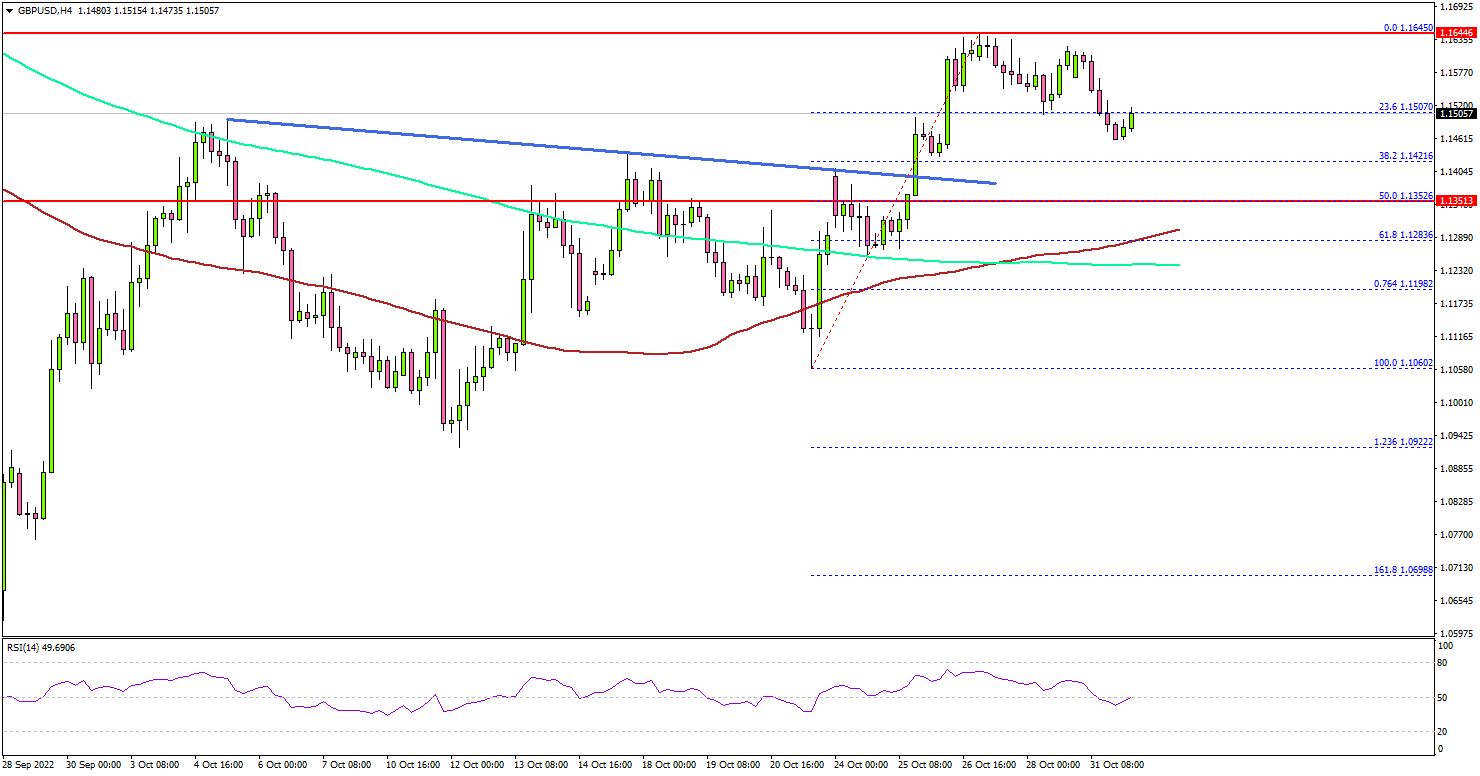
Looking at the 4-hours chart, the pair climbed above the 1.1550 level. There was also a close above the 100 simple moving average (red, 4-hours) plus the 200 simple moving average (green, 4-hours).
A high was formed near 1.1645 before there was a downside correction. The pair declined below the 1.1600 and 1.1585 support levels. The bears pushed the pair below the 23.6% Fib retracement level of the upward move from the 1.1060 swing low to 1.1645 high.
An initial support is near the 1.1425 level. The next major support is near the 1.1350 zone. It is near the 50% Fib retracement level of the upward move from the 1.1060 swing low to 1.1645 high.
The main support sits at 1.1280 and the 100 simple moving average (red, 4-hours). A downside break below the 1.1380 zone could push the pair into a bearish zone. In the stated case, it could decline towards the 1.1200 support.
On the upside, GBP/USD is facing a major resistance near the 1.1600 zone. The next major resistance may perhaps be near 1.1650. Any more gains could set the pace for a move towards the 1.1800 level, above which it could even test 1.2000.
Looking at EUR/USD, the pair topped near the 1.0093 level and recently started a downside correction below the 1.0000 level.
Economic Releases
- US ISM Manufacturing Index for Oct 2022 – Forecast 50.0, versus 50.9 previous.
Platinum Wave Analysis
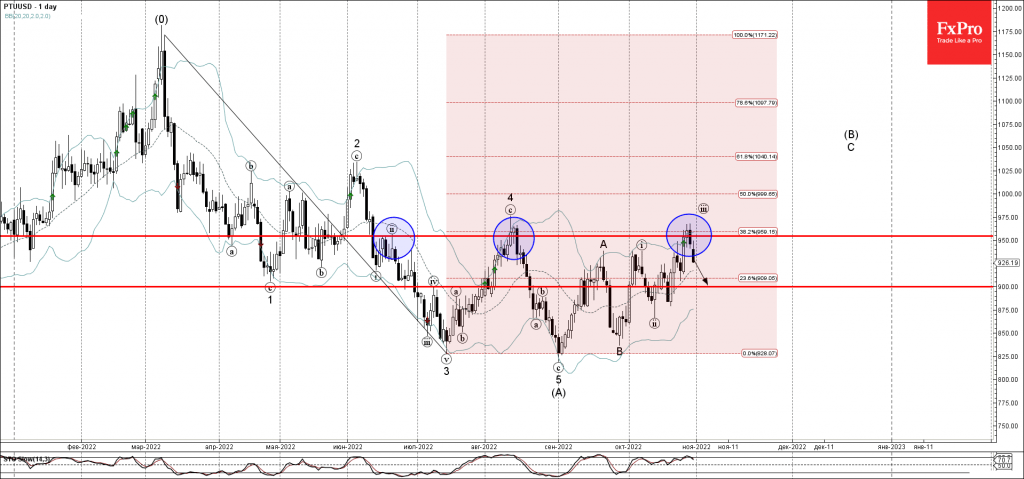
- Platinum reversed from resistance level 955.00
- Likely to fall to support level 900.00
Platinum recently reversed down from the pivotal resistance level 955.00 (which has been reversing the price from June), standing near the upper daily Bollinger Band and the 38.2% Fibonacci correction of the downward impulse from March.
The downward reversal from the resistance level 955.00 stopped the earlier impulse waves (iii) and C.
Given the bearish sentiment across the precious markets today, Platinum can be expected to fall further toward the next round support level 900.00.
EURGBP Wave Analysis
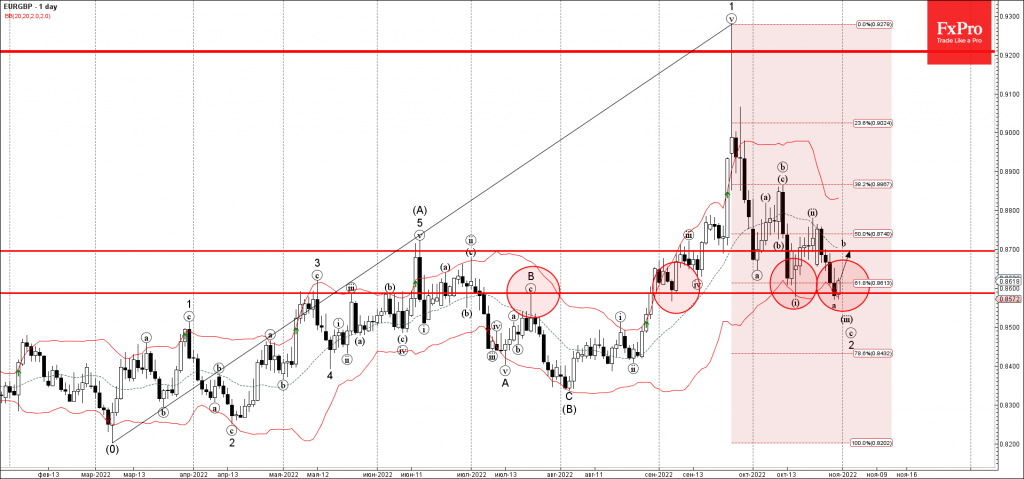
- EURGBP reversed from support level 0.8590
- Likely to rise to resistance level 0.8700
EURGBP currency pair recently reversed up from the key support level 0.8590 (former resistance from July), standing near the lower daily Bollinger Band and the 61.8% Fibonacci correction of the upward impulse from March.
The upward reversal from the support level 0.8590 started the active short-term correction b.
EURGBP can be expected to rise further toward the next resistance level 0.8700 (target price for the completion of the active wave b).
RBA hikes 25bps, rates to rise further over the period ahead
RBA raises cash rate target by 25bps to 2.85% as widely expected. It maintains tightening bias and expects to "increase interest rates further over the period ahead". The size and timing of future rate hikes will be determined by incoming data and the outlook for inflation and labor market.
The central bank expects inflation to "further increase" over the months ahead and peak at around 8% this year. CPI inflation is forecast to be around 4.75% over 2023 and a little above 3% over 2024. GDP growth forecast was "revised down a little" to 3% this year, 1.50% in 2023 and 2024. Unemployment rate is forecast to rise gradually from current 3.5% to a little above 4% in 2024 as economic growth slow.
(RBA) Statement by Philip Lowe, Governor: Monetary Policy Decision
At its meeting today, the Board decided to increase the cash rate target by 25 basis points to 2.85 per cent. It also increased the interest rate on Exchange Settlement balances by 25 basis points to 2.75 per cent.
As is the case in most countries, inflation in Australia is too high. Over the year to September, the CPI inflation rate was 7.3 per cent, the highest it has been in more than three decades. Global factors explain much of this high inflation, but strong domestic demand relative to the ability of the economy to meet that demand is also playing a role. Returning inflation to target requires a more sustainable balance between demand and supply.
A further increase in inflation is expected over the months ahead, with inflation now forecast to peak at around 8 per cent later this year. Inflation is then expected to decline next year due to the ongoing resolution of global supply-side problems, recent declines in some commodity prices and slower growth in demand. Medium-term inflation expectations remain well anchored, and it is important that this remains the case. The Bank's central forecast is for CPI inflation to be around 4¾ per cent over 2023 and a little above 3 per cent over 2024.
The Australian economy is continuing to grow solidly and national income is being boosted by a record level of the terms of trade. Economic growth is expected to moderate over the year ahead as the global economy slows, the bounce-back in spending on services runs its course, and growth in household consumption slows due to tighter financial conditions. The Bank's central forecast for GDP growth has been revised down a little, with growth of around 3 per cent expected this year and 1½ per cent in 2023 and 2024.
The labour market remains very tight, with many firms having difficulty hiring workers. The unemployment rate was steady at 3.5 per cent in September, around the lowest rate in almost 50 years. Job vacancies and job ads are both at very high levels, although employment growth has slowed over recent months as spare capacity in the labour market has been absorbed. The central forecast is for the unemployment rate to remain around its current level over the months ahead, but to increase gradually to a little above 4 per cent in 2024 as economic growth slows.
Wages growth is continuing to pick up from the low rates of recent years, although it remains lower than in many other advanced economies. A further pick-up is expected due to the tight labour market and higher inflation. Given the importance of avoiding a prices-wages spiral, the Board will continue to pay close attention to both the evolution of labour costs and the price-setting behaviour of firms in the period ahead.
Price stability is a prerequisite for a strong economy and a sustained period of full employment. Given this, the Board's priority is to return inflation to the 2–3 per cent range over time. It is seeking to do this while keeping the economy on an even keel. The path to achieving this balance remains a narrow one and it is clouded in uncertainty.
One source of uncertainty is the outlook for the global economy, which has deteriorated over recent months. Another is how household spending in Australia responds to the tighter financial conditions. The Board recognises that monetary policy operates with a lag and that the full effect of the increase in interest rates is yet to be felt in mortgage payments. Higher interest rates and higher inflation are putting pressure on the budgets of many households. Consumer confidence has also fallen and housing prices have been declining following the earlier large increases. Working in the other direction, people are finding jobs, gaining more hours of work and receiving higher wages. Many households have also built up large financial buffers and the saving rate remains higher than it was before the pandemic.
The Board has increased interest rates materially since May. This has been necessary to establish a more sustainable balance of demand and supply in the Australian economy to help return inflation to target. The Board expects to increase interest rates further over the period ahead. It is closely monitoring the global economy, household spending and wage and price-setting behaviour. The size and timing of future interest rate increases will continue to be determined by the incoming data and the Board's assessment of the outlook for inflation and the labour market. The Board remains resolute in its determination to return inflation to target and will do what is necessary to achieve that.
Will the Fed Confirm Hopes of Slower Tightening?
Although the dollar ended last week on a positive note, it’s been trading in a corrective fashion overall for more than a week now, due to growing speculation that the Fed may soon need to start reducing the pace of its rate increases. Although this is not expected to happen this week, investors are sitting on the edge of their seats in anticipation of clues and signals with regards to the future course of action. The decision and the statement are scheduled to be made public on Wednesday at 18:00 GMT, with a press conference by Fed Chair Powell to be held thirty minutes later.
The switch
When they last met, Federal Reserve officials delivered their third consecutive 75bps rate increase and updated their projections to point to a terminal rate of 4.6% in 2023 and not any cuts until 2024. Up until a couple of weeks ago, they were all singing from the same hawkish song sheet, which combined with the hotter-than-expected inflation numbers for September, allowed investors to lift their terminal rate up to 5%. Even with a rate cut in the equation, interest rates at the end of 2023 were seen higher than the Fed’s own projection for the year. In other words, the market turned more hawkish than the Fed itself.
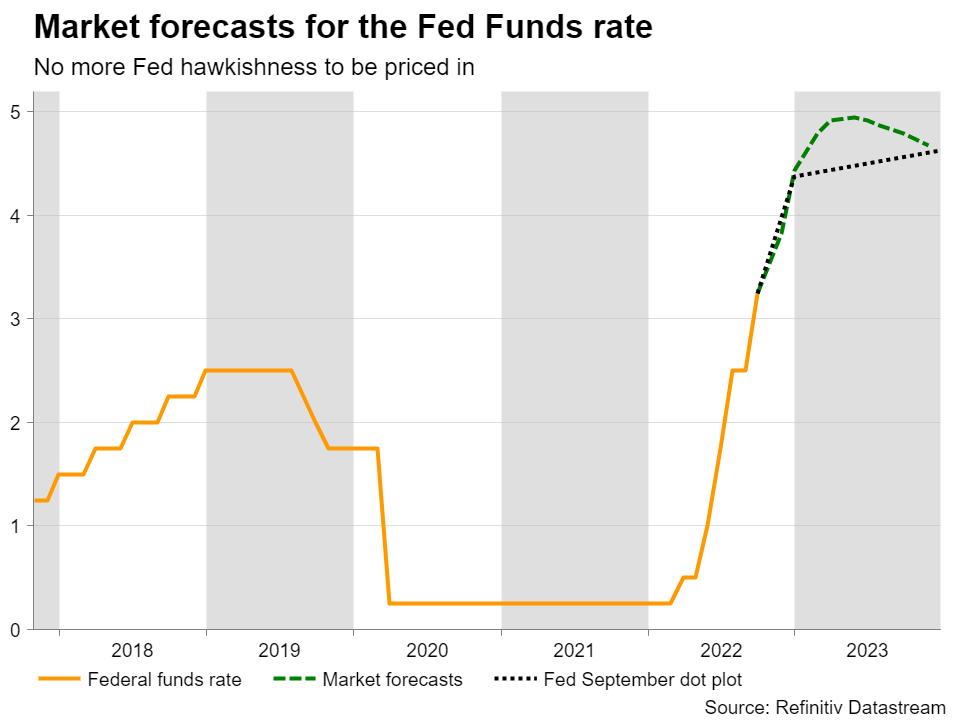
However, the whole aggressive-Fed narrative came into question a couple of weeks ago, when reports suggested a slowdown in rate increases from December onwards, with the view being echoed by some policymakers thereafter. What added more credence to the newborn dogma was the disappointing PMI and housing data last week, as well as the Bank of Canada’s decision to announce a smaller-than-expected hike and note that it is getting closer to ending this historic tightening crusade. This may have been interpreted as setting the tone for other major central banks, and indeed investors were proven right just a day later, when the ECB also opened the door to slower rate increases.
The decision
Investors are in full agreement that the Committee will serve its fourth consecutive triple hike on Wednesday, but they are split on whether the December increment will be of 50 or 75 basis points. And that’s still the case even after last week’s better-than-expected GDP data for Q3.
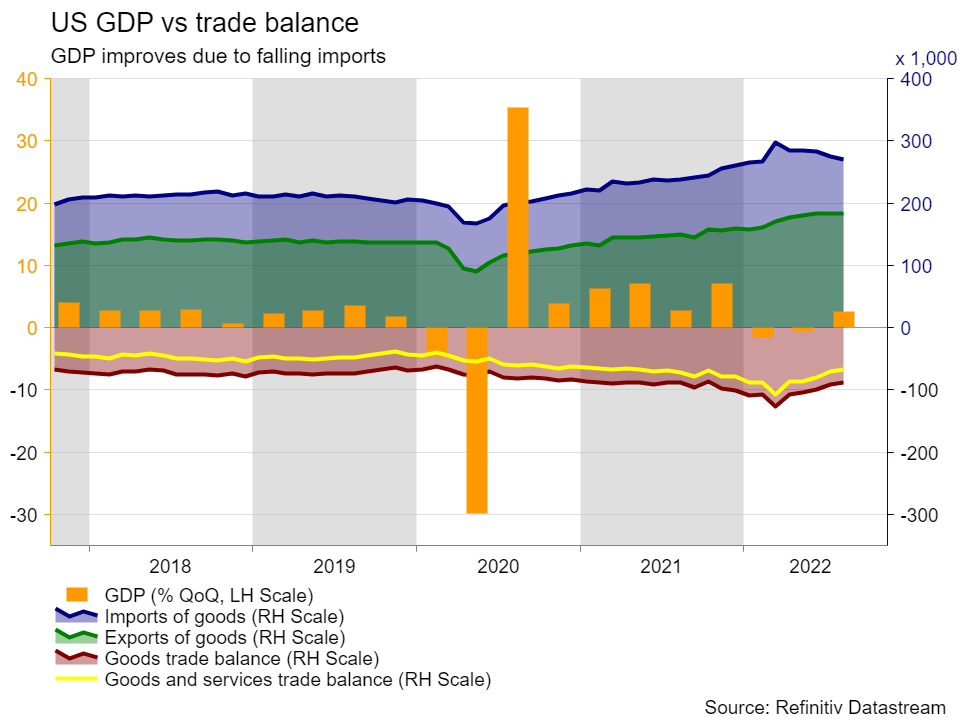
However, despite the sparkly GDP rate, a dive into the details revealed a different story. Domestic demand hit its lowest in two years due to the Fed’s aggressive hikes, while residential investment contracted for the sixth straight quarter. The nation’s economic health was overstated due to tumbling imports resulting in a shrinking trade deficit. Combined with the fact that the effects of the past cumulative tightening are not being fully felt yet, this suggests that there is still the likelihood of a modest downturn early next year.
Ergo, Powell and his colleagues may confirm the narrative of slower future hikes due to growing economic risks. They may have begun considering the risk of overdoing it as inflation tends to react slowly to higher rates, let alone now that the distortions to the economy caused by the pandemic are still not fully resolved. Given that the market still sees rates higher than the Fed does in December next year, such an outcome could result in some more dollar selling as there is no more Fed hawkishness to be priced in. However, Powell may try to pass the message in a way that it does not give rise to substantial loosening of financial conditions.
The reaction
Therefore, a potential retreat in the dollar may not be suggestive of a trend reversal genesis. After all, with other major central banks also hinting at slower rate increases, the Fed could hold onto first place on the hawks’ league. Traders may liquidate some more of their long dollar positions on Wednesday, but they may re-enter the game at lower, more attractive levels. A sanguine employment report on Friday could be a justification for doing so. Otherwise, the correction may extend for a while longer.
From a technical standpoint, the recent weakness in the greenback helped euro/dollar climb above the downtrend line drawn from the high of February 10, and although the pair pulled back on Friday, it stayed above that line. This keeps the case of a rebound firmly on the table. If the bulls indeed regain control, they could initially aim for another test at Friday’s high of 1.0100 or near the 1.0200 zone, marked by the peak of September 13. A break higher could pave the way towards 1.0370, slightly below the 200-exponential moving average. This is the territory around where traders may decide to buy dollars again.
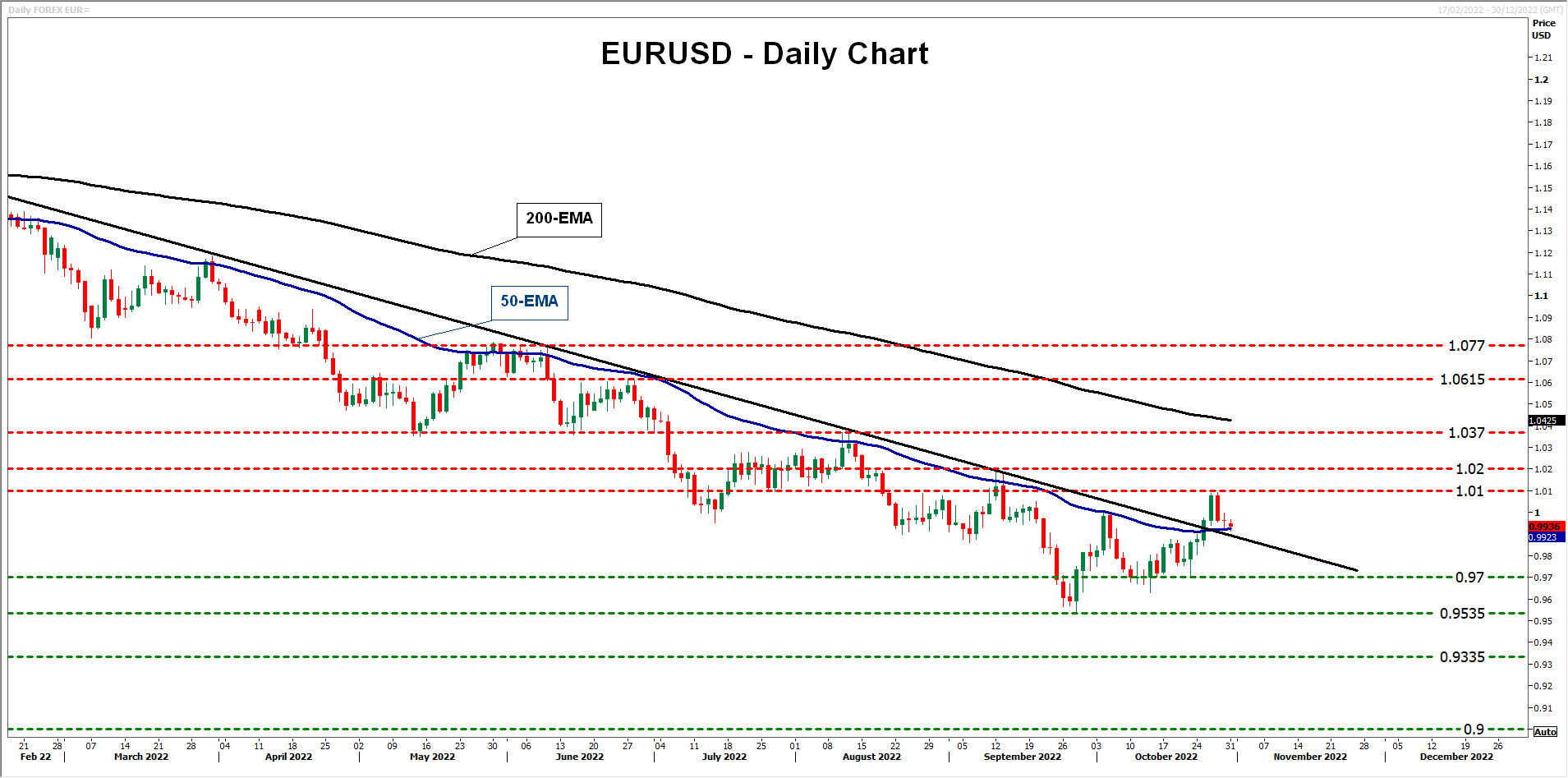
Now, in case the Fed appears much more hawkish than expected, showing no signs of remorse, euro/dollar may quickly break back below the downside line and slide to the 0.9700 or 0.9535 zones. A breach of the latter support area would confirm a lower low on the bigger timeframes and may allow extensions towards the 0.9335 zone, defined as a support by the inside swing high of September 17, 2001.
RBA Policy Meeting: Is a 50bps Rate Hike Up Next?
The Reserve Bank of Australia (RBA) took the initiative to slow the pace of its rate hikes in October after five months of rapid increases. The latest inflation release, however, raised speculation that a U-turn to outsized rate moves could be possible during Tuesday’s policy meeting. A resumption of the hawkish stance could lift the aussie, albeit temporarily.
Sharp rate hikes back under the spotlight
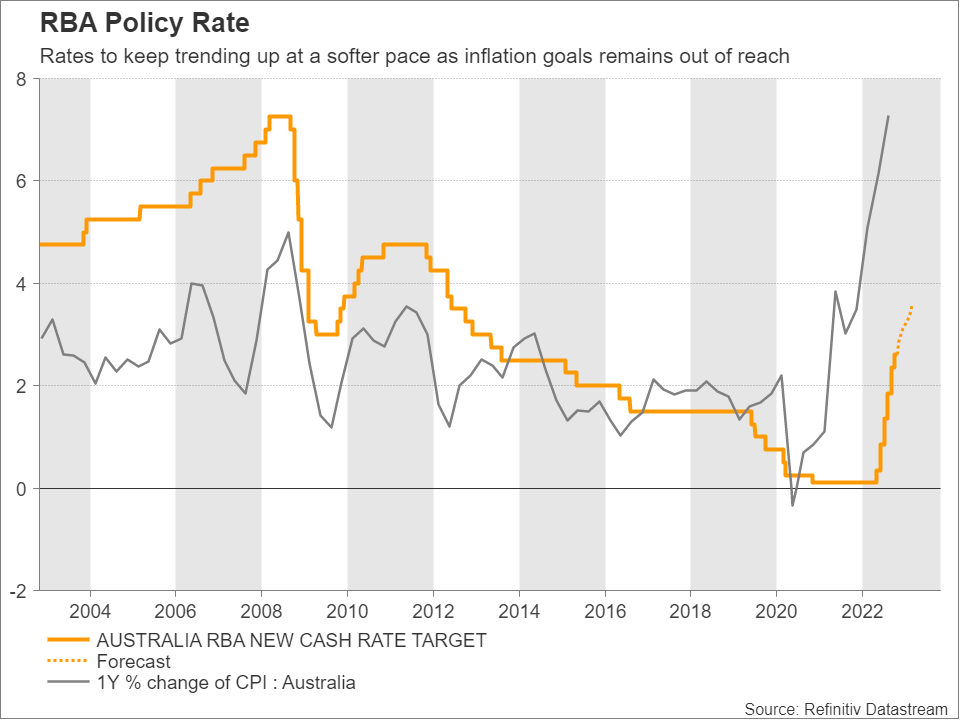
Fears that a continuous aggressive monetary tightening could backfire with undesirable economic shocks in the foreseeable future made the case for a smaller 25 bps rate hike at the start of October. The RBA was the first among major central banks to surprisingly ease its hawkish rhetoric, though the latest inflation report signaled that the shift was premature.
Despite 225 bps of significant rate increases over the past five months, the headline CPI advanced above expectations to unlock a new 32-year high at 7.3% y/y in the third quarter. Strikingly, the core measures rose at a much faster pace, suggesting that Australia is not different from other major economies which are struggling to contain growth in consumer prices. Consequently, the data sparked conversations for a reversal to 50bps rate hikes, although most analysts keep seeing only a modest 25 bps rate increase for this meeting.
Australia's outlook is still cloudy
Of course, there are some internal signs that the economy is losing momentum and a careful approach is necessary. Housing finance approvals are expected to slow further in September after a 3.4% decline in August, suggesting that rising borrowing costs are already adding pressure to highly indebted Australian households. Also, the latest business PMI survey revealed deteriorating activity in the services sector, which experienced the largest contraction in demand since September 2021.
External developments are not favorable at present either. Besides the geopolitical turmoil in Ukraine, China’s persisting zero-covid measures could delay the supply of products and services and ease demand for Australian exports. Note that Australia’s budget released on Tuesday involved an additional A$900 million spending for Pacific nations over four years and A$470 million for partners in Southeast Asia to counter China’s influence.
A 50 bps rate hike could be ideal
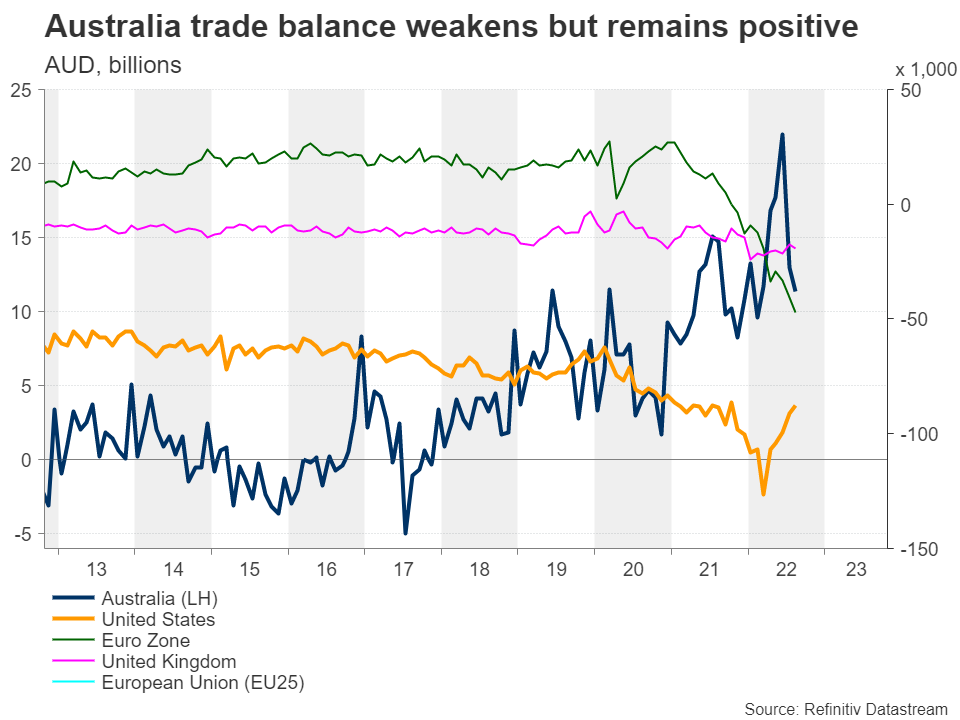
On the other hand, Australia is still in a relatively better place in terms of trade and budget balances when compared to other nations. The labor market is tight, and consumption, as proxied by retail sales, remains resilient in the growth territory, even though wages are lagging inflation. Hence, while that provides some extra space for monetary tightening, a second gradual 25 bps rate hike in a row this month could create the impression that the RBA is not committed to its inflation task. That is something the central bank could easily avoid by sacrificing some credibility and raising interest rates by 50 bps.
Besides, the minutes from October’s meeting have clearly stated that the “size and timing of future interest rate increases will continue to be determined by the incoming data and the Board’s assessment of the outlook for inflation and the labour market”. Therefore, policymakers could easily justify a sharper rate increase without significantly violating their guidance.
Aussie/dollar
Turning to FX markets, a sharper-than-expected rate hike could help the aussie to gain some extra ground against the US dollar, especially if the rate announcement is coupled with an upward revision in inflation projections. A confirmation that the Fed could reach its terminal interest rate sooner than later and a less exciting nonfarm payrolls report could trigger another bullish episode for the aussie at the end of the week. Still, how durable any upleg could be, and more importantly, whether the broad downtrend in aussie/dollar could soon reverse is questionable.
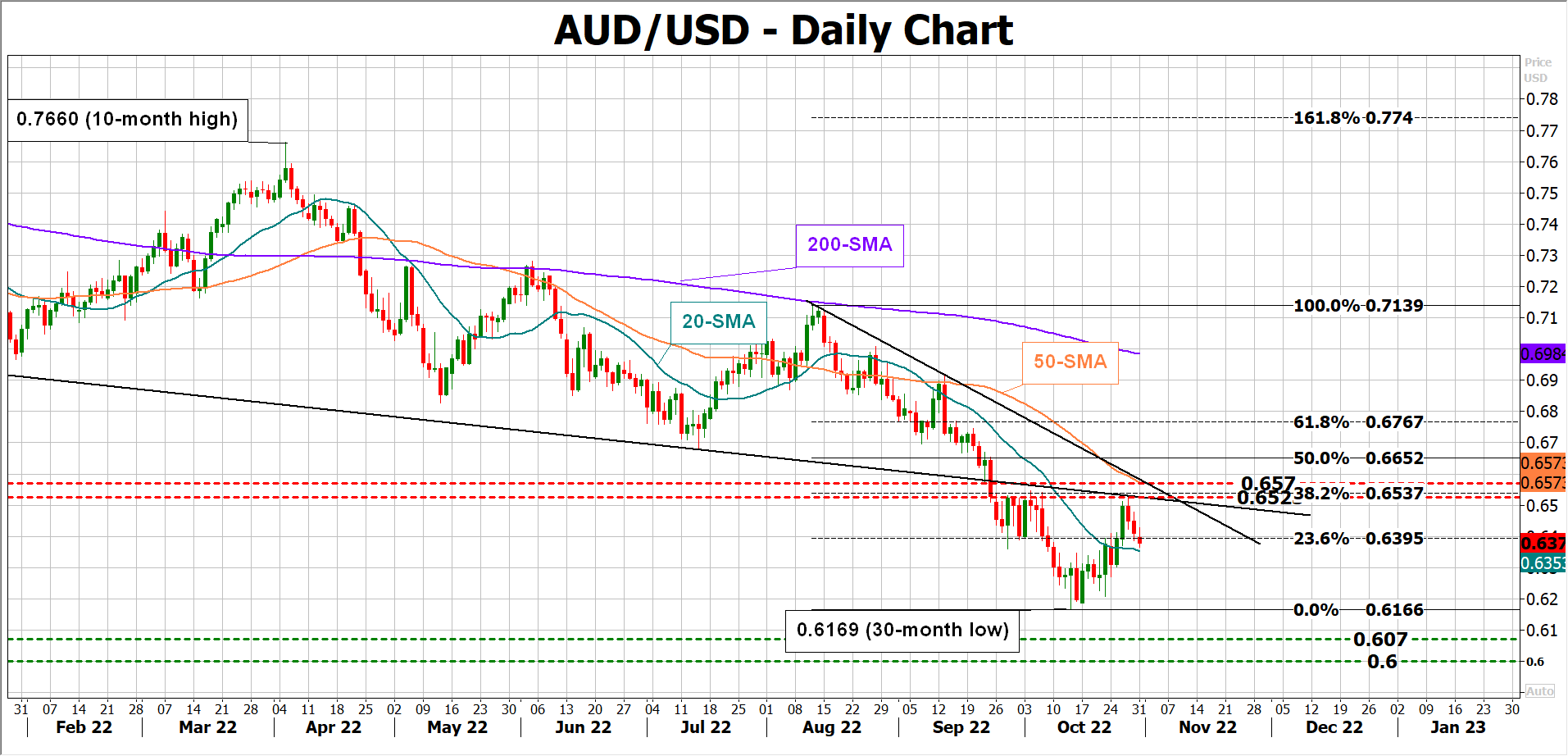
From a technical perspective, a decisive bounce above the 0.6320-0.6570 resistance is required to activate strong upside pressures up to the 0.6650-0.6680 constraining area. Otherwise, a pullback below 0.6300 may bring the 0.6200- 0.6169 floor back under examination. Failure to pivot here could worsen the downtrend to 0.6070-0.6000.