Sample Category Title
Dollar Rebounds, Aussie Weakens ahead of RBA
Dollar rebounds broadly today as US futures turn south, pointing to a lower open. Yen is back under some selling pressure. But Euro is also weak despite stronger than expected consumer inflation data, while Sterling and Swiss Franc are also soft. Commodity currencies are mixed with Canadian Dollar on the weaker side. But overall, traders are probably just repositioning ahead of RBA, FOMC and BoE rate decisions.
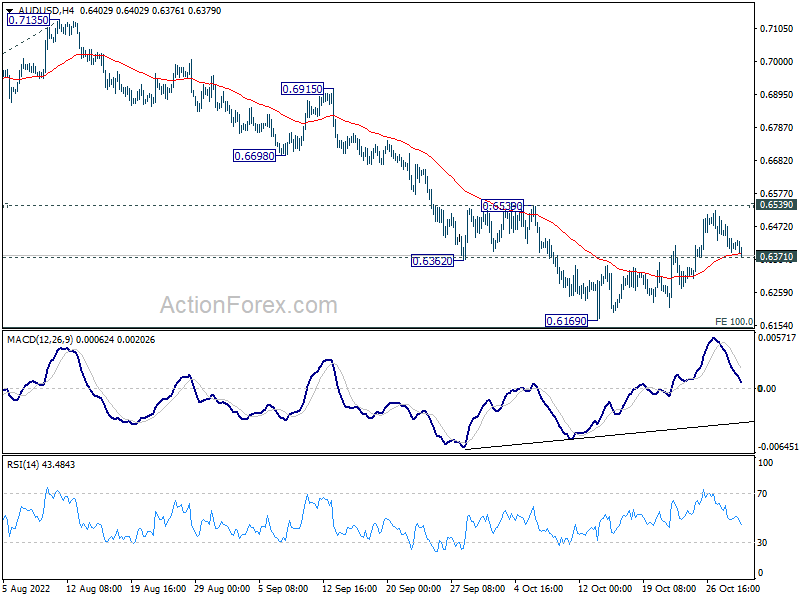
Technically, with Dollar's rebound, one immediate focus is now on 0.6371 minor support in AUD/USD. Break will indicate that rebound from 0.6169 has completed and bring retest of this low. The move could come as reaction to RBA rate decision, or even before. And, if happens, that could be a pre-signal of more upside in the greenback.
In Europe, at the time of writing, FTSE is up 0.22%. DAX is up 0.24%. CAC is down -0.16%. Germany 10-year yield is up 0.01 at 2.110. Earlier in Asia, Nikkei rose 1.78%. Hong Kong HSI dropped -1.18%. China shanghai SSE dropped -0.77%. Singapore Strait Times rose 1.11%. Japan 10-year JGB yield rose 0.0027 to 0.245.
ECB Visco: High uncertainty calls for gradual tightening
ECB Governing Council member Ignazio Visco said that interest rate will have to rise further to reduce the risk of persistent high inflation
However, he's uncertain on the pace of tightening, in face of economic risks. Also, the terminate rate of "can't be predetermined" due to the uncertain nature of economic forecasting amid Russia's war in Ukraine.
"The high level of uncertainty calls for a gradual approach, carefully assessing the appropriateness of the monetary stance on the basis of evidence as it becomes available," he said.
Eurozone GDP growth slowed to 0.2% qoq in Q3
Eurozone GDP grew 0.2% qoq in Q3, slightly above expectation of 0.1% qoq, but much slower than Q2's 0.8% qoq. EU GDP grew 0.2% qoq too, slowed from Q2's 0.7% qoq.
Among the Member States for which data are available for the third quarter of 2022, Sweden (+0.7%) recorded the highest increase compared to the previous quarter, followed by Italy (+0.5%), Portugal and Lithuania (both +0.4%). Declines were recorded in Latvia (-1.7%) as well as in Austria and Belgium (both -0.1%). The year-on-year growth rates were positive for all countries except for Latvia (-0.4%).
Eurozone CPI rose to 10.7% yoy in Oct, core CPI up to 5.0% yoy
Eurozone CPI accelerated from 9.9% yoy to 10.7% yoy in October, above expectation of 9.9% yoy. CPI core (all-items ex energy, food, alcohol & tobacco also rose from 4.8% yoy to 5.0% yoy, above expectation of 4.8% yoy.
Looking at the main components, energy is expected to have the highest annual rate in October (41.9%, compared with 40.7% in September), followed by food, alcohol & tobacco (13.1%, compared with 11.8% in September), non-energy industrial goods (6.0%, compared with 5.5% in September) and services (4.4%, compared with 4.3% in September).
Japan industrial production dropped -1.6% mom, as auto-related production dived
Japan industrial production declined -1.6% mom in September, below expectation of -1.0% mom. That's also the first contract in four months. The fall was driven by -12.4% mom decline in auto-related production, the steepest fall in eight months.
Manufacturers surveyed by the Ministry of Economy, Trade and Industry (METI) expected output to fall another -0.4% in October and then rise 0.8% in November.
Retail sales rose 4.5% yoy in September, above expectation of 4.1% yoy. Housing starts rose 1.0% yoy, below expectation of 2.3% yoy.
In October, consumer confidence dropped from 30.8 to 29.9, below expectation of 31.5.
Australia retail sales rose 0.6% mom in Sep
Australia retail sales rose 0.6% mom in September, matched expectations.
Ben Dorber, ABS head of retail statistics said, "This month's rise was again driven by the combined strength in the food industries. Food retailing rose 1.0 per cent, while cafes, restaurants, and takeaway food services rose 1.3 per cent.
"Many retailers remained open for the National Day of Mourning, an additional one-off public holiday in September, and this boosted spending on food, alcohol and dining out."
China PMI manufacturing and services fell to contraction
China PMI Manufacturing fell from 50.1 to 49.2 in October, below expectation of 50.0.
PMI Non-Manufacturing dropped from 50.6 to 48.7, below expectation of 50.2. Both readings were below 50-mark which separates growth from contraction on a monthly basis.
"In October, affected by the spread of the pandemic and other factors within the country, China's PMI fell, with the manufacturing PMI, non-manufacturing PMI and comprehensive PMI standing at 49.2 per cent, 48.7 per cent and 49.0 per cent, respectively, and the foundation of China's economic recovery needs to be further consolidated," said senior NBS statistician Zhao Qinghe.
"In October, the composite PMI stood at 49.0 per cent, down 1.9 percentage points from the previous month, falling below the critical point, indicating a general slowdown in the production and operating activities of Chinese enterprises."
EUR/USD Mid-Day Outlook
Daily Pivots: (S1) 0.9930; (P) 0.9964; (R1) 1.0001; More...
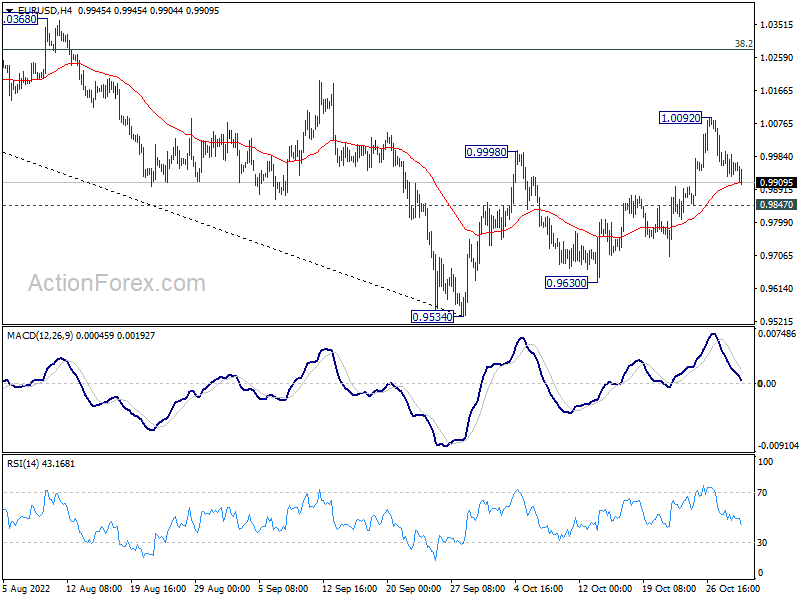
Intraday bias in EUR/USD remains neutral for the moment. Further rise is in favor as long as 0.9847 minor support holds. Break of 1.0092 will target 38.2% retracement of 1.1494 to 0.9534 at 1.0283. However, break of 0.9847 will turn bias back to the downside for 0.9534/9630 support zone instead.
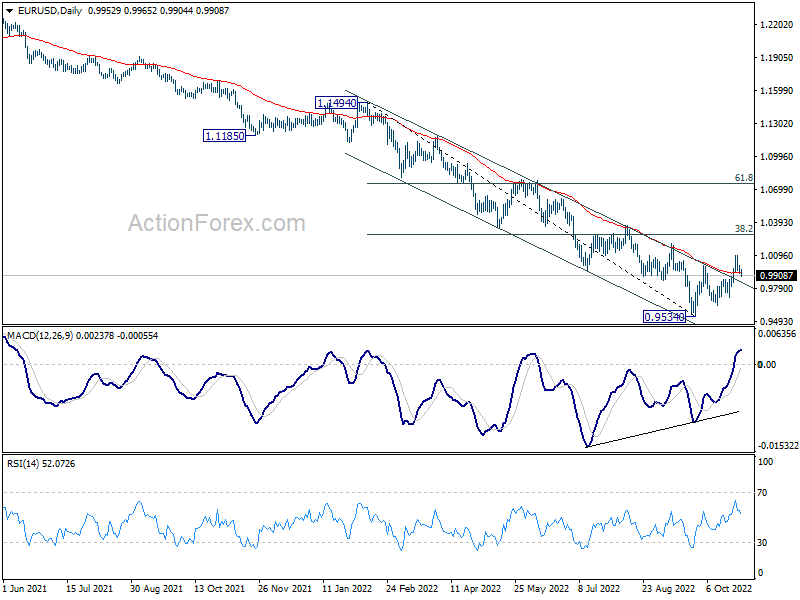
In the bigger picture, the case of medium term bottoming at 0.9534 building up, with bullish convergence condition in daily MACD. While it is too early to call for trend reversal, firm break of 0.9998 opens up stronger rebound back to 55 week EMA (now at 1.0630) even as a corrective rise. However, sustained trading back below 55 day EMA (now at 0.9938) will revive medium term bearishness for another fall through 0.9534 low.
Economic Indicators Update
| GMT | Ccy | Events | Actual | Forecast | Previous | Revised |
|---|---|---|---|---|---|---|
| 23:50 | JPY | Industrial Production M/M Sep P | -1.60% | -1.00% | 3.40% | |
| 23:50 | JPY | Retail Trade Y/Y Sep | 4.50% | 4.10% | 4.10% | |
| 00:00 | AUD | TD Securities Inflation M/M Oct | 0.40% | 0.50% | ||
| 00:30 | AUD | Private Sector Credit M/M Sep | 0.70% | 0.80% | 0.80% | |
| 00:30 | AUD | Retail Sales M/M Sep | 0.60% | 0.60% | 0.60% | |
| 01:00 | CNY | Manufacturing PMI Oct | 49.2 | 50 | 50.1 | |
| 01:00 | CNY | Non-Manufacturing PMI Oct | 48.7 | 50.2 | 50.6 | |
| 05:00 | JPY | Consumer Confidence Oct | 29.9 | 31.5 | 30.8 | |
| 05:00 | JPY | Housing Starts Y/Y Sep | 1.00% | 2.30% | 4.60% | |
| 07:00 | EUR | Germany Retail Sales M/M Sep | 0.90% | -0.50% | -1.30% | -1.40% |
| 07:30 | CHF | Real Retail Sales Y/Y Sep | 3.20% | 3.30% | 3.00% | |
| 09:00 | EUR | Italy GDP Q/Q Q3 P | 0.50% | -0.10% | 1.10% | |
| 09:30 | GBP | M4 Money Supply M/M Sep | 2.10% | 0.10% | -0.20% | -0.10% |
| 09:30 | GBP | Mortgage Approvals Sep | 67K | 66K | 74K | |
| 10:00 | EUR | Eurozone GDP Q/Q Q3 P | 0.20% | 0.10% | 0.80% | |
| 10:00 | EUR | Eurozone CPI Y/Y Oct P | 10.70% | 9.90% | 10.00% | 9.90% |
| 10:00 | EUR | Eurozone CPI Core Y/Y Oct P | 5.00% | 4.80% | 4.80% | |
| 13:45 | USD | Chicago PMI Oct | 47.1 | 45.7 |
Japanese Yen Falls to 148
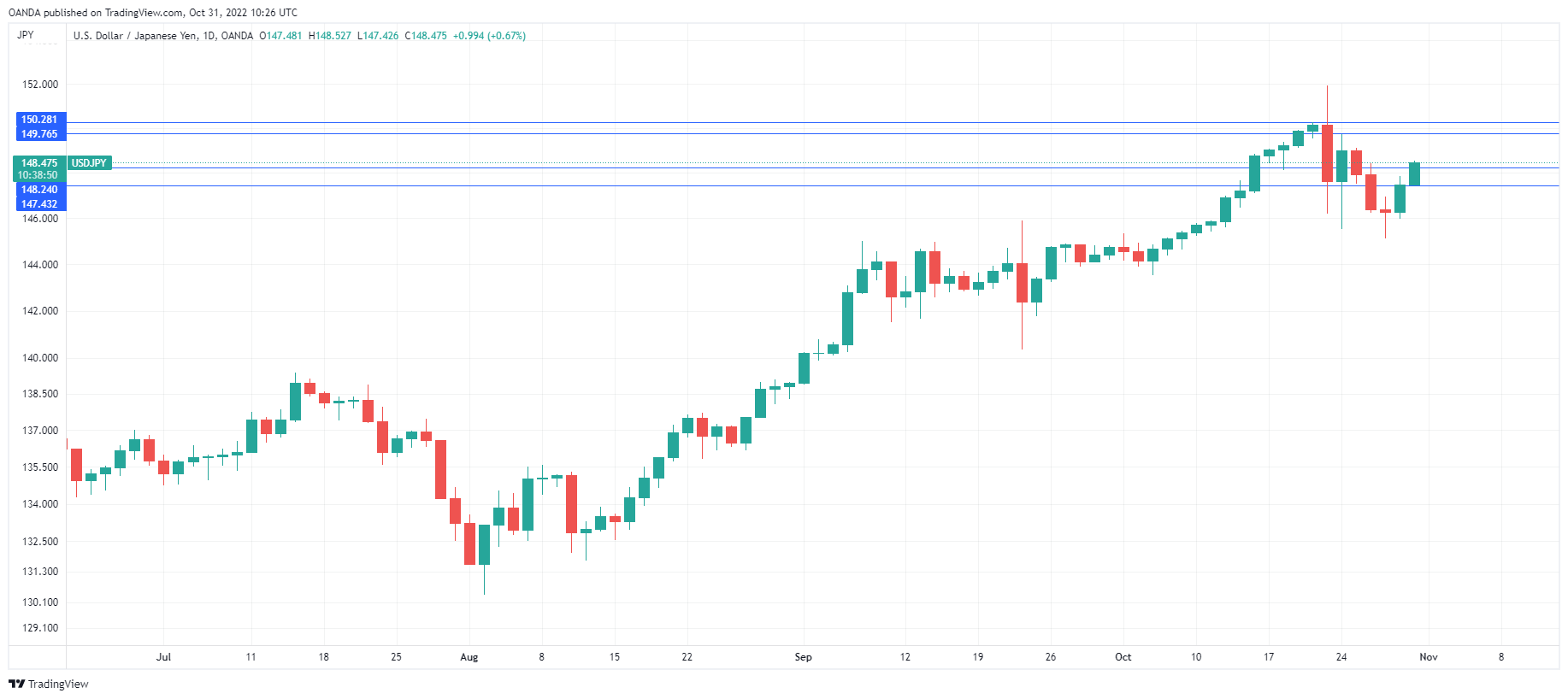
USD/JPY ended last week with strong gains and the uptrend has continued today. In the European session, the yen is trading at 148.23, up 0.51%.
Yen slips as BOJ stays the course
All eyes were on the Bank of Japan rate meeting, which wrapped up on Friday. It was business as usual for the BoJ, which maintained its dovish stance. Governor Kuroda said that the BoJ had no plans to raise rates or shift policy “anytime soon”. The BoJ has maintained an ultra-loose policy for years, but there has been speculation that the Bank might make some changes, as the yen has tumbled and inflation is higher than it has been in years. Kuroda’s remarks poured cold water on any such thoughts, as the BoJ remains focused on supporting the weak Japanese economy by means of an ultra-accommodative policy. Clearly, the BoJ has no interest in raising rates to support the yen, although Kuroda paid the usual lip service to the yen’s descent, saying that its rapid fall was “negative and undesirable”. Investors were not impressed and the yen fell close to 1% on Friday.
In the US, the Fed is widely expected to raise rates by 0.75% on Wednesday. Inflation has been falling slightly, but core inflation has been rising, which has put to rest hopes that solid data might induce the Fed to ease up on tightening. The Core PCE index, the Fed’s preferred inflation gauge, rose 5.1% in September, up from 4.9% in August and just shy of the consensus of 5.2%. The Fed continues to view inflation risks as weighted to the upside and is unlikely to ease rates unless it is satisfied that inflation has peaked.
ECB Visco: High uncertainty calls for gradual tightening
ECB Governing Council member Ignazio Visco said that interest rate will have to rise further to reduce the risk of persistent high inflation
However, he's uncertain on the pace of tightening, in face of economic risks. Also, the terminate rate of "can't be predetermined" due to the uncertain nature of economic forecasting amid Russia's war in Ukraine.
"The high level of uncertainty calls for a gradual approach, carefully assessing the appropriateness of the monetary stance on the basis of evidence as it becomes available," he said.
Eurozone GDP growth slowed to 0.2% qoq in Q3
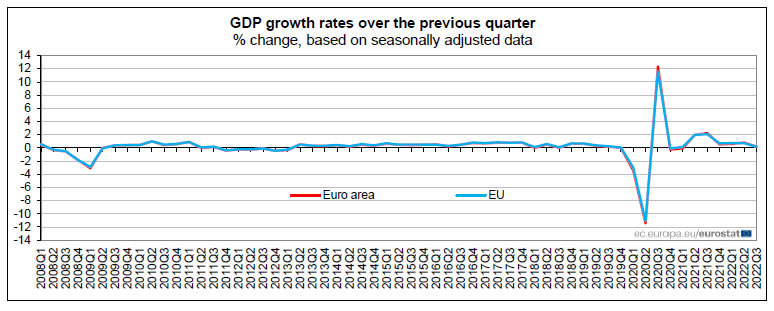
Eurozone GDP grew 0.2% qoq in Q3, slightly above expectation of 0.1% qoq, but much slower than Q2's 0.8% qoq. EU GDP grew 0.2% qoq too, slowed from Q2's 0.7% qoq.
Among the Member States for which data are available for the third quarter of 2022, Sweden (+0.7%) recorded the highest increase compared to the previous quarter, followed by Italy (+0.5%), Portugal and Lithuania (both +0.4%). Declines were recorded in Latvia (-1.7%) as well as in Austria and Belgium (both -0.1%). The year-on-year growth rates were positive for all countries except for Latvia (-0.4%).
Eurozone CPI rose to 10.7% yoy in Oct, core CPI up to 5.0% yoy
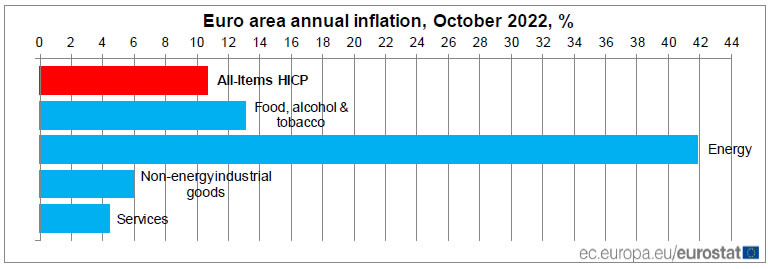
Eurozone CPI accelerated from 9.9% yoy to 10.7% yoy in October, above expectation of 9.9% yoy. CPI core (all-items ex energy, food, alcohol & tobacco also rose from 4.8% yoy to 5.0% yoy, above expectation of 4.8% yoy.
Looking at the main components, energy is expected to have the highest annual rate in October (41.9%, compared with 40.7% in September), followed by food, alcohol & tobacco (13.1%, compared with 11.8% in September), non-energy industrial goods (6.0%, compared with 5.5% in September) and services (4.4%, compared with 4.3% in September).
WTI Oil: Oil Loses Traction on China’s COVID-19 Measures, Weak Economic Data
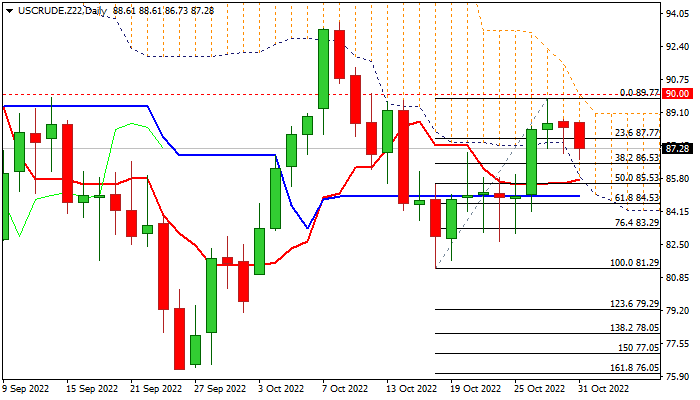
WTI oil starts week in red, dropping 2.1% in early Monday’s trading, as sentiment was soured by weak China’s manufacturing data and widening Covid restrictions, threatening of slower demand from the world’s second largest economy and world’s biggest oil importer.
Concerns about global economic slowdown on soaring inflation and aggressive rate hikes by world’s major central banks, add to negative signals.
Fresh weakness emerges after a double failure at pivotal Fibo barrier at $88.90 (61.8% of $93.60/$81.29), which guards psychological $90 barrier, but still lacking stronger bearish signals, which could be expected on violation of supports at $85.91 (daily cloud base) and $85.74 (daily Tenkan-sen).
Daily studies are mixed, as momentum is heading north but still in the negative territory, while MA’s are in bullish setup.
Failure to clear pivotal supports at $85.91/74 would keep near-term action within a consolidative range and bias with bulls, while sustained break above $90 remains a trigger for further advance.
Bearish scenario sees break of $85.91/74 pivots as a trigger for deeper fall, which could target $83.00 zone.
Focus will remain on economic data, which are nowadays oil’s key drivers.
Res: 88.90; 89.77; 90.00; 90.69.
Sup: 86.66; 85.91; 85.74; 85.05.
Dollar Index: Dollar Keeps Firm Tone on Renewed Hopes that Fed Will Remain Aggressive
The dollar extends rally into third straight day Monday, advancing around 0.4% in Asia / early Europe on Monday.
The greenback received fresh support from renewed hopes that the Fed will remain on aggressive mode on November policy meeting and go for another 0.75% hike, after dissonant tones about reducing pace of rate hikes, faded.
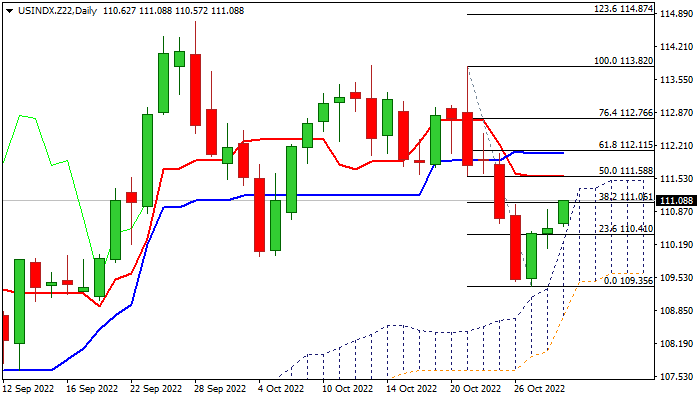
Recovery action from 109.45/35 double-bottom (Oct 26/27 lows) is underpinned by rising and thickening daily cloud and so far reached Fibo 38.2% retracement of 113.82/109.35 bear-leg), though fresh bulls need more evidence to generate bullish signal and open way for stronger recovery.
Momentum indicator is still deeply in the negative territory on daily chart and daily Tenkan-sen / Kijun-sen remain in bearish configuration that weighs on recovery, which needs lift and close above 112.00 zone (Fibo 61.8% retracement of 113.82/109.35 / daily Kijun-sen) to strengthen near-term structure and confirm base at 109.35/45.
Near-term action needs to hold above broken 55DMA (110.50) to keep fresh bulls in play.
Res: 111.33; 111.58; 112.11; 112.44.
Sup: 110.50; 110.00; 109.60; 109.35.
EUR/USD: Bullish Correction Close to Completion
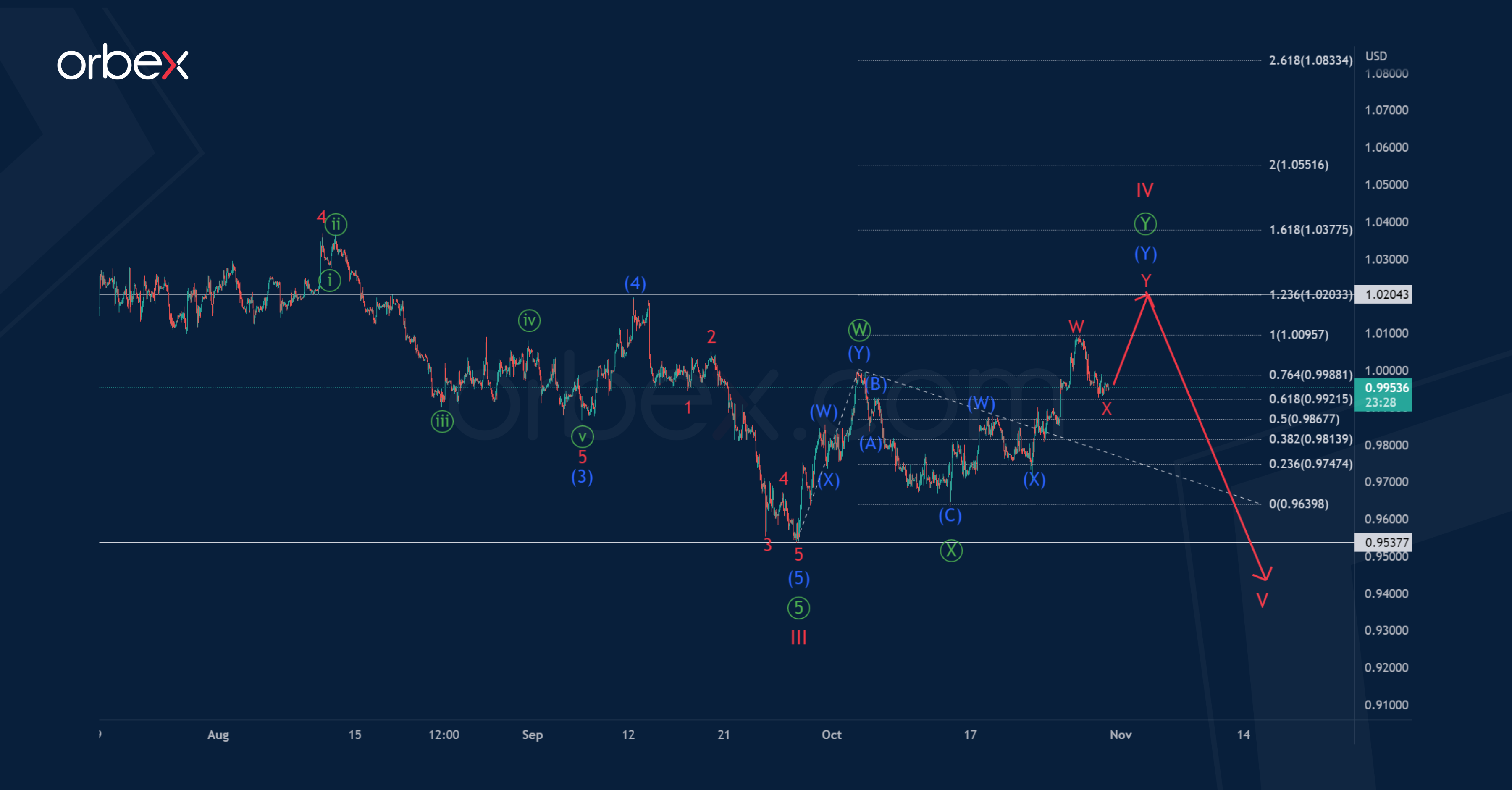
In the long term, EURUSD seems to be forming a bearish cycle impulse, which consists of five main sub-waves I-II-III-IV-V.
Most likely, the cycle impulse sub-wave III was fully completed, after which the formation of a bullish correction IV began. This correction is similar to a double zigzag consisting of primary sub- waves..
The primary sub-waves and look complete. The development of the last sub-wave. is expected in the near future. It may form a double zigzag pattern W-X-Y near 1.0204. At that level, wave will be at 123.6% of first actionary wave.
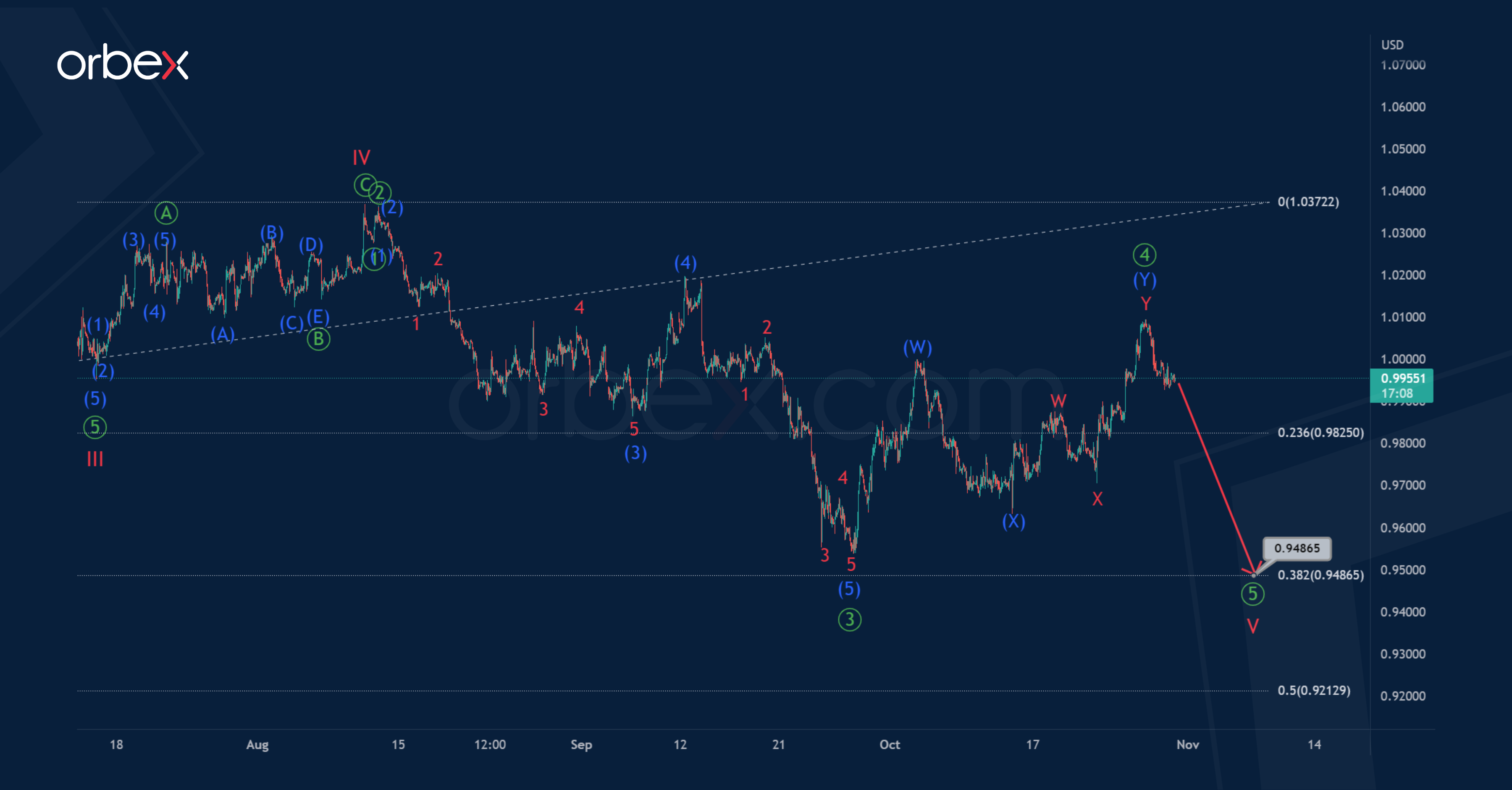
According to the alternative, the cycle correction IV has been fully completed and it is a standard zigzag.
In the last section of the chart, we can notice the development of the last leg of the cycle wave V, which takes the form of a primary impulse ①-②-③-④-⑤.
At the specified impulse, the first four parts look finished, and the last sub-wave ⑤ is under development.
In the near future, the currency is expected to decline to 0.948. At that level, cycle wave V will be at 38.2% of wave III.
EURUSD Drops Below Parity But Remains Above Descending Trendline
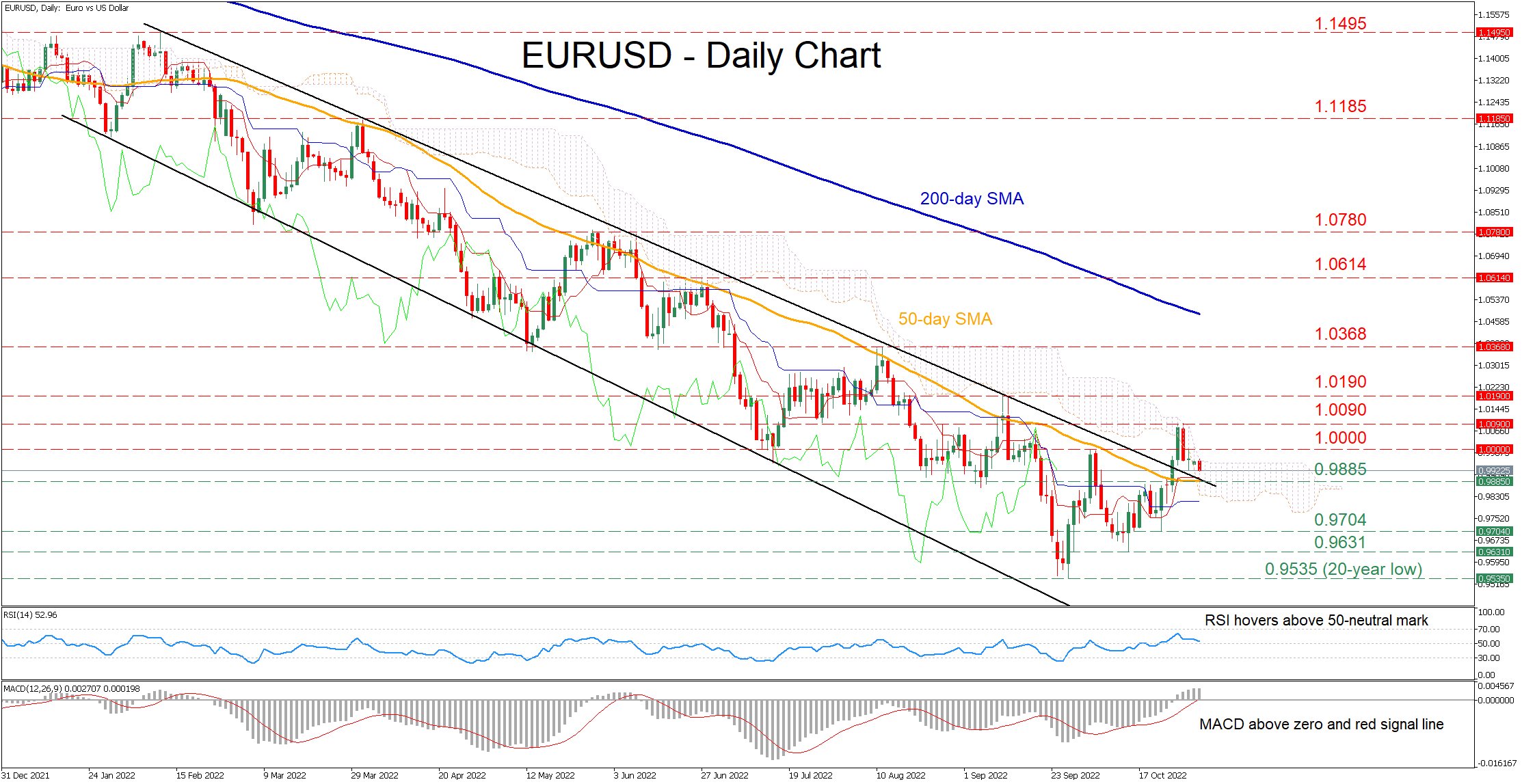
EURUSD has been losing ground since the beginning of the year, creating a clear structure of lower highs and lower lows. Although the pair managed to cross above both its descending channel and the 50-day simple moving average (SMA), it quickly retraced lower slightly below parity.
The momentum indicators currently suggest that bullish forces are subsiding but still hold the upper hand. Specifically, the RSI is pointing downwards above its 50-neutral mark, while the MACD histogram is softening above both zero and its red signal line.
Should buying pressures intensify, initial resistance could be encountered at parity, which is considered a crucial psychological mark by markets. Jumping above the latter, the price could challenge the recent rejection point of 1.0090 before the spotlight turns to the September peak of 1.0190.
To the downside, bearish actions could meet immediate support at the 0.9885 congested region, which includes the 50-day SMA and the restrictive trendline taken from the pair’s recent highs. Sliding beneath that floor, the pair could descend towards 0.9704 before it challenges the October low of 0.9631. A violation of the latter could open the door for the 20-year low of 0.9535.
Overall, despite its recent upside breakout, EURUSD appears to be losing momentum. Hence, for the pair to resume its recovery, the descending trendline must curb any potential declines.
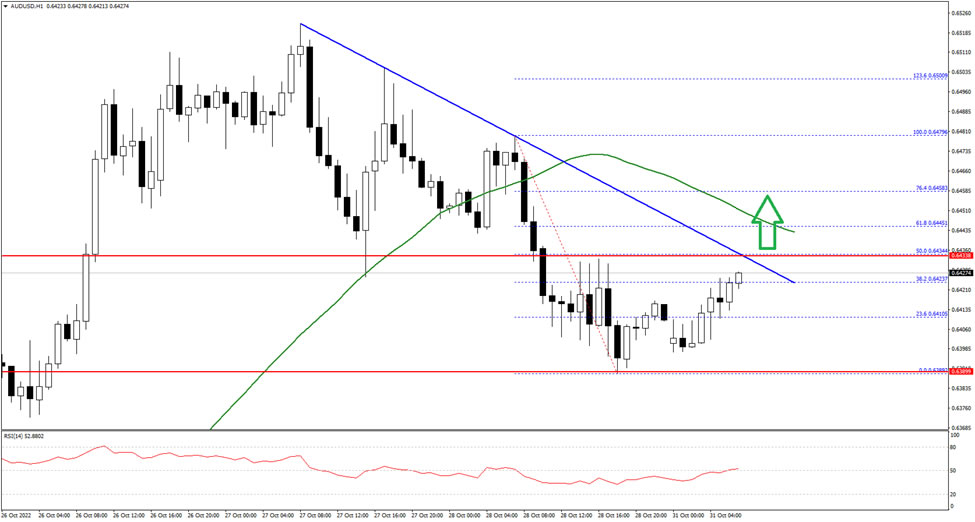
AUD/USD Pair is Correcting Losses from the 0.6450 Low
The Aussie Dollar started a fresh decline from the 0.6520 resistance zone against the US Dollar. The AUD/USD pair declined below the 0.6450 level to move into a bearish zone.
There was a clear move below the 0.6420 zone and the 50 hourly simple moving average. The pair traded as low as 0.6389 and is currently correcting losses. An immediate resistance on the upside is near the 0.6435 level and a connecting bearish trend line on the hourly chart.
If there is an upside break above the 0.6435 zone, the pair could rise steadily towards the 0.6480 level in the near term. The main resistance now sits near the 0.6520 level.
An immediate support is near 0.6400 on FXOpen. The next key support is near the 0.6380 level. A downside break below the 0.6380 support could lead the pair towards the 0.6320 support.