

Sample Category Title
GBP/USD Daily Outlook
Daily Pivots: (S1) 1.1495; (P) 1.1567; (R1) 1.1703; More...
Intraday bias in GBP/USD remains on the upside for the moment. Break of 61.8% projection of 1.0351 to 1.1494 from 1.0922 at 1.1628 will extend the rise from 1.0351 to 100% projection at 1.2065. On the downside, below 1.1429 minor support will turn intraday bias neutral first. But further rally will remain in favor as long as 1.0922 support holds, in case of retreat.
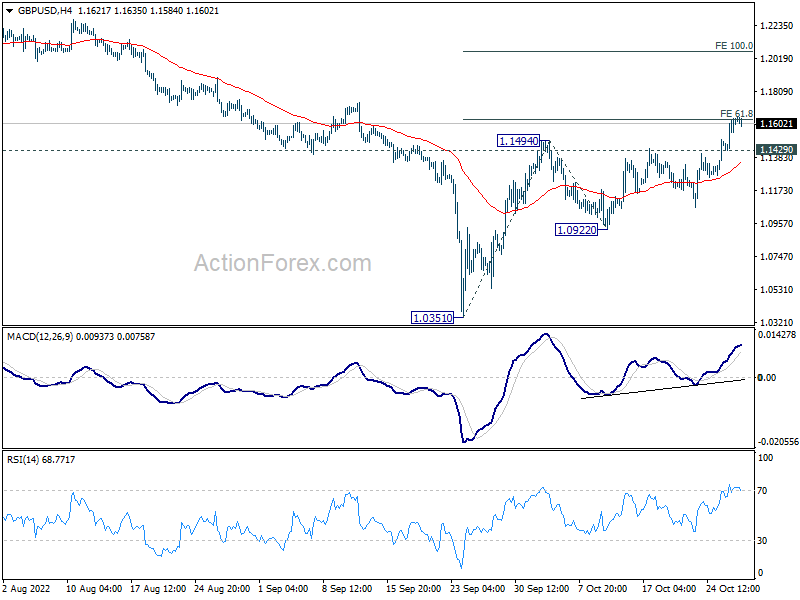
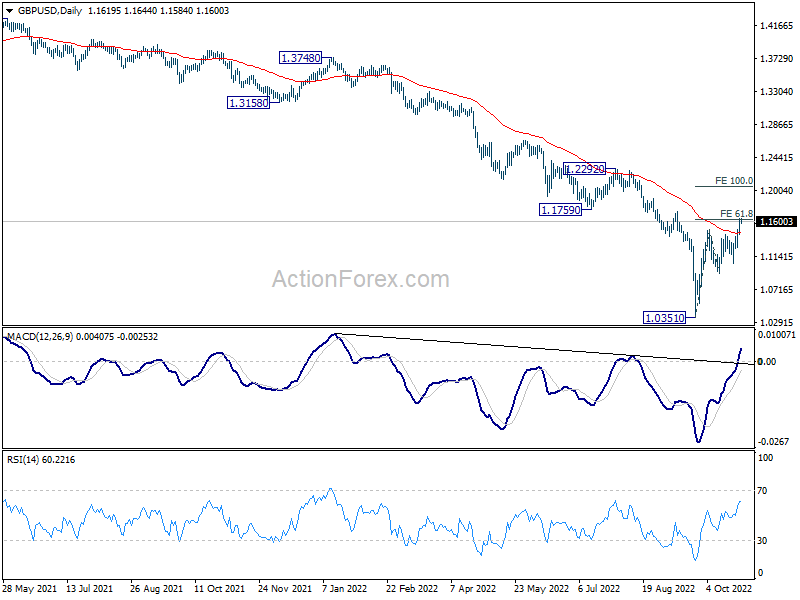
In the bigger picture, fall from 1.4248 (2018 high) is part of the long term down trend from 2.1161 (2007 high). Outlook will stay bearish as long as 1.1759 support turned resistance holds. Parity would be the next target on resumption. Nevertheless, firm break of 1.1759 will confirm medium term bottoming, and open up stronger rise back to 55 week EMA (now at 1.2392).
AUDUSD Moves Up, Suggesting Upside Correction in Near Term
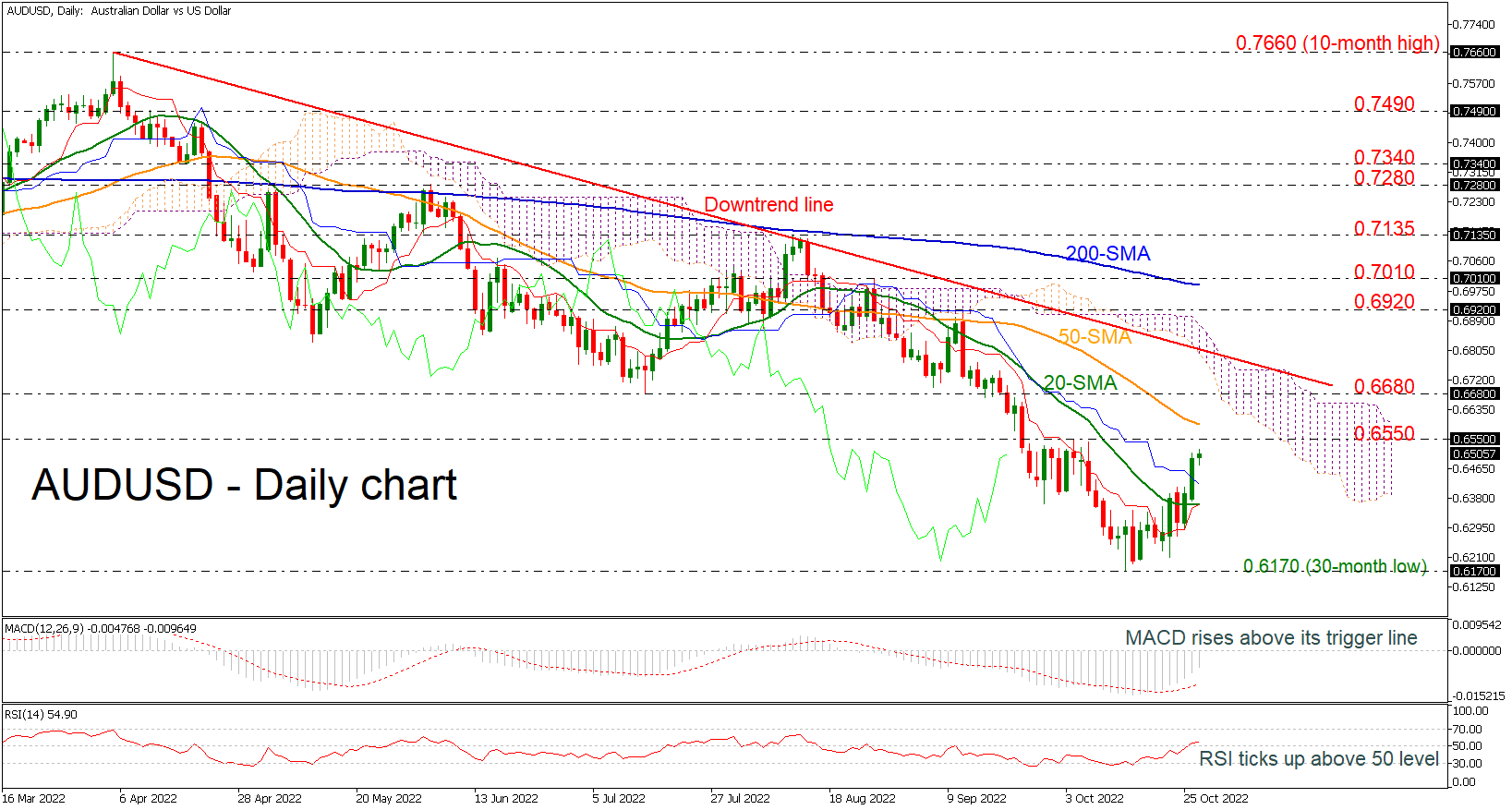
AUDUSD has been showing improvement over the last couple of days, taking the market above the 20-day simple moving average (SMA). The MACD oscillator is rising above its trigger line in the negative region, while the RSI is ticking higher above the neutral threshold of 50. The red Tenkan-sen line is also moving higher, suggesting an upside correction.
Immediate resistance to further gains would likely come from the 0.6550 resistance ahead of the 50-day SMA at 0.6590. If there is a successful break above this line, further resistance could be met around the 0.6680 barrier before testing the long-term descending trend line near 0.6760, which is also near the upper band of the Ichimoku cloud.
If, however, the strong upside momentum were to lose steam and if the pair were to reverse lower again, support would initially come from the 30-month trough of 0.6170. Failure to hold above this level would switch the focus back to the downside and attention would increasingly turn to the 0.5980 support, registered in March 2020.
In the long-term picture, the bearish outlook remains intact; however, in the very short-term, the bias is turning slightly higher.
US Oil Finds Support
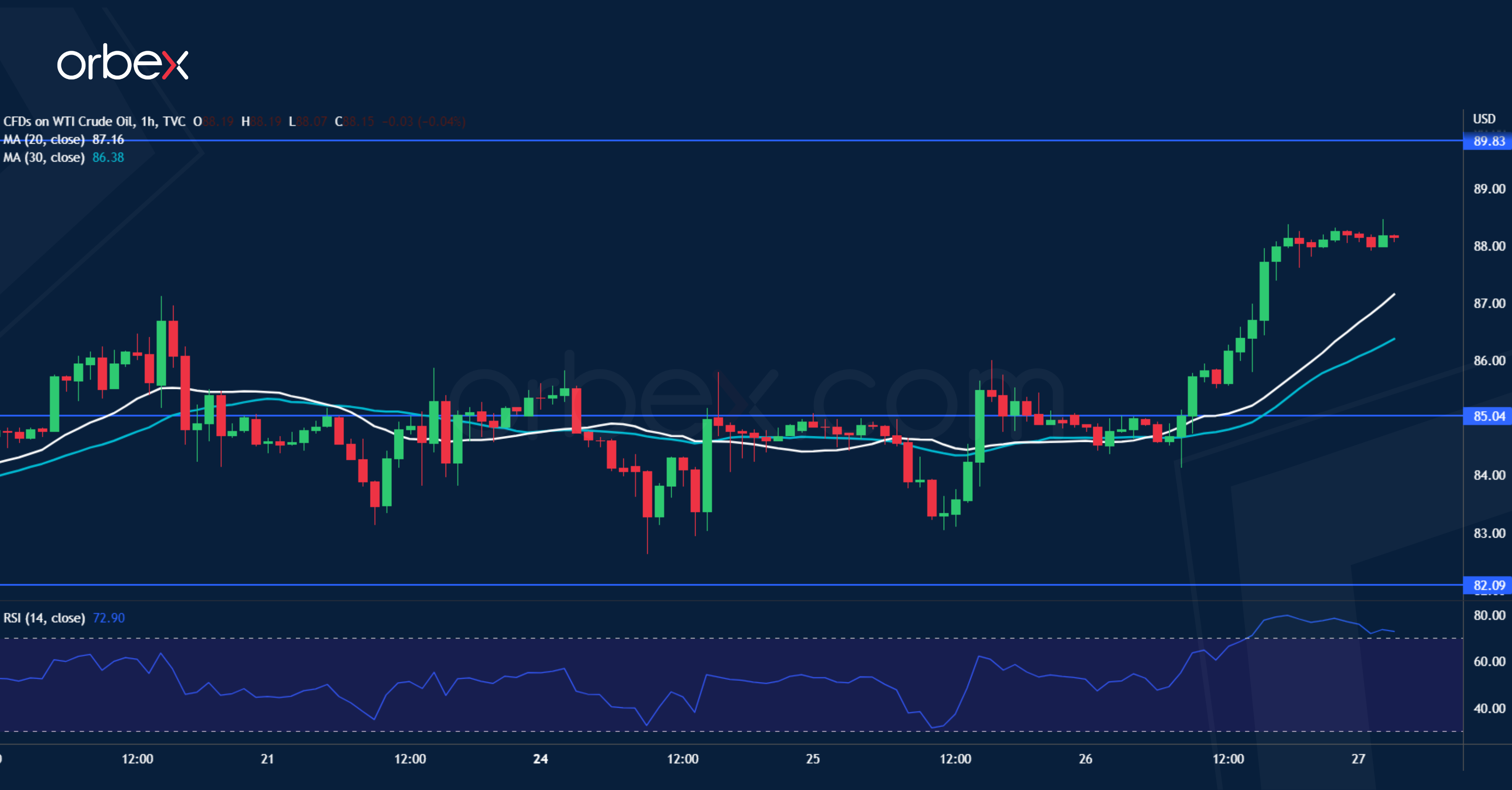
WTI crude rallied after data showed a rise in US crude exports. The price has stabilised near a 3-week low (82.00). A bullish MA cross on the daily chart suggests a potential acceleration to the upside. Cautious traders may wait for a bullish breakout as a form of confirmation. After a break above 87.00, sentiment would only start to shift in the bulls’ favour if they succeed in pushing past the support-turned-resistance at 89.80. 85.00 is a fresh support and 82.00 an important floor to keep the current bounce valid.
NZD/USD Bounces Higher
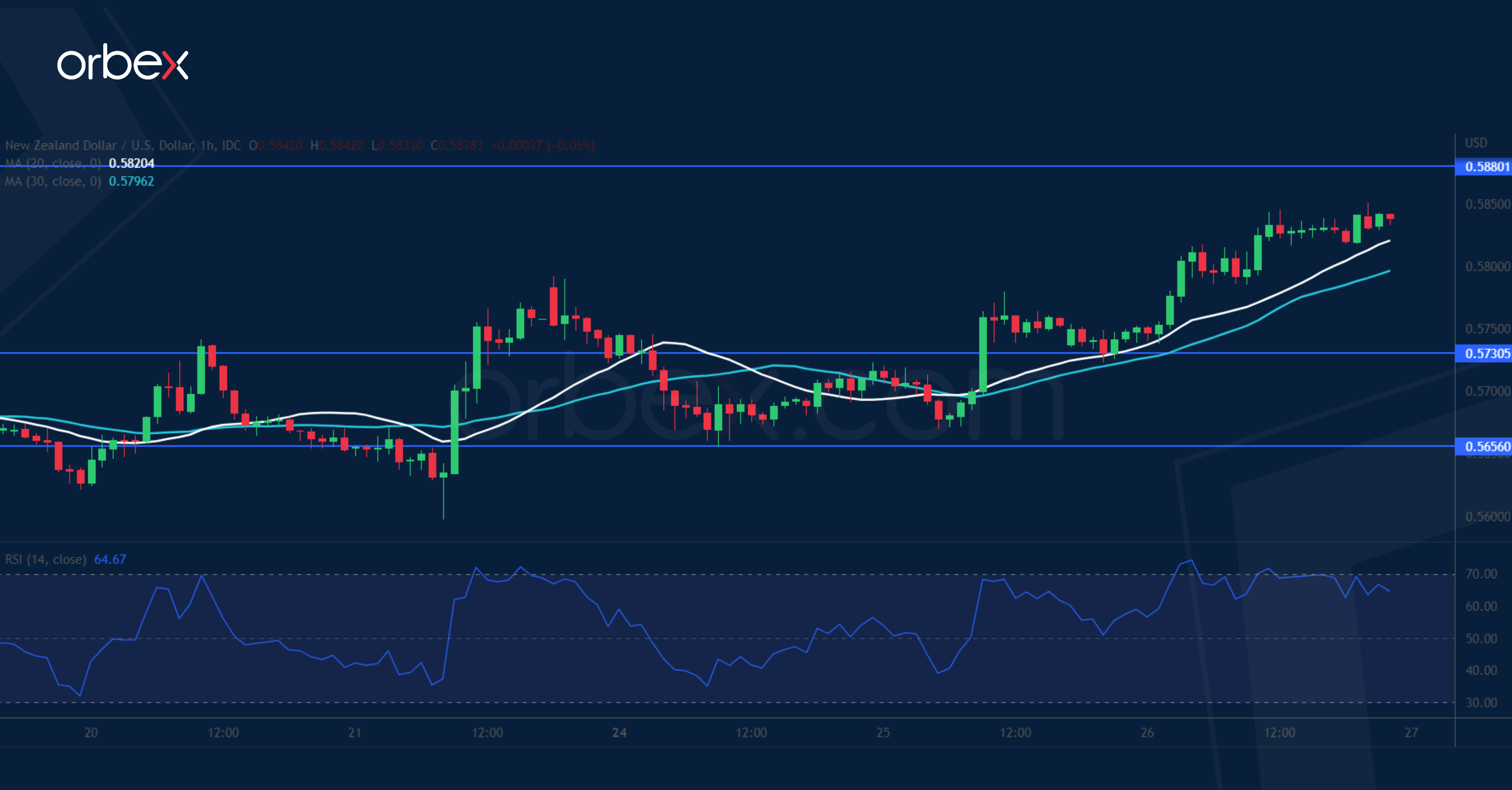
The New Zealand dollar climbs as soft US data raises risk appetite. The daily resistance at 0.5810 has been capping the recent price action. But a ‘buy-the-dips’ behaviour off March 2020’s low (0.5500) has offered the kiwi effective support. A series of higher lows indicates growing buying pressure. A bullish breakout would prompt sellers to cover their bets, paving the way for an extended rally should momentum pick up. 0.5880 would be the next stop and 0.5730 at the base of the breakout the first support in case of a pullback.
USD/CAD Tests Key Support
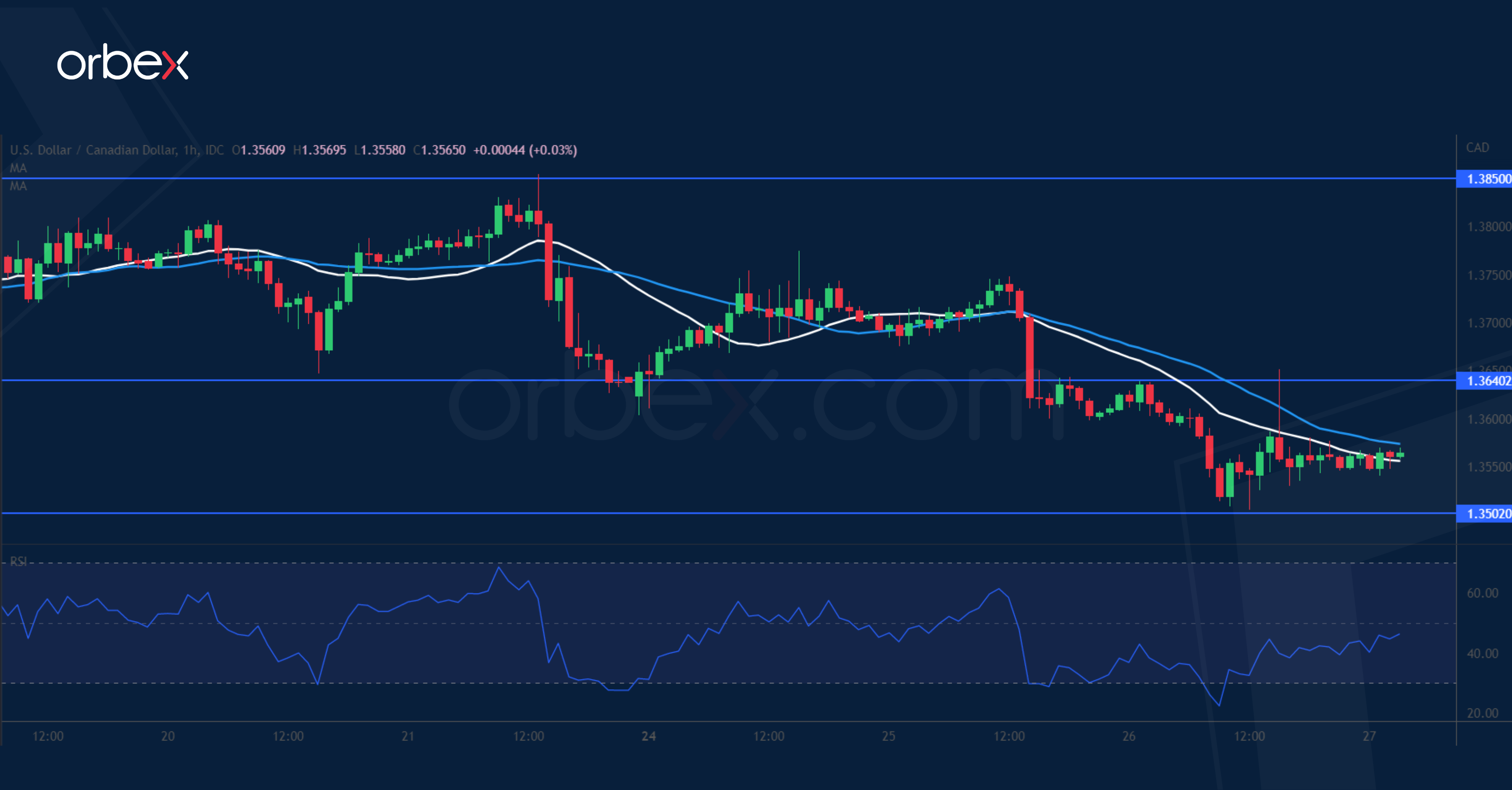
The Canadian dollar softened after the BoC surprised the market with a smaller-than-expected rate hike. On the daily chart, the rally came to a halt in the supply zone from May 2020 under 1.4000. The greenback is testing the recent low at 1.3500, a key level to keep short-term buyers interested. A lack of bids suggests that traders could be wary of chasing after an already high exchange rate. A breakout would force the bulls to bail out and trigger a deeper correction with 1.3360 as the next target. 1.3640 is the closest resistance.
Big Tech Lead Selloff – USD Softens, as ECB Meets
Yesterday wasn’t a good day for the US Big Tech. Google dived almost 10% after reporting disappointing results, while Microsoft sank almost 8%.
Nasdaq bounced 2% lower after having tested the major 38.2% Fibonacci retracement, a touch below the 11700.
And don’t expect things to look better today. Meta dived another 20% in the afterhours trading, after announcing disappointed results.
Could earnings from Amazon and Apple eventually cheer up the folks?
We will see. Apple’s EPS is expected to have risen around 2.4% in the latest quarter, the services revenue is seen 10% higher, year-on-year, and the total revenue may have increased around 6.3%. The company lately decided, and undecided to increase iPhone production. The slowing China, and the strong US dollar could be challenges for the most profitable holidays season.
Apple shares lost up to 23% since the beginning of the year, but rebounded up to 13% since the October dip. From a technical perspective, we are at a critical point. The stock should stay above the major 38.2% Fibonacci retracement on year-to-date rally to remain in the bullish consolidation zone. Any misstep in the results could send the stock back into the bearish waters.
Amazon, on the other hand, is facing a visible weakness in its e-commerce sales. As for Google and Microsoft, the cloud business could come to the rescue, but may not be enough. Amazon shares remain well below their long-term bullish trend base, which makes it an interesting ‘buy’ target for the long-term investors. But, of course, it doesn’t mean that Amazon won’t dive further if results disappoint investors.
Policy pivot?
The Bank of Canada (BoC) raised its rate by only 50bp yesterday, versus 75bp hike expected by analysts.
The latter has been perceived as a sign that maybe – but just maybe – a global policy pivot is approaching.
Despite the more dovish policy action, the Loonie gained against the US dollar, mostly because the US dollar lost against most currencies across the board.
The US dollar index dived below its 50-DMA yesterday, as US home sales fell almost 11% in September, as another sign that the US economy is well suffering from the aggressive rate hike policy that the Federal Reserve (Fed) is conducting.
For now, the weak economic data, and the BoC’s dovish action didn’t really impacted the expectation of another 75bp hike from the Fed next week – given more than 90% probability.
Due today, the latest US GDP update will be important for the Fed expectations. The US reported two back-to-back negative quarterly growth, which started a broad debate on whether the world’s number one economy entered recession. Although the numbers confirmed that the US is in a technical recession, many economists and officials downplayed the data, saying that the US economy remains strong.
This time, we could see the contrary happen. The US could print a 2.3% GDP growth, yet, in a deteriorating economic environment. The latest GDP figure is certainly boosted by higher net exports. The growing energy exports to Europe certainly help, but the slowing imports – despite the strong dollar, hint that the domestic demand is slowing. Add the slowing investment in housing due to soaring mortgage rates, we must certainly look deeper into today’s GDP report to drive conclusions about the health of the US economy.
In all cases, a softer-than-expected GDP print will help keeping the Fed hawks at bay.
And this is what everyone, massively, needs right now.
Softer dollar, finally
The softer US dollar is being cheered across the FX space. The EURUSD rallied past the 50-DMA, pulled out the 1.00 offers and is now testing the 100-DMA for the first time since February, as Cable consolidates above the 1.16 mark. The new PM Rishi Sunak announced that the announcement of the fiscal plan from October 31 to November 17, but investors have been fine with it. Everyone understands that Sunak needs time to ‘make the right decisions’, and the confidence is partially restored. The only problem is, the Bank of England (BoE) must decide next week without knowing what Sunak will do on the fiscal end. But, even the BoE is fine with the delay – as long as the market remains calm.
ECB to get more hawkish despite looming recession
The European Central Bank (ECB) is expected to hike the interest rates by another 75bp point, and begin discussing when to start unwinding the balance sheet.
European politicians are, of course, not happy with the rising interest rates, as the continent has certainly stepped into recession amid the energy crisis and the fast-slowing activity. The new Italian PM Meloni, and French President Macron have been critical about the hawkish ECB stance. But there is nothing else the ECB could do right now. If it doesn’t go ahead with the rate hikes as promised, the Europeans will fall behind in the global tightening race. The latter would further hit the euro and boost inflation which already reached double-digit levels in the eurozone.
A 75bp hike, and a hawkish statement from Christine Lagarde will likely keep the euro upbeat above parity, as long as the US dollar remains soft.
ECB and Danmarks Nationalbank Take Centre Stage
Market movers today
We expect a 75bp hike from the ECB today, which is also fully priced in by markets. Focus will be on communication and we expect Lagarde to acknowledge that the risk of the downside scenario from September materialising has increased.
We think it is a 70/30 call if Danmarks Nationalbank (DN) will decide to hike policy rates by 10bp less than the ECB (i.e. by 65bp) as a response to recent DKK strength and FX intervention selling. Markets seem 50/50 evenly split. Either way, we look for a small reaction in EUR/DKK following the rate announcement at 17:00 CEST.
In Sweden the monthly NIER survey is likely to show a further decline in confidence with special emphasis on manufacturing as Swedish PMIs show declining new orders. That said, we also have an eye on record-high retail trade price expectations to see if they are starting to budge. Consumers' perception of the risk of being unemployed and business hiring expectations are also in focus.
We see upside risks to our forecast for the US Q3 GDP of 1.1% q/q AR, as the recent sharp decline in imports could have boosted net exports more than anticipated.
Early Friday morning, we expect the Bank of Japan (BoJ) will keep its yield curve control firmly in place despite gaining pressures on yields and the yen. Until wage growth increases and boosts consumers purchasing power, BoJ will not loosen its grip on the yield curve willingly.
The 60 second overview
Bank of Canada: Yesterday the Canadian central bank surprised markets by delivering only a 50bp rate hike vs expectations of a 75bp increase in policy rates. While BoC clearly stated an expectation that further rate hikes are required the rhetoric surrounding the balance of risk to inflation was more balanced. Like many other central banks BoC increasingly face the trade-off between fighting high and persistent inflation by tightening policy and on the other hand the risk of overtightening amid leading indicators showing a clear downward momentum to growth prospects. 2Y CAD swap rates are down roughly 20bp since the announcement.
The pivot trade: the big focus point for markets has over the last week been the narrative that central banks globally are about to slow the pace of rate hikes. It started with a Wall Street Journal article last Friday presumably reflecting insider-intel that the Fed is contemplating delivering only a 50bp hike in December. This week speculations have only been fuelled further by weak economic data and Bank of Canada's decision yesterday to hike policy rates 'only' by 50bp. This has contributed to sending real rates lower and lifting equity markets although the technology sector specifically has suffered from a few prominent earning reports disappointing. The USD is on track for one of its worst weeks and broader commodity indices have rebounded.
From our chair it is important to stress that a slower pace of rate hikes - all else equal - still entails tightening of financial conditions. We do not share the view that a slower pace of rate hikes is a strong signal that we also approach the time when central banks are about to outright cut policy rates. Higher short-end inflation expectations since Friday in our view illustrate that it is still too early for central banks to shift policy stance albeit we understand the case for smoothening the last rate hikes in the cycle.
Equities: Global equities were lower yesterday dragged down by the US and tech. European and Asian markets were higher. The big difference yesterday was driven by earnings; half of the sectors sharply higher and half of them sharply lower. Taking for instance the S&P500 yesterday, cyclicals were down by 1.77% while defensives were up by 0.94%. Again not a macro-driven but an earnings-driven difference. VIX was also lower and small cap outperforming which is quite seldom to see on days with huge cyclical underperformance. In US, Dow +0.01%, S&P 500 -0.7%, Nasdaq -2.0% and Russell 2000 +0.5%. Asian markets are mixed this morning but the three tech-heavy markets, South Korea, Taiwan and Hong Kong are all higher. European futures are lower while US futures are up roughly 0.5%.
FI: Yesterday was primarily a wait-and-see session ahead of today's ECB meeting. However, the BoC surprise hike of only 50bp vs. 75bp consensus sent global yields lower. European rates ended lower across the board led by the 10y point down by around 5bp.
FX: Bank of Canada 'made an RBA', i.e., under-delivered vs expectations and CAD weakened in line with lower money market rates. Slight yet short-lived support to risk after the decision, while EUR/USD continued to edge higher. Monetary policy decisions and guidance from the ECB today and Fed on Wednesday will be crucial for how EUR/USD, which has parked above parity, and the Scandies will trade for the coming weeks.
Credit: Credit markets had their 3rd risk-on day in a row on Wednesday, as risky assets continued rallying on a more dovish outlook for rates. Itrax main tightened 2.8bp to close at 113.6bp, while Itrax Xover tightened 12.3bp to close at 553.3bp. Primary markets also saw decent activity with among others, the Irish utility ESB, printing a 9.5 year EUR benchmark at MS+110bp (30bp tighter compared to the IPT).
Nordic macro
At 09.30 CET, the Debt Office releases its new macro/funding forecast. We expect an upward revision of the 2022 surplus and a downward revision for 2023. There are several uncertainties such as how the rising electricity capacity fees from Svenska Kraftnät (the grid operator) is treated in connection to how these are expected to be recirculated back to firms and consumers via compensation schemes to be decided by the new Government. In addition, there is great uncertainty about the impact from Riksbank tightening on the budget via QE losses (requiring a capital injection), higher cost for interest rate deduction and higher short rates having a negative impact on the tax account (outflows). Finally, slashing the growth outlook should imply automatic stabilizers are expected to work, pushing the budget in a negative direction. Funding likely to be adjusted via short-dated instruments and foreign funding as long as the outlook is clouded.
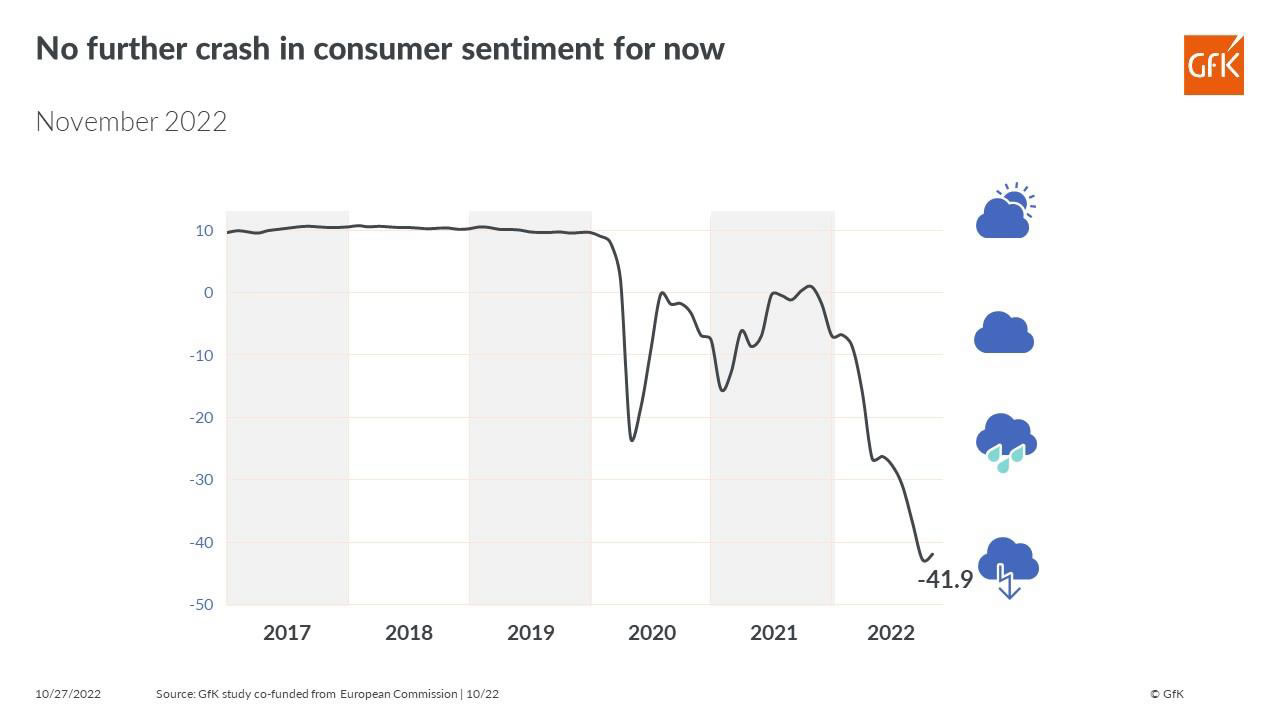
Germany Gfk consumer sentiment rose to -41.9, too early to speck of a trend shift
Germany Gfk Consumer Sentiment for November improved from -42.8 to -41.9, slightly below expectation of -41.8. In October, economic expectations dropped from -21.9 to -22.2. Income expectations rose from -67.7 to -60.5. Propensity to buy also rose from -19.5 to -17.5.
"It is certainly too early to speak of a trend shift at this time. The situation remains very tense for consumer sentiment," explains Rolf Bürkl, GfK consumer expert. "Inflation has recently risen to ten percent in Germany, and concerns about the security of energy supplies continue to rise. Therefore, it remains to be seen whether the current stabilization will last or whether, considering the upcoming winter, there is reason to fear a further worsening of the situation."
EUR/USD Daily Outlook
Daily Pivots: (S1) 0.9989; (P) 1.0039; (R1) 1.0134; More...
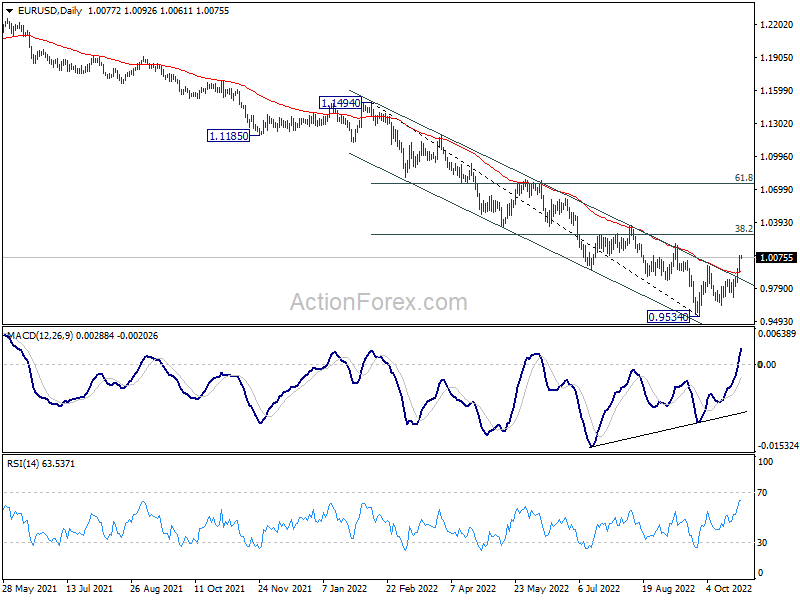
Intraday bias in EUR/USD remains on the upside at this point. Rise from 0.9534 is in progress for 38.2% retracement of 1.1494 to 0.9534 at 1.0283. On the downside, below 0.9942 minor support will turn intraday bias neutral and bring consolidations first, before staging another rally.
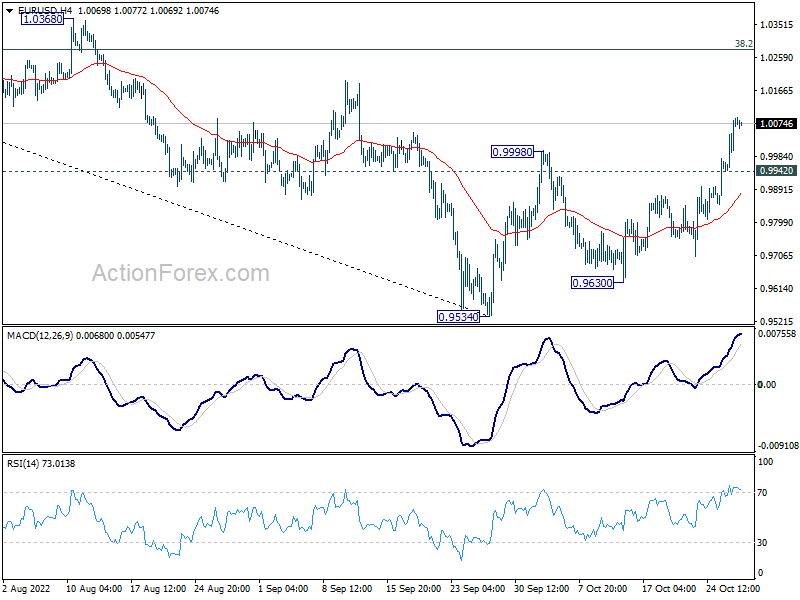
In the bigger picture, the case of medium term bottoming at 0.9534 building up, with bullish convergence condition in daily MACD. While it is too early to call for trend reversal, firm break of 0.9998 opens up stronger rebound back to 55 week EMA (now at 1.0630) even as a corrective rise. This will now be the favored case as long as 55 day EMA (now at 0.9937) holds.
Euro Awaits ECB Rate Hike, Dollar Staying Weak
Dollar remains broadly softer, and stays as the worst performer for the week. It's partly dragged down by the pull back in treasury yields, with 10-year yield breaching 4% handle overnight. Canadian Dollar is the next weakest, after the smaller than expected 50bps rate hike by BoC. On the other, Sterling remains the winner on political stabilization, but Euro is not too far away. The common currency indeed has prospect to overwhelm the Pound as reaction to today's ECB rate decision, which will catch all attention.
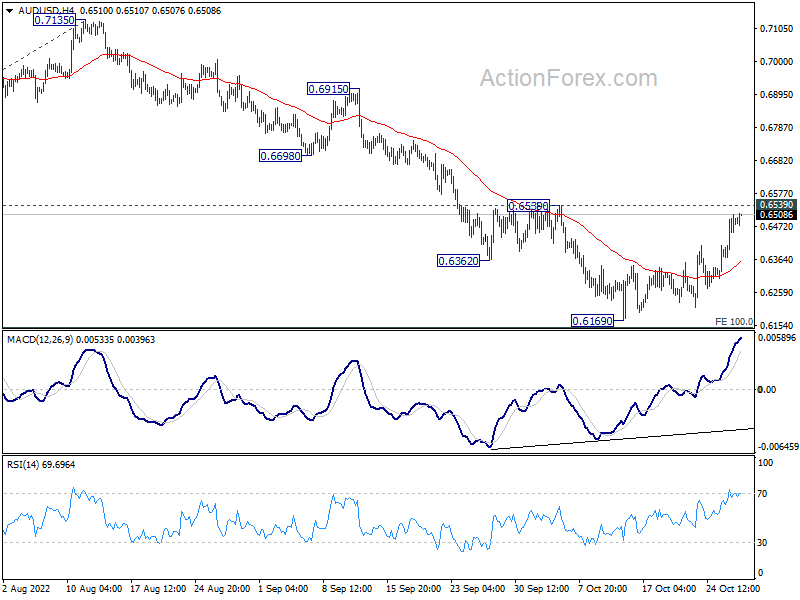
Technically, commodity currencies will also be a focus today. Risk-on sentiment in the US was rather uneven. That is, DOW's rebound was very strong. But NASDAQ lacked well behind. That's a reason for the relative indecisiveness in Aussie and Canadian. Attention will stay on 0.6539 resistance in AUD/USD, and 1.3501 support in USD/CAD. Firm break of these levels will align the outlook with EUR/USD and GBP/USD, and indicate that more selling in Dollar is underway. But of course, that would be subject to the development in overall market sentiment.
In Asia, at the time of writing, Nikkei is down -0.14%. Hong Kong HSI is up 1.74%. China Shanghai SSE is down -0.07%. Singapore Strait Times is down -0.11%. Japan 10-year JGB yield dropped -0.0008 to 0.258. Overnight, DOW rose 0.01%, S&P 500 dropped -0.74%. NASDAQ dropped -2.04%. 10-year yield dropped -0.0093 to 4.015.
RBNZ Orr: Employment prospects will be increasingly compromised by monetary tightening
RBNZ Governor Adrian Orr said in a speech that New Zealand's financial systems remains "well placed to support the economy", but there will be "stresses in business and amongst households as interest rates and asset prices adjust".
Regarding monetary policy objective, he emphasized, "we have our eyes firmly focused on meeting our inflation target". He also mentioned that inflation is still too high in an absolute sense."
"Central banks globally -- the Reserve Bank of New Zealand included -- are working to actively slow domestic spending by raising interest rates so as to constrain inflation," said Orr. "This means employment prospects will be increasingly compromised."
ECB to hike 75bps, EUR/CHF eyes parity
ECB is widely expected to raise interest rates by 75bps today. After that, the main refinancing rate will be at 2.00%, and the once negative deposit rate will be at 1.50%. President Christine Lagarde would signal that more tightening lies ahead, but the decision will stick to a meeting-by-meeting approach, and be data dependent.
There might be discussions on quantitative tightening, but it's still too soon to make a decision. The markets are expecting that concrete steps on shrinking the balance will only happen early next year.
Here are some previews on ECB:
- ECB Policy Meeting: Is More than a Rate Hike on the Table?
- ECB Preview: Everything You Need to Know
- What Can the ECB Do Now?
- ECB Preview – Focus on the Technicalities
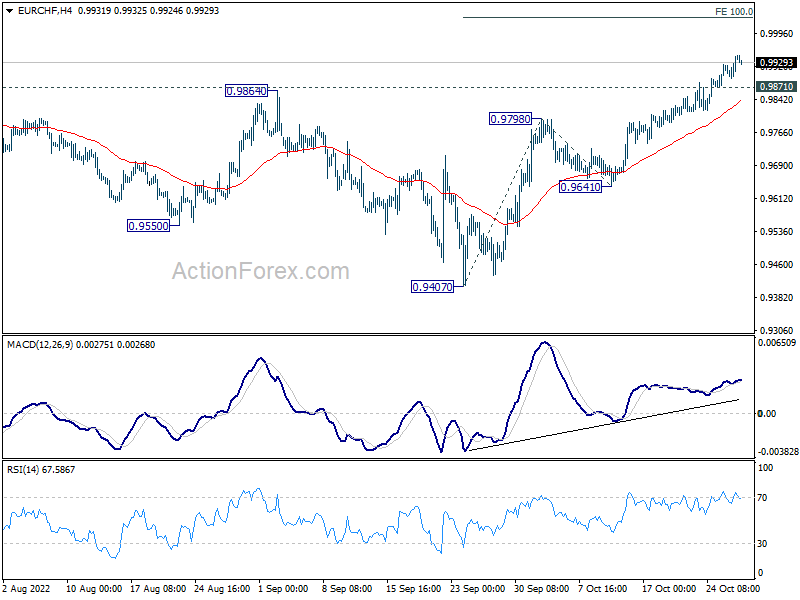
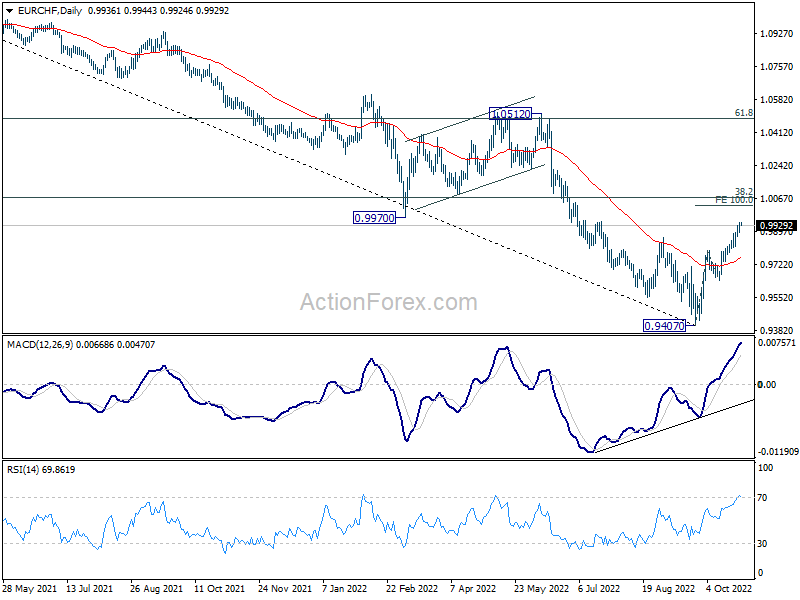
Regarding reaction to ECB decision, EUR/CHF is an interesting one to watch, as it's now eyeing parity. The cross was in persistent decline from June to September, after SNB surprisingly acted on interest rate earlier than ECB. Back then, ECB was still adjusting their forward guidance that rate hike would come weeks after stopping asset purchases. Now that ECB is catching up with global tightening pace, there is more upside prospect in the crosses.
While upside momentum in EUR/CHF is not too convincing for the moment, further rise is expected as long as 0.9871 minor support holds. Next target is 100% projection of 0.9407 to 0.9798 from 0.9641 at 1.0032. It's still too soon to judge whether rise from 0.9407 is a corrective bounce, or the start of an up trend. But in either case, stronger rally would be seen to 38.2% retracement of 1.1149 to 0.9407 at 1.0072. Reaction from there, as well as 55 week EMA (now at 1.0120) will reveal whether the trend is reversing.
On the data front
Australia import price index surged 3.0% qoq in Q3, much higher than expectation of 0.8% qoq. Germany Gfk consumer confidence is the main data release in European session. Later in the day, US will publish Q3 GDP and September durable goods orders.
EUR/USD Daily Outlook
Daily Pivots: (S1) 0.9989; (P) 1.0039; (R1) 1.0134; More...
Intraday bias in EUR/USD remains on the upside at this point. Rise from 0.9534 is in progress for 38.2% retracement of 1.1494 to 0.9534 at 1.0283. On the downside, below 0.9942 minor support will turn intraday bias neutral and bring consolidations first, before staging another rally.
In the bigger picture, the case of medium term bottoming at 0.9534 building up, with bullish convergence condition in daily MACD. While it is too early to call for trend reversal, firm break of 0.9998 opens up stronger rebound back to 55 week EMA (now at 1.0630) even as a corrective rise. This will now be the favored case as long as 55 day EMA (now at 0.9937) holds.
Economic Indicators Update
| GMT | Ccy | Events | Actual | Forecast | Previous | Revised |
|---|---|---|---|---|---|---|
| 00:30 | AUD | Import Price Index Q/Q Q3 | 3.00% | 0.80% | 4.30% | |
| 06:00 | EUR | Germany Gfk Consumer Confidence Nov | -41.8 | -42.5 | ||
| 12:15 | EUR | ECB Main Refinancing Rate | 2.00% | 1.25% | ||
| 12:30 | USD | Initial Jobless Claims (Oct 21) | 225K | 214K | ||
| 12:30 | USD | GDP Annualized Q3 P | 2.40% | -0.60% | ||
| 12:30 | USD | GDP Price Index Q3 P | 5.40% | 9.10% | ||
| 12:30 | USD | Durable Goods Orders Sep | 0.50% | -0.20% | ||
| 12:30 | USD | Durable Goods Orders ex Transportation Sep | 0.00% | 0.20% | ||
| 12:45 | EUR | ECB Press Conference | ||||
| 14:30 | USD | Natural Gas Storage | 111B |