Sample Category Title
EUR/USD Mid-Day Outlook
Daily Pivots: (S1) 0.9989; (P) 1.0039; (R1) 1.0134; More...
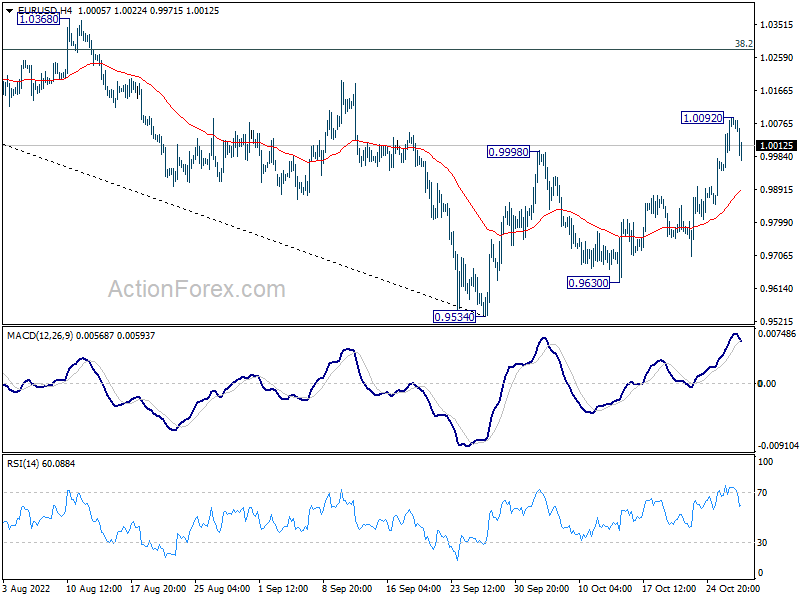
EUR/USD retreated after hitting 1.0092 and intraday bias is turned neutral first. Overall, rise from 0.9534 is still expected to continue as long as 4 hour 55 EMA (now at 0.9885). Above 1.0092 will resume the rally from 0.9534 to 38.2% retracement of 1.1494 to 0.9534 at 1.0283.
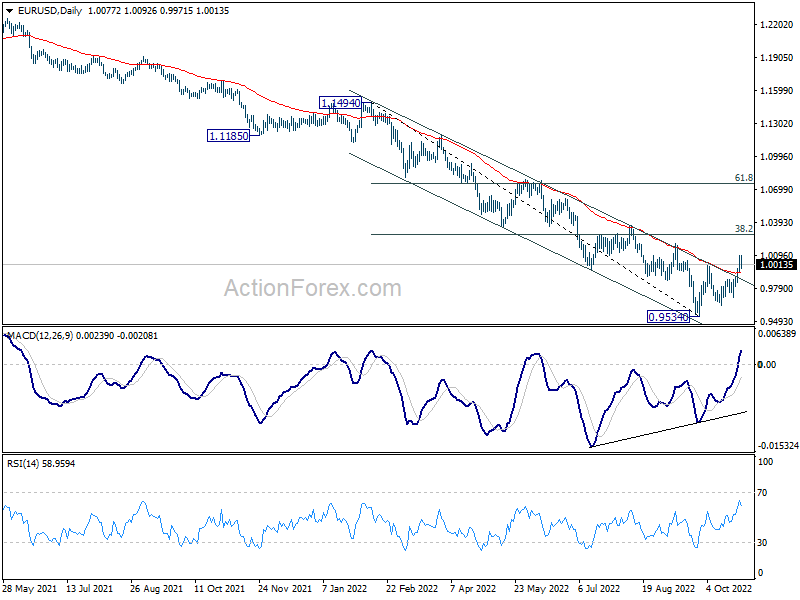
In the bigger picture, the case of medium term bottoming at 0.9534 building up, with bullish convergence condition in daily MACD. While it is too early to call for trend reversal, firm break of 0.9998 opens up stronger rebound back to 55 week EMA (now at 1.0630) even as a corrective rise. This will now be the favored case as long as 55 day EMA (now at 0.9937) holds.
Euro Retreats after ECB Hike, Dollar Recovers after GDP
Euro softens broadly today after ECB delivered 75bps rate hike as widely expected. President Christine Lagarde delivered no specially hawkish message that could give Euro another lift. On the down hand, Dollar is recovering, with some help from better than expected GDP data. But the greenback remains the worst performed followed by Canadian and Swiss Franc. Sterling is the leader.
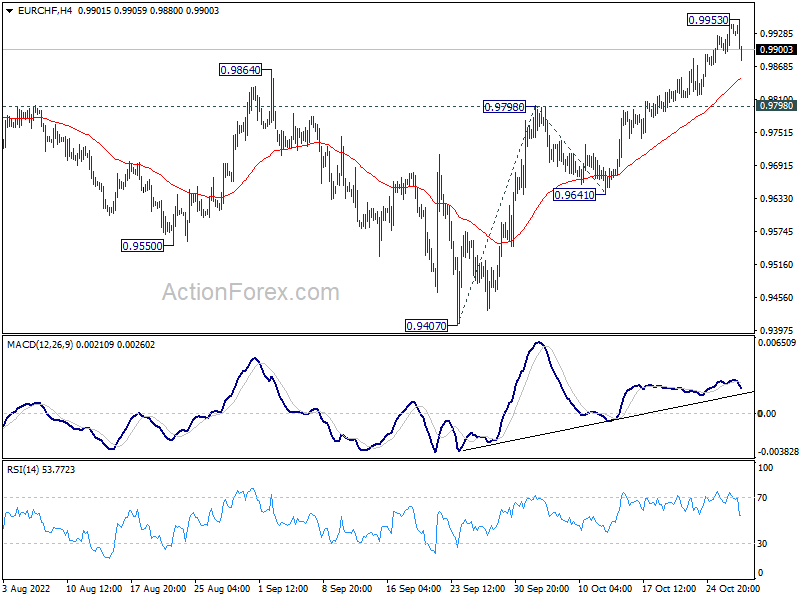
Technically, EUR/CHF's retreat now suggests that a temporary top is in place at 0.9953, just ahead of parity. Some consolidations could be seen. But another rise will remain in favor as long as 0.9798 resistance turned support holds. Rise from 0.9407 should still resume at a later stage.
In Europe, at the time of writing, FTSE is up 0.17%. DAX is up 0.05%. CAC is down -0.30%. Germany 10-year yield is down -0.102 at 2.014. Earlier in Asia, Nikkei dropped -0.32%. Hong Kong HSI rose 0.72%. China Shanghai SSE dropped -0.55%. Singapore Strait Times rose 0.23%. Japan 10-year JGB yield dropped -0.0055 to 0.253.
ECB hikes 75bps, recalibrates TLTRO III
ECB raises interest rates by 75bps as widely expected. The main refinancing, marginal lending, and deposit rates are 2.00%, 2.25%, and 1.50% respectively, with effect from November 2. The central bank also maintains tightening bias, and said, it "expects to raise interest rates further, to ensure the timely return of inflation to its 2% medium-term inflation target."
Future policy rate path will be based on the "evolving outlook for inflation and the economy", and follow its "meeting-by-meeting approach.
Also, the terms and conditions of the TLTRO III refinancing operations are changed, and "recalibrated" to ensure consistency with broader monetary policy normalization process.
US GDP grew 2.6% annualized in Q3, slightly above expectations
US GDP grew at annualized rate of 2.6% in Q3, above expectation of 2.4%. PCE price index growth slowed from 9.0% to 4.1%, below expectation of 5.4%.
BEA noted that the increase in real GDP reflected increases in exports, consumer spending, nonresidential fixed investment, federal government spending, and state and local government spending, that were partly offset by decreases in residential fixed investment and private inventory investment. Imports, which are a subtraction in the calculation of GDP, decreased.
Also released, durable goods orders rose 0.4% mom in september, below expectation of 0.5% mom. Ex-transport order dropped -0.5% mom, worse than expectation of 0.0% mom. Initial jobless claims rose 3k to 217k in the week ending October 21.
Germany Gfk consumer sentiment rose to -41.9, too early to speck of a trend shift
Germany Gfk Consumer Sentiment for November improved from -42.8 to -41.9, slightly below expectation of -41.8. In October, economic expectations dropped from -21.9 to -22.2. Income expectations rose from -67.7 to -60.5. Propensity to buy also rose from -19.5 to -17.5.
"It is certainly too early to speak of a trend shift at this time. The situation remains very tense for consumer sentiment," explains Rolf Bürkl, GfK consumer expert. "Inflation has recently risen to ten percent in Germany, and concerns about the security of energy supplies continue to rise. Therefore, it remains to be seen whether the current stabilization will last or whether, considering the upcoming winter, there is reason to fear a further worsening of the situation."
EUR/USD Mid-Day Outlook
Daily Pivots: (S1) 0.9989; (P) 1.0039; (R1) 1.0134; More...
EUR/USD retreated after hitting 1.0092 and intraday bias is turned neutral first. Overall, rise from 0.9534 is still expected to continue as long as 4 hour 55 EMA (now at 0.9885). Above 1.0092 will resume the rally from 0.9534 to 38.2% retracement of 1.1494 to 0.9534 at 1.0283.
In the bigger picture, the case of medium term bottoming at 0.9534 building up, with bullish convergence condition in daily MACD. While it is too early to call for trend reversal, firm break of 0.9998 opens up stronger rebound back to 55 week EMA (now at 1.0630) even as a corrective rise. This will now be the favored case as long as 55 day EMA (now at 0.9937) holds.
Economic Indicators Update
| GMT | Ccy | Events | Actual | Forecast | Previous | Revised |
|---|---|---|---|---|---|---|
| 00:30 | AUD | Import Price Index Q/Q Q3 | 3.00% | 0.80% | 4.30% | |
| 06:00 | EUR | Germany Gfk Consumer Confidence Nov | -41.9 | -41.8 | -42.5 | -42.8 |
| 12:15 | EUR | ECB Main Refinancing Rate | 2.00% | 2.00% | 1.25% | |
| 12:30 | USD | Initial Jobless Claims (Oct 21) | 217K | 225K | 214K | |
| 12:30 | USD | GDP Annualized Q3 P | 2.60% | 2.40% | -0.60% | |
| 12:30 | USD | GDP Price Index Q3 P | 4.10% | 5.40% | 9.10% | 9.00% |
| 12:30 | USD | Durable Goods Orders Sep | 0.40% | 0.50% | -0.20% | 0.30% |
| 12:30 | USD | Durable Goods Orders ex Transportation Sep | -0.50% | 0.00% | 0.20% | |
| 12:45 | EUR | ECB Press Conference | ||||
| 14:30 | USD | Natural Gas Storage | 111B |
FX Interventions Kicking USD to Correction
As we previously warned, major central banks worldwide that hold massive amounts of dollar securities are stepping up interventions to support their national currencies. On Wednesday, China, Japan, and Switzerland resorted to such measures. The UK and India used earlier the same tool.
Countries are using this short-term tool to stop the one-sided selling of their national currencies. A longer-term measure is to raise rates, but its side effect is that the time lag and the impact on the real economy, many of which are already heading for a recession, is too long.
On the speculative side, other consequences of this intensification of FX interventions are essential. More dollars are becoming available in the financial system, which counteracts the kind of liquidity drying that the Fed is engaged in by sharply raising rates and shrinking the balance sheet.
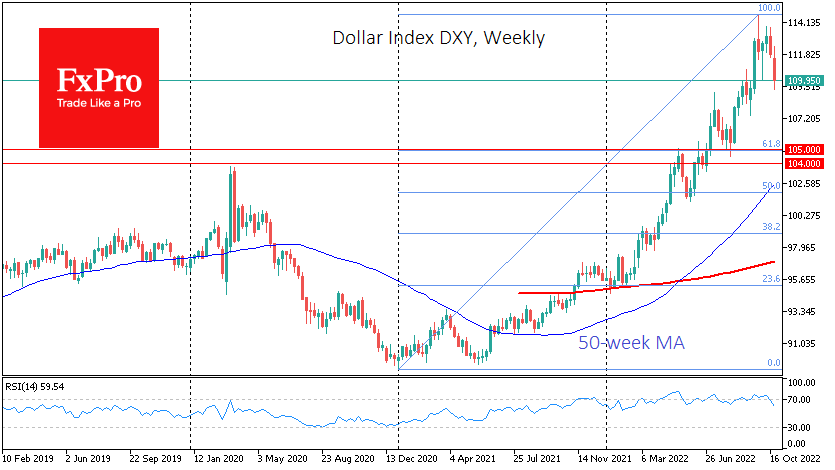
Central banks’ very regular dollar sales set the stage for at least a corrective pullback. Yesterday, for the first time since January of this year, the DXY Dollar Index was 1% below its 50-day average, which acts as a medium-term trend signal line.
Looking at the chart outside the context of FX interventions, the sharp dip below the line calls into question the continuation of the dollar’s rising trend. More locally, without the dollar returning to gains before the end of this week, the priority scenario for the FX market could be a correction in the DXY.
Given the total amplitude of the rally from the “double bottom” of January-May 2021 to the highs of September 2022, a pullback to the 104-105 area is possible. The target range’s lower end was the Dollar surge’s highs in March 2020. The 200-day moving average, which serves as a long-term trend indicator, pulls into the same area. The upper boundary is the retracement area to the 61.8% level of the dollar’s rise since the beginning of 2021.
ECB press conference live stream
https://www.youtube.com/watch?v=EbrC2HNBk4g
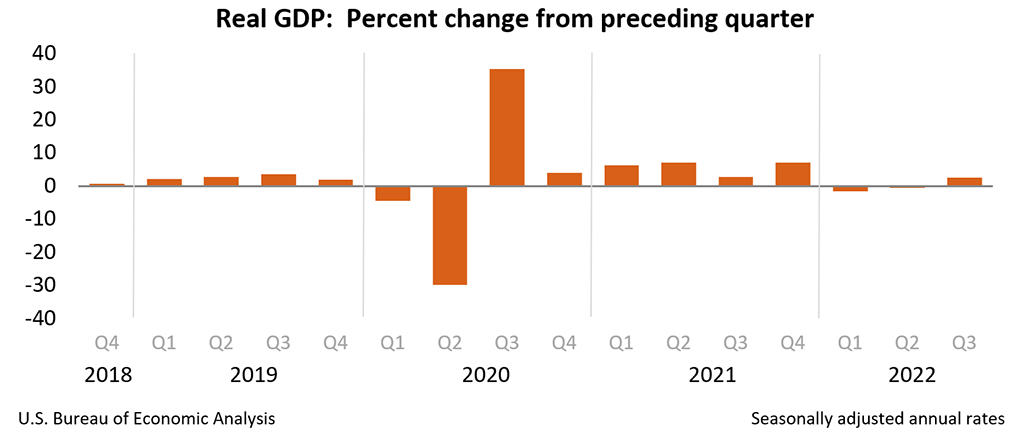
US GDP grew 2.6% annualized in Q3, slightly above expectations
US GDP grew at annualized rate of 2.6% in Q3, above expectation of 2.4%. PCE price index growth slowed from 9.0% to 4.1%, below expectation of 5.4%.
BEA noted that the increase in real GDP reflected increases in exports, consumer spending, nonresidential fixed investment, federal government spending, and state and local government spending, that were partly offset by decreases in residential fixed investment and private inventory investment. Imports, which are a subtraction in the calculation of GDP, decreased.
ECB hikes 75bps, recalibrates TLTRO III
ECB raises interest rates by 75bps as widely expected. The main refinancing, marginal lending, and deposit rates are 2.00%, 2.25%, and 1.50% respectively, with effect from November 2. The central bank also maintains tightening bias, and said, it "expects to raise interest rates further, to ensure the timely return of inflation to its 2% medium-term inflation target."
Future policy rate path will be based on the "evolving outlook for inflation and the economy", and follow its "meeting-by-meeting approach.
Also, the terms and conditions of the TLTRO III refinancing operations are changed, and "recalibrated" to ensure consistency with broader monetary policy normalization process.
(ECB) Monetary policy decisions
The Governing Council today decided to raise the three key ECB interest rates by 75 basis points. With this third major policy rate increase in a row, the Governing Council has made substantial progress in withdrawing monetary policy accommodation. The Governing Council took today's decision, and expects to raise interest rates further, to ensure the timely return of inflation to its 2% medium-term inflation target. The Governing Council will base the future policy rate path on the evolving outlook for inflation and the economy, following its meeting-by-meeting approach.
Inflation remains far too high and will stay above the target for an extended period. In September, euro area inflation reached 9.9%. In recent months, soaring energy and food prices, supply bottlenecks and the post-pandemic recovery in demand have led to a broadening of price pressures and an increase in inflation. The Governing Council's monetary policy is aimed at reducing support for demand and guarding against the risk of a persistent upward shift in inflation expectations.
The Governing Council also decided to change the terms and conditions of the third series of targeted longer-term refinancing operations (TLTRO III). During the acute phase of the pandemic, this instrument played a key role in countering downside risks to price stability. Today, in view of the unexpected and extraordinary rise in inflation, it needs to be recalibrated to ensure that it is consistent with the broader monetary policy normalisation process and to reinforce the transmission of policy rate increases to bank lending conditions. The Governing Council therefore decided to adjust the interest rates applicable to TLTRO III from 23 November 2022 and to offer banks additional voluntary early repayment dates.
Finally, in order to align the remuneration of minimum reserves held by credit institutions with the Eurosystem more closely with money market conditions, the Governing Council decided to set the remuneration of minimum reserves at the ECB's deposit facility rate.
The details of the changes to the TLTRO III terms and conditions are described in a separate press release to be published at 15:45 CET. Another technical press release, detailing the change to the remuneration of minimum reserves, will also be published at 15:45 CET.
Key ECB interest rates
The Governing Council decided to raise the three key ECB interest rates by 75 basis points. Accordingly, the interest rate on the main refinancing operations and the interest rates on the marginal lending facility and the deposit facility will be increased to 2.00%, 2.25% and 1.50% respectively, with effect from 2 November 2022.
Asset purchase programme (APP) and pandemic emergency purchase programme (PEPP)
The Governing Council intends to continue reinvesting, in full, the principal payments from maturing securities purchased under the APP for an extended period of time past the date when it started raising the key ECB interest rates and, in any case, for as long as necessary to maintain ample liquidity conditions and an appropriate monetary policy stance.
As concerns the PEPP, the Governing Council intends to reinvest the principal payments from maturing securities purchased under the programme until at least the end of 2024. In any case, the future roll-off of the PEPP portfolio will be managed to avoid interference with the appropriate monetary policy stance.
The Governing Council will continue applying flexibility in reinvesting redemptions coming due in the PEPP portfolio, with a view to countering risks to the monetary policy transmission mechanism related to the pandemic.
Refinancing operations
The Governing Council decided to adjust the interest rates applicable to TLTRO III. From 23 November 2022 until the maturity date or early repayment date of each respective outstanding TLTRO III operation, the interest rate on TLTRO III operations will be indexed to the average applicable key ECB interest rates over this period. The Governing Council also decidedto offer banks additional voluntary early repayment dates. In any case, the Governing Council will regularly assess how targeted lending operations are contributing to its monetary policy stance.
***
The Governing Council stands ready to adjust all of its instruments within its mandate to ensure that inflation stabilises at its 2% target over the medium term. The Transmission Protection Instrument is available to counter unwarranted, disorderly market dynamics that pose a serious threat to the transmission of monetary policy across all euro area countries, thus allowing the Governing Council to more effectively deliver on its price stability mandate.
The President of the ECB will comment on the considerations underlying these decisions at a press conference starting at 14:45 CET today.
EURUSD Bears Show Up ahead of ECB Rate Decision
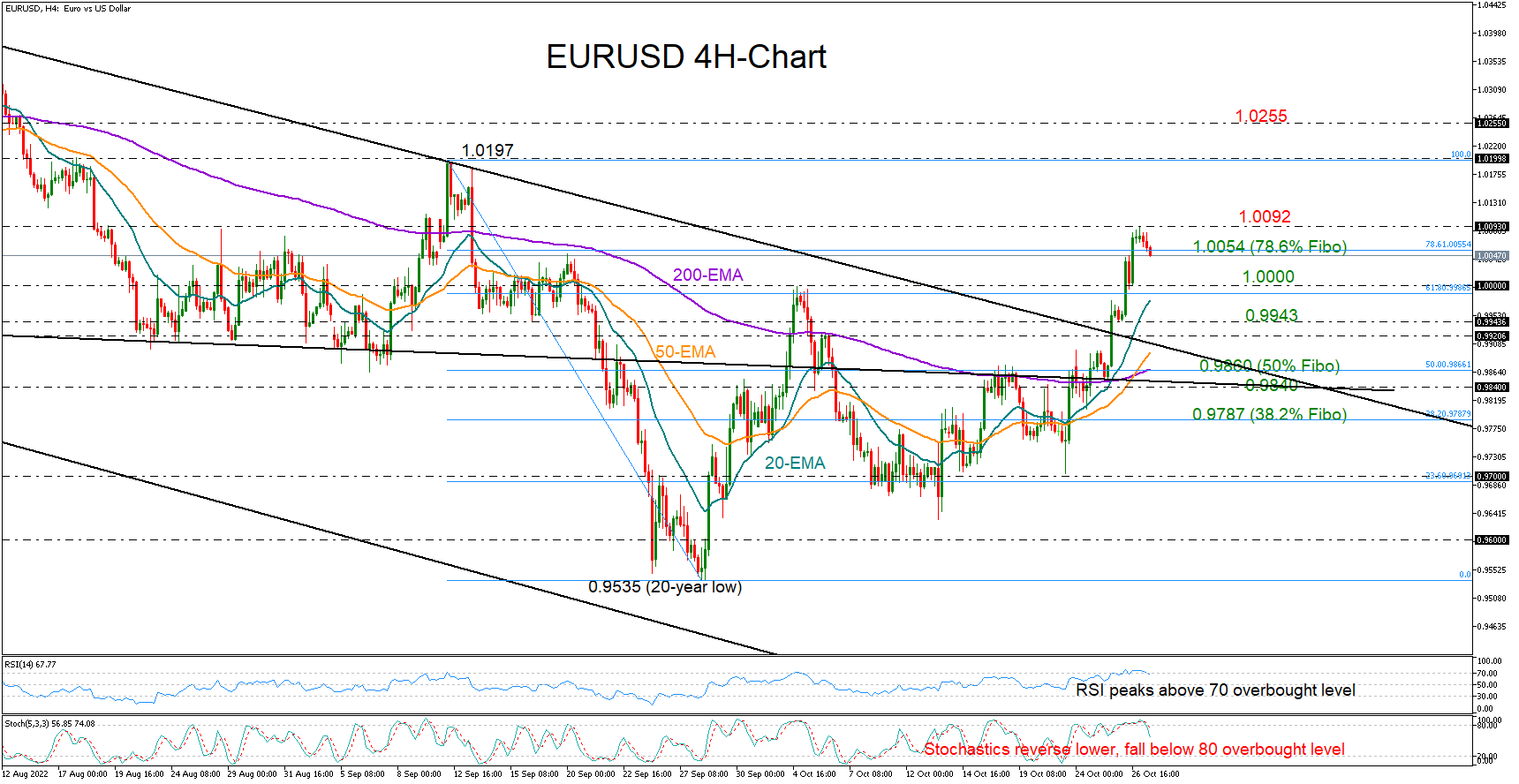
EURUSD lost momentum after speeding up to the six-week high of 1.0092 in the four-hour chart.
According to the RSI and the stochastics, the pair has reached overbought levels, making a downside correction possible ahead of the ECB policy announcement.
Yet, sellers may not take a lead if the support around the 78.6% Fibonacci retracement of the 1.0197-0.9535 downleg stands firm at 1.0054. In this case, the price could pivot northwards with scope to test September’s high of 1.0197. A decisive close above the 1.0255 bar could be the next challenge.
Should sellers press the price below 1.0054, all eyes will turn back to parity and the 61.8% Fibonacci. A step below the 20-period exponential moving average (EMA) could revisit the key constraining zone formed between the 0.9943 handle and the broken descending trendline. If downside pressures intensify, the pair could depreciate towards the 50% Fibonacci of 0.9860 and the 2018 constraining line seen near 0.9840.
In short, EURUSD is at risk of a downside correction after peaking slightly above parity, with traders waiting for a bearish confirmation below 1.0054.
EUR/USD Eyes ECB Rate Secision
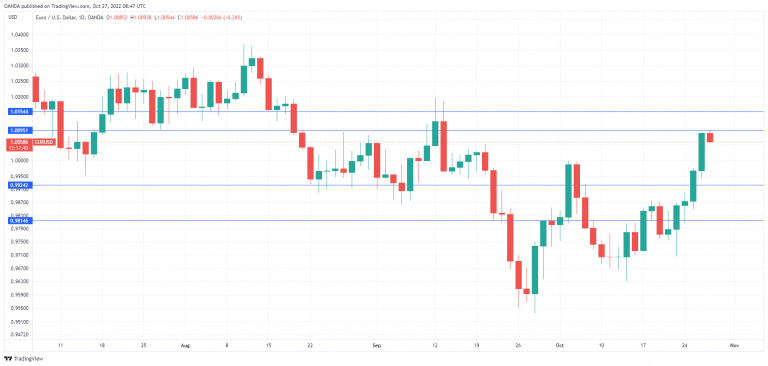
EUR/USD is in a holding pattern ahead of today’s ECB rate meeting. In the European session, the euro is trading at 1.0068, down 0.16%.
ECB projected to hike by 0.75%
The ECB holds its policy meeting later today, amidst difficult economic conditions in the eurozone. Inflation jumped to 9.9% in September, up sharply from 9.1%. The manufacturing and services sectors are in decline and confidence levels are low. The markets have priced in a 0.75% hike and there has even been talk of a jumbo full-point increase. Could the ECB surprise with a lower-than-expected hike of 0.50%? Earlier this week, the Bank of Canada and Reserve Bank of Australia both delivered smaller hikes than expected, at 0.50% and 0.25%, respectively. The message from both central banks is that they are close to ending their rate-tightening cycles and expect inflation to peak in the next several months.
Will the ECB follow suit? It’s possible but unlikely. The ECB only entered the tightening game in July, and the current benchmark of 1.25% remains out-of-sync with inflation, which is close to double-digits and the ECB needs to be aggressive if it hopes to beat inflation. The benchmark rates are much higher in Canada (3.75%) and Australia (2.60%) and have slowed economic growth, while the ECB’s low benchmark rate has not had the same effect. Still, the weak eurozone economy could tip into recession as a result of sharp rate hikes, which means that a 0.50% hike cannot be completely discounted. We can expect some movement from EUR/USD in response to the ECB decision – an increase of 0.75% or 1.00% will be bullish for the currency, while a 0.50% hike would disappoint investors and likely send the euro lower.
EUR/USD Technical
- There is resistance at 1.0095 and 1.0154
- 0.9924 and 0.9814 are the next support levels
XAG/USD: Intermediate Zigzag Nears Completion Level
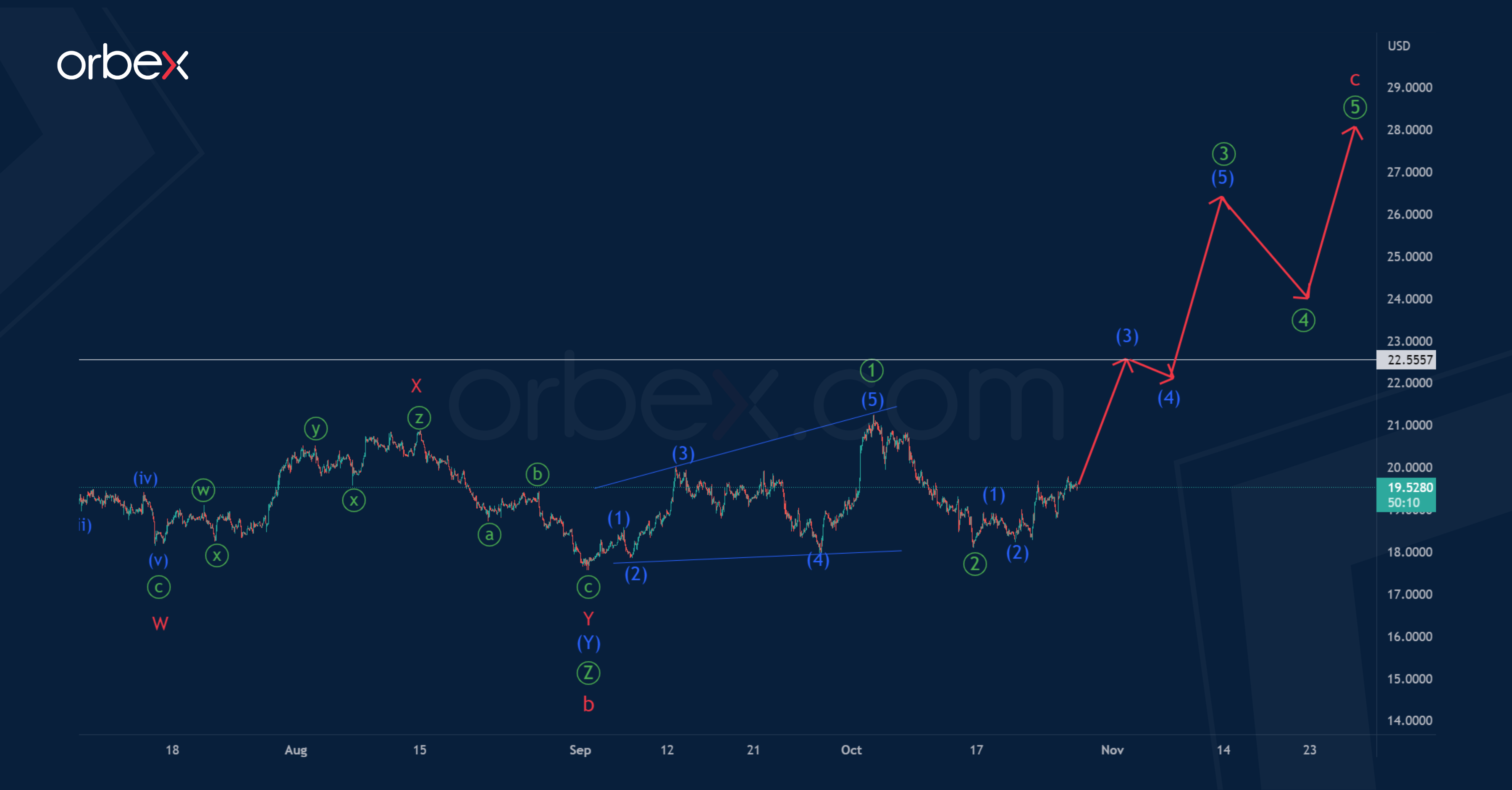
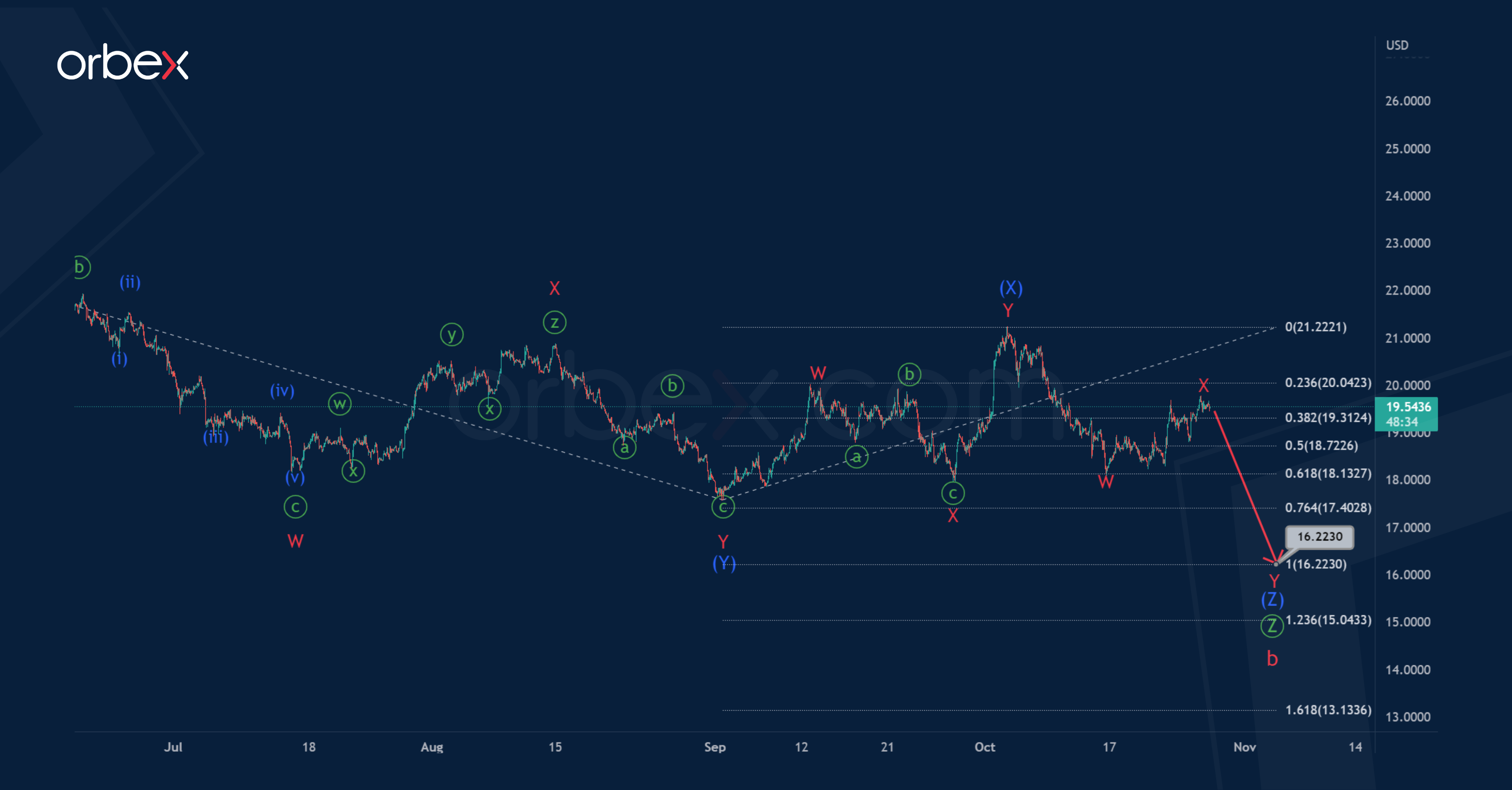
It is assumed that the XAGUSD pair forms a correction wave b of the cycle degree, which is part of the global zigzag. It is a primary triple zigzag Ⓦ-Ⓧ-Ⓨ-Ⓧ-Ⓩ. The first four parts of it have already been fully completed. In other words, we see the construction of the last wave Ⓩ.
Most likely, the wave Ⓩ will be an intermediate triple zigzag (W)-(X)-(Y)-(X)-(Z). It seems that the second intervening wave (X) in the form of a minor double zigzag W-X-Y has recently ended.
Thus, we can expect a drop in the intermediate wave (Z) to 16.223. At that level, sub-waves (Z) and (Y) will be equal. It is assumed that the wave (Z) takes the double zigzag pattern W-X-Y.
Let's consider the second option, where the bearish primary wave Ⓩ could have already completely ended in the form of a double zigzag (W)-(X)-(Y). And the whole correction b along with it.
Thus, in the last section of the chart, we can notice the initial part of the bullish wave c of the cycle degree. It is assumed that it will take the form of an impulse ①-②-③-④-⑤, as shown in the chart.
Perhaps the primary sub-wave ① has come to an end, it is similar to the leading diagonal and correction ②. In the near future, the growth may continue in the sub-wave ③ above the maximum of 22.555.