Sample Category Title
USD/CAD Daily Outlook
Daily Pivots: (S1) 1.3500; (P) 1.3564; (R1) 1.3631; More....
Intraday bias in USD/CAD stays neutral at this point. As long as 1.3501 holds, further rise is still in favor. On the upside, firm break of 1.3976 will target 200% projection of 1.2005 to 1.2947 from 1.2401 at 1.4285. However, firm break of 1.3501 will bring deeper correction to 55 day EMA (now at 1.3439) and possibly below.
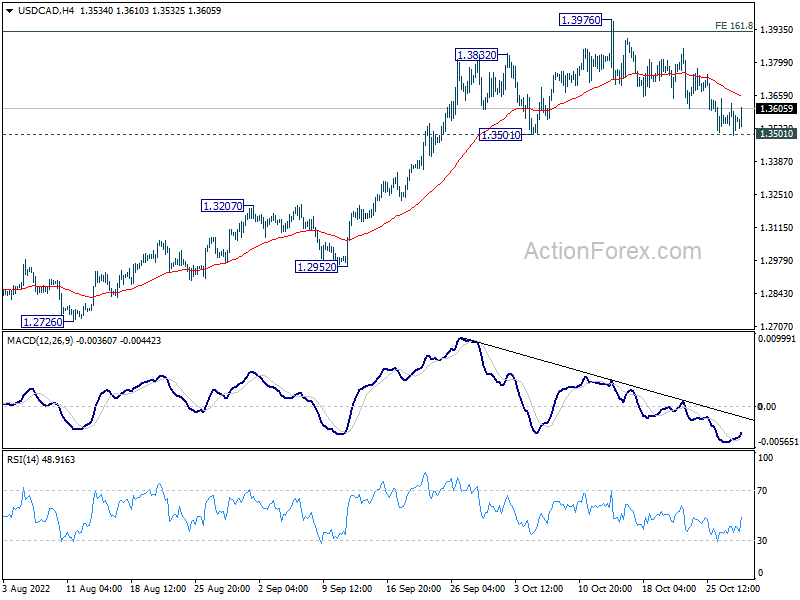
In the bigger picture, up trend from 1.2005 (2021 low) is still in progress. Based on current impulsive momentum, it could be resuming long term up trend from 0.9056 (2007 low). Whether it is or it isn't, retest of 1.4689 (2016 high) should be seen next. This will now remain the favored case as long as 1.3222 resistance turned support holds.
AUD/USD Daily Report
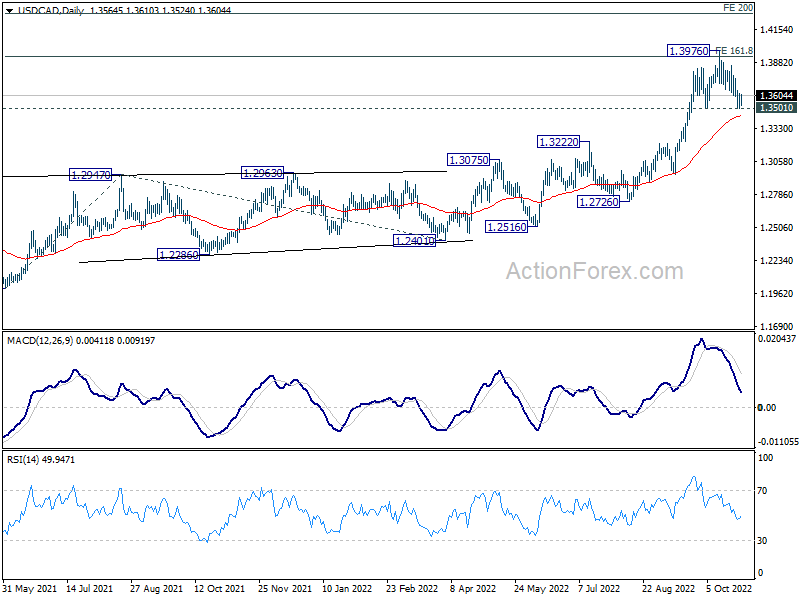
AUD/USD retreated ahead of 0.6530 resistance and intraday bias is turned neutral first. On the upside, decisive break of 0.6535, and sustained trading above 55 day EMA (now at 0.6564), will raise the chance of medium term bottoming, and target 0.6680 support turned resistance next. On the downside, below 0.6371 minor support will turn bias back to the downside for retesting 0.6169 low instead.

In the bigger picture, down trend form 0.8006 (2021 high) is expected to continue as long as 0.6680 support turned resistance holds. Medium term momentum remains strong and retest of 0.5506 (2020 low) cannot be ruled out. But firm break of 0.6680 will be the first sign of reversal, and bring stronger rebound back to 0.7135 resistance.
EUR/USD Daily Outlook
Daily Pivots: (S1) 0.9917; (P) 1.0006; (R1) 1.0053; More...
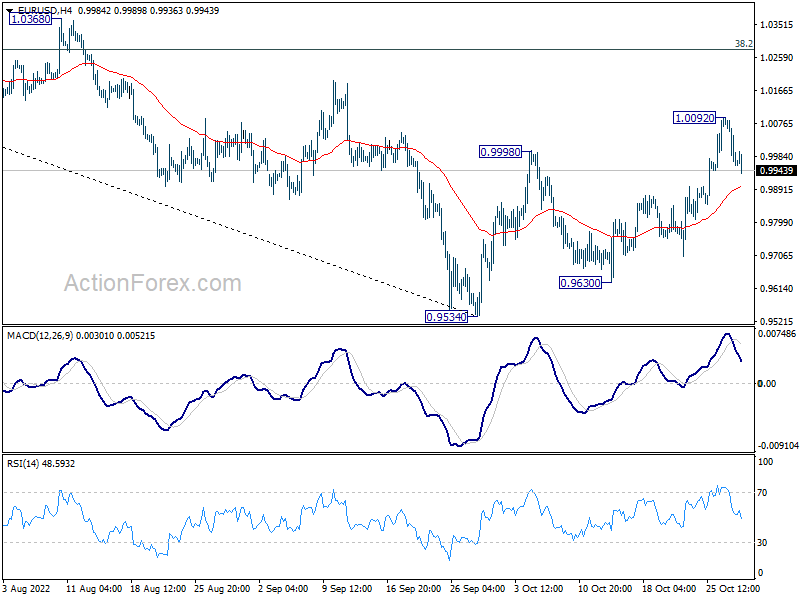
Intraday bias in EUR/USD remains neutral for the moment. Rise from 0.9534 is still expected to continue as long as 4 hour 55 EMA (now at 0.9898). Above 1.0092 will resume the rally from 0.9534 to 38.2% retracement of 1.1494 to 0.9534 at 1.0283. However, sustained trading below 4 hour 55 EMA will turn bias to the downside for 0.9534/9630 support zone again.
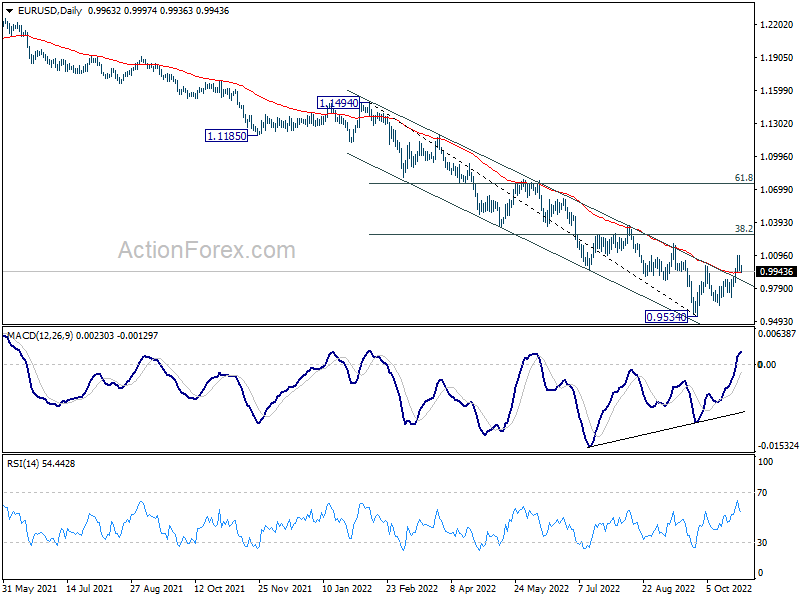
In the bigger picture, the case of medium term bottoming at 0.9534 building up, with bullish convergence condition in daily MACD. While it is too early to call for trend reversal, firm break of 0.9998 opens up stronger rebound back to 55 week EMA (now at 1.0630) even as a corrective rise. This will now be the favored case as long as 55 day EMA (now at 0.9937) holds.
GBP/USD Daily Outlook
Daily Pivots: (S1) 1.1527; (P) 1.1586; (R1) 1.1623; More...
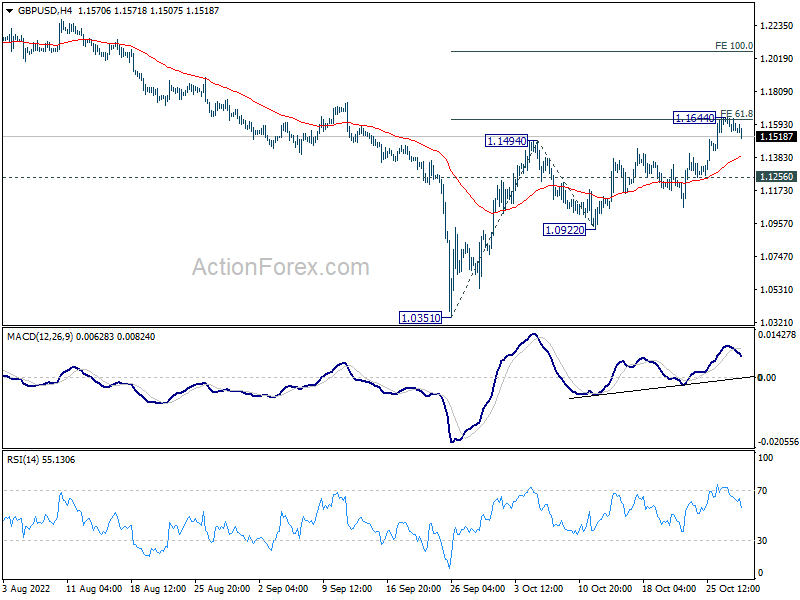
Intraday bias in GBP/USD is turned neutral with current retreat, and some consolidations could be seen. Further rally is expected as long as 1.1256 minor support holds. Break of 1.1644 will resume rise form 1.0351 to 100% projection of 1.0351 to 1.1494 from 1.0922 at 1.2065. However, break of 1.1256 will turn bias back to the downside for 1.0922 support and below.
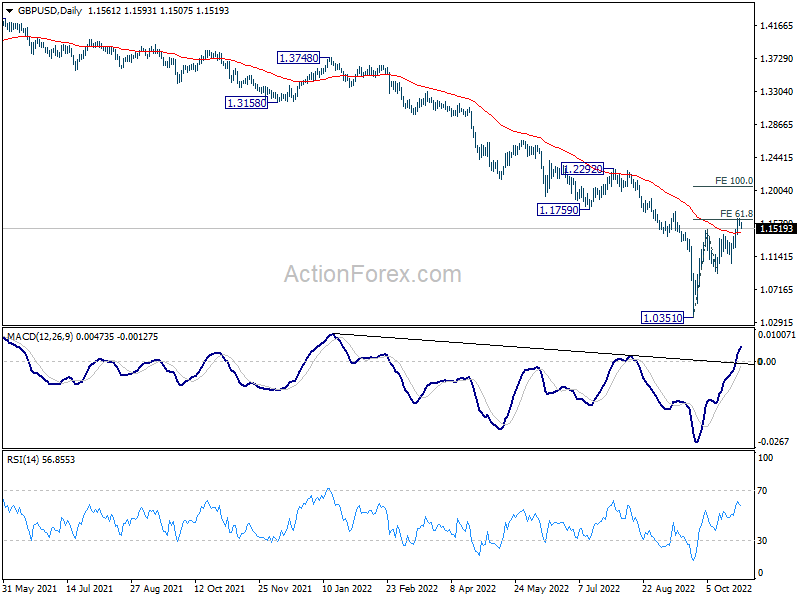
In the bigger picture, fall from 1.4248 (2018 high) is part of the long term down trend from 2.1161 (2007 high). Outlook will stay bearish as long as 1.1759 support turned resistance holds. Parity would be the next target on resumption. Nevertheless, firm break of 1.1759 will confirm medium term bottoming, and open up stronger rise back to 55 week EMA (now at 1.2392).
USD/CHF Daily Outlook
Daily Pivots: (S1) 0.9857; (P) 0.9892; (R1) 0.9943; More...
Intraday bias in USD/CHF remains neutral and outlook is unchanged. Further rally will remain in favor as long as 0.9779 support holds. On the upside, break of 1.0146 will resume larger up trend to 1.0283 projection level. However, firm break of 0.9779 will be a sign of reversal, and bring deeper decline back to 0.9478 support instead.
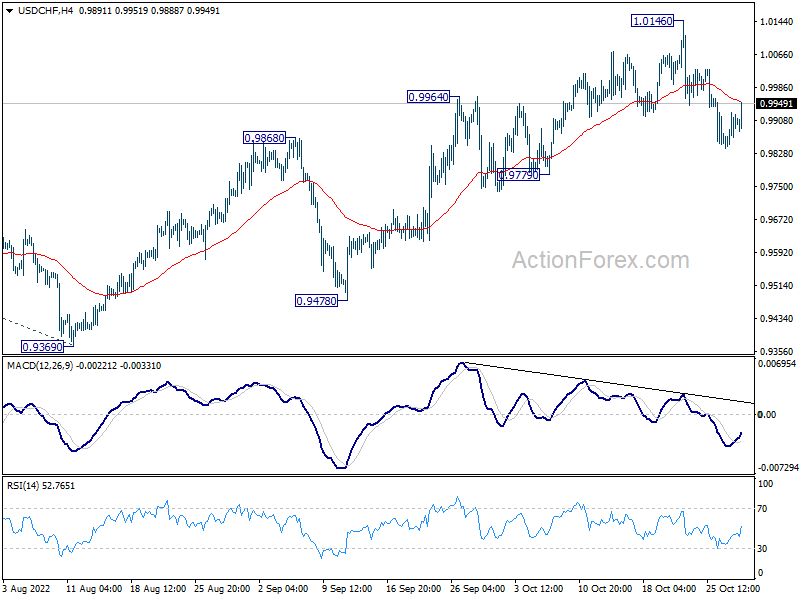
In the bigger picture, current development suggests that up trend from 0.8756 (2021 low) is still in progress. Sustained break of 1.0063 will target 100% projection of 0.9149 to 1.0063 from 0.9369 at 1.0283, and then 1.0342 (2016 high). For now, this will remain the favored case as long as 0.9779 support holds, even in case of deep pull back.
S&P 500 Hits Resistance
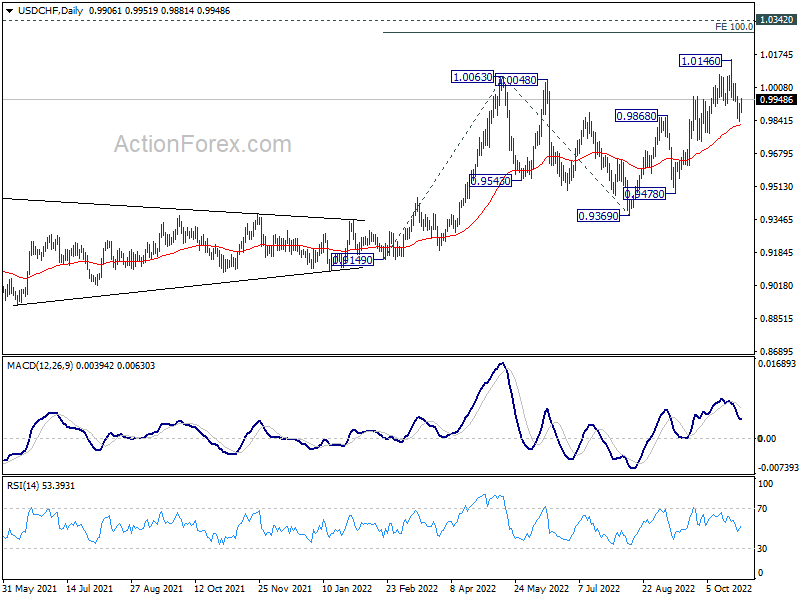
The S&P 500 softened as the US GDP beat expectations in Q3. A close above October’s high at 3800 prompted sellers to cover, easing the pressure on the index. The support-turned-resistance at 3900 is a major hurdle and its breach could trigger a bounce back to 4100. However, the RSI’s repeatedly overbought condition caused a pullback as buyers started to take some chips off the table. 3730 is a key area to expect follow-up interests. Otherwise, the index could be vulnerable to a correction towards 3640.
USD/JPY Seeks Support
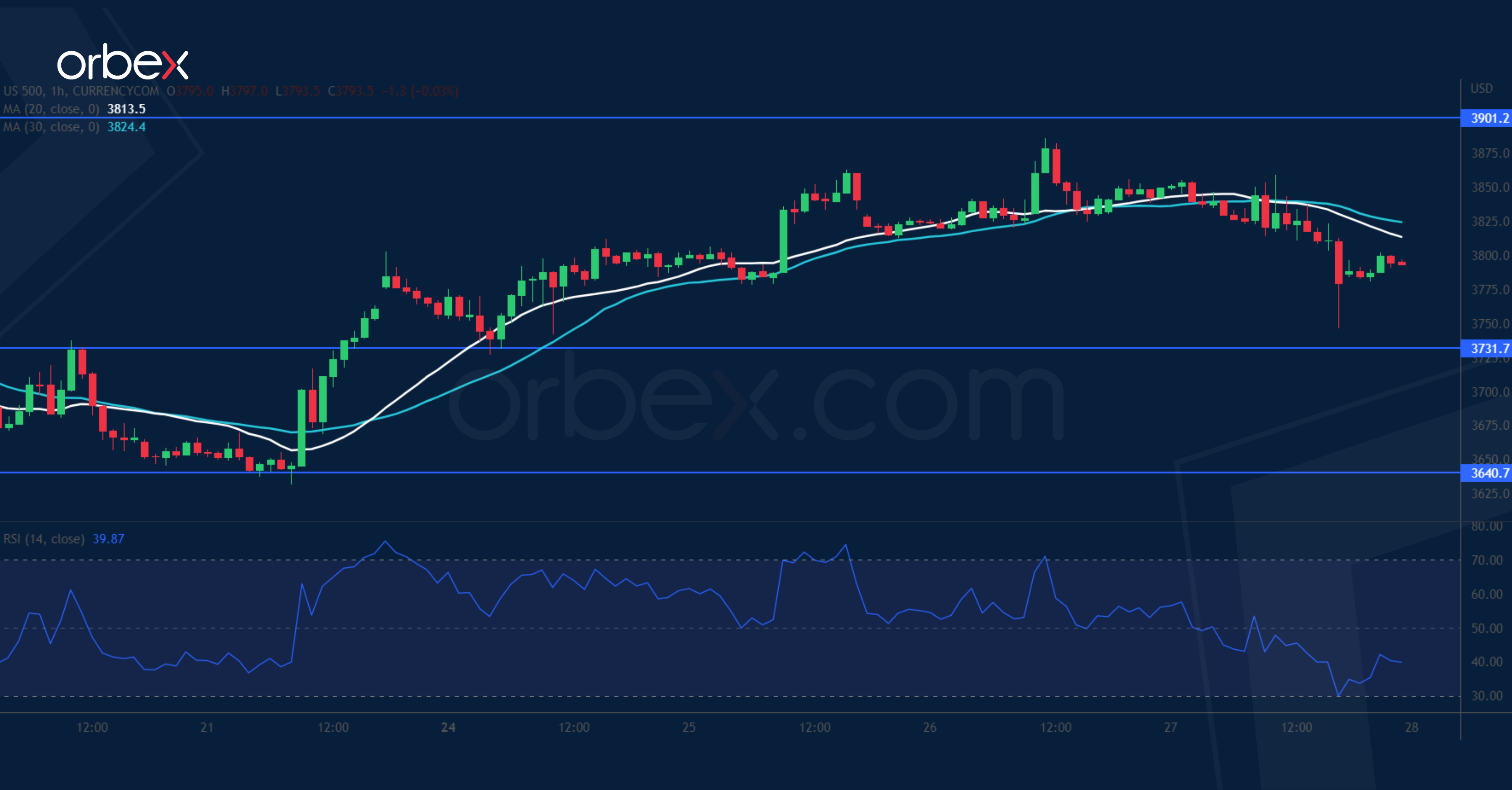
The Japanese yen weakens as the BoJ maintains its ultra low rates. The RSI’s double top in the overbought area on the daily chart was a strong sign of overextension. A sharp fall below 150.00 has triggered a wave of liquidation. Now that short-term leveraged buyers are out of the picture, the pair is looking for an area of accumulation as medium-term sentiment remains bullish. 145.00 near the consolidation back in early October is a key support. 147.30 is the first resistance and its breach could help the greenback recover.
EUR/USD Takes a Breather
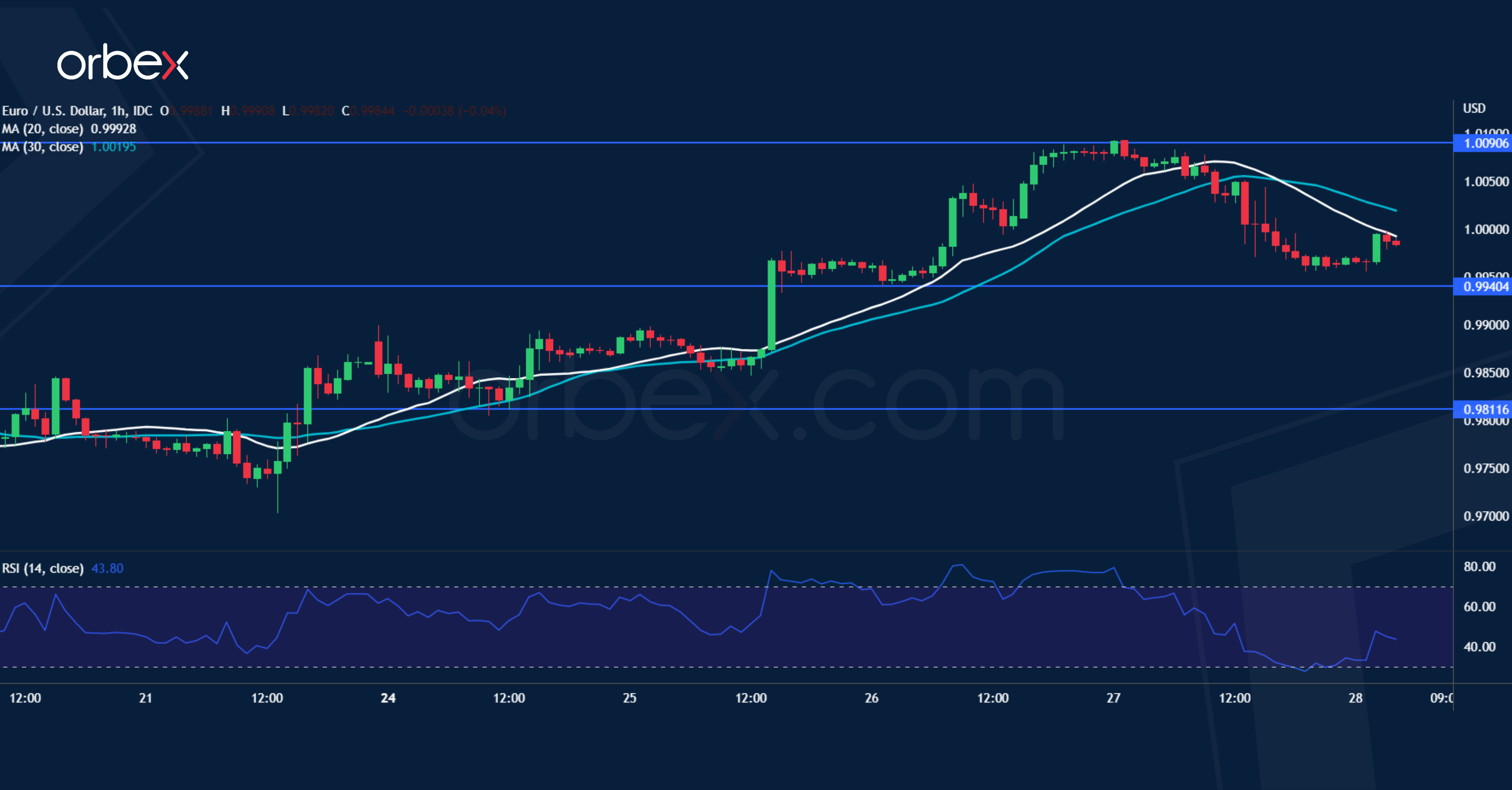
Traders took profit in the euro after the ECB raised its interest rates by 75 basis points as expected. A rally back to parity indicates strong interest in defending the historical exchange level. The price hit resistance at 1.0090 near September’s high (1.0200) and the current drawdown would allow the bulls to take a breather. 0.9940 from a previous breakout is the closest area to expect renewed buying as the RSI swung into the oversold area. A bullish breakout could lead to an extended recovery in the days to come.
The Odd One Out, BoJ Sticks to Super Easy Monetary Policy
Markets
The ECB hiked its policy rates by another 75 bps yesterday, bringing the total effort to 200 bps since the inaugural rate hike in July. The ECB deposit rate now stands at 1.5%. Rumours this morning suggest that three governors dissented in favour of a 50 bps move. The wording of the new policy statement in any case pointed to some disagreement on how to proceed from now on. It ditched a reference to continue hiking at several more meetings, though ECB Lagarde mentioned it at the Q&A session afterwards. Instead of focusing on frontloading, the opening paragraph now stressed the substantial progress made in withdrawing monetary policy accommodation. Both changes suggest no consensus on continuing the current 75 bps rate hike pace in December. At least not for the moment. EMU money markets discount a slowdown to 50 bps, bringing the policy rate at 2%. The jury is still out, but we prefer to err on the hawkish side of this consensus. Today’s first national October inflation readings (Germany, Spain, France, Italy, Belgium) could already serve as a wake-upcall. Especially should mild winter weather postpone the day of economic reckoning for the euro zone. The ECB will use its final policy meeting of this year to set out the blueprint for winding down its €3.2tn APP bond portfolio, a second pillar in the normalization process. Finally, they recalibrated TLTRO III terms from November 23 onwards (indexed to average applicable key ECB interest rates from that starting point). The correction higher on (European) bond markets accelerated following the “dovish hike” by the ECB. The German yield curve bull steepened with yields losing 9.7 bps (30-yr) to 17.8 bps (5-yr). 10-yr yield spreads vs Germany narrowed by up to 5 bps with Greece (-9 bps) and Italy (-17 bps) outperforming. The euro suffered from the significant loss of interest rate support, returning below parity. EUR/USD closed at 0.9964 from an open at 1.0081. EUR/GBP in the same vein slid from 0.8669 to 0.8616.
Today’s eco calendar centers around above-mentioned national inflation readings. First regional German figures showed a significantly higher M/M-pace, suggesting clear upside risks. German Bund futures immediately lost some of yesterday’s gains. We nevertheless think it’s too soon to call the bond correction already over with next week’s FOMC meeting potentially also delivering a dovish hike. Speeches by ECB members are wildcards. Overall risk sentiment turns more fragile again following disappointing Q3 earnings and weak outlooks.
News Headlines
The odd one out. The Bank of Japan sticks to its super easy monetary policy by keeping the main rate at a negative -0.10% and targeting a 10-y yield of 0% (with +/-25 bps deviations allowed). This is despite having lifted inflation forecasts for the FY ending in March from 2.3% to 2.9%. Inflation in the two years thereafter is seen back below 2% though, at 1.6%, a sign the BoJ views the current inflation (3% headline in September) as not durable. The central bank also grew more cautious on growth, revising it lower from 2.4% to 2% for the current year and from 2% to 1.9% for the next. The Japanese government yesterday announced a new economic package worth $200bn in support of the BoJ’s inflation quest. The extreme policy divergence with the likes of the US has inflicted serious damage to the JPY. USD/JPY recently breached the 150 barrier before the MoF stepped in again with yet-unconfirmed interventions. The pair currently trades unfazed around 146.25.
British PM Sunak and Chancellor Hunt are weighing tax increases and spending cuts totaling £50bn per year to fill a massive black hole in public finances, the FT reported citing people close to Hunt. The eyepopping number, to the tune of 2% of GDP, is based on Treasury calculations of an initial fiscal gap between £30 and £40bn. Filling this will require an effort of about £45bn because measures taken will also affect growth and thus government revenues. But Sunak and Hunt want to create some additional headroom to allow for the possibility that the economy performs worse than expected.
Swiss KOF dropped to 90.9, economic outlook remains subdued
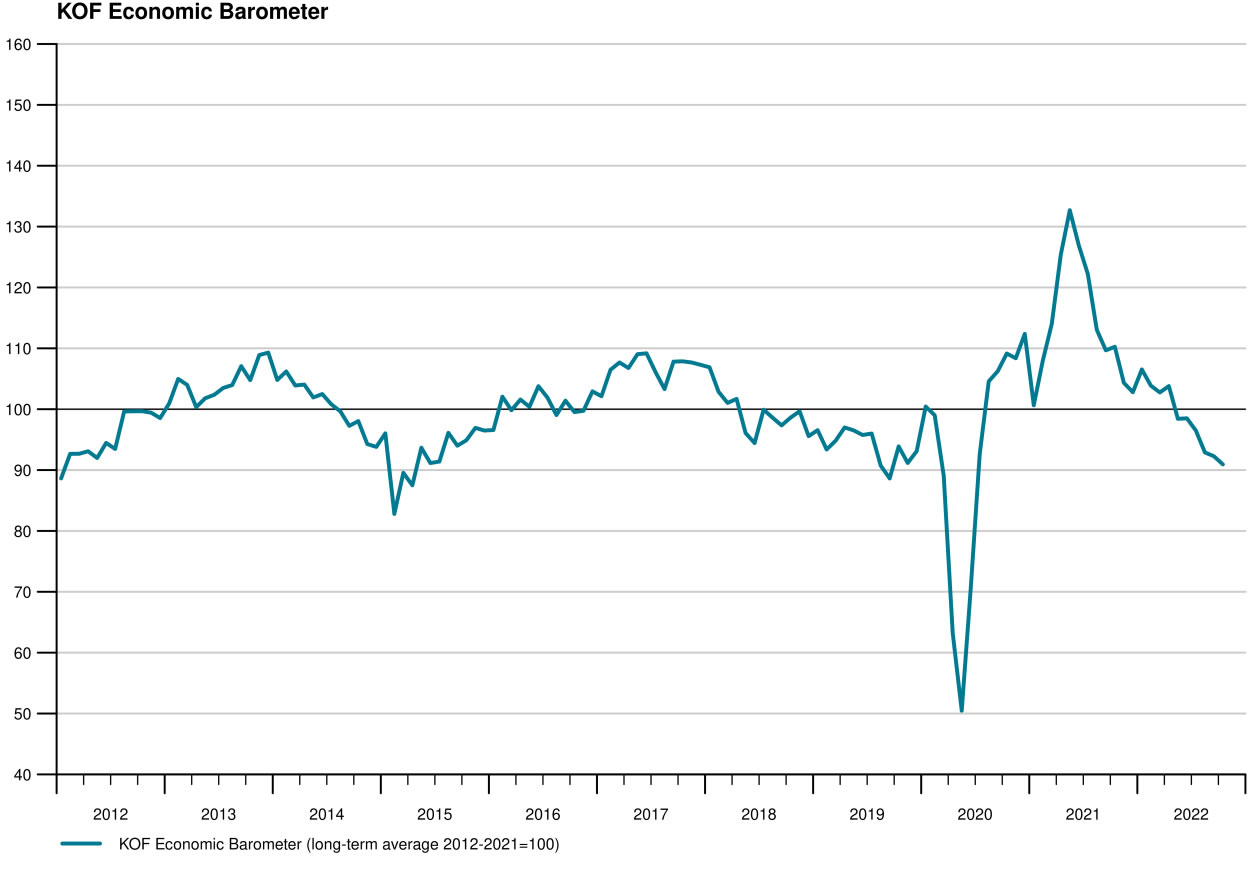
Swiss KOF Economic Barometer decreased from 93.8 to 90.9 in October, below expectation of 93.0. The index is now below its long-term average for the sixth month in a row. Outlook for the economy in the coming months "remains subdued".
KOF said: "The downward movement of the barometer is primarily driven by bundles of indicators from the manufacturing as well as the accommodation and food service activities sectors. Indicators for the construction sector, the financial and insurance services, and private consumption remained almost unchanged compared to the previous month. By contrast, indicators for the sector other services showed a slightly positive trend."