Sample Category Title
Weekly Economic & Financial Commentary: FOMC Set to Announce Another 75 bps Rate Hike Next Week
Summary
United States: Another GDP Head Fake
- Real GDP expanded by an annualized 2.6% during Q3. The Employment Cost Index moderated to 1.2% in Q3. Personal income improved 0.4%, while personal spending increased 0.6%. Pending and new home sales cratered 10.2% and 10.9%, respectively, in September. Consumer confidence fell to 102.5 in October.
- Next week: ISM Surveys (Tue, Thu), Trade Balance (Thu), Nonfarm Payrolls (Fri)
International: Spooky Times Ahead
- Survey data from the Eurozone painted a more pessimistic growth outlook, while the European Central Bank still opted to go for another 75 bps rate hike to quell inflation. Elsewhere, the Bank of Canada slowed down the pace of its rate hikes to 50 bps and signaled that the end of its tightening cycle is near. Last but not least, U.K. PMI survey data indicated that sentiment—and the overall growth outlook—is deteriorating.
- Next week: Eurozone CPI (Mon), Reserve Bank of Australia (Tue), Bank of England (Thu)
Interest Rate Watch: FOMC Set to Announce Another 75 bps Rate Hike Next Week
- The Federal Open Market Committee (FOMC) meets next Tuesday and Wednesday, and we expect it to announce a 75 bps increase in the target range for the federal funds rate. This move is widely anticipated by economists and market participants alike, and it would be a major surprise if the committee deviated from 75 bps.
Topic of the Week: Third Quarter Earnings Season in Full Swing
- The corporate earnings season is in full swing with large technology companies having reported results for the third quarter this week. Despite some dissappointing results, S&P 500 operating margins are shaping up to remain solid in the third quarter, which bodes well for U.S. economy-wide margins released at the end of November.
Fed to Follow BoC With Another Hike Next Week
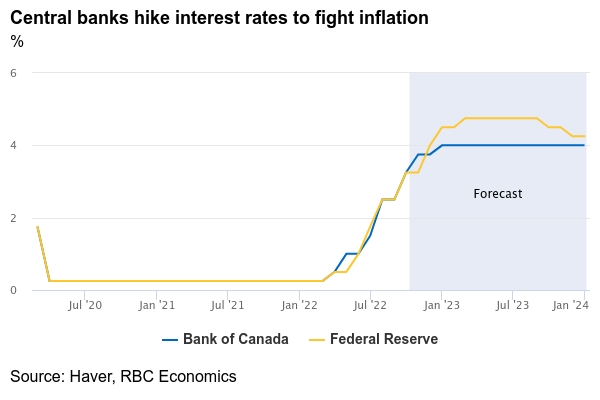
The U.S. Federal Reserve is likely to deliver another 75 basis point hike when it meets next week. The move will come on the heels of the Bank of Canada’s smaller-than-expected 50 basis point rate hike, which surprised markets this past week. And it will push the main U.S. policy rate slightly above the 3.75% overnight rate in Canada. Though comments from BoC Governor Macklem suggest Canada may be approaching the end of its current hiking cycle, the Fed isn’t likely to match that ‘dovish pivot’—at least not yet. Though we’ve seen some (very early) signs of inflation pressures easing in Canada, the same can’t be said of U.S. Indeed, core price inflation (which excludes food and energy), has been higher south of the border and more sticky.
Tamping down inflation will likely require more rate hikes in the U.S. than in Canada. Nevertheless, most Fed officials also expect the pace of those U.S. hikes to slow down after next week’s meeting. Our own forecast anticipates the Fed Funds rate entering the 4.5% – 4.75% range by early 2023. In Canada, we expect the overnight rate to reach 4% by year’s end. U.S. economic growth looks to be slowing—and that will eventually cut into inflation tailwinds. And though labour markets have remained exceptionally tight, there has been slight moderation in the number of job openings over the past few months. We expect employment growth will likely lose more momentum October. We expect a 150,000 increase in jobs alongside a tick higher in the unemployment rate, but to a still low 3.7%.
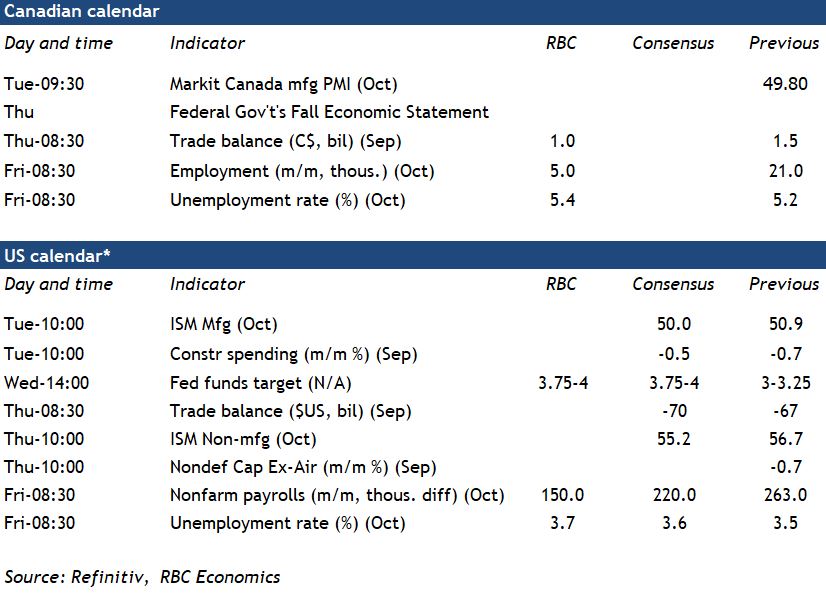
Labour markets aren’t exactly balanced in Canada either. But there are more signs of cracks forming, starting with 92,000 jobs lost over the last 4 months. We expect a 5,000 increase to Canadian employment in October, as hiring momentum (especially on the goods-producing side of the economy) continues to soften amid a cooling housing market and weakening demand for consumer products. That, together with a small rebound in the labour force participation rate, should drive the jobless rate back to August levels of 5.4%.
Week ahead data watch:
Next week’s Fall Economic Statement will be more fiscal update than mini budget as Ottawa forms its response to the U.S. Inflation Reduction Act. With a better-than-expected starting point for federal finances set against a deteriorating outlook, expect a follow-up on some of Budget 2022’s clean growth announcements—including the Canada Growth Fund and cleantech investment tax credit, as well as a plan to address carbon price uncertainty.
The Canadian trade surplus is expected to shrink again in September on lower oil prices.
Week Ahead – All About the Fed and NFP
US
Will the fourth 75 basis-point rate hike be the last major rise before the Fed downshifts in December? Next week’s FOMC decision is widely expecting a unanimous vote for one last major rate increase. With the Fed’s preferred price measure still showing inflation is running hot, that might make it harder for them to set up a possible downshift in its rate-hike pace for the December meeting. Despite an acceleration with inflation, strong consumer spending data, and a robust labor market, much of Wall Street is growing confident that the Fed will pause tightening once they take the funds rate to 4.50-4.75% next quarter.
In addition to the FOMC decision, traders will also closely monitor the nonfarm payroll report. The strong labor market is still expected to show job growth with 200,000 jobs created in October, down from the 263,000 created in the prior month. The unemployment rate is expected to tick higher and wage gains are expected to slow.
It will be another busy week filled with earnings that will likely confirm the slowdown being seen across the economy. Healthcare, consumer discretionary, energy, and car manufacturer stocks will report next week.
EU
Inflation has hit double-digits and remains the ECB’s number one priority. The Eurozone releases its inflation report on Monday.
Inflation rose to 10.0% in September, and it is expected to surge to 10.3% in October. Some analysts are expecting a possible surge to 11.0%. Core inflation is projected to tick higher to 4.9%.
The Eurozone will release the October Final PMIs, which are projected to indicate contraction, with readings below the 50.0 level. Manufacturing will be released on Wednesday and Services on Friday. Manufacturing is expected at 46.6 and Services at 48.2, confirming the initial estimates.
UK
The UK releases Final PMIs for October, with Manufacturing on Tuesday, Services on Thursday and Construction on Friday. The 50.0 line separates contraction from expansion.
The initial readings were 45.8 for manufacturing and 47.5 for services, indicative of weak economic activity in the UK. Construction may provide a silver lining, with an initial reading of 52.3, pointing to slight expansion.
The highlight of the week will be the Bank of England’s rate decision on Thursday. The BoE raised rates by 0.50% in September and is expected to go all in with a jumbo 0.75% hike, which would bring the cash rate to 3.0%. The vote could have two dissenters, which is why markets are expecting a downshift to a half-point pace in December. The UK may already be in a recession and higher rates will hurt households and businesses, but the BoE has little choice but to continue tightening if it hopes to curb red-hot inflation, which is at 10.1%.
Russia
The war in Ukraine and the severe Western sanctions have taken a steep toll on consumer spending. In August, real retail sales plunged by 8.8% and September is supposed to be just as bad with an 8.6% decline.
South Africa
South Africa’s recovery from Covid-19 has been slow and a weak global economy is not helping matters.
The October PMI will be released on Thursday. The PMI is expected to rise slightly to 49.7, following a 49.2 read in September. A reading below 50.0 indicates contraction.
Turkey
Turkey will release the October inflation report on Wednesday. The Turkish central bank continues to slash interest rates, with a 150 basis point cut earlier in October. This policy has seen inflation soar to staggering levels that is more than 17 times the CBRT’s target rate. CPI rose to a 24-year high of 83.4% in September, and the consensus for October stands at 85.6%.
Switzerland
Switzerland releases the October inflation report on Thursday. Inflation has been rising in Switzerland, which forced the central bank to raise interest rates by a massive 0.75% in September. Still, inflation is much lower than in the Eurozone or the UK. Headline CPI is expected to tick lower to 3.2%, down from 3.3% in September.
China
Strict anti-COVID measures are about to send China’s factory activity back into contraction territory. The global growth outlook will struggle as China’s economy shows their recovery is struggling. Both services and manufacturing data are expected to weaken in October.
Currency traders will pay close attention to the PBOC as they have set the yuan reference rate at the weakest levels since 2008. Authorities want a strong yuan, but defending it could prove costly. They might need to consider narrowing the band.
India
India’s economy is losing momentum and the latest PMI readings might confirm that trend. The growth outlook continues to get slashed and the current rate hiking cycle is starting to weigh much more on the economy.
The RBI will have an an out-of-cycle meeting next week as the government urges them to get inflation back under 6%. Traders should not be surprised if some RBI action occurs before the December 5-7th policy decision.
Australia & New Zealand
The focus is on the RBA policy decision. This meeting could have some added volatility as the general consensus leans towards a 25bp rate rise, but a half-point increase should not be ruled out. Inflation remains hot and with the cash rate nowhere near inflation, the bank might feel more pressure to act aggressively.
New Zealand’s third quarter Employment Change and Unemployment Rate data, due out next Wednesday (2 November), as an increase in employment and a decrease in unemployment will be beneficial to New Zealand’s economic growth. As the overall inflation level in New Zealand remains high, the money markets are pricing in either a half-point rise or 75- basis point rate hike at the RBNZ’s next interest rate meeting on November 23rd.
Japan
The Bank of Japan did not deliver any surprises. Both rates and the 10-year yield target did not have any changes. The yen remains a volatile trade and now the ball is in the Ministry of Finance hands. With momentum growing for the Fed to shift to a slower pace of tightening in December, Japan may try to be aggressive in defending the dollar-yen 150 level. Traders will also pay close attention to the minutes of the last BOJ decision.
Singapore
Singapore’s economy is weakening and the October PMI reading should show that the weakening trend continues. Traders will also pay close attention to the retail sales report for the month of September.
Markets
Energy
Oil markets remain volatile as China ramps up COVID restrictions, some US oil giants signal modest commitments to boost production, and the global economic outlook continues to dim. Next week, energy traders will get a better sense of how China’s economy is performing despite the COVID lockdowns that happened in October. OPEC will also announce their World Oil Outlook on Monday.
Commodities broadly will also have a reaction to the FOMC policy decision and nonfarm payroll report. A dovish rate rise could allow for dollar weakness which could keep oil prices supported here. If risk appetite remains healthy, WTI crude could continue to consolidate above the mid-$80s.
Gold
The bullish case for gold is improving as financial markets begin to grow optimistic that the Fed will begin the deliberation of a slower pace of tightening. Gold could be on the verge of a major breakout if the FOMC decision is supported by the nonfarm payroll report at the end of the week. Gold has initial support at $1640, with the line in the sand being $1,620. The $1680 provides major resistance for gold, followed by the $1700 level.
Cryptos
Bitcoin is forming a trading around the $20,000 level as many investors await to see what happens with next week’s market reaction to the FOMC decision. What will also draw extra attention is the Hong Kong Fintech Week, that includes appearances from FTX’s Sam Bankman-Fried, but could contain more insight on how Hong Kong will provide guidelines on how retail crypto trading could be allowed. Binance CEO Zhao and Ark’s Cathy Wood will speak at the Web Summit in Lisbon.
Economic Calendar
Sunday, Oct. 30
Economic Data/Events:
- Brazilians vote in a presidential runoff election between Luiz Inacio Lula da Silva and incumbent Jair Bolsonaro.
- Daylight savings time ends in the UK
- EU trade ministers informal meeting in Prague
Monday, Oct. 31
Economic Data/Events:
- Eurozone CPI, GDP
- Poland CPI
- Mexico GDP
- Australia retail sales
- China manufacturing and non-manufacturing PMI
- Japan industrial production, retail sales, housing starts
- South Africa trade balance
- Thailand trade
- UK mortgage approvals
- Danmarks Nationalbank conference, speakers include ECB Chief Economist Lane, Riksbank Governor Ingves, and Norges Bank Governor Wolden Bache
- Bank of Italy Governor Visco and Italian Finance Minister Giorgetti speak at a World Savings Day event.
- Nordic prime ministers meet in Helsinki for a Nordic Council meeting.
- Hong Kong Fintech Week: Speakers include FTX’s Sam Bankman-Fried, China Banking and Insurance Regulatory Commission’s Yuanqi and the Securities and Futures Commission’s Leung as speakers.
- OPEC launches its 2022 World Oil Outlook at the Abu Dhabi International Petroleum Exhibition and Conference.
- Russian President Putin meets the leaders of Armenia and Azerbaijan in the southern Russian city of Sochi.
Tuesday, Nov. 1
Economic Data/Events:
- US construction spending, ISM manufacturing index, light vehicle sales
- RBA rate decision: Expected to raise rates by 15bp to 2.85%
- China Caixin Manufacturing PMI
- Canada Manufacturing PMI
- Czech Republic Manufacturing PMI
- India Manufacturing PMI
- Japan Manufacturing PMI, Vehicle Sales
- Mexico Manufacturing PMI
- Norway Manufacturing PMI
- Russia Manufacturing PMI
- South Africa Manufacturing PMI
- UK Manufacturing PMI
- Czech Republic GDP
- Macau casino revenue
- Mexico international reserves
- New Zealand building permits
- Denmark’s general election
- Riksbank Governor Ingves gives a speech on the economy and monetary policy, in Helsingborg.
- Web Summit conference; Speakers include Binance CEO Zhao and ARK Investment Management’s Wood
Wednesday, Nov. 2
Economic Data/Events:
- FOMC Decision: Expected to raise rates by 75bps
- US MBA mortgage applications, ADP employment
- European Manufacturing PMI: Eurozone, France, Germany, Italy, Poland, Spain
- Australia building approvals
- Germany unemployment
- Japan BOJ minutes of Sept. meeting
- New Zealand unemployment, central bank Financial Stability Report
- Russia unemployment, retail sales
- EIA Crude Oil Inventory Report
- Bank of Ireland’s Financial System Conference: Speakers include Irish Central Bank Governor Makhlouf, Finance Minister Donohoe and Bank of France Governor Villeroy In Dublin.
Thursday, Nov. 3
Economic Data/Events:
- US factory orders, durable goods, trade, initial jobless claims, ISM services index
- Bank of England Rate Decision: Expected to raise rates by 75bps to 3.00%
- UK services PMI
- Australia trade balance
- China Caixin services PMI
- Eurozone unemployment
- India S&P Global services PMI
- Italy unemployment
- Norway rate decision: Expected to raise rates by 25bps to 2.50%
- Russia services PMI
- Spain unemployment
- G-7 foreign ministers to meet in Munster, Germany
- German Chancellor Olaf Scholz visits China
- RBA’s Kearns speaks at the ASIC Annual Forum in Sydney.
- ECB’s President Lagarde and Elderson speak at Latvijas Banka Economic Conference 2022.
- ECB’s Panetta gives a keynote speech at ECB money market conference.
- BOE’s Mann speaks on a panel about inflation at an American Enterprise Institute web event.
Friday, Nov. 4
Economic Data/Events:
- US October Change in nonfarm payrolls: 200Ke v 263K prior, unemployment Rate to tick higher to 3.6%, Average Hourly Wages
- European Services PMI: Eurozone, France, Germany, Italy, Spain
- Japan Services PMI
- Canada unemployment
- Eurozone PPI
- France industrial production
- Germany factory orders
- Singapore retail sales
- Spain industrial production
- Thailand CPI
- The UN’s Food and Agricultural Organization releases its monthly index of world food prices.
- ECB’s VP de Guindos gives a keynote speech at the Energy Prospectives session
- ECB President Lagarde gives a lecture on monetary policy in the euro area organized by Estonia’s central bank.
- Fed’s Collins speaks on macroeconomic conditions at a Brookings Institution virtual event.
Sovereign Rating Updates:
- France (Fitch)
- Ireland (Moody’s)
- Norway (Moody’s)
The Weekly Bottom Line: Fed’s Preferred Inflation Gauge Remains Hot
U.S. Highlights
- The U.S. economy left behind the declines recorded in the first half of 2022, with GDP growth accelerating to 2.6% (ann.) in the third quarter. The headline was flattered by an outsized contribution from net exports, whereas private domestic drivers remained soft.
- The weakest area of the third quarter GDP report was residential investment, which fell 26% (ann.). Outside of the pandemic, this was the sharpest pullback since 2010.
- With mortgage rates currently topping 7%, there’s more weakness in the cards for housing. Pending home sales, a leading indicator of existing home sales, fell for the fourth consecutive month by a massive 10.2% m/m in September.
Canadian Highlights
- The Bank of Canada surprised markets this week by raising rates 50 basis points, rather than the 75 investors were expecting, taking yields on Government of Canada bonds notably lower on the week.
- In its quarterly Monetary Policy Report, the bank laid out its case for an easing in the pace of rate hikes: a ‘considerable’ downgrade to economic growth which now sees inflation getting back to target sooner than expected.
- August’s GDP by industry data showed that the economy grew at a modest pace, consistent with the narrative of a slowing Canadian economy.
U.S. - Fed’s Preferred Inflation Gauge Remains Hot
U.S. Treasury yields trended lower this week as investors digested mixed signals from the economy and earnings reports. The 10-year yield has fallen to around 4% as of writing after topping 4.3% late last week. Equities were trekked higher, with the S&P 500 looking to end the week up about 2.9% as at the time of writing.
The U.S. economy left behind the negative prints recorded in the first half of the year, with growth accelerating to 2.6% annualized (ann.) in the third quarter – a touch higher than market expectations (2.3%). However, the headline number was flattered by an outsized gain in net exports (Chart 1). Meanwhile, private domestic drivers were largely unchanged, adding only 0.1 percentage points (pp) to headline growth – down from 0.5 pp in the second quarter. Consumer spending remained supportive, but its contribution to growth diminished in light of elevated inflation and a higher interest rate environment. Consumers continued to tap into the pent-up demand for services (up 2.8% ann.), while pulling back on goods – declined by 1.2%.
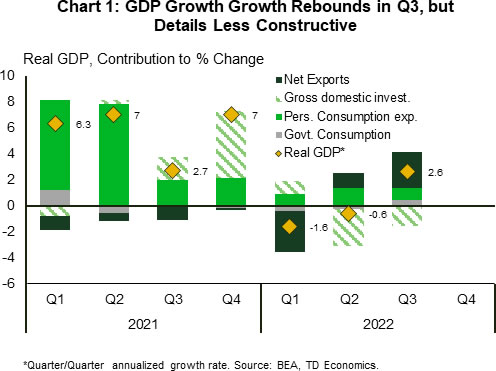
The weakest area weighing on domestic demand was residential investment, which fell 26% (ann.), marking the sixth consecutive quarterly decline. Outside of the pandemic, this was the largest quarterly decline since the start of 2010. The outsized pullback was the result of sharp declines in homes sales and residential construction through the third quarter, as higher interest rates have tighten the grip on the housing sector.
Housing is one of the most interest-sensitive areas of the economy and with rates elevated – with the 30-year fixed mortgage rate currently sitting at 7.1% – it is likely that there will be more weakness over the coming months. Several recent indicators support this view. Pending home sales, a leading indicator of existing home sales, fell by a massive 10.2% m/m in September. Meanwhile, mortgage applications to purchase a home dropped 2% last week from the week prior, and were 42% lower than a year ago.
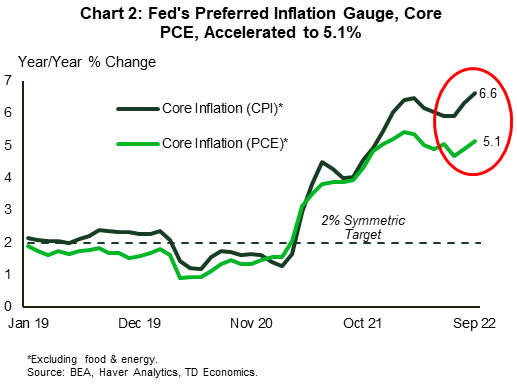
The housing market is also central to the Fed’s rate setting calculus. Market data tells us that rent growth is decelerating and that home prices are falling. However, as we explain in a recent note, market price changes take time to filter down to their corresponding inflation metrics, which means that shelter inflation is likely to continue to push up on core inflation over the next several months. This may be less of an issue for the Fed’s preferred inflation gauge, Core PCE – which accelerated to 5.1% Y/Y in September (Chart 2) – where shelter carries a lower weight than CPI (see here for differences). However, CPI gets released ahead of PCE, grabbing the market’s focus and adding to the Fed’s communication challenge.
The bottom line is that if the Fed does not pivot toward a more forward-looking stance, the result will be a more restrictive monetary policy than otherwise required, increasing the chances of a policy ‘error’. While the Fed will likely deliver on another 75-basis point hike next week, we expect the FOMC to soon start to pivot on its communication as the Fed will need to dial back on the pace of rate hikes.
Canada – BoC Eases Up on the Brakes
This week may have started with fireworks to celebrate Diwali, but the Bank of Canada (BoC) had some fireworks of its own by raising rates less than forecasters were expecting at their Wednesday meeting. The BoC raised its key overnight lending rate by half a percentage point to 3.75% -- the highest rate in nearly 15 years. Markets had been expecting a larger 75 basis point increase given the central bank's previously stated resolve on bringing inflation back to target.
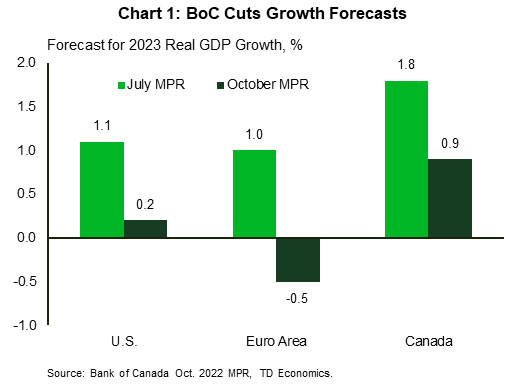
The BoC's accompanying Monetary Policy Report (MPR) laid out some compelling reasons why the bank opted for a large 50 basis point hike rather than a supersized 75 basis-point one. The Bank downgraded its growth forecasts across the board for 2023 (Chart 1). Global growth in 2023 was knocked back by 0.4 percentage points, but Canada and the U.S. were cut by about a full percentage point each. On net, this left the level of output about 1.5% lower by the end of 2024. Translation: demand is a lot weaker than the bank expected three months ago, which reduces a source of inflationary pressure. Not surprisingly, the bank also reduced its inflation forecast for 2023 from 4.6% to 4.1%.
While the BoC did not use the word recession – either in the MPR or in the press conference – it did say growth is expected to stall over the next few quarters. Specifically, real GDP growth is expected to run between 0-0.5% from Q4 of this year through the first half of next year and "suggests that a couple of quarters with growth slightly below zero is just as likely as a couple of quarters with small positive growth."
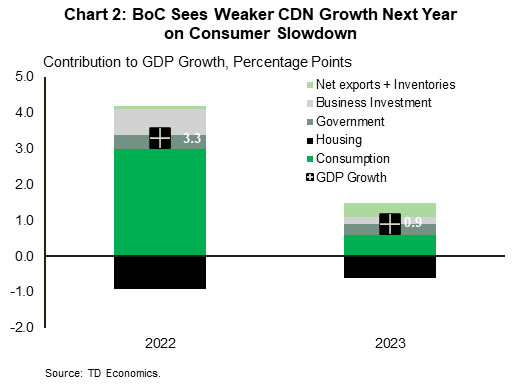
Looking at the Bank's forecast shifts from this year to next, the slowdown in consumer spending looms largest (Chart 2). The MPR stated that consumer spending is forecast to contract for three quarters, starting in the fourth quarter of this year, as higher interest rates weigh on spending. The Bank also cited decreasing house prices, the decline in financial wealth, and deterioration in consumer confidence is restraining consumer spending, which has never happened outside of a recession.
The good news in all of this is that the bank expects this slower growth environment to bring inflation pressures down to within its 1-3% target range by the end of next year. That is earlier than it had expected in July. As Governor Macklem emphasized in the press conference, with inflation getting to a 40-year high in the aftermath of the pandemic, there is no easy way out to restore price stability. It is clearly going to be a tough period of adjustment for Canada's economy to bring inflation back down to target.
The overarching story of an economic slowdown in Canada was supported by the August GDP by industry data. It showed the economy grew at a modest 0.1% month/month pace, and Statistics Canada estimates that September will progress at a similar clip (although these estimates haven't been too accurate lately). However, the Bank is going to need to take rates just a bit higher to achieve the necessary slowing to rein in inflation.
Week Ahead – Fed and BoE to Raise Rates ahead of US Payrolls
Another extraordinary week is coming up. The Fed is almost certain to raise rates, putting the spotlight on Chairman Powell, who needs to open the door for a smaller rate hike in December without giving the impression of a pivot. Meanwhile, central bank decisions in the UK and Australia will be crucial for those currencies, before the week concludes with the latest edition of nonfarm payrolls.
Fed pivot? Not quite
A three-quarter percentage point rate increase from the Federal Reserve on Wednesday is fully baked into the markets, as inflation remains uncomfortably high and the labor market has not absorbed any serious damage yet.
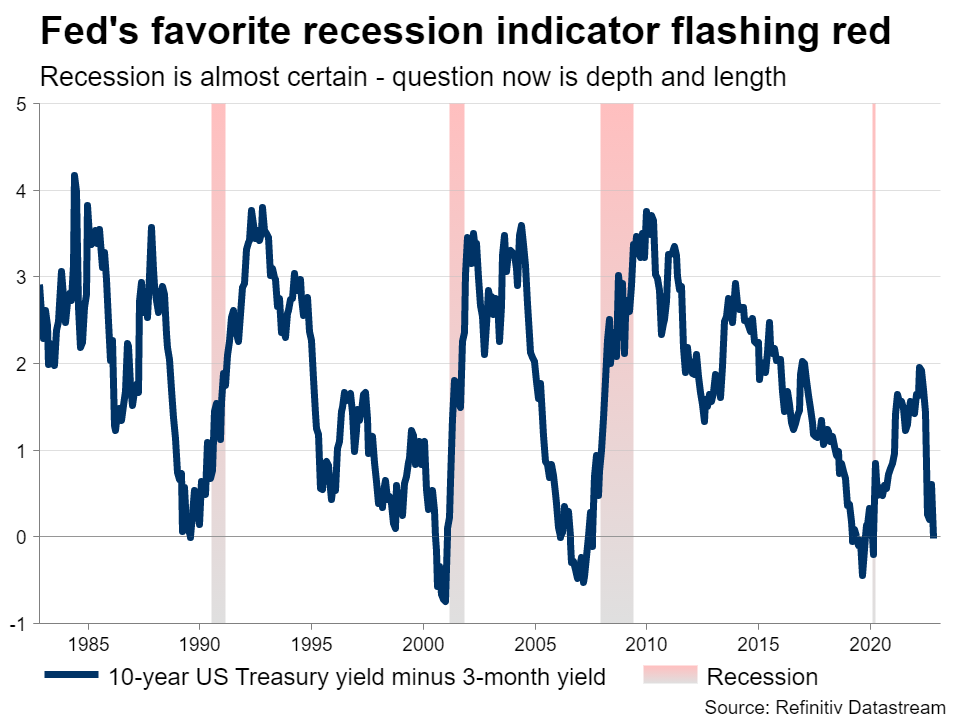
Nevertheless, the Fed has started to get cold feet. With business surveys, the yield curve, and various other leading indicators warning that a recession is just around the corner, Fed officials have signaled they might slow down the pace of tightening come December.
After all, monetary policy works with long lags and the true impact of all the rate increases they have already rolled out won’t be fully reflected in economic data until next year. They are worried that if they keep smashing the rate hike button too hard, that might cause unnecessary harm to the economy.
Hence, the challenge of this meeting will be how to open the door for slower rate hikes without making it seem like a surrender, since that could spark a stock market rally and a sharp drop in bond yields, adding fuel to inflation. It will be a difficult communications exercise, with Powell likely to stress that rates are still headed higher from here.
There is a flurry of crucial data releases on the schedule too, kicking off with the ISM manufacturing survey on Tuesday. Then on Wednesday, the ADP jobs report will hit the markets, ahead of the ISM services print on Thursday and the official employment report on Friday.
It seems the labor market finally felt the heat of the rapid-fire rate hikes in October. Economists expect another solid report with nonfarm payrolls seen at 200k, but the ‘tea leaves’ point to disappointment. The composite S&P Global survey revealed a slight contraction in employment, while applications for unemployment benefits rose during the month.
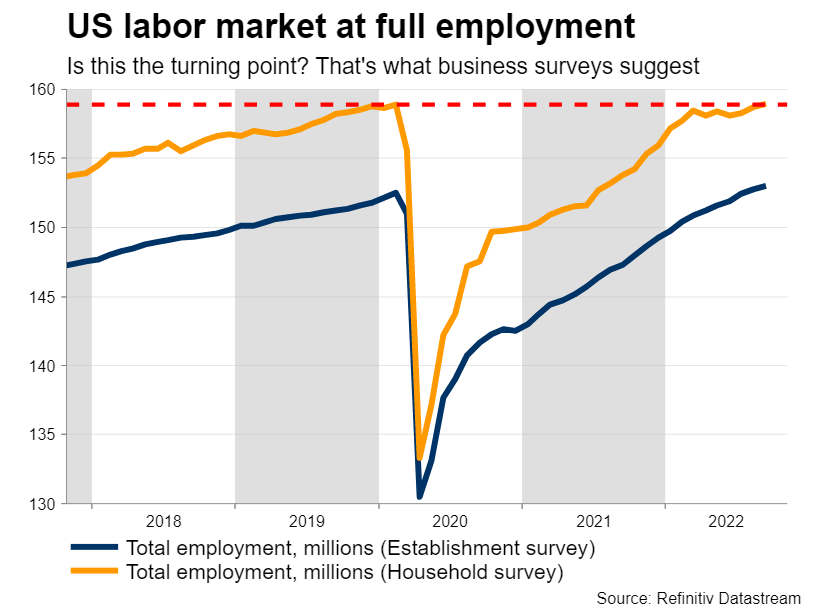
As for the dollar, while the broader picture is still positive, there is scope for a substantial retracement in this rally. The Fed is shifting into lower gear, the market is already flush with long-dollar bets, and the prospects for the euro have started to improve after the huge decline in European energy prices. Indeed, euro/dollar violated a crucial downtrend line this week, adding credence to this view.
BoE - Playing it safe
Over in the UK, with Rishi Sunak taking over as prime minister, order has been restored in FX and bond markets. The budget crisis seems to be fading into the rear view mirror, allowing sterling to realign with its classic drivers - monetary policy and risk sentiment.
Bank of England officials will announce their latest decision on Thursday, and money markets have fully priced in a three-quarter point rate increase. Speculation for an even bigger move evaporated recently, as deficit nerves calmed down and other central banks adopted a more cautious stance.
With the rate increase locked in, the market reaction will boil down to the meeting minutes, Governor Bailey’s press conference, and the updated economic forecasts.
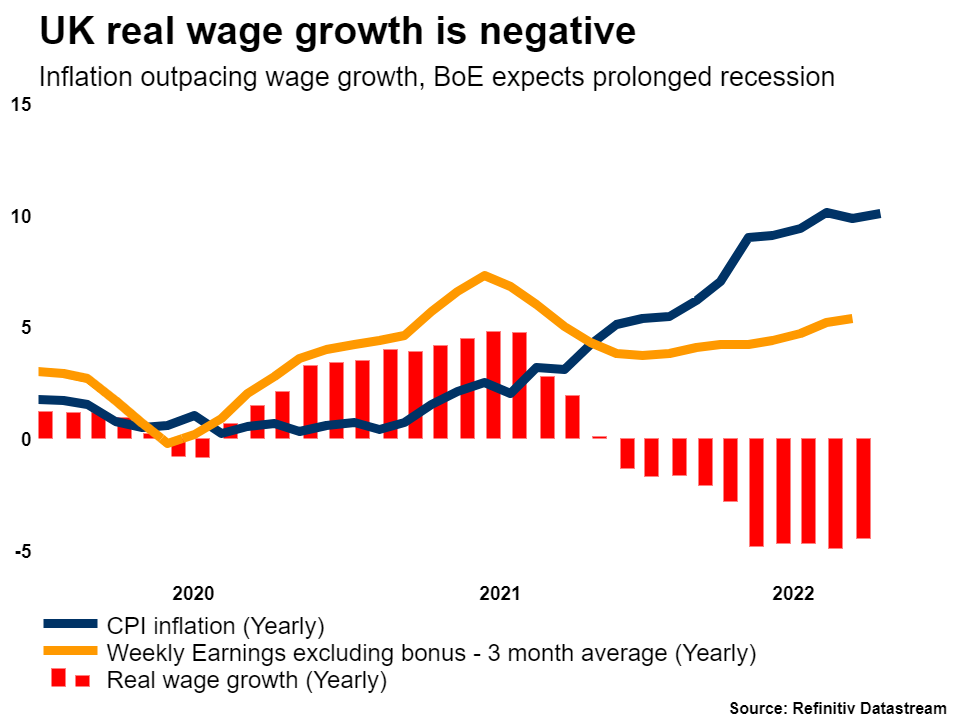
From a risk management perspective, this is not the time for the BoE to be a hero. Inflation is running above 10%, necessitating heavy action, but the central bank already expects a recession to begin this quarter and the latest business surveys confirm as much.
As such, the BoE might be inclined to strike a cautious tone overall. Signals of more shock-and-awe moves would risk causing further damage to an already-nervous bond market, which policymakers surely want to avoid. If so, sterling could slide on the news.
Beyond that, the currency’s fate will remain tied to global risk sentiment and stock market performance, as it has been all year.
Eurozone data deluge
In euro land, the ball will get rolling on Monday with inflation numbers for October and the first estimate of GDP growth for the third quarter. Unemployment data will follow on Thursday.
European business surveys point to an economy that is on the verge of recession, but following the massive decline in energy prices lately, it seems that the winter won’t be Armageddon after all.
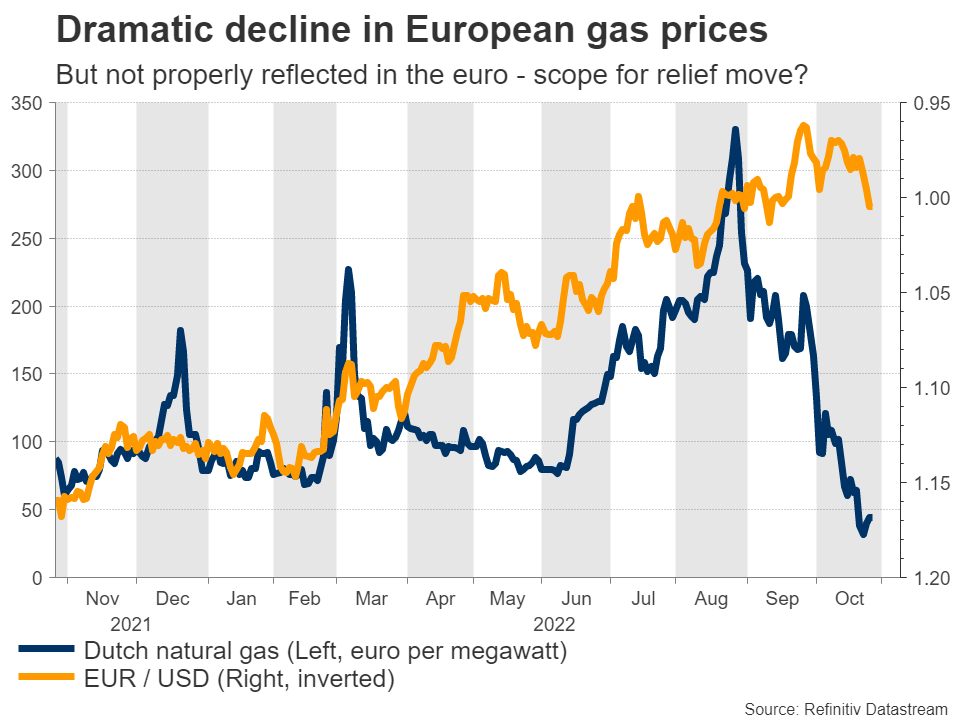
With Fed/ECB policy starting to converge too, the outlook for the euro is not horrendous anymore. It is still premature to discuss a trend reversal, as that would likely require a ceasefire in Ukraine and brighter economic skies globally, but the worst seems to be behind the euro.
RBA and the commodity complex
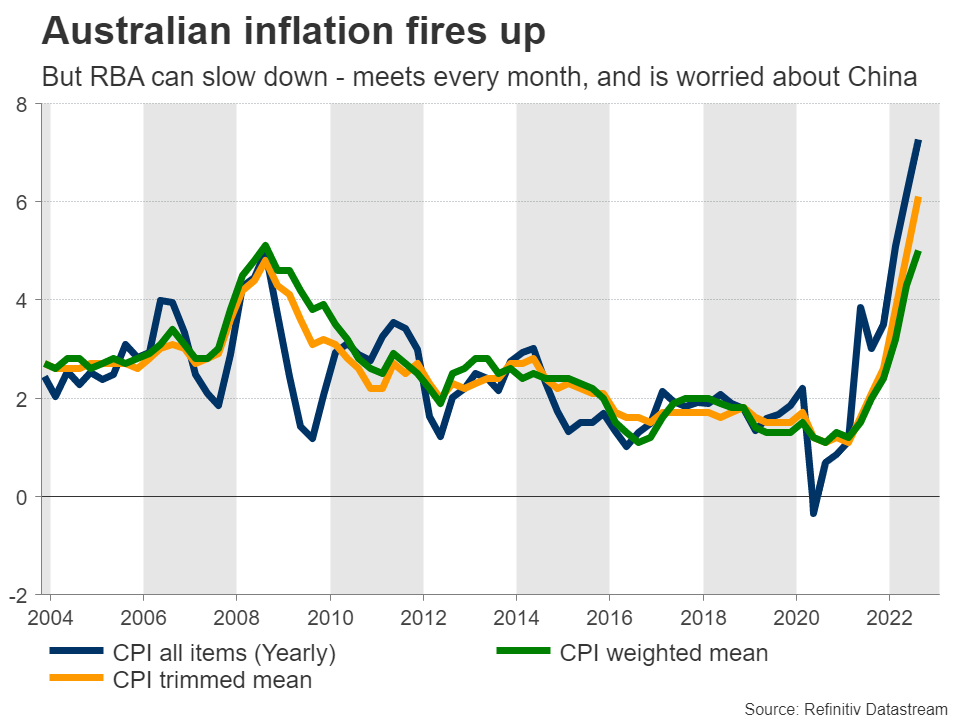
In Australia, the Reserve Bank will conclude its own meeting on Tuesday, and investors expect a cautious quarter-point rate hike. Despite a sharp acceleration in inflation, the RBA is worried about the global outlook, placing more emphasis on the rapid slowdown in China - Australia’s largest trading partner.
This decision is unlikely to change much for the aussie, which recovered lately alongside equity markets, albeit not convincingly. As long as the outlook for China remains so gloomy and the property market is in freefall, any relief rallies might remain shallow.
It’s a similar story for neighboring New Zealand, an economy that also relies heavily on Chinese demand to absorb its commodity exports. The nation’s employment report for Q3 is out on Wednesday.
In China, the business surveys for October will be released over the weekend. While the latest GDP growth print was solid, unemployment is on the rise and the offshore yuan is falling apart as foreign investors grow increasingly concerned that the political, regulatory, and economic trends of recent years will persist.
Finally in Canada, the jobs report for October will take center stage on Friday.
Fed Preview: Too Early for a Pivot
Fed Preview: Too Early for a Pivot
- We expect Fed to hike by 75bp next week, which is fully priced in by the markets.
- The recent soft macro data and the WSJ article suggesting that moderation in hiking pace could be near have sparked a 'pivot' rally in the markets - we think it is still too early.
- High spot core inflation, only modest tightening in real financial conditions and rising inflation expectations leave Fed little room to manoeuvre.
Anything but 75bp would be a major surprise to the markets next week, so the focus will be on how Fed sees the balance of risks for policy tightening going forward. Is FOMC looking to moderate the pace of hikes already in December or is further tightening in financial conditions still needed? We lean towards the latter.
Since the late-August Jackson Hole, Fed has clearly emphasized that there is still too much demand in the economy, and financial conditions need to be tightened further to close the positive output gap. While the communication had the desired impact on the markets in September, lately the direction has been turning.
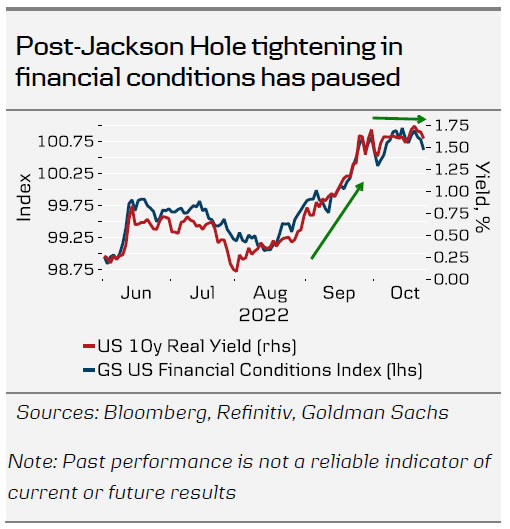
Real yields have ticked lower, equity markets recovered modestly and EUR/USD is back at parity. As we argued back in Research US - Fed continues to guide US economy towards a recession, 1 September, one of the key risks for US economy is that a 'verbal' pivot leads to pre-emptive easing in financial conditions, which is what we are now seeing. Fed also noted in the September minutes, that the cost of overdoing the tightening is lower than allowing inflation to prolong unnecessarily from here.
Fed has to maintain financial conditions restrictive well into 2023 in order to avoid renewed waves of commodity-driven inflation becoming more entrenched - a risk highlighted by Brent still trading above $95/bbl despite the gloomy growth outlook.
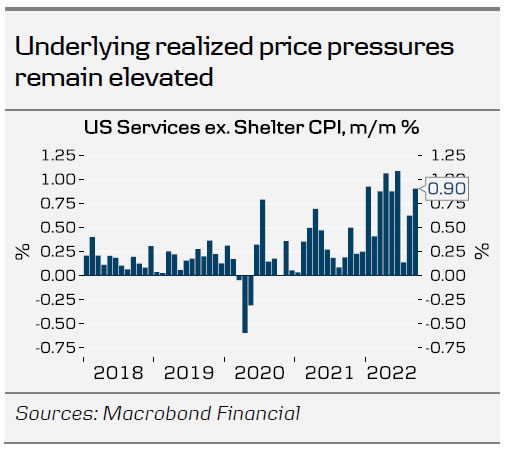
The September CPI surprised to the upside, driven by stickier components of inflation. While the cooling housing markets signal some easing in sticky prices with a delay, shelter prices did not explain the uptick in Core Services CPI in September (+0.8% m/m). In addition, the downturn in freight rates and commodity prices has not translated into lower core goods consumer prices, which to us is another signal of persistently high demand.
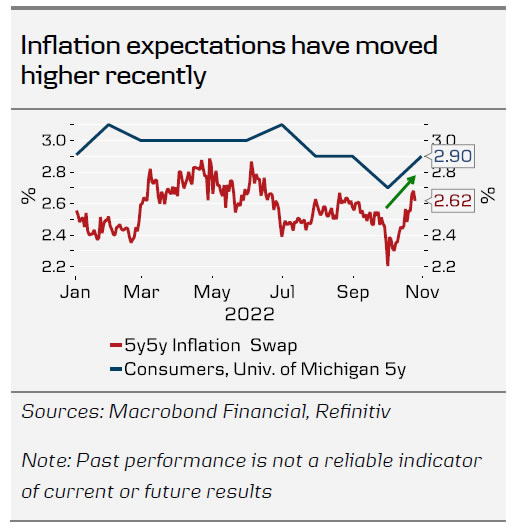
Both market and consumer-survey based inflation expectations have ticked higher in October, with 5y5y inflation swaps now trading at pre-JH levels. The levels are not yet concerning for the Fed as such, but the direction is in stark contrast to the steady decline seen since spring. Labour markets still remain in decent shape with especially the private service-providing sector recording strong gains. The uptick in October Service PMI input prices index suggests, that the rise in labour costs continues to feed into consumer prices at a rapid pace.
We stick to our forecast of 2x75bp hikes this year for now. If Fed clearly signals slower hiking pace (e.g. 50bp) for December, we look to revise our forecast with an additional hike for early 2023.
Weekly Focus – Peak of Hiking Pace
We saw flatter yield curves this week on a string of weaker than expected US data releases. Particularly the housing market is increasingly getting attention as the surge in mortgage rates weighs heavily, with new home sales down 10.9% in September, and also prices trending lower, which could soon be reflected in consumer demand. This also weakened the dollar which traded back around parity vs. euro as markets start to price in a potentially slowing of the tightening pace from the Fed. The tendency in equity markets that "bad data is good data" as long as yields drop continued, and stocks overall had a good week.
As widely expected, the ECB hiked its policy rate by 75bp and guides markets for further rate increases ahead. ECB will set the hiking pace with the economic outlook in mind, which is a clear indication of a slowing hiking cycle, and the market also priced out some almost 25bp of ECB hikes. The ECB also announced changes to the TLTRO terms, which will cause a significant drop in excess liquidity already from 23 November. Danmarks Nationalbank followed suit but only with 60bp in order to lift EUR/DKK off the low levels for good.
The economic contraction in the euro area continued for the fourth consecutive month, with October PMI declining further to 47.1. The contraction was driven particularly by a weaker than expected manufacturing sector. Germany is probably the weakest link, and Ifo data also confirms that Germany is headed for recession in H2. Supply bottlenecks do in fact show further signs of easing, but the weaker demand environment does not yet seem to have weakened firms' pricing power noticeably, which leaves inflation pressures high.
After continuous weakening of the yen, the Bank of Japan (BoJ) has intervened in the FX market several times during the recent week. At the same time, the BoJ injects yen into the market to defend its yield curve control, while the government prepares a USD 200 billion (4% of GDP) spending package to ease the pain from energy bills.
Next week, the FOMC meeting is the main event for markets. It is too early to turn soft for the Fed, and we look for a 75bp hike and hawkish communication. We also expect to see a relatively strong jobs report later next week. In the UK, the Bank of England will also have to tighten further to bring down inflation and wage growth.
In the euro area, the highlight will be the HICP figures for October. Given strong underlying inflation pressures, we expect core inflation still trending higher to 4.9%, and HICP inflation likely jumping above the 10% mark. GDP figures for Q3 might show that a recession has started to take hold in H2 22, but a late rebound in industrial production amid easing supply bottlenecks leaves upside risks. In China, we will look out for PMI data, and we see some downside risks as weaker exports now add to the headwinds from the property crisis and zero-Covid policy.
XAU/USD: Gold Price Eases on Revived Expectations Fed Will Keep Strong Hawkish Stance
Spot gold price was down around 1.5% by early US trading on Friday, pressured by stronger dollar on growing expectations that the Fed will deliver another 75 basis point hike in the policy meeting next week. Optimism on further policy tightening inflates dollar, weighing on its safe-haven counterpart.
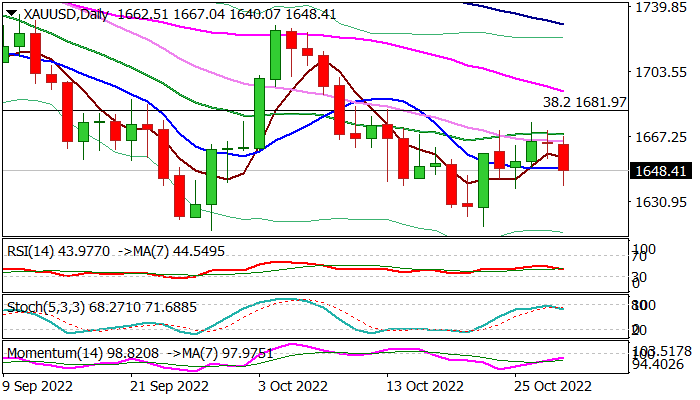
Fresh acceleration lower has so far retraced over 50% of $1617/$1674 upleg, with the metal being on track for the biggest daily fall since Oct 19.
Weekly action is also going to end in red, with more significant signal that the yellow metal will register seventh consecutive monthly loss.
Weakening daily studies (MA’s turning to bearish setup and momentum remains in negative zone) add to downside risk, which will be boosted by today’s close below $1646 (50% retracement of 1617/$1674/daily Tenkan-sen).
Also, gold price is on track for the second monthly close below pivotal Fibo support at $1681 (38.2% of $1046/$2074) that would add to reversal signals and re-confirm a monthly double-top ($2074/$2070) as well as a double bull-trap above psychological $2000 barrier.
Bears need to clear temporary footstep at $1647 (Oct low, reinforced by rising 55MMA) to open way for attack at monthly cloud base ($1598) and 50% retracement of $1046/$2074 ($1560).
Res: 1652; 1668; 1674; 1681.
Sup: 1639; 1630; 1614; 1598.
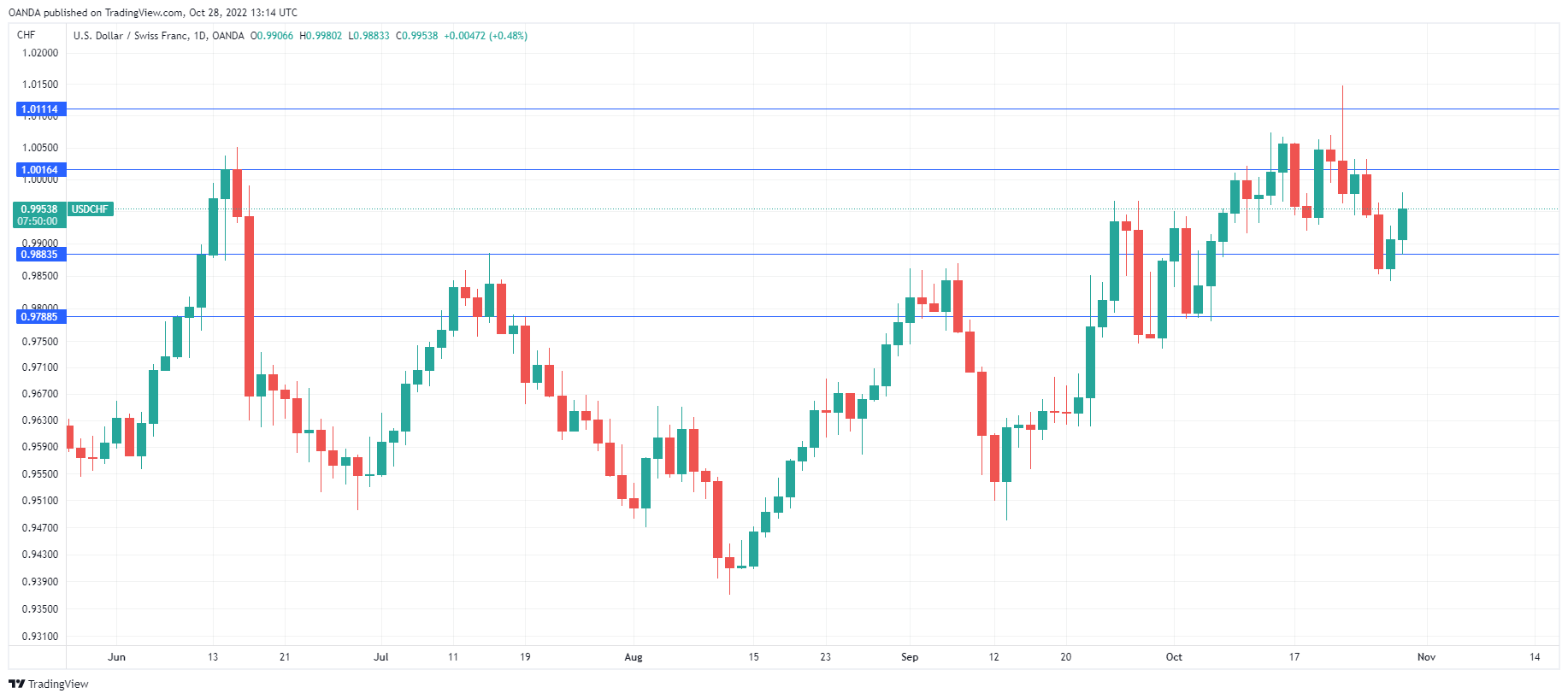
Is Swiss Franc Headed to Parity?
The Swiss franc is in negative territory for a second straight day. In the European session, USD/CHF is trading at 0.9975, up an impressive 0.69% on the day.
Swissie weakens on KOF barometer
The KOF Economic Barometer decreased in October to 90.9, down from 92.3 in September. This marked the sixth successive month that the index has been below the long-term average of 100. The primary driver of the downturn was manufacturing, which has been hurt by sluggish global demand. The economic outlook for the Swiss economy remains gloomy.
Despite weak risk appetite on the global scene, the safe-haven Swissie has been unable to capitalize and attract nervous investors. USD/CHF has been on a steady upswing since mid-September and briefly pushed above the symbolic parity line on October 21st.
We’ll get a look at Switzerland’s inflation report next week. Inflation has been rising in Switzerland, which forced the Swiss National Bank to raise interest rates by a massive 0.75% in September. This raised the cash rate to 0.50%, ending the era of negative rates. Still, inflation is much lower than in the Eurozone or the UK. Headline CPI is expected to tick lower to 3.2%, down from 3.3% in September.
In the US, Personal Spending gained 0.6%, as consumer spending was higher despite stubbornly high inflation. Core PCE, the Fed’s favorite inflation gauge, remained unchanged at 0.5% MoM. On an annualized basis, the index rose 5.1%, up from 4.9% and just below the consensus of 5.2%. The data is unlikely to change expectations of a 0.75% rate hike from the Fed next week.
USD/CHF Technical
- USD/CHF has pushed above resistance at 0.9711 and 0.9776. The next resistance line is 0.9892
- There is support at 0.9652 and 0.9530
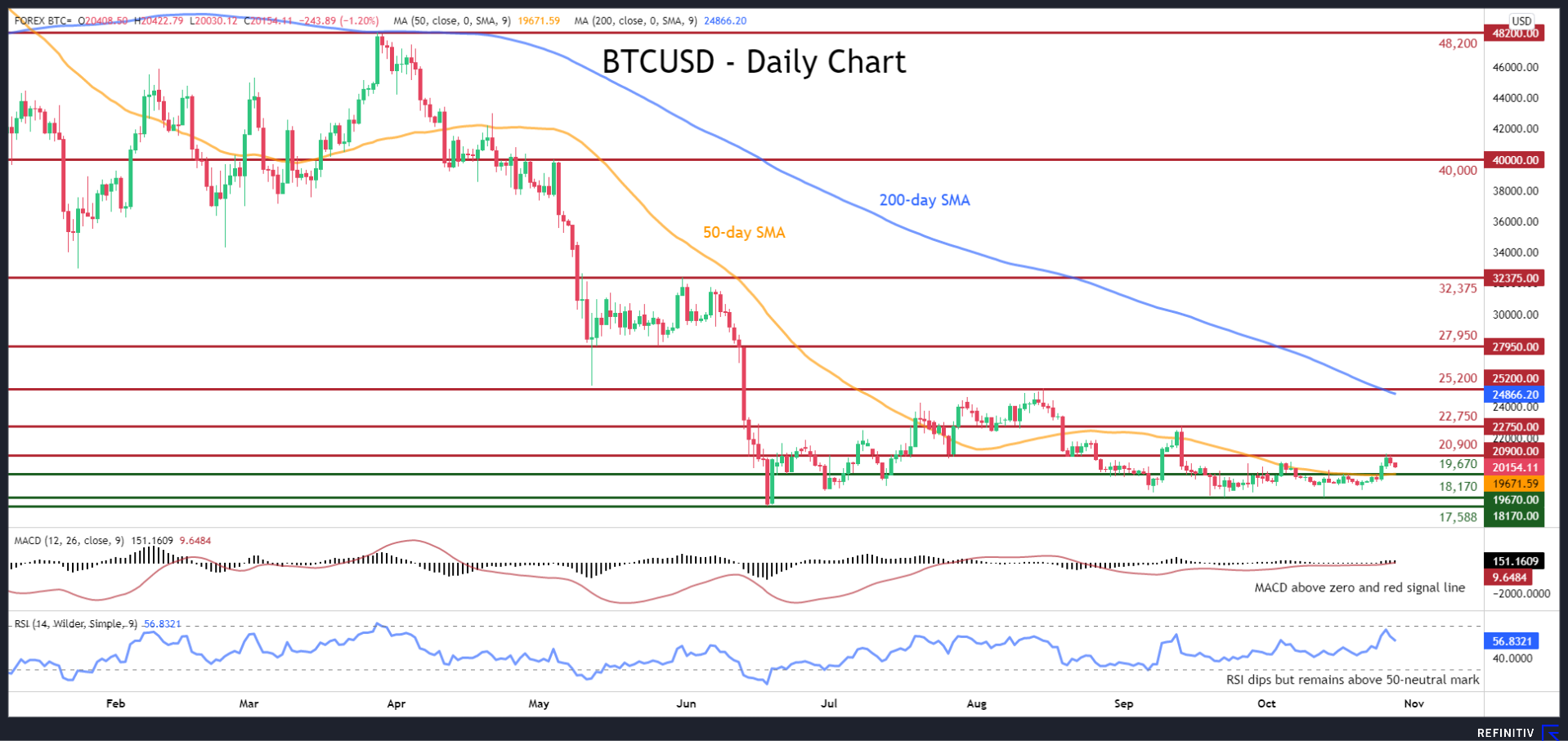
BTCUSD Jumps Above 50-day SMA But Advance Losses Steam
BTCUSD (Bitcoin) has been in a downtrend after the price failed to surpass the 25,200 region in mid-August. Although the king of cryptocurrencies has been trading within a tight range in the past month, it broke its sideways pattern to the upside and crossed above its 50-day simple moving average (SMA).
The momentum indicators suggest that bullish forces are subsiding. Specifically, the MACD histogram is weakening above zero and its red signal line, while the RSI is declining but remains above the 50-neutral mark.
Should selling pressures intensify, the price could initially test the 50-day SMA, currently at 19,670. Breaking below that level, the bears might aim for 18,170, which is the lower boundary of the cryptocurrency’s recent rangebound pattern. A violation of the latter could open the door for the 21-month low of 17,588.
Alternatively, if buyers regain control and propel the price higher, the recent rejection point of 20,900 may act as the first resistance. Conquering this barricade, further upside moves could then stall at the September peak of 22,750 before the four-month peak of 25,200 comes under examination. Failing to halt there, the price might then ascend towards 27,950.
All in all, even though BTCUSD exhibited an upside breakout and decisively jumped above its 50-day SMA, its advance seems to be running out of juice. Therefore, a close above the recent ceiling of 20,900 is needed to signal the resumption of the recovery.