Sample Category Title
Sunset Market Commentary
Markets
And it’s back to the drawing board for the ECB. Less than 24 hours after their “dovish” 75 bps rate hike, they faced runaway inflation numbers in Germany (1.2% M/M & 11.6% Y/Y), France (1.3% M/M & 7.1% Y/Y), Italy (4% M/M & 12.8% Y/Y) and Belgium (2.37% M/M & 12.27% Y/Y) for the month of October. Next week we’ll see 5%+ and 10%+ for EMU core and headline CPI, obviously both EMU records. Spanish inflation was exception to the rule at 0.1% M/M and 7.3% Y/Y. Today’s inflation readings forced ECB governing council member Simkus into admitting that December inflation forecasts will be revised up again. September ECB projections stood at 8.1% for this year, 5.5% for next and 2.3% for 2024. Following upward surprises for the month of September and now October, they effectively are outdated. He doesn’t want to call 75 bps rate hikes the new norm, but argues in favour of another substantial move in December. Inflation is simply too high and policy still expansionary. We’re on Simkus’ line and go for another 75 bps move in December compared to 50 bps discounted in EMU money markets. We see the ECB policy rate peak easily passing 3% next year. Other ECB governors stressed the need to continue hiking early 2023 to and beyond the neutral rate. A concept Slovak ECB member Kazimir interestingly compares to a runaway train.
This week’s core bond correction higher ended already after today’s very first regional German inflation print ahead of the opening bell. We’ve moved south throughout the day. German yields add 20 bps (5-yr) to 12 bps (30-yr) on a daily basis. The EU 10y swap rate rises by 16 bps and returns above the 3% mark following a brief spell below. 10-yr yield spreads vs Germany widen by 4 bps, which is only a small part of yesterday’s 17 bps tightening. US yields rise by more than 10 bps for the 2-5yr sector and 4.5 bps at the very long end. While we remain bearish on bonds medium term because of much more aggressive view on central bank actions than currently discounted, we are cautious short term. We expect the Fed to hike its policy rate next week for a fourth consecutive time by 75 bps with Powell clearly stating a slower tightening pace going forward. Unlike the ECB, we thus believe it could really be a dovish 75 bps rate hike which at least in the short run introduces a consolidation period for bonds. On FX markets, EUR/USD today failed to regain parity despite the bounce back in yields.
News Headlines
Hungarian prime minister Orban said the government is considering to further expand the list of products with centrally regulated prices in coming weeks. Measures currently in place span from staple goods including pork, cooking oil and flour to prices at the pump for as long as necessary. The Orban administration has also put an interest rate cap on household mortgages and announced last week that it will expand that mechanism to corporate credit (7.8% from November 15 to July 1 for SMEs). Orban said “it’s not a good thing” when a government needs to interfere in the economy but he said steps need to be taken to slow inflation.
National Bank of Belgium data showed the Belgian economy contracted by 0.1% q/q in the third quarter of this year. Compared to the same period last year, the economy was still 1.6% bigger. The numbers for Q2 were revised upwards though, from 0.2% q/q to 0.5% and from 3.3% y/y to 4.1%. Value added in the industry declined sharply, by 0.7% q/q. Services growth decelerated to 0.1% while construction rose 0.3% - similar to Q2. Belgium’s statistical office reported inflation accelerating from 11.27% to 12.27% in October on the back of a sharp 2.37% m/m increase. Core inflation (ex food and energy) rose too, from 6.21% to 6.5%. Among the biggest contributors to the biggest price pressures since June 1975 were housing, water, electricity, gas and other fuels (5.93 ppts), food (+2.27 ppts) and transportation (1.73 ppts).
US: Spending Stronger than Expected, Income Grows in Line with Estimates
Personal income added 0.4% month-on-month (m/m) in September, in line with market expectations. Wages and salaries increased by a solid 0.6% m/m while personal income receipts on assets were up 0.4% m/m. Controlling for inflation and taxes, real personal disposable income remained flat in September.
Personal consumption accelerated from August, rising by 0.6% and coming in ahead of the consensus forecast for 0.4%. In real terms, spending was up 0.3%, with both goods and services contributing equally to the headline number, rising by 0.4% and 0.3% m/m, respectively. Spending on nondurables rose 0.6%, while durable goods gained 0.1%, bouncing back from the pullback of 0.3% in August.
The personal saving rate fell 0.3 percentage points to 3.1% on the month.
Inflation as measured in the personal consumption deflator was unchanged at 6.1% year-over-year, while core PCE inflation (excluding food & energy) rose to 5.1% (from 4.9%). Both measures came in a tenth of a percentage point less than expected.
Key Implications
After yesterday’s advance GDP report providing quarterly growth figures, today’s monthly data offered additional details on the evolution of spending through the third quarter. Monthly spending on services slowed marginally while goods spending accelerated in the last month of the quarter. Heading into the final quarter of 2022, consumers face plenty of headwinds, including soaring inflation, high interest rates and a sizeable pull-back in wealth, all of which should continue to weigh on spending growth.
Adding to headwinds is the recent deceleration in real income growth, which has only helped to further erode consumer purchasing power. Following the annual benchmark revisions to national accounts data, the average consumer saving rate pulled back from 5.3% to 3.7%, which resulted in a downgrade of excess savings estimates to less than $1.5 trillion in Q3. While 10% lower than originally thought, households still have some cushion heading into the holiday season, though we suspect a more cautious consumer with spending likely to remain at a below-trend growth rate of just 1.0% (annualized) in Q4 2022.
Canada’s Economy Edges Up in August, Points to Further Gains in September
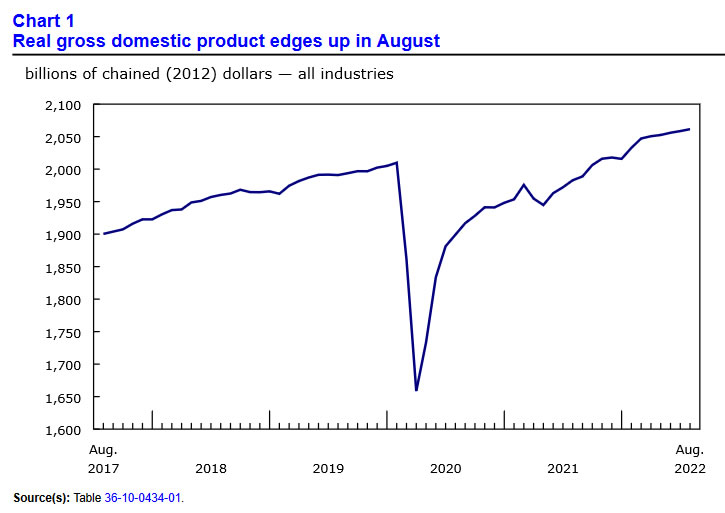
The Canadian economy expanded by 0.1% month/month (m/m) in August, beating Statistics Canada's flash estimate of no growth. The flash estimate for September showed a 0.1% gain.
August's increase in activity was relatively broad, with output expanding in 14 of the 20 industries. The service-producing sector rose by 0.3%, while the goods-producing sector declined 0.3%.
Retail activity rose on the month, with Canadians hitting the road for end of summer trips. Sales at gasoline stations increased by 6.9%, while sales at food and beverage stores saw a 1.3% gain.
Wholesale trade also grew by 0.9%, with machinery and equipment sales rising on the back of the ongoing "construction of a new liquefied natural gas terminal in British Columbia."
Showing weakness was construction, down 0.7%, as "residential building construction was down for the fourth time in five months, contracting 0.7% in August, in large part due to lower activity in new construction of single-detached homes, row units and apartments."
Key Implications
Though today's data release was encouraging, the overarching narrative of a decelerating Canadian economy hasn't changed. Given high inflation and the lagged impact of higher interest rates, we are seeing the effect of this in the goods sector and expect to see the same in the service side going forward.
The Bank of Canada decided to slow its pace of rate hikes on Wednesday as it believes a slowing in economic growth is forthcoming. Though this is starting to show up in the data, we think the BoC will need to continue to raise its policy rate to 4.25% in order to achieve the deceleration that is sufficient to bring down inflation.
USD/JPY Mid-Day Outlook
Daily Pivots: (S1) 145.62; (P) 147.01; (R1) 147.80; More...
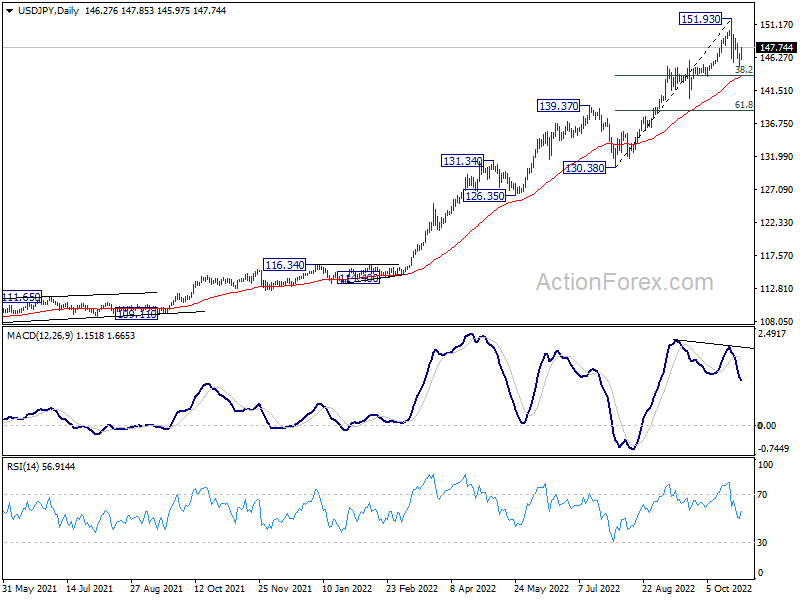
USD/JPY recovers in early US session but outlook is unchanged. Intraday bias stays neutral as corrective pattern from 151.93 would extend. Deeper pull back cannot be ruled out, but downside is expected to be contained by 38.2% retracement of 130.38 to 151.93 at 143.69 to bring rebound. On the upside, above 149.69 minor resistance will bring stronger rebound back towards 151.93 high. But upside should be limited there to continue the corrective pattern.
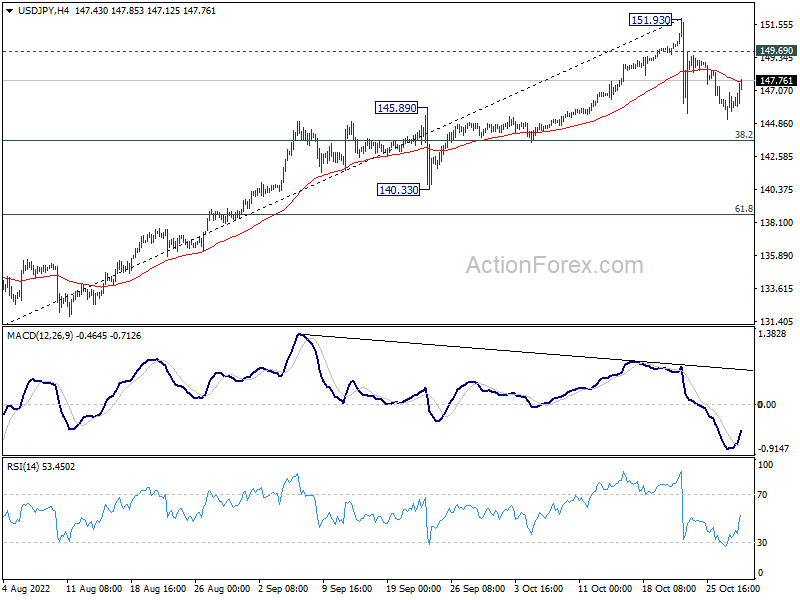
In the bigger picture, up trend from 101.18 is still in progress, as part of the whole up trend from 75.56 (2011 low). 147.68 (1998 high) was already met and there is no clearly sign of topping yet. In any case, break of 140.33 support is needed to be the first sign of medium term topping. Otherwise, further rise is in favor to next target at 160.16 (1990 high).
Dollar Recovers after Inflation Data, Yen Turns Weak
Dollar rises broadly in early US session. Stubbornly high inflation reading might be a factor. But the recovery could also be due to traders paring their positions ahead of the weekend, and next week's FOMC. Yen is back under some broad based pressure but stays in familiar range. European stocks are mixed, and so are US futures. Markets might start to turn quieter before close.
In Europe, at the time of writing, FTSE is down -0.32%. DAX is down -0.35%. CAC is up 0.04%. Germany 10-year yield is up 0.194 at 2.156. Earlier in Asia, Nikkei dropped -0.88%. Hong Kong HSI dropped -3.66%. China Shanghai SSE dropped -2.21%. Singapore Strait Times rose 1.46%. Japan 10-year JGB yield dropped -0.0110 to 0.242.
US PCE price index unchanged at 6.2% yoy, core CPI rose to 5.1% yoy
US personal income rose 0.4% mom or USD 78.9B in September, above expectation of 0.3% mom. Spending rose 0.6% or USD 113.0B, above expectation of 0.4% mom.
Headline PCE price index rose 0.3% mom, while core PCE price index rose 0.5% mom. Prices for goods dropped -0.1% mom while prices for services rose 0.6% mom. Food prices increased 0.6% mom and energy prices dropped -2.4% mom.
From the same month a year ago, PCE price index was unchanged at 6.2% yoy, above expectation of 5.8% yoy. Core PCE price index rose to 5.1% yoy, up from 4.9% yoy, below expectation of 5.2% yoy. Prices for goods rose 8.1% yoy while prices for services rose 5.3% yoy. Food prices rose 11.9% yoy and energy prices rose 20.3% yoy.
Canada GDP grew 0.1% mom in Aug, above expectations
Canada GDP rose 0.1% mom in August, above expectation of 0.0% mom. Services-producing industries grew 0.3% mom but goods-producing industries contracted -0.3%). 14 of 20 industrial sectors grew.
Advance information indicates that GDP growth continued in September by 0.1% mom. With that, GDP growth reached 0.4% in Q3.
Eurozone economic sentiment dropped to 92.5, EU down to 90.9
Eurozone Economic Sentiment Indicator fell from 93.6 to 92.5 in October. Industrial confidence dropped form -0.3 to -1.2. Services confidence dropped from 4.4 to 1.8. Consumer confidence improved from -28.8 to -27.6. Retail trade confidence rose from -8.4 to -6.9. Construction confidence rose from 1.8 to 2.6. Employment Expectations Indicator dropped from 106.6 to 104.9.
EU Economic Sentiment Indicator dropped from 92.4 to 90.9. Amongst the largest EU economies, the ESI fell in Germany (-1.0) and Italy (-0.9), while it remained essentially unchanged in the Netherlands (-0.3) and France (0.0) and improved in Poland (+0.4) and Spain (+1.4).
Germany GDP grew 0.3% qoq in Q3, avoided contraction
Germany GDP grew 0.3% qoq in Q3, much better than expectation of -0.2% qoq contraction. The economy finally exceeded pre-pandemic level in Q4 2019 for the first time.
Destatis said, "The German economy managed to hold its ground despite difficult framework conditions of the global economy, with the continuing Covid-19 pandemic, supply chain interruptions, rising prices and the war in Ukraine. The economic performance in the third quarter of 2022 was mainly based on private consumption expenditure."
France GDP growth slowed to 0.2% qoq in Q3
France GDP growth slowed to 0.2% qoq in Q3, matched expectations. That compares to 0.5% qoq growth in Q2.
Final domestic demand (excluding inventories) contributed positively to GDP growth this quarter (+0.4%). Thus, gross fixed capital formation (GFCF) accelerated strongly after an already relatively dynamic start to the year (+1.3%), while household consumption expenditure were stable (+0.0%). Foreign trade contributed negatively to GDP growth (-0.5%),
Swiss KOF dropped to 90.9, economic outlook remains subdued
Swiss KOF Economic Barometer decreased from 93.8 to 90.9 in October, below expectation of 93.0. The index is now below its long-term average for the sixth month in a row. Outlook for the economy in the coming months "remains subdued".
KOF said: "The downward movement of the barometer is primarily driven by bundles of indicators from the manufacturing as well as the accommodation and food service activities sectors. Indicators for the construction sector, the financial and insurance services, and private consumption remained almost unchanged compared to the previous month. By contrast, indicators for the sector other services showed a slightly positive trend."
BoJ stands pat, maintains yield cap at 0.25%
BoJ left monetary policy unchanged as widely expected. Under the yield curve control framework, short-term policy interest rate is held at -0.10%. 10-year JGB yield is kept at around 0%, with bond purchases without upper limit. 0.25% fixed rate purchase operation will continue to be held to cap 10-year JGB yield. The decision was unanimous.
In the new economic projections:
- Fiscal 2022 GDP growth forecast was downgraded from 2.4% to 2.0%.
- Fiscal 2023 GDP growth forecast was downgraded from 2.0% to 1.9%.
- Fiscal 2024 GDP growth forecast was upgraded from 1.3% to 1.5%.
- Fiscal 2022 CPI core forecast was upgraded from 2.3% to 2.9%.
- Fiscal 2023 CPI core forecast was upgraded from 1.4% to 1.6%.
- Fiscal 2024 CPI core forecast was upgraded from 1.3% to 1.6%.
- Fiscal 2022 CPI core-core forecast was upgraded from 1.3% to 1.8%.
- Fiscal 2023 CPI core-core forecast was upgraded from 1.4% to 1.6%.
- Fiscal 2024 CPI core-core forecast was upgraded from 1.5% to 1.6%.
USD/JPY Mid-Day Outlook
Daily Pivots: (S1) 145.62; (P) 147.01; (R1) 147.80; More...
USD/JPY recovers in early US session but outlook is unchanged. Intraday bias stays neutral as corrective pattern from 151.93 would extend. Deeper pull back cannot be ruled out, but downside is expected to be contained by 38.2% retracement of 130.38 to 151.93 at 143.69 to bring rebound. On the upside, above 149.69 minor resistance will bring stronger rebound back towards 151.93 high. But upside should be limited there to continue the corrective pattern.
In the bigger picture, up trend from 101.18 is still in progress, as part of the whole up trend from 75.56 (2011 low). 147.68 (1998 high) was already met and there is no clearly sign of topping yet. In any case, break of 140.33 support is needed to be the first sign of medium term topping. Otherwise, further rise is in favor to next target at 160.16 (1990 high).
Economic Indicators Update
| GMT | Ccy | Events | Actual | Forecast | Previous | Revised |
|---|---|---|---|---|---|---|
| 23:30 | JPY | Tokyo CPI Core Y/Y Oct | 3.40% | 3.20% | 2.80% | |
| 23:30 | JPY | Unemployment Rate Sep | 2.60% | 2.50% | 2.50% | |
| 00:30 | AUD | PPI Q/Q Q3 | 1.90% | 1.50% | 1.40% | |
| 00:30 | AUD | PPI Y/Y Q3 | 6.40% | 6.40% | 5.60% | |
| 03:00 | JPY | BoJ Interest Rate Decision | -0.10% | -0.10% | -0.10% | |
| 05:30 | EUR | France Consumer Spending M/M Sep | 1.20% | 1.20% | 0.00% | 0.10% |
| 05:30 | EUR | France GDP Q/Q Q3 P | 0.20% | 0.20% | 0.50% | |
| 07:00 | CHF | KOF Leading Indicator Oct | 90.9 | 93 | 93.8 | |
| 08:00 | EUR | Germany GDP Q/Q Q3 P | 0.30% | -0.20% | 0.10% | |
| 09:00 | EUR | Eurozone Economic Sentiment Indicator Oct | 92.5 | 92.5 | 93.7 | 93.6 |
| 09:00 | EUR | Eurozone Services Sentiment Oct | 1.8 | 3.3 | 4.9 | 4.4 |
| 09:00 | EUR | Eurozone Industrial Confidence Oct | -1.2 | -2 | -0.4 | -0.3 |
| 09:00 | EUR | Eurozone Consumer Confidence Oct F | -27.6 | -27.6 | -27.6 | -28.8 |
| 12:00 | EUR | Germany CPI M/M Oct P | 0.90% | 0.60% | 1.90% | |
| 12:00 | EUR | Germany CPI Y/Y Oct P | 10.40% | 10.10% | 10.00% | |
| 12:30 | CAD | GDP M/M Aug | 0.10% | 0.00% | 0.10% | |
| 12:30 | USD | Personal Income M/M Sep | 0.40% | 0.30% | 0.30% | 0.40% |
| 12:30 | USD | Personal Spending Sep | 0.60% | 0.40% | 0.40% | 0.60% |
| 12:30 | USD | PCE Price Index M/M Sep | 0.30% | 0.50% | 0.30% | |
| 12:30 | USD | PCE Price Index Y/Y Sep | 6.20% | 5.80% | 6.20% | |
| 12:30 | USD | Core PCE Price Index M/M Sep | 0.50% | 0.50% | 0.60% | |
| 12:30 | USD | Core PCE Price Index Y/Y Sep | 5.10% | 5.20% | 4.90% | |
| 12:30 | USD | Employment Cost Index Q3 | 1.20% | 1.30% | 1.30% | |
| 14:00 | USD | Pending Home Sales M/M Sep | -5.30% | -2.00% | ||
| 14:00 | USD | Michigan Consumer Sentiment Index Oct F | 59.8 | 59.8 |
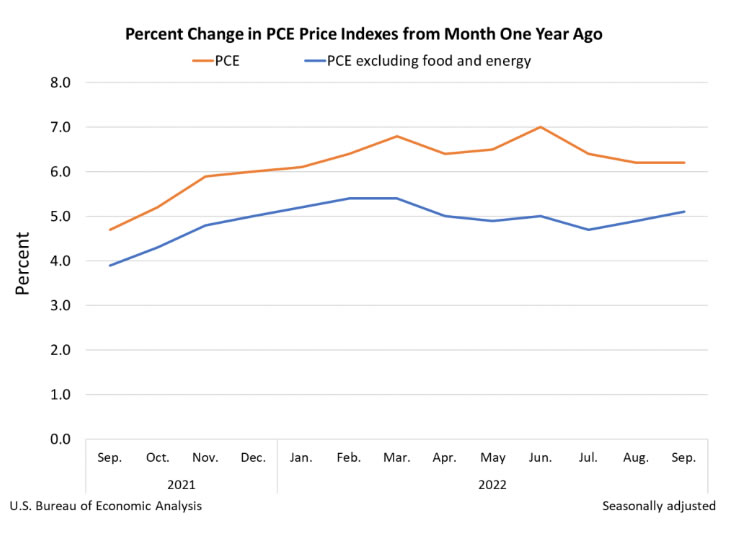
US PCE price index unchanged at 6.2% yoy, core CPI rose to 5.1% yoy
US personal income rose 0.4% mom or USD 78.9B in September, above expectation of 0.3% mom. Spending rose 0.6% or USD 113.0B, above expectation of 0.4% mom.
Headline PCE price index rose 0.3% mom, while core PCE price index rose 0.5% mom. Prices for goods dropped -0.1% mom while prices for services rose 0.6% mom. Food prices increased 0.6% mom and energy prices dropped -2.4% mom.
From the same month a year ago, PCE price index was unchanged at 6.2% yoy, above expectation of 5.8% yoy. Core PCE price index rose to 5.1% yoy, up from 4.9% yoy, below expectation of 5.2% yoy. Prices for goods rose 8.1% yoy while prices for services rose 5.3% yoy. Food prices rose 11.9% yoy and energy prices rose 20.3% yoy.
Canada GDP grew 0.1% mom in Aug, above expectations
Canada GDP rose 0.1% mom in August, above expectation of 0.0% mom. Services-producing industries grew 0.3% mom but goods-producing industries contracted -0.3%). 14 of 20 industrial sectors grew.
Advance information indicates that GDP growth continued in September by 0.1% mom. With that, GDP growth reached 0.4% in Q3.
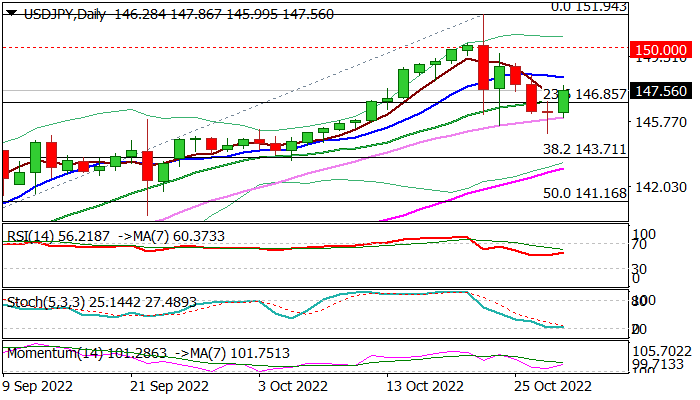
USD/JPY Gains Traction as BOJ Sticks to Ultra-loose Monetary Policy
The jumped vs yen on Friday after BoJ left its ultra-loose monetary policy unchanged, retracing 38.2% of post-intervention pullback from 32-year high at 151.94, which found footstep at 145.10 on Thursday.
Doji morning star reversal pattern is forming on daily chart, but will require confirmation on sustained break above 147.21 pivot of 151.94/145.10 pullback.
Daily techs support the action as bullish momentum is rising and Tenkan-sen / Kijun-sen remain in bullish configuration, with potential bear-trap under 30 DMA to add to positive signals.
Close above Fibo barrier at 147.21 to generate initial signal, while extension above 10DMA (148.30) would strengthen near-term structure and open way towards psychological 150 barrier.
Fresh bulls see today’s close above rising 20DMA (147.05) as a minimum requirement to remain in play.
Res: 147.86; 148.30; 148.52; 149.33.
Sup: 147.05; 146.85; 146.02; 145.10.
Canadian Dollar Slips ahead of GDP
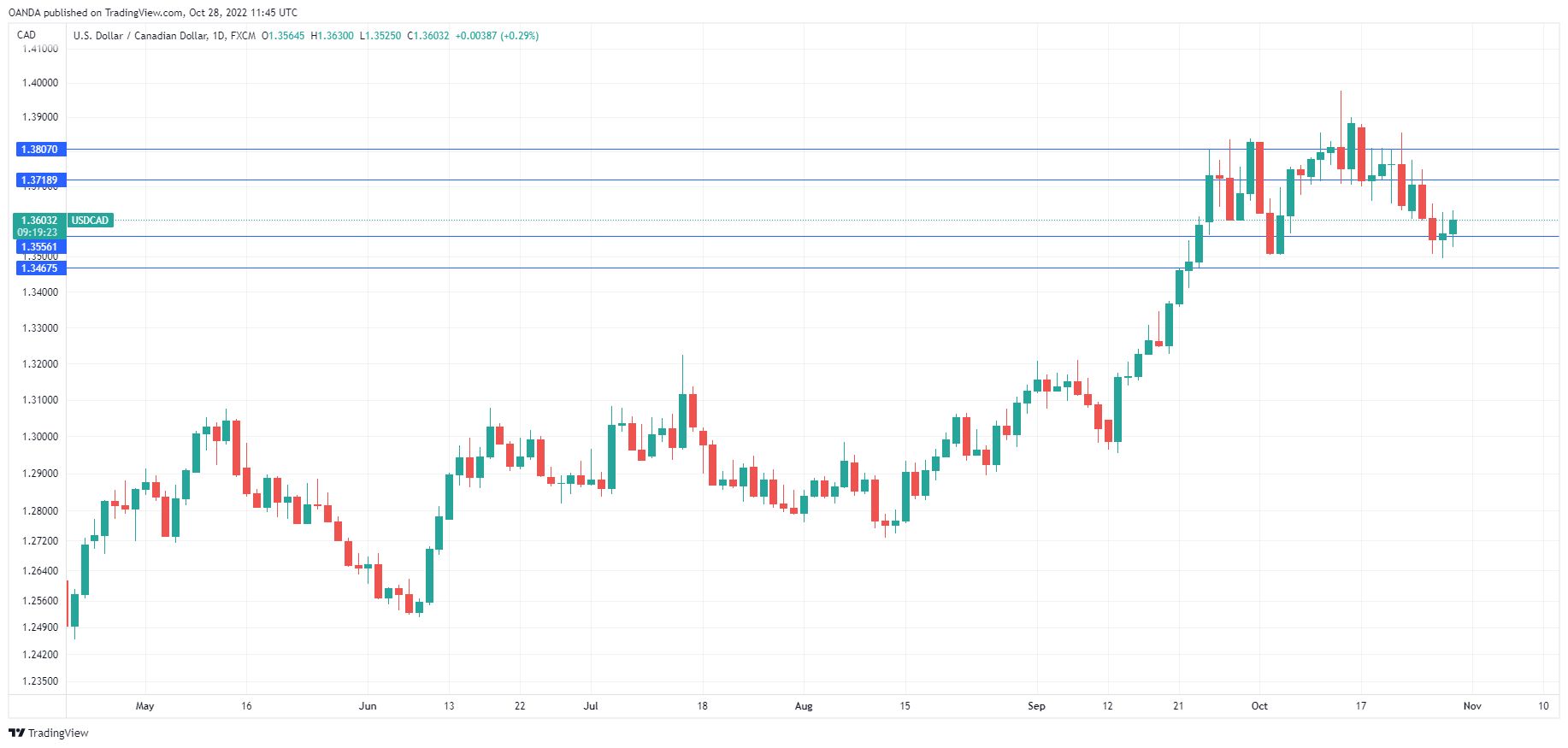
The Canadian dollar is lower today. In the European session, USD/CAD is trading at 1.3617, up 0.39%.
Markets eye Canada’s GDP
The week wraps up with Canada’s GDP for August. The economy is expected to have expanded by 0.1%, which would be unchanged from July. The economy is likely heading into a recession, and Finance Minister Chrystia Freeland stated recently that the coming months would be a “challenging economic time.”
The government’s key priority is curbing high inflation, which has eased slightly. In September, inflation fell to 6.9%, down from 7.0% in August. Still, this was higher than the consensus of 6.7%, as soaring food prices kept inflation from falling further. The good news is that inflation appears to have peaked from the June level of 8.1%, which marked a 40-year high. The bad news is that core inflation was unchanged at 5.3% in September, a sign that inflation remains sticky, despite the Bank of Canada’s aggressive rate-hiking cycle.
High inflation pushed the BoC to deliver another oversize rate on Wednesday, but the 0.50% hike was considered dovish, as the consensus stood at 0.75%. The cash rate is now at 3.75%, its highest level since 2008. Although inflation is far from being beaten, Canada’s economy is clearly slowing down as a result of the steep increase in rates, and the BoC is easing up on the rate pedal just a bit, in the hopes of guiding the economy to a soft landing and avoiding a recession. High rates are weighing on households and businesses and the BoC is concerned that further oversize rates may pose a risk to financial stability.
The US releases Personal Income and Spending data later today as well as the Fed’s preferred inflation indicator, the Core PCE Price Index. The index is expected to rise to 5.2%, up from 4.9%, but I don’t expect today’s numbers to change the Fed’s plan to raise rates by 0.75% next week.
USD/CAD Technical
- There is support at 1.3656 1.3467
- 1.3718 and 1.3807 are resistance lines
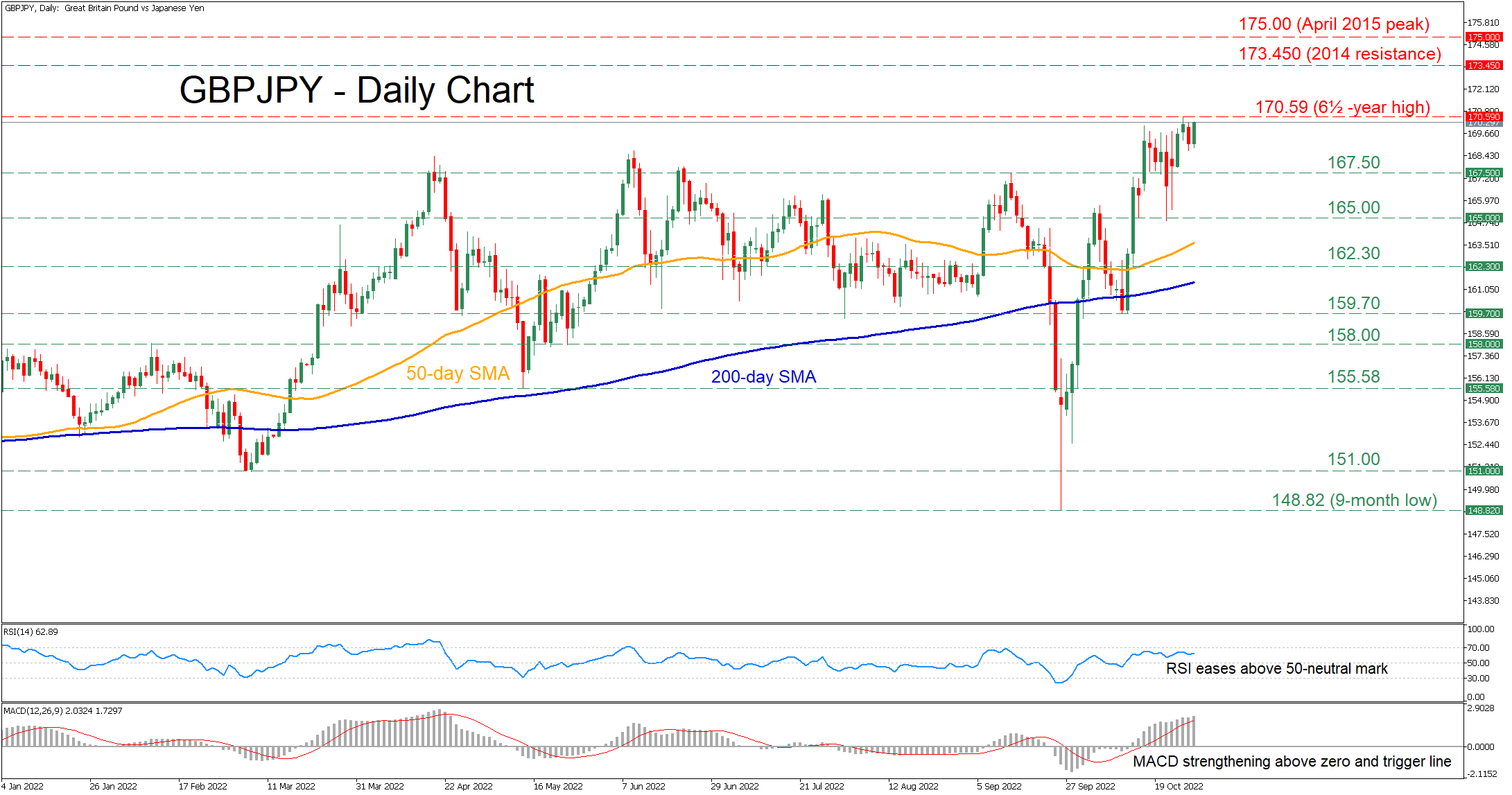
GBPJPY Consolidates after Posting a 6½-year High
GBPJPY has experienced significant moves in the short term, with the price losing around 11% before recovering back to form a fresh 6½-year high of 170.59. In the last couple of sessions, the pair has been trading sideways, but a break to the upside seems to be a matter of time as positive momentum is strengthening.
The short-term oscillators currently endorse a positive near-term bias. Specifically, the RSI is hovering above its 50-neutral mark, while the MACD histogram is strengthening above its red signal line in the positive territory.
Should the buying interest intensify, the pair could challenge the 6½-year peak of 170.59. Conquering this barricade, the price would edge higher to form fresh multi-year highs, where the crucial 2014 resistance region of 173.50 could curb further advances. Even higher, the spotlight may turn to the April 2015 peak of 175.00.
To the downside, if the positive momentum wanes and the price drifts lower, the recent support of 167.50 might act as the first line of defence. Sliding beneath that floor, the bears could aim for 165.00 before the 162.30 hurdle comes under examination. A break below the latter may set the stage for the October low of 159.70.
Overall, GBPJPY has been trading within a tight range after its latest advance paused, but near-term risks remain tilted to the upside. Therefore, a close above its latest multi-year peak is needed to verify the continuation of the uptrend.