Sample Category Title
France GDP growth slowed to 0.2% qoq in Q3
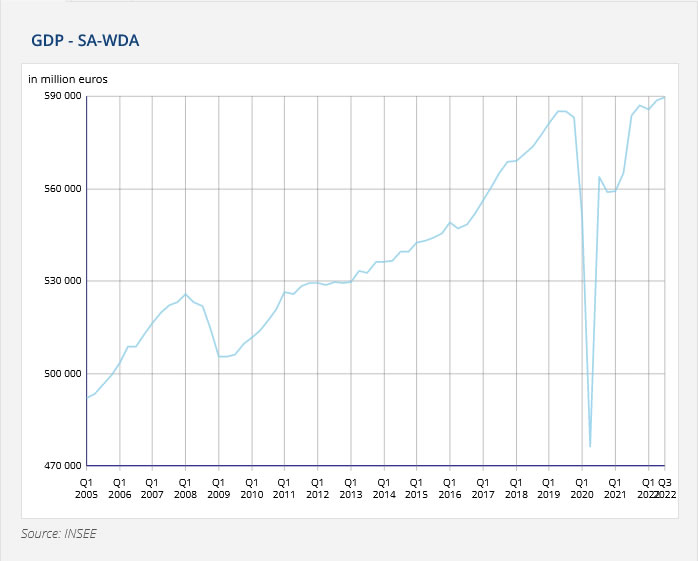
France GDP growth slowed to 0.2% qoq in Q3, matched expectations. That compares to 0.5% qoq growth in Q2.
Final domestic demand (excluding inventories) contributed positively to GDP growth this quarter (+0.4%). Thus, gross fixed capital formation (GFCF) accelerated strongly after an already relatively dynamic start to the year (+1.3%), while household consumption expenditure were stable (+0.0%). Foreign trade contributed negatively to GDP growth (-0.5%),
Ugly Big Tech Earnings Kill Joy – ECB Hikes and BoJ Sleeps
An ugly week of Big Tech earnings is coming to an end, having wipe out hopes of seeing earnings boost gains across the stock markets.
Yesterday, Meta plunged more than 24%; Nasdaq 100 lost almost 2%.
And today won’t be any better, as Apple and Amazon also lost in the afterhours trading.
Amazon lost up to 20%! Amazon’s Q3 revenues grew 15% versus last year, that was slightly less than expectations. The cloud segment grew 27% over the quarter, also worse-than-expected. The net income fell to $2.9bn from $3.2bn a year ago. But what really hit investors is the estimation of a holidays season revenue of around $140 to $148 billion, versus around $155 billion penciled in by analysts. The potential $15bn miss on holidays sales will send Amazon below the $100 mark at the open today. Whether the dive would attract dip-buyers is yet to be seen.
Apple, on the other hand, lost nearly 3% at its worse, after the bell. The company did better than the revenue and earnings expectations, but the uptick in iPhone sales was worse-than-expected, although Apple continues onboarding Android users, and grew its active user base to a fresh record. Apple lost more than 3% at yesterday’s tech selloff, and will unlikely recover much of it before the weekly closing bell.
In summary, the US Big Tech rather killed joy this week, so all eyes are on Big Oil to reverse mood. Exxon Mobil and Chevron will be reporting earnings this Friday, and are expected to announce stunning earnings.
But there are two important things to keep in mind. First, the expectations are high, so they will be harder to beat. And second, Joe Biden is pressuring oil companies not to use their stunning profits to buy back stocks, or throw out dividends, but rather to use them to increase supply, and bring oil prices lower.
In all cases, energy companies are the biggest winners of the energy crisis, and the rally is not ready to reverse.
Exxon Mobil flirted with $110 yesterday, extending its year-to-date rally to 80%, whereas the S&P500 lost up to 27%, and is 20% lower as of today due to high inflation – mostly triggered by skyrocketing energy prices, rising rates, and deteriorating economic outlook.
And that mixed US GDP
Investors didn’t know what to do with the mixed US GDP data yesterday. The latest GDP update showed that the US economy grew 2.6% in the Q3, reversing two consecutive month slowing.
Yet, growth was not necessarily driven by a stronger US economic activity. In fact, exports boosted the headline figure, while imports fell - meaning that the domestic demand from the US weakened despite a significant appreciation of the US dollar. Consumer spending, on the other hand, advanced way weaker than the previous period. So, the strong GDP number didn't boost the Federal Reserve (Fed) hawks. On the contrary, if the Fed wants a lower inflation, weaker demand is exactly what it needs – and weaker demand was a major conclusion of yesterday’s otherwise strong GDP print.
This is certainly why we saw the S&P500 stocks limit losses yesterday, while the Dow Jones eked out a 0.61% gain. The US 2-year yield eased almost 3%, although the dollar rebounded across major currencies.
ECB hiked, euro eased
The European Central Bank (ECB) hiked the interest rates by 75bp at yesterday’s meeting, but the hike was broadly expected and priced in. Investors mostly traded the post-meeting statement from Christine Lagarde, and that statement was rather… dovish.
Although Lagarde said that more rate hikes are on the pipeline, and that the pace and the size of the future actions will depend on data, she also said that a 'substantial progress' has been made in normalizing policy. And that ‘substantial’ word got many to think that the most aggressive part may have been already done.
Plus, the ECB said that the recession odds increased, and the officials didn't discuss QT at this meeting.
The EURUSD swung up and down around parity, and consolidates below 1 at the wake of the latest ECB decision. As a result, the 100-DMA offers, which stand a touch above parity couldn’t be cleared this week, and sentiment in the EURUSD remains negative, though less negative given some softening in USD outlook this week.
The yen on the other hand gave back some advance against the US dollar, as the stubborn Bank of Japan (BoJ) maintained its interest rate unchanged at -0.10% at today’s meeting, while revising the 2022 inflation forecast significantly higher from 2.3% to 2.9%.
If the BoJ is lucky, the dollar will weaken from the actual levels, and the depreciation in the yen would remain reasonable. Otherwise, we could see dollar-yen spike above the 150 level despite the BoJ’s direct interventions which do nothing more than burning money.
One last thing
Investors will be watching one last thing on the macro front before the weekly closing bell – and that’s the September PCE index, along with the personal income and spending data. Any weakness could further weigh on the dollar before we close the week, and before next week’s FOMC meeting.
ECB Interpreted as Being ‘Dovish’ Despite 75bp Hike
Market movers today
Today we get the first Q3 GDP figures out of the big euro area economies. Consensus sees slowing but still positive growth in France and Spain. We expect Q3 will mark the start of at least a technical recession in Germany with a GDP decline of 0.3%.
We also get German inflation figures for October. Here we expect to see CPI inflation around last month's 10.0% level as a VAT reduction on natural gas kicks in but core inflation will likely edge higher.
We expect an unchanged high mom 0.6% increase in the US PCE core index, which leaves core inflation at 5.3% in September, up from 4.9% in August.
We also get flash GDP indicator out of Sweden and jobless rate and retail sales from Norway, see more below.
The 60 second overview
ECB: At yesterday's meeting, the ECB decided to hike all policy rates by 75bp and importantly sent signals that it is slowing the hiking pace. Lagarde emphasised the data dependency, and the meeting-by-meeting approach. There was no discussion about ending the QE reinvestment policy.
Rates markets lowered the ECB's expectations for further rate hikes by around 25bp yesterday. Markets are now pricing 57bp for the December meeting and a peak in the ECB deposit rate to around 2.6%. 10Y yields in Germany and Italy fell 15bp and 32bp, respectively. We expect a 50bp rate hike at the December meeting.
The ECB also announced changes to the TLTRO terms. The latter is set to cause a significant drop in excess liquidity already from 23 November. For more on the ECB meeting, see Flash: ECB review that we published yesterday.
Danmarks Nationalbank (DN) hiked its key policy rate by 60bp to 1.25% (15bp less than the ECB). The smaller rate hike should be seen in light of the recent large scale FX intervention selling of DKK. The spread to ECB's key policy rate is now -0.25%, which we think will be enough to weaken DKK and end the need for further FX intervention. Hence, going forward DN is expected to mirror ECB one-by-one. For more see Flash comment Denmark that we published yesterday.
US GDP: US Q3 Flash GDP rose more than expected by 2.6% q/q AR (consensus +2.4%). The strong headline figure masked weakness in the underlying growth, as it was supported by +2.8%-point contribution from net exports, mostly reflecting declining imports. Private consumption growth slowed to only 1.4% q/q AR despite the recovery in real purchasing power, which provided modest support for the recent market speculation of an earlier Fed pivot. Nevertheless, we still think Fed is likely to stick to hawkish narrative in the next week's meeting, read more in our Fed preview that we published this morning.
FI: European rates sent yields markedly lower on a dovish interpretation of the ECB meeting and was led by the short end of the curve. Italian bonds led the outperformance of peripheral bonds to Bunds as the Italian-German spread narrowed 17bp yesterday, in response to the fact that no reinvestment policy discussed yesterday.
FX: While ECB delivered 75bp, markets concluded it was a dovish hike as indicated by substantial repricing of shorter rates. In FX there was broad EUR weakness including some downside in EUR/SEK but, in particular, EUR/NOK - NOK/SEK closer to October highs just below 1.07. DXY has lost 5% over five trading days but now seems to find ground at the 110 support area. Focus in FX will now shift to the Fed on Wednesday.
Credit: Credit markets were relatively muted on Thursday on the back of mixed economic data and weakness in select sectors of the economy. Itrax main was basically flat (+0.4bp) ending the day at 113.3bp. Itrax Xover tightened 4.6bp to end at 552.6bp.
Nordic macro
Sweden: The (flash) GDP indicator for Q3 is released today. If m/m growth in September remains flat, this will take the quarterly figure to -0.4% (q/q), in line with our GDP forecast from Nordic Outlook. However, the monthly figures are notoriously volatile and thus hard to pinpoint, but given current outlook for Swedish consumers we believe that risks are tilted to the downside.
Norway: We expect the jobless rate to climb to 1.7% in October, and we will also be keeping an eye on job openings to see if the downward trend there continues. Retail sales rebounded slightly in August after the sharp fall in July, but without breaking the downward trend. Strong inflation, higher interest rates and the shift from goods to services following the pandemic will probably continue to undermine retail sales in the coming months. We therefore expect them to fall 0.5% m/m in September.
USD/JPY Daily Outlook
Daily Pivots: (S1) 145.62; (P) 147.01; (R1) 147.80; More...
USD/JPY is extending the consolidation pattern from 151.93 and intraday bias remains neutral. Deeper pull back could be seen, but downside is expected to be contained by 38.2% retracement of 130.38 to 151.93 at 143.69 to bring rebound. On the upside, above 149.69 minor resistance will bring stronger rebound back towards 151.93 high. But upside should be limited there to continue the corrective pattern.
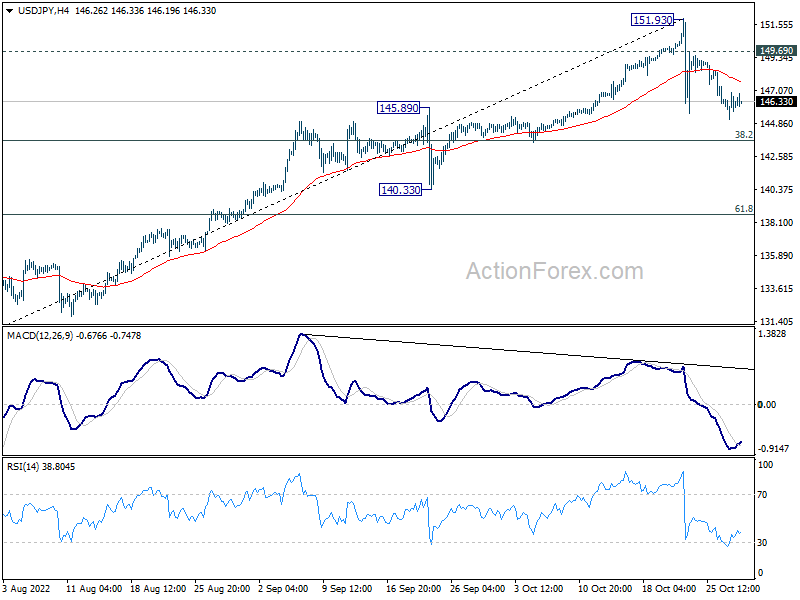
In the bigger picture, up trend from 101.18 is still in progress, as part of the whole up trend from 75.56 (2011 low). 147.68 (1998 high) was already met and there is no clearly sign of topping yet. In any case, break of 140.33 support is needed to be the first sign of medium term topping. Otherwise, further rise is in favor to next target at 160.16 (1990 high).
Yen Steady after BoJ, Treasury Yields Extending Correction
The markets are relatively quiet in Asia today. Yen is steady after BoJ stands pat as widely expected. Yet, there is some upside prospect for Yen if global benchmark yields continue to correct lower. Dollar remains the worst performer and today's PCE inflation data is unlikely to save it. Traders would more likely look beyond the data to next week's FOMC decision and guidance. There is so far no extended selloff in Euro after the post-ECB dip. Commodity currencies are firmer but lack follow through buying too.
Technically, US 10-year yield's close below 3.992 resistance turned support argues that it's already correcting the rise from 2.525 to 4.333. There is prospect of deeper pull back towards 55 day EMA (now at 3.624). If happens, that could help drag down Yen pairs, in particular USD/JPY towards 55 day EMA (now at 143.52).
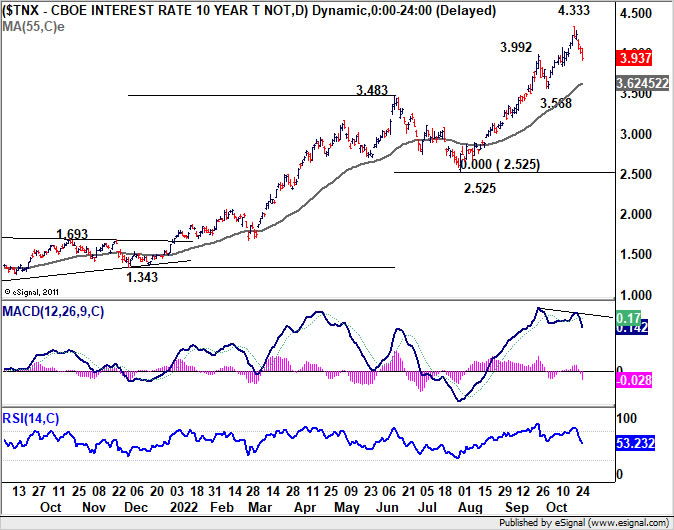
In Asia, at the time of writing, Nikkei is down -0.77%. Hong Kong HSI is down -2.73%. China Shanghai SSE is down -1.25%. Singapore Strait Times is up 1.64%. Japan 10-year JGB yield is down -0.0116 at 0.242. Overnight, DOW rose 0.61%. S&P 500 dropped -0.61%. NASDAQ dropped -1.63%. 10-year yield dropped -0.078 to 3.937.
BoJ stands pat, maintains yield cap at 0.25%
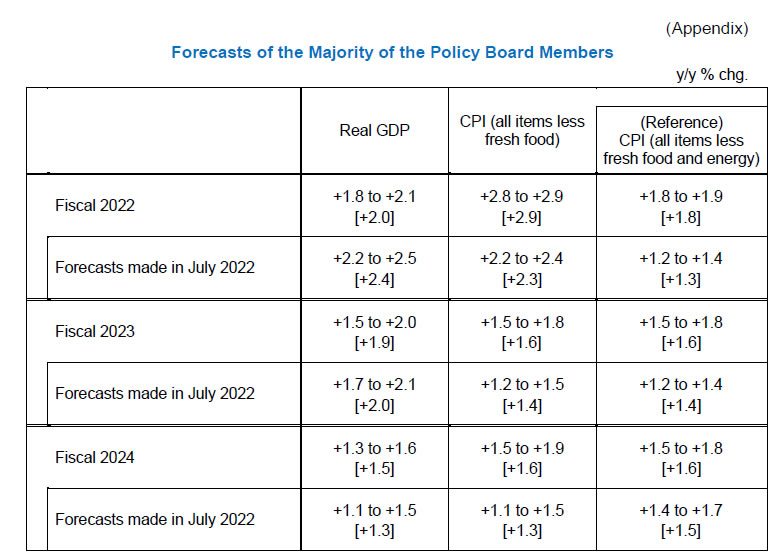
BoJ left monetary policy unchanged as widely expected. Under the yield curve control framework, short-term policy interest rate is held at -0.10%. 10-year JGB yield is kept at around 0%, with bond purchases without upper limit. 0.25% fixed rate purchase operation will continue to be held to cap 10-year JGB yield. The decision was unanimous.
In the new economic projections:
- Fiscal 2022 GDP growth forecast was downgraded from 2.4% to 2.0%.
- Fiscal 2023 GDP growth forecast was downgraded from 2.0% to 1.9%.
- Fiscal 2024 GDP growth forecast was upgraded from 1.3% to 1.5%.
- Fiscal 2022 CPI core forecast was upgraded from 2.3% to 2.9%.
- Fiscal 2023 CPI core forecast was upgraded from 1.4% to 1.6%.
- Fiscal 2024 CPI core forecast was upgraded from 1.3% to 1.6%.
- Fiscal 2022 CPI core-core forecast was upgraded from 1.3% to 1.8%.
- Fiscal 2023 CPI core-core forecast was upgraded from 1.4% to 1.6%.
- Fiscal 2024 CPI core-core forecast was upgraded from 1.5% to 1.6%.
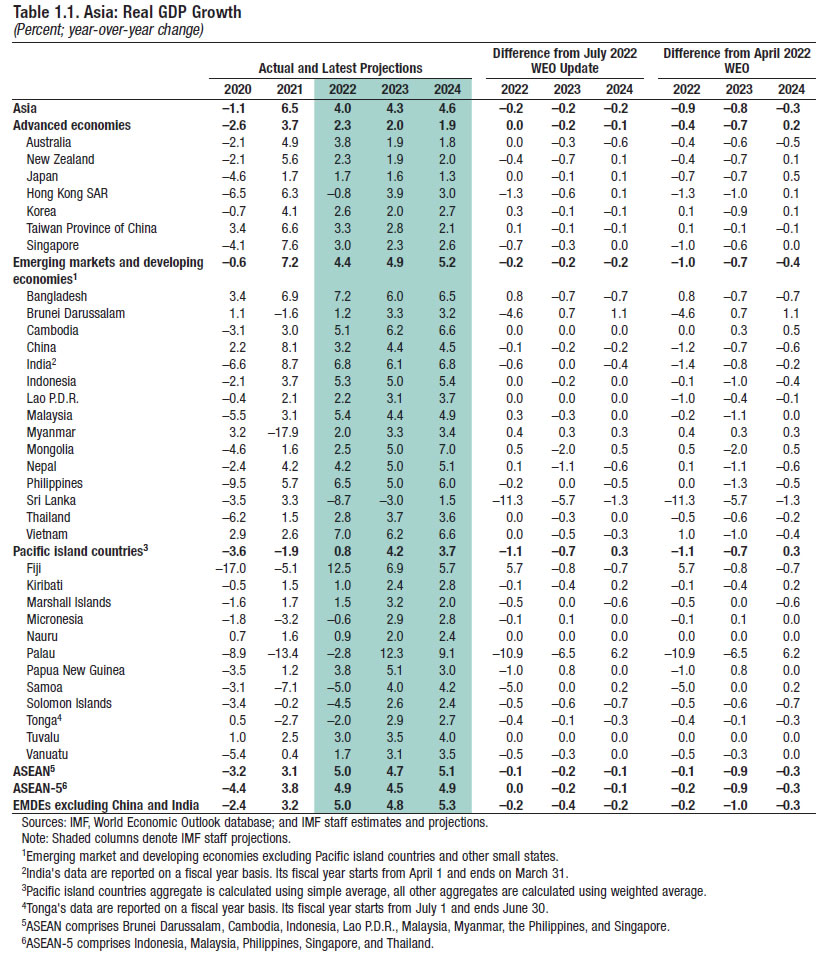
IMF cut Asia growth forecasts to 4% in 2022, 4.3% in 2023
IMF lowered Asia's growth forecast in to 4.0% in 2022, 4.3% in 2023, and 4.6% in 2024. Japan's growth forecast was held unchanged at 1.7% in 2022, downgraded slightly to 1.6% in 2023, and raised to 1.3% in 2024. For China, growth forecasts was downgraded to 3.2% in 2022, 4.4% in 2023, and 4.5% in 2024.
"As the effects of the pandemic wane, the region faces new headwinds from global financial tightening and an expected slowdown of external demand," the report said.
As for China, "with a growing number of property developers defaulting on their debt over the past year, the sector's access to market financing has become increasingly challenging," the report noted."Risks to the banking system from the real estate sector are rising because of substantial exposure."
Elsewhere
Japan Tokyo CPI core rose from 2.8% yoy to 3.4% yoy in October, above expectation of 3.2% yoy. Unemployment rate ticked up from 2.5% to 2.6% in September, above expectation of 2.5% yoy.
Australia PPI rose 1.9% qoq, 6.4% yoy in Q3, versus expectation of 1.5% qoq, 6.4% yoy.
Looking ahead, GDP from France, and GErmany will be the main focus in Euroepan session. Eurozone economic sentiment, Germany CPI flash and Swiss KOF will be featured too.
Later in the day, US personal income and spending, with PCE inflation will be the main feature.
USD/JPY Daily Outlook
Daily Pivots: (S1) 145.62; (P) 147.01; (R1) 147.80; More...
USD/JPY is extending the consolidation pattern from 151.93 and intraday bias remains neutral. Deeper pull back could be seen, but downside is expected to be contained by 38.2% retracement of 130.38 to 151.93 at 143.69 to bring rebound. On the upside, above 149.69 minor resistance will bring stronger rebound back towards 151.93 high. But upside should be limited there to continue the corrective pattern.
In the bigger picture, up trend from 101.18 is still in progress, as part of the whole up trend from 75.56 (2011 low). 147.68 (1998 high) was already met and there is no clearly sign of topping yet. In any case, break of 140.33 support is needed to be the first sign of medium term topping. Otherwise, further rise is in favor to next target at 160.16 (1990 high).
Economic Indicators Update
| GMT | Ccy | Events | Actual | Forecast | Previous | Revised |
|---|---|---|---|---|---|---|
| 23:30 | JPY | Tokyo CPI Core Y/Y Oct | 3.40% | 3.20% | 2.80% | |
| 23:30 | JPY | Unemployment Rate Sep | 2.60% | 2.50% | 2.50% | |
| 00:30 | AUD | PPI Q/Q Q3 | 1.90% | 1.50% | 1.40% | |
| 00:30 | AUD | PPI Y/Y Q3 | 6.40% | 6.40% | 5.60% | |
| 03:00 | JPY | BoJ Interest Rate Decision | -0.10% | -0.10% | -0.10% | |
| 05:30 | EUR | France Consumer Spending M/M Sep | 1.20% | 1.20% | 0.00% | 0.10% |
| 05:30 | EUR | France GDP Q/Q Q3 P | 0.20% | 0.20% | 0.50% | |
| 07:00 | CHF | KOF Leading Indicator Oct | 93 | 93.8 | ||
| 08:00 | EUR | Germany GDP Q/Q Q3 P | -0.20% | 0.10% | ||
| 09:00 | EUR | Eurozone Economic Sentiment Indicator Oct | 92.5 | 93.7 | ||
| 09:00 | EUR | Eurozone Services Sentiment Oct | 3.3 | 4.9 | ||
| 09:00 | EUR | Eurozone Industrial Confidence Oct | -2 | -0.4 | ||
| 09:00 | EUR | Eurozone Consumer Confidence Oct F | -27.6 | -27.6 | ||
| 12:00 | EUR | Germany CPI M/M Oct P | 0.60% | 1.90% | ||
| 12:00 | EUR | Germany CPI Y/Y Oct P | 10.10% | 10.00% | ||
| 12:30 | CAD | GDP M/M Aug | 0.00% | 0.10% | ||
| 12:30 | USD | Personal Income M/M Sep | 0.30% | 0.30% | ||
| 12:30 | USD | Personal Spending Sep | 0.40% | 0.40% | ||
| 12:30 | USD | PCE Price Index M/M Sep | 0.50% | 0.30% | ||
| 12:30 | USD | PCE Price Index Y/Y Sep | 5.80% | 6.20% | ||
| 12:30 | USD | Core PCE Price Index M/M Sep | 0.50% | 0.60% | ||
| 12:30 | USD | Core PCE Price Index Y/Y Sep | 5.20% | 4.90% | ||
| 12:30 | USD | Employment Cost Index Q3 | 1.30% | 1.30% | ||
| 14:00 | USD | Pending Home Sales M/M Sep | -5.30% | -2.00% | ||
| 14:00 | USD | Michigan Consumer Sentiment Index Oct F | 59.8 | 59.8 |
IMF cut Asia growth forecasts to 4% in 2022, 4.3% in 2023
IMF lowered Asia's growth forecast in to 4.0% in 2022, 4.3% in 2023, and 4.6% in 2024. Japan's growth forecast was held unchanged at 1.7% in 2022, downgraded slightly to 1.6% in 2023, and raised to 1.3% in 2024. For China, growth forecasts was downgraded to 3.2% in 2022, 4.4% in 2023, and 4.5% in 2024.
"As the effects of the pandemic wane, the region faces new headwinds from global financial tightening and an expected slowdown of external demand," the report said.
As for China, "with a growing number of property developers defaulting on their debt over the past year, the sector's access to market financing has become increasingly challenging," the report noted."Risks to the banking system from the real estate sector are rising because of substantial exposure."
BoJ stands pat, maintains yield cap at 0.25%
BoJ left monetary policy unchanged as widely expected. Under the yield curve control framework, short-term policy interest rate is held at -0.10%. 10-year JGB yield is kept at around 0%, with bond purchases without upper limit. 0.25% fixed rate purchase operation will continue to be held to cap 10-year JGB yield. The decision was unanimous.
In the new economic projections:
- Fiscal 2022 GDP growth forecast was downgraded from 2.4% to 2.0%.
- Fiscal 2023 GDP growth forecast was downgraded from 2.0% to 1.9%.
- Fiscal 2024 GDP growth forecast was upgraded from 1.3% to 1.5%.
- Fiscal 2022 CPI core forecast was upgraded from 2.3% to 2.9%.
- Fiscal 2023 CPI core forecast was upgraded from 1.4% to 1.6%.
- Fiscal 2024 CPI core forecast was upgraded from 1.3% to 1.6%.
- Fiscal 2022 CPI core-core forecast was upgraded from 1.3% to 1.8%.
- Fiscal 2023 CPI core-core forecast was upgraded from 1.4% to 1.6%.
- Fiscal 2024 CPI core-core forecast was upgraded from 1.5% to 1.6%.
USD/JPY Reaches Key Support, US GDP Improves
Key Highlights
- USD/JPY declined and tested the key 145.00 support zone.
- A major bearish trend line is forming with resistance near 147.20 on the 4-hours chart.
- EUR/USD surpassed 1.0000 and GBP/USD attempted an upside break above 1.1640.
- The US Gross Domestic Product grew 2.6% in Q3 2022 (Preliminary), up from -0.6%.
USD/JPY Technical Analysis
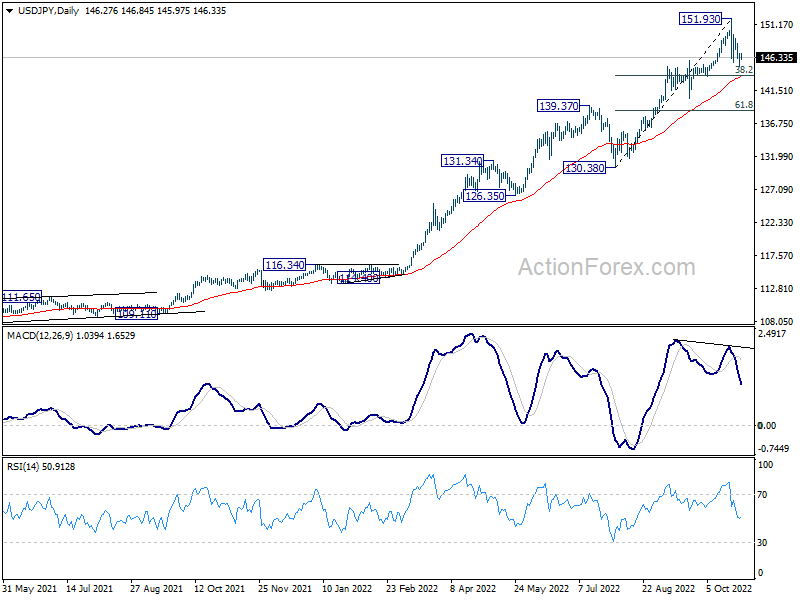
The US Dollar started a major decline after it tested the 152.00 resistance against the Japanese Yen. USD/JPY declined below 150.00 and 149.50 to move into a short term bearish zone.
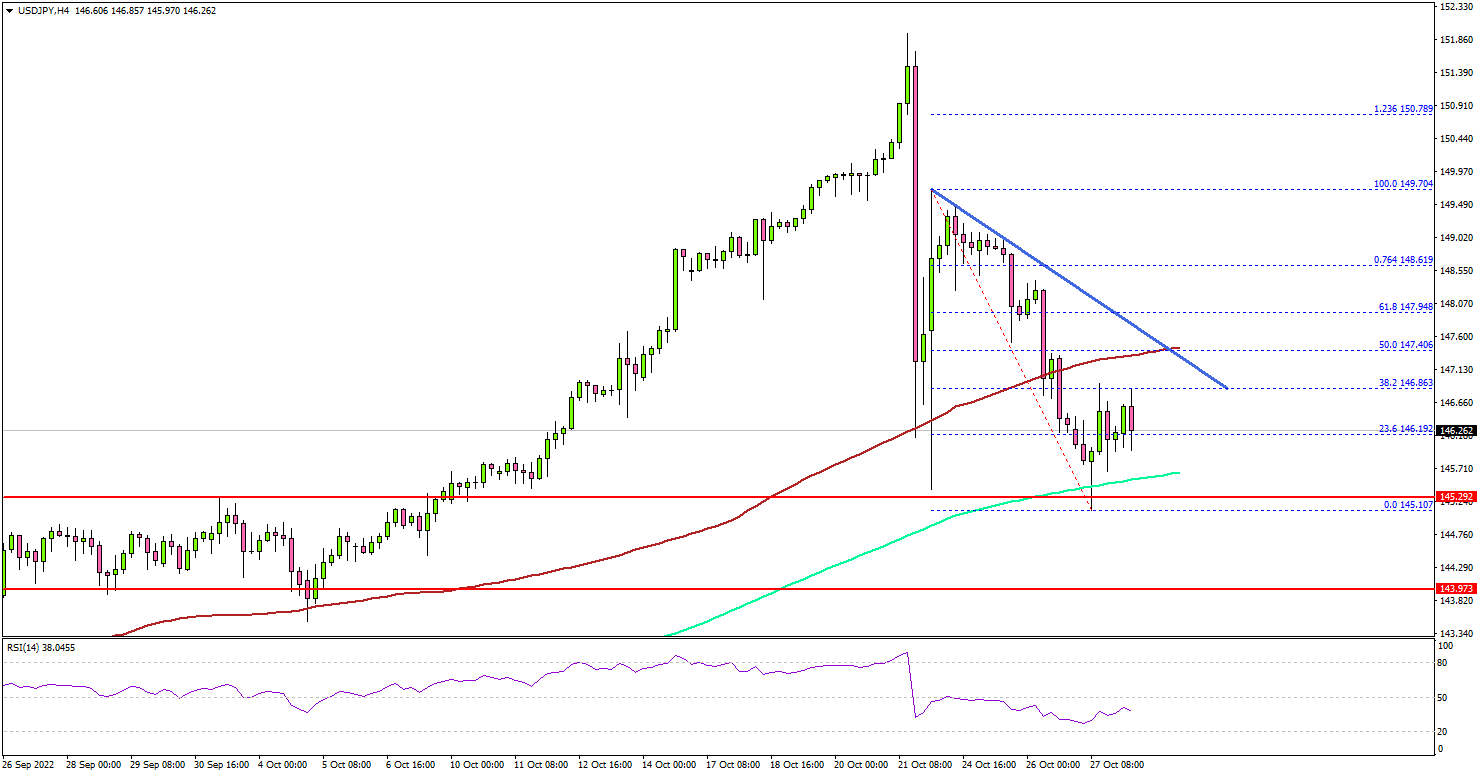
Looking at the 4-hours chart, the pair gained pace below the 148.00 level and the 100 simple moving average (red, 4-hours). This past week, there was a recovery wave, but the pair failed to climb back above the 150.00 resistance.
A high was formed near 149.70 before there was a fresh decline. The pair declined over 300 pips and tested the 145.00 support zone.
A low is formed near 145.10 and the pair is now consolidating losses. On the upside, it is facing a major resistance near the 147.00 zone. There is also a major bearish trend line forming with resistance near 147.20 on the same chart.
The next major resistance may perhaps be near 148.00 or the 100 simple moving average (red, 4-hours). Any more gains could set the pace for a move towards the 150.00 level.
An initial support is near the 145.70 level and the 200 simple moving average (green, 4-hours). The next major support is near the 145.00 zone. A downside break below the 145.00 zone could push the pair further into a bearish zone.
Fundamentally, the US Gross Domestic Product report for Q3 2022 (prelim) was released yesterday by the US Bureau of Economic Analysis. The market was looking for the GDP to increase by 2.4%.
The actual result was better than the forecast, as the US Gross Domestic Product grew 2.6% in Q3 2022, up from the last decline of 0.6%.
Looking at EUR/USD, there was a move above the 1.0000 resistance, but the pair seems to be losing bullish momentum and might decline below 0.9950.
Economic Releases
- German Consumer Price Index for Oct 2022 (YoY) (Prelim) – Forecast +10.1%, versus +10.0% previous.
- German Consumer Price Index for Oct 2022 (MoM) (Prelim) – Forecast +0.6%, versus +1.9% previous.
- US Personal Income for Sep 2022 (MoM) - Forecast +0.3%, versus +0.3% previous.
Cliff Notes: An Event Filled Week
This week, the second Australian Federal Budget for 2022 and the Q3 CPI report gave the market a lot to consider regarding Australia’s outlook. The same was true offshore, with the Bank of Canada and ECB respectively delivering ‘dovish’ 50bp and 75bp hikes as US Q3 GDP made clear US private demand growth is slowing rapidly.
Beginning with October Budget 2022. Our Bulletin and conversation with Chief Economist Bill Evans provides a full view of the new Government’s priorities and their economic expectations for the next four years. Most notable is that, while the starting point for October Budget 2022 is materially improved, the economy is expected to be weaken while spending grows rapidly, particularly interest costs and funding for the NDIS. As a result, net debt is forecast to continue rising to 2025/26, the last year of the forward estimates. Consistent with the policies Labor took to the election, October Budget 2022 focuses on providing cost of living relief for families through support for childcare; improving essential services, particularly aged care; and also commits to long-term investment in Australia’s capacity and productivity.
The day after Budget 2022, the Q3 CPI print came in well above the market’s expectation and our own. Critically, not only did headline inflation print at a challenging 1.8% (7.3%yr), so did the trimmed mean core (1.8%; 6.1%yr). Key contributors to the rise were housing (utilities and dwelling construction) and food. However, there was evidence of robust-to-strong inflation across the rest of the consumer basket.
In our view, it is therefore appropriate for the RBA to increase the cash rate by 50bps at the November meeting, and to follow that move with a further 75bps of cumulative tightening at the next three meetings to a peak of 3.85% in March (previously 3.60%). An on-hold posture will then be required over the remainder of 2023 to suppress inflation expectations and related risks. Chief Economist Bill Evans’ bulletin provides a detailed assessment of our expectations regarding the RBA.
Turning to the US. The Q3 GDP outcome was, more or less, as we anticipated, with a circa 3ppt contribution from net exports masking a continued deterioration in private demand growth. From 2.2% annualised in Q1, private demand growth has slowed to just 0.6%. As the service sector re-opening fades and durable purchases come under greater pressure from interest rates and cost of living, this downtrend will persist – note that in Q3, dwelling construction declined at a 26% annualised rate and business investment growth was sub-par.
We remain of the view that the US is likely to see cumulative GDP growth of only 0.5% through 2022 and 2023, with risks skewed to the downside. It will be interesting to see whether the FOMC take a more cautious view on the outlook for the economy at their November meeting next week as they deliver another outsized 75bp hike. For the US, inflation risks are still acute, but the probability of a hard landing in 2023 is on the rise.
Regarding the forward view for monetary policy globally, both the Bank of Canada and ECB delivered what were perceived to be ‘dovish’ extraordinary hikes this week, the Bank of Canada (BoC) raising 50bps and the European Central Bank (ECB) 75bps. For the BoC, growth in 2023 is clearly at risk, but excess demand remains and inflation is yet to show definitive signs of slowing. Ergo, further measured hikes are expected to prove necessary. Meanwhile in Europe, the ECB affirmed their resolve to combat inflation whilst being cognisant of the immediate and medium-term risks to growth. There is still a need to raise interest rates, but with domestic demand already showing clear signs of weakening in H2 2022 under the weight of historic inflation and collapsed confidence, a slowing in the pace of rate hikes is becoming increasingly likely. We expect another 75bp of rate hikes into early 2023, leaving the refi rate at a peak of 2.75% through the rest of that year and into early 2024.
Finally then to China. The end of the National Party Congress was as expected, with President Xi being confirmed for a third term and the Standing Committee re-shaped to cement his authority. The initial reaction of markets was unfavourable, though this has dissipated somewhat. The hold that President Xi has over the party, China’s development and COVID management is unnerving for many market participants. That said, the GDP and partial data for Q3 points to underlying economic strength.
In Q3, growth was more than a percentage point stronger than the market’s expectation, the 3.9% gain reversing Q2’s 2.7% loss. Year-to-date growth consequently bounced back to 3.0%, we expect on its way to 3.5% for the full year to be followed by 6.0% growth in 2023. From the GDP detail and monthly partial data, it is clear COVID management continues to pressure consumption and that residential construction is only starting to form a base after the provision of considerable stimulus. Supporting growth currently is fixed asset investment ex-housing and trade.
While trade with the US and Europe is under pressure as these economies stall and/or enter recession, Asia has capacity to offset. Not only does China stand to benefit from the region’s organic growth, they are also looking to take a greater share of these markets for both consumer and industrial goods. China’s decision to invest in and promote their own brands domestically over the past decade provides a strong foundation for their nascent Asian export expansion. So too the capital, production and know-how they are developing with respect to the green transition – a process Asia stands to benefit materially from. Of course, the greater China’s interest in Asia becomes, the stronger their footing on the global stage. Geopolitical uncertainty is then expected to persist and potentially escalate in the years ahead.
Elliott Wave View: USDJPY Looking for Double Correction
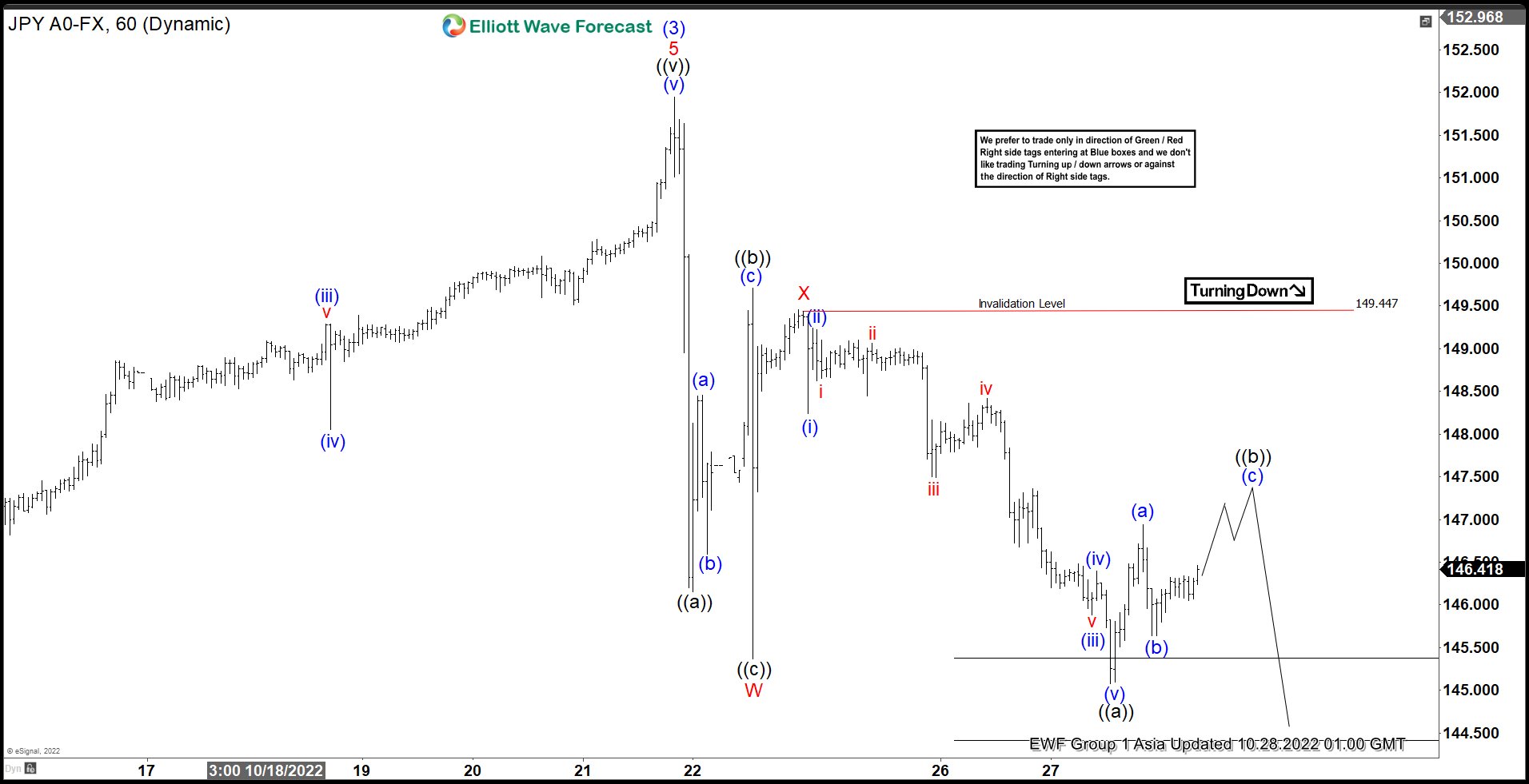
Short Term Elliott Wave structure of USDJPY shows a 5 swing sequence from 10.21.2022 high. This suggests the decline can extend lower into a 7 swing double three structure. Rally to 10.21.2022 high at 151.94 ended wave (3). Pullback in wave (4) is in progress with subdivision as a double three Elliott Wave structure. Down from wave (3), wave ((a)) ended at 146.15, rally in wave ((b)) ended at 149.71, and wave ((c)) lower ended at 145.37. This completed wave W.
Corrective rally in wave X ended at 149.44 and the pair has resumed lower. Wave Y is now in progress as a zigzag structure. Down from wave X, wave (i) ended at 148.24, and rally in wave (ii) ended at 149.24. Pair resumes lower in wave (iii) towards 145.88 and wave (iv) ended at 146.39. Final leg wave (v) ended at 145.08 which completed wave ((a)). Wave ((b)) rally is in progress to correct cycle from 10.24.2022 high in 3, 7, or 11 swing before the decline resumes. Near term, as far as pivot at 149.44 holds, expect rally to fail for further downside towards 141.3 – 142.8 area to end wave (4). This area, if reached, should see buyers for the next leg higher.
USDJPY 60 Minutes Elliott Wave Chart