Sample Category Title
AUD/USD: Broad Risk Aversion Pushes Aussie to New Multi-month Low
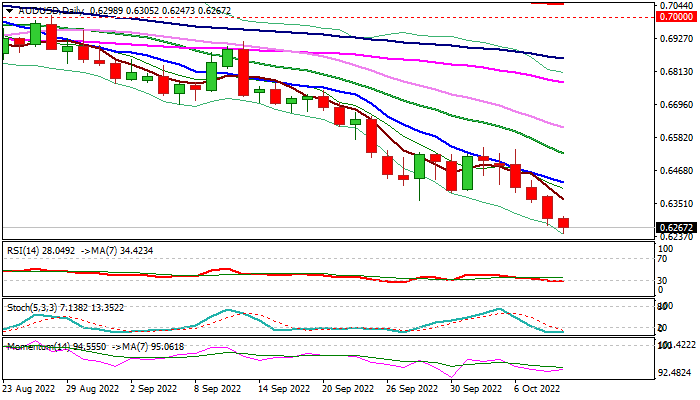
The Australian dollar extend the bear-leg from Oct 4 lower top (0.6547) into sixth straight day, hitting the lowest since Apr 2020, in early Tuesday’s trading.
Broad risk-off mode on economic uncertainty and growing geopolitical tensions keep the Aussie under pressure, with bad news from China, adding to negative picture.
The latest data showed that China’s services sector contracted for the first time in four months, a surge of new Covid infection cases has been registered in some areas and the United States announced the new package of export restrictions towards China, which together contributed to weakening sentiment.
Fresh bears face headwinds from oversold daily studies, with limited upticks (ideally to be capped under 0.6400 zone) to offer better levels to re-enter larger bearish market for extension towards targets at 0.6098/0.6000 (Fibo 76.4% of 0.5509/0.8007 rally / psychological).
Caution on break above 10DMA (0.6426) that would slow bears and expose pivotal barriers at 0.6530/50 zone (falling 20DMA / lower platform), violation of which would signal stronger correction.
Res: 0.6305; 0.6363; 0.6426; 0.6526.
Sup: 0.6247; 0.6200; 0.6098; 0.6000.
GBPUSD Extends Decline, Approaching the 1.1000 Region
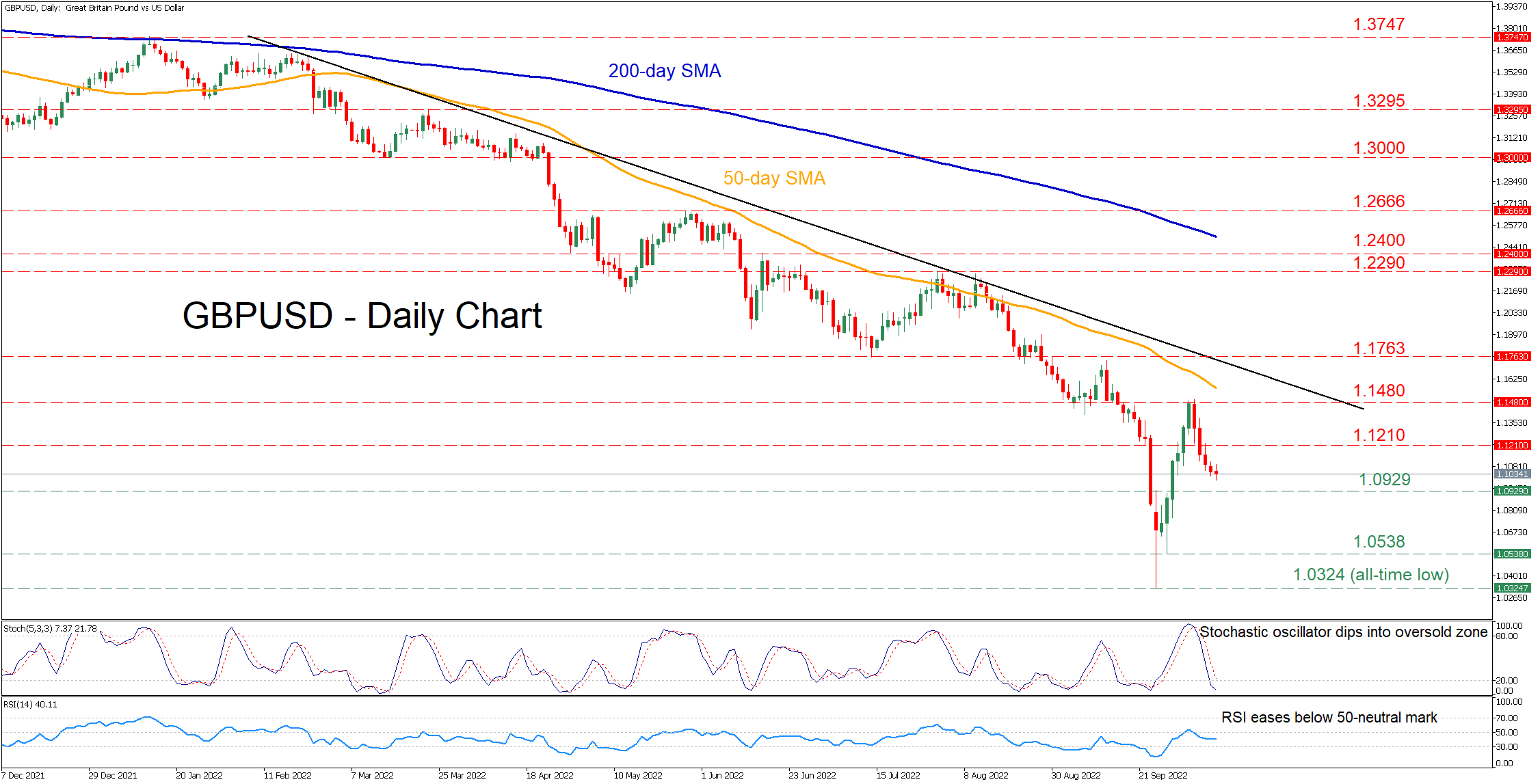
GBPUSD has been in a prolonged downtrend since the beginning of the year, plummeting to an all-time low of 1.0324 in mid-September. Even though the pair managed to bounce back and recoup some losses, it has turned lower again after the latest advance fell short near the 1.1480 zone.
The momentum indicators currently suggest that near-term risks are tilted to the downside. Specifically, the stochastic oscillator has dived lower and entered the 20-oversold territory, while the RSI has flatlined beneath its 50-neutral mark.
Should negative momentum strengthen, the price could encounter immediate support at the inside swing high of 1.0929. Dropping lower, the 1.0538 support could come under examination. A violation of the latter could open the door for the all-time low of 1.0324.
To the upside, if selling pressures wane and the price drifts higher, 1.1210 may prove to be the initial resistance point. Piercing through that ceiling, the bulls could aim for the recent rejection point of 1.1480 before the spotlight turns to 1.1763. Even higher, the July resistance of 1.2290 might curb any upside moves.
All and all, GBPUSD’s near-term picture has started to deteriorate, with the price slumping towards its recent lows. For that bearish sentiment to reverse, the pair needs to clearly close above the recent trend reversal region of 1.1480.
EURJPY Capped by 20-day SMA in the Short-term
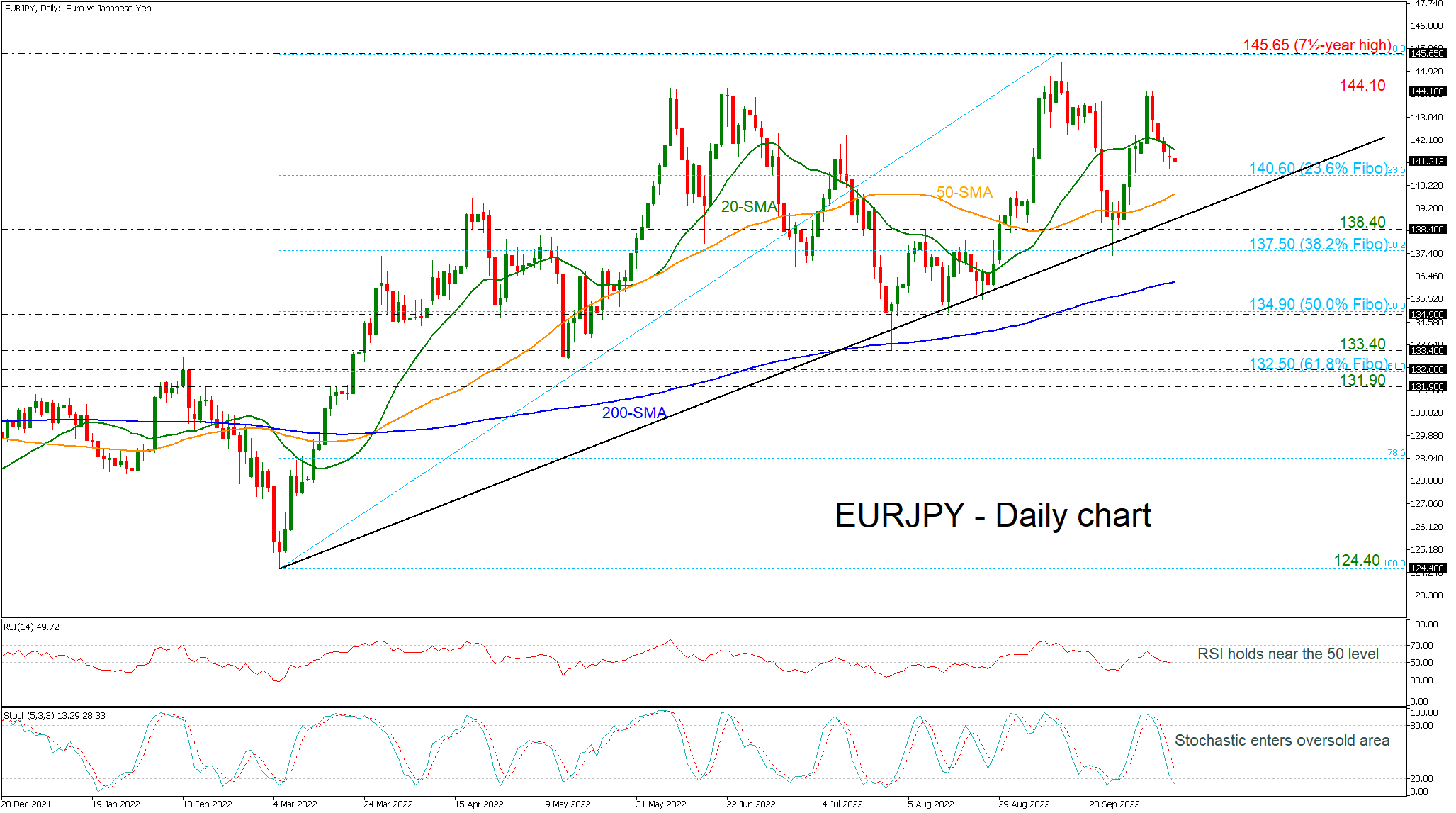
EURJPY is easing for the fifth consecutive red day and is being capped by the 20-day simple moving average (SMA). The pair is creating a bearish correction in the short-term timeframe, but it still remains above the long-term uptrend line.
Technically, the RSI indicator is moving slightly lower around the neutral threshold of 50, while the stochastic is entering the oversold zone. Both currently confirm the recent negative movement.
Should prices decline further, immediate support could be found around the 23.6% Fibonacci retracement level of the up leg from 124.40 to 145.65 at 140.60. Then a leg below that level, the pair could meet the 50-day simple moving average (SMA) at 139.90 before the focus shifts to the 138.40 barrier
However, if the market manages to pick up speed, the 20-day SMA at 141.70 could offer nearby resistance ahead of the 144.10 barrier. A significant close above the latter would break the seven-and-a-half-year high of 145.65, raising chances for further increases.
In the long-term, the outlook is likely to remain positive since prices are holding above the uptrend line and the 200-day SMA.
GBP/USD: The Bearish Trend May End Near 1.030
The structure of the GBPUSD currency suggests the formation of a global corrective trend – a triple zigzag w-x-y-x-z. On the 1H timeframe, we see the final actionary wave z of the cycle degree.
The wave z most likely takes the form of a primary triple zigzag Ⓦ-Ⓧ-Ⓨ-Ⓧ-Ⓩ. Perhaps at the beginning of August of this year, the bullish price movement ended within the small primary intervening wave Ⓧ, it took the form of an intermediate zigzag (A)-(B)-(C).
After that, we saw the continuation of the bearish trend in the primary wave Ⓩ, which may complete its intermediate triple zigzag pattern (W)-(X)-(Y)-(X)-(Z) near the 1.030 mark.
At that level, wave Ⓩ will be at the 100% Fibonacci extension of previous actionary wave Ⓨ.
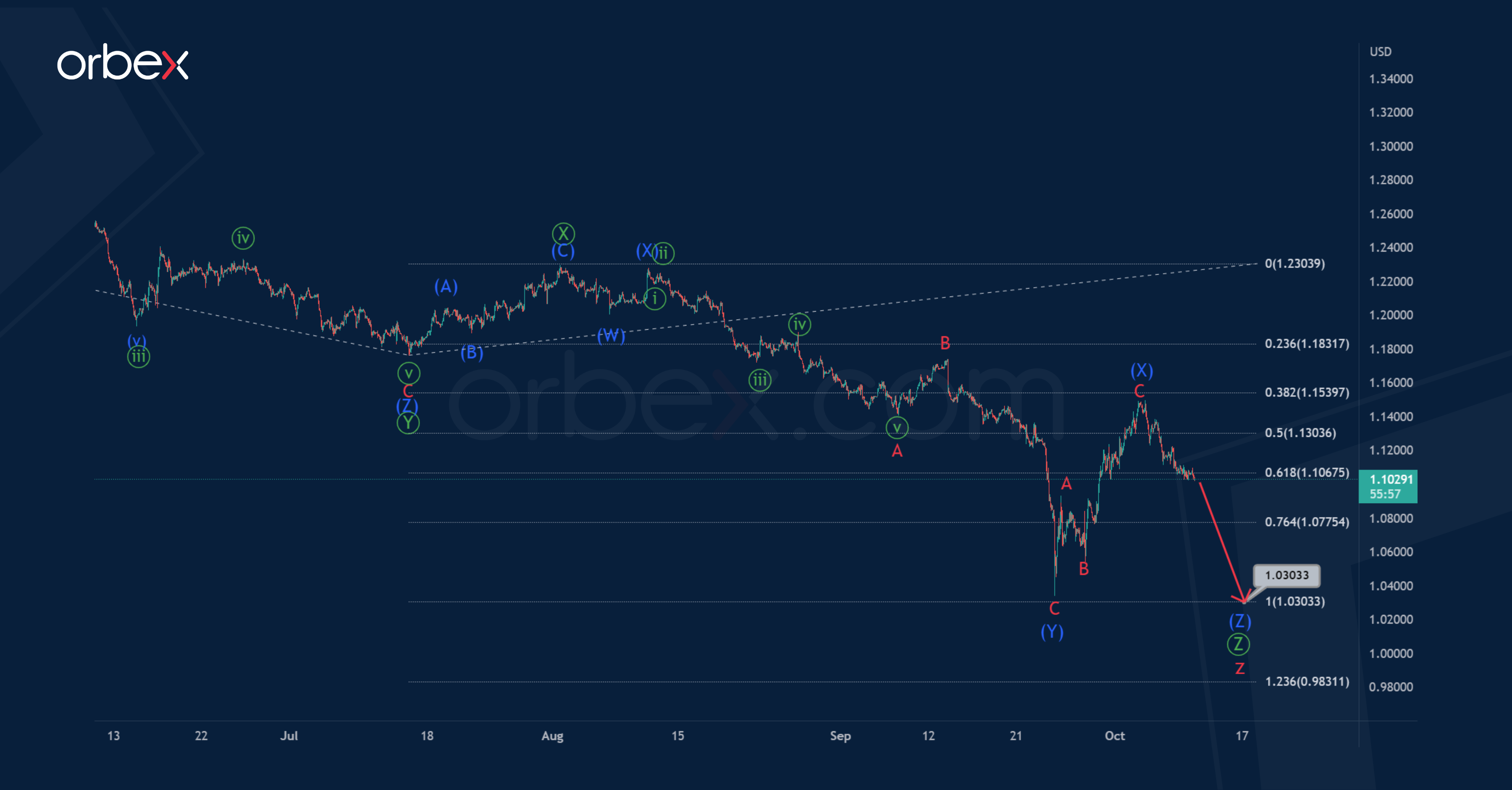
It is possible that the cycle wave z could be fully completed, it has the form of a primary triple zigzag, as suggested above.
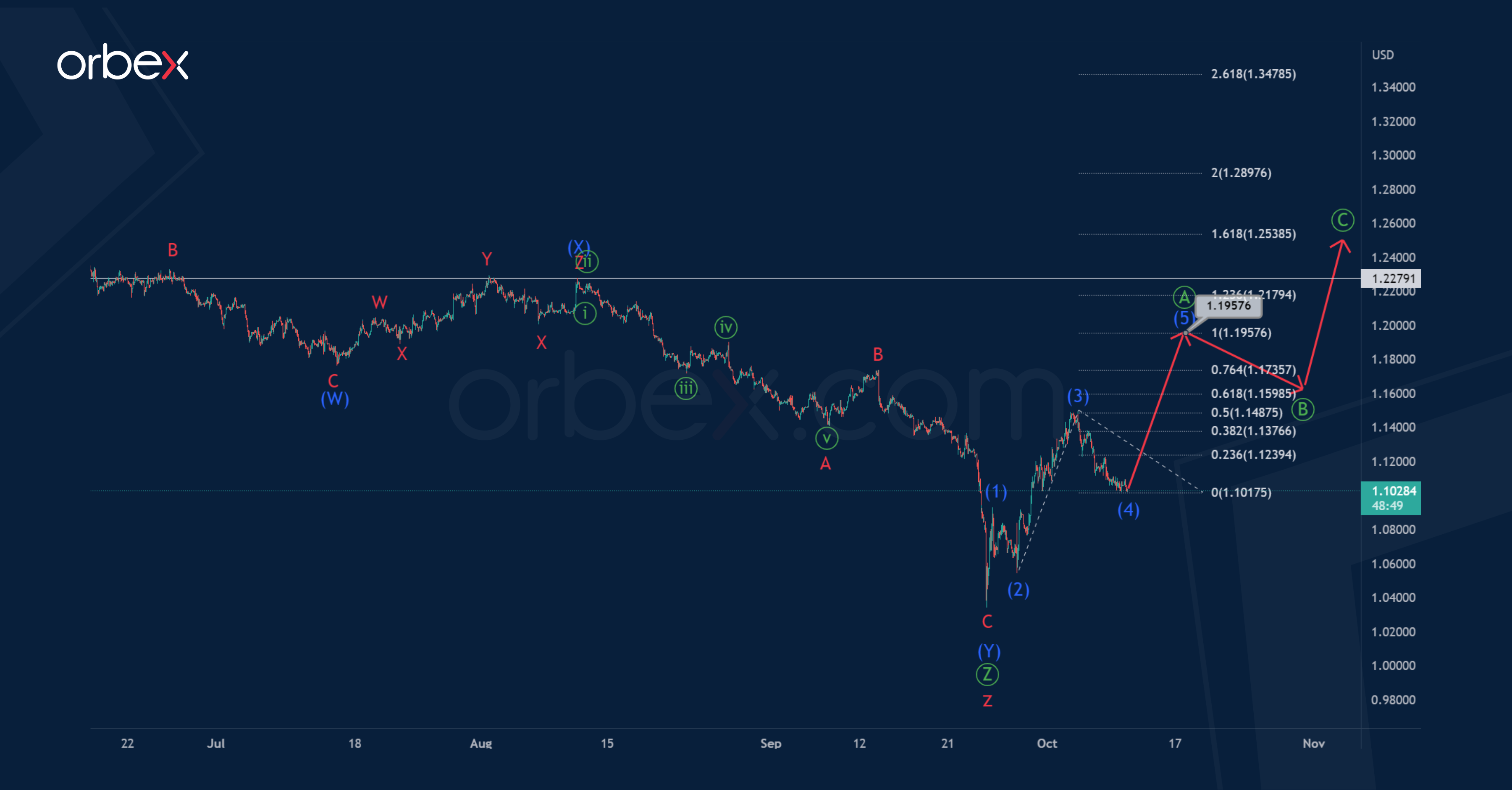
Thus, in the last section of the chart, we see that the bulls have started to move the price in a new trend.
Perhaps in the next coming trading weeks, market participants will observe the construction of the first impulse wave Ⓐ of a potential zigzag Ⓐ-Ⓑ-Ⓒ of the primary degree.
The end of the impulse Ⓐ is expected near 1.1957. At that level, intermediate sub-waves (3) and (5) will be equal.
Dax 40 Turns South
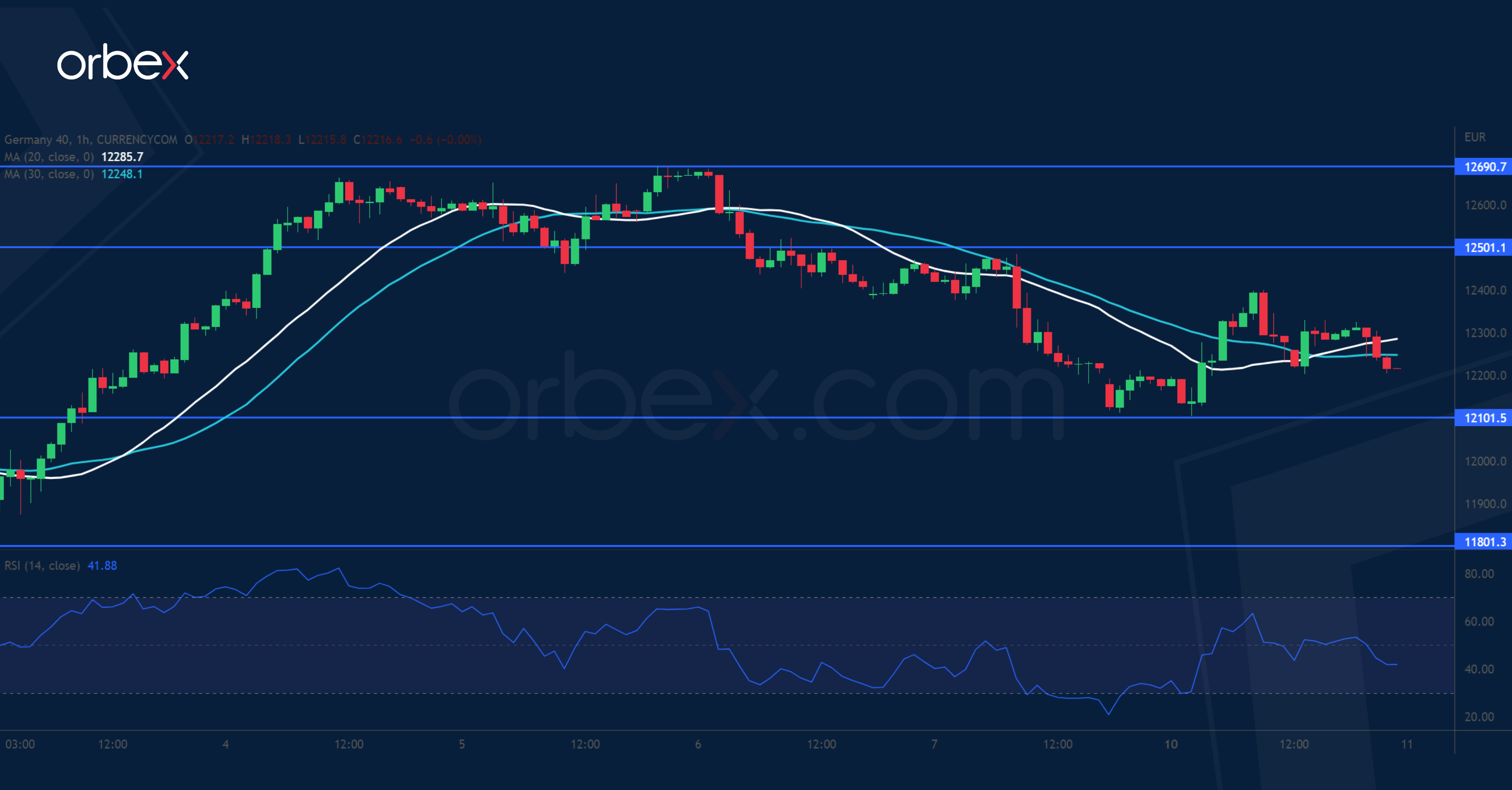
The Dax 40 struggles as tensions escalate in Ukraine. The index has met stiff selling pressure in the former demand zone (12690) from the daily chart, which also coincides with the 30-day moving average. A combination of profit-taking and fresh selling has triggered a liquidation of short-term long positions. 12100 at the origin of the previous bullish breakout is an important support. Only a rally back above 12500 may turn the situation around or the index could be vulnerable to a new round of sell-off below 11800.
EUR/GBP Tests Resistance
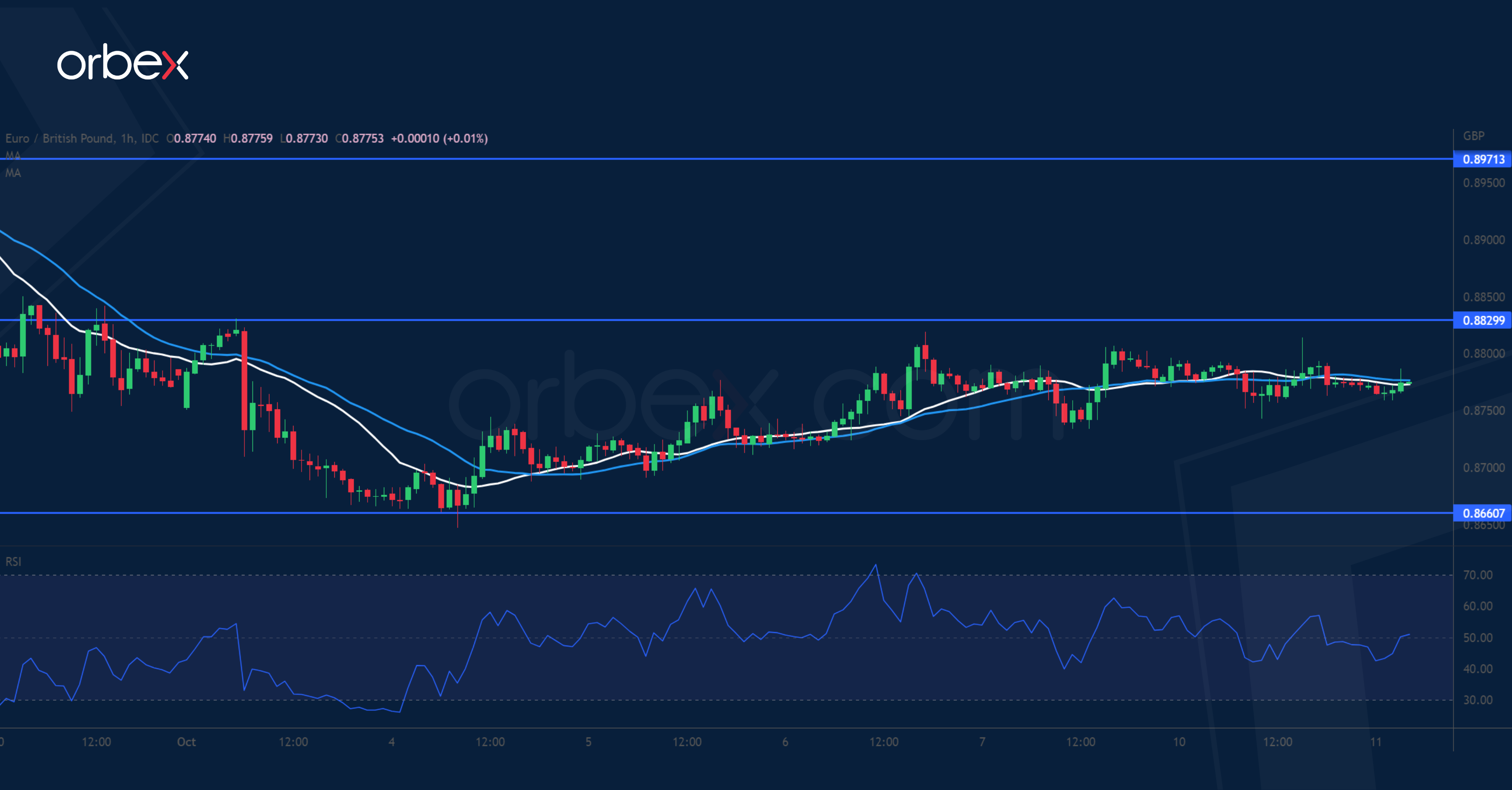
The pound slips after a loss of confidence in Britain’s government. The euro is still consolidating following a spike above 0.9200. A bounce off 0.8660 at the base of a rally in mid-September suggests a return of buyers after massive profit-taking. 0.8830 is a key hurdle ahead and the sideways action foreshadows an imminent breakout. Its breach could improve short-term sentiment. Then a break above 0.8970 may resume the uptrend in the weeks to come. A bearish breakout however, would deepen the correction towards 0.8500.
EUR/USD Struggles for Bids
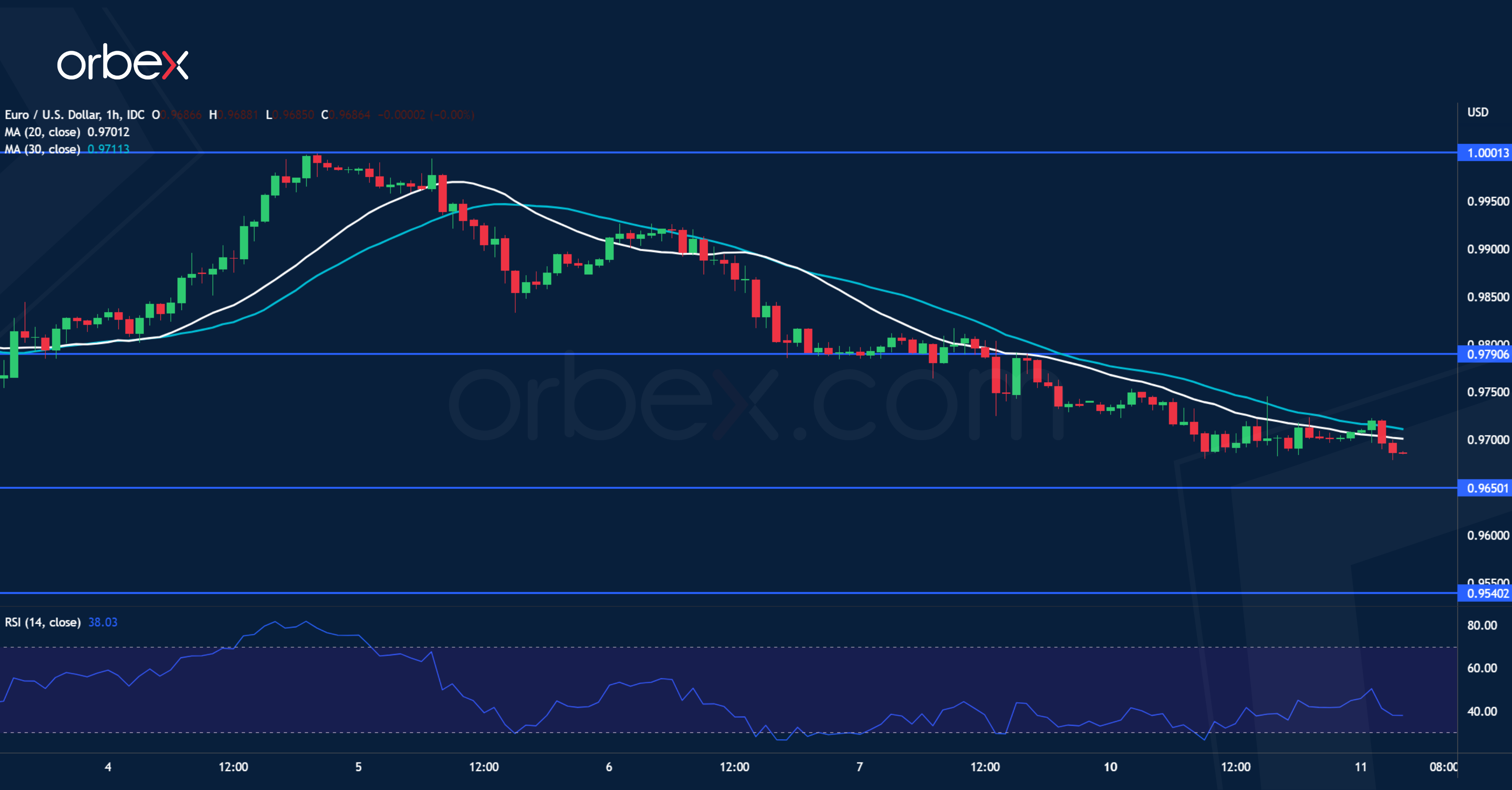
The US dollar keeps advancing thanks to the Fed policy momentum. The latest rally came to a halt at the parity level, a sign that the bears were eager to sell into strength. A fall below 0.9790 further weighs on the mood as buyers rush to the exit. 0.9650 is the next support as the RSI inches into the oversold area. The bulls will need to clear the fresh supply zone around 0.9790 before a rebound could materialise. Otherwise, its breach would indicate a lack of interest in the single currency and put 0.9540 at risk.
Increasingly Pessimistic
European stock markets are poised for another weak open as much of Asia reopened on Tuesday to large declines.
Asia is flashing red as it nears the close and Europe may be facing a similarly bleak day. JP Morgan CEO Jamie Dimon didn't hold back in his assessment of the economic outlook, adding to the warnings of the IMF and World Bank, among many others. Dimon was one of the first earlier this year to warn of far more aggressive monetary tightening and even he proved to be ultra-conservative, even if it didn't look that way at the time.
There is growing pessimism in the markets now and with some big data points to come from the US this week, not to mention the start of earnings season with JP Morgan among those getting us underway, investors should probably brace for more volatility ahead.
Tight UK labour market making BoE job harder
The UK labour market is showing little sign of loosening, with unemployment in the three months to August falling to 3.5%. At the same time, average earnings including bonuses jumped to 6% while excluding bonuses they rose to 5.4%. That's another sizeable increase but perhaps not surprising when firms are facing labour shortages, according to a report from CBI and Pertemps. At the same time, with inflation running at close to 10% and expected to increase further, real UK incomes remain extremely negative.
One lesson from the pandemic was that companies shouldn't be in such a rush to let workers go as hiring them back can be difficult and expensive. While that knowledge, alongside higher wages, may help households navigate the cost-of-living crisis and impending recession, it makes the job of reining in inflation that much harder for the Bank of England. How hard that will prove to be will depend on the Chancellor's budget in three weeks. Markets expect at least 1% of rate hikes in November, maybe more, but that may well change over the coming weeks.
The pound tumbled again after the data and is threatening to break back below 1.10 against the dollar, a move that will no doubt fuel parity debate once more.
Oil eases amid more recession warnings
Oil prices are paring recent gains for the second day as the IMF and World Bank warn of an increased risk of a global recession. Those warnings won't come as an enormous surprise given the immense economic headwinds as a result of the pandemic and Russia's invasion of Ukraine, not to mention the baffling decision by OPEC+ last week to cut output by two million barrels per day which will only add to them.
Oil prices rose around 20% from their September lows as a result of the output decision and may not be done yet. Prices are now back around levels the alliance appears to be targeting, despite forever claiming that balancing the market is what they're interested in. The level everyone is focused on now is $100 which Brent has struggled to overcome since early July. Perhaps with OPEC+ squeezing supply, it will have more luck this time.
Gold crumbles after unsustainable recovery
The rally in gold always looked like it was going to be difficult to sustain in an environment of higher government bond yields and a dominant dollar. And it has well and truly wilted over the last week, initially easing off its highs before totally giving up as it collapsed through $1,700 before stabilising a little today around $1,660.
A 4% decline in less than a week and it's hard to see it turning things around without a big helping hand from the US inflation data on Thursday. The Fed minutes will be of interest but to a large extent are outdated at this point. Even the CPI release may come too late as the Fed has made it clear that one good reading won't be enough to change course. We'll see whether traders agree over the coming days but early signs aren't promising.
Key levels below include $1,640 and $1,620, with $1,600 then the one to watch. If it does manage a recovery, then $1,685-1,690 looks interesting as it's a level it has repeatedly rotated around in recent months.
No one panicking just yet
The risk-aversion of recent days hasn't been ideal for bitcoin either, with the cryptocurrency slipping back below $20,000 and struggling to turn its fortunes around. It's off more than 1% again this morning around $19,000, having spent much of the last six days in the red. Of course, we've become accustomed to these fluctuations and the recent sell-off has been modest in pace. No major technical supports have been broken at this stage so I can't imagine anyone is panicking. Of course, we'll see if the same is true after Thursday.
CB Speakers (Fed’s Mester, ECB’s Lane, BoE’s Bailey and Cunliffe) are a Wildcard
Markets
Yesterday, risk sentiment remained fragile even as US markets (Columbus Day) and some Asian markets were closed. EMU equities (EuroStoxx 50 -0.55%) mostly closed in negative territory, but the damage could have been worse given the poor US close on Friday and an escalation of the conflict in Ukraine. Risk-off and growing recessionary fears still didn’t help core Bonds/German Bunds. The German yield curve bear steepened with yields rising between 4.3 bps (2-y) and 18.9 bps (30-y). A big part of the move occurred late in the session as comments suggested that German Chancellor Olaf Scholz on the sidelines of the EU Summit in Prague indicated that Germany would be open to the idea of joint issuance of European Union debt to mitigate the impact of the current energy crisis. If so, it would reinforce a process of common debt issuance that started during the pandemic. Despite the fragile risk sentiment, the idea of more common debt issuance triggered a sharp narrowing of intra-EMU spreads with the 10-y spread of Italy versus Germany easing 21 bps. Any gains in the euro were almost immediately reversed. A bad omen for the single currency. EUR/USD still closed at 0.9702 (compared to 0.9744 on Friday). UK bond markets further underperformed EMU/German markets even as the BoE gave an update on its bond market interventions. It announced some additional liquidity measures to ease the strain on pension funds. It still has ample room to support markets before the bond buying program ends at the end of the week. Still, markets aren’t convinced that stability is guaranteed once the BoE leaves the market. UK yields rose between 19.1 bps (5-y) and 29.2 bps (30-y). At 4.67%+, the 30-y yield is now back at the highest levels since the start of the BoE intervention.
This morning, sentiment in Asian remains outright risk-off with several indices losing between 2.6% (Japan) up to 4.0% (Taiwan). Mainland China outperforms (CSI 300 little changed). US Treasuries feel additional selling pressure with yields at several tenors testing key technical levels. The US 2-y and 10-y yield are testing/closing in on the cycle peak levels at 4.35% and 4.01% respectively. Fed Brainard overnight made some more ‘balanced’ comments that the Fed should assess the cumulative impact of the tightening already implemented. However, markets clearly stay cautious to preposition for a less aggressive Fed going into the key US CPI data to be published on Thursday. The dollar remains almighty (DXY 113.40, USD/JPY 145.75, EUR/USD 0.9685). The 0.9536 year low is again on the radar. Later today, the eco calendar in the US only contains the NFIB small business confidence. CB speakers (Fed’s Mester, ECB’s Lane, BoE’s Bailey and Cunliffe) are a wildcard as is the sale of $40 bln of US 3-y Notes. UK labour market data published this morning were ok (September payrolls growth 69k, unemployment rate 3.5%, weekly average earnings 6.0%), but probably won’t change fortunes of UK (Gilt) markets/sterling.
News Headlines
Polish monetary policy council member Litwiniuk spoke about Orwellian circumstances at the National Bank of Poland. He said that he’s not allowed to meet central bank staff unless with prior approval from NBP governor Glapinski. He only has restricted access to the headquarters of the central bank once a week. His criticism follows newcomer on the MPC Tyrowicz who said after last week’s meeting that the central bank isn’t doing all that is necessary to prevent high inflation from lasting longer. Both members were picked by the opposition-controlled upper house of parliament. EUR/PLN trades near recent highs just below 4.90. This year’s (all-time) low point for the zloty is EUR/PLN 5. The currency suffers from the NBP-stance (talking about a likely peak in policy rates) and the overall risk-off market climate.
The UK economic think tank IFS (Institute for Fiscal Studies) warned that it would require a fiscal tightening of £62bn in 2026-27 to stabilize debt as a fraction of national income. So even, reversing all of the permanent tax cuts in Chancellor Kwarteng’s mini-Budget would not be enough. Kwarteng yesterday announced that he will pull forward his long term fiscal outlook to October 31 from November 23, enabling the Bank of England to take them into account when setting policy on November 3.
GBP/JPY Daily Outlook
Daily Pivots: (S1) 149.93; (P) 155.84; (R1) 167.07; More...
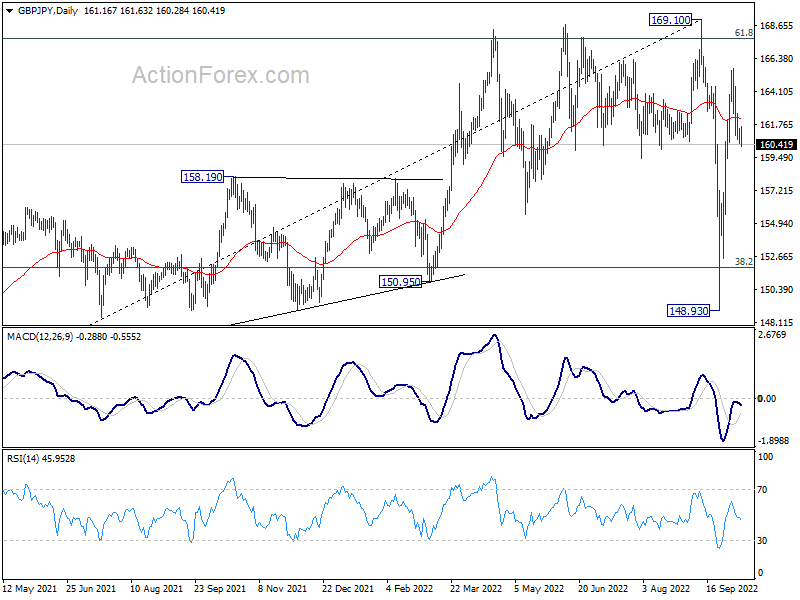
Intraday bias sin GBP/JPY remains neutral for the moment. On the downside, below 159.41 minor support will turn bias back to the downside for 148.93 again. However, firm break of 169.10 will confirm resumption of larger up trend. Also, while further rise could be seen, strong resistance might be seen from 169.10 high to limit upside, at least on first attempt.
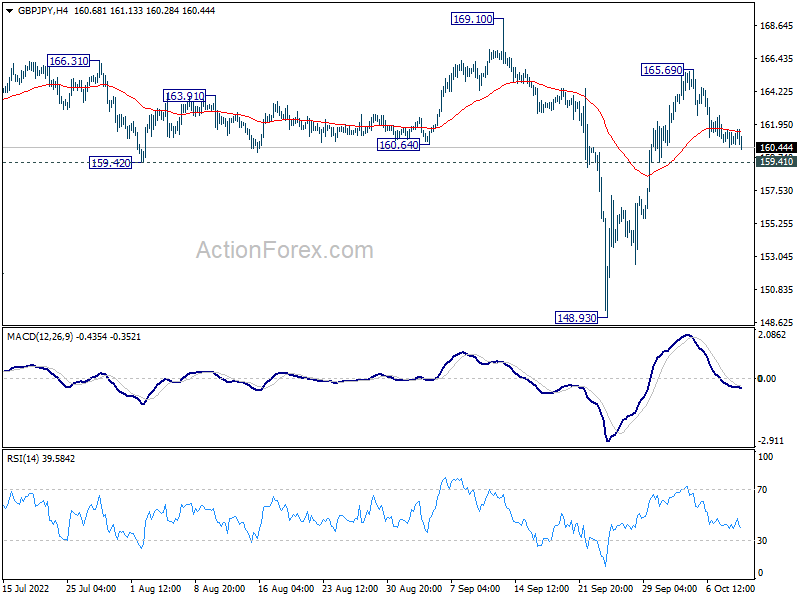
In the bigger picture, strong support from 38.2% retracement of 123.94 to 169.10 at 151.84 suggests that price actions from 169.10 are developing into a corrective pattern only. That is, rise from 123.94 (2020 low) should resume at a later stage. This will now remain the favored case as long as 148.93 support holds.