Sample Category Title
Majority of Dollar Bulls Staying on the Sideline
The majority of Dollar bulls appear to be staying on the sideline today. Despite earlier rally attempt, the greenback starts to pare back some gains into US session. US futures are also trading flat in very tight range. Investors are holding their bet ahead of a wave of speeches of central bankers, and more importantly, US CPI data to be featured later in the week. Sterling is taking European majors higher after solid job data. Commodity currencies are digesting recent losses.
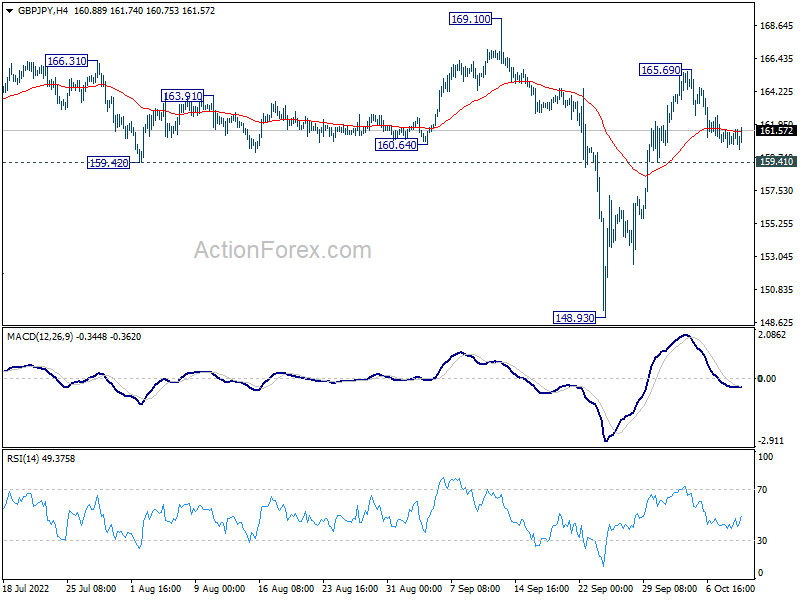
Technically, both EUR/JPY and GBP/JPY are holding above minor support levels of 140.77, 159.41 respectively, despite this week's retreats. As long as these levels hold, further rise could be seen to retest recent highs at 145.62 and 169.10, before another fall. The interesting part is, if EUR/JPY and GBP/JPY do rebound, what would be the corresponding action in USD/JPY? A break through 145.89 high even with the risk of intervention by Japan?
In Europe, at the time of writing, FTSE is down -0.44%. DAX is down -0.30%. CAC is down -0.01%. Germany 10-year yield is down -0.0164 at 2.330. Earlier in Asia, Nikkei dropped -2.64%. Hong Kong HSI dropped -2.23%. China Shanghai SSE rose 0.19%. Singapore Strait Times dropped -0.08%. Japan 10-year JGB yield rose 0.0014 to 0.255.
UK payrolled employment rose 69k in Sep, unemployment rate dropped to 3.5% in Aug
UK payrolled employment rose 69k in September, or 0.2% mom, to 29.7m. Total growth over the 12-month period was 714k. Median monthly pay rose 6.3% yoy to GBP 2131.
In the three-month period to August, unemployment rate dropped to 3.5%, down -0.3% from the previous three-month period. Employment rate also dropped -0.3% to 75.5%. Economic inactivity rate rose 0.6% to 21.7%. Totally weekly hours dropped -0.4% to 1046m.
Average earnings excluding bonus rose 5.4% 3moy in August, up from 5.2%. Average earnings including bonus rose 6.0% 3moy, up from 5.5% 3moy.
Japan foreign currency deposits up 8.3% since start of the year
Accord to latest BoJ data, foreign currency deposits at domestic banks rose the JPY 26.58T at the end of August, up 8.3% since the start of 2022. The increase in deposits in the eight month period was also the highest since 2015.
The surge could partly be explained by Yen's depreciation. Yet, the flow into foreign currencies could also be seen as a factor contributing to the persistent decline in Yen's exchange rate.
Japan Suzuki: Will take appropriate action on excessive Yen moves
Japanese Finance Minister Shunichi Suzuki reiterated today, "we will take appropriate action if there are any excessive moves" in Yen's exchange rate. The comment came as Yen threatens to decline further towards the lowest level since 1998 again.
Suzuki also said, Japan is closely watching current FX moves with a "strong sene of urgency". He planned to explain the stance on intervention at G20 meeting. He said that Japan have gained "certain understanding" from the US regarding intervention.
Australia Westpac consumer sentiment dropped to 83.7, RBA averted a much bigger fall
Australia Westpac Consumer Sentiment Index dropped -0.9% mom to 83.7 in October. Westpac said the index remains in "deeply pessimistic territory", at a level comparable to the lows "briefly reached during the pandemic", and during the Global Financial Crisis.
It added RBA's smaller than expected 25bps rate hike "averted a much bigger fall" in sentiment. Sentiment amongst those sampled before the RBA decision showed a "depressing" 77.4 index read. But the post RBA "relief rebound" is "unlikely to be repeated in future months".
Westpac expects four more consecutive 25bps rate hikes at RBA's November, December, February and March meetings.
Australia NAB business conditions rose to 25, confidence dropped to 5
Australia NAB Business Confidence dropped from 10 to 5 in September. Business Conditions rose from 22 to 25. Trading conditions rose from 29 to 38. Profitability conditions was unchanged at 19. Employment conditions dropped from 17 to 16.
"Conditions are now higher than their pre-COVID peak, which shows just how strong demand is at present," said NAB Chief Economist Alan Oster. "The current level of conditions are only exceeded by the post-lockdown surge in early 2021. Clearly, consumers are still finding a way to keep spending, with the very strong labour market, savings buffers and a broader post-pandemic recovery all playing a role."
"Confidence eased in the month but is still around the long-run average in the history of the survey," said Oster. "The confidence index has been volatile recently but is clearly a little lower than it was early in the year when the passing of the Omicron wave was providing a strong reason for optimism. Still, businesses are far from pessimistic."
USD/JPY Mid-Day Outlook
Daily Pivots: (S1) 145.30; (P) 145.55; (R1) 145.97; More...
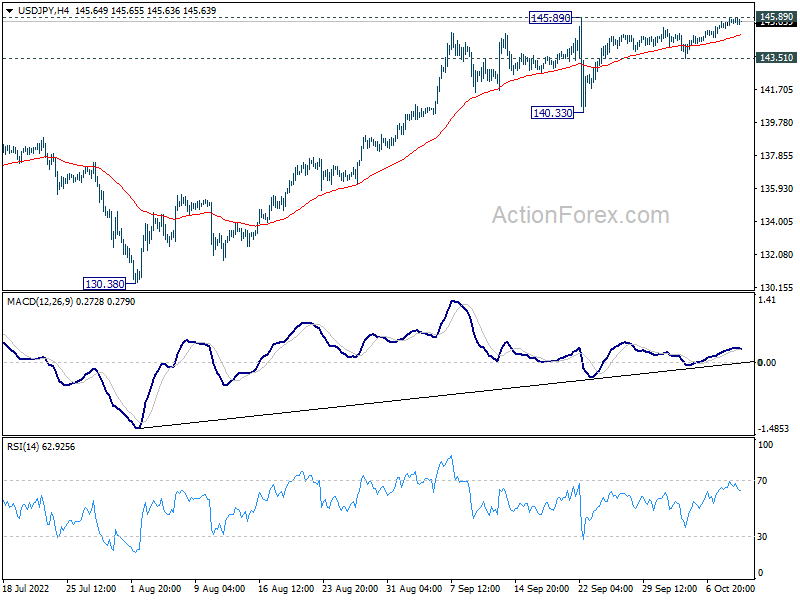
Intraday bias in USD/JPY remains neutral for the moment. On the upside, firm break of 145.89 will resume larger up trend to 147.68 long term resistance. On the downside, break of 143.51 minor support will turn bias back to the downside to 140.33 support. But overall outlook will stay bullish as long as 139.37 resistance turned support holds.
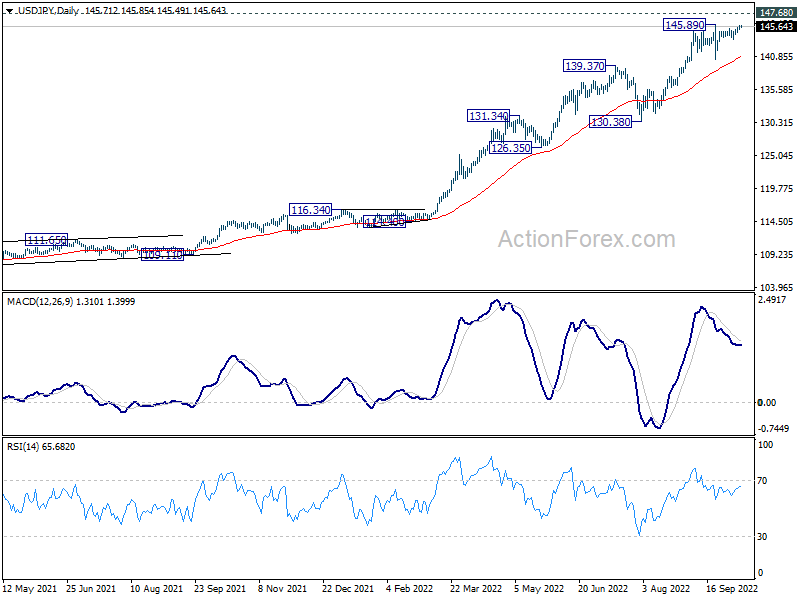
In the bigger picture, up trend from 101.18 is still in progress, as part of the whole up trend from 75.56 (2011 low). Further rise should be seen to 147.68 (1998 high). For now, break of 130.38 support is needed to be the first indication of medium term topping. Otherwise, outlook will stay bullish even in case of deep pull back.
Economic Indicators Update
| GMT | Ccy | Events | Actual | Forecast | Previous | Revised |
|---|---|---|---|---|---|---|
| 23:01 | GBP | BRC Like-For-Like Retail Sales Y/Y Sep | 1.80% | 0.50% | ||
| 23:30 | AUD | Westpac Consumer Confidence Oct | -0.90% | 3.90% | ||
| 23:50 | JPY | Current Account (JPY) Aug | -0.53T | -0.47T | -0.63T | |
| 00:30 | AUD | NAB Business Confidence Sep | 5 | 10 | ||
| 00:30 | AUD | NAB Business Conditions Sep | 25 | 20 | ||
| 06:00 | GBP | Claimant Count Change Sep | 25.5K | 4.2K | 6.3K | 1.1K |
| 06:00 | GBP | ILO Unemployment Rate (3M) Aug | 3.50% | 3.60% | 3.60% | |
| 06:00 | GBP | Average Earnings Excluding Bonus 3M/Y Aug | 5.40% | 5.30% | 5.20% | |
| 06:00 | GBP | Average Earnings Including Bonus 3M/Y Aug | 6% | 5.90% | 5.50% | |
| 08:00 | EUR | Italy Industrial Output M/M Aug | 2.30% | 0.20% | 0.40% | 0.50% |
GBP Has Already Passed its Bottom, Despite UK Job Market Data
A fresh batch of UK labour market data points to a turn for the worse, foreshadowing an economic slowdown sooner than in Europe or the USA.
The claimant count in September rose by 25.5k after a nominal increase of 1.1k a month earlier. This is a much more substantial increase than the expected 4.2k and demonstrates an apparent reversal in the trend.
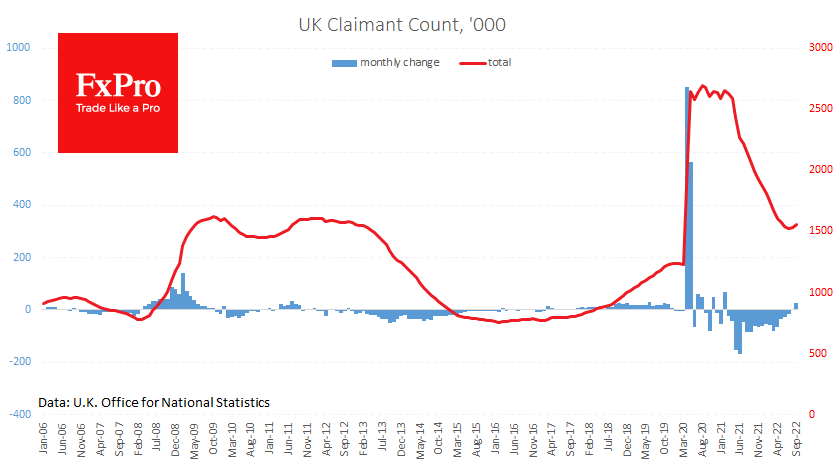
Just over 1.5M people in the UK are now receiving benefits, not far from the highs of the 2009-2013 period and 0.3m higher than before the pandemic. So, the cycle in the labour market here has reversed without ever reaching the point of full recovery.
In this context, the unemployment rate fall to 3.5% – the lowest since 1974 – is the result of an exit from the labour force rather than a tight labour market.
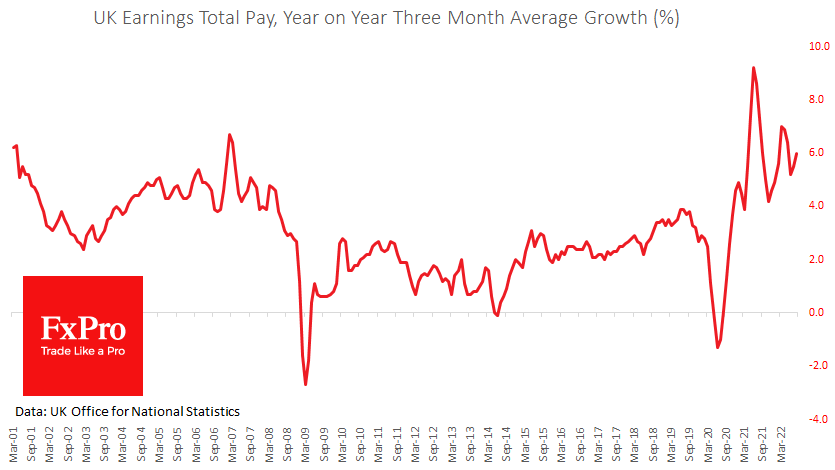
In the three months to August, wages, including bonuses, rose by 6% to the same period a year earlier – a marked acceleration from 5.5% the month before. This attempt to catch up with inflation, which stood at 9.9% YoY in August, is triggering the increase in claimant count we mentioned above.
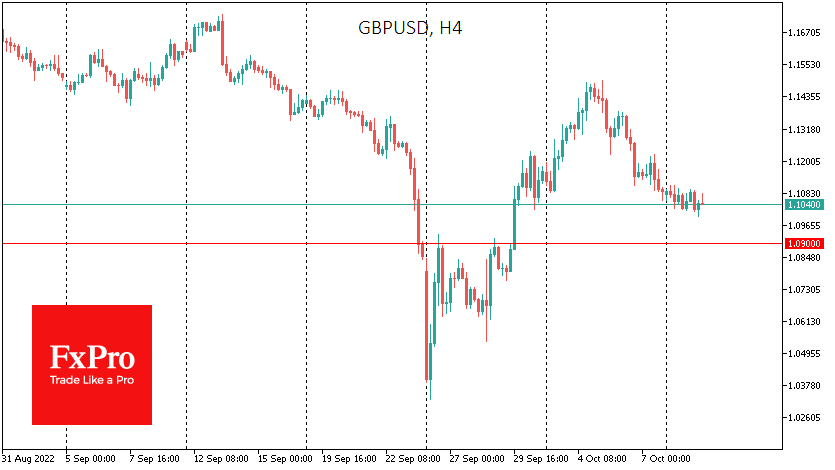
Meanwhile, GBPUSD is declining for the fifth consecutive trading session on the FX market. The initial downward momentum in the pair after the employment data came up against moderate buying around 1.10, a psychologically crucial round level. For now, however, it is unlikely that Pound buyers have enough strength at this stage to reverse the trend of recent days.
A glance at the short-term dynamics of GBPUSD allows us to expect more buying activity at 1.0900, where local resistances of September 26 and 28 are located and where the rapid growth of September 29 started.
Despite the worsening macroeconomic backdrop for the pound, many problematic expectations may already be embedded in the pound’s quotes. If we are right, a period of consolidation could start for GBPUSD, as it did from April to May 2020 or from October 2016 to January 2017, followed by a reversal to growth.
Japan foreign currency deposits up 8.3% since start of the year
Accord to latest BoJ data, foreign currency deposits at domestic banks rose the JPY 26.58T at the end of August, up 8.3% since the start of 2022. The increase in despoits in the eight month period was also the highest since 2015.
The surge could partly be explained by Yen's depreciation. Yet, the flow into foreign currencies could also be seen as a factor contributing to the persistent decline in Yen's exchange rate.
Market Mood Fragile Ahead Of US CPI
A sense of deep unease rippled through financial markets on Tuesday as concerns over the global growth outlook and geopolitical threats left investors on edge.
European stocks were painted red this morning amid fears around untamed inflation pushing interest rates higher at the expense of economic growth. US stock futures are pointing to a lower open with the negative momentum and risk-off sentiment infiltrating Wall Street. In the currency space, king dollar continues to draw power from aggressive rate hike bets while sterling remains shaky despite efforts from the Bank of England to support the currency and the vulnerable UK bond market. Oil is weaker thanks to a strong dollar and an outbreak of Covid-19 cases in China, while gold is selling off for a fifth day in a row as traders await Thursday’s US CPI report.
It may be wise to fasten your seatbelts tightly because this will be another busy week for markets. Investors will be served a platter of key economic reports and speeches from various financial heavyweights. Most importantly, all eyes will be on the latest US inflation figures which is now the biggest risk event on the calendar. Later today, the International Monetary Fund (IMF) publishes its World Economic Outlook and will almost certainly revise global growth lower. ECB Chief Economist Philip Lane, Bank of England Governor Andrew Bailey, and Cleveland Fed President Loretta Mester will be under their separate spotlights. Given how financial markets remain highly sensitive to anything relating to inflation or monetary policy, any fresh insight offered by these central bank officials could translate into market volatility.
All eyes on the US inflation report
Most attention will be directed toward the US inflation report on Thursday with investors watching to see if prices are rising again or perhaps finally peaking. According to Bloomberg, the headline print for September is projected at 8.1% from 8.3%, while the core is expected to rise to 6.5% from 6.3% in August. A higher-than-expected CPI figure may reinforce expectations around the Fed unleashing another monetary bazooka in November to tame inflation. This could inject dollar bulls with fresh momentum to steamroll G10 and other currencies. It’s worth keeping in mind that the greenback has had a phenomenal trading year, appreciating against every single major currency. Alternatively, a softer print could reduce aggressive rate hike bets and feed the “dovish pivot” narrative ultimately hitting the dollar. Traders are currently pricing in an 80% probability of a 75-basis point rate hike next month.
Currency spotlight – GBPUSD
Sterling has struggled for direction so far on Tuesday despite the upbeat jobs report soothing concerns over the UK economy. Unemployment hit a fresh multi-decade low at 3.5% in the three months to August from 3.6% in the previous period. This was the lowest level witnessed since February 1947. However, the fall in unemployment was the result of a sharp rise in the number of adults within working age labelled as economically inactive. The focus now shifts toward the BoE Governor Bailey’s speech later today. If he mentions anything relating to inflation, monetary policy, and the ructions in the gilt market, this could translate into pound volatility.
Focusing on the technical picture, GBP is under pressure on the daily charts. An appreciating dollar could drag prices back toward 1.0850 support. Weakness below this point may trigger a selloff towards 1.0520. Alternatively, a break back above 1.1100 has the potential to spark a rally towards 1.1300.
Commodity spotlight - Gold
Where gold concludes this week will most likely be influenced by the US inflation data on Thursday.
A red-hot CPI report will almost certainly reinforce aggressive rate hike bets, ultimately boosting the dollar and Treasury yields at gold’s peril. Such a development may drag the precious metal towards $1655, $1615, and $1600. Alternatively, an inflation report that misses expectations could offer space for gold bulls to fight back, opening a path back toward the psychological $1700 level.
XAU/USD: Gold Extends Steep Downtrend as Dollar Firms
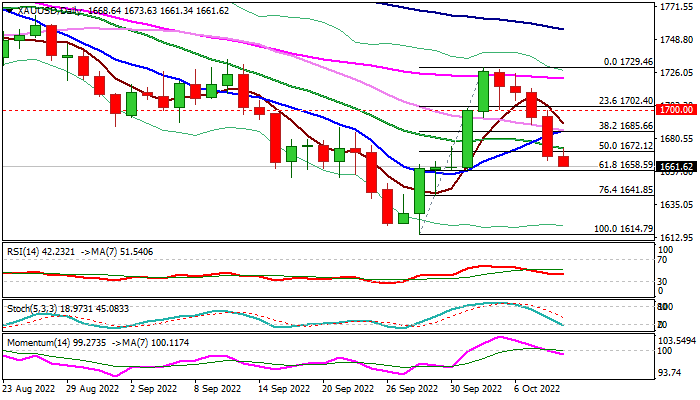
Spot gold hits one-week low in European trading on Tuesday, in extension of Monday’s 1.6% fall, holding in a steep downtrend for the fifth straight day.
Near-term action remains pressured by risk aversion that continues to lift dollar, in addition to expectations that Fed will remain in aggressive mode and deliver another big rate hike in Nov 2 policy meeting.
Pullback from $1729 (Oct 4 lower top) has so far retraced over 50% of $1614/$1729 recovery leg), with today’s close below 50% level, reinforced by falling 20DMA ($1672) to boost bearish signals for extension towards targets at $1658 / $1641 (Fibo 61.8% and 76.4% respectively), which guards key support at $1614 (2022 low).
Daily moving averages turned to full bearish setup and south-heading 14-d momentum moved into negative territory, adding to negative near-term structure.
Limited corrective upticks on oversold conditions and partial profit-taking, to provide better selling levels, while the action stays below broken 10DMA ($1686).
Res: 1672; 1685; 1690; 1700.
Sup: 1658; 1641; 1620; 1614.
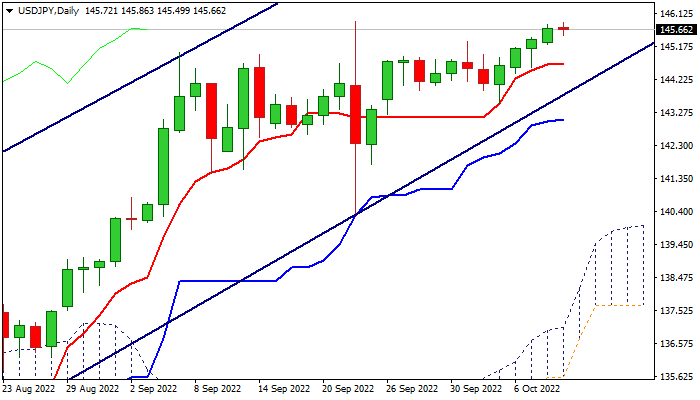
USD/JPY: Bulls Look for a Break of New 24-Year High
The USDJPY is trading just ticks ahead of new 24-year high (145.90, posted on Sep 22) in European session on Tuesday.
Bulls regained traction after a quick pullback from 145.90 peak found firm ground just above psychological 140.00 support and nearly fully retraced 145.90/140.34 dip, setting scope for a break higher that would signal a continuation of larger uptrend and bring in focus key long-term barrier at 147.68 (1998 high).
Bullish technical studies support the action, however, bulls may face headwinds at 145.90 pivot and slow the pace, as daily stochastic is strongly overbought and bullish momentum is easing.
Shallow dips should be contained by rising 10DMA (144.84) to keep bulls intact, while break lower would weaken immediate bullish structure and signal prolonged consolidation.
Trendline support at 144.12 (bull-trendline off Aug 2 through at 130.39) marks pivotal support.
Res: 145.90; 146.90; 147.21; 147.68.
Sup: 145.23; 144.84; 144.12; 143.52.
AUD/USD Falls to New 18-Month Low
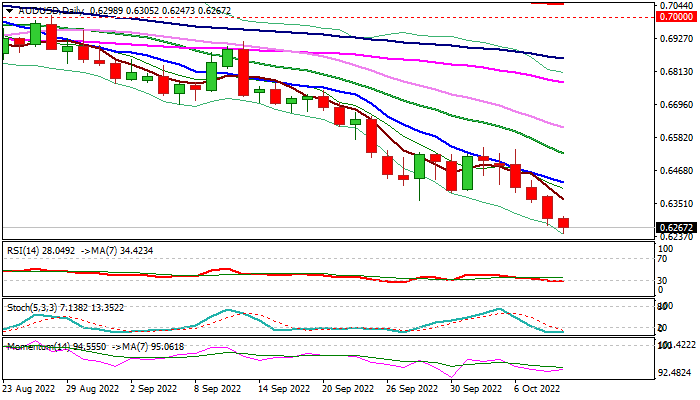
AUD/USD continues to lose ground and can’t find its footing. The Aussie started the week on the wrong foot, with a decline of 1.0% on Monday. In today’s European session, AUD/USD is trading at 0.6266 down 0.52%. Earlier the day, the Australian dollar fell to 0.6247, its lowest level since April 2020.
Weak PMI, confidence data weighs on Aussie
Australia has posted weak numbers this week, adding to the downward pressure on the ailing Australian dollar. The Services PMI fell into contraction territory with a reading of 48.0 in September, down from 53.3 in August, as the uncertain economic outlook is weighing on business activity. Business confidence levels are down, with NAB business confidence slowing to 5 in September, down from 10 in August. Westpac Consumer Sentiment indicated that consumers are also in a sour mood, with a reading of -0.9% in September after a gain of 3.9% in August, which was the sole gain over the past 11 months.
Risk appetite has been dampened by the escalating crisis in the Ukraine war, with Russia annexing parts of occupied Ukraine and firing missiles at civilian targets. As well, the energy crisis is looming over Western Europe, just weeks ahead of winter. This is weighing on the risk-sensitive Australian dollar.
In the US, inflation releases have taken on added significance, as the Federal Reserve has designated soaring inflation as public enemy number one. The US releases PPI data on Wednesday and CPI a day later. Headline inflation has dropped over the past two months, but remains at 8.3%. Unless headline and core inflation both surprise with much lower readings than expected, I don’t anticipate any change in course from the Fed. If inflation underperforms, the US dollar could lose ground. Conversely, a higher-than-expected inflation report would be bullish for the US dollar.
AUD/USD Technical
- AUD/USD has resistance at 0.6299 and 0.6424
- There is support at 0.6203 and 0.6106
Will US Inflation Seal the Deal for Another Triple Fed Hike?
After another employment report pointing to further tightening in the US labor market, market participants are nearly fully convinced that the Fed will deliver its fourth consecutive 75bps hike when it meets on November 2, and that’s maybe why they kept buying dollars. However, with still three weeks until the meeting, those bets could well be tweaked and the next data having the potential to do so is the inflation numbers for September, due to be released on Thursday at 12:30 GMT.
Fed plays the hawkish drumbeat
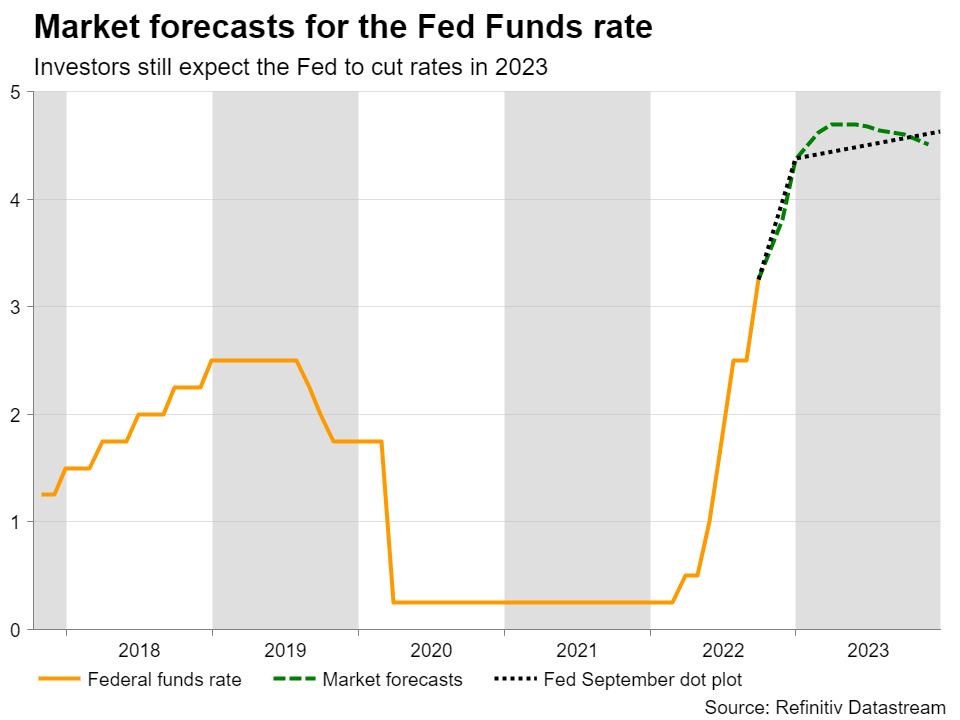
When they last met, Fed officials agreed to raise interest by 75bps for the third time in a row, appearing even more aggressive with regards to their future actions. According to their new dot plot, they were willing to take interest rates up to 4.4% this year and hit a terminal point around 4.6% next year, while they did not anticipate any rate cuts until 2024.
We will get the minutes of the gathering on Wednesday but given that several policymakers have been singing the same hawkish song in the aftermath of the meeting, the minutes may be treated as outdated and have little market impact. Investors are likely to keep their gaze locked on Thursday’s CPIs as they look for more updated information on how the Fed may proceed from here onwards.
Inflation may be stickier than it looks
Despite the US economy contracting during the first half of the year, Fed officials have been constantly arguing that due to a very strong labor market, this doesn’t constitute a recession yet. That placed even more emphasis on the labor market, with market participants adding to their rate-hike bets every time the data is pointing to further employment gains. Last Friday, nonfarm payrolls, though slowing, increased at a decent pace and the unemployment rate fell to its five-decade low of 3.5%. Earnings slowed somewhat, but with headline inflation slowing more, real earnings have been on a steady improvement since June.
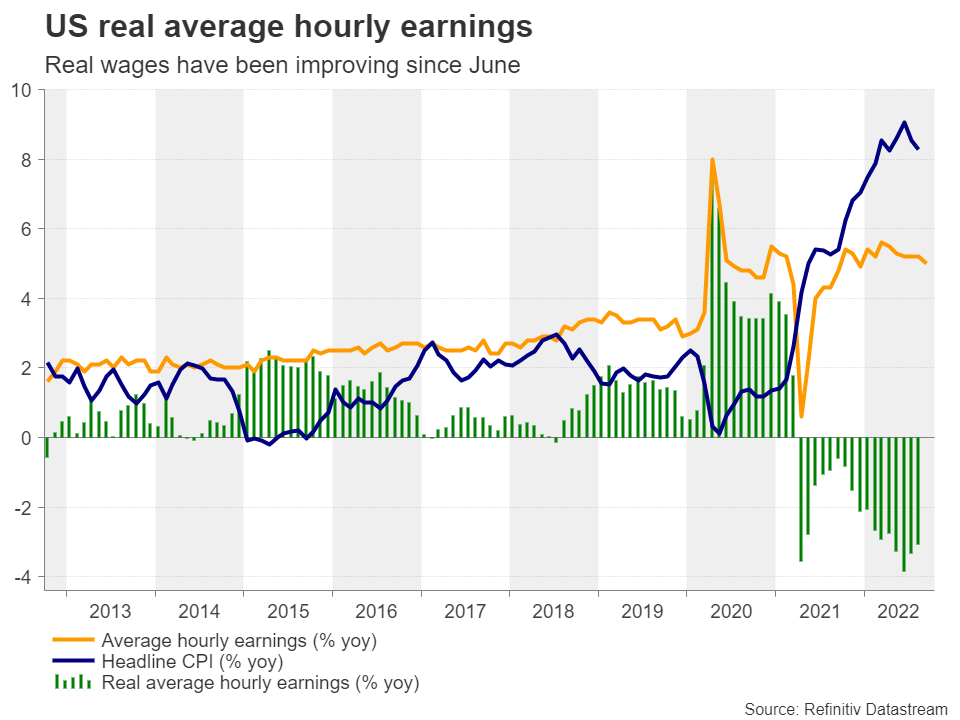
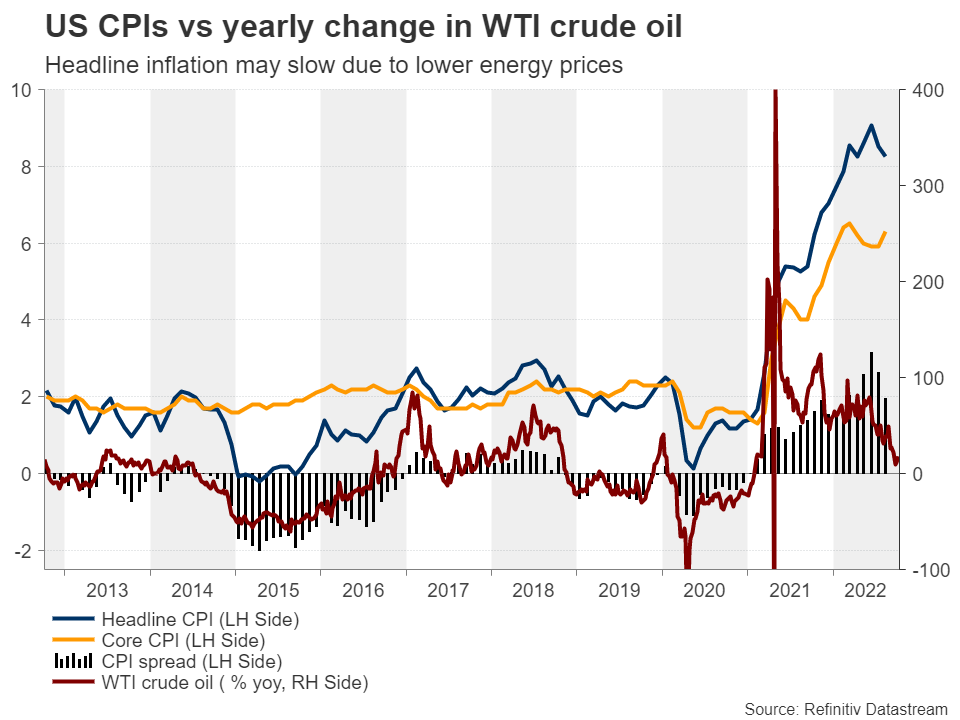
On Thursday, the headline CPI rate is expected to have slid further – to 8.1% year-on-year from the previous month’s 8.3%, but the core is anticipated to have risen to 6.5% from 6.3%. Such a development would imply that the slide in the headline rate is only due to lower prices in items like food and energy and that inflation has become stickier compared to a few months ago. Oil prices have also rebounded from their lows lately following the OPEC+ decision, which could keep headline inflation supported in coming months. Overall, such numbers would probably do very little to revive speculation that the Fed may soon need to slow down its tightening efforts.
According to the Fed funds futures, market participants are assigning a 92% probability for another 75bps hike at the upcoming Fed gathering and they see a terminal rate at around 4.7 in March, which is slightly higher than the Fed’s projections. However, they still see rates 20bps lower by November. Therefore, accelerating underlying inflation could seal the deal for another triple hike, while an upside surprise could prompt participants to price out some of the basis points that they expect to be cut next year.
Dollar to keep flapping its wings
The market reaction could be higher Treasury yields, lower equities, and an even stronger dollar, with euro/dollar sellers perhaps getting confident to aim for another test near the 20-year low of 0.9535, tested on September 28. If they are strong enough to go for a lower low, they will enter territories last seen in June 2002, with the next potential support being the inside swing high of September 16, 2001, at around 0.9335. If that barrier is not able to stop them either, then they could dive all the way down to the round figure of 0.9000, marked by the low of May 15, 2002.
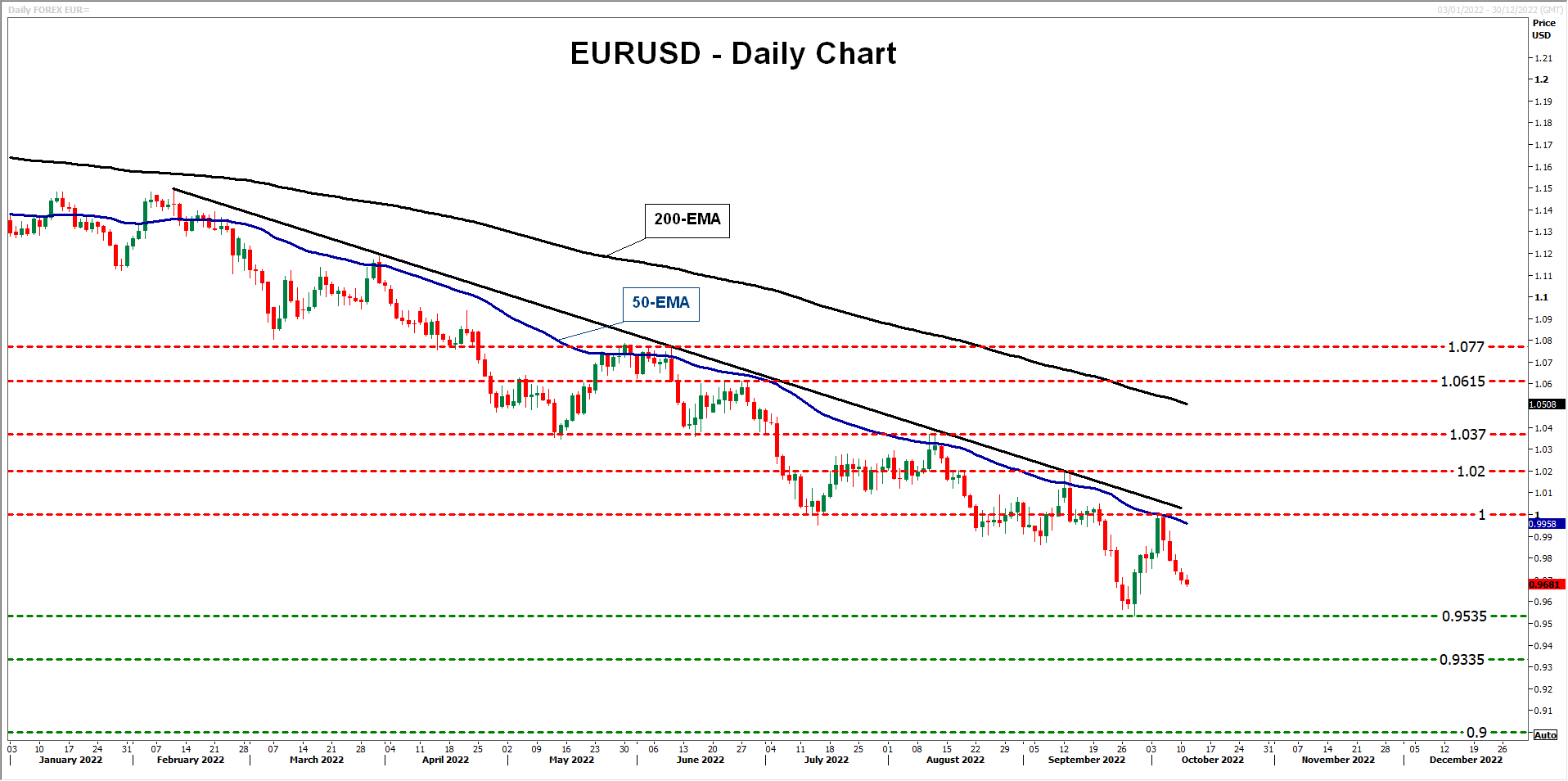
The move that could signal a bullish reversal may be a break above 1.0200 accompanied with improving economic data from the Eurozone and hints that the Fed may eventually not need to hike as aggressively as currently believed. Any signs that the war in Ukraine is moving towards a resolution could also help the euro. The bulls could then get encouraged to aim for the high of August 11 at 1.0370, the break of which could set the stage for extensions towards the high of June 27 at 1.0615.
Will GDP Shake Up GBP/USD?
GBP/USD is trading quietly for a second straight day. In the North European session, GBP/USD is trading at 1.1035, down 0.18%.
The pound has not posted a winning day since October 12th and has lost 400 points during that time. GBP/USD dropped below the symbolic 1.10 line earlier today, and a break below 1.10 will likely increase talk of the pound following the euro and dropping to parity with the dollar.
UK labour market remains robust
The UK labour market is one of the few bright spots in the economy, and today’s employment report reaffirmed that the job market remains tight. Unemployment in the three months to August dipped to 3.5%, down from 3.6%, while average earnings jumped to 6.0%, up from 5.5% and ahead of the consensus of 5.9%. These rosy numbers are dampened by an inflation rate of 9.9%, which has badly hurt real UK incomes.
The strong job market bolsters the likelihood of the Bank of England will deliver some tough medicine at its November meeting, perhaps a super-size rate hike of 1.0%. The BoE was forced to intervene on an emergency basis after the mini-budget almost caused a bond market crash, and investors have circled October 14th, which is the expiry date of the BoE’s gilt-buying intervention. There are concerns that if the BoE does not renew its bond-buying, the result could be another exodus from UK government bonds. On Wednesday, the UK releases GDP for August, which is expected at 0% MoM, down from 0.2% in July.
In the US, inflation will be in focus this week, with PPI data on Wednesday and CPI a day later. Headline inflation is expected to fall to 8.1% in September, down from 8.3% in August, but core CPI is expected to rise to 6.5%, up from 6.3%. Unless inflation surprises sharply to the downside, the release will not cause the Fed to rethink its hawkish policy.
GBP/USD Technical
- GBP/USD faces resistance at 1.1085 and 1.1214
- There is resistance at 1.0935 and 1.0776
AUD/USD: Broad Risk Aversion Pushes Aussie to New Multi-month Low
The Australian dollar extend the bear-leg from Oct 4 lower top (0.6547) into sixth straight day, hitting the lowest since Apr 2020, in early Tuesday’s trading.
Broad risk-off mode on economic uncertainty and growing geopolitical tensions keep the Aussie under pressure, with bad news from China, adding to negative picture.
The latest data showed that China’s services sector contracted for the first time in four months, a surge of new Covid infection cases has been registered in some areas and the United States announced the new package of export restrictions towards China, which together contributed to weakening sentiment.
Fresh bears face headwinds from oversold daily studies, with limited upticks (ideally to be capped under 0.6400 zone) to offer better levels to re-enter larger bearish market for extension towards targets at 0.6098/0.6000 (Fibo 76.4% of 0.5509/0.8007 rally / psychological).
Caution on break above 10DMA (0.6426) that would slow bears and expose pivotal barriers at 0.6530/50 zone (falling 20DMA / lower platform), violation of which would signal stronger correction.
Res: 0.6305; 0.6363; 0.6426; 0.6526.
Sup: 0.6247; 0.6200; 0.6098; 0.6000.