Sample Category Title
Eco Data 10/12/22
[php_everywhere instance="1"]
Fed Mester: There has been no progress on inflation
Cleveland Fed President Loretta Mester said, "Unacceptably high and persistent inflation remains the key challenge facing the U.S. economy. Despite some moderation on the demand side of the economy and nascent signs of improvement in supply side conditions, there has been no progress on inflation."
"Monetary policy is moving into restrictive territory and will need to be there for some time in order to put inflation on a sustained downward path to our 2 percent goal," she said, adding "I do not anticipate any cuts in the fed funds target range next year."
"With growth well below trend over the next couple of years, it is possible that a shock could push the U.S. economy into recession for a time," Mester said, adding "none of this is painless," but it is necessary, as high inflation exerts heavy costs on the economy.
Gold’s Momentum Shifted
Gold reversed course last week retracing its steps back to the $1660 level, after the dollar reinstated its position as the preferred safe haven asset of the market. Weighing the precious further was the resurgence of bond yields climbing near their highs after their recent hiccup and Fed’s policy makers’ hawkish remarks. In this report we aim to shed light on the catalysts driving the precious metal’s price, assess its future outlook and conclude with a technical analysis.
Upside surprise of US employment data lifts the dollar
The greenback managed to string five consecutive days in the greens earlier today, riding the momentum wave after the better-than-expected employment report results for September, that hit the market last Friday. The Non-Farm payrolls figure saw a positive surprise to the upside, with the US economy adding 263k jobs in September, exceeding expectations of 250k which was estimated prior to the release. The figure implies that the US labour market retains its ability to create new jobs amidst widespread fears of economic slowdown and gives confidence to Fed to press on aggressively, focusing solely on taming the persistent problem of inflation. Furthermore, the employment report pinpointed to the fall of the unemployment rate back down to the 3.5% level, showcasing the tightness of the US employment market. On another note, US treasury yields also extended their winning streaks after the data release, pressuring gold prices, contributing further to the pullback of the yellow metal. More specifically the benchmark US 10-Treasury yield is trailing upwards towards the 4% level, currently trading at 3.93%, a level once seen before during 2008. Even though, gold is considered a hedge against inflation and economic uncertainties, rising rates reduce the non-yielding bullion’s appeal, as it dampens its shine as a store of value.
Fed policy makers’ hawkish remarks restated
During a speech yesterday, Fed’s Vice Chair Brainard once again clearly stated the need for restrictive monetary policy, for a prolonged period of time, to ensure that inflationary pressures are indeed brought down to an acceptable level, acknowledging the fact that it may bring also the economy to a grinding halt and push the US economy into a recession. Also, data dependency was another point of reference made by the Vice Chair and since the favorable results of the recent employment report showcase tightness in the US labour market, it could provide extra confidence to the Fed. Given, the statements from the Vice Chair and several other FOMC members during the past week the market appears to have digested the Fed’s intentions for hiking by another 75 basis points in the November meeting and currently the FFF imply an 89% probability for such a scenario to materialize. Furthermore, market participants await in anticipation the high impact inflation print to be released on Thursday and an update on consumer spending tendencies to be showcased by the latest Retail Sales report for September which is expected on Friday. We would also like to point out the scheduled speeches from Philadelphia Fed President Harker, Cleveland Fed President Mester, Minneapolis Fed President Kashkari, Fed Board Governor Bowman and Kansas City Fed President George throughout the week, all of which will be monitored for any deviation from the main rhetoric. Also we highlight the release of the Fed’s last meeting minutes and should the tone of the contents continue to be tilted on the hawkish side, we may see the release providing additional support for the greenback. Should the speeches continue to deliver the as expected hawkish undertone, we would expect seeing support for the dollar and gold to remain prone for downside due to their inherent negative correlation.
CPI print due out on Thursday
The US inflation report is due out this Thursday and market participants will be looking for a status update on the ravaging inflationary pressures that spread discontent and fear across the US economy. According to estimates, the month-on-month CPI rate for September is expected to rise to 0.2% compared to the 0.1% reported last month and should the actual figure meet expectations, the uptick of inflationary pressures on a monthly basis could give confidence to the Fed to continue aggressively with its monetary policy tightening agenda, opting for another 75-basis points hike, in their November meeting. On the other side of the spectrum however, the year-on-year CPI rate for September, is expected to ease to 8.1% compared to the 8.3%, of the previous reading of August. Should the actual rate meet the expectations, with the yearly inflationary metric pointing to an easing of inflationary pressures, could lead the Fed to opt for a smaller rate hike. All things considered however, the yearly CPI rate of 8.1% is still well above the 2% inflation target set as a benchmark from the central bank and the multitude of recent speeches from Fed policy makers reiterating the need for squashing inflation by keep hiking rates, we hold the view that the Fed will stay on course and move aggressively with its tightening plans. Therefore, in our assessment, gold continues to be disproportionately predisposed towards the downside on a fundamental level, as the dollar continues to receive safe haven inflows amidst a grim global economic outlook.
Technical Analysis
XAUUSD H4 Chart
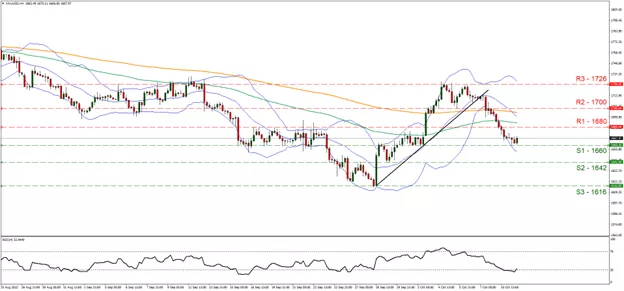
Looking at XAUUSD 4H chart we observe the breakdown from the ascending trendline which was initiated on the 28th of September and the price action moving lower after the better-than-expected employment report results last Friday. We hold a bearish outlook bias for the precious given the break of the ascending trendline and supporting our case is the RSI indicator below our 4-hour chart which currently registers a value of 31, highlighting the negative sentiment surrounding the bullion. We must note however that RSI move below the 30 oversold threshold may be due a correction. Should the bears maintain control, we may see the break below the 1660 (S1) support level and gold moving near the 1642 (S2) support base. Should the bulls take over, we may see the break above the 1680 (R1) resistance level and the price action moving closer to the 1700 (R2) resistance barrier.
IMF global growth at 3.2% in 2022, 2.7% in 2023
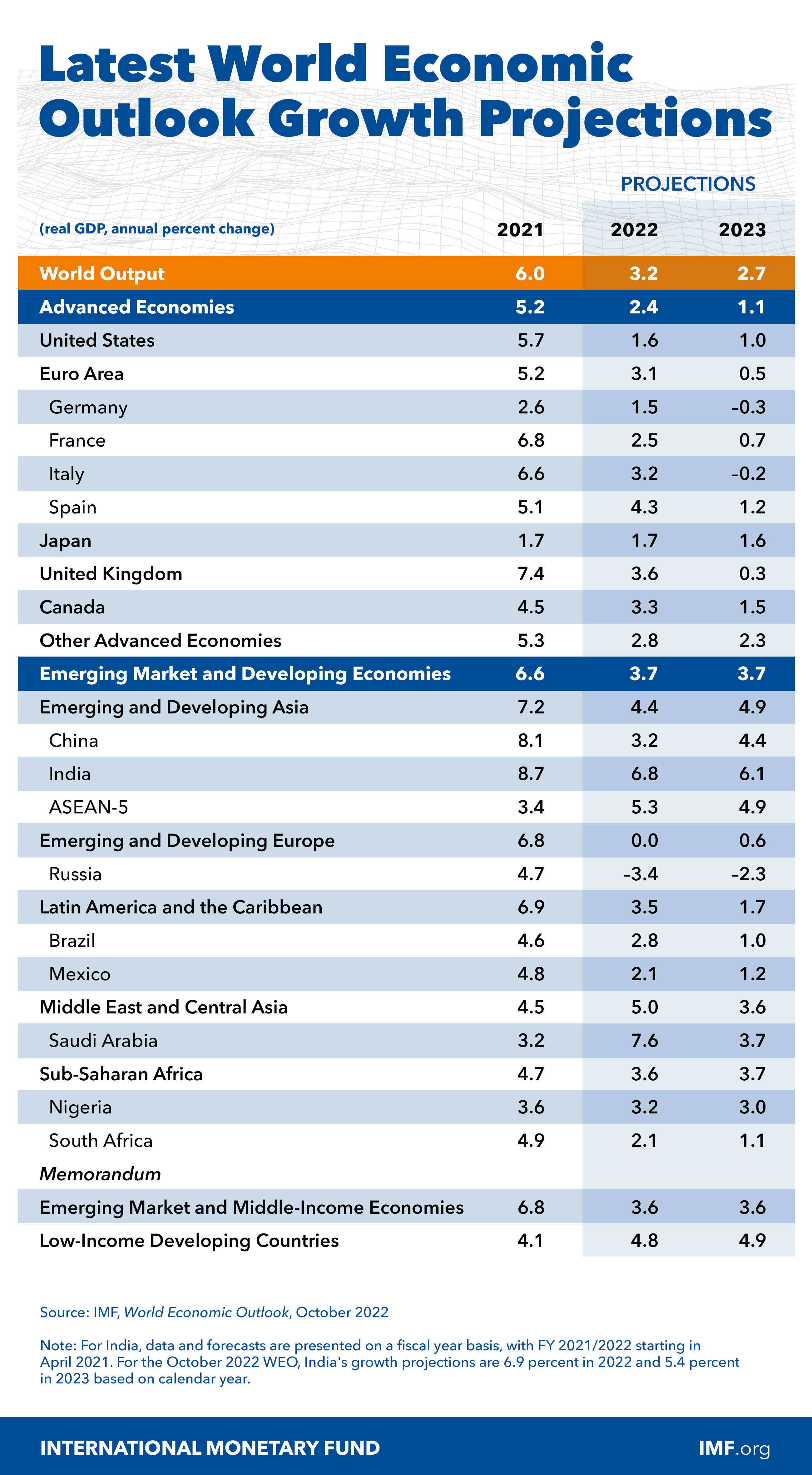
In the latest World Economic Outlook Report, IMF keeps global economic growth forecasts unchanged at 3.2% in 2022, but downgrade 2023 by -0.2% to 2.7%.
It said: "Global economic activity is experiencing a broad-based and sharper-than-expected slowdown, with inflation higher than seen in several decades. The cost-of-living crisis, tightening financial conditions in most regions, Russia's invasion of Ukraine, and the lingering COVID-19 pandemic all weigh heavily on the outlook."
Global inflation is forecast to rise from 4.7% in 2021, to 8.8% in 2022, but to decline to 6.5% in 2023, and then 4.1% in 2024.
IMF said, "Monetary policy should stay the course to restore price stability, and fiscal policy should aim to alleviate the cost-of-living pressures while maintaining a sufficiently tight stance aligned with monetary policy. "
ECB Lane: Monetary policy is to ensure residual inflation dynamic returns to target in timely manner
In a speech, ECB Chief Economist Philip Lane said that monetary is "always decided under conditions on uncertainty", both about "inflation dynamics" and the "channels connecting medium-term inflation to our monetary policy instruments". This uncertainty is "mitigated to some extent by taking a meeting-by-meeting".
The "considerable lags" between monetary policy actions and their impact on inflation outcomes imply that much of the near-term attention in assessing monetary policy actions focuses on the transmission to financial conditions.
Also, "in the absence of further shocks, the profile of euro area inflation over the next 12 to 18 months will be primarily driven by the fading impact of past supply shocks and the deceleration in demand that is signalled by the latest confidence indicators." The role of monetary policy is to ensure that the "residual" inflation dynamic returns to target in a timely manner.
Sunset Market Commentary
Markets
And there is the Bank of England again. Just yesterday, it announced additional measures to support market functioning. In a statement today, the UK central bank widened the scope of its emergency gilt purchase operations to include index-linked government bonds. “…, the beginning of this week has seen a further significant repricing of UK government debt, particularly index-linked gilts. Dysfunction in this market, and the prospect of self-reinforcing ‘fire sale’ dynamics pose a material risk to UK financial stability.”, it said. The BoE commits half of the recently boosted daily maximum (£10bn). The news comes after yields on inflation-linked gilts (= real yields) shot up between 59.7-76.4 bps across the curve yesterday. As these real yields are tied to monetary policy expectations and risk premia, it’s clear that those sharp moves have Chancellor Kwarteng’s £45bn minibudget written all over it. Gilt buying, both conventional and inflation-linked, are still scheduled to end this Friday. But some believe the BoE will be forced to delay its QT plans for a second time given the markets’ stress level. For today, some relative calm has returned to the UK. Gilt yields ease between 2.6 and 6.2 bps in a steepener. The ultralong end, the focus of the BoE interventions, underperforms (+3.8 bps). Inflation-linked bond yields drop 17.6 bps at the front but add a few bps still further out. Sterling holds fairly steady, both against the euro and the dollar. EUR/GBP sticks south of the 0.88 border while cable (GBP/USD) tested but bounced of 1.10 support (1.108 currently).
Other markets trade fairly quiet, killing time in the run-up to US CPI numbers on Thursday. The escalation in the Ukraine war is grabbing some headlines again and keeps sentiment below zero. The IMF cutting the 2023 world GDP outlook and warning that the worst is yet to come obviously isn’t helping either. European stocks shed 0.5%, though losses were almost triple that in the first half of the session. WS opens with losses up to 1%. The S&P500 risks losing the previous YtD low. European yields don’t build on yesterday’s late-session momentum. German rates ease 1.5-3 bps across the curve. The US curve steepens with the long end underperforming (+3.5-6.5 bps) the front (-1.5 bps) in a catch-up move. Key technical levels (e.g. 4% in US 10y) were tested but survive for now. The dollar fluctuates around opening levels. EUR/USD trades around 0.97, the trade-weighted USD is flipflopping around 113.
News Headlines
Czech inflation accelerated from 0.4% M/M in August to 0.8% M/M in September with the headline number picking up more than forecast from 17.2% Y/Y to 18% Y/Y. Core inflation did not increase further, but remains high at 14.7% Y/Y. Monthly dynamics were mainly influenced by prices of “housing, water, gas, electricity and other fuels”. Prices of goods in total went up by 1.5% M/M (20.7% Y/Y) while prices of services dropped by 0.3% M/M (13.7% Y/Y). The Czech National Bank commented on the inflation release. They point out that the Y/Y increase in consumer prices in September was more than two percentage points smaller than expected in the CNB’s summer forecast (20.4% Y/Y). Underlying dynamics strengthen their view this could be the peak. A moderation of price growth will be fostered by an easing of the dynamics of production costs, a decline in households’ purchasing power, and the stabilizing effect of the previous monetary policy tightening helping to cool domestic demand. Czech swap yields nevertheless follow the global trend higher, adding 10+ bps across the curve. Money markets still take into account one final fine-tuning hike from the CNB (+25 bps) despite the status quo of the past two months at 7%.
Hungarian inflation surged by 4.1% M/M to 20.1% Y/Y (from 15.6% Y/Y) in September. Changes in regulation for household utility prices pushed the cost of electricity, gas and other fuel significantly higher. Core inflation nevertheless also surged to 20.7% Y/Y. The Hungarian swap yield curve turned more inverse with yields spiking 20 bps (20-yr) to 50 bps (2-yr) higher. The forint sets an all-time low at EUR/HUF 430. Will the MNB be able to stick to its view that 13% is the policy rate peak? Money markets don’t think so and discount at least another 200 bps of tightening.
EUR/USD Mid-Day Outlook
Daily Pivots: (S1) 0.9670; (P) 0.9715; (R1) 0.9748; More...
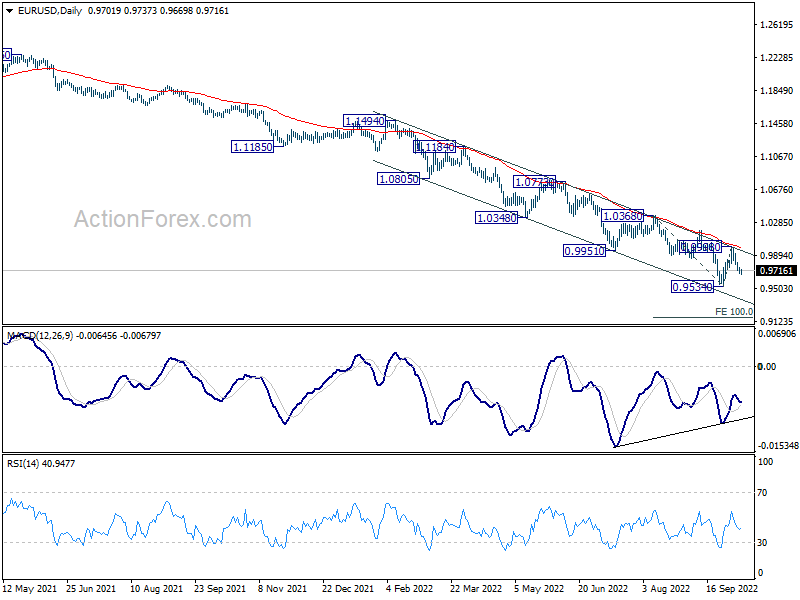
Intraday bias in EUR/USD stays mildly on the downside for retesting 0.9534 low. Firm break there will resume larger down trend for 100% projection of 1.0368 to 0.9534 from 0.9998 at 0.9163. For now, risk will stay on the downside as long as 0.9998 resistance holds, in case of recovery.
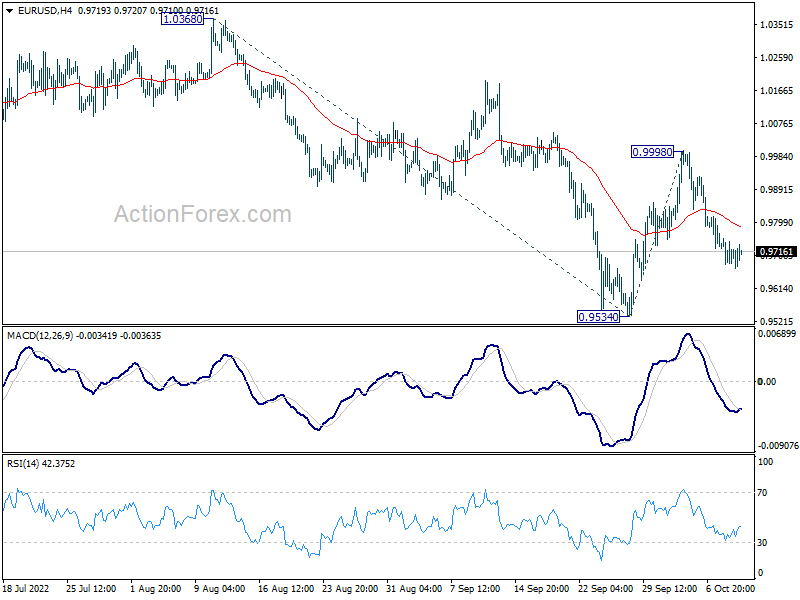
In the bigger picture, down trend from 1.6039 (2008 high) is still in progress. Next target is 100% projection of 1.3993 to 1.0339 from 1.2348 at 0.8694. In any case, break of 0.9998 resistance is needed to be the first sign of medium term bottoming. Otherwise, outlook will stay bearish even with strong rebound.
GBP/USD Mid-Day Outlook
Daily Pivots: (S1) 1.1003; (P) 1.1073; (R1) 1.1127; More...
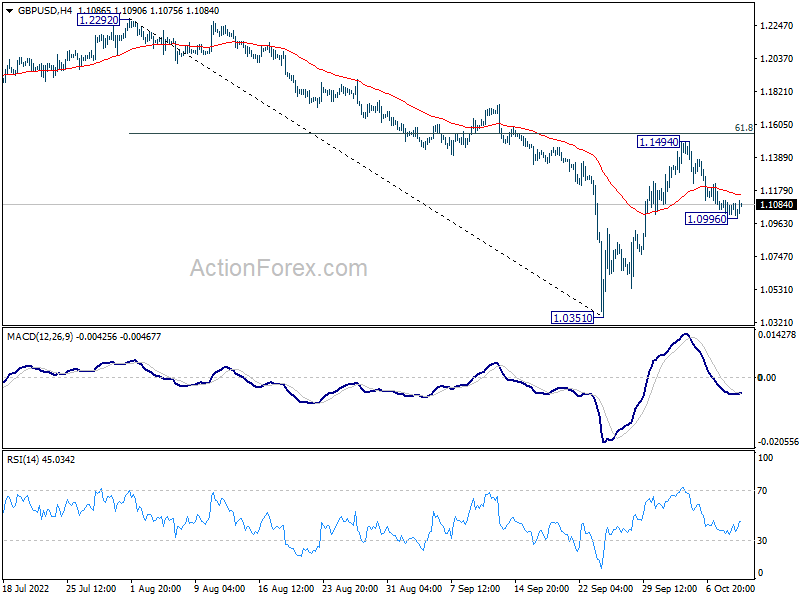
GBP/USD lost some downside momentum after dipping to 1.0996 and intraday bias is turned neutral first. Rebound from 1.0351 could have complete at 1.1494. Risk will stay on the downside as long as this resistance holds. Break of 1.0996 will resume the fall to retest 1.0351 low.
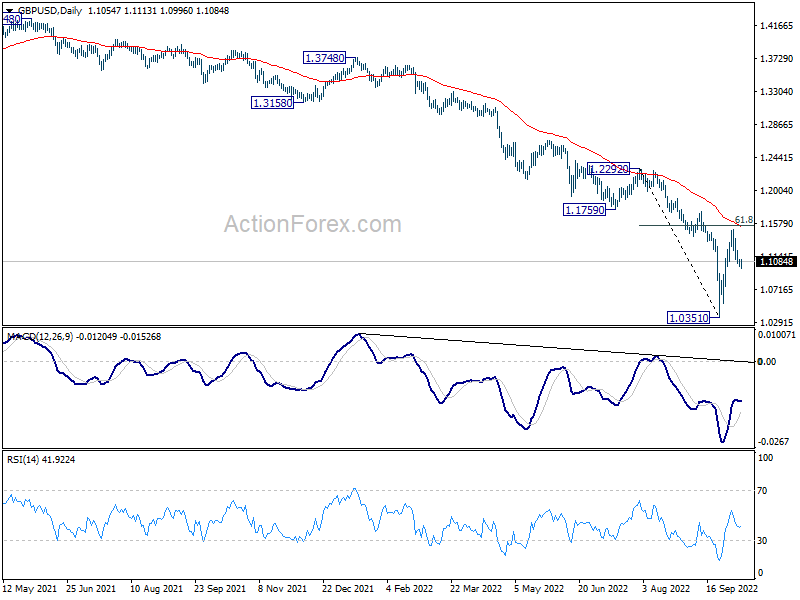
In the bigger picture, fall from 1.4248 (2018 high) is resuming long term down trend from 2.1161 (2007 high). Next target is 100% projection of 2.1161 to 1.3503 from 1.7190 at 0.9532. There is no scope of a medium term rebound as long as 1.1759 support turned resistance holds.
USD/CHF Mid-Day Outlook
Daily Pivots: (S1) 0.9951; (P) 0.9981; (R1) 0.0030; More...
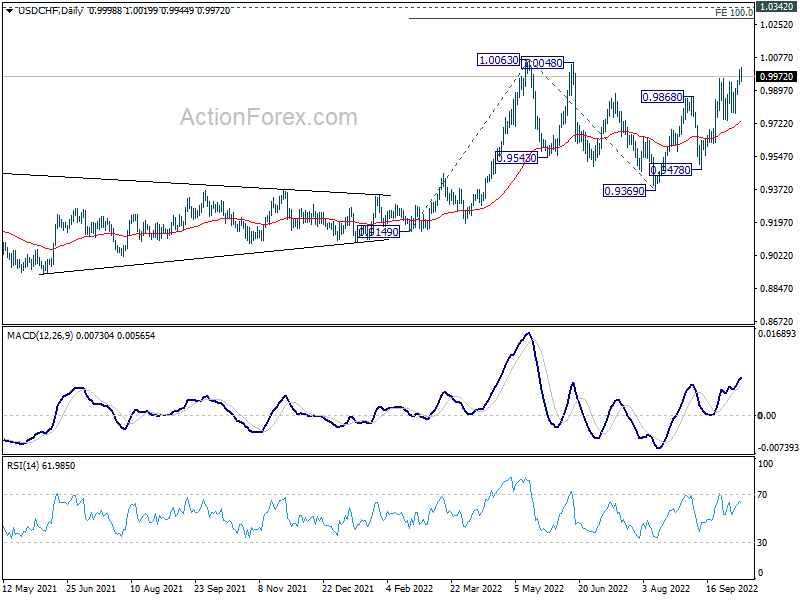
USD/CHF retreated after rising to 1.0019 and intraday bias is turned neutral again. While deeper fall cannot be ruled out, break of 0.9779 support is needed to indicate short term topping. Otherwise, outlook will stay cautiously bullish in case of retreat. On the upside, above 1.0019 will target 1.0063 high first. Decisive break there will resume larger up trend.
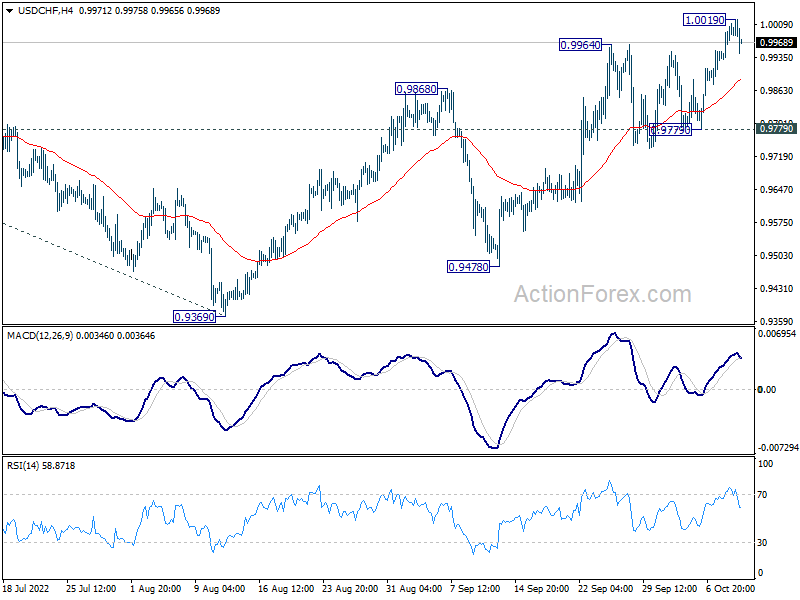
In the bigger picture, current development suggests that up trend from 0.8756 (2021 low) is still in progress. Sustained break of 1.0063 will target 100% projection of 0.9149 to 1.0063 from 0.9369 at 1.0283, and then 1.0342 (2016 high). For now, this will remain the favored case as long as 0.9369 support holds, even in case of deep pull back.
USD/JPY Mid-Day Outlook
Daily Pivots: (S1) 145.30; (P) 145.55; (R1) 145.97; More...
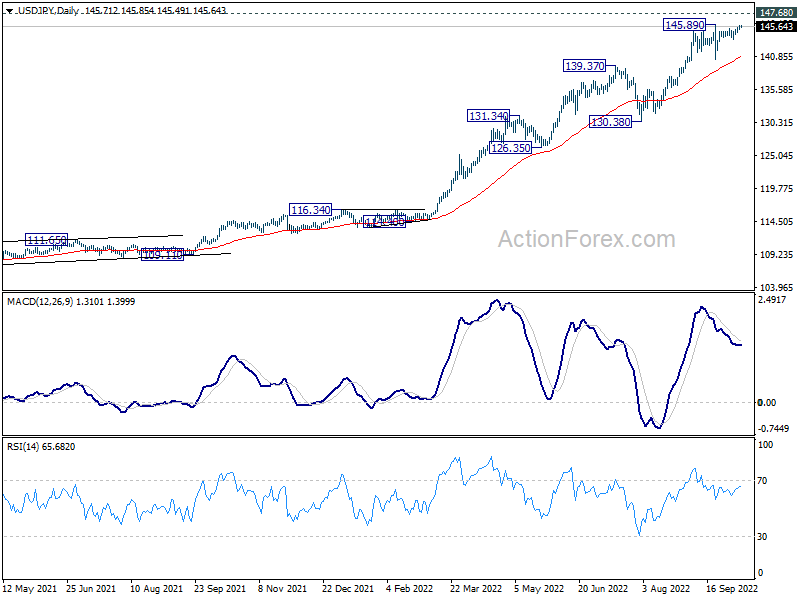
Intraday bias in USD/JPY remains neutral for the moment. On the upside, firm break of 145.89 will resume larger up trend to 147.68 long term resistance. On the downside, break of 143.51 minor support will turn bias back to the downside to 140.33 support. But overall outlook will stay bullish as long as 139.37 resistance turned support holds.
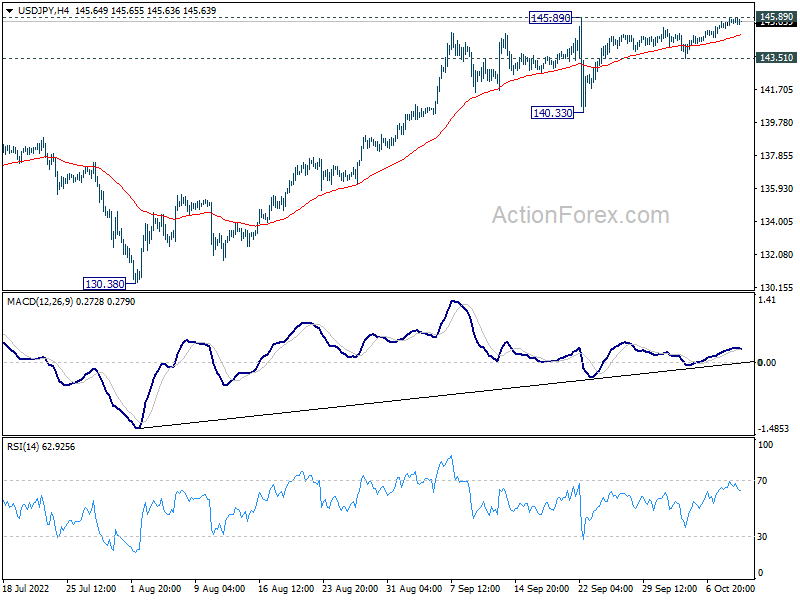
In the bigger picture, up trend from 101.18 is still in progress, as part of the whole up trend from 75.56 (2011 low). Further rise should be seen to 147.68 (1998 high). For now, break of 130.38 support is needed to be the first indication of medium term topping. Otherwise, outlook will stay bullish even in case of deep pull back.