Sample Category Title
NZDJPY Wave Analysis
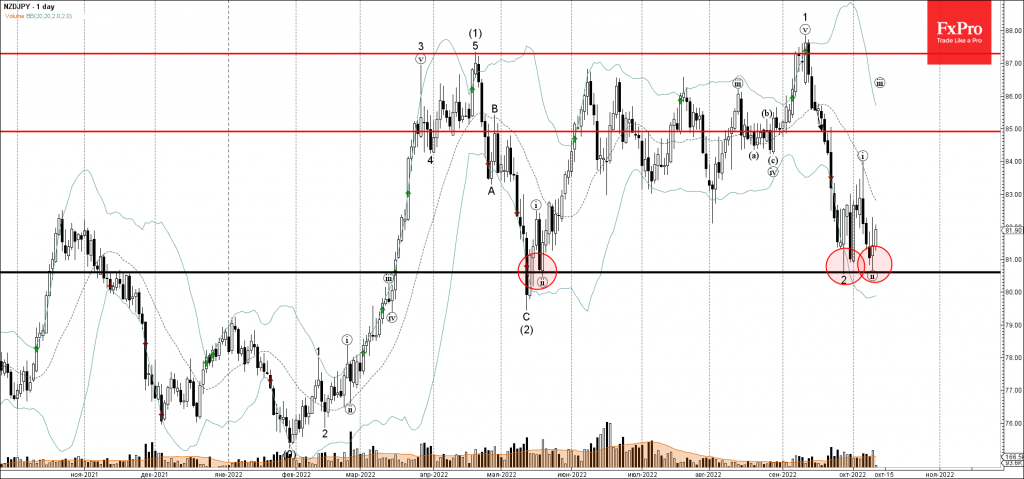
- NZDJPY reversed from support zone
- Likely to rise to resistance level 82.30
NZDJPY recently reversed up from the support zone lying between the key support level 80.60 (which has been reversing the pair from May) and the lower daily Bollinger Band.
The upward reversal from this support zone stopped the earlier short-term corrective wave (ii).
NZDJPY can be expected to rise further toward the next resistance level 82.30 (previous daily high).
NZDUSD Rises after Hitting New 31-Month Low
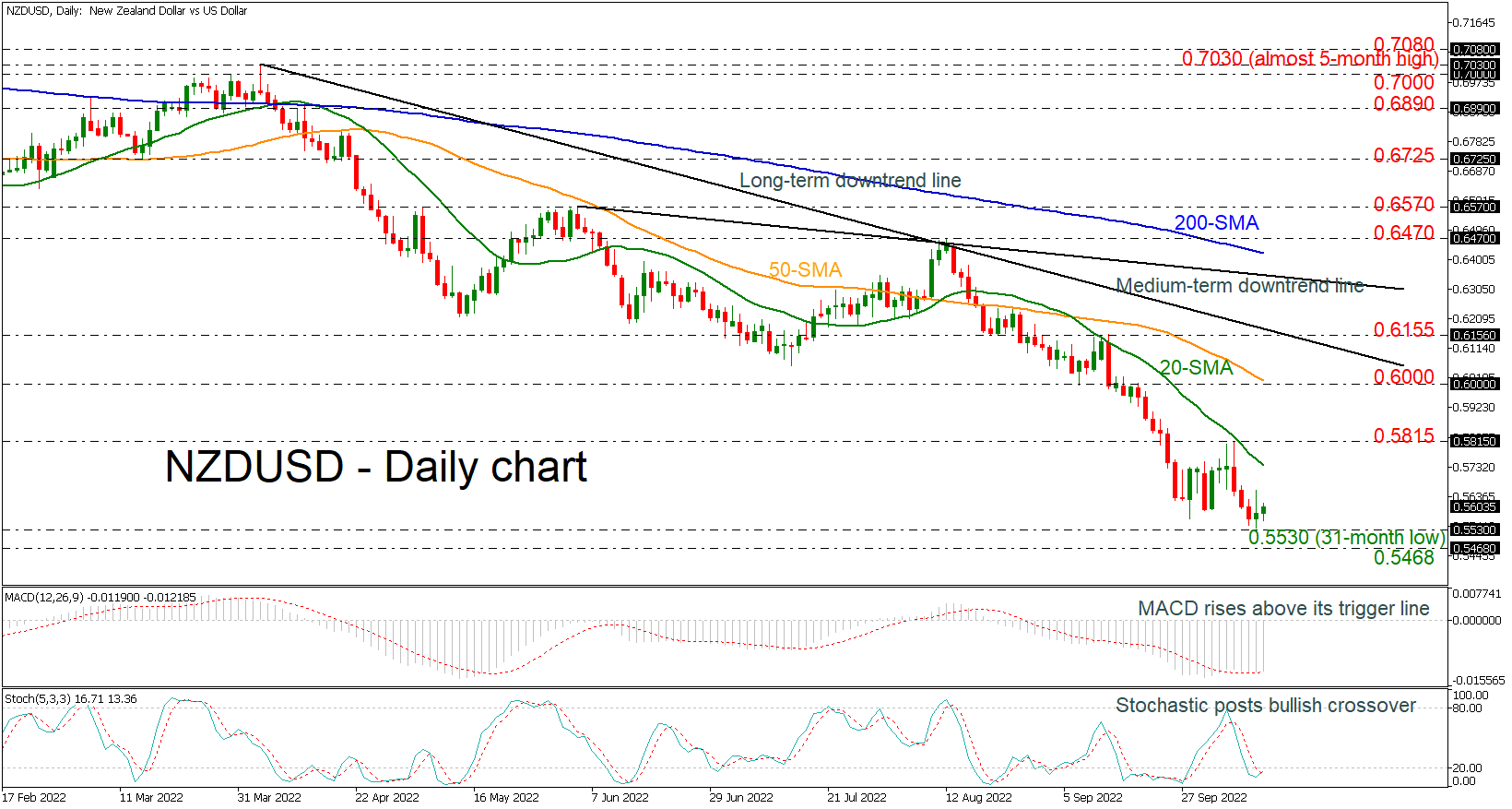
NZDUSD is posting some gains after the selling interest towards the 31-month trough of 0.5530. The technical oscillators are suggesting positive movements in the short-term, as the MACD moved above its trigger line, while the stochastic posted a bullish crossover within the %K and %D lines in the oversold zone. The short-term simple moving averages are heading south following the downside movement.
More upside pressures could drive the market until the immediate resistance of the 20-day SMA at 0.5740 before meeting the 0.5815 barrier. Moving higher, the 50-day SMA near the 0.6000 psychological level ahead of the medium-term downtrend line near 0.6220, could be important levels.
Alternatively, a dive below the 31-month low of 0.5530 would send the pair until the next support at 0.5468. Steeper losses could open the door for the March 2009 bottom at 0.4880.
Summarizing, NZDUSD has been developing in a descending movement in the medium- and long-term timeframes; however, in the very short-term, the pair is showing some positive sings.
USDJPY Storms to Fresh 24-Year Highs, Flirts with Intervention
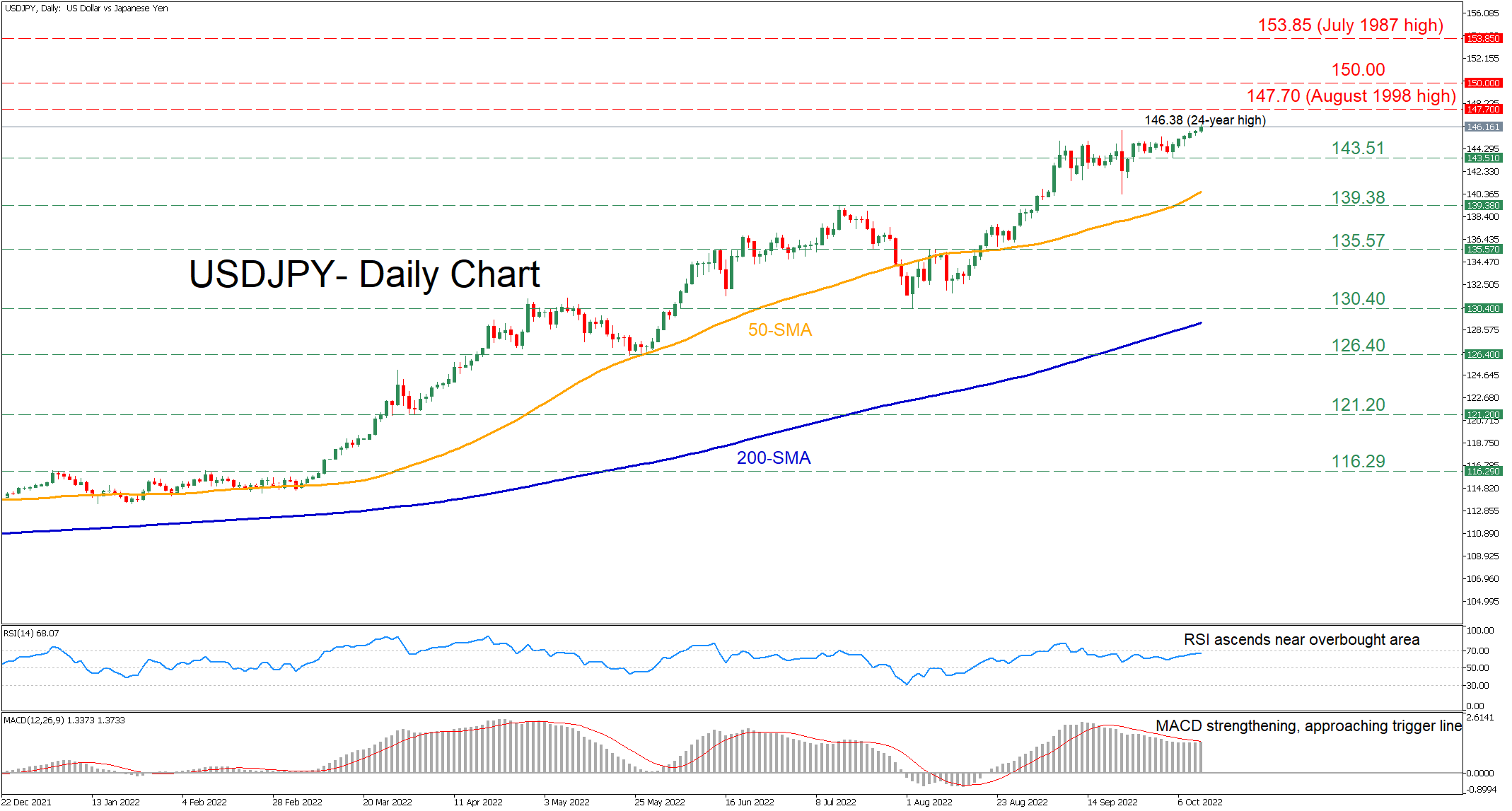
USDJPY has been in a prolonged uptrend since early March, crossing above its historical resistance levels and generating consecutive multi-year highs. Moreover, despite the recent consolidation, the positive tone appears to be strengthening in the near term as the pair has edged higher today to a fresh 24-year high of 146.38.
The short-term oscillators currently indicate that bullish forces are intensifying. Specifically, the RSI is sloping upwards towards its 70-oversold area, while the MACD histogram is strengthening in the positive region, approaching its red signal line.
Should buying pressures persist, the pair could move higher to form fresh multi-year highs, where the August 1998 resistance of 147.70 might curb further advances. Conquering this barricade, the bulls may target the 150.00 psychological mark. Even higher, the July 1987 peak of 153.85 could prove to be a tough barrier for the price to overcome.
On the flipside, a negative correction could initially come to a halt at the recent support region of 143.51. Should that floor collapse, the price could descend towards the 139.98 resistance territory, which might now act as support. A break below the latter could turn the spotlight to 135.57 before the August low of 130.40 appears on the radar.
Overall, USDJPY seems to have the necessary momentum to push higher and challenge its historical highs. Nevertheless, the bulls should not rule out the possibility of some retracement before the latter is accomplished as an intervention by the BoJ remains on the cards.
Gold Pauses Decline Near Familiar Support
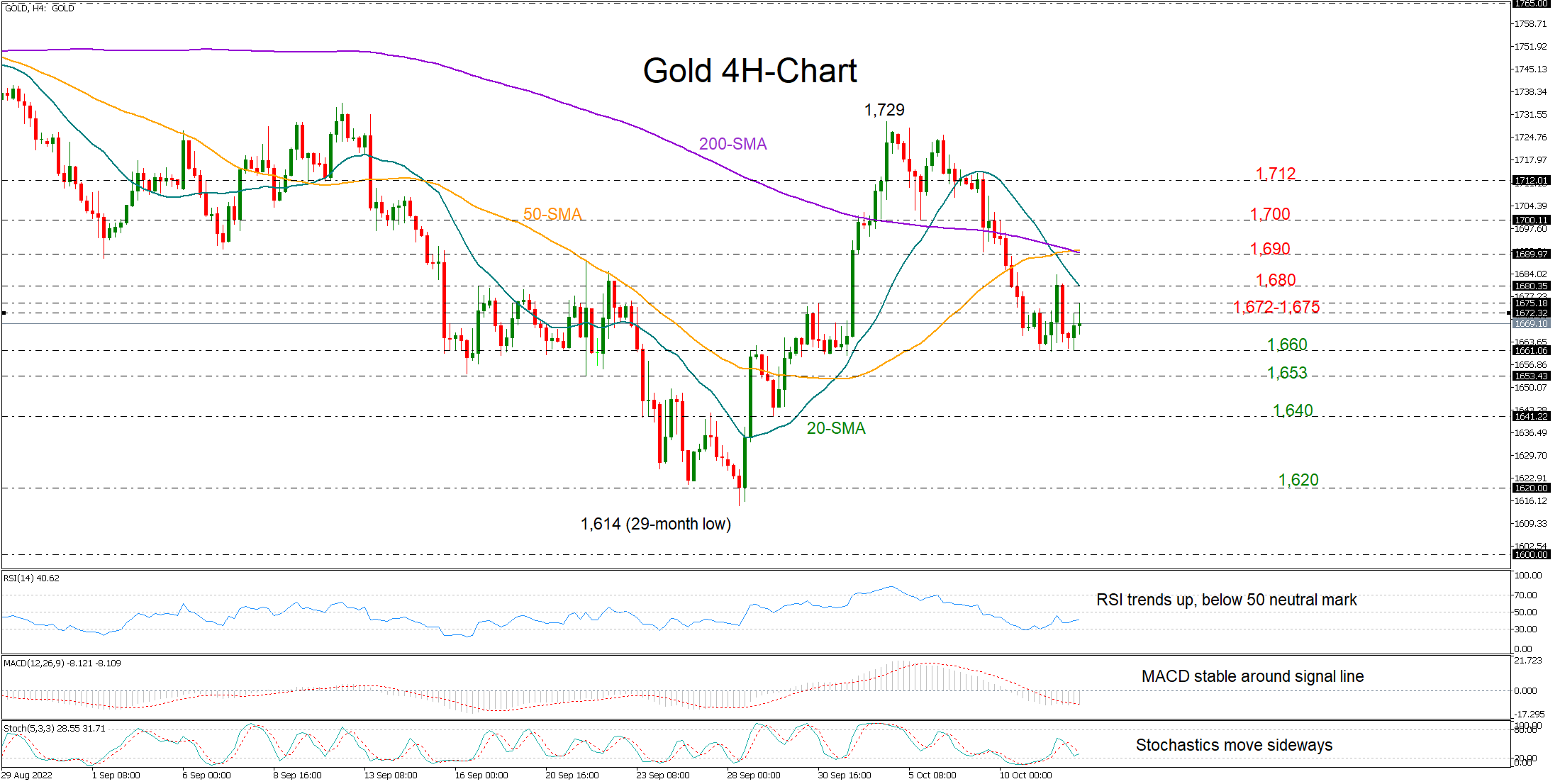
Gold opened Wednesday’s session gently up after finding fresh buying interest around the 1,660 level.
There is a ray of hope that market sentiment may improve as the RSI and the MACD are trying to change direction to the upside.
Yet, some caution is still required as the 1,670 zone seems to have resumed its resistance role. The 20-period simple moving average (SMA), which ceased bullish pressures last week, is also within breathing distance. Should the recovery continue above the 50- and 200-period SMAs currently both at 1,690, the price will head for the 1,700 round level and then for the 1,712 barrier.
In case the 1,660 floor collapses, the bearish wave could see a continuation towards the 1,653 area. A steeper decline could halt near 1,640, while lower, sellers will attempt to re-activate the 2022 downtrend below the 1,620-1,614 base.
Summarizing, the precious metal is not out of the woods yet despite pausing its latest bearish correction. Perhaps a close above the 20-period SMA could raise buying confidence, though whether the price will re-activate its short-term uptrend above the 1,729 peak remains to be seen.
Is the UK Already in Recession?
Stock markets are recovering slightly on Wednesday after another volatile start to the week.
It's clear this week that investors have one eye on the US, with Fed minutes this evening, US inflation data tomorrow and the start of earnings season likely to be the primary drivers into Friday's close.
Any hope of a helping hand from the Fed minutes may not be forthcoming, with the commentary to an extent outdated at this point and policymakers seemingly unified in their goal of defeating inflation. Even a good CPI number tomorrow may do little to change that in the near-term.
Sterling jumps on BoE reports
The FT has reported that the BoE could extend its emergency bond-buying measures beyond Friday in order to ensure continued stability in the market which has lifted the pound in early trade. While Governor Bailey's warnings to pension funds this week gave the impression there's no turning back, it would appear that isn't entirely true.
And that shouldn't be as surprising as it seemingly is. While the hope within the central bank will be that its emergency measures have allowed pension funds to recalibrate and address the vulnerability in the bond market, if that doesn't prove to be the case it would be ridiculous to pull the rug from under it rather than extend the measures until the end of the month when we get the full budget.
Still, at a time when investors are living in fear of what's around the corner, perhaps the mindset of "prepare for the worst and hope for the best" is behind it. It does go to show how huge the Chancellor's budget is in three weeks and the carnage that another misstep could cause. The BoE can buy the government time for now but it isn't a permanent solution.
UK may already be in recession after GDP miss
The rebound in sterling held even as we received some pretty bleak GDP data for August that suggests the UK may already be in recession. I mean, most people already agree that the country is in recession but we're just waiting for the data to technically confirm it. The numbers weren't good though, with a 1.6% manufacturing slump driving a 1.8% decline in production. Meanwhile, consumer-facing services fell sharply by 1.8%, with overall services dropping by 0.1%.
All in all, the numbers are pretty grim and I don't see much scope for improvement in the near future, particularly on the consumer side. Perhaps the minor reaction is a reflection of the fact that most already believe the economy to be in recession and the data just confirms that, despite falling short of analyst expectations.
BoK end game in sight
The Bank of Korea hiked interest rates by 50 basis points overnight, taking the Base Rate to 3% and not far below what it believes to be the terminal rate of around 3.5%. The move was widely expected, with the central bank still concerned about external conditions and a weaker won. Time will tell whether the central bank will indeed start to ease off the brake but today's comments suggest that, much like the RBA, the end game is now in sight.
Edging higher but growth concerns remain
Oil prices are nudging higher after paring recent gains so far this week. There are two dominant forces in the oil market at the moment; the economic outlook being the primary downside risk and OPEC+ the upside. The latter reasserted itself last week with the two million barrel per day cut (much less in reality, of course) but growth fears are still dominating in the markets which may stop the price from taking off. We could also see further coordinated action from consuming countries on the SPR after a frustrated response - to put it mildly - to the alliance's output cut.
Paring losses but optimism running thin
Gold is edging higher amid a slight softening in the dollar and marginally lower yields. I'm not sure anyone is getting too excited by today's rebound but coming after a week of declines, we may just be seeing some profit-taking ahead of the Fed minutes and inflation data. They will be the core focus for gold traders over the next 36 hours and given the response in the markets over the last week, they don't appear overly optimistic.
Remains in consolidation
Bitcoin is seeing small gains on Wednesday, with the cryptocurrency up less than 1% and still holding above $19,000. While the overall trend in recent days has been lower, the moves have been relatively mild and look more consolidatory than anything more worrying. The longer trend of consolidation around $20,000 remains intact which is the most important thing. Whether that will be the case at the end of the week, much like elsewhere, will depend on the Fed minutes and inflation data.
USD/JPY: Bulls Need a Last Spurt to Complete the Intermediate Impulse
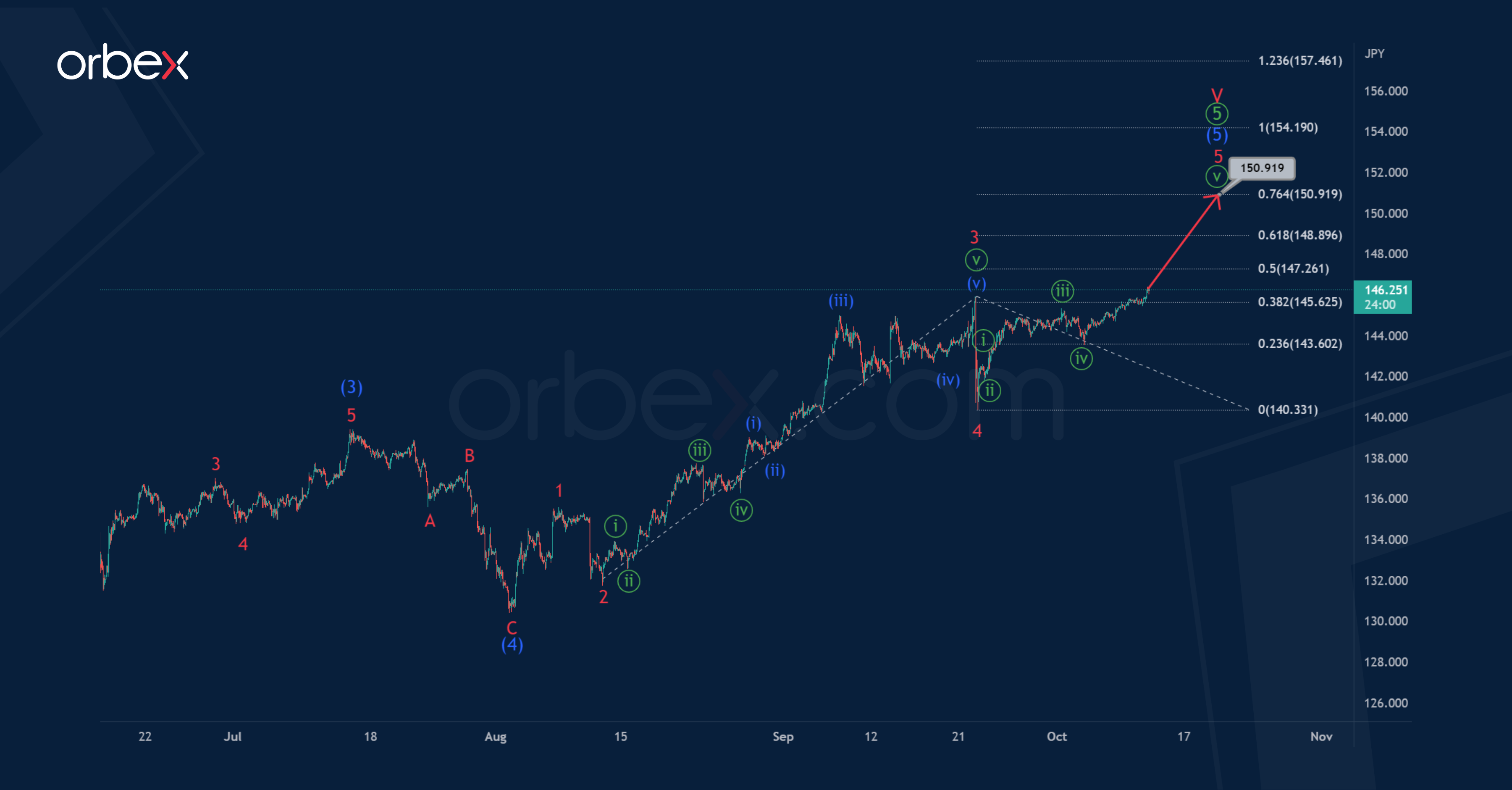
The current chart of the USDJPY pair shows the formation of a global impulse trend, which consists of cycle waves. In the last section of the chart, we see how confidently it creeps up in the cycle wave V, more precisely in its final part.
Wave V, apparently, takes the form of a 5-wave impulse ①-②-③-④-⑤ of the primary degree. In the specified impulse, the first four parts are finished.
Currently, we can expect the construction of the primary fifth wave, which takes the form of an intermediate impulse (1)-(2)-(3)-(4)-(5). The price in the final primary wave ⑤ may rise to 150.91.
At that price level, minor wave 5 will be at 76.4% of impulse 3.
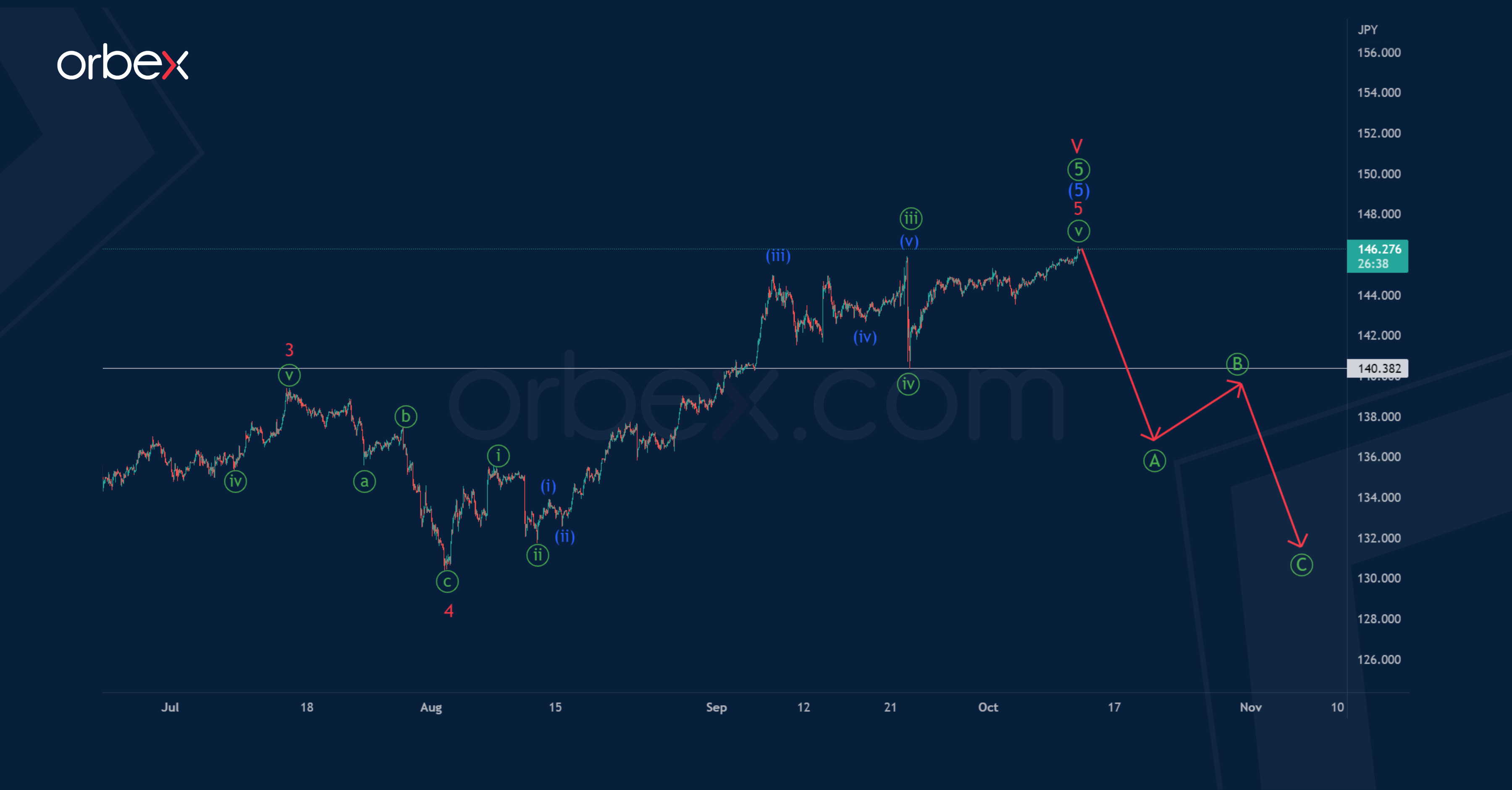
An alternative scenario shows that the cycle wave V has already ended in the form of a primary impulse.
Thus, in the next coming trading weeks, we can expect a fall in the exchange rate and the formation of a new bearish trend.
It is assumed that a bearish impulse Ⓐ may form on the market in the near future, which will mark the beginning of a new 3-wave zigzag.
The upcoming decline may reach the area of 140.38, that is, the previous minimum of fluctuations, and then even lower.
Bank of England Still Facing An Almost Impossible Balancing Act
Markets
US (bond) investors returning from a long weekend didn’t help to restore a more constructive narrative on global markets. Eco data were few, with Thursday’s US September CPI release still the first important data reference on the agenda. Recession risk (IMF downgrading global economic outlook for 2023) only suggested more difficult times ahead for risk/growth sensitive assets. US equities closed from little changed (Dow) to additional losses of 1.1% (Nasdaq), with the latter touching a new cycle low, breaking below the 10.500 support area. The Eurostoxx50 lost 0.5%. The index stays above recent lows, but the picture remains worrisome too. Bad news still isn’t good news for bond investors either. Both US and German/EMU yields continue testing the cycle peak levels. The US and German 30-year yields even closed at new cycle top levels (respectively at 3.92% and 2.32%). The US curve steepened with yields closing little changed (2-y) to 6.6 bps (10-y) higher, as they still had some catching up to do. German yields eased between 2.5 bps (30-y) and 7.6 bps (5-y). At least for now markets didn’t build on Monday’s rumours that Germany/the EMU would consider additional funding on a EU level. Monday’s narrowing in intra-EMU spreads was partially reversed (10-y Italia/German spread + 8 bps). On FX markets, the dollar remains the by ‘default’ preferred haven even as gains yesterday remained modest. DXY closed at 113.22. EUR/USD finished little changed just north of 0.97. USD/JPY is drifting north of last month’s MOF intervention levels (USD/JPY this morning 146.25).
In the UK, the Bank of England is still facing an almost impossible balancing act. The Bank yesterday widened the scope of its emergency bond buying to inflation-linked gilts as the Bank saw pressure building in that segment of the market, too. BoE governor Bailey yesterday indicated the Bank still intends to stop the program as scheduled at the end of this week. However, overnight the Financial Times suggested that the BoE in contacts with banks left to door open for a prolongation. After a sharp decline late yesterday, sterling this morning is looking for a bottom (EUR/GBP 0.8827, Cable 1.1015). Even so, the extremely difficult BoE balancing act between policy normalization and preserving financial stability probably suggests more volatility ahead for UK markets.
This morning, Asian equity markets still mostly trade with modest additional losses, with Hong Kong underperforming. South Korea outperforms (0.3%). Later today, the eco calendar is thin (US PPI) on both sides of the Atlantic. Several ECB and BoE members will speak today. Markets will also keep a close eye at the Minutes of the September Fed meeting, even as Fed governors recently were quite unisono on the need for substantial further tightening. We expect core yields and the dollar to hold near recent elevated levels, further counting down to tomorrow’s US CPI release. In the UK, August monthly GDP (0.3%) and production data (IP -1.8% M/M) were substantially weaker than expected. The direct impact of the report might be limited, but it doesn’t help to provide comfort for UK bonds and/or sterling.
News Headlines
The Bank of Korea raised its policy rate as expected by 50 bps, from 2.5% to 3%, the highest level since 2012. Two board members voted against the decision as growth momentum fades and with the property market under pressure. The Board sees continued rate hikes as warranted as inflation is expected to remain high and substantially above target. The BoK is also concerned about the weakness of the currency which adds to inflation woes. The won remains near lowest levels on record at USD/KRW 1430. Governor Rhee added that there’s a lot of disagreement over the pace of the November hike though.
US President Biden commented on recent OPEC+ production cuts in a CNN interview. He warned that there’s going to be some consequences for what they’ve done together with Russia. The so-called NOPEC bill which would allow US lawsuits against countries in the oil cartel for manipulating energy markets is one possible route. Halting US arm sales to Saudi Arabia for one year is another one. Any possible actions aren’t expected ahead of next month’s mid-term elections, but the President vowed to rethink the strategic relationship with Saudi Arabia.
US Oil Consolidates Gains
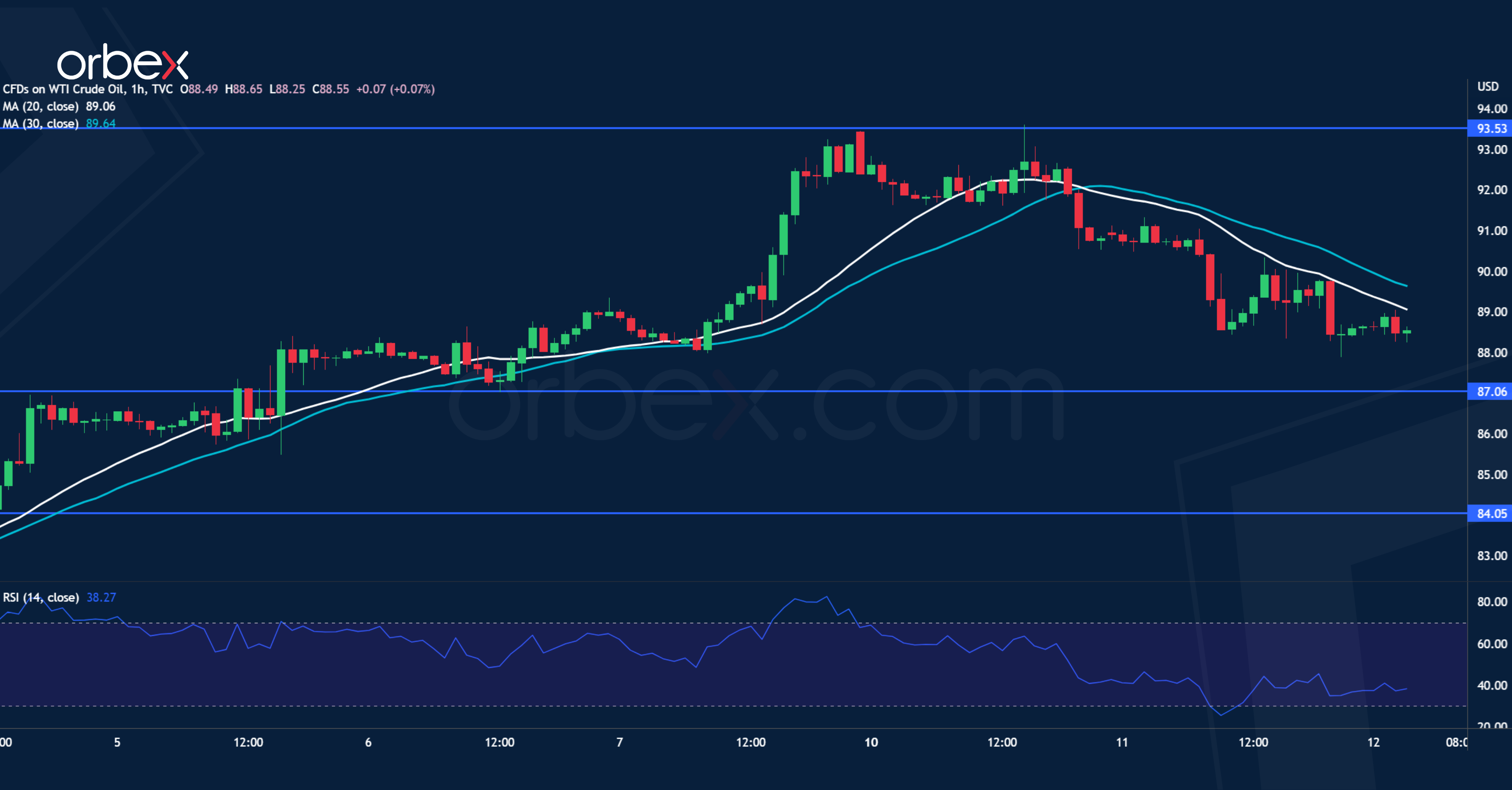
WTI softens as China ramps up Covid control in major cities. The rally above the psychological level of 90.00 has briefly lifted the optimism. But the origin (93.50) of the late August sell-off is a tough level to crack. The bulls are looking to consolidate their gains and 87.00 off the recent bullish breakout is the first area to gauge the strength of follow-up demand. If the bid gets hit, more profit-taking would follow and a correction may push the price towards 84.00 in the congestion area that sits over the 30-day moving average.
GBP/USD Seeks Support
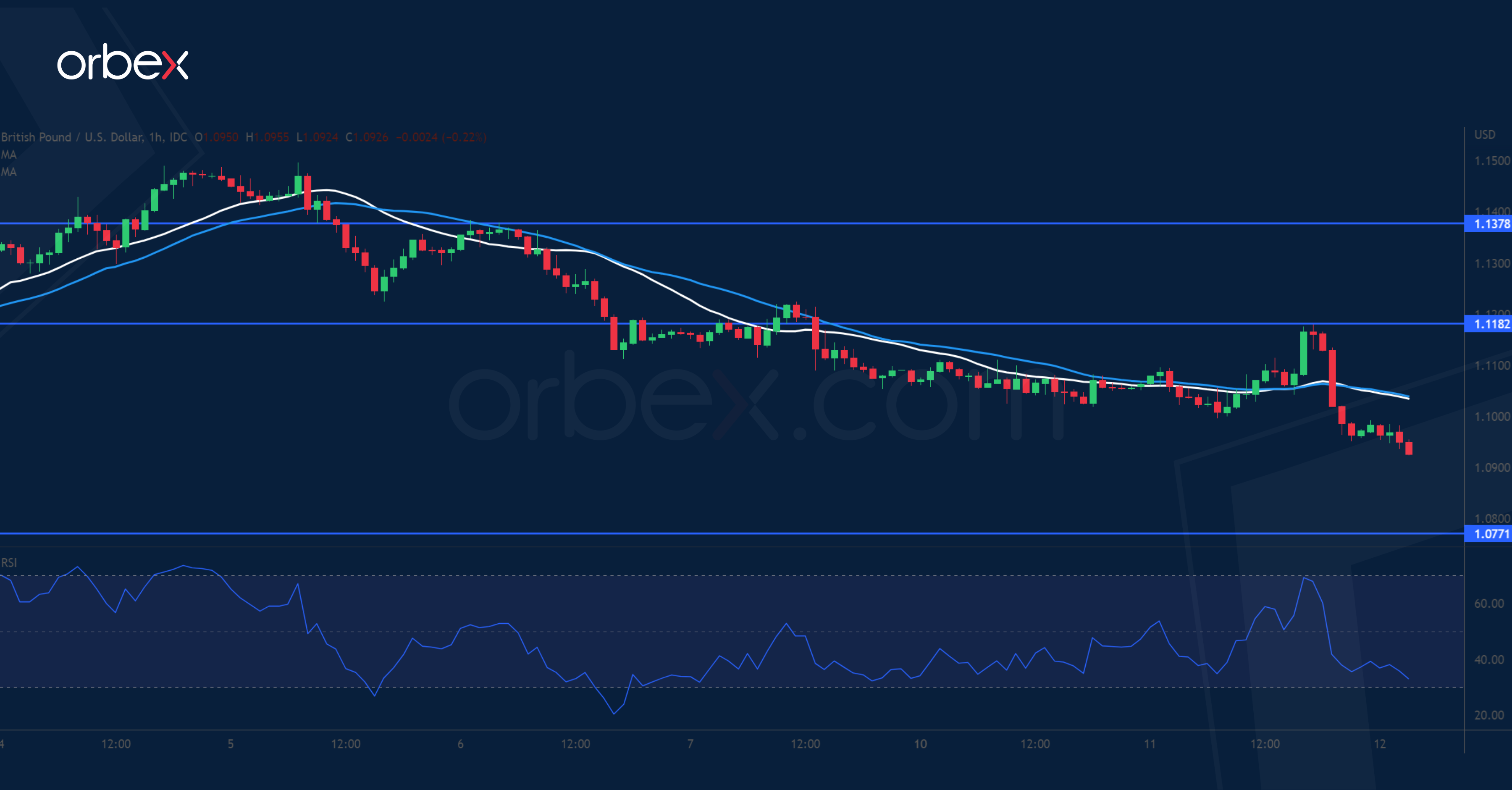
The pound slips as Britain’s pension funds scramble to meet margin calls amid bond firesale. Breaks below 1.1300 and 1.1100 prompted short-term buyers to take profit. As overall sentiment remains downbeat, the lack of support suggests that the bulls might be wary of catching a falling knife. 1.0770 is the next level to see if new buyers would emerge, or Sterling could drift to the base of the recent rebound at 1.0550. 1.1180 is the first hurdle and the bulls will need to clear 1.1380 before a recovery could gain traction.
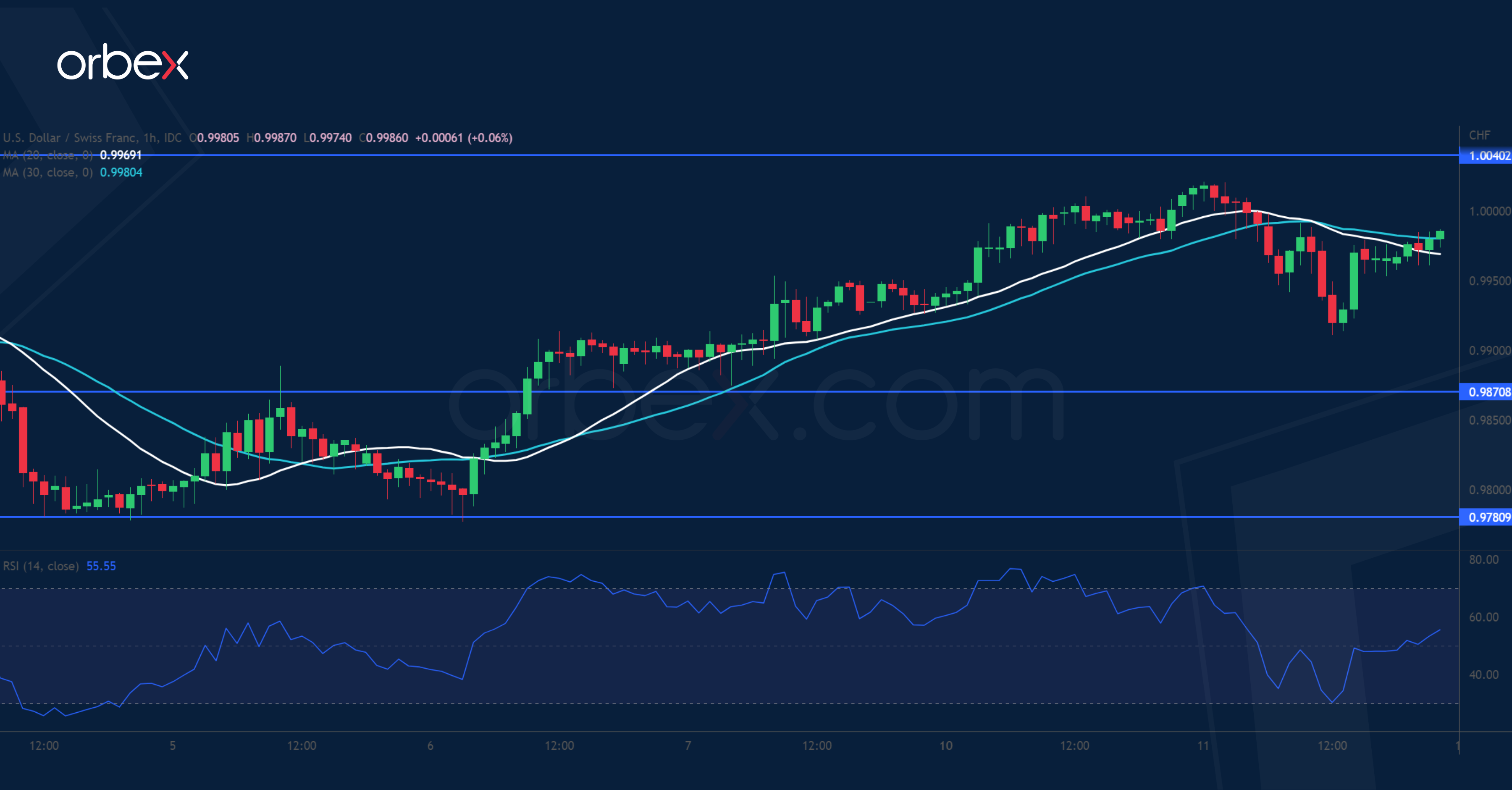
USD/CHF Grinds Major Resistance
The Swiss franc bounced after SNB Chairman Thomas Jordan insisted on pursuing the tightening. Following a break above the double top at 0.9870, a bullish MA cross on the daily chart indicates an acceleration to the upside. Strong buying interest has pushed the greenback back to parity. Last June’s high at 1.0040 is sellers’ last stronghold and its breach could resume the uptrend towards 1.0200. The RSI’s overbought condition caused a pullback and the former resistance at 0.9870 is the first level for accumulation.