Sample Category Title
USD/JPY Accelerates after BoJ Kuroda Drops No Hint on Intervention
Dollar surges further in early US session against Yen, after BoJ Governor Haruhiko Kuroda dropped no hint on intervention despite today's Yen selloff. Indeed, he noted that Yen depreciation could be could for the economy as a whole, just that speculation driven move is bad. But the greenback is actually struggling to gain against other major currencies. FOMC minutes will be featured later today but they're unlikely to reveal anything new. Traders will be keenly awaiting tomorrow's US CPI release.
Technically, one focus for now is whether USD/JPY's rally could taken other Yen crosses higher, especially EUR/JPY and GBP/JPY. Both are still having 140.77 and 159.41 minor support levels in pocket. Break of 144.06 and 165.69 will resume last week's rebound, towards 145.62 and 148.93 highs respectively.
In Europe, at the time of writing, FTSE is down -0.67%. DAX is down -0.25%. CAC is down -0.29%. Germany 10-year yield is up 0.107 at 2.410. Earlier in Asia, Nikkei dropped -0.02%. Hong Kong HSI dropped -0.78%. China Shanghai SSE rose 1.53%. Singapore Strait Times dropped -0.70%. Japan 10-year JGB yield dropped -0.007 to 0.254.
BoJ Kuroda: Yen depreciation may have good impact on economy, but speculation is bad
BoJ Governor Haruhiko Kuroda said, "yen depreciation may have a good impact on macro-economy as a whole, but there are some sectors which are suffering from weak yen." He added that "we have to carefully watch, and analyze the impact of currency movements on the economy."
Kuroda also qualified that "if currency movement is so fast and uni-direction, probably caused by speculation, that would be bad for the economy."
Meanwhile, he reiterated, "we will continue our monetary easing to achieve the 2% inflation target in a stable and sustainable manner."
US PPI up 0.4% mom, 8.5% yoy in Sep
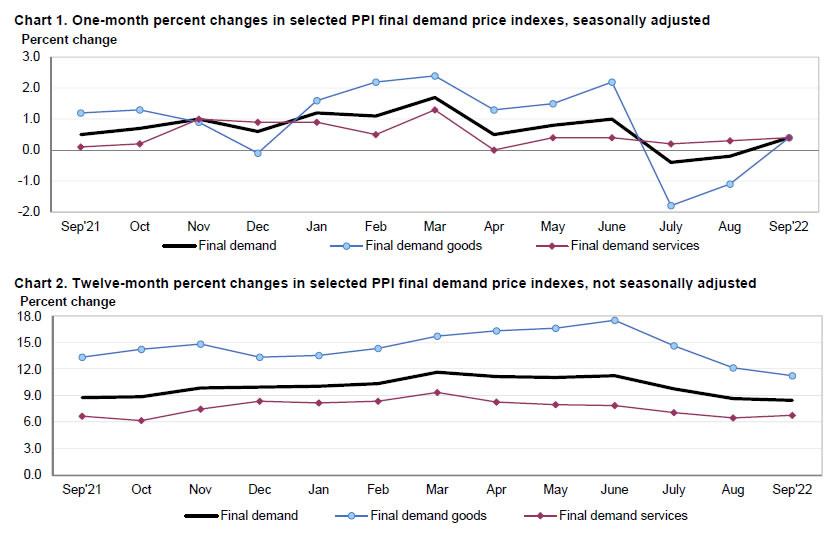
US PPI for final demand rose 0.4% mom in September, above expectation of 0.2% mom. Two-thirds can be traced to a 0.4% mom prices for services. The index for goods rose 0.4%. Prices less food, energy, and trade services rose 0.4% mom.
For the 12 months ended in the period, PPI slowed from 8.7% yoy to 8.5% yoy. PPI ex food, energy and trade was unchanged at 5.6% yoy.
BoE Pill: A significant monetary policy response required in Nov
BoE Chief Economist Huw Pill said in a speech, "Given the uncertain world and volatile markets we face, November can seem a long time away. At present, I am still inclined to believe that a significant monetary policy response will be required to the significant macro and market news of the past few weeks."
"But I will see when we get to November how events have evolved in the meantime. As always, my policy choices will be driven by the data and guided by pursuit of the inflation target," he added.
UK GDP contracted -0.3% mom in Aug, driven by production
UK GDP contracted -0.3% mom in August, worst than expectation of 0.1% mom expansion. In the three months to August, compared with the three months, GDP contracted by -0.3%, with -1.5% fall in production, -0.1% fall in services and flat growth in construction.
Production fell by -1.8% mom, and was the main contributor to the decline in GDP. Growth was negative in three of the four sectors. Services dropped -0.1% mom. Construction rose 0.4% mom.
Also released, industrial production came in at -1.8% mom, -5.2% yoy, versus expectation of -0.2% mom, 0.6% yoy. Manufacturing production came in at -1.6% mom, -6.7% yoy, versus expectation of 0.0% mom, 0.7% yoy. Goods trade deficit widened to GBP -19.3B, but smaller than expectation of GBP -20.5B.
UK NIESR: Energy price guarantees to drive GDP growth higher in Q4
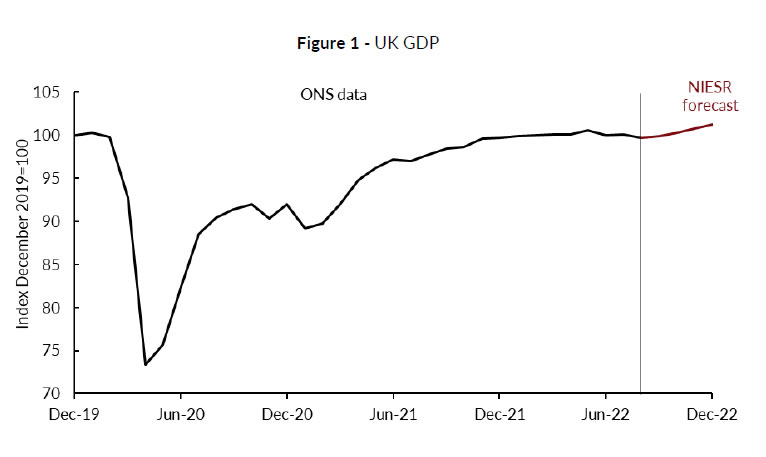
NIESR said the -0.3% contraction in UK GDP in August "possibly signalling the beginning of an economic recession". Given that September PMI pointed to further decrease in the manufacturing sector, it's likely to continue to drag on the economy in Q3.
However, it expects "the energy price guarantees for households and firms announced in September's fiscal event to drive GDP growth higher in the fourth quarter. The extent to which the measures in the mini-budget will counter the dampening effects of plummeting confidence and increased interest rates will become clearer over the coming months."
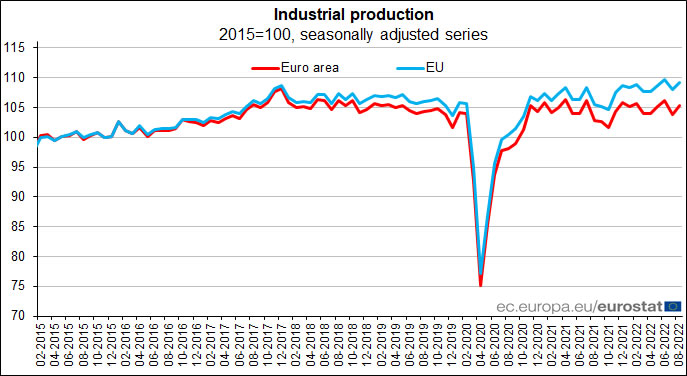
Eurozone industrial production up 1.5% mom in Aug, EU up 1.1% mom
Eurozone industrial production rose 1.5% mom in August, above expectation of 0.5% mom. Production of capital goods rose by 2.8% mom, durable consumer goods by 0.9% mom and non-durable consumer goods by 0.7% mom, while production of intermediate goods fell by -0.5% mom and energy by 2.1% mom.
EU industrial production rose 1.1% mom. Among Member States for which data are available, the highest monthly increases were registered in Ireland (+16.6%), Estonia (+5.0%) and Denmark (+4.3%). The largest decreases were observed in Sweden (-7.0%), Belgium (-6.1%) and the Netherlands (-1.5%).
RBA Ellis: Neutral is not a destination we necessarily reach
RBA Assistant Governor Luci Ellis said in a speech that "don't think of this as a mechanistic approach of 'we have to get back to neutral', or above neutral" interest rate.
"The neutral rate is an important guide rail for thinking about the effect policy might be having. It is not necessarily a prescription for what policy should do," he said.
"'Neutral', then, is not a destination we necessarily reach, but more a pole-star to guide us. And even then, its location is sufficiently uncertain that we are perhaps better served by paying more attention to the ground as it shifts beneath our feet than to that faraway pole-star," he added.
USD/JPY Mid-Day Outlook
Daily Pivots: (S1) 145.56; (P) 145.73; (R1) 146.03; More...
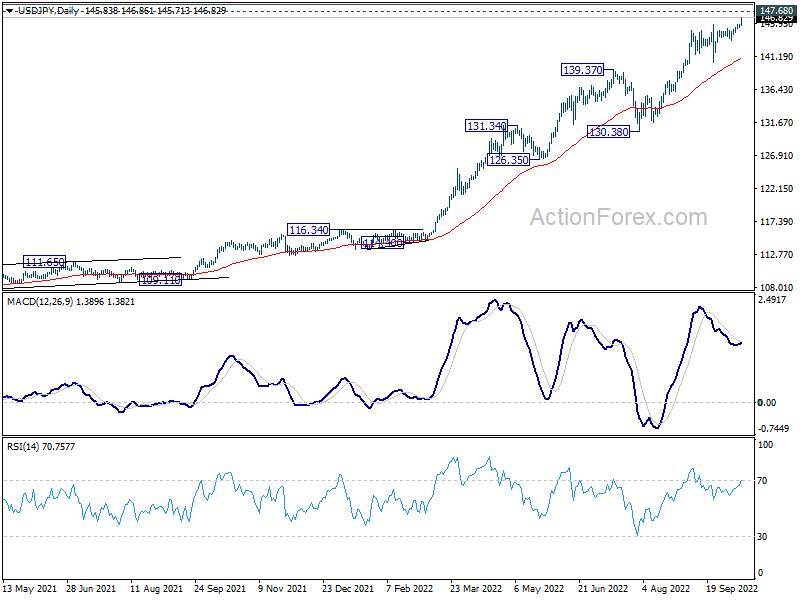
USD/JPY's rally continues today and accelerates to as high as 146.81 so far. Intraday bias remains on the upside for 147.68 long term resistance. On the downside, break of 145.789 resistance turned support will turn intraday bias neutral and bring consolidations again. But overall, outlook will remain bullish as long as 140.33 support holds, even in case of deep pullback.
In the bigger picture, up trend from 101.18 is still in progress, as part of the whole up trend from 75.56 (2011 low). Further rise should be seen to 147.68 (1998 high), and possibly to 100% projection of 75.56 (2011 low) to 125.85 (2015 high) from 98.97 at 149.26, For now, break of 130.38 support is needed to be the first indication of medium term topping. Otherwise, outlook will stay bullish even in case of deep pull back.
Economic Indicators Update
| GMT | Ccy | Events | Actual | Forecast | Previous | Revised |
|---|---|---|---|---|---|---|
| 23:50 | JPY | Machinery Orders M/M Aug | -5.80% | -2.30% | 5.30% | |
| 06:00 | GBP | GDP M/M Aug | -0.30% | 0.10% | 0.20% | 0.10% |
| 06:00 | GBP | Index of Services 3/3M Aug | -0.10% | 0.10% | -0.20% | |
| 06:00 | GBP | Industrial Production M/M Aug | -1.80% | -0.20% | -0.30% | |
| 06:00 | GBP | Industrial Production Y/Y Aug | -5.20% | 0.60% | 1.10% | |
| 06:00 | GBP | Manufacturing Production M/M Aug | -1.60% | 0.00% | 0.10% | |
| 06:00 | GBP | Manufacturing Production Y/Y Aug | -6.70% | 0.70% | 1.10% | |
| 06:00 | GBP | Goods Trade Balance (GBP) Aug | -19.3B | -20.5B | -19.4B | -17.6B |
| 09:00 | EUR | Eurozone Industrial Production M/M Aug | 1.50% | 0.50% | -2.30% | |
| 12:00 | GBP | NIESR GDP Estimate Sep | -0.30% | -0.30% | ||
| 12:30 | USD | PPI M/M Sep | 0.40% | 0.20% | -0.10% | -0.20% |
| 12:30 | USD | PPI Y/Y Sep | 8.50% | 8.30% | 8.70% | |
| 12:30 | USD | PPI Core M/M Sep | 0.30% | 0.30% | 0.40% | 0.30% |
| 12:30 | USD | PPI Core Y/Y Sep | 7.20% | 7.30% | 7.30% | |
| 18:00 | USD | FOMC Minutes |
BoJ Kuroda: Yen depreciation may have good impact on economy, but speculation is bad
BoJ Governor Haruhiko Kuroda said, "yen depreciation may have a good impact on macro-economy as a whole, but there are some sectors which are suffering from weak yen." He added that "we have to carefully watch, and analyze the impact of currency movements on the economy."
Kuroda also qualified that "if currency movement is so fast and uni-direction, probably caused by speculation, that would be bad for the economy."
Meanwhile, he reiterated, "we will continue our monetary easing to achieve the 2% inflation target in a stable and sustainable manner."
BoE Pill: A significant monetary policy response required in Nov
BoE Chief Economist Huw Pill said in a speech, "Given the uncertain world and volatile markets we face, November can seem a long time away. At present, I am still inclined to believe that a significant monetary policy response will be required to the significant macro and market news of the past few weeks."
"But I will see when we get to November how events have evolved in the meantime. As always, my policy choices will be driven by the data and guided by pursuit of the inflation target," he added.
UK NIESR: Energy price guarantees to drive GDP growth higher in Q4
NIESR said the -0.3% contraction in UK GDP in August "possibly signalling the beginning of an economic recession". Given that September PMI pointed to further decrease in the manufacturing sector, it's likely to continue to drag on the economy in Q3.
However, it expects "the energy price guarantees for households and firms announced in September's fiscal event to drive GDP growth higher in the fourth quarter. The extent to which the measures in the mini-budget will counter the dampening effects of plummeting confidence and increased interest rates will become clearer over the coming months."
US PPI up 0.4% mom, 8.5% yoy in Sep
US PPI for final demand rose 0.4% mom in September, above expectation of 0.2% mom. Two-thirds can be traced to a 0.4% mom prices for services. The index for goods rose 0.4%. Prices less food, energy, and trade services rose 0.4% mom.
For the 12 months ended in the period, PPI slowed from 8.7% yoy to 8.5% yoy. PPI ex food, energy and trade was unchanged at 5.6% yoy.
Bank of England’s Bipolar Policy
The Bank of England’s frenzy of emergency bond market support is rocking the currency market boat, leaving GBPUSD as one of the protagonists on FX.
The Bank of England extended emergency support to the debt market yesterday to include inflation-linked bonds in its buying list, triggering GBPUSD to rise from 1.10 to 1.1180 intraday. But in the evening, Governor Bailey reminded that the emergency measure remains temporary, and these extended purchases will end on October 14 as planned.
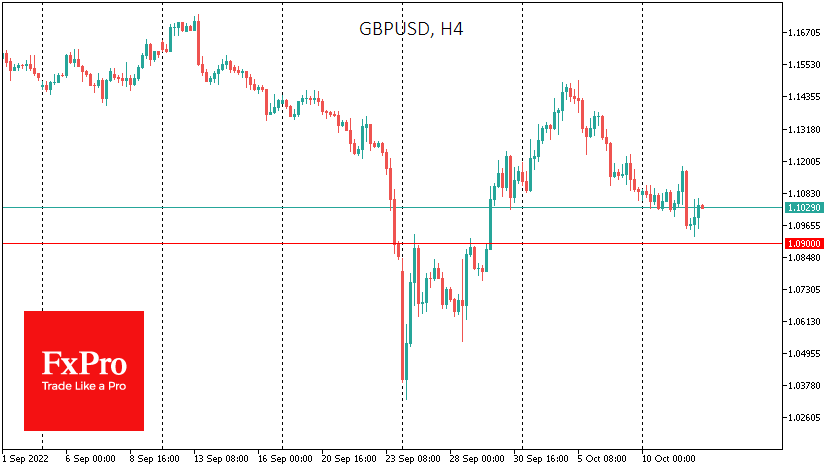
These statements triggered mini chaos in the debt market and took more than 2.3% off the pound from its peak to bottom on Wednesday morning at 1.0923. This bipolar policy is perplexing, although it makes a certain sense.
The Bank of England insists on leaving emergency market support temporary, while the market wants an extension of the support programmes, although it makes little use of it. The Bank of England issued bids for £40bn over the two weeks of the program but bought £5bn.
Distressed pension funds are in no hurry to sell bonds, simply hoping that the very presence of a “buyer of last resort” will drive up prices — a habit developed in the markets over the past decades.
Remarkably, the FX market is greeted by news of an extension of the QE programme or a “flexible approach” to bond purchases with GBP buying. Conventional logic suggests that buying assets on the balance sheet is a net issue for the pound, increasing its supply, which is harmful to the exchange rate. But now bond purchases are lowering the heat on the UK debt market, bringing buyers back into the pound.
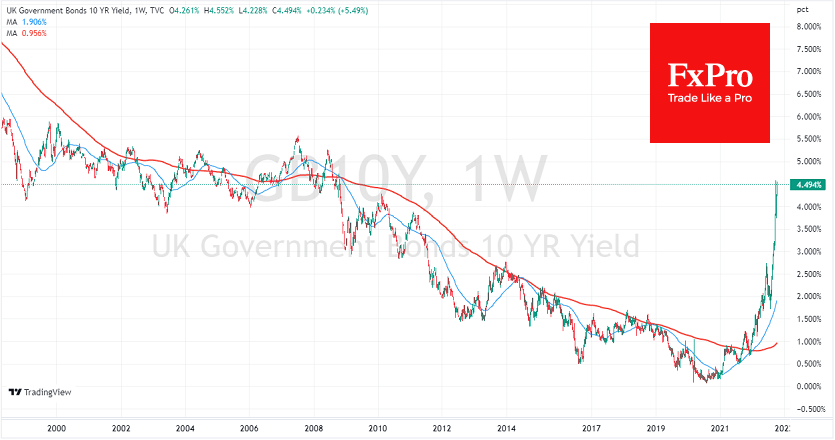
Locally GBPUSD is gaining support on declines in the 1.0900 area, reassuring that the exchange rate has already passed its low point in September. It is worth being prepared for the Bank of England to accelerate short-term interest rate hikes to support the attractiveness of the short-term debt market. But in the meantime, periodic interventions at the far end of the curve are not ruled out.
Overall, this is a positive strategy for the pound, although frequent shifts between support and constraint regimes create volatility in the pound and increase risk premiums in the markets.
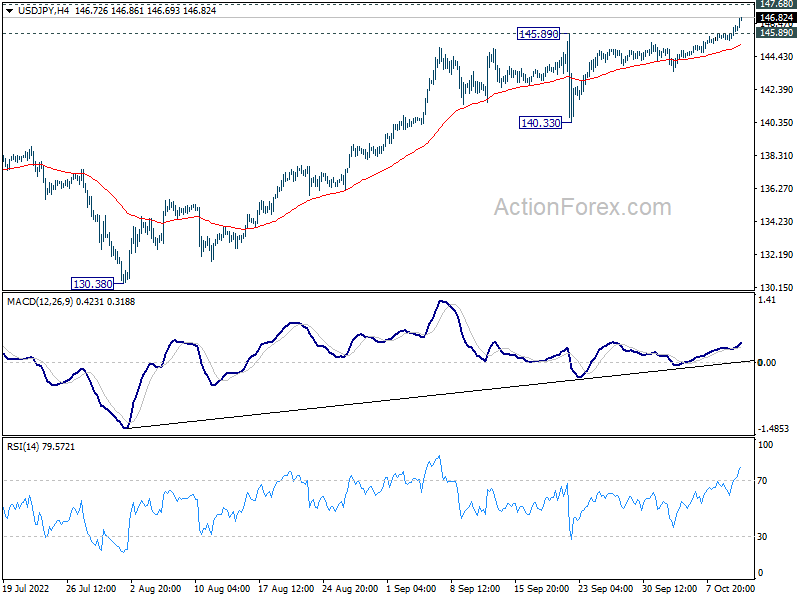
USD/JPY Rises to New Multi-Year High, Eyes 1998 Peak
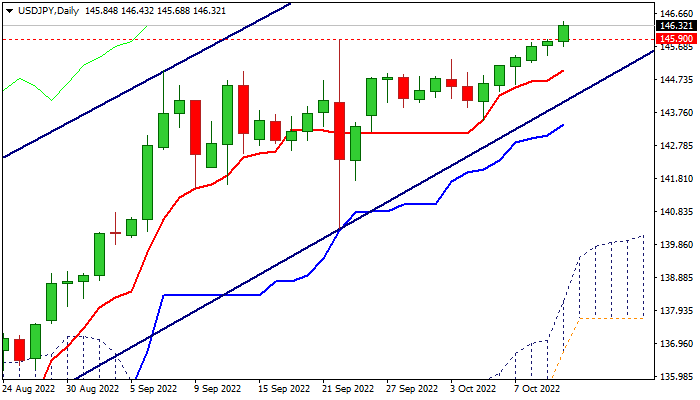
Fresh bullish acceleration broke above previous 24-year peak at 145.90, pushing the price to new multi-year highs in European trading on Wednesday.
Bullish continuation after a limited pullback, sparked by Japan’s intervention in September, confirms an end of larger consolidation, also showing that the downside remains well protected, as post-intervention dip was contained above psychological 140 support.
Overbought conditions on daily chart so far do not impact bulls, but some price adjustments could be expected in coming sessions, before final push towards target at 147.68 (1998 high).
Bulls look for confirmation daily close above broken top at 145.90, which will revert to initial support, with former tops at 145.00 zone, reinforced by rising daily Tenkan-sen, marking a solid support which should contain dips and guard lower pivot at 144.40 (the lower boundary of a bull-channel, a trendline drawn off 130.39, Aug 2 higher low).
Res: 147.05; 147.21; 147.68; 148.01.
Sup: 145.90; 145.30; 145.00; 144.40.
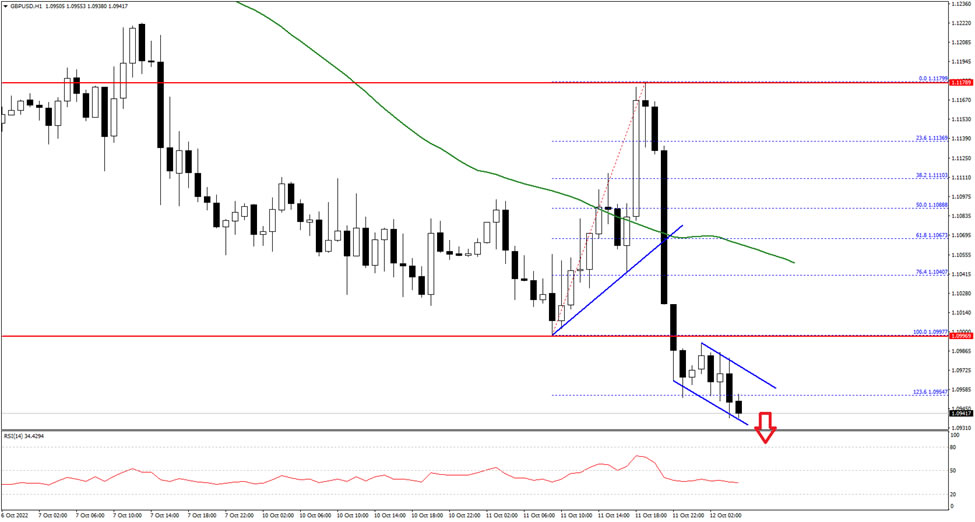
GBP/USD Pair is Now Consolidating Losses from 1.0940
The British Pound started a fresh decline from the 1.1180 resistance zone against the US Dollar. The GBP/USD pair declined below the 1.1050 support to move into a bearish zone.
There was a close below the 1.1100 level and the 50 hourly simple moving average. It even spiked below the 1.0960 support level. The pair is now consolidating losses, with an immediate support near the 1.0940 level.
The first major support is near 1.0920 on FXOpen. The main support is forming near the 1.0880 level. A break below the 1.0880 support could even push the pair below the 1.0850 support.
On the upside, the first major resistance sits near the 1.1100 zone. If there is a clear upside break above the 1.1100 resistance, the pair could rise steadily towards the 1.1150 level in the near term.
Eurozone industrial production up 1.5% mom in Aug, EU up 1.1% mom
Eurozone industrial production rose 1.5% mom in August, above expectation of 0.5% mom. Production of capital goods rose by 2.8% mom, durable consumer goods by 0.9% mom and non-durable consumer goods by 0.7% mom, while production of intermediate goods fell by -0.5% mom and energy by 2.1% mom.
EU industrial production rose 1.1% mom. Among Member States for which data are available, the highest monthly increases were registered in Ireland (+16.6%), Estonia (+5.0%) and Denmark (+4.3%). The largest decreases were observed in Sweden (-7.0%), Belgium (-6.1%) and the Netherlands (-1.5%).
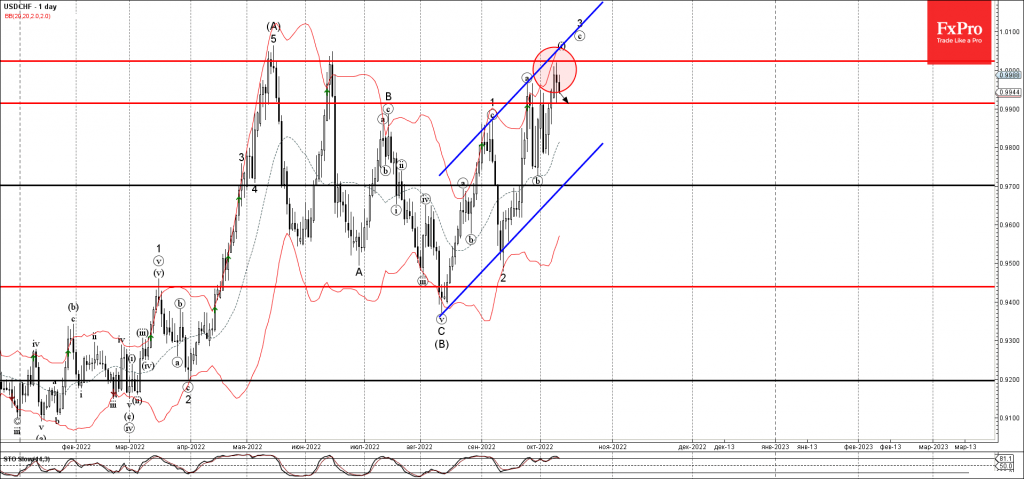
USDCHF Wave Analysis
- USDCHF reversed from resistance zone
- Likely to fall to support level 0.9915
USDCHF recently reversed down from the resistance zone lying between the key resistance level 1.0025
(which has been reversing the pair from May), upper daily Bollinger Band and the resistance trendline of the daily up channel from April.
The downward reversal from this resistance zone stopped the earlier short-term impulse wave (i).
Given the overbought daily Stochastic, USDCHF can be expected to fall further toward the next support level 0.9915.