Sample Category Title
Weekly Economic & Financial Commentary – Easy on the Gas: Germany Institutes Energy Price Cap
Summary
United States: Going to Take More to Break This Consumer
- Incoming data indicate a slowing yet resilient economy. Recent strength makes it less likely in our view that a recession will start by the beginning of next year and also means more monetary tightening will be necessary to slow growth sufficiently to quell elevated inflation. We still forecast a modest recession next year, but now are expecting it to begin a bit later.
- Next week: ISM Manufacturing Index (Mon), ISM Services Index (Wed), Employment (Fri)
International: Bank of England Intervenes to Calm Markets; Eurozone Inflation Hits Double Digits
- After the U.K.'s mini budget fueled concerns about inflation, the BoE committed to temporarily buying unlimited long-dated gilts to soothe markets, and will make a full assessment at its next policy meeting on November 3, where we expect a 100 bps rate hike. In other news, Eurozone September CPI reached 10% year-over-year. With the natural gas supply relationship between Russia and Europe deteriorating, there are concerns that energy prices will climb even higher.
- Next week: Japan Tankan Survey (Mon), RBA Decision (Tue), RBNZ Decision (Wed)
Interest Rate Watch: Update to Our Fed Funds Forecast
- The continued resiliency of the U.S. economy and the FOMC's apparent willingness to do "whatever it takes" to rein in inflation has led us to upwardly revise our forecast. We now see the Committee taking its target range for the fed funds rate to 4.75%-5.00% by Q1-2023.
Credit Market Insights: Five Trillion Down, Still 26 Trillion Up
- The Fed's updated Distributional Financial Accounts indicated declining household wealth over Q2 of this year. Since its peak in the Q4-2021, household wealth is down over $5 trillion, from $141.9T to $135.8T, and all but a quarter trillion of this decline occurred in Q2. Even with the recent hit to wealth, household wealth is still almost 24% above pre-pandemic levels.
Topic of the Week: Easy on the Gas: Germany Institutes Energy Price Cap
- On Thursday, the German government announced plans to institute a $194B package aimed at curtailing crippling energy costs. This announcement came on the same day that Germany’s September CPI report revealed inflation surging to a scorching hot 10.9% year-over-year.
RBNZ to Stick to its Guns, Eyes on Guidance
The month of October will mark a year since the Reserve Bank of New Zealand (RBNZ) launched its tightening campaign. Despite the nonstop rate increases, the central bank will not abandon its mission against inflation as the impact has been negligible so far, with traders largely expecting another half percentage point rate hike on Wednesday at 02:30 GMT.
RBNZ to raise rates by 50bps
A delayed lift of travel restrictions, China’s zero-covid policy, and a darkening global economic outlook overshadowed the impact of the RBNZ’ stimulus reduction, squeezing the risk-sensitive kiwi by more than 10% over the past year.
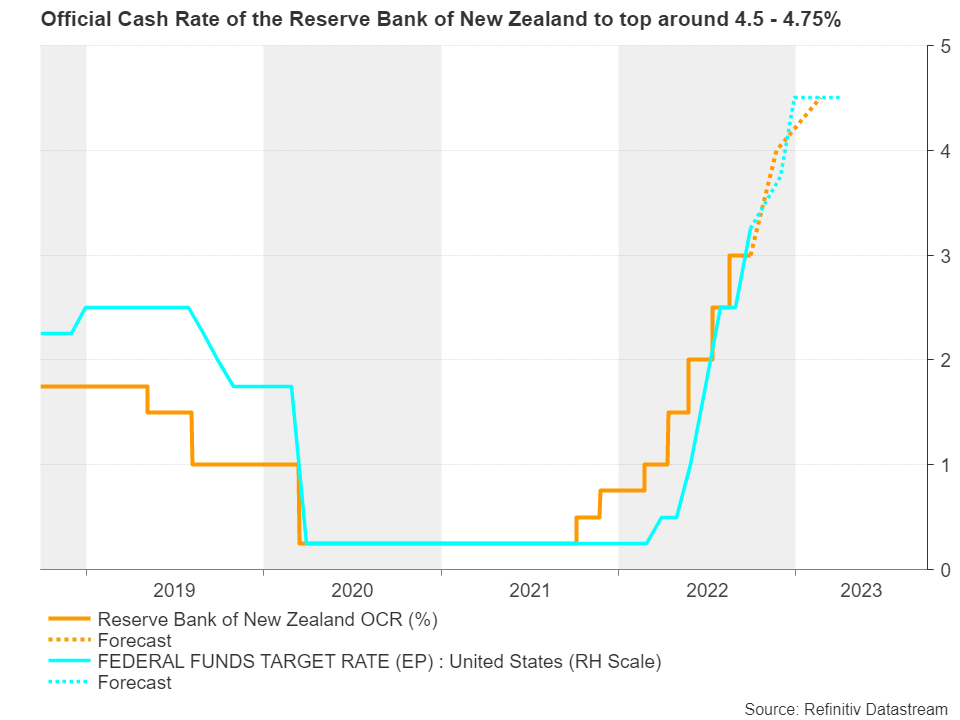
What is worse is that a plummeting domestic currency is making imports more expensive, adding more fuel to inflation that is already hot. Although the RBNZ was the first among the major central banks to enter the tightening era, increasing its benchmark rate abruptly from 0.25% to 3.0%, inflation continued to accelerate dangerously like elsewhere in the world. The latest quarterly CPI report for the three months to June showed consumer prices rising at the fastest pace in 32 years at 7.3% y/y and far above the central bank’s 1-3% target.
The next inflation update will be on October 18 but given evidence from abroad, there is not much room for doubt that consumer prices kept growing at an unacceptable pace, or at least eased at a snail pace during the third quarter. Hence, as investors have largely priced in, the RBNZ will probably stay on its hawkish path this week, announcing its fifth 50 bps rate hike in a row. Such an action would put interest rates above the Fed funds rate.
FX intervention
The depreciation in the currency has come under the spotlight after Japan’s FX intervention. However, a similar response in New Zealand is less likely. Firstly, the RBNZ has a far smaller share of foreign reserves than its US, Asian and European peers. Secondly, other major currencies have been falling aggressively too, but the kiwi is still relatively cheaper against the greenback, the euro and the pound, keeping exports and tourism competitive in international markets.
Rate guidance in focus
Monetary divergence with the Fed, and hence the spread between the US and New Zealand 10-year government bond yields, is narrow. Therefore, unless a sudden change in global risks, and particularly in the slowing Chinese economy, happens, the central bank’s policy guidance could be the only factor to set the mood in kiwi/dollar in the shor term.
Futures markets are currently foreseeing three more 50bps rate increases to be delivered by February 2023 and expect the central bank to gear down to normal 25bps rate hikes afterwards. Strikingly, the RBNZ chief Adrian Orr admitted that although some work still needs to be done, the “tightening cycle is very mature”, increasing speculation that the central bank could soon change course.
On the other hand, a majority of economists including the Westpac Banking corporation, have recently revised their 2023 rate forecasts upwards to 4.5-4.75% and higher than the RBNZ’s projected terminal rate of 4.10%, citing the resilience in the economy and the potential secondary inflation pressures that may subsequently emerge. Indeed, the surprisingly strong Q2 GDP growth numbers, the robust labor market, and the improvement in profit expectations and business activities suggest that the economy can still afford higher-debt service costs.
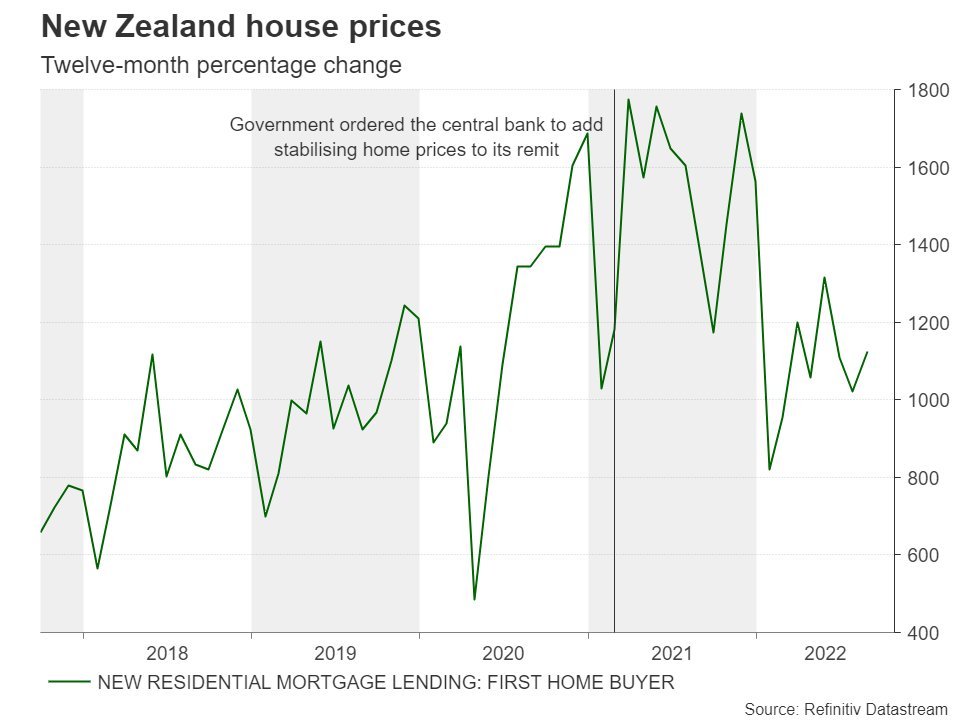
However, sectors such as the property market will need careful monitoring given the high household debt to income if rates keep spiraling higher. According to Westpac, nationwide housing prices dropped by 9.0% since last November. and the flattening trajectory in retail spending is already signaling more softness ahead. Note wage growth is still sluggish when compared to inflation.
NZD/USD
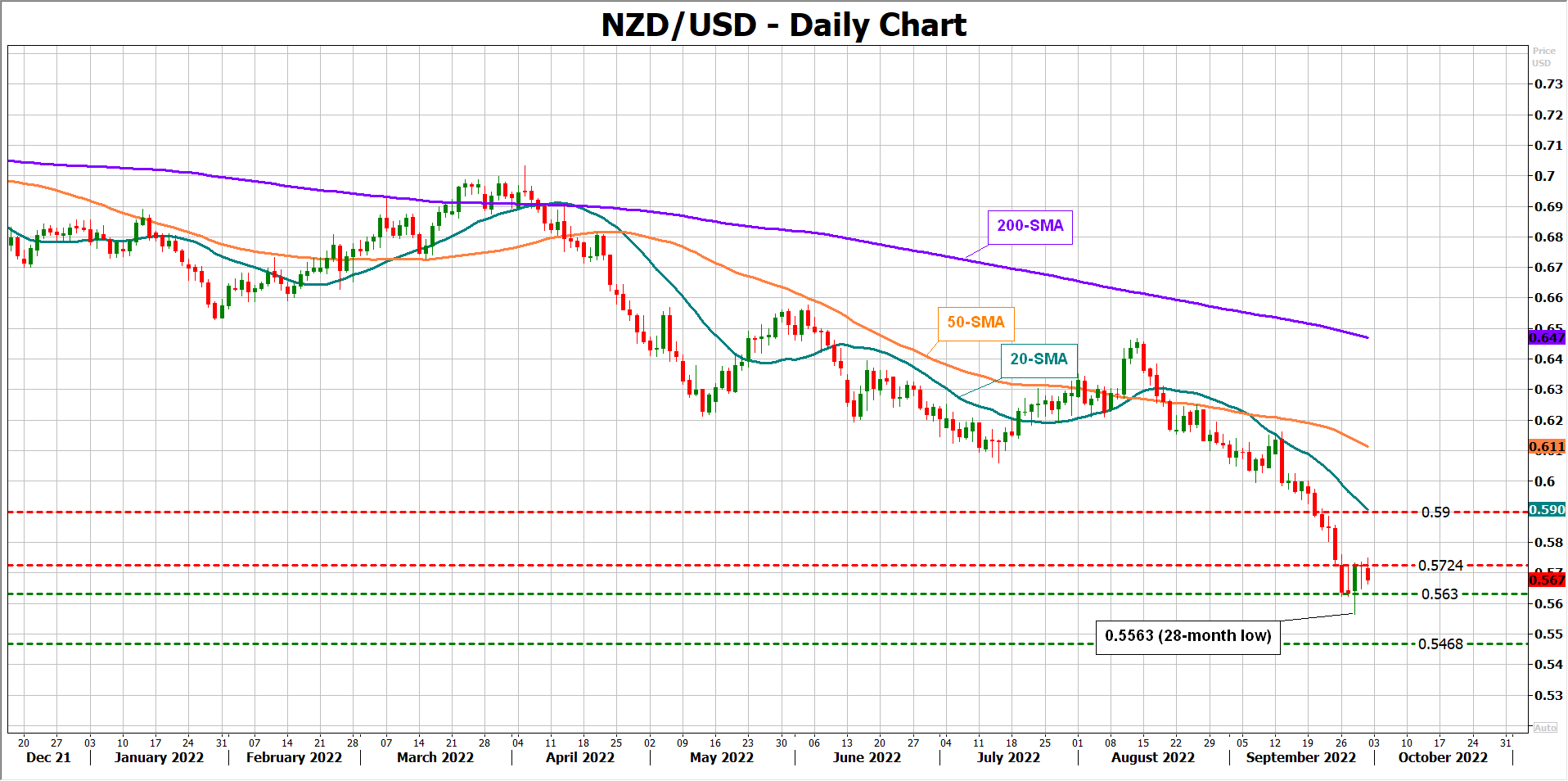
Hence, with investors getting conflicting signals about the path of monetary tightening in 2023, the kiwi might appear vulnerable to any tweaks in the RBNZ’s language. If the central bank sees the terminal rate peak higher than previously thought and plays down the risk of a cooling housing market, kiwi/dollar could extend its recovery above the nearby resistance of 0.5724 and towards the 20-day simple moving average (SMA) at 0.5900. Higher, traders will look for a break above the 0.6000 mark.
Alternatively, if policymakers show concerns about the global economic conditions, judging that monetary tightening has done enough for inflation to stabilize over the next year, the pair will push for a close below the crucial support of 0.5627. The 2020 trough of 0.5468 may come on the radar in the event of steeper declines.
Can the RBA Bring the Aussie Back to Life?
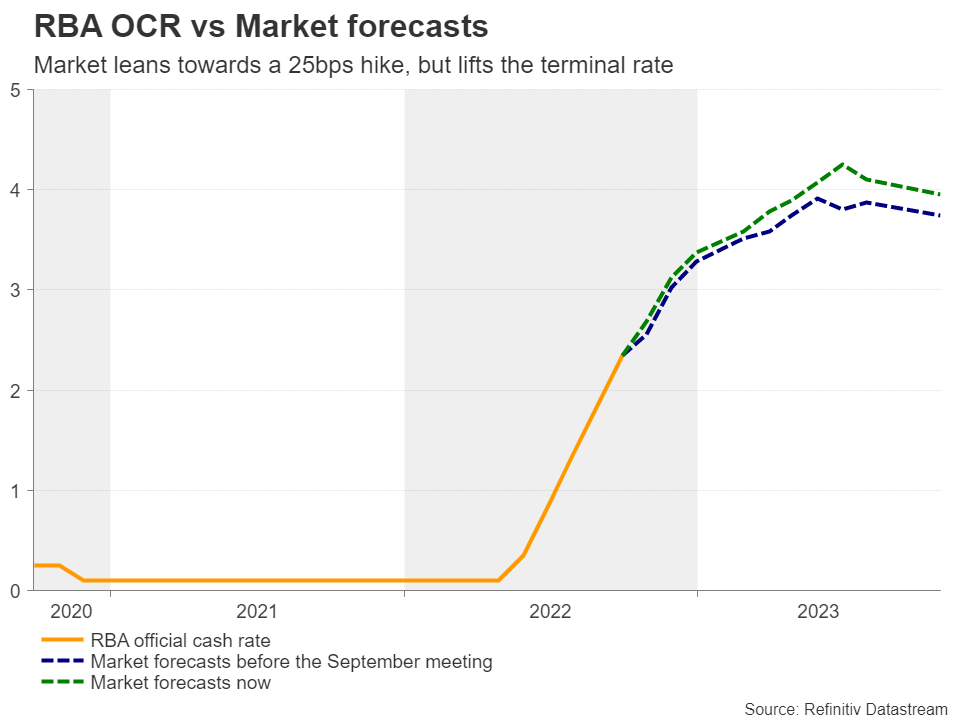
After raising interest rates by another 50bps in September, the RBA meets again to decide on monetary policy this Tuesday at 03:30 GMT. Following remarks by Governor Philip Lowe that the pace of rate hikes may slow from here onwards, investors are leaning slightly towards a 25bps increase this time. However, they see a higher terminal rate than they’d been projecting ahead of the prior meeting. Ergo, they may be eager to find out whether they are right or not, so they can adjust their aussie positions accordingly.
Governor Lowe signals slower rate hikes
When they last met, RBA policymakers increased the cash rate target by 50bps, reiterating their commitment to return inflation back within their 2-3% target range. Given that this was a gathering with no updated economic projections, they maintained the view that inflation will rise further this year to around 7.25%, slow down to 4% in 2023, and touch the upper end of their target range in 2024.
That said, when testifying before parliament a couple of weeks ago, RBA Governor Philip Lowe said that very soon they will not need to hike by 50bps as interest rates approach their normal setting. Though he added that interest rates are still too low. That’s maybe why market participants are now leaning slightly towards a 25bps rate increase, but they project a higher terminal rate. More specifically, they are assigning around a 52% probability for a quarter-point increase, with the remaining 48% pointing to another double hike. As for the terminal rate, they now see it at 4.3% in June, while ahead of the prior meeting, they saw it at 3.9% in May.
Data continue to support further tightening
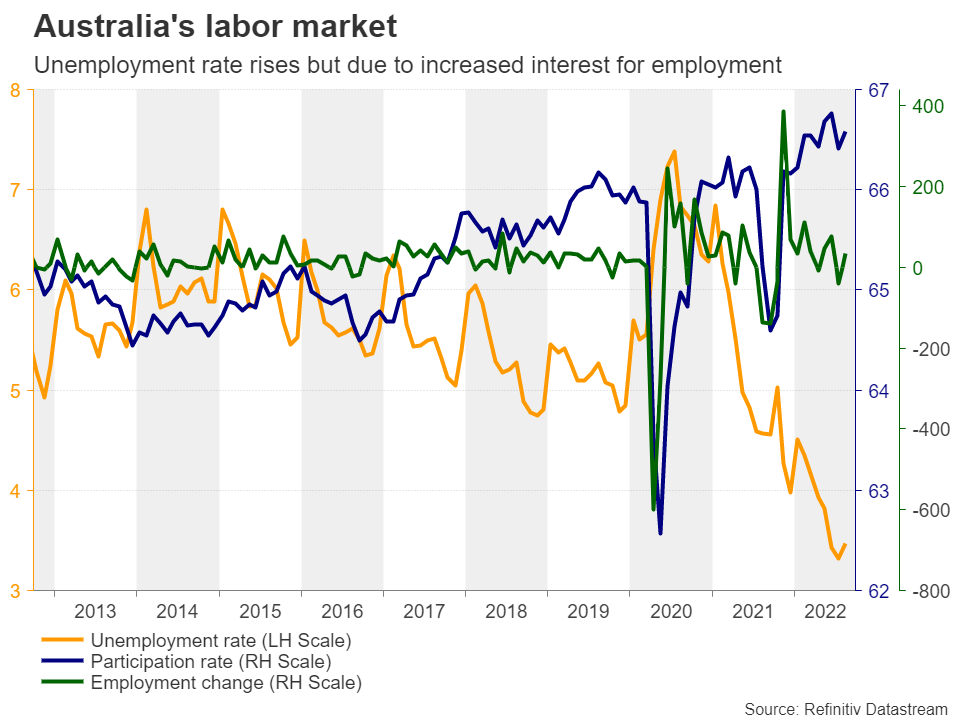
Since then, the only top-tier data released from Australia was the GDP for Q2 and the employment report for August. In contrast with other major economies, economic growth accelerated during that quarter, which combined with the fact that the Chinese economy shrank more than 2% during that same quarter, highlights how resilient the Australian economy is.
Yes, the unemployment rate ticked up to 3.5% from its record low of 3.4% but adding to the equation the rebound in employment change and the increase in participation rate, this may have been due to good reasons. In other words, the unemployment rate may have increased due to more people being encouraged to actively start looking for a job.
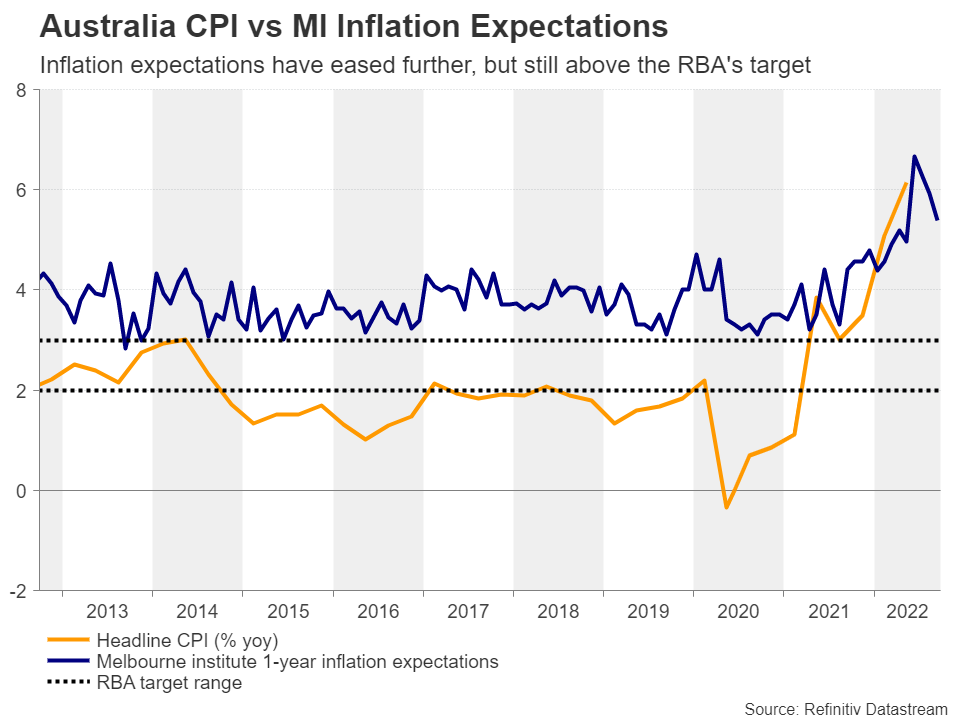
All this, combined with the smaller than expected slowdown in retail sales as well as the rise in the NAB business confidence index, suggests that the chance for another double hike may be bigger than the market pricing suggests. After all, although 1-year inflation expectations have come off their highs – as calculated by the Melbourne Institute – they remain well above the upper end of the RBA’s 2-3% target range.
What’s in store for aussie?
Another 50bps hike could support the Australian dollar at the time of the release, and a hawkish language suggesting that they will not slow the pace of rate increases yet, could add extra fuel. On the other hand, a quarter-point liftoff could validate Lowe’s remarks over slower hikes and could push the aussie off the cliff.
Even in the former case though, a potential recovery may not last for long, especially against the US dollar. Due to its risk-linked status, the aussie has been feeling the heat of the deteriorating broader sentiment. While the Australian economy is doing well, expectations over higher interest rates elsewhere have raised concerns over a global recession, pushing the aussie to fourth place among the major currencies in terms of best year-to-date performance. Ahead of the prior meeting, it was holding the third place.
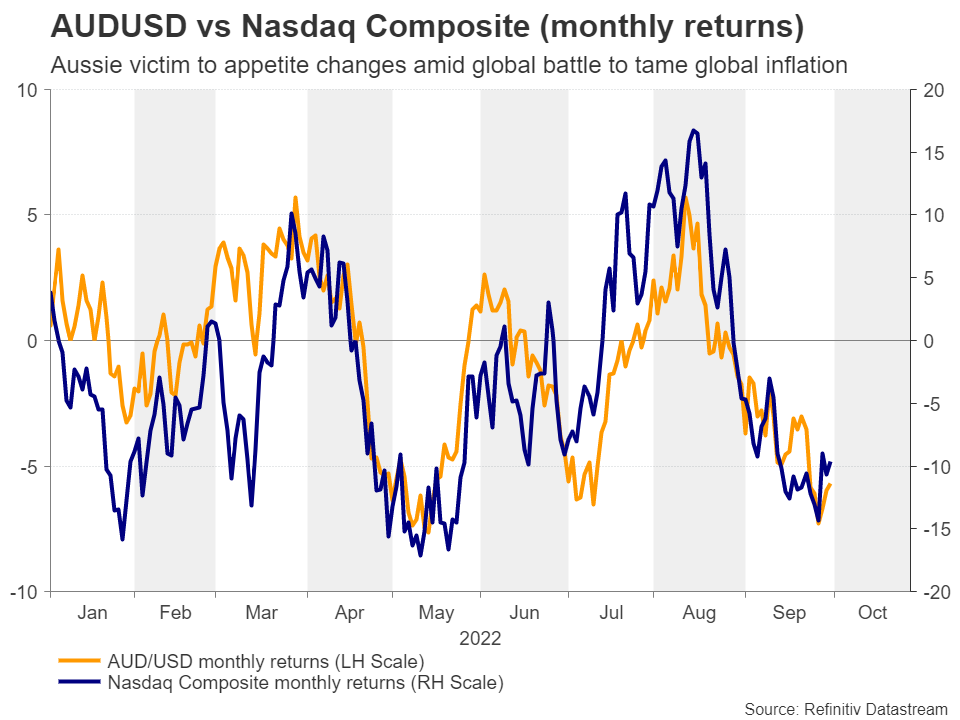
So, rebound or not, aussie/dollar may be destined to come under renewed selling interest soon. A break below Wednesday’s low of 0.6365 would confirm a lower low on the daily chart and take the action into territories last seen in April 2020. The next zone to consider as a support may be the low of April 21 of that year at 0.6250, the break of which could carry larger bearish implications and perhaps encourage the bears to put the round number of 0.6000 on their radars.
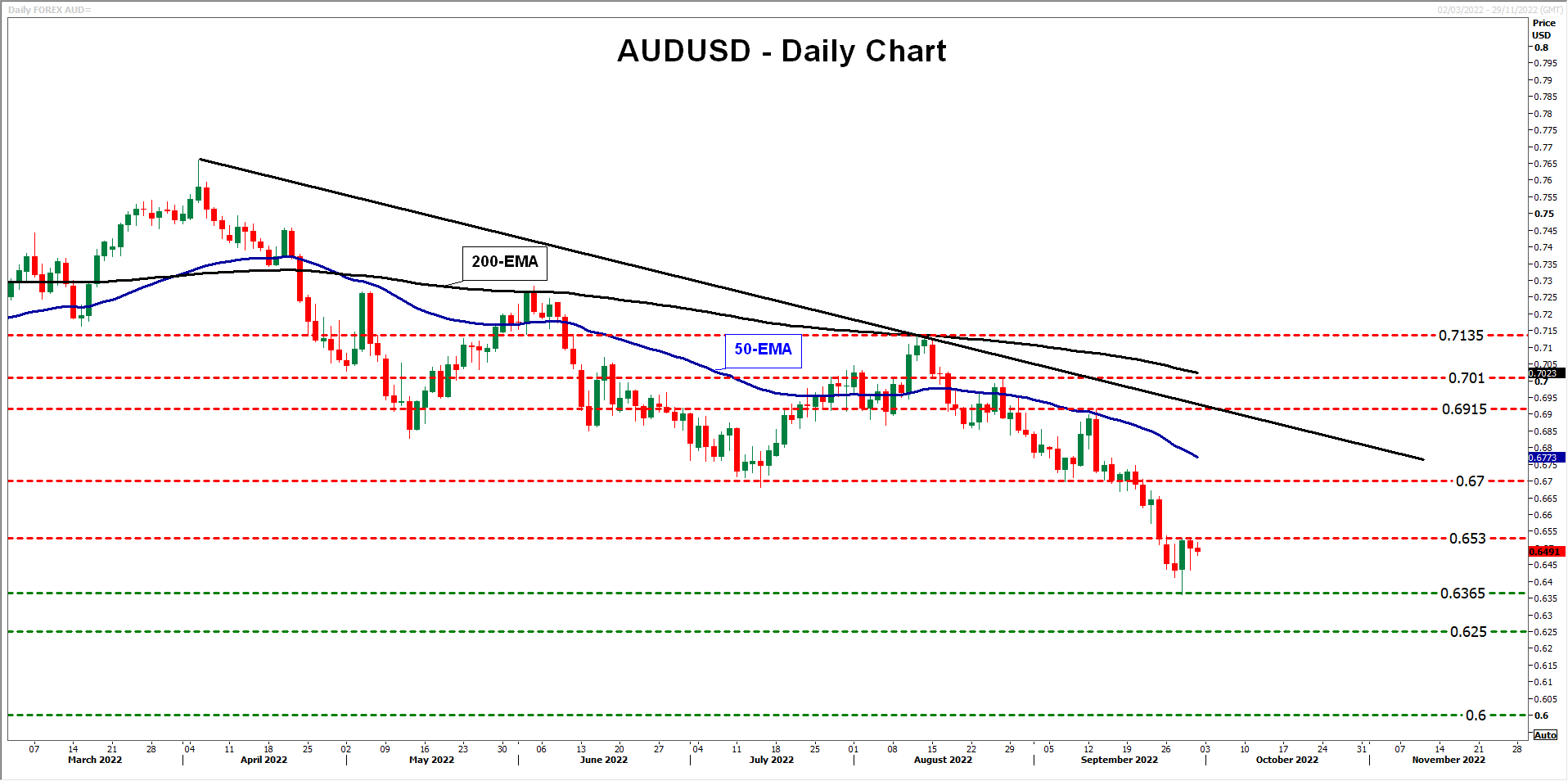
For the outlook to change, a break above the high of September 13 at 0.6915 may be needed. This could confirm the break above the downside resistance line drawn from the high of April 5 this year, but for any gains to have the potential for more and sustained extensions, the global market sentiment may have to take a 180-degree spin first.
Week Ahead – RBA and RBNZ to Weigh 50-bps Hikes But NFP Report to Set the Mood
The antipodean central banks will kick off the new month with their October policy decisions, but the latest jobs report out of the US could steal the limelight amid the never-ending anticipation of when the Fed will reach peak hawkishness. Following the latest panic in the markets and the renewed rush to buy US dollars, the reserve banks of Australia and New Zealand might be more inclined to maintain their aggressive pace of tightening and not ease up just yet. The dollar’s latest rampage has left few survivors and so investors will probably be hoping for a soft jobs print this time to stop the bleeding in non-dollar assets.
A strong NFP might not be desirable
After the recent turmoil over worries about the UK economy and recession risks in general as central banks are expected to keep hiking rates for the foreseeable future, the upcoming nonfarm payrolls report might prove to be a welcome distraction for traders.
Before that, though, the ISM manufacturing and non-manufacturing PMIs, due on Monday and Wednesday respectively, will be watched in the United States. Despite three consecutive quarter-point rate increases by the Fed, the American economy is showing no signs of material damage. Even though there’s been some discrepancy between the various business surveys, the ISM PMIs have held up relatively well.
If that remains the case in September as well, it would cement market bets for another 75-bps rise in November. But for the Fed, a more important criterion is the labour market. As long as both inflation and the labour market stay hot, the Fed will see no reason to slow down the pace of tightening. Friday’s jobs report will therefore be one of the most crucial deciding factors before the November decision.
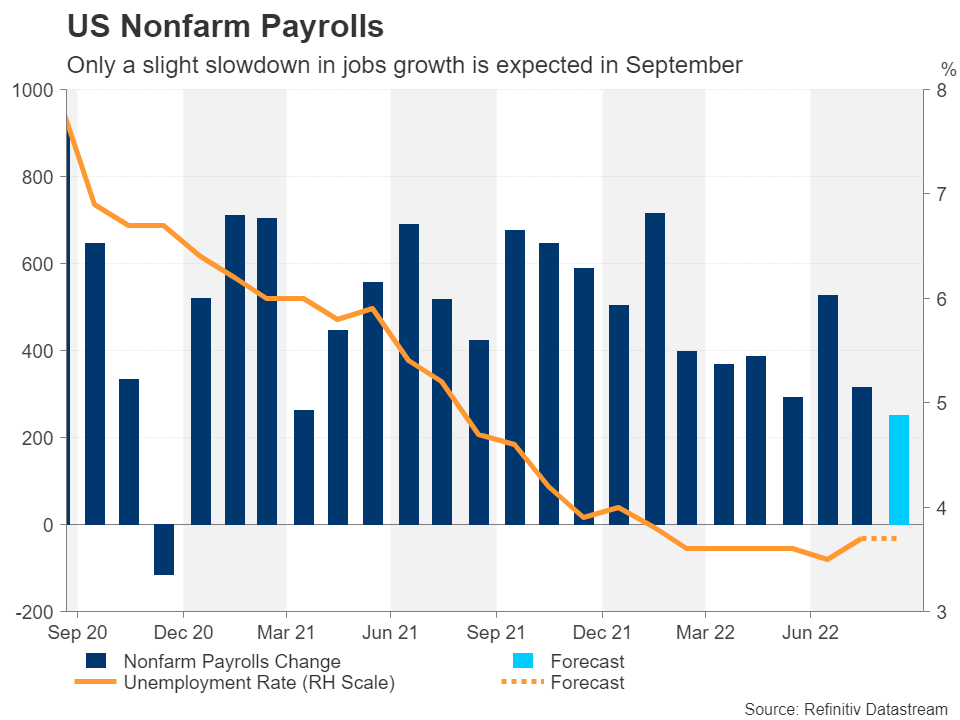
The consensus expectations are for nonfarm payrolls to have increased by a somewhat more moderate pace of 250k in September compared to the prior month’s figure of 315k. The jobless rate is projected to be unchanged at 3.7%, while average hourly earnings are forecast to have risen by 0.3% month-on-month in September.
Although a strong labour market is essential in maintaining confidence in the economy, investors would probably welcome a slight cooling down at this point as this could pave the way for the Fed to move into lower gear, potentially putting a break on the dollar’s advances.
On the other hand, another solid report risks worsening the rout in bond and equity markets as bets of a more aggressive Fed would be ramped up, further boosting the greenback.
RBA might begin to take foot off the brake
The Reserve Bank of Australia is widely expected to hike interest rates on Tuesday but after four straight increases of 50 basis points, many are speculating that policymakers will opt for a smaller 25-bps increment in October.
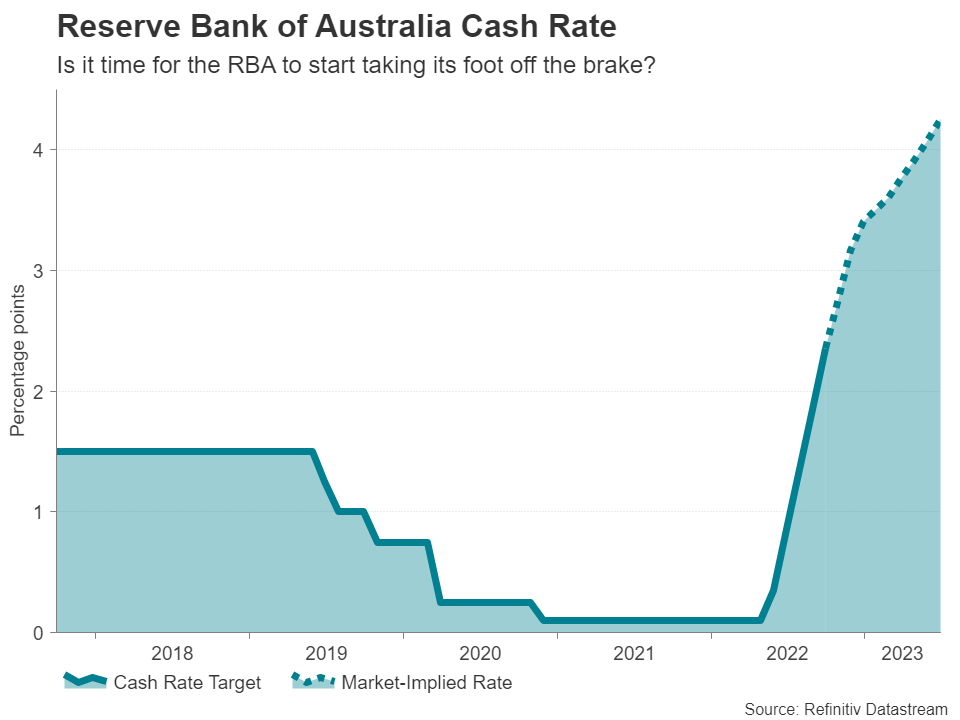
Governor Phillip Lowe previously signalled that the Bank is getting closer to the point that it will not need to keep hiking by 50 bps but just how close will likely be determined at the meeting. When considering how much the RBA has already tightened and that it meets more regularly than other central banks, a 25-bps increase seems sensible. However, following the turmoil in the markets and the recent acceleration of the Australian dollar’s slide, policymakers may want to hold off from signalling any let up in the fight against inflation.
Nevertheless, a slower pace is only a matter of time for the RBA so even if it were to raise rates by 50 bps, this may not necessarily provide much of a lift to the aussie and the currency will stay hostage to the risk mood in the markets.
RBNZ likely to stick with 50-bps increments
On Wednesday, it will be the turn of the Reserve Bank of New Zealand to announce its policy decision. Investors expect the RBNZ to raise the cash rate by 50 bps, maintaining the same pace as the last four meetings. However, they’ve priced in about 20% probability of a 75-bps hike, which seems unlikely considering that rates in New Zealand are already among one of the highest in the major advanced economies. But more significantly, Governor Adrian Orr recently remarked that the tightening cycle is “very mature”, although he did also stress that there is still some work to do.
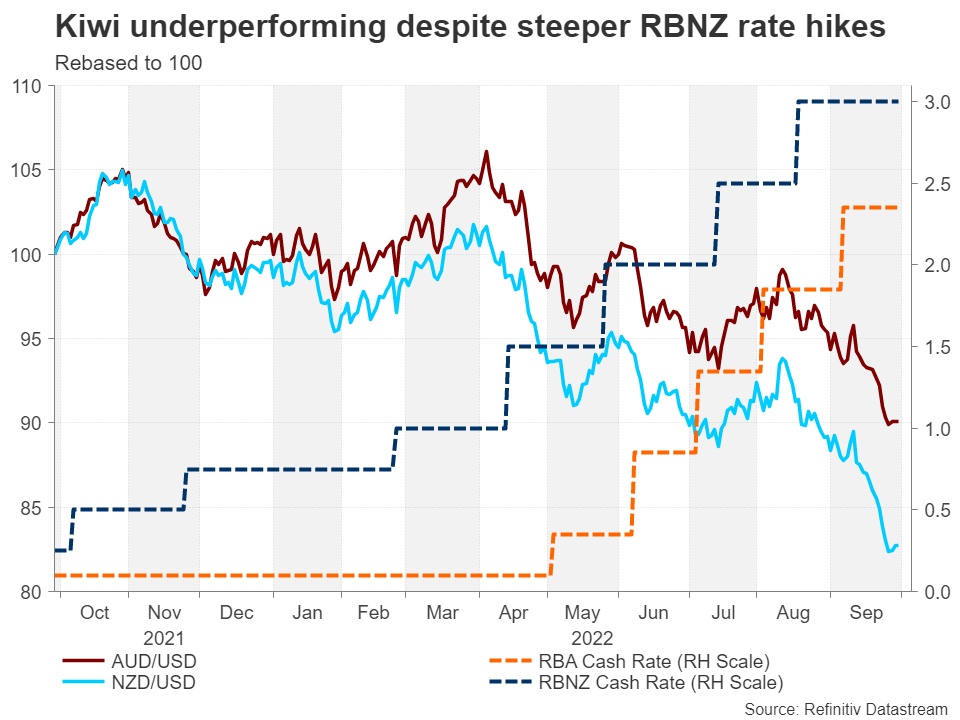
At the last meeting, the RBNZ upped its forecast of the terminal rate to 4.1%, suggesting there’s another 100-125bps of rate hikes to go by the middle of 2023. It’s possible the dramatic fall of the New Zealand dollar will prompt policymakers to favour a bigger 75 bps, but that could risk a further slump in the country’s housing market where the post-pandemic bubble appears to have burst.
Will there be a bounce back in Canadian jobs?
Sticking with the commodity-linked currencies, the highlight for the Canadian dollar will be Friday’s employment numbers. The Bank of Canada will probably find itself in a similar predicament as the RBA and RBNZ when it meets in just under a months’ time, and the October employment report will be watched for clues on the size of the rate hike.
Canada’s economy has been losing jobs for the past three months, contrary to expectations, so another disappointing reading in September could raise the odds of a smaller 25-bps rate increase at the next meeting. But even then, the consensus would probably remain at 50 bps as there’s been no shift in the hawkish tone coming out of the Bank of Canada. Hence, the data is not expected to stir much reaction in the loonie.
Euro and pound on shaky ground
Both the euro and pound are rebounding from the fresh lows brushed over the last week, with the latter plummeting to record levels versus the US dollar. But in the absence of major drivers in the coming week, their recovery is at risk of running out of steam.
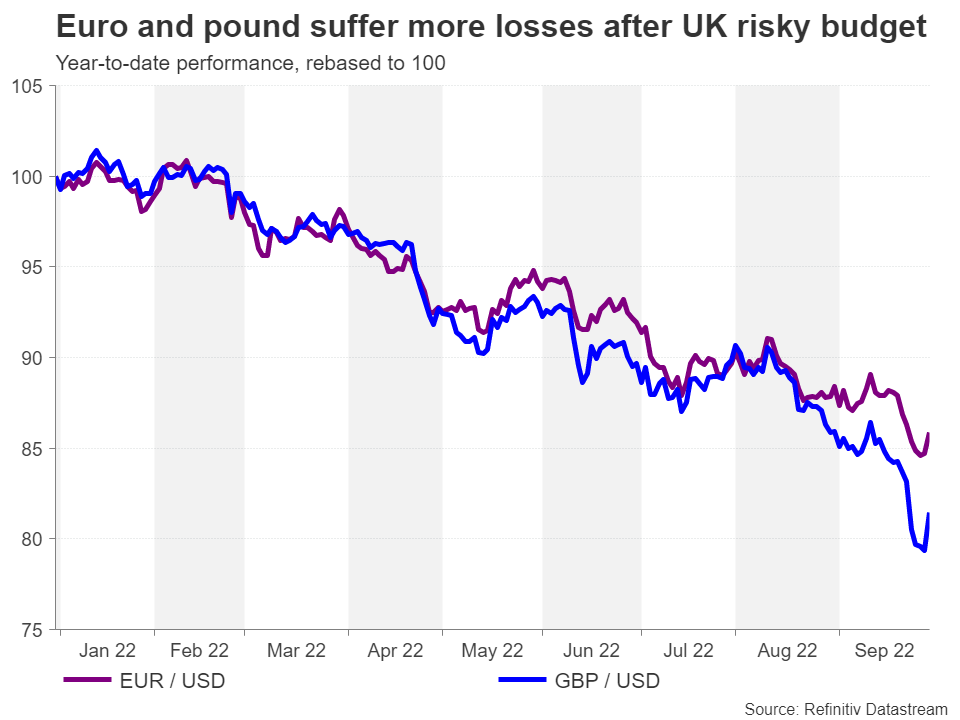
On the continent, traders will probably be focusing on the minutes of the European Central Bank’s September policy meeting on Thursday for any hints on the rate path. The ECB looks set to repeat the 75-bps hike in October but investors will try to gauge the appetite for further large moves beyond the next meeting.
In the UK, the economic agenda is extremely light but the headlines around the government’s disastrous budget will keep flowing in. The Bank of England has managed to restore some calm in the markets with its emergency scheme for purchasing long-dated bonds, but the situation remains fragile. If there is a return of volatility, further intervention by the BoE cannot be ruled out and the next one could come in the form of an unscheduled rate hike.
Either way, the euro and pound are far from being out of the woods as far as their downfall is concerned, amid persisting worries about energy rationing this winter.
OPEC+ to consider output cut
The OPEC+ alliance will hold its monthly meeting on Wednesday and there is talk that the major producers will decide to slash output again. However, it’s likely that the cut this time will be a lot bigger than the symbolic 100k barrels per day agreed in September, with Russia proposing a reduction of 1 million bpd.
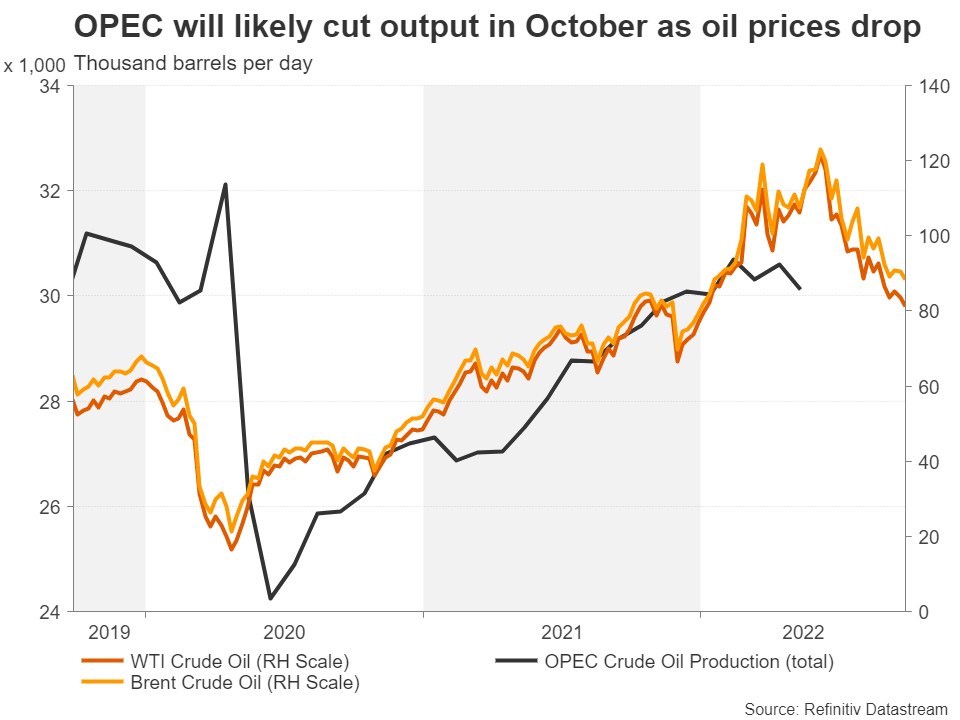
Oil has been in a steady downward trajectory since June and a greater-than-expected cut in production could push prices above this bearish channel. It would also weigh on broader risk sentiment as one of the few positives for investors lately has been the fact that energy prices have been coming down.
Week Ahead – Jobs Report Eyed
US
It remains all about the Fed as it continues down an aggressive tightening path. Wall Street will now fixated on how quick this economy is going to weaken. A weakening consumer will help drive down inflation but so far this economy has shown a lot of resilience in the service sector.
Investors will have a handful of key economic releases to follow this week. On Monday, the ISM manufacturing report is expected to soften but still remain in expansion territory while prices paid, new orders, and employment could show modest weakness. Factory orders are also expected to turn positive in August.
The key economic release for the week is the September nonfarm payroll report, which should show hiring continued with 250,000 jobs created. Unemployment is expected to remain steady at 3.7%, while wages continue to steadily increase at 0.3% over the prior month.
It will be another week filled with Fed speak; this time with 13 appearances. On Monday, we will hear from Bostic and Williams. Tuesday’s comments come from Logan, Williams, Mester, Jefferson, and Daly. On Wednesday, Bostic speaks on inflation. Thursday’s appearance will include Evans, Cook, Waller, and Mester. On Friday Williams speaks in New York.
EU
The minutes from the last ECB monetary policy meeting will no doubt be of interest but in reality, it all feels quite outdated. A 75 basis point rate hike is priced in for the next meeting, maybe even 100bps, and I’m not sure what in the minutes could change that.
There’s a lot of economic data being released and they may not make for great reading, particularly on the PMI front as companies head into a nervy winter period.
UK
It’s barely worth looking at the economic calendar next week as the direction of the pound is unlikely to be driven by the final PMI readings or Halifax PMI.
The spotlight will be on the government and Bank of England and the prospect of u-turns and more interventions. Commentary from Prime Minister Liz Truss, Chancellor Kwasi Kwarteng and BoE policymakers will obviously be of interest but ultimately it’s what they do more so than what they say that people are interested in. In the absence of action, will pressure mount on Truss and Kwarteng from within?
Russia
While the focus next week obviously centres around events in Ukraine and the response of the West to the “referendum results”, there is some economic data that will be of interest including inflation data and PMIs.
South Africa
A quiet week with the whole economy PMI on Wednesday the only notable release.
Turkey
The CPI data on Monday will tell us everything and the CBRT nothing about the shambolic monetary policy experiment taking place in Turkey. Inflation is expected to hit almost 85% in September but with President Erdogan calling for more rate cuts, we all know what’s coming next.
Switzerland
The SNB wants everyone to know that further rate hikes are coming, perhaps even before the next scheduled meeting, and the inflation data on Monday may tell us how seriously we should take those threats. PMI and unemployment data wrap up the week on the data front.
China
Golden week holidays are here and Mainland Chinese markets are closed through October 7th, while Hong Kong is only closed on Tuesday. After some verbal warnings about potentially selling dollars, traders will pay close attention to how the yuan trades. The PBOC could provide more signals about selling dollars.
India
The focus may be on the RBI and if they have pressure to tap their forex reserves. Economic data releases include both the manufacturing and services PMI releases.
Australia & New Zealand
Both the RBA and RBNZ are expected to continue with their tightening cycles.
The RBA is expected to deliver a fifth consecutive half-point hike despite signalling it could opt for a slower pace. With the rest of the world continuing to tighten aggressively, the central bank may want to avoid a downshift from its current pace.
The RBNZ is also expected to deliver a fifth straight half-point rate hike as inflation risks remain elevated. The peak in the tightening cycle is nearing thanks to lower energy prices and an improvement in supply chains.
Japan
It will be a busy week with lots of Japanese economic data. Key releases include the Tankan manufacturing report, PMI surveys, household spending data, and the leading index. Traders will pay close attention if the Japanese yen returns back to levels seen before the intervention. Currency intervention remains the most powerful that Japan has left to avoid massive selling pressure on the yen given the BoJ’s reluctance to tweak its yield curve control.
Singapore
Second-tier releases include the purchasing managers’ index, retail sales, and foreign reserve data. The Singapore dollar has been weakening but is still far from the lows seen earlier in the pandemic.
Economic Calendar
Saturday, Oct. 1
Economic Events
- Mainland Chinese markets are closed through Oct. 7 for the Golden Week holidays
- ECB’s de Cos joins a panel on the future of globalization at La Toja Forum 2022 in Galicia, Spain
Sunday, Oct. 2
Economic Events
- Brazilians vote in the Presidential election
- UK Conservative Party autumn conference starts in Birmingham, with speeches from Prime Minister Liz Truss and Chancellor Kwasi Kwarteng
Monday, Oct. 3
Economic Data/Events
- US construction spending, ISM manufacturing, light vehicle sales
- Eurozone manufacturing PMI
- France manufacturing PMI
- Germany manufacturing PMI
- India manufacturing PMI
- Japan Tankan, vehicle sales
- Singapore home prices, PMI
- UK S&P Global / CIPS UK manufacturing PMI
- Fed’s Bostic gives opening remarks at a conference on technology-enabled disruption
- Fed’s Williams speaks at the US Hispanic Chamber of Commerce National Conference in Phoenix
- Euro area and EU finance ministers meet in Luxembourg
Tuesday, Oct. 4
Economic Data/Events
- US factory orders, durable goods
- RBA decision: Expected to raise Cash Rate Target by 50bp to 2.85%
- Australia building approvals
- Colombia monetary policy minutes
- Eurozone PPI
- Japan Tokyo CPI
- Mexico international reserves
- Spain unemployment
- Fed’s Williams gives opening and closing remarks at an event on culture in the workplace hosted by the regional Fed bank
- Fed’s Logan speaks at an event on technology-enabled disruption hosted by the Atlanta Fed
- Fed’s Mester speaks at a payments conference hosted by the Chicago Fed
- Fed’s Daly takes part in a moderated Q&A at the Council on Foreign Relations in New York
- ECB’s Centeno speaks at a conference in Luxembourg
- German Foreign Minister Baerbock speaks at the Warsaw Security Forum
- Austrian financial regulator’s annual conference. Speakers include ESMA’s Verena Ross, ECB Supervisory Board chairman Enria, and Austrian Finance Minister Brunner
Wednesday, Oct. 5
Economic Data/Events
- US trade
- Eurozone Services PMI
- France industrial production
- New Zealand rate decision: Expected to raise rates by 50bp to 3.50%
- Poland rate decision: Expected to raise rates by 25bp to 7.00%
- Russia GDP
- Singapore retail sales, car permit prices
- Thailand CPI
- OPEC+ meeting
- Fed’s Bostic discusses inflation during a virtual event hosted by Northwestern University
- EIA crude oil inventory report
Thursday, Oct. 6
Economic Data/Events
- US initial jobless claims
- Australia trade balance
- Eurozone retail sales
- Germany factory orders
- Hungary one-week deposit rate
- Spain industrial production
- Fed’s Evans discusses the economy and monetary policy at an event hosted by the Illinois Chamber of Commerce in Chicago
- Fed Governor Cook speaks at the Peterson Institute for International Economics in Washington. Fed’s Mester discusses the economic outlook during an event hosted by the Council for Economic Education.ECB publishes an account of its September policy meeting
Friday, Oct. 7
Economic Data/Events
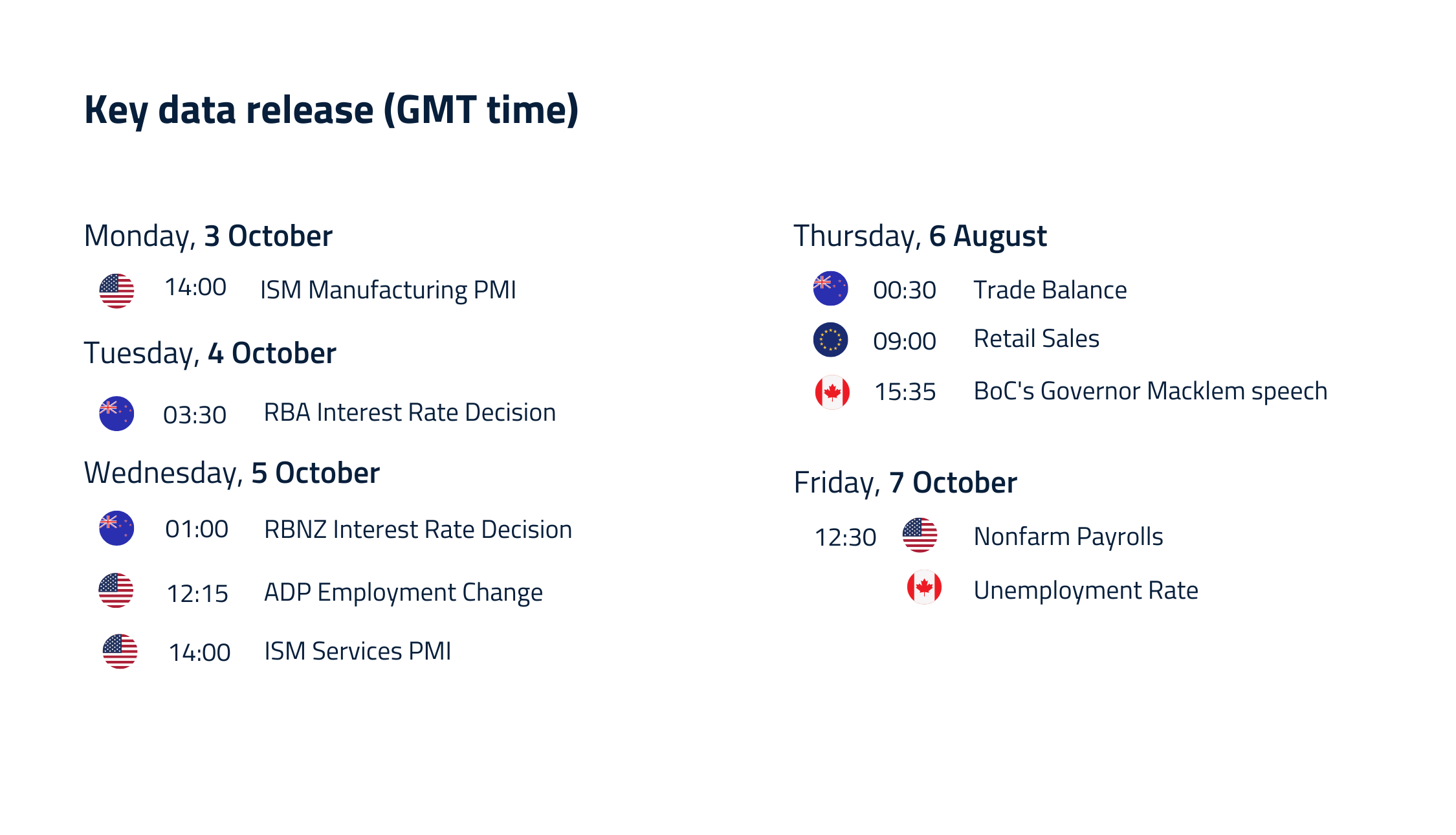
- US September change in nonfarm payrolls: 250K v 315K prior, wholesale inventories
- Australia’s central bank semi-annual financial stability review
- Canada unemployment
- China forex reserves
- France trade
- Germany industrial production
- Japan household spending
- Mexico CPI
- Russia CPI
- BOE Deputy Governor Dave Ramsden speaks at a securities industry conference on the development of fintech services
- Fed’s Williams takes part in a fireside chat and moderated Q&A in Buffalo, New York
- European leaders from within and outside the EU have an informal summit and meeting in Prague, the so-called European Political Community gathering
Sovereign Rating Updates
- Austria (Fitch)
- Greece (Fitch)
- Israel (Moody’s)
- Ukraine (Moody’s)
- Cyprus (DBRS)
- Netherlands (DBRS)
Temporary Relief: Selling in Risk Assets is Yet to End
AUD/USD slides over flight to safety
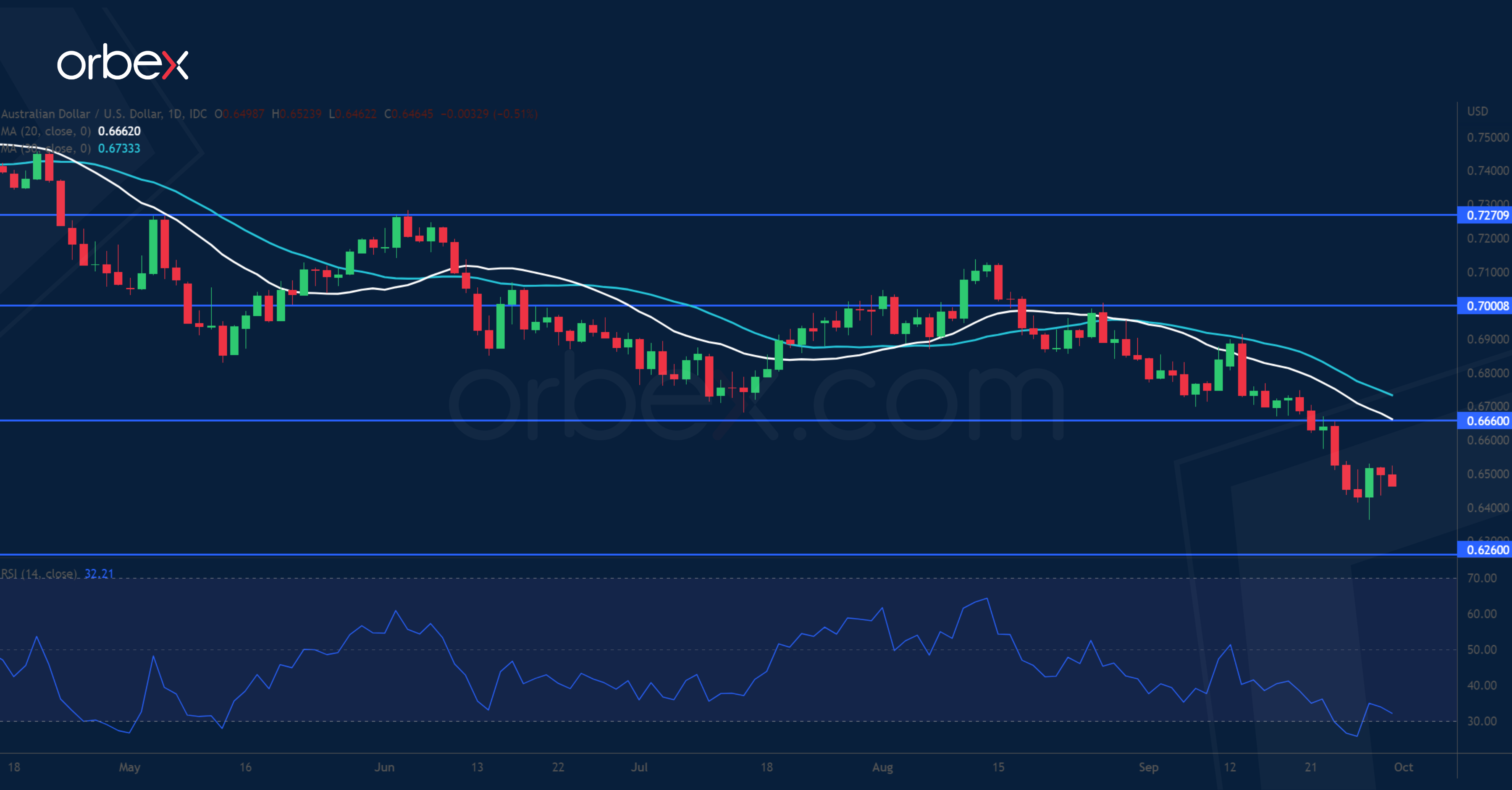
The Australian dollar slips as commodities fall amid recession fears. The latest CPI showed annual inflation easing slightly in August, which may convince policymakers that they are on the right track. However, another 50bp interest rate hike by the RBA this week could be sidelined by the market’s pessimism. Nervous traders may continue to hoard the safe-haven dollar amid selling of risk assets. Prolonged weakness in the Chinese yuan, as Australia’s biggest trading partner undergoes an economic slowdown could weigh on commodity prices and the Aussie proxy. 0.6260 is the next support and 0.6660 the first resistance ahead.
NZD/USD falls over risk aversion
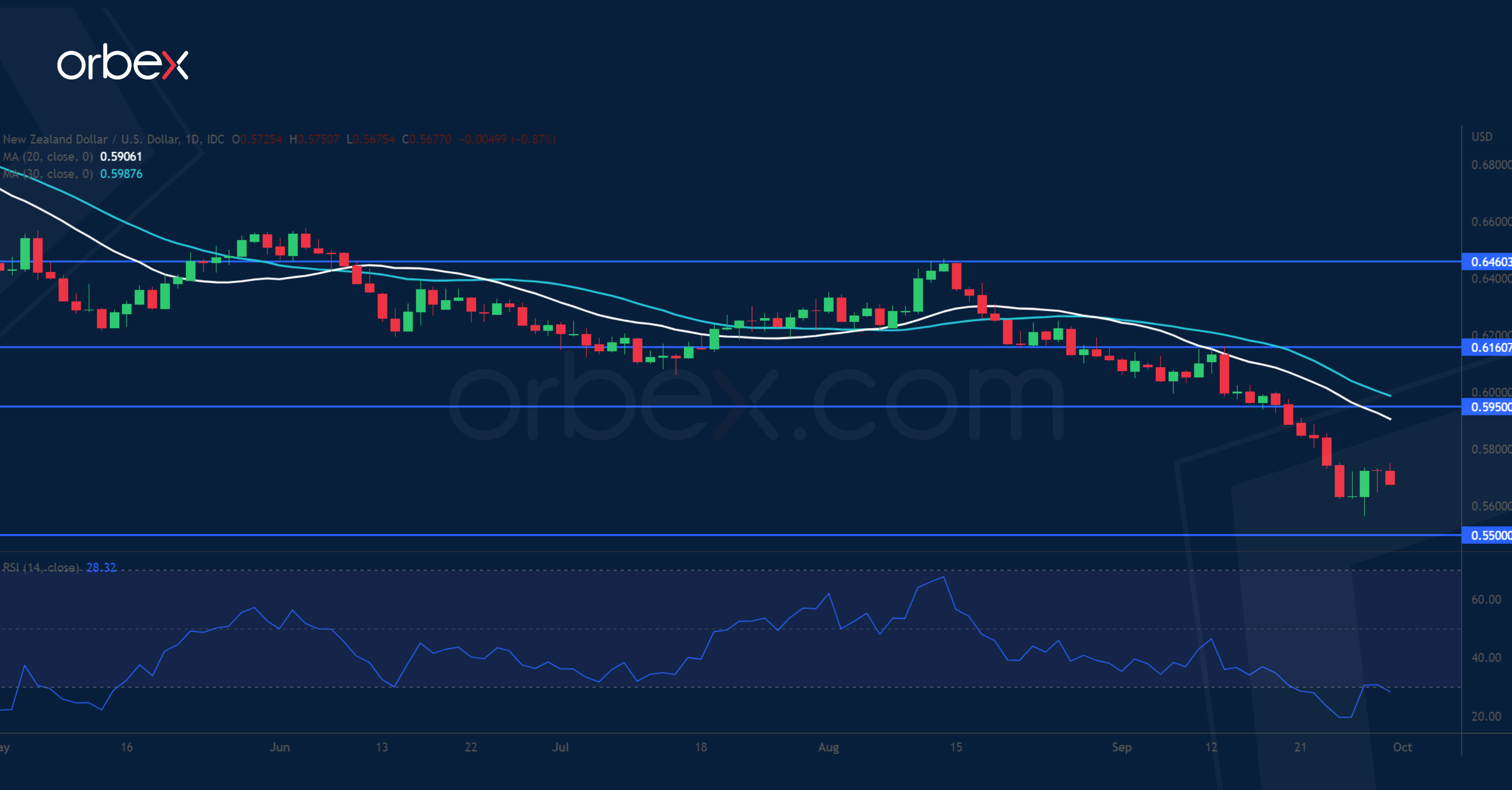
The New Zealand dollar weakens as the risk-off mode prevails. The RBNZ is set to deliver its eighth straight rate hike with another 50bps. Governor Adrian Orr said the tightening cycle is ‘well advanced’ but not over yet. Low unemployment rate and high inflation would still give the central bank leeway to push for tighter conditions. The market expects a further 50bp rate raise in November, taking the official cash rate to 4%. Though pronounced weakness in the kiwi may exacerbate inflation, which may turn into a downbeat spiral. The pair may find a short relief over March 2020’s low (0.5500). 0.5950 is the resistance in case of a bounce.
XAU/USD slumps as dollar bounces higher
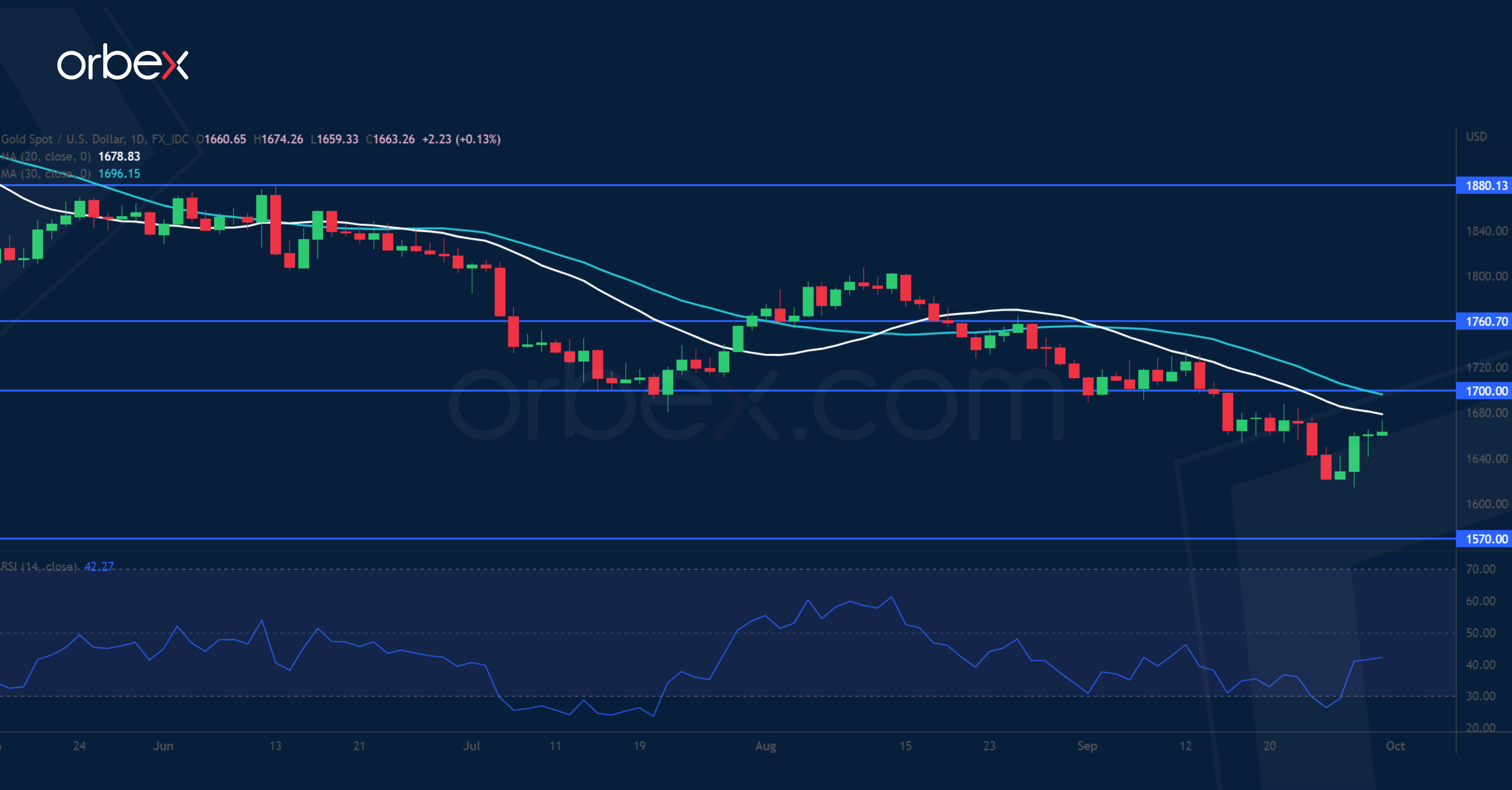
Bullion struggles as the dollar index climbs to a fresh two-decade high. Greater rate hike expectations may maintain a firm support to the greenback at the expense of gold. Renewed hawkish calls from Fed officials make the peak in US interest rates of anyone’s guess. The previously much-speculated 4% seems to be outdated. Policymakers are betting on the low unemployment rate to keep the monetary policy restrictive. A median estimate of all 19 Fed bankers shows interest rates rising to 4.4% by the end of this year. The precious metal would be heading to April 2020’s low at 1570 and 1700 is the closest resistance.
S&P 500 tumbles over global hard landing
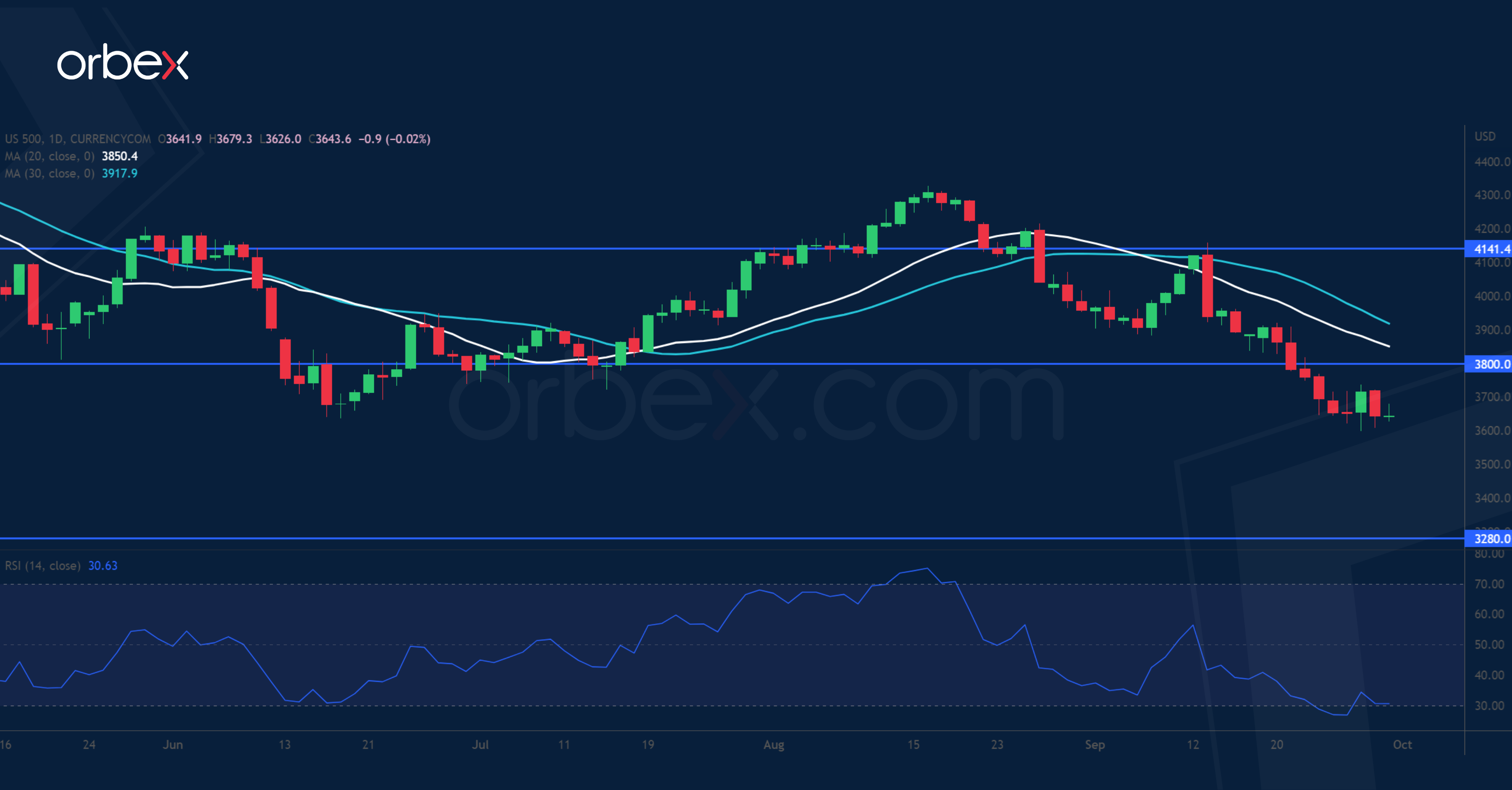
The S&P 500 falls as Fed officials remain vocal about tighter monetary policy. The market is bracing for another 75bp hike at the FOMC in November. There are definitely few good headlines to soothe investors. Property crisis in China and escalation on the Russia-Ukraine front only amplify worries of a concerted global hard landing. Resilience in the US job market may not be investors’ best friend but rather convince the Fed to carry on. With mega caps like Amazon and Apple under pressure, equities may bear the brunt of widespread risk aversion. The index is heading to a two-year low at 3280 and 3800 is a fresh resistance.
Global September PMIs and Market Sentiment
Global markets have returned to the downward trend, helped by a series of disappointing data over the last week. Although so far today there is apparently an attempt at a rally, that is likely more technical, related to the end of the quarter.
So, what could potentially turn market sentiment around? Better than anticipated PMIs are one possibility. Preliminary PMIs from the major countries were a disappointment, but there is a (small) chance that they might be revised higher and pleasantly surprise the markets. Of course, if they come in as expected, it could be seen as confirmation of the general downward trend, and affirm the course.
What to look out for
With focus turning toward US employment figures at the end of the month, PMIs could set the stage for the whole week. Many of the results are expected very near the 50 level, which separates expansion and contraction, so there could be some shake ups if there is a miss or beat by just a few decimals.
Australia: Is expected to confirm the minimum increase in Manufacturing PMI to 53.9 from 53.8 in August. Remember that the RBA will be meeting later in the week, where another 50bps hike is expected.
Spain: Might set the tone for Europe, being the first to report from the shared economy. Manufacturing PMI is expected to take a significant dip to 48.5 from 49.9 in August.
Switzerland: Is expected to remain broadly upbeat, unlike the rest of the nations on the continent. But a bit of shadow is expected to fall on the Swiss luster, with an even bigger drop than Spain. Manufacturing PMI is expected at 54.5 down from 56.4 prior.
France: Is expected to confirm it's fall back into contraction, with one of the worst results expected in the shared economy. It follows rising energy prices after the country had to idle nuclear power plants through the summer, so the drop might be somewhat temporary. Manufacturing PMI is forecast at 47.8 compared to 50.6 in August.
Germany: Is off on holiday, but will still report Manufacturing PMI, which is expected to be the same as the prelim at 48.3 compared to 49.1 in August.
UK: Despite the concerns over the budget, UK businesses are expected to actually increase their optimism. But, that might be because the Prelim number was from the survey done before Kwarteng's announcement. That might be revised lower with the full survey completed after the budget announcement, but before the BOE's intervention. Prelim Manufacturing PMI was 48.5 compared to 47.3 in August.
US: ISM Manufacturing PMI is expected to repeat the preliminary number and remain stable from the prior month at 52.8. Lower retail fuel prices over the period might have provided businesses with some more optimism, but several key companies radically cut their outlook. FedEx removing guidance ahead of an expected drop in deliveries spooked quite a few investors.
USD/JPY Mid-Day Outlook
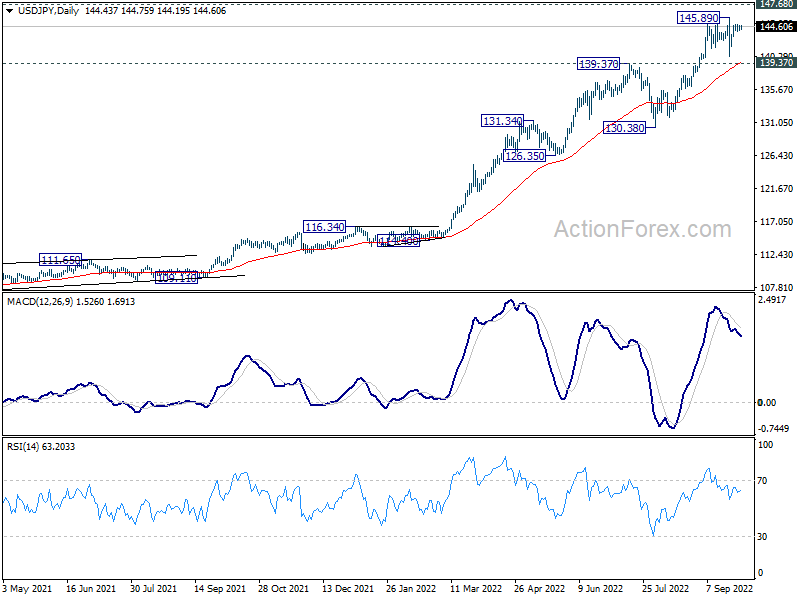
Daily Pivots: (S1) 144.07; (P) 144.44; (R1) 144.80; More...
Intraday bias in USD/JPY stays neutral as consolidation from 145.89 is extending. Further rally is expected as long as 139.37 resistance turned support holds. Break of 145.89 will target 147.68 long term resistance. On the downside, however, decisive break of 139.37 will confirm short term topping. Deeper decline would be seen back towards 130.38 support.
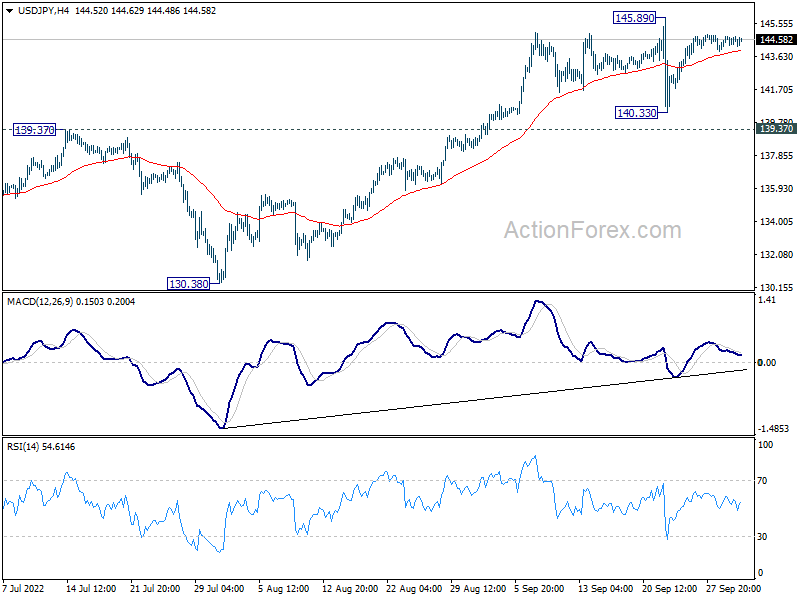
In the bigger picture, up trend from 101.18 is still in progress, as part of the whole up trend from 75.56 (2011 low). Further rise should be seen to 147.68 (1998 high). For now, break of 130.38 support is needed to be the first indication of medium term topping. Otherwise, outlook will stay bullish even in case of deep pull back.
USD/CHF Mid-Day Outlook
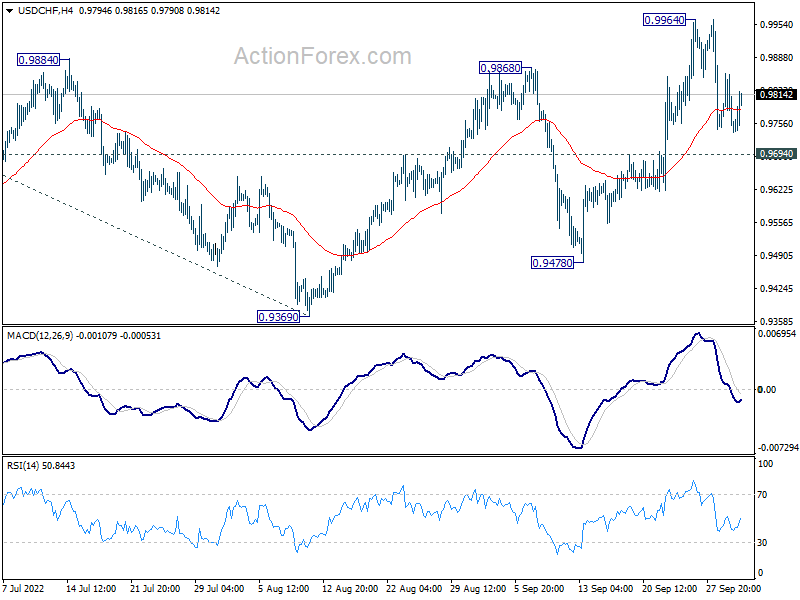
Daily Pivots: (S1) 0.9717; (P) 0.9786; (R1) 0.9823; More...
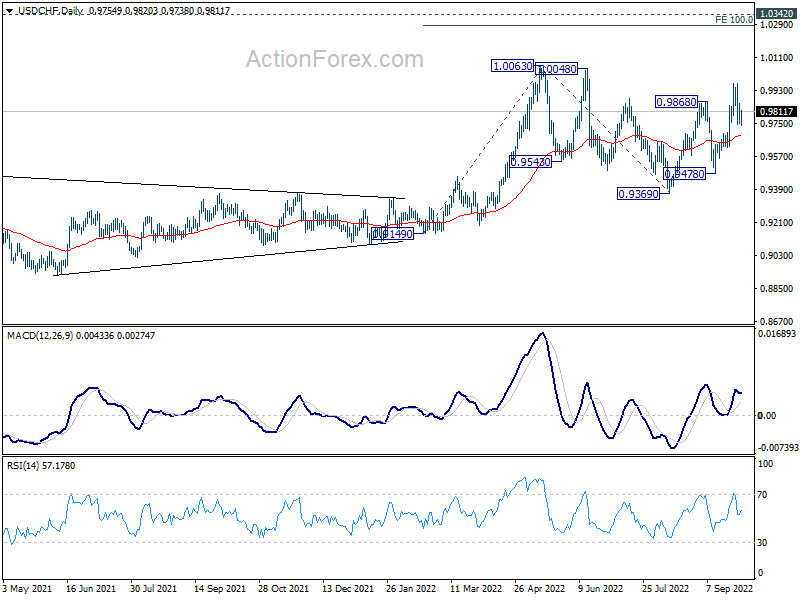
Intraday bias in USD/CHF stays neutral as corrective trading from 0.9964 continues. On the upside, above 0.9964 will resume the rally from 0.9369 to retest 1.0063 high. On the downside, break of 0.9694 support will extend the corrective pattern from 1.0063 with another falling leg, towards 0.9478 support first.
In the bigger picture, current development suggests that up trend from 0.8756 (2021 low) is still in progress. Sustained break of 1.0063 will target 100% projection of 0.9149 to 1.0063 from 0.9369 at 1.0283, and then 1.0342 (2016 high). For now, this will remain the favored case as long as 0.9369 support holds, even in case of deep pull back.
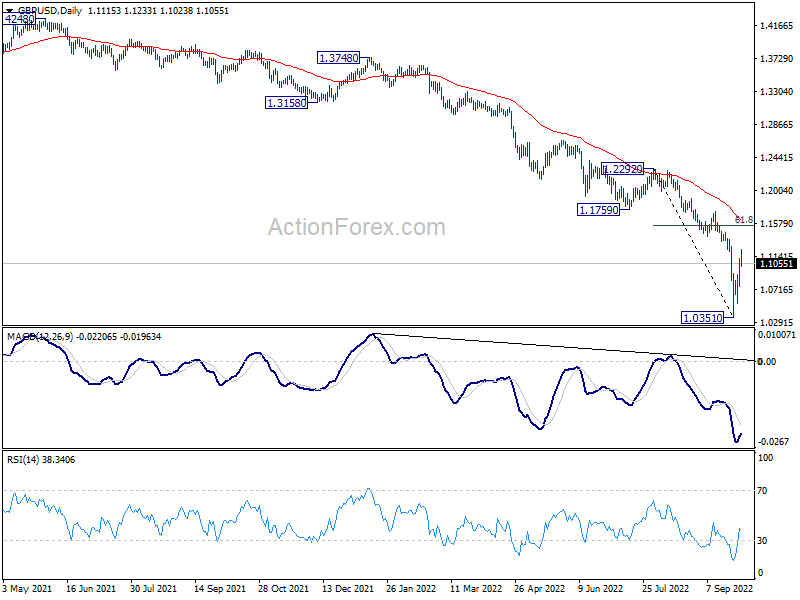
GBP/USD Mid-Day Outlook
Daily Pivots: (S1) 1.0881; (P) 1.1000; (R1) 1.1238; More...
GBP/USD's rebound from 1.0351 is still in progress and intraday bias stays mildly on the upside. Further rise could be seen to 61.8% retracement of 1.2292 to 1.0351 at 1.1551. On the downside, break of 1.0760 minor support will indicate that the rebound is over, and bring retest of 1.0351 low.
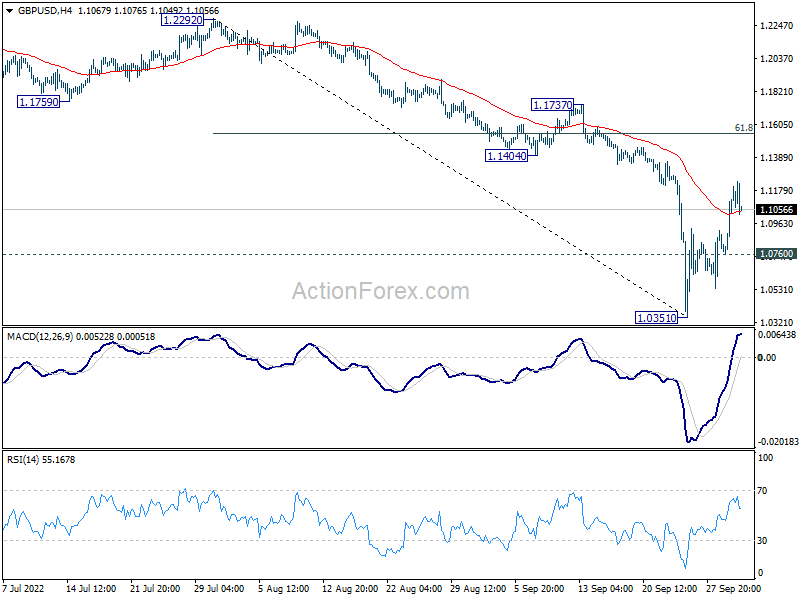
In the bigger picture, fall from 1.4248 (2018 high) is resuming long term down trend from 2.1161 (2007 high). Next target is 100% projection of 2.1161 to 1.3503 from 1.7190 at 0.9532. There is no scope of a medium term rebound as long as 1.1759 support turned resistance holds.