Sample Category Title
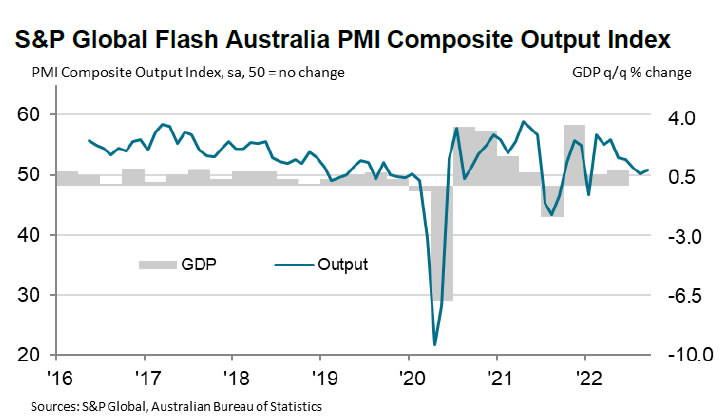
Australia PMI composite edged up to 50.8, at risk of heading into contraction territory
Australia PMI Manufacturing ticked up from 53.8 to 53.9 in September. PI Services also rose slightly from 50.2 to 50.4. PMI Composite Output rose from 50.2 to 50.8.
Laura Denman, Economist at S&P Global Market Intelligence said: "September data indicated that the recent interest rate hikes made by the RBA have begun to have the desired effect in terms of prices.... At the same time, the private sector has remained in expansion territory with the pace of growth even accelerating very slightly...
"On the negative side, the full effects of recent interest rate hikes will be lagged... Should the RBA continue to increase the base rate further, the private sector economy may be at risk of heading into contraction territory in the future as disposable incomes across the nation tighten and overall demand conditions remain subdued."
UK Gfk consumer confidence dropped to new record low at -49
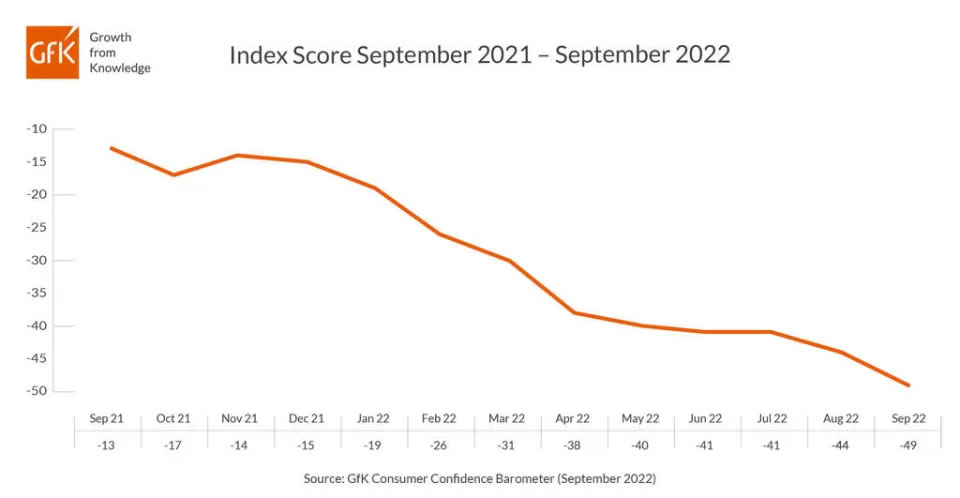
UK Gfk consumer confidence dropped further from -44 to -49 in September, hitting another record low since 1974. Personal financial situation over next 12 months dropped -9 pts to -40. General economic situation over next 12 months dropped -8 pts to -68. Major purchase index was unchanged at -38.
"Consumers are buckling under the pressure of the UK's growing cost-of-living crisis driven by rapidly rising food prices, domestic fuel bills and mortgage payments. They are asking themselves when and how the situation will improve." Joe Staton, client strategy director at GfK, said.
ECB Schnabel: Inflation pressures crept into all parts of economy
ECB Executive Board member Isabel Schnabel said yesterday in Luxembourg, "What we are seeing is that the inflationary pressures have become much more broad-based. They have somehow crept into all parts of the economy."
"At the moment, we are not in a situation where the normalization of monetary policy harms the economy," she said. "It's more like we have to remove the accommodation that we still have in the system."
USD/JPY Dips As Bulls Take Breather, Gold Consolidates
Key Highlights
- USD/JPY started a downside correction from the 145.90 high.
- It broke a major bullish trend line at 143.75 on the 4-hours chart.
- Gold price is still consolidating below the $1,700 resistance zone.
- The US Manufacturing PMI could decline from 51.5 to 51.1 in Sep 2022 (Preliminary).
USD/JPY Technical Analysis
The US Dollar remained in a positive zone above the 142.00 level against the Japanese Yen. USD/JPY traded to a new multi-year high at 145.90 before the bears appeared.
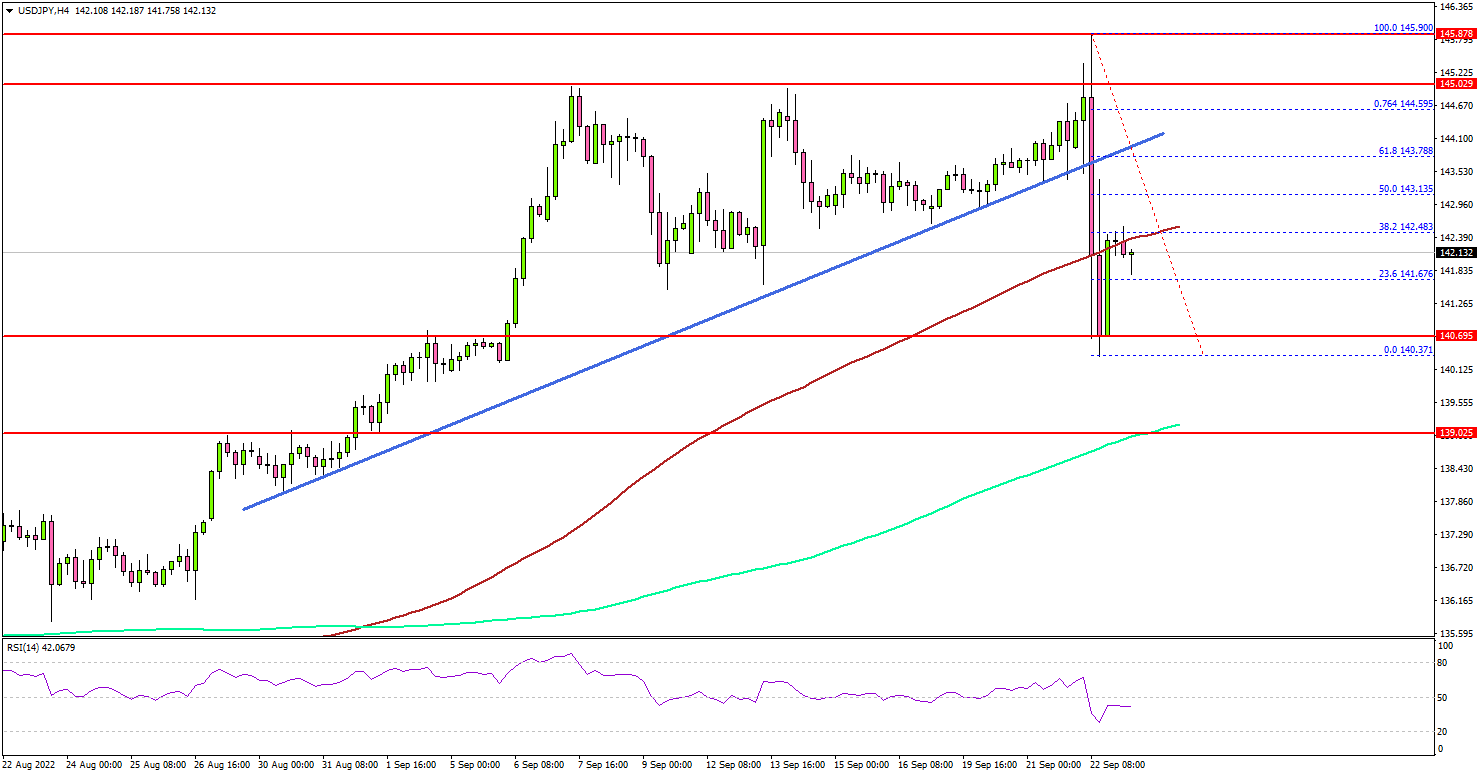
Looking at the 4-hours chart, the pair started a downside correction from the 145.90 high. There was a sharp decline below the 145.00 and 144.00 levels. Besides, the pair traded below a major bullish trend line with support at 143.75.
There was a drop below the 142.50 level and the 100 simple moving average (red, 4-hours). However, the pair remained well above the 139.00 support and the 200 simple moving average (green, 4-hours).
On the upside, an initial resistance sits near the 142.50 zone. The first major resistance is near the 143.15. A clear move above the 143.15 level could open the doors for a fresh increase to 144.00. Any more gains might send the pair towards the 145.00 level.
On the downside, an initial support is near the 141.25 level. The main support sits at the 140.00 level. A downside break below the 140.00 zone might send the pair towards the 139.00 level. The next major support is near the 138.40 level, below which the pair could even test the 136.50 level.
Looking at gold price, the price is still facing a strong resistance below the $1,700 level and remains at a risk of a fresh decline.
Economic Releases
- Germany’s Manufacturing PMI for Sep 2022 (Preliminary) - Forecast 48.3, versus 49.1 previous.
- Germany’s Services PMI for Sep 2022 (Preliminary) - Forecast 47.2, versus 47.7 previous.
- Euro Zone Manufacturing PMI for Sep 2022 (Preliminary) – Forecast 48.7, versus 49.6 previous.
- Euro Zone Services PMI for Sep 2022 (Preliminary) – Forecast 49.0, versus 49.8 previous.
- UK Manufacturing PMI for Sep 2022 (Preliminary) – Forecast 47.5, versus 47.3 previous.
- UK Services PMI for Sep 2022 (Preliminary) – Forecast 50.0, versus 50.9 previous.
- US Manufacturing PMI for Sep 2022 (Preliminary) – Forecast 51.1, versus 51.5 previous.
- US Services PMI for Sep 2022 (Preliminary) – Forecast 45.0, versus 43.7 previous.
Eco Data 9/23/22
[php_everywhere instance="1"]
Global September Preliminary PMIs and Economic Outlook
After a week in which a dozen central banks around the world either tightened policy or resorted to currency intervention, the focus is now on the economy. Just how much of the move was priced in, and how much will economic growth be impacted going forward. So far, tightening has contributed to a stronger dollar, on top of increased risk avoidance supporting safe havens.
Purchasing managers are likely to see the first signs of the effects of monetary policy. Whether that's in lower prices implying potentially less inflation in the future, or lower orders implying less growth in the future. Weaker PMIs could start raising bets that monetary policy will start to level off in the near future. The surveys are still being conducted, so we won't see the full effect on manager's thinking until next month. But central bank action was pretty well telegraphed ahead of the start of the survey.
What to look out for:
Australia
Australia is expected to keep bucking the global trend, with manufacturing PMIs expected to be firmly in expansion, although stumbling a bit. The services sector is expected to remain under pressure through the winter, and slower tourism activity. Australian Manufacturing PMI expected at 53.2 compared to 53.8 prior. Services PMI expected to expand modestly to 50.8 from 50.2 prior.
France
As usual, France is the first major EU country to report PMIs, and is likely to set the tone for the shared currency unless there is a major deviation with later data. The high cost of energy in France has been weighing on the economic outlook coupled with the ECB recently starting to raise rates. Both are likely to be on the minds of managers when they answer the survey.
French September Preliminary Manufacturing PMI is forecast to fall just barely into contraction at 49.8 compared to 50.4 prior. Services PMI is expected to remain just barely in expansion at 50.5 compared to 51.2 prior.
Germany
Recent positive news in Germany on the energy front isn't expected to lift businesses' spirits all that much. With energy prices still high despite the country well ahead of target on filling up its reserves, executives are worried about which plants will be idled next due to high operating costs.
German September Preliminary Manufacturing PMI is expected to fall further into contraction to 48.3 from 49.1 prior. Services PMI is expected to perform even worse, dropping to 46.0 from 46.9 prior.
UK
The British survey was conducted after PM Truss announced the price cap, so we could see if that has any effect on business optimism. However, the details have yet to be announced, so the impact might be minimal. UK Preliminary Manufacturing PMI is expected to improve modestly to 47.5 from 47.3 prior. Services PMI is expected to fall to 50.0 compared to 50.9 prior.
Bank of England Update: Another 50bp Hike and We Expect More to Come
- In line with our expectations, the BoE today hiked policy rates by 50bp, bringing the Bank Rate to 2.25.
- The extent to which fiscal policy is set to boost demand and hence impact policy setting is still highly uncertain.
- We maintain our call for a 50bp hike in November and December and 25bp in February with risks to our call skewed towards additional hikes in 2023.
In line with our expectation, the Bank of England (BoE) hiked the Bank Rate by 50bp to 2.25% with 5 members voting for a 50bp hike, 3 members voting for 75bp and one member voting for 25bp. As expected, BoE announced that outright government bond selling will start with a total reduction in bond holdings of 80 billion pounds over 12 months. The BoE repeated its meeting-by-meeting approach stating that "Policy is not on a pre-set path.", giving close to no forward guidance to markets.
One of the key takeaways from the Monetary Policy Summary is that the BoE no longer seem to pencil in a recession by Q4 2022. Note no inflation or growth forecast were published at this interim meeting, but not mentioning a recession gives a hint that the recession won't hit as soon as BoE predicted in August. This feeds well into our narrative of the fiscal stimulus providing near-term support to the economy. With newly elected PM Lizz Truss having announced the energy relief plan, which will cap energy prices for households, BoE now sees the peak in CPI inflation to be just below 11% compared to the 13% projected in August. The BoE emphasised that the package is likely to add to inflationary pressures in the medium term, which strengthens our case for a February hike in 2023. The BoE also repeated the message that they will "respond forcefully as necessary" if inflationary pressures look more persistent, noting that the upward risk could come from stronger demand. More details on the fiscal package will be announced tomorrow (Friday).
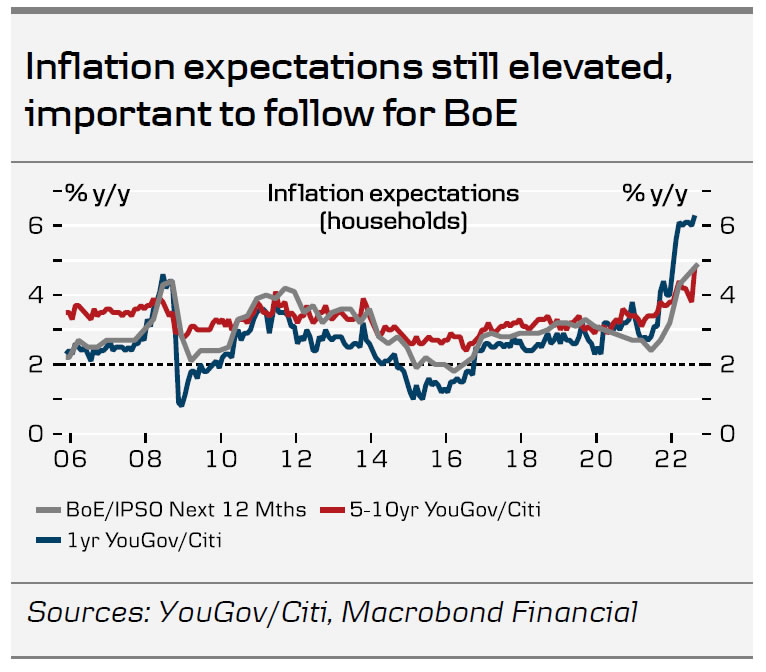
Rates: 10Y gilts jumped 20bp upon announcement as investors' took note of BoE's perceived lower recession risk. The market is currently pricing in another 270bp until the third quarter next year and thus expects the rate path to peak at around 4.6%. Our base case remains that of a peak in the Bank Rate of 3.5%.
FX. EUR/GBP initially moved higher upon announcement to 0.8740 from 0.8700. However, the move was overall muted with the cross later settling around 0.8720. We see a case for EUR/GBP to remain elevated in the near-term, but in the longer-term we expect the cross to move lower as we expect the positive USD environment to eventual benefit GBP relative to EUR.
Our call. We still expect BoE to deliver more rates hikes. We pencil in another 50bp rate hike in November and December and finally a 25bp hike in February. We do not expect rate hikes beyond the February meeting, although another 25bp rate hike in March seems like a close call at this point. Our expectations fall below current market pricing as we expect BoE to eventually turn less hawkish amid a weakening growth backdrop.
Swiss National Bank Exits Negative Rates
Summary
- The Swiss National Bank (SNB) delivered a 75 bps rate hike at its September monetary policy meeting, bringing its policy rate to +0.50%.
- Overall, the announcement's forward guidance was not as hawkish compared to many other global central banks' comments. Rather than signaling forceful rate hikes ahead, the SNB instead repeated that it cannot be ruled out that further increases in the SNB policy rate will be necessary to ensure price stability over the medium term. In addition, the central bank indicated it remains willing to intervene in the foreign exchange market as necessary.
- Looking ahead, we believe the SNB will continue tightening monetary policy but will deliver rate hikes of smaller magnitude, consistent with our outlook for slower growth and somewhat more contained inflation next year. More specifically, we expect the SNB to hike rates by 50 bps in December and 25 bps in March, with a terminal policy rate of 1.25%.
Swiss National Bank Exits Negative Rates
The Swiss National Bank (SNB) delivered a 75 bps rate hike at its September monetary policy meeting, bringing its policy rate to +0.50%. Switzerland was the last of the European countries to move its policy rate into positive territory.
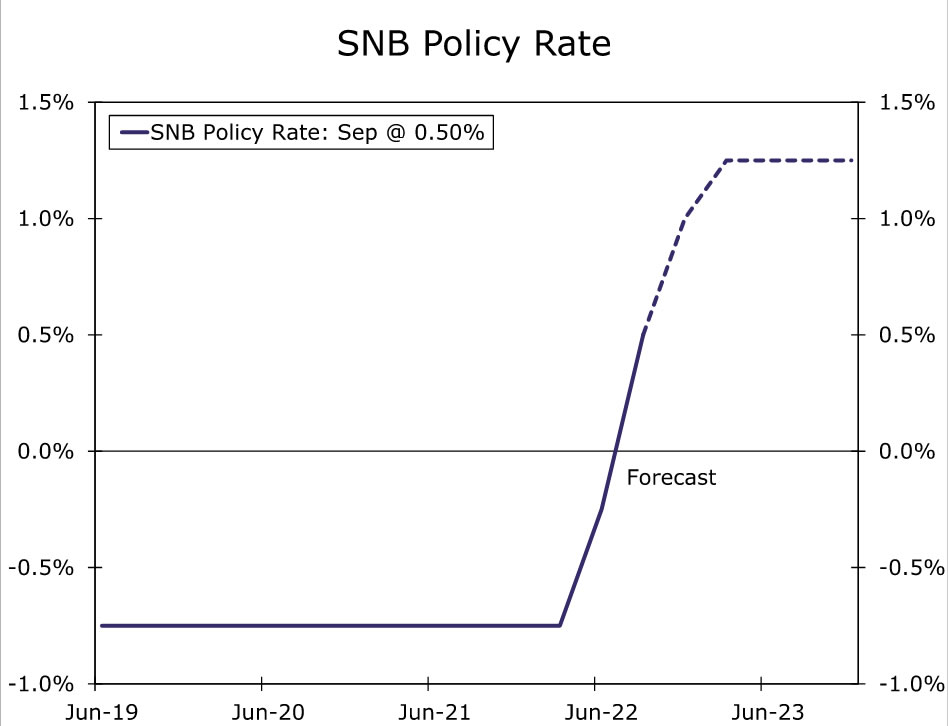
Overall, the announcement's forward guidance was not as hawkish compared to many other global central banks' comments. Rather than signaling forceful rate hikes ahead like other institutions, the SNB instead repeated that it cannot rule out further increases in the SNB policy rate to ensure price stability over the medium term. In addition, the central bank continues to closely monitor the franc exchange rate given currency strength has been a factor in helping dampen inflation pressures. After reaching a seven-year high this week against the euro, the franc fell around 2% versus the euro after the announcement, as the 75 bps rate move fell short of the increase priced into interest rate markets. The SNB reiterated it remains willing to intervene in the foreign exchange market as necessary.
Along with its monetary policy decision, the SNB also released updated economic projections. It upwardly revised its overall CPI forecast, and now expects inflation to average 3% in 2022, 2.4% in 2023, and 1.7% in 2024, conditional on its current policy rate of 0.50%. As for growth, the SNB cut its forecast to 2% GDP growth this year, half a percentage point lower than its June forecast, citing slower overall global growth and the energy shortage in Europe.
Where to From Here?
Looking ahead, we believe the SNB will continue tightening monetary policy but will deliver rate hikes of smaller magnitude, consistent with our outlook for slower growth and somewhat more contained inflation next year. More specifically, we expect the SNB to hike rates by an additional 50 bps in December, bringing its policy rate to 1.00% by the end of 2022. Then in 2023, we expect a 25 bps rate hike in March, with a terminal policy rate of 1.25%. Moreover, we do not expect any unscheduled inter-meeting rate hikes, as President Jordan indicated the SNB would only resort to unplanned tightening if the economic outlook changed significantly.
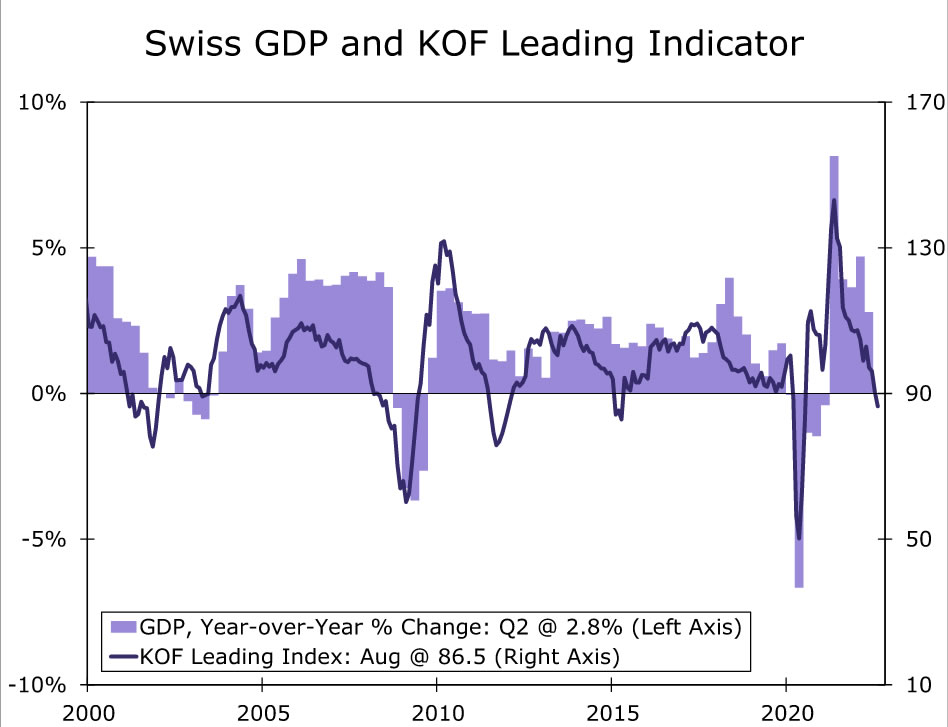
On the growth front, we see downside risks accumulating. While GDP growth in the second quarter was steady, warning signs are flashing for slower growth in the coming quarters as sentiment deteriorates and the Eurozone falls into recession. GDP grew 0.3% quarter-over-quarter in Q2, boosted by the services sector reopening and household consumption, which were resilient even amid higher prices (real private consumption was up 1.4% quarter-over-quarter). However, there was some noticeable softness in the manufacturing sector, which was also reflected in the manufacturing PMI falling for the fifth straight month in August.
Moreover, the KOF leading index, which historically has been a good indicator of GDP growth, declined for the fourth straight month in August, falling to 86.5. This downward trend suggests slower or negative growth ahead. Furthermore, our expectation for a Eurozone recession by the end of 2022 poses additional downside risks for Switzerland's growth prospects, as the two regions have significant trade relations—36% of Swiss exports go to the Eurozone, while 45% of Swiss imports come from the Eurozone. The economic outlook is further complicated by the Russia-Ukraine war and resulting energy crisis, as Switzerland ultimately sources almost half of its natural gas from Russia. While Switzerland has relatively low demand for gas at only around 15% of total energy consumption, the country currently does not have large capacity to store natural gas or its own gas reserve, adding to uncertainty surrounding the growth outlook. Against this backdrop, we do not forecast an outright recession in Switzerland, but we expect economic growth to slow in 2023, which is consistent with a slower pace of rate hikes from the SNB.
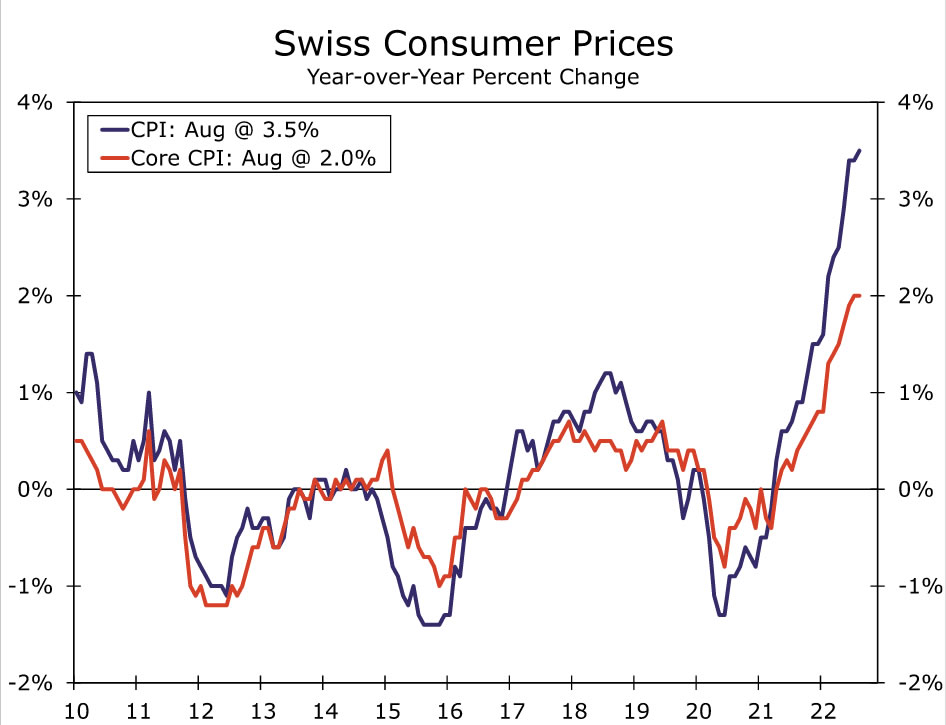
Also consistent with our expectation for a slower pace of rate hikes is our outlook for more contained inflation in 2023. Inflation in Switzerland is at a 30-year high and is above the SNB's 2% target, but remains much lower compared to other major European economies. In August, the CPI quickened to 3.5% year-over-year. Taking a closer look at the details, prices for housing, water, electricity, gas and other fuels were only up 4.7% from the previous year, significantly lower than in the Eurozone, where they are up 19.7%. With the updated SNB forecasts showing annual average inflation of 2.4% for 2023 and 1.7% for 2024, we believe the central bank will continue tightening monetary policy, although larger rate hikes are likely not needed given inflation is expected to be closer to target by the end of 2023. The central bank noted that without September's 75 bps rate hike, its inflation forecast would be significantly higher.
While our base case is for smaller magnitude rate hikes in the coming quarters, we would not fully rule out a 75 bps rate hike in December. Since the SNB only has one monetary policy meeting per quarter, half as many as the ECB, the central bank could opt to deliver a larger rate hike to account for this. The central bank has also repeatedly emphasized its commitment to support the franc in order to soften the blow from higher import prices and inflationary pressures. While its willingness to intervene in foreign exchange markets is an important policy lever, large rate hikes that support the currency could also complement these actions.
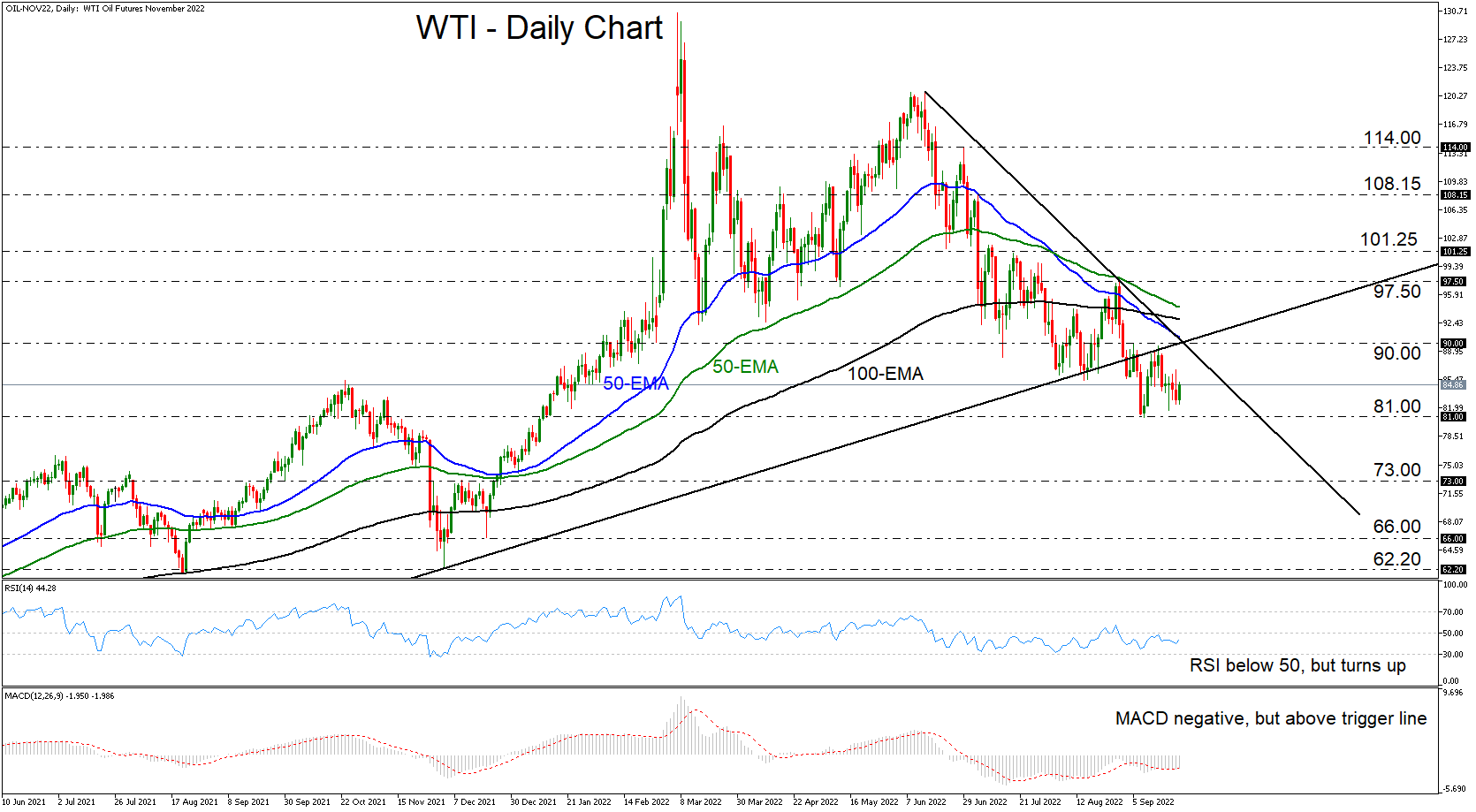
WTI Oil Futures Hold Above 81.00, But Broader Trend Stays Bearish
WTI oil futures traded higher on Thursday, after hitting support near 82.35. The black liquid continues to hold above the key barrier of 81.00, but the bigger picture still points to a downtrend. WTI continues to trade below the downside line drawn from the high of June 14, as well as below the prior longer-term upside line taken from the low of April 19, 2020.
That said, the daily oscillators suggest that some further recovery may be on the cards before the next leg south, perhaps towards the crossroads of the aforementioned diagonal lines and the round figure of 90.00, marked by the high of July 5. The RSI, although below 50, has turned up again, while the MACD, despite negative, has rebounded as well and crossed above its trigger line.
If indeed the bears recharge from near the 90.00 zone, a tumble below 81.00 may follow, which will confirm a lower low and perhaps extend the downtrend towards the 73.00 territory, marked by the inside swing highs of December 9 and 13. If no buyers are found around there either, the bears may dive towards the 66.00 or 62.20 zones, marked by the lows of December 20 and 2 respectively.
The short-term outlook could start turning bullish upon a break above 97.50. If so, the price will be above both the trendlines, as well as above all three of the moving averages. The next resistance may be at 101.25, the break of which could carry advances towards the peak of July 5 at 108.15.
In brief, oil has been in a recovery mode today, but the broader trend remains to the downside. That said, a break below 81.00 may be needed to confirm a lower low and its continuation.
New Zealand Dollar Dips to 2.5 Year Low
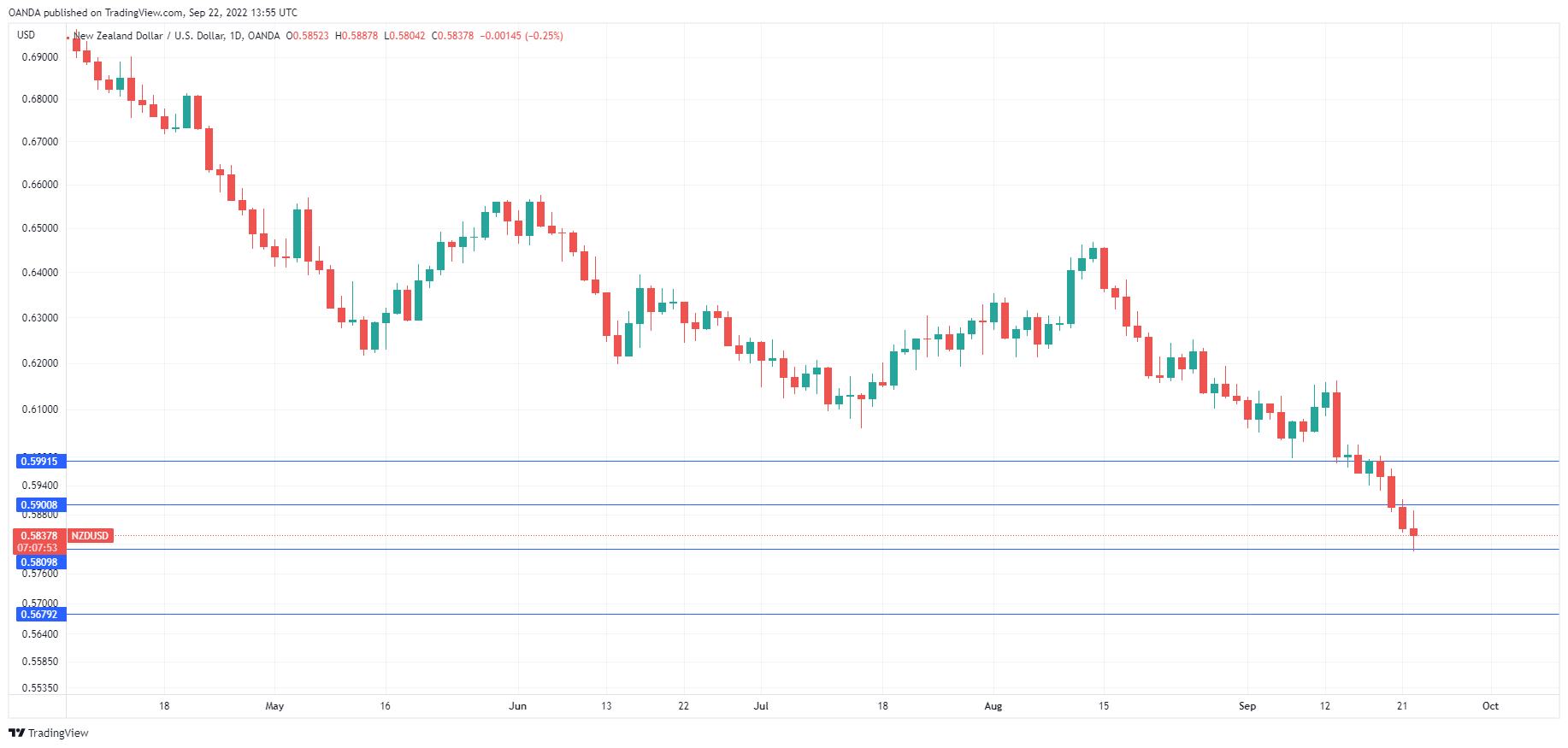
The New Zealand dollar is in negative territory for a fourth straight day. NZD/USD fell as low as 0.5803 in the Asian session, its lowest level since March 2020.
Putin threats, Fed hikes weighs on kiwi
The New Zealand dollar is in serious trouble. NZD/USD has slipped 2.2% this week, and September has been dreadful, with the kiwi declining by 4.3%. The New Zealand dollar is staggering from the double blow of an aggressive Federal Reserve and risk sentiment sliding due to ominous developments in Russia.
Ukraine’s counter-offensive has sent Russian forces in retreat, and a furious Vladimir Putin has upped the ante. He has given the go-ahead for a lightning-fast referendum in occupied Ukraine, in order to annex these territories. As well, Putin has said that all options are on the table to defend “Russian territory” and has hinted at the use of nuclear weapons. Second, Putin has ordered a partial mobilization which could involve up to 300,000 Russian soldiers. These moves are a clear escalation in the conflict and predictably, risk appetite has decreased, sending the risk-sensitive New Zealand dollar lower.
With the Federal Reserve and a host of other central banks tightening policy this week, the spectre of a global recession looms ever closer. This has unnerved investors, who are flocking to the safety of the US dollar and other safe haven assets. The Fed raised rates by 0.75% on Wednesday in a move that was widely expected. Still, the Fed’s hike can be considered hawish, as it sent a clear message that it will be uncompromising in the fight against inflation, even if that results in the US economy tipping into a recession. The markets are expecting another 0.75% rate hike in October, and with relations between Moscow and the West worsening, the outlook for risk currencies such as the New Zealand dollar look grim.
NZD/USD Technical
- NZD/USD tested support at 0.5810 earlier. Below, there is support at 0.5679
- There is resistance at 0.5900 and 0.5992