Sample Category Title
USD/JPY Daily Outlook
Daily Pivots: (S1) 139.85; (P) 142.87; (R1) 145.40; More...
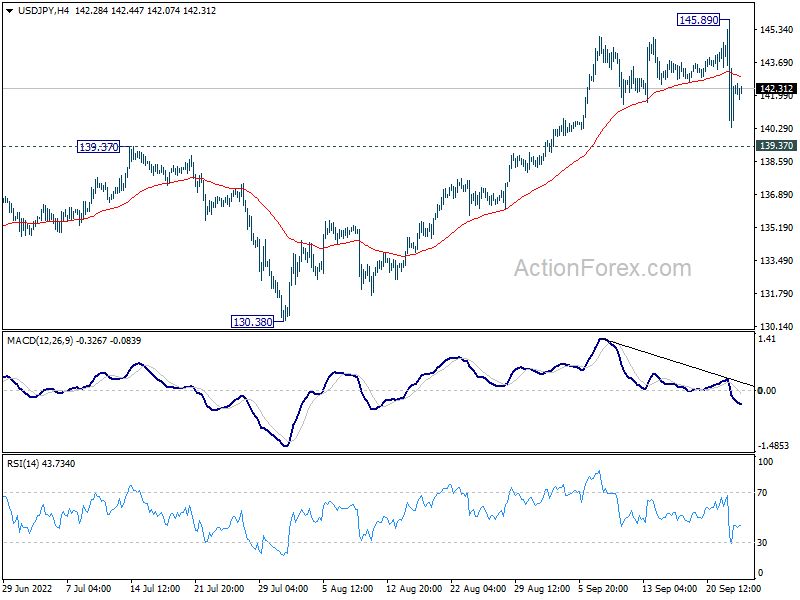
Intraday bias in USD/JPY remains neutral for consolidation below 145.89. Further rally will remain in favor as long as 139.37 resistance turned support holds. Break of 145.89 will resume larger rally to 147.68 long term resistance. However, decisive break of 139.37 will confirm short term topping, on bearish divergence condition in 4 hour MACD. Deeper decline would be seen back towards 130.38 support.
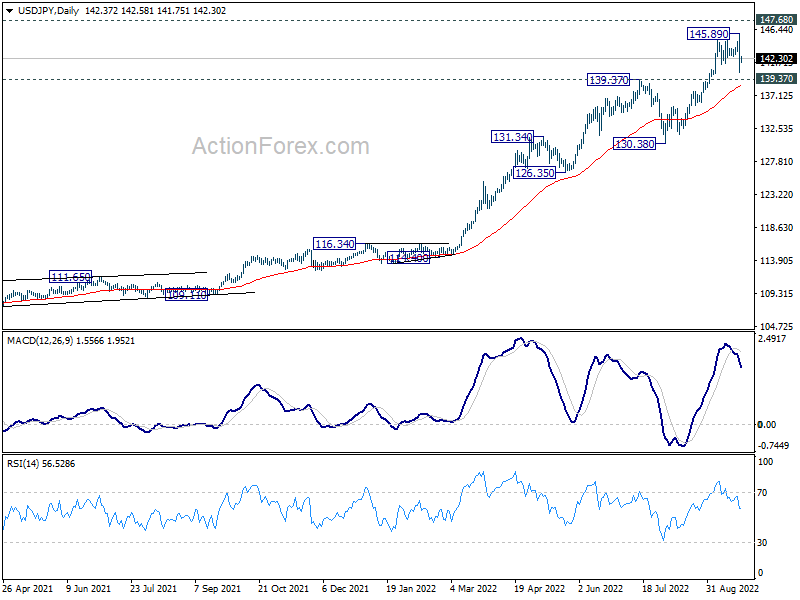
In the bigger picture, up trend from 101.18 is still in progress, as part of the whole up trend from 75.56 (2011 low). Further rise should be seen to 147.68 (1998 high). For now, break of 130.38 support is needed to be the first indication of medium term topping. Otherwise, outlook will stay bullish even in case of deep pull back.
AUD/USD Daily Report
Daily Pivots: (S1) 0.6588; (P) 0.6630; (R1) 0.6685; More...
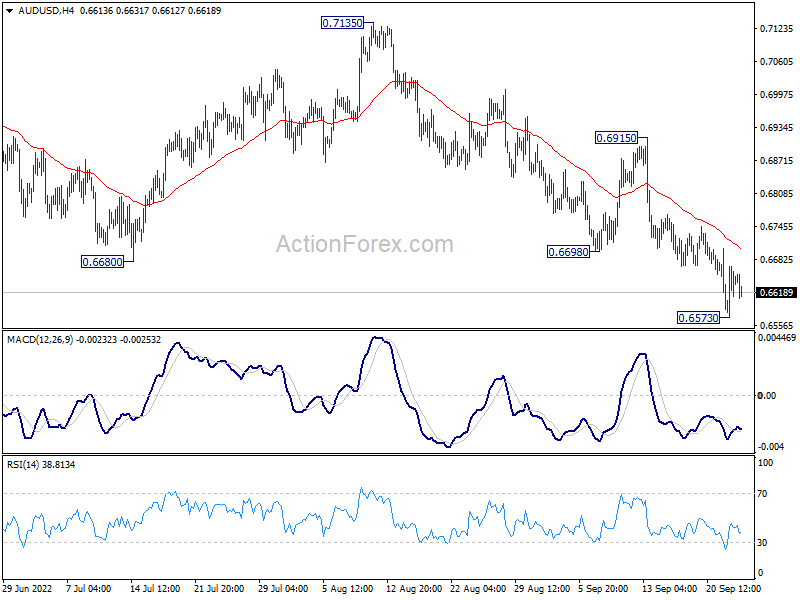
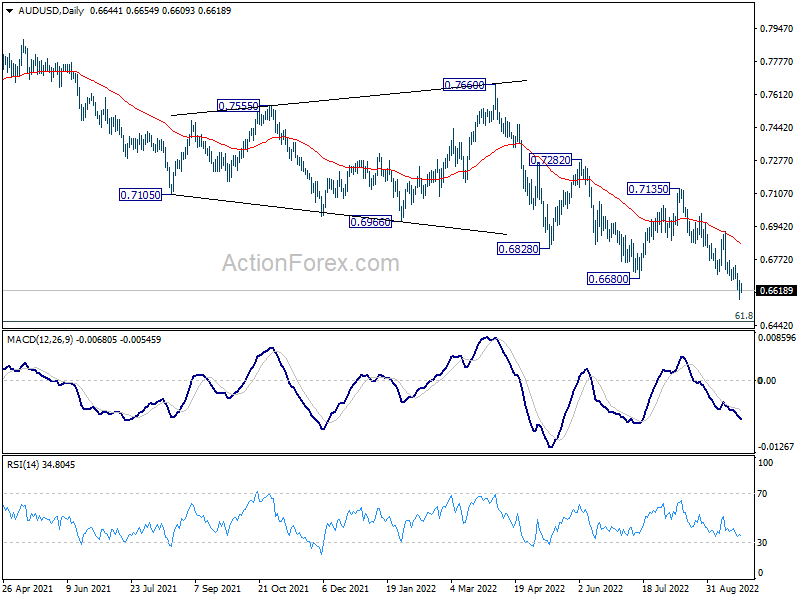
Intraday bias in AUD/USD is turned neutral with current recovery, and some consolidations could be seen above 0.6573 temporary low. Upside of recovery should be limited below 0.6951 resistance to bring another fall. On the downside, break of 0.6573 will resume larger down trend to 0.6461 long term fibonacci level.
In the bigger picture, price actions from 0.8006 (2021 high) is seen more as a corrective pattern to rise from 0.5506 (2020 low). Or it could also be a bearish impulsive move. In either case, outlook will remain bearish as long as 0.7135 resistance holds. Next target is 61.8% retracement of 0.5506 to 0.8006 at 0.6461.
We Have Lowered Our AUD Forecast to US 65¢ by End 2022
Following the September meeting of the FOMC we have raised our terminal forecast rate for the federal funds rate from 4.125% to 4.625% peaking at the January 2023 FOMC meeting.
That forecast follows the near term guidance we saw from the FOMC in their latest Report.
That entails us lifting our expectation for the November move from 50bps to 75bps; no change from our 50bps call for December; and a final 25bp movement in late January (revised up from "on hold").
The Committee's estimates are finely balanced for November/ December with only one member needed to tip the median down to a total of 100bps from the current median of 125bps. But we assess that, based on the press conference, Chairman Powell is in that more hawkish group.
Despite increasing the terminal rate for the federal funds by 50bps we have held the expected terminal rate for Australia steady at 3.6%.
The expected timing of the final RBA hike is unchanged for the February Board meeting in 2023, coming just after the final increase in the federal funds rate in late January.
We expect that both central banks will choose to hold their rates steady through the remainder of 2023 until there is convincing evidence that they are nearing their inflation targets.
Over the course of 2023 we expect that the Australian economy will slow to a growth rate of 1% with the US growing even more slowly at 0.5%. Classical recessions cannot be ruled out in either jurisdiction.
Given we have lifted our federal funds rate terminal by a further 50bps (after the 75bp lift following the recent US Inflation Report) why not lift Australia's rate further?
Recall that when we recently lifted the federal funds rate target by 75bps we lifted the RBA terminal rate by 25bps.
But the Australian economy is more sensitive to the overnight cash rate than the US economy will be to the federal funds rate.
Recall that 60% of Australian mortgages are floating rate and around 80% of the fixed rate mortgages are set to run off by end 2023, around 90% of Australia's mortgage market will be directly impacted by the overnight cash rate by end 2023.
Even though only one third of households in Australia hold mortgages, with one third tenants and one third outright owners, interest rates affect all households.
Mortgage borrowers' cash flows are impacted; investors try to pass on their higher funding costs to tenants, especially in those cities where vacancy rates are near historical lows; and outright owners are suffering significant negative wealth effects.
The RBA has moved rates very quickly to 2.35%, which is below the assessed neutral level of at least 2.5%.
We continue to expect that once the rate is increased by 50 basis points to 2.85% at the October 4 meeting, which is into the contractionary zone, the Board will slow the pace back to 25 basis points for the November, December, and February meetings.
Two of those meetings (November and February) will follow Inflation Reports and while we expect those Reports to signal the need for higher rates, we expect the response will be 25 basis point moves, given the "treacherous lags" that will have built up in the system following the rapid increases since May.
If the RBA does not respond to the likely higher profile for the US federal funds rate, the adjustment will occur through the Australian dollar.
We have lowered our forecast for the AUD by year's end from USD0.69 to USD0.65.
We still expect the AUD to lift against the USD in 2023, with most of the recovery occurring in the second half of 2023 but have lowered our forecast for end 2023 for AUD from USD 0.75 to USD0.72.
The case for a rising AUD in 2023 is supported by:
- Our "above Consensus" forecast for growth in China; and the Asian region in 2023.
- Australia's commodity export prices holding up better than current market expectations.
- The importance of a return to some certainty around central banks and inflation. Markets will respond to slowing inflation and acceptance that central banks have gone on hold. We expect the "on hold" signal to be clearly embraced by markets by the second quarter of 2023 – ahead of current market expectations.
- That return to some policy certainty will boost "risk on" appetite.
- Recognition of the damage to the US economy from FED policies and the need for rate cuts by the FED in 2024. This recognition will see an easing in bond rates through 2023 in anticipation of 150bps in fed rate cuts in 2024.
- That 150bps will compare with a likely 100bps of rate cuts expected for the RBA in 2024, narrowing the expected yield differential.
There are two standout risks to this scenario:
- The global economic downturn that is expected for 2022H2 and 2023 is deeper and more sustained than we currently expect. Uncertainty about the depth and duration of the downturn will constrain any move to "risk on".
- Inflation proves to be much "stickier" than we currently expect, forcing central banks to "restart" their tightening policies, or, at best, delay rate cuts.
We have significantly lowered our 2022 end year "target" for the AUD to USD0.65. That means that over the remainder of 2022 there will be periods when the AUD will trade below the USD0.65 level given the high volatility in currency markets to date.
Despite the higher base level of the federal funds rate over the forecast period we have neither accelerated or extended the likely easing in the federal funds rate in 2024. We still expect 150bp of easing in the rate in 2024. That compares to the 100bp of easing we expect for the RBA in 2024. By end 2024, that would have the fed funds rate at 3.125% and the RBA cash rate at 2.60%.
Furthermore, we continue to expect both central banks to keep rates on hold from the March quarter 2023 – an earlier peak than is current expected by markets.
For the higher federal funds rate profile, we have added 20bps to the US 10 year profile and 30bps to the US 3 year profile.
We have narrowed the spread between US and AUD long bonds from 20bps to 10bps and lifted the AUD 3 year bond rates by 20bps to reflect the higher US rates.
The market's adjustment to the recent repricing has been to boost the RBA terminal rate to 4.1% (well above our 3.6%) and as a result the market repricing of Australian bond rates has been significantly more extreme than we envisage to be sustainable.
Cliff Notes: The Fight Against Inflation Reaches New Heights
Key insights from the week that was.
This week has been all about monetary policy, in particular global central banks’ fight against inflation. Their rhetoric, the implications for global growth and the market’s reaction have led us to revise down our Australian dollar view.
The minutes of the RBA’s September meeting presented a relatively balanced view, highlighting the need to act against inflation and the risks around expectations while also recognising the cost to activity and employment from tight policy and the lags associated with changes in the monetary stance. Unlike August, at the September meeting, “the arguments around raising interest rates by either 25 basis points or 50 basis points” were discussed, with “the importance of returning inflation to the target, the potential damage to the economy from persistent high inflation and the still relatively low level of the cash rate” leading the Board to favour 50bps. Arguably, with the US August CPI and the rhetoric of global central banks since highlighting the uncertainties that remain with respect to inflation, the case for quickly taking policy to neutral and then above in Australia has strengthened. Westpac expects another 50bp increase in October followed by three 25bp hikes to a peak cash rate of 3.60% at February 2023.
Meanwhile in the US, Chair Powell and the Committee again made an aggressive stand against inflation at the September FOMC meeting, raising their peak fed funds rate forecast to 4.6% in 2023 and inflation projections for 2022-2024 while also remaining sanguine on the impact to activity and employment. The short time horizon to the end of this hiking cycle – likely January 2023 – leaves little room for the data to speak, and so a further 150bps of hikes has to be expected from here. The cost to the economy will be significant however. We now expect the US economy to experience an output gap circa 3.5% by end-2023 and near 4.0% by end-2024 following next-to-no growth in 2022 and 2023 and a below-trend gain in 2024. A rise in the unemployment rate in the order of 2ppts is anticipated as a result.
Nonetheless, the market pricing in rate cuts into term interest rates throughout 2023 along with the FOMC’s acute concern over inflation expectations will result in the Committee holding off on rate cuts until 2024, when we expect concerns over external inflation risks to have subsided as domestic slack suppress growth in wages and discretionary consumer spending. The consequences of this tightening cycle have the potential to restrain growth opportunities for the US into the medium-term, in stark contrast to the FOMC’s current expectations. As is evinced by the sharp reduction in the housing construction pipeline, this has the potential to create additional supply constraints (and inflation) further out.
Finally to the UK, the Bank of England decided to raise the bank rate by 50bps in September, from 1.75% to 2.25%. Despite not having lifted the pace of rate hikes, the shift in the Committee’s dissent profile was still perceived as a hawkish tilt by markets. Indeed, with three members having voted for a 75bp hike and five members favouring a 50bp move, the overarching consensus from the Committee is that inflation will remain uncomfortably high for many months, strengthening the case for further rate hikes into year-end.
The UK Government’s announcement of an Energy Price Guarantee was a welcome development, expected to improve household’s real income position and the inflation outlook – now expected to peak “slightly under 11%” – though uncertainties around its impact on demand, both within energy consumption and more broadly across the economy, led to a split decision between 50bps and 75bps. Regardless, this meeting largely served as a platform to reaffirm the Committee’s commitment to reducing inflationary pressures and reining in inflation expectations at the cost of economic activity. We continue to expect the Committee to hike into 2023, anticipating a Bank Rate of 3.00% at December 2022 and 3.25% by March 2023. To this view, there are clear upside risks which largely relate to whether the consumer will use the funds saved on energy to make additional purchases.
As above, in light of this week’s developments, Westpac has revised down our expectation for the Australian dollar at end-2022 to USD0.65 and for end-2023 to USD0.72. Chief Economist Bill Evans today outlined the reasoning for the change as well as the primary risks. Most notable is the outlook for the global economy and, of course, inflation. If the impact of policy tightening is more significant than we currently expect, particularly in Asia, or inflation proves more sticky than forecast globally, then our currency is likely to come under further pressure.
What a Week – And It’s Not Over Yet
A busy week for central banks come to an end with plenty of rate hikes, increased prospects of slowing growth, that leave investors with a bad taste in their mouth. But the week is not over. The Italian elections due Sunday will likely continue pressuring the euro lower.
What a busy week
We had a tsunami of central bank decisions, and many surprises this week.
The Swedish Riksbank was the first major central bank to surprise with a 100bp rate hike.
The US Federal Reserve (Fed) delivered its third 75bp hike. But the dot plot hinted at another jumbo hike before the year-end. We are ending the week with nearly 75% chance of a fourth 75bp hike in November.
The Bank of Japan (BoJ) maintained its policy rate unchanged at -0.10%, but intervened directly in the FX market to buy yen to fight back the strengthening dollar as the USDJPY hit the 145 mark. It was the first currency intervention from the BoJ since 1998 – to tell you how frustrated the policymakers got with the dollar rally. The pair pulled to 140 level, then rebounded past 142. But we are not sure about how long the BoJ could counter the yen weakness, and by how much it could ease the pressure on the yen, knowing that Japan is increasingly isolated in conducting an ultra-dovish monetary policy. In fact, Japan is now the only country still offering negative yields on its bonds, while there were 21 of them back in May 2020. So, you bet, the pressure on the yen will remain tight. But, the BoJ intervention will likely cool down the JPY-bears, as the threat of a sudden and a sharp appreciation in the yen will help taming speculation against the Japanese currency.
The Swiss National Bank (SNB) raised its policy rate by 75bp yesterday, but the Swiss franc took a severe hit, as apparently, traders were expecting a second month surprise – which didn’t happen. The dollar-swissy rebounded to 0.9850, while the euro-swissy hit the 50-DMA, before bouncing back. Despite the negative kneejerk reaction, the hawkish shift in the SNB policy stance should continue having a positive impact on the Swiss franc. On the equities front, the strong franc will likely further squeeze the Swiss exporters, and pressure the Swiss equities to the downside. The SMI lost 1.26% yesterday, and slipped below the summer lows. We are now at levels last seen in December 2020, and it’s just a matter of time we see the index slip below the 10’000 psychological mark.
The Bank of England (BoE) opted for a 50bp hike, combined with an £80 billion Quantitative Tightening, and said the UK is now in recession. Officials said that the huge energy package to contain energy costs would ‘likely limit significantly’ the positive pressure on inflation. They pulled their peak inflation expectation from 13 to 11% for this autumn. But they also said “while the guarantee on energy bills reduces inflation in the near term, it also means that household spending is likely to be less weak … this would add to inflationary pressures in the medium term.” The pound continues its race to the bottom. Cable tested the 1.12 support post-BoE, and the 1.12 support could well be pulled out with the announcement of – what they call – a mini budget today. But the mini budget has nothing mini, really. The UK government will reveal a £200 billion spending package, including the massive plan to limit the energy bills, and also the biggest tax-cuts in 34 years. The government will announce how it will finance this huge spending. The policymakers hope that the tax cuts will boost the British economy, increase its revenues and prevent a massive increase in the national debt. Though it sounds crazy, in theory, it is possible. According to the Laffer curve, there is an ideal tax rate above which individuals don’t want to work more, to pay less taxes. So, if the UK is above the ideal tax rate, bringing it lower could actually help refill the government’s coffers. But I am not sure, investors will take the massive spending package this relaxed. We will rather see the British yields further spike. The 10-year gilt yield is now at 3.50%, compared to near 0 at the beginning of the year.
Norges Bank also increased its policy rate by 50bp but signaled that tightening may be coming to an end. Indonesia and the Philippines also hiked by 50bp. Taiwan raised by a modest 12.5% as expected, Vietnam opted for a 100bp hike, South Africa raised by 75bp.
And Turkey… cut its rate by 100bp for the second consecutive month! The USDTRY spiked to 18.40 but the move was contained with the central bank selling more dollars. Anyway, the BIST index jumped 1.50% yesterday while the mood elsewhere was rather morose.
We saw the S&P 500 slip to 3750, while Nasdaq fell more than 1% to 11500 level. The barrel of American crude rallied to $86 but the top sellers rapidly came in to pull the price back to around $83 on looming recession worries. FedEX, which shook the markets last Friday with its warning of a slowing demand said that it will increase rates by nearly 7% starting from January for its express, ground and home delivery services, and that they will reduce flight frequencies and suspend certain Sunday operations.
Into the Italian elections
The EURUSD tested 0.98 support yesterday and remains under pressure ahead of the Italian election due Sunday. The polls give more chance for a right-wing win, as the right wing could join forces, with Berlusconi back on headlines, while the left’s inability to cooperate gives them no chance of winning this Sunday, the experts say. As a result, the far-right Fratelli d’Italia party is expected to win a majority of the vote on Sunday and the vote will be a major political shift for Italy – a pivotal country for the EU -, and not toward the ‘right’ direction.
Hikes Continue Despite Rising Recession Worries
Market movers today
The implications for financial markets of the flurry of G10 central bank meetings over the past two days remain a key focus, notably the decision by the Japanese finance ministry yesterday to intervene in the FX market to support the Japanese yen—something that could have broader market impact also in our parts of the world.
In addition, attention turns to the economic outlook with PMIs being released in both Europe and the US. In Europe, nothing in the August PMIs suggested that a rebound is in store in September and we expect them to overall give another gloomy reading (though we would not expect them to fall off the cliff either). If anything, the worsening energy crisis leaves further downside ahead with waning new orders and slowing hiring pace. Germany remains the epicentre of the slowdown, but it will be interesting to see whether recession risks are also growing in Southern Europe with the fading services sector boost.
In the US, the service PMI is expected to rebound modestly (though remain below the 50 benchmark) as the fall in gasoline prices supports consumers' purchasing power. Manufacturing PMI is seen remaining slightly in the expansionary territory.
Watch out also for the Italian parliamentary elections on Sunday. A right-wing win seems a done deal, but it is all about the margin of victory and whether the right wing alliance can get a two-thirds majority. It is also important to look out for the Giorgia Meloni's post-election comments on EU and the support for sanctions on Russia.
The 60 second overview
Norges Bank: As expected by both analysts and markets, Norges Bank delivered the third 50bp hike in a row. Governor Bache communicated clearly that in its base case Norges Bank is looking to continue hiking in the November, December and March meetings, but it also expects to reduce the hiking pace back to 25bp amid weakening growth outlook. We think Norges Bank's hiking cycle could come to an end already in November at 2.50%, although risks are tilted towards higher rates.
BoE: In line with our expectation, the Bank of England hiked the Bank Rate by 50bp to 2.25% and we maintain our call for a 50bp hike in November and December and 25bp in February although risks to our call is skewed towards additional hikes in 2023. Read our review here: Bank of England Update - Review: another 50bp hike and we expect more to come, 22 September.
BoJ/MoF FX intervention: Yesterday, the Bank of Japan was instructed by the Ministry of Finance to intervene in the FX markets to support JPY after BoJ made no changes to its dovish monetary policy stance and following the rapid weakening of yen this year. USD/JPY declined sharply around 140.8, but has since recovered above 142, likely reflecting the fact the BoJ still pursues a monetary policy that sends more yen into the market. We think the pressure to give in to the globally rising yields and abandoning the yield curve control has increased further, as without changes we could quickly be back in the same situation with record weak JPY. Read our take in Research Japan - Bank of Japan intervenes to support JPY, 22 September.
SNB: The Swiss National Bank hiked its policy rate by 75bp in its meeting yesterday, bringing the policy rate to positive territory (0.50%) for the first time since 2014. The overall message was still dovish, as the communication hinted at a lower probability of intermeeting hikes going forwards. Our base case remains that the next hike will come in December, but we still highlight the risk of intermeeting hikes as SNB meets only four times a year and as inflation pressures have become increasingly broad-based also in Switzerland. We also continue to expect lower EUR/CHF despite the uptick following yesterday's announcement.
Equities: Equities finished lower, but US markets recovered somewhat into the closing. It was a classic defensive vs cyclical rotation, where health care and consumer staples fairing best while consumer discretionary and financials sold off -2%. Despite the massive pickup in yields growth did not underperform value. In fact, tech outperformed banks which is very seldom in a day that the US 10y adds 20bp. In fact, tech and communication services outperformed all other cyclical sectors. We believe that we are at the brink of the recession trade which explains these moves. S&P -0.8%, Nasdaq -1.4%, Dow -0.4% and Russell 2000 -2.3%. Futures are slightly lower this morning too.
FI: The big central bank week is coming to an end with German Bunds now flirting with the 2% level (+7bp yesterday to 1.97%). Yesterday European markets sold off markedly in the afternoon session amid UK QT and mini-budget presentation expectations for today, which have likely spilled over to the European curves. Today's PMI reports should get attention.
FX: Yesterday, MoF/BoJ followed up on the 'rate check' and the decision to keep the monetary policy stance unchanged by conducting the first currency intervention since 1998. USD/JPY reached almost 140 before erasing some of the losses in the afternoon as US yields moved sharply higher. EUR/NOK immediately lower after Norges Bank and then back up again. Sterling traded marginally on the soft side after BoE and CHF dropped 2% vs EUR after SNB ended NIRP. EUR/SEK was stable throughout the European and US sessions.
Credit: Credit markets continued the cautious sentiment ahead of the US rate decision, leaving iTraxx main slightly wider by 1.9bp at 122.4bp, while Xover widened 4.6bp, closing the session at 601.4bp.
USD/CAD Daily Outlook
Daily Pivots: (S1) 1.3417; (P) 1.3480; (R1) 1.3552; More...
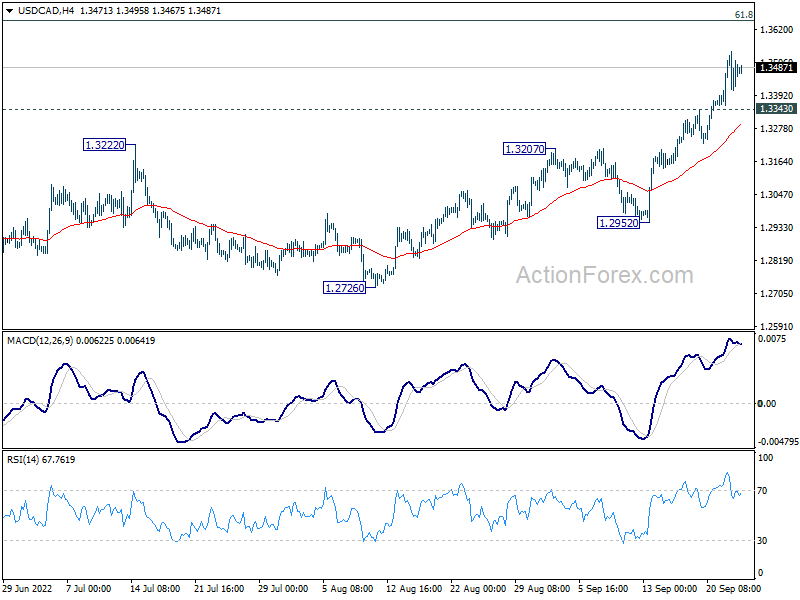
USD/CAD's rally is still in progress and intraday bias stays on the upside. Current up trend should target medium term fibonacci level at 1.3650. On the downside, below 1.3343 minor support will turn intraday bias neutral and bring consolidations first, before staging another rally.
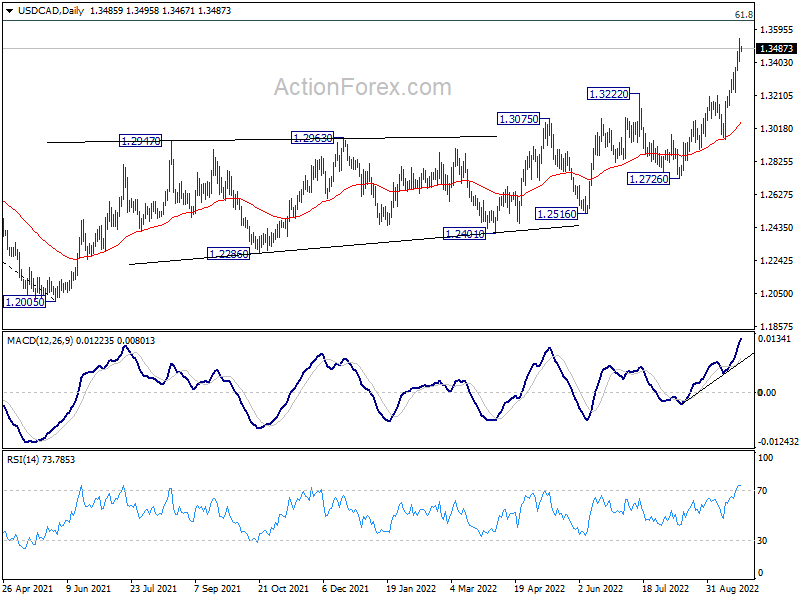
In the bigger picture, down trend from 1.4667 (2020 high) should have completed at 1.2005, after defending 1.2061 long term cluster support. Rise from there should target 61.8% retracement of 1.4667 to 1.2005 (2021 low) at 1.3650. This will remain the favored case now as long as 1.2716 support holds.
Dollar and Yen Staying Strong on Risk-Off Sentiment
Dollar, Yen and Swiss Franc are currently trading as the strongest ones for the week, as supported by risk-off sentiment. Yen overpowers the other with help from intervention by Japan. Dollar is supported by hawkish Fed while Swiss Franc clearly lagged behind. Nevertheless, the Franc is still up against Euro and Sterling, which are among the worst performers together with New Zealand Dollar.
Technically, as long as some levels hold, there is prospect for Dollar to extend recent rally before weekly close. the levels include 0.9943 minor resistance in EUR/USD, 0.6698 minor resistance in AUD/USD, 0.9694 minor support in USD/CHF, and 1.3343 minor support in USD/CAD. But that would depend very much on how risk market flares.
In Asia at the time of writing, Hong Kong HSI is down -0.85%. China Shanghai SSE is down -1.08%. Singapore Strait Times is down -0.83%. Japan is on holiday. Overnight, DOW dropped -0.35%. S&P 500 dropped -0.84%. NASDAQ dropped -1.37%. 10-year yield rose 0.198 to 3.708.
Australia PMI composite edged up to 50.8, at risk of heading into contraction territory
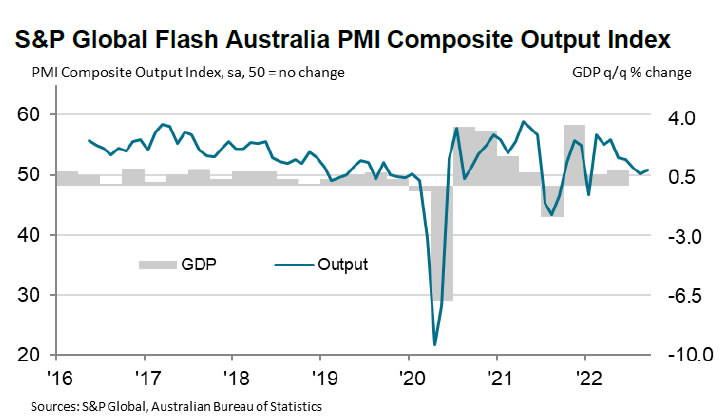
Australia PMI Manufacturing ticked up from 53.8 to 53.9 in September. PI Services also rose slightly from 50.2 to 50.4. PMI Composite Output rose from 50.2 to 50.8.
Laura Denman, Economist at S&P Global Market Intelligence said: "September data indicated that the recent interest rate hikes made by the RBA have begun to have the desired effect in terms of prices.... At the same time, the private sector has remained in expansion territory with the pace of growth even accelerating very slightly...
"On the negative side, the full effects of recent interest rate hikes will be lagged... Should the RBA continue to increase the base rate further, the private sector economy may be at risk of heading into contraction territory in the future as disposable incomes across the nation tighten and overall demand conditions remain subdued."
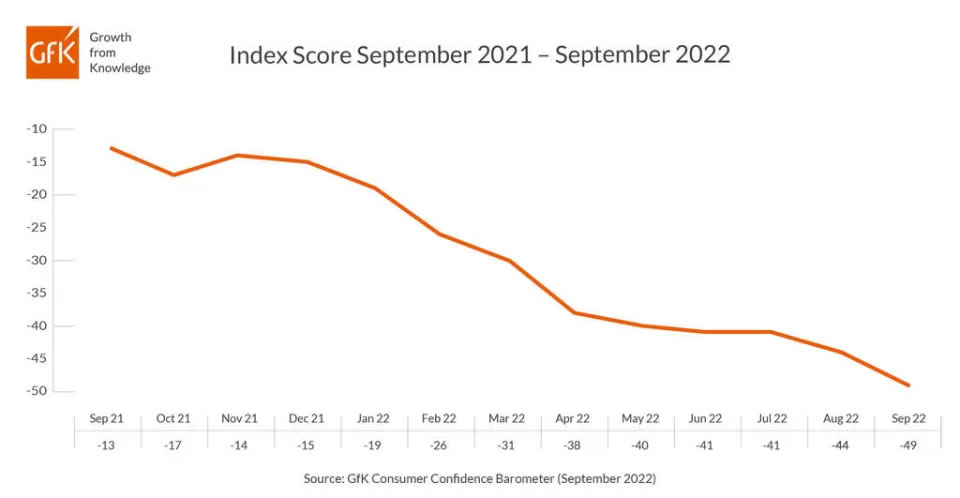
UK Gfk consumer confidence dropped to new record low at -49
UK Gfk consumer confidence dropped further from -44 to -49 in September, hitting another record low since 1974. Personal financial situation over next 12 months dropped -9 pts to -40. General economic situation over next 12 months dropped -8 pts to -68. Major purchase index was unchanged at -38.
"Consumers are buckling under the pressure of the UK's growing cost-of-living crisis driven by rapidly rising food prices, domestic fuel bills and mortgage payments. They are asking themselves when and how the situation will improve." Joe Staton, client strategy director at GfK, said.
ECB Schnabel: Inflation pressures crept into all parts of economy
ECB Executive Board member Isabel Schnabel said yesterday in Luxembourg, "What we are seeing is that the inflationary pressures have become much more broad-based. They have somehow crept into all parts of the economy."
"At the moment, we are not in a situation where the normalization of monetary policy harms the economy," she said. "It's more like we have to remove the accommodation that we still have in the system."
Looking ahead
PMIs from Eurozone, UK and US will be released today. Canada will also publish retail sales.
USD/CAD Daily Outlook
Daily Pivots: (S1) 1.3417; (P) 1.3480; (R1) 1.3552; More...
USD/CAD's rally is still in progress and intraday bias stays on the upside. Current up trend should target medium term fibonacci level at 1.3650. On the downside, below 1.3343 minor support will turn intraday bias neutral and bring consolidations first, before staging another rally.
In the bigger picture, down trend from 1.4667 (2020 high) should have completed at 1.2005, after defending 1.2061 long term cluster support. Rise from there should target 61.8% retracement of 1.4667 to 1.2005 (2021 low) at 1.3650. This will remain the favored case now as long as 1.2716 support holds.
Economic Indicators Update
| GMT | Ccy | Events | Actual | Forecast | Previous | Revised |
|---|---|---|---|---|---|---|
| 23:00 | AUD | Manufacturing PMI Sep P | 53.9 | 53.8 | ||
| 23:00 | AUD | Services PMI Sep P | 50.4 | 50.2 | ||
| 23:01 | GBP | GfK Consumer Confidence Sep | -49 | -42 | -44 | |
| 07:15 | EUR | France Manufacturing PMI Sep P | 49.9 | 50.6 | ||
| 07:15 | EUR | France Services PMI Sep P | 50.4 | 51.2 | ||
| 07:30 | EUR | Germany Manufacturing PMI Sep P | 48.3 | 49.1 | ||
| 07:30 | EUR | Germany Services PMI Sep P | 47.2 | 47.7 | ||
| 08:00 | EUR | Eurozone Manufacturing PMI Sep P | 48.8 | 49.6 | ||
| 08:00 | EUR | Eurozone Services PMI Sep P | 49.1 | 49.8 | ||
| 08:30 | GBP | Manufacturing PMI Sep P | 47.4 | 47.3 | ||
| 08:30 | GBP | Services PMI Sep P | 50 | 50.9 | ||
| 12:30 | CAD | Retail Sales M/M Jul | -2.00% | 1.10% | ||
| 12:30 | CAD | Retail Sales ex Autos M/M Jul | -1.00% | 0.80% | ||
| 13:45 | USD | Manufacturing PMI Sep P | 51.2 | 51.5 | ||
| 13:45 | USD | Services PMI Sep P | 45 | 43.7 |
Australia PMI composite edged up to 50.8, at risk of heading into contraction territory
Australia PMI Manufacturing ticked up from 53.8 to 53.9 in September. PI Services also rose slightly from 50.2 to 50.4. PMI Composite Output rose from 50.2 to 50.8.
Laura Denman, Economist at S&P Global Market Intelligence said: "September data indicated that the recent interest rate hikes made by the RBA have begun to have the desired effect in terms of prices.... At the same time, the private sector has remained in expansion territory with the pace of growth even accelerating very slightly...
"On the negative side, the full effects of recent interest rate hikes will be lagged... Should the RBA continue to increase the base rate further, the private sector economy may be at risk of heading into contraction territory in the future as disposable incomes across the nation tighten and overall demand conditions remain subdued."
UK Gfk consumer confidence dropped to new record low at -49
UK Gfk consumer confidence dropped further from -44 to -49 in September, hitting another record low since 1974. Personal financial situation over next 12 months dropped -9 pts to -40. General economic situation over next 12 months dropped -8 pts to -68. Major purchase index was unchanged at -38.
"Consumers are buckling under the pressure of the UK's growing cost-of-living crisis driven by rapidly rising food prices, domestic fuel bills and mortgage payments. They are asking themselves when and how the situation will improve." Joe Staton, client strategy director at GfK, said.