

Sample Category Title
Sunset Market Commentary
Markets
No mercy for sterling today even as it’s the Queen’s state funeral. Cable is drifting towards Friday’s sell-off low at 1.1350 with EUR/GBP reaching for the 0.88 big figure. General market conditions are thin though in Asia and Europe with Japan and London closed. The trading theme is well-known: central bank’s determination in normalizing and tightening monetary policy even as alarm bells are ringing on the strength of the economy. Risk sentiment on stock markets remains negative. Main European bourses cede up to 1%. The Eurostoxx 50 is testing the early September lows (3450 area) which is final intermediate support ahead of the YTD low zone just below 3400. A break lower would be a strong signal that the sell-on-upticks pattern is still in place. Key US equity benchmarks open with losses to the tune of 0.5%. Brent crude loses the $90/barrel mark, approaching the September low at $87/b. Core bonds face selling pressure going into this week’s central bank gatherings, though the pace is slowing compared to last week’s hemorrhage. German yields add 2.2 bps (10-yr) to 5.4 bps (2-yr) in a daily perspective. Changes on the US yield curve range between -0.5 bps (30-yr) and +7.2 bps (2-yr). Just like last week, the dollar fails to really profit from the additional rate boost and the fragile risk environment. EUR/USD switched sides intraday around parity, changing hands at 0.9985 at the moment of writing. The trade-weighted dollar at 110 holds south of the 110.79 YTD high. An additional dimension of dollar strength seems unlikely ahead of Wednesday’s FOMC meeting. We expect another 75 bps rate hike with markets, if any, erring on the hawkish side of that call. New policy rate projections will give a strong indication on how far the Fed is willing to go and for how lang. Markets adapted accordingly on the former, putting the policy rate peak near 4.5%, but still disagree with the Fed’s current marching orders that policy rate cuts won’t come in 2023. Other central bank gatherings this week are in Sweden, the UK, Switzerland, Norway and Japan. All of them, apart from the BoJ are expected to continue (and most of them accelerate) their tightening cycles.
News Headlines
According to a statement of the Norwegian Finance Ministry, the country is facing a growing funding need of ‘tens of billions of kroner’ for next year as the country has to cope with the cost of spending in the likes of national insurance, the integration of Ukraine refugees, construction projects and subsidies to alleviate power prices of households. However, the government indicates that it doesn’t want the rising gap to be filled by a higher use of proceeds from the countries country’s oil wealth fund as increased spending funded from such a source could put further pressure on inflation and on the interest rate path. So the government will look to other ways to close to budget gap as it will present its budget on October 06. The krone weakened further today with EUR/NOK trading in the 10.29 area, the weakest level for the Norwegian currency since mid-July.
According to a proposal for a Single Market Emergency Instrument made public by the European commission today, European authorities are seeking emergency powers that could force European companies to prioritize the production of key production and stockpile such key goods. The proposal is a reaction to supply chain disruptions caused by the Covid pandemic and by the war in Ukraine. "We need new tools that allows us to act fast and collectively at whatever kind of risk we face," Commission Vice-President Margrethe Vestager was quoted at a news press conference. The new instrument is still subject to internal political debate an also raises critics from some industry groups.
Investors Don’t Believe in Gold
Gold continues falling – by Monday 19 September, it has reached $1,664. Earlier, it rebounded from the resistance level at $1,680 to indicate how strong the bearish pressure still is. This week, investors are expecting another aggressive rate hike from the US FOMC to continue its fight against growing inflation. Market players believe that it will be a 75-point hike, but if the regulator raises the rate by 1%, it might force Gold to continue plummeting.
Despite the fact that Gold usually acts as a “safe haven” asset” when inflation rises, high interest rates increase expenditures to store physical Gold. At the same time, increasing economic risks do not inspire market players to buy such “safe haven” assets, making the USD a more preferable investment.
Since mid-2020, Gold has been stuck inside a sideways channel between $2,065 and $1,680. If bears succeed to keep the metal at the current levels (and there are no fundamental reasons that might hint at a possible reversal so far), Gold might plummet to $1,300 in the long-term.
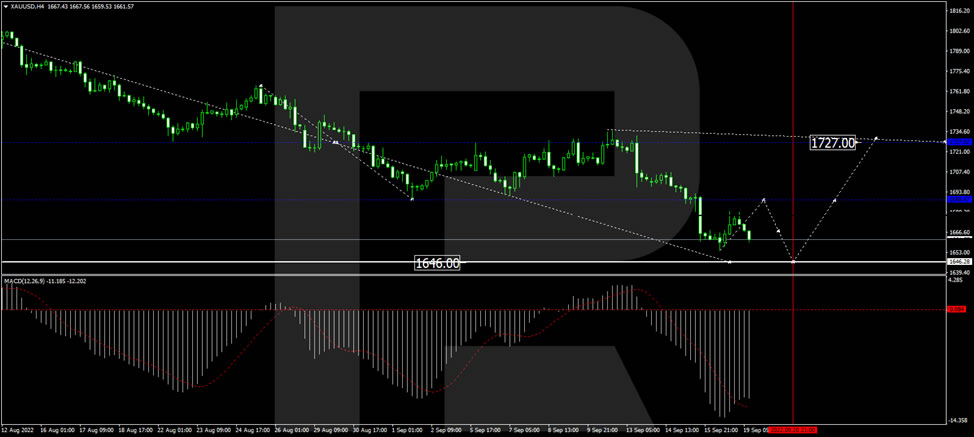
As we can see in the H4 chart, after rebounding from 1730.00, XAU/USD is forming another descending wave towards 1646.00. Later, the market may start a new growth with the target at 1727.00. From the technical point of view, this scenario is confirmed by MACD Oscillator: its signal line is moving below 0 outside the histogram area. In the future, the line may reverse and grow towards 0.
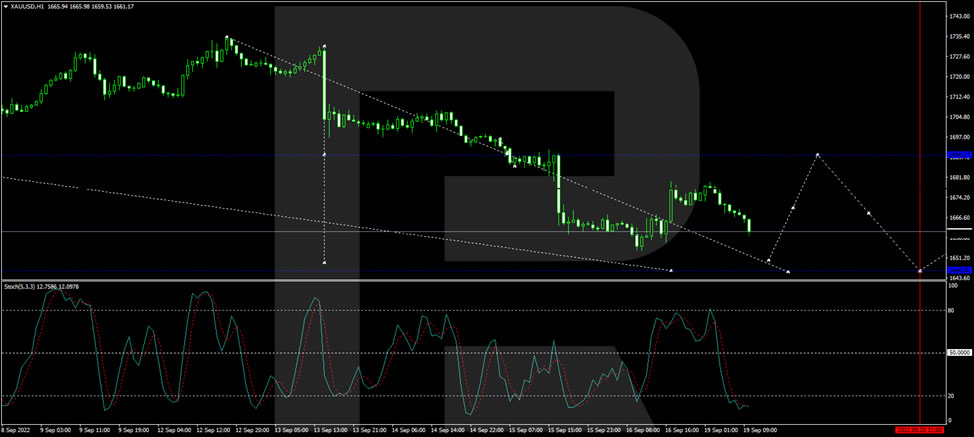
In the H1 chart, Gold continues trading downwards with the short-term target at 1650.00. Later, the market may grow towards 1690.00 and then resume falling to reach 1646.00. From the technical point of view, this scenario is confirmed by the Stochastic Oscillator: its signal is moving below 20 and may soon grow towards 50. After that, the line may resume falling to return to 20.
USD/JPY Pushes above 143, Core CPI Next
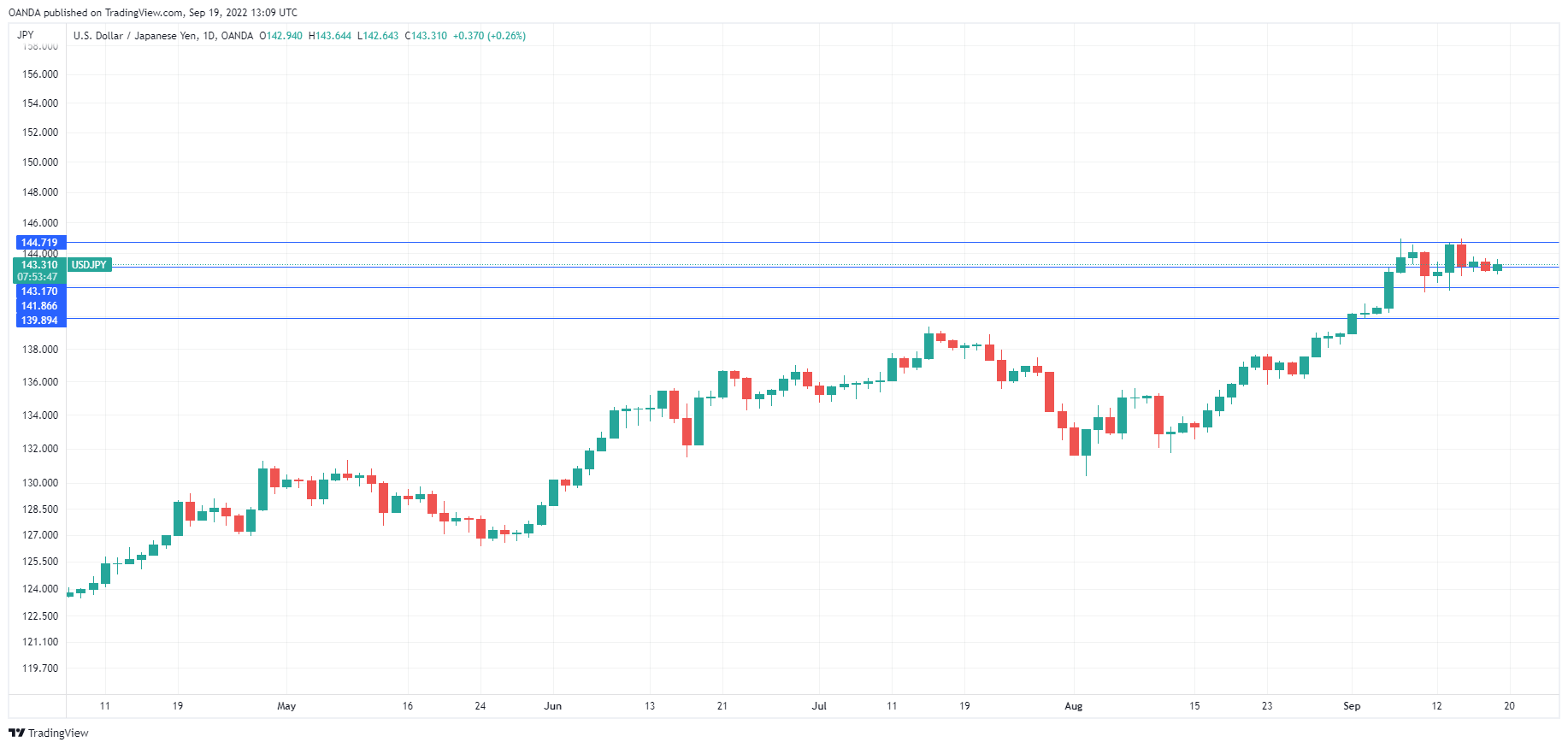
The Japanese yen is trading lower today. In the North American session, USD/JPY is trading at 143.52, up 0.44%. Japan’s Core CPI, a key inflation indicator, is expected to rise to 2.7% in August, up from 2.4% in July.
Fed, BoJ to meet later this week
Central banks will be in the spotlight this week, with the Federal Reserve meeting on Wednesday and the Bank of Japan on Thursday. The yen hasn’t posted a winning week since early August and fell to 144.99 earlier this month, its lowest level since 1998. The sharp depreciation of the yen promises to be high on the agenda at BoJ’s meeting. The yen has borne the brunt of the BoJ’s ultra-accommodative policy, which has kept a tight lid on Japanese government yields while US Treasuries are heading higher, thanks to the Fed’s continued tightening. This has left the yen at the mercy of the US/Japan rate differential, which continues to widen.
The BoJ could provide relief to the yen by tightening policy, but Governor Kuroda has repeated that he will not tighten unless there is a clear indication that inflation is broad-based and sustained. With inflation at just 2.6%, the BoJ is in no hurry to tighten, unlike other major central banks, where soaring inflation is the number one priority.
The BoJ and Japan’s Ministry of Finance have engaged in verbal rhetoric as the yen continues to slide, but without any action to back up their warnings, speculators continue to drive down the yen. After reports last week that the BoJ had conducted a rate check, speculation rose that Tokyo was considering a currency intervention, but such a drastic move still appears unlikely. The BoJ may use stronger language about its concern about the yen’s slide at this week’s meeting, but short of the Bank signalling a change in policy or hinting at intervention, the yen is unlikely to get any relief from the BoJ.
USD/JPY Technical
- 1.4363 is the next line of resistance, followed by 144.81
- USD/JPY has support at 142.56, followed by 141.88
EUR/USD Mid-Day Outlook
Daily Pivots: (S1) 0.9961; (P) 0.9999; (R1) 1.0053; More...
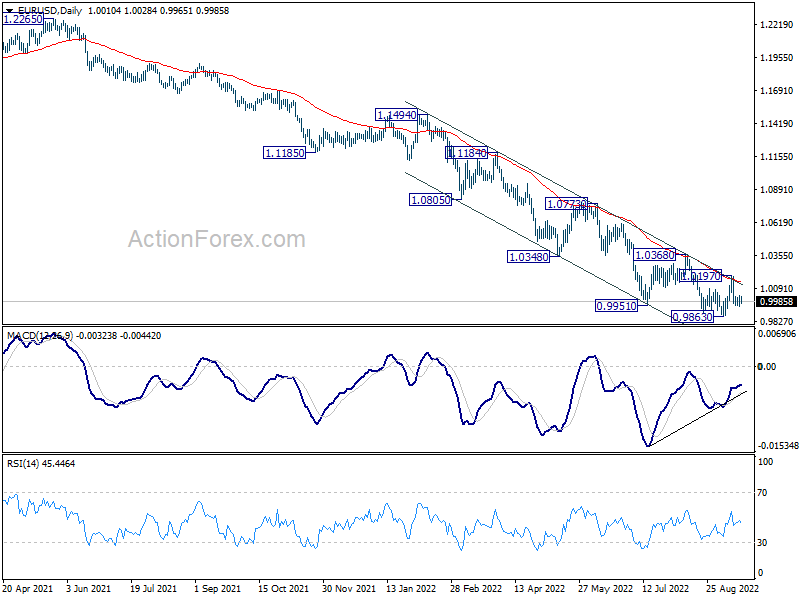
Intraday bias in EUR/USD stays neutral as range trading continues. Outlook also remains bearish. On the downside, firm break of 0.9863 support will resume larger down trend. On the upside, break of 1.0197 resistance will now raise the chance of larger trend reversal, and target 1.0368 resistance.
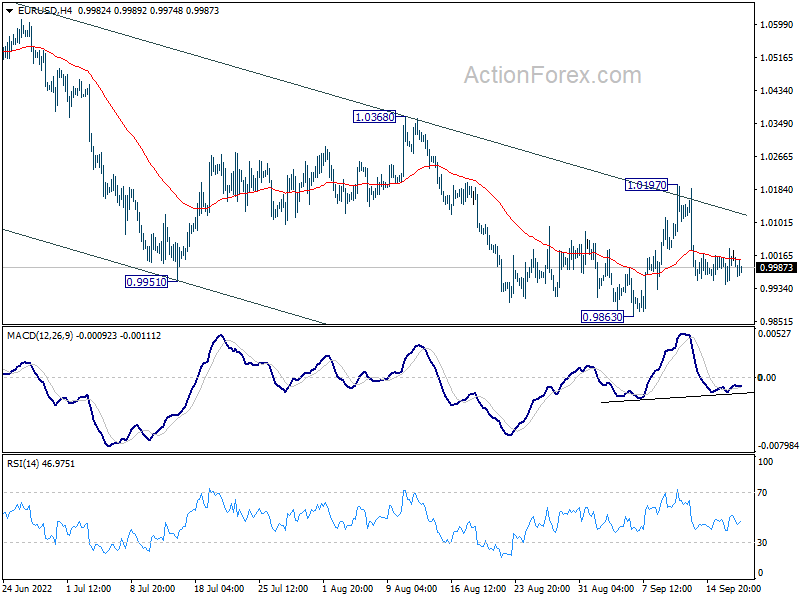
In the bigger picture, down trend from 1.6039 (2008 high) is still in progress. Next target is 100% projection of 1.3993 to 1.0339 from 1.2348 at 0.8694. In any case, outlook will stay bearish as long as 1.0368 resistance holds, in case of strong rebound.
GBP/USD Mid-Day Outlook
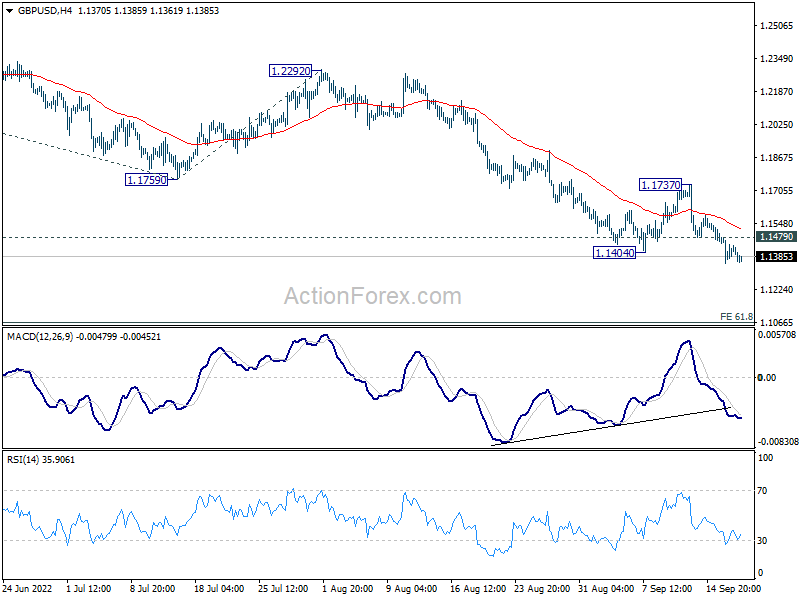
Daily Pivots: (S1) 1.1355; (P) 1.1418; (R1) 1.1485; More...
Intraday bias in GBP/USD stays on the downside for the moment. Current down trend should target 61.8% projection of 1.3748 to 1.1759 from 1.2292 at 1.1063. On the upside, above 1.1479 minor resistance will turn intraday bias neutral first. But break of 1.1737 resistance is needed to indicate short term bottoming. Otherwise, outlook will remain bearish in case of recovery.
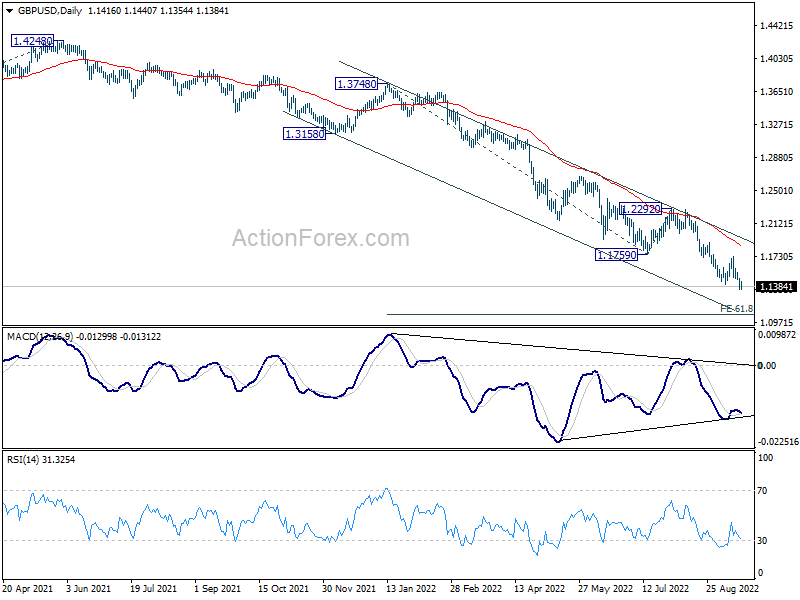
In the bigger picture, based on current momentum, fall from 1.4248 (2018 high) is probably resuming long term down trend from 2.1161 (2007 high). Sustained break of 1.1409 will target 61.8% projection of 1.7190 (2014 high) to 1.1409 (2020 low) from 1.4248 (2021 high) at 1.0675. This will remain the favored case for now as long as 1.2292 resistance holds.
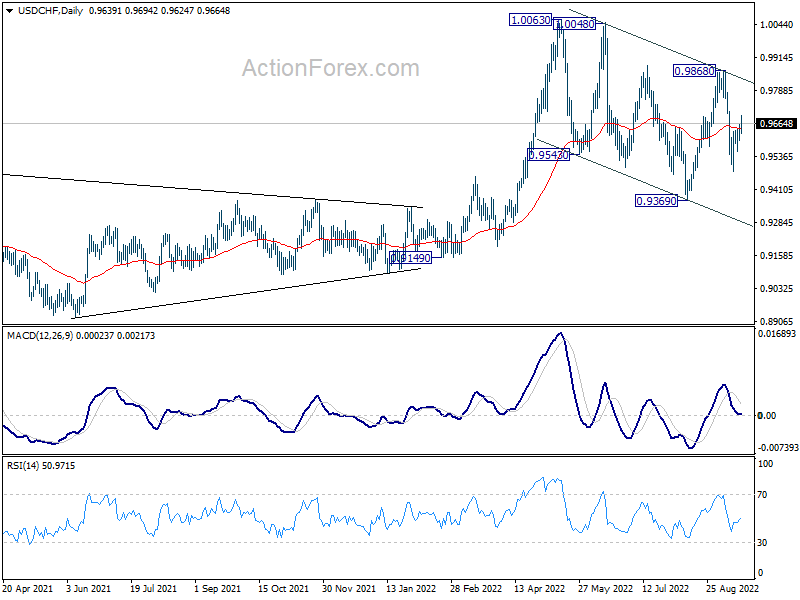
USD/CHF Mid-Day Outlook
Daily Pivots: (S1) 0.9610; (P) 0.9636; (R1) 0.9670; More
Intraday bias in USD/CHF stays mildly on the upside. Current rise from 0.9478 would target 0.9868 resistance. Break there will argue that larger up trend is ready to resume through 1.0063. Overall, the corrective pattern from 1.0063 high could still extend. Below 0.9554 minor support will turn bias back to the downside for 0.9478 and below.
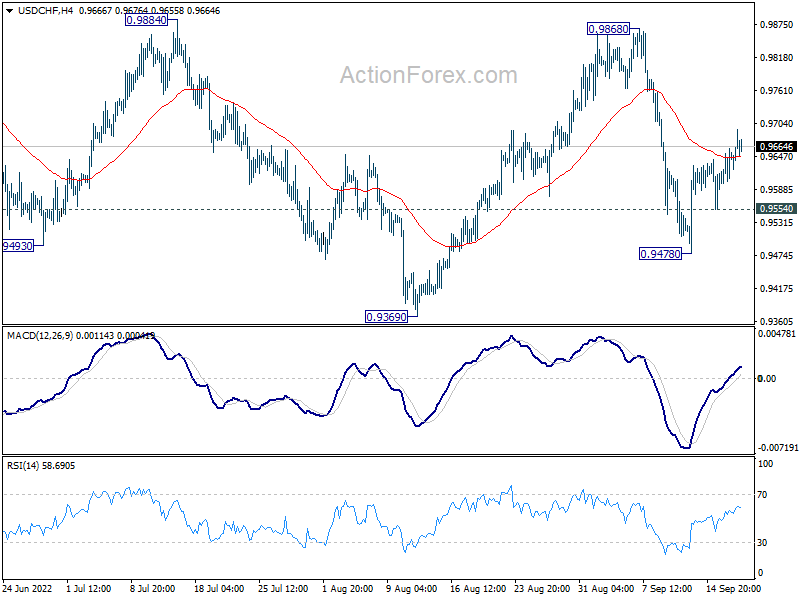
In the bigger picture, current development suggests that up trend from 0.8756 (2021 low) is still in progress. Sustained break of 1.0063 will target 100% projection of 0.9149 to 1.0063 from 0.9369 at 1.0283, and then 1.0342 (2016 high). For now, this will remain the favored case as long as 0.9369 support holds, even in case of deep pull back.
USD/JPY Mid-Day Outlook
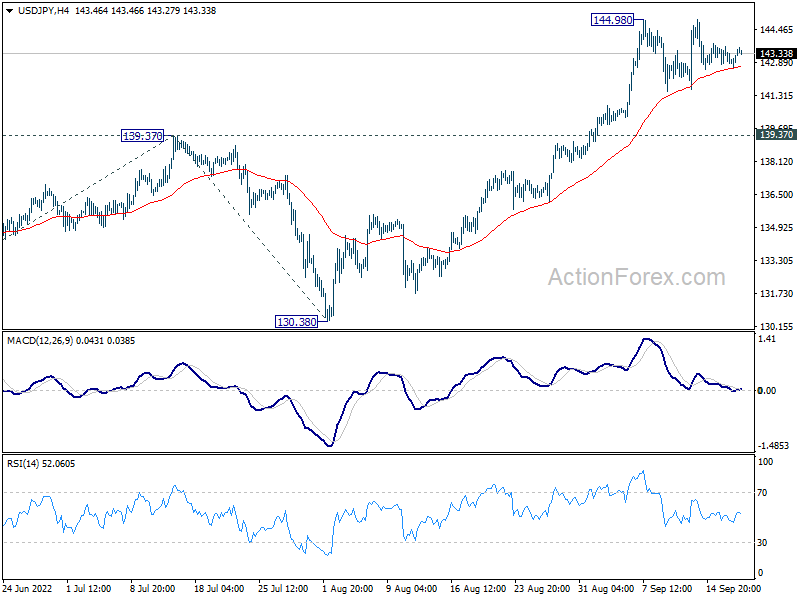
Daily Pivots: (S1) 142.62; (P) 143.16; (R1) 143.47; More...
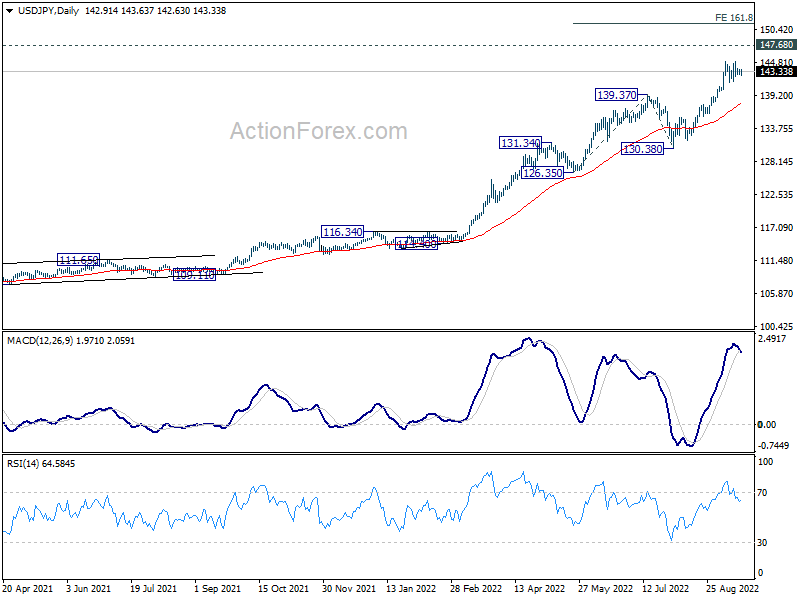
USD/JPY is still staying in consolidation from 144.98 and intraday bias remains neutral. While deeper retreat cannot be ruled out, downside should be contained by 139.37 resistance turned support. On the upside, break of 144.98 will resume larger up trend to 147.68 long term resistance. Break there will target 161.8% projection of 126.35 to 139.37 from 130.38 at 151.44 next.
In the bigger picture, up trend from 101.18 is still in progress, as part of the whole up trend from 75.56 (2011 low). Further rise should be seen to 147.68 (1998 high). For now, break of 130.38 support is needed to be the first indication of medium term topping. Otherwise, outlook will stay bullish even in case of deep pull back.
Dollar Firmer on Risk-off Sentiment, Cryptos Tumble
The markets are relatively quiet today with Japan and the UK on holiday. Sentiment is on risk-off side, ahead of central bank rate hikes later in the week. The more notable moves are found in selloff in cryptocurrencies. Dollar is standing firm, together with Swiss Franc and Euro. Aussie and Kiwi are softer together with Sterling. Yen is mixed awaiting the next move. Yet, most major pairs are crosses are still staying inside Friday's range.
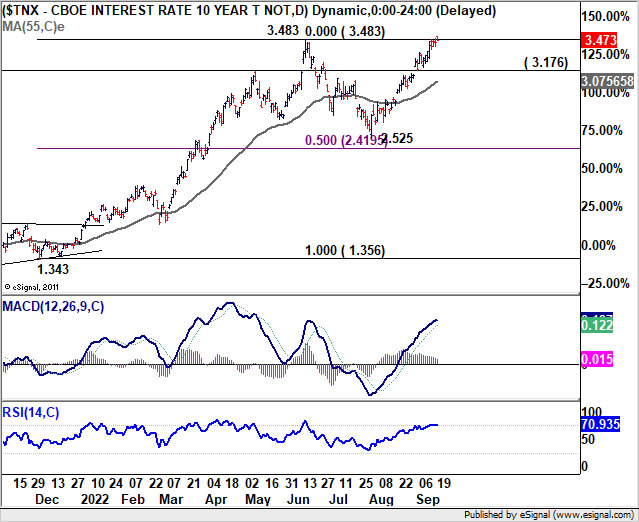
Technically, a focus is on whether US 10-year yield would gather momentum for another challenge on 3.483 resistance. Decisive break there will confirm larger up trend resumption. If that happens, USD/JPY could also be shot up through 144.98 resistance, toward 147.68, which was 1998 high.
In Europe, at the time of writing, DAX is down -0.29%. CAC is down -0.94%. Germany 10-year yield is up 0.0218 at 1.780. UK is on holiday. Earlier in Asia, Hong Kong HSI dropped -1.04%. China Shanghai SSE dropped -0.35%. Singapore Strait Times dropped -0.37%. Japan was on holiday.
Bundesbank: Inflation should move into double digits in the next few months
Bundesbank said in the monthly report that there are "increasing signs that the German economy is slipping into a recession". It added, "the high inflation and the uncertainty regarding the energy supply and its costs affect not only the gas and electricity-intensive industry and its export business and investments, but also private consumption and the service providers dependent on it."
Gas supply situation is expected to "remain extremely tense in the coming month". For Q4 and Q1, economists expect a "noticeable decline in economic output", and outlook is "extremely uncertain".
Regarding inflation, Bundesbank said the fiscal relief package will only be reflected in consumer prices at the beginning of next year. "The bottom line is that the inflation rate should move into the double digits in the next few months," it added.
NZ BusinessNZ services rose to 58.6, bouncing for how long?
New Zealand BusinessNZ Performance of Services Index rose from 54.4 to 58.6 in August. Looking at some details, activity/sales rose from 54.4 to 67.1. Employment rose from 49.3 to 50.8. New orders/business rose from 53.4 to 66.5. Stocks/inventories rose from 53.8 to 59.6. Supplier deliveries rose from 47.6 to 49.6.
BNZ Senior Economist Doug Steel said that "overall, combining August's strong PSI with last week's firmer PMI yields a composite index (PCI) that suggests annual GDP growth up toward 5% in Q3 2022. We currently forecast 5%+ for that period but that strength is mostly a function of the very weak base period. If the PCI is truly bouncing, the key question is for how long?"
Ethereum tumbling, bitcoin follows
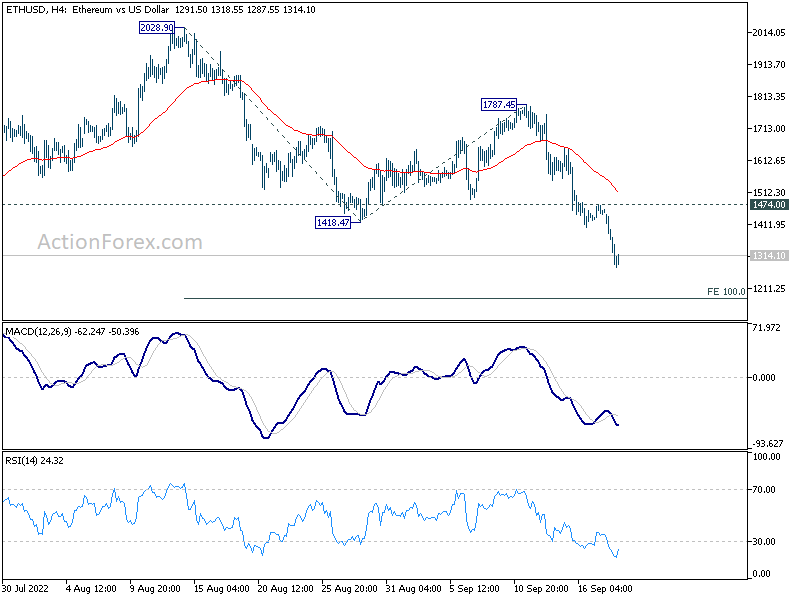
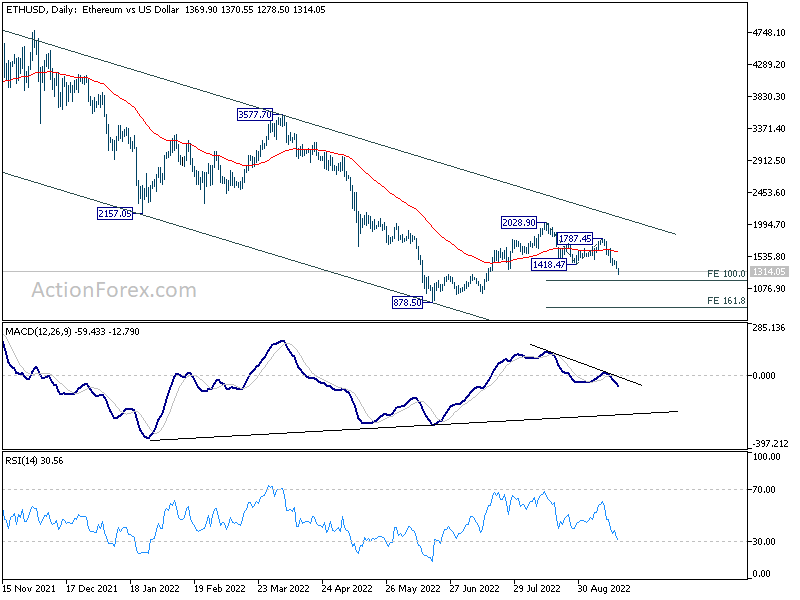
Ethereum plummets further today and the post "merge surge" decline extends. Deeper fall is expected as long as 1474.00 minor resistance holds. Next near term target is 100% projection of 2028.90 to 1418.47 from 1787.45 at 1177.02. Firm break there could bring downside acceleration through 878.5 to 161.8% projection at 799.77.
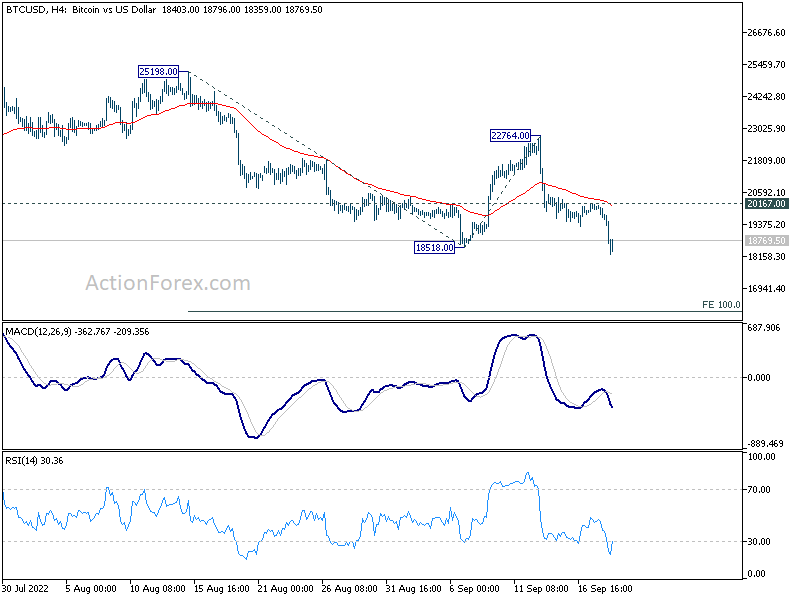
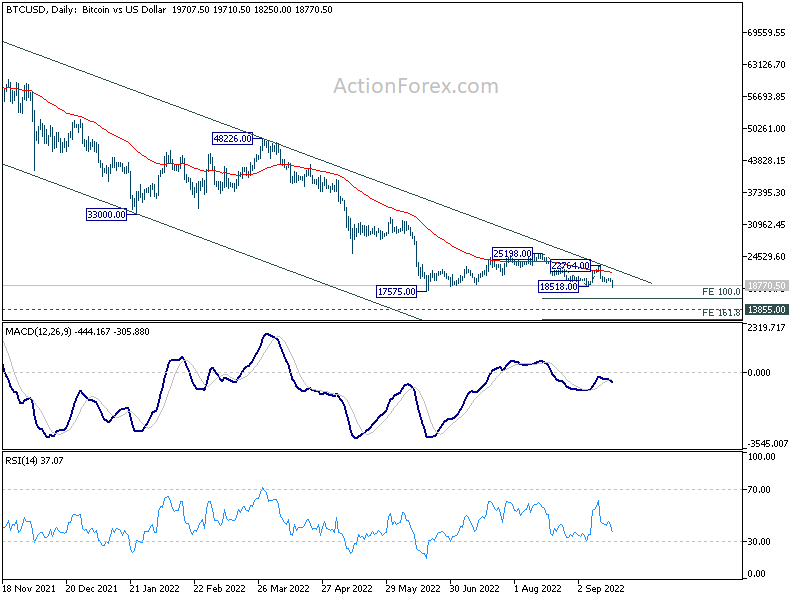
Bitcoin's development is even worse. Deeper decline is expected as long as 20167 resistance holds, for 17575 low. Break there will target 100% projection of 25198 to 18518 from 22764 at 16084.
GBP/USD Daily Outlook
Daily Pivots: (S1) 1.1355; (P) 1.1418; (R1) 1.1485; More...
Intraday bias in GBP/USD stays on the downside this week. Current down trend should target 61.8% projection of 1.3748 to 1.1759 from 1.2292 at 1.1063. On the upside, above 1.1479 minor resistance will turn intraday bias neutral first. But break of 1.1737 resistance is needed to indicate short term bottoming. Otherwise, outlook will remain bearish in case of recovery.
In the bigger picture, based on current momentum, fall from 1.4248 (2018 high) is probably resuming long term down trend from 2.1161 (2007 high). Sustained break of 1.1409 will target 61.8% projection of 1.7190 (2014 high) to 1.1409 (2020 low) from 1.4248 (2021 high) at 1.0675. This will remain the favored case for now as long as 1.2292 resistance holds.
Economic Indicators Update
| GMT | Ccy | Events | Actual | Forecast | Previous | Revised |
|---|---|---|---|---|---|---|
| 22:30 | NZD | Business NZ PSI Aug | 58.6 | 51.2 | 54.4 | |
| 10:00 | EUR | German Buba Monthly Report | ||||
| 12:30 | CAD | Industrial Product Price M/M Aug | -1.20% | 0.20% | -2.10% | |
| 12:30 | CAD | Raw Material Price Index Aug | -4.20% | 3.20% | -7.40% | |
| 14:00 | USD | NAHB Housing Market Index Sep | 48 | 49 |
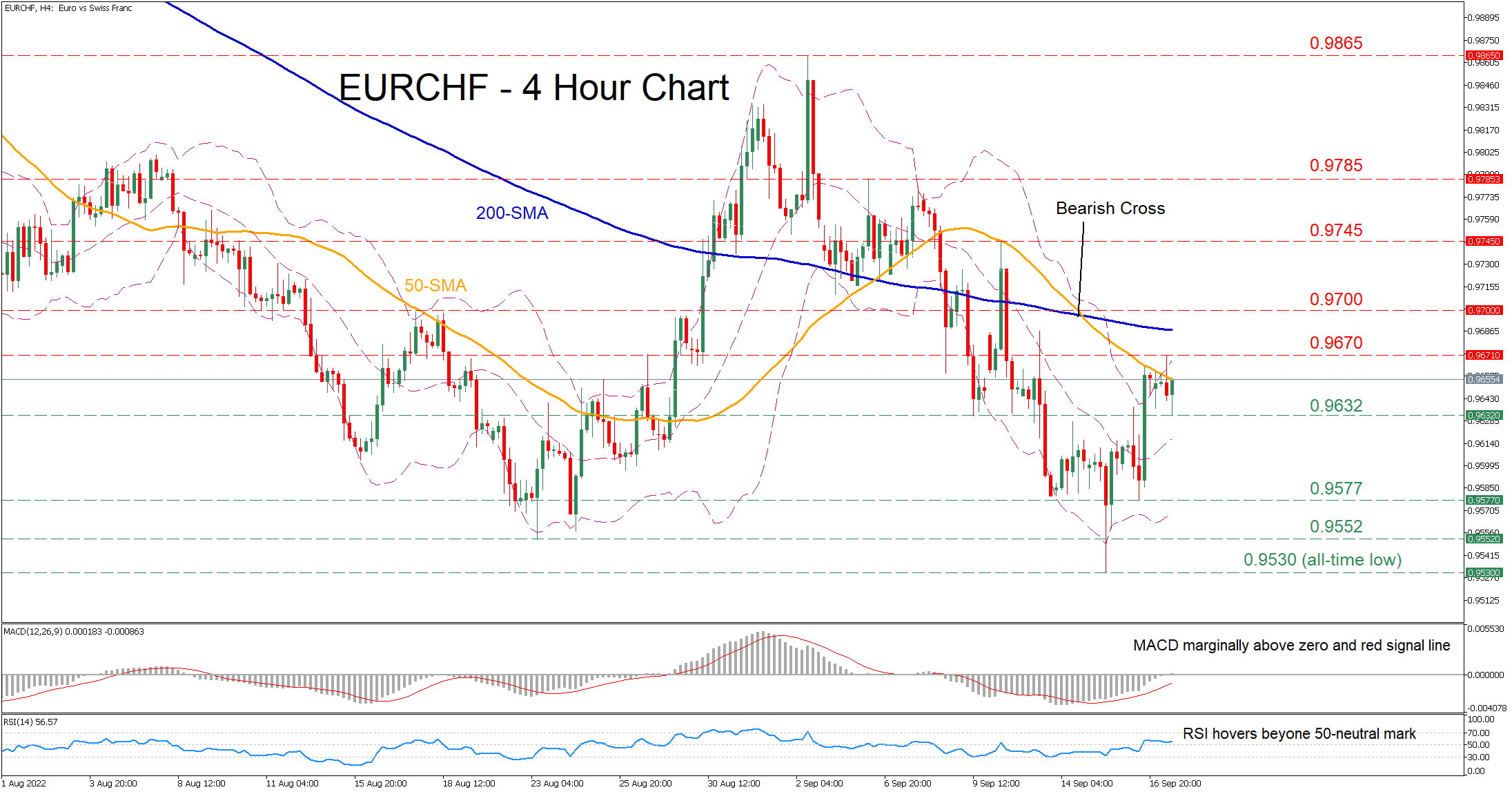
EURCHF Consolidates as 50-SMA Caps Latest Rebound
EURCHF has been gaining some ground in the short term after its sharp decline came to a halt at the all-time low of 0.9530. However, the recent price recovery has been repeatedly held down by the descending 50-period simple moving average (SMA) and the upper Bollinger band.
The momentum indicators currently suggest that bullish forces remain in control, but they are moderating. The MACD histogram is found above zero and its red signal line, while the RSI is flatlining beyond its 50-neutral mark.
Should buying pressures intensify and the price crosses above the 50-period SMA, initial resistance could be met at the recent high of 0.9670. A jump above the latter could then shift the attention to the August resistance zone of 0.9700 before the 0.9745 peak appears on the radar. Even higher, the 0.9785 hurdle might prove to be a tough one for the bulls to overcome.
On the flipside, if positive momentum wanes and the price drifts lower, 0.9632 could act as the first line of defence. Sliding beneath that floor, the bears could aim for 0.9577 before the spotlight turns to the August low of 0.9552. Failing to halt there, the all-time low of 0.9530 might come under examination.
In brief, EURCHF’s recovery appears to be in danger as the 50-period SMA has been acting as a stronghold. Therefore, a clear close above the latter could ignite buyers’ hopes for a sustained uptrend.
Ethereum tumbling, bitcoin follows
Ethereum plummets further today and the post "merge surge" decline extends. Deeper fall is expected as long as 1474.00 minor resistance holds. Next near term target is 100% projection of 2028.90 to 1418.47 from 1787.45 at 1177.02. Firm break there could bring downside acceleration through 878.5 to 161.8% projection at 799.77.
Bitcoin's development is even worse. Deeper decline is expected as long as 20167 resistance holds, for 17575 low. Break there will target 100% projection of 25198 to 18518 from 22764 at 16084.