

Sample Category Title
EUR/AUD Daily Outlook
Daily Pivots: (S1) 1.4370; (P) 1.4418; (R1) 1.4476; More...
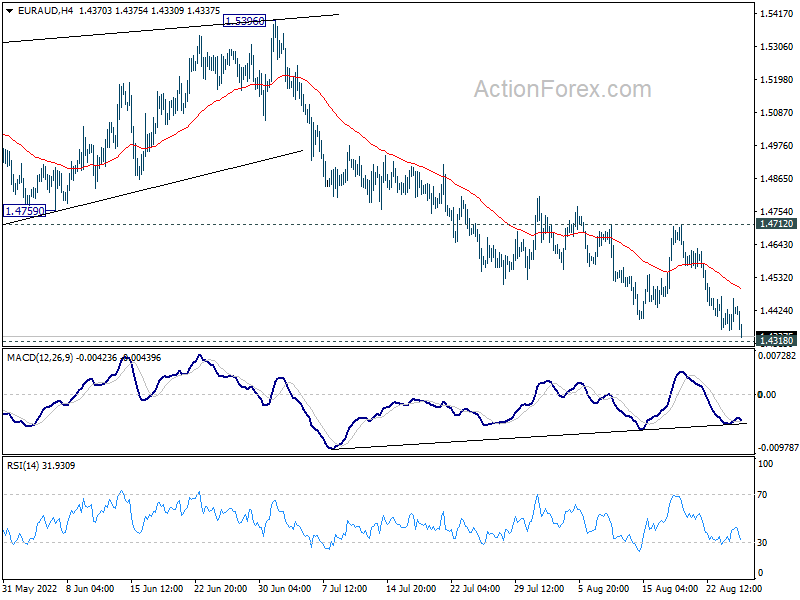
Intraday bias in EUR/AUD stays on the downside for 1.4318 support. Decisive break there will resume larger down trend to medium term projection level at 1.3623. On the upside, break of 1.4712 resistance will delay the bearish case and turn bias to the upside for stronger rebound first.
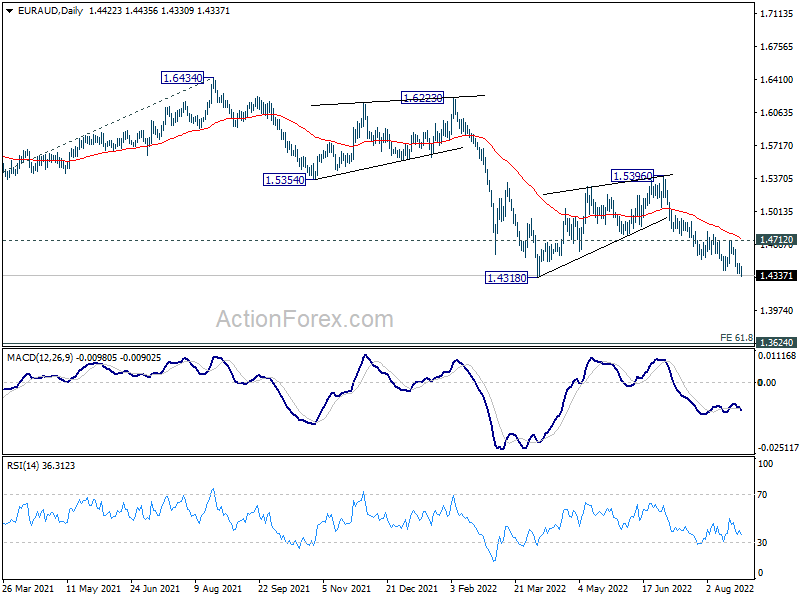
In the bigger picture, down trend from 1.9799 is still in progress. Break of 1.4318 low will target 61.8% projection of 1.9799 to 1.5250 from 1.6434 at 1.3623, which is close to 1.3624 long term support (2017 low). This will remain the favored case now as long as 1.5396 resistance holds.
EUR/CHF Daily Outlook
Daily Pivots: (S1) 0.9580; (P) 0.9615; (R1) 0.9673; More....
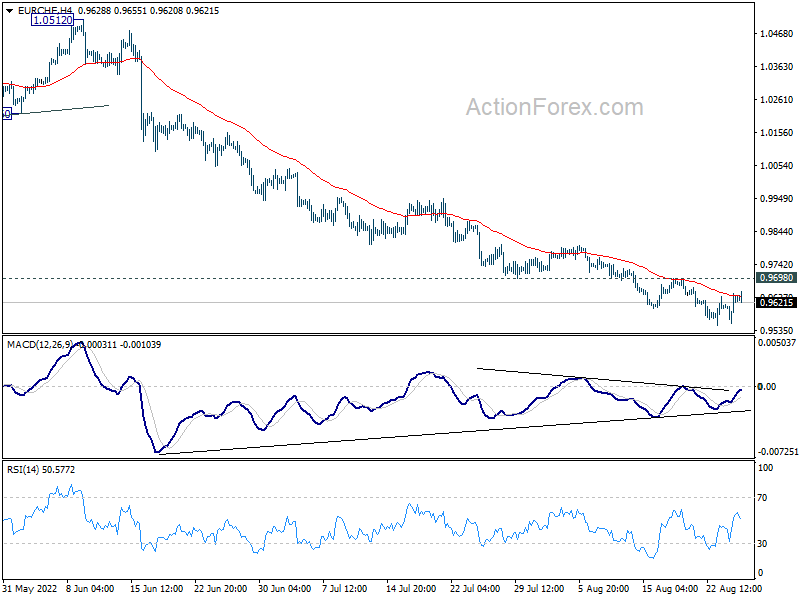
While EUR/CHF recovers, further decline is still expected with 0.9698 resistance intact. Current down trend should now target 100% projection of 1.1149 to 0.9970 from 1.0513 at 0.9334. On the upside, break of 0.9698 resistance will indicate short term bottoming, and turn bias back to the upside for stronger rebound.
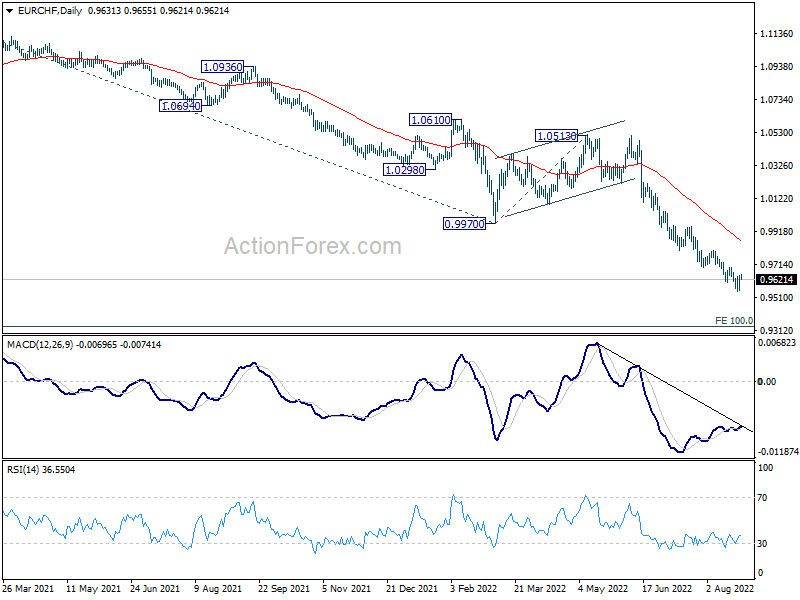
In the bigger picture, long term down trend from 1.2004 (2018 high) is still in progress. Next target is 138.2% projection of 1.2004 to 1.0505 to 1.1149 at 0.9033. On the upside, break of 0.9970 support turned resistance is needed to be the first sign of medium term bottoming. Otherwise, outlook will stay bearish in case of strong rebound.
EUR/USD: Powell’s Message from Jackson Hole Will Define Whether Current Bounce is Correction
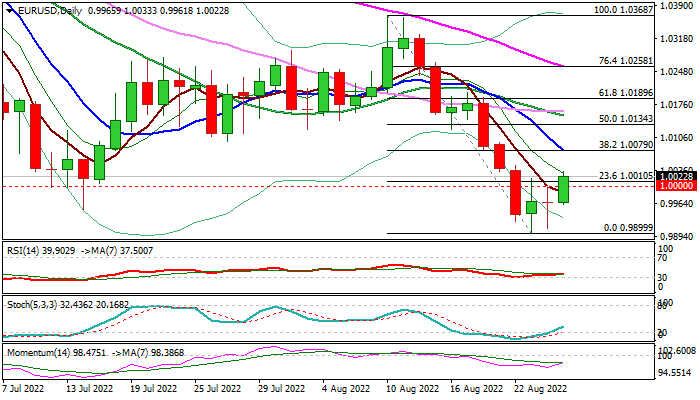
The Euro bounces back above parity level in early European trading on Thursday as traders collect profits from this week’s drop to the lowest levels since 2002.
Oversold daily studies and a double daily Doji (Tue/Wed) added to signals that bears ran out of steam and need to consolidate before resuming, though still need a confirmation on weekly close below parity as a minimum requirement, while close below former 2022 low (0.9952) would add to bearish signals.
Current bounce could be seen as positioning ahead of fresh acceleration lower as markets await the speech from Fed’s Chair Powell in Jackson Hole symposium on Friday, with expectations of 58.5% that the US central bank will remain in aggressive path and opt for another super-sized 0.75% rate hike, against 41.5% expecting 0.5% hike in September policy meeting.
In light of prevailing hawkish expectations, Euro’s bounce is likely to provide better selling prices for fresh push lower that would risk drop to Sep 2002 low (0.9607).
Conversely, the Euro may rise further if Powell disappoints markets by less hawkish than expected tone, with violation of pivotal barrier at 1.0079 (falling 10DMA / Fibo 38.2% of 1.0368/0.9900 bear-leg) to sideline bears and signal near-term bottom.
Res: 1.0033; 1.0079; 1.0134; 1.0152.
Sup: 1.0000; 0.9961; 0.9900; 0.9853.
AUDUSD Picks Up Steam But More Needs to be Done
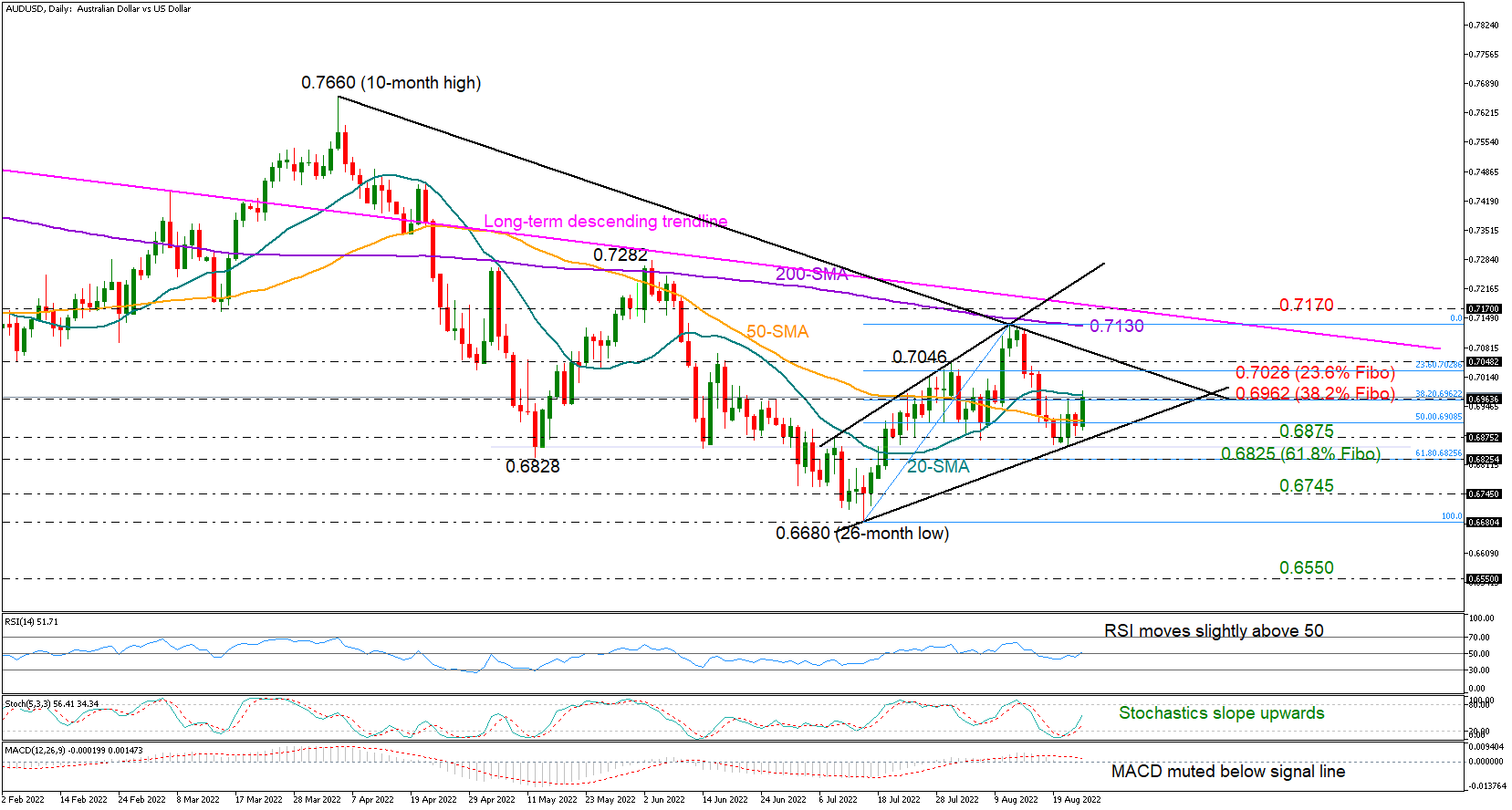
AUDUSD started the day with strong positive momentum, quickly recouping yesterday’s mild losses to peak marginally above the 20-day simple moving average (SMA) and the 0.6962 level, which previously was unbreakable. That is also where the 38.2% Fibonacci retracement of the latest upleg resides.
The momentum indicators cannot guarantee that the bullish correction will continue. Despite the sharp rebound in the stochastics, the RSI has just ticked above its 50 neutral mark, while the MACD remains muted and negative below its red signal line.
Hence, traders may wait for a durable move above the 0.6962 resistance and the 20-day SMA before they raise their buying orders towards the 23.6% Fibonacci of 0.7028 and the tentative descending trendline at 0.7048. Another successful step higher may open the door for the 200-day SMA at 0.7130, while not far above, the resistance line drawn from the 2021 top of 0.8006 might be worthy to watch as well around 0.7170.
On the downside, a break below the 0.6875 – 0.6825 territory and the tentative short-term ascending trendline could initially seek support near the 0.6745 boundary. If not, the sell-off could reach the 26-month low of 0.6680, where any violation is expected to pressure the price fiercely towards the 0.6550 barrier taken from April-May 2020.
In short, despite its latest bullish efforts, AUDUSD has yet to secure buying confidence. For that to happen, the pair will need to advance above 0.7048 and then close sustainably above the 200-day SMA.
WTI Futures Jump Higher, Surpassing 200-day SMA
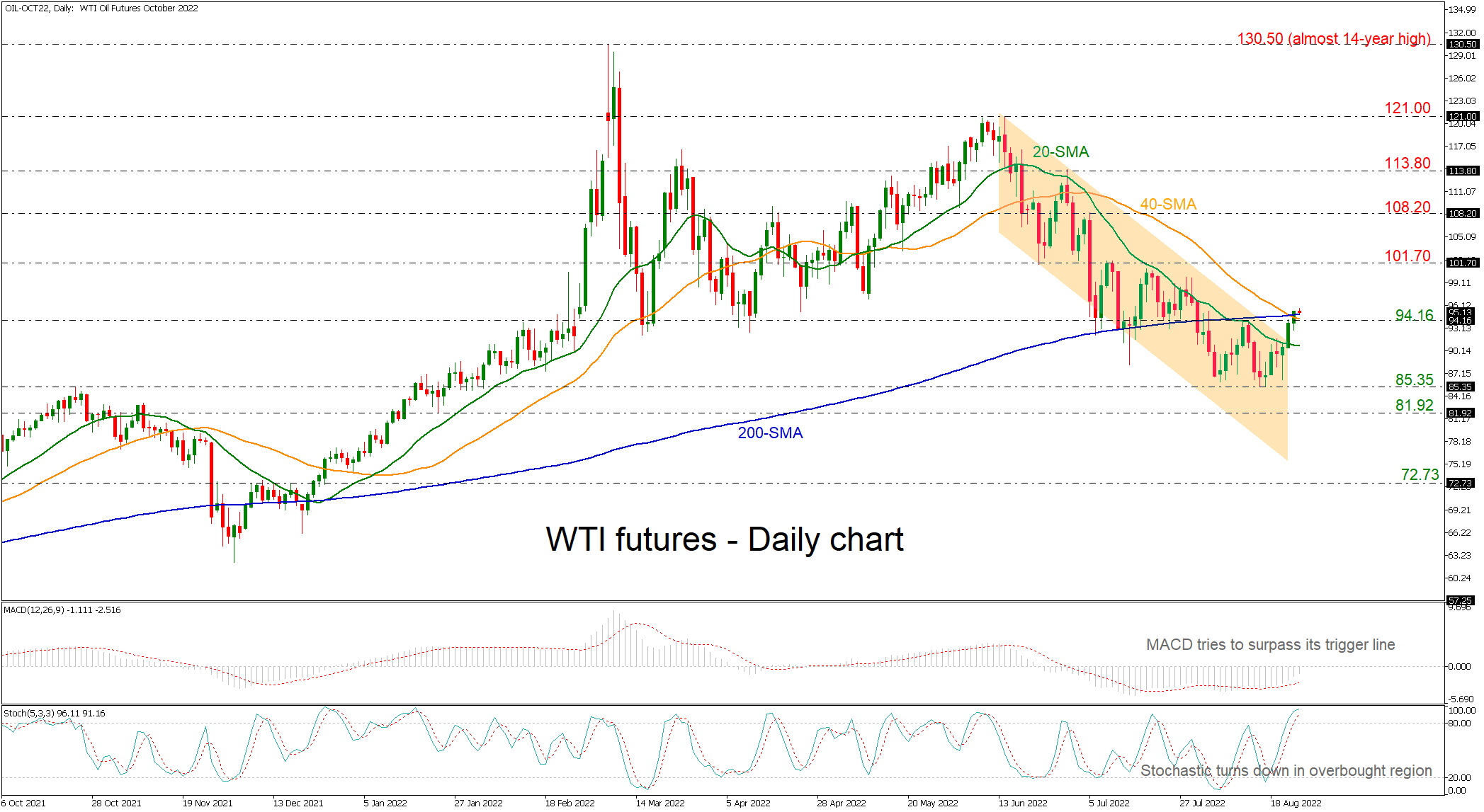
WTI crude oil futures made a notable attempt to surpass the medium-term descending channel and the bearish crossover within the 40- and the 200-day simple moving averages (SMAs). Currently, the momentum is weak but if the price remains above those crucial lines, the bullish structure may be confirmed.
Technically, the MACD oscillator is rising in the negative region, holding above its trigger line; however, the stochastic oscillator is turning lower above the 80 level, suggesting an overbought market.
A move to the upside may meet resistance around 101.70, this being the top recorded on July 8. More bullish actions could take the market towards the 108.20 barrier ahead of 113.80.
On the other hand, immediate support to further declines may be taking place around the 94.14 figure, while the 20-day SMA at 90.87 could provide additional support in case of steeper losses. Though, a drop back below the downward sloping channel would open the way for a retest of the 85.35 hurdle.
All in all, WTI futures are showing some positive signs for bullish movement in the very short-term as the price jumps above the 200-day SMA.
EUR/USD: Bullish Impulse Towards Previous High Expected
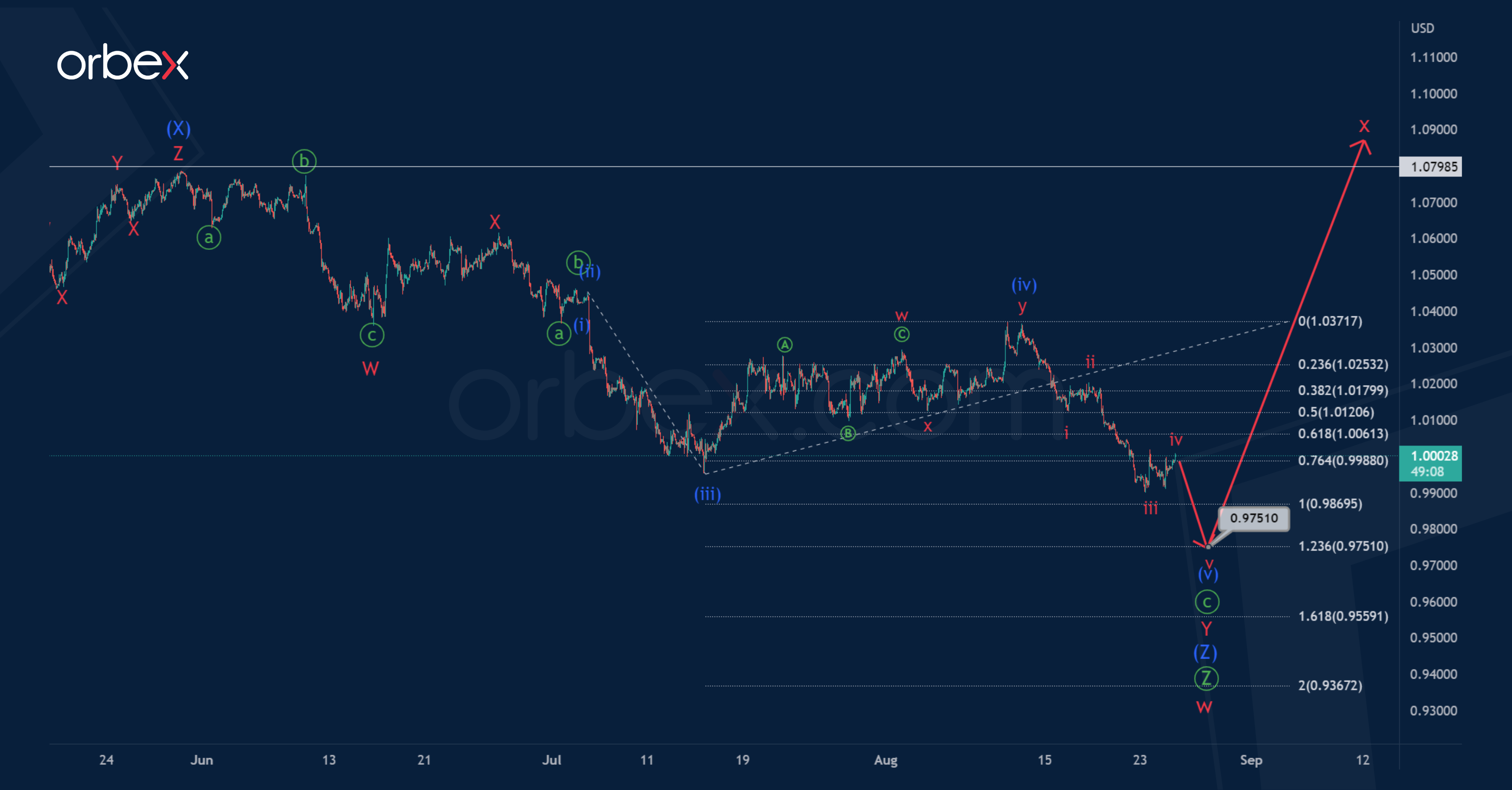
In the long term, EURUSD currency is expected to form a bearish corrective trend, which may take the form of a double zigzag consisting of cycle waves w-x-y.
It is likely that at the time of writing, the construction of the actionary wave w has ended. It took the form of a primary triple zigzag. Then the market turned around, and a new upward movement of the currency began in the reactionary intervening wave x. Most likely, this wave takes the form of a primary zigzag, as shown in the chart.
It is assumed that the first primary wave, which can take the impulse pattern, will end near the price level of 1.079. This is the previous maximum, which was marked by the intermediate intervening wave (X).
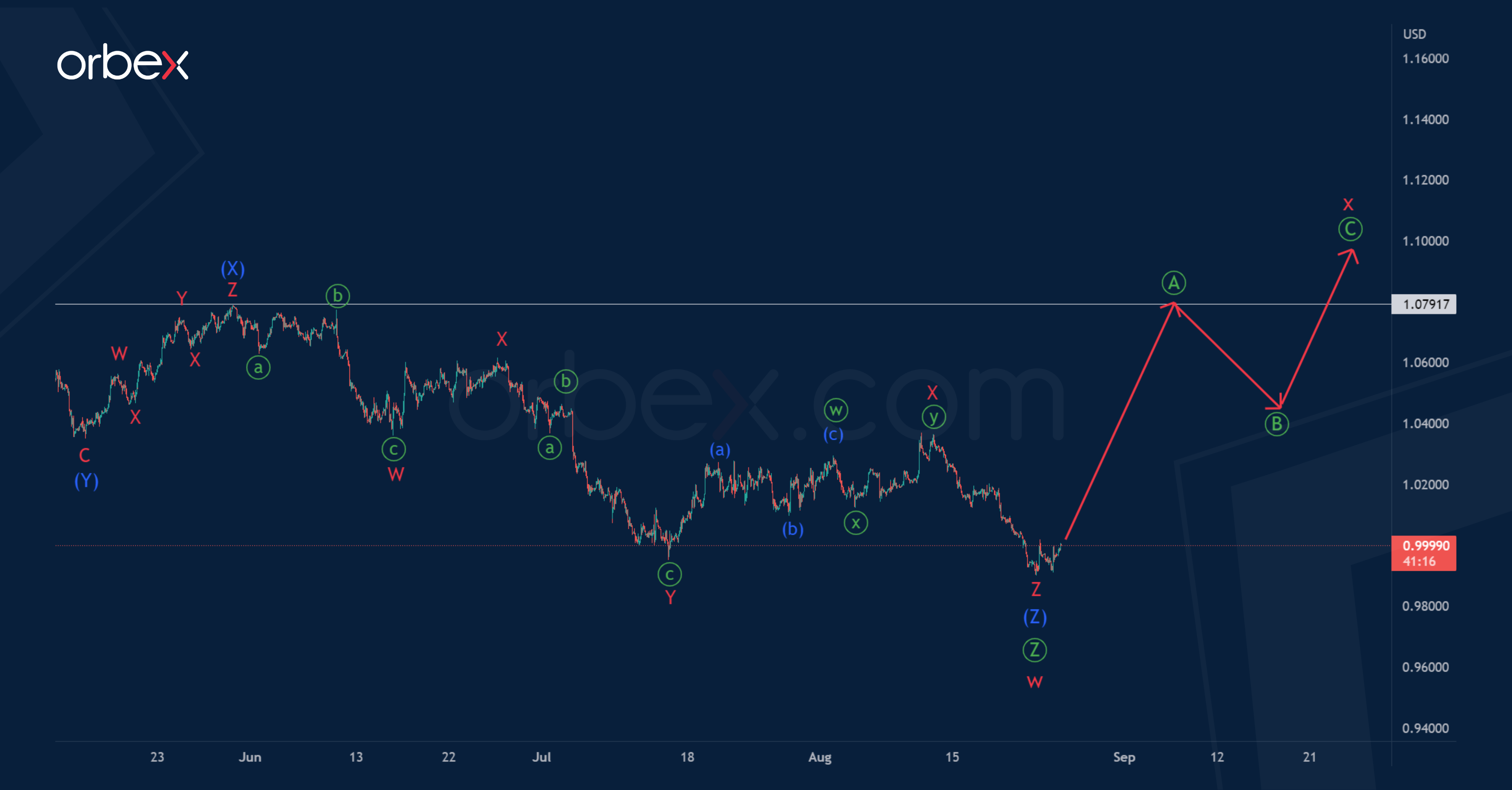
According to the alternative, the formation of the cycle actionary wave w has not yet been fully completed. Most likely, in the next coming trading weeks, the formation of an intermediate wave (Z) may continue, taking the form of a minor double zigzag W-X-Y.
The last minor wave Y can end in the form of a minute standard zigzag. The minute impulse wave is likely to end near 0.975. At that level, sub-wave (v) will be at 123.6% of sub-wave (iii).
An approximate scheme of possible future movement is shown on the chart.
We will continue to monitor EURUSD in the future.
US Oil Breaks Higher
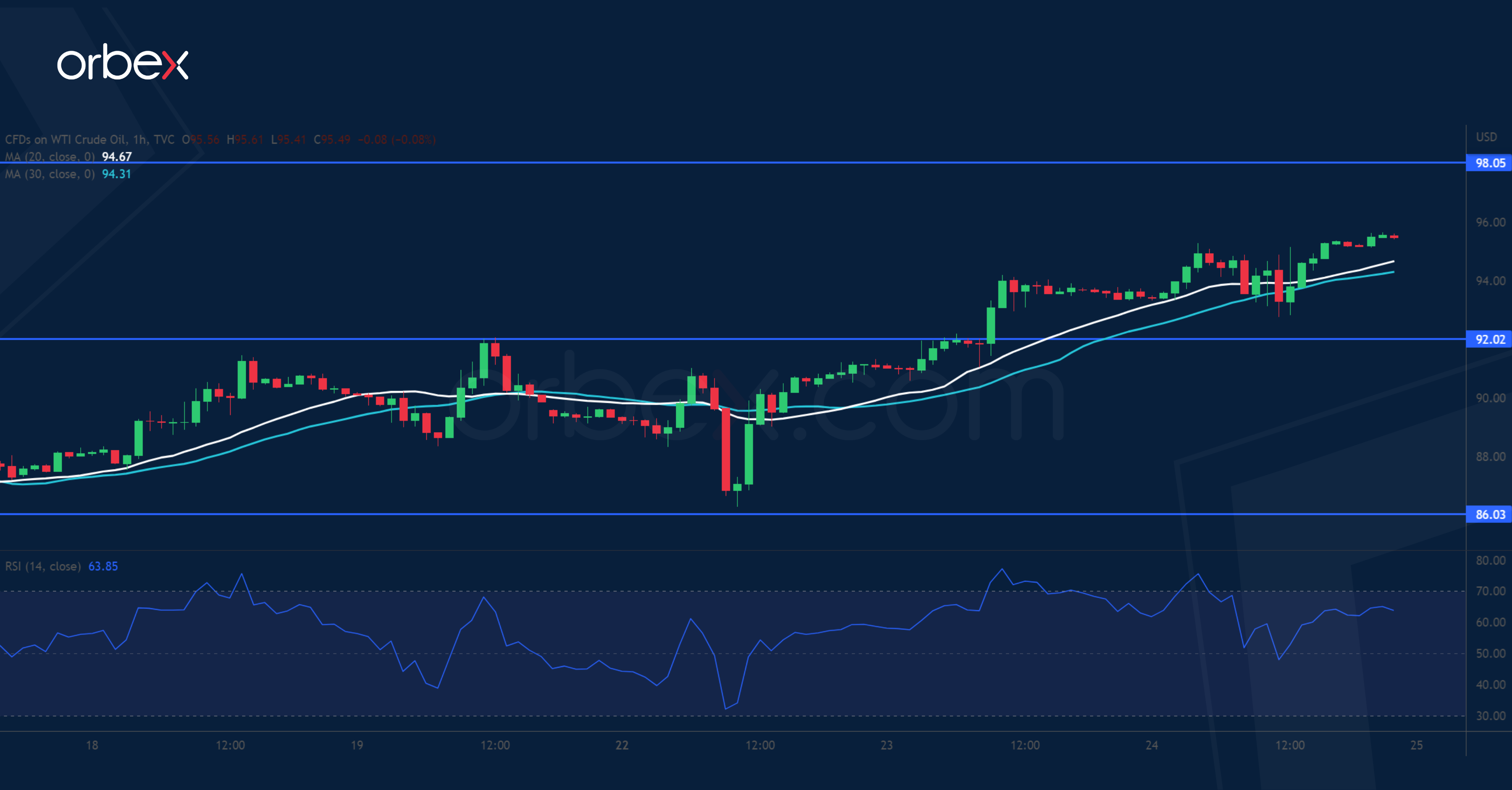
WTI crude climbed after Saudi Arabia suggested trimming output. Both 20 and 30-day moving averages previously acted as resistance in a month-long retreat. A break above 95.00 and the MAs prompted sellers to cover, easing the downward pressure. 98.00 at the start of the August sell-off could be the next hurdle, which might open the door to the recent peak at 102.00. In the meantime, the RSI’s overbought situation has temporarily limited the range of the bounce. 92.00 is a fresh support to let the price take a breather.
XAU/USD Seeks Support
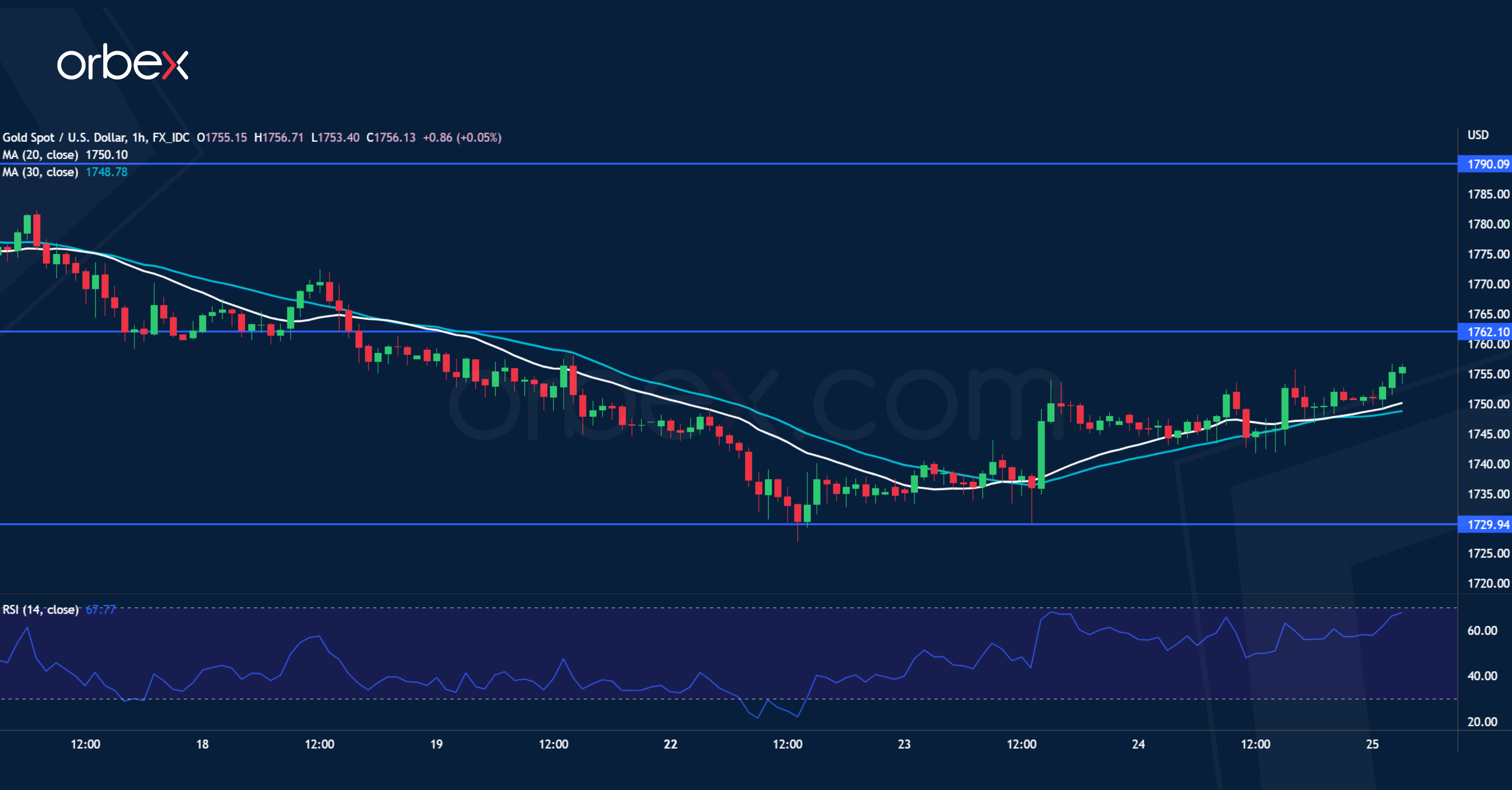
Gold consolidates as traders await Fed comments from Jackson Hole. After the precious metal gave up more than half of its recent gains, the bulls are seeking to hold above the major support (1680) from the daily chart as its breach could trigger a bearish reversal in the medium-term. An oversold RSI attracted some buying interest near the origin of a rally in late July. 1730 is an intermediate support and 1705 the bulls’ last stronghold. 1762 is the first hurdle to lift. Only a rally above 1790 could lead to an extended recovery.
NZD/USD Struggles to Bounce
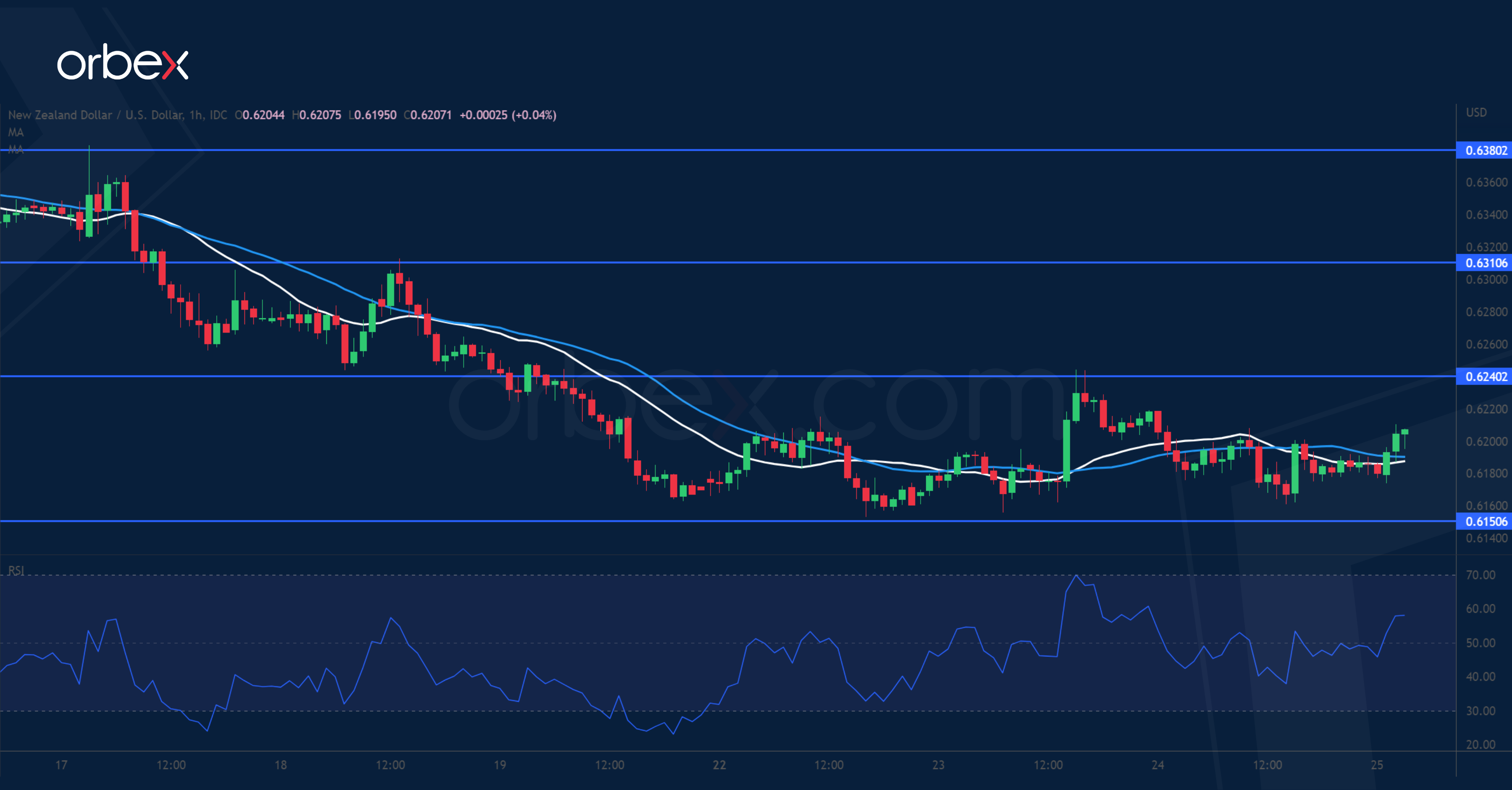
The New Zealand dollar treads water as Q2 retail sales numbers disappoint. The pair is grinding the demand zone (0.6150) from a bullish breakout in mid-July. A bullish RSI divergence shows a deceleration in the sell-off and could pave the way for a rebound. A close above the support-turned-resistance at 0.6240 would act as a confirmation and put the kiwi back on track. A rally above 0.6310 may shift sentiment to the upside once again. On the downside, a fall below 0.6150 could send the price to the critical floor at 0.6070.
There’s No Stopping the Core Bond Sell-off for the Moment
Markets
There’s no stopping the core bond sell-off for the moment. UK Gilts remain underperformers with UK money markets betting on aggressive BoE action (4.5% policy rate peak mid-next year). Double digit inflation and the political blame game put BoE governor Bailey with his back against the wall. UK yields yesterday rose by 4.9 bps (30-yr) to 22.6 bps (3-yr). The German yield curve bear flattened with yields ending up to 7.1 bps (2-yr) higher while US yields ended with around 6 bps gains across the curve. 10-yr yield spread changes vs Germany widened only marginally. Bond weakness yesterday didn’t spill to other markets. Main European and US equity benchmarks managed a slightly positive close. The dollar attempted to set new YTD highs on a trade-weighted basis (DXY 109.30) and against the euro (EUR/USD 0.9901), but didn’t succeed, prompting return action during US dealings and this morning. EUR/USD is currently changing hands a tad below parity. Sterling again didn’t benefit from the relative yield dynamics with EUR/GBP closing just below 0.8450. Brent crude broke above the $100/b mark, currently approaching $102/b on fears of reduced supply coming from OPEC+.
Today’s eco calendar won’t inspire trading. Details of Q2 German GDP (0.1% Q/Q from 0%) showed decent consumption (0.8% Q/Q), a big push in the back from the government (2.3% Q/Q) and a drop in investments (-1.3% Q/Q). German Ifo business sentiment loses relevance following PMI figures earlier this week. Minutes of the ECB meeting will be an interesting reading, but might prove outdated already. Since yesterday, money markets for the first time fully embrace the idea of additional 50 bps rate hikes at both the September and October ECB policy meetings. German members Schnabel and Nagel (Bundesbank) already backed a 50 bps hike in September. The countdown to Powell’s Jackson Hole address keeps core bonds under pressure. We still see a possibility to surprise on the hawkish side in case of a nod in the direction of a higher neutral rate. The median projection in the June FOMC dot plot was “only” 2.4%.
News Headlines
The Bank of Korean this morning raised its policy rate by 0.25% to 2.50%. As such the central bank returned to a more normal pace of adjustment after an exceptional 50 bps move in July. The BoK raised its 2022 inflation outlook to 5.2% from 4.5%. At the same time, it cut the projection for 2022 growth to 2.6% from 2.7%. Growth is expected to slow further to 2.1% next year. Governor Rhee at the news conference confirmed the BoK’s intention for further tightening. He said that as long as growth “stays relatively sound compared with other countries, making sure inflation is under control first would be helpful for everyone in the medium-to long-term”. In this respect he saw market expectations for the policy rate to move towards 2.75%/3.0% by year-end as appropriate. After reaching a multi-year low against the dollar earlier this week, the won this morning gains about 0.5% to USD/KRW 1336,25. The BOK repeated that it doesn’t target a level for the currency but it is taking the impact of the won valuation on inflation into account. The Chinese state council yesterday approved a 19 point policy package to further stimulate economic activity. The government foresees a further 1tn yuan funding amongst others, to support infrastructure spending. Local government will get access to 500bn from previous unused quota. The state council indicated the government will take "timely and decisive measures, maintain a reasonable policy scale and make good use of policy tools in the toolkit, and intensify efforts to consolidate the foundation for economic recovery”. At the same time, the government will avoid to flood the economy with excessive stimulus.