

Sample Category Title
GBP/USD: Pound May Fall Further if Conditions Continue to Weaken
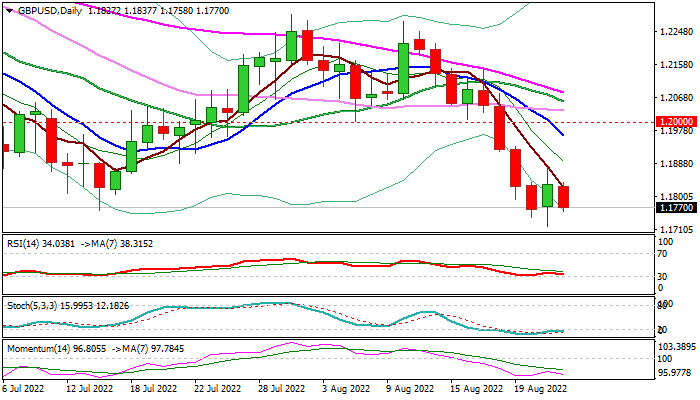
Cable returned to red after limited bounce on Tuesday, sparked by downbeat US data, signaling that short consolidation is likely to precede fresh push lower.
Initial negative signal on break below 2022 low (1.1760) that hit new lowest since March 2020 (1.1717), needs confirmation on repeated close below 1.1760 pivot and open way for continuation of a bear-phase from 1.2293/76 double-top.
Sterling remains heavily pressured by surging inflation which already hit a double-digit value and forecast show it may rise to 18% next year, built on the base of a massive amounts of money pumped in the economy to keep it afloat during coronavirus pandemic.
Soaring inflation undermined a pillars of the households – housing market and a cost of living that is likely to drive the pound lower, as economic activity is slowing sharply and bringing the economy into conditions last seen during 2008 recession.
Below 1.1760, bears see no significant obstacles en-route towards pandemic low at 1.1410, with increased risk of stronger bearish acceleration if current situation deteriorates that can not be ruled out.
The upside so far remains well protected and only sustained break above 1.20 zone (psychological / base of thick daily cloud) would be a game changer.
Res: 1.1837; 1.1877; 1.1916; 1.1963.
Sup: 1.1717; 1.1700; 1.1634; 1.1556.
USD/JPY: Dollar Keeps Firm Tone Above Daily Coud
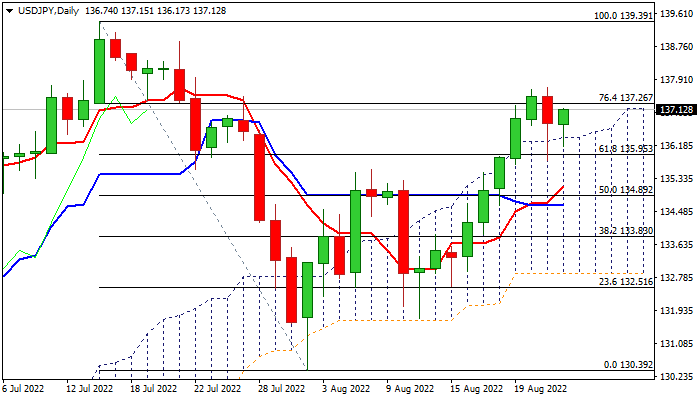
The USDJPY holds firm tone despite the most recent double-rejection at 137.70 zone (upper 20-d Bollinger band) as subsequent dips were contained by the top of thick daily cloud, keeping near-term action within narrow consolidation.
Bullish daily techs (strong positive momentum / daily Tenkan-sen/Kijun-sen bull-cross / MA’s in bullish setup / daily cloud) support the action for final push towards 2022 high at 139.39 (24-year high), but the action may hold in extended consolidation, as markets await fresh signals from Fed Chair Powell’s speech in Jackson Hole symposium.
Although Powell is widely expected to confirm Fed’s readiness to use all available tools to bring soaring inflation under control, investors look for more clues about the Fed’s stance in the near future, to learn whether the central bank is going to maintain aggressive stance or it would reduce the pace of rate hikes and act according to the latest economic data that would directly impact dollar’s performance.
Res: 137.26; 137.70; 138.87; 139.39.
Sup: 136.40; 135.81; 135.51; 134.89.
This is What Happens with GBP Soon
The highest inflation in the UK doesn’t leave a chance for their currency to feel good. Hundreds of households in the country are in a very fragile condition, trying to allocate their funds between high food and even higher electricity costs. How deep can the pound fall? FBS analysts explained everything in this article.
Effect of the high UK inflation
The annual inflation rate in the UK increased to 10.1% in July of 2022 from 9.4% in the previous period and slightly above market forecasts of 9.8%. It was the highest reading since February 1982.
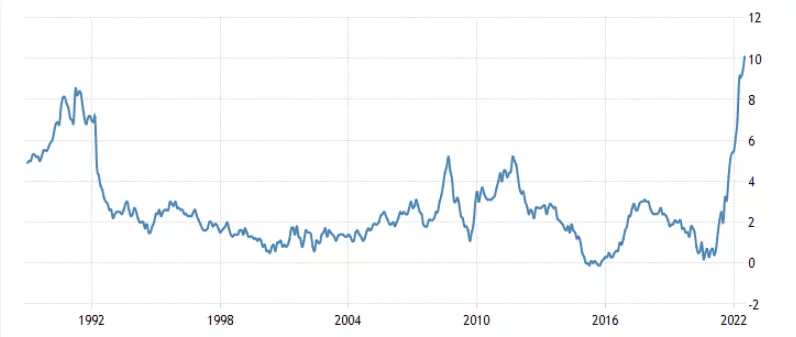
Source: tradingeconomics.com
Gas prices are rising at an unseen speed, putting the UK on a path to 18% inflation next year. It would be the highest rate among larger western economies, Citigroup report says. Bank of America and Goldman Sachs have a slightly more positive view of the next year’s inflation at 14-15%. Still, these numbers press on the country’s currency. The Bank of England (BOE), which has a long-term target set at 2%, will have to react.
Tory, one of the leading parties in the UK, is electing a new Prime Minister after Boris Johnson’s resignation in July. Liz Truss, one of the candidates to become a new Tory leader (and the next Prime Minister), is accusing the BOE of being too slow to increase interest rates to deal with rising inflation. However, we cannot agree with her completely.
We should take into account that BOE was one of the first major central banks to hike the interest rate from 0.10% to 0.25% in December 2021. Back then, the rate hikes were intended to slow down the economy after the rapid money printing because of Covid-19. Nobody could have imagined that geopolitical tensions would go to a completely new level two months later, followed by the rapid growth in commodities. On the other hand, with a 2% inflation target, the bank should have reacted much earlier because price growth exceeded 2% in the middle of 2021, much before the first hike.
Next actions of the BOE
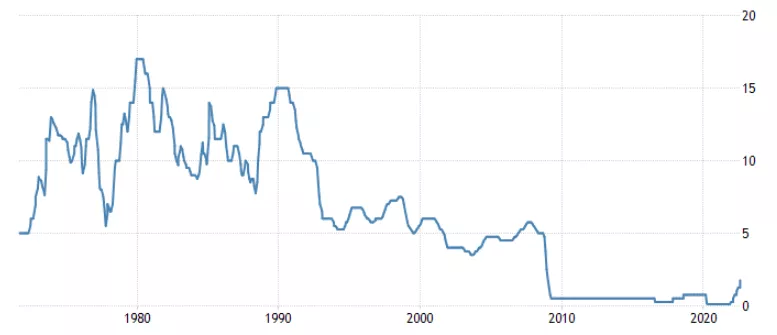
The last rate hike took place on August 4 as the Bank of England raised the rate by 50 basis points. Combine it with the current inflation of 10% and the war in Ukraine that is unlikely to end in 2022, and you will get a terrifying outlook for Great Britain. In 1982, the UK interest rate was close to 15%. We suppose the situation may become the same this time, and the bank will become more hawkish as prices skyrocket.
Some relief will reach the UK in case of a relatively mild winter. A Downing Street spokesperson urged people not to panic over energy supplies. He said the UK has one of the world’s most diverse and reliable energy systems. If so, price growth may slow down significantly (because it’s supported mainly by energy costs), and the BOE wouldn’t need to be extremely aggressive in its decisions.
GBP outlook is a two-edged sword
Usually, a rate hike is a bullish factor for the currency, but this time it’s not so simple. The BOE failed to strengthen the GBP amid high inflation, and we may see a rise in the GBP only in two cases:
- GBPUSD may rise if the USD plunges. It may happen if Federal Reserve slows down rate hikes and implies a less hawkish policy.
- The BOE will surprise the market and make a bigger-than-expected hike (for example, 100 basis points instead of 50).
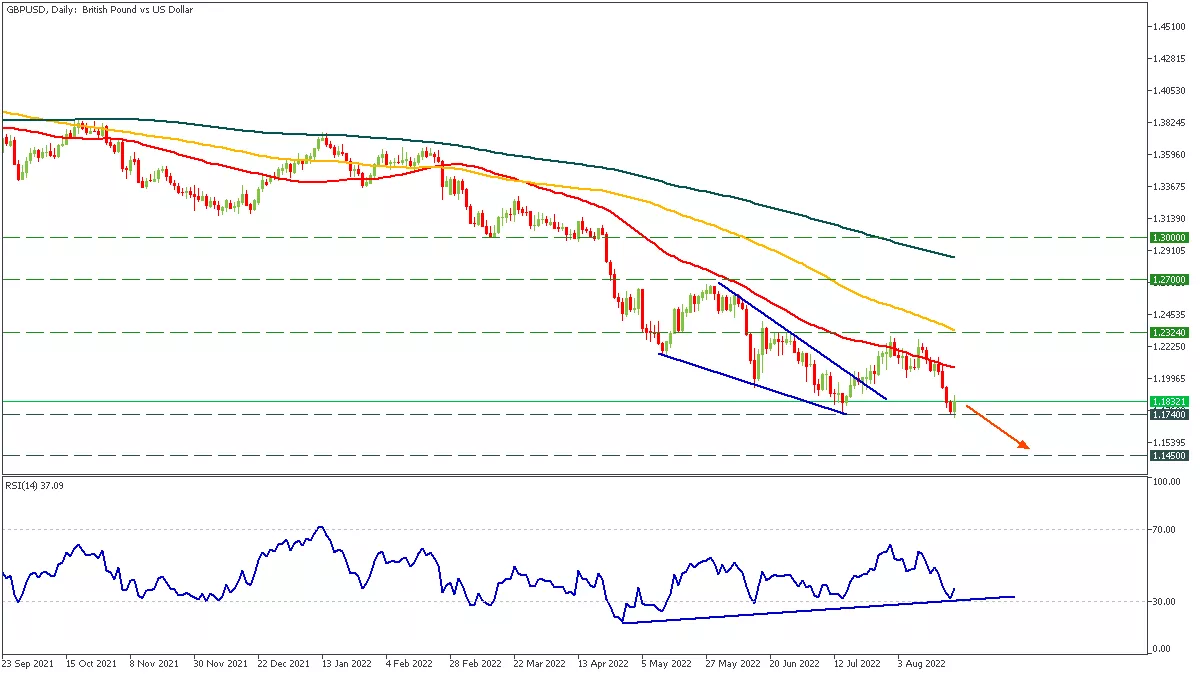
As for now, none of these scenarios seems likely, and with growing prices in the UK, the GBP will tend to decrease. In the GBPUSD pair, the double bottom pattern is trying to form. However, on the 1.1740 support breakout, the pair will reach 1.1450 in less than a month.
GBPUSD daily chart
- Resistance: 1.2324, 1.2700, 1.3000
- Support: 1.1740, 1.1450
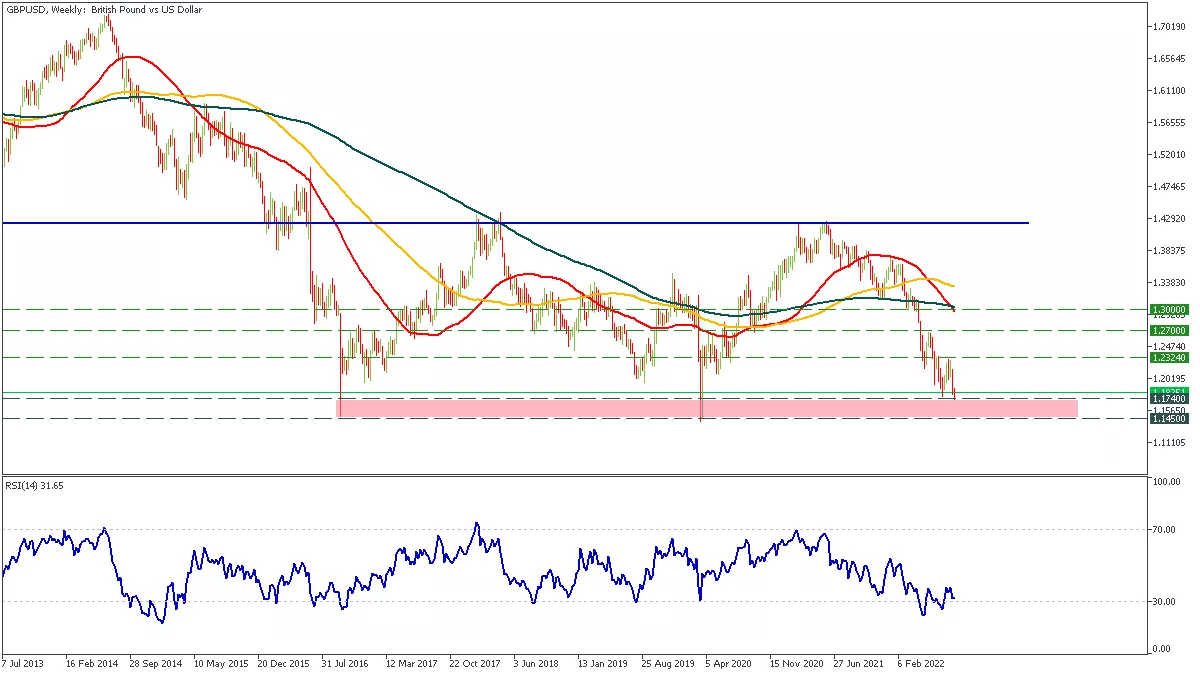
The weekly timeframe is even more pessimistic, especially in case of the red zone breakout. A horizontal channel continuation pattern has been forming for the last five years. In case of a breakout, the movement will be massive, with possible, although long-term, targets at the parity level (1.0000).
Today’s Main Trend was the Persistence in Core Bond Weakness
Markets:Slightly better-than-expected core US durable goods orders (July) featured an otherwise pale eco calendar. Capital goods shipments non-defense excluding aircraft, a proxy for investment in GDP calculations, rose by 0.7% M/M from an upwardly revised 0.8% M/M in June. Markets didn’t react to the release.
Today’s main trend was the persistence in core bond weakness. As has been the case more of late, UK Gilts underperformed German Bunds who on their turn underperformed US Treasuries. UK yields increased by 8.2 bps (30-yr) to 20 bps (2-yr).
UK money markets discount a cumulative 175 bps of rate hikes at this year’s three remaining policy meetings. That would bring the policy rate at 3.5% by year-end. An additional 100 bps of rate hikes is discounted at the first three policy meetings of 2023, after which expectations flatline near 4.5%. It’s a seismic shift compared to June/July when the idea was that the Bank of England (and other central banks for that matter) would slow down their tightening cycle by this year’s final policy meetings before keeping it stable over 2023 or even pondering a rate cut by end 2023. UK money markets discounted a flat 2.75% policy rate over 2023 only three weeks ago. What a difference a double digit inflation print makes…
The German yield curve bear flattens with yields rising by 3 bps (30-yr) to 7.7 bps (2-yr). EMU money markets for the first time discount a cumulative full percentage point rate increase at the next two ECB meetings with another 100 bps priced in by mid next year (2% deposit rate). Again for comparative reasons, we take a look at August 1st pricings: a 1% policy rate, hit early next year followed by a flat path afterwards.
The US yield curve becomes more inverse with yields 3.8 bps (30-yr) to 5.5 bps (2-yr) higher. US money markets discount a cumulative 125 bps rate hikes by the first meeting of next year (3.75%), but don’t completely abandon the idea of a rate cut by the end of the year. Early this month, the expected policy rate was 3.25% by year-end. Today’s core bond sell-off doesn’t spill to stock markets which fluctuate near opening levels in Europe and started flat in the US.
The risk aversion hierarchy plays on FX markets. The dollar outperforms with the trade-weighted greenback nearing the YTD high at 109.30. EUR/USD dives to the low 0.99 area. Sterling can’t hold its momentum despite the yield advantage with EUR/GBP a tad higher at 0.8430.
News Headlines:
The composite economic sentiment indicator of the Czech statistical office decline 1.6 point to 94.1 in August. The monthly dynamic for business confidence and consumers’ mood diverged. Business sentiment decreased 2.6 ppts to 97.6. The decline affected all economic subsectors with construction hit the hardest (110.2 from 118.6). The loss in trade, services and industry was more modest. Consumers turned slightly more optimistic/less pessimistic with the headline index rebounding from -33.0 to -29.8 after five months of consecutive declines. The share of respondents expecting a deterioration in the overall economic situation and their own financial situation over the next twelve months decreased. Still, consumers stay reluctant to spend money on large purchases. Consumers’ concerns on rising prices eased significantly, but remain high. Still, confidence is lower compared to the same month last year. The Czech korona today gains marginally but at EUR/CZK 24,64, the Czech currency is holding near the lowest levels since the early August MPC meeting. A further CZK decline is probably mainly prevented by CNB interventions.
The Hungarian Statistical Office reported total gross wages to have risen 1.5% M/M and 15.4% Y/Y in June. According to the office, previously scheduled wage increases, as well as the growth of the minimum wage and minimum wage for skilled workers mainly contributed to the increase in earnings. Real earnings growth was reported at 3.3%. The National Bank of Hungary meets next week. Persistent high inflation (13.7% in July), high wage growth and ongoing pressure on the forint are all good reasons for the NMB to continue its hiking cycle after raising the base rate by 1.0% to 10.75% end July. The forint gains slightly today but at EUR/HUF 411 stays near the all-time low of EUR/HUF 416.89 touched early July.
EUR/USD Mid-Day Outlook
Daily Pivots: (S1) 0.9907; (P) 0.9962; (R1) 1.0024; More...
Intraday bias in EUR/USD remains neutral for consolidation above 0.9899 temporary low. Upside of recovery should be limited by 1.0121 minor resistance to bring another fall. Break of 0.9899 will resume larger down trend to 61.8% projection of 1.0773 to 0.9951 from 1.0368 at 0.9860. Firm break there should prompt downside acceleration to 100% projection at 0.9546.
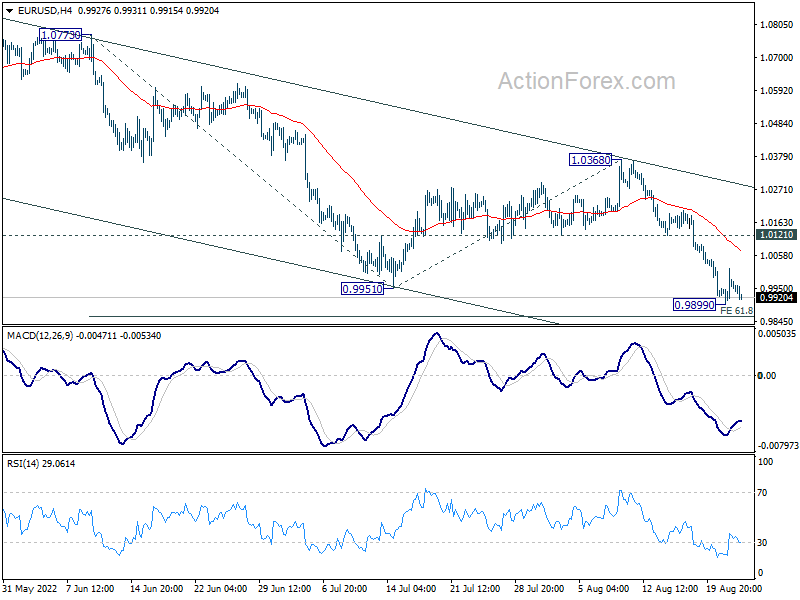
In the bigger picture, down trend from 1.6039 (2008 high) is still in progress. Next target is 100% projection of 1.3993 to 1.0339 from 1.2348 at 0.8694. In any case, outlook will stay bearish as long as 1.0368 resistance holds, in case of strong rebound.
GBP/USD Mid-Day Outlook
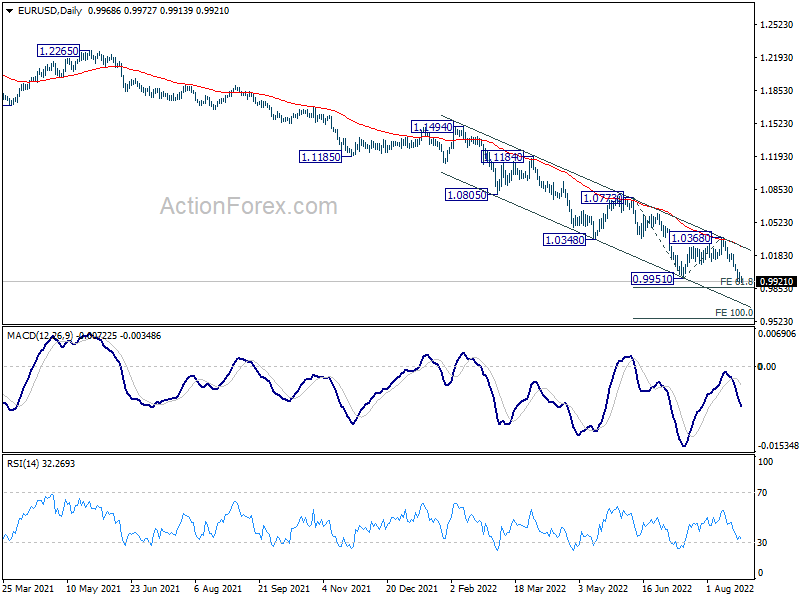
Daily Pivots: (S1) 1.1740; (P) 1.1809; (R1) 1.1900; More...
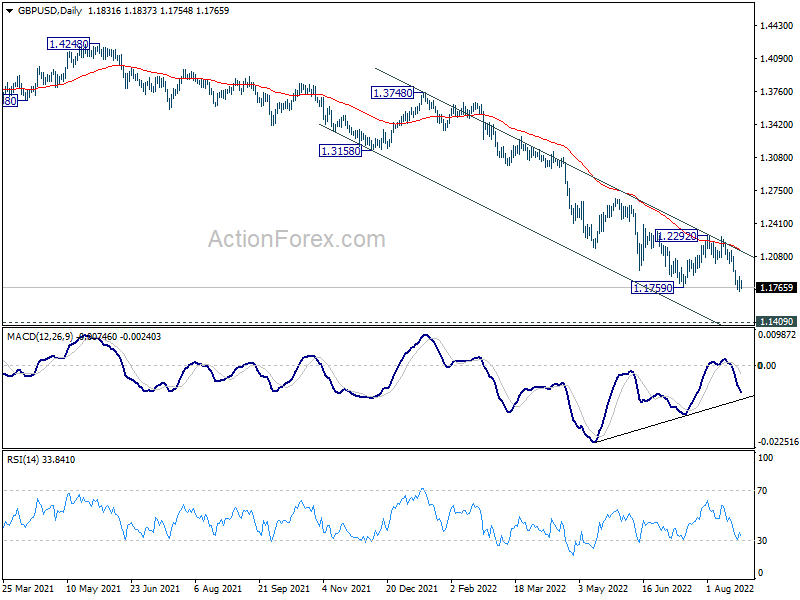
Intraday bias in GBP/USD remains neutral for consolidations above 1.1716 temporary low. Upside of recovery should be limited by 1.2002 support turned resistance to bring another fall. Break of 1.1716 will resume larger down trend to 1.1409 long term support.
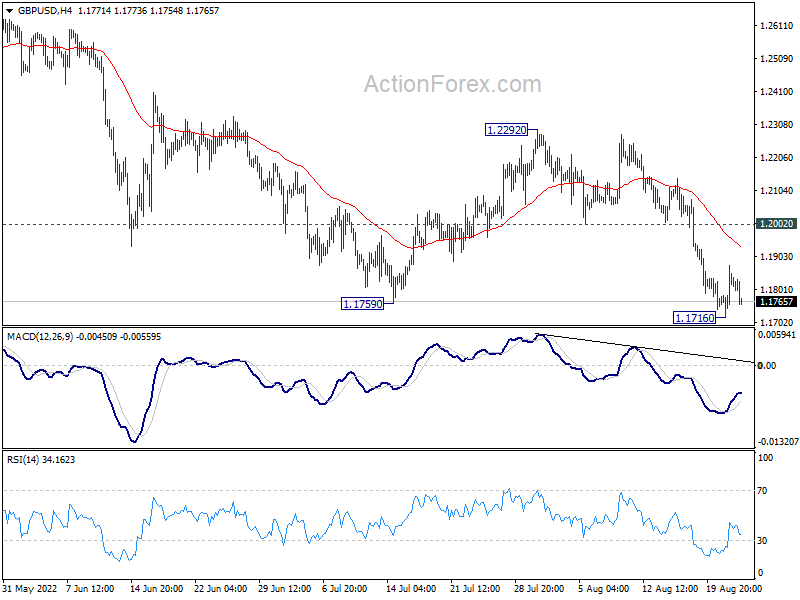
In the bigger picture, fall from 1.4248 (2018 high) could be a leg inside the pattern from 1.1409 (2020 low), or resuming the longer term down trend. Deeper decline is expected as long as 1.2292 resistance holds. Next target is 1.1409 low. However, firm break of 1.2292 will bring stronger rise back to 55 week EMA (now at 1.2859).
USD/JPY Mid-Day Outlook
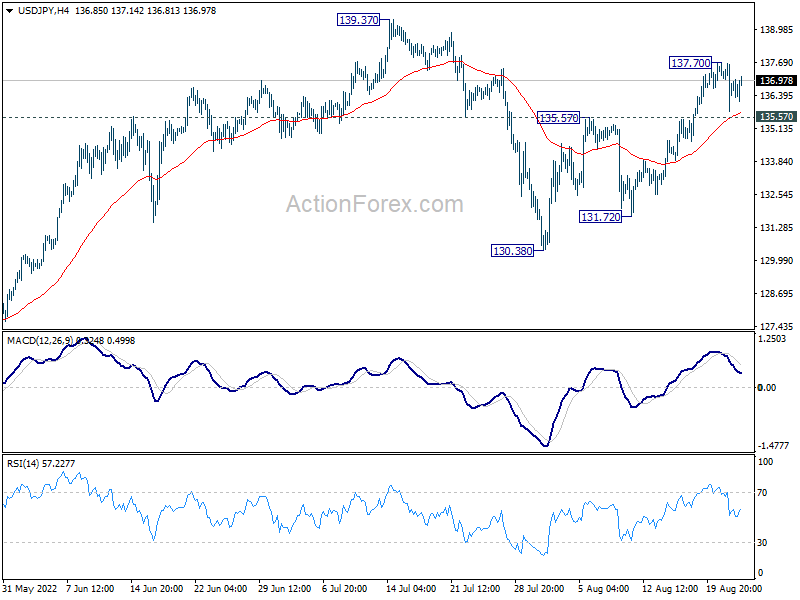
Daily Pivots: (S1) 135.80; (P) 136.76; (R1) 137.70; More...
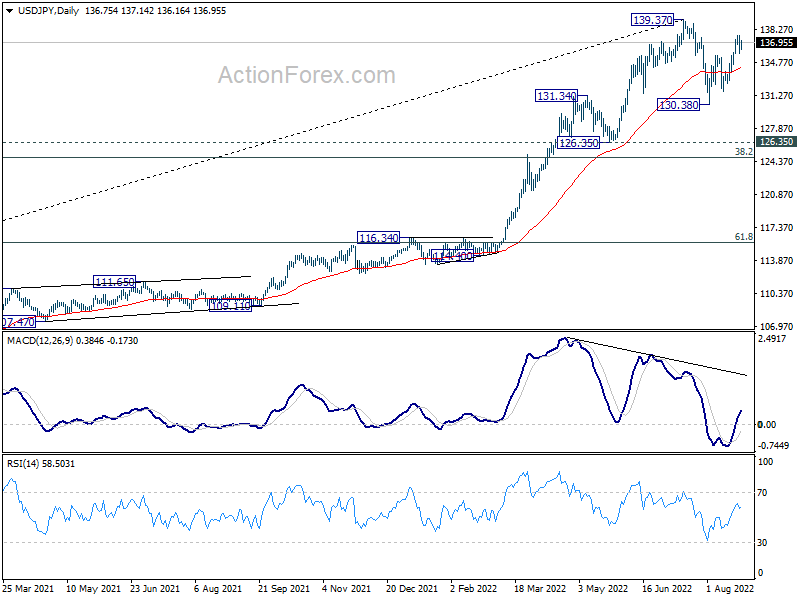
Intraday bias in USD/JPY remains neutral and outlook is unchanged. Overall, price actions from 139.37 are seen as a corrective pattern, with rise from 130.38 has the second leg. Above 137.70 will extend the rebound but upside should be limited by 139.37. On the downside, firm break of 135.57 will suggest that the third leg of the pattern has started, and turn intraday bias back to the downside for 131.72 support first.
In the bigger picture, price actions from 139.37 medium term top are seen as a corrective pattern to up trend from 101.18 (2020 low). While deeper decline cannot be ruled out, outlook will stays bullish as long as 55 week EMA (now at 123.21) holds. Long term up trend is expected to resume through 139.37 at a later stage, after the correction finishes.
USD/CHF Mid-Day Outlook
Daily Pivots: (S1) 0.9600; (P) 0.9646; (R1) 0.9689; More...
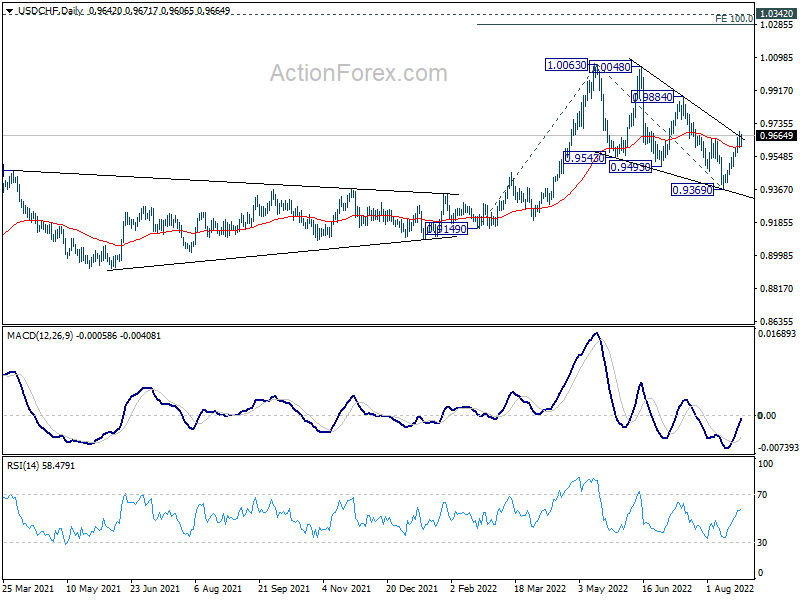
Intraday bias in USD/CHF stays neutral at this point. Triangle correction from 1.0063 could have completed at 0.9369 already. Above 0.9691 will t target 0.9884 resistance next. Break there will argue that larger up trend is ready for resumption through 1.0063. On the downside, below 0.9500 minor support will dampen this view and turn bias back to the downside for 0.9369 support instead.
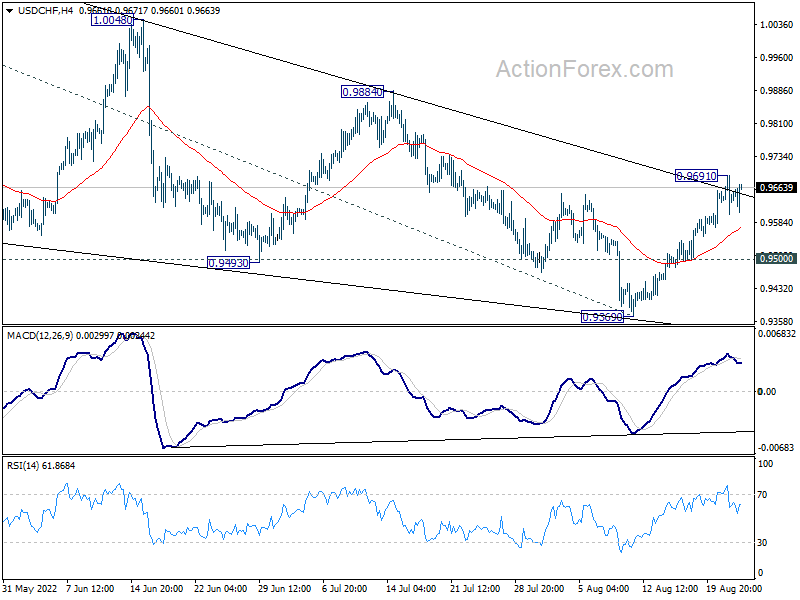
In the bigger picture, current development suggests that up trend from 0.8756 (2021 low) is still in progress. Sustained break of 1.0063 will target 100% projection of 0.9149 to 1.0063 from 0.9369 at 1.0283, and then 1.0342 (2016 high). For now, this will remain the favored case as long as 0.9369 support holds, even in case of deep pull back.
Dollar Higher in Consolidations, Subdued Pre-Jackson Hole Trading
Dollar is recovering some ground today but stays below yesterday's high in general, consolidations continue. Overall trading in subdued with major pairs and crosses suck inside yesterday's range. Kiwi and Aussie are on the softer side while the greenback and Yen are firmer. European majors are also weak but there is no follow through selling. Traders are apparently holding their bets before Jackson Hole.
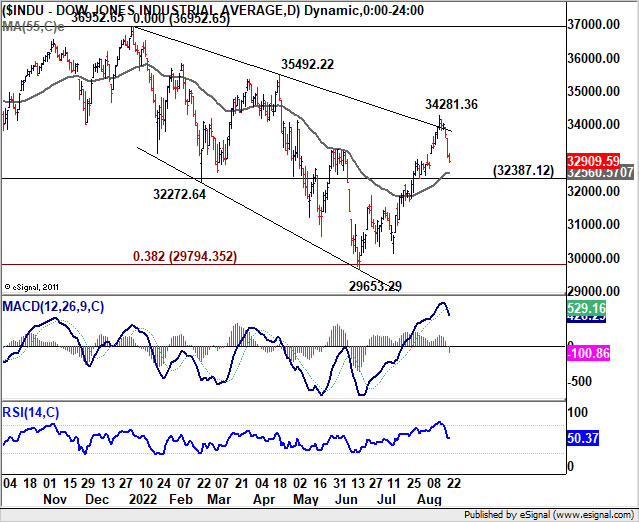
Technically, while DOW's pull back this week is steep and deep, it's holding above 55 day EMA as well as 32387.12 support so far. There is no serious threat to the rally from 29653.29 yet. A bounce from current level could set the base for another rise, probably after Fed Chair Jerome Powell's comments at Jackson hole. However, firm break of 32387.12 will argue that the near term move has reversed fro another take on 30k handle.
In Europe, at the time of writing, FTSE is down -0.41%. DAX is up 0.01%. CAC is up 0.12%. Germany 10-year yield is up 0.0585 at 1.378. Earlier in Asia, Nikkei dropped -0.49%. Hong Kong HSI fell -1.20%. China Shanghai SSE lost -1.86%. Singapore Strait Times declined -0.39%. Japan 10-year JGB yield rose 0.0022 to 0.224.
US durable goods orders flat in July, ex-transport orders rose 0.3% mom
US durable goods orders dropped -0.0% mom to USD 273.5B in July, well below expectation of 0.6% mom rise. Ex-transport orders rose 0.3% mom, above expectation of 0.2% mom. Ex-defense orders rose 1.2% mom. Transportation equipment drove the decrease and dropped -0.7% mom to USD 93.0B.
Shipments of manufactured durables goods rose 0.4% mom to USD 270B. Transportation equipment shipments rose 1.1% mom to USD 86.3B.
ECB Rehn: Digital native form of safe central bank money could enhance stability
ECB Governing Council member Olli Rehn said, "a digital euro would give people an additional choice about how to pay and would make it easier to do so in an increasingly digital economy."
"A digital native form of safe central bank money could enhance stability by providing the neutral trusted settlement layer in the future financial system," he added.
Rehn expected the investigation phase for digital Euro to conclude in October 2023.
USD/CHF Mid-Day Outlook
Daily Pivots: (S1) 0.9600; (P) 0.9646; (R1) 0.9689; More...
Intraday bias in USD/CHF stays neutral at this point. Triangle correction from 1.0063 could have completed at 0.9369 already. Above 0.9691 will t target 0.9884 resistance next. Break there will argue that larger up trend is ready for resumption through 1.0063. On the downside, below 0.9500 minor support will dampen this view and turn bias back to the downside for 0.9369 support instead.
In the bigger picture, current development suggests that up trend from 0.8756 (2021 low) is still in progress. Sustained break of 1.0063 will target 100% projection of 0.9149 to 1.0063 from 0.9369 at 1.0283, and then 1.0342 (2016 high). For now, this will remain the favored case as long as 0.9369 support holds, even in case of deep pull back.
Economic Indicators Update
| GMT | Ccy | Events | Actual | Forecast | Previous | Revised |
|---|---|---|---|---|---|---|
| 12:30 | USD | Durable Goods Orders Jul | 0.00% | 0.60% | 2.00% | |
| 12:30 | USD | Durable Goods Orders ex Transportation Jul | 0.30% | 0.20% | 0.40% | |
| 14:00 | USD | Pending Home Sales M/M Jul | -2.50% | -8.60% | ||
| 14:30 | USD | Crude Oil Inventories | -2.4M | -7.1M |
US durable goods orders flat in July, ex-transport orders rose 0.3% mom
US durable goods orders dropped -0.0% mom to USD 273.5B in July, well below expectation of 0.6% mom rise. Ex-transport orders rose 0.3% mom, above expectation of 0.2% mom. Ex-defense orders rose 1.2% mom. Transportation equipment drove the decrease and dropped -0.7% mom to USD 93.0B.
Shipments of manufactured durables goods rose 0.4% mom to USD 270B. Transportation equipment shipments rose 1.1% mom to USD 86.3B.