

Sample Category Title
EUR/USD Daily Outlook
Daily Pivots: (S1) 1.0047; (P) 1.0120; (R1) 1.0160; More...
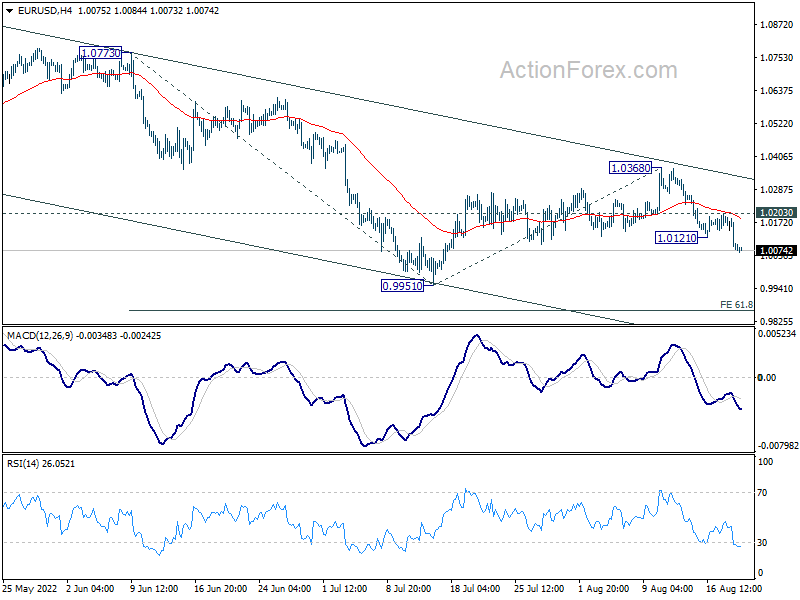
EUR/USD's fall from 1.0368 resumed by breaking through 1.0121. Intraday bias is back on the downside for retesting 0.9951 low first. Firm break there will resume larger down trend trend. Next near term targets are 61.8% projection of 1.0773 to 0.9951 from 1.0368 at 0.9860, and then 100% projection at 0.9546. On the upside, above 1.0203 minor resistance will turn intraday bias neutral. But risk will stay on the downside as long as 1.0368 resistance holds.
In the bigger picture, down trend from 1.6039 (2008 high) is still in progress. Next target is 100% projection of 1.3993 to 1.0339 from 1.2348 at 0.8694. In any case, outlook will stay bearish as long as 1.0773 resistance holds, in case of strong rebound.
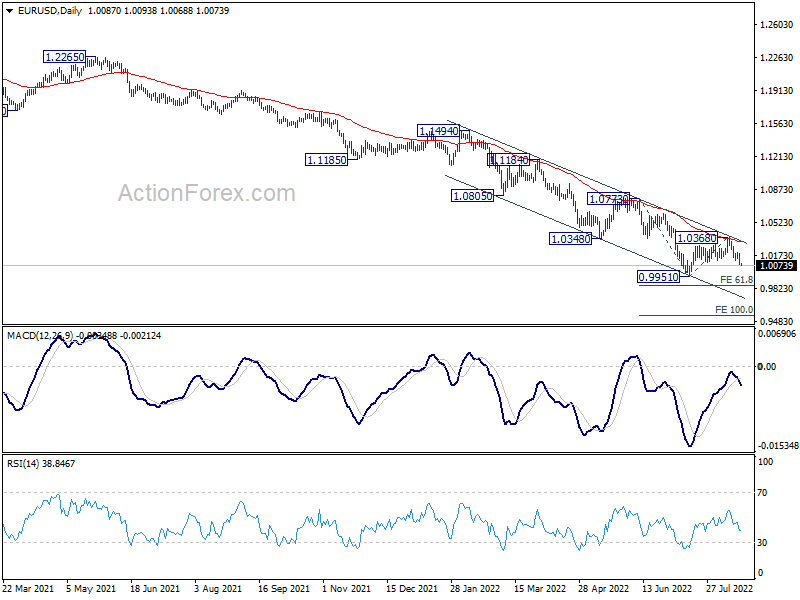
UK retail sales volume rose 0.3% mom in Jul
In volume term, UK retail sales rose 0.3% mom in July, better than expectation of -0.2% mom. Ex-auto sales rose 0.4% mom. Comparing to a year ago, retail sales dropped -3.4% yoy while ex-auto sales dropped -3.0% yoy.
In value term, retail sales rose 1.3% mom, 7.8% yoy. Ex-auto sales rose 1.4% mom, 5.7% yoy.
Everyone Hikes, Turkey Cuts
The Norwegian central bank raised the interest rates by 50bp yesterday and said that there will be a similar move in September, to tackle the soaring inflation in Norway. The Philippines hiked by 50bp as well, to cool inflation. That was the fourth rate hike this year in Philippines. The Federal Resevre (Fed) minutes released this Wednesday showed that the US will continue raising the rates and tightening the monetary conditions to bring inflation back toward the 2% level in the US. The European Central Bank (ECB) board member Isabel Schnabel said that the eurozone inflation outlook has failed to improve since the rate hike in July and that she will favour another large interest rate hike next month, even as recession risks harden. But Turkey cut its rate by 100bp yesterday, although consumer prices rose 80% year-to-date, and near 180% since a year.
The USDTRY jumped past the 18, although the selloff remained under controlled because of central bank intervention. Yet, the central bank’s reserves fell to 20-year level lows this summer. The 5-year CDS rate, which was cooling since a month, spiked higher again, and investors know the situation is not sustainable. The lira is a time bomb, but no one knows when the bomb will explode.
In FX
The dollar index jumped near 3% since a week or so, and the major peers are coming under a decent downside pressure as well. The EURUSD is headed toward parity, again, as Cable slipped below the 1.19 mark this morning, even though the scary inflation data released earlier this week boosted the expectation for larger rate hikes in the UK moving forward. The negative breakout in Cable points at further sales in sterling, and there is potential for a deeper dive toward the 1.15 mark.
In Japan, consumer prices rose to the highest levels in almost eight years, to 2.6% on yearly basis, due to the surging energy costs and the weakening yen. The broad-based rally in the US dollar sent the dollar-yen above the 136 level, but the rising inflation will likely get the Bank of Japan (BoJ) to take some precautions before things get out of control in Japan, as well.
Elsewhere
Gold extended losses to $1750 on the back of a stronger US dollar, while crude oil rallied near 4% yesterday. News that the US crude inventories fell 7 million barrels last week, versus a 300’000-build expected by analysts helped pushing the price higher, as the latest data boosted the hope that demand remains robust despite the economic slowdown worries.
Else, the latest data showed that the existing home sales declined in the US, but the Philly Fed manufacturing index came unexpectedly stronger. Jobless claims also fell more than expected last week, defying those calling for recession in the US. As a result, US equities closed the session slightly in the positive, after brushing off the Fed hawkishness, and the disappointing Target earnings released a day earlier.
And interestingly, Home Depot and Lowe’s said at this week’s earnings call that despite the slowing home sales in the US, and rising inflation, Americans continued spending on building material and higher-end appliances in the Q2, and that they don’t necessarily expect a cool down in sales. Though mixed, this week’s retailer results were also, mostly, better-than-expected.
Finally, the Bed Bath and Beyond trade is certainly over, on news that Ryan Cohen sold his entire position and stepped out. The shares dived 20% yesterday, and another 44% in the afterhours trading. It was fun, but it’s certainly time to look for the next winner!
Hawkish FOMC comments and Norges Bank hike
Market movers today
It will be a very quiet day on the data front today with only UK retail sales and German PPI of interest.
The 60 second overview
Norway: Norges Bank (NB) goes 'front-loaded' and hiked rates by 50bp. As expected, NB hiked rates by 50bp to 1.75%. This was widely expected after the 4.5% core-inflation print for July, despite the 'promise' to hike by 25bp at the time of the June monetary policy meeting. In the press statement, the committee stated that: "Based on the Committee's current assessment of the outlook and balance of risks, the policy rate will most likely be raised further in September". Importantly - contrary to the June meeting - NB stopped short of sending a clear signal about the size of the likely September hike. This was one of the small meetings without a new Monetary Policy Report (MPR) and rate path.
Several FOMC members were on the wires yesterday all signalling that they are not close to ending the tightening process. Daly and Bulland favoured a 75bp hike in September. Kashkari said that it isn't certain that inflation could be back at target without a recession. ECB's Schnabel sent similar signals and while she did not rule out a technical recession she was not sure that recession would tame inflation itself, hence further policy tighten should be expected.
Euro area inflation was confirmed at 8.9% for July. Early signs of various underlying inflation measures point to a flattening out of the inflation pressure, however with the surging electricity and energy prices headline inflation will increase and stay elevated in Q4 and well into next year which will pose a challenging balancing act for the ECB in the period ahead.
In Germany, the government announced that the VAT on gas will be lowered to 7% from 19% until March 2024 in its most recent attempt to shield consumers from the implications of the energy crisis.
The Turkish central bank cut rates yesterday by 1pp despite recording almost 70% inflation rate.
Equities: Equities finished slightly higher yesterday but without a clear direction and very limited sector and style rotations. Energy, the prime outperformer as oil priced ticked higher while second best performer was technology. Perhaps most interestingly, vol measures by the VIX index softened further to 19.5 and thereby came below the average level observed historically under the current macroeconomic conditions. In US Dow +0.1%, S&P 500 +0.2%, Nasdaq +0.2% and Russell 2000 +0.7%. The directionless trading continues this morning in Asia with half of the indices being higher and half of them being lower. European and US futures in small declines this morning.
FI: There was a small bearish tone in markets yesterday as curves flattened beyond the belly of the curve. Intra-euro area spreads were broadly unchanged on the day. Schnabel kicked off, what we expect is a number of central bank comments ahead of the September meeting yesterday morning. We argued for a 50bp rate hike in September and the view that a recession in itself would not get inflation lower. As a result the front end rose.
FX: Broad USD strengthened yesterday against European currencies in tandem with European natural gas prices reaching a new all-time high. Norges Bank hiked by 50bp and we see some short-term upside risk to EUR/NOK.
Credit: The cautious sentiment in credit markets continued while the primary market was rather busy with several financial institutions active in the Eurobond market. Itraxx main closing a tad tighter by -2.4bp at 97.2bp, while Xover tightened 9.8bp, closing the session at 491.9bp.
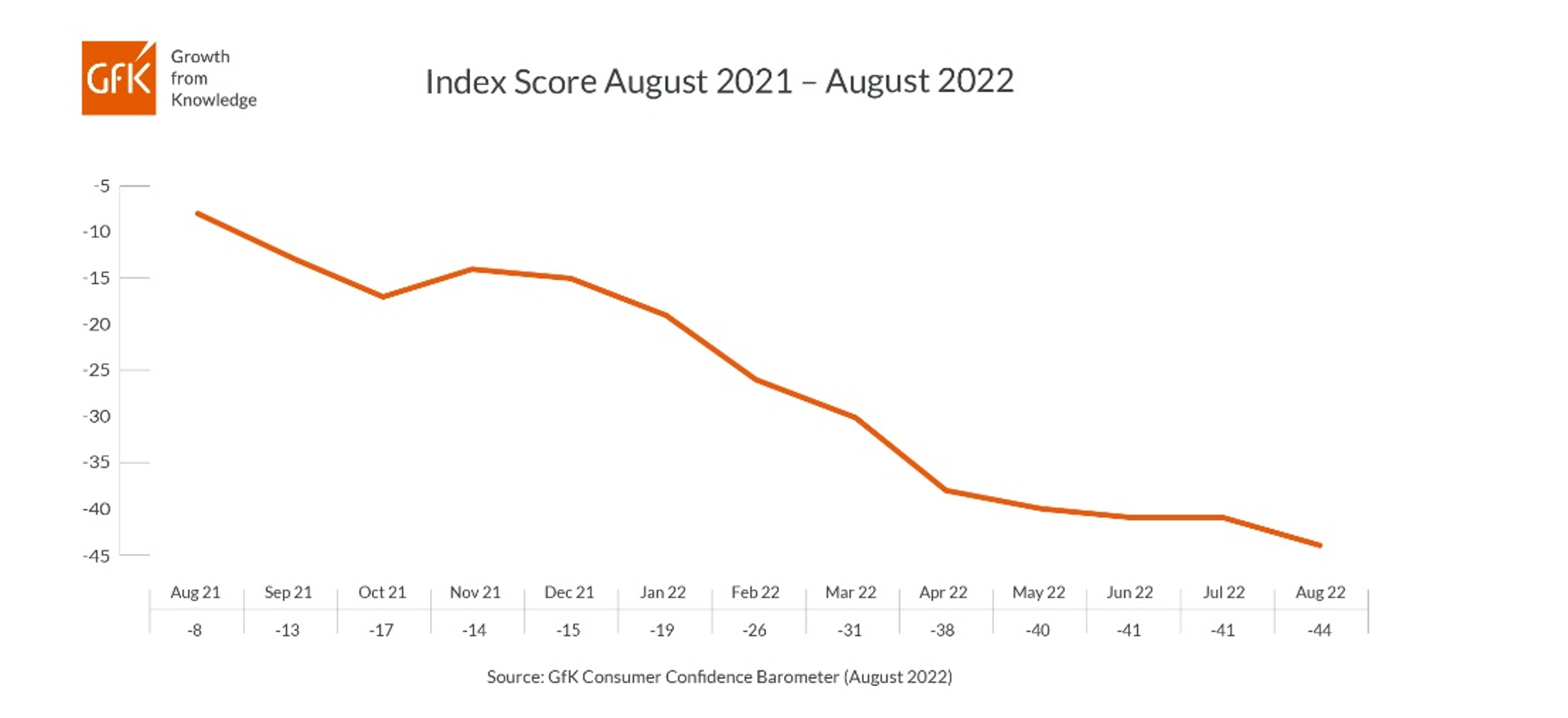
UK Gfk consumer confidence drooped to -44, another record low
UK Gfk consumer confidence dropped from -41 to -44 in August, hitting another record low. Personal financial situation over the next 12 months dropped from -26 to -31. General economic situation over the next 12 months dropped from -57 to -60, setting a new record low.
Joe Staton, Client Strategy Director, GfK says: "The Overall Index Score dropped three points in August to -44, the lowest since records began in 1974. All measures fell, reflecting acute concerns as the cost-of-living soars. A sense of exasperation about the UK's economy is the biggest driver of these findings."
New Zealand goods exports rose 16% yoy in Jul, imports rose 26% yoy
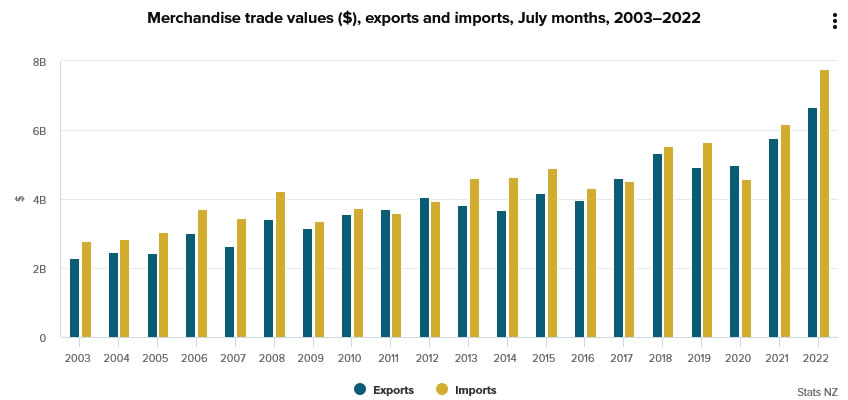
New Zealand goods exports rose 16% yoy to NZD 6.7B in July. Goods imports rose 26% yoy to NZD 7.8B. Trade deficit came in at NZD -1.1B, comparing expectation of NZD 105m surplus.
China led the monthly rise in exports, up 13%. Exports to Australia was down -1.1%, USA up 5.8%, EU up 7.5%, Japan up 18%. Imports from China was up 19%, EU up 3.0%, Australia up 16%, USA up 34%, and Japan up 54%.
Japan CPI core rose to 2.4% yoy, highest since 2014
Japan headline CPI rose from 2.4% yoy to 2.6% yoy in July, above expectation of 2.2% yoy. CPI core (all items ex-fresh food) rose from 2.2% yoy to 2.4% yoy, matched expectations. CPI core-core (all items ex-food, energy) rose from 1.0% yoy to 1.2% yoy, above expectations of 0.6% yoy.
Core inflation has now exceeded BoJ's 2% target for four straight months, and hit the highest level since December 2014. The core-core reading was also the fastest since December 2015, while the headline reading was the strongest since 2008.
Both Prime Minister Fumio Kishida and BoJ Governor Haruhiko Kuroda have called for robust wage gains to ensure that inflation is sustainable. But the markets are expecting some pressure on the BoJ for acting on monetary policy if CPI hits 3%.
Fed Bullard: We should continue to move expeditiously on rates
St. Louis Fed President James Bullard told WSJ, "we should continue to move expeditiously to a level of the policy rate that will put significant downward pressure on inflation" and "I don't really see why you want to drag out interest rate increases into next year."
Bullard also indicated that he backs another 75bps rate hike in September. He also reiterated he preference to have federal funds rate at 3.75-4.00% by the end of the year, from current 2.25-2.50%.
Fed George: Direction for rates pretty clear, but pace to be debated
Kansas City Fed President Esther George said yesterday that "the case for continuing to raise rates remains strong" and "the direction is pretty clear".
But, "the question of how fast that has to happen is something my colleagues and I will continue to debate," she added.
"We have done a lot, and I think we have to be very mindful that our policy decisions often operate on a lag. We have to watch carefully how that's coming through," she warned.
Cliff Notes: Labour Market Strength to Prove a Key Determinant of Policy in 2023
Key insights from the week that was.
The strength of the Australian labour market was a key talking point this week as the unemployment and underemployment rates reached new multi-decade lows of 3.4% and 6.0% respectively.
Intriguingly, this occurred as the Australian economy lost 41k jobs and total hours worked declined 0.8%, offset by a 0.3ppt decline in participation. The ABS made clear that the loss of jobs in the month likely stemmed from the sample period coinciding with the winter school holidays; absences associated with COVID-19 and other illnesses; and flooding in NSW. Shifting seasonality also looks to have been a factor, with 35k jobs created on a non-seasonally-adjusted basis.
Not only is demand for labour strong, but the supply of labour remains heavily constrained (see below for a discussion of the latest migration data). Combined, these two trends look set to tighten Australia’s labour market further in coming months, with the unemployment rate forecast to fall to 3.0% around the turn of the year. While the headline Wage Price Index is yet to respond to this historic degree of labour market tightness (0.7%; 2.6%yr), the detail of the Q2 report make clear momentum is building. Most significantly, the private sector respondents that received a wage increase in the quarter reported a 3.8% gain, the strongest result since June 2012. We expect these gains to broaden across the population and to strengthen further through 2023, with annual growth in the headline wage price index forecast to peak at 4.5% at end-2023.
The potential risk that (extremely) limited spare capacity poses to Australia’s fight against inflation was evident in the RBA minutes for August, as discussed by Chief Economist Bill Evans. While global factors continue to be recognised for their role in the current inflationary episode, the August minutes gave “widespread upward pressures on prices from strong demand, a tight labour market and capacity constraints” greater attention. The Board also emphasised that strong demand conditions are expected to hold through 2022, potentially impacting inflation and expectations into 2023.
While cognisant of these risks, we continue to expect a peak cash rate of 3.35% at February 2023 will quell domestic inflation pressures as GDP growth abruptly slows to just 1.0%yr by December 2023. Before moving on from the RBA minutes, we also must highlight their discussion of climate change and the management of related risks. Specifically, climate change’s growing prominence in investor decision making was emphasised, as was the potential for these considerations to impact the cost of funding. Disclosure standards as well as the risks to the economy and financial system from climate change were also front of mind.
As noted above, migration data for July was also released this week. The recovery in overseas travel was supported by a return to mid-year seasonal strength as Australian residents and visitors embarked on short-term holiday travel. Arrivals and departures have now risen to be at 60% and 55% of their respective pre-pandemic levels, with a full recovery in these headline figures by the end of summer becoming increasingly likely. However, the clear lack of evidence indicating positive net inflows of temporary workers presents some offsetting concerns. This is not due to a lack of foreign demand for Australian temporary work, but rather the presence of substantial visa processing delays creating a notable lag in the return of temporary workers, offering little support to alleviate labour supply constraints within Australia.
Across in New Zealand, the resolve of the RBNZ to suppress inflation and associated risks was again on display at their August meeting, with another 50bp hike delivered and more flagged for later this year. As detailed by our New Zealand economics team, the decision statement focused heavily on inflation pressures and capacity constraints, most notably in the labour market. The expected pace of rate increases was also accelerated and the projected peak for the cash rate lifted slightly to 4.1%. Our New Zealand team broadly concur with the RBNZ’s thinking, having forecast two additional 50bp increases for the remainder of the year to a peak of 4.0%. However, they see more scope for interest rates to ease back in subsequent years given growing evidence that policy tightening is having the desired effect. Westpac’s August Economic Overview is now available for a full view of New Zealand’s economy.
Data received for the US this week was largely secondary in significance. July housing starts/ permits and existing home sales highlighted the shock to activity from tight financial conditions and declining real incomes, the latter materially impairing affordability. Retail sales meanwhile met expectations, but again showed a consumer challenged by the cost of living, with total sales flat in the month and core spending up modestly after a poor Q2.
The release of the week for the US was instead the FOMC’s July meeting minutes. Perhaps because the July meeting is between participant forecast updates, or potentially as they expect recent weakness to be recovered quickly, the tone of the Committee’s commentary was sanguine on activity and, in terms of the risks, still focused on inflation. That said, it seems as though expectations of risks are shifting. Inflation risks related to pandemic supply disruptions are seen as largely in the past, and “the apparent absence of a wage–price spiral” was noted – the latter minimising the risk of a third wave of inflation on strong consumer demand. Participants are also clearly of the view that “the bulk of the effects on real activity had yet to be felt” and so there is need to be cognisant of any change in activity momentum month to month. We remain of the view that September’s 50bp hike will be followed by two 25bp hikes in November and December to a peak fed funds rate of 3.375%. However, a pause to late-2023 will then be seen with 125bps of cuts to follow from December quarter 2023. This easing should support growth back to trend by end-2024 and see the unemployment rate stabilise around 5.0%, up from 3.5% currently.
In Europe, inflation continues to spark concern. In short, the Russia-Ukraine conflict and the COVID-19 reopening represent a dual-front of inflationary pressures. Supply issues continue to drive record inflation prints in the Euro Area (8.9%yr), with energy (39.6%yr) and food (11.5%yr) making particularly strong contributions. Simultaneously, the rebound in consumer spending across recreation, furniture and restaurants has materially broadened this pulse. Indeed, annual core inflation is not only double the ECB’s medium-term target at 4%yr, but a record 74% of the consumption basket is running at an annual inflation rate above 2.5%, well above the 10-20% range during the pre-pandemic era. Similarly in the UK, annual headline inflation has reached a double-digit pace of 10.1%, and a more concerning print for core inflation (6.2%yr) highlights the extent of the inflation challenge facing the region. Further monetary tightening is clearly warranted to fight this battle, even if a degree of weakness in activity materialises. Hence, we expect the ECB and the Bank of England to raise their respective key policy rates to 1.50% and 2.75% by year-end.
Coming back to China. The data received over the past week disappointed on every front. We are not anxious over the production environment, nor the outlook for infrastructure and business investment – even after the poor July credit outcome, year-to-date total social financing growth still sits at 15%, while comments by Premier Li this week made clear more support is coming. What is of concern though is the spread of COVID-19 in tourist areas such as Hainan. This outbreak has the potential to transmit the virus to multiple locations across the country, as holiday makers go home, and is also likely to deter other households from planning holidays and potentially increasing their discretionary services consumption closer to home. The limited progress in resolving the mortgage strike of recent months and with many developers remaining in a fragile state, it also seems likely that the recovery in housing investment will come later than we anticipated. As a result, we have revised down our 2022 growth forecast to 3.0% from 3.5%, but maintain a 7.0% projection for 2023. Authorities certainly have the capacity to deliver such an outcome, but co-ordinated action at both the central and local level will be required.