Sample Category Title
USD/JPY Mid-Day Outlook
Daily Pivots: (S1) 134.15; (P) 134.83; (R1) 135.74; More...
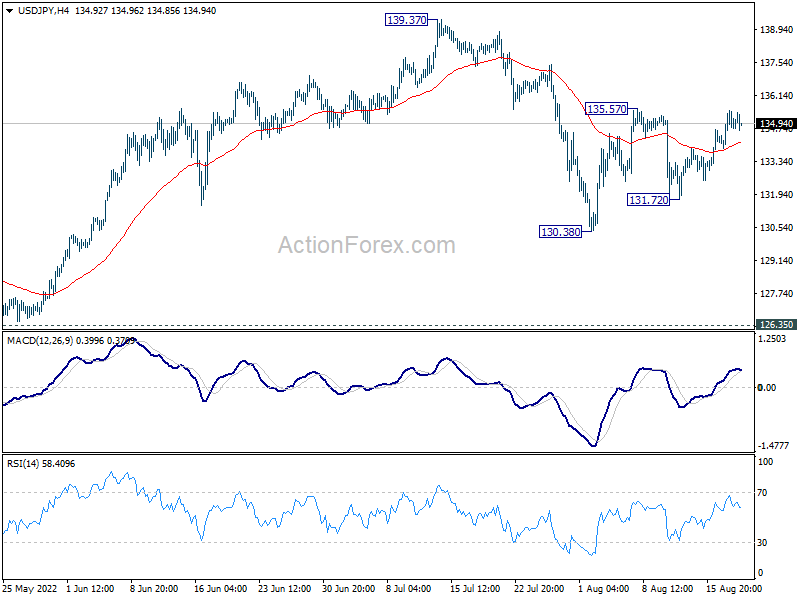
Intraday bias in USD/JPY stays neutral at this point. Overall, corrective pattern from 139.37 will extend further. On the upside, above 135.57 will resume the rebound to retest 139.37 high. But a decisive break there is not expected this time. On the downside, below 131.72 will resume the fall from 139.37 through 130.38 support.
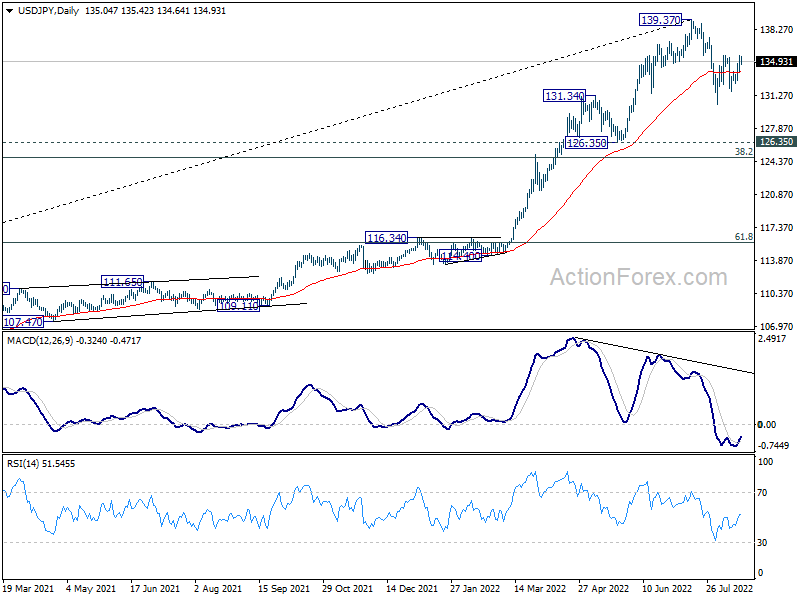
In the bigger picture, fall from 139.37 medium term top is seen as correcting whole up trend from 101.18 (2020 low). While deeper decline cannot be ruled out, outlook will stays bullish as long as 55 week EMA (now at 122.70) holds. Long term up trend is expected to resume through 139.37 at a later stage, after the correction finishes.
Dollar Rally Not Making Progress as Dull Trading Continues
The markets are generally rather quiet today, with major pairs and crosses trading inside yesterday's range, as well as last week's range. For now, Dollar is the strongest ones, followed by Sterling and then Euro. Australian and New Zealand Dollars are the weakest. Yen and Swiss Franc are mixed together with Canadian.
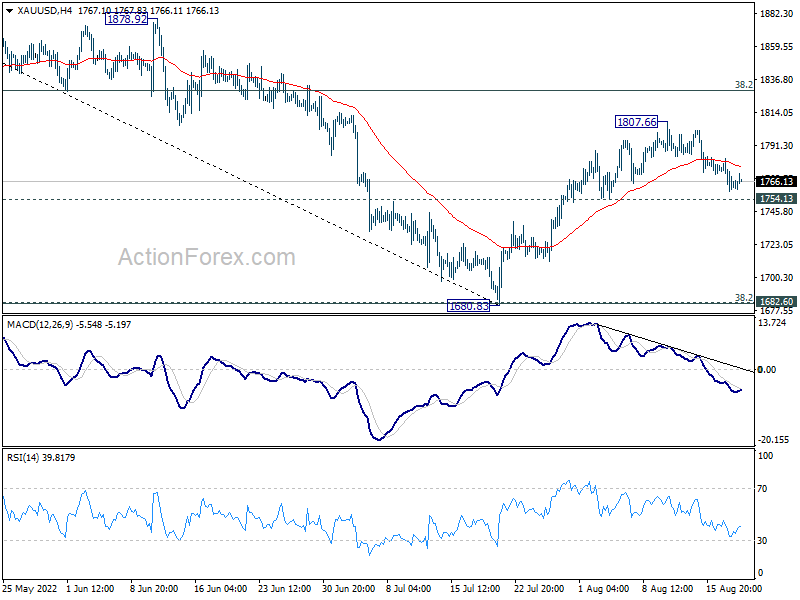
Technically, Dollar's rally this week is not making much progress so far. Even Gold's pull back is relatively shallow. As long as 1754.13 support holds, rise from 1680.83 is still in favor to resume through 1807.66. Nevertheless, firm break of 1754.13 will probably bring reversal for retesting 1680.83 low. That might be accompanied by stronger rise in the greenback.
In Europe, at the time of writing, FTSE is up 0.16%. DAX is up 0.53%. CAC is up 0.24%. Germany 10-yaer yield is up 0.022 at 1.110. Earlier in Asia, Nikkei dropped -0.96%. Hong Kong HSI dropped -0.80%. China Shanghai SSE dropped -0.46%. Singapore Strait Times rose 0.33%. Japan 10-year JGB yield rose 0.0139 to 0.200.
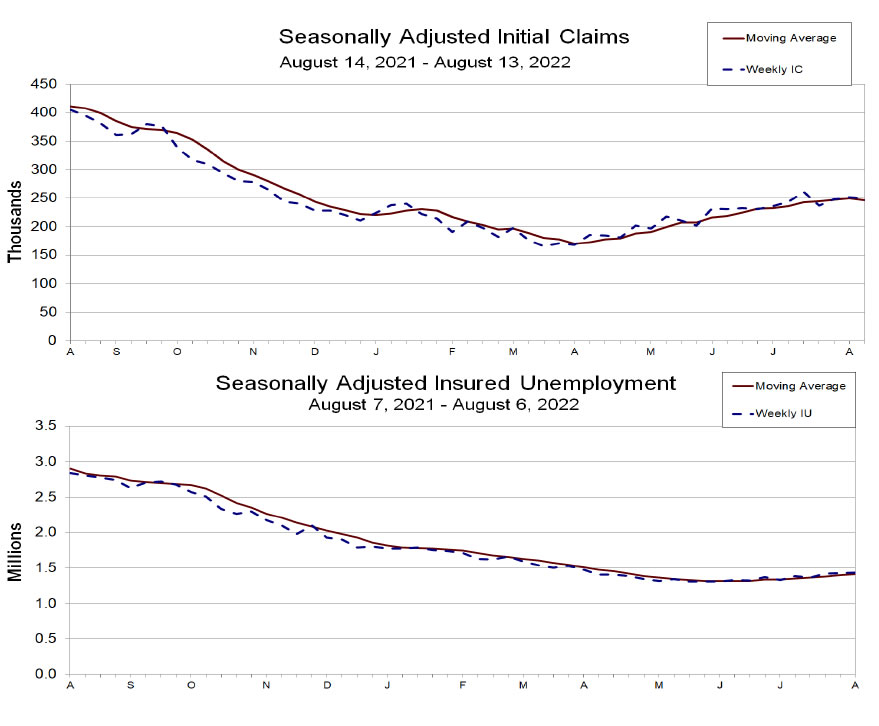
US initial jobless claims dropped to 250k, below expectations
US initial jobless claims dropped -2k to 250k in the week ending August 13, below expectation of 261k. Four-week moving average of initial claims dropped -2750 to 247k.
Continuing claims rose 7k to 1437k in the week ending August 6. Four-week moving average of continuing claims rose 13k to 1413.
Also released Philly Fed manufacturing survey improved from -12.3 to 6.2 in August. Canada IPPI dropped -2.1% mom in July. RMPI dropped -7.4% mom.
ECB Schnabel: Our concerns was not alleviated after Jul 50bps hike
ECB Executive Board member Isabel Schnabel said in an interview that there was a "strong indication that growth is going to slow". She would not rule out a technical recession in Eurozone, "especially if energy supplies from Russia are disrupted further". Downside risks also increased due to "additional supply-side shocks, caused by droughts or the low water levels in major rivers."
Regarding inflation she said the increasing inflation rates are a "broad-based development". "Inflationary pressures are likely to be with us for some time; they won't vanish quickly," she added. "I would not exclude that, in the short run, inflation is going to increase further.... it's very difficult to predict when inflation is going to peak."
Regarding September meeting, Schnabel said that "the concerns we had in July have not been alleviated". Back in July, ECB raised interest rate by 50bps. "At the moment I do not think this outlook has changed fundamentally," she added.
Eurozone CPI finalized at 8.9% yoy in Jul, core CPI at 5.4% yoy
Eurozone CPI was finalized at 8.9% yoy in July, comparing with June's 8.6% yoy. CPI ex-energy, food, alcohol, and tobacco was finalized at 5.4% yoy (up from June's 4.9% yoy). The highest contribution to the annual Eurozone inflation rate came from energy (+4.02%), followed by food, alcohol & tobacco (+2.08%), services (+1.60%) and non-energy industrial goods (+1.16%).
EU CPI was finalized at 9.8% yoy, up from June's 9.6% yoy. The lowest annual rates were registered in France, Malta (both 6.8%) and Finland (8.0%). The highest annual rates were recorded in Estonia (23.2%), Latvia (21.3%) and Lithuania (20.9%). Compared with June, annual inflation fell in six Member States, remained stable in three and rose in eighteen.
Australia lost -40.9k jobs, but unemployment rate dropped to 3.4%
Australia employment contracted -40.9k in July, much worse than expectation of 25.0k growth. Full time jobs decreased by 86.9k while part time jobs rose 46k.
Unemployment rate dropped from 3.5% to 3.4%. Participation rate dropped notably from 66.8% to 55.4%. Monthly hours worked in all jobs dropped -16m hours, or -0.8% mom.
"The fall in unemployment in July reflects an increasingly tight labour market, including high job vacancies and ongoing labour shortages, resulting in the lowest unemployment rate since August 1974," Bjorn Jarvis, head of labour statistics at the ABS, said.
RBNZ Orr: Monetary policy was too loose for a period
RBNZ Governor Adrian Orr told a parliamentary committee, "our core inflation is too high and that suggests at some point monetary policy was too loose for a period."
"I have already apologized for the current level of inflation. I have already said that the Reserve Bank was party to that," he added.
However, "the worst mistake we could be having would be fighting deflation, unnecessary unemployment and economic collapse," he said. "We have ended up with the better problem -- but it is a problem -- which is inflation, core inflation of 4-6% that we need to put back in the bottle."
USD/JPY Mid-Day Outlook
Daily Pivots: (S1) 134.15; (P) 134.83; (R1) 135.74; More...
Intraday bias in USD/JPY stays neutral at this point. Overall, corrective pattern from 139.37 will extend further. On the upside, above 135.57 will resume the rebound to retest 139.37 high. But a decisive break there is not expected this time. On the downside, below 131.72 will resume the fall from 139.37 through 130.38 support.
In the bigger picture, fall from 139.37 medium term top is seen as correcting whole up trend from 101.18 (2020 low). While deeper decline cannot be ruled out, outlook will stays bullish as long as 55 week EMA (now at 122.70) holds. Long term up trend is expected to resume through 139.37 at a later stage, after the correction finishes.
Economic Indicators Update
| GMT | Ccy | Events | Actual | Forecast | Previous | Revised |
|---|---|---|---|---|---|---|
| 01:30 | AUD | Employment Change Jul | -40.9K | 25.0K | 88.4K | |
| 01:30 | AUD | Unemployment Rate Jul | 3.40% | 3.50% | 3.50% | |
| 06:00 | CHF | Trade Balance (CHF) Jul | 3.58B | 3.55B | 3.80B | 3.68B |
| 09:00 | EUR | Eurozone CPI Y/Y Jul F | 8.90% | 8.90% | 8.90% | |
| 09:00 | EUR | Eurozone CPI Core Y/Y Jul F | 4.00% | 4.00% | 4.00% | |
| 12:30 | CAD | Industrial Product Price M/M Jul | -2.10% | -0.80% | -1.10% | |
| 12:30 | CAD | Raw Material Price Index Jul | -7.40% | -3.90% | -0.10% | |
| 12:30 | USD | Initial Jobless Claims (Aug 12) | 250K | 261K | 262K | 252K |
| 12:30 | USD | Philadelphia Fed Manufacturing Survey Aug | 6.2 | -6.2 | -12.3 | |
| 14:00 | USD | Existing Home Sales Jul | 4.85M | 5.12M | ||
| 14:30 | USD | Natural Gas Storage | 38B | 44B |
US initial jobless claims dropped to 250k, below expectations
US initial jobless claims dropped -2k to 250k in the week ending August 13, below expectation of 261k. Four-week moving average of initial claims dropped -2750 to 247k.
Continuing claims rose 7k to 1437k in the week ending August 6. Four-week moving average of continuing claims rose 13k to 1413.
Fed Minutes Did Not Cheer Stocks and Ironed USD Return to Growth
The US dollar slowly added for the third trading session, returning to levels of three weeks ago. While the published FOMC meeting minutes did not cause a sharp reaction, the FX dynamics of the past week are more indicative of the end of a corrective pullback. And we would not be surprised if the Dollar’s growth will shift to the next gear in the coming days.
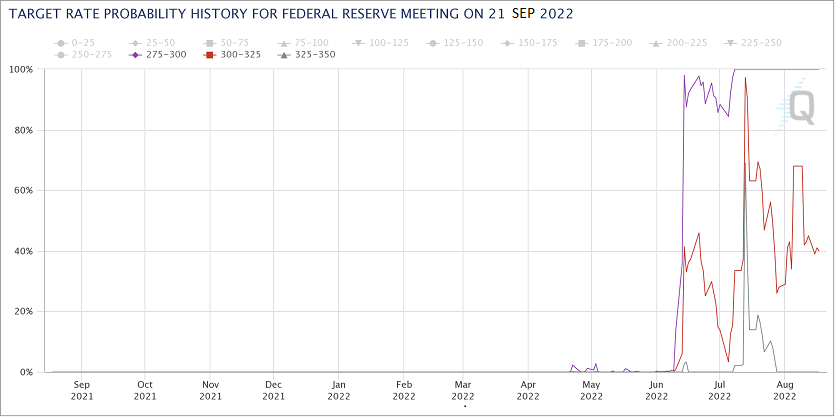
The market’s primary focus has been whether there will be a 75-point rate hike next. These expectations have changed little since the futures market, as has been the case for the last week or so, is laying down a roughly 40% chance of a third consecutive such move.
However, the central bank officials are concerned that the inflation threat could quickly return if policy tightening does not suppress expectations. So, the FOMC is in the mood to press the monetary brake pedal more firmly than the market expects. This is now roughly the same signal Powell sent in autumn 2018, resulting in a violent sell-off in the equity market.
It seems that markets are setting expectations for a lower final rate hike than the Fed. The FOMC has been using more and more channels lately to explain its view, from comments from committee members and minutes to explanatory articles in the WSJ.
It is well visible that the currency market has been taking note of these signals for at least a week now, although investors continued to push stocks up until yesterday. The currency market often goes half a step ahead of stocks, so we see the reversal of the Dollar Index to growth over the last ten days as the end of a corrective decline and the start of a new wave of dollar strength.
Apart from the Fed, there are also several fundamental factors on the Dollar’s side right now, from slowing retail sales and a collapse in the housing market to strong demand for LNG, which the US exports to Europe. These factors are reducing pressure on the Dollar through the trade balance.
At the same time, money markets are paying increasing attention to rising bond yields in the US. While the two-year US bonds most sensitive to Fed policy are trading at with 3.2% yield, compared to similar Chinese bonds at just 2.07% and German as low as 0.75%. This disposition attracts buyers to dollar securities, which further support its exchange rate.
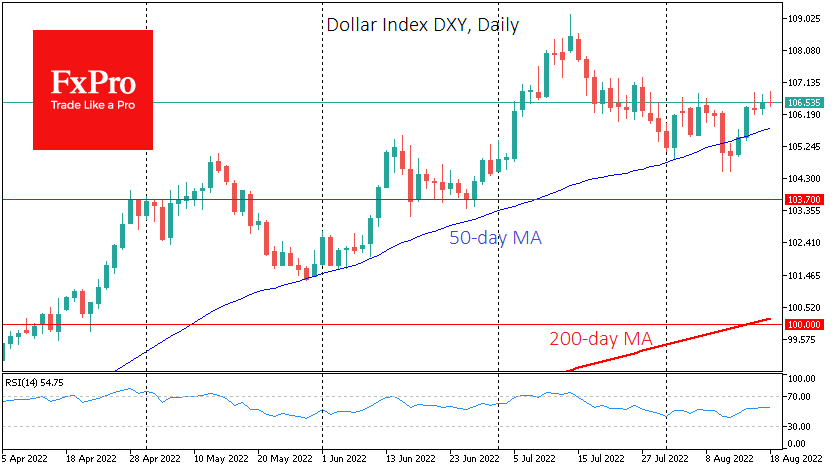
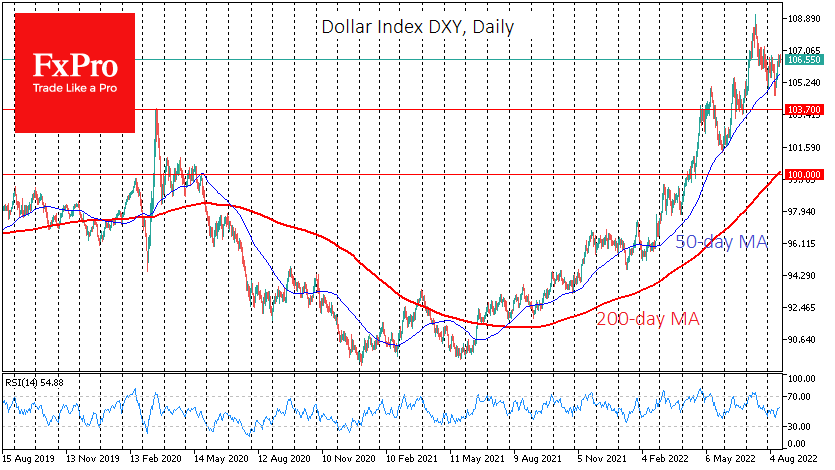
The Dollar Index has managed to quickly return above its 50-day moving average, maintaining it as support for over a year. If we are right, the Dollar could soon reach a retest of the July highs, when the DXY was above 109, and the EURUSD was down to 1.0. And with a new retest, we should expect dollar buyers to be able to push it to renew multi-year highs unless the macroeconomic situation changes drastically.
Aussie Bounces Back After Soft Jobs Report
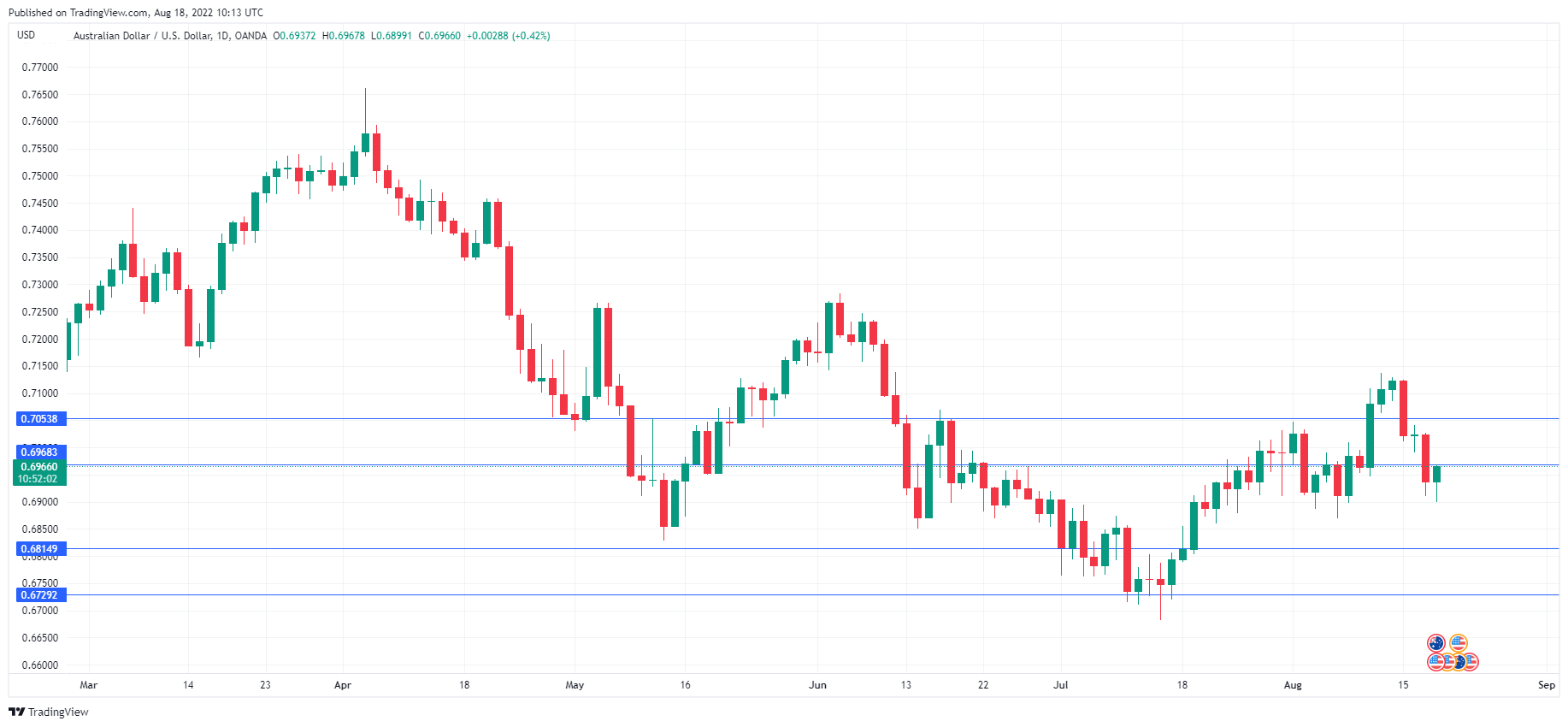
The Australian dollar edged lower following today’s Australian employment report but has reversed directions. In the European session, AUD/USD is trading at 0.6957, up 0.28%.
Australian employment report disappoints
Australia released the July employment report, and the numbers were surprisingly soft. The economy lost 40.9 thousand jobs, well below the estimate of 25.0 thousand. This follows a strong gain of 88.4 thousand in May. Making the report sting even more, full-time positions fell by 86.9 thousand. The silver lining was a drop in the unemployment rate to 3.4%, down from 3.5%. However, that was likely due to the participation rate falling to 66.4%, down from 66.8%. The Australian dollar lost ground following the job report release but has reversed directions.
The Aussie tumbled 1.23% on Tuesday, as ominous developments in China are weighing on the currency. The latest news was the Chinese central bank lowering its 1-year MLF loans to 2.75%, down from 2.85%. The spike in Covid cases and the worsening property crisis have resulted in a decline in credit growth, and the PBOC has loosened policy in an effort to boost credit demand. The Aussie is sensitive to developments in China, which is Australia’s number one trading partner.
The RBA meets next on September 6th and another rate hike is likely, even with the weak job report. The markets have priced in a 25 basis point hike, which would bring the cash rate to 2.10%. The RBA minutes, published on Tuesday, indicated that further rate hikes were coming, but reiterated that the Bank would be guided by economic data and the inflation forecast.
AUD/USD Technical
- There is resistance at 0.7053, followed by a monthly resistance line at 0.7122
- AUD/USD has support at 0.6968 and 0.6902.
ECB Schnabel: Our concerns was not alleviated after Jul 50bps hike
ECB Executive Board member Isabel Schnabel said in an interview that there was a "strong indication that growth is going to slow". She would not rule out a technical recession in Eurozone, "especially if energy supplies from Russia are disrupted further". Downside risks also increased due to "additional supply-side shocks, caused by droughts or the low water levels in major rivers."
Regarding inflation she said the increasing inflation rates are a "broad-based development". "Inflationary pressures are likely to be with us for some time; they won't vanish quickly," she added. "I would not exclude that, in the short run, inflation is going to increase further.... it's very difficult to predict when inflation is going to peak."
Regarding September meeting, Schnabel said that "the concerns we had in July have not been alleviated". Back in July, ECB raised interest rate by 50bps. "At the moment I do not think this outlook has changed fundamentally," she added.
Eurozone CPI finalized at 8.9% yoy in Jul, core CPI at 5.4% yoy
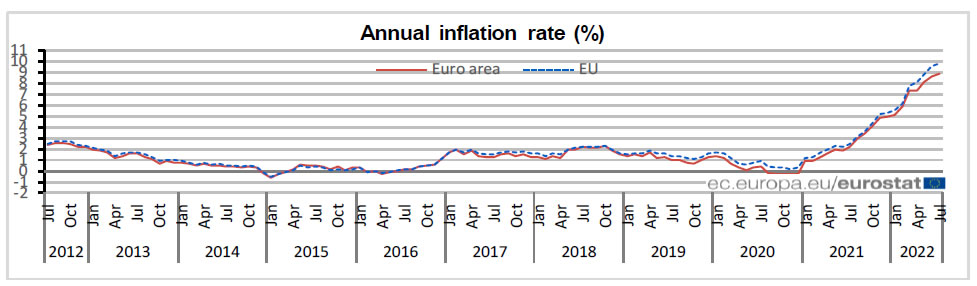
Eurozone CPI was finalized at 8.9% yoy in July, comparing with June's 8.6% yoy. CPI ex-energy, food, alcohol, and tobacco was finalized at 5.4% yoy (up from June's 4.9% yoy). The highest contribution to the annual Eurozone inflation rate came from energy (+4.02%), followed by food, alcohol & tobacco (+2.08%), services (+1.60%) and non-energy industrial goods (+1.16%).
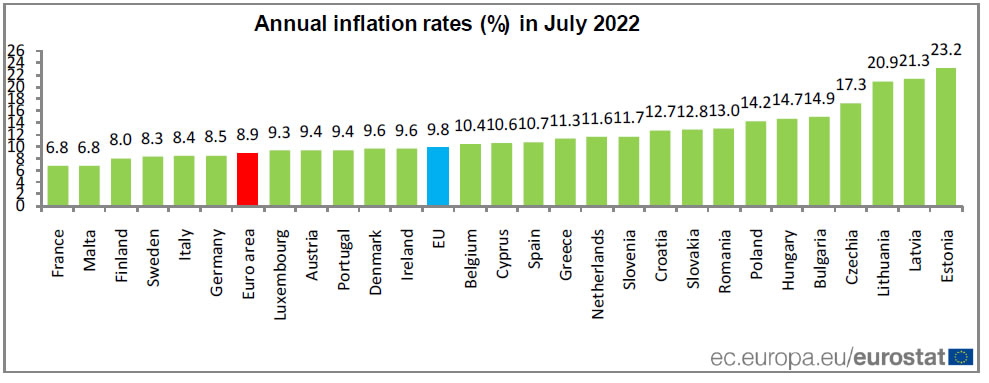
EU CPI was finalized at 9.8% yoy, up from June's 9.6% yoy. The lowest annual rates were registered in France, Malta (both 6.8%) and Finland (8.0%). The highest annual rates were recorded in Estonia (23.2%), Latvia (21.3%) and Lithuania (20.9%). Compared with June, annual inflation fell in six Member States, remained stable in three and rose in eighteen.
July Retail Sales for UK, Canada
Retail sales have become a bellwether of the economy, and consequently for the movement of currencies. Additionally, they can swing market sentiment, particularly if it's a major economy that's reporting. Tomorrow there are two currency majors reporting the latest figures, and that could shake up their respective pairs a bit.
Retail sales figures are particularly important now that fuel prices are coming down. The underlying components show how the consumer side of the economy is being impacted by inflation. Central banks - particularly relevant to the data tomorrow, the BOE and BOC - are going all-in on fighting inflation. Demand is one of the driving forces of inflation.
Balancing the factors
One of the things that can lead to confusion in the current environment is that some countries adjust for inflation in their surveys and others do not. The UK, for example, publishes inflation-adjusted retail sales data, while Canada (like their neighbor to the south) does not. Given how high inflation is among the reporting countries, this can lead to some very uneven numbers, which needs to be taken into context.
The main issue for now is volume. Are consumers buying more, or simply spending more? If consumers are spending more, even if volumes aren't going up, it could mean the situation isn't so dire. And if inflation gets under control, then volumes can potentially increase and the economy right-side. But, if retail sales are going down, and volume is going down, it could mean that consumers are simply running out of money, and that can imply a recession is imminent. Like the BOE already warned.
What's in the data? UK July retail sales are expected to show a monthly decline of -0.2% compared to -0.1% in the prior month. On an annual basis, however, the decline is expected to narrow th -3.3% compared to -5.8% prior. But this is likely explained by slowing sales last year as the delta variant took hold in the summer. The acceleration to the downside in the monthly figure might worry investors more.
UK July retail sales excluding fuel are also expected to see a -0.2% decline compared to 0.4% increase in June. In other words, the immediate spending impact of fuel is starting to diminish. Compared to the prior year, retail sales ex fuel are expected at -3.3% compared to -5.8% in the prior reading.
How does Canada compare?
Canada's expected figures are dramatically different, because they aren't adjusted for inflation which last came in at an annual rate of 7.6%, and a monthly rate of 0.1%. Canadian monthly retail sales are expected to have increased by 0.3% compared to 2.2% in the prior month (reflecting the improving inflation situation). Annual retail sales are expected to have grown 9% compared to 14.1% in the prior report. Again, the annual comparables likely due more to covid effects last year, than the current situation.
The Crypto Market Tests the Strength of Buyers
Market picture
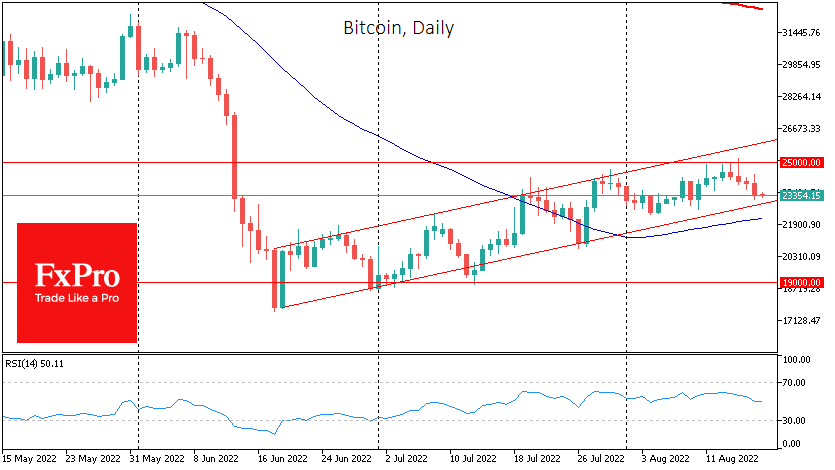
Bitcoin has lost 4% in the past 24 hours, falling to $23.3K. Ethereum lost 5.3% to $1840. Top altcoins are down 3% (XRP) to 8% (Solana).
Total crypto market capitalisation, according to CoinMarketCap, sank 3.4% to $1.12 trillion. The Crypto Fear and Greed Index fell 11 points to 30 by Thursday, tumbling deeper into “fear” territory.
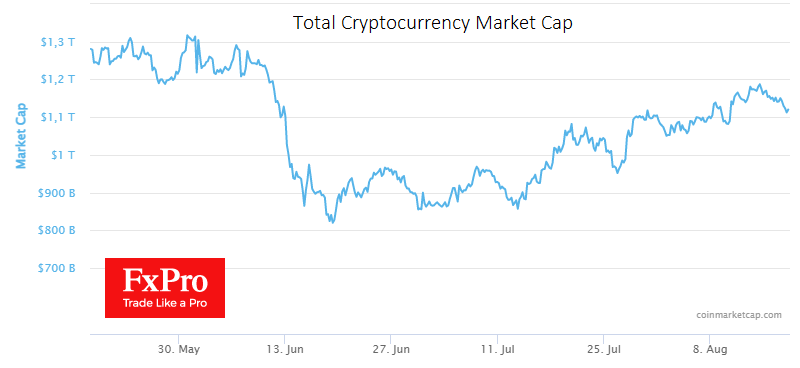
Once again, Bitcoin seems to have acted as a leading indicator of risk sentiment in global markets. The former cryptocurrency had been sluggishly correcting over the previous three days but only yesterday took a decisive step down, warning of a similar move in the US indices.
Right now, BTCUSD has rolled back to the area of previous local lows and is approaching the lower boundary of the uptrend channel. A break below $22.5K in a sharp move down would be evidence of a gap in the last two months’ trend and a deeper dive harbinger.
News background
According to Fox Business journalist Eleanor Terrett, the US Securities and Exchange Commission (SEC) may yet charge Ethereum creators with selling unregistered securities in the US.
Cryptocurrency hacking damage in 2022 was $1.9 billion, having doubled in a year and a half, according to analytics service Chainalysis.
The European Green Party has introduced legislative amendments to increase capital requirements for banks using cryptocurrencies.
Stablecoins backed by the US dollar, and other fiat currencies will expand access to financial services and Web3, according to cryptocurrency exchange Coinbase.
According to Blockckdata, Alphabet, Google’s parent company, has invested more than $1.5bn in four blockchain companies between September 2021 and June 2022. This is followed by Blackrock ($1.17bn) and Morgan Stanley ($1.11bn). Large public companies have invested about $6 billion in crypto.
AUDUSD Wave Analysis
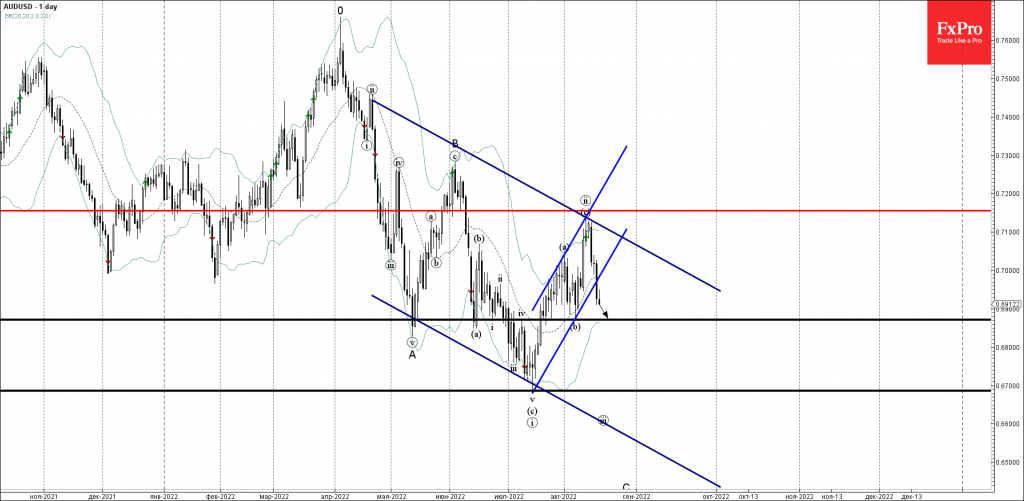
- AUDUSD broke daily up channel
- Likely to fall to support level 0.6870
AUDUSD recently broke the support trendline of the daily up channel, inside which the pair has been rising from the middle of July.
The breakout of this up channel continues the active multi-impulse downward sequence made out of the impulse waves (iii) and C.
Given strong daily downtrend – AUDUSD can be expected to fall further toward the next support level 0.6870 (low of the previous correction (b)).