

Sample Category Title
BoJ Amamiya: We need to support economic activity with accommodative monetary policy
Deputy Governor Masayoshi Amamiya said, "Japan's economy hasn't recovered yet to pre-pandemic levels... The foundations for an economic recovery remain weak and the outlook for wages is highly uncertain. As such, we need to support economic activity with accommodative monetary policy."
"Achieving our price target means having consumer inflation hit 2% on average over the business cycle, not a temporary rise to that level driven by exogenous factors such as increasing energy import costs," he emphasized.
Japan's CPI core (all-item ex fresh food), has been above BoJ's 2% target for three straight months. But officials are seeing it as temporary, at least until wage pressures build up.
DOW resuming near term rebound as Fed Powell signals slowing tightening ahead
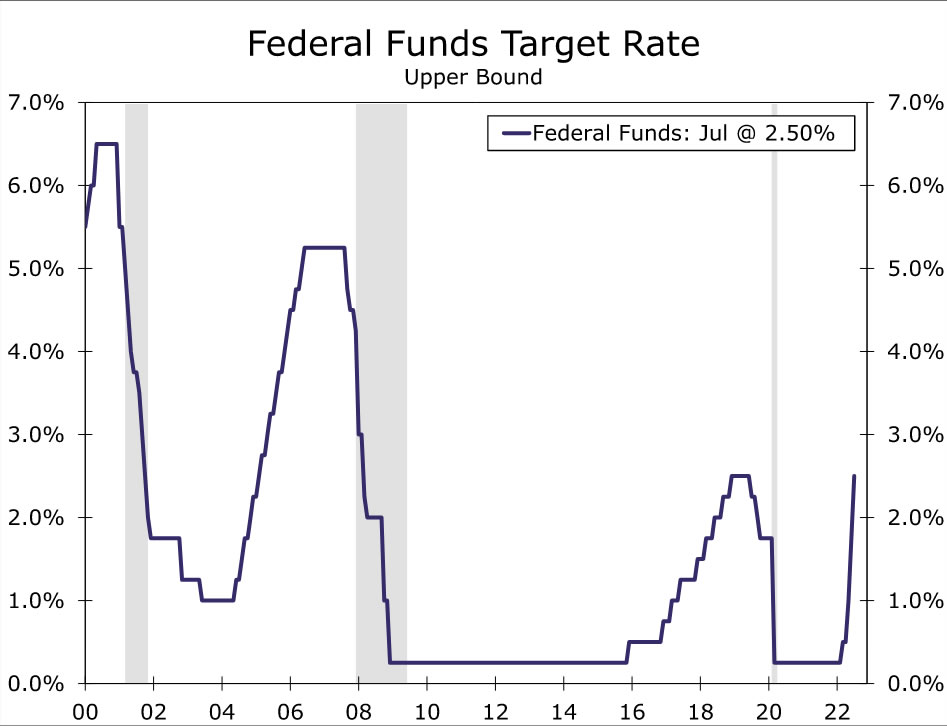
US stocks staged a strong rebound overnight after Fed Chair Jerome Powell hinted that tightening could slow ahead. After yesterday's 75bps hike, federal funds rate is now at 2.25-2.50%, close to the 2.5% neutral rate.
"While another unusually large increase could be appropriate at our next meeting, that is a decision that will depend on the data we get between now and then," Powell said. "We will continue to make our decisions meeting by meeting, and communicate our thinking as clearly as possible."
"As the stance of monetary policy tightens further, it likely will become appropriate to slow the pace of increases while we assess how our cumulative policy adjustments are affecting the economy and inflation," he also noted.
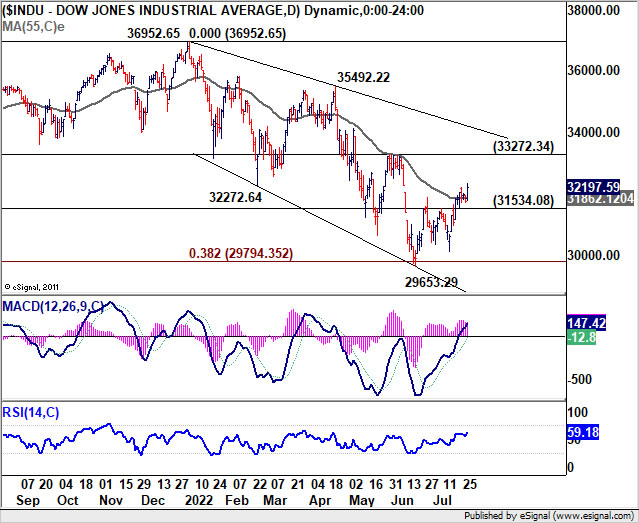
DOW rose 436 pts or 1.37% to close at 31799. Rebound from 29653.29 is resuming and the break above 55 day EMA again is a positive signal. Further rally is now in favor, as long as 31534.08 minor support holds, towards 33272.34 resistance. Firm break there will add to the case that whole corrective fall from 36952.65 has completed.
FOMC Raises Rates by 75 bps and Indicates More to Come
Summary
- The FOMC raised rates by 75 bps at today's meeting, which was widely expected.
- All 12 voting members of the Committee supported the decision to hike rates by 75 bps.
- Inflation remains forefront in the minds of most Committee members. The statement announcing the decision to hike rates noted that "the Committee is strongly committed to returning inflation to its 2 percent objective."
- But the FOMC also made a reference to recent data indicating that the pace of economic activity has downshifted.
- The statement indicated that more tightening likely will be appropriate. In our view, the degree of tightening will depend on incoming data.
- Strong labor market data and/or continued hot inflation data likely would prompt the Committee to hike by another 75 bps in September. Conversely, weak labor market data and/or lower inflation likely would result in a smaller rate hike.
- In short, the FOMC is edging into data dependency mode. Stay tuned.
FOMC Raises Rates by 75 bps, but Downgrades Assessment of the Economy
As widely expected, the Federal Open Market Committee (FOMC) raised its target range today for the federal funds rate by 75 bps, bringing the top end of the range to 2.50%. There was widespread support for another supersized rate hike—the FOMC raised rates by 75 bps at its last meeting in June—as all 12 voting members of the Committee voted in favor today. The FOMC has now hiked rates by 225 bps since March, a pace of tightening that has not been experienced in more than 40 years.
In explaining its decision to tighten policy further today, the Committee again pointed to the fact that "inflation remains elevated." Indeed, the year-over-year rate of CPI inflation rose from 8.6% in May to 9.1% in June, which was higher than most market participants, and likely most FOMC members, had expected at the time. The statement also reiterated that "the Committee is strongly committed to returning inflation to its 2 percent objective." This sentence, which was used previously in the June statement, in conjunction with the unanimous vote to raise rates by another 75 bps today, indicates that inflation remains forefront in the minds of most FOMC members.
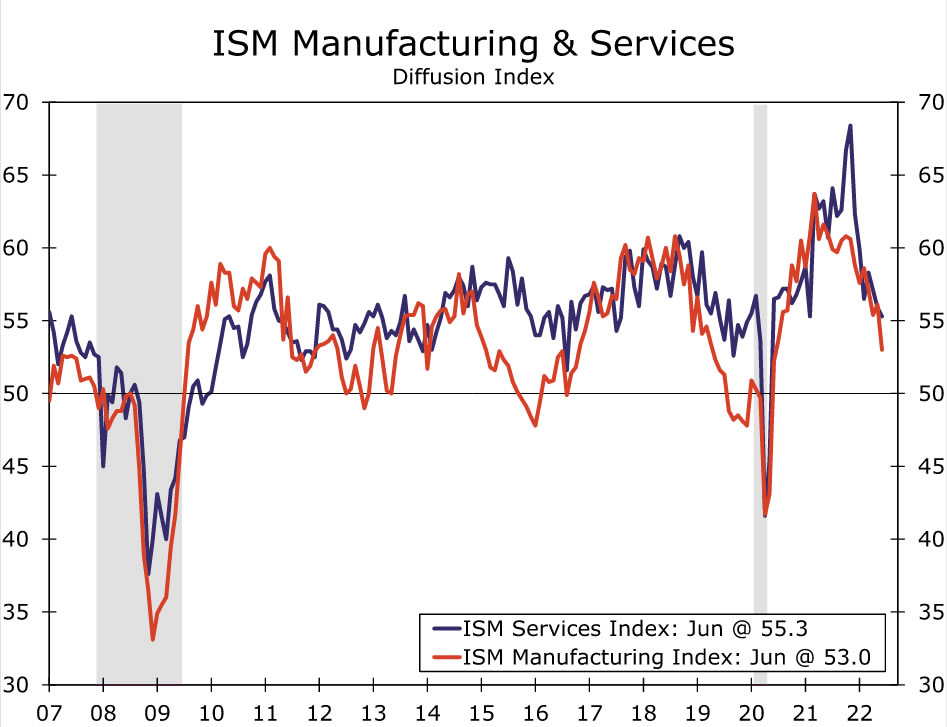
That said, the FOMC downgraded its assessment of the current state of economic activity. Following the June FOMC meeting, the Committee noted that "overall economic activity appears to have picked up." But today's statement began with the following sentence: "Recent indicators of spending and production have softened." In that regard, the ISM services index, which measures the pace of activity in the service sector, has moved lower in recent months, although it remains above the line separating expansion from contraction. The comparable index for the manufacturing sector also moved lower in June Real GDP data for Q2-2022 are slated to print Thursday morning at 8:30 EDT. Although we project that real GDP inched higher in the second quarter, a negative print is entirely possible. If so, then real GDP would have contracted for two consecutive quarters, although as we discuss in more detail in a recent report, that outcome, should it occur, would not necessarily mean that the economy is currently in recession.
FOMC Moving into Data Dependency Mode
Looking forward, the Committee indicated that more tightening is likely. When the FOMC hiked rates by 75 bps on June 15, the statement said the Committee anticipated that "ongoing increases in the target range will be appropriate." Today's statement repeated that phrase. So how much tightening should we expect at the next FOMC meeting on September 21? We currently expect another 75 bps rate hike on September 21, but we readily acknowledge that the degree of tightening will depend crucially on incoming data over the intervening period. Four data releases stand out to us as vitally important. Specifically, there will be two employment reports (August 5 and September 2) and two CPI releases (August 10 and September 13) between now and the next FOMC meeting. If the labor market reports show continued strength and/or CPI inflation continues to come in hot, then yet another 75 bps rate hike would be likely. Conversely, if the employment reports show signs of labor market weakening and/or inflation comes in lower than expected, then the FOMC likely would opt to raise rates by a smaller amount.
In short, the FOMC is edging into data dependency mode. That is, the Committee has wanted to raise rates as fast as possible in recent months to get the fed funds rate back to some measure of "neutral." ("Neutral" is the setting of the fed funds rate that is neither stimulating the economy nor restraining it). Although there is no precise estimate of "neutral," most FOMC members would place it somewhere in the vicinity of 2-1/2% based on the Summary of Economic Projections. Our inference of the onset of data dependency mode was supported by a statement by Chair Powell in his post-meeting press conference. Specifically, Powell said that the pace of further tightening "will depend on incoming data and the evolving outlook for the economy." Stay tuned.
The FOMC to Advance Meeting by Meeting
The move to a broadly neutral stance and the circumstances the US economy faces are increasingly leading the FOMC to take a more balanced view of the risks regarding inflation and activity.
The July FOMC meeting saw a very important shift in the Committee’s communications regarding the future path of policy, with Chair Powell highlighting in the press conference that the Committee no longer feel behind the curve and can now assess the appropriateness of policy “meeting by meeting”.
In that regard, there was also a significant pivot in the opening sentence of the decision statement, with June’s “Overall economic activity appears to have picked up after edging down in the first quarter” replaced with “Recent indicators of spending and production have softened” in July.
However, this is not to say that the rate-hike cycle is complete or even that a pause is coming. Throughout the press conference, Chair Powell talked up the strength of the economy, despite a poor run of activity data, as well as the lingering upside risks for inflation. On interest rates specifically, he also made clear the Committee’s belief that policy needed to be “moderately restrictive” instead of broadly neutral as it is now at 2.375% – in the FOMC’s view.
To our mind, the most likely course for policy from here remains a 50bp increase at the September meeting – taking the fed funds rate to the upper end of the FOMC’s 2-3% neutral range – followed by two 25bp increases to 3.375% at December. But risks to this view look as though they are transitioning from being skewed to the upside to the downside.
It is obvious that inflation is currently far too high and, as yet, unclear whether the pulse is sustainably decelerating. However, Chair Powell was crystal clear in the press conference that policy acts with a lag, believing that “significant further tightening” is in the pipeline. Further, while the labour market continues to be assessed as strong, the singular reference in the Q&A to the stalling of household survey employment over the past three months makes apparent that the FOMC believe job creation has slowed materially and is at immediate risk. Regarding the outlook, we would add the additional concerns of rapidly decelerating hourly earnings growth; a household savings rate already back at pre-pandemic levels; and record-low University of Michigan consumer sentiment which argues for weak and delayed transmission of future income growth to spending.
Also notable in Chair Powell’s remarks is that, now that their stance is broadly neutral, risks related to inflation are no longer the Committee’s pre-eminent concern. Instead they are to be balanced with the building downside risks for activity and employment, resulting in a desire to undertake “just the right amount of tightening” to bring about below-trend growth and “not make a mistake” by creating the pre-conditions for recession.
For the policy outlook into year-end, it will therefore be as important to fully assess the labour market detail as the components of inflation. On employment, the pace of job creation in the establishment and household surveys; the pipeline of new openings from JOLTS; and any signs of accelerating redundancies via initial claims will all matter. For inflation, critical will be the degree to which inflation is within the FOMC’s influence or an uncontrollable force for policy, with the latter possibility better regarded as a tax on households’ real income and economic activity than an inflation risk the FOMC need to act against. Note, this more nuanced assessment of inflation risks will still need to be made in the context of developments in inflation expectations which the Committee assess through a number of measures.
As we have long emphasised, a continuous assessment of financial conditions is also necessary when calibrating policy. Term interest rates, at which economic agents borrow, have been heavy of late. If they track lower still, the FOMC will have scope to raise the fed funds rate further without a cost to the economy through market interest rates or the US dollar, all else equal. Alternatively, if quantitative tightening and the risks clouding the outlook see credit spreads widen, the FOMC will have less capacity to raise the fed funds rate, with some of the required tightening of financial conditions coming instead from market participants.
Regardless, given our inflation and growth forecasts, we believe the policy debate can turn to rate cuts in 2023. While somewhat more cautious than the market with respect to the timing of these cuts, by late-2023 we see the case for 125bps of cuts from December quarter 2023 to December quarter 2024 having been made as restoring growth back near trend by the close of 2024 becomes the FOMC’s key policy objective.
FOMC Hikes Policy Rate by 75 Basis Points, Meeting Market Expectations
The Federal Reserve Open Market Committee (FOMC) lifted the federal funds rate to the 2.25% to 2.50% range and will continue its balance sheet runoff.
The Fed updated its language to reflect recent economic data, stating that "indicators of spending and production have softened. Nonetheless, job gains have been robust in recent months, and the unemployment rate has remained low."
On rising prices, the statement noted that "inflation remains elevated, reflecting supply and demand imbalances related to the pandemic, higher food and energy prices, and broader price pressures."
All of the members of the FOMC voted in favor of the decision.
Key Implications
The Fed met market expectations with a unanimous 75 basis-point hike, contrary to the prior meeting where there was one dissention in favor of 50 basis points. Clearly developments on the inflation slide left little doubt this time around. With all members onside to keep tightening the screws on demand, expectations are for continued rate hikes as the Fed aggressively attempts to bring down inflation.
Market pricing is looking for another 50 basis-point hike in September and has the policy rate reaching to upwards of 3.5% by year-end. With this policy path and the rising risk of recession in the U.S., the yield curve is moving even further into negative territory. Chair Powell is on deck to speak. He will have to walk a fine line as he justifies the Fed's actions against the growing downside risks.
Eco Data 7/28/22
[php_everywhere instance="1"]
Fed chair Jerome Powell press conference live stream
https://www.youtube.com/watch?v=P-97NiA1sY8
Fed hikes 75bps, spending and production softened
FOMC raises federal funds rate target by 75 bps to 2.25-2.50% as widely expected. The decision was by unanimous vote.
In the accompanying statement, Fed said that recent indicators of spending and production have "softened". But job gains have been "robust". Inflation remains "elevated". Russia's war against Ukraine are "creating additional upward pressure on inflation" and are "weighing on global economic activity".
Fed pledged to "continue to monitor the implications of incoming information for the economic outlook" and be "be prepared to adjust the stance of monetary policy as appropriate if risks emerge that could impede the attainment of the Committee's goals".
(FED) Federal Reserve Issues FOMC Statement
Recent indicators of spending and production have softened. Nonetheless, job gains have been robust in recent months, and the unemployment rate has remained low. Inflation remains elevated, reflecting supply and demand imbalances related to the pandemic, higher food and energy prices, and broader price pressures.
Russia's war against Ukraine is causing tremendous human and economic hardship. The war and related events are creating additional upward pressure on inflation and are weighing on global economic activity. The Committee is highly attentive to inflation risks.
The Committee seeks to achieve maximum employment and inflation at the rate of 2 percent over the longer run. In support of these goals, the Committee decided to raise the target range for the federal funds rate to 2-1/4 to 2-1/2 percent and anticipates that ongoing increases in the target range will be appropriate. In addition, the Committee will continue reducing its holdings of Treasury securities and agency debt and agency mortgage-backed securities, as described in the Plans for Reducing the Size of the Federal Reserve's Balance Sheet that were issued in May. The Committee is strongly committed to returning inflation to its 2 percent objective.
In assessing the appropriate stance of monetary policy, the Committee will continue to monitor the implications of incoming information for the economic outlook. The Committee would be prepared to adjust the stance of monetary policy as appropriate if risks emerge that could impede the attainment of the Committee's goals. The Committee's assessments will take into account a wide range of information, including readings on public health, labor market conditions, inflation pressures and inflation expectations, and financial and international developments.
Voting for the monetary policy action were Jerome H. Powell, Chair; John C. Williams, Vice Chair; Michael S. Barr; Michelle W. Bowman; Lael Brainard; James Bullard; Susan M. Collins; Lisa D. Cook; Esther L. George; Philip N. Jefferson; Loretta J. Mester; and Christopher J. Waller.
Sunset Market Commentary
Markets
The (mostly) European inspired recession trade that dominated trading since end last week finally took a breather as the market focus is turning to this evening’s Fed decision. European data at least didn’t provide much comfort. German GFK August consumer sentiment dropped further to a record low (-30.6 from 27.7) as consumers pondered whether there will enough gas this winter. Sentiment indicators in Italy and France also show growing pessimism among businesses and consumers. For now, there are few indications that uncertainty on Russian gas supplies will be resolved any time soon. The reference Dutch gas contract again touched a new peak since March (€ 222.5 MWH) before easing modestly. Despite lingering fears on a sharp deterioration in EMU economic activity, German yields bottomed, at least temporarily, after recent sharp decline. German yields ‘regain’ between 1-2 bps. On intra-EMU bond markets, Italian bonds again underperform (10-y spread vs Germany +6 bps) after S&P yesterday evening changed the outlook on the Italian BBB rating from positive to stable (cf. infra). US data mostly were stronger than expected. The US June trade deficit narrowed to $98.2 bln from $104 bln. US durable goods orders unexpectedly jumped 1.8% M/M. Even as the rise was supported by defense aircraft orders, core capital goods shipments (used to calculate investments in the GDP report) also rose a solid 0.7%. The data are supportive for tomorrow’s Q2 GDP release. Still it had little lasting impact on (bond) markets. US yields even decline up to 5 bps (5-y). Equity markets are in better shape today, supported by solid earnings from US bellwethers. European equities again up to 0.75/1.0%. US indices open with gains of up to 2.0% (Nasdaq). Moves in most major USD cross rates remain very limited. The DXY USD index declines marginally (107.5). EUR/USD hovers in the 1.0150 area. EUR/GBP tested the 0.84 area, but no break occurred (currently 0.8425).
The most important topic for global trading today evidently is this evening’s Fed decision. Anything different from a 75 bps trade hike to 2.25%/2.50% would be a huge surprise. Investors will be keen to get insights on the pace of the hiking cycle in September and beyond. Fears for a slowdown recently lowered expectations for Fed hiking to come to an end around the turn of the year near 3.25%/3.5%. We’re not convinced that Powell will already signal the Fed to sharply slow its anti-inflation campaign in the near future as inflation remains elevated and the labour market stays hot. As recent repositioning was mainly driven by risks to growth rather risks to persistent high inflation, a balanced Fed message might slow the setback in yields. Such a scenario would also help to put a floor for the USD.
News Headlines
The leaders of Italy’s right-wing bloc are meeting this afternoon to agree on how to pick the country’s new prime minister should they win the elections on September 25 as polls currently predict. The gathering takes place against the backdrop of S&P having lowered Italy’s outlook from positive to stable. The rating agency said Draghi’s resignation and the prospect of early elections risk shifting the “focus away from key reforms and further weigh on confidence and growth at a time of high uncertainty and rising inflation.” Under an informal rule, the party that gets the most votes picks a new PM. According to a most recent poll, this would be Meloni of the Brothers of Italy party (23.4%). But the League and Forza Italia are resisting this. Italian bond underperform today following the S&P downgrade. The spread vs. Germany’s 10y yield is at 236 bps, the highest since mid-June.
Sunak, one of the two remaining candidates to become the UK’s next PM, dramatically changed his view on tax cuts. In a surprise announcement today, Sunak said he would scrap the VAT on domestic energy bills if he wins. Going into the leadership contest, he defended his fiscally conservative approach as being essential to fix public finances and not to stoke inflation even further. His opponent, Truss, on the other hand hinted at a raft of immediate tax cuts should she become PM. The Secretary of State is leading by a big margin in polls of party members.