Sample Category Title
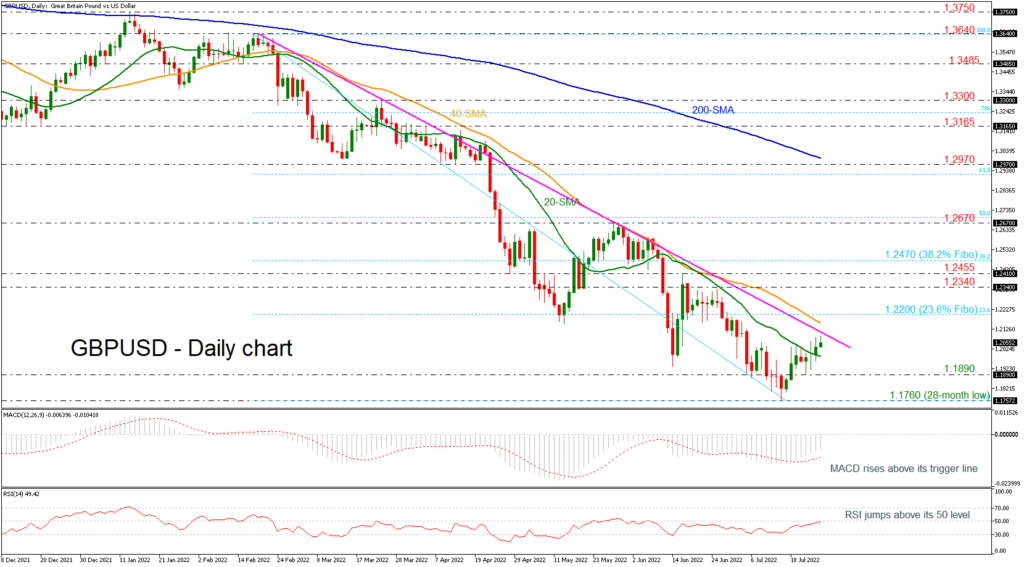
GBPUSD Turns Bullish in Short Term after Dramatic Slump
GBPUSD has reversed back up after finding strong support at the 28-month low of 1.1760. The pair is advancing above the 20-day simple moving average (SMA) and the next obstacle to surpass is the medium-term descending trend line.
The momentum indicators are pointing to a positive bias in the short term with the RSI just above 50 and the MACD is holding above its trigger line in the negative region.
A move to the upside could see immediate resistance at the 40-day SMA at 1.2150 but should the market increase positive momentum above this area, the 23.6% Fibonacci retracement level of the down leg from 1.3640 to 1.1760 at 1.2200 could be the next level in focus. A stronger area, though, could be found at the 1.2340-1.2455 since any violation of this point could increase chances for further gains probably towards the 38.2% Fibonacci of 1.2470.
In the wake of negative pressures, the market could meet immediate support at the 20-day SMA at 1.1990 before it heads lower to the 1.1890 support. A successful close below this level could see a retest of the previous low of 1.1760, while in case of steeper declines, the pair could breach this trough, diving to the 1.1410 barrier, registered in March 2020.
In the medium-term, the outlook remains negative since prices hold below the falling trend line; however, in the short-term timeframe, the market is positive.
Dollar Index: There is a High Probability that the Index Will Rise to the Previous Maximum
The structure of the DXY index hints at the development of a large triple zigzag w-x-y-x-z of the cycle degree.
Most likely, a cycle actionary wave z is currently under construction. The internal structure of the wave z suggests a triple zigzag Ⓦ-Ⓧ-Ⓨ-Ⓧ-Ⓩ. Perhaps the first four parts of the triple zigzag are fully completed, and the primary wave Ⓩ is still developing. It may take the form of a double zigzag (W)-(X)-(Y) of the intermediate degree.
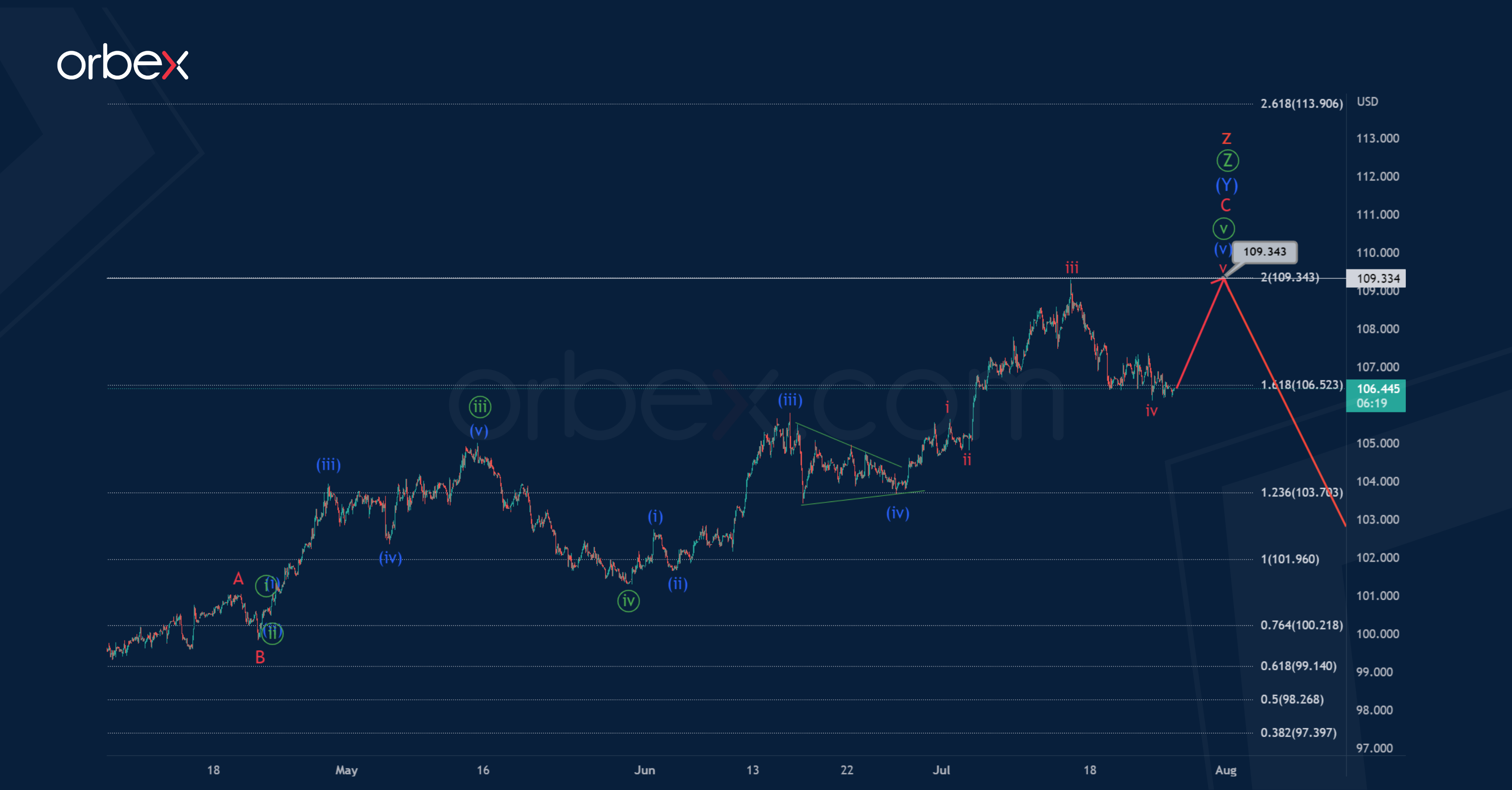
Bulls can push the price up again to the maximum of 109.34, marked by impulse iii. The goal is determined using the Fibonacci extension tool. At that level, wave z will be at 161.8% of the previous actionary wave y.
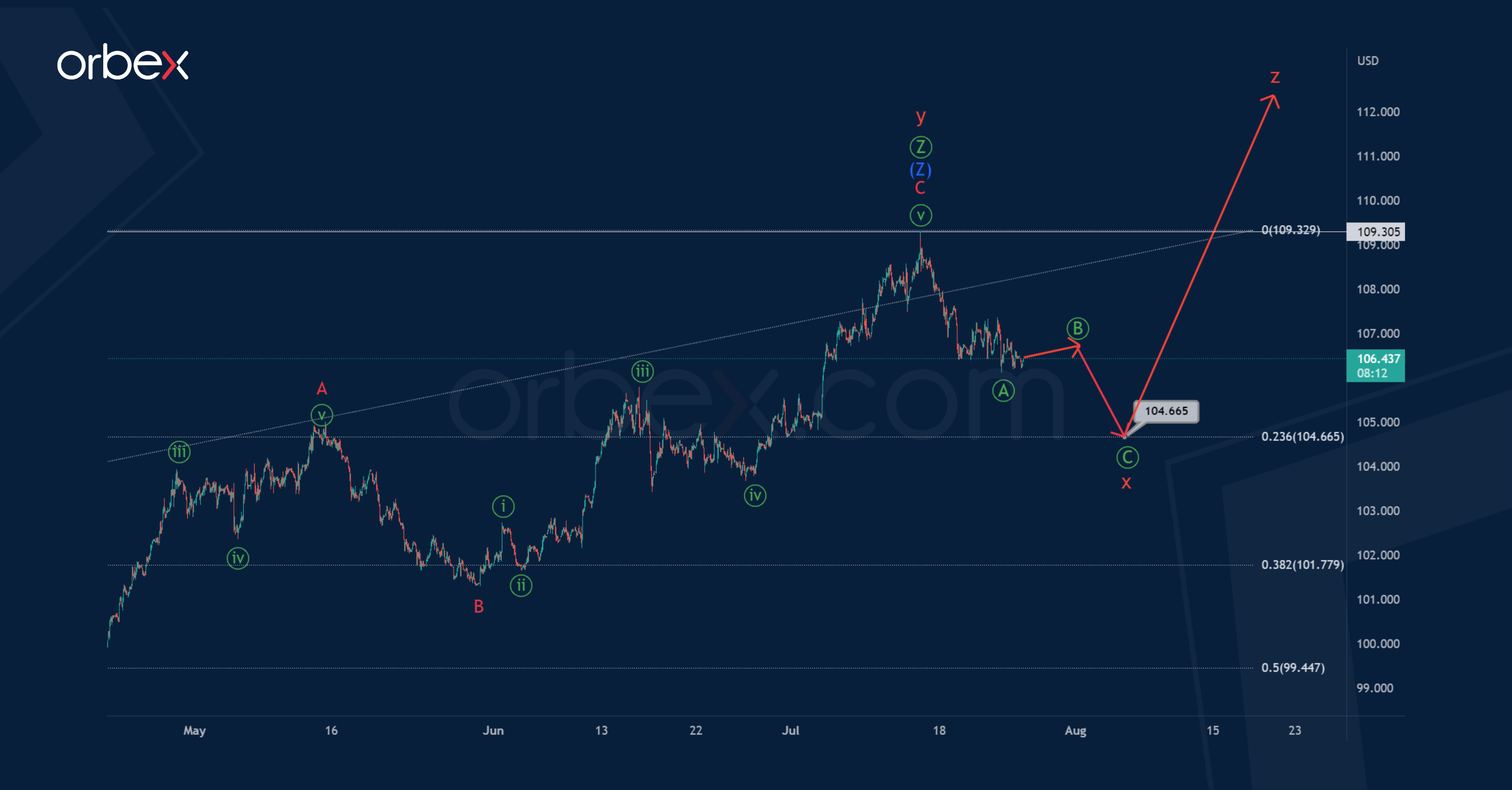
In an alternative scenario, the cycle actionary wave y was longer, and at the time of writing, it had come to its end. The wave y has the form of a primary triple zigzag.
Thus, if this option is confirmed, in the near future the market will move in a downward direction, building a cycle intervening wave x. The intervening wave x is similar to the primary zigzag Ⓐ-Ⓑ-Ⓒ.
It is possible that the price will fall to 104.66, as shown on the chart. At that level, wave x will be at 23.6% along the Fibonacci lines of wave y.
Bitcoin’s Normal Sluggishness
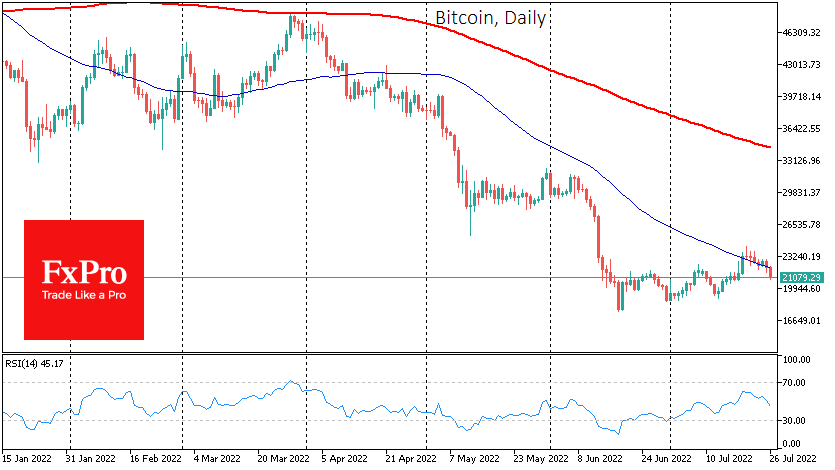
Bitcoin has lost 3.5% in 24 hours, having rolled back to $21,100 at the time of writing. Meanwhile, Ethereum has lost 6.1% in the same time frame, to $1430. Altcoins in the top 10 have fallen from 3.5% (XRP) to 6.8% (Solana).
Total crypto market capitalisation, according to CoinMarketCap, fell 3.7% to $971bn overnight.
Bitcoin continued its corrective decline near its 50-day average on Monday but began to pull away from it on Tuesday morning. Without support from stock indices, the cryptocurrency market is buckling under its weight with no meaningful growth drivers.
This situation is fuelling expectations of a prolonged lull, which fits into historical patterns. The history of previous cryptocurrency cycles teaches us that buyers may be slow to buy even after a bottom is reached, as a sustained rally should be expected about a year after the previous peak. But even then, the last, brightest episode of FOMO-based growth will have to wait another year. The history of cryptocurrencies is still too short to count on any trends. However, a prolonged pause in hype names after a massive sell-off is also a familiar phenomenon in equities, though without specifying a period.
According to Glassnode, around 80% of bitcoins are already concentrated in the long-term holders’ hands, indicating the ‘bottom’ is near.
Retail investors have rushed to buy up cryptocurrency stocks. In 10 days, capital inflows into crypto stocks totalled nearly $1 billion, according to VandaTrack.
A class action lawsuit was filed in the US against Celsius Network, which filed for bankruptcy on 14 July. The crypto lending platform is accused of violating the Securities Act by selling unregistered securities.
The developers of Shiba Inu are preparing to issue a Visa-backed card to accelerate the burning of SHIB, thereby boosting the price.
Daily Technical Analysis
EUR/USD
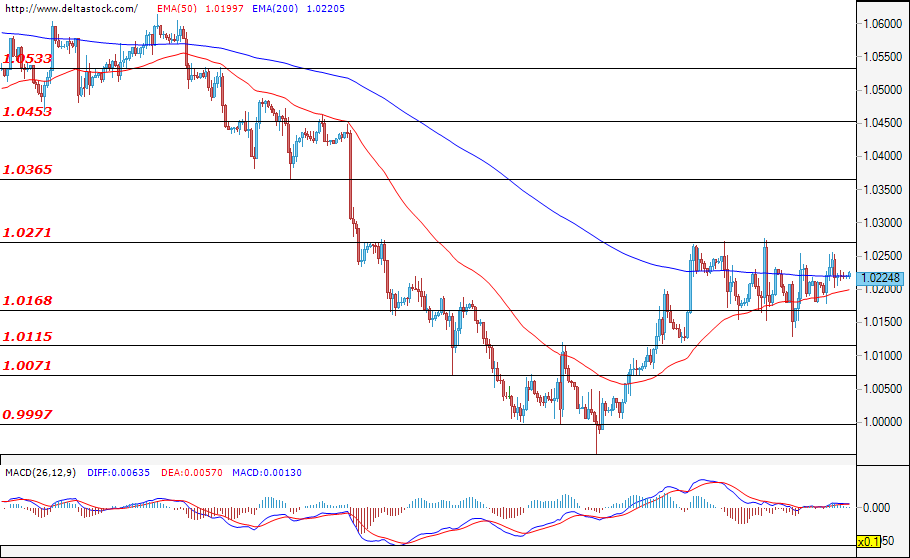
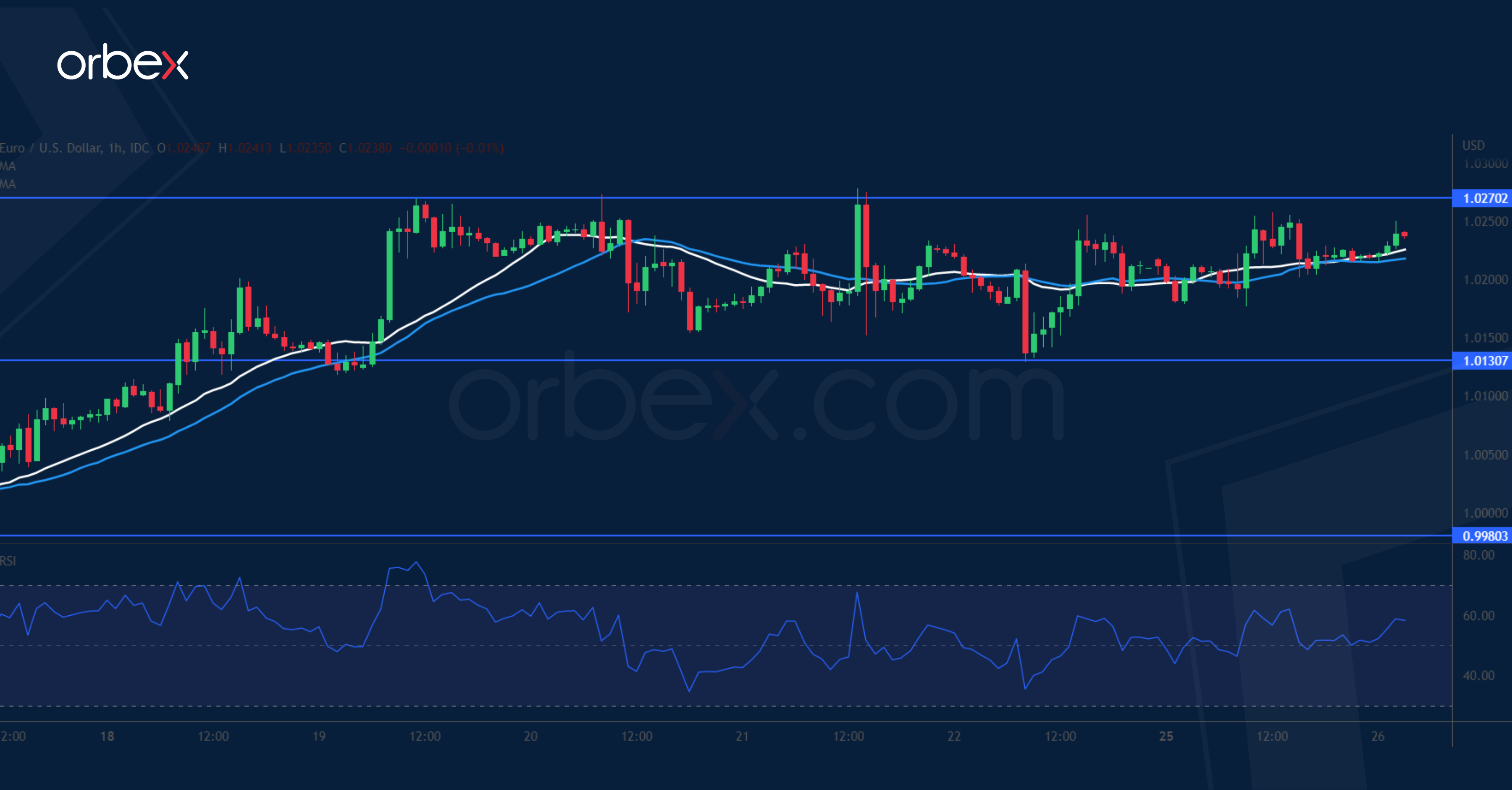
The pair still cannot break through the range 1.0170 – 1.0270 and the market is likely to remain in "standby" mode, as investors are cautious and expect the announcement of the Fed interest rate decision on Wednesday at 21:00 GMT. The level at 1.0270 seems to be a strong resistance for the bulls and the expectations are for the bears to try to take control over the market and attack the critical support at 1.0170, where a successful breach may be considered as a signal for a resumption of the downtrend. In this scenario, the sell-offs may deepen and the pair would most probably head towards the support at 1.0115. However, if the bulls prevail and manage to overcome the critical resistance at 1.0270, their next target would be the resistance at 1.0365.
USD/JPY
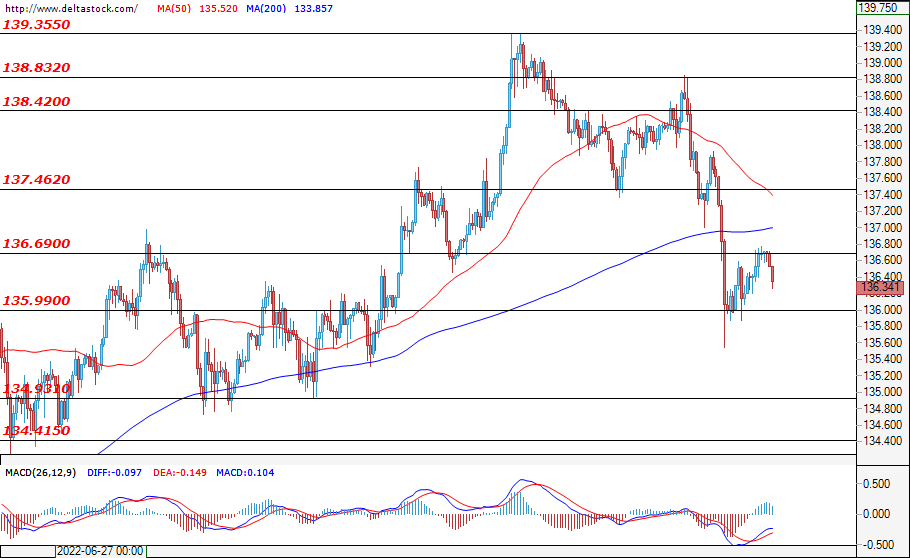
The pair bounced back from the resistance at 136.70 as the bulls could not gain enough momentum to violate this zone and to lead the pair towards the next resistance at 137.46. The forecasts for today’s trading session are for USD/JPY to continue its downward movement towards the support at 135.90 where a confirmed breach could easily deepen the decline and lead to a sell-off towards the support zone at 134.93.
GBP/USD
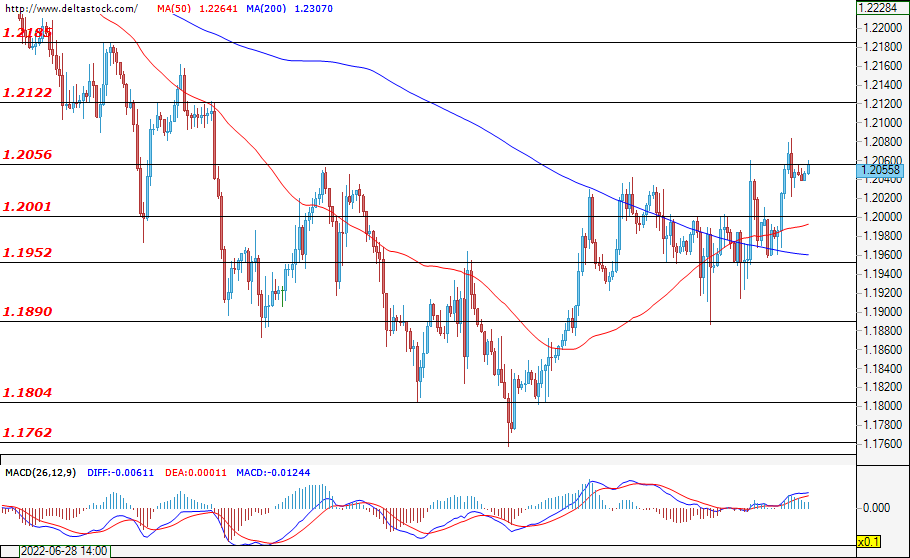
At the time of writing this analysis, the bulls are trying to break through the resistance at 1.2060 and a confirmed breach of this level would most probably lead the pair towards the next key resistance at 1.2120. In case the bears manage to keep the pair below the mentioned resistance, we may expect a downward movement and a test of the psychological level at 1.2000, where a successful breach would easily lead the pair towards the support at 1.1950.
EUGERMANY40
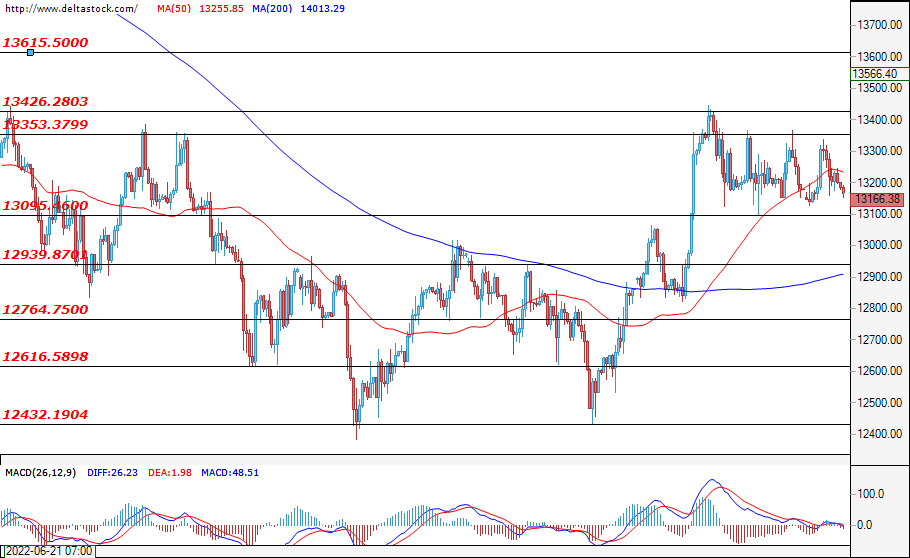
Neither the bears nor the bulls managed to gain enough momentum and lead the German index out of the zone between 13100 and 13350. The price is holding positions around the current level at 13166 and only a successful breach of one of the borders could signal the future direction of the index. A violation from the buyers could continue the recovery and could easily send the EUGERMANY40 towards a test of the zone at 13615. If the bears take control and breach the support at 13095, they could lead the price towards the next target at 12939, a violation of which could strengthen the negative expectations of the market participants.
US30
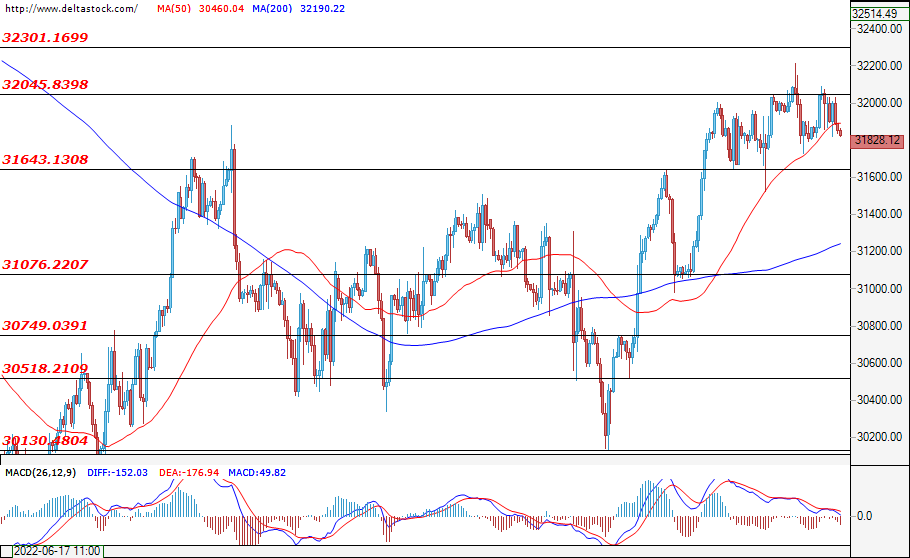
The U.S. blue-chip index is trading in the range with 31643 as support and 32045 as resistance. The bulls are experiencing serious difficulties around this area and the expectations are for the sellers to lead the price towards a test of the lower border of the range. A successful breach of this level would most probably result in sell-offs towards the level at 31076. On the other hand, if the bulls manage to overcome the resistance at 32045, their next target would be the area at around 32300.
DAX 40 Attempts to Rebound
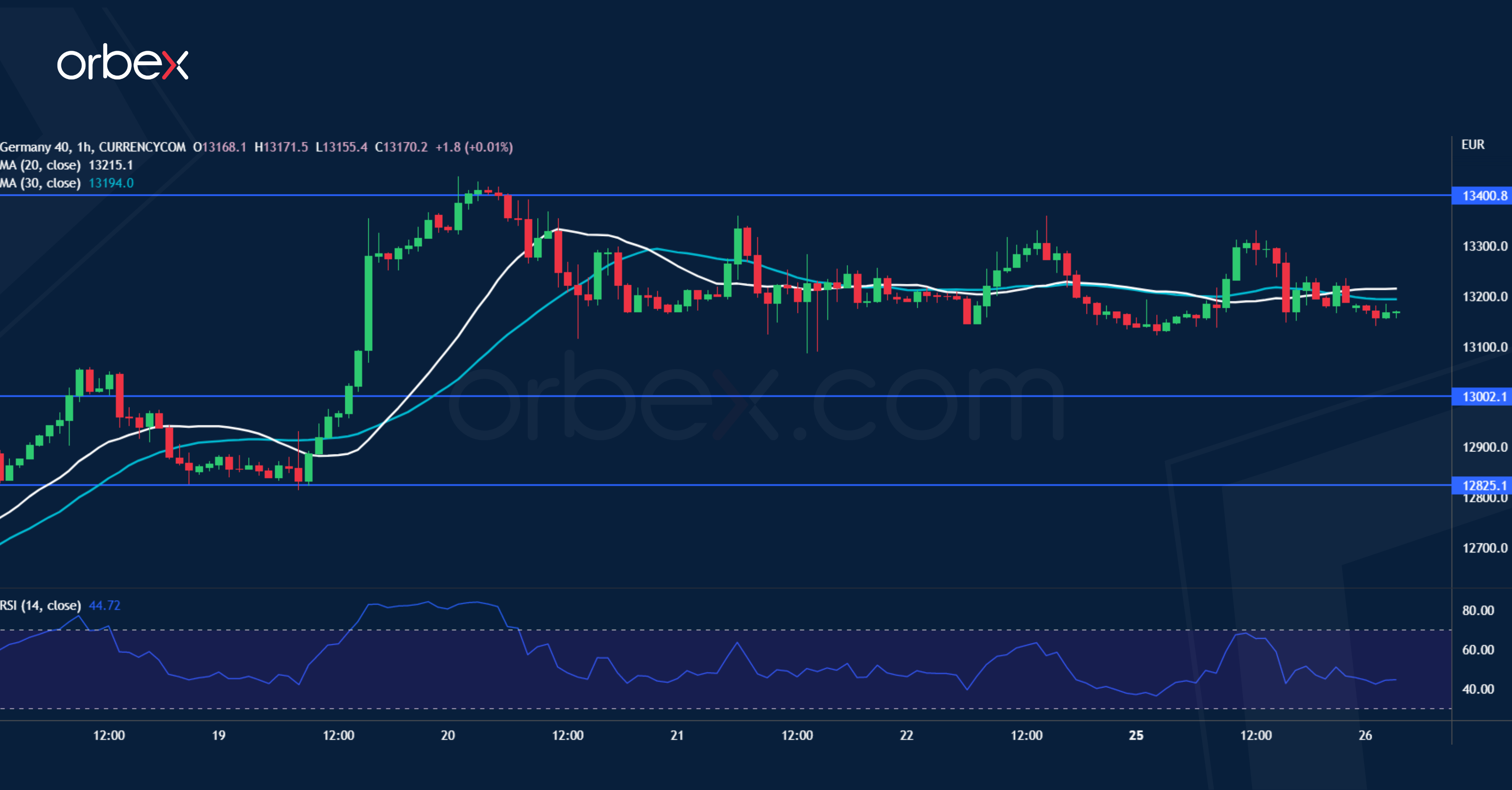
The Dax 40 treads water as business sentiment remains sensitive to energy uncertainty. Optimism grew after the price broke above the supply zone around 13400. The sideways action suggests commitment to keep the rebound intact. A close above 13400 may raise bids to 13650, a key resistance from the mid-June sell-off and the bears’ last stronghold. A bullish breakout could lead to a full-blown recovery as sellers capitulate. On the downside, 13000 is a fresh support and its breach would send the index back to 12820.
GBP/JPY Tests Resistance
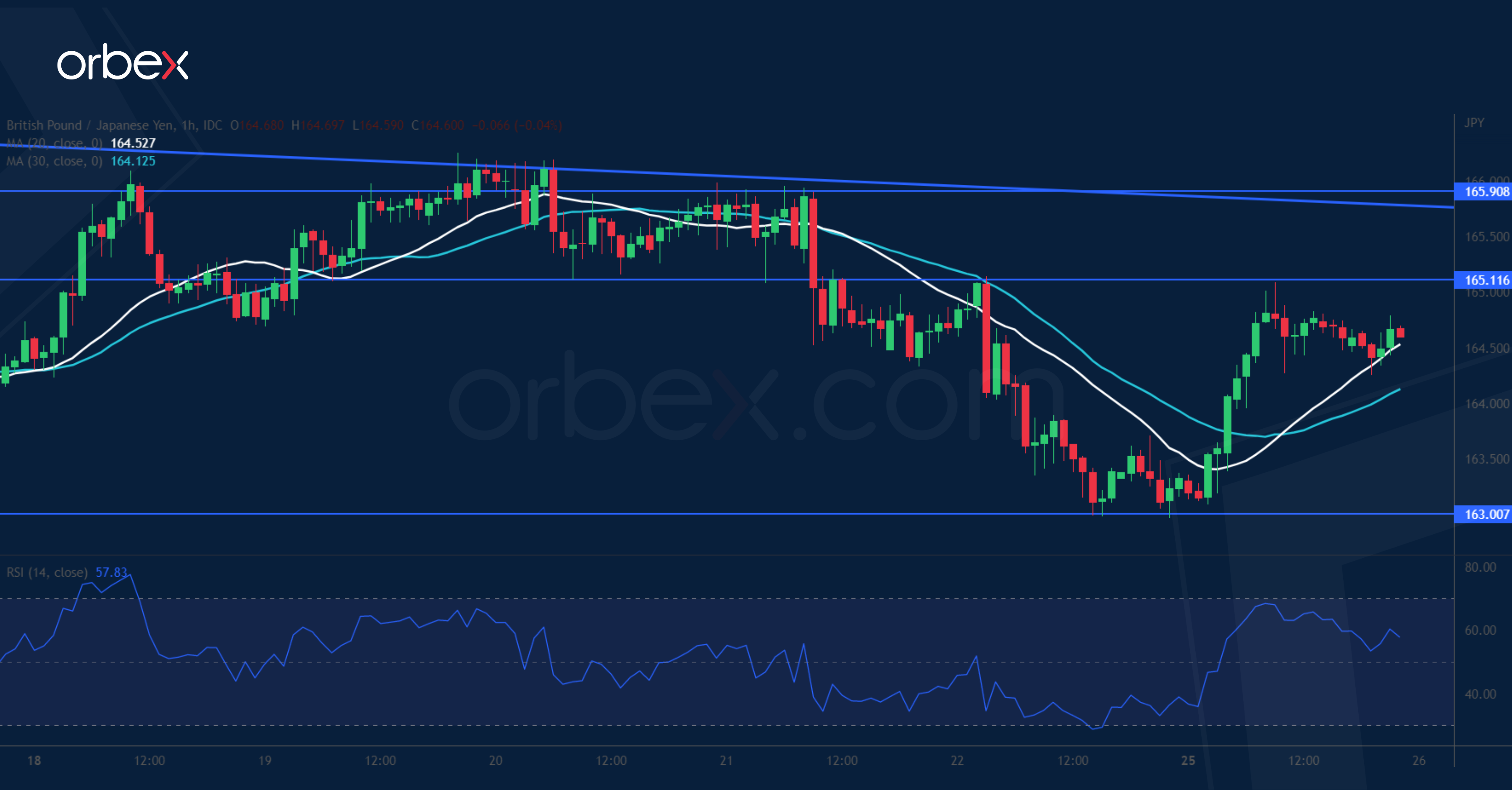
The Japanese yen softened after dovish BoJ meeting minutes. On the daily chart, the pair is swinging in a flag consolidation. The uptrend is still intact and the bulls may see the choppy price action as an opportunity to accumulate in anticipation of bullish continuation. 163.00 on the lower band of the flag pattern is the closest support. A break above 165.10 would bring the pound to the upper band (165.90) where a breakout could resume the rally. A bearish breakout though might cause a sell-off below 161.80.
EUR/USD Continues to Recover
The euro inches higher supported by the ECB’s shift to normalising its monetary policy. The psychological effect of parity had triggered a ‘buy-the-dips’ behaviour. A surge above 1.0200 prompted the short side to cover their positions and turned short-term sentiment around. The bulls further consolidated their gains above 1.0130, paving the way for a sustained rebound. A close above 1.0270 would attract momentum buying and send the single currency to the previous daily support-turned-resistance at (1.0440).
Directionless Trading as Investors Look for Clues What Fed’s Next Move is
Markets
Core bond yields yesterday sought to recover some of the heavy losses incurred on Thursday and Friday last week. With (small) success initially, especially in the US. European bond yields were helped by comments from ECB’s Kazaks and Visco respectively advocating and not ruling out another 50 bps rate hike in September. But then news hit markets that Russia is taking another turbine essential for gas flows to Europe offline for maintenance. This will cut supply from an already reduced 40% to just 20%.
German yields swapped all gains to the tune of 5 bps for losses. The curve steepened by dropping 4.3 bps at the front and 0.6 bps at the very long end. US yields retained about half of earlier gains, adding between 3.8 and 5.1 bps across the curve even as two more regional manufacturing activity gauges either turned or became more negative.
Gas prices surged 10%. Oil prices added almost 2% with tight physical supplies, particularly in Europe, outweighing recession fears. Stock markets dropped on the news but largely recovered later on. Europe finished with small gains of about 0.2%. Wall Street closed mixed with the Nasdaq underperforming (-0.43%).
The euro and the dollar were both trading without clear direction. It kept EUR/USD balanced just north of 1.02. The Japanese yen slid half a percent against both. The British pound was among the better bid with EUR/GBP falling through 0.85 yesterday and continues to be one of the better performers in quiet Asian dealings this morning. The dollar is marginally on offer.
Asian-Pacific stocks in many cases overcame opening weakness following retail bellwether Wallmart’s profit warning after US closing hours yesterday. Hong Kong outperforms. In other news on the autonomous region, the aggregate balance – a measure of interbank liquidity – halved in recent weeks. This is the result of the Hong Kong Monetary Authority heavily intervening in FX markets (buying HKD from commercial banks, selling USD) to protect the dollar peg. USD/HKD has been trading near the upper bound of the 7.75-7.85 range since May.
At the current rate, liquidity may be depleted as soon as the end of next month. More major companies including McDonalds, 3M and Coca-Cola are publishing earnings today and economic data includes the Conference Board consumer confidence for July and some US housing data. Barring significant surprises, they probably won’t influence trading materially ahead of tomorrow’s Fed policy meeting.
Core bonds traders are sidelined. With US money markets having fully discounted the flagged back-to-back 75 bps hike, we expect low-volume, directionless trading as investors look for clues what the Fed’s next move is going to be. There may be room for some further dollar consolidation but we see very few reasons for its resilience to be undermined any time soon, especially against the euro.
News Headlines
Economic growth in Korea unexpectedly accelerated in Q2 to 0.7% Q/Q from 0.6% in Q1. Activity was 2.9% higher compared to the same period last year. The strong performance was driven by a 3% rise in private consumption as consumer spending picked up more than expected after the lockdowns. Government spending (1.1%) and construction investment (0.6%) also added to growth. The strong domestic performance was partially offset by a 3.1.% decline in exports. Imports eased 0.8%. The data allows the Bank of Korea to continue its tightening cycle. Inflation printed at 6.0% in June. The BoK earlier this month raised its policy rate by 50 bps to 2.25%. The next BoK policy meeting is scheduled on August 25.
According to Czech TV, Finance Minister Zbynek Stanjura proposed to raise the 2022 budget deficit target to CZK 326.9 bn. The initial deficit was put at CZK 280 bn. Higher spending, amongst others, will be used to address the impact of the war in Ukraine and to facilitate further measures to ease the impact of higher energy prices. The budget deficit also widens due to higher pension costs. At the same time the deficit will be mitigated by higher tax revenues due to higher inflation. The Czech budget deficit hit a record high CZK 420 bn least year (5.9%). The finalization of the amended budget is expected to be debated by the cabinet on Wednesday. The Finance Minister recently indicated that he still intends to reduce the 2023 deficit to CZK 280 bn, the level that was initially planned for this year.
The Waiting Game
As expected, markets were quiet overnight ahead of a deluge of tier-1 earnings, data, and the US FOMC policy decision over the rest of the week. Equity, currency, oil, and precious metals markets were content to range trade, with only Bitcoin showing some life, falling by nearly 6.0%. Bloomberg is reporting that it looks like Coinbase is in trouble with the US SEC over what is a security and what isn’t. Draining the crypto-swamp is going to be a drawn-out process. Oil is rising higher this morning in Asia as energy markets, once again, get caught out by a Russian whipsaw choke hold.
There have been a couple of developments overnight that appear to be weighing on Asia today. Gazprom cut natural gas flows through Nord Stream 1 to around 20% of capacity, citing the usual “technical issues.” That follows the cruise missile attack on Odesa at the weekend, shortly after signing a Turkish-brokered deal with Ukraine to allow the resumption of grain exports. Markets continue to place hope on what Russia says, rather than what it does, when they should be approaching it from the opposite direction. Dutch natural gas prices moved nearly 10.0% higher, but European equities were remarkably resilient; despite a weak German IFO number, I can’t see that lasting.
Late in the US session, retail stalwart Walmart produced a very unimpressive set of results alongside a grim outlook for the rest of the year. Walmart blamed food and energy inflation, reducing consumers' discretionary spending power, and I can’t argue with that. Today sees Alphabet and Microsoft also announcing earnings, and although there is a lot of nerves around the digital advertising space, I suspect it will be Meta’s results tomorrow that really set the tone. As Meta found out earlier in the year, stock markets are a harsh mistress now if the pandemic-derived growth fantasies can’t be maintained. The same fate surely awaits all three, and Apple this week is that the fairy-tale hits a brick wall. Either way, we are unlikely to see a Wall Street session this week as quiet as the one overnight.
Meanwhile, in China, the announcement of a $44 billion fund by the government to support beleaguered property developers had zero impact on Chinese equity markets yesterday. That could be because China will need to stump up a lot more than $44 billion worth of Yuan to stop the rot. Evergrande, the big distressed-debt kahuna of the space, is approaching an end of July deadline to progress on restructuring its offshore debts. The CEO has been replaced this week, a victim of creative accounting by the group uncovered earlier this year. It looks like the end of July deadline will be a bit of a sea anchor for China equities this week.
Yesterday, Singapore’s inflation data surprised to the upside on both the core and headline readings. We can safely assume that the MAS will be sharpening their pencils for another tightening of monetary policy at their scheduled October meeting, although October seems like a long way away right now.
One bright spot today was South Korean Adv Q2 GDP, which rose by 0.70%, with forecasts expecting a retreat to 0.40%. Strong consumer consumption as covid restrictions eased, were behind the gain. Unfortunately, April-June 2022 is also an age away now, and the picture may have darkened since. I am expecting minimal impact from the data on either the Won or the Kospi.
The Thailand Balance of Trade and Singapore Industrial Production will be of only marginal interest today. Europe’s calendar is empty except for the Hungarian Central Bank policy decision; markets expect a 0.75% hike to 10.0%. The US calendar is rather more substantial, featuring Case-Shiller House Price Index, New Home Sales, CB Consumer Confidence and Richmond Fed Manufacturing and Services Indexes. In the present environment, with the recession word on everyone’s lips, you’d have to say all that data has downside risks.
The US Government is apparently trying to change the definition of a recession from two consecutive quarters of negative growth. Like governments everywhere, they are in a damage-control mood as inflation soars, making their populaces angry. In many cases, most of that blame should be laid at the feet of Russia and their respective central banks. Bulging with PhDs in economics, they all missed the transitory versus entrenched inflation trade, and now here we are.
Governments get the blame, of course, especially in democracies. The White House’s responses of late, as mid-terms loom, are starting to look desperate and are lacking dignity. Still, US commodity prices have fallen this month, gasoline consumption and pump prices have fallen sharply, and the US-centric WTI complex is looking much more wobbly than Brent crude. They say the best cure for high prices is high prices; perhaps the Democrats will get some good news before the mid-terms, although if job losses have started in earnest, it may still be for nought.
Anyway, I digress. Today’s session in Asia is likely to be erring to the soft side as recession fears mount in the US after Walmart’s results. Europe will be dominated by gas, the US by big tech earnings with a smattering of data. I had said previously that the bear market rally will have its moment of truth at the FOMC, but judgement day could arrive a little earlier. I am still not game to pick how this week finishes and will happily watch the circus from the upper-tier seats.
One last thing, and I know I must be boring readers now, but it’s important, and it's China. Reuters has reported overnight that authorities had ordered 100 large firms in Shenzhen into closed loop systems to counter covid and keep the factories going. Once again, covid-zero means covid-zero, not covid-zero once and done. If push comes to shove, I have no doubt that China will engage in large-scale lockdowns once again if it can’t get on top of its covid outbreaks. Bottom fish China if you wish, and if you have a long-term view, why not? But be prepared for an exciting ride along the way, as the light at the end of the 2022 tunnel could be the train coming the other way: possibly carrying officials to an Evergrande creditors meeting.
Asian equity markets are slightly softer after Walmart results
US markets had a mixed session overnight, with the S&P 500 and Dow Jones booking small gains while the Nasdaq fell. Overall, the picture was of continued range-trading, and investors positioning themselves for the earnings run this week, as well as the FOMC. In the Nasdaq’s case, it looked like some trimming of positions ahead of the big-tech earnings releases starting today. The S&P 500 edged 0.10% higher, the Nasdaq fell by 0.43%, and the Dow Jones rose by 0.28%.
The Walmart results also saw Amazon and Target stocks get a beating by association and re-energised recession nerves. That sees US futures falling in Asia. S&P 500 futures are 0.35% lower, Nasdaq futures are down by 0.25%, and Dow futures have fallen by 0.45%. That sentiment has carried over into Asian markets today, which are also having a modestly mixed day, erring towards the downside.
Japan’s Nikkei 225 has fallen by 0.20%, while South Korea’s Kospi has risen by 0.35% after strong GDP data. In China, the Shanghai Composite has edged 0.05% lower, with the CSI 300 adding 0.15% and Hong Kong gaining 0.40%.
Singapore is 0.25% higher, but Taipei has slipped 0.50% lower, and Jakarta and Kuala Lumpur have fallen by 0.40%. Manila and Bangkok have edged 0.25% higher. In Australia, markets are treading water. The All Ordinaries is down 0.10%, with the ASX 200 unchanged.
It doesn’t look like the Asia session will be one to set the world on fire today, especially with a light data calendar. The natural gas situation in Europe means that European equities will struggle to replicate yesterday’s gains. US markets will come down to the Microsoft and Alphabet results with a dash of data for seasoning. I won’t even bother to speculate what the soup will taste like.
Currency markets range-trade overnight
Currency markets range-traded overnight, with very little to show in either the G-10, Asia FX, or EM space. The technical picture on the dollar index, however, is testing the bottom of its rising wedge, and it is shouting that the US Dollar correction lower still has legs. Overnight, the dollar index finished almost unchanged at 106.48 but has moved through the wedge support at 106.40 today, falling 0.18% to 106.29. A daily close under 106.40 signals more losses towards 1.0500 and 1.0350, and it could extend to the 102.50 long-term breakout point. Resistance is at 107.00, 107.30 and 108.00.
EUR/USD was flat at 1.0230 overnight, gaining 0.15% to 1.0237 in Asia. Russian gas woes could limit gains despite the technical picture being constructive. It has resistance at 1.0275, but only a sustained break above 1.0360 would suggest a longer-term low is in place. EUR/USD has support at 1.0150 and 1.0100.
GBP/USD edged 0.35% higher to 1.2040 overnight, rising to 1.2065 in Asia. Sterling has support at 1.1900 and 1.1800, with resistance taken out at 1.2060 today, followed by 1.2200. A close above the 1.2060 wedge formation signals a larger rally to the 1.2400 regions, but it would take a sustained break above 1.2400 to call for a longer-term low by sterling.
With US yields moving sideways overnight, USD/JPY drifted 0.40% higher to 136.65 overnight, where it remains in Asia. A loss of 135.50 sets the scene for a larger downside correction, potentially reaching 132.00. Initial resistance is distant at 138.00, followed by 139.40. The US/Japan rate differential continues to hold USD/JPY in its thrall.
AUD/USD and NZD/USD rose modestly overnight to 0.6960 and 0.6265, where they remain in Asia. They continue consolidating their respective topside wedge breakouts. Only a move back below either 0.6800 or 0.6150 changes the short-term bullish technical outlook. Like AUD and NZD, the Asian FX space was almost unchanged overnight and is in a holding pattern ahead of the main events for the week, starting with US tech earnings this evening.
Russia lifts oil prices
Russia has further reduced gas flows to Germany overnight, which is threatening to unwind oil’s move lower on Nord Stream 1 reopening. As that reality set in, Brent crude rose 1.20% to 104.85, and WTI gained 1.30% to $96.25 a barrel. In Asia, the Russian moves have also spooked local markets, sending prices sharply higher. Brent crude is 1.85% higher at $106.60, and WTI has leapt 1.80% higher to $98.00 a barrel.
Despite the price discount by WTI over Brent widening to near three-year highs, both contracts have futures curves that remain in deep backwardation, signalling that prompt physical supplies remain tight, even if US gasoline stocks are now rising sharply and refining margins are falling. Russia remains the wild card in the energy space, supporting prices, a situation unlikely to change anytime soon. Of the two contracts, WTI looks the more vulnerable, having the greater physical beta to US domestic energy consumption.
Brent crude is approaching significant technical resistance at $108.80, a sustained break of which signals a larger rally targeting $115.00 a barrel. Support is at $101.50 a barrel. WTI has resistance at $100.00, while it once again, bounced off its 200-day moving average (DMA) at $94.85 overnight. Until a sustained break of the 200-DMA occurs, significant topside squeezes by WTI remain entirely possible.
Gold trades sideways
Gold finished 0.45% lower at $1720.00 overnight, edging 0.20% higher to $1723.25 an ounce in another aimless Asian session. The charts continue to suggest that while gold is trying to form a medium-term low, its price action remains underwhelming, and we will have to wait until we get into the meat of the week's calendar to see if this scenario plays out.
Gold needs to overcome heavy resistance at the $1745.00 an ounce triple top before the gold bugs can really start to get excited. It has support at $1680.00, and then the longer-term support around $1675.00 an ounce zone. A sustained failure of $1675.00 will signal a much deeper move lower targeting the $1450.00 to $1500.00 an ounce regions.
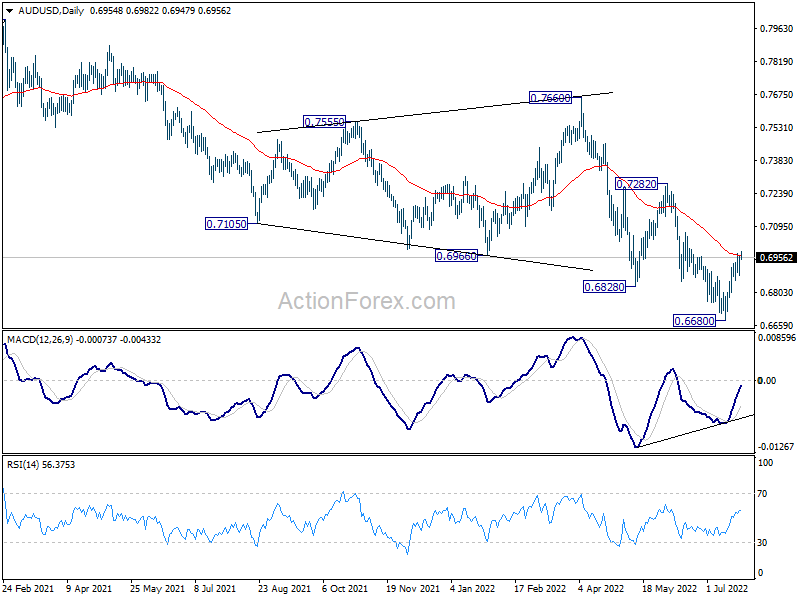
AUD/USD Daily Report
Daily Pivots: (S1) 0.6903; (P) 0.6934; (R1) 0.6988; More...
AUD/USD's rebound from 0.6680 resumed after brief retreat and intraday bias is back on the upside. Sustained trading above 55 day EMA (now at 0.6967) will pave the way to 0.7282 resistance next. Nevertheless, break of 0.6877 will turn bias back to the downside for retesting 0.6680 low.
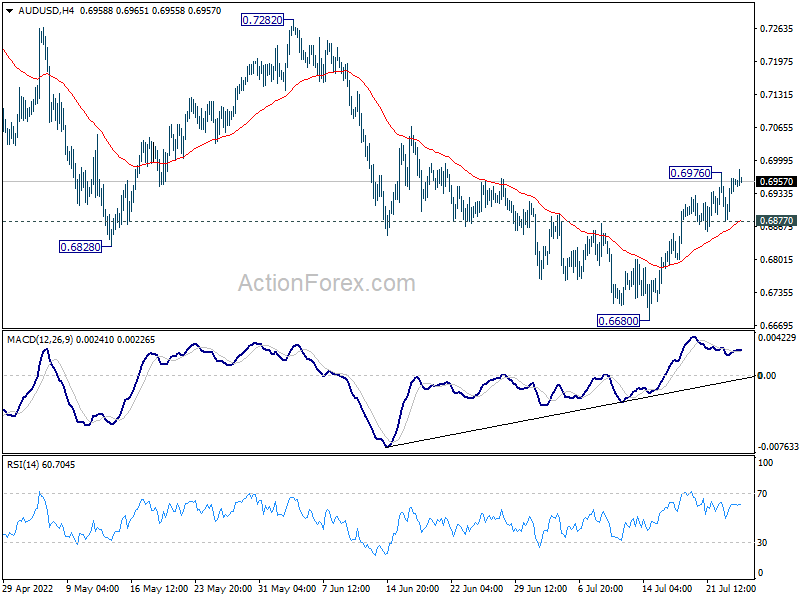
In the bigger picture, price actions from 0.8006 (2021 high) could still be a corrective pattern to rise from 0.5506 (2020 low). But current downside acceleration, as seen in weekly MACD), is raising the chance that it's a bearish impulsive move. In either case, outlook will remain bearish as long as 0.7282 resistance holds. Next target is 61.8% retracement of 0.5506 to 0.8006 at 0.6461.