

Sample Category Title
Market is Shunning Euro While Stacking Up Dollars
Markets
The dollar enjoyed another day in paradise yesterday. The greenback excelled at the start of the new week, sprinting higher against all of its most important peers during outright risk aversion. Recession fears already took over again after Friday’s solid payrolls brought some temporary comfort. The trade-weighted index (DXY) hit a new two-decade high of 108.02. That move coincided with USD/JPY breaking previous cycle highs to close at 137.44 (24-year high). Unwavering euro weakness added to EUR/USD’s protracted decline. The combination closed millimeters away from parity (1.004). EUR/CHF erased a two-day recovery to finish at 0.987. Sterling kept the upper hand over the common currency as well. Since breaking below the upward sloping trend channel, EUR/GBP fell about 1.5 big figures from 0.86 last Tuesday to 0.844 yesterday. Cable (GBP/USD) stuck to the YtD lows around 1.19 though. Meanwhile, several senior Tories warned for policy paralysis if outgoing PM Johnson sticks around until his successor has been chosen. This is due by September 5. Former Chancellor Sunak entered and is currently leading the early race. Moves in other markets were equally tainted by the risk off. Core bonds jumped with German Bunds outperforming UST’s in sessions that see liquidity increasingly drying up. German yields dropped between 7.2 (30y) and 10.1 (5y) bps. Peripheral spreads vs. Germany’s 10y rose by 2 bps. US yields were down 3.4 (2y) to 9.4 (20y) bps for the day. Equities fell 1-1.5% in Europe and between 0.5-2.3% in the US. Tech underperformed. The negative mood spilled over into Asian dealings this morning. South Korean stocks lag (-2.2%). European equity futures suggest a red opening to the tune of -0.75%. The US yield curve flattens by 3.5 bps at the front and it remains dollar dominance on FX markets. EUR/USD came as close to parity as 6 pips. Given the lack of economic data we expect the current market atmosphere to set the tone for trading today. A test of the highly symbolic EUR/USD 1 level looks inevitable. A break paves the way to intermediate support around 0.96. But the actual reference is the all-time low of 0.823. The market is shunning the euro while stacking up dollars for the rainy days to come. It poses yet another difficult trade-off for the European Central Bank as it jolts imported inflation even further. That said, markets are much less convinced than just a few months ago about the amount of rate hikes the ECB will be able to deliver with the continent in (energy) crisis mode. That’s less the case for the Fed, with the US economy still proving resilient (eg. Friday’s payrolls). We’re keen to see whether US June inflation figures due tomorrow are able to diverge markets focus again. In Europe, a €8bn EU dual tranche transaction is upcoming today, comprising a new 7yr benchmark due 4 December 20029 and a tap of the EU 0.45% 07/2041 bond.
News Headlines
According to the data from the British retail consortium (BRC), the nominal value of retail spending in the UK for the third month in a row printed below the level of the same month last year at -1.0% y/y (from -1.1% in May). However, as the data are not corrected for price rises, volumes of sales are declining sharply. According to BRC ‘sales volumes are declining at a rate not seen since the depth of the pandemic, as inflation continues to bite and also are cutting back spending’. BRC also signals that shoppers are shifting spending to cheaper brands of foods and other goods as well as postponing some purchases. According to the New York Fed June 2022 survey of consumers expectations, US consumers see inflation rising further in the one-year ahead period from 6.6% to 6.8%. However, medium term inflation expectations (3-y ahead) eased to 3.6% from 3.9%. US consumers also expect a sharp slowdown the rise of house prices one year from now at 4.4% down from 5.8%. The decline is the second largest on record and the expected rise marks the lowest since February 2021. US households see higher unemployment and a rising probability of losing their own job in the year ahead (11.9% from 11.1%). Median year-ahead household spending growth expectations retreated from its series high in May, declining by 0.6 percentage point to 8.4% but remains well above its 2021 average of 5.0%.
Struggling for Parity
Things sure are looking messy out there right now, especially in Forex Land where the Euro is within a hair’s breadth of trading at parity with the US Dollar this morning. Overnight, the single currency slumped by 1.45% to 1.0040 as Euro yields edged lower as markets fell over themselves to price in a European recession. Energy, and by this, I mean Russian energy, lies at the heart of Europe’s turmoil, with news that Canada would release a specialised gas pipeline pump back to Russia to keep the petajoules flowing having no positive impact. My understanding is that as of yesterday, Nord Stream 1 which carries the fruits of Germany’s energy policies from Russia has entered its annual 10-day maintenance shutdown. The key question is, will the gas return after the 21st of July. Markets seem to be making up their mind already.
The slump by the Euro overnight also dragged Sterling down with it, which faces a messy leadership battle now post-Bojo. Today it was announced that the process would be concluded by err… September 5th. Wonderful. Risk sentiment indicators, the Australian and New Zealand Dollar, were also dragged down the Euro whirlpool as well as investors loaded up on US Dollars and a fair few US government bonds as well by the looks, as US yields fell overnight. Gold, the forgotten asset class, is also trading one-for-one with EUR/USD this morning as well.
As for EUR/USD itself, it has never looked back after it fell through the multi-decade support line at 1.0850 earlier this year. I have no doubt there are plenty of options-related buds just ahead of parity. Likely these are related to 1.0000 knockouts and one-touches and other arcane options “structures”. If previous form is followed, we are likely to see a slow erosion of those bids, along with some dead cat bonces, and when parity finally goes, the stop-losses will kick in sending EUR/USD quickly lower. My charts are thin on the ground at these subterranean levels, but somewhere around 0.9900 looks like the next stop for the train.
US data has thrown the cat amongst the pigeons of course. Friday produced another blockbuster Non-Farm Payrolls, which leapt higher to 372,000. Unemployment was unchanged at 3.60% suggesting Americans are returning to the workforce and are being slurped up by employers. That certainly rained on the “recession-is-nigh” party, something I have been saying isn’t a done deal to global deaf ears. The street is locked and loading another 75 basis points from the Fed at the end of the month. This Thursday’s US Inflation data will be the pivotal moment for financial markets this morning. If headline inflation stays at or above 8.80% YoY, and/or the core stays at 5.70% or above, get ready for a risk-aversion sell-off. Having said that, given the genetic propensity of the equity market FOMO gnomes to buy the dip, lower prints could spark a welcome relief rally in the stock, bond, and currency markets.
Another risk points the street is begrudgingly waking up to at last is China and covid-zero. The city of Wugang is being locked down today for three days, while cases are creeping higher in other parts of the Mainland. That is weighing heavily on China's equities right now with Mainlanders rightly worried that more lockdowns, especially in Shanghai or Beijing, could occur. That has overshadowed excellent lending data released this week, as banks respond to central government exhortations to get play their stimulus part. ASEAN markets are yet to wilt, although the Northern Asia heavyweights geographically collocated certainly are. That could be because of their correlation to the Nasdaq though. The value-heavy ASEAN stock markets are looking like a safety play this morning, I’m not sure how long that will last.
Japan’s Finance Minister Suzuki has been on the wires this morning as USD/JPY approaches 138.00 saying Japan will take “necessary steps” in the forex market, as necessary I suppose. He also said that they would be closely communicating with other FX authorities internationally. This is the usual rhetoric when things don’t go to plan, and I do not believe we are imminently going to see the Ministry of Finance intervening in USD/JPY. (sidenote: the MOF makes the call on intervention; the BOJ merely executes it.) I am a little surprised that USD/JPY has remained at these levels, just as I am certain other “authorities” have bigger fish to fry right now and don’t think the Yen’s depreciation is a threat to global financial stability. If the MOF intervenes, it’ll be doing it alone. Probably the best hope Japanese authorities have for some Yen relief is a slump in US yields triggering a culling of the heavily long USD/JPY open interest out there.
China will also be front-and-centre at the end of this week amongst the tier-1 US data dump. On Friday, it releases its House Price Index, Industrial Production, Retail Sales, Fixed Asset Investment, and Unemployment for June, as well as quarterly GDP Growth and Capacity Utilisation. Although virus nerves will captivate the short-term attention of traders and investors, the data will go a long way to answering how well-placed China is to weather another bout of Covid lockdowns.
Tomorrow, we get rate decisions from the Bank of Korea and Reserve Bank of New Zealand as well as China’s 1-year Medium Term Facility Rate. The lending numbers from China this week mean there is no urgency to lower the 1-year MTF. The Bank of Korea is on track to announce a punchy (by their standards), 0.50% rate hike after recent elevated inflation data and a rapidly weakening Won in the face of the Dollar juggernaut.
The Reserve Bank of New Zealand is being bandied around as the canary in the coal mine for other central banks, having started normalising policy sooner than other developed market central banks. That is giving the RBNZ far too much credit, only the Central Bank of Turkey has done a worse job. The RBNZ kept quantitatively easing as inflation exploded in New Zealand and sent house prices spiralling. Having sat like a possum in the headlights while the cost of living spiralled out of control and presided over the greatest transfer of wealth ever from our young people to our old people, they were then tardy and timid in stopping QE and then raising interest rates. They have nicely set up the country for an abrupt slowdown this year. A 0.50% rate hike is baked in, but the attention will be on whether they indicate a slower pace of hikes going forward. Given the stagflation nightmare they created, this would be a mistake and all I can say to any central bankers reading this newsletter is if the RBNZ blinks, you should absolutely do the opposite. The RBNZ is a reverse leading indicator, not a leading indicator. (NB: I am a Kiwi, and you may have noticed, that I am a bit upset with the RBNZ)
Data released today in Asia have been second-tier. Japan’s June PPI rose by 9.20% YoY, higher than expected, and the Bank of Japan sticking to an easy monetary policy, has kept up the pressure on the Yen. The Philippines' Balance of Trade was worse than expected, falling to $-5.678 billion in May as imports exploded. Once again, a deteriorating trade balance will keep the pressure on the Peso, already at record lows. Australian Consumer and Business Confidence data was weak, but a much lower Australian Dollar overnight is keeping local equities supported.
This afternoon sees the release of the German ZEW Economic Sentiment Index for July. It goes without saying it has serious downside risks and will be another headwind for the Euro and European equities this afternoon. India’s Inflation data this evening should see YoY Inflation remaining above 7.0% as the Indian Rupee slump continues and energy prices remain firm. The US 10-year note auction will be worth watching, with heavily US bond issuance this week. A weak bid-to-cover could give the US Dollar rally a reason to pause, while the API Crude Inventories could lift oil prices if the headline number falls sharply from last week’s 3.8 million-barrel gain.
Asian equities are mostly lower
Wall Street went back into recession mode overnight, with the growth-centric Nasdaq underperforming as tech heavyweights were sold off. The Nasdaq’s fall has translated directly into weakness with the correlated North Asia heavyweights, while the rest of Asia and Pacific has escaped mostly unscathed. Covid-19 fears in China continue to hang like a dark cloud over the region, however.
Overnight, the S&P 500 fell by 1.15%, with the Nasdaq tumbling by 2.26%, while the Dow Jones finished 0.52% lower. The giant Non-Farm Payrolls number has given Wall Street food for thought on US rate hikes, with the FOMC looming at the end of the month, even as haven flows sent US yields lower across the curve. In Asia, US futures continue to fall with futures on all three major indexes down by around 0.50%.
The continuing retreat of US futures, along with the Nasdaq slump overnight and lockdown fears in China sees most of Asia lower. Japan’s Nikkei 225 has slumped by 2.0%, with South Korea’s Kospi dropping by 1.20%. In Mainland China, lockdown fears see the Shanghai Composite 1.0% lower, with the CSI 300 falling by 1.20%. Hong Kong’s Hang Seng is also 1.20% lower.
In regional markets, a holiday in Singapore and Malaysia yesterday see the Straits Times managing to remain unchanged, but the KLCI has fallen by 0.45%. Taipei has tumbled 2.55% lower. Jakarta is down just 0.05%, with Bangkok and Manila easing by 0.40%. A lower Australian Dollar seems to be boosting the resource-heavy Australian markets today. The ASX 200 is 0.20% higher, while the All Ordinaries has gained 0.40%.
Asia is roughly mirroring the Wall Street growth/value split overnight. Unfortunately, European markets are unlikely to find much solace because of that. Energy concerns and a slump by Wall Street overnight are likely to see European bourses open well in the red this afternoon.
US Dollar tramples all before it
The US Dollar caught another flight-to-safety boost overnight, running rampant over DM currencies with the Euro, Sterling, Yen, and Australian Dollar coming in for particular attention. In Asia today, EUR/USD continues to flirt with parity, while the US Dollar has strengthened broadly across the Asia FX space.
The dollar index soared 1.23% higher to 108.21 overnight, gaining another 0.16% to 108.38 in Asia as Euro and Sterling losses continued. Overall, the technical picture remains constructive for the dollar index, although the daily relative strength index (RSI) is now in overbought territory, suggesting a temporary downward correction is possible. Having broken out of a 5-year triangle at 102.50 in April, its longer-term target remains in the 1.1700 area. More immediate resistance is at 108.45 and 110.00. Support is at the 1.0585 breakout point, and then 1.0500, followed by 1.0350 and 102.50.
EUR/USD tumbled by 1.43% to 1.0040 overnight, edging 0.17% lower to 1.022 today, having traded as low as 1.0006 earlier in the session. I expect there to be plenty of bids into parity initially, likely option and exporter-related. A break of 1.0000 is likely to trigger a sharp move lower as stop-losses and algos kick in. Since breaking a multi-year support line at 1.0850 in April, Euro has looked consistently weak, the recovery rally failing ahead of 1.0850 in a technical analysis nirvana. An oversold RSI allows for short-term recovery, with resistance at 1.0200 and 1.0270. Support is at 1.0000, and failure targets the 0.9900/25 area.
GBP/USD fell by 1.19%% to 1.1890 overnight, dragged lower by the Euro and a rampant US Dollar. With a new Prime Minister not due to be announced until early September, this uncertainty will continue to weigh on the sterling. In Asia GBP/USD has edged 0.20% lower to 1.1867. Immediate support is nearby at 1.1860 and 1.1800, with 1.1400 the medium-term target. Resistance is well defined at 1.2060 and 1.2200.
USD/JPY rallied by 0.98% to 137.40 overnight despite US yields easing. In Asia, it is steady at 137.30 as Finance Minister Suzuki’s comments add some two-way risk into being long USD/JPY at these levels, at least temporarily. USD/JPY has resistance at 138.00 and 140.00, with support at 136.00, 134.25 and 132.00. Only a sharp fall in US yields seems likely to turn USD/JPY lower.
AUD/USD slumped by 1.70% overnight to 0.6735 on a combination of haven-based US Dollar buying, a reversal in global investor sentiment, and China lockdown concerns. In Asia, it has eased 0.17% lower to 0.6725. A correction above resistance at 0.6900 looks unlikely for now, with risks skewed towards the downside and a test of 0.6600. NZD/USD also plummeted overnight and is facing a test of 0.6100 today.
Asian currencies fell overnight as investors moved into risk-aversion mode and bought US Dollars across the board. The Won, Baht and Yuan led losses, and today USD/Asia is higher by around 0.30%, with the Philippines Peso falling 0.60% after poor trade data, while USD/IDR is testing 15,000.00 and USD/MYR looks set to test 4.4500. USD/INR and USD/PHP are trading at record lows although the price action in USD/INR, USD/IDR, USDKRW, USD/PHP and USD/THB suggests that local central banks are offering US Dollars at these levels. That is likely to be smoothing rather than lines in the sand, and US inflation above 7.0% this Thursday will probably spur more selling. USD/CNH has also moved sharply higher in the last 24 hours, and any indication that China is enacting lockdowns again in major urban centres will see it and the rest of the Asia FX space move sharply lower.
Oil trades sideways overnight
Oil prices had another choppy session overnight but ultimately traded sideways, booking just modest losses. Markets remain torn between recession fears in the US, Europe, and China torpedoing growth and thus, oil consumption, and the still very tight supply/demand reality of the physical market. Little hope is being assigned to Biden’s visit to Saudi Arabia unlocking more production from them or the UAE. The price is likely to be very high to achieve that.
Brent crude finished 0.70% lower at $106.25 overnight, while WTI fell 1.30% to $103.35 a barrel. News that a court in Russia has overturned the environmental ban at the Kazakh’s Black Sea terminal in Russia, has sent oil prices slightly lower in Asia. That is likely to be temporary given the Russian judicial system, and it seems that China's lockdown fears are keeping oil prices offered in Asia. Brent crude is 0.80% lower at $105.35 a barrel, with WTI falling by 1.10% to $102.30 a barrel.
Reports that Iran is about to sell 100’s of drones, some armed, to Russia could be a body blow to any nuclear deal with the west. That means that the chances of Iranian crude returning legally to international markets in greater volumes is receding and could prove supportive of prices as the day goes on.
Brent crude has resistance at $107.50 and then its 2022 trendline breakout at $108.85, followed by the 100-day moving average (DMA) at 110.75. It has traced double bottom at $103.75 and $98.60, followed by the 200- day moving average (DMA) at $96.75 a barrel. WTI has resistance at $105.00 and then its 100-DMA at $107.50 a barrel. Support is at $101.00 and then $96.60.
Gold is soggy in Singapore
The wholesale retreat of investor sentiment overnight saw massive inflows into the US Dollar, pressuring gold once again. Gold fell 0.50% to $1734.00 an ounce overnight. In Singapore, gold has had a choppy $1723.00 to $1744.00 range this morning and appears to be trading tick-for-tick with movements in EUR/USD today. As such, a break of parity by EUR/USD will signal a test of $1700.00 by gold. As I write, gold is down by 0.30% to $1729.00 an ounce in Asia.
Since breaking $1780.00, gold’s technical picture has deteriorated rapidly, and it is clear it remains at the mercy of the US Dollar's direction. The only positive note to be seen is that its RSI is now in very oversold territory, allowing for a modest corrective rally to occur if a downward correction in the US Dollar happens. Despite four sessions of sideways trading, gold remains anchored at the bottom of its range and only a miracle slump by the US Dollar this evening is likely to move it off the seafloor.
Gold has resistance at $1780.00, $1785.00, and $1820.00, its downward trendline. Support is at $1720.00, followed by $1675.00. Failure of longer-term support at $1675.00 sets in motion a much deeper correction, potentially reaching $1500.00 an ounce.
Elliott Wave View: Gold (XAUUSD) Remains Bearish Near Term
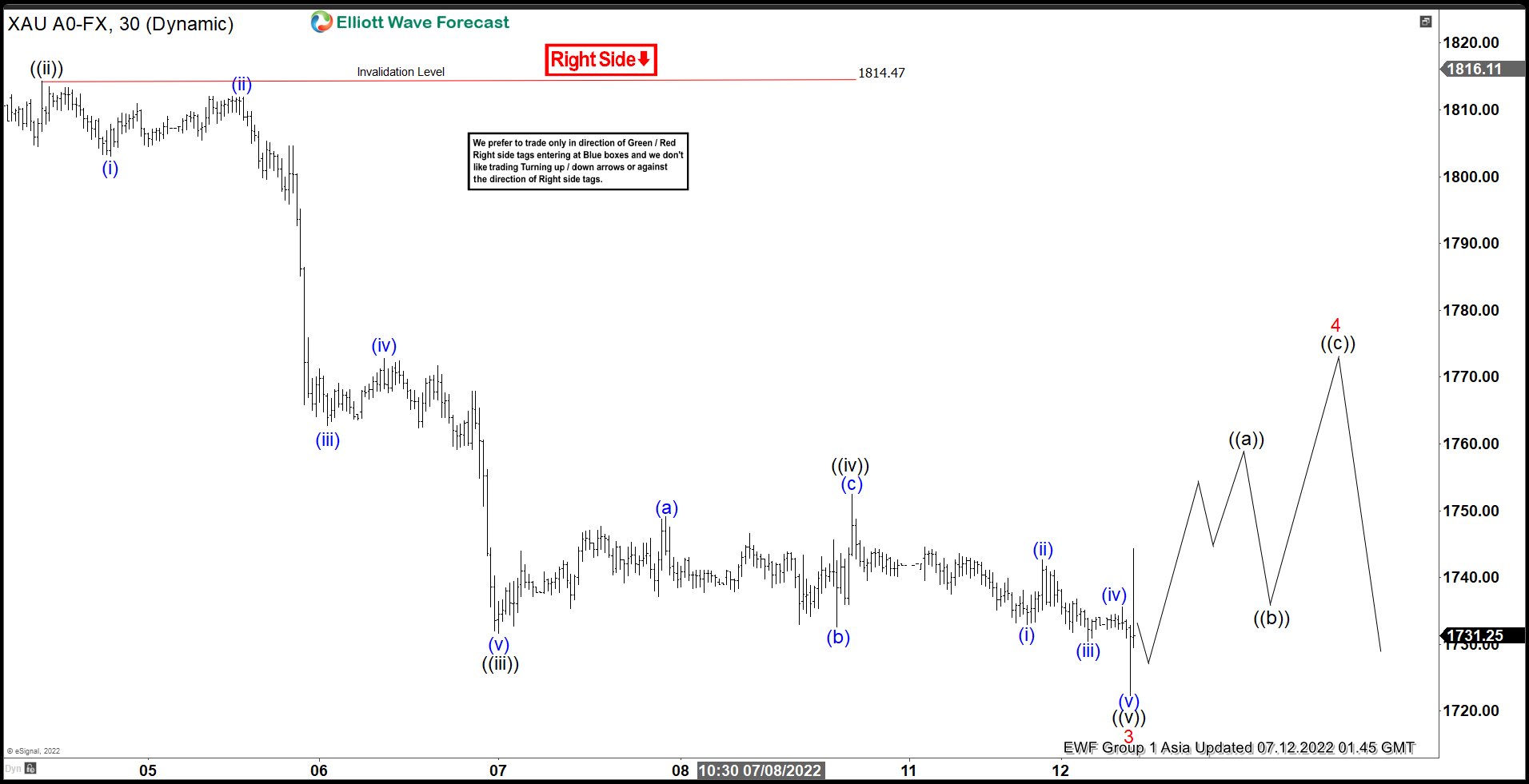
Short term Elliott Wave view in Gold (XAUUSD) suggests the decline from 6/17/2022 high is unfolding as a 5 waves impulse Elliott Wave structure to complete a wave 3 of higher degree. Down from 6/16/2022 high, wave ((i)) ended at 1783.55 and rally in wave ((ii)) ended at 1814.47. Internal subdivision of wave ((ii)) unfolded as a double correction Elliott Wave structure. Wave (w) of this double correction ended at 1808.8. Pullback in wave (x) ended at 1797.22, and final 3 swings as wave (y) ended at 1814.47 which also completed wave ((ii)).
The 30 minutes chart below shows wave ((iii)) decline starting from wave ((ii)). Wave ((iii)) lower has completed with subdivision as an impulse in lesser degree. Down from wave ((ii)), wave (i) ended at 1802.97 and rally in wave (ii) ended at 1812.06. Gold extended lower in wave (iii) towards 1762.48, and rally in wave (iv) ended at 1772.77. Final leg lower wave (v) finished at 1731.47 and wave ((iii)) was completed. Wave ((iv)) pullback did flat correction ending at 1752.32. Last drop in 5 swings ended wave ((v)) at 1722.25 which also completed wave 3. The metal should do a corrective rally in wave 4 before the decline resumes. Expect wave 4 rally to fail in 3, 7, or 11 swing for further downside.
XAUUSD 30 Minutes Elliott Wave Chart
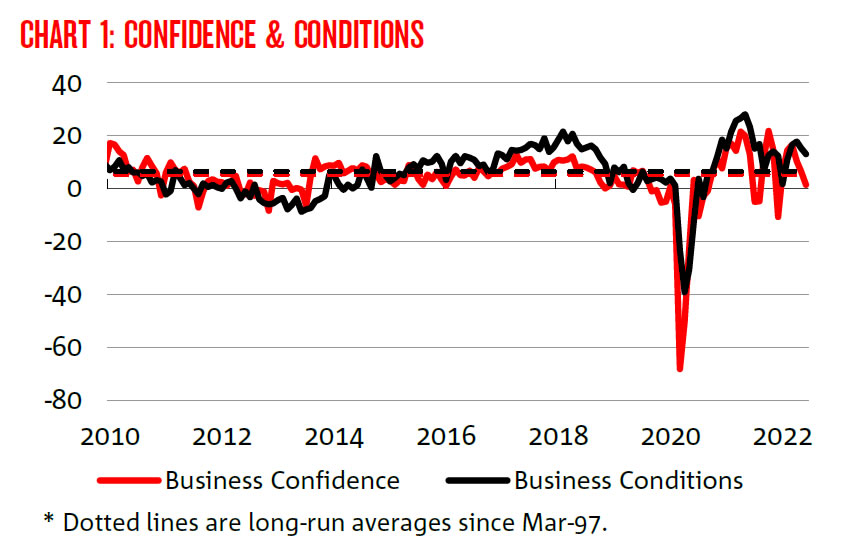
Australia NAB business confidence dropped to 1, but conditions held up
Australia NAB business confidence dropped from 6 to 1 in June. Business conditions dropped from 15 to 13. Looking at some details, trading conditions dropped from 21 to 18. Profitability conditions dropped from 16 to 12. Employment conditions dropped from 12 to 10.
"Confidence sank below average in June as inflation and interest rate hikes clouded the outlook," said NAB Group Chief Economist Alan Oster. "Confidence in the retail sector took a significant hit, falling more than 20pts to be well into negative territory, reflecting concerns about the outlook for household spending."
"While confidence fell, business conditions held up in June," said Oster. "Conditions remain strong across the states and in most industries. Construction continues to be the only real outlier with building costs weighing, despite a healthy pipeline of work in the sector."
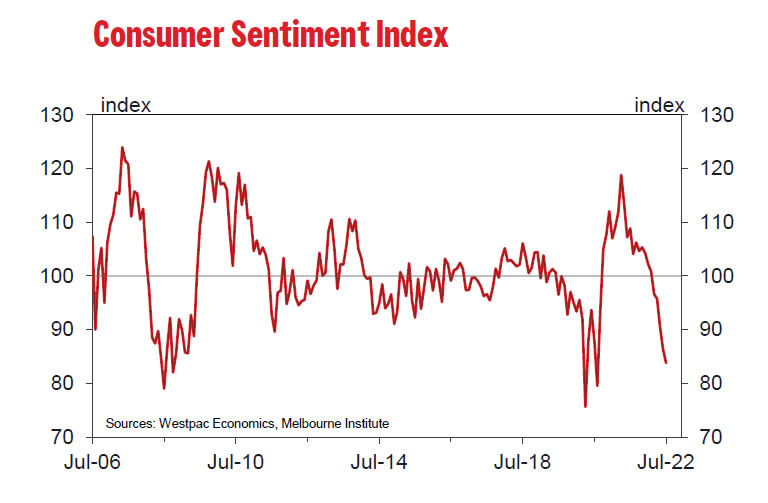
Australia Westpac consumer sentiment dropped to 83.8, comparable to previous major shocks
Australia Westpac Consumer Sentiment Index dropped from 86.4 to to 83.8 in July. The confidence has been falling every month this year, and it's now -19.7% below December's level.
Westpac said that both level and pace of deterioration are "comparable to previous major shocks". It added that rate fears were intensifying, with 73% polled expecting rates to rise more than 1%.
As for RBA policy, Westpac expects another 50bps rate hike on August 2, taking interest rate to 1.85%. That would be near to Westpac's assessed "neutral zone" of 1.5-2.0%. It expects RBA to adopt a "more cautious approach" once policy moved to "neutral", and pause the tightening first after August's hike.
Fed Bostic supports another 75bps rate hike in Jul
Atlanta Fed president Raphael Bostic said yesterday, "the data that came in the last several months really pointed to a need for us to get closer to that neutral stance faster,"
"I'm confident that the economy will be able to withstand this next move. I would support a 75 basis point" rate hike at the July FOMC meeting, he added.
Beyond July, the decisions will depend on incoming economic data. "If demand comes down much faster than we expected or supply comes back, I will be comfortable pulling off" further rate increases, Bostic said.
Separately, St. Louis Federal Reserve president James Bullard said, "now we have lots of inflation, but the question is, can we get back to 2% without disrupting the economy? I think we can."
Bojo Leaves, What’s Next?
The UK prime minister saw his career suddenly collapsing last week at the most burdensome period for the economy. While the race to replace him is already heating up, his unfinished political goals suggest his successor will have to make herculean efforts to put the country back in the right direction. The British pound may also face a tough time along the way despite its initial positive reaction to the political chaos, as GDP growth figures will probably revive fresh recession fears on Wednesday at 07:00 GMT.
Success before failure
Boris Johnson was about to fight for his leadership if only several dozens of ministers from his own cabinet had not resigned, abandoning him in solitude more or less two years before his term officially ends. But that was not the first time he went defensive. He was actually determined to do whatever it takes from the first days in office when he was accused of suspending parliament unlawfully for a month with the goal of preventing ministers from blocking a no-deal Brexit until the October 31 2019 deadline.
Then, after just six months in office, he managed to resolve the Brexit paralysis that his predecessor Theresa May had been long struggling to achieve without success, helping the buttered British pound to experience a much needed rally against the US dollar. Following up, after a year at the end of 2020, he signed a trade deal with the EU.
The coronavirus crisis was supposed to be another win for Boris given the first administration of a Covid-19 vaccine and the immunization of a large share of population while releasing a huge amount of stimulus to safeguard consumption and business activities. His victory, however, did not last long as the media unearthed his many partygate scandals during lockdown periods, provoking distrust and then a no-confidence vote against him. Of course, the prime minister survived, but his political reputation was badly bruised, even within his own party.
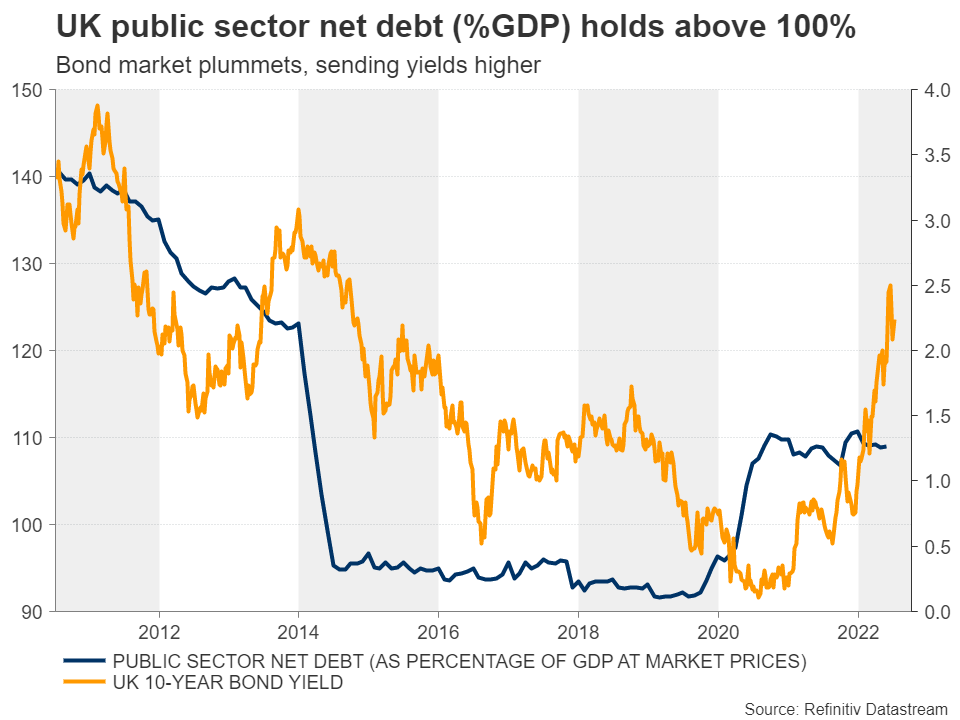
Post-Brexit problems
The health crisis was also the time when problems in the UK-EU trade and cooperation agreement started to resurface, further questioning the PM’s pledge of taking back control of fisheries and minimal bureaucracy at the border with Northern Ireland. The former promise fell apart when the UK and France entered a dispute over post-Brexit fishing rights in mid-2021, followed by detentions of non-licensed boats and retaliations that even threatened the UK’s energy supply.
Soon after the two sides found a compromise, new tensions with Brussels popped up on the Northern Ireland protocol, signaling once again that Brexit arrangements are fragile to preserve peace in the neighbouring island. A government change in Northern Ireland requested for the protocol to be altered to respect the Good Friday Agreement and see power-sharing restored in the area. Consequently, Boris Johnson’s government introduced a bill that would scrap post-Brexit checks and standards for companies selling goods from Great Britain destined for Northern Ireland rather than the EU. And of course, once again his new proposal faced imminent opposition from Brussels and fresh legal threats.
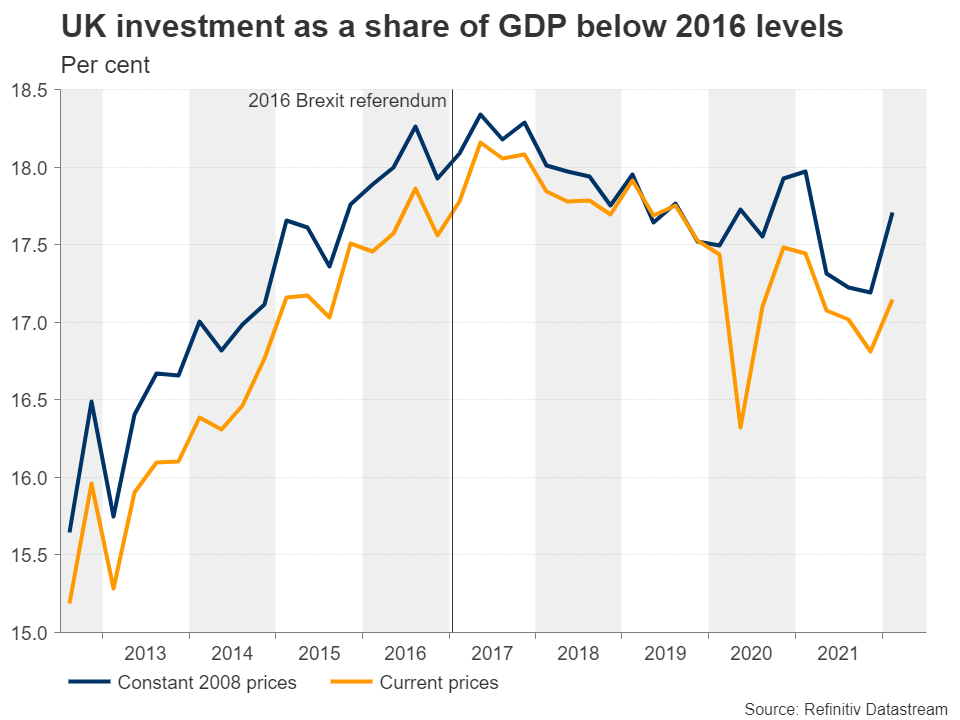
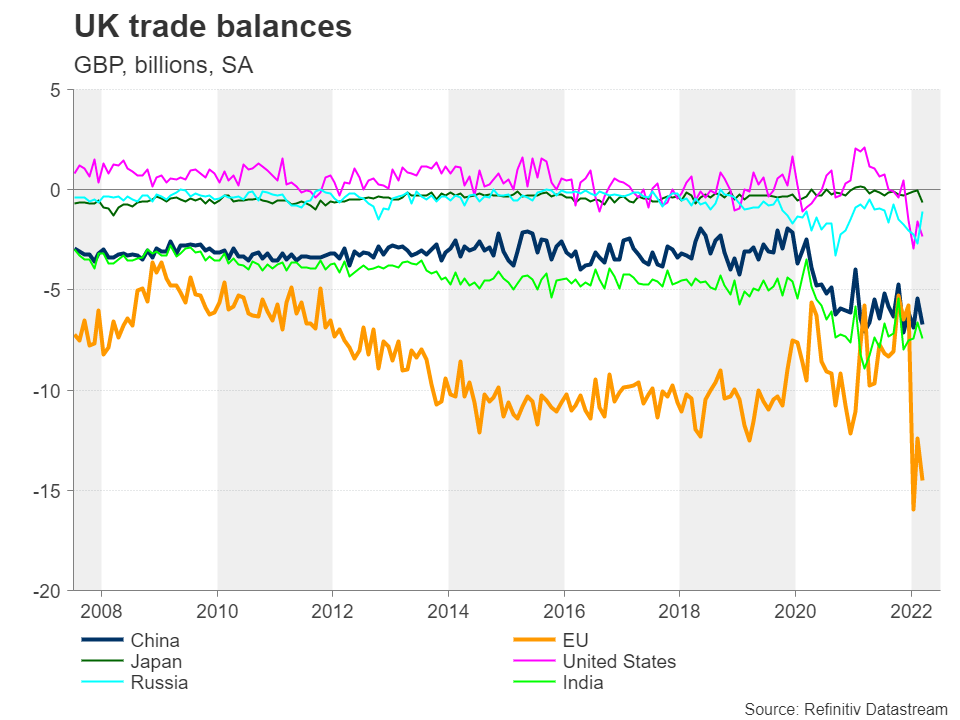
Well, Brexit was not the reason that ousted Boris out of leadership, but it has definitely cost the UK a huge loss in political stability, having witnessed two prime ministerial resignations in its recent history, while exacerbating headwinds in other areas too. Besides the shortage of workers, the UK’s trade balance with the EU and non-EU economies deteriorated significantly, inflation is now among the highest within the G7 group and is forecast to reach 11% y/y in autumn, while investment as a share of GDP has been trending downwards since the 2016 referendum. Notably, studies from the Centre for European Reform also reported that the UK economy was smaller by 5.2% or 31 billion pounds by the end of 2021 than it would have been had it stayed in the union.
How could the pound perform?
Turning to the FX markets, the question that arises at this point is whether an accommodative fiscal policy will help the pound to finally find its feet before the next election in January 2025. Well, first of all, the divided Conservative party will need to achieve unity before it passes through more spending in parliament. If they prove successful, that will simultaneously signal more persisting inflation ahead because demand is not the economy’s problem so far, but supply is. In this case, the Bank of England may find itself alone in the fight against a prolonged period of inflation, likely calling for faster rate increases, which theoretically could be pound positive.
On the other hand, if the next prime minister postpones his rate cut promises for another day and sacrifices some growth for the sake of inflation, cable could suffer more selling, especially if the trade war with the EU intensifies alongside the Ukrainian war, and the interconnection between the UK nations (Wales, Scotland, Northern Ireland, England) further worsens.
UK economy to diminish in May
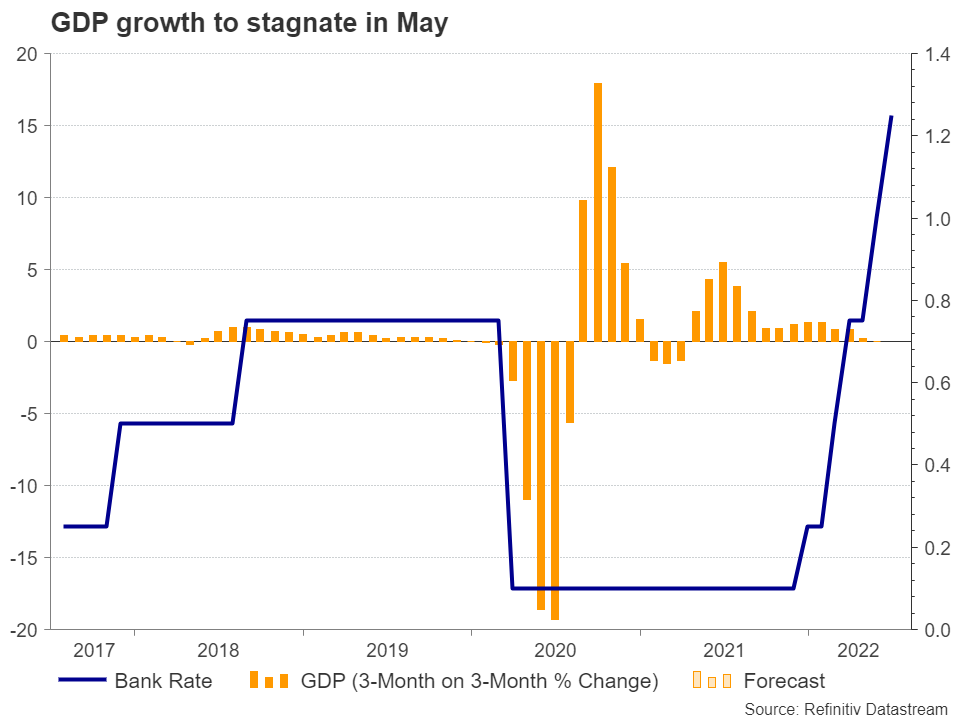
In the meantime, monthly GDP figures for May could renew the pound’s sell-off earlier on Wednesday if they arrive significantly worse than expected. The three-month average gauge is projected to show no expansion in the economy for the first time since March 2021 after barely rising by 0.2% in April. The annual change is also forecast to ease to 2.7% y/y from 3.4%, with the trade deficit likely widening in the same month to -21.20 billion pounds.
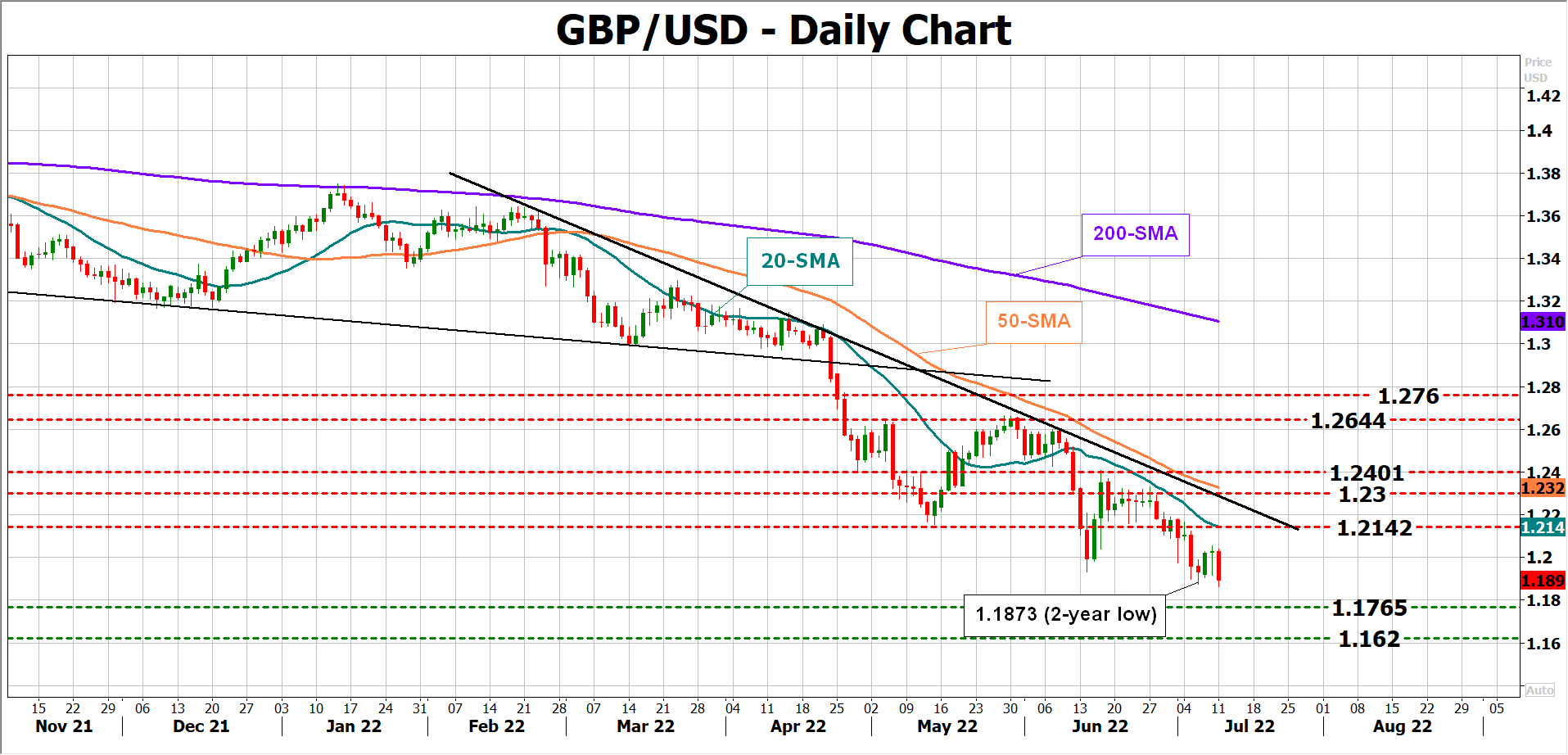
Investors are still somewhat skeptical about a 50 bps rate increase from BoE on August 4, providing a 68% probability for that scenario, which gives room for more downside for the pound if the figures bolster recession concerns. In this bearish scenario, pound/dollar could dive below the two-year low of 1.1874 and towards the 1.1765 region.
For an outlook improvement, cable will have to step above its 20-day simple moving average at 1.2127 and then stage a durable rally above its previous high of 1.2400 to raise buying appetite.
RBNZ Set to Hike Rates Again But Kiwi Slumps as Outlook Gets Cloudier
The Reserve Bank of New Zealand is widely anticipated to stay on its rate hike course on Wednesday when it announces its latest policy decision at 02:00 GMT. A 50-basis-point rate increase is fully priced in by the markets so what investors will be on the lookout for is any changes to the rate outlook amidst all the talk of a recession. There is no press conference scheduled for the July meeting and the RBNZ will not be publishing any new forecasts, so the focus will be entirely on the language of the statement. Any hints on the future rate path could be significant for the local dollar.
Growth outlook is diminishing
Having pushed up the official cash rate (OCR) consecutively at every meeting since October last year, borrowing costs in New Zealand have already reached what the RBNZ considers to be a neutral level at 2.0%. The neutral rate of interest is the level thought to be neither contractionary nor expansionary for the economy. But as fears of a global recession run rampant, is the risk of one more pronounced in New Zealand?
After an initial swift and robust recovery from the pandemic, New Zealand’s economic growth has stalled since the second half of 2021. GDP unexpectedly declined by 0.2% q/q in the first three months of the year, mainly due to Omicron and softer exports, and although a rebound is likely in the second quarter, the outlook for the rest of 2022 is diminishing.
Business confidence has plunged
The RBNZ’s aggressive tightening of monetary policy, soaring inflation and weakening demand from New Zealand’s largest trading partners such as China are weighing on business sentiment. The NZIER business confidence index – a closely watched gauge – slumped in Q2 to the lowest since the height of the pandemic crisis in 2020.
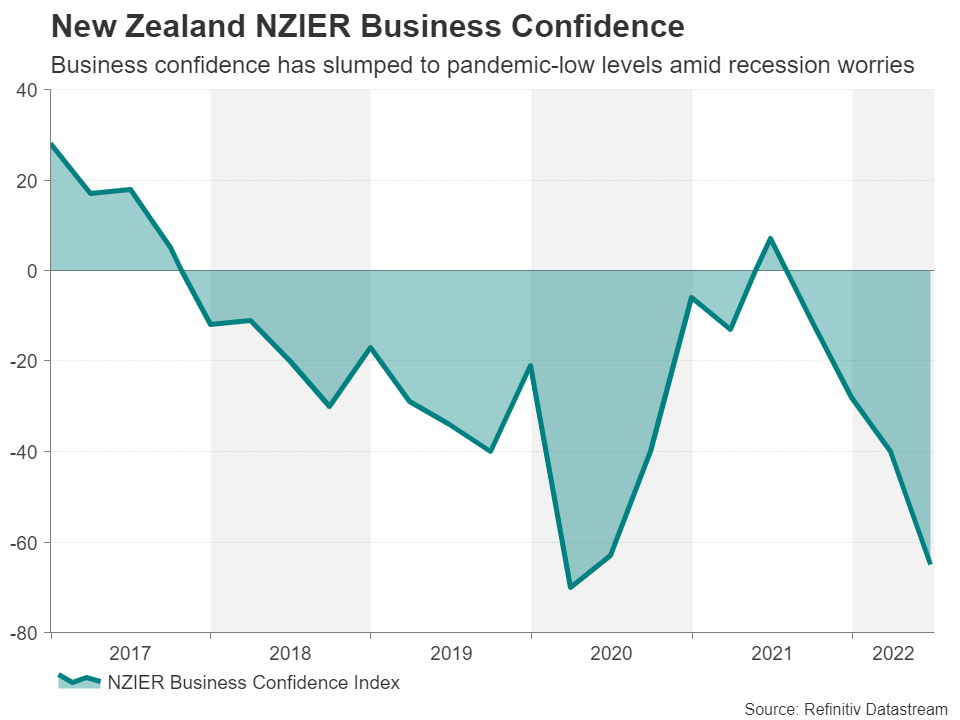
But as businesses face rising interest rates at a time when energy and other input costs are skyrocketing and the demand picture globally is faltering, the biggest impact of the RBNZ’s tightening blitz has been on the housing sector. The combined fiscal and monetary stimulus that was launched to support the economy during the lockdowns fuelled an already hot property market. But now that the stimulus has been withdrawn and the RBNZ is about to push rates into restrictive territory, house prices are sliding.
A downturn in the housing market
Whilst it’s true that New Zealand has an ongoing housing shortage and this will likely put a floor under prices at some point, the huge size of the property bubble means that the correction could nonetheless be quite steep. If house prices don’t stabilize soon, the effect of declining household wealth could knock consumer confidence further. A measure of consumer confidence by a Westpac survey fell to the lowest on record in the second quarter as households felt the squeeze from surging living costs.
The deteriorating backdrop has led investors to scale back their expectations of how high rates will go, shaving off about 50 basis points from futures markets. The question is, are policymakers at the RBNZ having a rethink too?
RBNZ is eying more rate hikes
At its last meeting in May, the RBNZ predicted that the cash rate will peak sooner but at a higher level, forecasting a terminal rate of 3.95%. But before the latest repricing, investors were even more aggressive with their expectations and so the current market-implied path is now much better aligned with the RBNZ’s own guidance. Hence, the impact of all this on the New Zealand dollar has been minimal, and the currency has been trading mostly as a function of global risk sentiment.
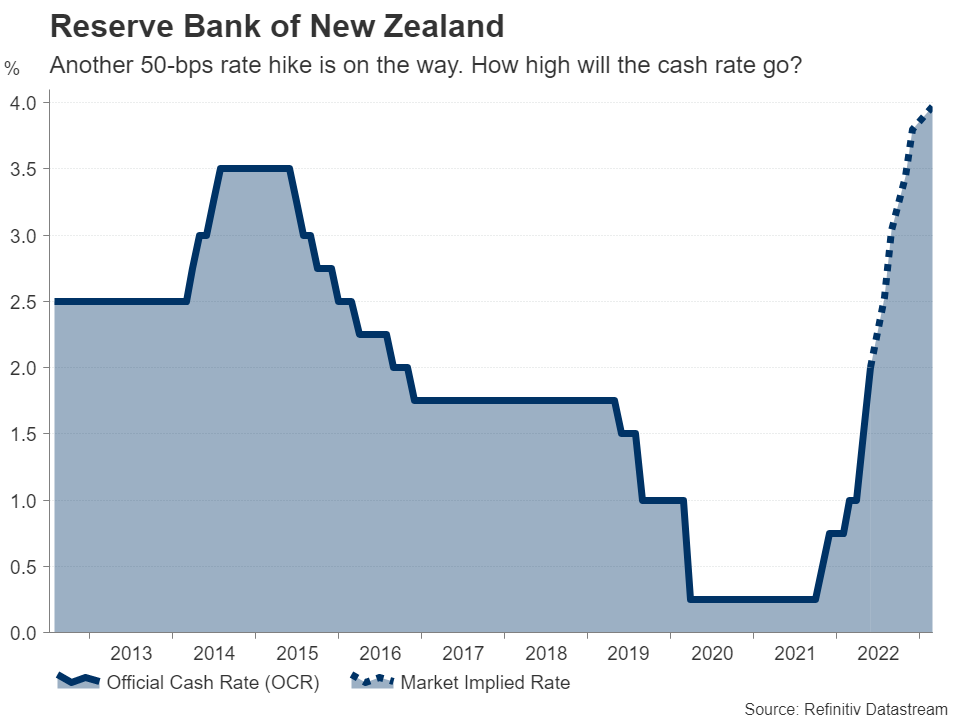
With inflation hitting a three-decade high of 6.9% in Q1, the RBNZ is unlikely to sound more cautious just yet, even as the economy might be entering a major storm. The next quarterly CPI data is due on July 18 and it could well have ramifications for the August policy decision.
Kiwi looking vulnerable after drop to $0.61
But for the meeting on Wednesday, the bank is highly likely to hike rates by 50 bps for the third time and maintain its hawkish tone. This could help the kiwi to steady above the $0.61 level, which it tested today for the first time in two years. If a hawkish statement coincides with an improvement in risk appetite, the kiwi could claw back above the $0.62 handle. However, a recovery towards the neutral setting of the 50-day moving average located slightly below the 61.8% Fibonacci retracement of the May-June upleg at $0.6352 seems some distance away.
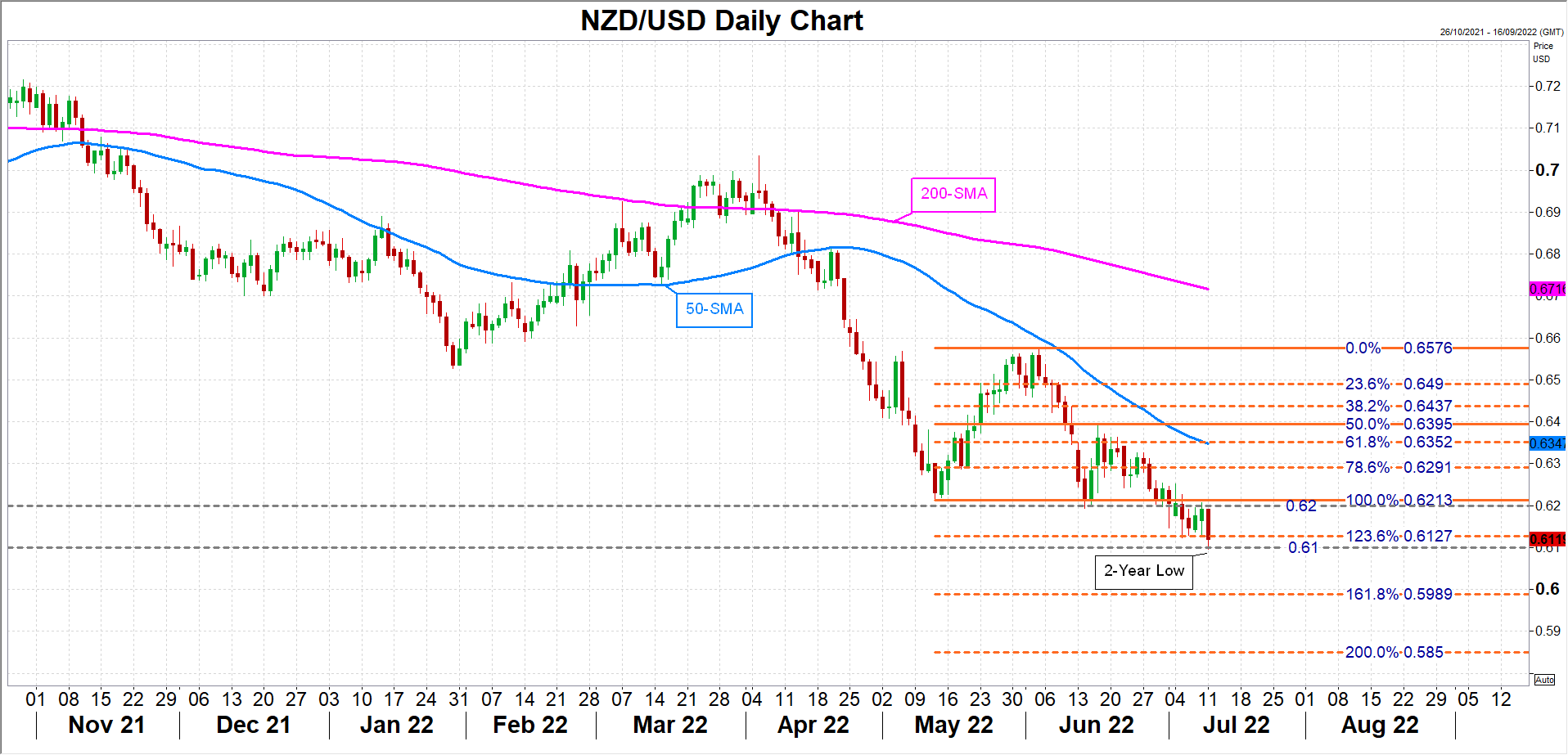
In the event, though, that the RBNZ cites some elevated downside risks to growth, markets might interpret that as a dovish tilt. Renewed selling pressure could pull the kiwi down to the 161.8% Fibonacci extension of $0.5989 before the bears set their sights on the 200% Fibonacci of $0.5850.
Technical Outlook and Review
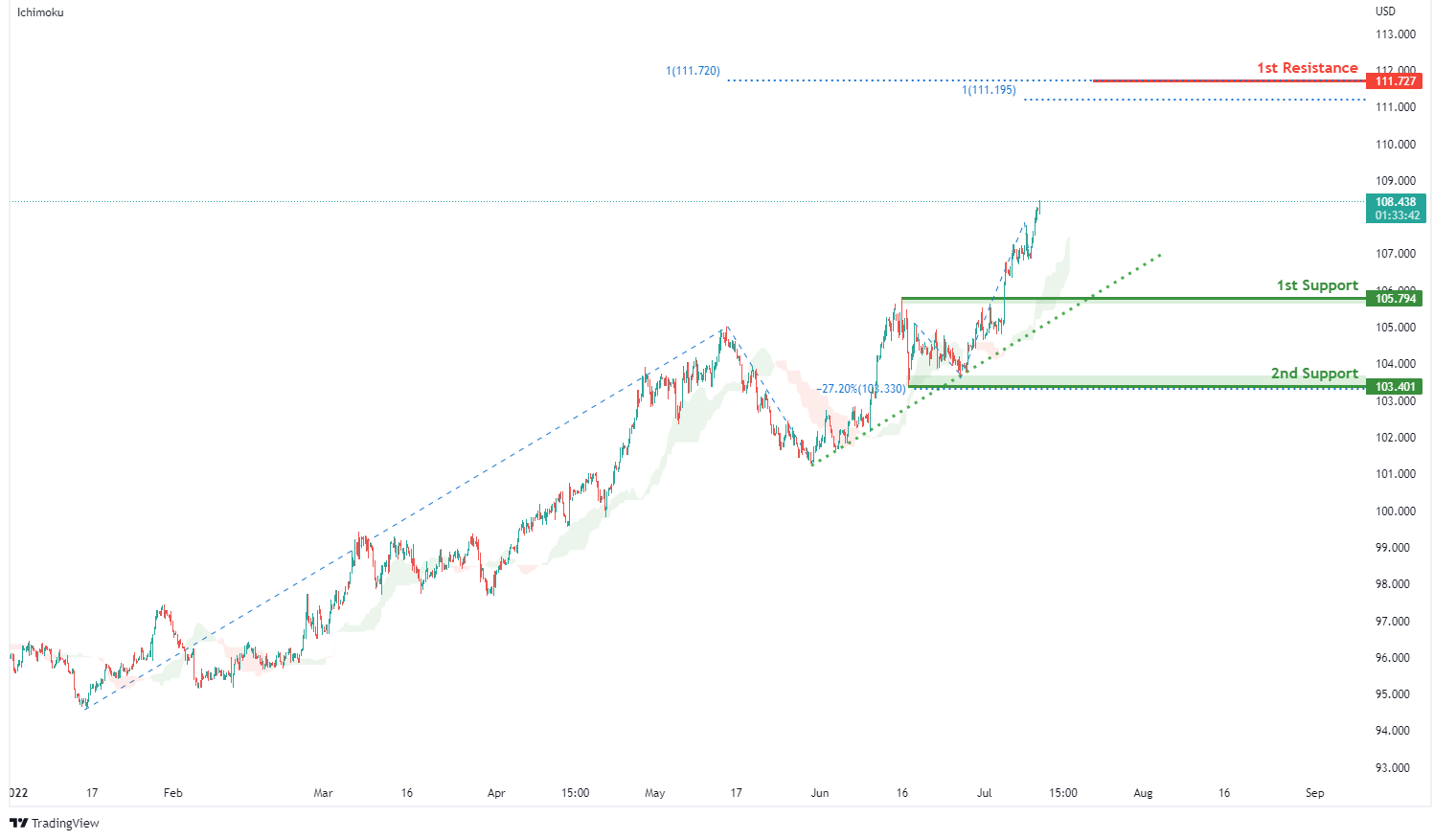
DXY:
On the H4, with prices moving above the ichimoku indicator and along the ascending trendline, we have a bullish bias that prices will drop and rise from 1st support at 105.794 where the pullback support is to 1st resistance at 111.727 in line with 100% fibonacci projection and 100% fibonacci projection. Alternatively, price may break 1st support structure and drop to 2nd support at 103.401 where the horizontal swing low support and -27.2% fibonacci expansion are.
Areas of consideration:
- H4 time frame, 1st resistance at 111.727
- H4 time frame, 1st support at 105.794
XAU/USD (GOLD):
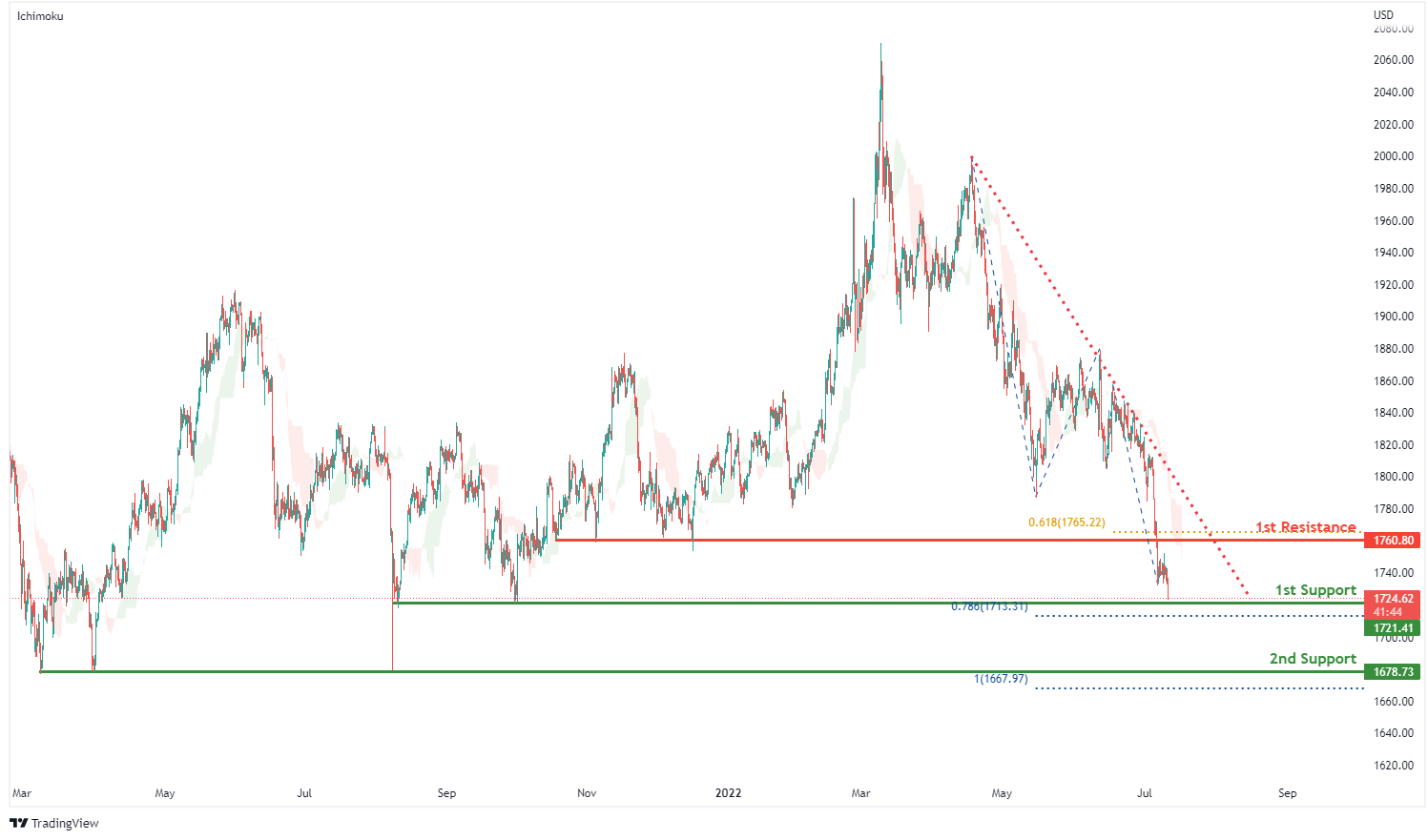
On the H4, with prices moving below the ichimoku indicator and along a descending trendline, we have a bearish bias that prices will drop to our 1st support at 1721.41 where the horizontal swing low support and 78.6% fibonacci projection are. Once we have downside confirmation of price breaking 1st support structure, we would expect bearish momentum to carry price to 2nd support at 1678.73 in line with swing low support and 100% fibonacci projection. Alternatively, price could rise to our 1st resistance at 1760.80 in line with overlap resistance and 61.8% fibonacci projection.
Areas of consideration:
- H4 time frame, 1st Resistance at 1760.80
- H4 time frame, 1st Support at 1721.41
GBP/USD:
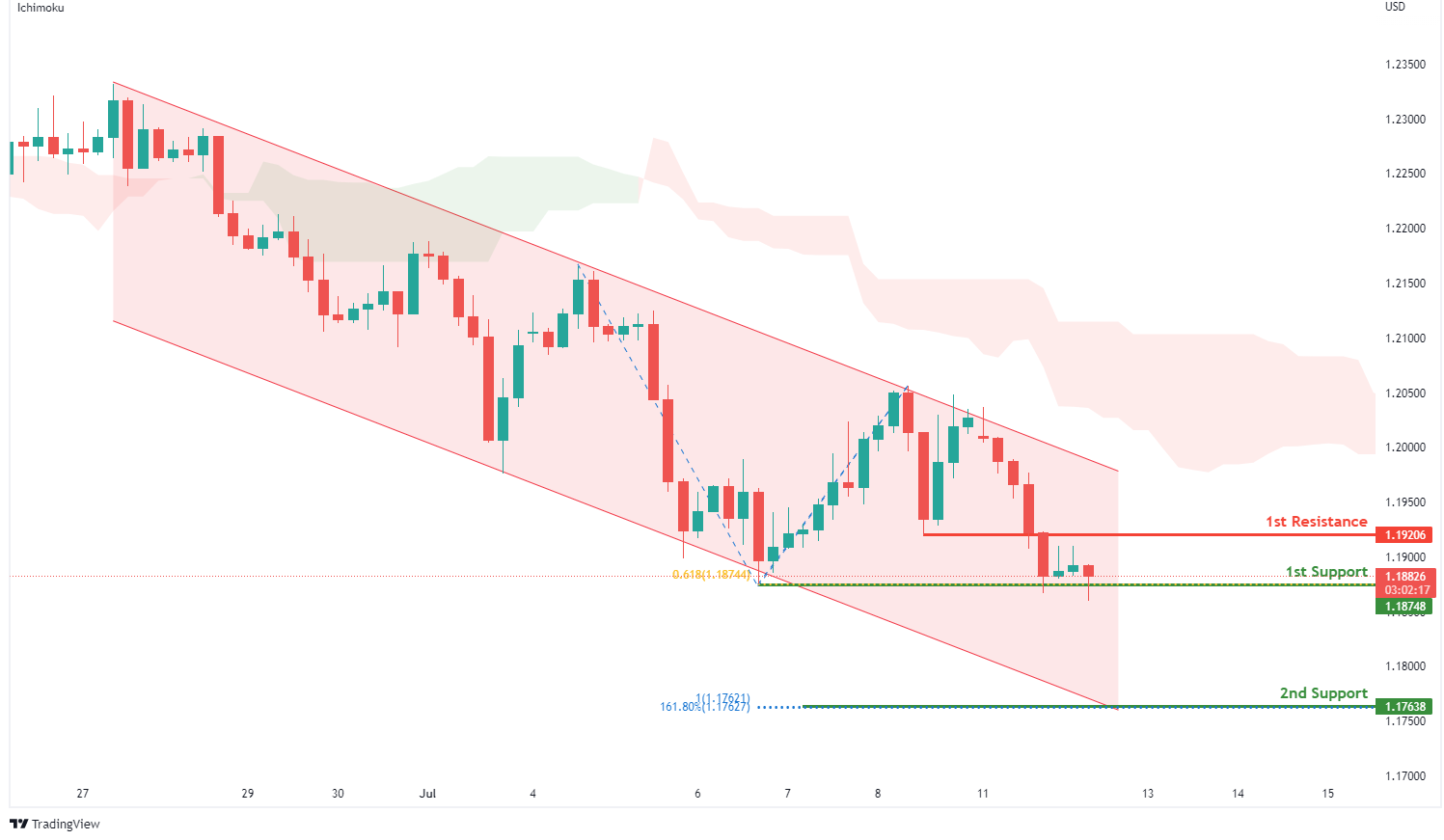
On the H4, with prices moving below the ichimoku indicator and within the descending channel, we have a bearish bias that price will drop to our 1st support at 1.18748 where the swing low support and 61.8% fibonacci projection are. Once there is downside confirmation of price breaking 1st support, we would expect bearish momentum to carry price to our 2nd support at 1.17638 where the 100% fibonacci projection and 161.8% fibonacci extension are. Alternatively, price could rise to 1st resistance at 1.19206 in line with the pullback resistance.
Areas of consideration:
- H4 1st resistance at 1.19206
- H4 1st support at 1.18748
USD/CHF:
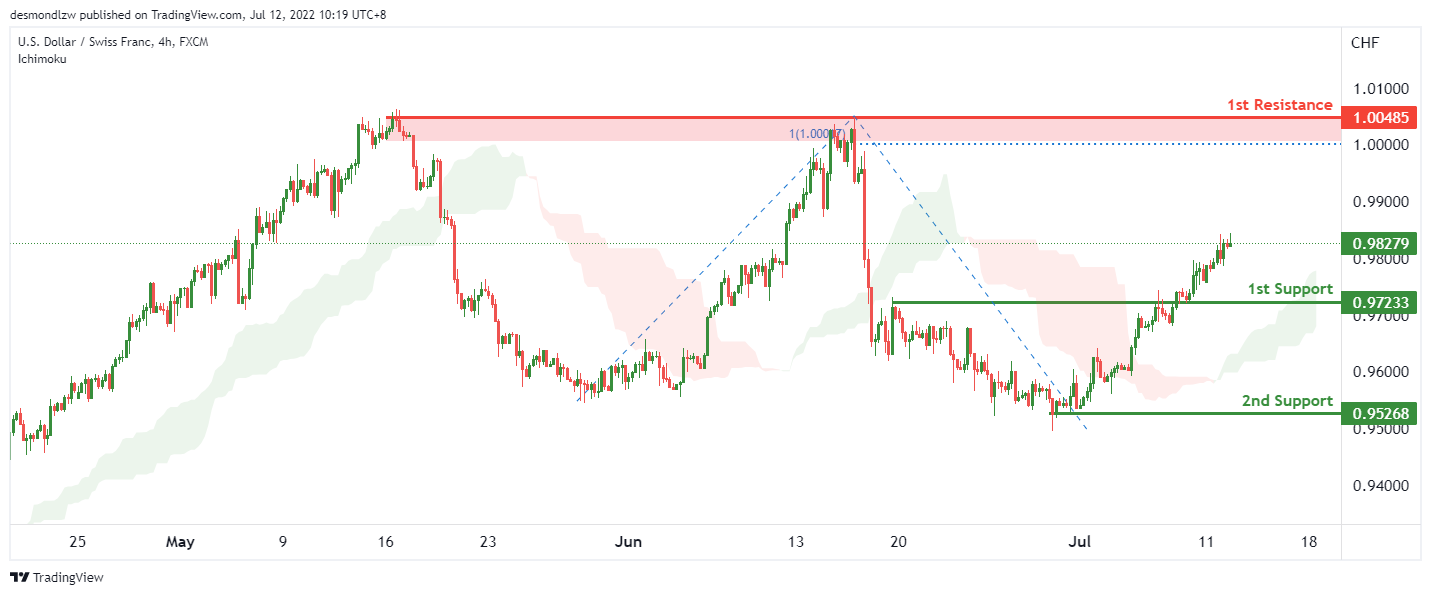
On the H4, with price moving above the ichimoku cloud, we have a bullish bias that price will rise from our 1st support at 0.97233 where the horizontal pullback support is to our 1st resistance at 1.00485 in line with the 100% Fibonacci projection is. Alternatively, price may not break 1st support and head for 2nd support at 0.95268 where the horizontal pullback support.
Areas of consideration
- 1st support level at 0.97233
- 1st resistance level at 1.00485
EUR/USD :
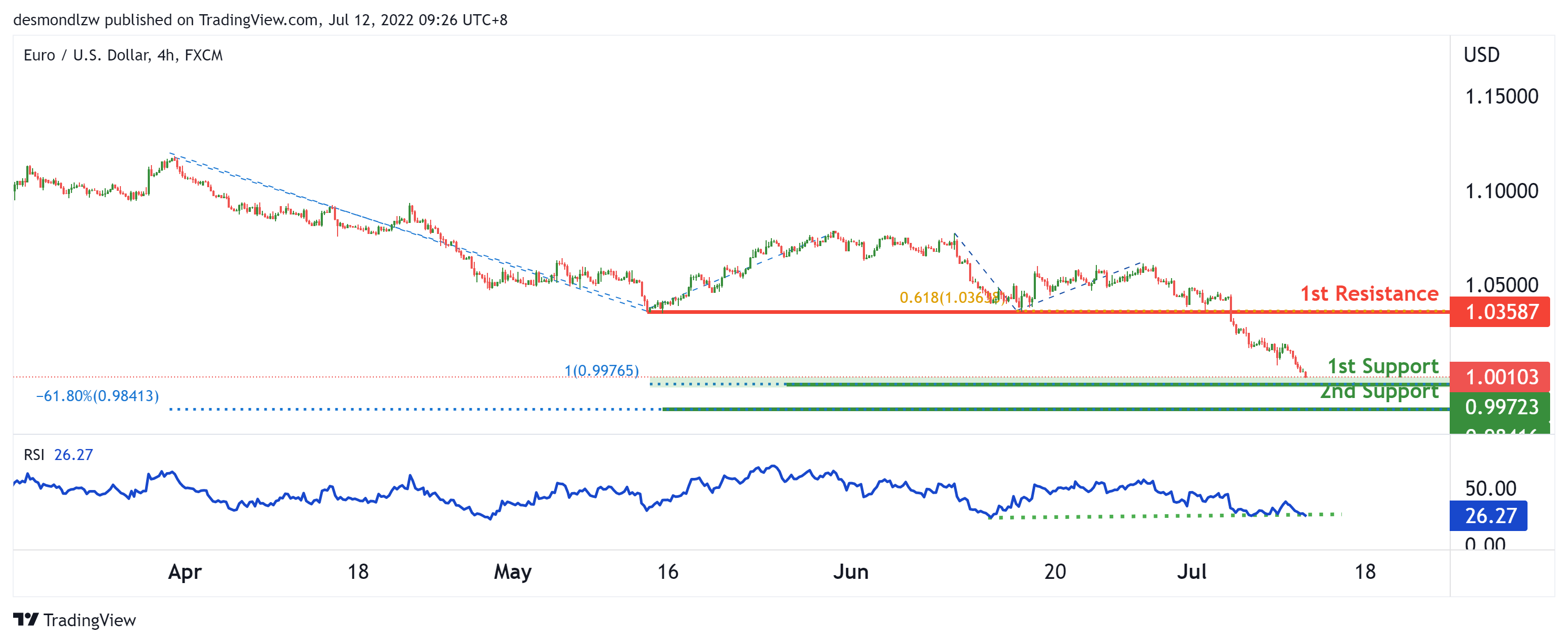
On the H4, with price moving in an ascending trendline on our RSI, we have a bullish bias that price will rise from our 1st support at 0.99723 in line with the swing low and 100% fibonacci projection to the 1st resistance at 1.03587 at the pullback resistance. Alternatively, price may break the support structure at 1st support and drop to the 2nd support at 0.98416 in line with the -61.8% fibonacci expansion.
Areas of consideration :
- H4 1st resistance at 1.03587
- H4 1st support at 0.99723
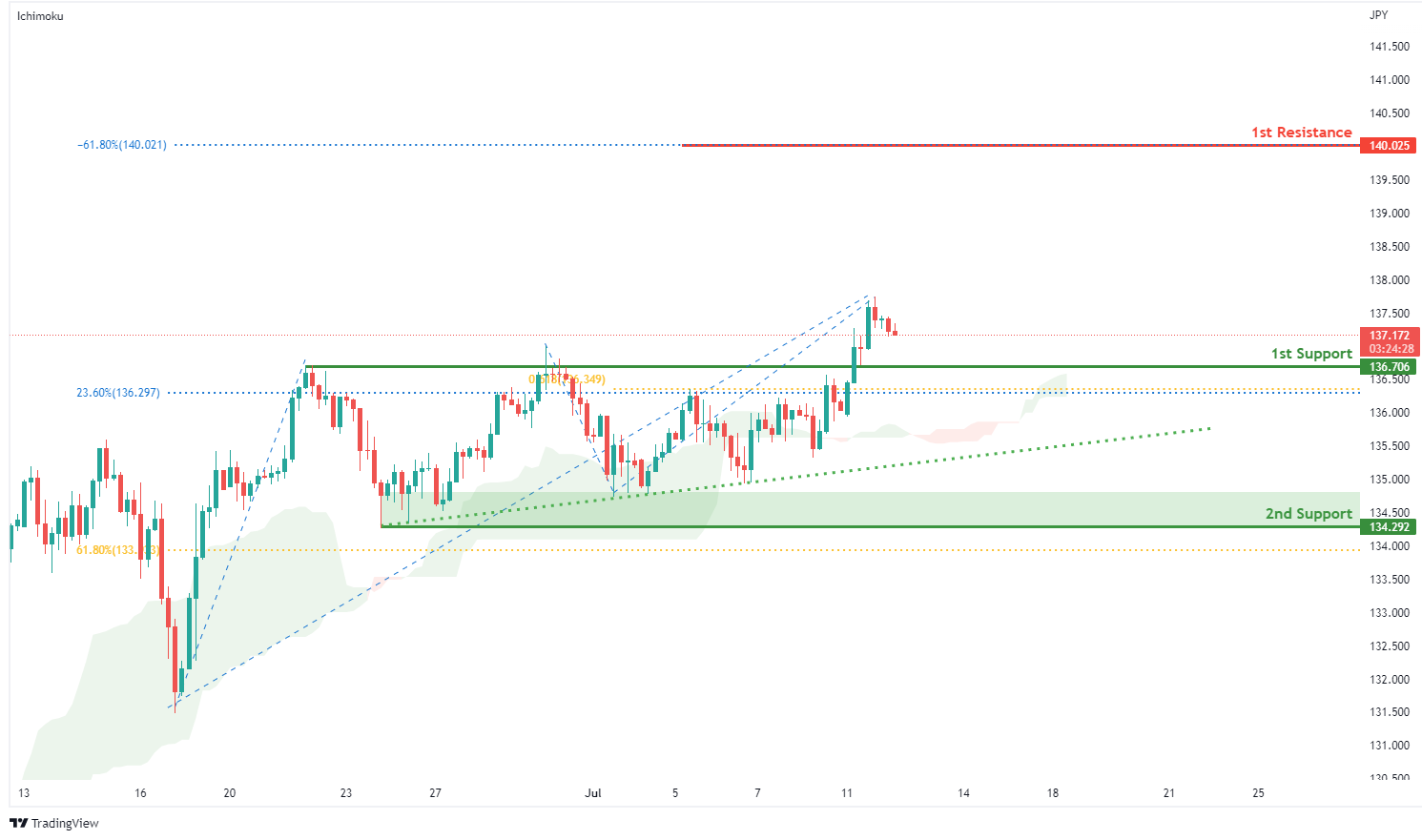
USD/JPY:
On the H4, with price moving along an ascending trendline and above the ichimoku indicator, we have a bullish bias that price will rise from our 1st support at 136.706 where the overlap support, 23.6% fibonacci retracement and 61.8% fibonacci projection are to our 1st resistance at 140.025 in line with the -61.8% fibonacci expansion. Alternatively, price could break 1st support and drop to 2nd support at 134.292 in line with the swing low support and 61.8% fibonacci retracement.
Areas of consideration:
- H4 time frame, 1st resistance at 140.025
- H4 time frame, 1st support at 136.706
AUD/USD:
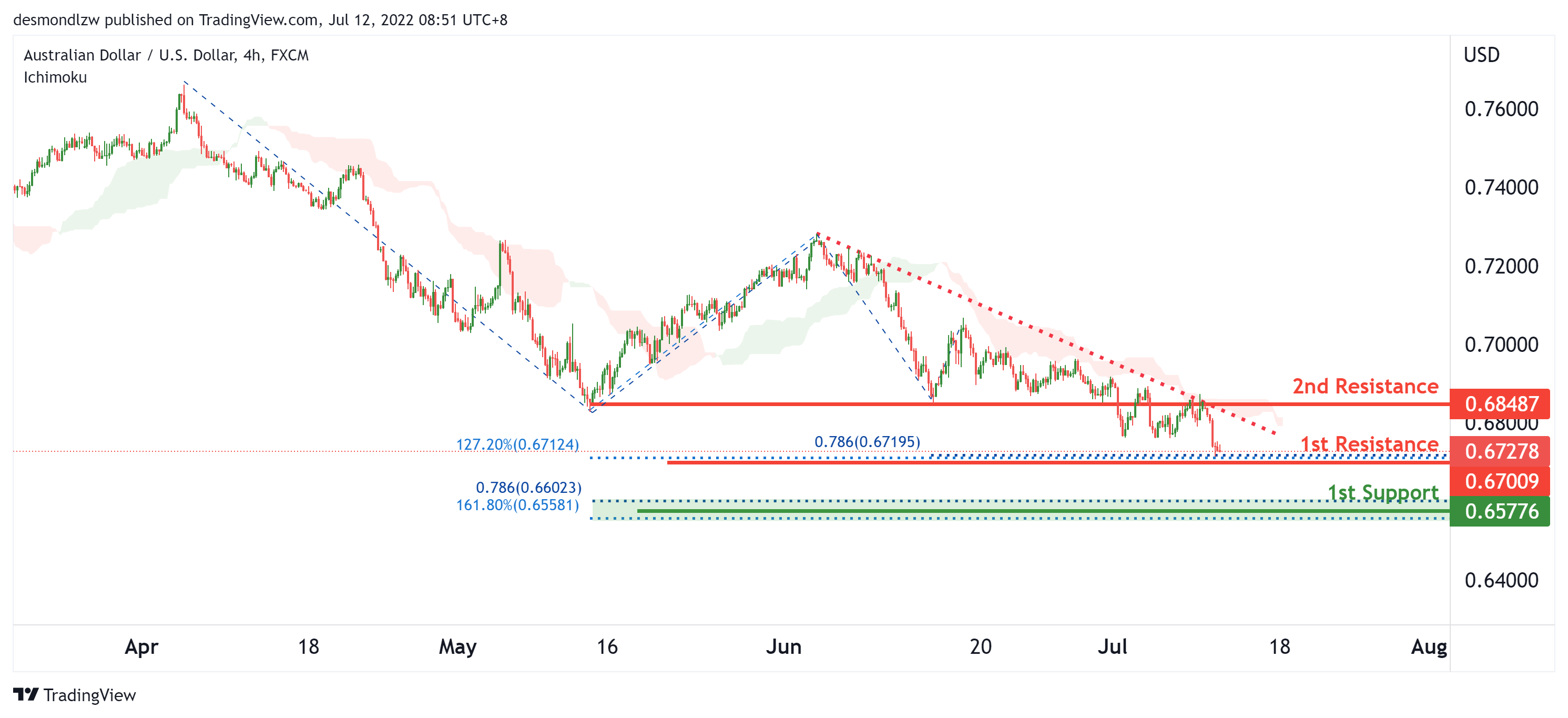
On the H4, with price moving below the ichimoku cloud and in a descending trendline, we have a bearish bias that price will continue to drop from the 1st resistance at 0.67009 in line with the 127.2% fibonacci extension and 78.6% fibonacci projection to the 1st support at 0.65776 in line with the 161.8% fibonacci extension and 78.6% fibonacci projection. Alternatively, price may reverse off the 1st resistance and rise to the 2nd resistance at 0.68487 in line with the overlap swing high.
Areas of consideration
- H4 1st resistance at 0.67009
- H4 1st support at 0.65776
NZD/USD:
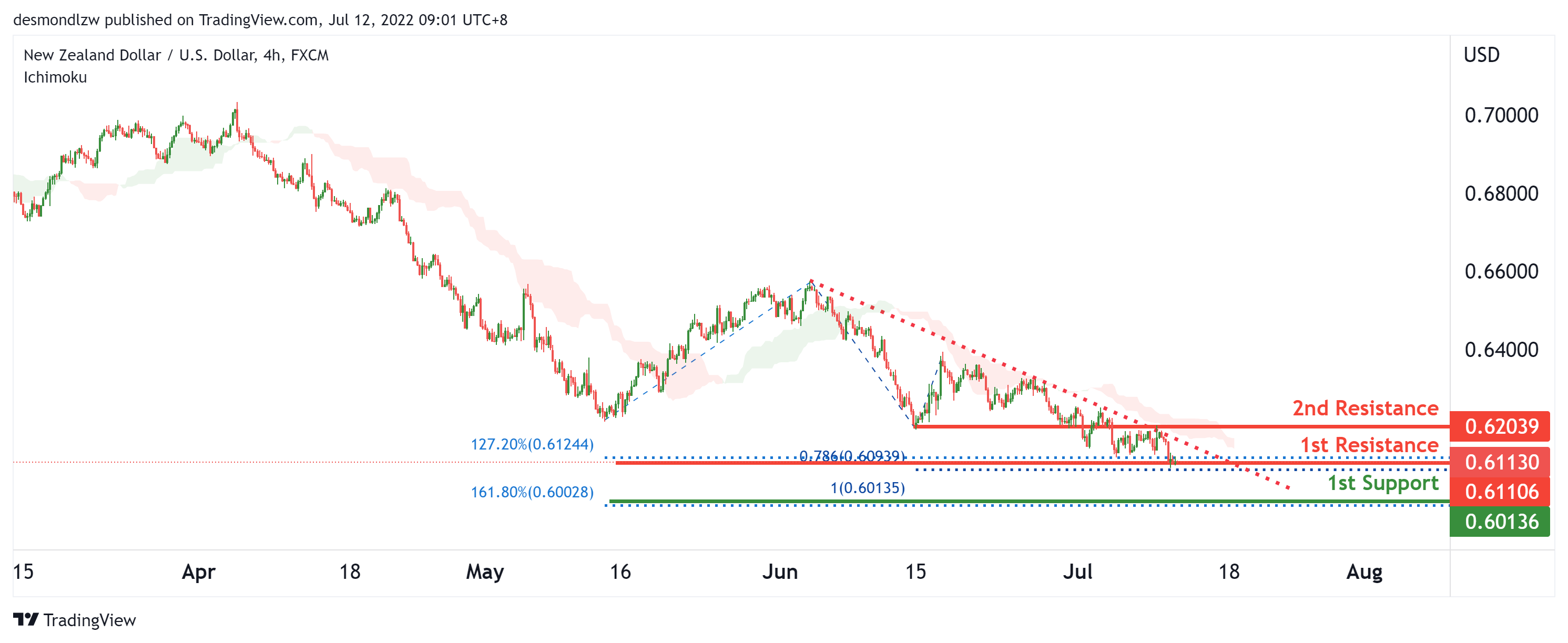
On the H4, with price moving below the ichimoku cloud and in a descending trendline, we have a bearish bias that price will continue to drop from the 1st resistance at 0.61138 in line with the 127.2% fibonacci extension and 78.6% fibonacci projection to the 1st support at 0.61106 in line with the 161.8% fibonacci extension and 100% fibonacci projection. Alternatively, price may reverse off the 1st resistance and rise to the 2nd resistance at 0.62039 in line with the overlap swing high.
Areas of consideration:
- H4 time frame, 1st support at 0.61106
- H4 time frame, 1st resistance at .61138
USD/CAD:
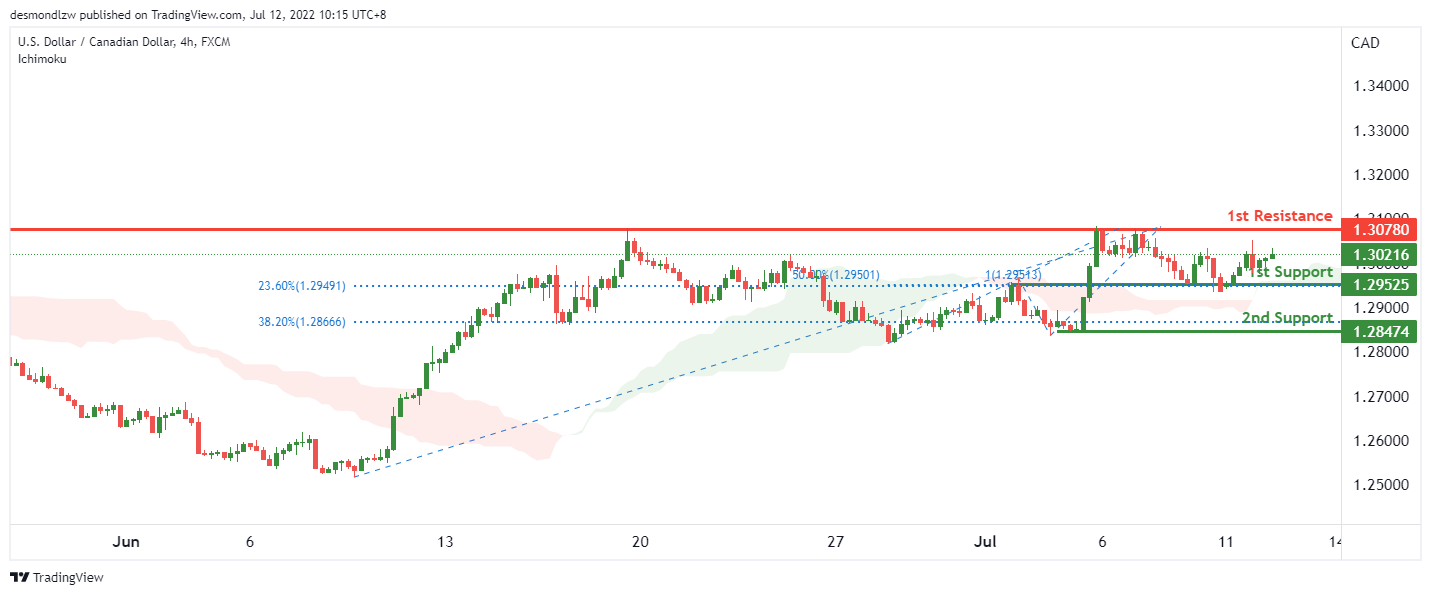
On the H4, with price moving above the ichimoku cloud, we have a bullish bias that price will rise from our 1st support at 1.29525 where the horizontal pullback support and fibonacci confluence are to our 1st resistance at 1.30780 in line with the horizontal swing high resistance. Alternatively, price may not break 1st support and head for 2nd support where the horizontal swing low support is
Areas of consideration:
- H4 time frame, 1st resistance at 1.30780
- H4 time frame, 1st support at 1.29525
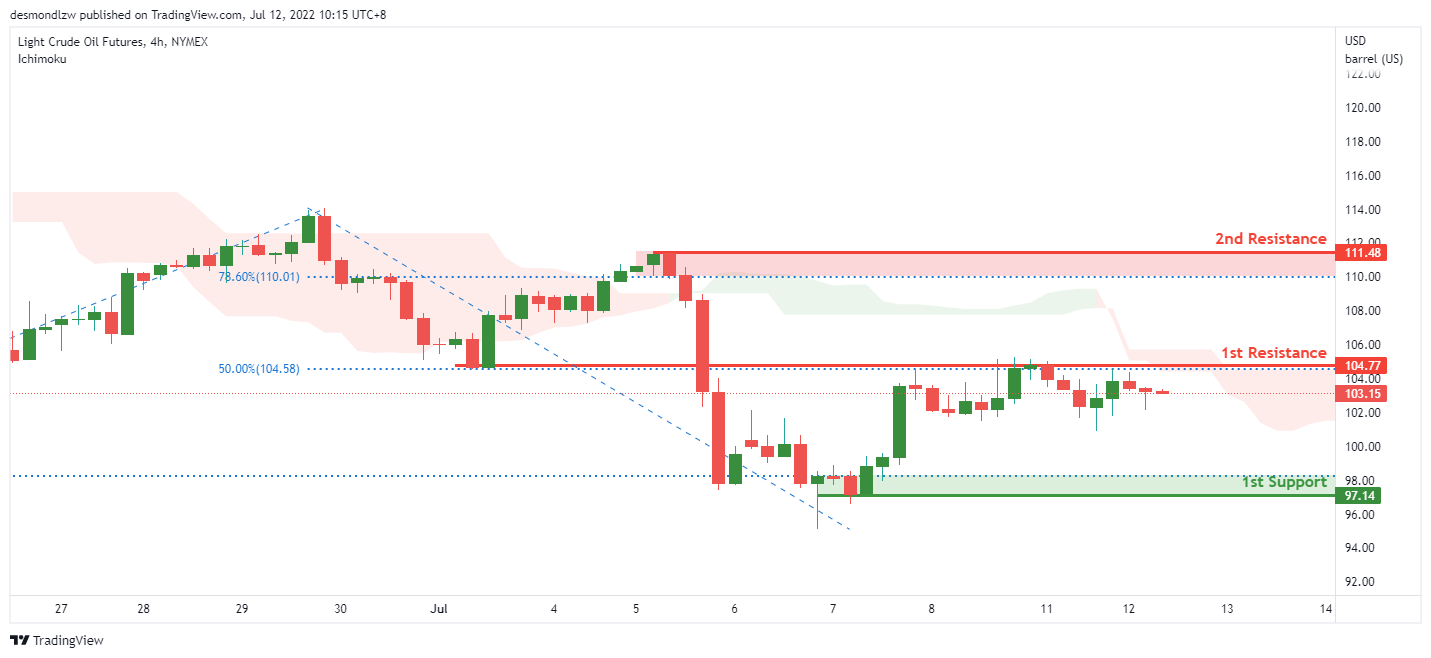
OIL:
On the H4, with price moving below the ichimoku cloud, we have a bearish bias that price will drop to our 1st support at 97.1 where the horizontal swing low support is from our 1st resistance at 104.77 in line with the horizontal pullback resistance and 50% Fibonacci retracement. Alternatively, price may break 1st resistance and head for 2nd resistance at 111.48 where the horizontal swing high resistance and 78.6% Fibonacci retracement is.
Areas of consideration:
- H4 time frame, 1st resistance of 104.77
- H4 time frame, 1st support of 97.1
Dow Jones Industrial Average:
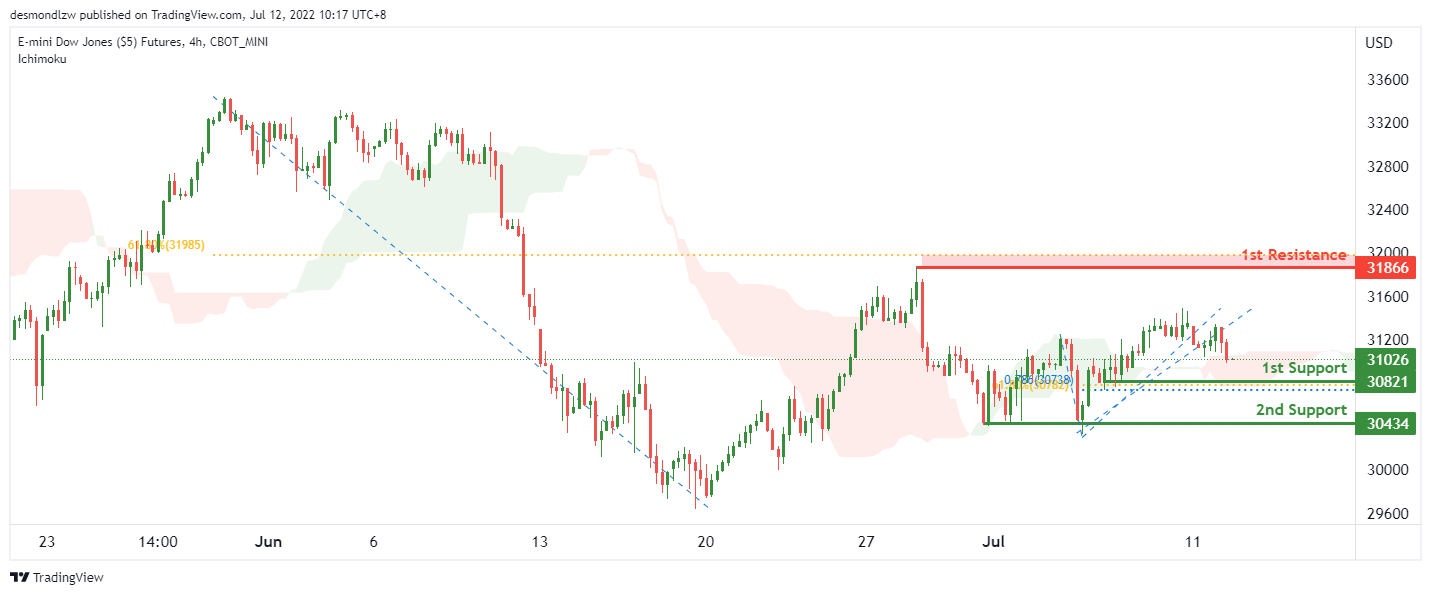
On the H4, with price moving above the ichimoku cloud, we have a bullish bias that price will rise from our 1st support at 31218 where the horizontal pullback support is to our 1st resistance at 31866 in line with the horizontal swing high resistance. Alternatively, price may not break 1st support and head for 2nd support at 30434 where the horizontal swing low support is.
Areas of consideration:
- H4 time frame, 1st resistance of 31866
- H4 time frame, 1st support of 31218
Eco Data 7/12/22
[php_everywhere instance="1"]