Sample Category Title
GBP/USD Mid-Day Outlook
Daily Pivots: (S1) 1.1827; (P) 1.1932; (R1) 1.1998; More...
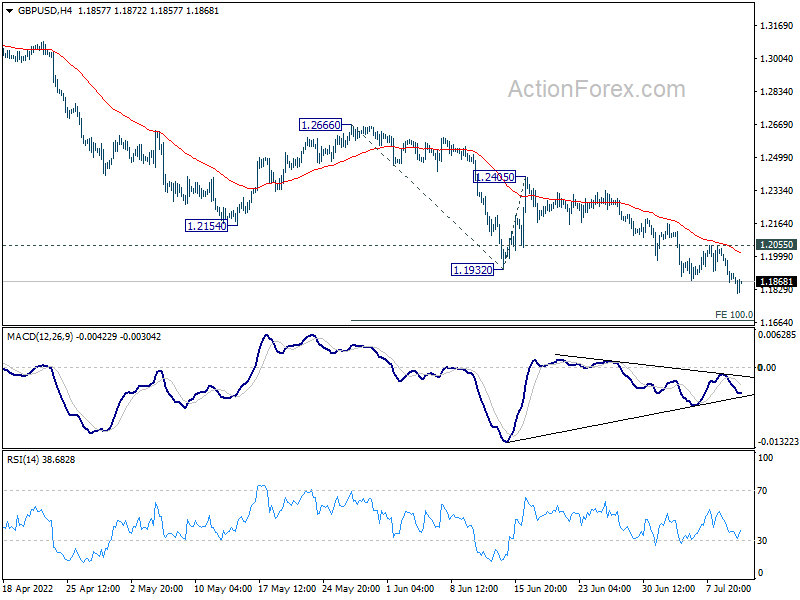
Intraday bias in GBP/USD remains on the downside for the moment. Current down trend should target 100% projection of 1.2666 to 1.1932 from 1.2405 at 1.1671. Decisive break there will target a test on 1.1409 long term support. On the upside, above 1.2055 minor resistance will now indicate short term bottoming, and turn bias to the upside for stronger rebound.
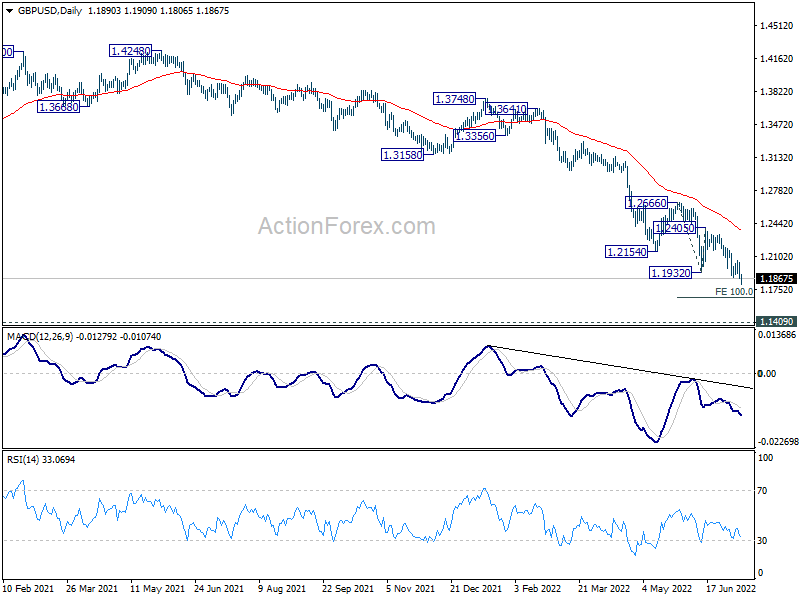
In the bigger picture, fall from 1.4248 (2018 high) could be a leg inside the pattern from 1.1409 (2020 low), or resuming the longer term down trend. Deeper decline is expected as long as 1.2666 resistance holds. Next target is 1.1409 low. However, firm break of 1.2666 will bring stronger rise back to 55 week EMA (now at 1.3065).
EUR/USD Mid-Day Outlook
Daily Pivots: (S1) 0.9989; (P) 1.0086 (R1) 1.0139; More...
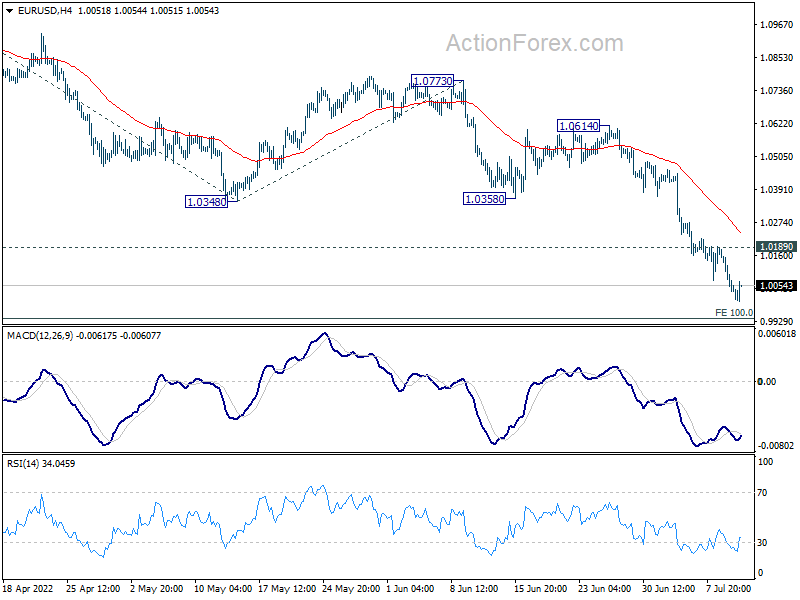
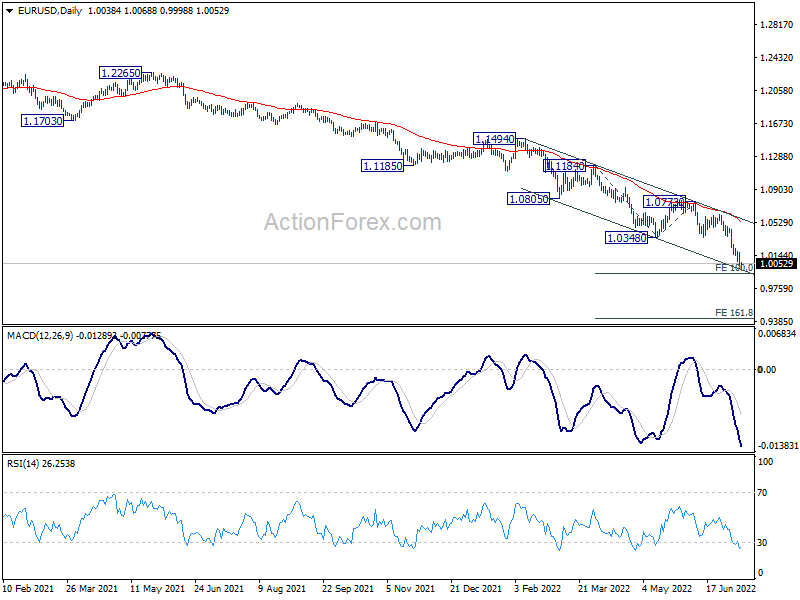
EUR/USD's down trend is in progress today and reaches as low as 0.9999 so far. Intraday bias stays on the downside. Current down trend should target 100% projection of 1.1184 to 1.0348 from 1.0773 at 0.9937, which is close to parity. Firm break there could prompt downside acceleration to 161.8% projection at 0.9420. On the upside, break of 1.0189 minor resistance will turn intraday bias neutral again. But outlook stays bearish as long as 1.0358 support turned resistance holds.
In the bigger picture, down trend from 1.6039 (2008 high) is still in progress. Next target is 100% projection of 1.3993 to 1.0339 from 1.2348 at 0.8694. In any case, outlook will stay bearish as long as 1.0773 resistance holds, in case of rebound.
Dollar Breaches Parity Against Euro, But No Follow Through Buying
Dollar's rally continues today and breached parity against Euro for the first time in two decades. Nevertheless, the greenback seems to be losing some momentum since then, in particular against Yen. There is prospect of a deeper retreat for Dollar as 10-year yield is also weakening slightly. Yen is currently the stronger one for today, followed by Kiwi and Aussie. Sterling is the worst, followed by Canadian and Swiss Franc.
Technically, while Dollar might be paring gain, there is no sign of topping for now. Levels to watch including 1.0189 minor resistance in EUR/USD, 1.2055 minor resistance in GBP/USD, 0.6873 minor resistance in AUD/USD, 0.9721 minor support in USD/CHF, 134.74 minor support in USD/JPY. As long as these levels holds, further rally is still expected in Dollar in general.
In Europe, at the time of writing, FTSE is down -0.21%. DAX is down -0.61%. CAC is down -0.22%. Germany 10-year yield is down -0.1065 at 1.142. Earlier in Asia, Nikkei dropped -1.77%. Hong Kong HSI dropped -1.32%. China Shanghai SSE dropped -0.97%. Singapore Strait Times rose 0.46%. Japan1 0-yaer JGB yield dropped -0.0059 to 0.244.
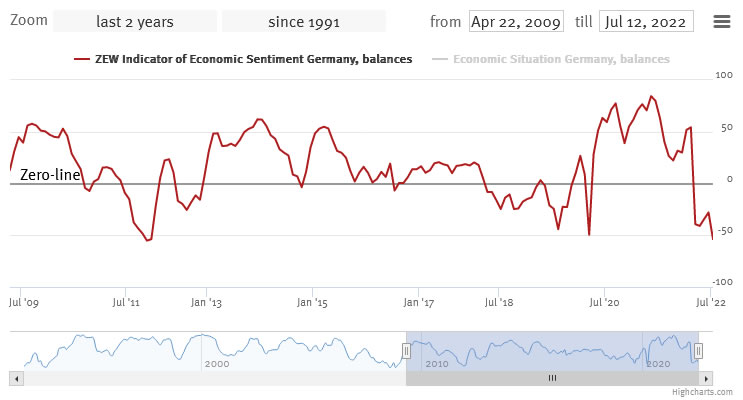
Germany ZEW economic sentiment dropped to -53.8, even worse than pandemic low
Germany ZEW Economic Sentiment dropped from -28 to -53.8 in July, well below expectation of -38.0. Current Situation Index dropped from -27.6 to -45.8, below expectation of -33.5. Both readings were even worse than the values recorded at the beginning of the COVID-19 pandemic.
Eurozone ZEW Economic Sentiment dropped form -28.0 to -51.1, below expectation of -40.0. Current Situation Index dropped -18.0 to -44.4. Inflation expectations rose 6.8 pts to -25.6, remaining clearly in negative territory.
ZEW President Professor Achim Wambach: "The current major concerns about the energy supply in Germany, the ECB's announced interest rate hike and further pandemic-related restrictions in China have led to a considerable deterioration in the economic outlook.
"The experts assess the current economic situation significantly more negatively than in the previous month and have further lowered their already unfavourable forecast for the next six months.
"Expectations for energy-intensive and export-oriented sectors of the economy have fallen particularly sharply, and private consumption is also assessed as significantly weaker."
BoE Cunliffe on four lessons learned from crypto winter
In a speech, BoE Deputy Governor Jon Cunliffe talked about the lessons learned from recent "instability and losses in crypto markets", also called the "crypto winter".
He said, "a widespread collapse of crypto-asset valuations has cascaded through the crypto ecosystem and generated a number of high-profile firm failures," which also resulted in Bitcoin losing 70% of its value.
The four lessons learned include:
- Technology does not change the underlying risks in economics and finance;
- Regulators should continue and accelerate their work to put in place effective regulation of the use of crypto technologies in finance;
- This regulation should be constructed on the iron principle of 'same risk, same regulatory outcome' ;
- Crypto – technologies offer the prospect of substantive innovation and improvement in finance. But to be successful and sustainable innovation has to happen within a framework in which risks are managed: people don't fly for long in unsafe aeroplanes.
Australia Westpac consumer sentiment dropped to 83.8, comparable to previous major shocks
Australia Westpac Consumer Sentiment Index dropped from 86.4 to to 83.8 in July. The confidence has been falling every month this year, and it's now -19.7% below December's level.
Westpac said that both level and pace of deterioration are "comparable to previous major shocks". It added that rate fears were intensifying, with 73% polled expecting rates to rise more than 1%.
As for RBA policy, Westpac expects another 50bps rate hike on August 2, taking interest rate to 1.85%. That would be near to Westpac's assessed "neutral zone" of 1.5-2.0%. It expects RBA to adopt a "more cautious approach" once policy moved to "neutral", and pause the tightening first after August's hike.
Australia NAB business confidence dropped to 1, but conditions held up
Australia NAB business confidence dropped from 6 to 1 in June. Business conditions dropped from 15 to 13. Looking at some details, trading conditions dropped from 21 to 18. Profitability conditions dropped from 16 to 12. Employment conditions dropped from 12 to 10.
"Confidence sank below average in June as inflation and interest rate hikes clouded the outlook," said NAB Group Chief Economist Alan Oster. "Confidence in the retail sector took a significant hit, falling more than 20pts to be well into negative territory, reflecting concerns about the outlook for household spending."
"While confidence fell, business conditions held up in June," said Oster. "Conditions remain strong across the states and in most industries. Construction continues to be the only real outlier with building costs weighing, despite a healthy pipeline of work in the sector."
EUR/USD Mid-Day Outlook
Daily Pivots: (S1) 0.9989; (P) 1.0086 (R1) 1.0139; More...
EUR/USD's down trend is in progress today and reaches as low as 0.9999 so far. Intraday bias stays on the downside. Current down trend should target 100% projection of 1.1184 to 1.0348 from 1.0773 at 0.9937, which is close to parity. Firm break there could prompt downside acceleration to 161.8% projection at 0.9420. On the upside, break of 1.0189 minor resistance will turn intraday bias neutral again. But outlook stays bearish as long as 1.0358 support turned resistance holds.
In the bigger picture, down trend from 1.6039 (2008 high) is still in progress. Next target is 100% projection of 1.3993 to 1.0339 from 1.2348 at 0.8694. In any case, outlook will stay bearish as long as 1.0773 resistance holds, in case of rebound.
Economic Indicators Update
| GMT | Ccy | Events | Actual | Forecast | Previous | Revised |
|---|---|---|---|---|---|---|
| 23:01 | GBP | BRC Like-For-Like Retail Sales Y/Y Jun | -1.30% | -1.50% | ||
| 23:50 | JPY | PPI Y/Y Jun | 9.20% | 9.00% | 9.10% | 9.30% |
| 01:30 | AUD | NAB Business Confidence Jun | 1 | 6 | ||
| 01:30 | AUD | NAB Business Conditions Jun | 13 | 16 | ||
| 09:00 | EUR | Germany ZEW Economic Sentiment Jul | -53.8 | -38 | -28 | |
| 09:00 | EUR | Germany ZEW Current Situation Jul | -45.8 | -33.5 | -27.6 | |
| 09:00 | EUR | Eurozone ZEW Economic Sentiment Jul | -51.1 | -40 | -28 | |
| 10:00 | USD | NFIB Business Optimism Index Jun | 89.5 | 93 | 93.1 |
NZ Dollar Takes Pause after Tumble
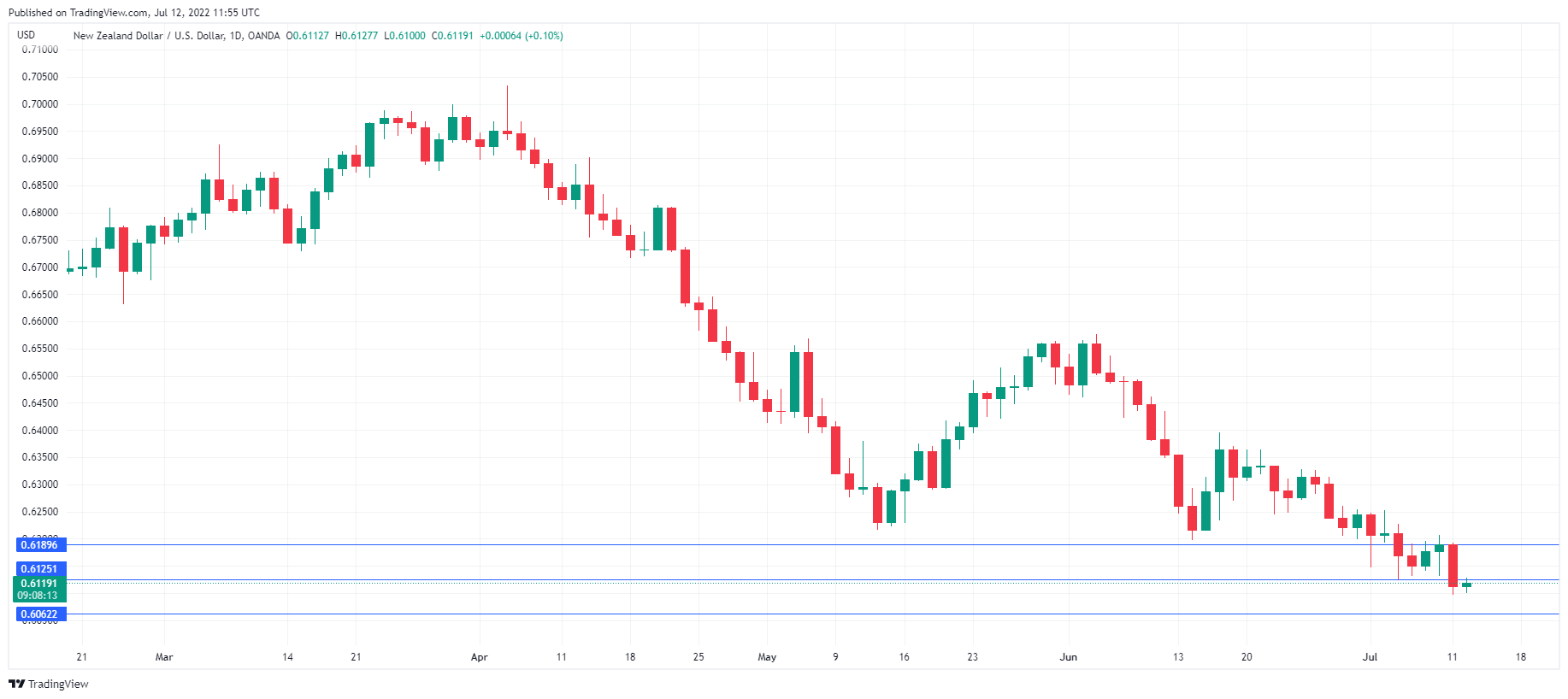
The New Zealand dollar has steadied on Tuesday, after a plunge a day earlier. In the European session, NZD/USD is trading at 0.6120, up 0.13%.
RBNZ expected to deliver 50bp hike
The Reserve Bank of New Zealand holds its policy meeting on Wednesday, and all indications point to a 50-bp hike, which would be the third such increase in as many meetings. This is a very aggressive rate-tightening cycle and would bring the cash rate to 2.50%. The central bank is playing catch-up with the inflation curve and is determined to wrestle down spiralling inflation, which has climbed to 6.9%, a 30-year high.
There are concerns that the central bank could over-tighten and rather than a soft landing, the economy could tip into a recession. With inflation and inflation expectations viewed by the RBNZ as public enemy number one, the price of a recession would be painful but one that central bank policymakers are willing to pay. Interest rates are expected to continue to rise, with another 50bp hike likely in August.
The tightening cycle has not brought about a peak in inflation, but there are unmistakable signs that the economy is slowing down. Business and consumer confidence indicators point to a weakening in confidence, which could translate into lower spending in the private sector. Homeowners are paying higher mortgage rates due to the rise in rates, which has dampened the housing market.
The New Zealand dollar was pummelled on Monday, as NZD/USD fell by a massive 1.24%. The US dollar was broadly higher as a strong non-farm payroll report raised expectations that the Fed will deliver a second straight 75 bp hike at the June meeting. If Wednesday’s US inflation report shows that CPI continues to accelerate, it would likely cement a 75bp move by the Fed.
NZD/USD Technical
- NZD/USD is testing resistance at 0.6125, followed by 0.6189
- There is support at 0.6062 and 0.5998
USD/CAD Above 1.30 Ahead of BoC
- The BoC is expected to hike by 75 bps on Wednesday
- How much more can the BoC do after September is the big question
USD/CAD Trying to Push Higher
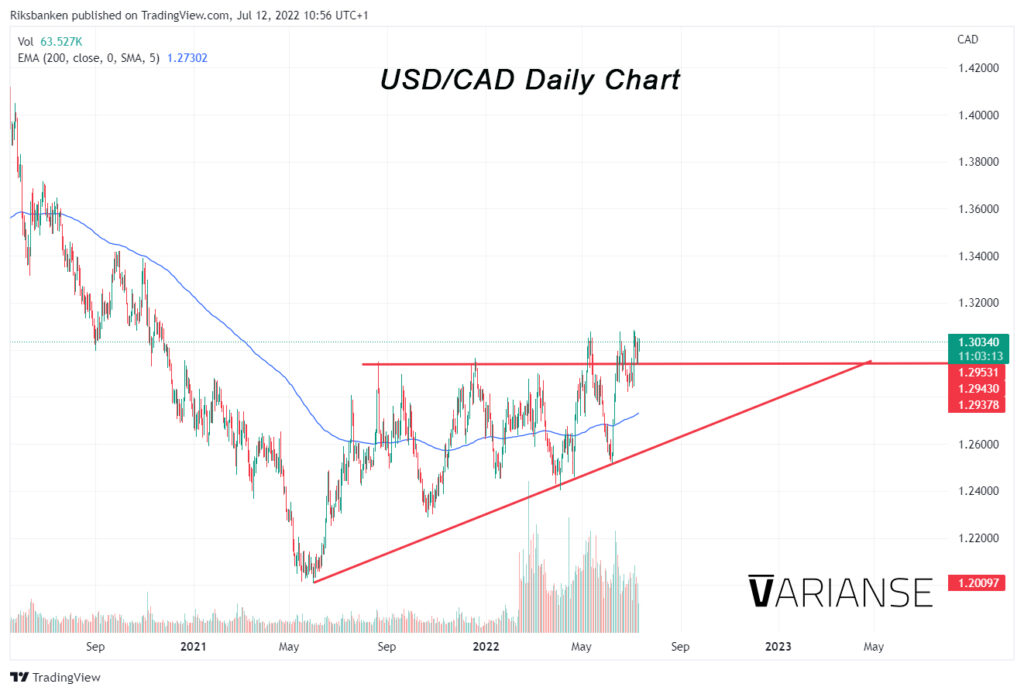
With forex traders squarely focused on the collapse of the EUR and GBP, USD/CAD may not be getting much airtime at the moment. Nevertheless, price at the time of writing was again pushing up above 1.30, after two failed attempts to stick above that level in May and June of this year. Prior attempts to break above the 1.2937 to 1.2943 resistance area failed on the retest, but this latest thrust higher has found some support above that region. For me, 1.30 remains a key level to watch as it marks the September 2020 swing of the prior downtrend. The ascending triangle pattern that fully formed in May is also hard to miss.
BoC Expected to Hike by 75 bps
Of course, one chart pattern or support/resistance level doesn’t make a trade. Crude oil price gyrations are also certainly having an impact on USD/CAD at the moment. Given that the Bank of Canada is also widely expected on Wednesday to raise its key interest rate to 75 bps to 2.25%, being bearish CAD at the moment might seem misplaced. Like the Fed, the Bank of Canada has been talking tough on inflation. Economists are expecting another 50 bps hike in September, according to a recent Reuters poll. Thereafter, however, there is mixed agreement on the future degree of tightening.
Canadian Housing Market Concern
One big area of concern is the Canadian housing market, which is already feeling the heat from higher interest rates. Home resales in May were down by 8.6% from April - the third consecutive drop. After falling 1.1% in April, Canada’s national MLS Home Price index declined by another 0.8% in May. Most believe the recent cooling in Canada’s housing market won’t deter the Bank of Canada from hiking interest rates. But the big question for traders, and ultimately for USD/CAD, should be what more can the Bank of Canada signal on Wednesday in terms of interest rates hikes given its current constraints.
Dollar Proves Exchange Rate Strength, Now the Turn for Economical One
The euro is one hair from parity with the dollar, a psychologically important line above which the single currency has been trading for the last generation.
After losing more than 4% over the week, the EURUSD looks excessively and emotionally oversold, and the oversold conditions of RSI confirm this on all time frames above H4. However, the single currency should not hope for support at these levels.
History suggests that neither the fall below parity in 1999, nor the rebound above it in 2002, were turning points, only temporarily attracting the attention of the media and market participants. At the dawn of the single currency, the European Central Bank began forex interventions near 0.8500 and after a 30% fall for almost two years.
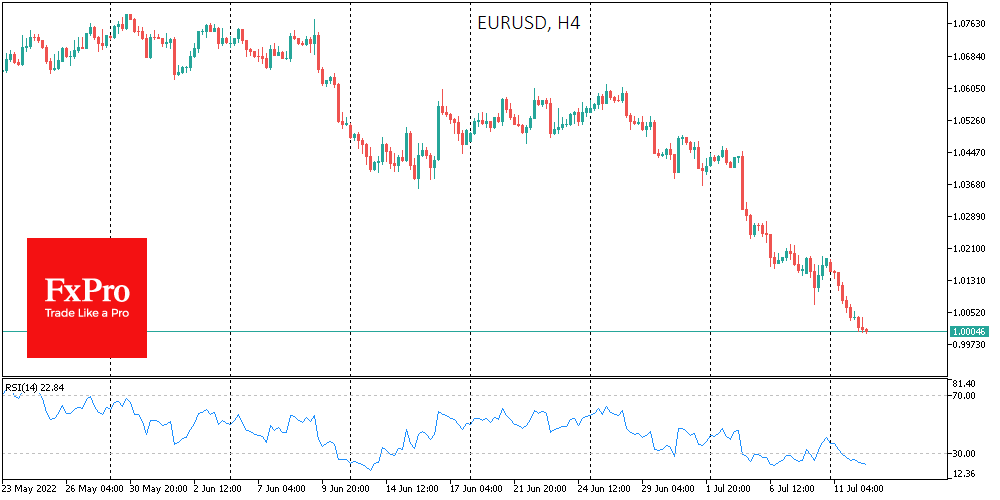
The situation is now very similar to the early 2000s, as the sell-off started from the same starting point. An analogy with the economic crisis can also be found. Both then and now, Germany was temporarily losing its status as the locomotive of the region, lacking the capacity and political will to consolidate the entire Euro-region around itself.
It is only logical to expect that central bank and government politicians would be forced to respond to questions about exchange rate depreciation. They may harbour hopes of an accelerated normalisation of the region’s monetary policy.
But the euro is a heavy machine whose movement is not easily stopped. It is worth expecting that Europe will no longer get away with soft market reassurances and modest actions, so the pressure on the single currency may persist for the foreseeable future.
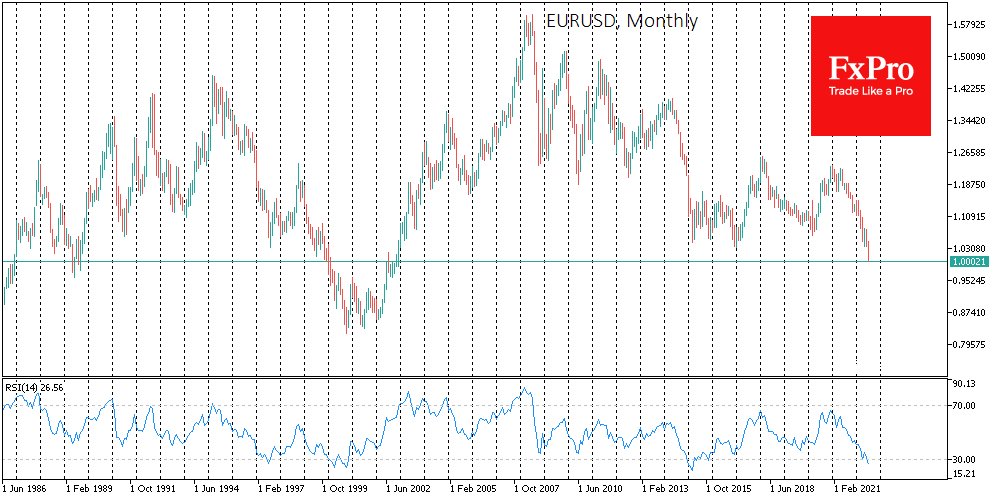
Moreover, it is quite possible that near the 0.9800 level in EURUSD, there is a “pain point”, a quick fall under which will cause a market capitulation with an acceleration of the single currency’s decline. Investors should also be prepared for a new round of discussions on the viability of the Euro-region, which means that the coming days and weeks promise to be very nervous for the single currency.
The dollar index, where the euro holds the most weight, is also renewing its highs in 20 years. This dynamic has smoothly removed the issue of dollar sustainability that dominated the media at the end of 2020. We saw two other attempts to bury the dollar in early 2008 during the mortgage crisis and in 2011 at the start of QE. However, things quickly went wild, proving that the dollar, at least for now, is like Churchill’s definition of democracy: ‘the worst… except for all others that have been tried from time to time…’.
Right now, we see the exchange rate strength of the dollar. Still, we should be prepared that its economical and geopolitical power will manifest itself very soon if (or rather when) investors will come to grips with the sustainability of the debt burden of Japan and some eurozone countries, which could happen in the coming weeks.
Japanese Yen’s Drop Sparks MOF Warning
The Japanese yen has stabilized on Tuesday, after taking a nasty tumble at the start of the week. In the European session, USD/JPY is trading at 136.91, down 0.35%.
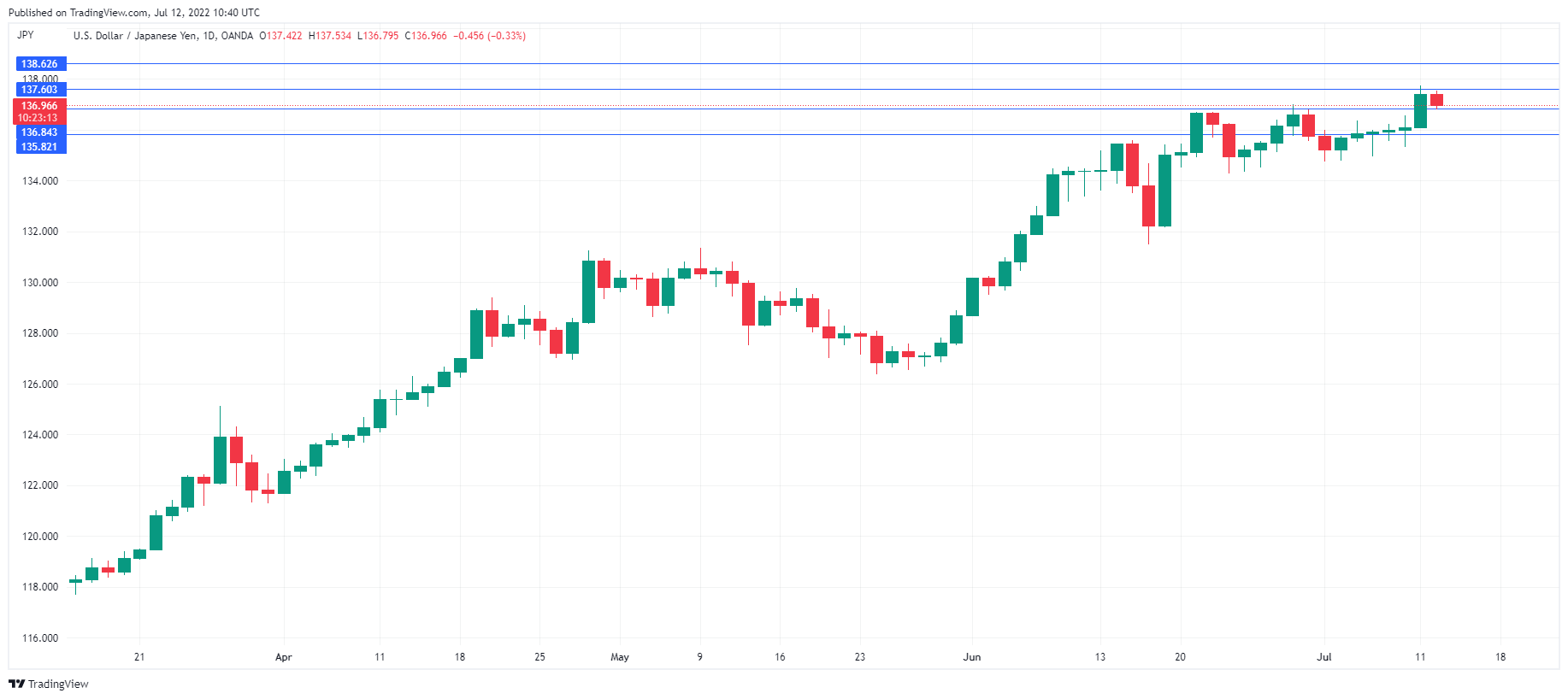
USD/JPY punches above 137
The US dollar went on a tear on Monday, as an excellent non-farm payroll report paved the way for the Fed to proceed with another supersize 75bp increase at the July meeting. CME’s FedWatch has pegged a 75bp move at 90%, with a 10% likelihood of a full 100bp increase. The Fed is in an ultra-aggressive mode in its battle against inflation and clearly willing to deliver 75bp salvos. It wasn’t long ago that a 50bp hike was considered a massive move; now such an increase would barely raise an eyebrow.
The US releases inflation on Wednesday, which could have a sharp impact on the dollar. Headline CPI is expected to rise from 8.6% to 8.8%, and if inflation does move higher, it would likely cement a 75bp move from the Fed and send the dollar higher. Conversely, a surprise drop in inflation would raise hopes that inflation has peaked and the Fed might resort to a 50bp increase, sending the dollar lower.
The Japanese yen continues its march towards the symbolic 140.00 line, and fell to 137.75 on Monday after USD/JPY soared by 1.01%. This triggered a response from Japan’s Finance Minister Suzuki, who expressed his concern about the exchange rate at a meeting with US Treasury Secretary Yellen. For her part, Yellen stated that she did not discuss currency intervention with Suzuki, and it appears that Suzuki is engaged in the usual jawboning whenever the yen takes a fall. BoJ Governor Kuroda’s stance doesn’t seem to be helping the yen at all, as he stated on Monday that the central bank would take additional monetary easing steps as necessary in order to boost the fragile economy.
USD/JPY Technical
- USD/JPY is putting pressure on support at 1.3684, followed by 135.82
- There is resistance at 137.60 and 138.62
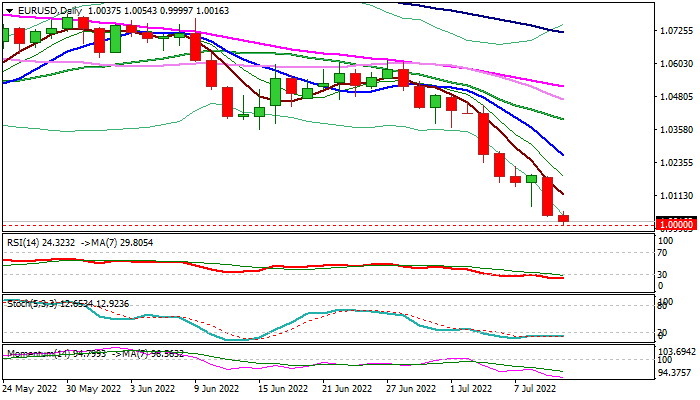
EUR/USD: Euro Touches Parity for the First Time in Two Decades But So Far Without Break Lower
The Euro is wobbling at parity level, but so far without clear break lower.
The sentiment remains very negative and was additionally hit by terrible German ZEW data which showed investor morale collapsed in July.
Traders also focus on Wednesday’s release of US June CPI data, with forecast for further rise of inflation to add to Fed’s firmly hawkish stance and further additionally boost the greenback.
Dollar’s rise seems to be unstoppable that heavily weighs on the single currency, which is hesitating at critical psychological support (the Euro was last time below parity in Dec 2002).
Oversold studies contribute to the headwinds that bears face at this zone, though mild reaction can be expected, as downside pressure is massive, with deteriorating economic conditions in the bloc to keep the downside at strong risk.
Potential upticks are likely to remain under falling 10DMA (1.0261) to keep bears fully in play for final break through parity level and offer better selling opportunities.
Eventual break of parity level would open way for deeper drop and expose next target at 0.9607 (Sep 2002 low).
Res: 1.0054; 1.0116; 1.0183; 1.0221.
Sup: 1.0000; 0.9944; 0.9859; 0.9607.
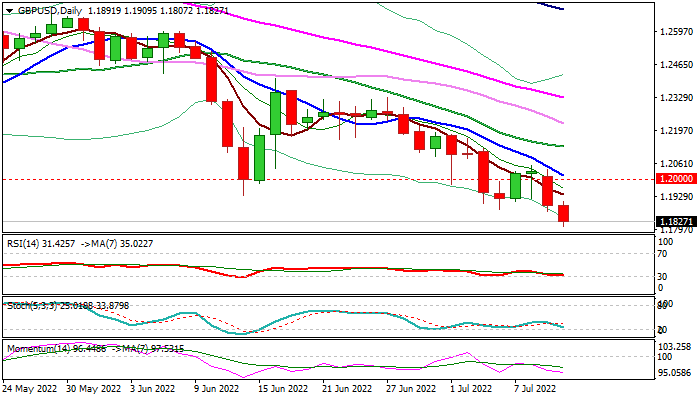
GBP/USD: Pound Extends Weakness, Pandemic Low Comes in Focus
Cable hit new lowest since March 2020, in extension of Monday’s 1% drop, with close well below 1.20 handle and former lows at 1.1958/30 (Sep 2019 / Oct 2016 lows respectively) and fresh extension lower on Tuesday, signaling that bears regained control.
Pound is pressured by rising dollar and risk aversion, which add to negative internal factors – political turmoil and slowing economic growth in Britain that raises threats of recession.
Daily techs show rising negative momentum and moving averages in full bearish setup that supports the action for final push towards Mar 2020 low (1.1409).
Price adjustments are expected to remain below strong barriers at 1.2000/13 (psychological / falling 10DMA) and offer better levels to re-enter bearish market.
Res: 1.1909; 1.1939; 1.2013; 1.2055
Sup: 1.1807; 1.1727; 1.1669; 1.1611
Germany ZEW economic sentiment dropped to -53.8, even worse than pandemic low
Germany ZEW Economic Sentiment dropped from -28 to -53.8 in July, well below expectation of -38.0. Current Situation Index dropped from -27.6 to -45.8, below expectation of -33.5. Both readings were even worse than the values recorded at the beginning of the COVID-19 pandemic.
Eurozone ZEW Economic Sentiment dropped form -28.0 to -51.1, below expectation of -40.0. Current Situation Index dropped -18.0 to -44.4. Inflation expectations rose 6.8 pts to -25.6, remaining clearly in negative territory.
ZEW President Professor Achim Wambach: "The current major concerns about the energy supply in Germany, the ECB's announced interest rate hike and further pandemic-related restrictions in China have led to a considerable deterioration in the economic outlook.
"The experts assess the current economic situation significantly more negatively than in the previous month and have further lowered their already unfavourable forecast for the next six months.
"Expectations for energy-intensive and export-oriented sectors of the economy have fallen particularly sharply, and private consumption is also assessed as significantly weaker."