

Sample Category Title
USD/CHF Daily Outlook
Daily Pivots: (S1) 0.9794; (P) 0.9827; (R1) 0.9849; More...
Further rally is expected in USD/CHF with 0.9721 minor support intact. Consolidation pattern from 1.0063 should have completed with three waves down to 0.9493 already. Further rise would be seen to retest 1.0063 high first. Decisive break there will resume larger up trend. On the downside, break of 0.9670 minor support will dampen this bullish view and turn intraday bias neutral first.
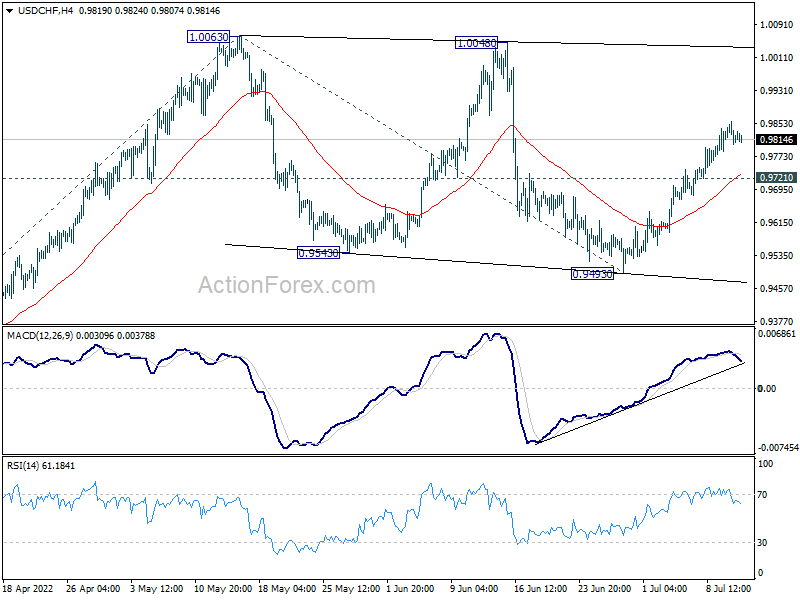
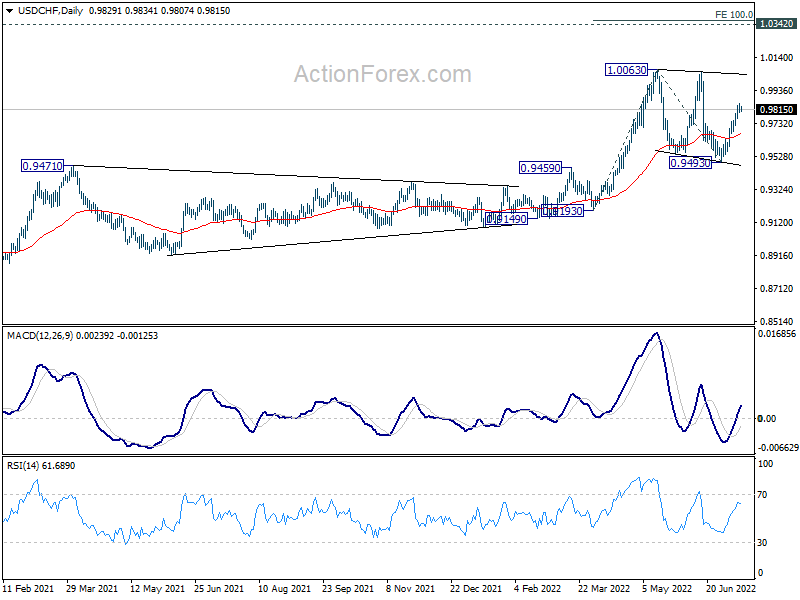
In the bigger picture, medium term up trend from 0.8756 (2021 low) is still in progress. Next target is 1.0342 (2016 high). Sustained break there will resume long term up trend from 0.7065 (2011 low). This will remain the favored case as long as 0.9471 resistance turned support holds.
USD/JPY Daily Outlook
Daily Pivots: (S1) 136.39; (P) 136.96; (R1) 137.44; More...
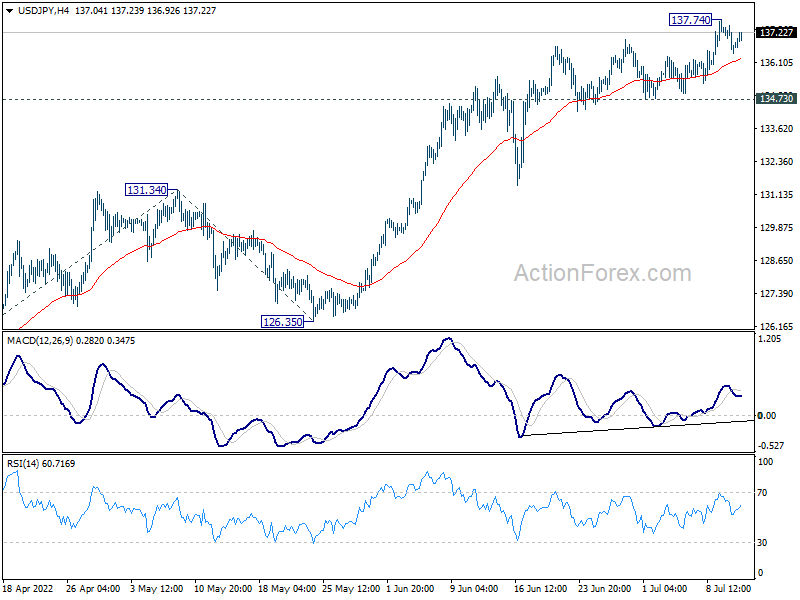
Intraday bias in USD/JPY stays neutral for consolidation below 137.74. Further rally is expected as long as 134.73 support holds. On the upside, break of 137.74 will resume larger up trend to 100% projection of 114.40 to 131.34 from 126.35 at 143.29.
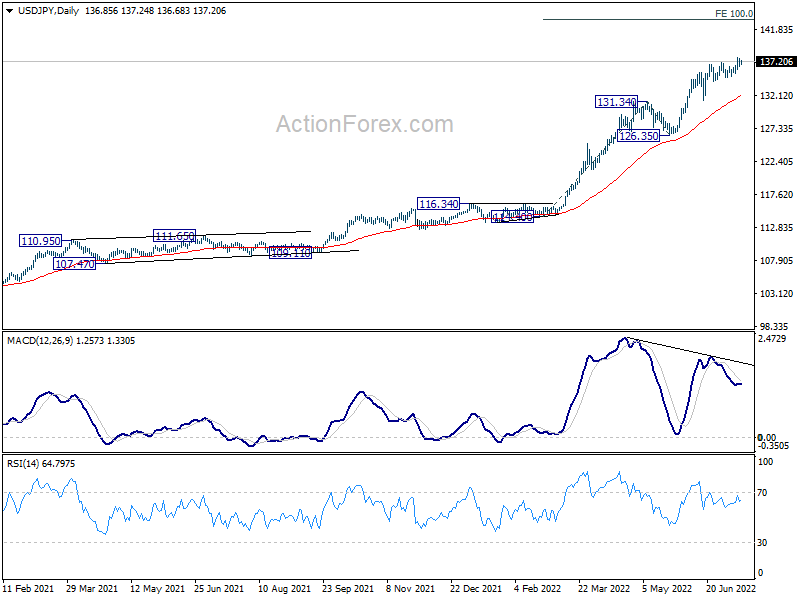
In the bigger picture, current rally is seen as part of the long term up trend from 75.56 (2011 low). Next target is 100% projection of 75.56 (2011 low) to 125.85 (2015 high) from 98.97 at 149.26, which is close to 147.68 (1998 high). This will remain the favored case as long as 126.35 support holds.
GBP/JPY Daily Outlook
Daily Pivots: (S1) 161.83; (P) 162.69; (R1) 163.55; More...
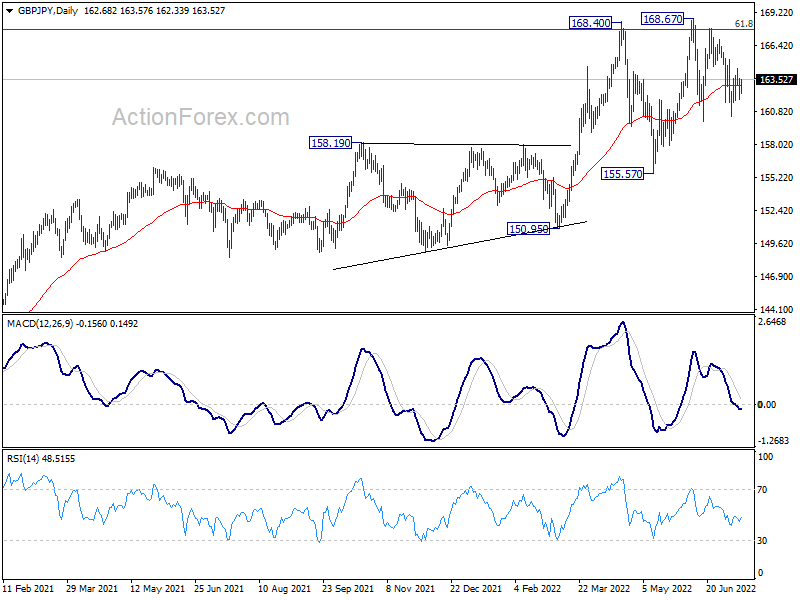
Range trading continues in GBP/JPY and intraday bias remains neutral. Further fall is in favor with 165.26 minor resistance intact. On the downside, below 160.37 support will target 155.57 key support level next. On the upside, above 165.26 minor resistance will turn bias back to the upside and bring retest of 168.67 high instead.
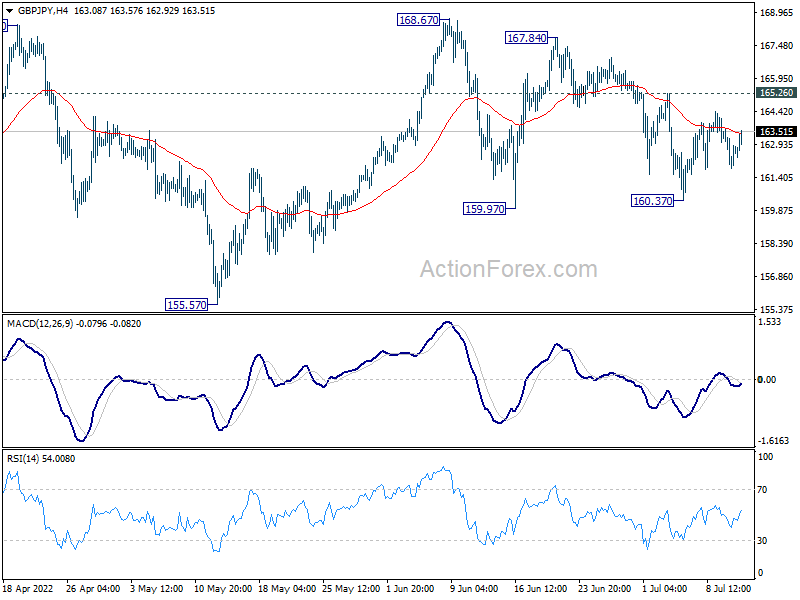
In the bigger picture, up trend from 123.94 (2020 low) is still in progress. Sustained break of 61.8% retracement of 195.86 (2015 high) to 122.75 (2016 low) at 167.93 will be a long term bullish signal, and could pave the way back to 195.86 high. This will now remain the favored case as long as 155.57 support holds, even in case of deep pull back.
EUR/JPY Daily Outlook
Daily Pivots: (S1) 136.90; (P) 137.49; (R1) 137.95; More....
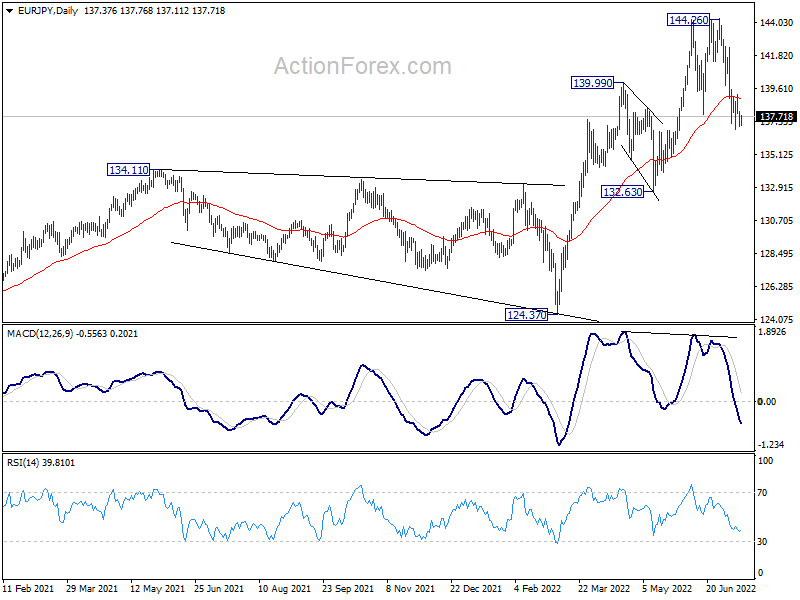
Intraday bias in EUR/JPY remains neutral for consolidations. But further decline is in favor with 139.78 minor resistance intact. On the downside, below 136.86 will target 132.63 support. Decisive break will turn outlook bearish for 124.37 support. On the upside, above 139.78 minor resistance will turn bias to the upside for stronger recovery.
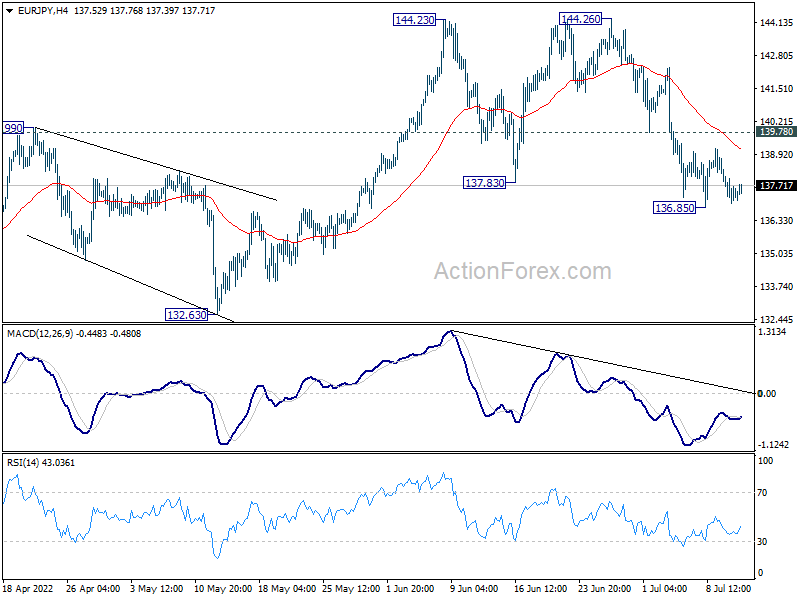
In the bigger picture, up trend from 114.42 (2020 low) is seen as the third leg of the pattern from 109.30 (2016 low). Further rally is in favor as long as 134.11 resistance turned support holds, even in case of deep pull back. Firm break of 139.78 will target 149.76 (2015 high. However, sustained break of 134.11 will be a sign of medium term bearish reversal and turn focus to 124.37 support for confirmation.
EUR/CHF Daily Outlook
Daily Pivots: (S1) 0.9826; (P) 0.9862; (R1) 0.9888; More....
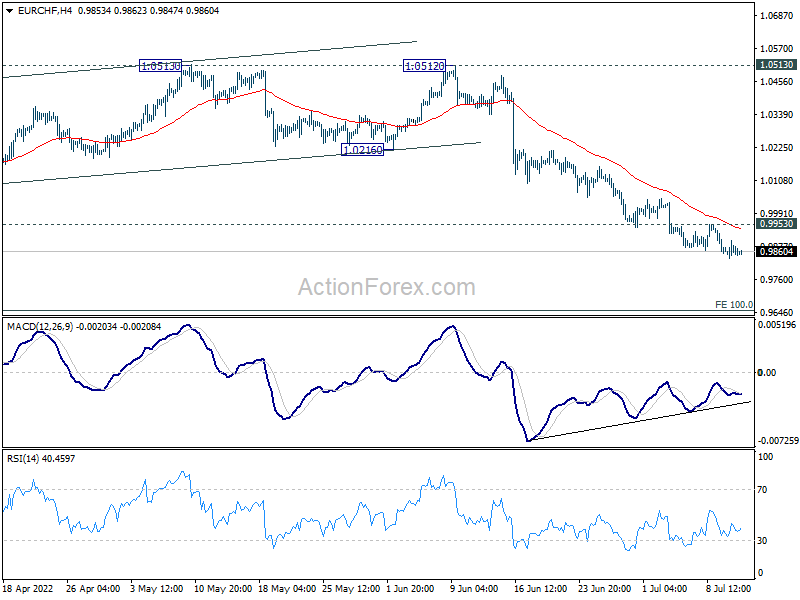
Intraday bias in EUR/CHF stays on the downside for the moment. Current down trend should target 0.9650 long term projection level. On the upside, above 0.9953 minor resistance will turn intraday bias neutral again, and bring consolidations, before staging another fall.
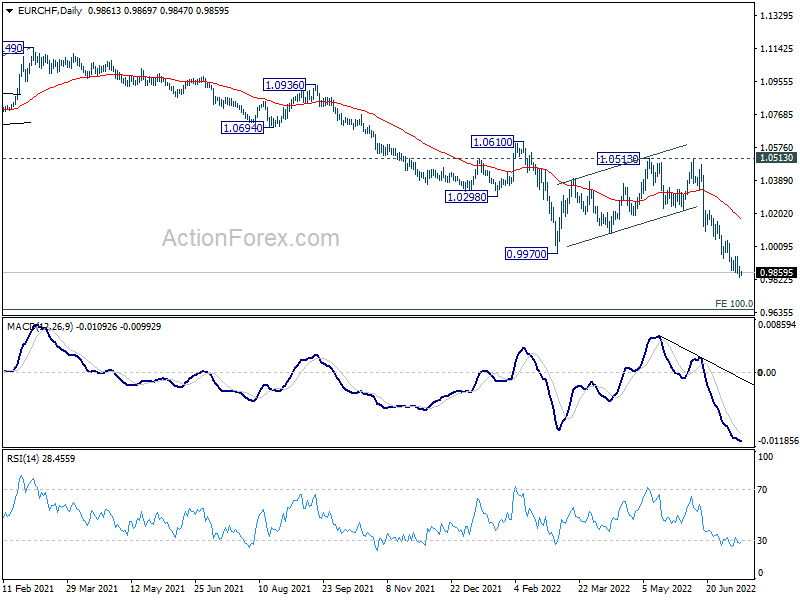
In the bigger picture, rejection by 55 week EMA affirmed medium term bearishness. Long term down trend from 1.2004 (2018 high) is expected to target 100% projection of 1.2004 to 1.0505 to 1.1149 at 0.9650. On the upside, break of 1.0513 resistance is needed to indicate medium term bottoming. Otherwise, outlook will stay bearish in case of strong rebound.
EUR/AUD Daily Outlook
Daily Pivots: (S1) 1.4812; (P) 1.4877; (R1) 1.4914; More...
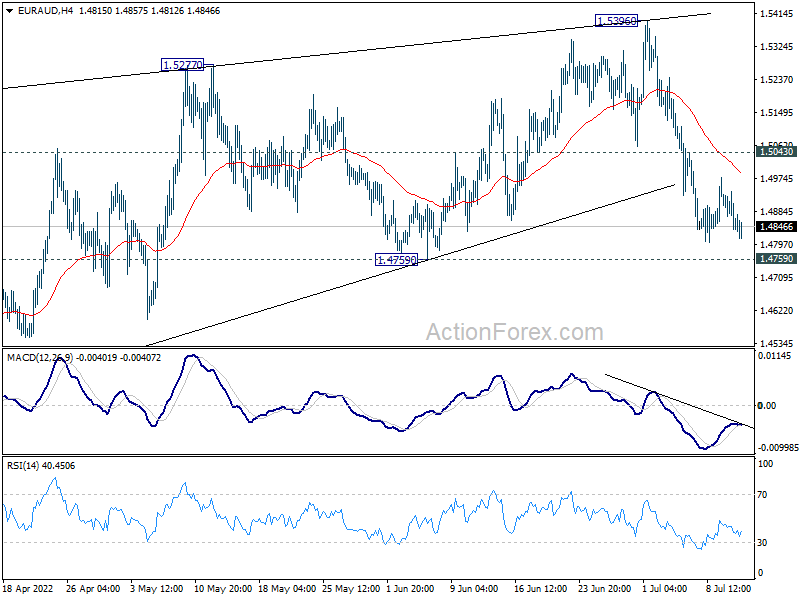
Intraday bias in EUR/AUD stays neutral at this point. Further decline is in favor with 1.5043 minor resistance intact. Break of 1.4759 support should confirm that corrective rise from 1.4318 has completed at 1.5396 after rejection by 1.5354 support turned resistance. Deeper fall should then be seen back to retest 1.4318 low. On the upside, however, break of 1.5043 will bring stronger rebound back towards 1.5396.
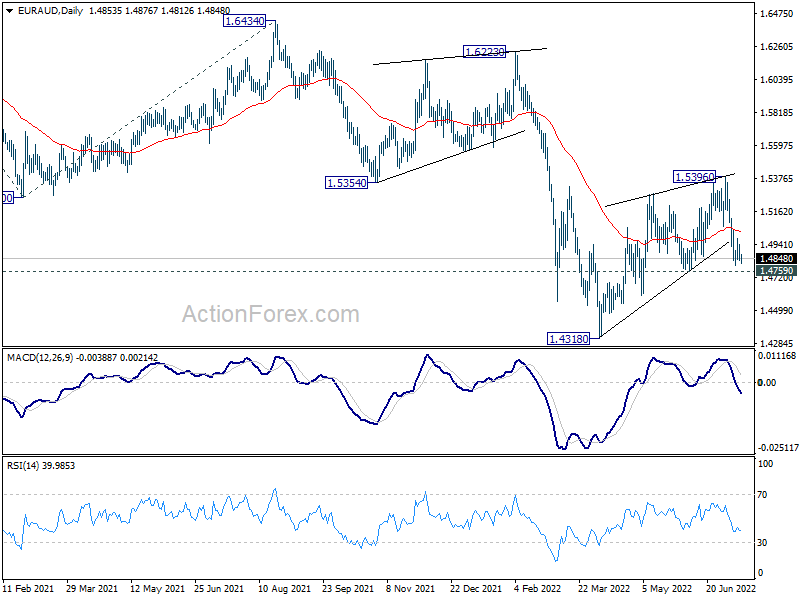
In the bigger picture, rejection by 1.5354 support turned resistance, as well as 55 week EMA (now at 1.5398), maintain medium term bearishness. That is, larger down trend from 1.9799 is not completed yet. Break of 1.4318 low will target 61.8% projection of 1.9799 to 1.5250 from 1.6434 at 1.3623, which is close to 1.3624 long term support (2017 low). This will remain the favored case now as long as 1.5396 resistance holds.
EUR/GBP Daily Outlook
Daily Pivots: (S1) 0.8423; (P) 0.8453; (R1) 0.8474; More...
EUR/GBP's decline is continuing today and intraday bias remains on the downside. Rebound from 0.8201 should have completed at 0.8720, after rejection by 0.8697 medium term fibonacci level. Further fall would be seen to retest 0.8201/48 support zone next. On the upside, above 0.8488 minor resistance will turn intraday bias neutral first.
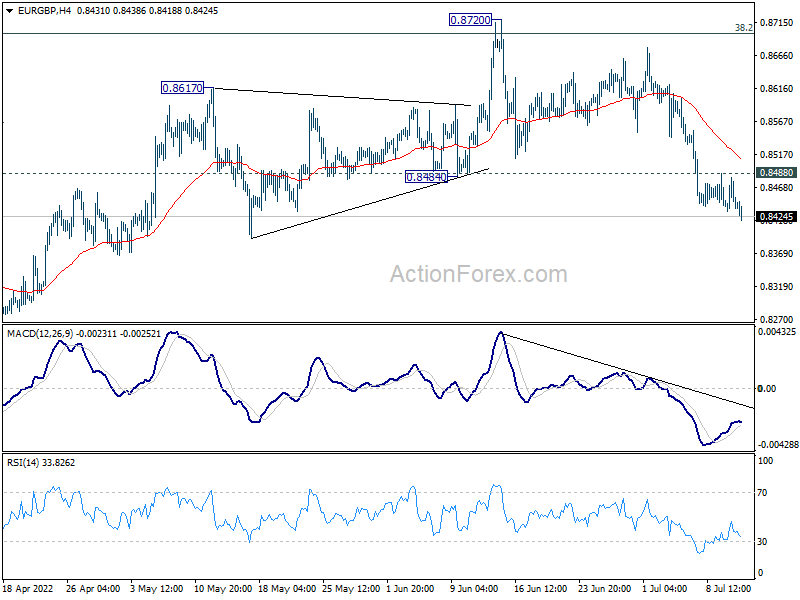
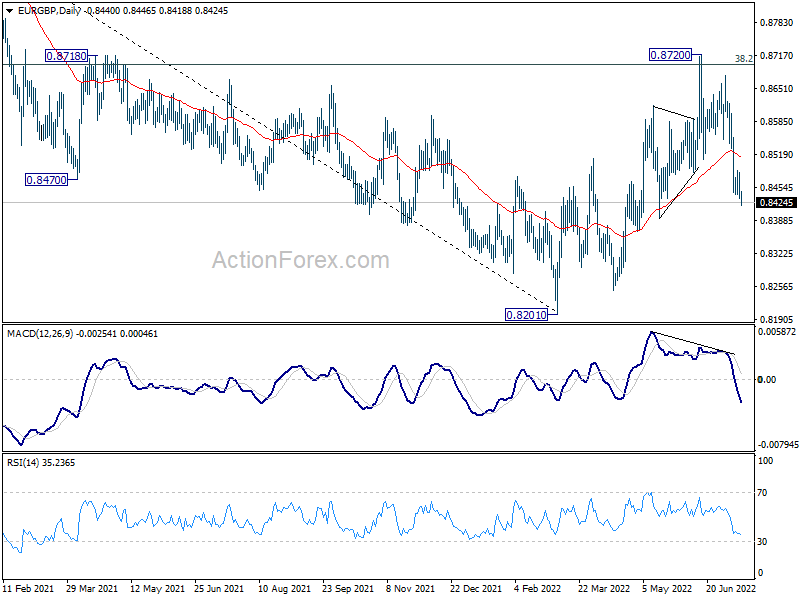
In the bigger picture, rejection by 38.2% retracement of 0.9499 to 0.8201 at 0.8697 argues that rebound from 0.8201 is merely a corrective move. That is, down trend from 0.9499 (2020 high) is now over. Sustained break of 0.8201 will resume such decline and target 61.8% retracement of 0.6935 to 0.9499 at 0.7917. This will now remain the favored case as long as 0.8720 resistance holds.
Sterling in Recovery Supported by GDP, Dollar Eyes CPI
Sterling is in recovery today, and it's supported by better than expected monthly GDP data. Yen is currently the softer one. But overall trading is quiet in the currency markets. RBNZ's rate hike doesn't give any lift to Kiwi. Canadian Dollar is range bound, awaiting BoC rate decision. Meanwhile, Dollar is consolidating recent gains, awaiting US CPI data.
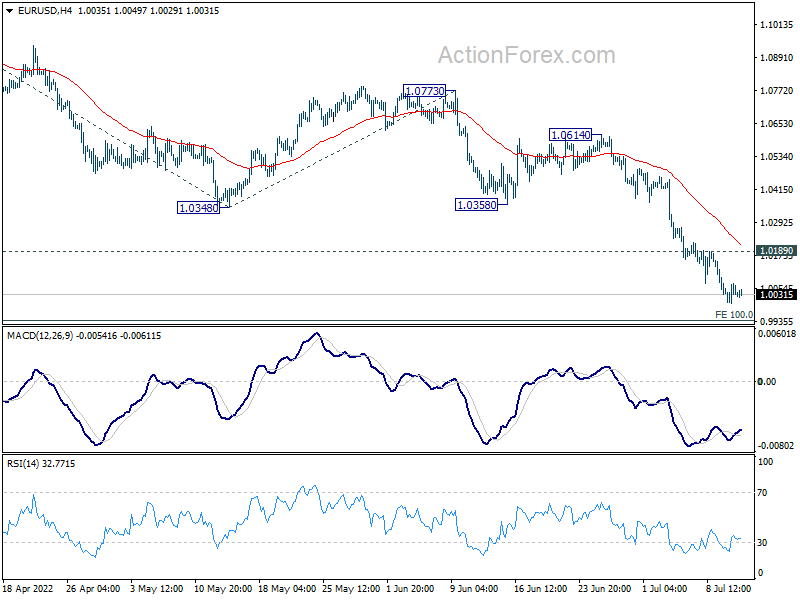
Technically, Dollar is losing some upside momentum, but there is no clear sign of topping yet. Near term levels to monitor include 1.0189 minor resistance in EUR/USD, 1.2055 minor resistance in GBP/USD, 0.6873 minor resistance in AUD/USD, 0.9721 minor support in USD/CHF, 134.74 minor support in USD/JPY. Buying dips in Dollar is still the way to go as long as these levels hold.
In Asia, Nikkei rose 0.48%. Hong Kong HSI is up 0.03%. China Shanghai SSE is up 0.07%. Singapore Strait Times is down -0.67%. Japan 10-year JGB yield is down -0.0049 at 0.239. Overnight, DOW dropped -0.62%. S&P 500 dropped -0.92%. NASDAQ dropped -0.95%. 10-year yield dropped -0.033 to 2.958.
UK GDP grew 0.5% mom in May, much better than expectations
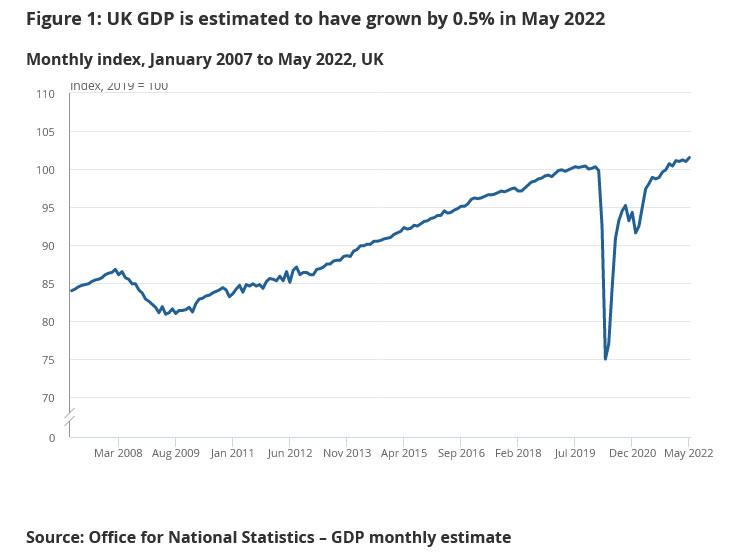
UK GDP grew 0.5% mom in May, much better than expectation of 0.0%. Services rose 0.4% mom. Production rose 0.9% mom. Construction also rose 1.5% mom. Monthly GDP is estimated to be 1.7% above its pre-pandemic levels in February 2020. In the three months to May, GDP grew 0.4%. Annual growth in monthly GDP was 3.5% yoy.
Also published, industrial production was up 0.9% mom, 1.4% yoy, versus expectation of 0.0% mom, 1.7% yoy. Manufacturing production was up 1.4% mom, 2.3% yoy, versus expectation of 0.1% mom, 0.3% yoy. Goods trade deficit was little changed at GBP -21.4B, versus expectation of GBP -18.3B.
RBNZ lifts OCR by 50bps to 2.5%, maintains approach of brisk rate hikes
RBNZ raised Official Cash Rate by 50bps to 2.50% as widely expected. The central bank also indicated that it will follow the projected path to raise interest to nearing 3.5% by the end of 2022, and then around 4% in mid-2023.
"The Committee is comfortable that the projected path of the OCR outlined in the recent May Monetary Policy Statement remains broadly consistent with achieving its primary inflation and employment objectives - without causing unnecessary instability in output, interest rates and the exchange rate," RBNZ said in the statement.
Also, as noted in the summary records of meeting, "The Committee agreed to maintain its approach of briskly lifting the OCR until it is confident that monetary conditions are sufficient to constrain inflation expectations and bring consumer price inflation to within the target range."
Fed Barkin expects inflation to come down, but not immediately, not suddenly, and not predictably
Richmond Fed President Thomas Barkin said yesterday, "I definitely see signs of softening" in the economy, with evidence "most pronounced in lower income households".
"I expect inflation to come down but not immediately, not suddenly, and not predictably," he said. "My expectations are it will be a slower path rather than an immediate path down to 2%."
Barkin also said he's open to a 50bps or 75bps hike in July. "I am one of the guys who like the option value of deciding the week of the meeting as opposed to two weeks before the meeting. But I thought Jay's (Fed Chair Jerome Powell) guidance the last time was very sound," he added.
IMF projects US inflation to slow to 1.9% by end of 2023
IMF cut US 2022 GDP growth forecasts from 2.9% to 2.3% in the latest report. For 2023, GDP growth was was also lowered from 1.7% to 1.0%. Inflation is forecast to come down to 6.6% in Q4 2022, then slow further to 1.9% by Q4 2023.
IMF Managing Director Kristalina Georgieva said: "In sum, we are confident the Fed will be effective in bringing inflation down, will remain data dependent and, as conditions change, will telegraph clearly where policy is likely to go. This is important not just for the U.S. but also for the global economy.
Looking ahead
Eurozone industrial production will be released today. But major focuses will firstly be on US CPI. Then, BoC is expected to raise interest rate again, probably by a jumbo 75bps. Fed will also publish Beige Book economic report.
EUR/GBP Daily Outlook
Daily Pivots: (S1) 0.8423; (P) 0.8453; (R1) 0.8474; More...
EUR/GBP's decline is continuing today and intraday bias remains on the downside. Rebound from 0.8201 should have completed at 0.8720, after rejection by 0.8697 medium term fibonacci level. Further fall would be seen to retest 0.8201/48 support zone next. On the upside, above 0.8488 minor resistance will turn intraday bias neutral first.
In the bigger picture, rejection by 38.2% retracement of 0.9499 to 0.8201 at 0.8697 argues that rebound from 0.8201 is merely a corrective move. That is, down trend from 0.9499 (2020 high) is now over. Sustained break of 0.8201 will resume such decline and target 61.8% retracement of 0.6935 to 0.9499 at 0.7917. This will now remain the favored case as long as 0.8720 resistance holds.
Economic Indicators Update
| GMT | Ccy | Events | Actual | Forecast | Previous | Revised |
|---|---|---|---|---|---|---|
| 02:00 | NZD | RBNZ Interest Rate Decision | 2.50% | 2.50% | 2.00% | |
| 06:00 | GBP | GDP M/M May | 0.50% | 0.00% | -0.30% | |
| 06:00 | GBP | Index of Services 3M/3M May | 0.10% | 0.20% | 0.00% | 0.20% |
| 06:00 | GBP | Industrial Production M/M May | 0.90% | 0.00% | -0.60% | -0.10% |
| 06:00 | GBP | Industrial Production Y/Y May | 1.40% | 1.70% | 0.70% | 1.60% |
| 06:00 | GBP | Manufacturing Production M/M May | 1.40% | 0.10% | -1.00% | -0.60% |
| 06:00 | GBP | Manufacturing Production Y/Y May | 2.30% | 0.30% | 0.50% | 1.30% |
| 06:00 | GBP | Goods Trade Balance (GBP) May | -21.4B | -18.3B | -20.9B | -21.5B |
| 06:00 | EUR | Germany CPI M/M Jun F | 0.10% | 0.10% | 0.10% | |
| 06:00 | EUR | Germany CPI Y/Y Jun F | 7.60% | 7.60% | 7.60% | |
| 09:00 | EUR | Eurozone Industrial Production M/M May | 0.20% | 0.40% | ||
| 11:00 | GBP | NIESR GDP Estimate (3M) Jun | -0.10% | |||
| 12:30 | USD | CPI M/M Jun | 1.00% | 1.00% | ||
| 12:30 | USD | CPI Y/Y Jun | 8.70% | 8.60% | ||
| 12:30 | USD | CPI Core M/M Jun | 0.50% | 0.60% | ||
| 12:30 | USD | CPI Core Y/Y Jun | 5.70% | 6.00% | ||
| 14:00 | CAD | BoC Interest Rate Decision | 2.00% | 1.50% | ||
| 14:30 | USD | Crude Oil Inventories | -1.5M | 8.2M | ||
| 18:00 | USD | Fed's Beige Book |
UK GDP grew 0.5% mom in May, much better than expectations
UK GDP grew 0.5% mom in May, much better than expectation of 0.0%. Services rose 0.4% mom. Production rose 0.9% mom. Construction also rose 1.5% mom. Monthly GDP is estimated to be 1.7% above its pre-pandemic levels in February 2020. In the three months to May, GDP grew 0.4%. Annual growth in monthly GDP was 3.5% yoy.
Also published, industrial production was up 0.9% mom, 1.4% yoy, versus expectation of 0.0% mom, 1.7% yoy. Manufacturing production was up 1.4% mom, 2.3% yoy, versus expectation of 0.1% mom, 0.3% yoy. Goods trade deficit was little changed at GBP -21.4B, versus expectation of GBP -18.3B.
RBNZ Monetary Policy Review: No Holding Back
- The Reserve Bank increased the OCR by another 50 basis points to 2.50% as widely expected.
- The RBNZ endorsed the OCR path that it projected in its May Monetary Policy Statement, and repeated much of the language from that as well.
- The RBNZ's focus remains on the risk of homegrown inflation pressures becoming persistent, with strong demand running up against capacity constraints.
- We continue to expect another 50 basis point hike in August.
- By that point, the OCR will be much closer to where we (and the RBNZ) see the peak for this cycle.
The Reserve Bank's decision to lift the Official Cash Rate by another 50 basis points was almost universally expected. Not only was the move right in line with the path that the RBNZ projected in its May Monetary Policy Statement, but the key language in today's statement was mostly identical. The RBNZ remains "resolute" in its commitment to bringing inflation back within the target range, and it intends to keep lifting interest rates "at pace".
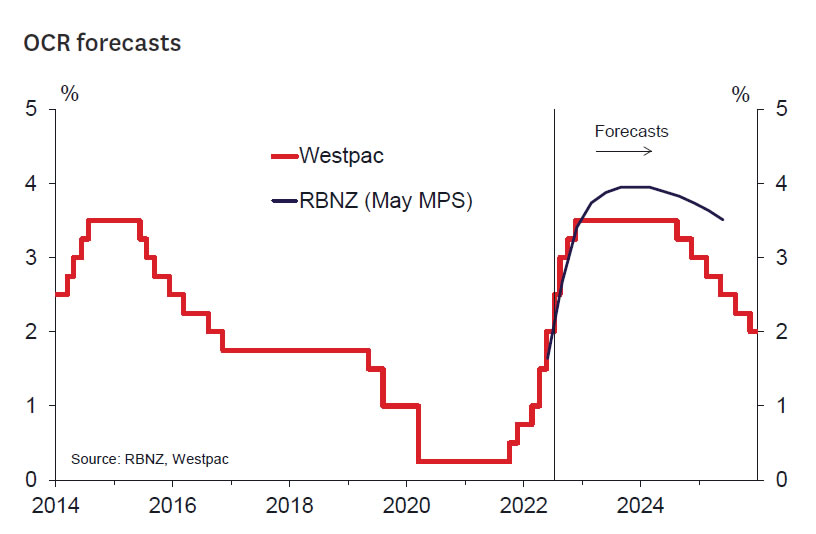
The lack of change in the message is itself the message. The RBNZ has not been fazed one way or another by recent developments, and its focus remains on the medium-term outlook. That's useful to know – the alternative was that the RBNZ could have followed the more downbeat tone that has pervaded financial markets in recent weeks, with inflation being replaced by recession as the 'big bad'.
The RBNZ is certainly not oblivious to recent developments, referencing both upside risks to inflation and downside risks to activity in the near term. But its focus remains on the mediumterm outlook and the homegrown inflation pressures that are becoming more pervasive. Demand continues to outstrip the economy's capacity, and skill shortages and Covid disruptions certainly don't help.
The RBNZ noted that the OCR path that was projected in its May Monetary Policy Statement is still broadly consistent with meeting its inflation and employment objectives. The addition of "broadly" could be taken to imply some wiggle room around what that projection would look like if they re-ran it today. But any meaningful change to the OCR path is more likely to come down to the flow of data between now and the August statement. That includes the CPI next Monday, the labour market surveys in early August, and the survey of inflation expectations, which remain a key concern for the RBNZ.
We continue to expect a fourth 50 basis point hike at the August review, which would bring the OCR up to 3%. It's at that point that we might see a change of tone from the RBNZ. For one, the OCR will by then be much closer to the endpoint that the RBNZ envisages (the May projection peaked just below 4%), so the logic of "a stitch in time saves nine" becomes less relevant. Secondly, the Monetary Policy Committee will have the benefit of a full set of economic forecasts in August, along with additional time to consider the softening global backdrop. At that point, the RBNZ could signal that further rate hikes are likely, but the pace and extent of them will be played by ear.
There is one final aspect of the RBNZ's forecast (and ours) that hasn't garnered much attention yet: once the OCR does peak, it's likely to fall again in the years to come. The RBNZ has been clear that in order to get on top of the inflationary pressures that have built up, it needs to take monetary policy settings above 'neutral' and into 'tight' territory, for at least some time. In other words, this is a good old-fashioned cycle, not a permanent shift.
That idea hasn't really been reflected in longer-term market interest rates, which are more consistent with the OCR rising and staying there. If the economic outlook does turn gloomier from here, there's plenty of scope for a fall in longer-term interest rates – and a de facto easing in monetary conditions – without the RBNZ having to do anything differently. So for now the RBNZ can afford to keep up its inflation-fighting message, without making concessions to the market's worries.