Sample Category Title
US Inflation in Focus, as COVID-19 Cases Rise, Again
Market mood is sourish, appetite is limited. Major US indices fell for a second session on Tuesday, as recession talks, rising Covid cases in the US and Europe, and prospects of renewed lockdown measures in China add a renewed pressure on market sentiment.
Even OPEC’s warnings that demand will exceed supply by 1 million barrels per day next year couldn’t prevent crude oil from falling back to $95 per barrel.
US inflation data in focus
The US CPI is expected to advance to 8.8% in June, from 8.6% printed a month earlier. There are a couple of factors hinting that we could see a softer-than-expected figure at today’s release. The softening food, energy and commodity prices, the improved supply chains, the easing shipping costs and lower purchasing manager indices hint that US inflation may have hit a peak last month, or will hit one soon.
But when, is the million-dollar question. Investors are looking for back-to-back data points to confirm that inflation is finally easing. Therefore, whatever will come out of today’s release will not be sufficient to drive major conclusions. The Federal Reserve (Fed) will still raise the interest rates by 75bp hike this month. Yet, a softer inflation figure could revive the Fed doves for the last three FOMC meetings of the year.
How could the market react?
A further rise in the US consumer prices will certainly revive the Fed hawks today, push the US dollar higher and equities lower.
A softer-than-expected figure, on the other hand, could revive hope that the US economy could experience a soft landing and result in a much-awaited pause in the dollar rally, and a rebound in equities before big US banks start releasing their quarterly results on Thursday.
In both cases, the market volatility will likely remain high, and the visibility likely remain low especially when you add the lower summer trading volumes into that mix.
Parity
It’s a matter of time before we see the EURUSD fall below parity. And that’s bad news for the European Central Bank (ECB).
The lower the euro, the higher the cost of imports as energy, commodities, and higher the pressure on inflation. But, the ECB hawks are nowhere to be found before next week’s ECB meeting, as no one believes at this point that the ECB could surprise with a bigger rate hike. The Ukrainian war, the worsening energy crisis, the slowing European economies, the talk of recession and the risk of a renewed debt crisis will likely keep the ECB on path for a too little 25bp hike next week.
So yes, the EURUSD will likely trade below parity, but how deep it could fall will depend on the strength of the US dollar.
Big Wednesday
It may not be monster surf breaks in Hawaii or Uluwatu in Bali, but today is shaping up to be a stormy day for markets, with plenty of chances to get dumped and held under the waves for a while. We have already had two central banks in Asia raise policy rates this morning, with the Bank of Korea and Reserve Bank of New Zealand hiking by 0.50%, with a hawkish tone in their statements. Rather surprisingly, the Korean Won and New Zealand Dollar are both sharply unchanged, suggesting that the news was already priced in.
This evening, it will be the Bank of Canada’s turn, and markets have a chunky 0.75% rate hike pencilled in. Even the Bank of England was beating the rate hike inflation-fighting drums last night. India’s June YoY inflation stayed stubbornly above 7.0% overnight at 7.01%. That will keep the pressure on the Reserve Bank of India to keep tightening, and on the Indian Rupee. So, at a glance, the G-20 central banks are very much in inflation-fighting mode, unless you are China, Turkey and possibly Europe, who are in a world of stagflation pain now.
Just how much pain the Eurozone may be in inflation/stagflation-wise may be highlighted by German inflation this afternoon. June Inflation YoY is expected to remain very high at 7.60%, only modestly retreating from May’s 7.90%. French and Spanish Inflation YoY for June will be equally grim, expected to be 6.50% and 10.20% respectively. If the gas stays off through Nord Stream 1 after the maintenance period finishes on the 21st of July, those numbers are set to get worse, and not better. I suspect the outlook for the Euro will get worse as well, and we will be looking wistfully back at EUR/USD at 1.0000 and wishing we’d sold more. It will be interesting to see if the ECB decides to take the Asian route through the pandemic and wear the inflation pain to keep the economic lights on.
The United Kingdom (unless you’re Scottish), releases a chuck of tier-1 data this afternoon as well, including GDP, the Trade Balance, Manufacturing, and Industrial Production for May. All of it has downside risks and won’t have improved in May and in many ways, the BOE is facing the same quandary as the ECB. Combined with an extended leadership contest to select a new Prime Minister to replace Boris Trump, pressure is likely to remain on Sterling as well.
Before that, we get China’s balance of Trade shortly, expected to come in at $75.70 billion for June. Its market impact should be minimal though, as Mainland markets fret over new potential covid-zero lockdowns, and ahead of a slew of tier-1 data releases on Friday, including GDP, retail sales and industrial production.
All roads lead to the US Inflation data this evening, which comes after a surprisingly strong Non-Farm Payroll print last Friday. Overnight the US NFIB small business survey was quite weak, but it will be overruled by the inflation data, especially if headline inflation remains near 9.0% for June YoY, and the core remains near 6.0% YoY. That will lock and load 0.75% from the FOMC at the end of the month with potentially larger rate hikes to come, as well as shaking the confidence of the most ardent bottom-fisher in the US equity and bond market. Having said that, given the recent moves in the US Dollar and US equities, if the data comes in softer than forecast, we could see a decent correction lower by the greenback, relieving some of the Euro’s pain. Equities will probably rally as the FOMO gnomes pile in, and the US yield curve will move lower.
Glancing around other asset classes, the big mover overnight was oil, which plummeted after the US API Crude Inventories by 4.762 million barrels, the second week of huge increases. Notably, gasoline inventories rose by 2.927 million barrels, and distillates by 2.262 million barrels. Offsetting that was another big fall by stocks in the US SPR, which seems to be making up the feedstock difference now. With the street on recession watch, saw Brent and WTI fall by around 7.0%, with Brent crude closing under $100.00 a barrel. I remain sceptical that oil prices will move materially lower from here, however. The forward futures remain heavily in backwardation on both Brent and WTI, indicating real-world supplies remain tighter than Elon Musk’s wallet. OPEC also forecast a supply/demand deficit from its member to persist through 2023 overnight as well. The price action still appears to be a disconnect between the speculative world, and the real world, although I don’t discount more downside losses in the short term.
Over in Disneyland, I mean crypto-land, Bitcoin has slipped back below $20.000.00 of fiat currency US Dollars to $19,500.00 this morning. A soft US inflation print tonight should save Bitcoin’s bacon along with equities, temporarily at least. The line in the sand to flush our more margin stop-outs, 5-minute macros and some more HODL’ers is probably just below the June lows at around $18,500.00.
Also hanging out for a weak US inflation number tonight are gold bugs. Gold remains in Dire Straits, hovering near $1725.00 an ounce, strictly rhythm, it doesn’t want to cry or sing. (old people will get this) Another bout of US Dollar strength could well see $1675.00 fail, setting of another capitulation trade.
Asian heavyweight gain on lower oil prices
Asia’s northern heavyweights are higher despite a negative Wall Street session overnight, thanks to the slump in oil prices late in the New York session. Wall Street couldn’t hold onto early gains as pre-CPI nerves and recession fears sent US equities down once again. The S&P 500 fell by 0.92%, the Nasdaq by 0.85%, and the Dow Jones by 0.62%. US futures are showing resilience in Asia though, suggesting choppy trading ahead of the US inflation data tonight. S&P futures are 0.25% higher, Dow futures are 0.15% higher, while Nasdaq futures have jumped by 0.50%.
In Asia, the slump in oil prices overnight has lifted the northern Asia heavyweights, all of whom are voracious consumers of imported energy. Japan’s Nikkei 225 has gained 0.35%, with South Korea’s Kospi rising by 0.75%. In Mainland China, the Shanghai Composite is 0.35% higher, while the CSI 300 has gained 0.45%. Hong Kong has risen by 0.70%. Taipei has leapt 2.85% higher after the government activated its stock stabilisation fund today.
Elsewhere, growth-centric ASEAN has been unable to replicate those gains, following Wall Street’s overnight lead and heading south this morning. Singapore has fallen by 0.70%, with Jakarta losing 0.55%, and Kuala Lumpur falling by 0.65%. Manila continues to struggle as markets price in more aggressive tightening from the BSP and the trade balance deteriorates, retreating by 1.10% today. Bangkok has lost 0.75% today.
Australian markets are treading water after resource prices fell again overnight. The ASX 200 and All Ordinaries are ranging narrowly on each side of unchanged.
European markets conjured up a relied rally overnight, perhaps driven by Canada releasing a previously embargoed gas pipeline pump back to Russia, lifting hopes that Nord Stream 1 will start flowing again after maintenance finishes on the 21st of July. The momentum from that trade is going to wane quickly though, and Europe will be casting a nervous glance at US inflation data this evening, and inflation data from German, France, and Spain. I expect a cautious slightly negative, opening this afternoon.
US Dollar consolidates
After the impressive rally on Monday, the US Dollar settled into a pre-US-inflation waiting game overnight, which continues today in Asia as the greenback consolidates recent gains. The dollar index closed almost unchanged at 108.15 overnight, where it remains in Asia. Resistance is at 108.45 and 110.00. Support is at the 1.0585 breakout point, and then 1.0500, followed by 1.0350 and 102.50. The US inflation data will dictate whether the overbought relative strength index indicator (RSI) has signalled a short-term correction lower for the US Dollar.
EUR/USD traded at 1.0000 overnight, but held this level and rose back to finish the day unchanged at 1.0037, where it remains in Asia. A break of 1.0000 is likely to trigger a sharp move lower as stop-losses and algos kick in. Since breaking a multi-year support line at 1.0850 in April, Euro has looked consistently weak, the recovery rally failing ahead of 1.0850 in a technical analysis nirvana. An oversold RSI allows for short-term recovery, with resistance at 1.0200 and 1.0270. Support is at 1.0000, and failure targets the 0.9900/25 area.
GBP/USD fell to nearly 1.1800 overnight before rallying to an unchanged close at 1.1890 overnight. In Asia, it has crept slightly higher to 1.1910. Immediate support is at 1.1800, with 1.1400 as the medium-term target. Resistance is well defined at 1.2060 and 1.2200.
USD/JPY edged 0.40% lower to 136.90 overnight as US yields eased, rising to 137.05 in sedate Asian trading. USD/JPY has resistance at 138.00 and 140.00, with support at 136.00, 134.25 and 132.00. Only a sharp fall in US yields seems likely to turn USD/JPY lower, but a soft US CPI (relatively), this evening, could also do the job.
AUD/USD edged 0.35% higher overnight to 0.6755, rising slightly to 0.6770 in Asia as risk sentiment stabilises, at least for now. In Asia, it has eased 0.17% lower to 0.6725. Risks remain skewed towards the downside and a test of 0.6600. It has resistance at 0.6780 and 0.6850. NZD/USD is unchanged at 0.6130 today, with the RBNZ’s 0.50% hike today clearly priced into the market.
Asian currencies ranged overnight, producing a mixed bag of modest gains and losses against the US Dollar. The Philippine Peso underperformed again, USD/PHP rising 0.65% to 56.34 as the trade balance deteriorates, inflation rises and harsher tightening by the BSP is priced in. Asian currencies have booked small gains today in an otherwise lacklustre session.
Overall, currency markets look content to wait on the sidelines for the US inflation data this evening. How the coins fall will dictate the US Dollar’s next directional move.
Oil slumps overnight
As mentioned above, a surprisingly high build in US API crude and refined product inventories spurred a late and aggressive slump in oil prices. Clearly, the speculative market is not prepared to wear any sort of losses from bottom fishing now, and we can expect to see more of these sorts of days going forward until the recession/inflation picture becomes clearer. That said, I believe that the disconnect between the real world, and the speculative world, is growing wider and although I don’t rule out more downside surprises, I believe the recent selloff could be getting a little overdone.
Brent crude plummeted by 6.75% lower to $99.10 overnight, while WTI collapsed by 7.60% to $95.60 a barrel. In Asia, both contracts probed the downside initially, but the lure of low prices was too irresistible for Asian buyers. Brent crude has risen 0.30% to $99.40, while WTI has recovered its losses to be unchanged at $95.60 a barrel.
The chart picture has turned negative again for both contracts, although I note that Brent crude has had these ranges up and down in three of the past six trading sessions, showing just how skittish the short-term trading market is. The RSIs on both contracts are still in neutral territory, implying that more downsides could occur, just as easily as a sharp rally could.
Brent crude has nearby resistance at $100.00, followed by a now distant $106.00 a barrel. It has nearby support at $98.40 followed by the much more import 200-day moving average (DMA) at $96.80 a barrel. Consecutive daily closes below the 200-DMA will force a reassessment by me, perhaps meaning that the backwardation important futures curves move lower with spot prices but remain in backwardation. A sort-off hawkish easing if you like. 2022 continues to surprise me.
WTI looks the more vulnerable after the API crude inventory data overnight, and tonight’s official US crude inventory data rises in importance. WTI tested its 200-DMA this morning at $94.00 a barrel but managed to rally from there. Consecutive daily closes under the 200-DMA would be an ominous development for prices, depending on your point of view. $93.00 is the next support level after the 200-DMA. Resistance is at $96.00 a barrel, followed by a now-distant $103.50 a barrel.
Gold needs a low US inflation print
Gold traded in quite a wide range between $1723.00 and $1745.00 an ounce overnight, but finished 0.45% lower at $1726.50 an ounce, another unimpressive close. In Asia, it has eased slightly to $1725.50 an ounce in a moribund session.
Gold desperately needs the US inflation data to come in lower than expectations tonight, which should trigger a pullback by the US Dollar, lifting gold prices. That said unless the US Dollar stages an extended and extensive pullback lower, gold’s technical picture remains grim. A high inflation number tonight from the US could well see $1675.00 finally tested. The only saving grace for gold right now is an oversold RSI, suggesting that a lower US Dollar could trigger a disproportionate upside correction by gold.
Gold has resistance at $1745.00, now a double top. That is followed by $1780.00, $1785.00, and $1802.00, its downward trendline. Support is at $1720.00, followed by $1675.00. Failure of longer-term support at $1675.00 sets in motion a much deeper correction, potentially reaching $1500.00 an ounce.
Technical Outlook and Review
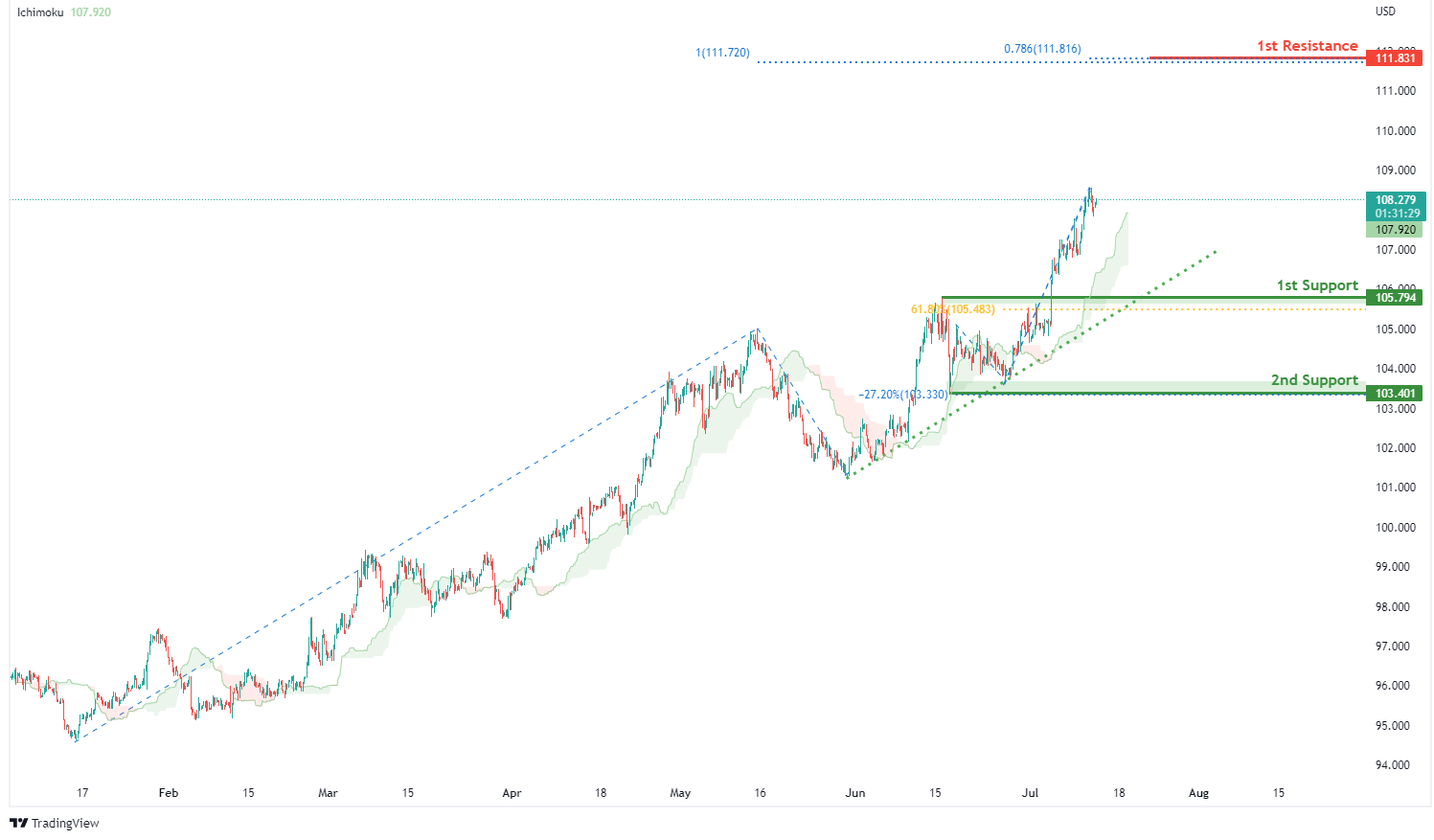
DXY:
On the H4, with prices moving above the ichimoku indicator and along the ascending trendline, we have a bullish bias that prices will drop and rise from 1st support at 105.794 where the pullback support and 61.8% fibonacci retracement are to 1st resistance at 111.831 in line with 100% fibonacci projection and 78.6% fibonacci projection. Alternatively, price may break 1st support structure and drop to 2nd support at 103.401 where the horizontal swing low support and -27.2% fibonacci expansion are.
Areas of consideration:
- H4 time frame, 1st resistance at 111.831
- H4 time frame, 1st support at 105.794
XAU/USD (GOLD):
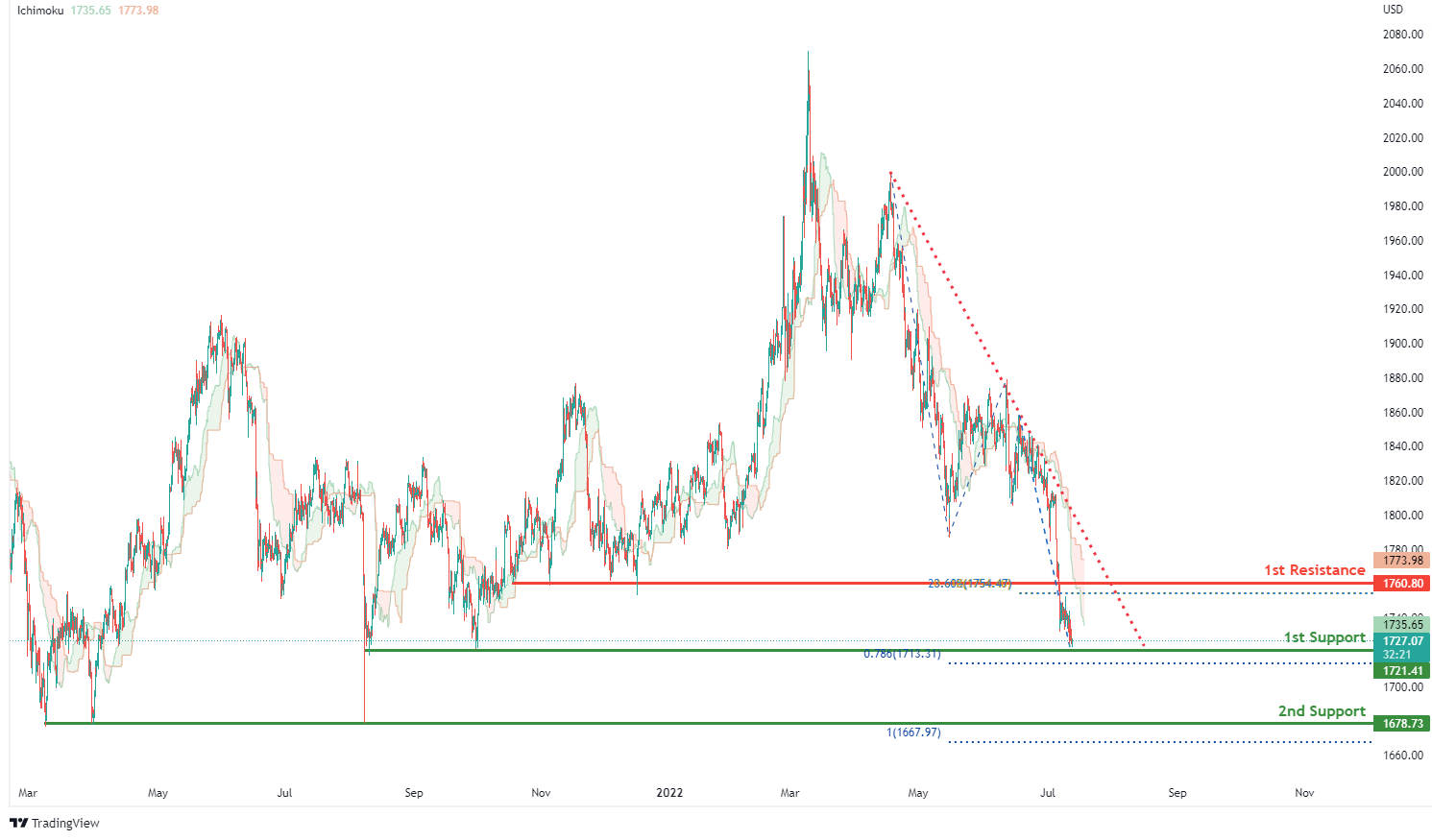
On the H4, with prices moving below the ichimoku indicator and along a descending trendline, we have a bearish bias that prices will drop to our 1st support at 1721.41 where the horizontal swing low support and 78.6% fibonacci projection are. Once we have downside confirmation of price breaking 1st support structure, we would expect bearish momentum to carry price to 2nd support at 1678.73 in line with swing low support and 100% fibonacci projection. Alternatively, price could rise to our 1st resistance at 1760.80 in line with overlap resistance, 23.6% fibonacci retracement and 61.8% fibonacci projection.
Areas of consideration:
- H4 time frame, 1st Resistance at 1760.80
- H4 time frame, 1st Support at 1721.41
GBP/USD:
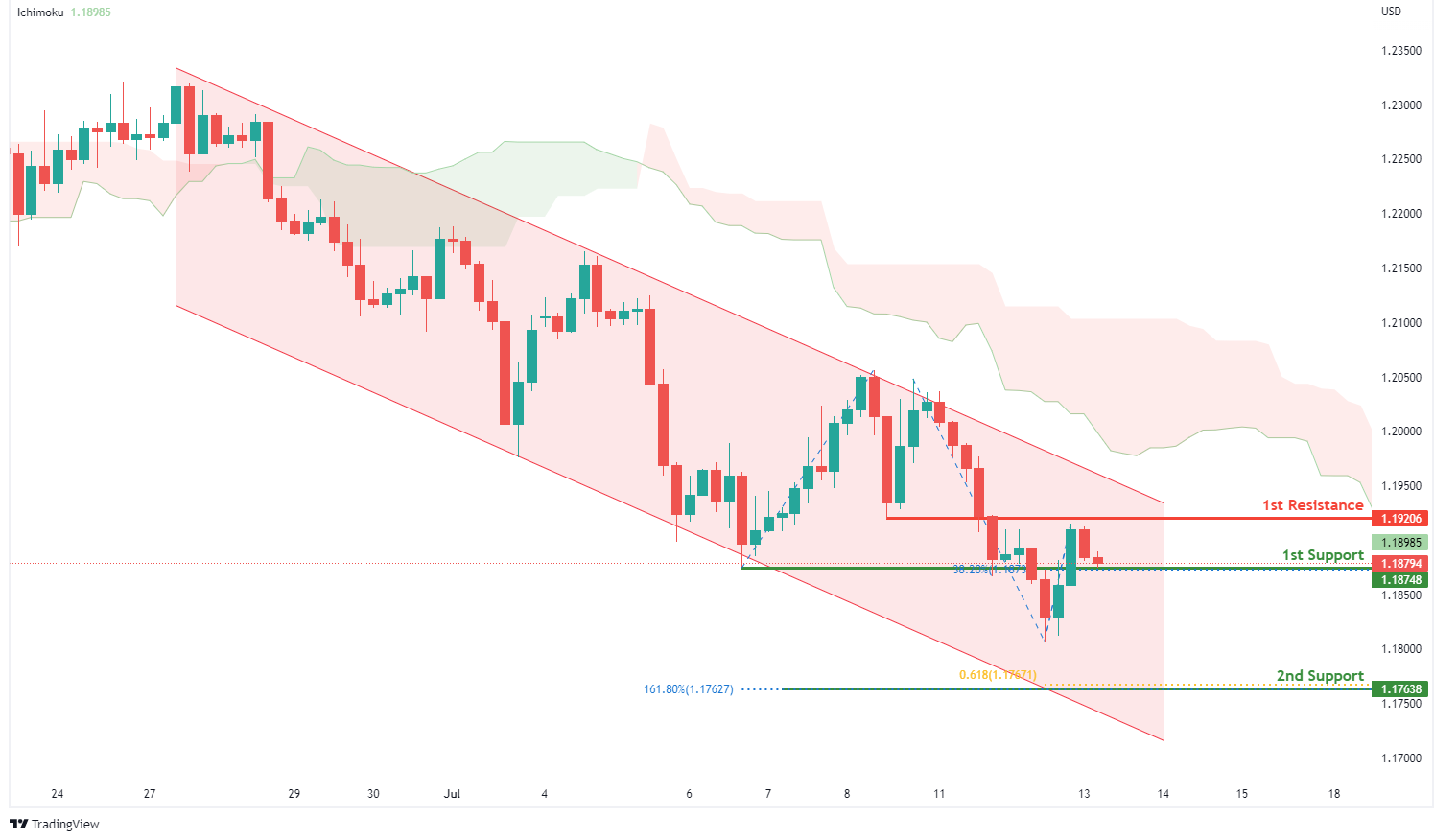
On the H4, with prices moving below the ichimoku indicator and within the descending channel, we have a bearish bias that price will drop to our 1st support at 1.18748 where the pullback support and 38.2% fibonacci retracement are. Once there is downside confirmation of price breaking 1st support, we would expect bearish momentum to carry price to our 2nd support at 1.17638 where the 61.8% fibonacci projection and 161.8% fibonacci extension are. Alternatively, price could rise to 1st resistance at 1.19206 in line with the pullback resistance.
Areas of consideration:
- H4 1st resistance at 1.19206
- H4 1st support at 1.18748
USD/CHF:
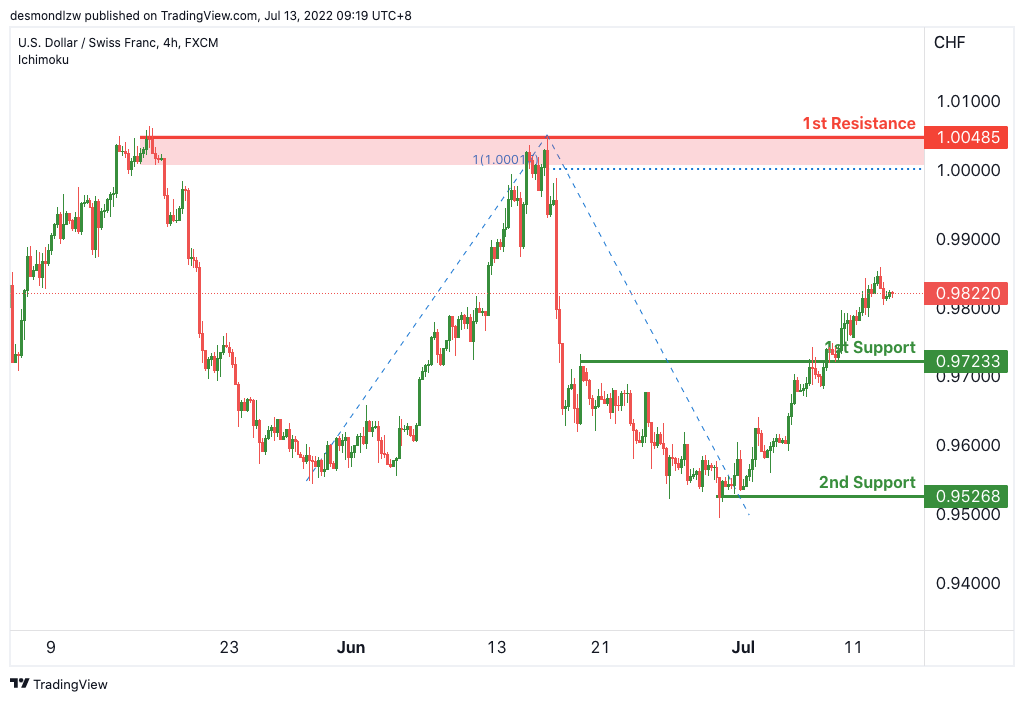
On the H4, with price moving above the ichimoku cloud, we have a bullish bias that price will rise from our 1st support at 0.97233 where the horizontal pullback support is to our 1st resistance at 1.00485 in line with the 100% Fibonacci projection is. Alternatively, price may not break 1st support and head for 2nd support at 0.95268 where the horizontal pullback support.
Areas of consideration
- 1st support level at 0.97233
- 1st resistance level at 1.00485
EUR/USD :
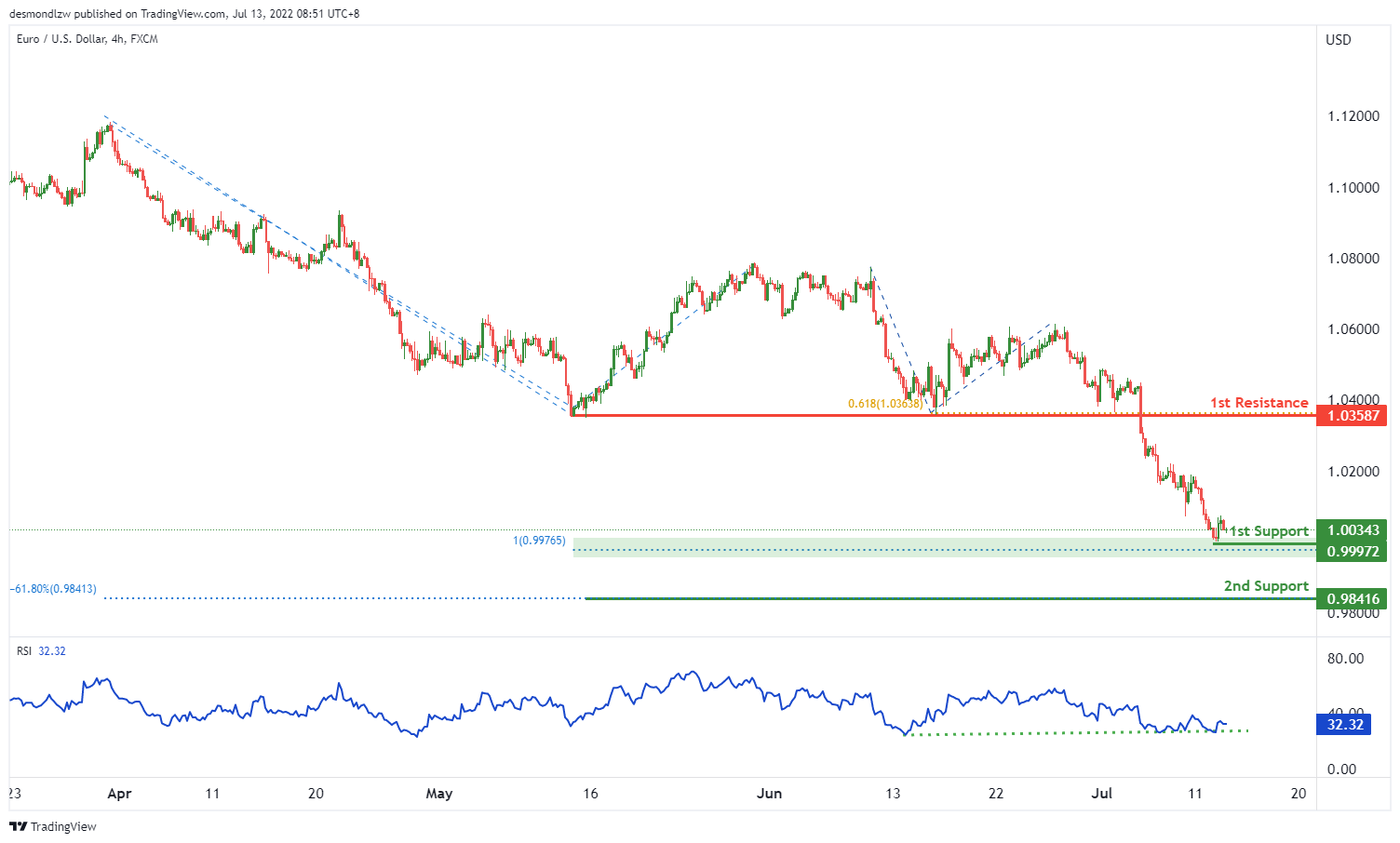
On the H4, with price moving in an ascending trendline on our RSI, we have a bullish bias that price will rise from our 1st support at 0.99972 in line with the swing low and 100% fibonacci projection to the 1st resistance at 1.03587 at the pullback resistance. Alternatively, price may break the support structure at 1st support and drop to the 2nd support at 0.98416 in line with the -61.8% fibonacci expansion.
Areas of consideration :
- H4 1st resistance at 1.03587
- H4 1st support at 0.99972
USD/JPY:
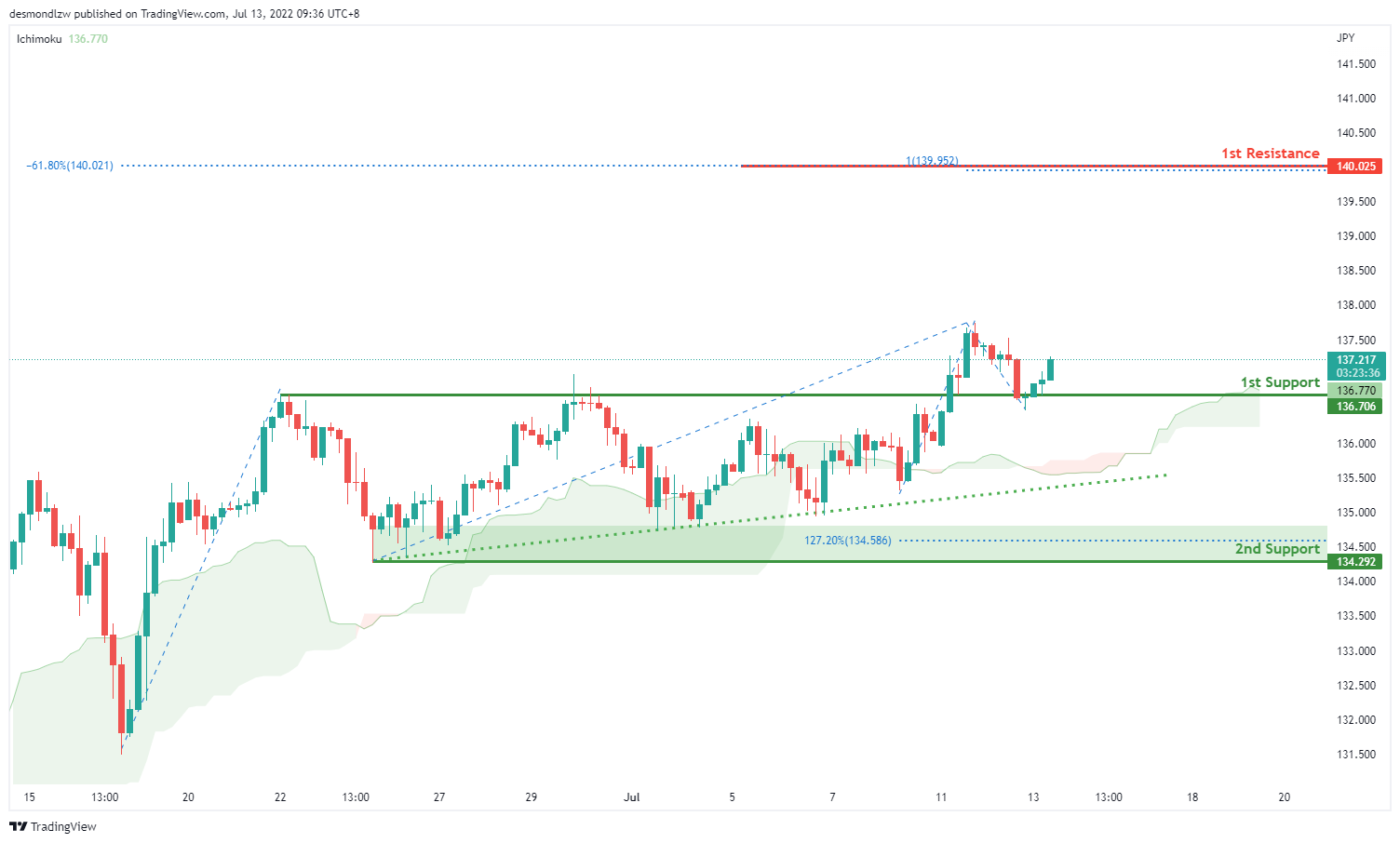
On the H4, with price moving along an ascending trendline and above the ichimoku indicator, we have a bullish bias that price will rise from our 1st support at 136.706 where the overlap support is to our 1st resistance at 140.025 in line with the -61.8% fibonacci expansion and 100% fibonacci projection. Alternatively, price could break 1st support and drop to 2nd support at 134.292 in line with the swing low support and 127.2% fibonacci extension.
Areas of consideration:
- H4 time frame, 1st resistance at 140.025
- H4 time frame, 1st support at 136.706
AUD/USD:
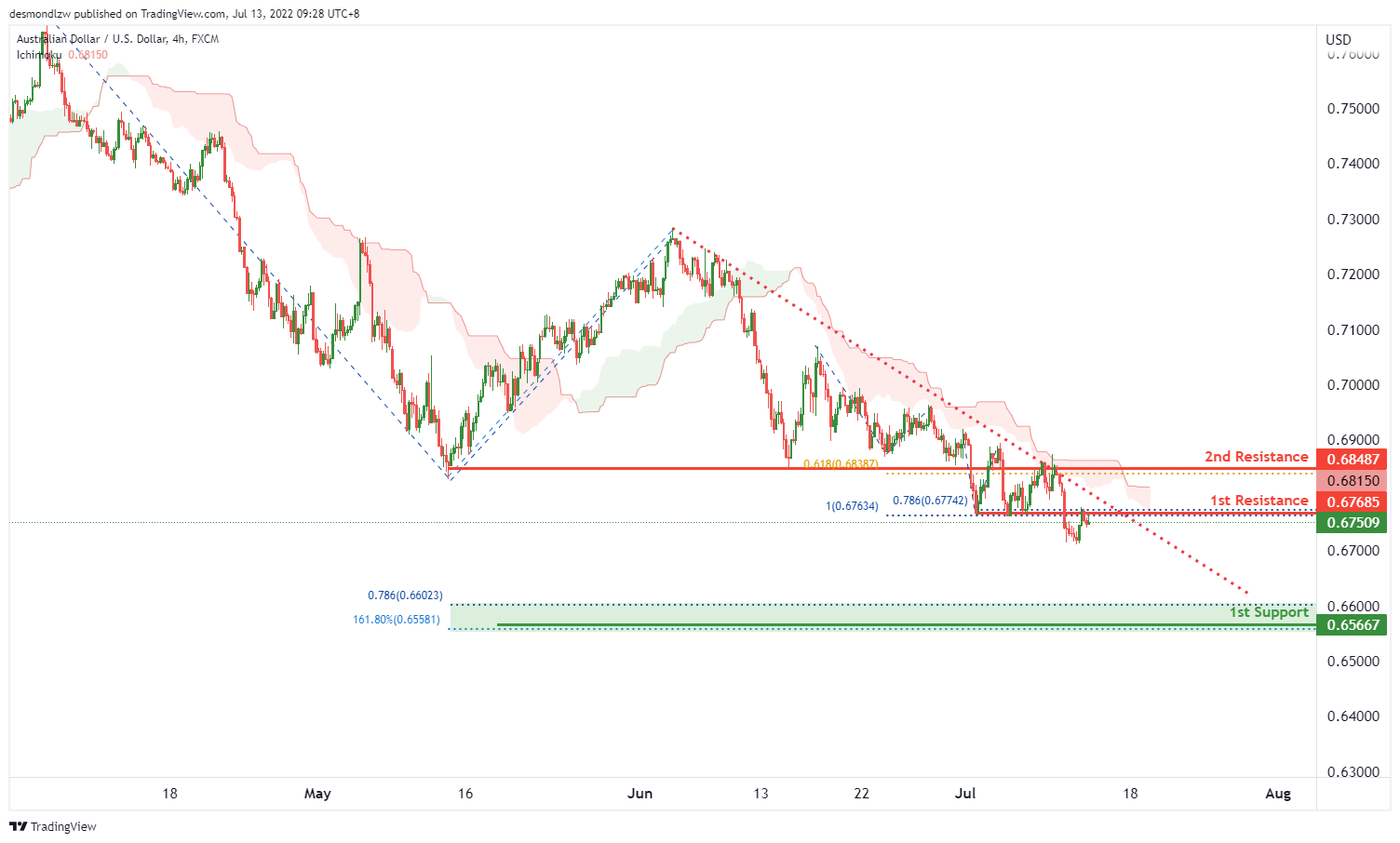
On the H4, with price moving below the ichimoku cloud and in a descending trendline, we have a bearish bias that price will continue to drop from the 1st resistance at 0.67685 in line with the 100% and 78.6% fibonacci projections to the 1st support at 0.65667 in line with the 161.8% fibonacci extension and 78.6% fibonacci projection. Alternatively, price may reverse off the 1st resistance and rise to the 2nd resistance at 0.68487 in line with the overlap swing high and 61.8% fibonacci projection
Areas of consideration
- H4 1st resistance at 0.67685
- H4 1st support at 0.65667
NZD/USD:
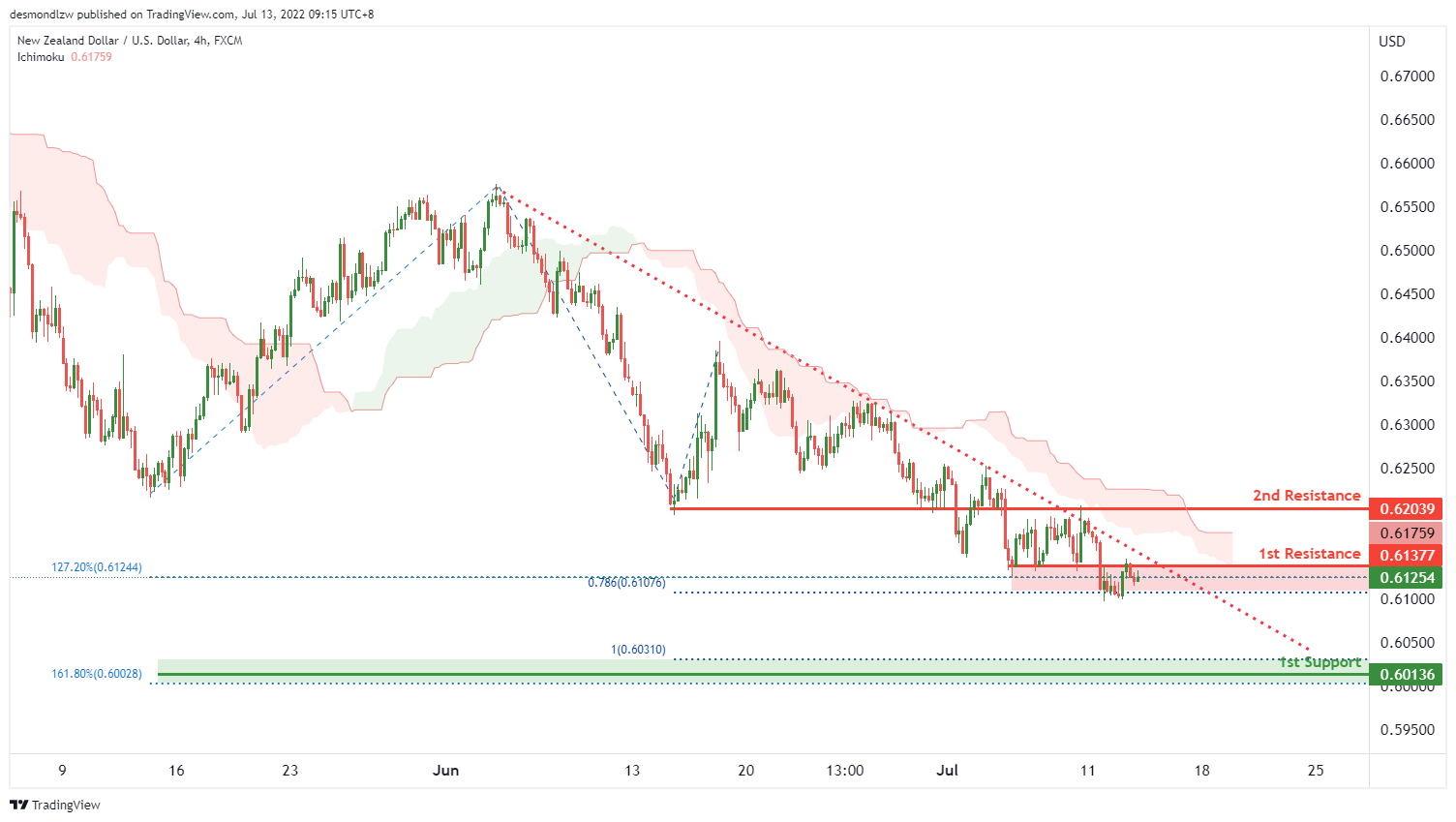
On the H4, with price moving below the ichimoku cloud and in a descending trendline, we have a bearish bias that price will continue to drop from the 1st resistance at 0.61138 in line with the 127.2% fibonacci extension and 78.6% fibonacci projection to the 1st support at 0.61106 in line with the 161.8% fibonacci extension and 100% fibonacci projection. Alternatively, price may reverse off the 1st resistance and rise to the 2nd resistance at 0.62039 in line with the overlap swing high.
Areas of consideration:
- H4 time frame, 1st support at 0.61106
- H4 time frame, 1st resistance at .61138
USD/CAD:
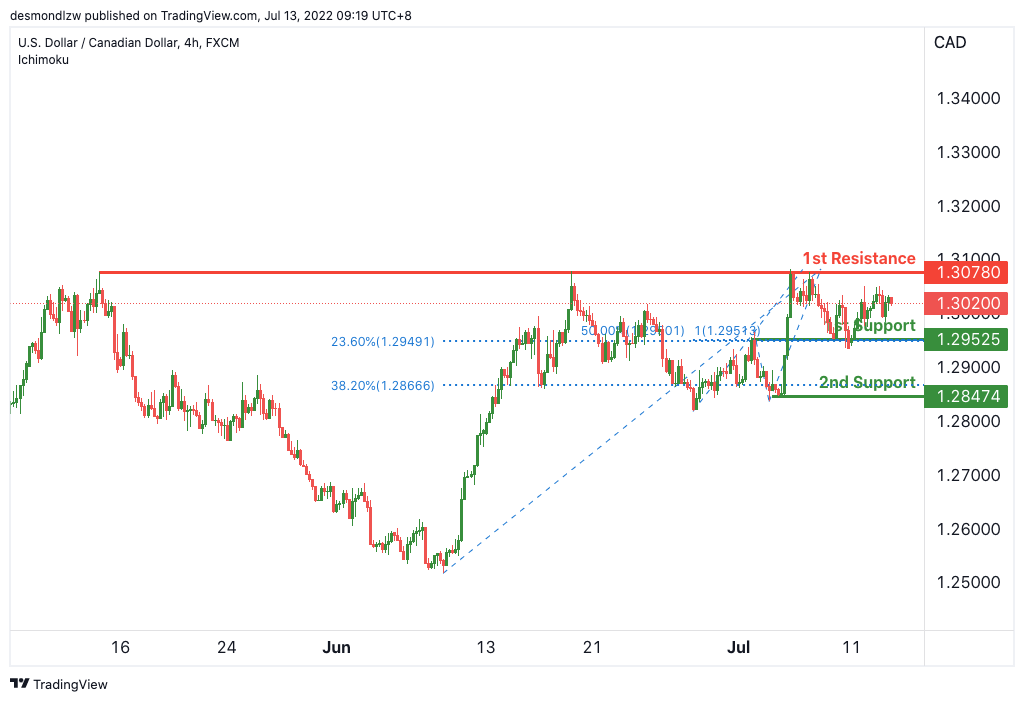
On the H4, with price moving above the ichimoku cloud, we have a bullish bias that price will rise from our 1st support at 1.29525 where the horizontal pullback support and fibonacci confluence are to our 1st resistance at 1.30780 in line with the horizontal swing high resistance. Alternatively, price may not break 1st support and head for 2nd support where the horizontal swing low support is.
Areas of consideration:
- H4 time frame, 1st resistance at 1.30780
- H4 time frame, 1st support at 1.29525
OIL:
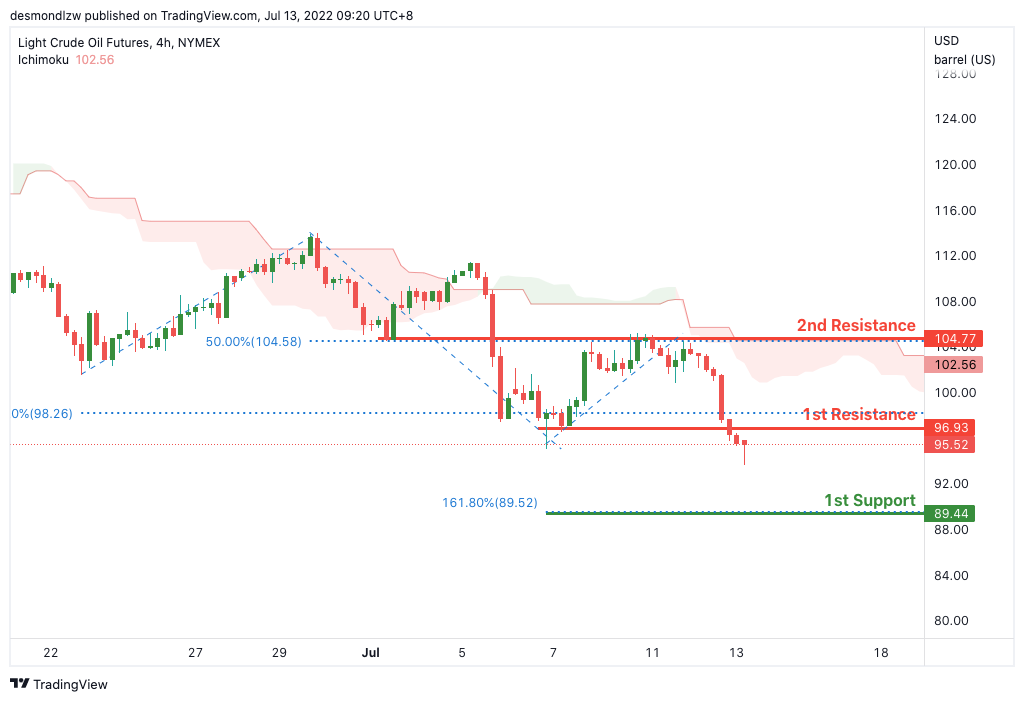
On the H4, with price moving below the ichimoku cloud, we have a bearish bias that price will drop to our 1st support at 89.44 where the 161.8% Fibonacci extension is from our 1st resistance at 96.93 in line with the horizontal pullback resistance and 50% Fibonacci retracement. Alternatively, price may break 1st resistance and head for 2nd resistance at 104.77 where the horizontal pullback resistance and 50% Fibonacci retracement is.
Areas of consideration:
- H4 time frame, 1st resistance of 96.93
- H4 time frame, 1st support of 89.44
Dow Jones Industrial Average:
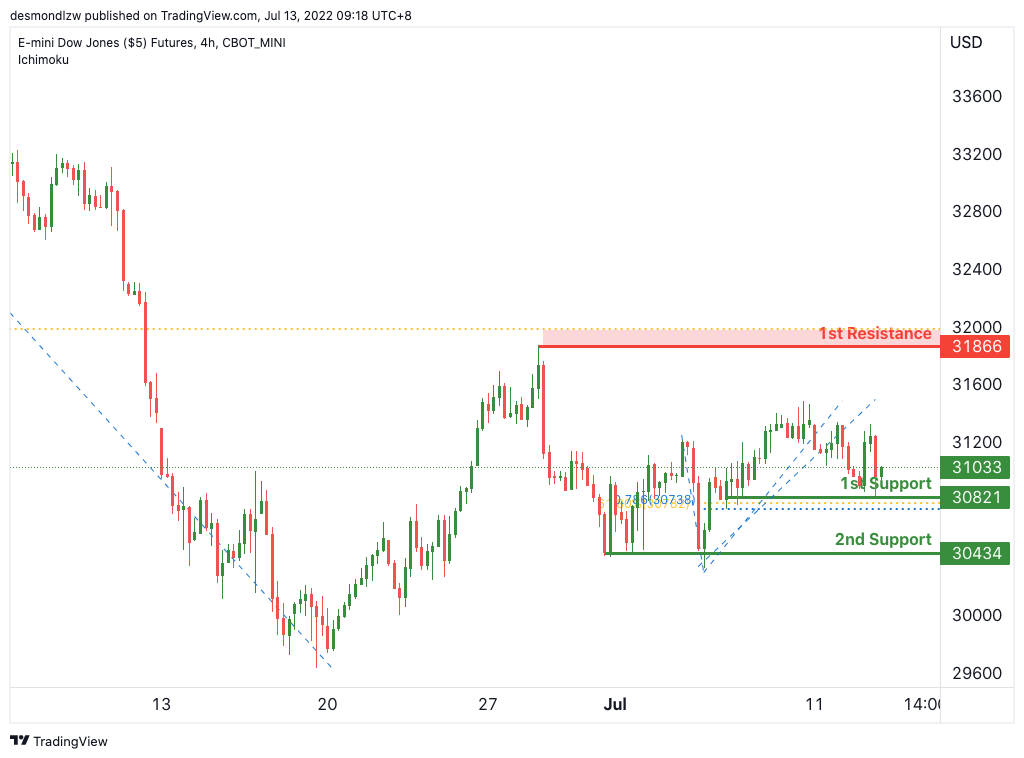
On the H4, with price moving above the ichimoku cloud, we have a bullish bias that price will rise from our 1st support at 31218 where the horizontal pullback support is to our 1st resistance at 31866 in line with the horizontal swing high resistance. Alternatively, price may not break 1st support and head for 2nd support at 30434 where the horizontal swing low support is.
Areas of consideration:
- H4 time frame, 1st resistance of 31866
- H4 time frame, 1st support of 31218
RBNZ lifts OCR by 50bps to 2.5%, maintains approach of brisk rate hikes
RBNZ raised Official Cash Rate by 50bps to 2.50% as widely expected. The central bank also indicated that it will follow the projected path to raise interest to nearing 3.5% by the end of 2022, and then around 4% in mid-2023.
"The Committee is comfortable that the projected path of the OCR outlined in the recent May Monetary Policy Statement remains broadly consistent with achieving its primary inflation and employment objectives - without causing unnecessary instability in output, interest rates and the exchange rate," RBNZ said in the statement.
Also, as noted in the summary records of meeting, "The Committee agreed to maintain its approach of briskly lifting the OCR until it is confident that monetary conditions are sufficient to constrain inflation expectations and bring consumer price inflation to within the target range."
(RBNZ) Monetary tightening continues
The Monetary Policy Committee today increased the Official Cash Rate (OCR) to 2.50 percent.
The Monetary Policy Committee today increased the Official Cash Rate (OCR) to 2.50 percent. The Committee agreed it remains appropriate to continue to tighten monetary conditions at pace to maintain price stability and support maximum sustainable employment. The Committee is resolute in its commitment to ensure consumer price inflation returns to within the 1 to 3 percent target range.
The level of global economic activity, combined with the ongoing supply disruptions largely driven by both COVID-19 persistence and the Russian invasion of Ukraine, continue to generate global inflation pressures. Food and energy prices are especially affected by geopolitical tension. However, the pace of global economic growth is slowing. The broad-based tightening in global monetary and financial conditions is acting to reduce spending growth. Asset prices have also declined due to higher interest rates and a weaker earnings outlook.
In New Zealand, domestic spending remains supported by high employment levels, resilient household balance sheets in aggregate, continued fiscal support, and a strong terms of trade. The reduction in COVID-19 health-related restrictions is also enabling increased demand. Labour and resource scarcity are also contributing to upward price pressures which are currently exacerbated by seasonal illness, a resurgence in COVID-19 cases, and a net outflow of labour abroad.
In these circumstances, spending and investment demand continues to outstrip supply capacity, with a broad range of indicators highlighting pervasive inflation pressures. Employment remains above its maximum sustainable level and the Reserve Bank's core inflation measures are around 4 percent. The Committee acknowledged there is a near-term upside risk to consumer price inflation and emerging medium-term downside risks to economic activity.
The Committee agreed to continue to lift the OCR to a level where it is confident consumer price inflation will settle within the target range. The Committee is comfortable that the projected path of the OCR outlined in the recent May Monetary Policy Statement remains broadly consistent with achieving its primary inflation and employment objectives - without causing unnecessary instability in output, interest rates and the exchange rate. Once aggregate supply and demand are more in balance, the OCR can then return to a lower, more neutral, level.
Summary Record of Meeting – July 2022
The Monetary Policy Committee discussed developments affecting the outlook for inflation and employment in New Zealand. Members agreed that developments were broadly in line with their assessment at the May Monetary Policy Statement. The Committee agreed it remains appropriate to continue to tighten monetary conditions at pace to maintain price stability and support maximum sustainable employment.
The Committee judged that the global economic outlook has continued to weaken, broadly as anticipated. The weaker outlook reflects a tightening of financial conditions, ongoing global supply disruptions, and rising geopolitical tensions. The Russian invasion of Ukraine continues to cause disruption to the supply of oil, gas and food commodities, resulting in continued high prices for food and energy. Ongoing health restrictions are exacerbating supply disruptions, as currently most notable in China.
Globally, many central banks have increased policy rates in response to rising inflationary pressures, to realign economic demand with supply. Members agreed that global inflationary pressures will likely persist in the near-term, as reflected in ongoing high domestic import prices and elevated shipping costs.
Members noted that the New Zealand dollar exchange rate has depreciated since the May Monetary Policy Statement. A moderation in global commodity prices, amid a continued decline in investor risk appetite, and rising central bank policy rates globally have contributed to this depreciation. The Committee noted that the weaker New Zealand dollar is continuing to have an impact on New Zealand dollar import prices.
In New Zealand, GDP contracted modestly in the March 2022 quarter. However, these data remain volatile, with a catch-up in government spending and exports expected. Increased visitors to New Zealand are also supporting hospitality and tourism. Meanwhile, household spending has remained resilient despite a decline in consumer confidence.
Financial conditions have continued to tighten with mortgage rates rising in response to, and in anticipation of, increases to the Official Cash Rate (OCR). Asset prices, including house prices, continue to decline. Members agreed that the increase in mortgage interest rates will assist to bring house prices more in line with sustainable levels. The Committee also agreed that both high food and energy costs and rising mortgage interest rates will lead to more subdued household discretionary spending in coming quarters.
Members noted that while there are near-term upside risks to consumer price inflation, there are also medium-term downside risks to economic activity. Despite these risks, members agreed that capacity pressures remain pervasive. Labour shortages continue to be a major constraint for business activity, as are the ongoing impacts of global supply chain disruptions. A resurgence in COVID-19 cases and a rise in other seasonal illnesses continues to constrain productive capacity in New Zealand. The recent removal of travel restrictions have also enabled a net outflow of labour in the near-term. Members agreed that employment is above its maximum sustainable level, and that rising wage pressure remains an expected outcome. Meanwhile, core inflation measures are around 4 percent.
The Committee discussed the unique shocks the economy is currently facing relative to historical experience. These developments increase the uncertainty about how households and firms will respond to a tightening of monetary policy. The Committee agreed that observing how households and firms are responding to these economic challenges will be important to understanding when monetary policy settings will be sufficient to achieve its remit objectives.
The Committee agreed to maintain its approach of briskly lifting the OCR until it is confident that monetary conditions are sufficient to constrain inflation expectations and bring consumer price inflation to within the target range. The Committee remains broadly comfortable with the projected path of the OCR outlined in the recent May Monetary Policy Statement. Once aggregate supply and demand are more in balance, the OCR can then return to a lower, more neutral, level. The Committee viewed this strategy as consistent with achieving their primary inflation and employment objectives without causing unnecessary instability in output, interest rates and the exchange rate.
On Wednesday 13 July, the Committee reached a consensus to increase the OCR to 2.50 percent.
Attendees:
Reserve Bank staff: Adrian Orr, Karen Silk, Christian Hawkesby, Adam Richardson,
External: Bob Buckle, Peter Harris, Caroline Saunders
Treasury Observer: Tim Ng
Reserve Bank observer: Paul Conway
Secretary: Sandeep Parekh
IMF projects US inflation to slow to 1.9% by end of 2023
IMF cut US 2022 GDP growth forecasts from 2.9% to 2.3% in the latest report. For 2023, GDP growth was was also lowered from 1.7% to 1.0%. Inflation is forecast to come down to 6.6% in Q4 2022, then slow further to 1.9% by Q4 2023. .
IMF Managing Director Kristalina Georgieva said: "In sum, we are confident the Fed will be effective in bringing inflation down, will remain data dependent and, as conditions change, will telegraph clearly where policy is likely to go. This is important not just for the U.S. but also for the global economy.
Fed Barkin expects inflation to come down, but not immediately, not suddenly, and not predictably
Richmond Fed President Thomas Barkin said yesterday, "I definitely see signs of softening" in the economy, with evidence "most pronounced in lower income households".
"I expect inflation to come down but not immediately, not suddenly, and not predictably," he said. "My expectations are it will be a slower path rather than an immediate path down to 2%."
Barkin also said he's open to a 50bps or 75bps hike in July. "I am one of the guys who like the option value of deciding the week of the meeting as opposed to two weeks before the meeting. But I thought Jay's (Fed Chair Jerome Powell) guidance the last time was very sound," he added.
First Impressions: RBNZ Monetary Policy Review, July 2022
The Reserve Bank lifted the OCR another 50 basis points to 2.50% as expected, and it remains focused on the risks of persistent inflation in a capacity-constrained economy.
RBNZ Monetary Policy Review, July 2022
- The Reserve Bank raised the OCR by 50 basis points to 2.50%, as widely expected.
- The key language in the statement was largely identical to the May review.
- The RBNZ still intends to raise interest rates “at pace”, and remains “resolute” in its commitment to bring inflation back within target.
- The RBNZ indicated that the OCR path projected in the May Monetary Policy Statement was still appropriate.
- The RBNZ noted upside risks to inflation and downside risks to activity in the near term.
- However, its concern remains with the risk of persistent inflation over the medium term, reflecting the pervasive capacity pressures in the economy.
Implications
The main signal to take from today’s statement was the lack of a signal – there is no change in the RBNZ’s plans to get on top of inflation through assertive action. As such, there is no reason to change our view of a further 50 basis point hike at the August Monetary Policy Statement. That would be entirely in line with the RBNZ’s May projections.
The August review itself may be an opportunity to review the situation. For one, the OCR will have reached 3% by that point, much closer to the endpoint that the RBNZ envisages. Secondly, it will have the benefit of a full set of economic forecasts, along with additional time to consider the weakening global backdrop. We still expect further, though more modest, rate hikes beyond that, reaching a peak of 3.50%.
More detail in our bulletin later today.
RBNZ media release
Monetary Tightening Continues
The Monetary Policy Committee today increased the Official Cash Rate (OCR) to 2.50 percent. The Committee agreed it remains appropriate to continue to tighten monetary conditions at pace to maintain price stability and support maximum sustainable employment. The Committee is resolute in its commitment to ensure consumer price inflation returns to within the 1 to 3 percent target range.
The level of global economic activity, combined with the ongoing supply disruptions largely driven by both COVID-19 persistence and the Russian invasion of Ukraine, continue to generate global inflation pressures. Food and energy prices are especially affected by geopolitical tension. However, the pace of global economic growth is slowing. The broad-based tightening in global monetary and financial conditions is acting to reduce spending growth. Asset prices have also declined due to higher interest rates and a weaker earnings outlook.
In New Zealand, domestic spending remains supported by high employment levels, resilient household balance sheets in aggregate, continued fiscal support, and a strong terms of trade. The reduction in COVID-19 health-related restrictions is also enabling increased demand. Labour and resource scarcity are also contributing to upward price pressures which are currently exacerbated by seasonal illness, a resurgence in COVID-19 cases, and a net outflow of labour abroad.
In these circumstances, spending and investment demand continues to outstrip supply capacity, with a broad range of indicators highlighting pervasive inflation pressures. Employment remains above its maximum sustainable level and the Reserve Bank’s core inflation measures are around 4 percent. The Committee acknowledged there is a near-term upside risk to consumer price inflation and emerging medium-term downside risks to economic activity.
The Committee agreed to continue to lift the OCR to a level where it is confident consumer price inflation will settle within the target range. The Committee is comfortable that the projected path of the OCR outlined in the recent May Monetary Policy Statement remains broadly consistent with achieving its primary inflation and employment objectives - without causing unnecessary instability in output, interest rates and the exchange rate. Once aggregate supply and demand are more in balance, the OCR can then return to a lower, more neutral, level.
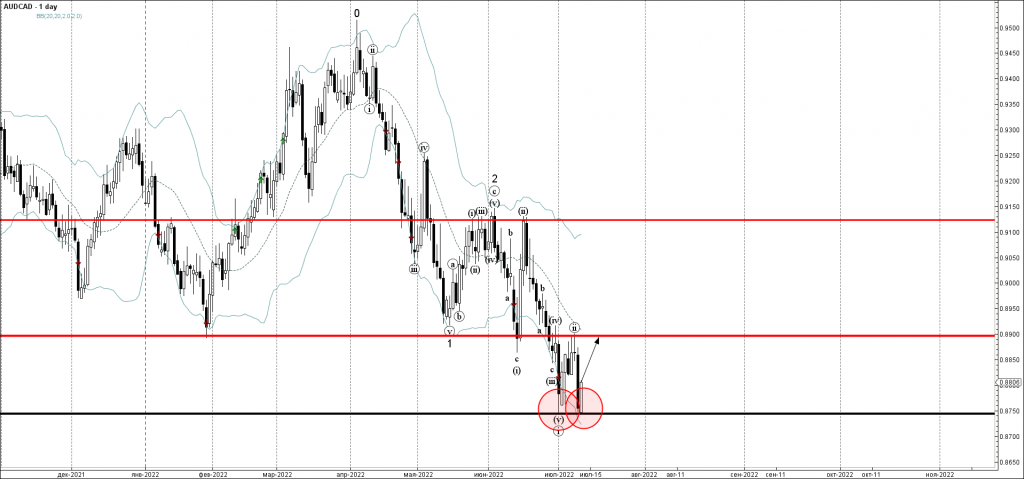
AUDCAD Wave Analysis
- AUDCAD reversed from key support level 0.8750
- Likely to rise to resistance level 0.8900
AUDCAD currency pair recently reversed up from the key support level 0.8750 (low of the previous minor impulse wave (i) from the end of last month), intersecting with the lower daily Bollinger Band.
The upward reversal from the support level 0.8750 stopped the previous minor downward impulse wave (i) of wave 3 from June.
AUDCAD can be expected to rise further toward the next resistance level 0.8900 (former strong support from January and June).
USDCAD Wave Analysis
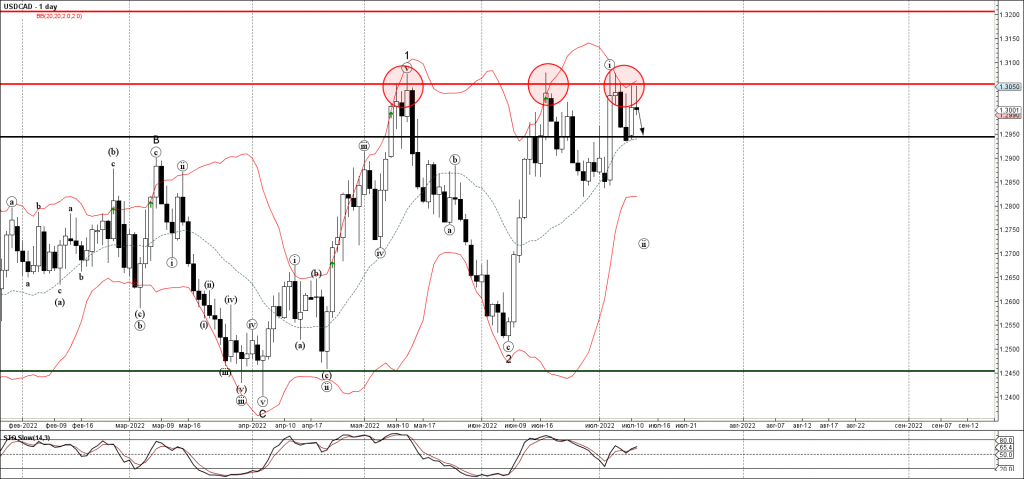
- USDCAD reversed from resistance level 1.3055
- Likely to fall to support level 1.2950
USDCAD currency pair recently reversed down from the pivotal resistance level 1.3055 (which has been repeatedly reversing the pair from the start of May, as can be seen below).
The resistance area near the resistance level 1.3055 was strengthened by the upper daily Bollinger Band.
Given the strength of the resistance level 1.3055, USDCAD can be expected to fall further toward the next support level 1.2950.