Sample Category Title
NY Fed 1-yr inflation expectations rose to 6.8%, but 3-yr expectations down
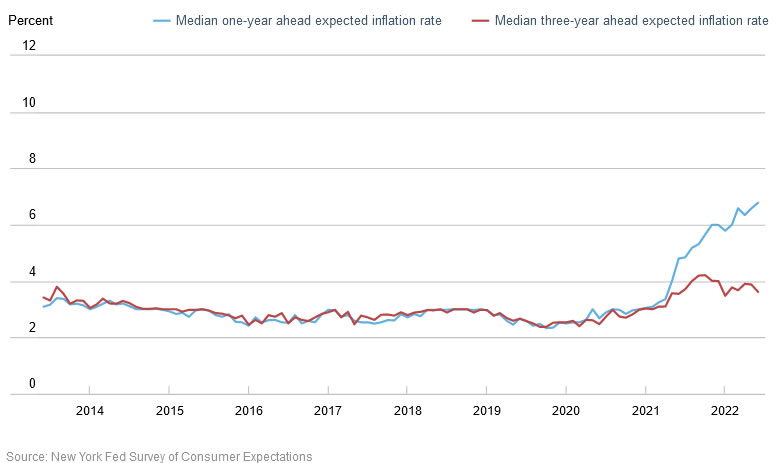
According to New York Fed's survey of consumer expectations, median one-year-ahead inflation expectations rose from 6.6% to 6.8% in June, hitting a new series high. However, three-year ahead inflation expectations dropped from 3.9% to 3.6%.
Median expected one-year-ahead change in home prices dropped sharply from 5.8% to 4.4%. Median year-ahead household spending growth expectations retreated from a series high in May, declining -0.6% point to 8.4%.
New York Fed added, "households' assessments of their current financial situation deteriorated in June as more respondents reported being financially worse off than they were a year ago."
Euro Above Parity by a Thread
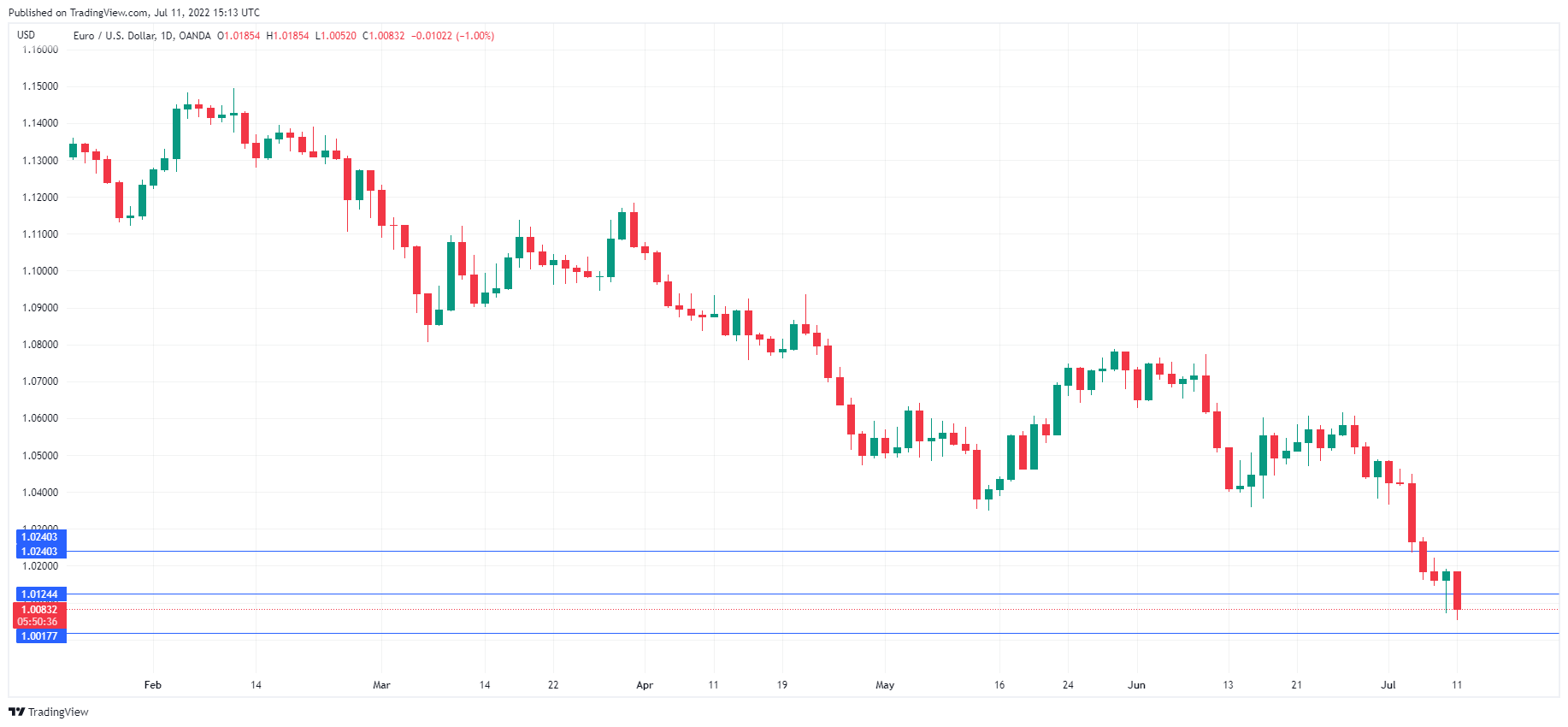
It is looking like July 2022 could be a memorable month for the euro, but unfortunately not for the right reasons. EUR/USD is within a whisker of dropping below parity with the US dollar for the first time since 2002, when the euro was just three years old. In the North American session, EUR/USD is trading at 1.008, down 1.00%.
Euro slides after solid US jobs report
The euro, along with all the other majors, is seeing red against the US dollar today. The markets have reacted to the surprisingly strong non-farm payroll report on Friday, as the June gain of 381 thousand surpassed the May reading of 336 thousand and easily beat the consensus of 240 thousand. The unemployment rate remained steady at 3.6%, while wage growth grew by 0.3%. The solid employment report has raised expectations of another 75bp hike by the Fed at the end of July. A 75bp move will substantially widen the Europe/US rate differential, which is contributing to the euro’s sharp descent today.
The ECB holds its policy meeting six days ahead of the Federal Reserve, on July 21st. This meeting will likely mark the lift-off for ECB rate hikes, with another increase expected in September. The ECB has been scrambling to catch up to the inflation curve, as it badly misjudged the staying power of high inflation. ECB interest rates are in negative territory, and a modest 0.25% hike, the most likely scenario at the July meeting, may not do much to boost the euro, although perhaps the perception that the ECB is finally tightening will provide some support to the ailing currency.
On Tuesday, Germany releases ZEW Economic Sentiment. The index has been mired in negative territory for months, indicative of strong pessimism about the economic outlook. In June, the index came in at -28.0 and this is expected to worsen to -40.0 in July.
EUR/USD Technical
- EUR/USD is putting strong pressure on support at 1.001, just above parity. Below, there is support at 0.9849
- There is resistance at 1.0124 and 1.0221
AUD/USD: Aussie Hits New 2-Year Low on Fresh Risk Aversion
Australian dollar accelerated lower on Monday, driven by fresh risk aversion that inflated its US counterpart.
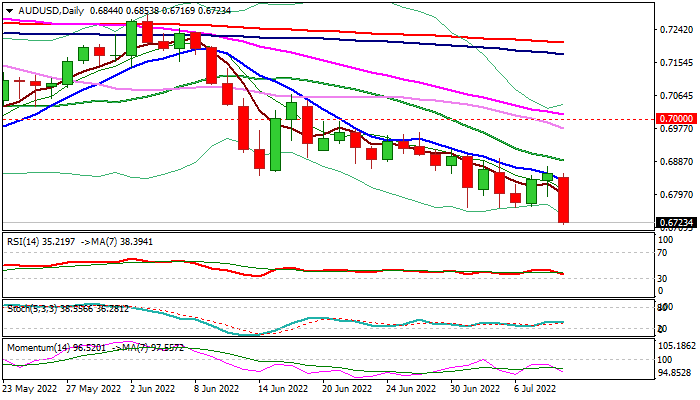
The Aussie hit new two-year low and generate strong bearish signal on break through important Fibo support at 0.6758 (50% retracement of 0.5509/0.8007, 2020/2021 rally) with close below this level to verify the signal and open way for further easing.
Round-figure support at 0.6700 and June 2020 low at 0.6647 mark next targets, violation of which would unmask 0.6463/39 (Fibo 61.8% of 0.5509/0.8007 / monthly cloud base).
Daily studies are at full bearish setup and support the action, with limited upticks to be capped by falling 10DMA (0.6835) which tracks downtrend for one month, to offer better selling opportunities.
Res: 0.6761; 0.6798; 0.6835; 0.6874
Sup: 0.6700; 0.6647; 0.6601; 0.6547
Fed George: More abrupt changes in interest rates could create strains
Kansas City Fed president Esther George said, "this is already a historically swift pace of rate increases for households and businesses to adapt to, and more abrupt changes in interest rates could create strains, either in the economy or financial markets,"
"I find it remarkable that just four months after beginning to raise rates, there is growing discussion of recession risk, and some forecasts are predicting interest rate cuts as soon as next year. Such projections suggest to me that a rapid pace of rate increases brings about the risk of tightening policy more quickly than the economy and markets can adjust," she added.
Dollar Index Seems Unstoppable Now
The dollar index is making new highs, rising to 107.6 on Friday afternoon, and by the start of active trading in Europe, trading at 107.45. This is the highest rate since October 2002. The dollar index has added about 20% to its 2021 low.
The strengthening dollar carries positive secondary effects for the US, from reducing inflationary pressures through imports to ending the talk of dollar weakness that has been prevalent since late 2020.
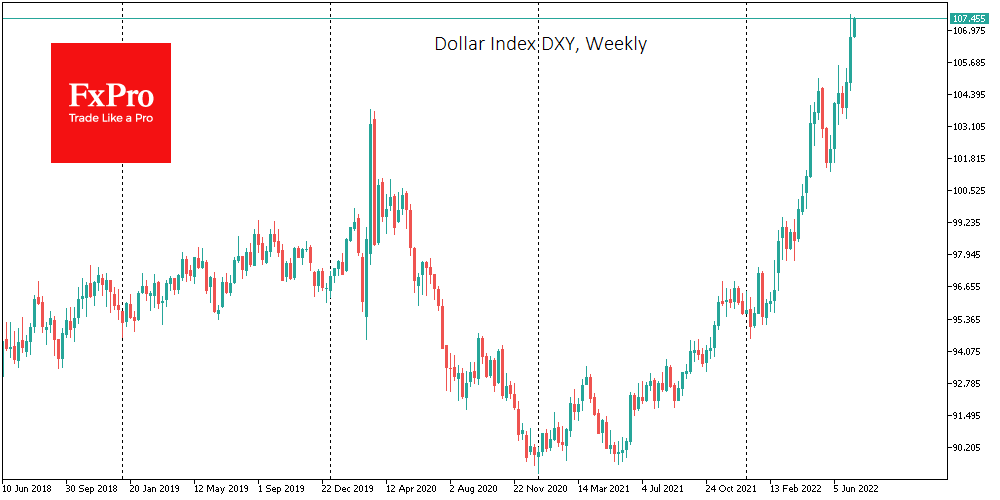
Nevertheless, central bankers are not welcome too sharp currency fluctuations in either direction, although they blatantly ignore the absolute value of the exchange rate against another currency or trade-weighted basket.
So far, the Fed has paid little attention to dollar appreciation, but it is worth being prepared that this approach would change in the coming days and weeks to avoid causing an uncontrolled rise in the dollar that could prove devastating.
In the past fortnight, the Fed has begun selling assets off its balance sheet, reducing it by $42.5B. The ECB stopped net buying in July, but active Fed-like selling is a matter of uncertainty.
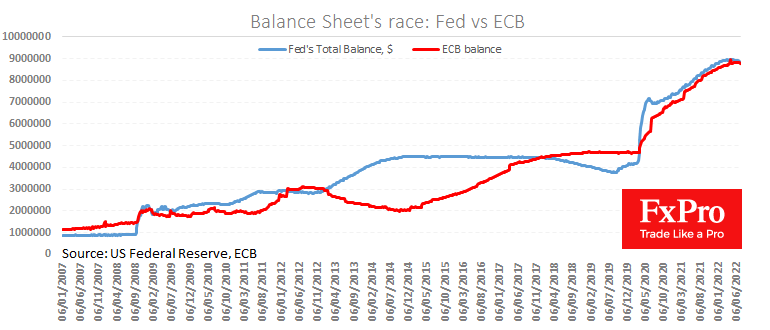
Other key central banks are also a step or two behind the Fed, or moving slower, from full-blown QE from the Bank of Japan to the Reserve Bank of Australia, which raised its rate by 50 points against +75 from the Fed last month and forecasts another such hike at the end of July.
The dollar’s strengthening so far looks controlled. Still, after last week’s substantial rise to multi-year highs, the markets could start a wave of an exodus from Europe and Asia, underpinned by the news and macroeconomic backdrop and current exchange rate movements.
In our view, the currency market has reached the point where it can become a one-way street, and we are witnessing a massive capitulation on one side. In such cases, it is hard to say which levels could be the real turning point. Suffice it to recall the negative oil prices in April 2020 and the EURCHF dip from 1.20 to 0.78 in January 2015.
Such a point could be a EURUSD drop below parity if it occurs in the next couple of weeks. To sustainably turn the euro upwards or stop further dangerous dollar appreciation, it may take the resolve of monetary and government officials, which we lack now.
Perhaps only the Fed is now able to stop the dollar by starting to mention a slowdown in the pace of policy tightening, a potential rate hike limit in this cycle and a rate cut condition. And all this may not be as distant a prospect as the markets now seem to think.
USDJPY Heading Towards the 25-year High
A rise in Treasury yields and solid US labor data on Friday boosted the dollar, which climbed against the basket of major currencies.
The yen fell to a fresh 24-year low after Japan's ruling coalition expanded its majority in Sunday's upper house election. Investors interpreted the result as an upcoming wave of super-easy monetary policy.
USDJPY gained 0.9%, breaching the closely watched 137 level. Bank of Japan Governor Haruhiko Kuroda stated on Monday that he wouldn't hesitate to add monetary stimulus if needed to boost the stuttering economy.
However, the election outcome reflects public support for Prime Minister Fumio Kishida, who adheres to a dovish monetary policy and makes it clear that rising inflation in Japan isn't as critical for the local population as overseas.
With the BOJ keeping interest rates pinned to the floor even as foreign ones climb, the yen has sunk over 16% against the greenback this year. According to data compiled by Bloomberg, the currency is just a hair's breadth away from its worst drawdown ever.
What about the USD?
The US dollar may remain expensive until the risks around elevated global inflation, European energy security, and China's growth outlook have been resolved. Moreover, the breakout of the 107.50 resistance level opens the way to 110.50 for the US dollar index, which is a 2.8% gain. An upcoming 50 basis point rate hike by the Federal Reserve in July makes it almost inevitable.
Technical analysis
USDJPY, Daily chart
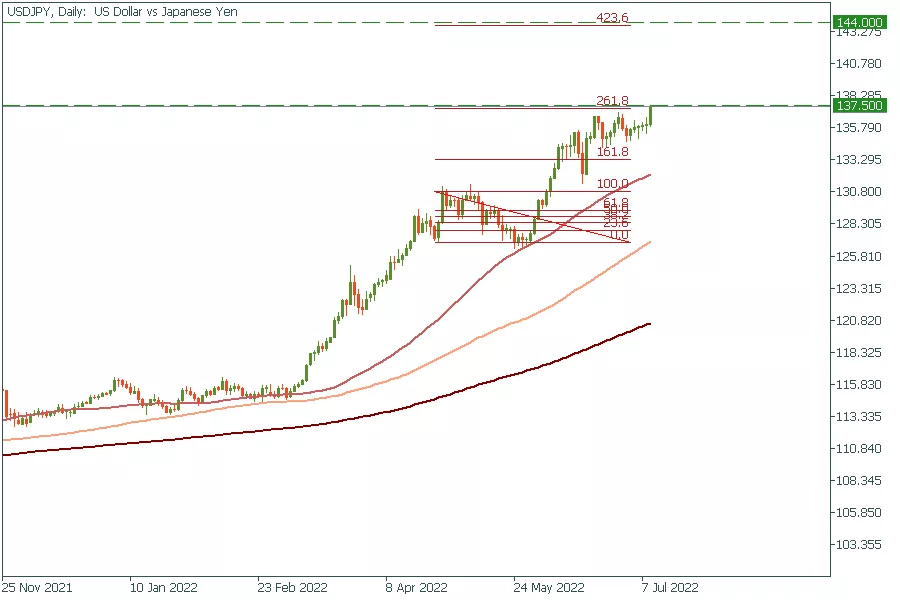
Currently, buyers are attacking the 137.50 resistance, the 261.8 Fibonacci level. The breakout of this zone opens the way to 144.00, the highest ratio since 1998.
WTI Oil Price Dips on Renewed Demand Worries
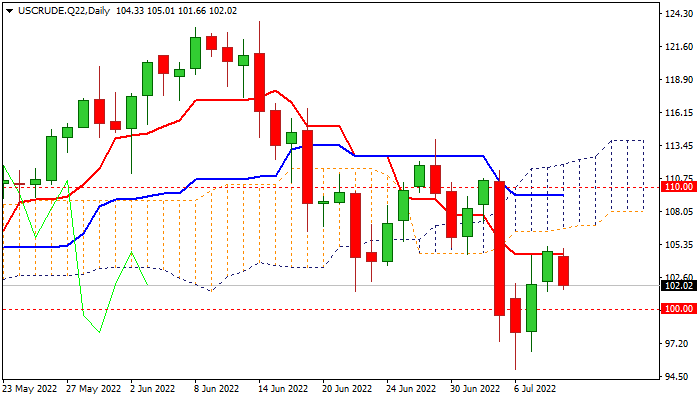
WTI oil price eases on Monday, after last Thu/Fri strong recovery stalled on attempts through daily Tenkan-sen (104.55).
Oil came under pressure on renewed demand concerns after China had discovered first cases of Omicron variant and ordered mass testing for Covid 19 that weakened the sentiment, raising concerns that demand from world biggest oil importer may ease.
Daily techs remain bearishly aligned with Tenkan-sen / Kijun-sen in bearish setup and fresh rise of negative momentum that adds to the view of correction stall, though, such scenario needs firmer signal on close below $101.34 (Fibo 38.2% of $95.09/$105.21 recovery leg).
Further easing would risk fresh attack of psychological $100 level, loss of which weaken the structure and risk deeper drop.
Daily Tenkan-sen marks solid resistance, followed by another significant barrier at $106.91 (daily cloud base).
Res: 102.82; 104.55; 105.21; 106.40.
Sup: 101.34; 100.15; 100.00; 98.96.
Politics Might Support GBP
GBP/USD is balancing at 1.1987 on Monday. The Pound Sterling remains under pressure despite a recent rebound caused by political news.
British Prime Minister Boris Johnson resignation drama seems to be gathering pace – it’s going to be a long story. First of all, the Conservative party has to find a new leader, and it will surely take some time. Until then, Johnson will continue to carry out his duties. Secondly, a reshuffle of the Cabinet is ahead –some of the ministers resigned due to disagreement with the current policy, while the others might be reassigned by the next Prime Minister. Market rumours have it that such global changes in British policy might solve some aspects of political uncertainty; for example, the Bank of England might finally raise its interest rates. If so, it’s nothing but positive for the Pound.
Currencies seldom respond to political changes in a positive way, but the Pound may get a lot of opportunities here.
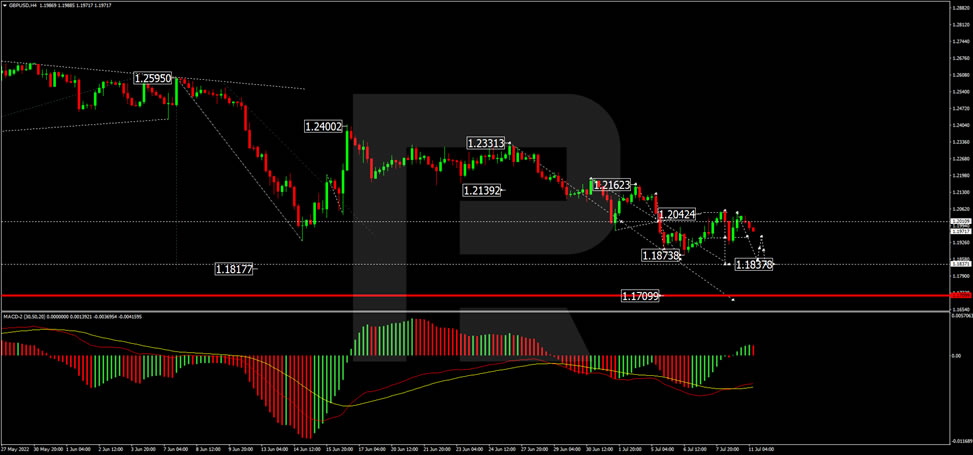
As we can see in the H4 chart, after rebounding from 1.2042, GBP/USD is forming another descending wave towards 1.1837 and may consolidate there. Later, the market may correct test 1.2042 from below and then resume trading within the downtrend with the target at 1.1700. From the technical point of view, this scenario is confirmed by the MACD Oscillator: its signal line is moving below 0 and may continue falling to update the lows.
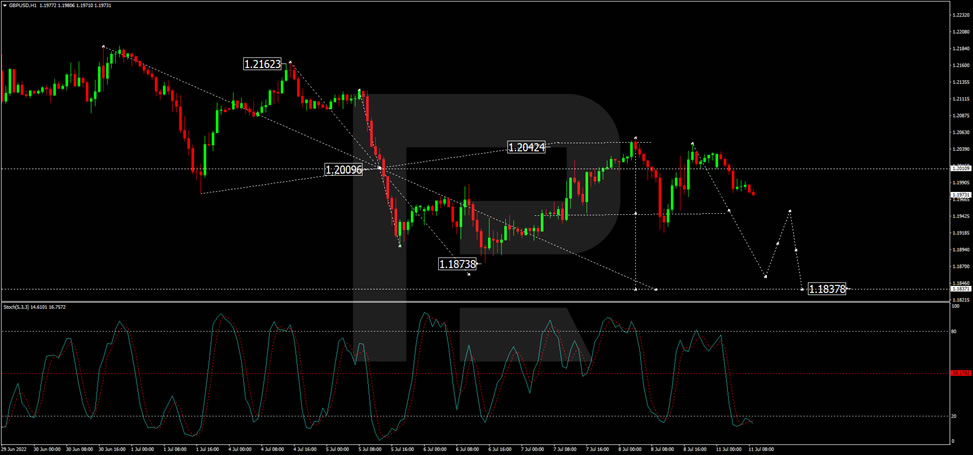
In the H1 chart, having completed the descending impulse at 1.1919 along with the correction up to 1.2020, GBP/USD is forming another descending structure towards 1.1944 and may later consolidate there. If the price breaks this range to the downside, the market may resume moving within the downtrend with the short-term target at 1.1856, and then start a new growth to test 1.1944 from below. After that, the pair may resume falling towards 1.1837. From the technical point of view, this scenario is confirmed by the Stochastic Oscillator: after breaking 50 and reaching 20, its signal line is expected to return to 50, rebound from it again, and resume falling to re-test 20.
EUR/USD Mid-Day Outlook
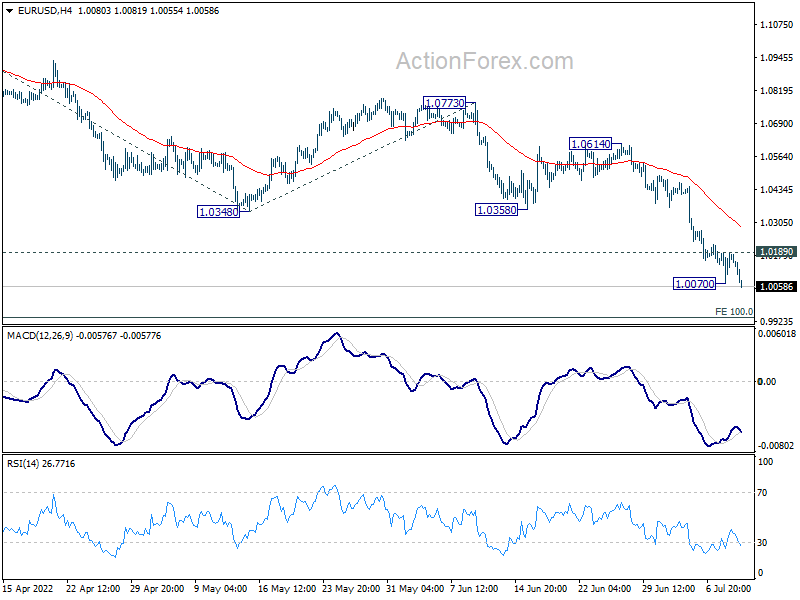
Daily Pivots: (S1) 1.0108; (P) 1.0150 (R1) 1.0227; More...
EUR/USD's fall resumes after brief consolidations. Intraday bias is back on the downside. Current down trend should target 100% projection of 1.1184 to 1.0348 from 1.0773 at 0.9937, which is close to parity. On the upside, break of 1.0189 minor resistance will turn intraday bias neutral again. But outlook stays bearish as long as 1.0358 support turned resistance holds.
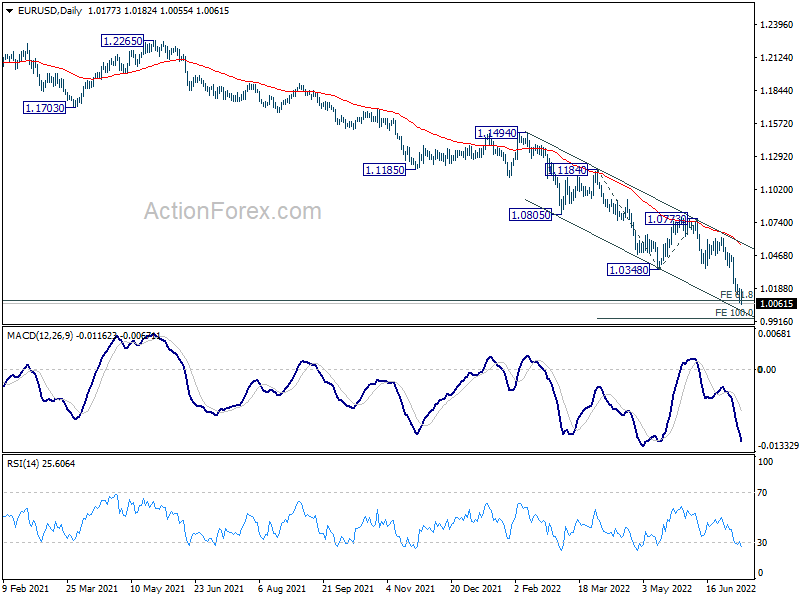
In the bigger picture, down trend from 1.6039 (2008 high) is still in progress. Sustained break of 61.8% projection of 1.3993 to 1.0339 from 1.2348 at 1.0090 will pave the way to 100% projection at 0.8694. In any case, outlook will stay bearish as long as 1.0773 resistance holds, in case of rebound.
GBP/USD Mid-Day Outlook
Daily Pivots: (S1) 1.1951; (P) 1.2004; (R1) 1.2087; More...
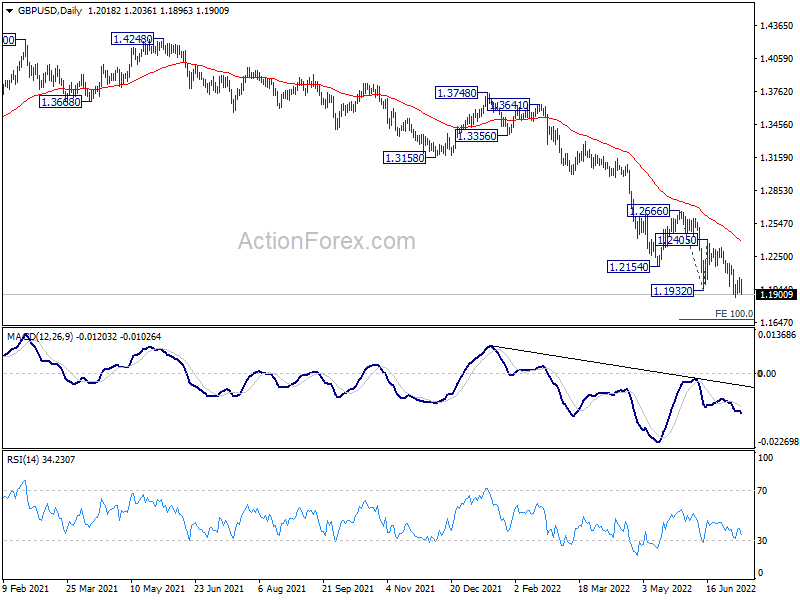
Intraday bias in GBP/USD remains neutral and more consolidation could be seen above 1.1874. Outlook remains bearish with 1.2405 resistance intact. On the downside, break of 1.1874 will resume larger down trend to 100% projection of 1.2666 to 1.1932 from 1.2405 at 1.1671. Break there will target 1.1409 long term support.
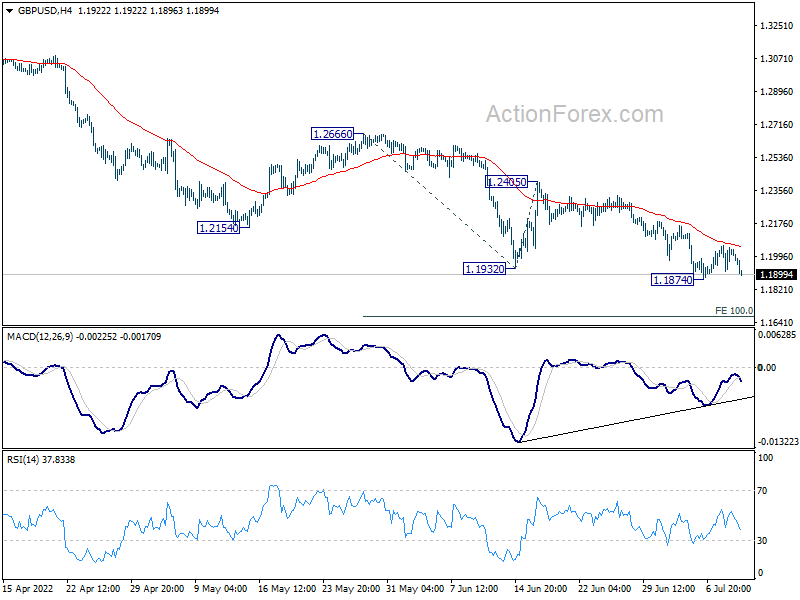
In the bigger picture, fall from 1.4248 (2018 high) could be a leg inside the pattern from 1.1409 (2020 low), or resuming the longer term down trend. Deeper decline is expected as long as 1.2666 resistance holds. Next target is 1.1409 low. However, firm break of 1.2666 will bring stronger rise back to 55 week EMA (now at 1.3065).