

Sample Category Title
EUR/AUD Daily Outlook
Daily Pivots: (S1) 1.5115; (P) 1.5235; (R1) 1.5300; More...
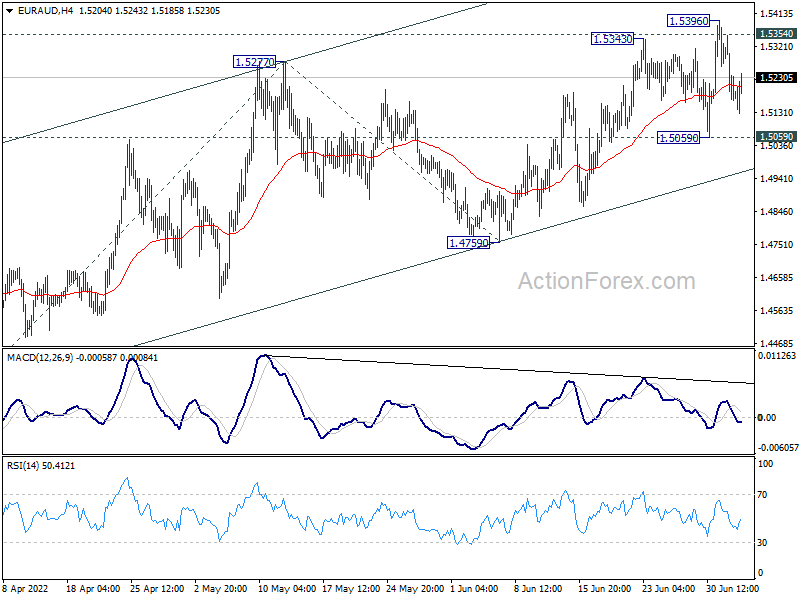
Intraday bias in EUR/AUD remains neutral and further rise is expected with 1.5059 support intact. Sustained trading above 1.5343 resistance should indicate medium term bottoming at 1.4318. Stronger rally would be seen back to 100% projection of 1.4318 to 1.5277 from 1.4759 at 1.5718. However, firm break of 1.5059 support will indicate rejection of 1.5354, and revive medium term bearishness, and turn bias back to the downside.
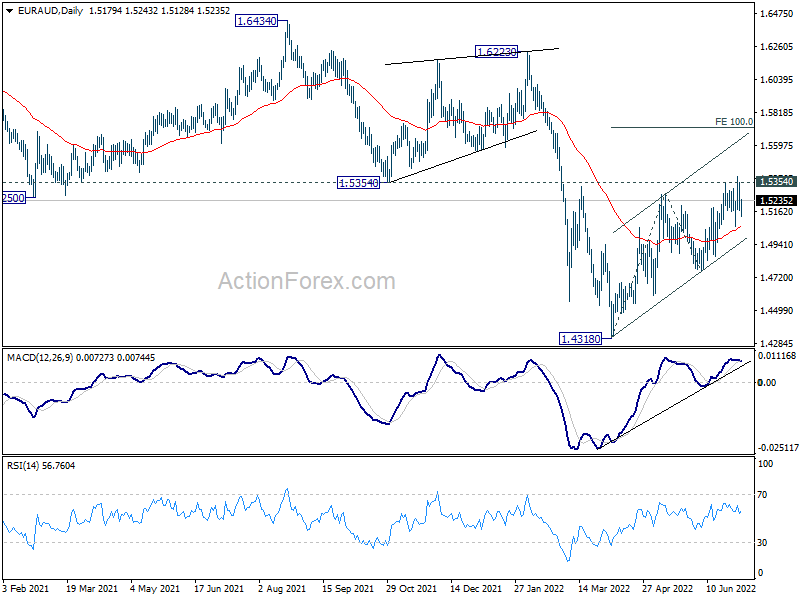
In the bigger picture, sustained break of 1.5354 support turned resistance will argue that a medium term bottom was formed at 1.4318 already. It would still be too early to call for long term trend reversal. But further rise would then be seen back towards 1.6434 resistance (2021 high). However, rejection by 1.5354 will retain bearishness for extending the down trend from 1.9799 (2020 high) through 1.4318 at a later stage.
EUR/CHF Daily Outlook
Daily Pivots: (S1) 0.9982; (P) 1.0014; (R1) 1.0052; More....
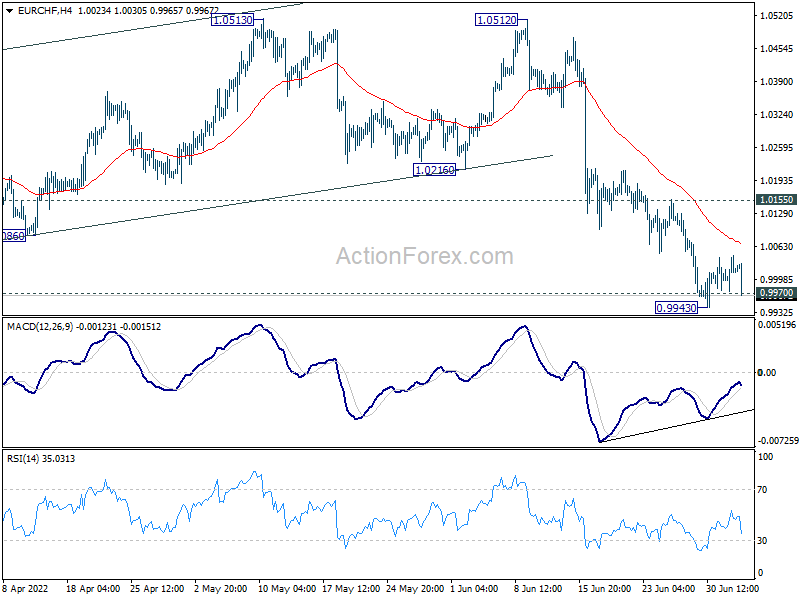
Intraday bias in EUR/CHF stays neutral and outlook remains bearish with 1.0155 resistance intact. On the downside, sustained trading below 0.9970 will resume larger down trend for 0.9650 long term projection level. For now, outlook will stay bearish as long as 1.0155 resistance holds, in case of stronger recovery.
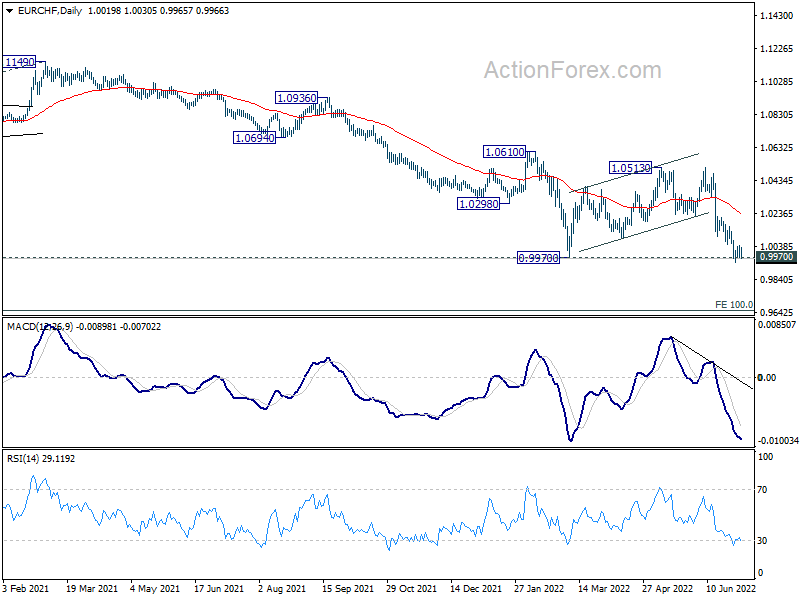
In the bigger picture, as long as 1.0505 support turned resistance (2020 low) holds, long term down trend from 1.2004 (2018 high) is expected to continue. Next target is 100% projection of 1.2004 to 1.0505 to 1.1149 at 0.9650. However, firm break of 1.0505 will suggest medium term bottoming, and bring stronger rebound towards 1.1149 structural resistance.
EUR/USD Daily Outlook
Daily Pivots: (S1) 1.0406; (P) 1.0435 (R1) 1.0452; More...
Intraday bias in EUR/USD remains neutral and further decline is expected as long as 1.0614 resistance holds. On the downside, sustained break of 1.0339/48 will resume larger down trend. Next target is long term projection level at 1.0090. On the upside, above 1.0614 will turn bias back to the upside for 1.0786 resistance instead.
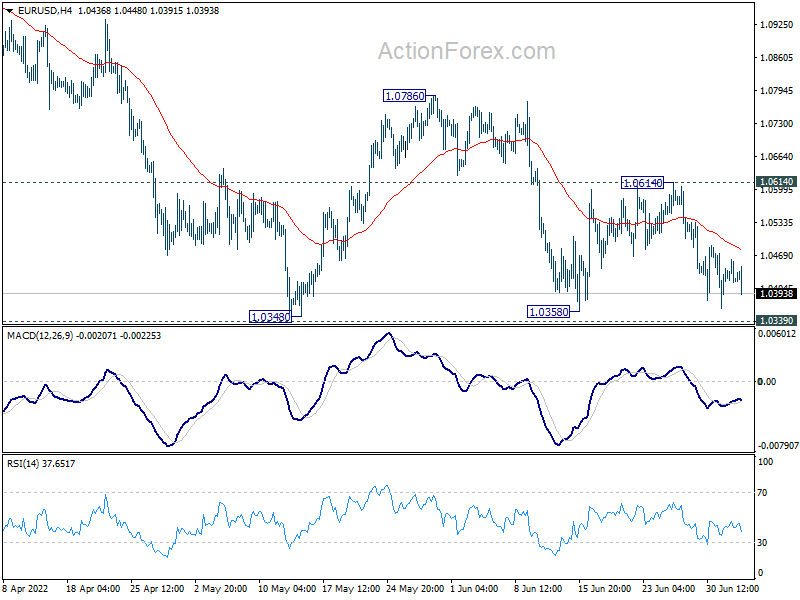
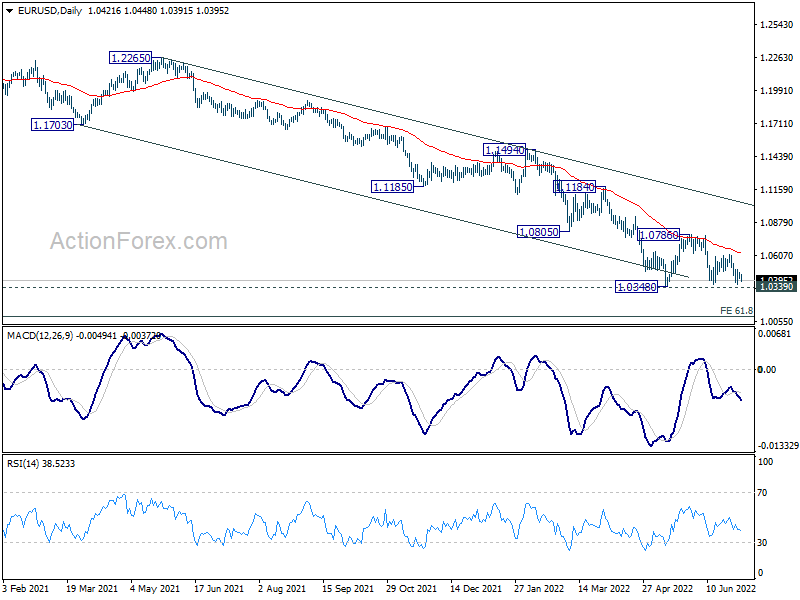
In the bigger picture, focus stays on 1.0339 long term support (2017 low). Decisive break there will resume whole down trend from 1.6039 (2008 high). Next target is 61.8% projection of 1.3993 to 1.0339 from 1.2348 at 1.0090. However, firm break of 1.0805 support turned resistance will delay this bearish case, and bring stronger rebound first.
GBP/USD Daily Outlook
Daily Pivots: (S1) 1.2070; (P) 1.2118; (R1) 1.2150; More...
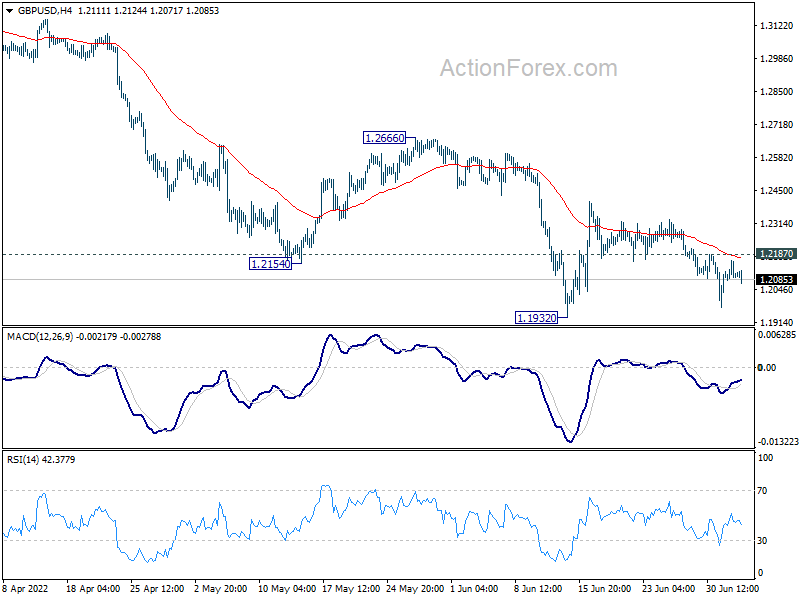
Intraday bias in GBP/USD remains neutral and further decline is mildly in favor with 1.2187 minor resistance intact. Break of 1.1932 will resume larger down trend from 1.4248. However, on the upside, above 1.2187 minor resistance will turn bias back to the upside for 55 day EMA (now at 1.2453) instead.
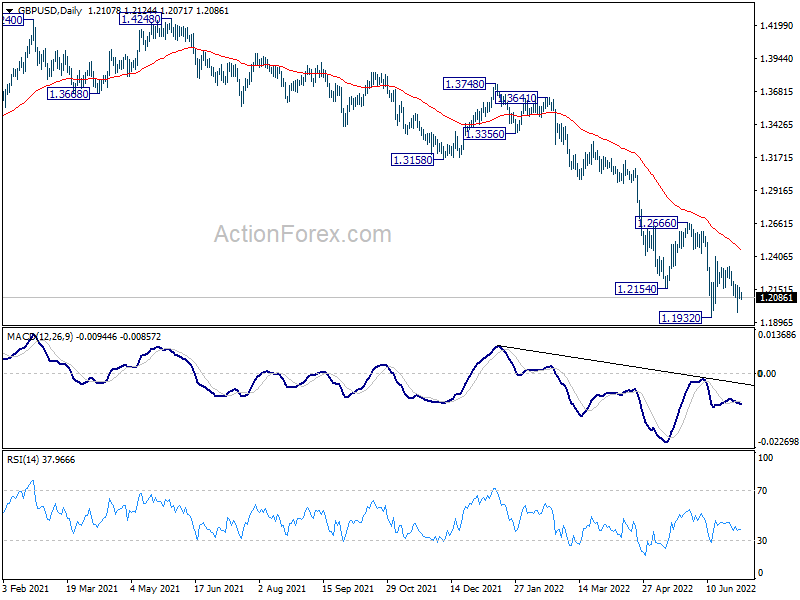
In the bigger picture, fall from 1.4248 (2018 high) could be a leg inside the pattern from 1.1409 (2020 low), or resuming the longer term down trend. Deeper decline is expected as long as 1.2666 resistance holds. Next target is 1.1409 low. However, firm break of 1.2666 will bring stronger rise back to 55 week EMA (now at 1.31403).
USD/CHF Daily Outlook
Daily Pivots: (S1) 0.9584; (P) 0.9601; (R1) 0.9630; More...
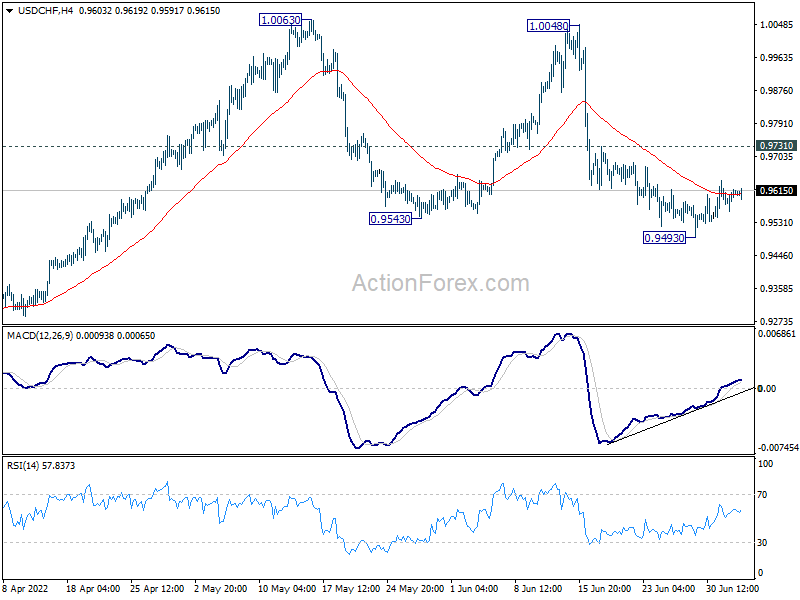
Intraday bias in USD/CHF stays neutral first. Price actions from 1.0063 are still seen as a consolidation pattern. On the upside, break of 0.9731 resistance will argue that such consolidation has completed and bring stronger rally back to retest 1.0063 high. However, another fall below 0.9493 will dampen this view and target 0.9459 resistance turned support.
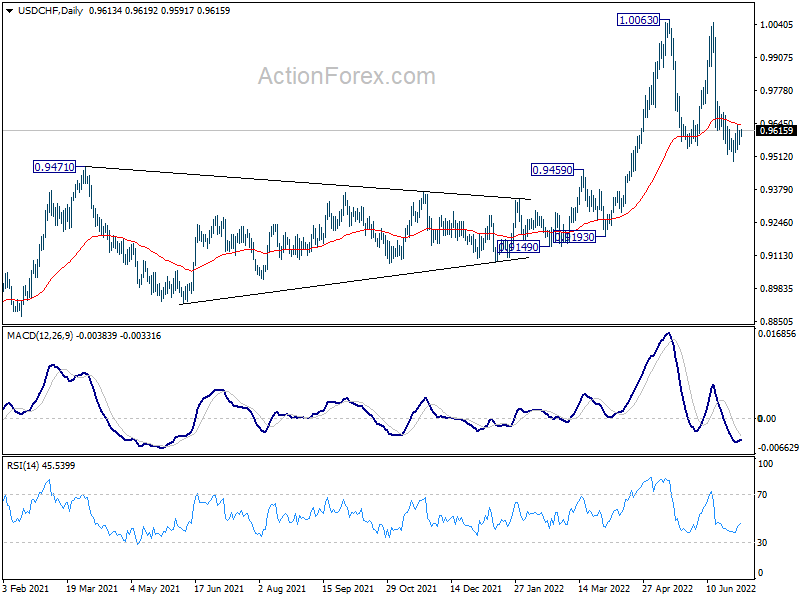
In the bigger picture, down trend from 1.0342 (2016 high) should have completed with three waves down to 0.8756 (2021 low) already. Rise from 0.8756 is likely a medium term up trend of its own. Next target is 1.0237/0342 resistance zone. This will remain the favored case as long as 0.9471 resistance turned support holds. However, sustained break of 0.9471 will extend long term range trading with another falling leg.
USD/JPY Daily Outlook
Daily Pivots: (S1) 135.07; (P) 135.42; (R1) 136.06; More...
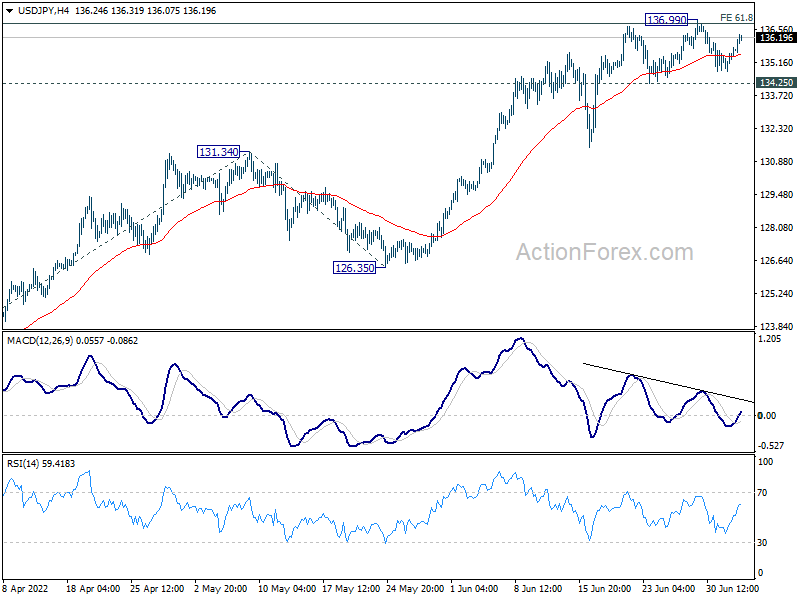
Range trading continues in USD/JPY and intraday bias remains neutral for the moment. On the downside, break of 134.25 support will indicate short term topping at 136.99. Intraday bias will be back on the downside for 131.34 support resistance turned support. Nevertheless, firm break of 136.99 will resume larger up trend to 100% projection of 114.40 to 131.34 from 126.35 at 143.29.
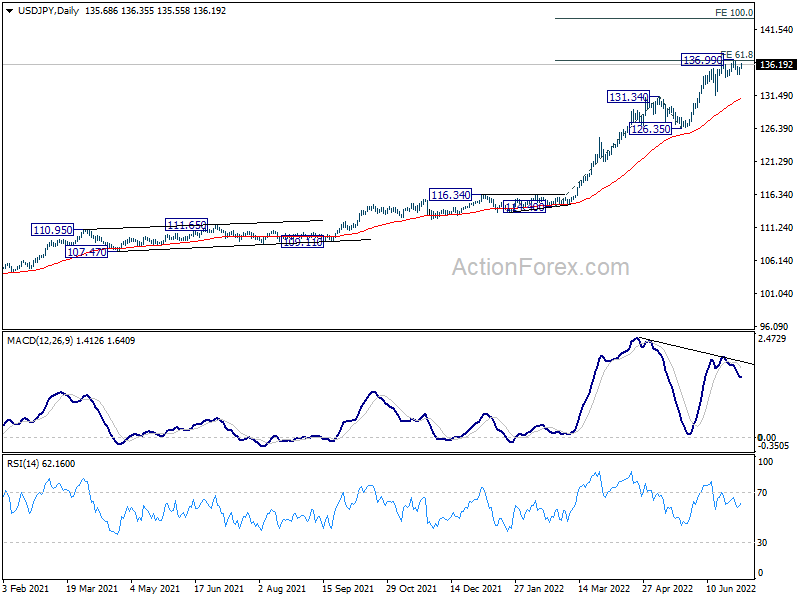
In the bigger picture, current rally is seen as part of the long term up trend from 75.56 (2011 low). Next target is 100% projection of 75.56 (2011 low) to 125.85 (2015 high) from 98.97 at 149.26, which is close to 147.68 (1998 high). This will remain the favored case as long as 126.35 support holds.
USD/CAD Daily Outlook
Daily Pivots: (S1) 1.2831; (P) 1.2867; (R1) 1.2896; More...
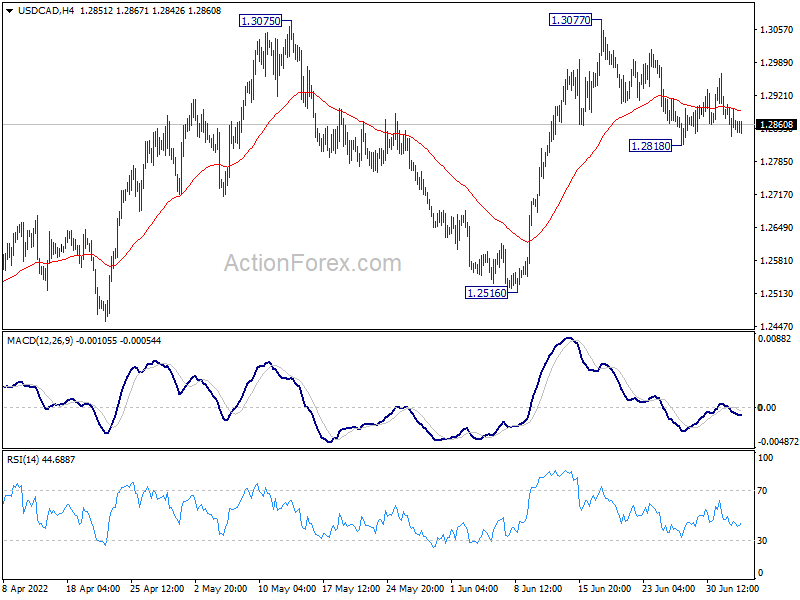
Range Trading continues in USD/CAD and intraday bias stays neutral at this point. On the downside, break of 1.2818 minor support will resume the fall from 1.3077 towards 1.2516 support next. On the upside, break of 1.3077 and sustained trading above 1.3022 fibonacci level will carry larger bullish implications, and bring up trend resumption.
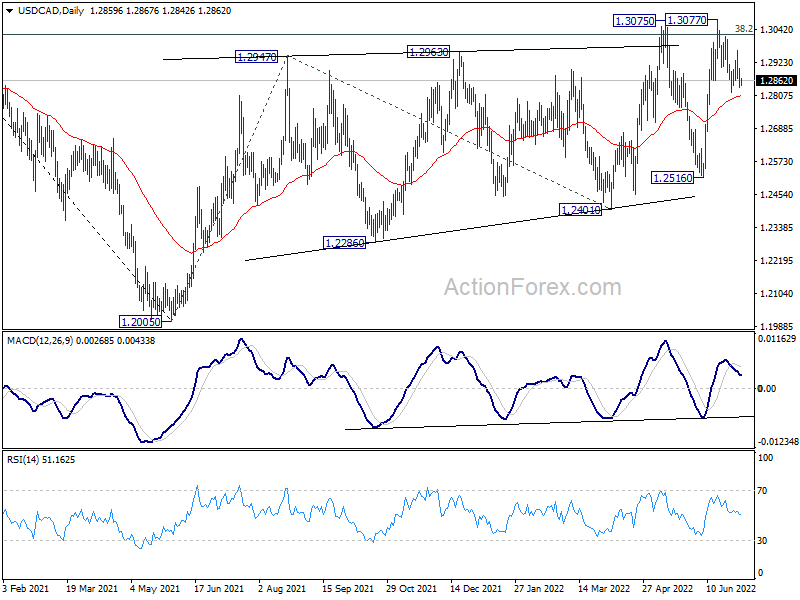
In the bigger picture, focus stays on 38.2% retracement of 1.4667 (2020 high) to 1.2005 (2021 low) at 1.3022. Sustained break there should confirm that the down trend from 1.4667 has completed after defending 1.2061 long term cluster support. Further rise would then be seen towards 61.8% retracement at 1.3650. However, rejection by 1.3022 will maintain medium term bearishness.
Risk-on Momentum Isn’t Really Convincing
Markets
Trading for the new week took a slow start as US markets were closed in observance of the 4th of July holiday. In Europe only second tier data were scheduled for release. Last week’s panic on growth eased, at least temporarily. However, in the new market era, a day of relative calm still allows moves on (European) interest rate markets of 10+ bps. After last week’s sharp setback in yields, markets apparently reached a more neutral positioning. Bund yields rose 10/11 bps across the curve with the very long end slightly outperforming (30-y +7.2 bps). The German 10-y yield (close 1.33%) rebounded off the key 1.15%/1.18 support area (38% retracement March/previous top). Intra-EMU spreads versus German finally ended recent narrowing trend (Greece being the exception). The 10-y Italian spread widened 5 bps. Buba chief Nagel said that the new ECB crisis tool to support bond markets of weaker nations should only be used in ‘exceptional circumstances and under narrowly defined conditions’ This sounds quite different from the ‘whatever-it-takes’ narrative to prevent policy fragmentation as aired by other ECB members of late. European equities initially gained some ground, but in the end gains, if any, were negligible (EuroStoxx50 + 0.12%). Potential headwinds from inflation and growth remain a factor of huge uncertainty going into the earnings season. On FX markets, the dollar stabilized slightly below recent peak levels (DXY close at 105.14). EUR/USD closed modestly higher at 1.0422, but the technical picture remains fragile. Sterling held a tight sideways range near the 0.8620 pivot. This morning, Asian equities and US futures try to see some positives from a video call between US Treasury Secretary Yellen and Chinese Vice premier Liu He. The US is considering to reduce some of the Trump era import tariffs to ease inflation. However, the risk-on momentum isn’t really convincing. China Caixin PMI’s (composite 55.3 from 42.2) also suggest an economic recovery as corona restrictions are scaled back. At the same time, higher yields and rising energy prices (oil and European natural gas) remain persistent challenges for global/regional growth. The dollar trades mixed (DXY 105.10). The yen underperforms on higher core yields & energy prices. USD/JPY regains the 136 handle (136.25). EUR/USD gains a few ticks (1.044). The 50 bps RBA rate hike apparently was fully discounted by the Aussie dollar (cf infra). Later today, the calendar is thin. US factory orders and final EMU PMI’s are probably no market movers. On interest rate markets, we look out whether yesterday’s rebound might be the start of a bottoming out process (in yields). EUR/USD last week avoided a real test of the 1.0350/41 key support area. Still the picture remains fragile as long as the pair fails to regain the 1.0615 level. This still looks quite far. The BoE today will publish its financial stability report. It probably won’t contain much positive news for sterling. For now, EUR/GBP trading is still guided by a gradually but protracted buy-on-dips pattern.
News Headlines
The Reserve Bank of Australia conducted a back-to-back 50 bps rate hike this morning, lifting the policy rate from 0.85% to 1.35%. Inflation is forecast to peak later this year and return towards the 2%-3% target range next year. Medium-term inflation expectations remain well anchored and the RBA stresses the importance that this remains the case. Resilient economic growth and a tight labour market (including wage growth) add to the case that current still extraordinary monetary support is no longer needed. The RBA sticks with its forward guidance that further rate hikes will be coming with the size and timing data dependent. The RBA specifically mentions the Q2 CPI print (July 27) as key input for the inflation outlook. The household spending serves as an economic risk. The Aussie dollar is virtually unchanged (AUD/USD 0.6875) following June underperformance (correction commodities & stronger dollar). Australian swap rates are stable as well. Money markets discount a 3%+ policy rate by the end of the year.
European gas prices yesterday rose by 10% as a strike at Norwegian gas fields over a wage dispute started overnight. An additional 191 members would join the strike from July 9 if no solution is found. Gas production is set to fall by 292k barrels of oil-equivalent/day with about 13% of Norway’s daily gas exports falling away.
RBA Board Raises the Cash Rate by 50 Basis Points; We Expect Another 50 in August
The RBA Board lifted the cash rate by 50 basis points to 1.35%.That move was expected. The details in the Statement indicate nothing to dissuade us that the next move in August, following the release of the June quarter Inflation Report, will also be 50 basis points. To support our view that the Board will then pause we will need to see a significantly different Statement in August than we have seen in June and July.
The Reserve Bank Board decided to increase the cash rate target by 50 basis points to 1.35% at its Board meeting today.
This decision was expected by Westpac and widely expected by the market and other analysts.
The the Governor’s Statement provides ample flexibility for the next Board meeting on August 2.
Key points from the final “policy” paragraph are: “further step in the withdrawal of extraordinary monetary support”; “The Board expects to take further steps in the process of normalising monetary conditions in Australia over the months ahead”; “the size and timing of future increases will be guided by the incoming data and the Board’s assessment of the outlook for inflation and the labour market.”
There is one point of difference from the June Statement that is worthy of notice.
A key issue is whether the Board sees that this 50 basis point move signals a significant change in the policy stance – for example moving policy from stimulatory to neutral. We assess the neutral range as 1.5-2.0% so the 1.35% means that policy is still stimulatory.
In the final “policy” paragraph one of the few changes is to exclude the description of the level of rates “still very low level of interest rates”. “Very low” is not replaced with another description but the exclusion of “very low” has some significance. However, that exclusion should certainly not be interpreted that the Board believes that policy is now in the neutral range.
In our analyses of the previous decision in June we pointed out that although there was no mention of inflationary expectations in the June Statement we expected that the Board is highly sensitive to managing those expectations. That a key reason why we have been advocating decisive upfront moves to emphasise the Board’s commitment to returning inflation to the target over time.
In today’s Statement the Governor emphasises that “medium term inflation expectations remain well anchored and it is important that this remains the case”
He also highlights the importance of the Inflation Report which prints on July 27 – “a full set of updated forecasts will be published next month following the release of the June quarter CPI.”
The description of the labour market is even more upbeat than in June. On “underemployment” the description has changed from “a further decline is expected” to “has fallen significantly.”
But there seems to be increased confidence in the prospects for lowering inflation. In June the description was” increase further but then decline back towards the 2–3% range next year” to “forecast to peak later this year and then decline back towards the 2–3% range next year.” Arguably, this extra lift in the interest rate has materially improved the prospects from the Bank’s perspective of containing the inflation pressures.
Both Statements point out the importance of the data on the household sector. They both discuss the high savings rate; the pressure on budgets from higher inflation and higher interest rates, although the July Statement points adds that the “recent spending data being positive.”
Conclusion
From our perspective the key objective of scrutinising the Statement was to detect whether there appeared to be any clear signal that the Board planned to scale back the sequence of 50 basis point moves which we have now seen for two consecutive months.
Since the RBA began announcing the cash rate publicly in 1990 it has never raised the cash rate in two consecutive meetings by 50 basis points each. However, the Governor’s statement made no reference to that historical precedent something that may have been done if he was signalling the intention to scale back the moves.
Neither did he assess that the stance of policy had moved from stimulatory to the neutral range.
He sounded more confident about the inflation outlook while observing that the real time data on the labour market and household spending had lifted.
He stopped referring to rates as “very low” but did not substitute that term with a more moderate assessment.
Of some significance was the new emphasis in the Statement of the importance of inflationary expectations.
And most importantly he implied that the June quarter Inflation Report would be pivotal to future decisions.
With all this in mind and given our upbeat forecast for the June inflation report (5.9% headline; 4.2% trimmed mean) we are very comfortable that the Board will decide on a further 50 basis point lift at the August 2 meeting.
However, we are expecting the Board to pause in September and October.
To justify that expectation, we will need to a significant change in the August Statement – highlighting how far rates have moved in such a short time; describing the rate of 1.85% as in the neutral zone; noting the much higher frequency of RBA meetings than other central banks; while firmly indicating that further increases will be required.
Knot-Tying Masterclass Continues
One of the more pleasing aspects of being aboard a slow boat into the rainforests of Borneo these past few days was the complete loss of mobile telephony signals. The temptation to look at emails, chats, social media, or news from the markets was compulsorily removed, thanks to the national park being bigger than all of Bali. Phones (sorry; devices) become mere cameras to capture orangutans and others, or scenery for posterity. Experiences are experienced instead of captured for the “Gram, books are read, conversations are had. I could have done without the leeches and insect bites, but that’s all part of nature’s plan, and if I’m honest, in my long career in the great game we call the financial markets, I’ve noticed they attract plenty of leeches and biting insects of their own.
I certainly haven’t missed much in my short absence. Yes, volatility remains elevated across every asset class to be sure, although a US holiday overnight meant a 12-hour break from the noise. (New Yorkers don’t do 8-hour days, lunch is for wimps) What is clear is that the strategy of watching the rooster fight from the sidelines instead of getting involved remains the sensible one. The financial markets continue to tie themselves in knots so complicated, that they would give even the saltiest mariner a headache, as they try to price in a recession no recession and its impact on asset prices. Nobody is saying it, but really, it is a cover for looking for an excuse to pick the low in the stock market, which is struggling still to cope with the transition back to the real world after being back-stopped by the world’s central bank for the past 20 years.
Other asset classes are trying to price in a recession as well. US 10-year yields are now back to near 3.0% and I must say I got this one completely wrong, I thought it would be nearing 4.0% by now. That said, the US yield curve from 2-year to 30-year continues to flatten dramatically, with only a 24 bps difference as of Friday. We seem to be on the way to an inversion sooner than later, signalling a recession. Not much of a reason to bottom-fish equities I’d have thought.
Oil fell by over 5.0% on Friday for much the same reason, but frankly, with Russian sanctions and OPEC’s production targets merely a fantasy on paper, we’re going to have to see things get a lot worse in the world economy to see Brent crude under $100 a barrel. That ties in nicely with my outlook that inflation may be nearing a peak, but the risk is that it stays elevated for longer than the market is pricing, even if it peaks in the US. Don’t consign stagflation to the cupboard just yet. Elsewhere inflation in the world is still on its way up, as evidenced by European data last week and yesterday’s Indonesian inflation numbers.
The crypto space is also in the Accident and Emergency department still, waiting to be seen by a doctor. Bitcoin flirted with $18,000.00 while I was away but held the crucial $17,500.00 region. The dead cat bounce to $20,000.00 isn’t inspiring confidence with another crypto lender halting withdrawals, deposits, and trading on its platform yesterday. This one, I believe, was conjuring up to 40% potential returns through the magic of Defi. Cryptos have proven to be neither a hedge for deflation, stagflation, or inflation, even gold has done a better job and that’s saying something. Nor have they usurped the US Dollar or other fiat currencies. All I can say about the crypto space is a saying I heard before the global financial crisis and used a lot during it when a bank CEO would proclaim “we have plenty of capital.” That is “there is never just one cockroach.”
Perhaps the biggest surprise is that despite US yields tanking last week on recession fears, USD/JPY remains near 136.00. That is becoming a dangerous trade in my opinion, especially if US 10 years fall below 3.0%. Still, the US Dollar remains firm across the board, with the modest recovery in risk sentiment recently not translating into material strength in Asia currencies or major currencies versus the greenback. In fact, looking at the likes of the Euro, Yen, Aussie or Won, you might argue the opposite. The price action in the currency markets is perhaps a less-than-subtle warning to temper those bullish animal spirits in other asset classes.
That said, it looks like the bottom-fishers of the equity, bond and crypto-space may hold the reins in the first past of the week. US Treasury Yellen and China Vice-Premier Liu have held a construction phone call this morning and the market is alive with speculation that US President Biden will cut tariffs on a swath of Chinese goods this week to lower inflation. Following on from an impressive recovery by US manufacturing PMIs last week, China’s Caixin Services PMI leapt massively to 54.5 this morning for June, a giant recovery from May’s 41.4.
Japan’s Jibun Bank Services PMI for June also rose to 54.0 from 52.3 in May. Both China and Japan are emerging from varying degrees of virus restrictions, but the strength of the China's PMI recovery is a surprise. Whether it can last is another matter and once again I’ll focus on China once again and beat the drum of warning. China’s covid-zero policy is NOT one and done and President Xi said as much last week. Already, a flare-up of virus cases elsewhere has led to some restrictions being reimposed. Readers should be under no illusion that flare-ups in Beijing and Shanghai will not lead to a reimposition of movement restrictions. Tread carefully on bottom-fishing in China asset markets. And I have even mentioned the still ongoing implosion in the private property developer sector there.
Elsewhere in Asia, inflation warning signs continue to make some noise. Having started the post-covid recovery later than the United States and Europe, Asia is starting to see the inflation pass-through happening. South Korean Inflation YoY for June rose to 6.0% today from 5.40% in May, you can lock and load a Bank of Korea rate hike at the next meeting, it's just by how much. Philippine Inflation YoY for June has risen to 6.10% from 5.90% in May as well. On Friday, Indonesian inflation jumped to 4.40%, led by food inflation. An ominous development for a country of 270 million, mostly poor, citizens. Although core inflation remained benign, two of the most reluctant rate hikers, the Philippines and Indonesia, are going to be forced to act, or see pressure mounting on their currencies, causing a negative feedback loop of involuntary tightening via a lower currency. Likewise, India may need to accelerate hikes as well as soaring energy prices torpedoed the current account yesterday, which slumped to $-25.64 billion. And that’s with cheap Russian oil. This might partially explain why lower US yields are producing no peace dividend for Asian currencies against the US Dollar.
Another central bank facing the music in a couple of hours is the Reserve Bank of Australia. Home Loan and Building Permits soared yesterday, as did ANZ Job Advertisements. S&P Global Services PMI for June edged only slightly lower to 52.6, with the Composite PMI also printing at 52.6 from 52.9 last month. The lucky country remains far too lucky it seems, and despite a 50bps hike last month, the battlers aren’t going down without a fight. Another 50bps is priced in for the RBA today, and if they stay on the fence and do just 25bps, the Australian Dollar is going to have a very bad day. It will probably only book modest gains anyway with 50bps unless the RBA statement is very hawkish. There is an outside chance the RBA could look at the data and go 75bps and surprise markets, I’m not betting my remaining hair on it though.
Although I said the stock market bulls may have the momentum in the first half of the week, the first challenge to that will loom in the dark hours of tomorrow evening Singapore time. Wednesday sees the release of May JOLTs Job-Opening data, expected to still be just above 11.0 million jobs. JOLTs Job Quits should come in around 4.4 million. That is hardly consistent with a US economy on the verge of a recession although some may argue that May is now history. Junes ISM Non-Manufacturing PMI, Activity, Employment, New Orders and Non-Manufacturing sub-indexes might take the heat out of a high JOLTs number unless they surprise to the upside.
Later that evening, the FOMC Minutes are due to be released, although I would be surprised if the committee is blinking on its inflation fight yet. That would create an intolerable credibility gap that already has a few holes below the waterline after the past 12 months. Before we know it, Friday is here and another US Non-Farm Payrolls release for June. Time flies when you’re getting whipsawed every day. Jobs are expected to fall from last month's monster 390,000 print to a still-healthy 270,000. Maybe there is some risk of downward back-month revisions, but that forecast is still not consistent with a US economy on the verge of a big slump. The scope for bond market volatility is high is “peak-Fed” has to be revised higher again. The US Dollar will lap it up like a cat with a plate of high-fat milk, but equity markets are unlikely to feel the same love.
It looks like another week to be patient and observe from the sidelines. Otherwise, strap in everybody, and keep practising those complicating sailing knots, they will be used this week.
Asian equities China tariff rally fades
US OTC equity markets were closed overnight for the July 4th holiday, but US futures posted consistent gains as markets pinned their hopes on a reduction of US tariffs on Chinese goods this week. S&P 500 futures are 0.40% higher, Nasdaq futures have rallied by 0.85%, and Dow futures have gained 0.55%.
That theme saw Asian markets open higher this morning, but that rally seems to have faded as the session marched on. Concerns around the latest China virus flare-up and the prospect of restrictions seem to be weighing on Asian markets and rightly so. Lower tariffed goods to the US will mean little if supply chain disruptions from China occur again. That has led to a mixed day across Asia.
Japan’s Nikkei 225 is 0.55% higher today, well of the intraday highs, while South Korea’s Kospi has rallied by 1.20%. Mainland China has moved into the red, the Shanghai Composite falling by 0.25%, with the CSI 300 falling by 0.60% despite an impressive recovery by the Caixin Services PMI data. Hong Kong’s Hang Seng has now fallen into negative territory, down by 0.05%.
Singapore is 0.30% lower, with Taipei easing by 0.25%, Kuala Lumpur clinging to a 0.05% gain, while Jakarta is outperforming, rising by 0.90%. Manila has also surprised, rallying by 1.20%, with Bangkok adding 0.25%. Australia is clinging onto some of its earlier gains ahead of the RBA policy decision, with 0.50% priced in. Still, its high beta to China means it is well off earlier highs in the day. The ASX 200 and All Ordinaries are 0.30% higher.
Europe had a mixed session overnight, and with a US holiday and a slow news day, there will be little to inspire a strong direction move this afternoon. I expect a neutral opening. With US futures gaining during the US holiday, and China tariff cuts expected this week, I expect US markets to focus their efforts on this direction and open higher tonight, potentially lifting European markets later in the day.
US Dollar remains firm
A US holiday overnight torpedoed volatility in currency markets, but overall, the US Dollar continues to maintain its gains versus the DM and EM currency space, despite insipient bullish sentiment in other asset classes and falling US yields. It seems that while markets tie themselves in knots in other asset classes, the US Dollar remains the favoured seats to watch the fun and games from in the stadium. The dollar index was almost unchanged at 1.0516 overnight, where it remains in Asia. Support remains at 1.0350 and 102.50. With resistance at 105.00 now eroded, the index’s next resistance is at 1.0585.
EUR/USD is steady at 1.0430 in Asia. Resistance is well and truly in place at 1.0600, followed by 1.0650. It remains uncomfortably close to the critical 1.0350 support region. Failure signals further losses to 1.0200 initially and potentially to parity in the weeks ahead.
Sterling has edged 0.10% higher to 1.2110 in Asia. A probe of the 1.2200 upside came to nought overnight and it remains initial resistance, followed by 1.2300. Support at 1.2080 and then Friday’s low at 1.1975. More important support at 1.1950 held and failure now signals a test of the 1.1400 pandemic low.
USD/JPY climbed by 0.35% to 135.70 overnight, adding another 0.35% to 136.20 in Asia. The resilience of USD/JPY continues to surprise, given the moves lower by US yields. Perhaps markets are pricing in an imminent inversion of the US yield curve and sharply higher short-term rates, but the excessive bullishness of USD/JPY is, in my opinion, becoming a dangerous trade if the US/Japan yield differential narrows. Perhaps US data this week will show a healthier US economy and put inflation-fighting back on track, perhaps not. Additionally, far too many “experts” are now calling for 140+, always a dangerous sign in my books. USD/JPY has resistance at 136.65 and 138.00, and support at 134.25 and 132.00.
Asian currencies are steady today, with a US holiday overnight giving Asian currency markets a reason to sit this session out. The US Dollar is maintaining its gains across the Asian FX space, with USD/PHP now at 55.000, while USD/IDR is approaching 15,000, and USD/KRW trading on each side of 1300.00. The India trade data did the INR no favours and USD/INR remains near record highs at 78.930 this morning. The Chinese Yuan remains a paragon of managed currency stability, thanks to components in its index slumping. USD/CNY is at 6.6935 today, comfortably in the middle of its two-month 6.6400 to 6.8100 range. If US data and/or the FOMC minutes, come in on the firmer side this week, receding recession fears and higher rate expectations will leave Asian FX vulnerable to another bout of downside pressure.
Oil is steady in Asia
Oil price continued their recovery from Thursday’s recession-fear sell-off as the supply-demand balance in the real world continues to underpin prices in the futures market. Brent crude rose by 2.15% overnight, easing 0.35% to $113.40 a barrel in subdued Asian trading. WTI rose by 1.90% to $100.55 overnight, easing by 0.30% to $110.10 a barrel in Asia.
Notably, Brent crudes retreat last week saw its ascending 2022 trendline support at $108.50 a barrel tested and held in textbook fashion. The support line is at $109.00 today and we can reasonably assume that Brent crude’s downside is limited unless we get a couple of daily closes below it. That would open a deeper test lower, potentially extending to $100.00. On the topside, the $120.00 region looks unlikely to break thanks to global recession nerves, unless we get more negative developments related to Russia.
WTI looks the more vulnerable of the two, as recession nerves rachet up in the United States. Again, US data this week has upside risks in this respect. WTI is ranging each side of its 2022 ascending trendline support, today at $108.50 a barrel. A close below the 100-day moving average at $106.95 likely signals a test of $104.00 and potentially $100.00 a barrel. Resistance lies at $112.00 and $114.00 a barrel for now.
Gold underwhelms again
Gold fell to $1784.00 an ounce last Thursday in what looked like a series of stop-losses going through the market after $1800.00 failed. It immediately recouped those losses and has been trading sideways around $1810.00 an ounce since then. Gold has risen slightly to $1811.00 in Asian trading today.
Overall, gold bugs will have taken a modicum of comfort that the fall below $1800.00 an ounce was short-lived, but the ensuing rally is uninspiring, to say the least. It suggests that any further US Dollar strength this week could see the downside tested once again as it refuses to react positively to the flattening and move lower by the US yield curve. The series of lower daily highs traced out over the last month continue to warn of the path of least resistance for gold.
Gold has resistance layered at $1820.00, its sloping downtrend line, then $1840.00, $1860.00, and $1880.00, the latter appearing an insurmountable obstacle. Support is at $1784.00 and then $1780.00 an ounce. Failure of the latter sets in motion a much deeper correction, potentially reaching $1700.00 an ounce.