Sample Category Title
Sunset Market Commentary
Markets
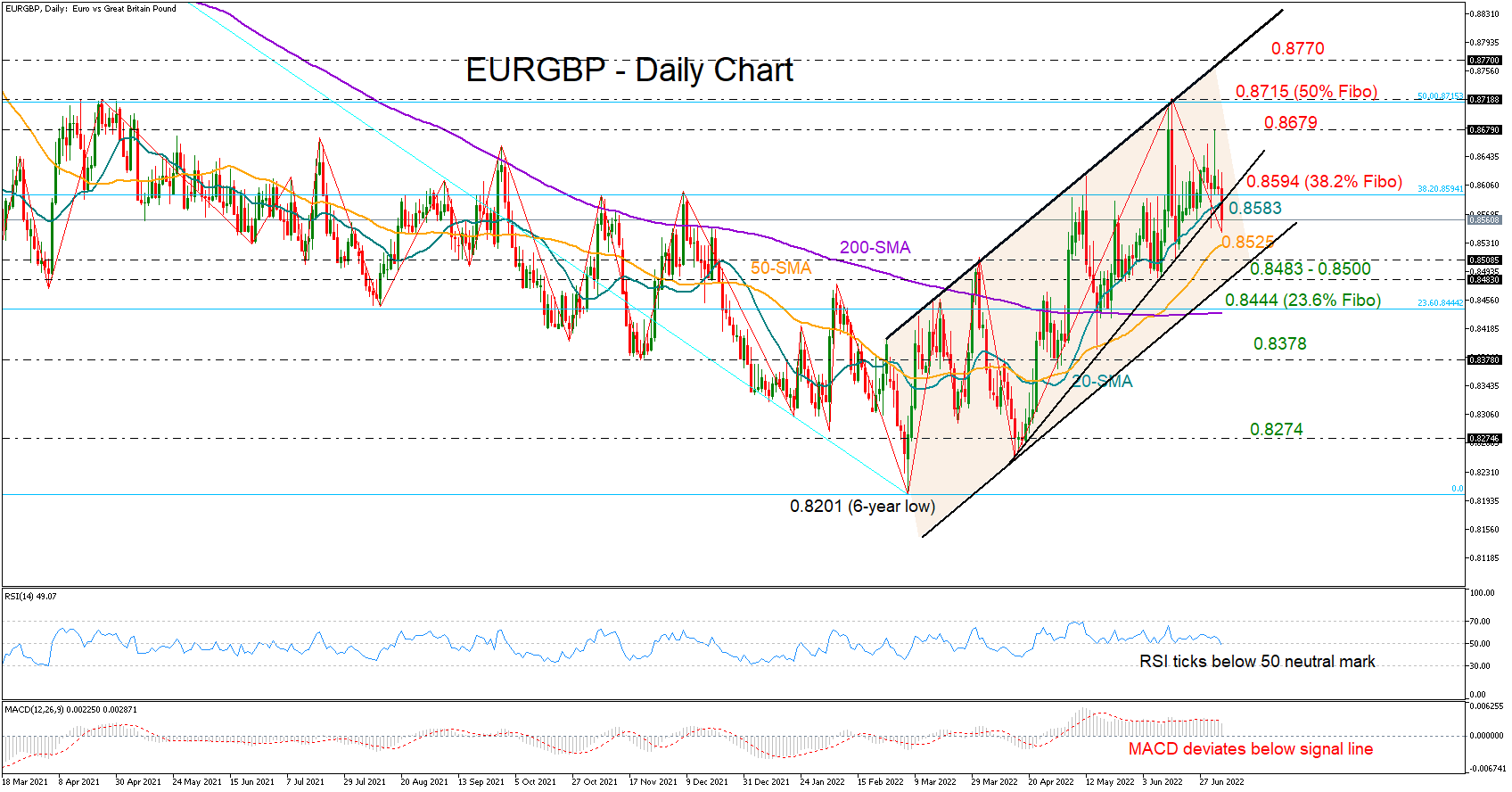
GEURONIMOOO! The euro is sliding to new multiyear lows against a range of currencies. EUR/CHF revisited sub-parity territory after recovering over the past few days from a similar adventure last week. The currency pair is currently changing hands at 0.993, the lowest since 2015. Excluding for this volatile period (after the SNB ditched the 1.20 peg), EUR/CHF trades at the lowest since the creation of the monetary union. EUR/USD is on the ropes. The combination tested the mid-May multiyear low around 1.035 a few times recently. It started again with a test today but one could see (based on moves in other crosses) how this time would be different. That key support level broke and EUR/USD slid further south below 1.03 (1.027 at the time of writing). From a technical point of view, there’s little in the way for a return to parity (76.4% dollar recovery in the 2000-2008 EUR/USD rally). After that, there’s a gaping hole to be bridged all the way down to 0.823 in a throwback to the Duisenberg era, the ECB’s first president. Even sterling was able to capitalize, temporarily at least, on euro weakness despite overall risk-off. EUR/GBP for a second time in less than a week tumbled out of the upward sloping trend channel. It then staged an intraday comeback to around 0.86 to keep the technical picture intact still. This balancing act makes sense considering what is driving the moves today. Recession fear is taking hostage of the euro with ever-higher (energy and food) inflation weighing on disposable income, corporate margins and soon (if not already) the European economy. But this is at least equally the case for the UK (see headline below). Sticking to currencies, EUR/JPY is the widow-maker now. The 140 support level (April interim high and neckline of the June double top formation) is being heavily tested. A confirmed break spells more trouble ahead for other euro crosses. It’s all hands on deck in Central-Europe. EUR/HUF is hitting new record lows at 408+. The MNB’s 185 bps super hike hasn’t convinced the forint at all. The Polish zloty is depreciating to the lowest level since end March. EUR/PLN is filling offers around 4.76. The CNB in Czechia is busy putting its large pile of FX reserves at work to prevent the CZK to weaken beyond EUR/CZK 24.75.
As said, fears for a recession are responsible. This results in sharp gains for core bonds as markets question the central banks tightening intentions. Bunds outperform US Treasuries. German yields tumble between 13 and 16 bps across the curve. The 10y yield (1.20%) is edging closer to critical support at 1.15%. US yields ease a more moderate 3-8.1 bps but missed out on yesterday’s European yield jump. But here too, important technical levels are nearing fast (US10y 2.81% vs 2.72% support). European equities raise the alarm. The EuroStoxx50 loses 2.4% to new YtD lows of 3370. Next support is located at 3109 before returning to 3000. Wall Street opens with losses between 1.7-1.9%. News Headlines
In its financial stability report, the Bank of England sees the global outlook deteriorating markedly due to the war in Ukraine and downside risks could further adversely affect financial stability. Still, the bank assesses UK banks have considerable capacity to support lending to households and business even if the economic outlook worsens. Aggregate household debt relative to income has remained broadly flat and debt servicing costs for UK business are assessed to remain affordable even as higher yields, rising (living)costs, weaker growth and other issues are putting pressure on household finances and corporate balance sheets. The BoE confirmed it will raise the contra-cyclical capital buffer to the pre-pandemic level of 2.0% by June next year. The BoE will also start annual stress tests in September 2022, testing the banks resilience to deep simultaneous recessions in the UK and global economies, real income shocks, large falls in asset prices and higher global interest rates. The BoE will also conduct an in-depth analysis of the functioning of the commodities market as the Russian invasion in Ukraine illustrated the risk of these markets to amplify economic shocks.
EUR/CHF Mid-Day Outlook
Daily Pivots: (S1) 0.9982; (P) 1.0014; (R1) 1.0052; More....
EUR/CHF's down trend resumes by breaking 0.9943 temporary low. Intraday bias is back on the downside. Next target if 0.9650 long term projection level. On the upside, break of 1.0044 minor resistance will turn intraday bias neutral and bring consolidations, before staging another decline.
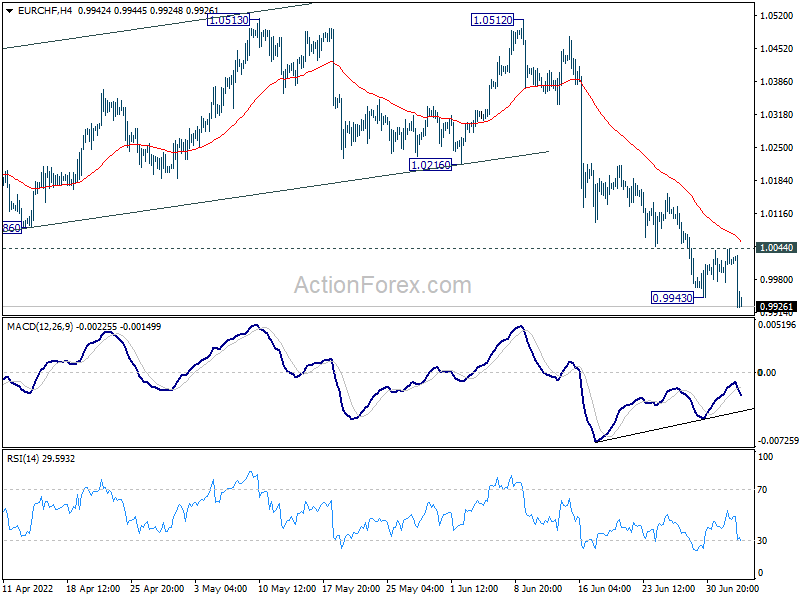
In the bigger picture, as long as 1.0505 support turned resistance (2020 low) holds, long term down trend from 1.2004 (2018 high) is expected to continue. Next target is 100% projection of 1.2004 to 1.0505 to 1.1149 at 0.9650. However, firm break of 1.0505 will suggest medium term bottoming, and bring stronger rebound towards 1.1149 structural resistance.
USD/JPY Mid-Day Outlook
Daily Pivots: (S1) 135.07; (P) 135.42; (R1) 136.06; More...
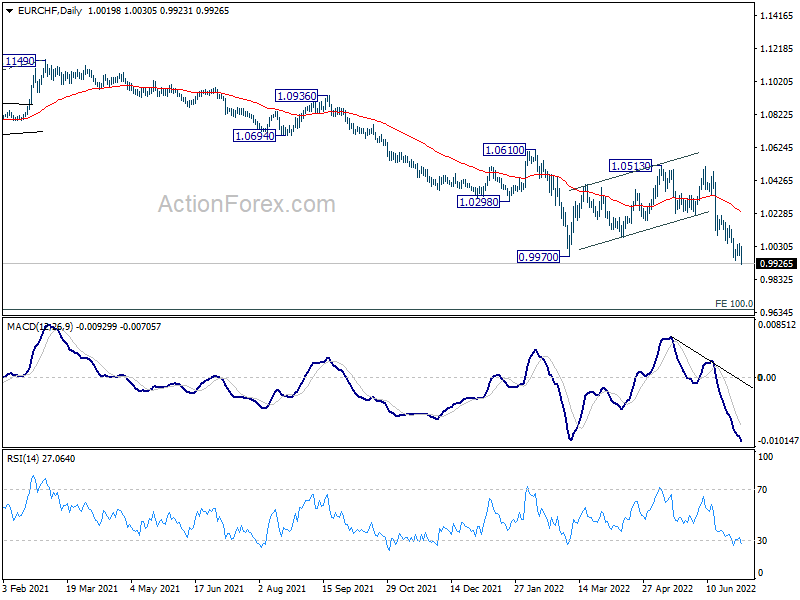
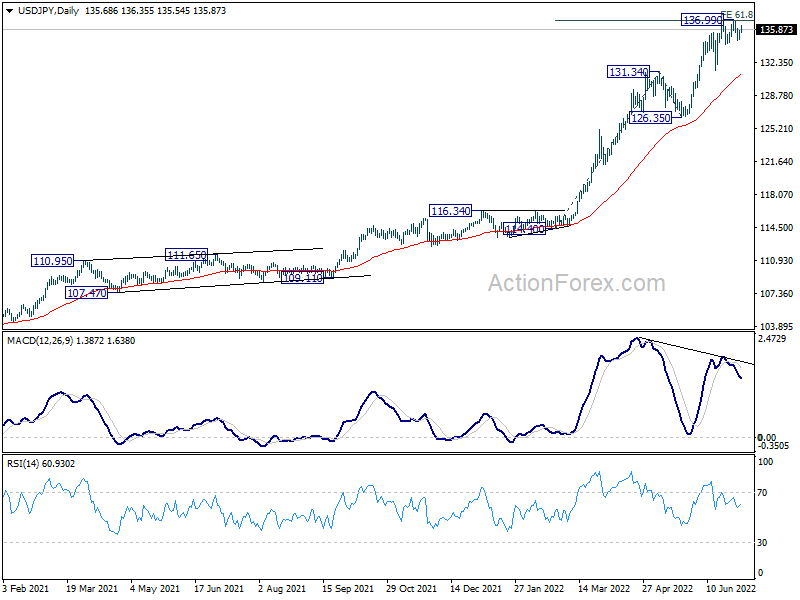
Intraday bias in USD/JPY stays neutral as sideway consolidation continues. On the downside, break of 134.25 support will indicate short term topping at 136.99. Intraday bias will be back on the downside for 131.34 support resistance turned support. Nevertheless, firm break of 136.99 will resume larger up trend to 100% projection of 114.40 to 131.34 from 126.35 at 143.29.
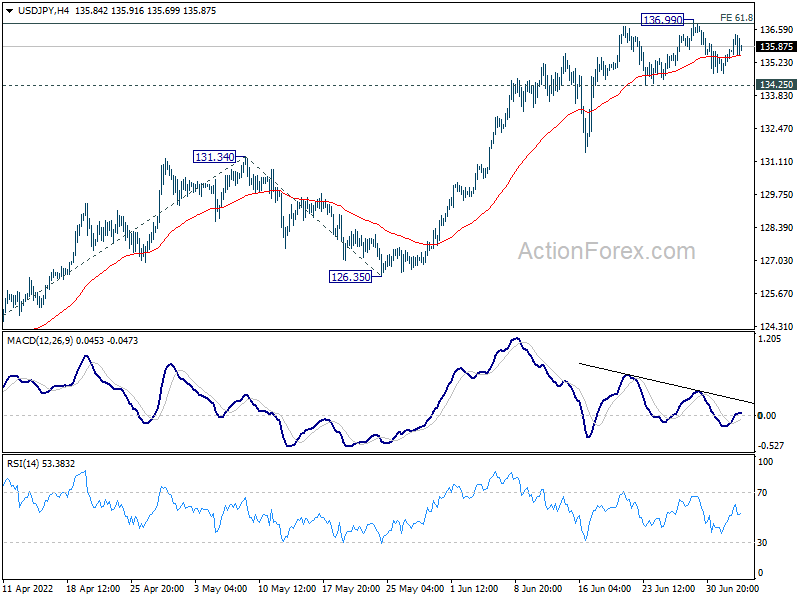
In the bigger picture, current rally is seen as part of the long term up trend from 75.56 (2011 low). Next target is 100% projection of 75.56 (2011 low) to 125.85 (2015 high) from 98.97 at 149.26, which is close to 147.68 (1998 high). This will remain the favored case as long as 126.35 support holds.
USD/CHF Mid-Day Outlook
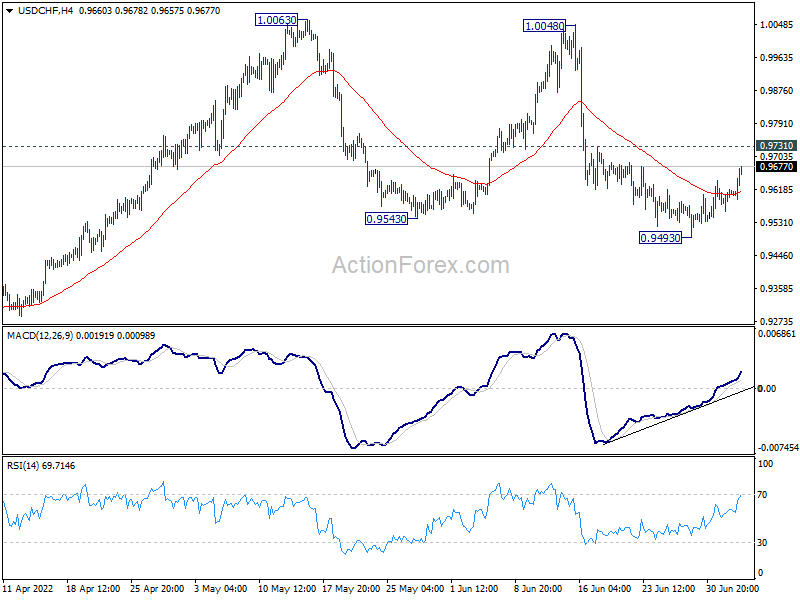
Daily Pivots: (S1) 0.9584; (P) 0.9601; (R1) 0.9630; More...
USD/CHF's recovery from 0.9493 continues today but stays below 0.9731 minor resistance. Intraday bias remains neutral first. On the upside, break of 0.9731 will argue that the consolidation from 1.0063 has completed and bring stronger rally back to retest 1.0063 high. However, another fall below 0.9493 will dampen this view and target 0.9459 resistance turned support.
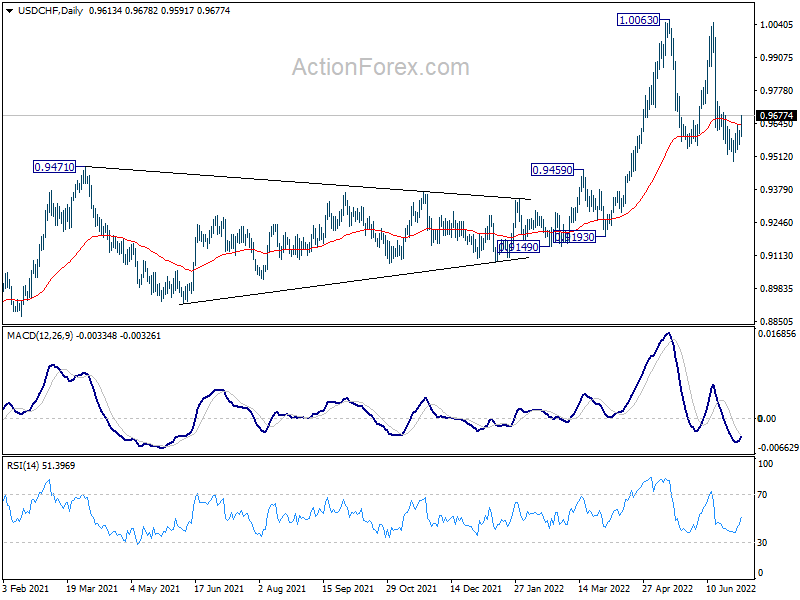
In the bigger picture, down trend from 1.0342 (2016 high) should have completed with three waves down to 0.8756 (2021 low) already. Rise from 0.8756 is likely a medium term up trend of its own. Next target is 1.0237/0342 resistance zone. This will remain the favored case as long as 0.9471 resistance turned support holds. However, sustained break of 0.9471 will extend long term range trading with another falling leg.
GBP/USD Mid-Day Outlook
Daily Pivots: (S1) 1.2070; (P) 1.2118; (R1) 1.2150; More...
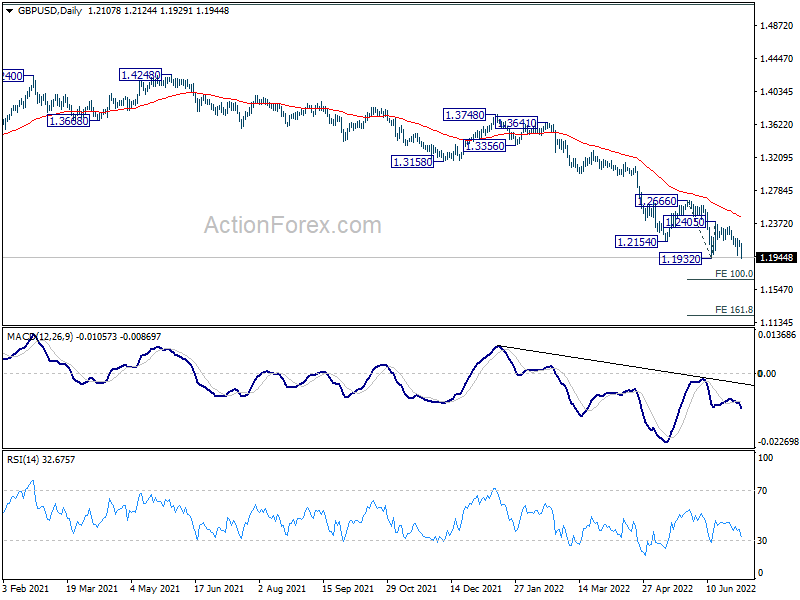
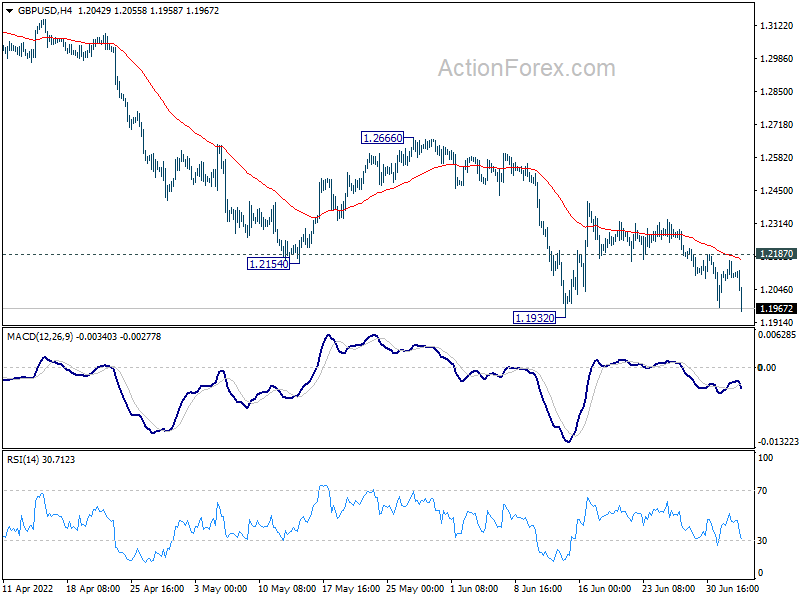
GBP/USD's breach of 1.1932 support indicates down trend resumption. Intraday bias is back on the downside. Next near term target is 100% projection of 1.2666 to 1.1932 from 1.2405 at 1.1671. Break will accelerate further to 161.8% projection at 1.1217. On the upside, break of 1.2164 minor resistance will delay the bearish case and turn intraday bias neutral first.
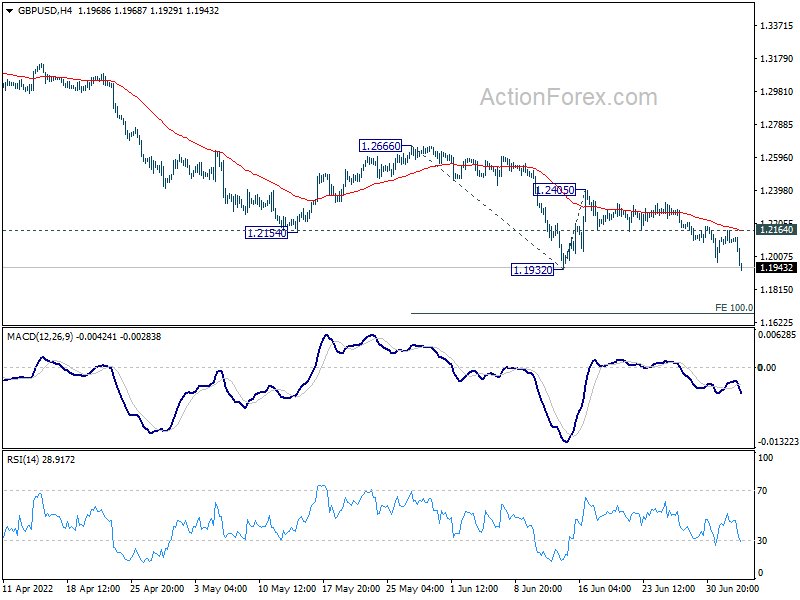
In the bigger picture, fall from 1.4248 (2018 high) could be a leg inside the pattern from 1.1409 (2020 low), or resuming the longer term down trend. Deeper decline is expected as long as 1.2666 resistance holds. Next target is 1.1409 low. However, firm break of 1.2666 will bring stronger rise back to 55 week EMA (now at 1.31403).
EUR/USD Mid-Day Outlook
Daily Pivots: (S1) 1.0406; (P) 1.0435 (R1) 1.0452; More...
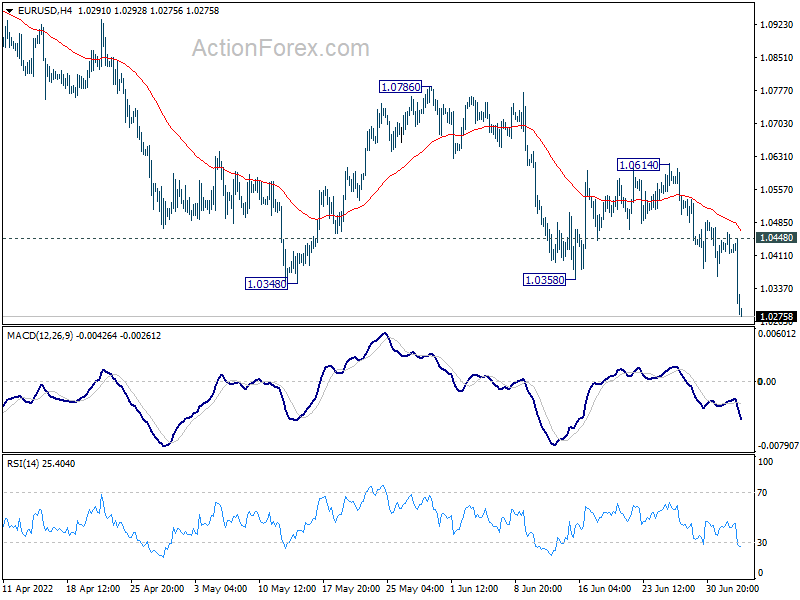
EUR/USD's down trend finally resumes and intraday bias is back on the downside. Next target is 1.0090 long term projection level. On the upside, above 1.0448 minor resistance will delay the bearish case and turn intraday bias neutral again.
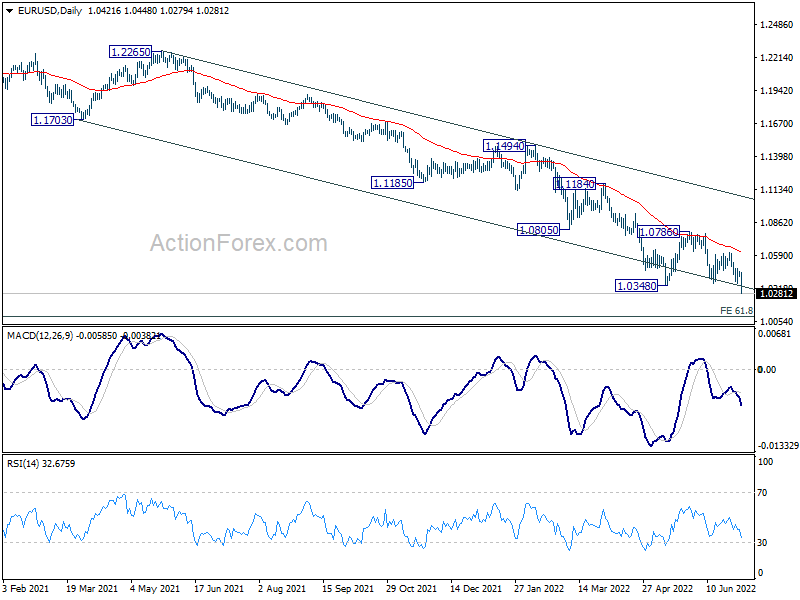
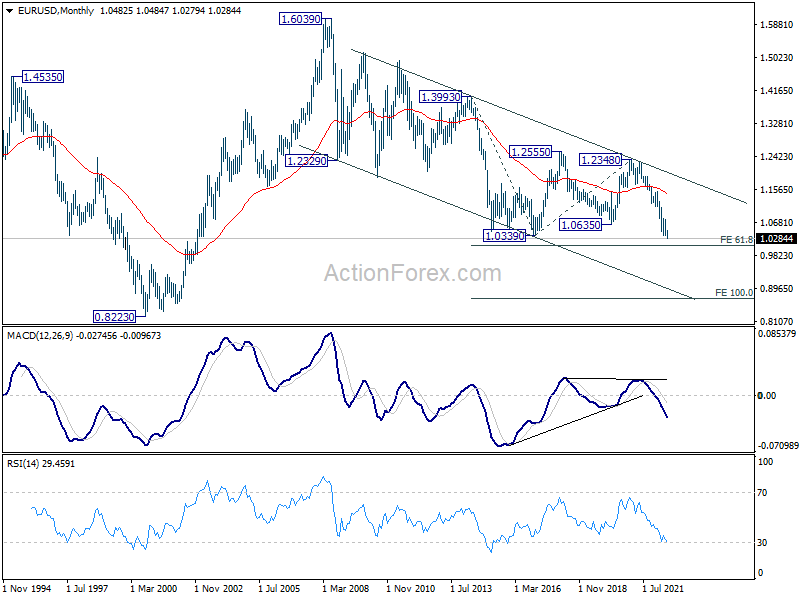
In the bigger picture, the break of 1.0339 long term support (2017 low) indicates resumption of whole down trend from 1.6039 (2008 high). Next target is 61.8% projection of 1.3993 to 1.0339 from 1.2348 at 1.0090. Sustained break there will pave the way to 100% projection at 0.8694. IN any case, outlook will stay bearish as long as 1.0786 resistance holds, in case of recovery.
Euro Hammered Broadly on Gas Crisis, Dollar and Yen Jump
Euro drops sharply and broadly today on renewed concerns over recession on gas crisis. The common currency is also taking other European majors lower. Dollar and Yen are currently the strongest ones on risk aversion. Commodity currencies are also weak, with Aussie shrugging of RBA rate hike. Nevertheless, Canadian Dollar is relatively resilient
Technically, EUR/USD's break of 1.0339 support confirms down trend resumption. One focus is now on when GBP/USD would follow and break through 1.1932 support. Another focus is whether Dollar's strength is enough to power AUD/USD through 0.6762 low, and USD/CAD Through 1.3077 high.
In Europe, at the time of writing, FTSE is down -1.91%. DAX is down -2.47%. CAC is down -2.47%. Germany 10-year yield is down -1.006 at 1.234. Earlier in Asia, Nikkei rose 1.03%. Hong Kong HSI rose 0.10%. China Shanghai SSE dropped -0.04%. Singapore Strait Times dropped -0.52%. Japan 10-year JGB yield dropped -0.0080 to 0.218.
European gas prices surge on Norway strike
The selloff in Euro intensifies today on the back on heightening gas crisis, which could drag the economy faster and deeper into recession.
Norway's Equinor is temporarily shutting down three oil and gasfields after workers went on strike. The Norwegian Oil and Gas Association has warned that could cut the country's daily gas exports by 13%. The country has supplied 20-25% of gas demand in Europe. The disruption comes at time as the Russia is already weaponizing its gas supply after Europe responded to its invasion of Ukraine.
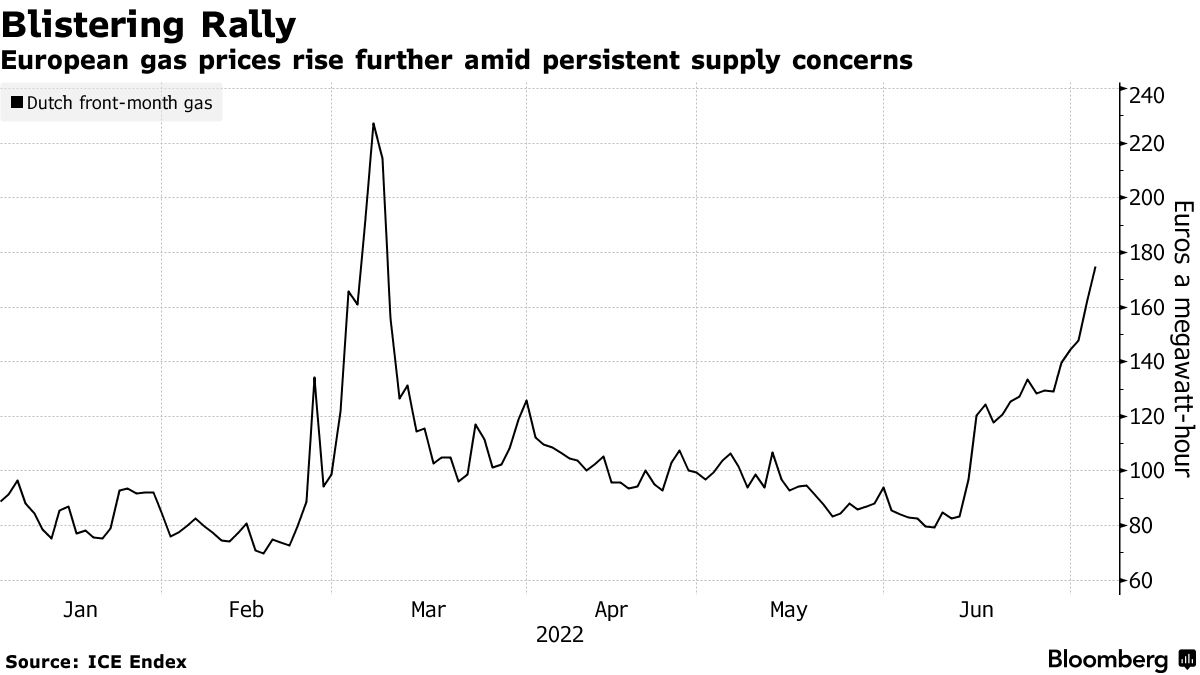
Dutch front-month gas futures, the European benchmark, continued ti surge to highest level in four months. UK equivalent prices had jumped another 10% while Germany 2023 power is trading at record.
UK PMI services finalized at 54.3, remained in expansion
UK PMI Services was finalized at 54.3 in June, up from May's 53.4. S&P Global said there was solid rise in business activity, but new work lost momentum. Business expectations slumped to the weakest level since May 2020. Input costs inflation held close to May's survey-record high. PMI Composite was finalized at 53.7, up from May's 53.1.
Tim Moore, Economics Director at S&P Global Market Intelligence: "The service sector remained in expansion mode during June, but persistently high inflation has started to dent discretionary spending and negatively influence demand projections across the board... June data highlighted the second-fastest rise in input prices since the survey began 26 years ago, driven by intense wage pressures and rapid increases in fuel costs... Service providers are casting a nervous eye over their sales momentum and forward bookings, which led to a slump in business activity expectations to their lowest since May 2020."
Eurozone PMI composite finalized at 52 in Jun, risk of economic decline in Q3
Eurozone PMI Services was finalized at 53.0 in June, down from May's 56.1, a 5-month low. PMI Composite was finalized at 52.0, down from May's 54.8, a16-month low.
Looking at some member states, Spain PMI composite dropped to 3-month low at 53.6. Ireland dropped to 16-month low at 52.8. France dropped to 14-month low at 52.5. Germany dropped to 6-month low at 51.3. Italy dropped to 5-month low at 51.3.
Chris Williamson, Chief Business Economist at S&P Global Market Intelligence said: "The sharp deterioration in the rate of growth of eurozone business activity raises the risk of the region slipping into economic decline in the third quarter. The June PMI reading is indicative of quarterly GDP growth moderating to just 0.2%...
"The manufacturing sector is already in decline, for the first time in two years, and the service sector has suffered a marked loss of growth momentum amid the cost of living crisis.... risks have increasingly tilted towards the economy slipping into a downturn at the same time that inflationary pressures moderate but remain elevated."
RBA hikes 50bps to 1.35%, more to come
RBA raised cash rate target by 50bps to 1.35% as widely expected. It also increased the interest rate on Exchange Settlement balances by 50bps to 1.25%.
It also maintains tightening bias. "The Board expects to take further steps in the process of normalising monetary conditions in Australia over the months ahead," it said. The timing and size of future hikes will be guided by the incoming data and assessment of the outlook for inflation and the labor market.
RBA also pointed to "behaviour of household spending" as one source of domestic "ongoing uncertainty". Global outlook "remains clouded" by war in Ukraine and the impacts of energy and agriculture prices. There are also ongoing uncertainties related to COVID, especially in China.
Also from Australia, AiG Performance of Construction dropped sharply form 50.4 to 46.2 in June.
New Zealand business confidence dropped to -65 in Q2
New Zealand NZIER Business Confidence dropped from -40 to -65 in Q2. A net 65% of firms surveyed expected general business conditions to deteriorate. That's the weakest level since Q1 2020.
NZIER said: "For the June quarter, firms saw activity in their own business remaining subdued. Besides the continued uncertainty over the COVID-19 outbreak, businesses are also grappling with the intensification of cost pressures and higher interest rates."
China Caixin PMI services rose to 54.5 in Jun, composite rose to 55.3
China Caixin PMI Services rose from 41.4 to 54.5 in June, above expectation of 49.0. That's the highest level since July 2021, signaling strongest upturn in business activity for 11 months. There were renewed increase in overall sales, despite slight drop in export orders. Inflationary pressures weakened. PMI Composite rose from 42.2 to 55.3.
Wang Zhe, Senior Economist at Caixin Insight Group said: "Overall, regional Covid outbreaks were put under control and restrictions were loosened in June, facilitating a gradual recovery in business operations. The supply side was the first to reflect improvements in production and logistics, while it will take more time to restore demand. The rebound in the services sector, which was hit harder by Covid outbreaks, was stronger than that of the manufacturing sector. Job creation lagged behind these positive developments, with the gauge for employment remaining in contractionary territory. Manufacturers still faced high cost pressure and profit challenges."
EUR/USD Mid-Day Outlook
Daily Pivots: (S1) 1.0406; (P) 1.0435 (R1) 1.0452; More...
EUR/USD's down trend finally resumes and intraday bias is back on the downside. Next target is 1.0090 long term projection level. On the upside, above 1.0448 minor resistance will delay the bearish case and turn intraday bias neutral again.
In the bigger picture, the break of 1.0339 long term support (2017 low) indicates resumption of whole down trend from 1.6039 (2008 high). Next target is 61.8% projection of 1.3993 to 1.0339 from 1.2348 at 1.0090. Sustained break there will pave the way to 100% projection at 0.8694. IN any case, outlook will stay bearish as long as 1.0786 resistance holds, in case of recovery.
Economic Indicators Update
| GMT | Ccy | Events | Actual | Forecast | Previous | Revised |
|---|---|---|---|---|---|---|
| 22:00 | NZD | NZIER Business Confidence Q2 | -65 | -40 | ||
| 22:30 | AUD | AiG Performance of Construction Index Jun | 46.2 | 50.4 | ||
| 23:30 | JPY | Labor Cash Earnings Y/Y May | 1.00% | 1.50% | 1.70% | |
| 01:45 | CNY | Caixin Services PMI Jun | 54.5 | 49 | 41.4 | |
| 04:30 | AUD | RBA Rate Decision | 1.35% | 1.35% | 0.85% | |
| 06:45 | EUR | France Industrial Output M/M May | 0.00% | 0.50% | -0.10% | -0.30% |
| 07:45 | EUR | Italy Services PMI Jun | 51.6 | 51.5 | 53.7 | |
| 07:50 | EUR | France Services PMI Jun F | 53.9 | 54.4 | 54.4 | |
| 07:55 | EUR | Germany Services PMI Jun F | 52.4 | 52.4 | 52.4 | |
| 08:00 | EUR | Eurozone Services PMI Jun F | 53 | 52.8 | 52.8 | |
| 08:30 | GBP | Services PMI Jun F | 54.3 | 53.4 | 53.4 | |
| 12:30 | CAD | Building Permits M/M May | 2.30% | -1.40% | -0.60% | |
| 14:00 | USD | Factory Orders M/M May | 0.50% | 0.30% |
European gas prices surge on Norway strike
The selloff in Euro intensifies today on the back on heightening gas crisis, which could drag the economy faster and deeper into recession.
Norway's Equinor is temporarily shutting down three oil and gasfields after workers went on strike. The Norwegian Oil and Gas Association has warned that could cut the country's daily gas exports by 13%. The country has supplied 20-25% of gas demand in Europe. The disruption comes at time as the Russia is already weaponizing its gas supply after Europe responded to its invasion of Ukraine.
Dutch front-month gas futures, the European benchmark, continued ti surge to highest level in four months. UK equivalent prices had jumped another 10% while Germany 2023 power is trading at record.
Bitcoin Rebounds above $20,000 Despite Intensifying Systemic Woes
Even though Bitcoin and most cryptocurrencies finished last week on the wrong foot, they quickly gained back some lost ground on Monday benefiting from a slight rebound in investor sentiment. The largest cryptocurrency by market capitalization reclaimed the crucial $20,000 psychological level but this recovery does not stem from any positive fundamental developments in the crypto space. The crypto Fear and Greed Index remains tilted in the extreme fear territory as markets remain short of convincing evidence that macro and idiosyncratic jitters are waning, thus further downside could be in the cards.
Cryptos continue to track stock market performance
European stock markets are in the green today, building on solid momentum as they also closed higher on Monday, capitalizing on mild risk-on sentiment triggered by Wall Street’s rebound on Friday. Moreover, US stock futures are in the positive region today, with markets eyeing the release of the Fed’s latest meeting minutes on Wednesday for clues as to whether the Bank will proceed with a softer monetary tightening on signs that inflation in the US is peaking. This latest relief rally in equity space has spilled over to crypto markets, dragging most cryptocurrencies higher despite the plethora of bearish crypto headlines.
Another potential reason why Bitcoin recouped some losses could be the tweet from the CEO of Binance regarding news that the Bank for International Statements (BIS) would allow commercial and investment banks to keep 1% of their reserves in Bitcoin. Thus, should banks start accumulating Bitcoin that would account for 1% of their total reserves, this would amount to trillions of dollars being invested in Bitcoin, propelling its price a lot higher than the current levels.
Systemic risks mount adding to an already bearish macro environment
Bitcoin’s year-to-date decline is largely attributed to the ongoing monetary tightening alongside global fears over inflation and growth slowdown. However, the downfall has been exacerbated by regulatory woes, idiosyncratic risks of the digital asset universe and operational crackdowns among crypto financial service providers. On Monday, a Singaporean crypto lender called Vauld paused withdrawals, trading and deposits on its platform, citing extremely volatile market conditions.
Furthermore, the cryptocurrency hedge fund Three Arrows Capital fell into liquidation after defaulting on a more than $660 million loan from Voyager Digital. On a similar note, Meta, the parent company of Facebook, announced that it will shut down its digital wallet Novi in September 2022, terminating the project in its pilot stage due to the recent mayhem in cryptocurrency markets. The ongoing market crash has been continuously exposing flaws and failures in several cryptocurrency projects and business models, delivering significant blows to the trustworthiness of the broader crypto space.
Technical picture remains intact
Although Bitcoin's price managed to recover from its fresh 18-month low of $17,588 and jump above the $20,000 mark, it remains below the 200-week simple moving average (SMA), which is essentially the bottom of all its previous bear market cycles.
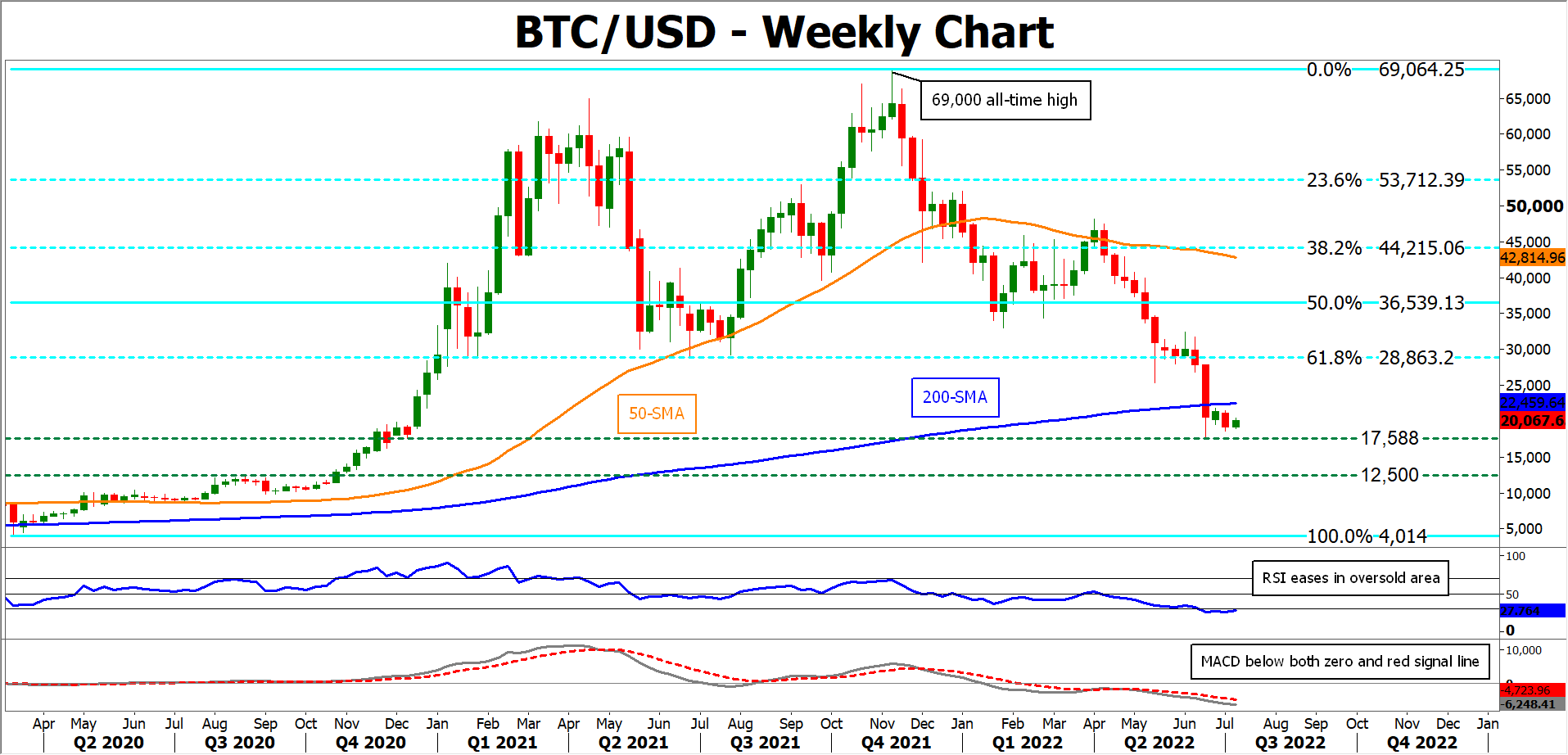
If negative momentum strengthens, the 2022 low of $17,588 may act as the first line of defense. Sliding beneath this crucial support, the price would descend to form fresh multi-year lows, where the next significant barrier could be found at the August 2020 resistance of $12,500.
On the flipside, bullish actions might encounter initial resistance at the 200-week SMA, currently at $22,459. An upside violation of the latter may pave the way for the $28,737 level, which is the 61.8% Fibonacci retracement of the 3,850-68,999 upleg.
EURGBP Plummets Below Key Support; Bias Worsens
EURGBP sellers came in with force during early European trading hours on Tuesday, squeezing the price beneath the protective 20-day simple moving average (SMA) and towards an intra-day low of 0.8566.
The quick bearish correction also pierced the 38.2% Fibonacci retracement of the long-term 0.9228 – 0.8201 downleg at 0.8594, which has been limiting both upside and downside pressures over the past two months, and breached the steeper ascending trendline.
If the bears secure a close below the 20-day SMA, the decline could initially test the 50-day SMA at 0.8525 ahead of the 0.8500-0.8483 support zone. Sliding lower, the pair may head directly towards the flattening 200-day SMA and the 23.6% Fibonacci of 0.8444. Another failure at this point could spur further selling towards the 0.8378 handle.
Although the RSI and the MACD are painting a blurry picture for short-term trading, with the former inching below its 50 neutral mark and the latter deviating below its red signal line, an upside reversal above the 38.2% Fibonacci of 0.8594 could see the pair re-challenging the 0.8679 bar once again. If efforts prove successful this time, the price could advance towards the 50% Fibonacci of 0.8715, a break of which could clear the way towards the tough resistance line currently seen around 0.8770.
In conclusion, EURGBP technical signals seem to be leaning on the downside, as the price is aiming for a close below the 0.8583 support region. The 50-day SMA at 0.8525 will be the next target if sellers keep the market below that threshold today.