Sample Category Title
S&P500 Bounces Back from Oversold, But What’s Around the Corner?
The US market opens later today after a long weekend. S&P500 futures indicate a 1.5% gain to Friday’s closing level, playing off the positive outperformance on the outside. The currency market has also swung towards buying risky assets, reinforcing hopes of at least a rebound in the coming days after a 13.5% dip from the highs to the lows of the month in the first two weeks of June.
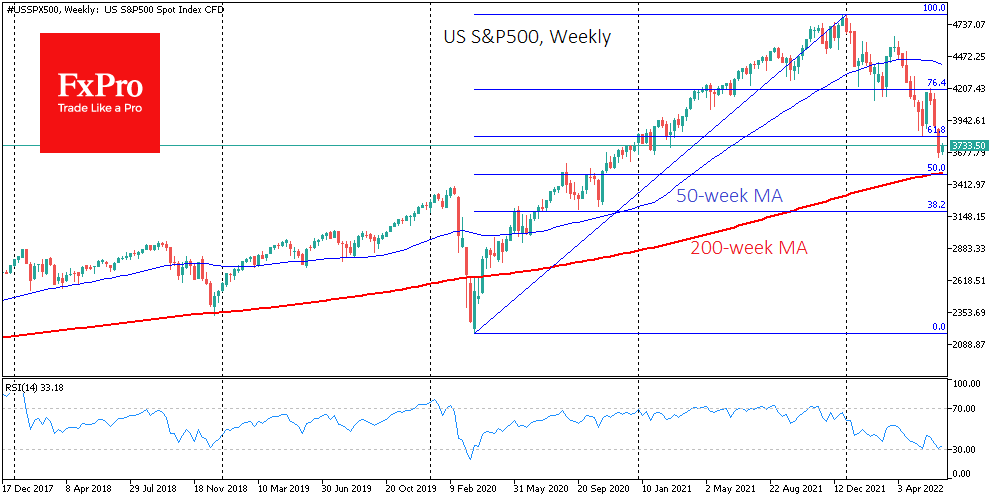
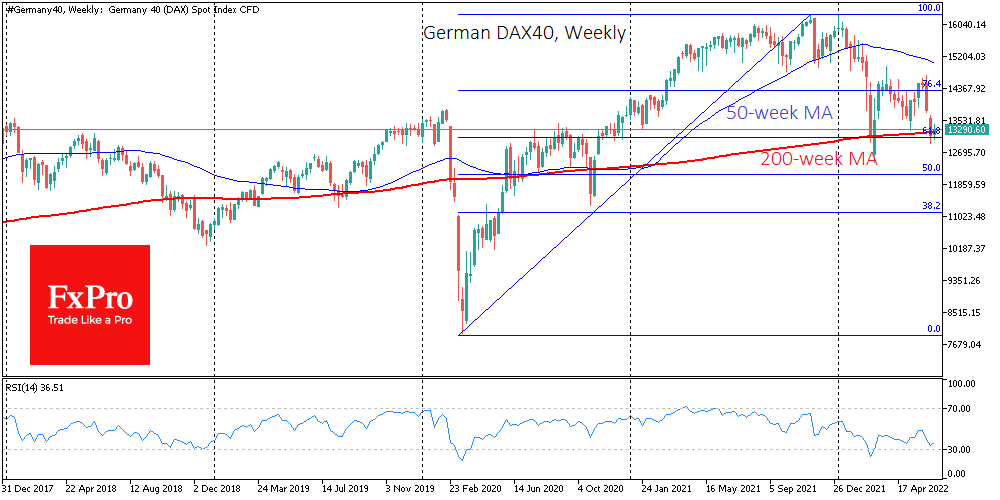
In equities, the positive tone is set by the performance of Asian equities and the recovery of major European indices from oversold territory. The DAX40 and FTSE100 are recovering from their lows of March. Both indices have stuck within the Fibonacci retracement pattern and got support at 61.8% for DAX and 76.4% for FTSE from the pandemic amplitude.
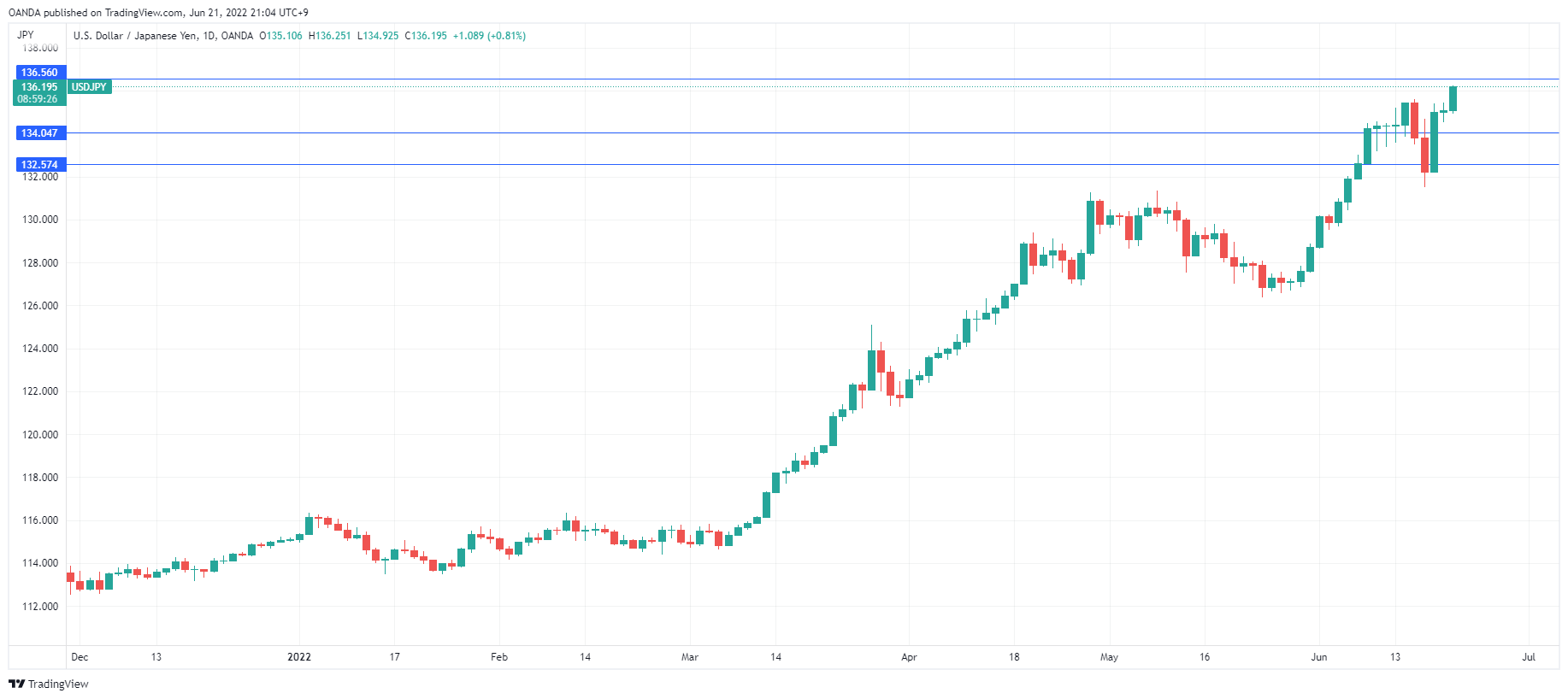
The weakening of the traditional shelter currencies – JPY, CHF – is setting a positive tone. The USDJPY has updated to a new high since 1998, above 136, indicating a return of risk appetite in some financial market segments. USDCHF settled near 0.9660, stopping the decline after last week’s unexpected SNB rate hike.
The euro and the pound are also gaining against the dollar, signalling a recovery in risk appetite.
However, it is essential to note the fragility of the current rebound. Most likely, we will see a corrective bounce after the worst week in equities in more than two years.
However, finding medium-term reasons to buy “risk” is still tricky. Aside from the BoJ, the main central banks are tightening policy or promise to do so as soon as next month. And so far, we see no sign that this trend is about to end or reverse.
Thus, cautious investors can still only tune in for a short-term bounce but do not hold out hope that the markets have bottomed out. The bear market in the USA will likely continue until we hear from the Fed the first hints of a halt to aggressive policy tightening. Until then, a bear market with occasional corrective bounces is likely.
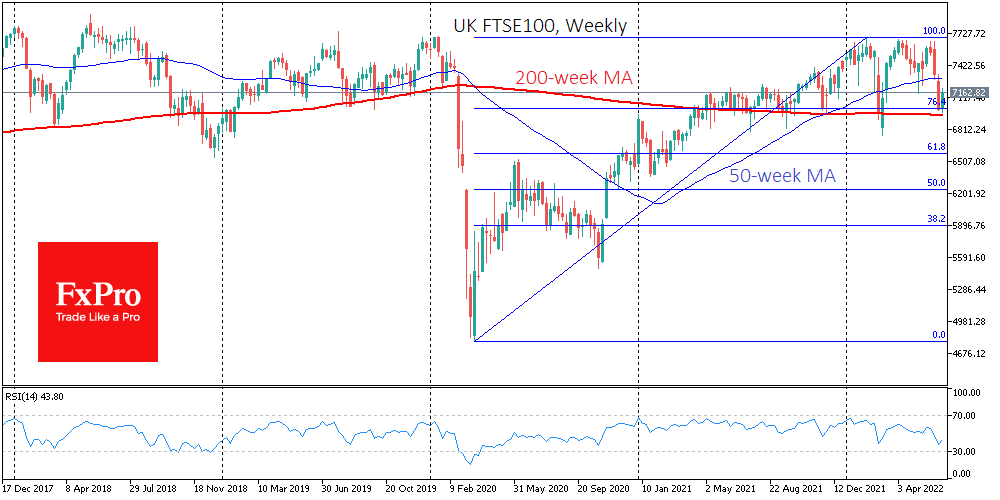
History also tells us that after entering a bear market phase and losing 20%, the market loses about another 20% on average (about 2900 for the S&P500) before it finds its footing. This scenario looks especially relevant when the Fed is not at all concerned about markets correcting, as it did at the beginning of the pandemic.
But it is too early for the bears to celebrate because they have yet to break the emerging rebound and push the S&P500 below 3500, significant psychological support, where the 200-week moving average and critical support/resistance levels of the second half of 2020 are located.
Our pessimistic scenario could be reversed if the S&P500 exceeds the 3900 mark during the emerging rebound. In that case, a reversal of the equity market to the upside would have to be considered.
British Pound Calm ahead of Inflation
The pound is having a quiet week, after some sharp swings last week. Monday was a holiday in the US, and it was a quiet session for the US dollar. The currency markets are calm today as well, with the exception of the sinking Japanese yen.
British pound eyes CPI
Last week was the turn of the central banks to perform on stage, with the Fed, BoE and SNB all raising rates. All three central banks are keeping a close eye on rising inflation and tightening policy in order to wrestle down inflation. The BoE has been accused of raising a white flag with regard to inflation, and last week’s tepid rate hike of 0.25% won’t silence the critics.
The UK releases the May inflation report on Wednesday, with headline CPI expected to nudge higher to 9.1%, up from 9.0% in April. The BoE estimates that inflation will peak above 11%, sometime later this year. With the BoE grimly predicting that inflation will hit double-digits, the cost of living crisis, which is already bad, is poised to get even worse. This has led to inflation expectations continuing to accelerate, and the UK rail strike, the biggest in 30 years, is a reflection of workers taking extreme action in the face of rising inflation. Consumer confidence is down, and a drop and consumer spending would be disastrous for an economy that may be headed for a recession.
In the US, Fed Chair Powell will testify on Capitol Hill on Wednesday and Thursday, and the ratings should be high, following the Fed’s largest rate hike since 1994. Fed members Barkin and Mester will speak later today, and the markets will be listening, looking for insights regarding upcoming rate hikes.
GBP/USD Technical
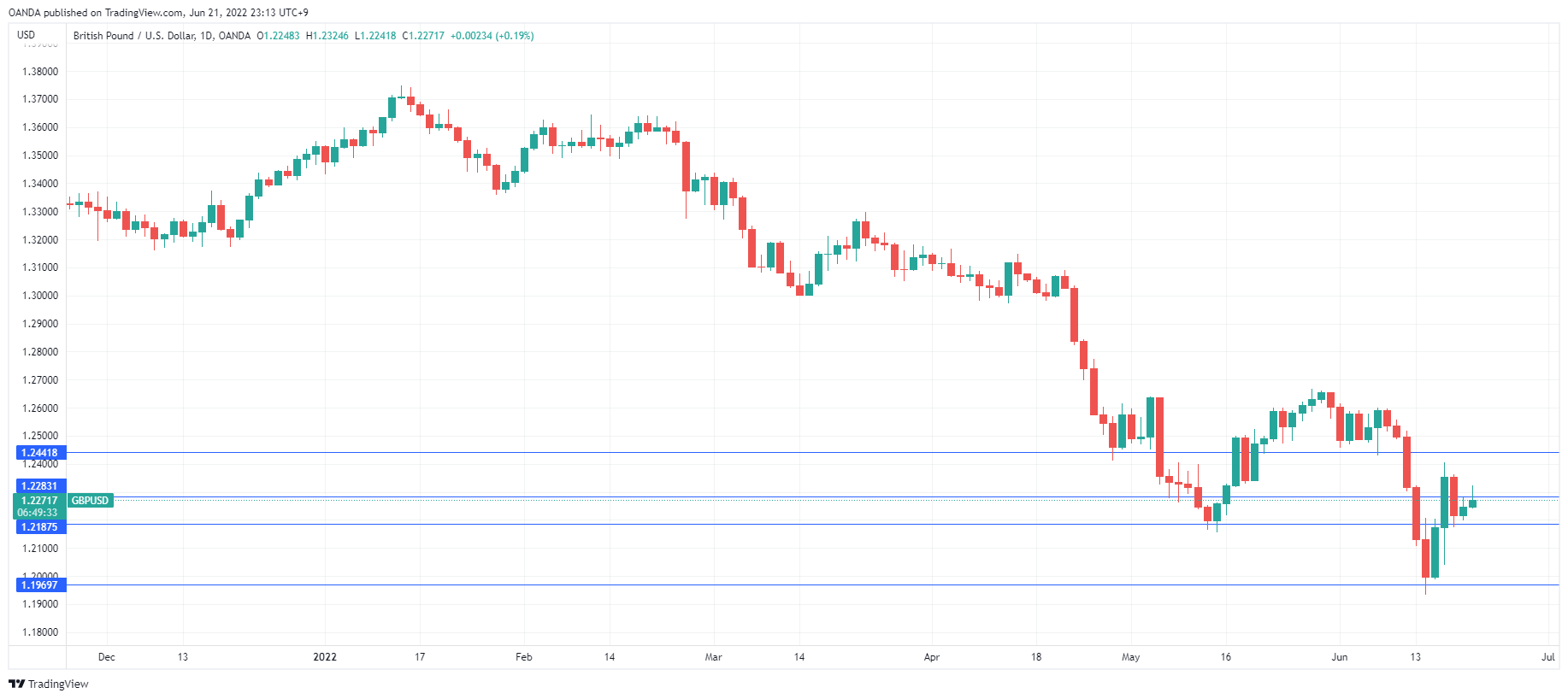
- GBP/USD is testing resistance at 1.2292. Above, we have resistance at 1.2441
- There is support at 1.2187 and 1.1969
Sunset Market Commentary
Markets
Europeanstock markets built on Asian risk momentum at the start of trading, but had some difficulties to really hold on to that vibe. As the US session gets going, they gain around 0.5% compared to +1.5% at their best levels around European noon. It’s another sign that the global setting of central bank policy normalization, high inflation, sluggish growth forecasts and still relatively high valuation isn’t really inviting for bulls to show their teeth. We remain in a sell-on-upticks environment with room for correction higher near term given the absence of inflation numbers and central bank meetings before the end of the month. Core bonds followed the intraday dynamic of stocks. They attempted to recover some lost ground in the early stage of European dealings, but the move lacked dash and was followed by return action lower. The German yield curve steepens at the time of writing with daily changes varying between -1.3 bps (2-yr) and +3 bps (30-yr). Peripheral yield spreads vs Germany narrow by up to 3 bps with Greece (-13 bps) and Italy (-7 bps) continuing their outperformance since last week’s extraordinary ECB meeting in which the central bank added strength to its commitment of not allowing for market fragmentation during the normalization cycle. Yield changes on the US yield curve are amplified by yesterday’s Juneteenth holiday. The US yield curve bear steepens with yields rising by 0.8 bps (2-yr) to 7.9 bps (30-yr). The euro gains some technically insignificant ground to trade at 1.0550 from an open at 1.0511. First intermediate resistance stands at 1.0627/42. EUR/GBP in the same vein rises to the 0.86 handle. Comments by BoE chief economist Pill are ignored. He added weight to last week’s policy meeting outcome (sharper tightening might be on the horizon) by saying that he would sacrifice some growth to cut inflation. Before last week’s meeting, the BoE sounded less firm in its inflation fighting commitment compared with other central banks. UK Gilts underperform today, rising by 4 bps (2-yr) to 7 bps (30-yr). Eco and event news was thin today, though we retain the ECB’s new measure of domestic inflation for the euro area that takes into account the import intensity of HICP items (“Low Import Intensity or LIMI-indicator). More specifically it looks at items like housing rentals, domestic services, maintenance and repairs en education. LIMI suggests that, although the sharp rise in headline inflation is mainly explained by imported inflation, domestic inflationary pressures have also increased over the past year. Tracking back, the LIMI-indicator started to point at increasing underlying inflationary pressures in the years immediately preceding the Covid-pandemic. It restarted its upward trend in mid-2021, passing 2% in the final quarter of last year to currently trade around 3.25% Y/Y.
News Headlines
The Russian ruble continues to appreciate and is now trading at a 7-year high vs the dollar (USD/RUB 54.7). The strong ruble was powered by surging prices for Russia’s commodity exports while imports collapsed and is increasingly posing a threat to exporters and public finances. Russian officials are scrambling for ways to keep the currency on a leash without abandoning the 4% inflation target. The most obvious one – direct FX interventions – is prevented by international sanctions. A suggestion that didn’t make the cut was a requirement for exporters to convert their earnings into yuan. Another abandoned idea was modeled after Iran’s approach to include two-tier exchange rates. One of the only options that remain open is to further loosen rules on currency operations for companies active abroad and more access to foreign exchange for households and business at home.
British manufacturing order books deteriorated in the three months to June, CBI data revealed. The diffusion index fell from 26% to 18% vs 21% expected. That is still high compared to history though, 0% in the series is considered a “normal level”. Slipping export orders (falling back from 19% to a 1%) were the main responsible. Looking ahead, the subseries gauging output volumes for the next three months eased slightly from 23% to 20%. Selling price expectations over that same period fell markedly, from 75% to 58%, a 9-month low. CBI notes that “we may be seeing the first signs that weaker activity is beginning to slow the pace of price increases in the sector.”
EUR/USD Mid-Day Outlook
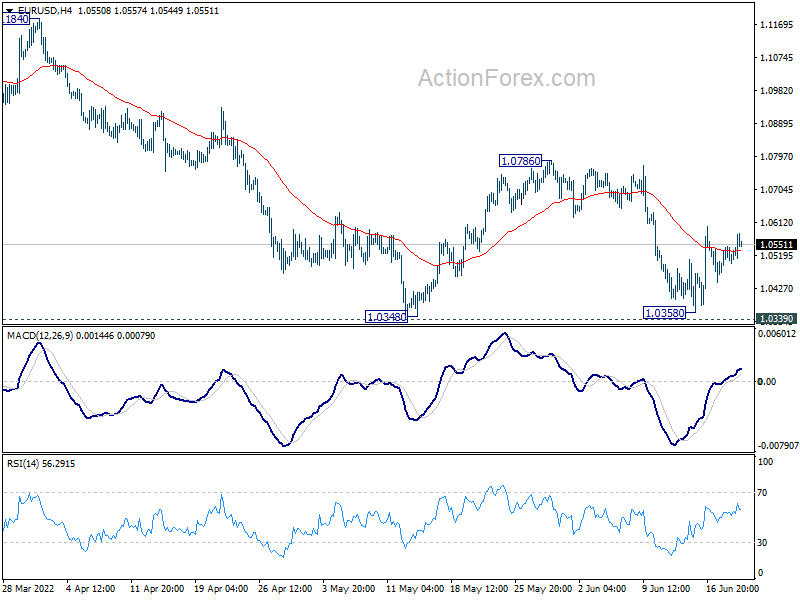
Daily Pivots: (S1) 1.0475; (P) 1.0511 (R1) 1.0546; More...
Intraday bias in EUR/USD remains neutral as sideway consolidations continues. Further fall is in favor with 1.0786 resistance intact. On the downside, sustained break of 1.0339/48 will resume larger down trend. Next target is long term projection level at 1.0090.
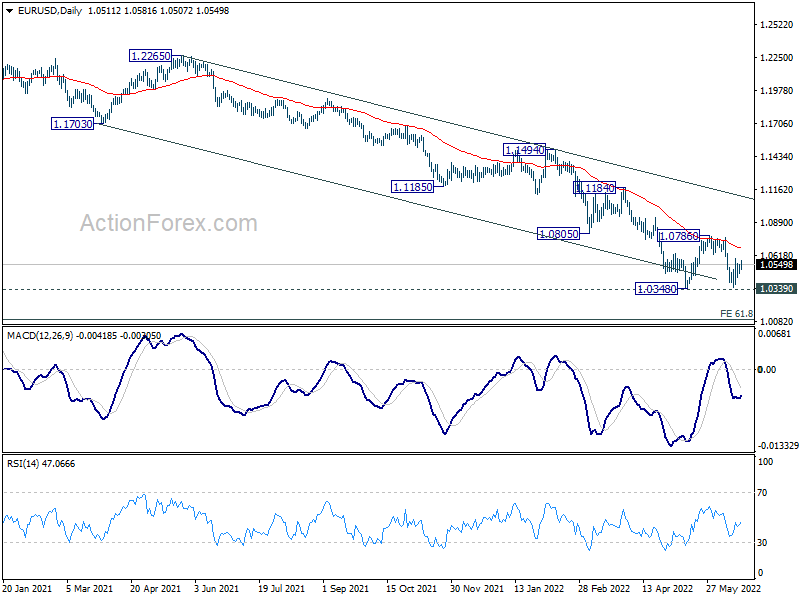
In the bigger picture, focus stays on 1.0339 long term support (2017 low). Decisive break there will resume whole down trend from 1.6039 (2008 high). Next target is 61.8% projection of 1.3993 to 1.0339 from 1.2348 at 1.0090. However, firm break of 1.0805 support turned resistance will delay this bearish case, and bring stronger rebound first.
GBP/USD Mid-Day Outlook
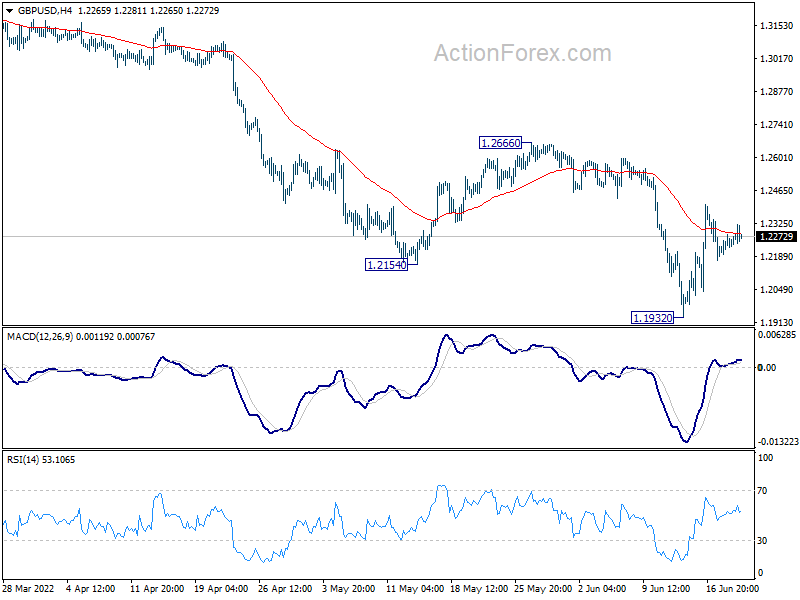
Daily Pivots: (S1) 1.2205; (P) 1.2242; (R1) 1.2286; More...
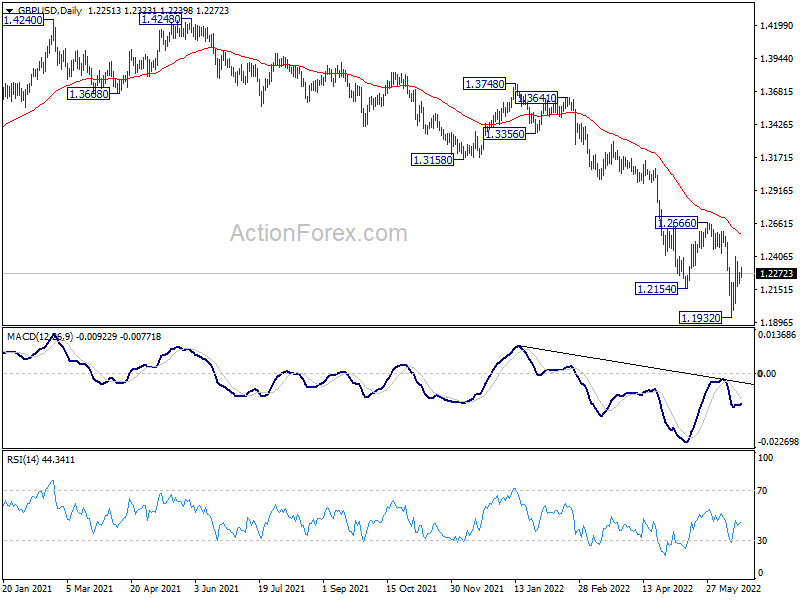
Intraday bias in GBP/USD remains neutral as range trading continues. Outlook stays bearish as long as 1.2666 resistance holds. On the downside, break of 1.1932 will resume larger down trend from 1.4248. However, firm break of 1.2666 will suggest medium term bottoming and bring stronger rebound back towards 1.3158 support turned resistance.
In the bigger picture, fall from 1.4248 (2018 high) could be a leg inside the pattern from 1.1409 (2020 low), or resuming the longer term down trend. Deeper decline is expected as long as 1.2666 resistance holds. Next target is 1.1409 low. However, firm break of 1.2666 will bring stronger rise back to 55 week EMA (now at 1.3175).
USD/CHF Mid-Day Outlook
Daily Pivots: (S1) 0.9627; (P) 0.9671; (R1) 0.9720; More...
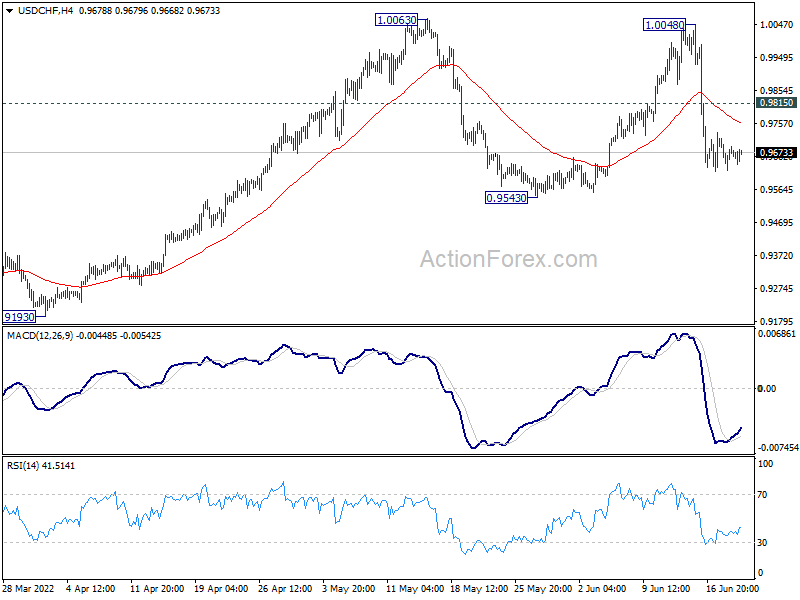
Intraday bias in USD/CHF stays neutral at this point. Another fall cannot be ruled out. But decline from 1.0048 is viewed as the third leg of the corrective pattern from 1.0063. Strong support should be seen at around 0.9543 to contain downside to bring rebound. On the upside, above 0.9815 minor resistance will turn bias back to the upside for retesting 1.0063 resistance.
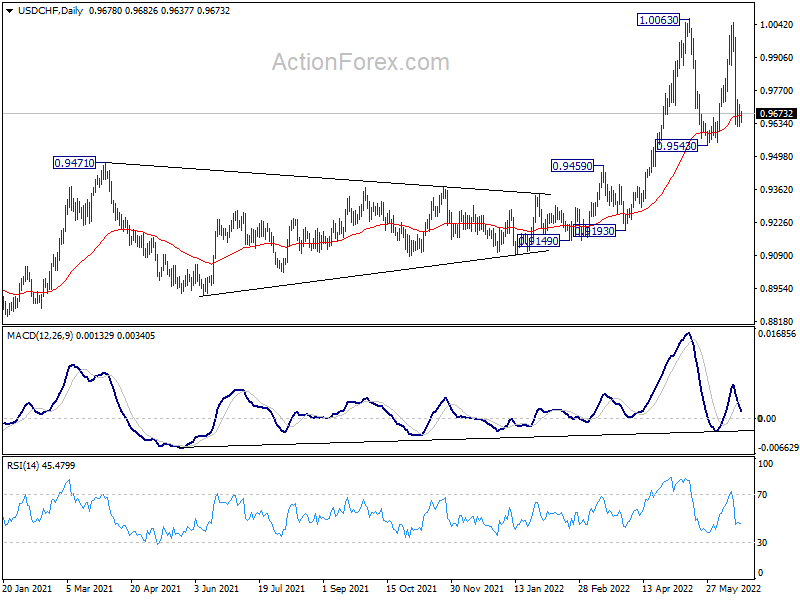
In the bigger picture, down trend from 1.0342 (2016 high) should have completed with three waves down to 0.8756 (2021 low) already. Rise from 0.8756 is likely a medium term up trend of its own. Next target is 1.0237/0342 resistance zone. This will remain the favored case as long as 0.9471 resistance turned support holds. However, sustained break of 0.9471 will extend long term range trading with another falling leg.
USD/JPY Mid-Day Outlook
Daily Pivots: (S1) 134.62; (P) 135.03; (R1) 135.52; More...
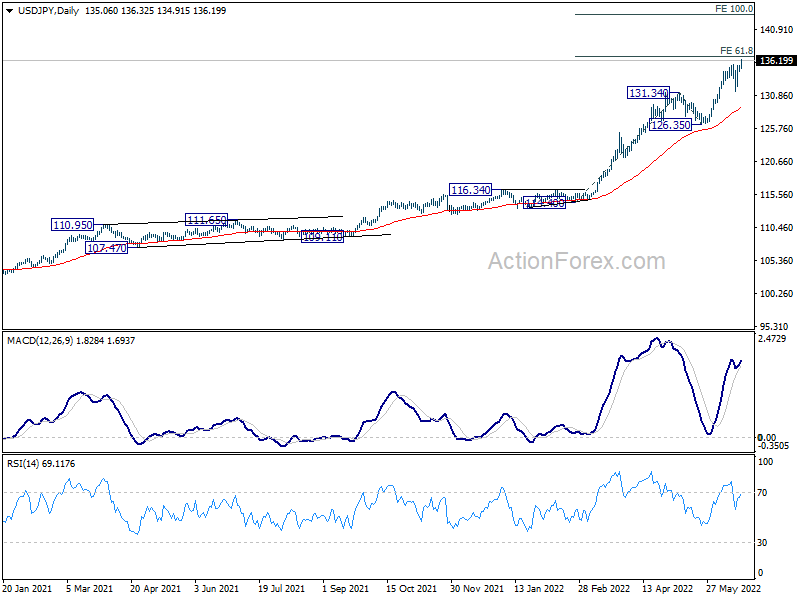
USD/JPY's up trend resumes by breaking through 135.58 today. Intraday bias is back on the upside for 61.8% projection of 114.40 to 131.34 from 126.35 at 136.81. Firm break there will target 100% projection at 143.29. On the downside, below 134.52 minor support will turn intraday bias neutral first. But outlook will remain bullish as long as 131.48 support holds.
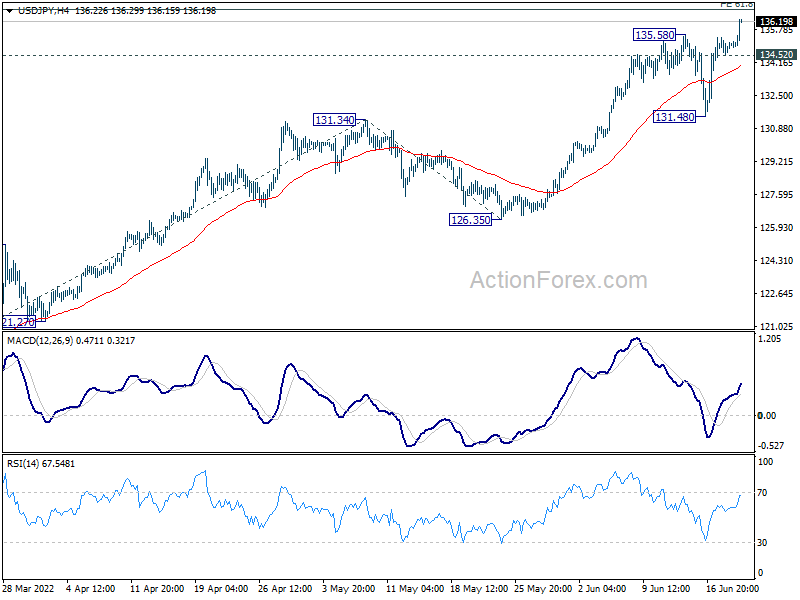
In the bigger picture, current rally is seen as part of the long term up trend from 75.56 (2011 low). Next target is 100% projection of 75.56 (2011 low) to 125.85 (2015 high) from 98.97 at 149.26, which is close to 147.68 (1998 high). This will remain the favored case as long as 126.35 support holds.
Yen Selloff is Back as USD/JPY Resumes Up Trend
Yen's selloff accelerates today as US stocks are set to stage a rebound after the long weekend. For now, Euro is the strongest one with help from rebound against Sterling and Swiss Franc. It's followed by Canadian Dollar, which is supported by slightly better than expected retail sales data. On the other hand, Kiwi and Aussie are the weakest one, following Yen.
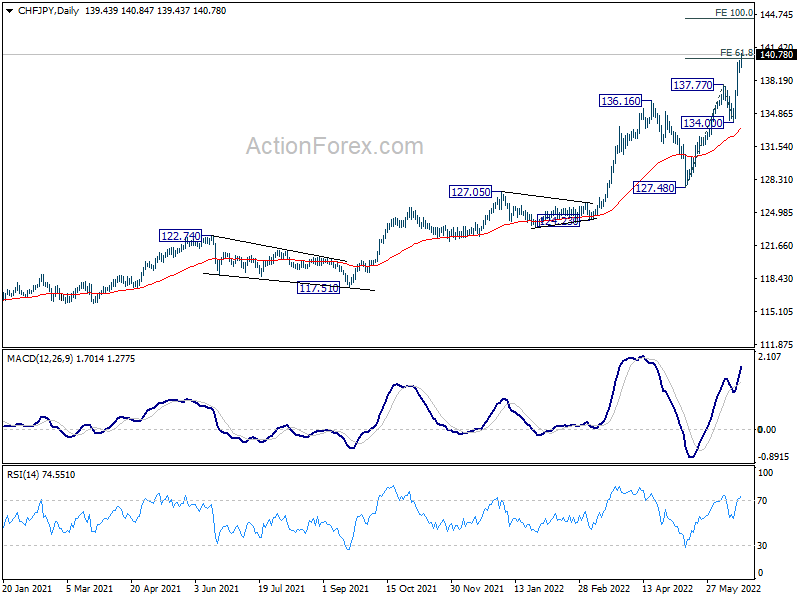
Technically, CHF/JPY's rally continues today and breaks through 61.8% projection of 127.48 to 137.77 from 134.00 at 140.35. Next target is 100% projection of 144.29. USD/JPY's break of 135.58 indicates up trend resumption. Now focus is on 144.23 resistance in EUR/JPY and 168.67 resistance in GBP/JPY. Break of these levels will also confirm resumption of recent up trends.
In Europe, at the time of writing, FTSE is up 0.45%. DAX is up 0.33%. CAC is up 0.86%. Germany 10-year yield is up 0.031 at 1.780. Earlier in Asia, Nikkei rose 1.84%. Hong Kong HSI rose 1.87%. China Shanghai SSE dropped -0.26%. Singapore Strait Times rose 0.68%. Japan 10-year JGB yield rose 0.0032 to 0.236.
Canada retail sales up 0.9% mom in Apr, to rise 1.6% mom in May
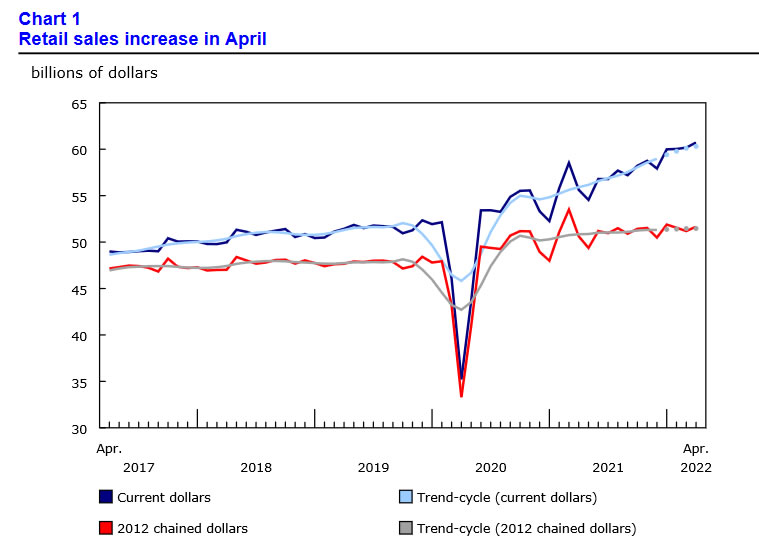
Canada retail sales rose 0.9% mom to CAD 60.7B in April, slightly above expectation of 0.8% mom. Sales were up in 6 of 11 subsectors. Excluding gasoline stations and motor vehicle and parts dealers, sales rose 1.0% mom.
Preliminary data suggests that sales rose 1.6% mom in May.
ECB Rehn: Sharply rising inflation justifies expedite policy normalization
ECB Governing Council member Olli Rehn said, "with inflation rising sharply, there has been good reason to expedite the normalization of monetary policy,"
"The impacts of Russia's brutal war are being felt around the world, and people are having to pay higher prices for energy and food," he said.
BoE Pill sees tightening of monetary policy over the coming months
BoE Chief Economist Huw Pill said today, "we will do what we need to do to get inflation back to target. And at least in my view, that will require further tightening of monetary policy over the coming months."
"When we assess inflation pressure, we need to take into account the exchange rate," he added. "We see ourselves as steering a narrow path between persistent inflation pressure and recession."
"Terms of trade shock means UK will be poorer, UK must decide how that reduction in income will be distributed."
RBA Lowe: Going to be some years before inflation back in target range
RBA Governor Philip Lowe said the larger than expected 50bps hike at last meeting was driven by "additional information suggesting a further upward revision to an already high inflation forecast".
He also emphasized, "as we chart our way back to 2 per cent to 3 per cent inflation, Australians should be prepared for more interest rate increases."
"In the next month or so, we'll be doing a full forecast update, but it's going to be some years, I think, before inflation is back in the 2-3 per cent range, he added.
"I don't see a recession on the horizon," Lowe said. "If the last two years has taught us anything, it's that you can't rule anything out. But our fundamentals are strong, the position of the household sector is strong, and firms are wanting to hire people at record rates. It doesn't feel like a precursor to a recession," he said.
New Zealand Westpac consumer confidence dropped to 78.7 in Q2, record low
New Zealand Westpac consumer confidence dropped sharply from 92.1 to 78.7 in Q2. That's the lowest level on record, and well below long-term average at 110.2.
Westpac said: "The pressure on household finances and sharp fall in confidence reinforces our expectations for a downturn in household spending – and economic growth more generally – over the coming months".
"The RBNZ's own projections show the cash rate rising to 3.9%, while financial markets have started to price in the chance that it could go as high as 4.5%...
"If there is a more abrupt slowdown in spending than the RBNZ anticipates, then it's likely that increases in the cash rate will be more measured."
Japan PM Kishida and opposition Tamaki agree BoJ to keep loose monetary policy
Japan Prime Minister Fumio Kishida asked opposition DDP's Yuichiro Tamaki on monetary policy. Tamaki said the BOJ must keep current ultra-low interest rates, arguing that tightening monetary policy was "unthinkable". Kishida said afterwards, "I agree with you on the point that Japan shouldn't alter monetary policy,"
Kishida also said, "monetary policy affects not just currency rates, but the economy and smaller firms' businesses. Such factors must be taken into account comprehensively."
Separately, Finance Minister Shunichi Suzuki said, "I'm concerned about the rapid yen weakening seen recently." He added that the government will "closely liaise" with BoJ on watching the exchange markets with "even greater sense of urgency".
"We will respond appropriately if necessary while keeping close communication with currency authorities from other countries," Suzuki said.
USD/JPY Mid-Day Outlook
Daily Pivots: (S1) 134.62; (P) 135.03; (R1) 135.52; More...
USD/JPY's up trend resumes by breaking through 135.58 today. Intraday bias is back on the upside for 61.8% projection of 114.40 to 131.34 from 126.35 at 136.81. Firm break there will target 100% projection at 143.29. On the downside, below 134.52 minor support will turn intraday bias neutral first. But outlook will remain bullish as long as 131.48 support holds.
In the bigger picture, current rally is seen as part of the long term up trend from 75.56 (2011 low). Next target is 100% projection of 75.56 (2011 low) to 125.85 (2015 high) from 98.97 at 149.26, which is close to 147.68 (1998 high). This will remain the favored case as long as 126.35 support holds.
Economic Indicators Update
| GMT | Ccy | Events | Actual | Forecast | Previous | Revised |
|---|---|---|---|---|---|---|
| 21:00 | NZD | Westpac Consumer Survey Q2 | 78.7 | 92.1 | ||
| 01:30 | AUD | RBA Meeting Minutes | ||||
| 06:00 | CHF | Trade Balance (CHF) May | 3.12B | 3.78B | 4.13B | 4.03B |
| 08:00 | EUR | Eurozone Current Account Apr | -5.8B | -3.2B | -1.6B | |
| 12:30 | CAD | New Housing Price Index M/M May | 0.50% | 0.40% | 0.30% | |
| 12:30 | CAD | Retail Sales M/M Apr | 0.90% | 0.80% | 0.00% | 0.20% |
| 12:30 | CAD | Retail Sales ex Autos M/M Apr | 1.30% | 0.50% | 2.40% | 2.60% |
| 14:00 | USD | Existing Home Sales May | 5.41M | 5.61M |
Canada retail sales up 0.9% mom in Apr, to rise 1.6% mom in May
Canada retail sales rose 0.9% mom to CAD 60.7B in April, slightly above expectation of 0.8% mom. Sales were up in 6 of 11 subsectors. Excluding gasoline stations and motor vehicle and parts dealers, sales rose 1.0% mom.
Preliminary data suggests that sales rose 1.6% mom in May.
Japanese Yen Punches Past 136
After a quiet start to the week, the US dollar is again rallying against the hapless Japanese yen. USD/JPY is currently trading at 136.18, up 0.78% on the day. The yen is trading at its lowest level since September 1998.
Yen gets no help from BoJ
It shouldn’t come as a surprise that the yen continues to lose ground. The currency has been left to the (dollar) wolves by the Bank of Japan. The BoJ signalled at Friday’s meeting that it would stick to its ultra-accommodative policy, despite pressure to adjust its yield curve control. The central bank has tenaciously capped the 10-year yield on JGBs at 0.25%, intervening to keep rates from moving higher. Governor Kuroda has defended this policy as critical to support the fragile economy and push inflation higher.
The price for the BoJ’s stance is being paid by the yen, which is losing ground as the US/Japan rate differential widens. The central bank purchased a record USD 81 billion in JGBs last week, after the 10-year yield breached above 0.25%. This has pushed the yield to 0.23%, but USD/JPY surged 2.11% on Friday and continues to move higher. With the Federal Reserve in the midst of an aggressive rate-tightening cycle, USD/JPY appears headed towards the lofty 140 level.
Will Japan intervene in order to stabilize the exchange rate? The Bank of Japan and the Ministry of Finance have resorted to verbal intervention, warning that they are concerned about the rapid descent of the yen and our monitoring the situation. The jawboning has not had much effect, as the yen shows no signs of rebounding. There has been speculation that the BoJ has a ‘line in the sand’ at which it will step in and defend the yen, but USD/JPY continues to rise without hindrance. Could a 140 yen be that line in the sand?
USD/JPY Technical
- There is resistance at 1.3657 and 1.3814
- USD/JPY has support at 1.3404 and 1.3247