

Sample Category Title
GBPUSD Rebounds Off 27-Month Low But SMAs Act as Strong Resistance
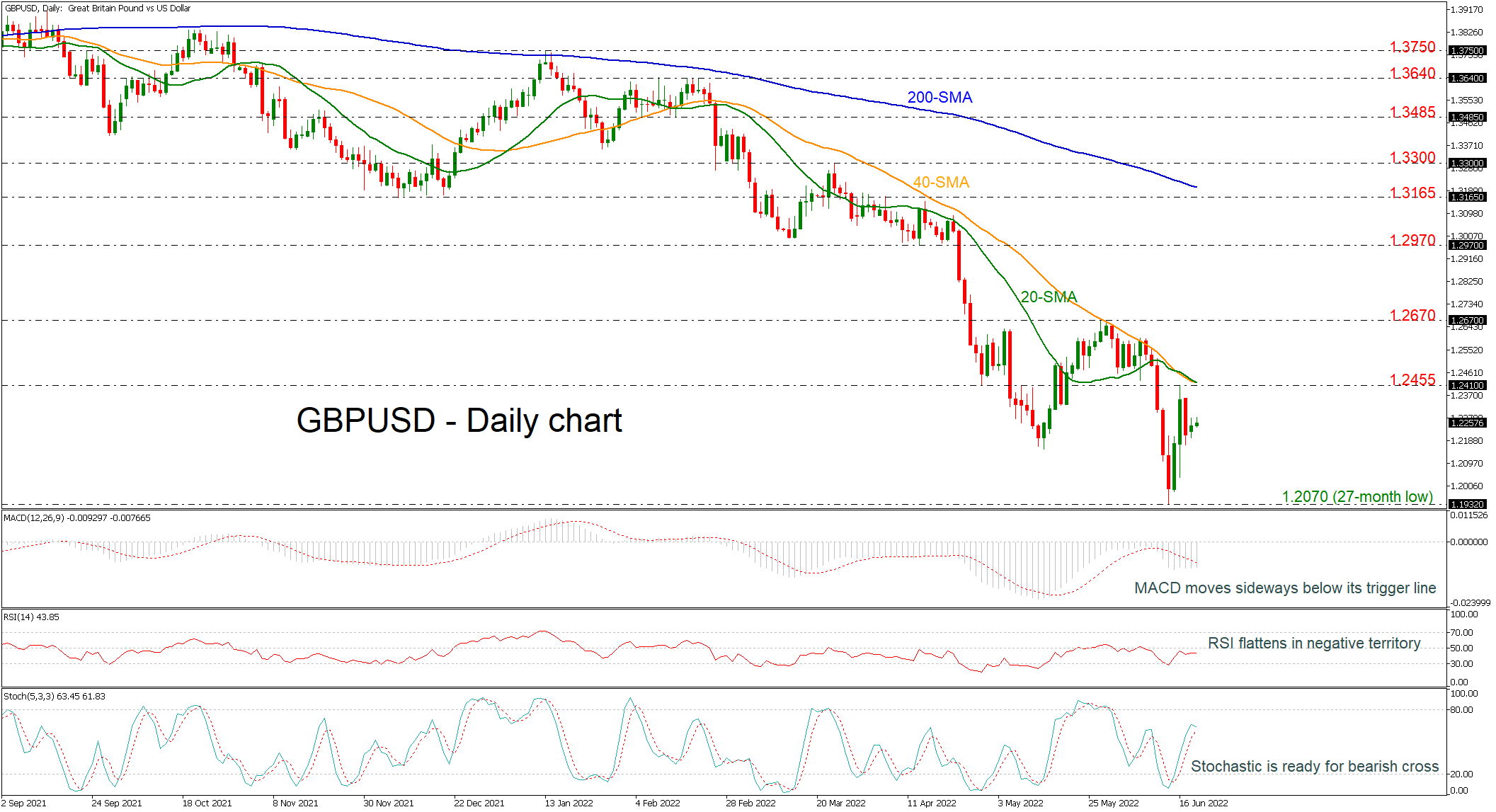
GBPUSD has reversed back up again after finding support at the 27-month low of 1.2070, achieved last week, but the current momentum is still weak.
The technical indicators are pointing to a neutral to negative bias in the short term with the RSI just below 50 and the MACD oscillator remaining in bearish territory. Moreover, the stochastic is attempting a bearish crossover within the %K and %D lines, suggesting a downside movement is nearing.
Further losses should see the latest bottom at 1.2070 acting as major support, while even lower, the 1.1410 key level would reinforce the bearish structure in the long-term timeframe, taken from the trough on March 2020.
In the event of an upside reversal, the short-term simple moving averages (SMAs) around the 1.2455 resistance would act as a barrier before being able to re-challenge the 1.2670 level. A break above this hurdle would shift the short-term outlook to a more bullish one, driving the pair until 1.2970. Further gains would lead the way towards the 1.3165 resistance and the 200-day SMA at 1.3200.
All in all, GBPUSD has been developing within a bearish view since January, posting lower lows and lower highs; however, any advances beyond the 200-day SMA may change the longer timeframe to be positive.
Daily Technical Analysis
EUR/USD
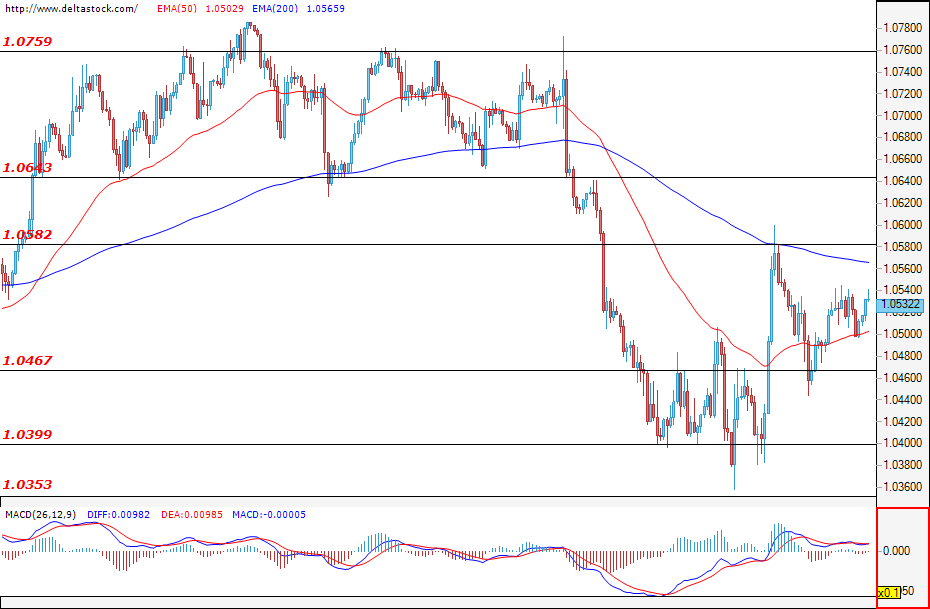
Volatility during yesterday’s trading session remained muted and the single European currency continues to consolidate between the two key levels at 1.0470 and at 1.0580. Neither the bears nor the bulls can boast a breakthrough on any significant level, but if the bulls manage to breach the mentioned range, then the next resistance for them would be the level at 1.0640. An increase in short EUR volumes to an extent, to which the bears could manage to overcome the range, would mean that the next key resistance in front of them would be placed at 1.0400. Important news for today that would help develop the above scenarios is the data on existing home sales in the United States (14:00 GMT).
USD/JPY
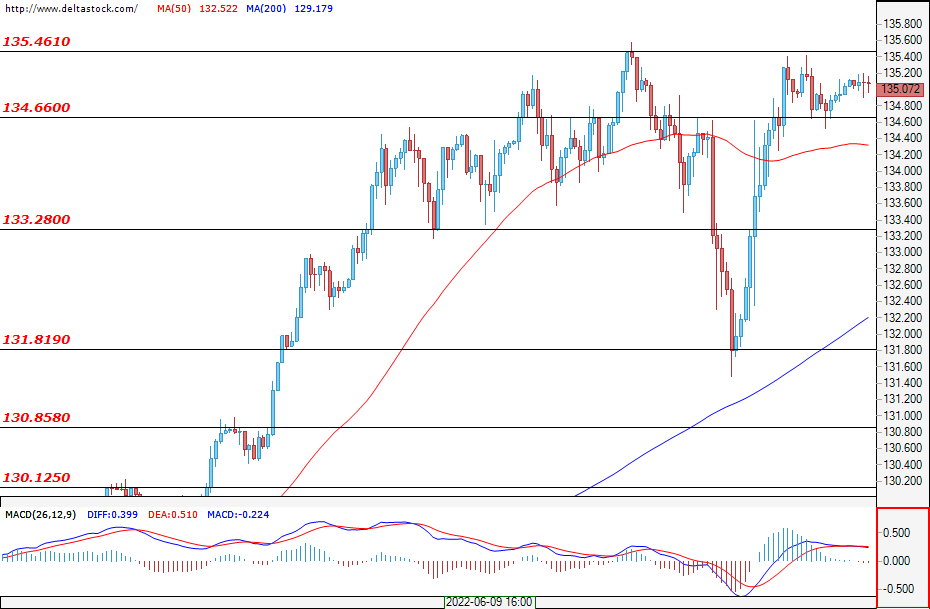
The non-working day in the United States also affected the Ninja as it resulted in lower liquidity, which led to sharp moves in both directions. From the start of today's trading session to the time of writing the analysis, the pair fluctuated only a few pips, however this calm state will most likely not last during today’s session. If we witness increased market activity, then the bears would first have to overcome the support at 134.60. In order to find the next resistance for the bulls, we would have to go back several years until we reach the historic level of 138.50. This week, no major news that could affect the Japanese yen is expected from the land of the rising sun.
GBP/USD
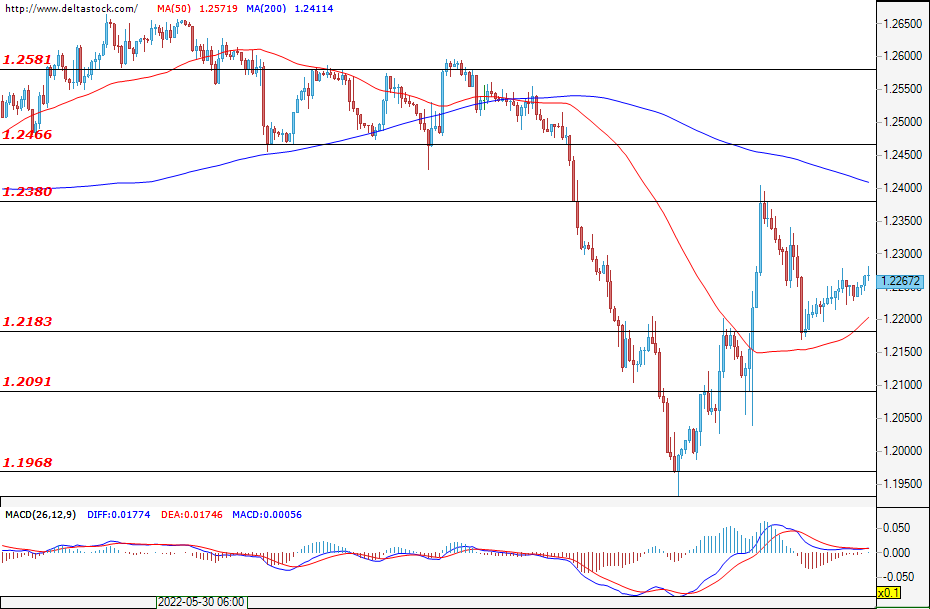
As with the other currencies, the sterling didn’t experience any large movements yesterday and volatility remained muted. Still, the day was more profitable for the bulls as they were able to record a jump of around half a figure at the time of writing the analysis. If they maintain their momentum, then they could face resistance at 1.2380. If, on the other hand, the bears manage to attract the market's attention, a more stubborn obstacle in front of them would be the support at 1.2180.
EUGERMANY40
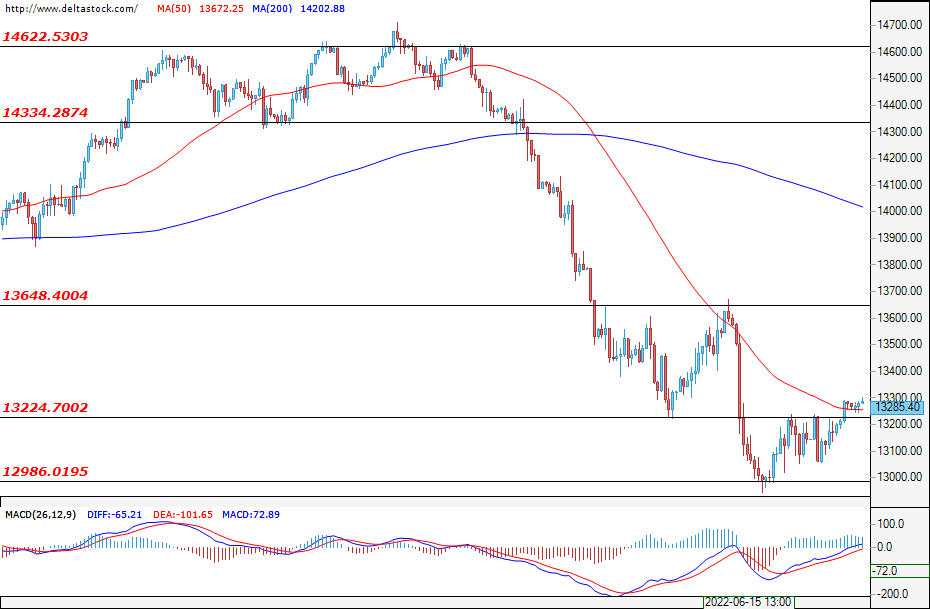
The day for the German index was marked by a breach of the resistance at 13225 on behalf of the bulls. If they continue to dominate the market, then they will have to deal with the resistance at 13650 as well. In the event that the bears are able to recoup their positions, we can witness a breach attempt aimed at the support at 12990. No news is expected from Germany that could strongly influence the index.
US30
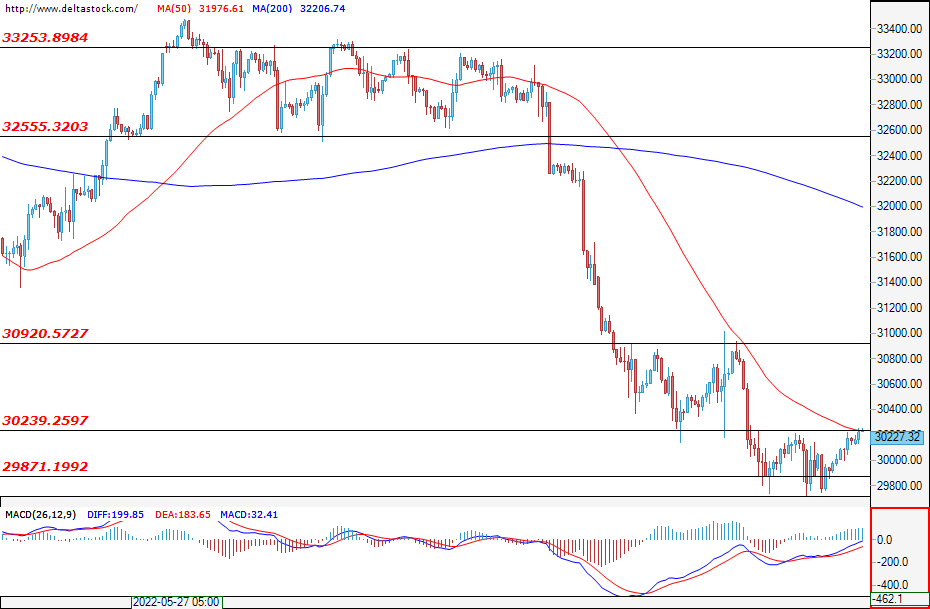
Despite the non-working day in the U.S., the US30 "did not rest", and at the time of writing the analysis, managed to reach and test the resistance at 30240. If the bulls finally breach this level, then they could focus their efforts on the resistance at 30920. If, on the other hand, the bears manage to tip the scales in their favour, then they would have to overcome the support at 29870.
Dow Jones Struggles to Bounce
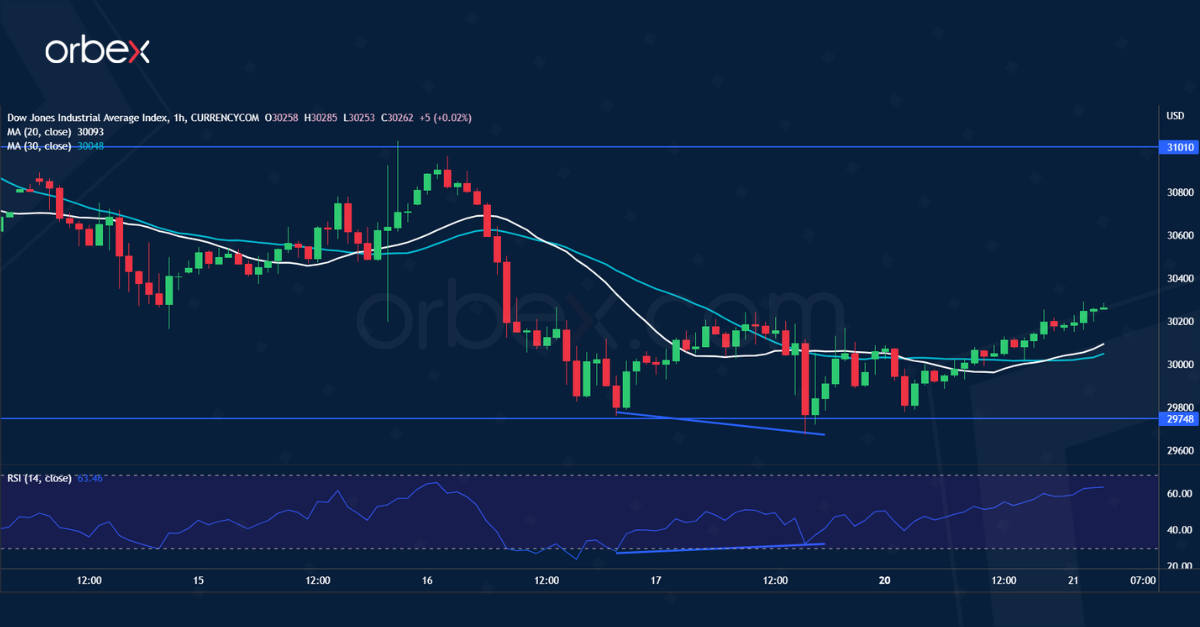
The Dow Jones 30 slips as investors fret that the Fed may go too far in its tightening. Bearish inertia prevails as buyers remain on the sidelines. The few bulls who are still in the market are struggling to hold above February 2021’s lows (29750). A bullish RSI divergence suggests a slowdown in the downward impetus. But buyers have the challenging task of clearing the former support at 31000 before they could draw more attention. Strong selling pressure could be expected as trend followers would look to fade rebounds.
XAU/USD Consolidates Gains
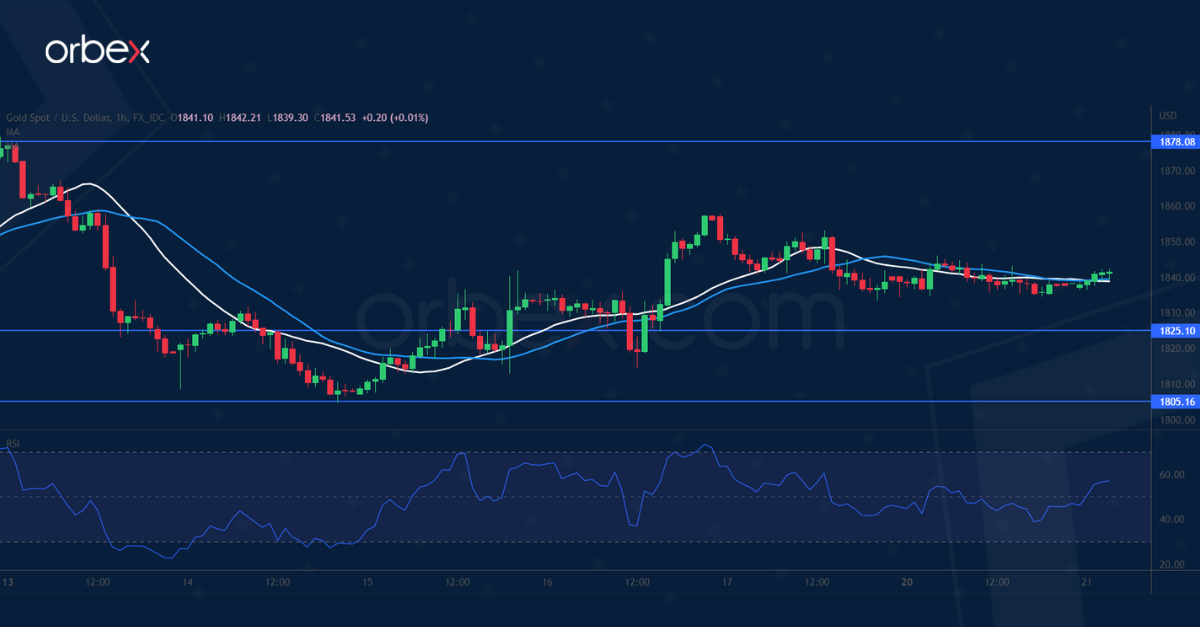
Gold seeks support as the US dollar inches higher across the board. A break above the former demand zone near 1840 has prompted sellers to cover some of their bets. The price action is likely to consolidate in a narrow range between 1805 and 1878 in the next couple of days for lack of decisive catalyst. 1825 is the immediate support and its breach might break the latest momentum, leaving the precious metal vulnerable to a sell-off. A rally above 1878 may turn sentiment around and trigger a strong recovery.
AUD/USD Finds Support
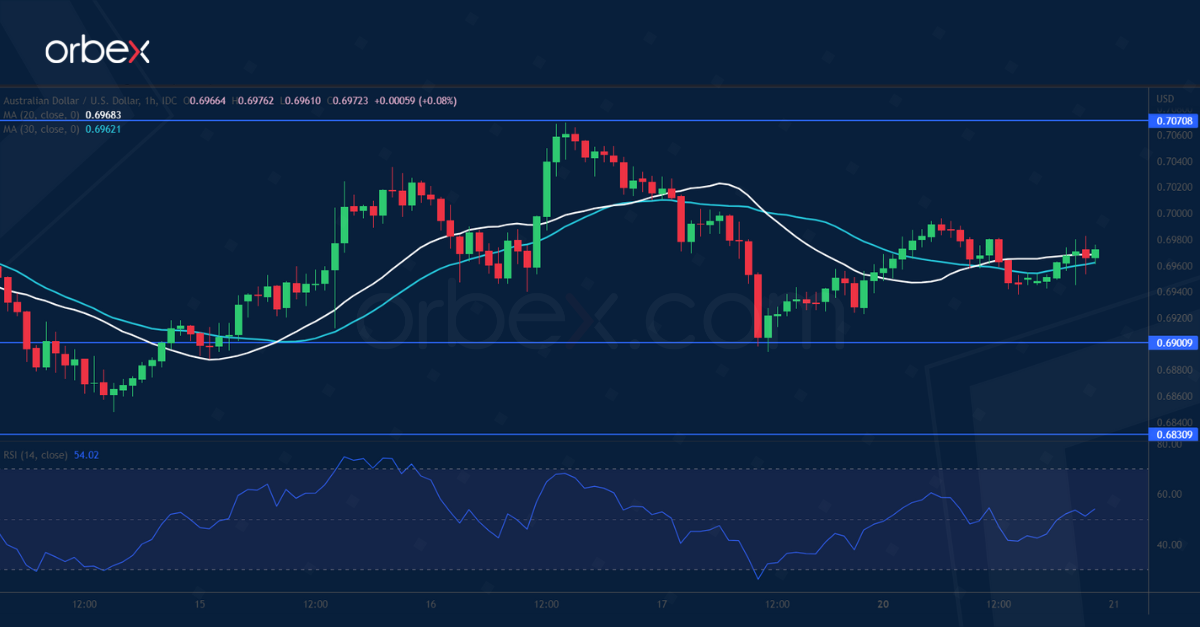
The Australian dollar rallies as the RBA minutes show its commitment to rate hikes. The pair is hovering above May’s lows around 0.6830 as the bulls seek to safeguard the previous rebound. The price saw support at the base of the recent rally over 0.6900. An oversold RSI in this demand zone might have triggered a ‘buy-the-dip’ behaviour. A rally back above 0.7070 would show that the path of least resistance is up and the recent top at 0.7270 could be within reach. A bearish breakout may cause a deeper correction.
US Markets Join the Rest in the Waiting Game
Markets
With US markets closed for Juneteenth, trading was confined to Asia and Europe yesterday. The economic calendar contained no important data but several high-profile speeches, including from president Lagarde as she appeared before the European Parliament. She didn’t spill the beans though and simply sticked to the normalization path laid out at the June meeting. Neither did she dwell on the outcome of the emergency meeting or on the details of the new bond-buying tool. Turning to markets, core/German bonds initially looked as if economic growth would once again take over from the inflation & tightening narrative. Further easing commodity prices (eg. oil) provided similar clues. But that soon changed with German yields eventually adding 5.9 bps (2y) to 9 bps (30y), be it in low-volume trading. European stock markets rose about 1%. The dollar traded a tad softer. The trade-weighted index (DXY) stabilized near Friday’s closing levels but EUR/USD eked out a gain to close just north of 1.05. EUR/GBP tried to reconquer the 0.86 barrier but failed to do so (close at 0.858). Norway’s krone outperformed G10 peers after a losing streak that brought EUR/NOK to the highest level since August last year. The pair eased from 10.5 to 10.42 yesterday. The Norges Bank is meeting on Thursday. Equities in the Asian-Pacific region are better off than yesterday. Gains mount up to 2.5% in Japan. US yields add about 5 bps across the curve after cash markets reopen from a long weekend. Yields in Australia went in reverse after RBA governor Lowe dampened expectations for a 75 bps hike. He added that policy rates of 4% by year-end, as expected by markets, is unlikely. The Aussie dollar trades stable sub AUD/USD 0.70. Moves on other currency markets are muted too. The Japanese yen (USD/JPY 135.02) is unimpressed by an umpteenth verbal intervention by Japanese MinFin Suzuki. US markets join the rest in the waiting game today. The economic calendar only starts to heat up from Wednesday with UK CPI, EMU consumer confidence and Fed chair Powell’s semi-annual testimony before Congress. It may mean a quiet trading day within the bigger picture of some short-term consolidation on core bond markets. As dust settles a bit after a volatile last week, we expect the dollar to continue topping out for the time being. EUR/USD 1.0601 serves as first intermediate resistance. Sterling investors will probably stick to the sidelines, awaiting key data (CPI, PMI and retail sales) that may affect Bank of England tightening expectations.
News Headlines
Israelian PM Bennett yesterday announced that he and foreign minister Lapid had decided to dissolve parliament, making way for the fifth election in four years and setting the stage for a potentially sooner than hoped for return of current opposition leader Netanyahu. Lapid will become caretaker PM in the run-up to a ballot which should take place before the end of October. Bennet’s fragile coalition, which centered more around the will to oust than sitting PM Netanyahu rather than around political ideas, already lost its majority earlier this year following the resignation of two MP’s.
That Mysterious Instrument
The week started on a calm note, with small gains in European indices and US futures.
The selloff in cryptocurrencies slowed as Bitcoin could throw itself above the psychological $20K level, and is catching its breath right now. The risk of a further selloff cannot be ruled out as the tighter Federal Reserve (Fed) expectations, the global selloff in risk assets and the fact that the massive outflows in cryptocurrencies started showing some cracks in the freshly born crypto industry make the cryptocurrencies increasingly less appetizing. Therefore, we could see a limited recovery in cryptocurrencies in the near future. what we must see is the cryptocurrency companies survive to the chaotic market conditions.
Gold and oil
Crude oil consolidated above the $110 per barrel as the bullish trades were held back by increased risk of global recession.
Gold remained offered as the improved risk appetite, and the prospects of higher US yields weighed on appetite.
The mysterious tool
The currency markets were calm as well, with the US dollar giving back some field against most majors. The EURUSD consolidated above the 1.05 level. The European Central Bank (ECB) Chief Christine Lagarde warned that there is a ‘severe’ risk of disorderly financial correction in Europe, especially in financial and housing markets as a result of a tighter ECB policy that is about to hit the fan.
The spread between the Italian and German 10-year yields narrowed since the ECB announced that they will invent another financial instrument to deal with the diverging pace of rising yields between the core and the periphery. At her speech yesterday, Lagarde defended once again this new instrument, yet the euro bulls will likely remain in retreat until we have more details on this mysterious new anti-fragmentation tool. The 50-DMA, which stands near 1.0620 will likely act as resistance in the short run.
In France, Macron lost majority in the National Assembly in the latest legislative elections of the weekend. It’s something rare in France, and it will force the French to find compromise to make new laws, which is a situation they are not used to, and they don’t like. The problem is, there is now such a huge opinion divergence in the Parliament that no one sees how this will play out in the next five years of Macron’s rule. The far left and far right gained a lot of seats, with Le Pen’s party increasing its seats by 10 folds compared to 2017. So it won’t be easy, and even less given the chaotic situation on the continent with the pandemic and the war.
Elsewhere, Cable was bid above 1.22 as Brits are holding their breath before tomorrow’s inflation data, and the Aussie-dollar approached the 70 cents mark, as the minutes from the latest Reserve Bank of Australia (RBA) meeting reiterated that the Australian policymakers are ready to whatever is necessary to tame inflation, and that more rate hikes would follow the latest rate hike from the RBA.
Calm before the testimony
We have certainly a couple of more hours of calm in the markets. But the things will start getting serious with Jerome Powell’s semi-annual testimony due Wednesday and Thursday, where he will reiterate how strong the Fed is committed to fight the soaring inflation in the US. Recovery in US equities should remain limited into Powell’s testimony. But, from a pricing perspective, we may not see an aggressive pricing this week, as the fed funds futures already price an almost 100% chance for a 75bp hike in FOMC’s July meeting.
A Quiet Day In Asia
With the US on holiday yesterday, activity was muted overnight. Currency, precious metal, and crypto markets traded sideways, while equities used a slow news night to stage a modest recovery, led by European equities. The modest equity market recovery continues in Asia, thanks to US index futures grinding higher since the early morning opening yesterday in Asia.
Energy markets have continued unwinding the Friday capitulation at a steady pace this week. Reduced Russian natural gas flows are supporting European prices, with a number of countries looking to reactivate coal-fired power plants to make up potential energy shortfalls. Chinese energy demand is hitting record highs in the North of the country thanks to a heat wave. Reuters is reporting that Iran is preparing to step up uranium enrichment, and US Treasury Secretary Yellen is circulating a plan to put a price cap on Russian oil to deprive them of revenues.
Taken in totality, the physical market is as tight as ever, and thus, the speculative capitulation in futures markets probably shouldn’t be taken as a picture of the reality on the ground in the real world. Iran’s measures, if correct, likely mean we won’t be seeing a return of Iranian crude to greater world markets anytime soon either. The bottom line seems to be that until we see physical demand destruction, oil and other energy markets are, as tight as ever.
In Asia today, South Korean 20-day exports for June fell unexpectedly by 3.40% YoY. Most of that though will be down to the trucker's strike this month, and a recovery should occur in July. The Bank of Korea put out a statement saying that “CPI would likely remain over 5.0% for the time being.” The BoK seems to be priming markets for a 50bps hike in July and a couple more hikes shortly thereafter. Some concern around the currency is clearly evident as they warned they would take action over “herd-like” behaviour. Translating as “if you all keep buying USD/KRW, we’ll intervene.” They won’t be the only Asian central bank with that problem this year.
The Reserve Bank of Australia Minutes were released this morning. The minutes signalled potentially another 50bps hike next month followed by a series of 25bps hikes for the rest of the year. They also mentioned that the RBA had lost some credibility in how it exited its yield control policy. They shouldn’t feel too bad about this. There are plenty of other central banks with eggs on their face, and their trans-Tasman neighbours, the Reserve Bank of New Zealand, have put on a veritable Muppet Show with monetary policy and will make the RBA look good, no matter what.
That is about it for data releases today in both Asia and Europe, leaving markets to continue quietly reversing Friday’s price moves until the US walks in the door, or we get a headline bomb. The Fed’s Barkin speaks this evening, but most eyes will be on US Existing Home Sales for May. There is downside risk to the 5.40 million forecasts with stresses in the US housing market evident for some time now as mortgage rates rose precipitously. I’m not sure what the reaction will be to a bad number. Theoretically, the gnomes of Wall Street will price in less Fed tightening and send US yields lower and equities higher and buy risk sentiment currencies. But I can’t see how a slowing US housing market is a positive environment for equities going forward either. I think I’ll sit this one out and watch from the sidelines.
Asian equities move higher.
US futures moved higher in Asia yesterday and continued gaining through European time as a lack of really negative headlines allowed the buy-the-dippers to dip their toes in the market. That also helped European equities sage a decent recovery as well, with markets ignoring the shock result in the French parliamentary elections. S&P, Nasdaq and Dow futures rose around 1.0% overnight, and all three have added another 0.55% this morning.
With US index futures maintaining their gains into today’s session, some confidence has returned to Asian markets, which are mostly higher today. The speculative FOMO herd has sent the Nikkei 225 1.90% higher, with South Korea’s Kospi adding 0.45%. In Mainland China, both the Shanghai Composite and CSI lost ground early doors, after suspiciously artificial gains yesterday. Those losses have once again reversed, with the Shanghai Composite now 0.05% higher, and the CSI 300 edging 0.15% higher. Hong Kong’s Hang Seng has jumped by 1.30%, helped perhaps by signals from Evergrande of a timetable for debt repayments and relisting of its shares.
In other markets, Singapore has climbed by 0.75%, with Taipei jumping 1.85% higher, Kuala Lumpur and Jakarta have gained 0.45%, Bangkok 0.25%, but Manila has fallen by 0.45%. Australian markets have wasted no time in reversing yesterday’s losses, thanks to firm US futures. The ASX 200 and All Ordinaries are 1.45% higher today.
Assuming the news ticker stays quiet, and with little data out this afternoon, European markets should continue recouping some recent losses, and as long as the US housing data holds steady, I can see Wall Street maintaining its recent gains as well.
Currency markets trade sideways over the US holiday.
Not a lot has changed in currency markets overnight despite some decent intraday ranges. The US holiday and a slow news reel ensured that currency traders took the option of easing into the week, awaiting the US return this evening. The dollar index edged 0.16% to 104.48 overnight, easing another 0.14% to 104.34 in Asia. thanks mostly to a weak yen. The dollar index has support at 1.0350 with resistance now distant at 1.0570.
EUR/USD rose just 0.17% to 1.0511 overnight, adding another 10 pips to 1.0525 in Asia. It has initial resistance at 1.0600, with challenging resistance at 1.0650. Support is at 1.0450 and 1.0400 now although I note that EUR/USD has based twice at 1.0350. That leaves the door open slightly to a corrective recovery this week. Sterling rose just 0.27% to 1.2248 overnight, edging 0.20% higher to 1.2270 in Asia. GBP/USD has initial resistance at 1.2360 and 1.2400, with support at 1.2200 and then 1.1950.
USD/JPY is holding steady at 135.00 today, almost unchanged for the past 24 hours. It is likely awaiting the reopening of the OTC US bond market this evening. It once again failed ahead of 135.45 overnight and the 135.45/60 region is shaping up as decent resistance now. Unless US yields move higher again this week, the odds of a USD/JPY correction lower are rising. USD/JPY has support at 134.50 and then 132.20.
AUD/USD and NZD/USD have booked modest gains to 0.6975 and 0.6345 over the last 24 hours, with trading volumes muted, but a tentative rise in sentiment proving supportive to both. A US holiday is dampened volumes but both Australasians have traced out bottoming patterns on the charts. As long as 0.6850 and 0.6200 hold respectively, further gains to 0.7150 and 0.6450 cannot be ruled out.
Asian currencies are barely changed overnight as regional markets await the return of the US later today. Noises from officials in Seoul and Tokyo about currency speculation are probably limiting US Dollar gains for now. Two notable exceptions are the Indonesian Rupiah and Philippine Peso, with weakened sharply by around 0.65% to $14,825.00 and $54.10 overnight. It is no coincidence that both have monetary policy meetings this week and both are reluctant rate hikers, as they prioritise the pandemic recovery. More selling pressure this week could force their hand on Thursday, but if both hold policy unchanged, could see more waves of selling into the end of the week.
Oil prices start reversing the Friday slump.
As I outlined above, oil futures have started reversing the Friday price slump as speculative capitulation collides with the reality of tight energy markets in the real world. Brent crude held $112.00 overnight, finishing 0.92% higher at $114.05 a barrel. It has added another 0.85% to $115.15 a barrel in Asian trading today. WTI held $108.50 overnight, finishing 0.20% higher at $110.05 a barrel. It has jumped 1.20% higher to $111.50 a barrel in Asian trading.
Friday’s falls have bought my six-month support lines back into focus. On Brent crude, that is at $107.00 a barrel today, just below its 100-day moving average (DMA) at $107.95. Ahead of this, it has support at $112.00, with resistance at $116.00 a barrel. WTIs six-month support line is at $106.25 a barrel, just ahead of its 100-DMA at 105.25. It has interim support at $108.50, and resistance at $112.50 a barrel.
Of the two, WTI looks the more vulnerable, having fallen further and closed closer to its multi-month support zone. If the US cuts federal fuel taxes this week, or US housing data is very soft, that could be enough to tip the scales lower. It is hard to see either contract moving lower than $100.00 a barrel given the state of the physical market. From a technical perspective, I would like to see one of either contract tracing out a couple of daily closes below the longer-term support lines and the 100-DMAs, before reassessing my longer-term bullish outlook.
Gold range continues.
It was another wax-on, wax-off day for gold overnight thanks to US markets being closed. It edged 0.11% lower to $1839.00 an ounce. In Asia, it has gained slightly by 0.12% to $1840.60 an ounce as comatose trading conditions continue.
Despite the noise of the past week, it remains anchored in the middle of its one-month range. The overnight price action shows that the inverse correlation to the US Dollar is as strong as ever
Gold has resistance at $1860.00 and $1880.00, the latter appearing an insurmountable obstacle for now. Support is at $1805.00 and then $1780.00 an ounce. Failure of the latter sets in motion a much deeper correction, while I would need to see a couple of daily closes above $1900.00 to get excited about the upside.
NZD Dips after Poor Consumer Confidence, Markets Staying in Consolidations
The markets are rather mixed in Asian session today, engaging in mostly consolidative moves. New Zealand Dollar trades broadly lower following record low consumer confidence data. But Canadian and Australian Dollars are firmer on steady risk sentiment. Dollar is also weak together with Yen while European majors are mixed.
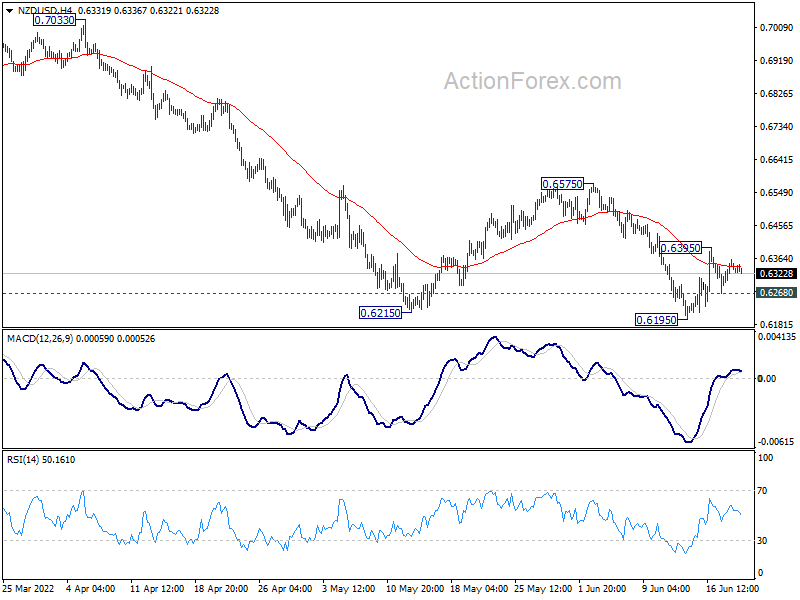
Technically, NZD/USD dips slightly after failing to stand above 4 hour 55 EMA again today. Overall development suggests that recovery from 0.6195 is merely a corrective move and outlook stays bearish. Break of 0.6286 minor support will likely resume larger down trend through 0.6195 low. Though, bring of 0.6395 will bring stronger rise back to 0.6575 structural resistance.
In Asia, at the time of writing, Nikkei is up 2.37%. Hong Kong HSI is up 1.59%. China Shanghai SSE is down -0.12%. Singapore Strait Times is up 0.88%. 10-year JGB yield is down -0.0003 at 0.233.
ECB Lane: Initial policy normalization steps clear and robust
ECB Chief Economist Philip Lane said yesterday, "we have very high inflation rates now, and clearly we could be in a world where inflation psychology is taking hold."
In a presentation, he said that Eurozone is facing three inflation shocks: pandemic cycle, energy shock and Russia-Ukraine war. Risks to inflation outlook include catch-up adjustment in wages, re-set of long term inflation expectations, inflation psychology, downward revision in potential output, and rise in real interest rate.
He added that monetary policy normalization is "appropriate" with "clear and robust" initial steps. That is, ECB will be stopping asset purchases, raise interest rate by 25bps in July, and again in September. Though, the size of the September hike is undecided. As for further steps, they will be state-contingent (gradualism, optionality, flexibility, data-dependency).
RBA Lowe: Going to be some years before inflation back in target range
RBA Governor Philip Lowe said the larger than expected 50bps hike at last meeting was driven by "additional information suggesting a further upward revision to an already high inflation forecast".
He also emphasized, "as we chart our way back to 2 per cent to 3 per cent inflation, Australians should be prepared for more interest rate increases."
"In the next month or so, we'll be doing a full forecast update, but it's going to be some years, I think, before inflation is back in the 2-3 per cent range, he added.
"I don't see a recession on the horizon," Lowe said. "If the last two years has taught us anything, it's that you can't rule anything out. But our fundamentals are strong, the position of the household sector is strong, and firms are wanting to hire people at record rates. It doesn't feel like a precursor to a recession," he said.
New Zealand Westpac consumer confidence dropped to 78.7 in Q2, record low
New Zealand Westpac consumer confidence dropped sharply from 92.1 to 78.7 in Q2. That's the lowest level on record, and well below long-term average at 110.2.
Westpac said: "The pressure on household finances and sharp fall in confidence reinforces our expectations for a downturn in household spending – and economic growth more generally – over the coming months".
"The RBNZ's own projections show the cash rate rising to 3.9%, while financial markets have started to price in the chance that it could go as high as 4.5%...
"If there is a more abrupt slowdown in spending than the RBNZ anticipates, then it's likely that increases in the cash rate will be more measured."
Japan PM Kishida and opposition Tamaki agree BoJ to keep loose monetary policy
Japan Prime Minister Fumio Kishida asked opposition DDP's Yuichiro Tamaki on monetary policy. Tamaki said the BOJ must keep current ultra-low interest rates, arguing that tightening monetary policy was "unthinkable". Kishida said afterwards, "I agree with you on the point that Japan shouldn't alter monetary policy,"
Kishida also said, "monetary policy affects not just currency rates, but the economy and smaller firms' businesses. Such factors must be taken into account comprehensively."
Separately, Finance Minister Shunichi Suzuki said, "I'm concerned about the rapid yen weakening seen recently." He added that the government will "closely liaise" with BoJ on watching the exchange markets with "even greater sense of urgency".
"We will respond appropriately if necessary while keeping close communication with currency authorities from other countries," Suzuki said.
Looking ahead
Swiss trade balance and Eurozone current account will be release in European session. Later in the day, Canada retail sales will take center stage. US will release existing home sales.
USD/JPY Daily Outlook
Daily Pivots: (S1) 134.62; (P) 135.03; (R1) 135.52; More...
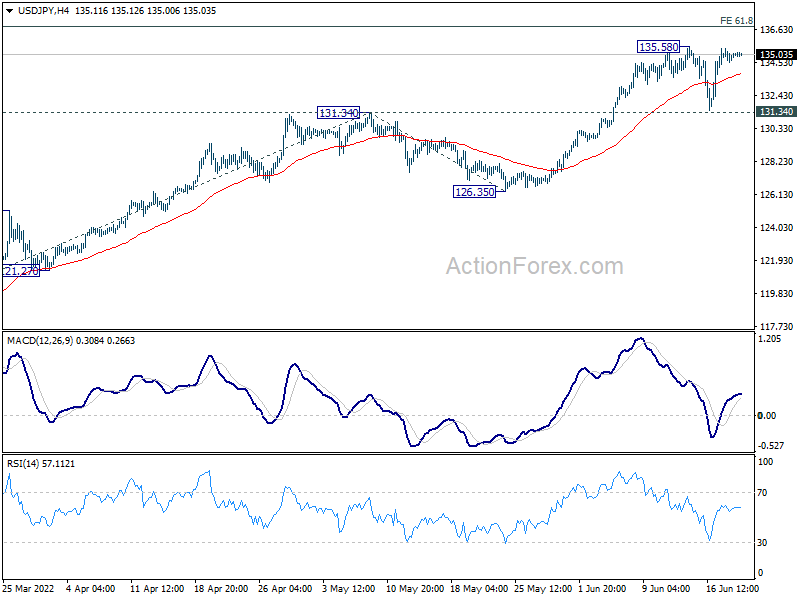
USD/JPY is still bounded in range below 135.58 and intraday bias remains neutral first. More consolidations could be seen but further rally is expected as long as 131.34 support holds. On the upside, break of 135.58 will resume larger up trend to 61.8% projection of 114.40 to 131.34 from 126.35 at 136.81. Firm break there will target 100% projection at 143.29.
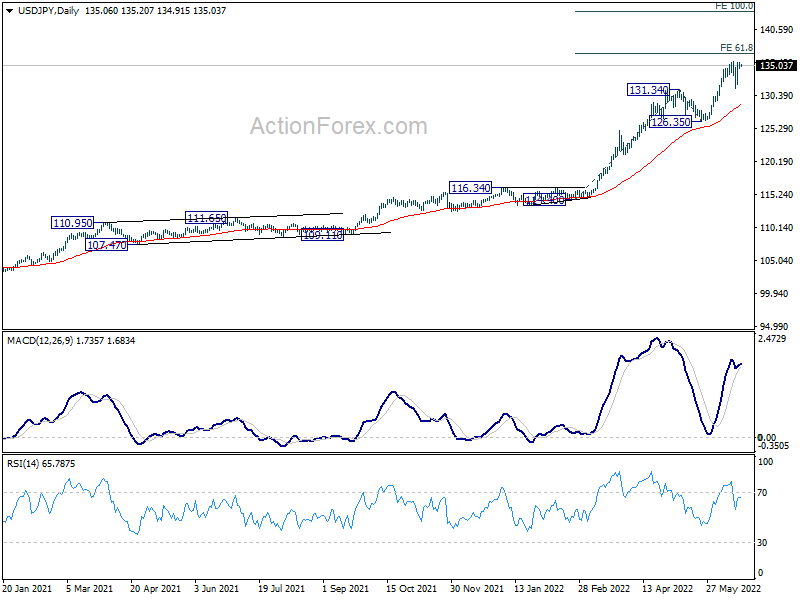
In the bigger picture, current rally is seen as part of the long term up trend from 75.56 (2011 low). Next target is 100% projection of 75.56 (2011 low) to 125.85 (2015 high) from 98.97 at 149.26, which is close to 147.68 (1998 high). This will remain the favored case as long as 126.35 support holds.
Economic Indicators Update
| GMT | Ccy | Events | Actual | Forecast | Previous | Revised |
|---|---|---|---|---|---|---|
| 21:00 | NZD | Westpac Consumer Survey Q2 | 78.7 | 92.1 | ||
| 01:30 | AUD | RBA Meeting Minutes | ||||
| 06:00 | CHF | Trade Balance (CHF) May | 3.78B | 4.13B | ||
| 08:00 | EUR | Eurozone Current Account Apr | -3.2B | -1.6B | ||
| 12:30 | CAD | New Housing Price Index M/M May | 0.40% | 0.30% | ||
| 12:30 | CAD | Retail Sales M/M Apr | 0.80% | 0.00% | ||
| 12:30 | CAD | Retail Sales ex Autos M/M Apr | 0.50% | 2.40% | ||
| 14:00 | USD | Existing Home Sales May | 5.41M | 5.61M |
Japan PM Kishida and opposition Tamaki agree BoJ to keep loose monetary policy
Japan Prime Minister Fumio Kishida asked opposition DDP's Yuichiro Tamaki on monetary policy. Tamaki said the BOJ must keep current ultra-low interest rates, arguing that tightening monetary policy was "unthinkable". Kishida said afterwards, "I agree with you on the point that Japan shouldn't alter monetary policy."
Kishida also said, "monetary policy affects not just currency rates, but the economy and smaller firms' businesses. Such factors must be taken into account comprehensively."
Separately, Finance Minister Shunichi Suzuki said, "I'm concerned about the rapid yen weakening seen recently." He added that the government will "closely liaise" with BoJ on watching the exchange markets with "even greater sense of urgency". "We will respond appropriately if necessary while keeping close communication with currency authorities from other countries," Suzuki said.