

Sample Category Title
RBA Lowe: Going to be some years before inflation back in target range
RBA Governor Philip Lowe said the larger than expected 50bps hike at last meeting was driven by "additional information suggesting a further upward revision to an already high inflation forecast".
He also emphasized, "as we chart our way back to 2 per cent to 3 per cent inflation, Australians should be prepared for more interest rate increases."
"In the next month or so, we'll be doing a full forecast update, but it's going to be some years, I think, before inflation is back in the 2-3 per cent range, he added.
"I don't see a recession on the horizon," Lowe said. "If the last two years has taught us anything, it's that you can't rule anything out. But our fundamentals are strong, the position of the household sector is strong, and firms are wanting to hire people at record rates. It doesn't feel like a precursor to a recession," he said.
(RBA) Minutes of the Monetary Policy Meeting of the Reserve Bank Board
Sydney – 7 June 2022
Members present
Philip Lowe (Governor and Chair), Michele Bullock (Deputy Governor), Mark Barnaba AM, Wendy Craik AM, Ian Harper AO, Carolyn Hewson AO, Steven Kennedy PSM, Carol Schwartz AO, Alison Watkins AM
Others present
Luci Ellis (Assistant Governor, Economic), Christopher Kent (Assistant Governor, Financial Markets)
Anthony Dickman (Secretary), Penelope Smith (Deputy Secretary)
Alexandra Heath (Head, International Department), Bradley Jones (Head, Economic Analysis Department), Marion Kohler (Head, Domestic Markets Department)
International economic developments
Members commenced their discussion of international developments by noting that inflation had increased further in April and May, and the outlook for global growth had become more uncertain. Many central banks and professional forecasters expected headline inflation to be approaching a peak, but to remain well above central banks' targets until at least 2023. Measures of underlying inflation remained high in most advanced economies and had not yet shown signs of easing. Persistent supply chain disruptions, tightening labour market conditions and the ongoing recovery in private demand were contributing to strong underlying inflationary pressures. Members noted that the sources of inflation were broadening. Services inflation, which is typically more persistent than goods inflation, had picked up noticeably in advanced economies over the preceding year to be well above pre-pandemic levels.
Wages growth remained strong or had increased in a number of advanced economies as labour markets tightened further, but remained lower than inflation. The resulting decline in purchasing power had been substantial for many households, particularly in the United Kingdom and the euro area. This had contributed to sharp declines in consumer sentiment. Household consumption in advanced economies had nevertheless been resilient in the March quarter, notwithstanding the Omicron outbreak, supported by declining rates of household saving. While many advanced economies still had high household saving rates, those in the United States and the United Kingdom had fallen to pre-pandemic levels or below. Members agreed that a key uncertainty for the global economic outlook was how household consumption would respond to lower real wages and rising interest rates.
In China, economic activity had slowed sharply in April, with COVID-19 containment measures weighing heavily on consumer spending and manufacturing production in some parts of the country. Chinese authorities had extended further support to the economy, including by providing significant tax concessions to COVID-19-affected firms, and some analysts expected additional stimulus measures in the near term. Public investment had become an increasingly important source of growth since late 2021. Timely data suggested the disruptions from lockdowns in parts of China had not yet affected supply chains in Asia to a significant degree. Nevertheless, export volumes from Shanghai had been affected and members noted that the prospect of rolling lockdowns in China could disrupt global supply chains further and add to goods price inflation.
Global commodity prices had remained high and volatile. Limited spare capacity in global oil refining at a time of strengthening demand had boosted refinery margins, in turn feeding into higher retail fuel prices. Global gas prices had eased from peaks earlier in the year while thermal coal prices had increased further, reflecting a boycott of Russian coal by some countries and the substitution of gas with coal by electricity producers in Asia. Agricultural commodity prices had also increased, particularly wheat as disruptions to the supply from Ukraine had been compounded by India's decision to restrict wheat exports. These commodity price movements had resulted in Australia's terms of trade reaching a record high in the March quarter, with the terms of trade forecast to rise further in the June quarter.
Domestic economic developments
Members agreed that the Australian economy had significant underlying momentum and inflationary pressures were pronounced. Domestic demand had been resilient to disruptions from Omicron outbreaks and the floods on the east coast in the March quarter. A pick-up in GDP growth was anticipated for the June quarter. Labour market conditions were the tightest they had been in many years and wage pressures were emerging. Timely measures of wages indicated that labour cost pressures were likely to broaden and pick up further in the period ahead. Members observed that capacity constraints were binding in some parts of the economy. Information from the Bank's liaison program indicated that firms were more willing and able to pass higher global and domestic input prices through to final consumer prices.
Although GDP growth had slowed in the March quarter, household consumption had been resilient and timely indicators pointed to solid growth in the June quarter. The recovery in spending on discretionary services, including for travel, was well under way and further increases were anticipated. Household consumption was expected to be supported in the period ahead by solid growth in disposable income, a decline in the saving rate towards more normal levels and the large increase in liquid savings and wealth that had been accumulated during the pandemic. Nevertheless, there were several sources of uncertainty surrounding the outlook for consumption, including the response of households to rising prices, rising interest rates and declining housing prices in some cities.
Members noted that an upswing in private and public investment was under way. However, shortages of materials and labour were an ongoing challenge for residential construction and infrastructure projects. Dwelling investment had declined in the March quarter as the Omicron outbreak and weather-related disruptions had exacerbated ongoing supply constraints, although there remained a large pipeline of residential construction work. Business investment had increased in the March quarter, led by strength in spending on machinery and equipment. Firms' surveyed investment intentions from the Capital Expenditure Survey pointed to further growth in the year ahead. Supply constraints and cost overruns were slowing the rollout of public investment plans, including a number of major infrastructure projects. Some projects that had not been started were being deferred, while others were at risk of being cancelled.
The decline in national housing prices over recent months had been concentrated in Sydney and Melbourne, following strong nationwide gains over the prior year. In some other capital cities and regional areas, growth in housing prices had also moderated recently. Overall, housing prices remained more than 25 per cent higher than prior to the pandemic, supporting household wealth and spending. Conditions in rental markets had continued to tighten in Sydney and Melbourne and remained tight in most other cities, as indicated by very low vacancy rates. Advertised rents had continued to increase strongly in most housing markets. This was expected to flow through to the Consumer Price Index measure of rents, following several years of subdued growth.
Turning to the labour market, members noted that labour market conditions were the tightest in decades. At 3.9 per cent in April, the unemployment rate was at its lowest level in nearly 50 years, when the participation rate was also much lower than it is currently. Other measures of spare capacity in the labour market had also declined to levels not seen for many years. Leading indicators of labour demand pointed to a further tightening in labour market conditions in the near term, and many firms in the Bank's liaison program had indicated that they intended to increase headcount over coming months.
Members agreed that tight labour market conditions and higher inflation were likely to support a further lift in growth in labour costs in the period ahead. Early in the year, wages growth had remained around its pre-pandemic pace. This had been confirmed by the Wage Price Index (WPI), which had increased by 0.7 per cent in the March quarter to be 2.4 per cent higher in year-ended terms. For those jobs with wage changes, the average size of wage rises had increased to its highest level since 2014, while the share of jobs that received a wage rise of 4 per cent or more had also increased. Since the mid-February reference period for the WPI survey, more timely evidence from liaison and surveys continued to suggest a further pick-up in growth in labour costs. Around 40 per cent of firms reporting wages information in the Bank's liaison program indicated that wages growth was exceeding 3 per cent, and about 60 per cent of firms expected wages growth over the year ahead to be higher than current growth rates; this reflected firms responding to higher job turnover, a tighter labour market and higher inflation. It was also probable that adjustments to public sector wages policies and the upcoming Fair Work Commission ruling on new minimum and award rates would result in faster wages growth for affected workers in the period ahead.
Members agreed that inflation in Australia had increased significantly owing to both global and domestic factors; it had also become more broadly based. Domestically, capacity constraints in some sectors and the tightening in labour market conditions had contributed to this. Higher prices for electricity and gas and recent increases in petrol prices meant that inflation was likely to peak at a higher level than expected a month earlier. More broadly, information from the Bank's liaison program indicated that upstream price pressures were being passed on by firms, as global and domestic supply chain pressures had persisted and demand had remained strong. Indeed, the domestic demand deflator, which is the broadest measure of domestic prices in the national accounts, had increased at its fastest rate in more than two decades in the March quarter. Measures of long-term inflation expectations remained in the 2 to 3 per cent target band, although members noted there was a risk that a sustained period of higher inflation could result in a shift up in expectations of inflation. A particular source of uncertainty related to future wage outcomes during a period of high inflation and tight labour market conditions.
International financial markets
Members observed that global financial conditions had tightened since the start of the year, when they had been highly accommodative. This tightening was partly a result of central banks withdrawing some of the substantial monetary policy stimulus that had been implemented in response to the pandemic and partly because markets had revised upwards the expected path of policy rates in response to persistently high inflation. Government bond yields had risen substantially over the year, particularly at shorter tenors.
Central banks in several advanced economies had increased their policy rates further over the prior month, as expected. Generally, these central banks had indicated that they would need to return policy rates towards a neutral setting quickly; some had noted that policy rates might need to move into restrictive territory to ensure inflation returned to levels consistent with their targets. Members observed that policy rate expectations in many advanced economies had been little changed overall since the May meeting. Central banks in most emerging market economies, including in Asia, had also increased policy rates in preceding months in response to rising inflation. An important exception was China, where authorities had eased monetary policy a little further given the effects of COVID-19 restrictions on economic activity and continued weakness in the property sector.
Concerns about the global growth outlook relating to declining real household incomes, the withdrawal of stimulatory monetary policies and COVID-19 restrictions in China had contributed to a further increase in corporate bond spreads over the prior month. Members noted that the increase in uncertainty around the economic outlook had also meant that investors had become more cautious about investing in more innovative and risky businesses. Equity prices had been little changed over the prior month, but had declined significantly since the beginning of the year; however, the decline in equity prices in Australia had been relatively modest given the boost to profitability for resource companies from very high commodity prices.
The US dollar had appreciated since the start of 2022 in line with the more pronounced rise in US Government bond yields compared with those in most advanced economies. The Australian dollar had moved in a relatively wide range over the course of the year, but in trade-weighted terms had appreciated over recent months, partly reflecting the increase in Australian Government bond yields relative to those in most other advanced economies.
Domestic financial markets
Members noted that Australian Government bond yields had increased a little over the prior month. Yields had risen noticeably following the decision at the May meeting to lift the cash rate by more than anticipated by market pricing and the release of upwardly revised inflation forecasts, although yields had declined over subsequent days in line with global yields. Money market rates had also increased. Market pricing at the time of the June meeting implied that market participants expected cash rate increases of more than 25 basis points on average at each meeting over the remainder of the year, with an expected cash rate of 2¾ per cent by December 2022. This was considerably higher than the median of market economists' expectations.
Banks' funding costs had begun to increase from historically low levels owing to the rise in market rates over preceding months and the increase in the cash rate in May. Members noted that most lenders had passed on the increase in the cash rate in full to existing variable-rate housing and small business borrowers. Pass-through to deposit rates had been more limited.
Growth in total credit in April had remained around the fastest pace of the preceding decade. Business credit growth had been particularly strong, driven by lending to large- and medium-sized business, and supported by merger and acquisitions activity and solid economic growth. Demand for housing finance remained strong, although credit growth for owner-occupiers had declined, as had commitments for housing loans for both owner-occupiers and investors, consistent with signs of an easing in activity in the housing market.
Review of the yield target
Members reviewed the operation and effectiveness of the three-year yield target introduced in March 2020 as part of the Bank's COVID-19 pandemic response. The discussion was based on a staff review that the Board had earlier commissioned. Members commenced their discussion by noting that the environment in which the yield target was introduced was one of extreme downside risks for the Australian economy. At the time, there were credible forecasts of significant loss of life, very high rates of unemployment and prolonged economic scarring. In this environment, the Board had sought to build a bridge to the day when the pandemic was contained and to provide a high level of insurance against the catastrophic downside risks.
The yield target was one element of the broader policy package announced in March 2020. The package also included lowering the cash rate to 25 basis points and introducing the three-year Term Funding Facility. The Board agreed that the package had served its purpose of lowering funding costs and supporting the provision of credit in Australia. In doing so, it had assisted with the recovery of the Australian economy.
The yield target was initially set at 25 basis points and subsequently lowered to 10 basis points in November 2020, before being discontinued a year later in November 2021. The Board adopted the yield target as an alternative to a program of bond purchases. A bond purchase program was subsequently adopted.
Members noted that the yield target, along with the three-year Term Funding Facility, could be construed as a form of time-based forward guidance, implying that the Board's decisions were dependent on the calendar, when in fact they depended on the state of the economy. They agreed to undertake a review of the Bank's general approach to forward guidance later in 2022.
Members also noted that, by the later part of the targeting period, the transmission of the yield target to other interest rates in the economy had weakened, which reduced its effectiveness as a policy tool. The exit from the policy in late 2021 had been disorderly and resulted in some dislocation in markets. Members agreed that this experience had caused reputational damage to the Bank and accepted that earlier communication from the Bank could have avoided this. At the same time, the ending of a target that is losing credibility is always likely to produce some volatility in market prices.
The staff review discussed the various decision points during the operation of the yield target and the focus of the Board in providing insurance against the downside risks. Members acknowledged that different decisions could have been made at particular times if alternative weighting had been applied to the upside and downside scenarios. Members also acknowledged that opinions would vary as to whether the Board achieved the right balance throughout a highly uncertain period. They agreed to strengthen the Board's analysis of the full range of scenarios in future decision-making.
Members concluded that the probability of using a yield target again was low, but did not rule out using this policy tool in extreme circumstances, and it would need to be evaluated against other policy options at the time.
Members agreed to the publication of the review of the yield target. They also agreed to undertake reviews of the bond purchase program and the Bank's approach to forward guidance. These reviews will be conducted and published later this year.
Considerations for monetary policy
In considering the policy decision, members observed that inflation in Australia had increased significantly and that the outlook for inflation had been revised higher over the prior month. Inflation was expected to increase further, before declining back towards the top of the 2 to 3 per cent range in 2023.
Global factors, including COVID-19-related disruptions to supply chains and the war in Ukraine, accounted for much of the increase in inflation. However, domestic factors were increasingly playing a role. Capacity constraints in some sectors and the tight labour market were contributing to upward pressure on prices. The east coast floods earlier in the year had also affected some prices.
Higher electricity and gas prices and recent increases in petrol prices meant that, in the near term, inflation was likely to be higher than expected a month earlier. As the global supply-side problems are resolved and commodity prices stabilise, even if at a high level, inflation was expected to moderate to the top of the target range. Members observed that these forecasts incorporated a technical assumption of further increases in the cash rate.
Members discussed the resilience of the Australian economy. Growth had been supported by household and business balance sheets that are generally in good shape, an upswing in business investment and the large pipeline of construction work to be completed. Macroeconomic policy settings were also supportive of growth and higher commodity prices had provided a boost to national income. The terms of trade were at a record high.
The resilience of the economy was most evident in the labour market. Employment had grown significantly in preceding months and the unemployment rate was at multi-decade lows. Job vacancies and advertisements were at high levels and further declines in unemployment and underemployment were expected. Information from the Bank's liaison program continued to indicate that wages growth would increase from the low rates of recent years as firms compete for staff in a tight labour market.
Members agreed that there was a material risk that inflation would not return to the target if current policy settings were maintained. The very low level of interest rates that had been put in place to support the economy during the pandemic was no longer appropriate. The increase in the cash rate at the previous meeting had been accompanied by communication that further increases in interest rates would be needed, with the timing and extent of the increases to be determined by incoming information and the evolving balance of risks. Recent information showed that inflation was high and rising, and there had been further upside surprises over the prior month.
Two options for the size of the cash rate increase were considered: raising the cash rate target by 25 basis points or by 50 basis points. Members noted that both options would leave the cash rate below 1 per cent, which would still be highly stimulatory, and that further increases would be required.
The main argument for an increase of 50 basis points was that the level of interest rates was still very low for an economy with a tight labour market and facing a period of higher inflation. Additionally, the inflation mindset in Australia appeared to be shifting. Firms had become more willing to pass on cost increases to consumers and, in a tight labour market, employees were demanding higher wages as compensation for higher living costs. In such an environment, there is a heightened risk of persistently high inflation, especially if expectations of higher inflation become entrenched. If that were to occur, the task of returning inflation to the target would become more difficult and come at a higher cost in terms of lower levels of economic activity and employment. Raising the cash rate by 50 basis points at the current meeting would help to mitigate this risk.
Members considered whether an increase of 50 basis points could add to the community's concerns that inflation was likely to stay high. While this was a risk, the Bank could communicate that inflation was expected to return to the target over time and that the Board was committed to this objective.
The argument for an increase of 25 basis points was that a sequence of 25 basis point moves represented a steady approach to withdrawing monetary policy stimulus and that this was appropriate in an uncertain environment. Members observed that if the cash rate were to be increased by 25 basis points at each meeting over the remainder of 2022, the cash rate would be 2.1 per cent by the end of the year. In a historical context, this would be quite a rapid tightening. While some central banks had been increasing policy rates in 50 basis points increments, these central banks meet less frequently than the Reserve Bank Board. Members also noted that, over the preceding couple of decades, increases in the cash rate had typically occurred in 25 basis point increments. The previous instance of the Board having increased the cash rate by 50 basis points was in February 2000.
Members also considered the evolving risks to household consumption, including how households would adjust their spending in response to higher prices and interest rates, and the impact of higher interest rates on the housing market. Housing prices had declined in some markets over preceding months, but remained more than 25 per cent higher than prior to the pandemic, thereby supporting household wealth and spending. Further, many households had built up large financial buffers during the pandemic and the household saving rate was very high. The central scenario, which was conditioned on the assumption of further rate rises, was for strong household consumption growth over the remainder of the year.
Given the current inflation pressures in the economy and the still very low level of interest rates, on balance, members agreed to a 50 basis point adjustment in the cash rate target. Members also agreed that further steps would need to be taken to normalise monetary conditions in Australia over the months ahead. The size and timing of future interest rate increases will continue to be guided by the incoming data and the Board's assessment of the outlook for inflation and the labour market, including the risks to the outlook. The Board remains committed to doing what is necessary to ensure that inflation in Australia returns to the target over time.
The decision
The Board decided to increase the cash rate target by 50 basis points to 85 basis points. It also increased the interest rate on Exchange Settlement balances by 50 basis points to 75 basis points.
New Zealand Westpac consumer confidence dropped to 78.7 in Q2, record low
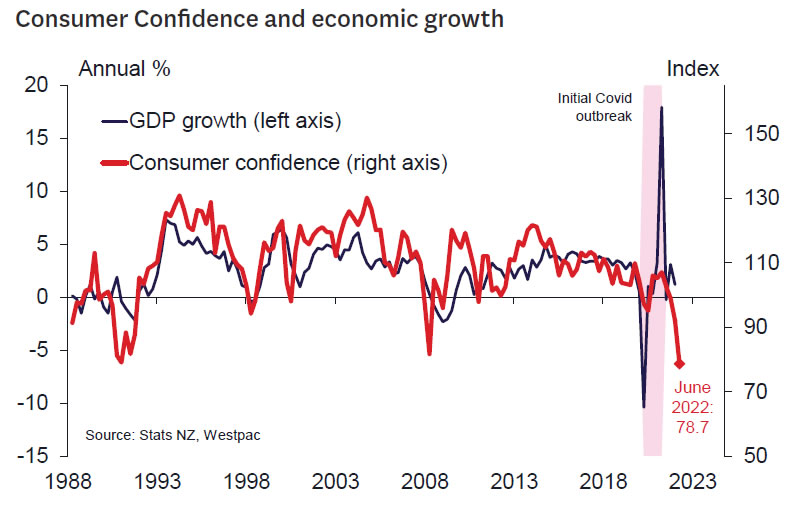
New Zealand Westpac consumer confidence dropped sharply from 92.1 to 78.7 in Q2. That's the lowest level on record, and well below long-term average at 110.2.
Westpac said: "The pressure on household finances and sharp fall in confidence reinforces our expectations for a downturn in household spending – and economic growth more generally – over the coming months".
"The RBNZ's own projections show the cash rate rising to 3.9%, while financial markets have started to price in the chance that it could go as high as 4.5%...
"If there is a more abrupt slowdown in spending than the RBNZ anticipates, then it's likely that increases in the cash rate will be more measured."
ECB Lane: Initial policy normalization steps clear and robust
ECB Chief Economist Philip Lane said yesterday, "we have very high inflation rates now, and clearly we could be in a world where inflation psychology is taking hold."
In a presentation, he said that Eurozone is facing three inflation shocks: pandemic cycle, energy shock and Russia-Ukraine war. Risks to inflation outlook include catch-up adjustment in wages, re-set of long term inflation expectations, inflation psychology, downward revision in potential output, and rise in real interest rate.
He added that monetary policy normalization is "appropriate" with "clear and robust" initial steps. That is, ECB will be stopping asset purchases, raise interest rate by 25bps in July, and again in September. Though, the size of the September hike is undecided. As for further steps, they will be state-contingent (gradualism, optionality, flexibility, data-dependency)
Wounded Sterling Awaits Heavy Dose of UK Data
The economic calendar is packed with data releases from the United Kingdom this week, starting with the latest inflation report at 06:00 GMT on Wednesday. Sterling has taken a heavy beating this year, underperforming even the war-ravaged euro despite a flurry of rate increases from the Bank of England. Until there is some good news from Ukraine that boosts stock markets and hammers energy prices, it is difficult to call for a trend reversal.
Ransacked
The British pound has been devastated. It has lost almost 10% of its value against the almighty US dollar and roughly 2% versus the euro this year alone, even though the Bank of England has raised interest rates at every single policy meeting.
Most of this lackluster performance boils down to the strong relationship between the pound and stock markets. The 60-day rolling correlation between Cable and the S&P 500 index currently stands at 0.93, so the two assets have moved in the same direction 93% of the time over the last couple of months.
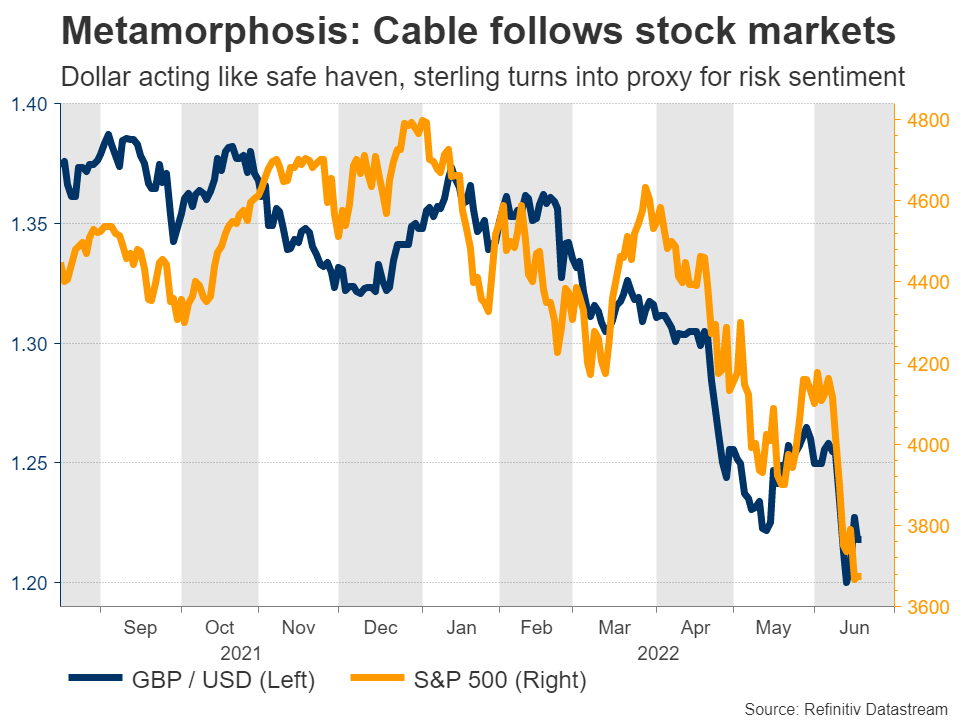
Sterling is essentially trading like a proxy for global risk sentiment, which has been terrible lately. Surging energy prices and a sharp drop in business confidence that typically foreshadows an economic slowdown have also played a role in the pound’s dreadful performance.
Upcoming data
Turning to this week’s releases, the show will get started on Wednesday with the inflation stats for May. Forecasts suggest inflation reached 9.1% in yearly terms. On the bright side, this would be only a minor acceleration from the 9.0% recorded in April.
As for any surprises, the risks surrounding this inflation print seem tilted to the upside. The S&P Global PMI for the month pointed to another record increase in prices charged by services companies, so the official inflation forecast seems like a ‘lowball’ estimate.
An upside inflation surprise could lend some support to sterling, on expectations that the BoE might accelerate the pace of rate increases. Taking a technical look at Cable, in this case the pair could edge higher for another test of the 1.2400 region.
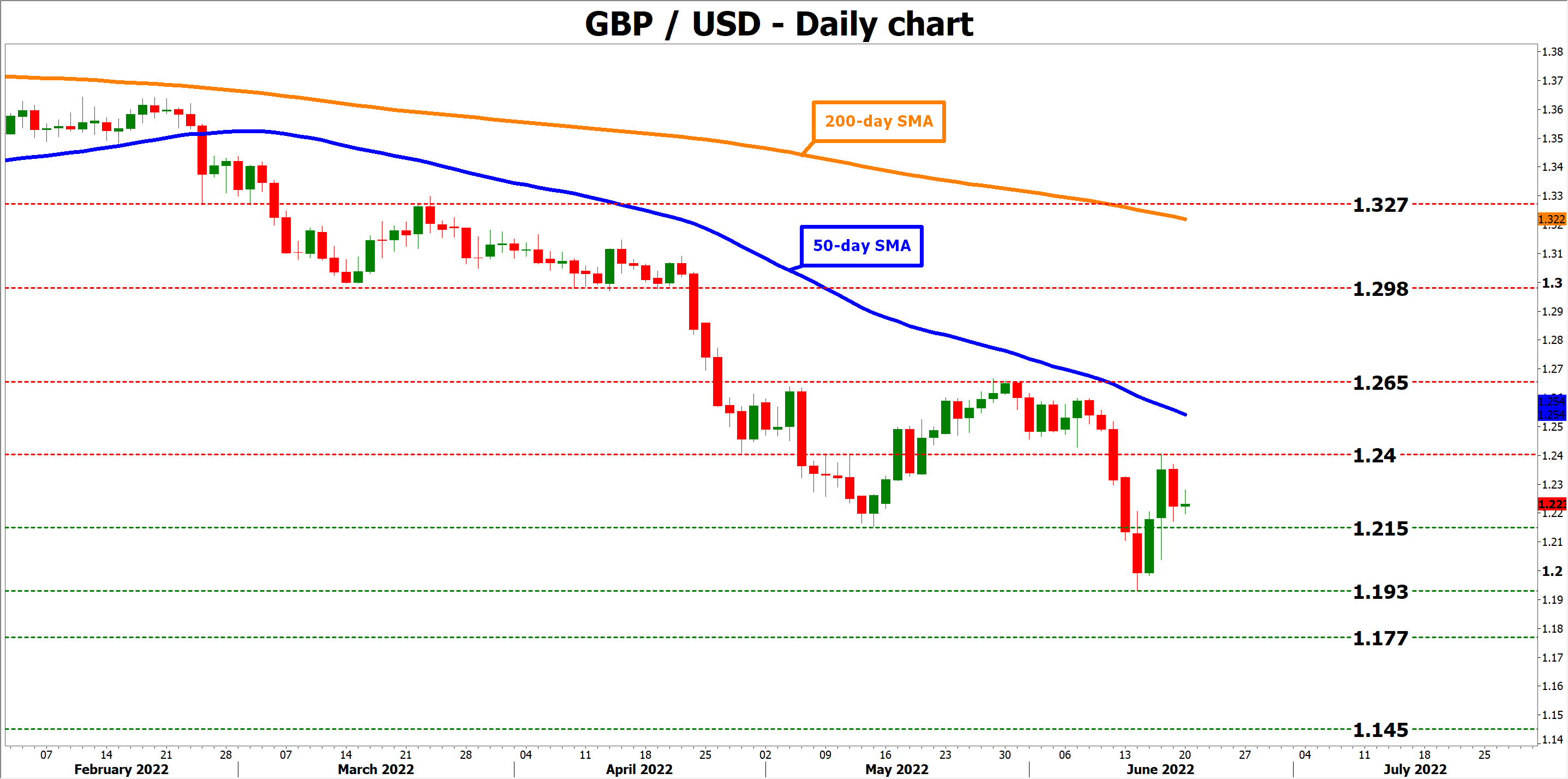
Then on Thursday, the preliminary PMIs for June will hit the markets ahead of the latest retail sales on Friday. The PMIs are expected to have fallen further while retail sales are seen turning negative on a monthly basis. A soft dataset could cause the pound to give back any inflation-related gains, with downside moves in Cable likely to encounter initial support around 1.2150.
Big picture
All told, the outlook for the pound remains cautiously negative. It’s just difficult to call for any massive recovery while sentiment in stock markets remains so weak and energy prices so high.
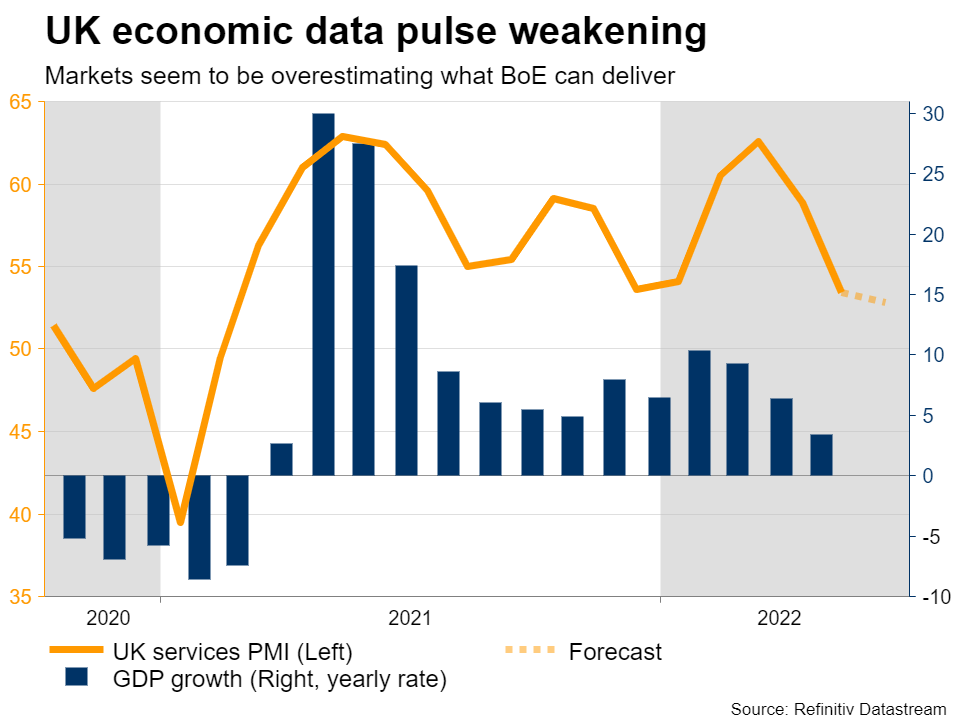
Traders also seem to be overestimating what the Bank of England can deliver. Market pricing currently suggests that the Bank Rate will close the year at 3%, from 1.25% currently. This implies the central bank will step up its game and raise interest rates by 50 basis points at three of its next four meetings.
The BoE has not raised rates by 50 bps so far in this cycle while the UK economy was firing on all cylinders - why would it so now that it is losing momentum and whispers of recession are growing louder? There is plenty of scope for disappointment embedded into current market pricing, which implies downside risks for sterling.
Political risk is back on the menu too, with reports that the UK is planning to abandon plans of the Brexit deal it negotiated with the European Union amid disagreement over the rules governing trade in Northern Ireland.
A trend reversal in the pound can be taken seriously only if it is accompanied by a major event that spreads joy in the markets and revives risk appetite - ideally with oil prices coming down as well. Some positive news around the Ukraine conflict could do the trick. Until then, the trend remains negative.
Technical Outlook and Review
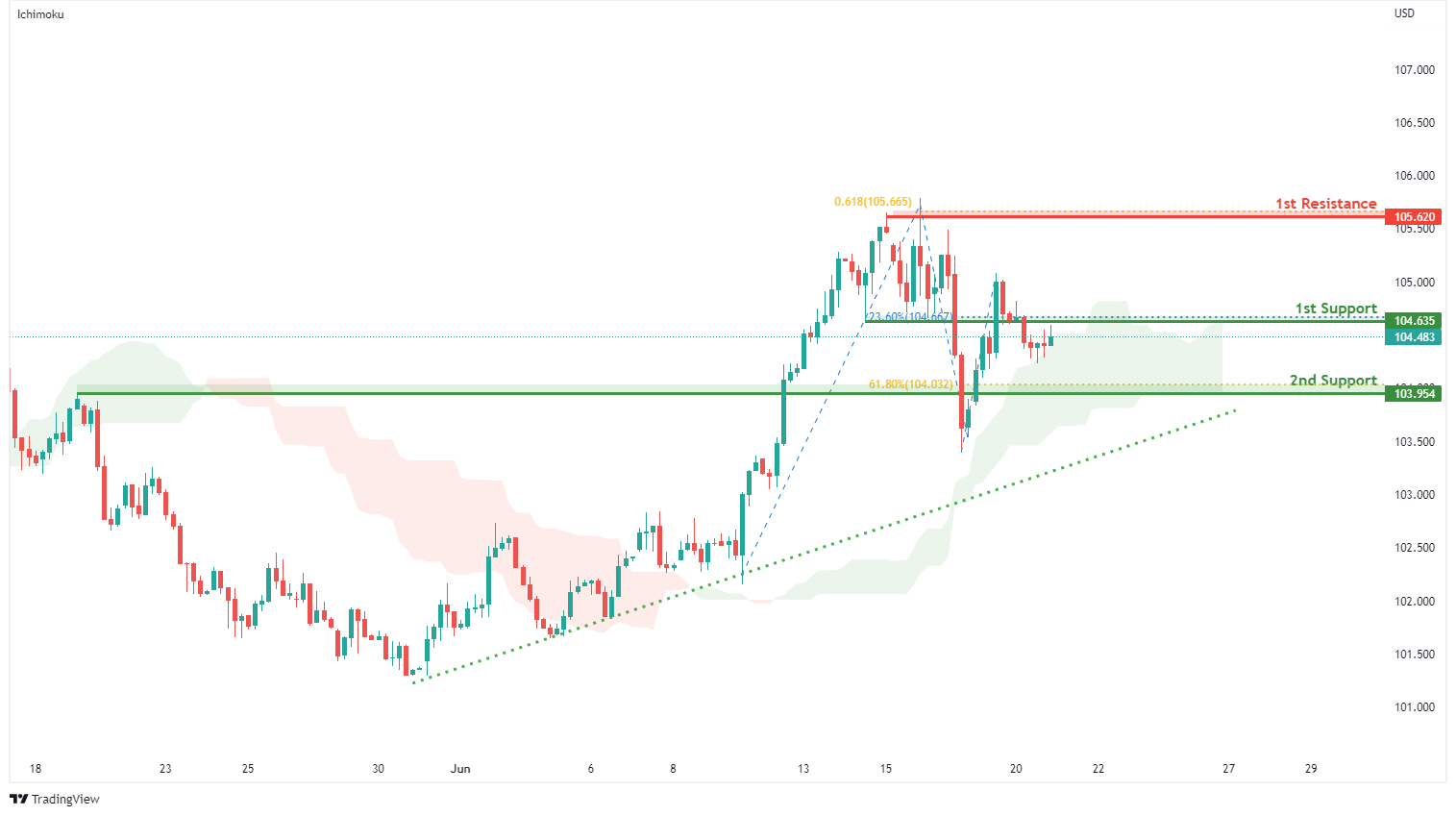
DXY:
On the H4, with prices bouncing off the ichimoku indicator and along the ascending trendline, we have a bullish bias that price will rise to our 1st resistance at 105.620 where the 61.8% fibonacci projection and swing high resistance are from our 1st support at 104.635 in line with the horizontal pullback support and 23.6% fibonacci retracement. Alternatively, price may break 1st support structure and head for 2nd support at 103.954 where the horizontal pullback support and 61.8% fibonacci retracement.
Areas of consideration:
- H4 time frame, 1st resistance at 105.620
- H4 time frame, 1st support at 104.635
XAU/USD (GOLD):
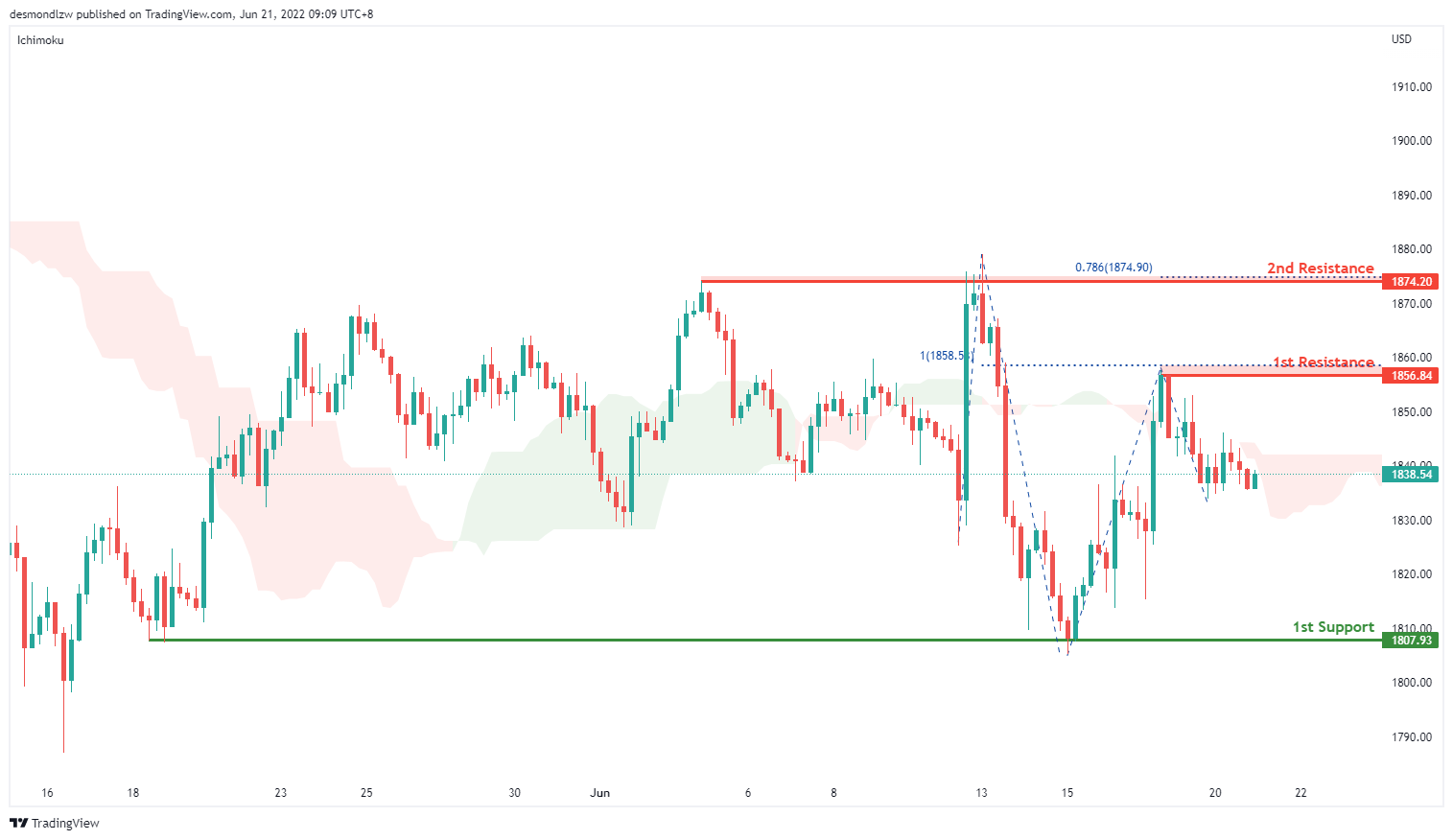
On the H4, with prices moving below the ichimoku indicator, we have a bearish bias that prices will drop from our 1st resistance at 1856.84 where the horizontal swing high resistance and 100% fibonacci projection are to our 1st support at 1807.93 in line with swing low support. Alternatively, price may break 1st resistance structure and head for 2nd resistance at 1874.20 in line with swing high resistance and 78.6% fibonacci projection.
Areas of consideration:
- H4 time frame, 1st Resistance at 1856.84
- H4 time frame, 1st Support at 1807.93
GBP/USD:
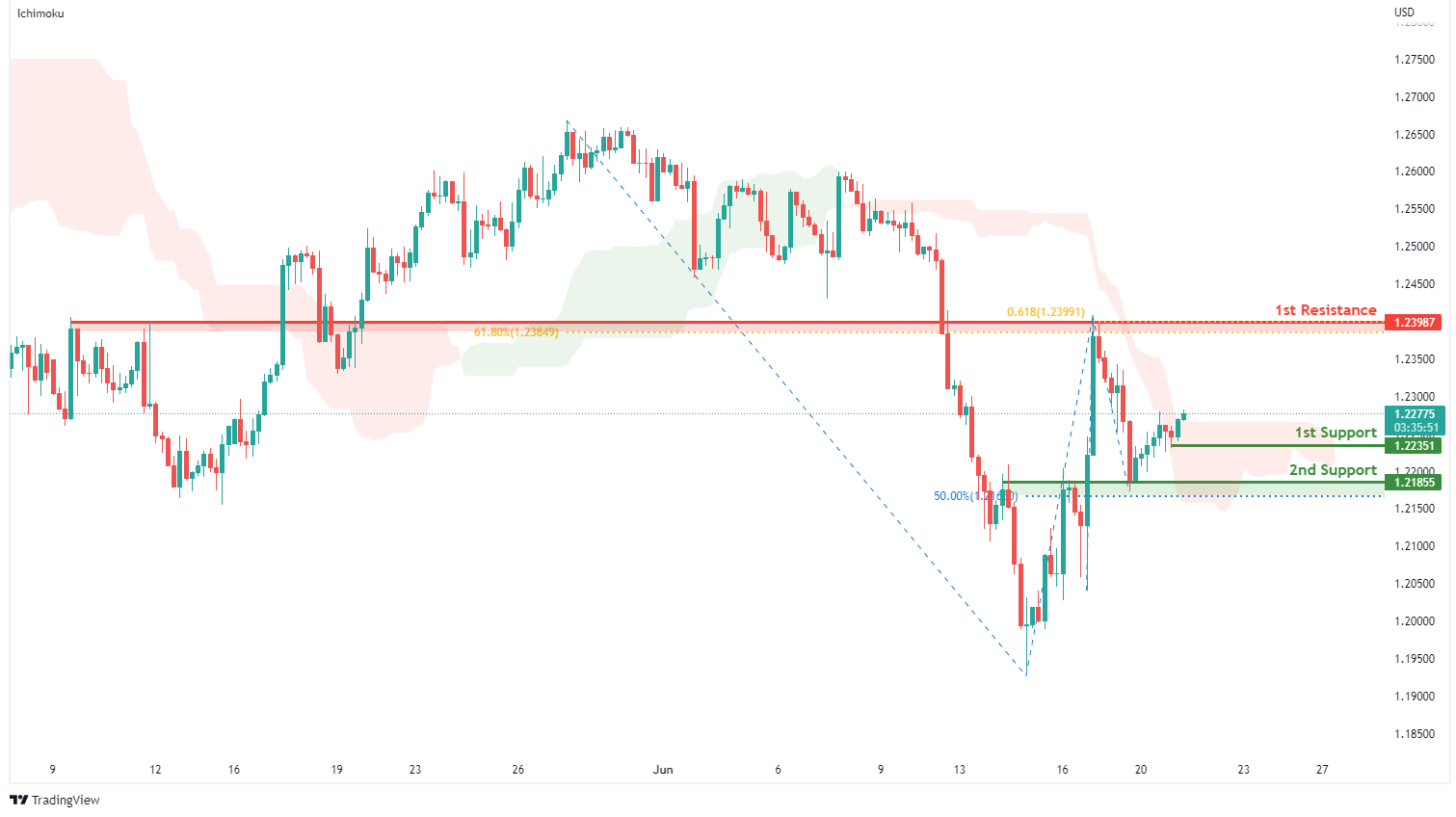
On the H4, with prices moving above the ichimoku indicator, we have a bullish bias that price will rise from our 1st support at 1.22351 where the horizontal swing low support is to our 1st resistance at 1.23987 in line with the 61.8% fibonacci projection, 61,8% fibonacci retracement and overlap resistance. Alternatively, price may break 1st support structure and head for 2nd support at 1.21855 where the horizontal overlap support and 50% fibonacci retracement are.
Areas of consideration:
- H4 1st resistance at 1.23987
- H4 1st support at 1.22351
USD/CHF:
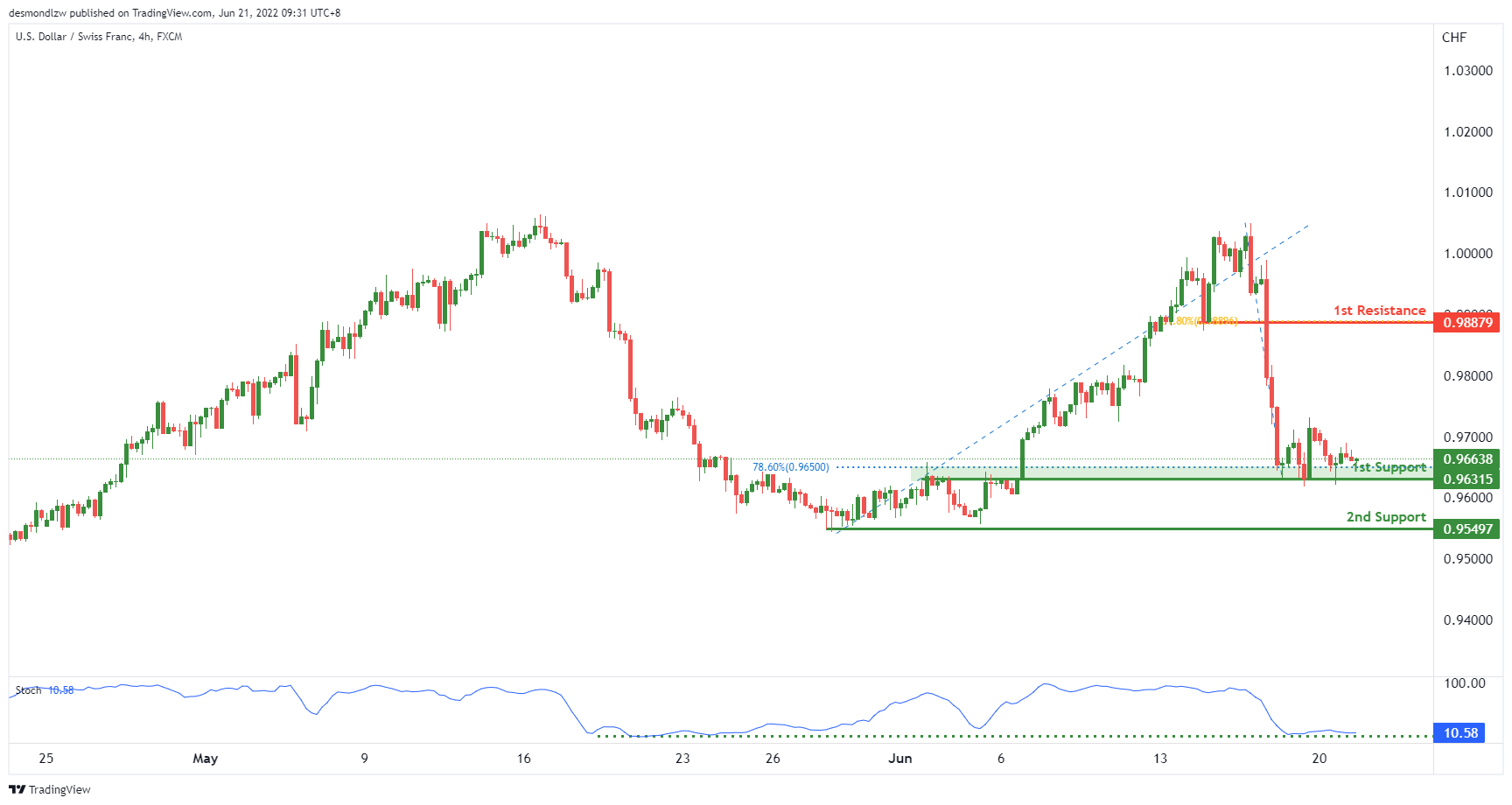
On the H4, with price expected to bounce off the stochastics indicator, we have a bullish bias that price will rise from our 1st support at 0.96315 where the horizontal pullback support and 78.6% Fibonacci retracement is to our 1st resistance at 0.98879 in line with the horizontal pullback resistance and 61.8% Fibonacci retracement. Alternatively, price may break structure and head for 2nd support where the horizontal swing low support is.
Areas of consideration
- 1st support level at 0.96315
- 1st resistance level at 0.98879
EUR/USD :
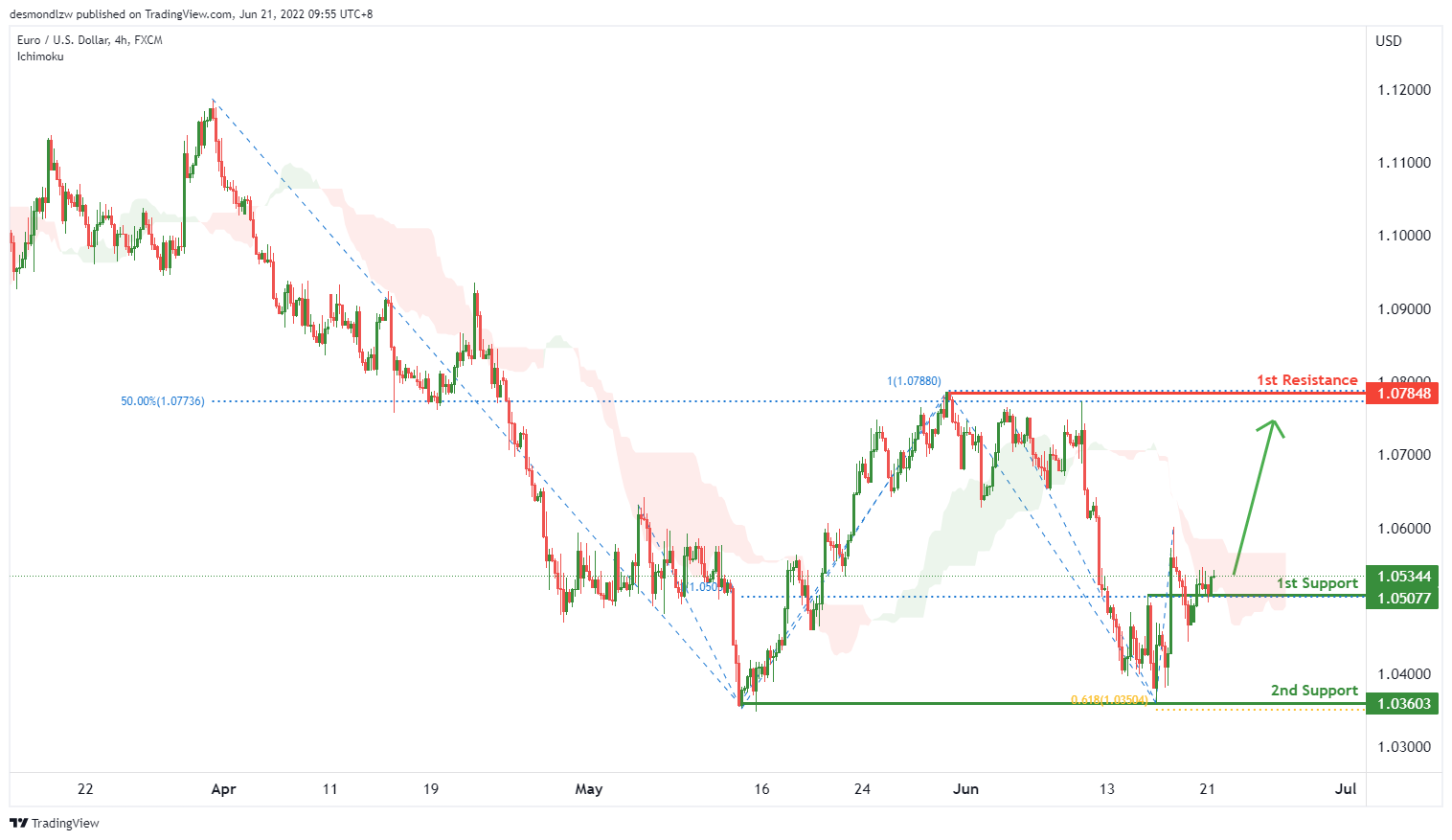
On the H4, with price moving into the ichimoku cloud, we have a bullish bias that price will rise from the 1st support at 1.05077 in line with the pullback support and 100% fibonacci projection to the 1st resistance at 1.07848 in line with the swing high, 100% fibonacci projection and 50% fibonacci retracement. Alternatively, price may reverse off the 1st support and drop to the 2nd support at 1.03603 in line with the multiple swing lows and 61.8% fibonacci projection.
Areas of consideration :
- H4 1st resistance at 1.07848
- H4 1st support at 1.05077
USD/JPY:
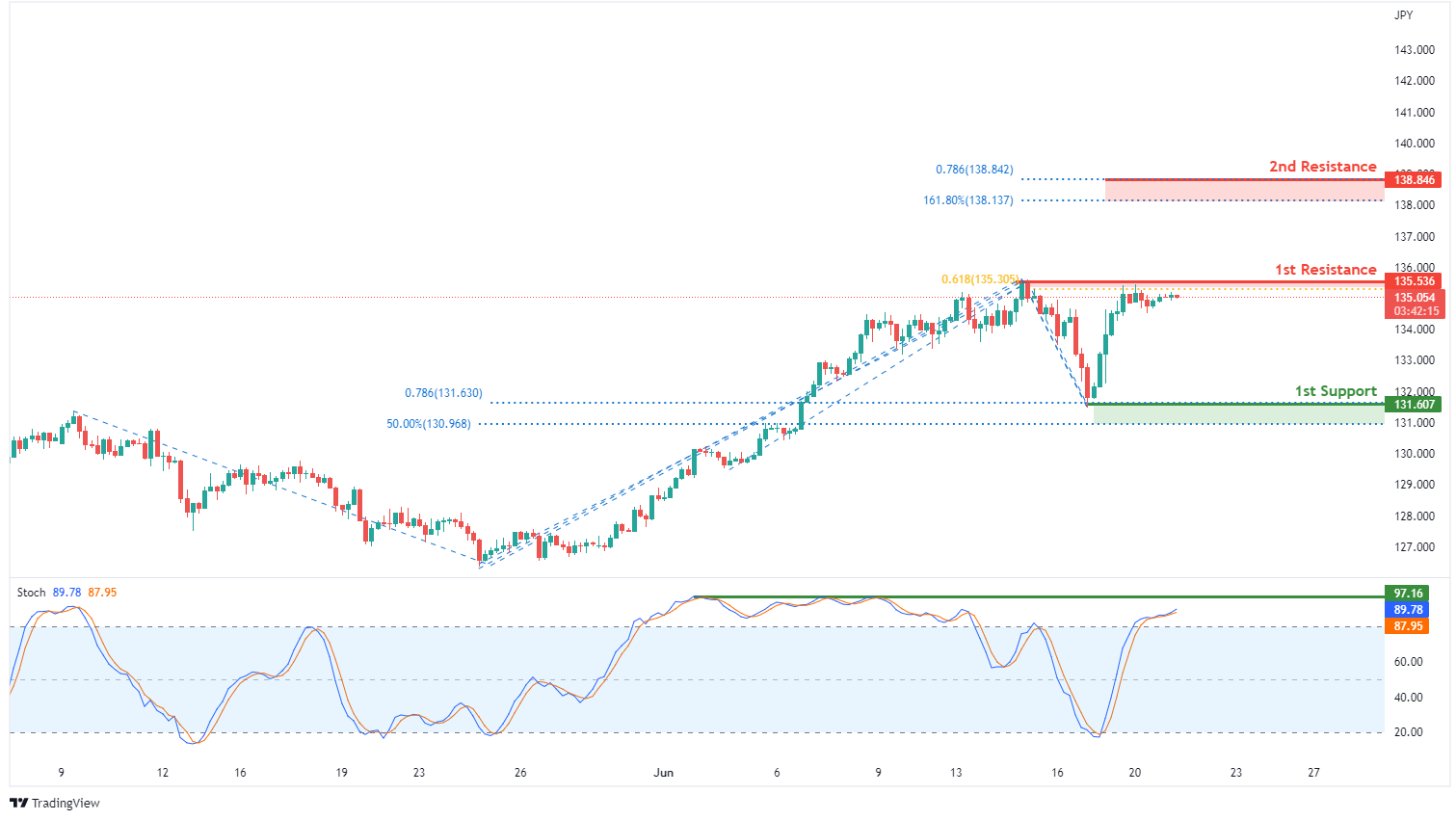
On the H4, with price approaching and expected to reverse off stochastic indicator, we have a bearish bias that price will drop from our 1st resistance at 135.536 in line with the swing high resistance and 61.8% fibonacci projection to our 1st support at 131.607 in line with the swing low support,78.6% fibonacci projection and 50% fibonacci retracement . Alternatively, price may break 1st resistance structure and head for 2nd resistance at 138.846 where the 161.8% fibonacci extension and 78.6% fibonacci projection are.
Areas of consideration:
- H4 time frame, 1st resistance at 135.536
- H4 time frame, 1st support at 131.607
AUD/USD:
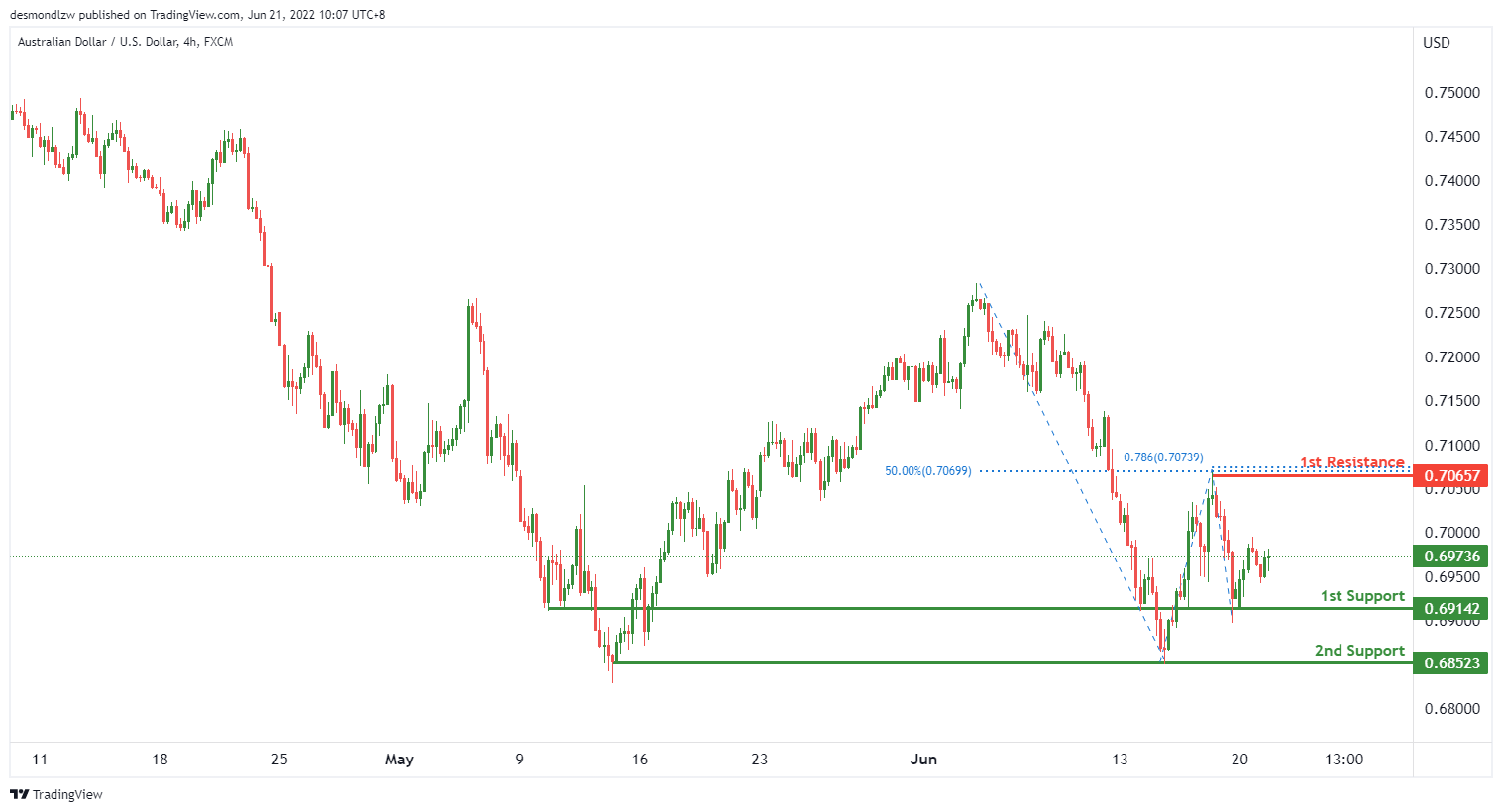
On the H4, price bounced off the 1st support at 0.69142 in line with the pullback support, and we have a bullish bias that it will rise to 1st resistance at 0.70657 in line with the swing high, 50% fibonacci retracement and 78.,6% fiboinacci projection. Alternatviely, price may reverse off the 1st support and drop to the 2nd support at 0.68523 in line with the multiple sing lows.
Areas of consideration
- H4 1st resistance at 0.70657
- H4 1st support at 0.69142
NZD/USD:
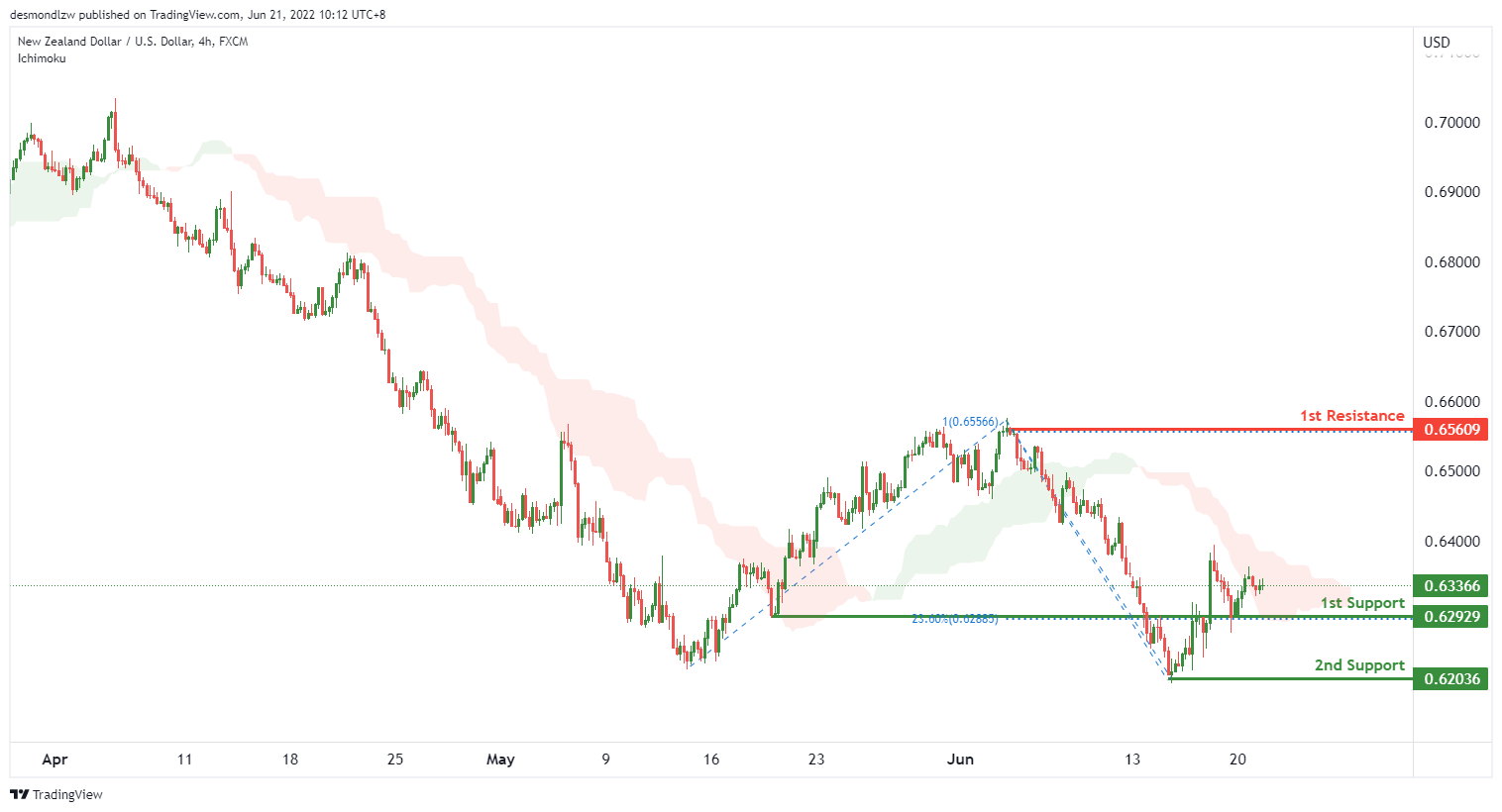
On the H4, with price moving in the ichimoku cloud, we have a bullish bias that price will rise from the 1st support at 0.62929 in line with the pullback support and 23.6% fibonacci retracement to the 1st resistance at 0.65609 in line with the 100% fibonacci projection at the swing high. Alternatively, price may reverse off the 1st support at drop to the 2nd support at 0.629036 at the horizontal swing low.
Areas of consideration:
- H4 time frame, 1st support at 0.62929
- H4 time frame, 1st resistance at 0.65609
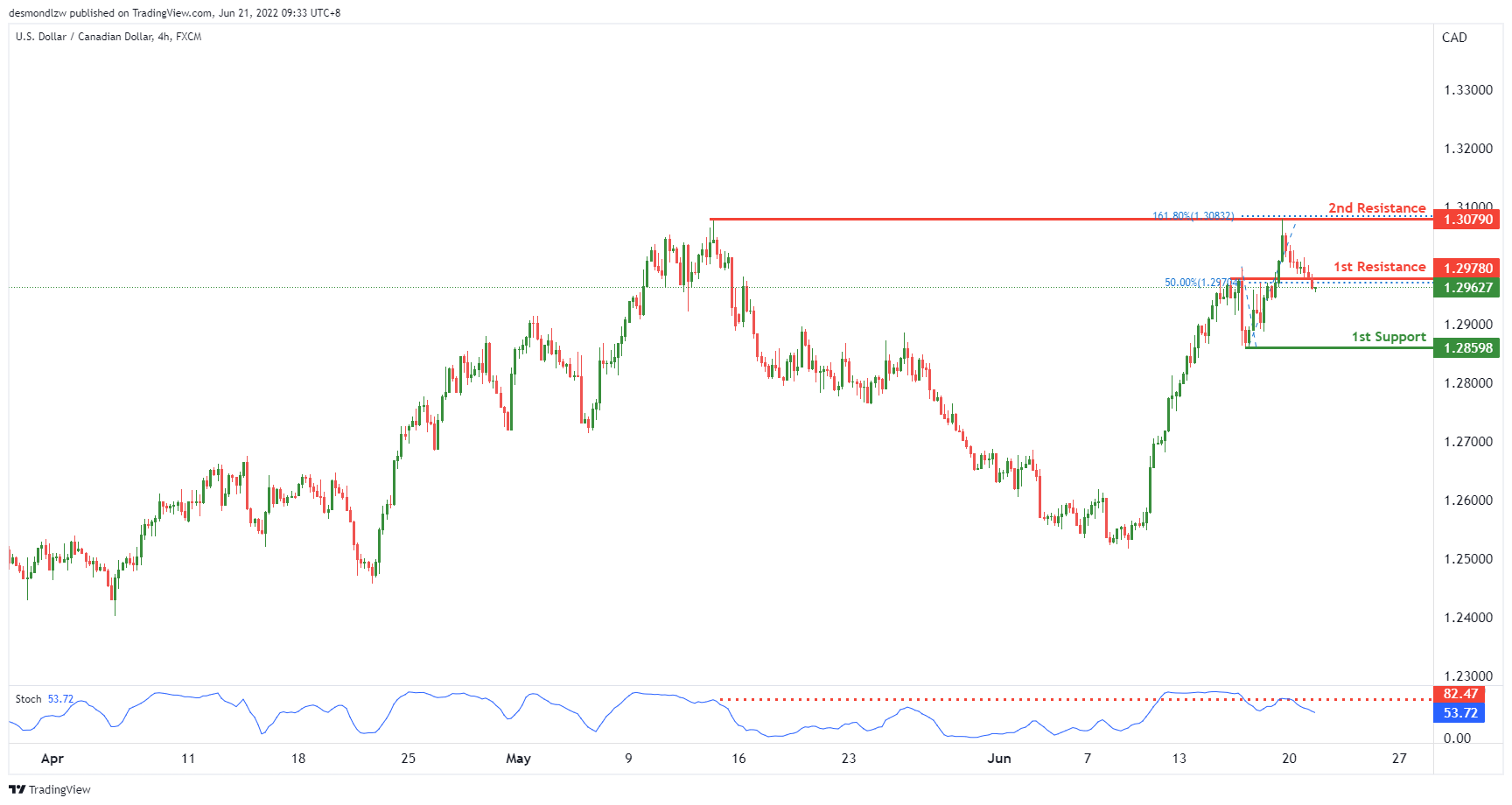
USD/CAD:
On the H4, with price expected to reverse off the stochastics indicator, we have a bearish bias that price will rise from our 1st resistance where the 50% Fibonacci retracement is to our 1st support at 1.28598 in line with the horizontal pullback support and 50% Fibonacci retracement. Alternatively, price may head for 2nd resistance where the horizontal swing high resistance and 161.8% Fibonacci projection is.
Areas of consideration:
- H4 time frame, 1st resistance at 1.30780
- H4 time frame, 1st support at 1.28598
OIL:
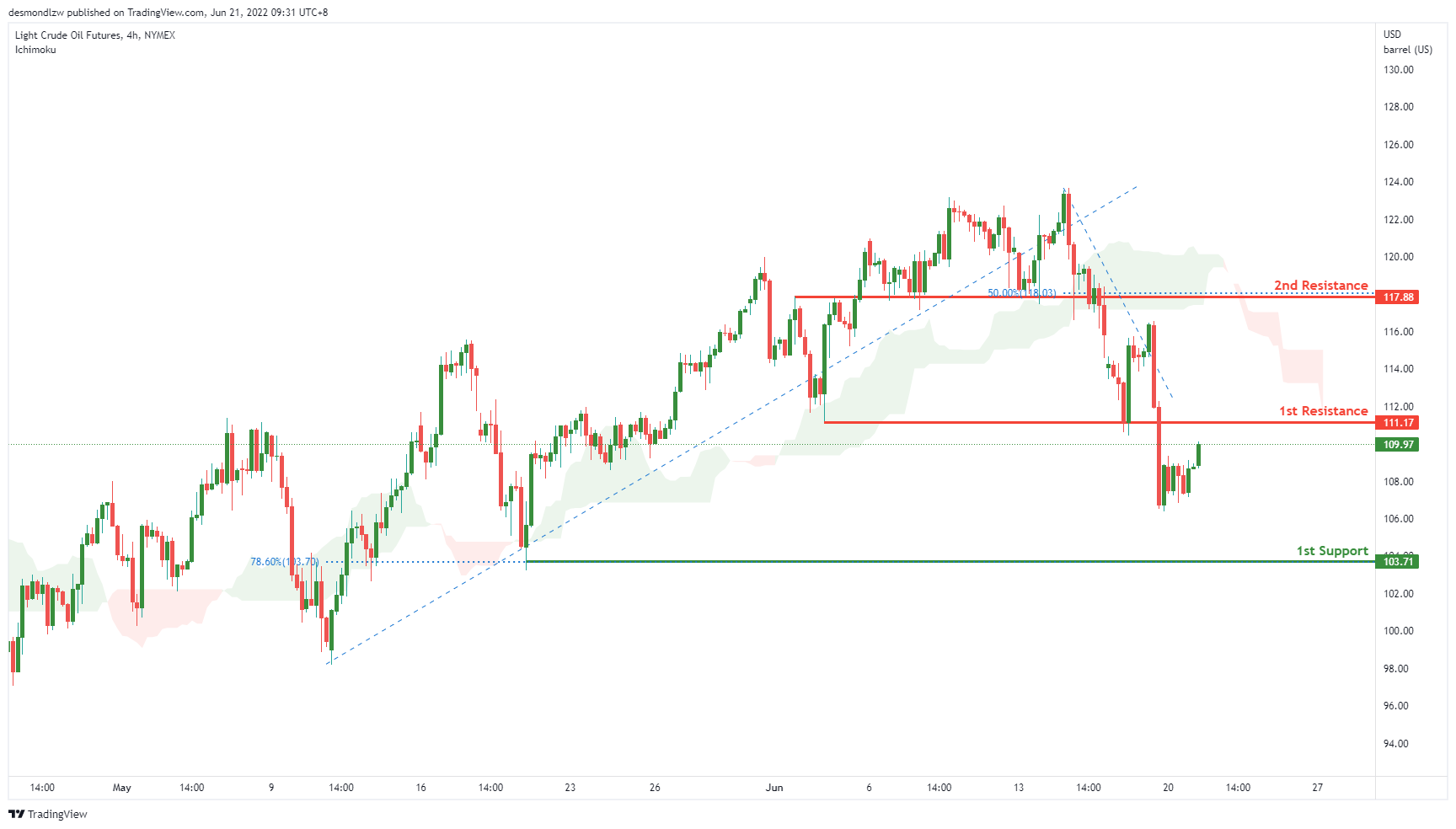
On the H4, with price moving below the ichimoku cloud, we have a bearish bias that price will rise from our 1st resistance at 111.17 where the horizontal pullback resistance is to our 1stsupport at 103.71 in line with the horizontal swing low support. Alternatively, price may head for 2nd resistance where the horizontal pullback resistance and 50% Fibonacci retracement is. Take note that we are waiting for the break of 1st resistance to confirm the bearish continuation.
Areas of consideration:
- H4 time frame, 1st resistance of 112.51
- H4 time frame, 1st support of 103.71
Dow Jones Industrial Average:
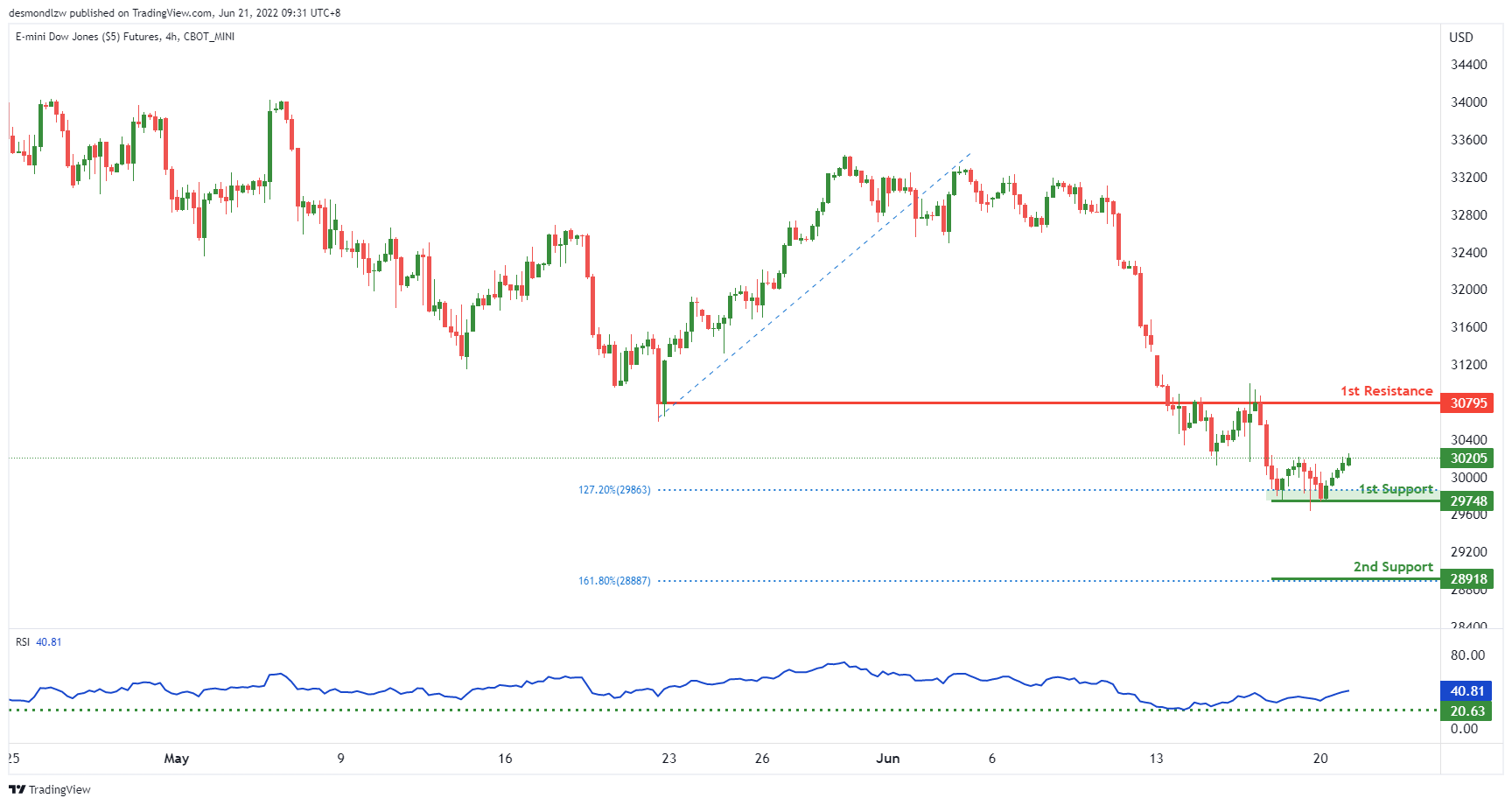
On the H4, with price expected to bounce off the stochastics indicator, we have a bullish bias that price will rise from our 1st support at 29748 where the 127.2% Fibonacci extension is to our 1st resistance at 30795 in line with the horizontal pullback support. Alternatively, price may break structure and head for 2nd support where the 161.8% Fibonacci extension is.
Areas of consideration :
- H4 time frame, 1st resistance at 30795
- H4 time frame, 1st support at 29748
EURJPY Wave Analysis
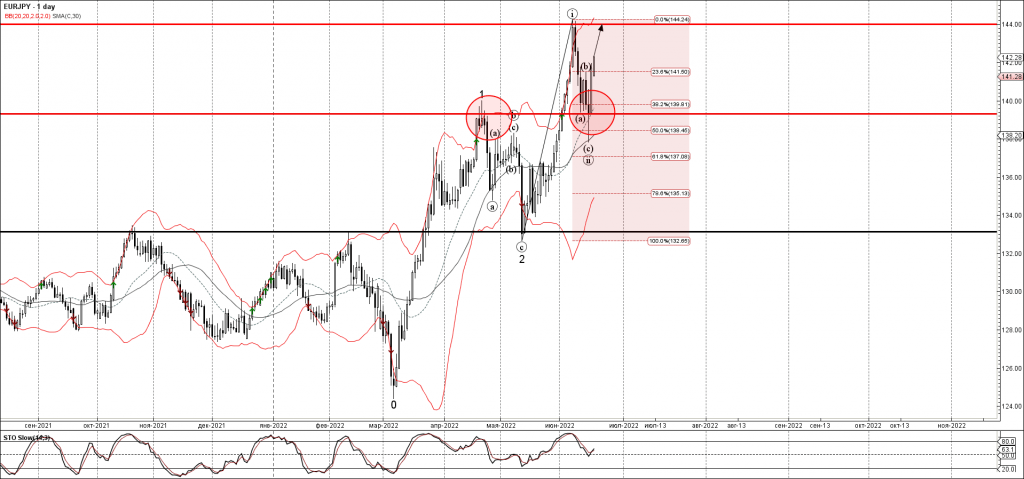
- EURJPY reversed from support level 139.30
- Likely to rise to resistance level 144.00
EURJPY currency pair just reversed up from the key support level 139.30 (former strong resistance from the middle of April).
The upward reversal from the support level 139.30 stopped the previous minor ABC correction (ii) .
EURJPY currency pair can be expected to rise further toward the next resistance level 144.00 (top of wave (i) from the start of June).
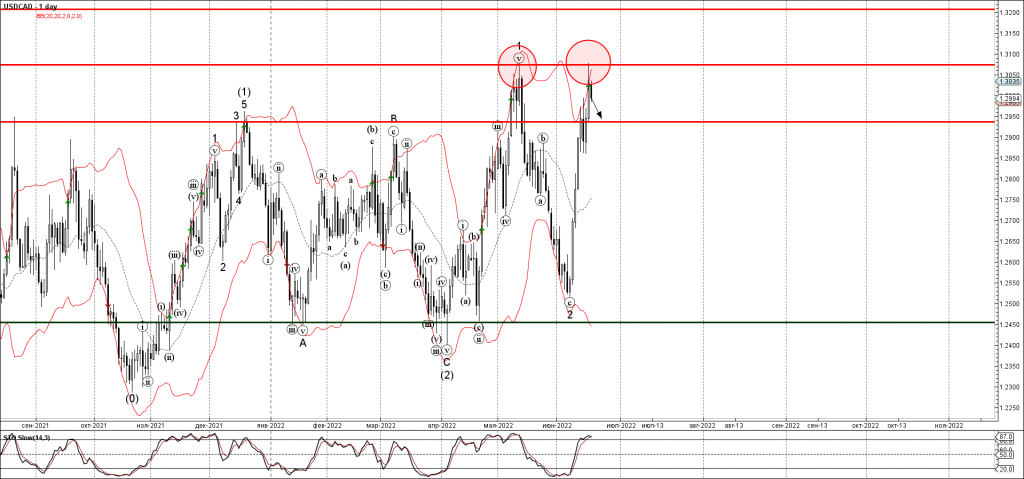
USDCAD Wave Analysis
- USDCAD reversed from resistance level 1.3075
- Likely to fall to support level 1.2940
USDCAD currency pair just reversed down from the strong resistance level 1.3075 (former top of the impulse wave 1 from the start of May) – standing well above the upper daily Bollinger Band.
The downward reversal from the resistance level 1.3075 stopped the previous impulse waves 3 and (3).
Given the strength of the resistance level 1.3075 and the overbought daily Stochastic, USDCAD currency pair can be expected to fall further toward the next support level 1.2940.
Eco Data 6/21/22
[php_everywhere instance="1"]
BoE Mann: Robust policy move reduces risk of further inflation further boosted by Sterling depreciation
BoE MPC member Catherine Mann explained in a speech that her for a 50bps last week. She said, " a more robust policy move, based on both domestic conjuncture and commensurate with the global factor, reduces the risk that domestic inflation already embedded is further boosted by inflation imported via a Sterling depreciation."
She's open to a policy rate reversal in the medium term "when the domestic supports to demand fade and when weakness in external sources of demand bite."
She said, "the domestic conjunctural situation is characterized by very high inflation and various supports to consumer purchasing power relative to real income". The support factors include "two fiscal packages, strong employment, wide-spread bonuses as well as robust wage growth, strong housing values, accumulated savings, quality trade-down, and borrowing through credit cards among other schemes."
Globally, tightening by Fed and ECB suggests depreciation pressure on Sterling that could "add to inflation particularly in the near term".