Sample Category Title
EUR/USD Mid-Day Outlook
Daily Pivots: (S1) 1.0441; (P) 1.0500 (R1) 1.0556; More...
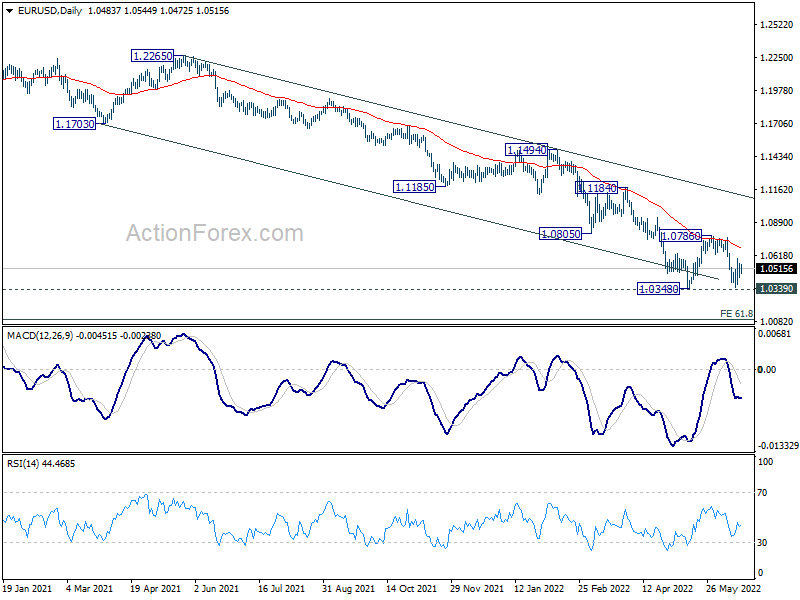
Range trading continues in EUR/USD and intraday bias remains neutral at this point. Further fall is in favor with 1.0786 resistance intact. On the downside, sustained break of 1.0339/48 will resume larger down trend. Next target is long term projection level at 1.0090.
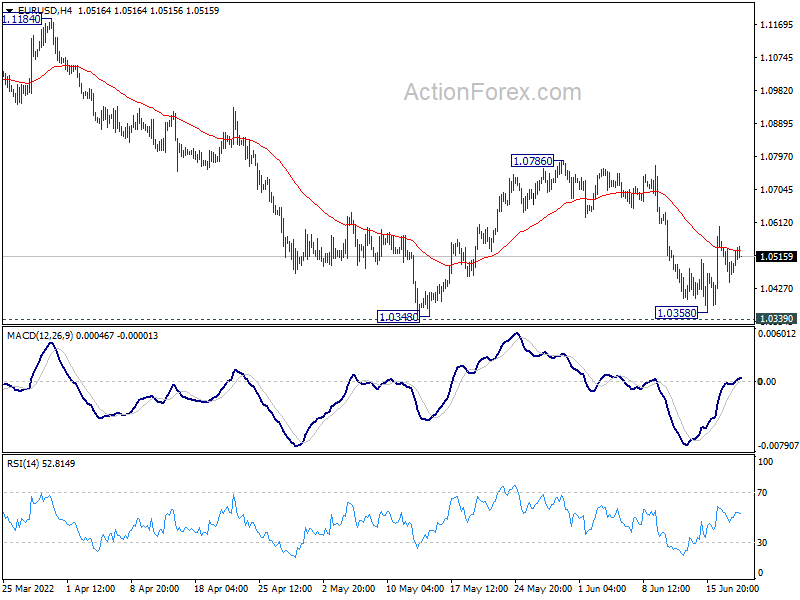
In the bigger picture, focus stays on 1.0339 long term support (2017 low). Decisive break there will resume whole down trend from 1.6039 (2008 high). Next target is 61.8% projection of 1.3993 to 1.0339 from 1.2348 at 1.0090. However, firm break of 1.0805 support turned resistance will delay this bearish case, and bring stronger rebound first.
Markets Tread Water With US on Holiday, Dollar and Yen Soft
Markets are generally quiet today, with a near empty European calendar and US holiday. Major European indexes are recovering slightly but lack follow through buying. Gold and oil are staying in tight range. In the currency markets, Aussie and Kiwi recover mildly while Dollar, Yen and Euro are the softer ones. But with the exception of some Kiwi pairs, most major pairs and crosses are stuck inside Friday's range.
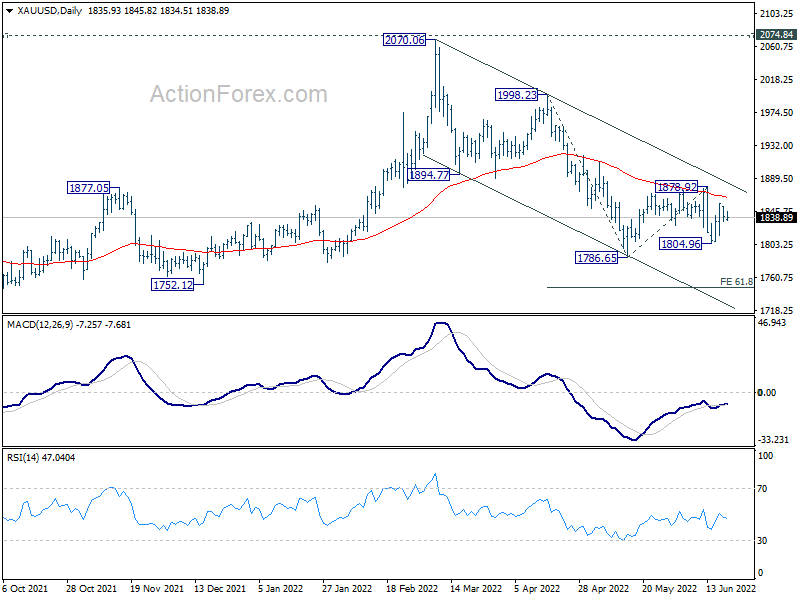
Technically, Gold's price actions have been very indecisive recently. But bearish bias is maintained as it's staying comfortably below falling 55 day EMA (now at 1866.60). Break of 1804.96 minor support should resume the larger fall from 2070.06 through 1786.65 low. 61.8% projection of 2070.06 to 1786.65 from 1878.92 at 1748.16 could be the place where the five-wave sequence ends.
In Europe, at the time of writing, FTSE is up 1.33%. DAX is up 0.48%. CAC is up 0.22%. Germany 10-year yield is up 0.043 at 1.701. Earlier in Asia, Nikkei dropped -0.74%. Hong Kong HSI rose 0.42%. China Shanghai SSE dropped -0.04%. Singapore Strait Times dropped -0.05%. Japan 10-year JGB yield rose 0.0002 to 0.233.
ECB Kazaks supports 25bps hike in Jul, 50bps in Sep
ECB Governing Council member Martins Kazaks said he would support 25bps rate hike in July and 50bps in September. He added that inflation would "need to surprise on the low side" for it not to be 50bps in September.
But he emphasized that investors should not think that 50 bps rate hikes are "the new default."
Japan: Industrial production appears to be pausing for picking up
In June economic report, Japan's government said "industrial production appears to be pausing for picking up." That's a downgraded assessment from May's "industrial production shows movements of picking up." Exports continued to be "almost flat".
It reiterated that "full attention should be given to the downside risks due to rising raw material prices, supply-side constraints and fluctuations in the financial and capital markets while there are concerns regarding the effects of lengthening the state of affairs of Ukraine and suppression of economic activities in China."
Nevertheless, for the short-term, the economy is "expected to show movements of picking up, supported by the effects of the policies while all possible measures are being taken against infectious diseases, and economic and social activities proceed to normalization".
BoJ Kuroda: PM Kishida didn't say anything special about exchange rate
After a meeting with Japan Prime Minister Fumio Kishida, BoJ Governor Haruhiko Kuroda said "I told the prime minister that recent rapid yen moves were undesirable".
"(Kishida) did not say anything special but I told him that it was important for currencies to move stably reflecting economic fundamentals," he added. "I'll fully watch currency movements carefully from now on as well and will appropriately respond to them while liaising with the government."
New Zealand BusinessNZ services rose to 55.2, back above average
New Zealand BusinessNZ Performance of Services Index rose from 52.2 to 55.2 in May. Activity/sales rose sharply from 53.3 to 59.6. But employment dropped from 51.0 to 48.5. New orders/business rose from 55.2 to 62.0. Stocks/inventories ticked down from 55.0 to 54.6. Supplier deliveries rose from 40.5 to 45.0.
BNZ Senior Economist Doug Steel said that "while the improvement was far from universal across components, reflecting many ongoing challenges across segments of the service sector, the overall outcome was the first above average result since the outbreak of Delta in August last year."
EUR/USD Mid-Day Outlook
Daily Pivots: (S1) 1.0441; (P) 1.0500 (R1) 1.0556; More...
Range trading continues in EUR/USD and intraday bias remains neutral at this point. Further fall is in favor with 1.0786 resistance intact. On the downside, sustained break of 1.0339/48 will resume larger down trend. Next target is long term projection level at 1.0090.
In the bigger picture, focus stays on 1.0339 long term support (2017 low). Decisive break there will resume whole down trend from 1.6039 (2008 high). Next target is 61.8% projection of 1.3993 to 1.0339 from 1.2348 at 1.0090. However, firm break of 1.0805 support turned resistance will delay this bearish case, and bring stronger rebound first.
Economic Indicators Update
| GMT | Ccy | Events | Actual | Forecast | Previous | Revised |
|---|---|---|---|---|---|---|
| 22:30 | NZD | Business NZ PSI May | 55.2 | 51.4 | 52.2 | |
| 06:00 | EUR | Germany PPI M/M May | 1.60% | 1.50% | 2.80% | |
| 06:00 | EUR | Germany PPI Y/Y May | 33.60% | 33.50% | 33.50% |
New Signs that the Price of Oil has Passed its Peak
Friday’s collapse added signs of oil’s reversal to a bear market. Brent losses exceeded 5% over Friday, and the pressure continued into Monday morning. Brent dropped more than 11% from the highs of June 8 to around $110, which was last seen four weeks ago.
Several technical factors now favour oil being taken over by the bears.
Firstly, oil has been losing in seven of the last eight trading sessions, while we have seen mixed movements in the currency and equity markets. Such a single-digit drop in oil is a sure sign of a sustained sell-off, suggesting that peak oil may be behind us.
At $111, the 50-day moving average and the upside support line of the last seven months converged. Oil closed below that critical point, and intraday trades are in the area below these one-time essential support levels.
The day’s close below $110 promises to be another tough reminder of the start of a deep correction in the oil market.
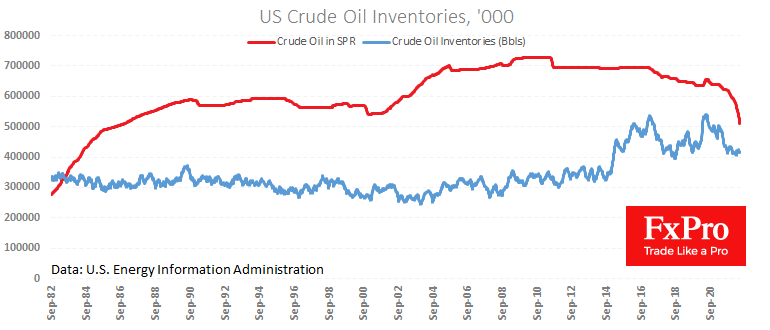
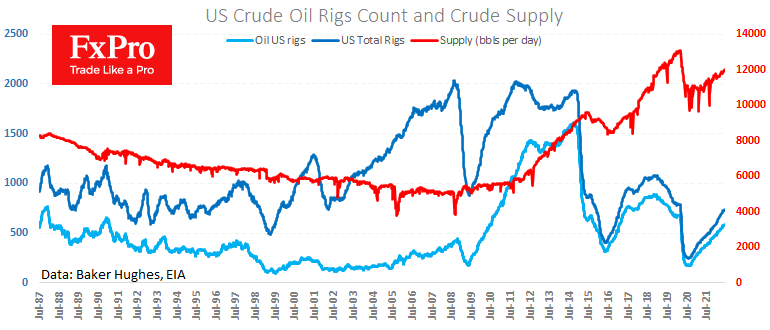
There is more and more oil in the USA. The Energy Agency has reported an increase in production of up to 12 million barrels per day. Active sales of crude stocks from the Strategic Reserve are helping to maintain the balance of commercial reserves.
At the same time, producers are ramping up drilling activity. Data last Friday showed an increase of 7 drilling rigs working to 740.
The US Presidential Administration has promised to return to filling reserves in September, which looks like good news for producers, who can get a steady buyer from the government, potentially keeping the price from an uncontrollable decline. The balance of market forces now suggests that the market has hit its high point in the trend of the last seven months. In the coming weeks, we should be prepared for a correction to $100 or even $90 with negative surprises in the global economy and a stock market crash. However, for the rest of this year and most of the next, Brent crude may stay mainly within the $90-120 range.
Pound Steady after Rough Week
The British pound is slightly higher at the start of the week, and I expect a quiet session, with US markets closed for a holiday.
British pound under pressure
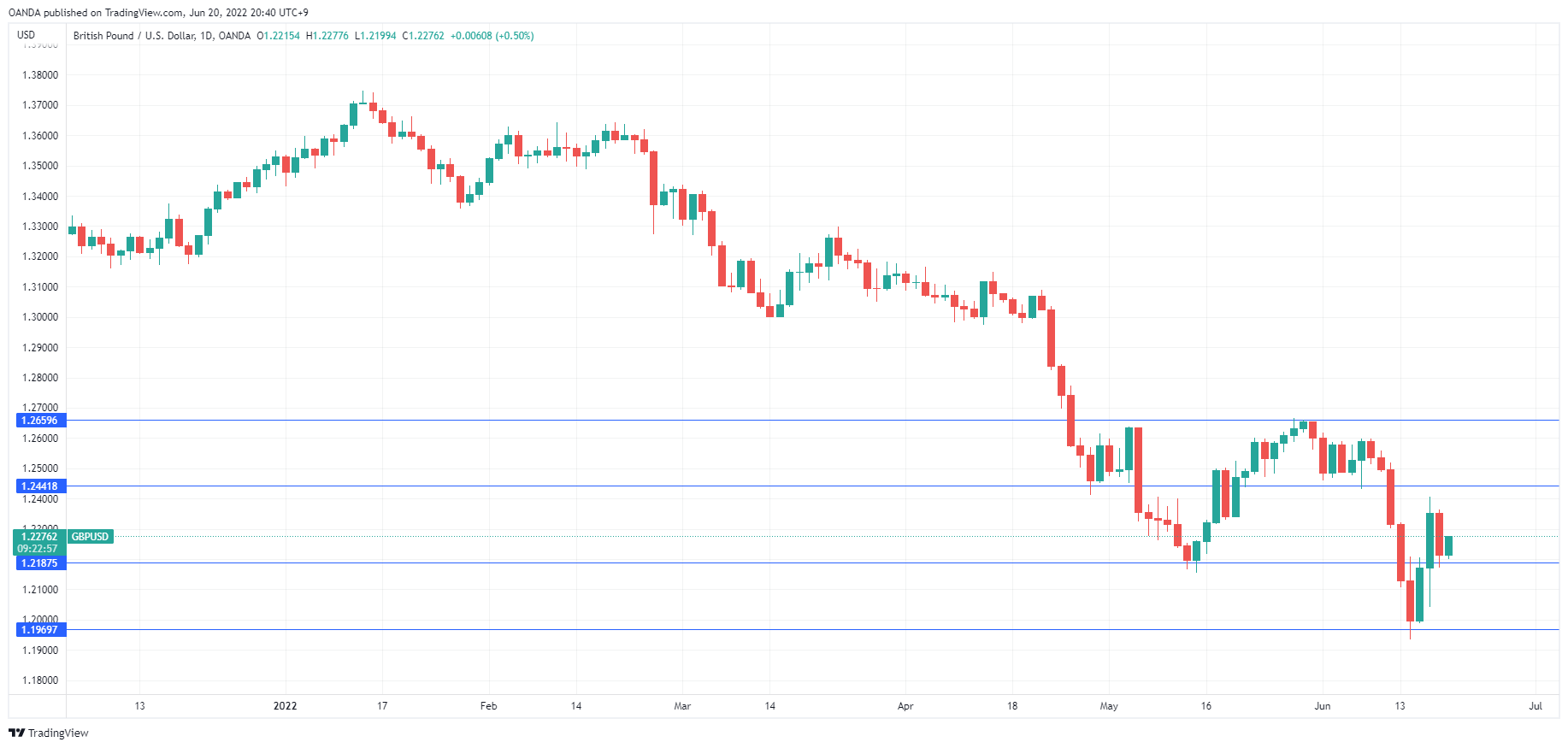
There was plenty of volatility from GBP/USD last week, as the currency started the week with gains, only to reverse directions and end the week in the red, the third losing week in a row. Perhaps the biggest red flag from the pound’s slide was the break below the symbolic 1.20 level last week, for the first time since 2020. The pound has been hammered in 2022, plunging as much as 1500 points.
The BoE rate hike of 0.25% on Thursday failed to impress the markets, with GBP/USD sliding 1.37% in the Thursday session. Three of the nine MPC members voted for a 0.50% increase, and it appears that the 0.25% was too feeble a move by the BoE, even though the benchmark rate is now at its highest level since 2009. The markets have priced in a 60% chance of a 0.50% rise at the next meeting in August, and there will be strong pressure for the BoE to deliver a 0.50% salvo unless inflation unexpectedly begins to ease. The UK releases May CPI on Wednesday, with an estimate of 9.1%, up slightly from the April reading of 9.0%.
The dark clouds hovering above the UK economy are not good news for the struggling pound. GDP fell by 0.3% in April after a 0.1% decline in March, the first back-to-back contractions since March 2020, at the start of the Covid pandemic. J.P. Morgan said on Friday that the likelihood of a recession in the UK has increased over the next year or two, warning that a recession in the US would spill over to the UK.
GBP/USD Technical
- GBP/USD has support at 1.2187 and 1.1969
- There is resistance at 1.2441 and 1.2659
Bitcoin Crash Gains Steam as Crypto Market Cap Falls Below $1T
The euro declined on Monday as the energy crisis in Europe continued over the weekend. Last week, Russia decided to cut its natural gas shipments to some key European countries like France, Italy, and Germany. It lowered sales to Germany by 60% citing the impact of sanctions. As a result, Germany announced that it will restart its coal plants in a bid to protect its industry. The euro will react to a speech by key European Central Bank (ECB) officials like Christine Lagarde and Philip Lane, the bank’s chief economist. The two are expected to signal that the bank will hike interest rates by 0.25% in its July meeting.
Cryptocurrency prices crashed hard during the weekend as concerns about the industry remained. Bitcoin moved below $20,000 for the first time since 2020. Similarly, Ethereum dropped below $1,000 while the total market cap of all cryptocurrencies declined below $1 trillion. Investors are concerned about the lack of demand for coins. Also, many investors are experiencing margin calls as their holdings slide. For example, Three Arrows, a well-known hedge fund became the latest big firm to implode. At its peak, the fund had over $10 billion in assets.
The price of crude oil remained under pressure as investors continue focusing on important news in the industry. There is uncertainty about the outcome of Biden’s meeting with Saudi’s Salman. It is unclear whether Saudi Arabia will agree to raise production in a bid to stabilize prices. Meanwhile, investors are concerned about Libya’s output. In a statement, the country’s prime minister said that it’s unlikely the country will hold elections this year. Output from Libya has dropped to between 100k and 200k from last year’s high of 1.3 million barrels.
XBRUSD
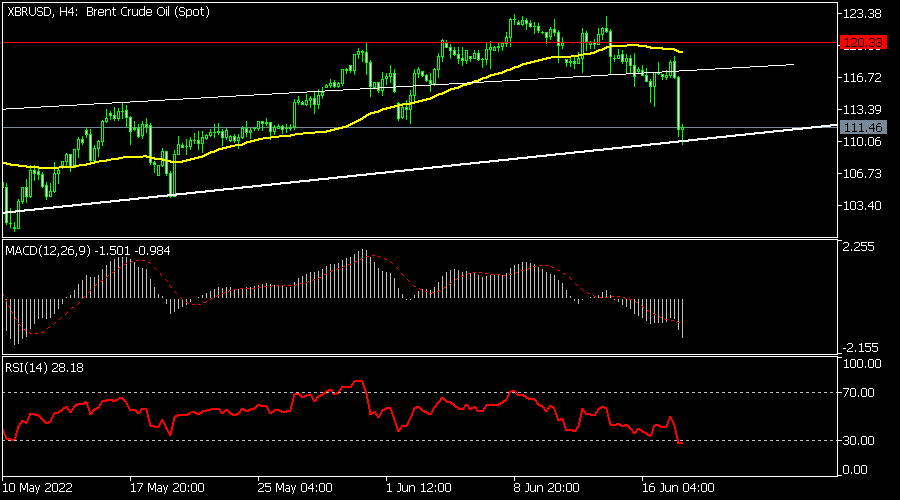
The XBRUSD pair has dropped sharply in the past few days as concerns in the industry continued. It is trading at 111.46, which is lower than this month’s high of over 123. It has moved below the upper side of the ascending channel shown in white. At the same time, the pair has dropped below the 25-day moving average while the MACD has moved below the neutral point. The Relative Strength Index has dropped below the oversold level. Therefore, the pair will likely have a relief rally today.
EURUSD
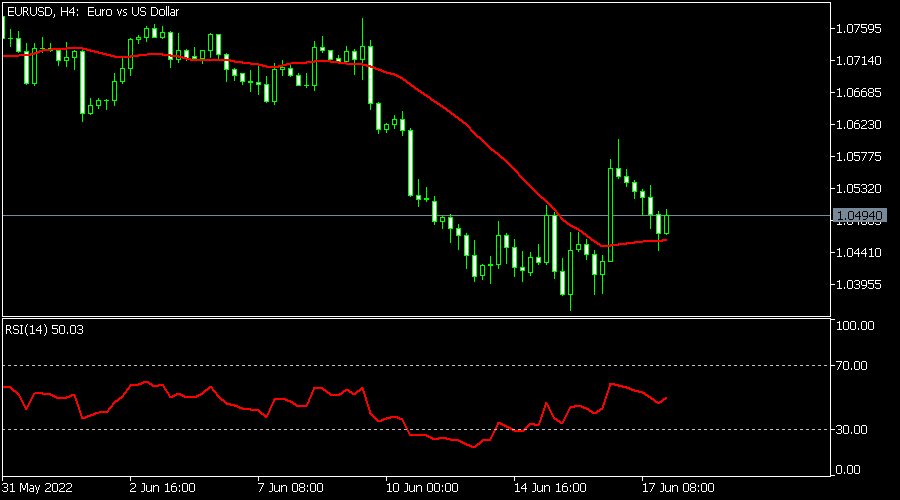
The EURUSD pair is trading at 1.0495, which is higher than last Friday’s low of 1.0440. On the four-hour chart, the pair moved above the 25-day moving average while the RSI is above the neutral point at 50. It has moved slightly below the 61.8% Fibonacci retracement level. The pair will likely resume the uptrend as investors wait for the upcoming speech by Lagarde and Lane.
USDJPY
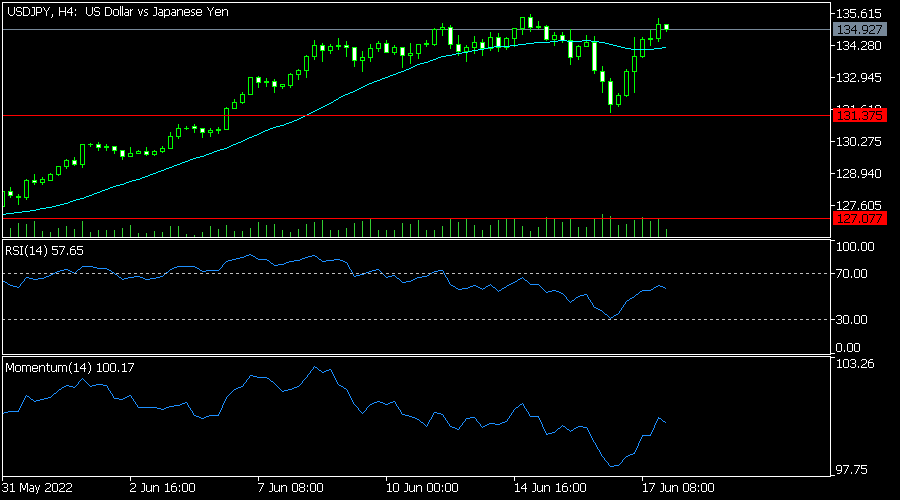
The USDJPY pair continued its bullish trend after the Bank of Japan decided to maintain its dovish tone. It is trading at 134.92, which is slightly below the highest point this year. It has moved slightly above the 25-day moving average while the RSI and momentum have moved upwards. The pair will likely continue rising, with the next key target being at 135.61.
ECB Kazaks supports 25bps hike in Jul, 50bps in Sep
ECB Governing Council member Martins Kazaks said he would support 25bps rate hike in July and 50bps in September. He added that inflation would "need to surprise on the low side" for it not to be 50bps in September.
But he emphasized that investors should not think that 50 bps rate hikes are "the new default."
Japan: Industrial production appears to be pausing for picking up
In June economic report, Japan's government said "industrial production appears to be pausing for picking up." That's a downgraded assessment from May's "industrial production shows movements of picking up." Exports continued to be "almost flat".
It reiterated that "full attention should be given to the downside risks due to rising raw material prices, supply-side constraints and fluctuations in the financial and capital markets while there are concerns regarding the effects of lengthening the state of affairs of Ukraine and suppression of economic activities in China."
Nevertheless, for the short-term, the economy is "expected to show movements of picking up, supported by the effects of the policies while all possible measures are being taken against infectious diseases, and economic and social activities proceed to normalization".
BoJ Kuroda: PM Kishida didn’t say anything special about exchange rate
After a meeting with Japan Prime Minister Fumio Kishida, BoJ Governor Haruhiko Kuroda said "I told the prime minister that recent rapid yen moves were undesirable".
"(Kishida) did not say anything special but I told him that it was important for currencies to move stably reflecting economic fundamentals," he added. "I'll fully watch currency movements carefully from now on as well and will appropriately respond to them while liaising with the government."
Institutions Pulled Down Bitcoin and Ether; Retail Bought Back Altcoins
The crypto market has set several historic lows in recent days, demonstrating the fragility and naivety of its historical patterns. In a 37% drop, Bitcoin closed below its 200-week moving average for the first time. Not only did we not see a rebound in retail action over the weekend, but an intensified sell-off sent the exchange rate below 2017 peak levels at $19.6K. At one point on Saturday, the price was down to $17.6K, disproving the idea that you can’t lose money owning Bitcoin for over four years.
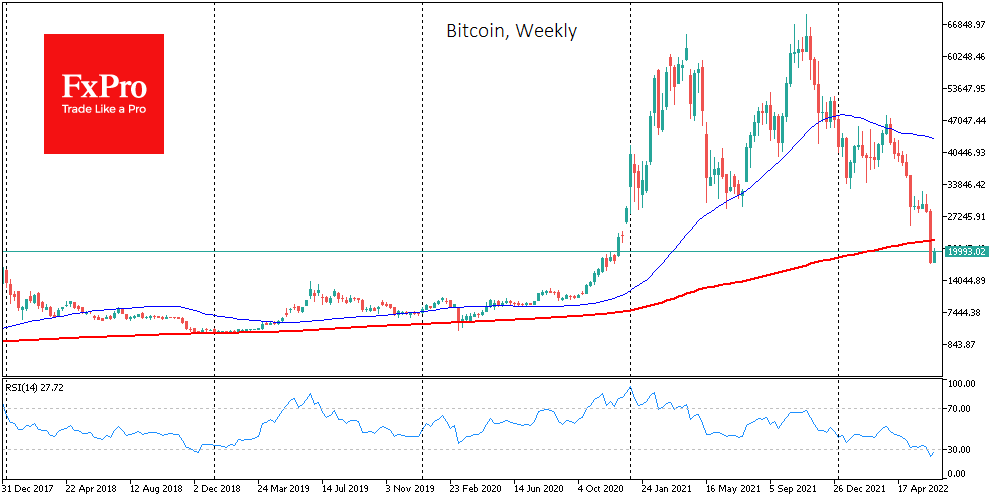
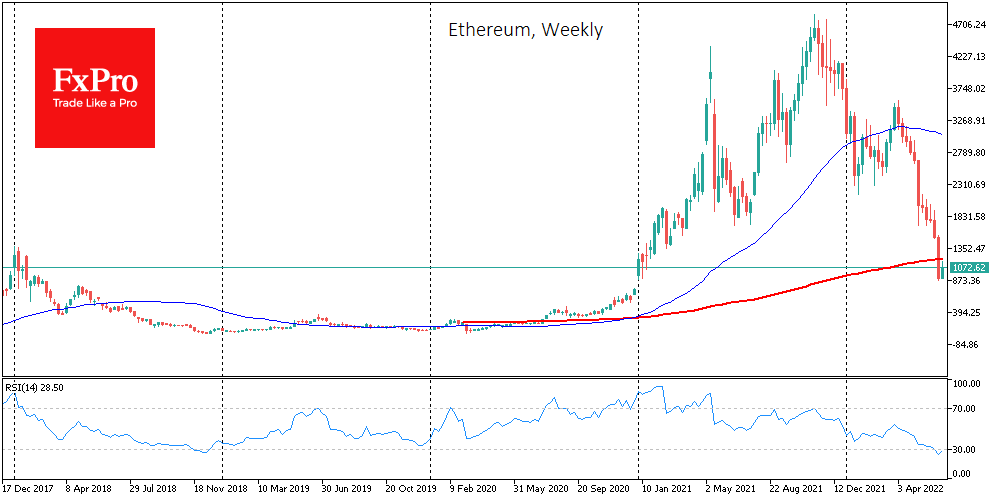
The crypto market mostly added on Sunday, with BTCUSD trading at $20K at the start of the day on Monday. Ethereum lost 20.5% in seven days. After bottoming at $900 on Saturday night, the second cryptocurrency has now settled near $1070.
An essential characteristic of the crypto market was that altcoins were sidelined. Except for BNB (-12% for the week), we note either flat movements (XRP, Doge) or strengthening (Solana, Polkadot). The Bitcoin dominance index fell from 3.5% to 43.5% over the same period due to Bitcoin’s outperformance.
The Cryptocurrency Fear and Greed Index dropped 8 points for the week to 6 and continues to be in a state of “extreme fear”. By Monday, it had climbed to 9 due to positive coin movements the day before.
Bitcoin last week posted its highest decline since March 2020 on the back of a continuing fall in stock indices and a higher-than-expected US Federal Reserve key rate hike. At the weekend, BTC broke through the previous market cycle high of $20,000, which has never happened before.
The negative market sentiment was exacerbated when three cryptocurrency platforms, Celsius, Finblox and crypto hedge fund Three Arrows Capital, froze or restricted financial transactions and withdrawals.
The US has investigated the suspension of withdrawals by crypto lending platform Celsius. Experts say the bankruptcy of Celsius is almost inevitable.
The CEO of cryptocurrency OTC platform Genesis Trading, Michael Moreau, reported the liquidation of a “major counterparty” position. The hedge fund in question is presumably Three Arrows Capital.
The collapse in the cryptocurrency market will have a cleansing effect, and breakthrough projects launched during a bear market “will always succeed”, billionaire Mark Cuban said. Galaxy Digital CEO Mike Novogratz believes the cryptocurrency market recovery could take a long time and will depend heavily on the US Federal Reserve’s actions. He thinks the market will begin to grow after the Fed raises rates.
Gold Indecisive Within Constraining Zone
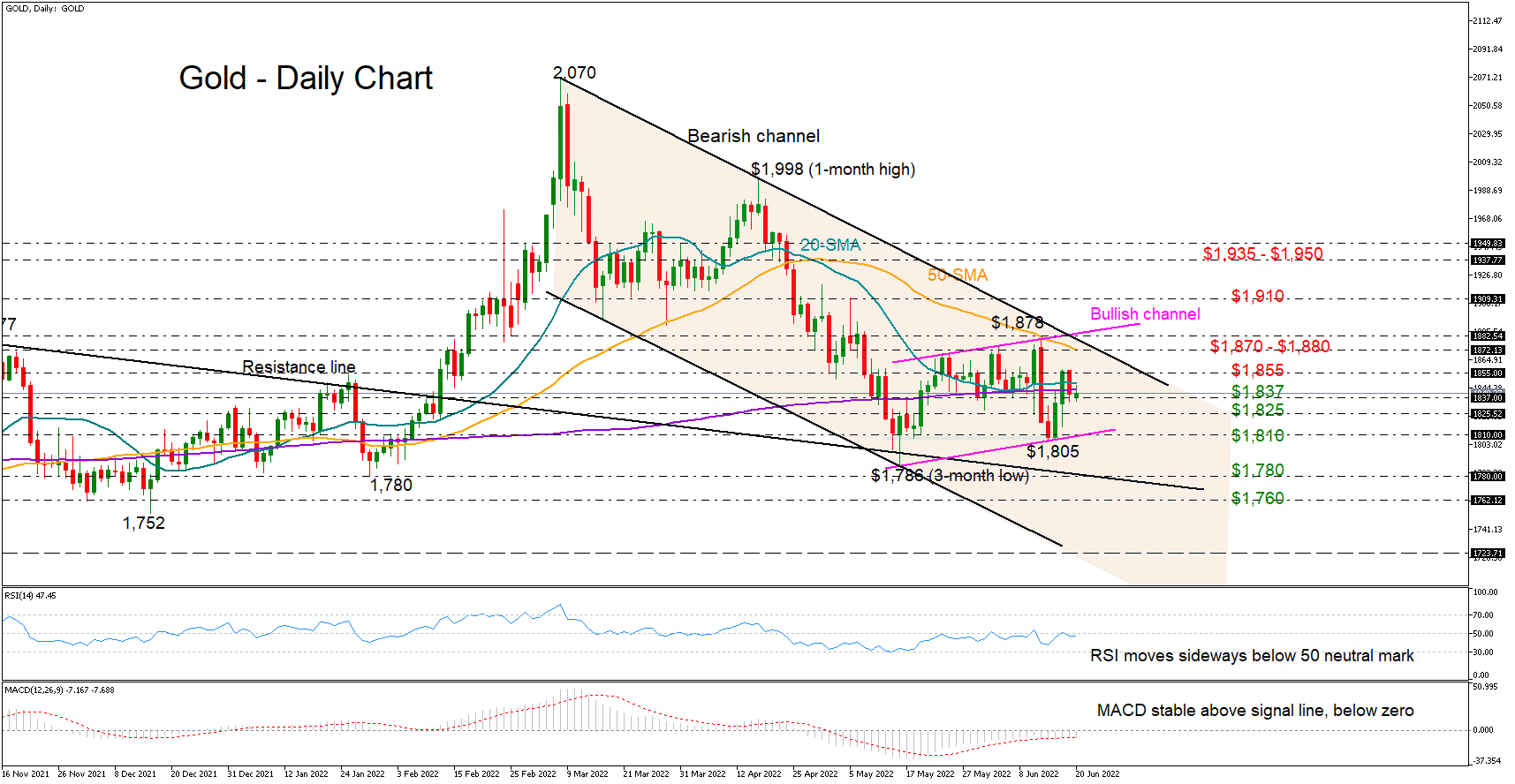
Gold got immediately congested within the $1,837 – $1,855 region following last week’s bounce off the $1,805 low.
The 20- and 200-day simple moving averages (SMAs) are currently limiting bullish pressures, while the RSI and the MACD provide little direction about the next move in the price as the former is drifting sideways below its 50 neutral mark and the latter remains stable within the negative territory.
If buyers claim the $1,855 boundary, the next challenge could develop within the $1,870 – $1,880 territory formed by the 50-day SMA and the surface of the short-term bullish channel. Notably, the upper boundary of the medium-term bearish channel is positioned within the same area. Therefore, any upside breakout from here could be critical for approaching the $1,910 barricade. Even higher, the ascend may pause somewhere between $1,935 and $1,950.
On the downside, a close below $1,837 may immediately stabilize around $1,825. Then, the lower bar of the upward-sloping channel may come to the rescue around $1,810, preventing a sharper decline towards the $1,780 mark, where the broken long-term resistance trendline stretched from the 2020 record high of $2,079 is also placed.
In brief, gold is preserving a neutral bias in the short-term picture, with traders waiting for a sustainable move above $1,880 or below $1,810 to get fresh direction in the market.