

Sample Category Title
Local Retreat in Gold
Despite attempts at rebounding equity markets, moderate pressure on gold has persisted for the third consecutive trading session. This pressure is directly linked to rising long-term bond yields on US debt and several other developed countries.
Bonds and gold work like communicating vessels: rising real long-term yields draw capital to the debt markets away from gold. Over the last two years, the inverse correlation between gold and US 10-year Treasury yields has been very strong: gold prices peaked in August 2020, while yields rose from 0.5%.
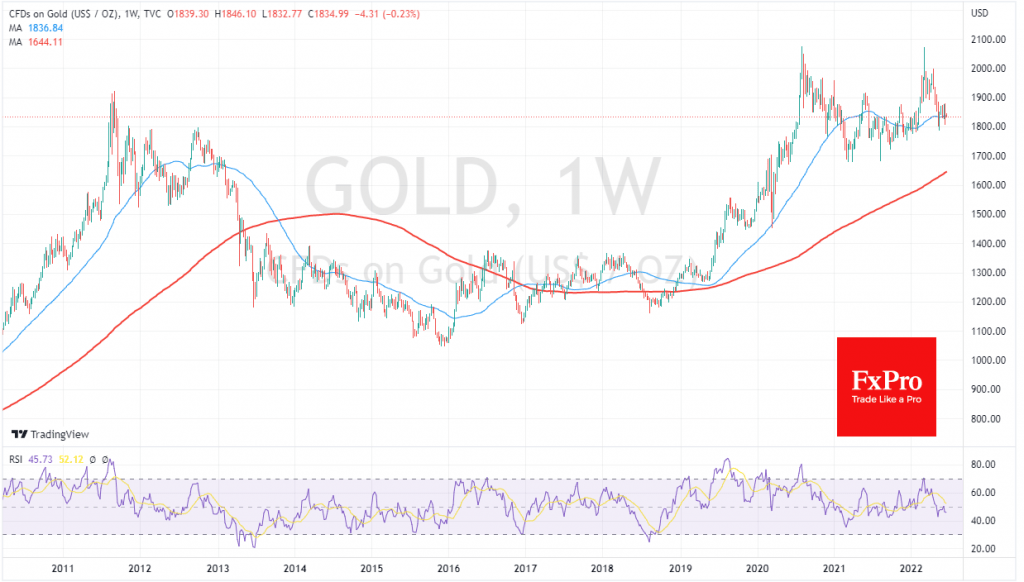
Last week, when the 10-year Treasury yield was rising temporarily to 3.5%, it tested the $1800 area.
However, there are several essential points to understand in this correlation.
First, the 10-year Treasury yields touched 11-year highs last week, while gold has retreated only to the levels last seen at the start of the year. In other words, an active capital outflow from gold only occurs when yields decline sharply, whereas the long-term trend favours the shiny metal. This correlation can easily be explained by inflation, which eats into the purchasing power of money in the long term.
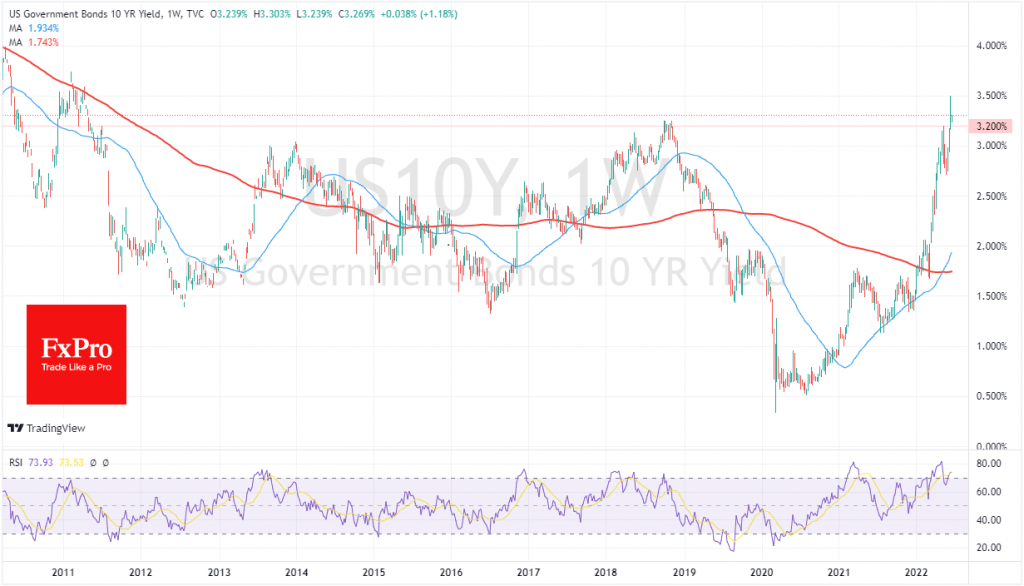
Secondly, 10-year yields are not so much influenced by short-term Fed interest rates as economic growth forecasts. Increased chances of a recession in the foreseeable future have dampened long-term yields. In addition, there are signs that the upward movement in UST yields was too fast, setting up a corrective pullback in the near term.
In our opinion, the potential danger for gold is a further tightening of the Fed’s tone, i.e. hints of new steps of a 75-point rate hike and a willingness to keep rates above inflation. But so far, we have seen a significant outperformance of inflation over key rates, and comments from FOMC members indicate a willingness to stop with a tightening in the 3.5-4.0% area, with no attempt to ride out inflation and a reversal to a rate cut as early as 2024. Such outlooks are keeping long-term bond yields in check and, at the same time fuelling interest in a strategy of buying gold during intense downturns.
Locally, creeping upward bond yields are working for sellers of gold. This also has a bearish signal in the form of consolidation below the 200-day (or 50-week) moving average.
However, gold’s resilience drew attention when markets overestimated expectations of a rate hike from 50 to 75 points and multiple buying gains on dips under the 200-day moving average since December last year.
RBA’s Lowe Signals 50-bps Hike
It continues to be a quiet week for the Australian dollar, in sharp contrast to last week’s roller-coaster ride. AUD/USD has edged higher today, as the market response to the RBA minutes and a speech from Governor Lowe has been muted.
RBA minutes, Lowe offer few clues
Anyone looking for some guidance from the RBA minutes came away disappointed, as the gist of the minutes was a defence of the surprise move to raise interest rates by 50bps at the meeting. The markets had expected a modest hike of 0.25%. The minutes noted that even with the supersize 50-bps move, the Cash Rate remained below 1%, and it was clear to members that policy remained highly stimulative and further rate hikes would be required. The minutes noted that the RBA was relying on strong consumer spending and a solid labour market to enable the central bank to continue to raise rates.
Inflation remains the RBA’s number one time on the agenda, with Q4 CPI rising to 7.0%. The minutes stated that the RBA expected inflation to continue to accelerate before easing and would move towards the top of the RBA’s target of 1%-3%. With an inflation peak still nowhere to be seen, the markets have priced in 95% odds of a 50bps move in July. RBC and Goldman Sachs are predicting a series of 50bps moves in July, August and September. It seems clear that the RBA will be in a very aggressive mode in the second half of 2022, which could provide key support for the Australian dollar.
In a speech after the minutes, Governor Lowe stated that a 75-bps hike was off the table in July. Analysts were quick to point out that Lowe only ruled out such a move in July, perhaps giving himself room for a super-size hike at a later date. Lowe also admitted that the exit from the RBA’s yield target in 2021 had been “disorderly” and the credibility of the bank had been damaged.
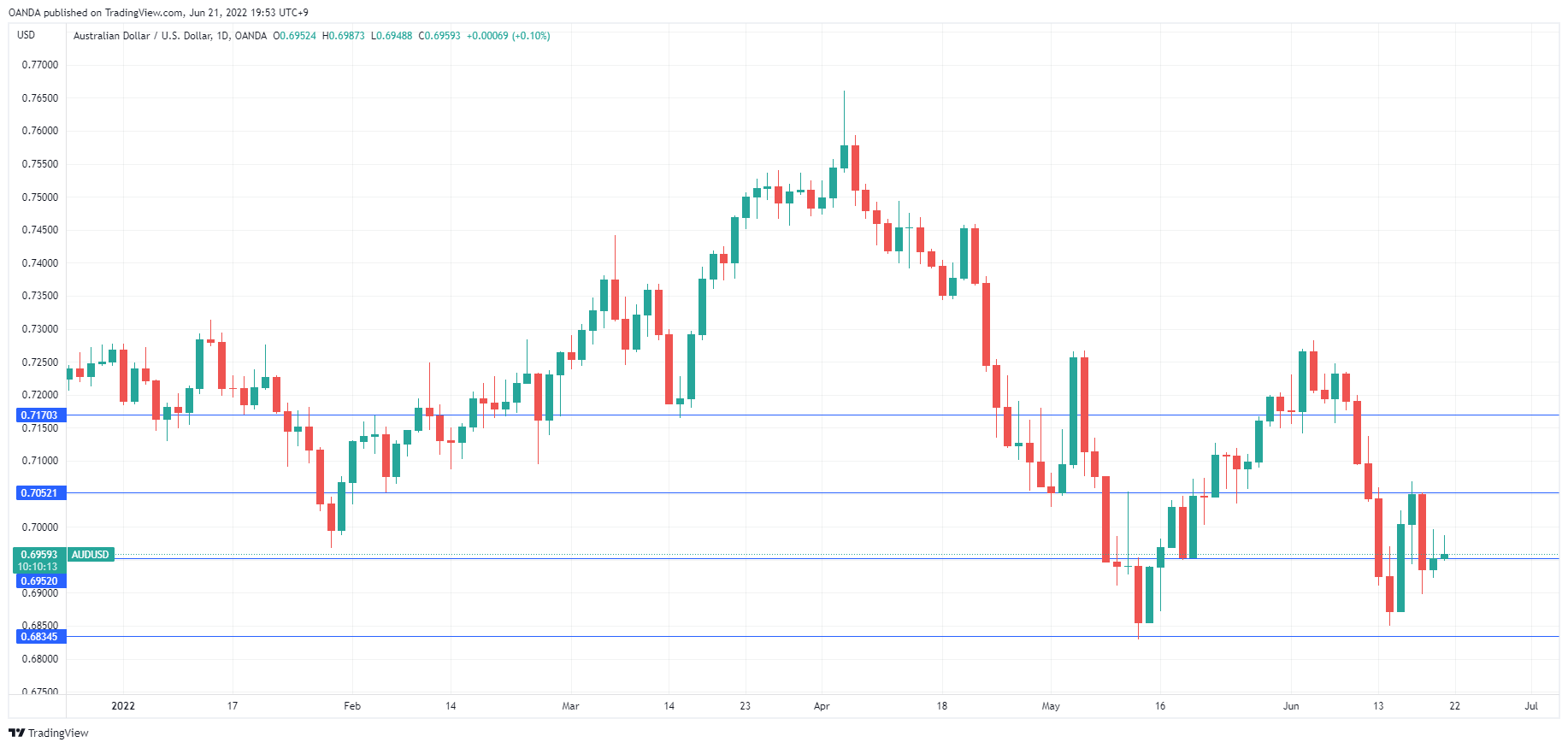
AUD/USD Technical
- AUD/USD is testing support at 0.6952. Below, there is support at 0.6834
- There is resistance at 0.7052 and 0.7170
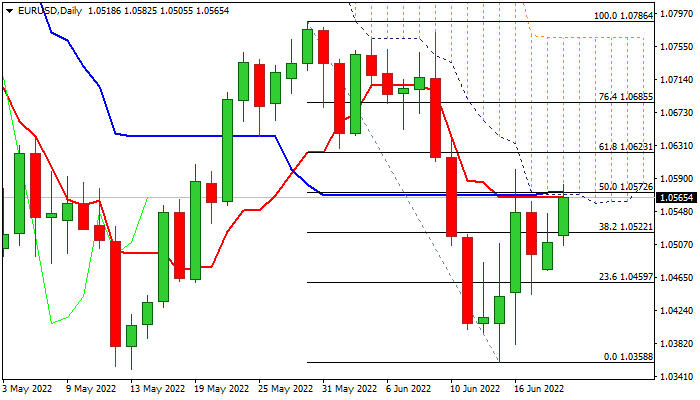
EUR/USD: Recovery Continues to Face Strong Headwinds from Thick Daily Cloud
The Euro advances for the second consecutive day and cracks strong resistance provided by the base of thick daily cloud (1.0569) reinforced by converged daily Tenkan-sen/Kijun-sen.
Recovery was already rejected under the cloud base last week, as cloud heavily weighs on the single currency and adds to negative fundamentals.
Strong dollar’s safe-haven appeal and support from expectation that the Fed will remain aggressive in policy tightening, keeps the Euro in defensive.
I addition, the data released today, showed that EU’s current account balance slipped into deficit for the first time since 2012 that would have a negative impact on Euro, which was supported by a big surplus during past years.
The action is expected to continue to face strong headwinds from thick cloud and repeated failure to clearly break into cloud would signal another recovery stall and keep the downside at risk. Daily techs remain in bearish setup and add to negative outlook.
Res: 1.0601; 1.0623; 1.0641; 1.0686.
Sup: 1.0505; 1.0483; 1.0459; 1.0380.
Bitcoin’s Decline Oversold, But Too Early to Talk About a New Rally
Bitcoin has rebounded 5% in the past 24 hours, trading at $20,800. Ethereum has recovered 6.4% to $1130 in the same time frame. Leading altcoins in the top 10 are adding from a modest 3.5% (XRP) to an impressive 15% (Solana).
Total cryptocurrency market capitalisation, according to CoinMarketCap, rose 5% to $914bn. Tuesday, the cryptocurrency fear and greed index was unchanged at 9 points (“extreme fear”).
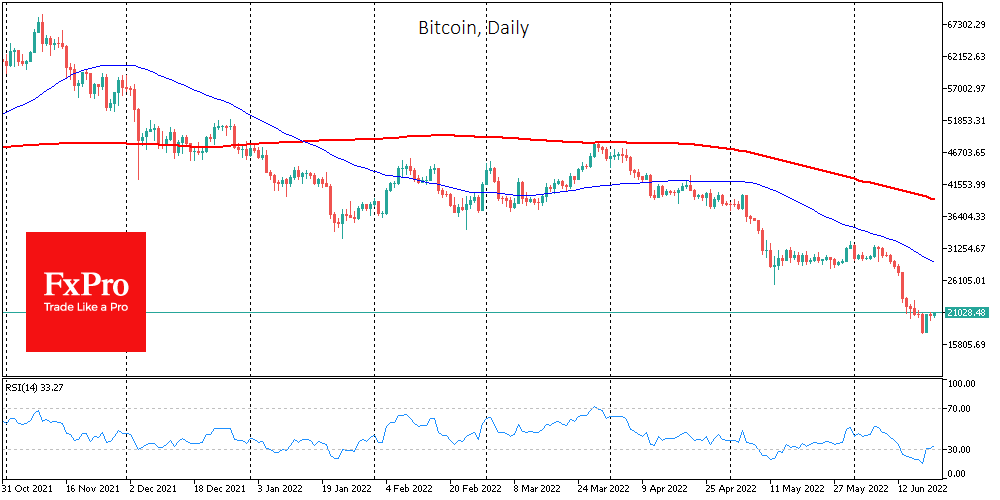
Bitcoin managed to hold above the $20,000 round level on Monday amid weak trading activity due to the US holidays and attracting enough speculative demand after dipping below the meaningful round level. This recovery removes some of the extreme oversold nature of the cryptocurrency. Still, it will be too early to talk about a long-term reversal: all negative fundamentals remain.
In our view, until sharp monetary policy tightening becomes the norm, financial market pressures can quickly negate bounces in cryptocurrencies. Even if we have seen a bottom, it could still be months before the next sustained rally.
Bitcoin’s return above $20,000 does not mean it has hit “the bottom”, warned renowned cryptocurrency critic and gold supporter Peter Schiff.
Kraken exchange marketing director Dan Held said bitcoin had chosen the most pessimistic scenario possible amid rising inflation and an impending recession. According to him, “those who survive will get HODLer status”.
El Salvador President Nayib Bukele urged the cryptocurrency community not to panic as the market falls. According to him, the decline is relatively standard, and market participants must be patient.
JPMorgan Bank said that the rising share of stable coins in the total market capitalisation of the crypto market indicates its growth potential. Changpeng Zhao, chief executive of cryptocurrency exchange Binance, denied media reports that the platform bought more than 100K BTC on a falling market.
ECB Rehn: Sharply rising inflation justifies expedite policy normalization
ECB Governing Council member Olli Rehn said, "with inflation rising sharply, there has been good reason to expedite the normalization of monetary policy,"
"The impacts of Russia's brutal war are being felt around the world, and people are having to pay higher prices for energy and food," he said.
USD/JPY: Bullish Continuation Likely Scenario after Completion of Shallow Correction
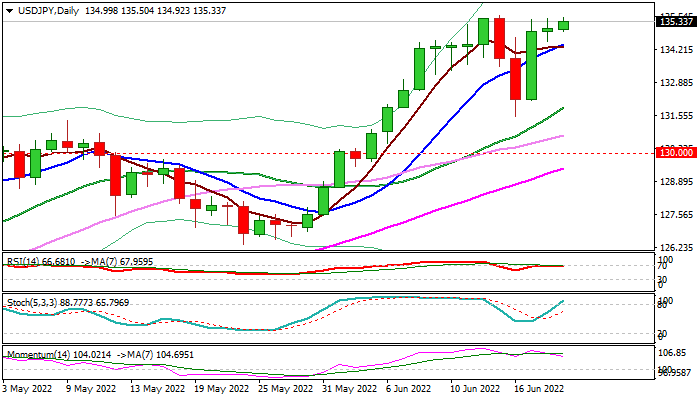
Bulls pressure a multi-year peak at 135.57 on Tuesday after shallow pullback last week, as bear-trap under 112.06 Fibo support and Friday’s bullish engulfing signaled that bulls returned to power and accelerated rebound.
Although daily studies are in full bullish setup, overbought stochastic and sideways-moving momentum, suggest bulls may face headwinds and hold in extended consolidation before fresh acceleration.
Clear break of 135.27 pivot would signal continuation of larger uptrend and expose targets at 136.98 (Fibo 138.2%) and 137.99 (Fibo 161.8%), though larger bulls will look for confirmation on a monthly close above 2002 peak at 135.16.
Rising 10DMA offers initial support at 134.42, which should hold to keep bulls intact, however, deeper dips cannot be ruled out if bulls fail to break higher, with daily Tenkan-sen (133.53) expected to contain.
Res: 136.41; 136.98; 137.99; 138.51.
Sup: 134.92; 134.42; 133.53; 133.00.
AUD/USD: Downside Remains at Risk While Price Stays Below 0.70 Pivot
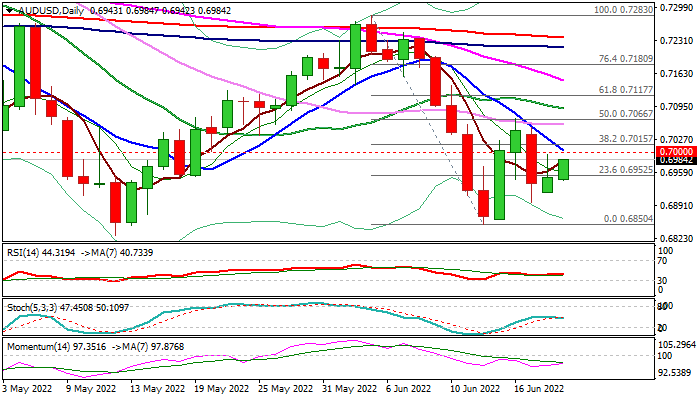
The AUDUSD remains constructive in early Tuesday, though the downside is still at risk after Monday’s action was strongly rejected at psychological 0.70 barrier, reinforced by falling 10DMA, which marks pivotal point.
Technical studies on daily chart maintain strong negative momentum and moving averages are in bearish setup, while the action is weighed by thick daily cloud, suggesting limited recovery.
Near-term bias is expected to remain negatively aligned while the action stays below 0.70 level and keep in play risk of retesting key supports at 0.6850 (June 14 low) and 0.6828 (2022 low).
Alternatively, break of 0.70 pivot would ease downside pressure, but extension above 0.7069 (June 16 recovery top) would generate stronger bullish signal.
The minutes of the Reserve Bank of Australia’s last policy meeting showed that the central bank is on track for further tightening and discussing the size of next hike, with 0.25% and 0.50% increases being on the table.
The policymakers downplayed the expectations for a super-sized 0.75% hike which many anticipated, softening Aussie’s tone.
However the situation remains quite dramatic, as the central bank expects price pressures to continue and revised their inflation forecast to 7% from previous 6% estimation that signals more rate increases, in attempts to bring rising inflation under control and start to push it towards desired 2% target level.
Res: 0.7000; 0.7051; 0.7066; 0.7091.
Sup: 0.6942; 0.6897; 0.6850; 0.6828.
BoE Pill sees tightening of monetary policy over the coming months
BoE Chief Economist Huw Pill said today, "we will do what we need to do to get inflation back to target. And at least in my view, that will require further tightening of monetary policy over the coming months."
"When we assess inflation pressure, we need to take into account the exchange rate," he added. "We see ourselves as steering a narrow path between persistent inflation pressure and recession."
"Terms of trade shock means UK will be poorer, UK must decide how that reduction in income will be distributed."
EURJPY Pushes Above 142.00; Bias Cautiously Bullish
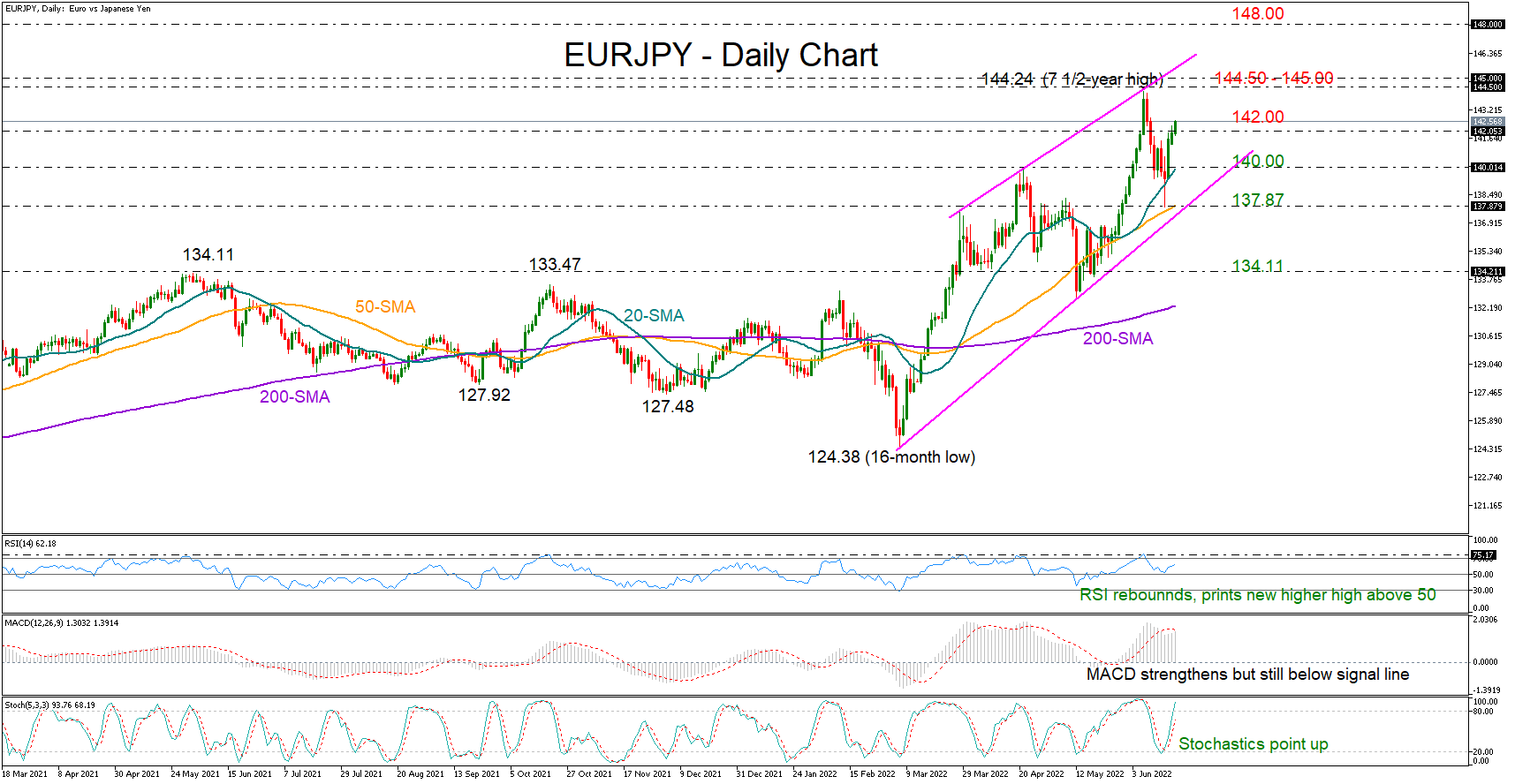
EURJPY is still eagerly pushing for a close above the 142.00 psychological mark, which came to oppose Friday’s quick bounce on the 20-day simple moving average (SMA) and the 139.40 level.
The ascending simple moving averages are endorsing the positive trend in the market, while the rebound in the RSI, which is trying to print a new higher high above its 50 neutral mark, is an encouraging sign that buyers are still in play. The upward trajectory in the Stochastics is backing this narrative as well, though the MACD is signaling some caution as its recent improvement was not enough for the indicator to climb above its red signal line. The momentum indicators on the four-hour chart are rising at a softer pace, mirroring some discomfort among traders too.
If upside pressures persevere above the 142.00 mark, the pair may attempt to breach the 7½-year high of 144.24 with scope to meet the tough resistance line seen within the 144.40 – 145.00 region. Breaking that ceiling, the rally may accelerate up to 148.00, where the 161.8% Fibonacci extension of the latest pullback is placed.
In the event of a downside reversal, the price may immediately seek support near its 20-day SMA at 140.00, where any violation could confirm an extension towards the 50-day SMA and the tentative supportive trendline seen at 137.87. If the latter fails to add footing, the bearish action may fortify towards the 134.11 key barrier. Any step lower from here would neutralize the long-term outlook.
All in all, EURJPY is looking cautiously bullish in the short-term picture. A clear break above the 142.00 may eliminate any skepticism and shift the focus back to June's highs.
Markets Stablise as Global Sentiment Improves
A sense of normality seems to be returning to financial markets after the brutal selloff in global shares last week. Asian stocks rebounded on Tuesday following the positive cues from European markets overnight while U.S futures moved higher after their markets were closed for a holiday. While the improving sentiment could support equity bulls in the near term, caution lingers in the air with investors likely to adopt a guarded approach towards risky assets.
In the currency arena, the dollar kicked off the week in a shaky fashion while gold waited for another fresh directional catalyst to break out of its current range. Oil prices rose 1% this morning, clawing back more of last week’s steep losses as market players focused on the tight supply dynamics in the commodity.
The week ahead promises to be eventful and potentially volatile thanks to key economic reports from major economies and Fed Chair Jerome Powell’s semi-annual testimony before Congress. Major themes ranging from inflation fears, rate hike expectations, ongoing geopolitical risks, and recession concerns will influence the market mood.
All eyes on Powell's testimony
Fed Chair Jerome Powell will be under the spotlight this week as he testifies before Congress over two days.
Last week, the Federal Reserve raised interest rates by 75 basis points – its biggest increase since 1994. However, the central bank reassured markets that such jumbo-sized rate hikes would be rare. Powell’s testimony will be closely scrutinised for hints about incoming rate hikes and the outlook for the US economy. Should Powell strike a hawkish note and offer fresh insight into rates, this may boost expectations that the central bank will maintain an aggressive approach towards rates. Traders are pricing in an 89% chance of a 75-basis point rate hike at the next FOMC meeting in July.
Taking a look at the dollar, it has weakened against most G10 currencies this morning. The Dollar Index (DXY) could extend declines if a breakdown below 104.0 is achieved. Alternatively, a move above 104.50 may signal an advance towards 105.00.
Oil prices buoyed by supply worries
Oil prices pushed higher on Tuesday as investors focused on the persistent supply constraints and tightening market conditions. Given how the global commodity remains pulled and tugged by conflicting forces, this could result in more volatility down the road.
On one side of the equation, ongoing geopolitical risks and sanctions on Russian supplies continue to support prices. However, the Fed's aggressive hawkish stance has fanned concerns of an economic slowdown which will hit the demand outlook. Despite the conflicting forces, oil benchmarks are up almost 50% since the start of the year.
In regard to the technical picture, Brent crude prices remain under pressure after the steep selloff last Friday. A breakdown below $112.00 could encourage a decline towards $104 and $100. A move above $116.00 could inspire a move back towards $120.
Commodity spotlight – Gold
After the explosive volatility last week, gold has kicked off the new week on a calmer note. The lack of momentum suggests that a fresh fundamental spark needs to be brought into the picture to trigger the next major move in gold. Such a catalyst could come in the form of Fed Chair Jerome Powell’s testimony before Congress this week.
Looking at the technical picture, gold prices are trading below the 50, 100, and 200 SMA on the daily charts. Strong support can be found at $1800 and strong resistance at $1900. There seems to be minor support around $1830. A solid breakdown below this level could encourage a decline towards $1800 and $1764. A breakout above $1858 could trigger a move higher towards $1870 and $1900, respectively. Beyond $1900, the first checkpoint can be found at $1920.