Sample Category Title
GBP/JPY to Test Peak
The Japanese yen weakens as the BoJ’s meeting minutes confirm its ultra-loose stand. The sell-off came to a halt at the psychological level of 160.00 where the pair first broke out in late May. The latest rally above 166.00 further trimmed the downward pressure. A break above 168.60 would put the rally back on track. The uptrend remains intact in the medium-term and the bulls may see pullbacks as an opportunity to jump in. 165.50 is the first support as buyers may wait for the RSI to drop back into the neutral area.
EUR/USD Attempts to Rebound
The US dollar finds support from higher Treasury yields. The pair saw strong support near May’s lows (1.0380). A surge above 1.0500 prompted short-term sellers to cover and paved the way for a rebound. This is a sign of robust interest in keeping last month’s rally intact. 1.0660 is former support that has turned into a resistance. Its breach would bring the single currency to the recent peak near 1.0770, which is the last hurdle before a meaningful recovery. On the downside, 1.0460 is fresh support in case of a pullback.
GBP/USD Technical Analysis 22th June 2022
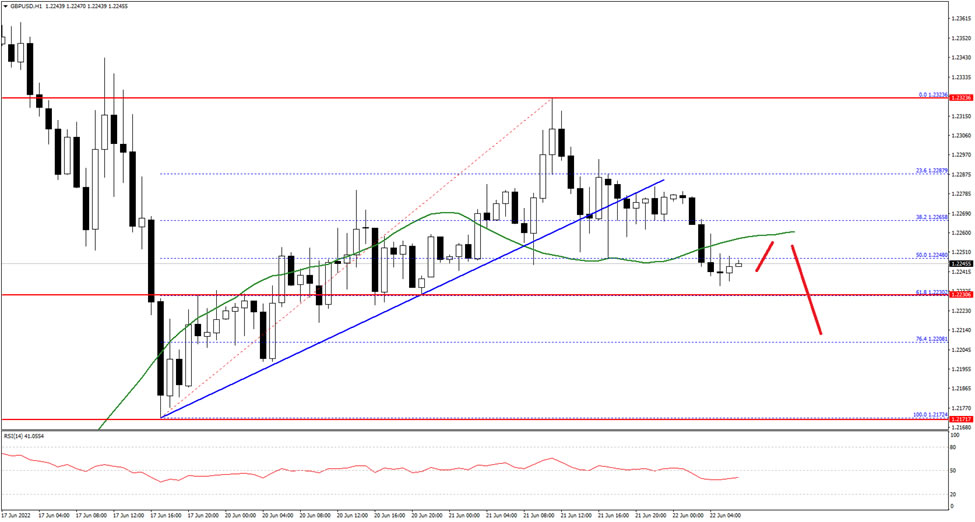
The British Pound started a fresh decline from the 1.2325 resistance against the US Dollar. The GBP/USD pair traded below the 1.2300 support zone to enter a bearish zone.
There was a break below a key bullish trend line with support near 1.2270 on the hourly chart. The pair even declined below 1.2250 and the 50 hourly simple moving average. It is now showing bearish signs below the 1.2250 level on FXOpen.
The next major resistance sits near the 1.2265 zone. If there is a clear upside break above the 1.2265 resistance, the pair could rise steadily towards the 1.2300 level in the near term. The next major resistance sits near the 1.2325 level.
On the downside, an initial support is near the 1.2230 level. The main support is forming near the 1.2200 level. A break below the 1.2200 support could even push the pair below the 1.2170 support.
Main Focus Will Go to Fed Chair Powell’s Testimony Before the Senate
Markets
US investors returned from a long weekend and immediately left a stamp on trading. Especially equity markets were in good shape. Main indices jumped between 2.15-2.51%. European equities had to settle for <1%. The improved sentiment filtered through in core bond markets. US Treasuries underperformed German Bunds in a catch-up move. The US curve steepened by adding 1.6 bps at the front-end (2y) to 5.7 bps further out (20y). German yields rose 2.2-3.4 bps in the 10y-30y bucket. Both closed at a new cycle high. Peripheral spreads vs. Germany’s 10y continued to narrow for the likes of Italy (-3 bps) and Greece (-10 bps) amid excitement for the ECB’s yet-unknown new anti-fragmentation policy tool. The Japanese yen felt pressure from global sentiment and the BoJ sticking to its easing guns. USD/JPY surpassed the 135 resistance zone (2002 top) to close at 136.57, the highest in 24 (!) years. EUR/USD enjoyed a decent bid but lost momentum as (US) trading developed. The pair closed a little higher at 1.053. Bank of England chief economist Pill said he’s willing to sacrifice growth to cut inflation. It’s posing sterling for a difficult trade-off between tempting interest rates (Gilts underperformed yesterday) but an increasingly gloomier economic picture. EUR/GBP simply decided to stay put (close at 0.858, unchanged).The Asian stock bounce yesterday already goes into reverse today. We’ve seen no specific trigger or concrete news, confirming our view of a sell-on-upticks market. South Korea is lagging with losses amounting to 3.5%. Core bonds, the dollar and the Japanese yen attract safe haven bids. The trade-weighted greenback (DXY) advances to 104.70. USD/JPY gives up a slight part of yesterday’s gains. EUR/JPY (142.95) changes course after hitting the 144 resistance area/cycle high yesterday.EMU consumer confidence (June) is due today but the main focus will go to Fed chair Powell’s testimony before the Senate. The text released on Friday highlighted the Fed’s “unconditional” commitment to restore price stability. We don’t expect the tone before Congress to differ much from that or from the policy meeting last week. The actual grilling by Congress members could be interesting though. Will political attention already shift a bit from growth or is it too soon with surging prices dominating the political discourse going into the November mid-terms? Whatever the outcome, risk sentiment will probably prove the market theme for today anyway. UK inflation in May couldn’t be more close to expectations, coming in at 0.7% m/m to be up 9.1% y/y, slightly higher than last month (9%). Core inflation edged down a bit more than anticipated, to 5.9%. The numbers justify last week’s message by the BoE to raise rates faster if needed.
News Headlines
Italian Foreign Minister Luigi Di Maio on Tuesday announced that he’s leaving the 5-Star Movement. He will form a new parliamentary group. The split in the 5SM comes as the party is internally highly divided on the support of Italy for Ukraine. 5SM leader Conte recently became ever more critic on Italy sending weapons to the country. At the same time, Di Maio doesn’t want to break ranks with PM Draghi’s supportive policy towards Ukraine. There is growing speculation recently that Conte wants the 5SM to leave the government coalition as the party is losing support in the opinion polls, but the party yesterday dismissed this. It is unsure how many how many 5SM members will join Di Maio. For now the split doesn’t cause an immediate danger to the majority of PM Draghi’s government. Even so, it is not good news for the stability of the coalition ahead of next year’s elections.
US existing home sales data yesterday provided a mixed picture. Sales dropped for the fourth consecutive month (3.4% M/M) to the lowest level since June 2020 as mortgage interest rates continue to rise. At the same time, the median average selling price for the first time rose a record north of $400 000 (+14.8% y/y). Higher prices and higher mortgage rates are making houses less affordable for new buyers. At the same time, prices still are supported by a very low inventory levels of houses for sale. Earlier this month housing starts and building permits data already showed a loss of momentum.
All Eyes on Powell
US equity markets kicked off the short trading week with a bang. Major US indices jumped more than 2% yesterday with Nasdaq leading gains with a 2.50% advance in the session. Tesla gained 9.35% to close the session above the $710 level and FAANG stocks gained 1.80%.
But the gains may not last as Jerome Powell’s semiannual testimony could turn the market mood sour again as the Fed Chief is expected to reiterate his strong commitment to fighting inflation even if it means slower economy and a softer jobs market.
Joe Biden said earlier this week that he doesn’t think the recession is inevitable, but Goldman upped its recession expectation from 15 to 30%, and Morgan Stanley said that the S&P500 must drop another 15-20% to fully reflect the scale of contraction.
Therefore, yesterday’s rally in stocks could be another dead cat bounce, and we may see the market painted in red in the following sessions. The US futures are already in the red this morning.
Calm before the testimony
The calm reins in the FX markets, with the dollar index pushing higher this morning, as the markets prepare for some hawkish comments from the Federal Reserve (Fed) Chair Jerome Powell today.
The EURUSD is back below the 1.05 mark, the dollar-yen extends gains above the 137 mark, with the bulls targeting the 140 level on the back of a clear divergence between the Fed and a still-dovish Bank of Japan (BoJ), and the USDCAD is back above the 1.30 level, after a short tentative to break below. The hawkish Fed pricing and cheaper oil play in favour of a higher USDCAD in the short run.
Gold is stuck between a rock and a hard place
Gold is down for the fourth day. The yellow metal is stuck between a rock and a hard place. When the risk sentiment is poor, it is held back by rising US yields, which reduce the safe haven flows to the precious metal. And when the sentiment gets better, it is held back by improved risk appetite, which drives capital to riskier and better yielding assets. And because the US yields rise parallel to inflation expectations, gold sees hardly the benefits of rising inflation expectations.
Plus, there is news that Switzerland, which is the world’s biggest refining and transit center, imported some $200 million worth of gold from Russia for the first time in May, hinting at a softer industry protest for the war in Ukraine, and a potentially higher supply which could further weigh on the yellow metal’s price.
Oil and commodities feel the pinch of global recession fears, as well
iShares Diversified Commodity index broke the 50-DMA significantly for the first time this year. And the energy and commodities’ effectiveness in hedging the rising inflation may be easing, as a global recession would hit demand, and let the energy sector retrace a part of last year’s rally.
The latter is true for oil prices. The barrel of American crude tanked to $106 per barrel this morning on the back of recession fears. We shall see a strong support near the 100-DMA level, around $106pb, but the real test will be the $100 psychological level, if the fall continues.
A persistent fall in oil prices will hint that the global recession fears are taking the upper hand, and weigh heavier than the positive factors such as a tight supply, prospects of Chinese reopening and booming travel.
Joe Biden’s efforts have little impact. The release of strategic reserves and improved relations with Saudi Arabia could hardly ease the price at the pump. The federal gas tax holiday will probably remain ineffective as it won’t help an average SUV driver to save significantly, it won’t last beyond mid-term elections and it may not even have a bipartisan approval as the gas contributes to the Highway Trust Fund, and suspending it would cut the flow to a critical infrastructure.
So, the best option is a recession-led demand shock to stop the rally to pull the price of a barrel below the $100 level, and ideally toward the $92, the 200-DMA.
Mind Bank of Japan
Market movers today
UK CPI inflation in May is due this morning. Inflation is likely to remain very high so there is definitely still a lot of pressure on the Bank of England to hike the Bank Rate further despite concerns about the economic outlook.
Simultaneously with UK inflation, we also receive Swedish unemployment data. Due to the large volatility in the unemployment numbers we refrain from providing an official forecast. However, we are having a close look at the hours actually worked, as they are an important indicator for the economic activity and thus the GDP outcome for the second quarter. Danish consumer confidence is also out this morning.
Later in the day we will look out for weekly US mortgage applications, as housing market risks are increasing because of rising interest rates. Euro area consumer confidence is due out at 16:00 CEST. Consumer confidence is likely to remain at depressed levels, as consumers still feel pain from high inflation rates.
Besides that, there are several central bank speeches. Most notably is Fed Chair Jerome Powell's testimony to Congress. We also hear from other Federal Reserve policymakers, Bank of England's Jon Cunliffe and SNB Chairman Thomas Jordan.
The 60 second overview
Markets: Sentiment has soured overnight with recession fears creeping back into markets. After a few days of relief the big equity futures are trading solidly in red this morning and also yields are moving lower. Brent crude has shown remarkable resilience this spring. Despite China weakness and record selling of strategic oil reserves oil prices have until recently managed to stay little changed or even move higher. Meanwhile, this seems to have changed over the last week amid rising global growth concerns and this morning Brent Crude has fallen to 111 USD/bbl. The USD is stronger and cyclically sensitive currencies are trading on the back-foot again. It is difficult to pinpoint the mood change to any single event this morning. Instead it highlights the more general challenging macro backdrop for risky assets amid central banks forcefully tightening policy into a cyclical slowdown.
Bank of Japan (BoJ): Amid a window of opportunity to finally lift inflation and inflation expectation to target, BoJ remains one of the very few global central banks that so far have not signalled a need to tighten monetary policy. BoJ still operates with a yield curve control targeting 10Y Japanese government bonds at 0.25% - far below current market levels for government bonds in the rest of the world. In order to defend its yield target BoJ must buy massive amounts of bonds and thereby adding equivalent amounts of JPY into the Japanese money market system. This has contributed to a record weakening of the JPY and an interesting connection to Fed monetary policy: the more Fed tightens, the more BoJ is forced to ease.
The JPY slide has resumed this week and while souring risk appetite overnight has supported JPY slightly, USD/JPY yesterday traded through 136.5 - the highest level since 1998. The renewed pressure on JPY comes from markets realising that the Bank of Japan (BoJ) is not planning on giving in to the global pressure for higher yields. The yield curve control remains in place. Last week BoJ decided not to alter its policy stance and this week Prime Minister Kishida has confirmed his backing of BoJ's yield curve control.
Long-end Japanese inflation expectations have risen over the last year but remains below 1% and hence still far below BoJ's 2% inflation target. For this reason we do not expect BoJ to scrap its yield curve control in the near-term. Yet we still highlight that this is one of the biggest single global macro and market event risks for the coming years. Lessons from the Swiss National Bank in 2015 show that scrapping market price targets can yield substantial market volatility. When BoJ ultimately decides to scrap its policy it would act as a global duration shock not only to Japan but also to the rest of the world.
Sweden home prices: Given that Danske Bank's home-price indicator for flat prices in Stockholm showed a price decline of 3% (-1.3% SA) during May, it was not of surprise that this morning's HOX Valuegard Home-Price Index revealed a country-wide downturn for the housing market of 1.6% (-1.2% SA). Among the big cities, flat prices in Stockholm fell the most (-3%) according to HOX Valuegard. First indications for June show a further decline at the same time as transaction volumes during May and June (so far) are substantially lower than normal.
Equities: Equities were almost 2% higher yesterday and basically without any news. This tells of course something about the volatile period we are in and the massive uncertainty among investors. As this has been the case for most of 2022, we see a more or less continuously lowering of equity share in balanced funds and we are at a level were pessimism is extremely high. When pessimism is at the current level, it does not take that much good news to bring a rally of 5-10% in equities. Defensives made a small outperformance to cyclicals, which in itself is not so special however, as markets were up 2% we would typically see cyclicals outperforming if investors were becoming more optimistic. As defensive outperforming it tells us investors are not convinced about a sustainable rally being ahead of us. In US, Dow +2.2%, S&P 500 +2.5%, Nasdaq +2.5% and Russell 2000 +1.7%. Asian markets are lower across the continent this morning and the same goes for European and US futures that have been sliding steadily overnight.
FI: The global bond markets are still caught in deciding whether to increase the recession risk into the pricing of the yield curves or whether the tightening of global monetary policy can manage to get a "soft landing". The support for more front-loading in the US continues to be strong. Yesterday, the Federal Reserve member from Richmond supported the "75bp" strategy as he stated that policy rates should be raised as fast as possible. We have more speeches tonight from Federal Reserve members including Fed Chairman Powell.
The discussion of the anti-fragmentation tool has brought stability to the BTPS-Bund spread that is now again below 200bp. Hence, it has brought some stabilization short-term.
FX: Amid souring risk appetite overnight the USD has gained while commodity and cyclically sensitive currencies have weakened.
Credit: The European credit markets had a relatively uneventful day Tuesday with iTraixx main tightening by 1bp to 107bp and Xover tightening by 4bp to 538bp. Overall the credit market seems to be in consolidation mode currently after steep spread widening in recent weeks.
Gone in 60 Seconds
Gone in 60 Seconds was a movie released in 2000 starring Nicholas Cage who is charged with stealing 50 high-end cars in three days. It is actually a remake of my preferred 1974 version, where the “hero” is set a much more reasonable target of stealing 48 cars in five days, but I guess that is productivity progress for you. The premise is that from start to finish, one must break into the car and be driving it off (preferably in a cloud of tyre smoke), within 60 seconds, thus avoiding the long arm of the law.
Gone in 60 seconds is what the equity market is looking like today, with the outsized overnight rally on Wall Street, disappearing in a cloud of smoke this morning, with no real reason why. Although the S&P 500, Nasdaq and Dow Jones all finished well over 3.0% higher overnight, US index futures have headed south this morning, and Asian equities completely ignored Wall Streets' overnight rally for a change.
The term “bear market rally” does come to mind, and given that currency markets didn’t move overnight, and US yields actually rose, it does seem as if Wall Street came back to work with a post-holiday glow, especially as equities globally did quite well over the US long weekend. On top of that US existing home sales continued to ease, maybe the FOMO gnomes of Wall Street felt it meant less Fed hiking? It seems that markets just can’t shake off fears of intensive central bank tightening and recession nerves.
It's another slow day for data internationally, leaving markets to stew in their recessionary juices and react to headlines. UK Inflation is released at 1400 SGT, with the headline YoY for May expected to rise to 9.10%. A Bank of England member did come out on the hawkish side of the fence, even if it meant a recession. That will be of little solace to the pound, which held steady overnight. Britain is in the throes of a winter of discontent over the cost of living, with a huge rail strike disrupting the country this week. Anyone wondering why stagflation is fait accompli for central banks, need only look at Britain. Do nothing and expect protests on the streets, tighten policy and cause a recession.
With that in mind, all eyes will be on Fed Chairman Jerome Powell tonight, who has the unenviable task of semi-annual testimony on Capitol Hill tonight. (he is also speaking tomorrow) Markets will be standing by to dissect every word the poor man utters for clues on the direction of monetary policy. The FOMO gnomes of Wall Street will be desperately looking for signs he is blinking on tightening so that they can rush back into their buy-the-dip happy place.
On the side-lines, a few things are happening in Asia today. Oil has slumped by 3.50% although I cannot see any notable reason for it. Maybe some large positions are being shopped, or perhaps it is a reaction to expectations that US President Biden will announce a suspension of Federal fuel tax tonight. That’s about 19 cents a gallon, making it drop in the ocean for gasoline prices. Maybe 3.50% of oil futures prices is equivalent to that?
In the equity space, South Korea Kospi is getting an outsized beating today. The Kospi is down just over 2.0% at the moment, rather a surprise after the successful test of a rocket to launch satellites yesterday. Perhaps markets believe it can also be loaded with high explosives and pointed north? More likely it seems, are reports of two monkeypox cases in South Korea. The pandemic has left markets frazzled about viruses. I welcome any input from readers more connected or cleverer than I. (the latter being a low bar)
We should also be paying attention to Europe right now, most especially the energy space. Russian natural gas flows have slumped with each side blaming the other. Countries across Europe are activating emergency energy plans, including reactivating coal-fired power plants. Even the greens are finally admitting that a clean energy transition is incompatible with the short-term goals of a war-time economy. (nb: I’m a tree hugger but also a realist, especially around nuclear power and transitioning the energy transition and wat-time economic needs. Don’t email me accusing me of wanting to cut down the Amazon forest) If Russian gas continues to fall, we can pencil in a European recession if they hold their nerve with Vladimir. The Euro is likely to make its way towards parity shortly thereafter. A recession in Europe will be another headwind for growth globally and give the ECB a few more stagflation headaches.
Following Mr Powell, we also have the Fed’s Barkin, Evans and Harker speaking this evening. Barkin was particularly hawkish on the wires overnight, which made the Wall Street rally even more surprising. We also have a 20-year bond auction and the bid-to-cover ratio will be interesting. If all four are aligned as the four riders of the monetary policy apocalypse, yesterday’s Wall Street equity rally looks more and more like gone in 60 seconds.
Asian equities ignore the overnight Wall Street rally
Wall Street rallied broadly overnight, with the three main indexes having banner days as the call of buy-the-dip proved irresistible after a weekend in the Hamptons. The S&P 500 rallied by 2.45%, the Nasdaq leapt 2.51% higher, and the Dow Jones booked a healthy 2.19% gain. Unfortunately, US index futures in Asia are telling a story of fast-money locking in short-term overnight gains as all three head south. S&P 500 and Dow futures have sunk by 0.85%, while Nasdaq futures have fallen by 0.70%.
Rather surprisingly, Asian markets, even the Wall Street following slaves in Japan and Australia, have completely ignored the overnight rally, with most of Asia flat to lower. The abrupt about-turn by US futures today could be behind it when combined with a lack of conviction about the overnight rally’s staying power.
Japan’s Nikkei 225 is 0.20% lower today, while the South Korean Kospi has slumped by 2.0%, perhaps over monkeypox fears. Mainland China’s Shanghai Composite is down 0.30%, with the CSI 300 falling by 0.45%. In Hong Kong, Hang Seng has retreated by 1.30%.
Across regional markets, Singapore has eased 0.40% lower, while Taipei has slumped by 2.0%. It is interesting that the Caligula’s of semi-conductor manufacturing, Taiwan, and South Korea, are the day's worst performers. Perhaps it is a proxy play for a US and Europe recession? Kuala Lumpur has fallen 0.70%, Jakarta by 0.30%, Bangkok by 0.60%, and Manila by 0.40%. In Australia, the ASX 200 is 0.10% lower, with the All Ordinaries down by 0.20%.
Asia-Pacific markets, ex Taipei and Seoul, appear content to adopt a wait-and-see approach this week, letting the dust settle on the Powell testimony. That caution is likely to finally nip the European equity rally in the bud as well, which has been ignoring the natural gas crisis completely and at its peril. European equities are likely to open lower this after in line with Asia.
Currency markets continue their sideways trading
With the notable exception of the Japanese Yen once again, currency markets refused to buy into the snake oil promises of the equity markets. The US Dollar did push lower intraday across the board but recovered as US yields held firm. The dollar index finished almost unchanged at 104.42, edging higher to 104.60 in Asia, as equities sink. The dollar index has support at 1.0350 with resistance now distant at 1.0570.
EUR/USD rose just 0.22% to 1.0535 overnight, an intraday rally fading ahead of 1.0600 once again. In Asia, risk sentiment has soured, sending the single currency 0.22% lower to 1.0510, unwinding the overnight gains. It has initial resistance at 1.0600, with challenging resistance at 1.0650. Support is at 1.0450 and 1.0400. Sterling rose just 0.25% to 1.2280 overnight, unwinding that move and falling 0.30% to 1.2240 in Asia. GBP/USD has initial resistance at 1.2360 and 1.2400, with support at 1.2200 and then 1.1950.
USD/JPY was the big mover in the DM space overnight, rocketing 1.15% higher to 136.65, a 24-year high. In Asia, it has fallen 0.35% to 136.20 after some belligerent comments about currency moves by the Bank of Japan. The Bank of Japan minutes though, reveal the committee is comfortable with monetary policy settings, and although not happy with the Yen vol, is not hitting the panic button at all. US yields firmed overnight, boosting USD/JPY, and although I don’t rule out some nasty downside corrections, they are likely to be short-lived in the current environment. Only a sharp, and I mean sharp, fall by US yields is likely to stop the USD/JPY rally. USD/JPY has support at 135.00 and 134.50, with resistance at 136.65 and 138.00.
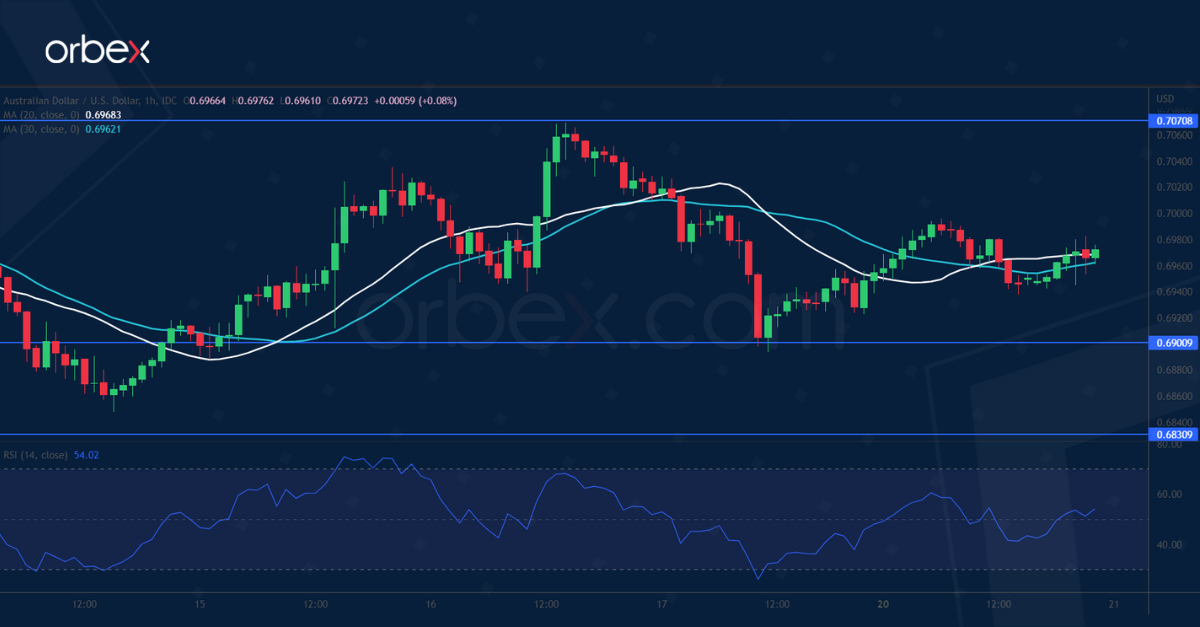
AUD/USD and NZD/USD booked modest gains overnight but have slumped today as risk sentiment has soured. AUD/USD has fallen 0.60% to 0.6930, and NZD/USD has slumped 0.95% to 0.6275. While supports at 0.6850 and 0.6200 hold respectively, further gains to 0.7150 and 0.6450 cannot be ruled out, but both down under dollars remain as tied to swings in investor sentiment as ever.
Asian currencies saw no sentiment-driven gains overnight, and in fact, most post small losses versus the US Dollar. Another warning sign that the overnight Wall Street rally was a solitary rear-guard action. With the US Dollar strengthening today, Asian currencies are in retreat. USD/KRW, USD/CNH, USD/CNY, USD/INR and USD/PHP have all gained around 0.40% this morning. A hawkish Jerome Powell this evening, with reinforcement from the other Fed speakers could prelude more Asian FX weakness, and I wouldn’t be surprised to see the Bank of Korea, Bank Indonesia and the BSP Manila all intervening tomorrow.
Oil prices slump in Asia
Oil prices probed the topside intraday overnight but gave back those gains with Brent crude almost unchanged at $114.60 a barrel, and WTI edging 0.55% lower to $109.65 a barrel. In Asia, both contracts have slumped, with WTI notably, falling through longer-term support. Brent crude has fallen 3.40% to $110.75, and WTI has fallen by 3.80% to $105.50 a barrel.
There is a distinct lack of drivers behind this move, and certainly no headlines to justify it. I surmise that President Biden’s expected announcement of a temporary suspension of Federal fuel taxes this evening has prompted the selling, and I do note the US-centric WTI contract is leading the charge lower. From here, a more likely outcome is a widening of the Brent premium over WTI. Brent is the internationally traded benchmark and in the real world, supplies remain as tight as ever.
Today’s falls have bought my six-month support lines back into focus. WTI has fallen through its six-month support line at $106.30 a barrel and is attacking the 100-day moving average (DMA) at $105.40. A daily close below $105.40 would be a very bearish technical development for WTI. Brent crude’s 100-DMA is at $108.40 today, with the six-month support line at $107.30 a barrel. Failure of the latter would also be a powerful bearish technical signal, although Brent crude remains well clear of both levels.
Given the weight of speculative long-positioning in WTI especially, it looks the more vulnerable to the Biden gasoline put. However, I remain of the opinion that the contortions of the futures market are not representative of the real-world situation. As such we shouldn’t get our hopes up for sub-$100 dollar oil just yet.
Gold range continues
Although gold’s interminable range-trading continued overnight, the falls of the past three sessions to hint that any upward momentum for the yellow metal is doing an Elvis and is leaving the building. Gold has been grinding lower, even as US yields and the US Dollar trade sideways.
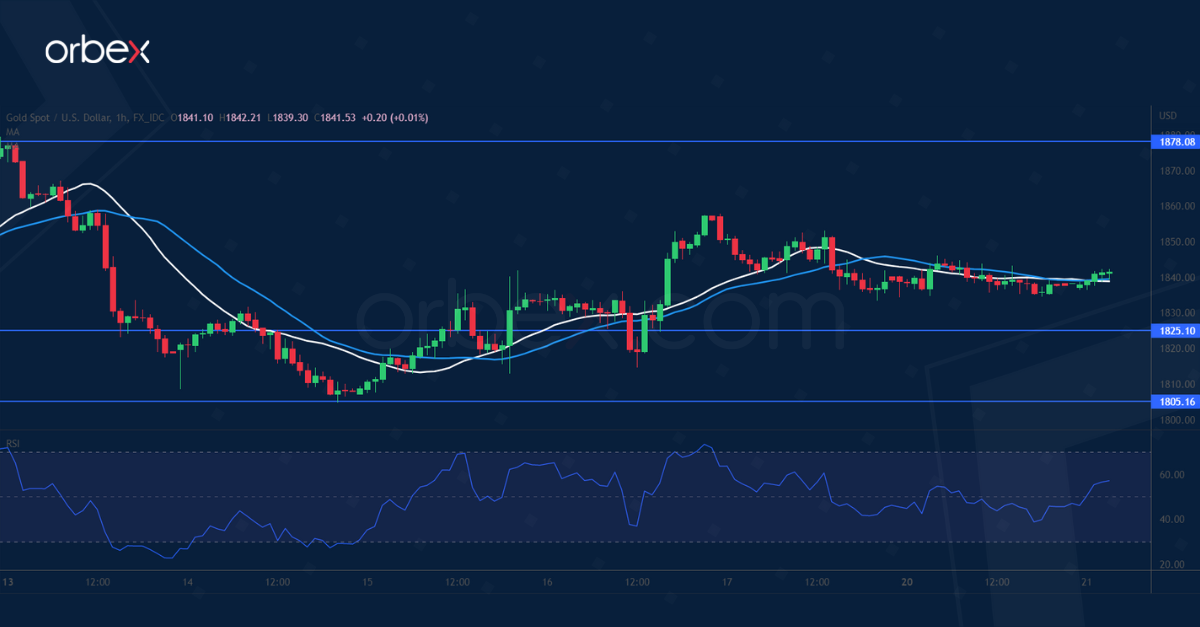
Overnight, gold edged 0.30% lower to $1833.00 an ounce, falling another 0.33% in Asia to $1827.00 an ounce as US Dollar strength returns. A bout of US Dollar strength post-Powell testimony could finally set up a meaningful test of the bottom of the recent range around $1800.00 an ounce.
Gold has resistance at $1860.00 and $1880.00, the latter appearing an insurmountable obstacle for now. Support is at $1805.00 and then $1780.00 an ounce. Failure of the latter sets in motion a much deeper correction, potentially reaching $1700.00 an ounce. On the topside, I would need to see a couple of daily closes above $1900.00 to get excited about a reinvigorated rally.
EUR/USD Daily Outlook
Daily Pivots: (S1) 1.0502; (P) 1.0542 (R1) 1.0576; More...
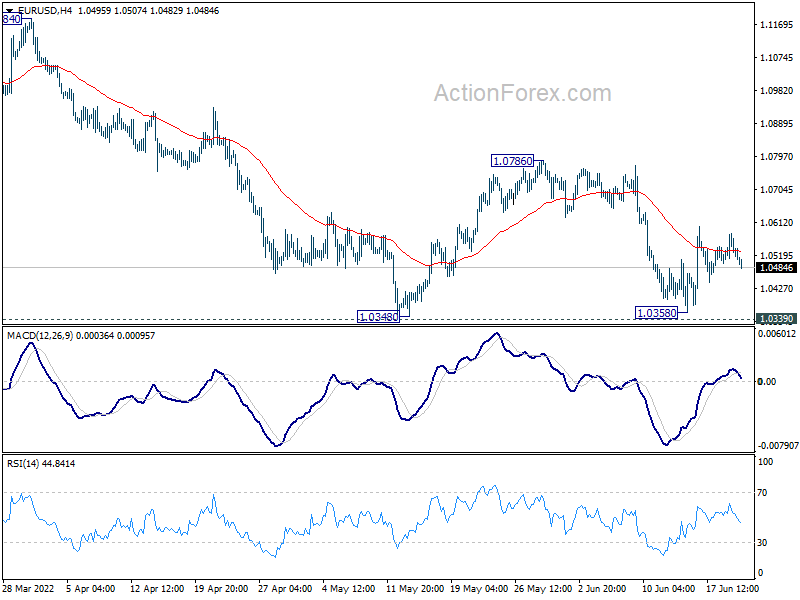
EUR/USD is still bounded in range of 1.0358/0786 and intraday bias remains neutral. Further fall is in favor with 1.0786 resistance intact. On the downside, sustained break of 1.0339/48 will resume larger down trend. Next target is long term projection level at 1.0090.
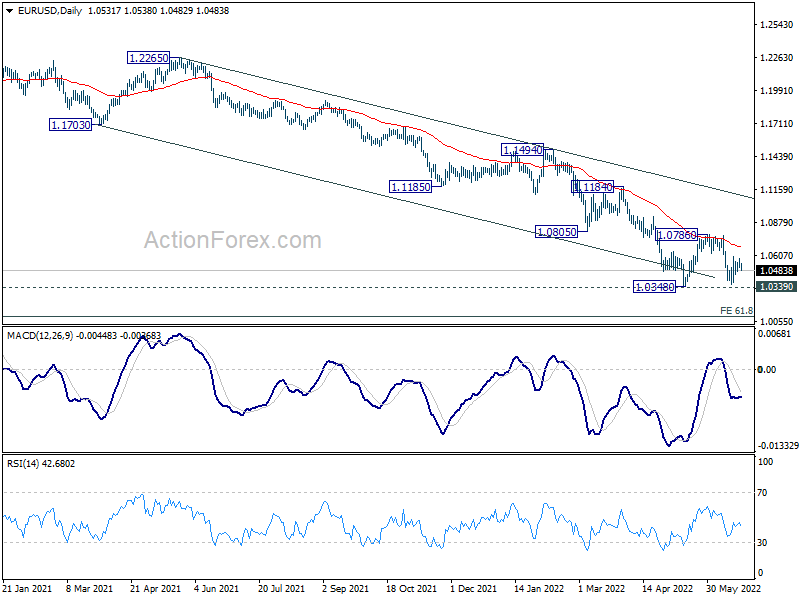
In the bigger picture, focus stays on 1.0339 long term support (2017 low). Decisive break there will resume whole down trend from 1.6039 (2008 high). Next target is 61.8% projection of 1.3993 to 1.0339 from 1.2348 at 1.0090. However, firm break of 1.0805 support turned resistance will delay this bearish case, and bring stronger rebound first.
GBP/USD Daily Outlook
Daily Pivots: (S1) 1.2241; (P) 1.2282; (R1) 1.2323; More...
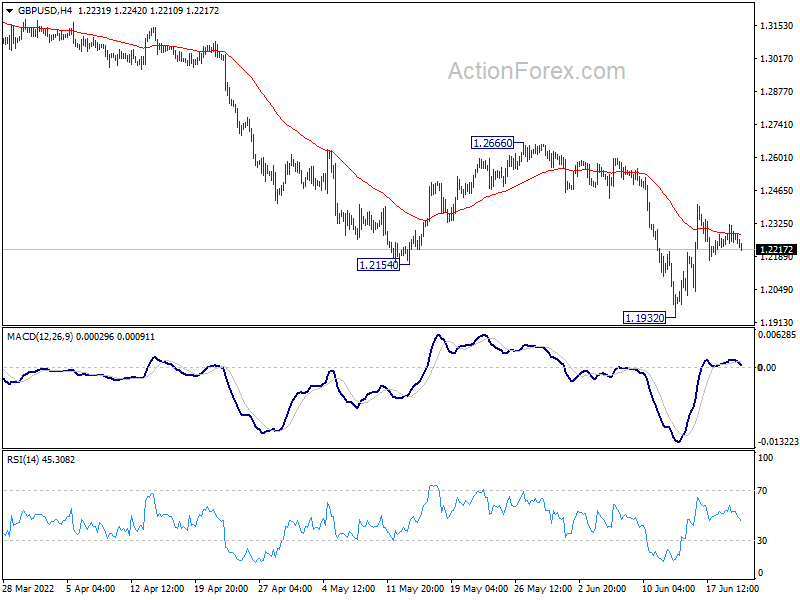
GBP/USD is staying in range of 1.1932/2666 and intraday bias remains neutral. Outlook stays bearish as long as 1.2666 resistance holds. On the downside, break of 1.1932 will resume larger down trend from 1.4248. However, firm break of 1.2666 will suggest medium term bottoming and bring stronger rebound back towards 1.3158 support turned resistance.
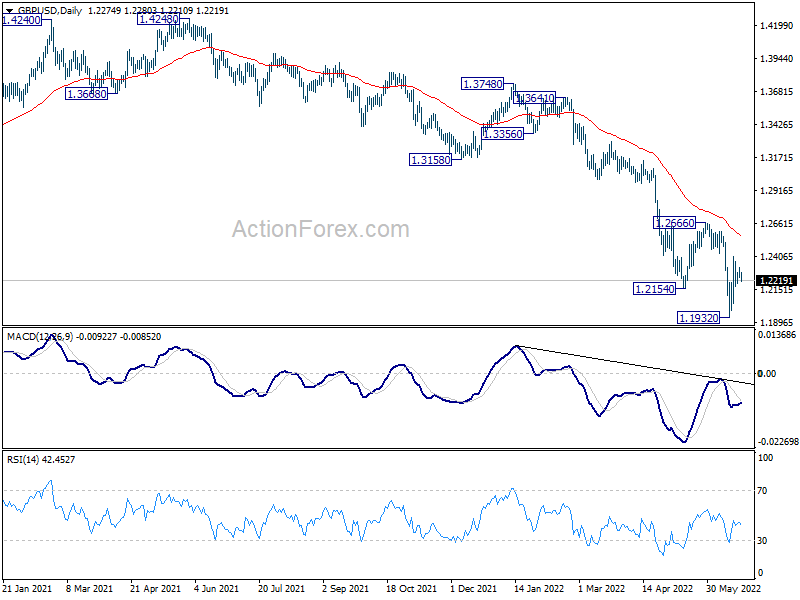
In the bigger picture, fall from 1.4248 (2018 high) could be a leg inside the pattern from 1.1409 (2020 low), or resuming the longer term down trend. Deeper decline is expected as long as 1.2666 resistance holds. Next target is 1.1409 low. However, firm break of 1.2666 will bring stronger rise back to 55 week EMA (now at 1.3175).
USD/CHF Daily Outlook
Daily Pivots: (S1) 0.9634; (P) 0.9659; (R1) 0.9686; More...
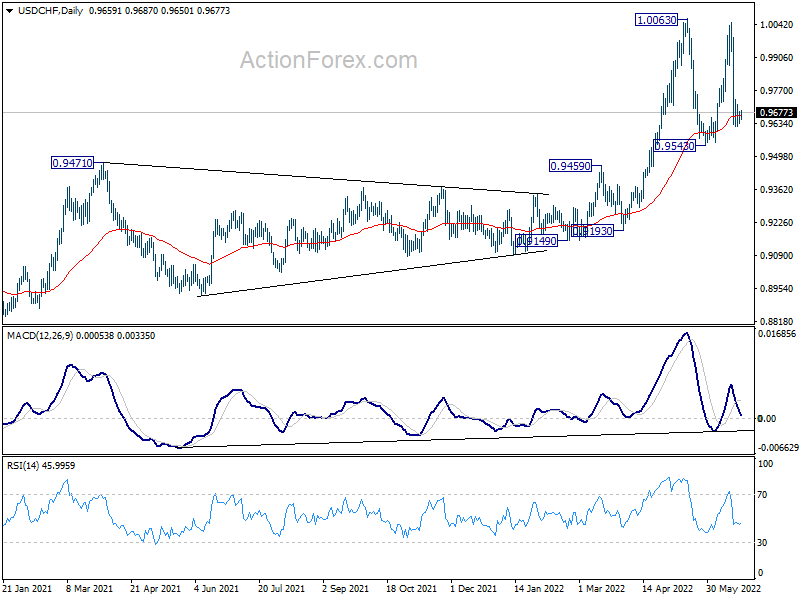
Intraday bias in USD/CHF remains neutral and outlook is unchanged. Another fall cannot be ruled out. But decline from 1.0048 is viewed as the third leg of the corrective pattern from 1.0063. Strong support should be seen at around 0.9543 to contain downside to bring rebound. On the upside, above 0.9815 minor resistance will turn bias back to the upside for retesting 1.0063 resistance.
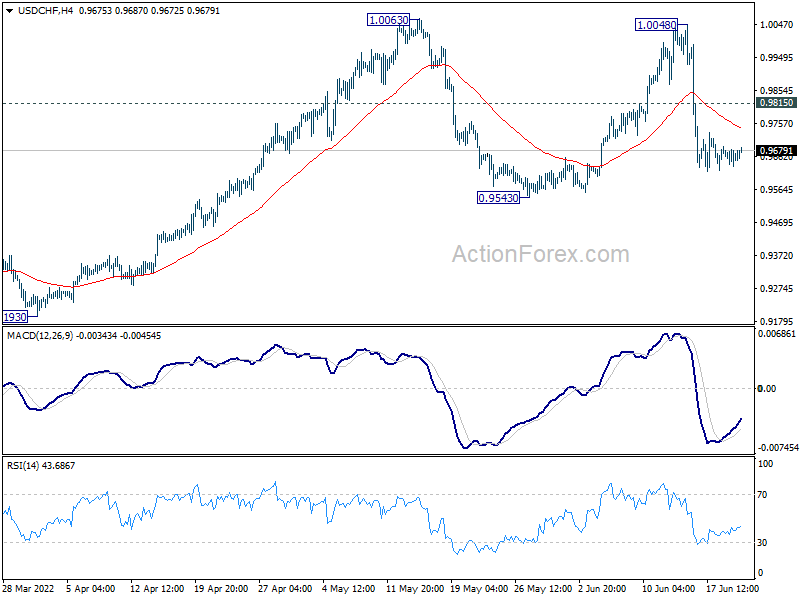
In the bigger picture, down trend from 1.0342 (2016 high) should have completed with three waves down to 0.8756 (2021 low) already. Rise from 0.8756 is likely a medium term up trend of its own. Next target is 1.0237/0342 resistance zone. This will remain the favored case as long as 0.9471 resistance turned support holds. However, sustained break of 0.9471 will extend long term range trading with another falling leg.