Sample Category Title
EUR/CHF Daily Outlook
Daily Pivots: (S1) 1.0292; (P) 1.0310; (R1) 1.0339; More....
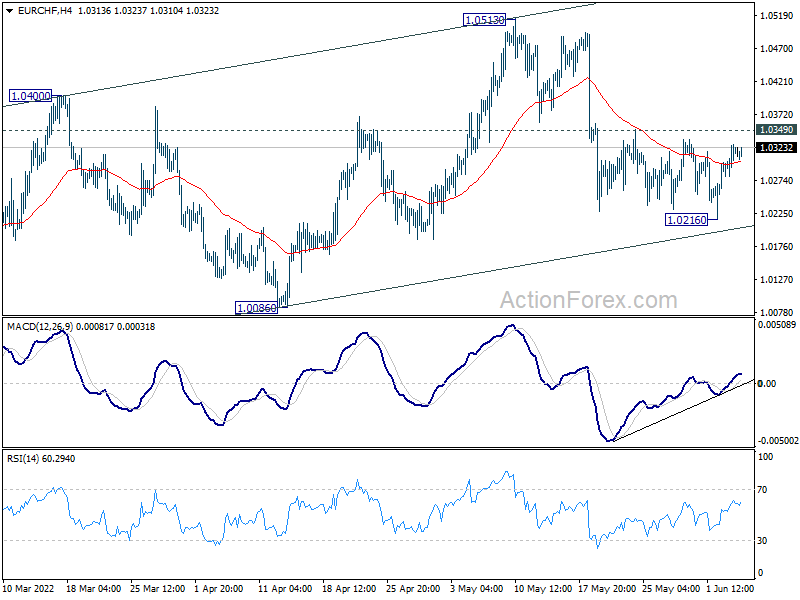
Intraday bias in EUR/CHF stays neutral and further decline is in favor with 1.0349 resistance intact. Break of 1.0216 support will reaffirm the case that corrective rebound from 0.9970 has completed at 1.0513. Deeper fall would be seen to 1.0086 support next. However, above 1.0349 will dampen this bearish view and bring stronger rebound back towards 1.0513 resistance.
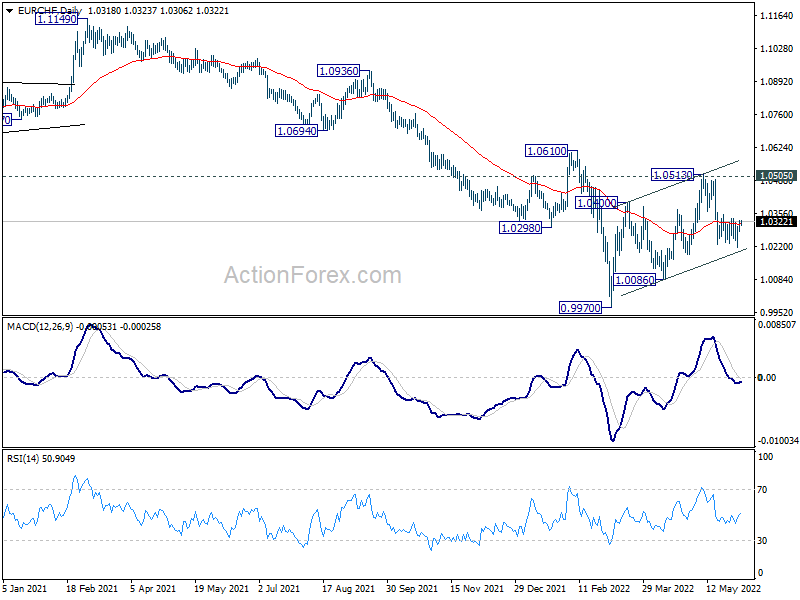
In the bigger picture, as long as 1.0505 support turned resistance (2020 low) holds, long term down trend from 1.2004 (2018 high) is expected to continue. Next target is 100% projection of 1.2004 to 1.0505 to 1.1149 at 0.9650. However, firm break of 1.0505 will suggest medium term bottoming, and bring stronger rebound towards 1.1149 structural resistance.
EUR/USD Daily Outlook
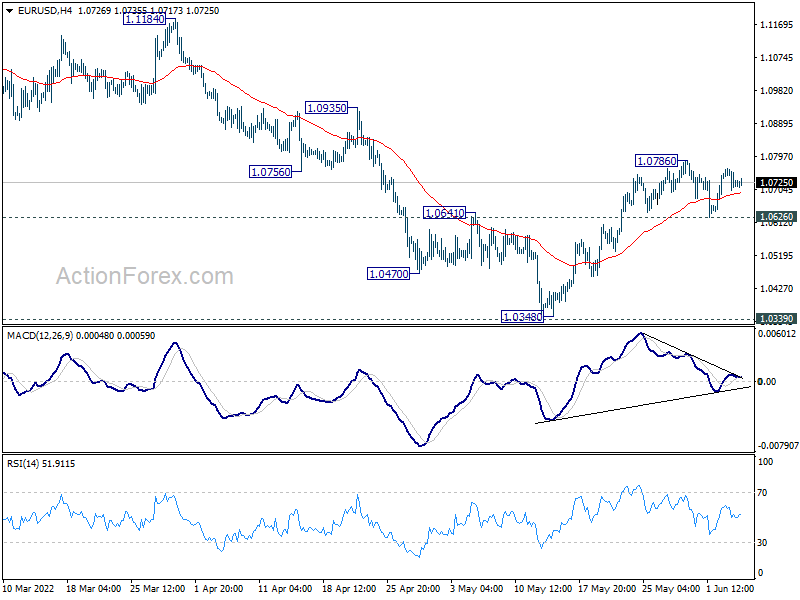
Daily Pivots: (S1) 1.0695; (P) 1.0729 (R1) 1.0755; More...
Intraday bias in EUR/USD stays neutral for the moment. On the downside, break of 1.0626 minor support will indicate rejection by 55 day EMA, and turn bias back to the downside for retesting 1.0348. On the upside, break of 1.0786, and sustained trading above 55 day EMA (now at 1.0757) will target 1.0935 resistance next.
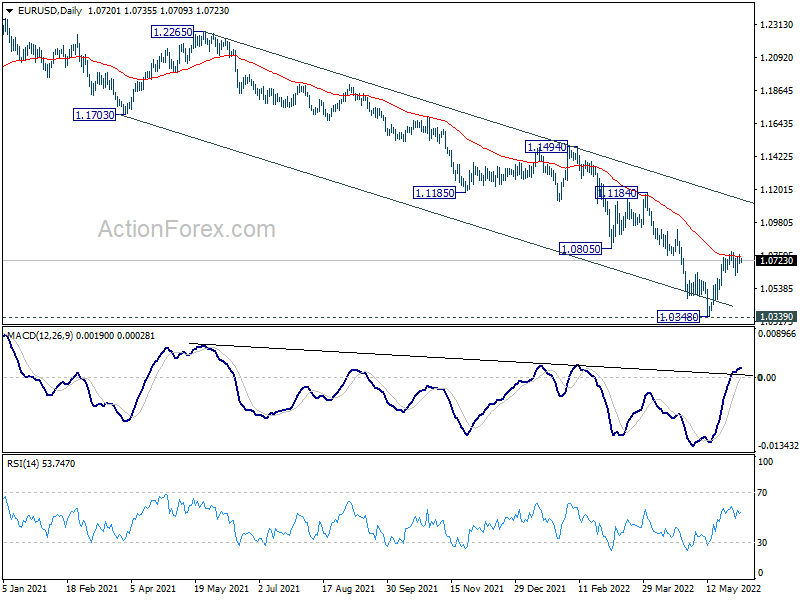
In the bigger picture, focus stays on 1.0339 long term support (2017 low). Decisive break there will resume whole down trend from 1.6039 (2008 high). Next target is 61.8% projection of 1.3993 to 1.0339 from 1.2348 at 1.0090. However, firm break of 1.0805 support turned resistance will delay this bearish case and bring medium term corrective rebound first.
GBP/USD Daily Outlook
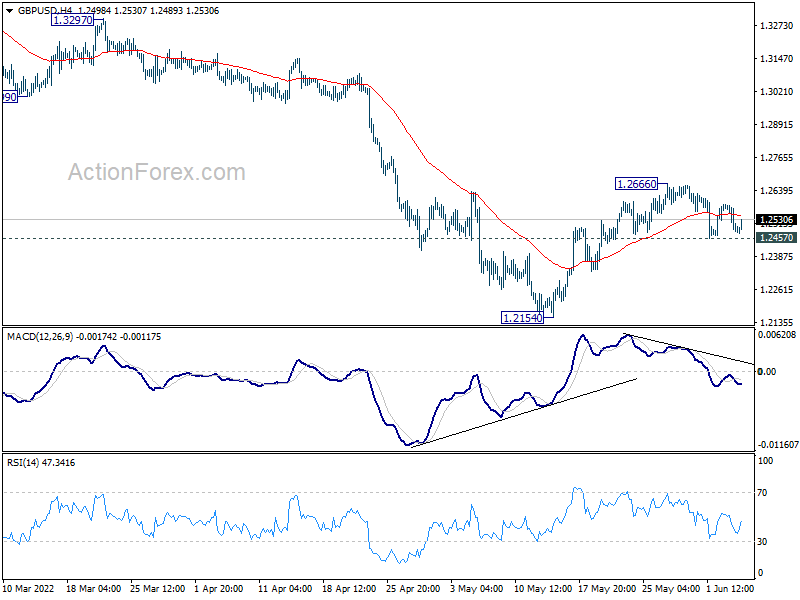
Daily Pivots: (S1) 1.2455; (P) 1.2522; (R1) 1.2559; More...
Intraday bias in GBP/USD stays neutral for the moment. On the downside, break of 1.2457 minor support will suggest that rebound from 1.2154 has completed. Intraday bias will be back on the downside for resting this low. On the upside, above 1.2666 will target 55 day EMA (now at 1.2722) and above.
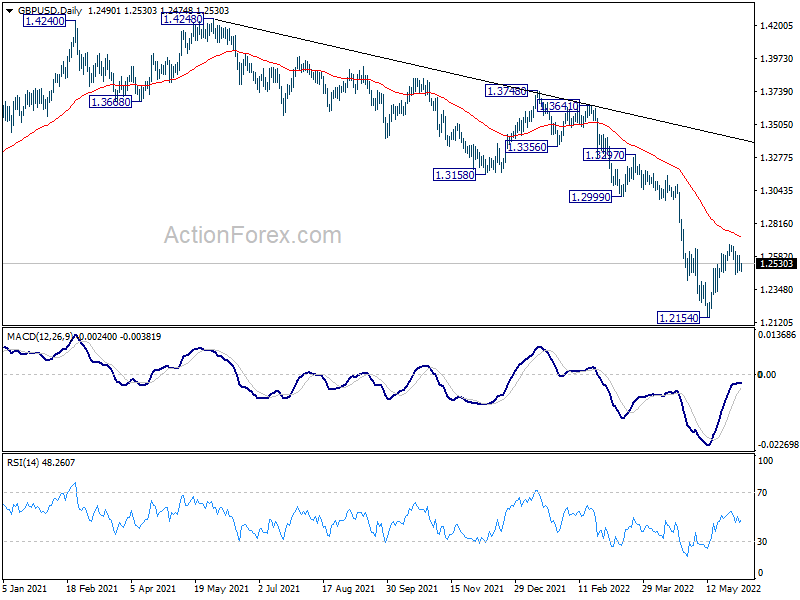
In the bigger picture, fall from 1.4248 (2018 high) could be a leg inside the pattern from 1.1409 (2020 low), or resuming the longer term down trend. Deeper decline is expected as long as 1.2999 support turned resistance holds. On resumption, next target is 1.1409 low.
USD/CHF Daily Outlook
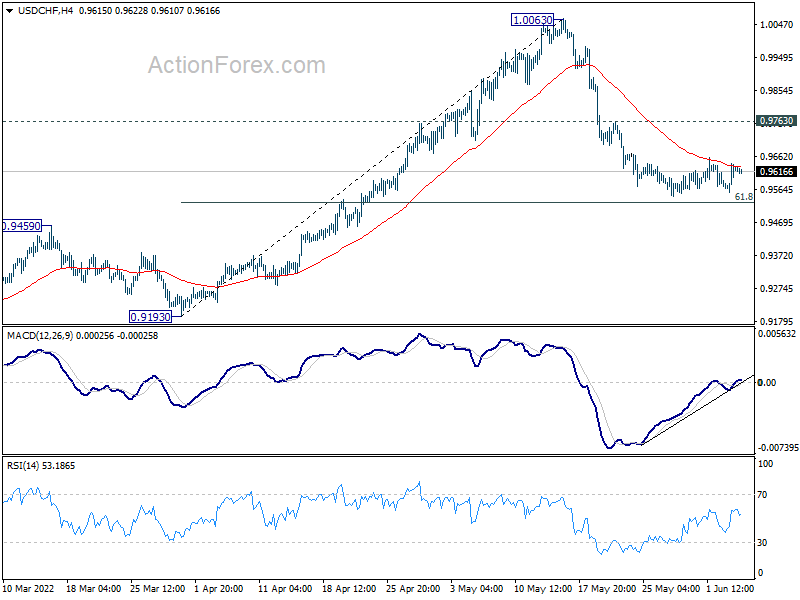
Daily Pivots: (S1) 0.9575; (P) 0.9609; (R1) 0.9661; More...
Intraday bias in USD/CHF stays neutral at this point. Strong support is expected at 61.8% retracement of 0.9193 to 1.0063 at 0.9525 to complete the pull back from 1.0063. On the upside, above 0.9763 minor resistance will turn bias back to the upside for retesting 1.0063 high. However, sustained break of 0.9525 will bring deeper decline to 0.9193 support.
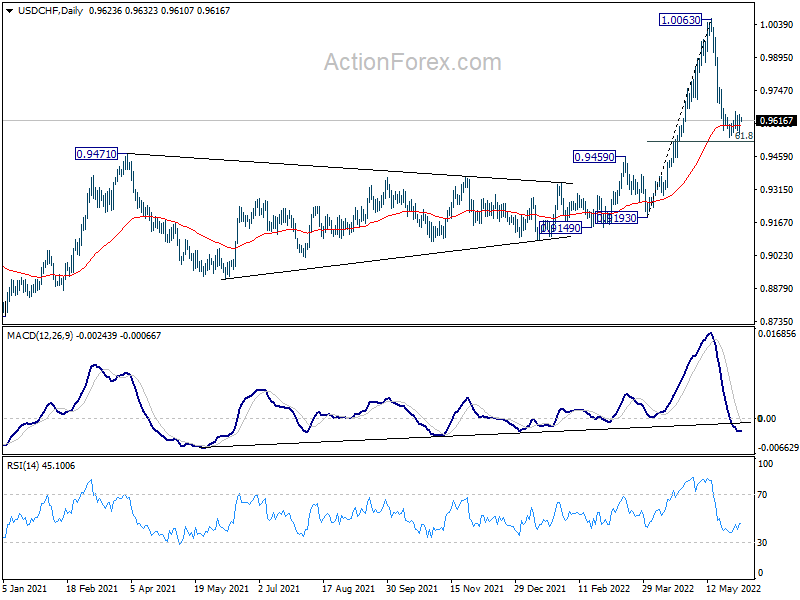
In the bigger picture, down trend from 1.0342 (2016 high) should have completed with three waves down to 0.8756 (2021 low) already. Rise from 0.8756 is likely a medium term up trend of its own. Next target is 1.0237/0342 resistance zone. This will remain the favored case as long as 0.9471 resistance turned support holds. However, sustained break of 0.9471 will extend long term range trading with another falling leg.
USD/JPY Daily Outlook
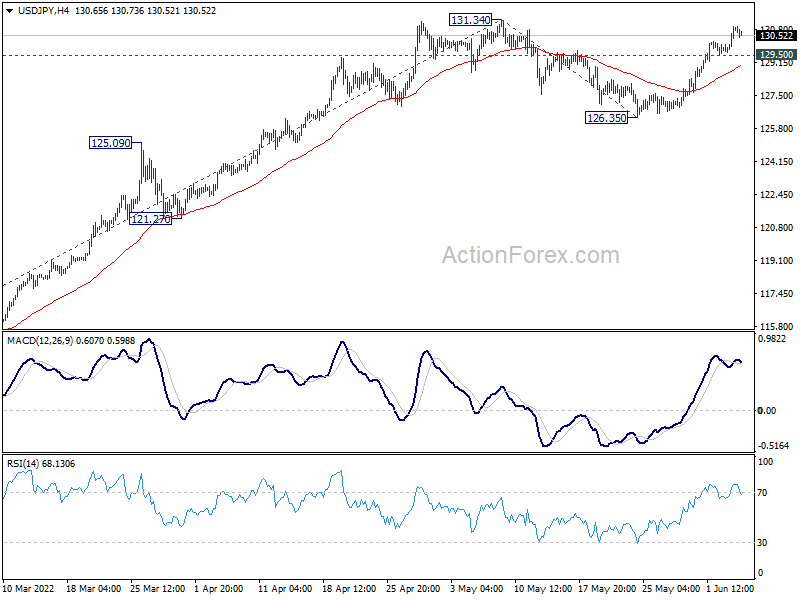
Daily Pivots: (S1) 130.03; (P) 130.50; (R1) 131.32; More...
Intraday bias in USD/JPY stays on the upside for 131.34 resistance. Decisive break there will confirm larger up trend resumption. Next target is 61.8% projection of 114.40 to 131.34 from 126.35 at 136.81. On the downside, below 129.50 minor support will delay the bullish case and turn intraday bias neutral first.
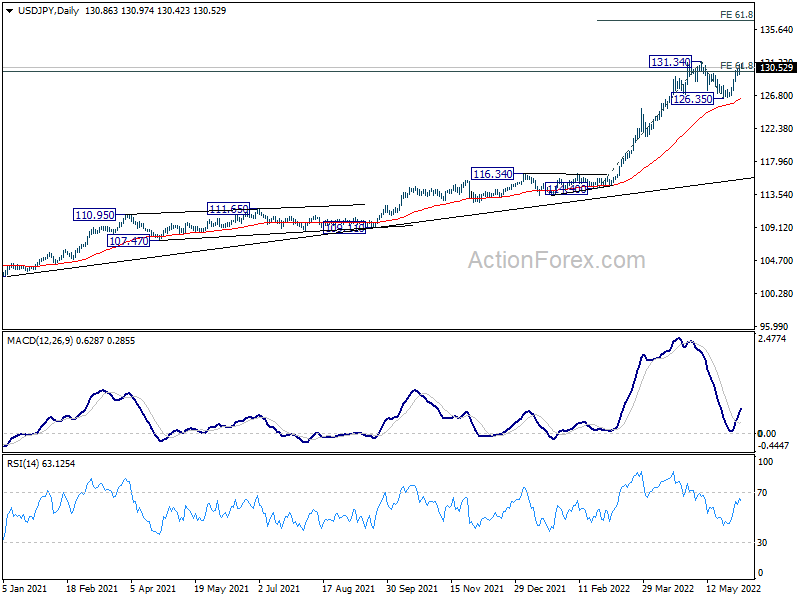
In the bigger picture, current rally is seen as part of the long term up trend form 75.56 (2011 low). Sustained trading above 61.8% projection of 75.56 (2011 low) to 125.85 (2015 high) from 98.97 at 130.04 will pave the way to 100% projection at 149.26, which is close to 147.68 (1998 high). For now, this will remain the favored case as long as 126.35 support holds.
AUD/USD Daily Report
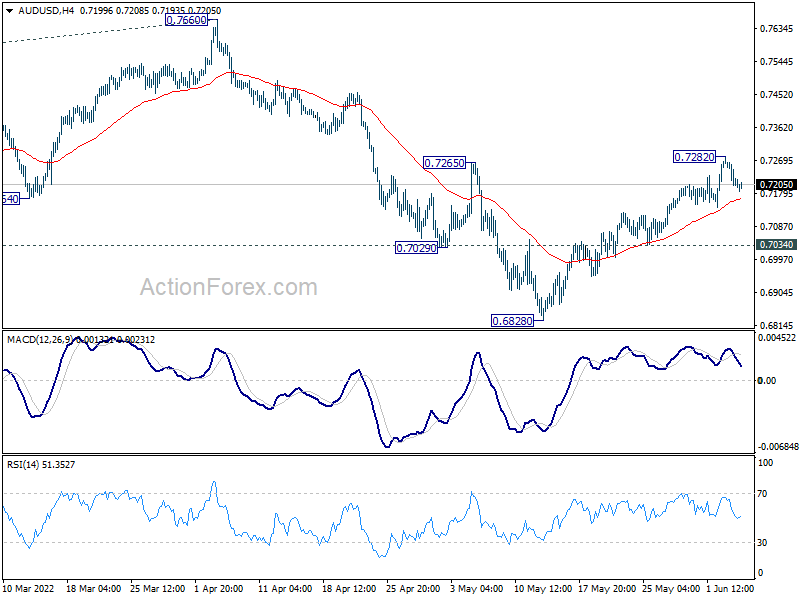
Daily Pivots: (S1) 0.7179; (P) 0.7231; (R1) 0.7260; More...
Intraday bias in AUD/USD is turned neutral with current retreat. Further rise will remain in favor as long as 0.7034 support holds. Current development raised the chance that whole fall corrective fall from 0.8005 has completed at 0.6828. Above 0.7282 will extend the rebound to 0.7660 resistance for confirmation. However, break of 0.7034 will dampen this bullish view and bring retest of 0.6828 low instead.
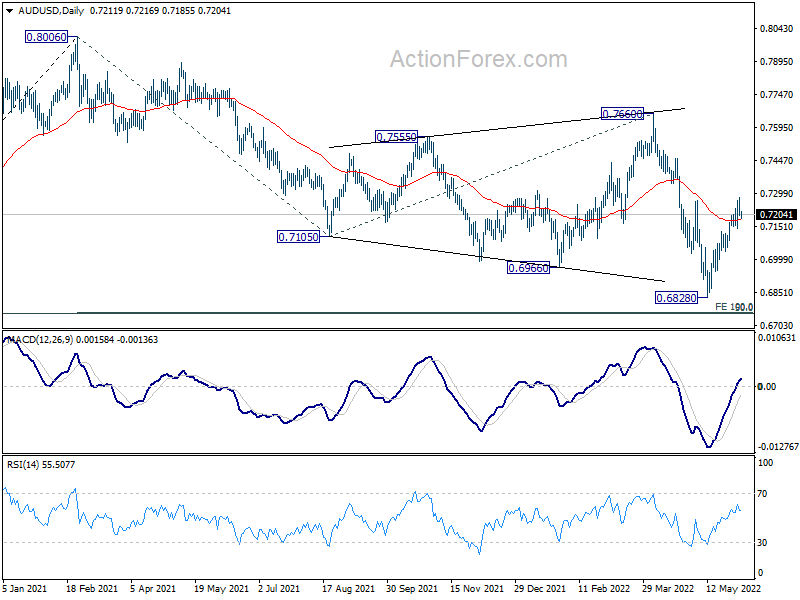
In the bigger picture, price actions from 0.8006 are seen as a corrective pattern to rise from 0.5506 (2020 low). Deeper fall could be seen to 50% retracement of 0.5506 to 0.8006 at 0.6756. This coincides with 100% projection of 0.8006 to 0.7105 from 0.7660 at 0.6760. Strong support is expected from 0.6756/60 cluster to contain downside to complete the correction. Meanwhile, firm break of 0.7660 resistance will confirm that such corrective pattern has completed, and larger up trend is ready to resume.
Beijing Reopening Dulls Nonfarm Retreat
Wall Street had another schizophrenic day on Friday as May US Non-Farm Payrolls outperformed, rising by 390,000 jobs, slightly less than April’s number, but well above market forecasts of 325,000. That sparked yet another tail-chasing reversal across asset classes as US markets continue to desperately search for “peak-hiking” from the Fed and return to their buy-everything happy space, an illness caused by endless rounds of quantitative easing and ultra-low rates by the world’s central banks over the past 15 years, as they themselves, tried to rewrite the laws of nature.
Equities markets tumbled, the US Dollar rallied, bond yields edged higher, and precious metals fell on Friday. Meanwhile, energy markets continued reacting to a disappointing OPEC+ meeting on the production front, Brent crude and WTI both closing just above $120.00 a barrel. We can expect more of the same behaviour from US markets this week, tiring and asinine as it may be. US markets will have a second bite of the cherry this Friday when Inflation and Core Inflation for May are released. YoY Inflation is currently expected to be unchanged at 8.30%, with Core Inflation expected to ease slightly to 5.90%. As per Friday’s note, we can once again expect a binary outcome as we head into next week's FOMC policy decision. An "on forecast" to lower number equals buys everything, sell US Dollars, higher equals sell everything buy US Dollars. It’s pretty hard to guess what the FOMO gnomes of Wall Street will do until Friday, but I’m pretty sure volatility will, once again, be the winner.
Asia is having an altogether more orderly start to the week thankfully. China has announced a further easing of curbs in Beijing over the weekend, which is seeing some Asian equity markets, and US futures, trading in positive territory. Other glimmers of relief are that officials in Washington D.C. are considering a selective removal of tariffs on Chinese imports to aid the inflation fight. In the energy space, Reuters is reporting that Washington DC is allowing Spain’s Repsol, and Italy’s ENI, to resume debt-for-oil shipments with Venezuela. With Libya announcing its largest oil field had finally restarted operations. Oil has shrugged those headlines off in Asia, holding steady on weekend news that Saudi Arabis had hiked oil export prices to Asia and Europe, and with China reopening hopes suggesting higher oil demand.
Asia’s data calendar is quiet today. Australian ANZ Job Advertisements for May rebounded to a 0.40% gain MoM, after dropping 2.0% in April. More importantly, China’s Caixin Services PMI for May rose to 41.4 from April’s shocking 37.2 print. 41.4 is nothing to write home about either, but investors will take heart that some sort of rebound has taken place even as restrictions remained in place in Shanghai and Beijing, and that as they ease in both cities, the rebound will accelerate. That seems to be another tailwind for China equities today.
Holidays will impact markets today with South Korea, New Zealand, and Malaysia away today. Much of Europe is also closed including Germany, France, the Netherlands, and the Nordic region. UK markets return from a four-day break, with the UK media reporting that Prime Minister Boris Johnson could face a vote of no confidence and a leadership challenge this week. I’m not sure if BoJo’s demise would be bullish or bearish for the Sterling or UK equities, I guess it depends on your point of view.
The data calendar is also very quiet in America this afternoon with the most heavyweight data releases back-ended later in the week including US CPI and the Bank of Canada policy decision. Tomorrow, we have a Reserve Bank of Australia policy decision, with the Reserve Bank of India on Wednesday. With all three, a rate hike is a certainty, the main question being by how much and whether slowdown fears cause them to blink on aggressiveness.
The next 24 hours in global markets, therefore, are likely to be driven by headlines and intraday swings in sentiment. A case in point being the Bank of Japan’s Kuroda reiterating today that there would be no tightening of monetary policy, which has lifted Japanese equities at the periphery while maintaining upward pressure on USD/JPY.
Asian equities are higher on Beijing reopening
Friday’s higher than expected US Non-Farm Payrolls saw Wall Street make an abrupt retreat as easier Fed hiking hopes on a slowing economy were dashed, although I’d argue a slowing US economy wouldn’t be good for equities either. The S&P 500 finished 1.63% lower, the Nasdaq tumbled by 2.47%, and the Dow Jones fell by 1.06%.
In Asia, an easing of restrictions in Beijing, along with reiterations of easy monetary policy in Japan has shielded Asia from New York’s back-and-forth volatility, lifting sentiment in US futures and North Asian markets. US futures have rebounded with Nasdaq futures rising 0.70%, S&P 500 futures are 0.50% higher, and Dow Futures have added 0.40%.
Japan’s Nikkei 225 has risen by 0.60%, unwinding a rocky start. South Korea is closed today, but Mainland China’s Shanghai Composite has jumped by 1.05%, with the CSI 300 leaping 1.50% higher. Hong Kong’s Hang Seng has rallied by 1.10% and it appears that reopening news and its positive outlook forward is outweighing any backwards-looking Chinese data like the PMIs for now.
The picture is more mixed in the rest of Asia, possibly thanks to higher oil prices and a soggy New York close. Singapore is 0.15% lower, having unwound most of its earlier losses. Taipei is 0.55% higher, while Jakarta has fallen by 1.50%, led by resources after the Government announced it was investigating potential palm oil distribution cartels. Malaysia closed today, while Bangkok is just 0.25% lower, and Manila is down by 0.55%. Australian markets have also been unable to shake off Friday’s weak Wall Street close, ahead of an expected rate hike by the RBA tomorrow. The All Ordinaries are down by 0.25%, with the ASX 200 falling by 0.55%.
With most of Europe closed today, most eyes will be on UK markets, which reopen after a four-day break. The rise in oil prices over the past two days is likely to make cost-of-living concerns front-and-centre again, potentially weighing on sentiment. A potential change of leadership in the UK, regardless of your political views, will be another source of uncertainty.
US Dollar eases lower in Asia
Friday’s higher Non-Farm Payroll data saw the US Dollar reverse much of its losses from Thursday, characterising a very choppy back-and-forth week last week. The dollar index by 0.40% to 1.0217, leaving the index slightly higher for the week. Notably, the rally was not enough to lift the index above its 102.35 pivot point, suggesting that the downside remains the path of least resistance still. Support/resistance lies at 101.30 and 102.70. In Asia, the China reopening trade has pushed the index slightly lower to 102.11.
EUR/USD fell only slightly by 0.27% to 1.0720 on Friday post-data, where it remains in Asia. Resistance between 1.0770 and 1.0830 remains a formidable barrier, with support at 1.0650. However, the single currency continues to show resilience at these levels, and resistance could be seriously tested if China's reopening trade continues to support risk sentiment. Volumes will be impacted by European holidays today.
Sterling tumbled by 0.70% to 1.2490 on Friday in yet another whipsaw session. It remains there in Asia today. It has support/resistance at 1.2460 and 1.2670. A UK leadership challenge this week may serve to limit gains but a clean break of 1.2670 opens a potentially larger rally to 1.2800 and 1.3000, while the failure of 1.2460 could see Sterling fall to 1.2400.
USD/JPY rose 0.73% to 130.85 on Friday, accounting for most of the dollar index gains post US data as US bond yields firmed slightly. USD/JPY has edged 0.15% lower to 130.65 today despite dovish BOJ comments, but the US/Japan rate differential should continue to support the downside unless US yields suddenly fall sharply. It has support/ 129.00 and resistance at 131.00, a double top, and 131.30.
AUD/USD fell post US data as risk sentiment turned south. It finished 0.80% lower at 0.7205, easing another 0.20% to 0.7195 in Asia. AUD/USD has nearby support at 0.7180, an ascending one-month trendline, with resistance between its 50/100/200-day moving averages (DMAs) between 0.7225 and 0.7255. RBA hiking concerns ahead of tomorrow's RBA meeting look set to limit gains in the short term.
USD/Asia moved higher on Friday on firm US data, with the Korean Won, New Taiwan Dollar, Singapore Dollar, and India Rupee the main losers, being favourites by fast-money to express risk sentiment of late. Yuan trading was impacted by a China holiday. Markets are quiet in Asia today, with Asian currencies booking only small gains versus the greenback. The sharp rise in oil prices on Friday, which continues in Asian trading today, is likely limiting Asia FX gains. The double-edged sword of China's reopening is that oil prices are likely to remain firm as well as demand returns.
Oil is steady in Asia as Saudi Arabia hikes prices
Oil prices ignored Fed tightening nerves after the US data, rallying strongly with the relaxing of China Covid curbs, with its ensuing return of oil demand, the story driving oil markets. Brent crude rose 2.70% to 121.25 a barrel, with WTI rising 2.35% to 120.35 a barrel. There seems to be some confusion with pricing feeds on oil futures today, possibly as platforms shift their front-month futures from June to September. Brent crude has eased slightly in Asia to $120.45 a barrel, while WTI has eased to $119.65 a barrel. While China relaxing Covid curbs and Saudi Arabia hiking selling prices to Asia and Europe are supporting prices, potential Venezuelan shipments to Europe are providing temporary resistance.
Whichever way you look at it though, both Brent and WTI prices are nearing post-Ukraine highs, stripping at the days of the initial hostilities themselves. Returning Venezuelan and Libyan production to Europe and North America, should it occur, will not be material enough in the shorter term to force prices lower. Refining margins globally suggest that demand for petrol and diesel remain in heavy demand, with the refining logjam in refined products backstopping crude prices.
Additionally, the damp squib OPEC+ meeting outcome, with some production bones thrown to some angry dogs, and a potential recovery in demand from Mainland China is it has got on top of omicron, provides yet more reasons to believe that physical demand will keep prices elevated.
Brent crude has resistance at $122.00, and $124.00, with support distant at $116.00 and $112.50 a barrel. WTI has resistance at $121.00, with now distant support at $115.00 and $111.25 a barrel.
Gold’s flip-flop ranging continues
Strong US data saw the fast-money longs in gold take fright and head to the exit door on Friday. That pushed gold sharply lower by 0.95% to $1851.00 an ounce as the US Dollar rallied. In Asia, a moribund session has seen gold add 0.25% to $1855.70 an ounce.
The chart picture shows gold is now eroding resistance at $1870.00, touching $1874.00 an ounce on Friday. Overall, though, resistance at $1870.00 remains intact, followed by the 100-DMA at $1889.00, and then $1900.00. So, gold has plenty of wood to chop on the upside. Support is at $1844.00, $1830.00, and then $1780.00 an ounce. I do not discount a disorderly retreat if the latter fails.
Gold remains at the mercy of intraday direction moves by the US Dollar it seems.
USD/CAD Daily Outlook
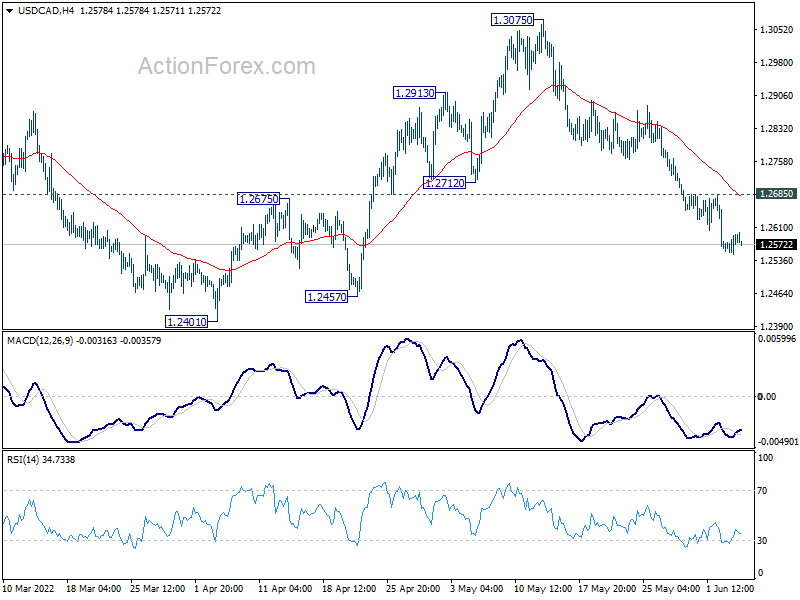
Daily Pivots: (S1) 1.2563; (P) 1.2584; (R1) 1.2616; More...
USD/CAD is losing some downside momentum again as seen in 4 hour MACD. But further fall is expected with 1.2685 resistance intact, towards 1.2401 support. Decisive break there will argue that whole rebound from 1.2005 has completed, after rejection by 1.3022 fibonacci resistance. Deeper fall would then be seen to retest this low. On the upside, above 1.2685 minor resistance will mix up the near term outlook and turn intraday bias neutral first.
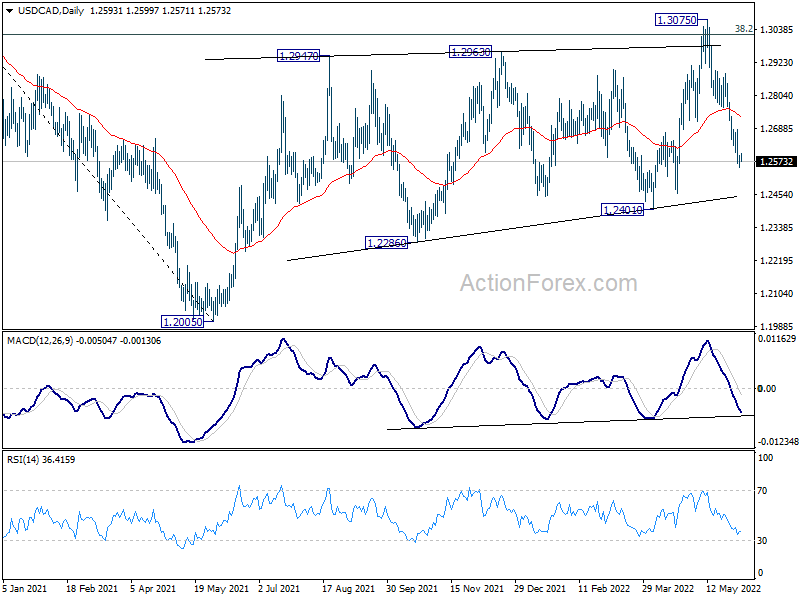
In the bigger picture, focus stays on 38.2% retracement of 1.4667 (2020 high) to 1.2005 (2021 low) at 1.3022. Sustained break there should confirm that the down trend from 1.4667 has completed after defending 1.2061 long term cluster support. Further rise would then be seen towards 61.8% retracement at 1.3650. However, rejection by 1.3022 will maintain medium term bearishness. Break of 1.2005 will resume the down trend from 1.4667 and that carries larger bearish implications too.
RBA, ECB and US CPI in Focus This Week
Major Asia indexes trade mildly higher today but the forex markets are quiet. Trading will likely be subdued ahead with Swiss, France and Germany on bank holiday, while the US economic calendar is empty. But an eventful week will kick start with RBA rate decision tomorrow, followed by ECB on Thursday. Then the week would likely end on a strong note, in terms of volatility, with US CPI and Canada employment on Friday.
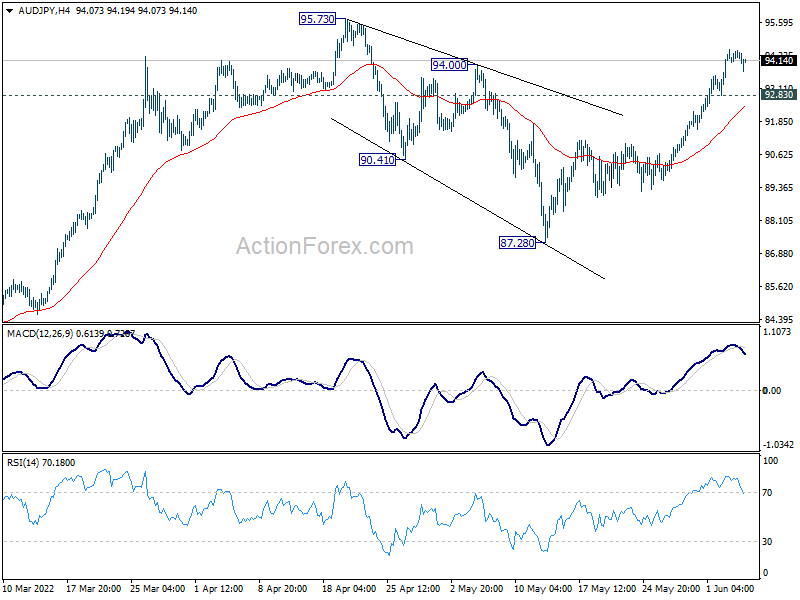
Technically, AUD/JPY is a pair to watch for the next 24-hours. Currently, considering broad based weakness in Yen, the favored view is that correction from 95.73 has completed with three waves down to 87.28. Medium term up trend should be ready resume. Further rise is expected as long as 92.83 minor support holds and break of 95.73 high will confirm this bullish case. However, should RBA disappoint by delivering less than a 40bps hike, AUD/JPY could break through 92.83 to extend the corrective pattern from 95.73 with another falling leg.
In Asia, at the time of writing, Nikkei is up 0.75%. Hong Kong HSI is up 1.32%. Chinas Shanghai SSE is up 0.89%. Singapore Strait Times is down -0.18%. Japan 10-year JGB yield is up 0.0054 at 0.242.
Kuroda: BoJ takes a strong stance on continuing with monetary easing
BoJ Governor Haruhiko Kuroda said in a speech that the economy is "still on its way to recovery from the pandemic and has been under downward pressure from the income side due to rising commodity prices". In this situation, "monetary tightening is not at all a suitable measure".
He added that the top priority is to "persistently continue with the current aggressive monetary easing centered on yield curve control". And, unlike other central banks, BoJ has noted faced the "the trade-off between economic stability and price stability". Hence, it's "certainly possible for the Bank to continue stimulating aggregate demand from the financial side."
He concluded that BoJ "will take a strong stance on continuing with monetary easing, in that it will provide a macroeconomic environment where wages are likely to increase so that the rise in inflation expectations and changes in the tolerance of price rises -- which have started to be seen recently -- will lead to sustained inflation."
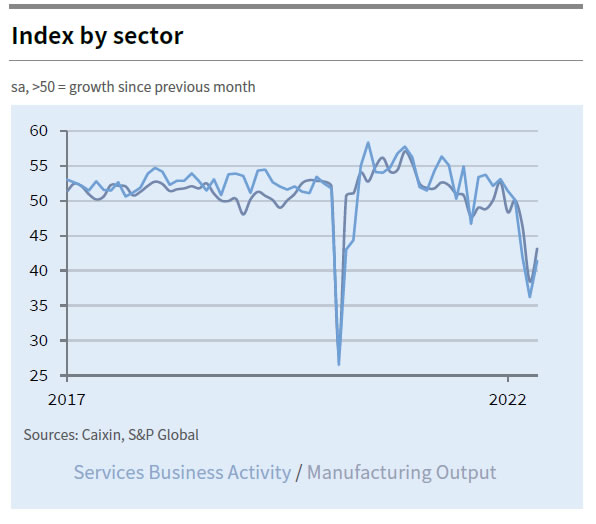
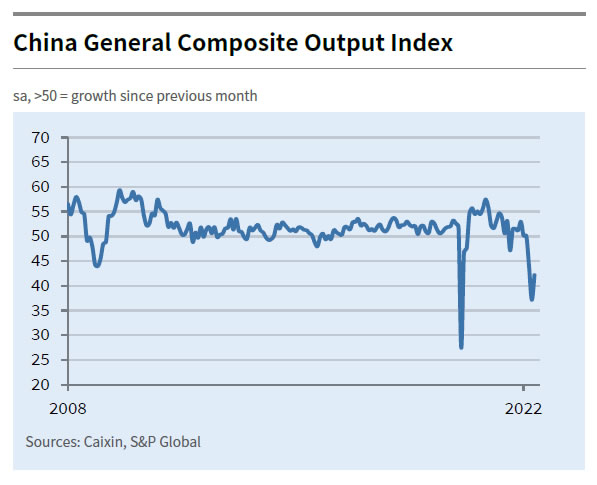
China Caixin PMI services rose to 41.4 in May, composite rose to 42.2
China Caixin PMI Services rose form 36.2 to 41.4 in May, but missed expectation of 47.3. Caixin said services activity fell at softer, but still sharp rate amid COVID-19 restrictions. Drop in overall new work moderated. Input cost inflation eased to nine-month low. PMI Composite rose from 37.2 to 42.2.
Wang Zhe, Senior Economist at Caixin Insight Group said: "Overall, in May, local Covid outbreaks continued and manufacturing and services activity improved slightly, but continued to contract, with services hit harder. Demand was slightly stronger than supply. The fallout from the epidemic on market supply and demand has been transmitted to the labor market, which is deteriorating at a faster pace in both the manufacturing and services sectors. Disrupted supply chains and longer logistics delivery times have yet to improve. Businesses remained under great cost pressure."
RBA to hike again, ECB to end net asset purchases
Two central banks will meet this week. RBA is expected to raise the target by 40bps to 0.75%. But a small increase of 25bps cannot be ruled, and it would be a disappointment to Aussie bulls should that happen. Additional, RBA would maintain hawkish bias and indicates that more tightening is underway.
ECB officials, including President Christine Lagarde, have set up market expectations for a July rate hike. To do that, it should announce the end of the asset purchase program at the upcoming meeting. There is no consensus on the size of hike in July, with some preferring 50bps and some not. The post meeting press conference will be scrutinized for hints on the hawk/dove balance in the Governing Council.
On the data front, US CPI will be the biggest event. Still there are other data to watch including Eurozone Sentix, China trade balance, as well as Canada employment. Here are some highlights for the week:
- Monday: Australia MI inflation gauge; China Caixin PMI services.
- Tuesday: Australia AiG Services, RBA rate decision; Japan average cash earnings, household spending, leading indicators; Germany factory orders; Swiss foreign currency reserves; Eurozone Sentix investor confidence; UK PMI services final; Canada trade balance, Ivey PMI; US trade balance.
- Wednesday: Japan GDP final, current account, bank lending; Swiss unemployment rate; Germany industrial production; France trade balance; Italy retail sales; UK PMI construction; Eurozone GDP revision; US wholesale inventories final.
- Thursday: UK RICS house price balance; Japan M2, machine tool orders; China trade balance; ECB rate decision; US jobless claims.
- Friday: Japan PPI; China CPI, PPI; Italy industrial production; Canada employment ; US CPI, U of Michigan consumer sentiment.
USD/CAD Daily Outlook
Daily Pivots: (S1) 1.2563; (P) 1.2584; (R1) 1.2616; More...
USD/CAD is losing some downside momentum again as seen in 4 hour MACD. But further fall is expected with 1.2685 resistance intact, towards 1.2401 support. Decisive break there will argue that whole rebound from 1.2005 has completed, after rejection by 1.3022 fibonacci resistance. Deeper fall would then be seen to retest this low. On the upside, above 1.2685 minor resistance will mix up the near term outlook and turn intraday bias neutral first.
In the bigger picture, focus stays on 38.2% retracement of 1.4667 (2020 high) to 1.2005 (2021 low) at 1.3022. Sustained break there should confirm that the down trend from 1.4667 has completed after defending 1.2061 long term cluster support. Further rise would then be seen towards 61.8% retracement at 1.3650. However, rejection by 1.3022 will maintain medium term bearishness. Break of 1.2005 will resume the down trend from 1.4667 and that carries larger bearish implications too.
Economic Indicators Update
| GMT | Ccy | Events | Actual | Forecast | Previous | Revised |
|---|---|---|---|---|---|---|
| 01:00 | AUD | TD Securities Inflation M/M May | 1.10% | -0.10% | ||
| 01:45 | CNY | Caixin Services PMI May | 41.4 | 47.3 | 36.2 |
China Caixin PMI services rose to 41.4 in May, composite rose to 42.2
China Caixin PMI Services rose form 36.2 to 41.4 in May, but missed expectation of 47.3. Caixin said services activity fell at softer, but still sharp rate amid COVID-19 restrictions. Drop in overall new work moderated. Input cost inflation eased to nine-month low. PMI Composite rose from 37.2 to 42.2.
Wang Zhe, Senior Economist at Caixin Insight Group said: "Overall, in May, local Covid outbreaks continued and manufacturing and services activity improved slightly, but continued to contract, with services hit harder. Demand was slightly stronger than supply. The fallout from the epidemic on market supply and demand has been transmitted to the labor market, which is deteriorating at a faster pace in both the manufacturing and services sectors. Disrupted supply chains and longer logistics delivery times have yet to improve. Businesses remained under great cost pressure."