Sample Category Title
EUR/JPY Weekly Outlook
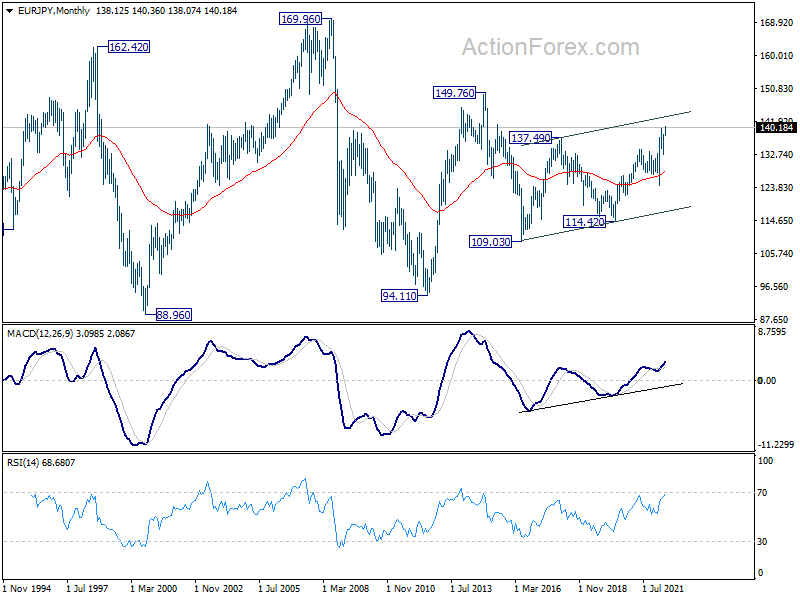
EUR/JPY rose to as high as 140.36 last week and the break of 139.99 resistance should confirm up trend resumption. Initial bias stays on the upside this week for 61.8% projection of 124.37 to 139.99 from 132.63 at 142.28. On the downside, below 138.18 minor support will turn intraday bias neutral and bring consolidations first, before staging another rally.
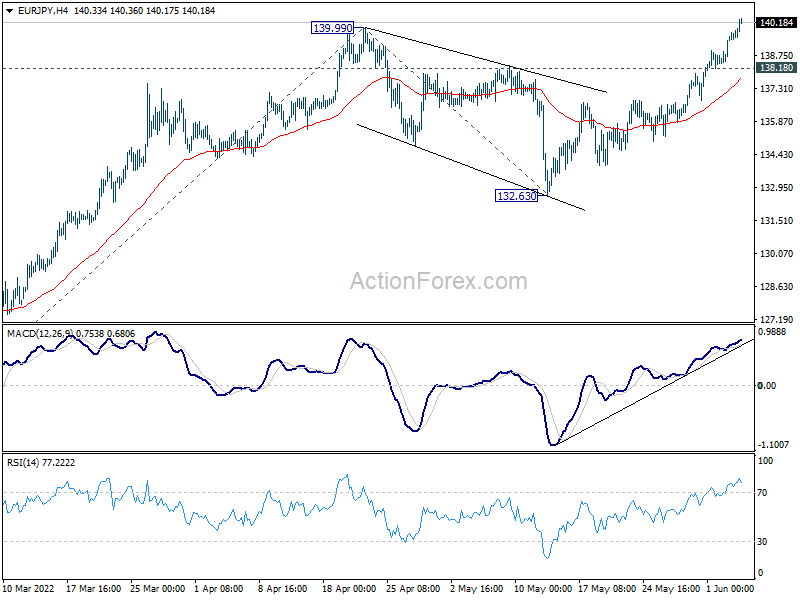
In the bigger picture, up trend from 114.42 (2020 low) is in progress. Such rise is seen as the third leg of the pattern from 109.30 (2016 low). Next target will be 100% projection of 114.42 to 134.11 from 124.37 at 144.06. In any case, outlook will now remain bullish as long as 132.63 support holds, in case of deep pull back.
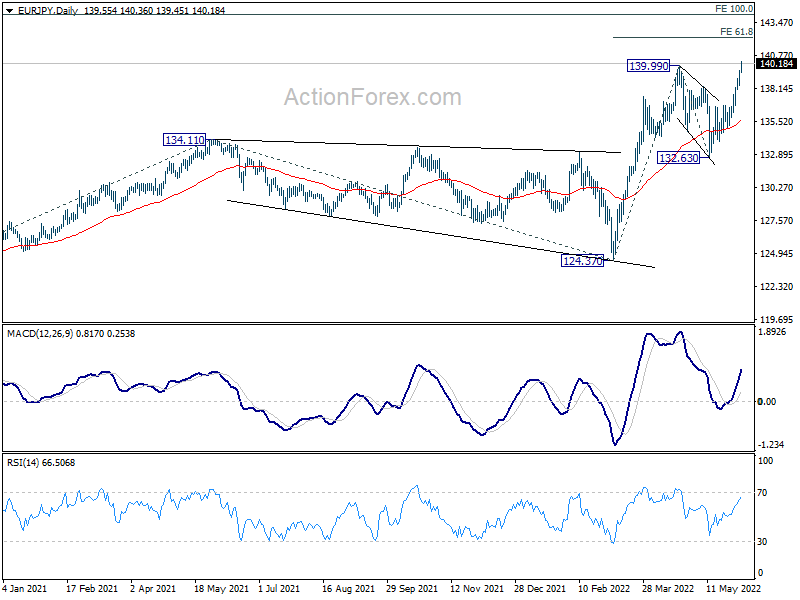
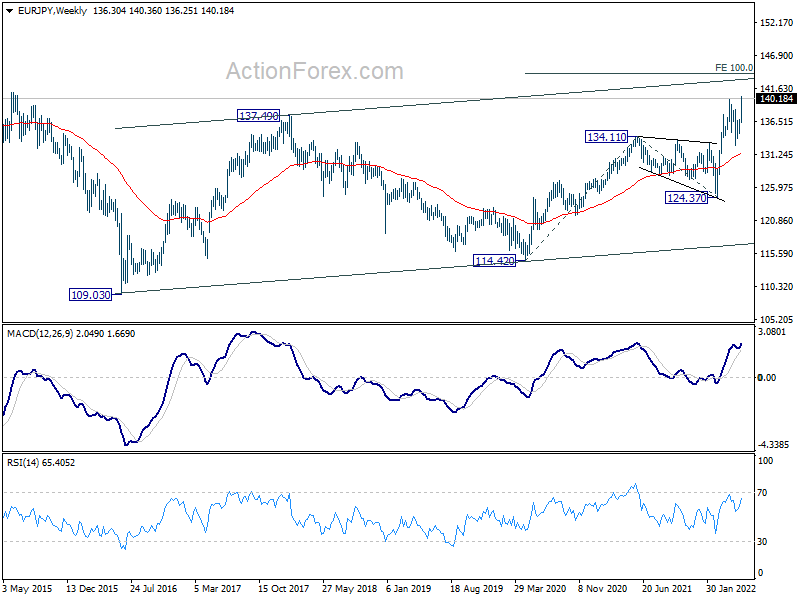
In the long term picture, current rally could be resuming whole rise from 94.11 (2012 low). Further rally would be seen to 149.76 resistance (2014 high) and above. This will remain the favored case as long as 132.63 support holds.
EUR/GBP Weekly Outlook
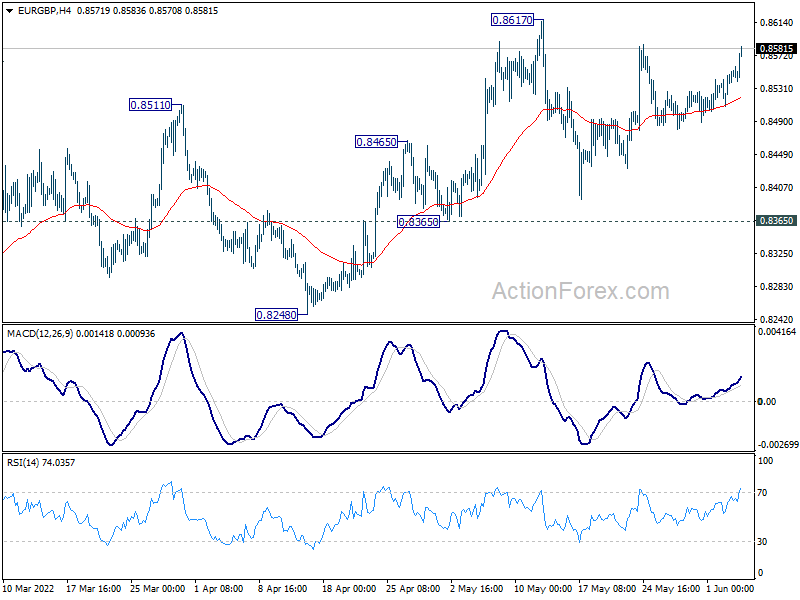
EUR/GBP stays in sideway trading below 0.8617 last week and outlook is unchanged. Initial bias stays neutral this week first. With 0.8365 support intact, further rise is in favor. On the upside, break of 0.8617 will resume rise from 0.8201 medium term bottom to 0.8697 medium term fibonacci level. However, break of 0.8365 will dampen this bullish view, and turn bias back to the downside instead.
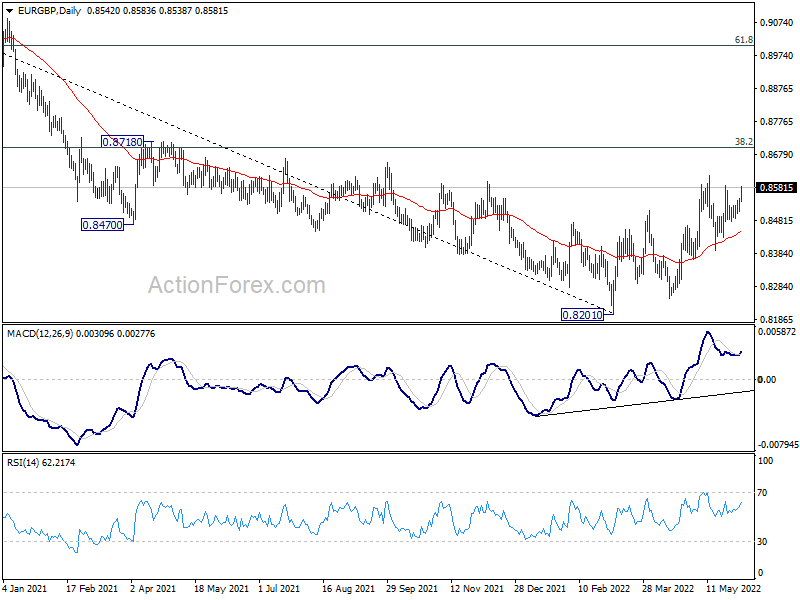
In the bigger picture, a medium term bottom could be in place at 0.8201, on bullish convergence condition in daily and weekly MACD. Rise from there could either be a correction to the down trend from 0.9499 (2020 high), or a medium term up trend itself. In either case, further rise should be seen to 38.2% retracement of 0.9499 to 0.8201 at 0.8697. Sustained break there will target 61.8% retracement at 0.9003.
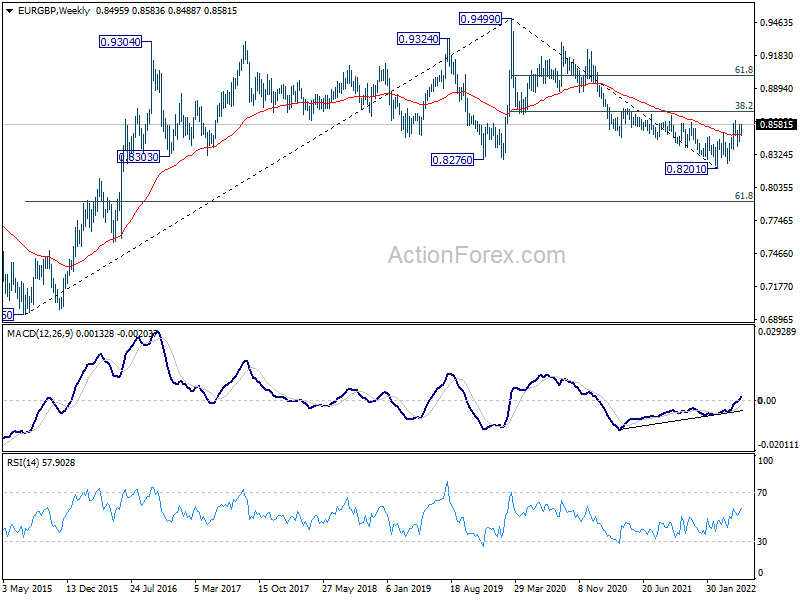
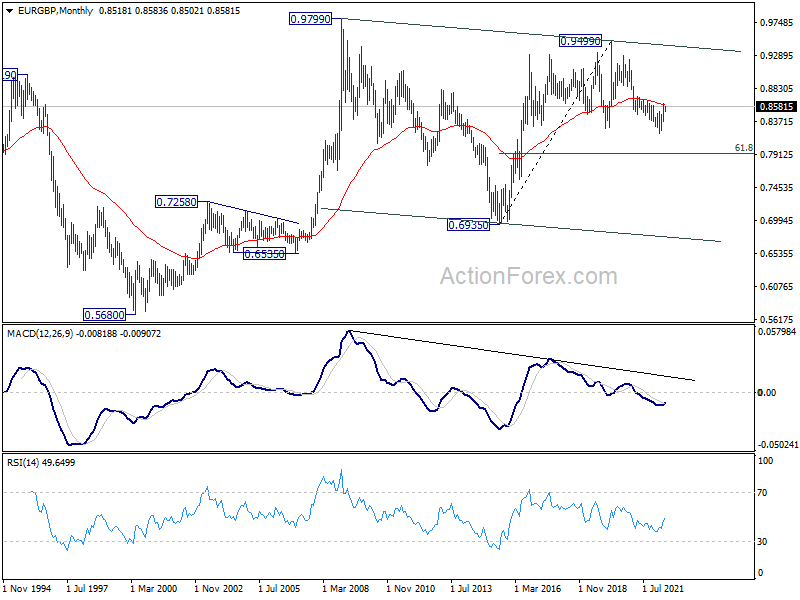
In the long term picture, current development argues that fall from 0.9499 is probably the third leg of the pattern from 0.9799 (2008 high). Sustained break of 61.8% retracement of 0.6935 to 0.9499 at 0.7917 will pave the way back to 0.6935 (2015 low) and probably below. However, sustained trading above 55 month EMA (now at 0.8604) will dampen this bearish view and bring stronger rebound.
EUR/AUD Weekly Outlook
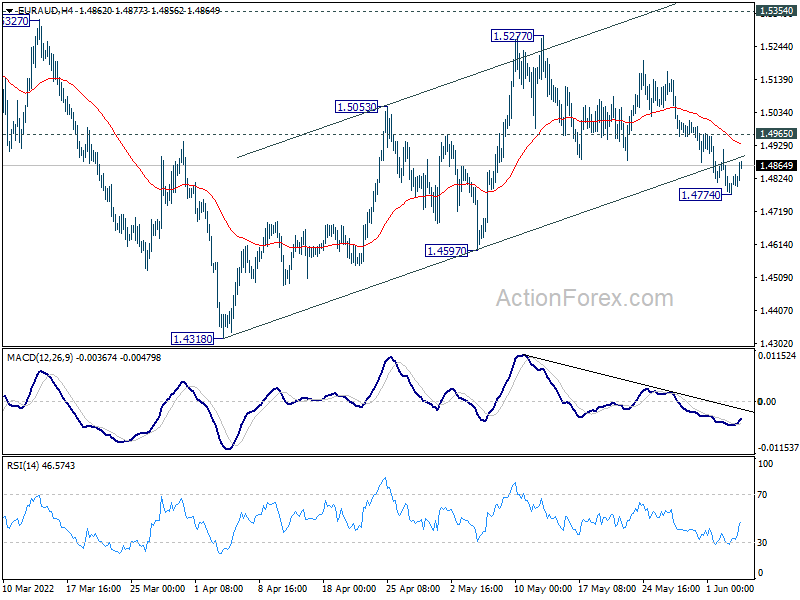
EUR/AUD dropped further to 1.4774 last week but recovered since then. Initial bias is turned neutral this week first. Deeper fall will remain in favor as long as 1.4965 minor resistance holds. Corrective rebound from 1.4318 should have completed at 1.5277 already. Below 1.4774 will target 1.4597 support next. However, on the upside, break of 1.4965 will dampen this bearish view and turn bias back to the upside for 1.5277 resistance instead.
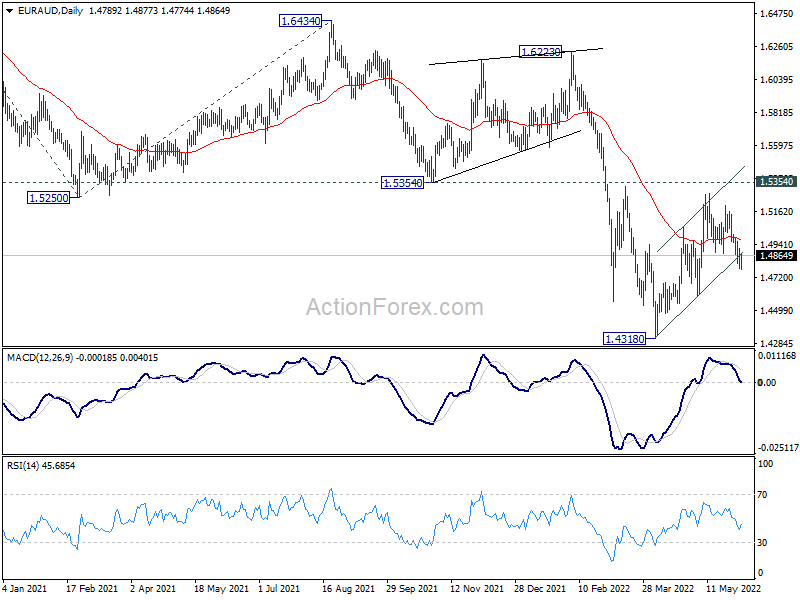
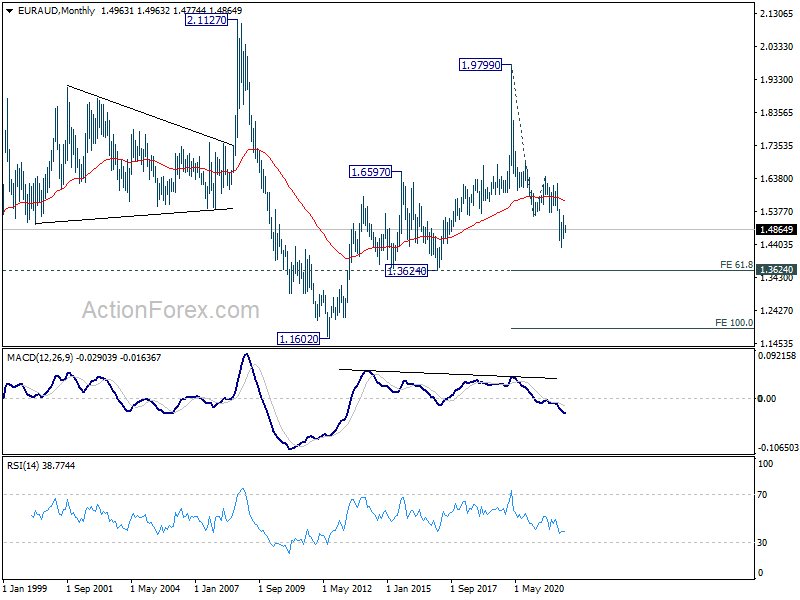
In the bigger picture, as long as 1.5354 support turned resistance holds, larger down trend from 1.9799 (2020 high) is still expected to continue. On resumption, next target is 61.8% projection of 1.9799 to 1.5250 from 1.6434 at 1.3623, which is close to 1.3624 long term support (2017 low). However, firm break of 1.5354 will indicate medium term bottoming and bring stronger rally back to 1.6434 key resistance.
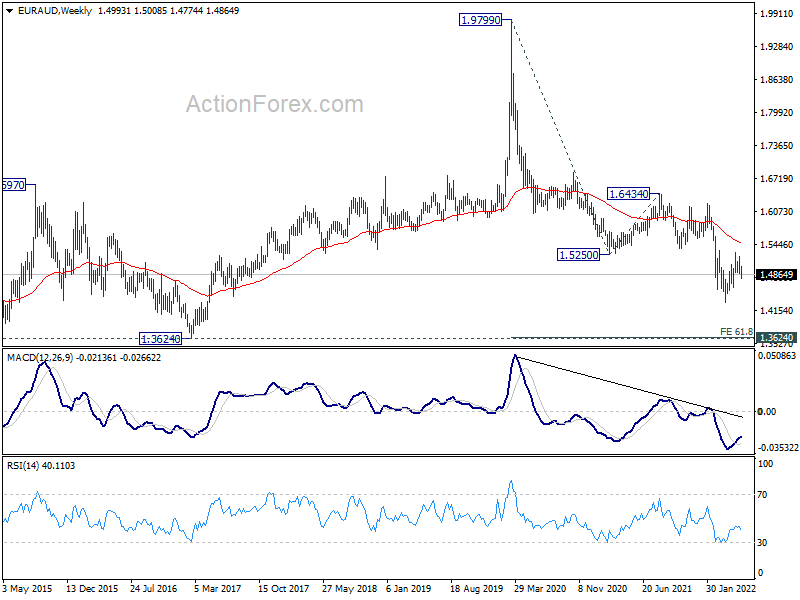
In the longer term picture, fall from 1.9799 (2020 high) is seen as the third leg of the pattern from 2.1127 (2008 high). Deeper fall should be seen to 1.3624 support. Decisive break there would pave the way back to 1.1602 (2012 low).
EUR/CHF Weekly Outlook
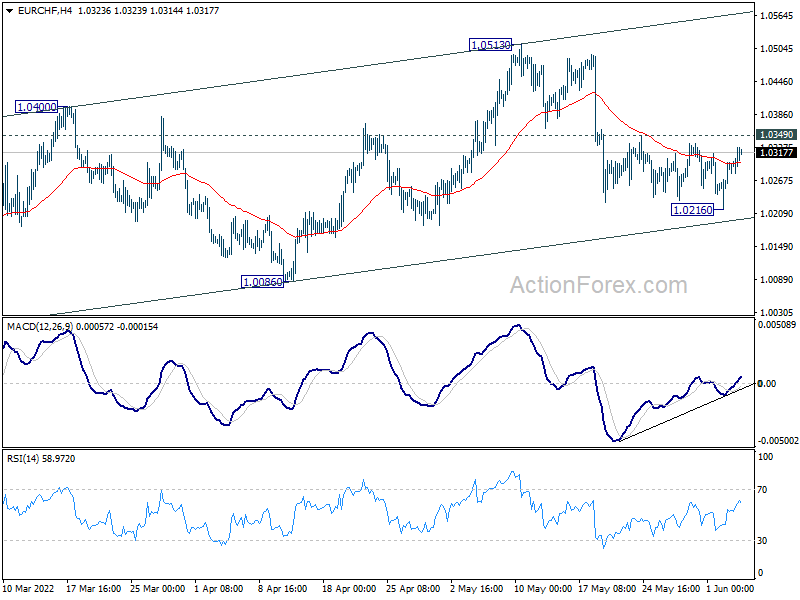
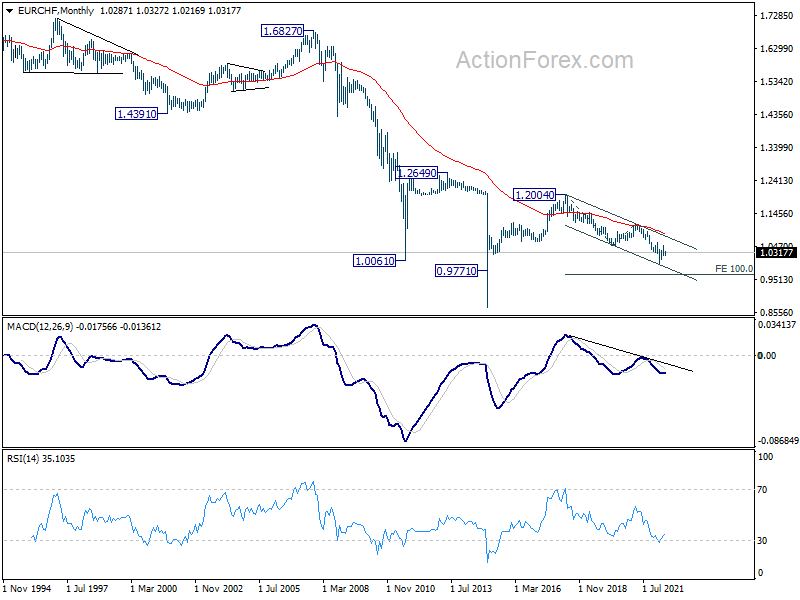
EUR/CHF edged lower to 1.0216 last week, but recovered quickly since then. Initial bias is neutral this week first. Further fall is in favor as long as 1.0349 resistance holds. Break of 1.0216 support will reaffirm the case that corrective rebound from 0.9970 has completed at 1.0513. Deeper fall would be seen to 1.0086 support next. However, above 1.0349 will dampen this bearish view and bring stronger rebound back towards 1.0513 resistance.
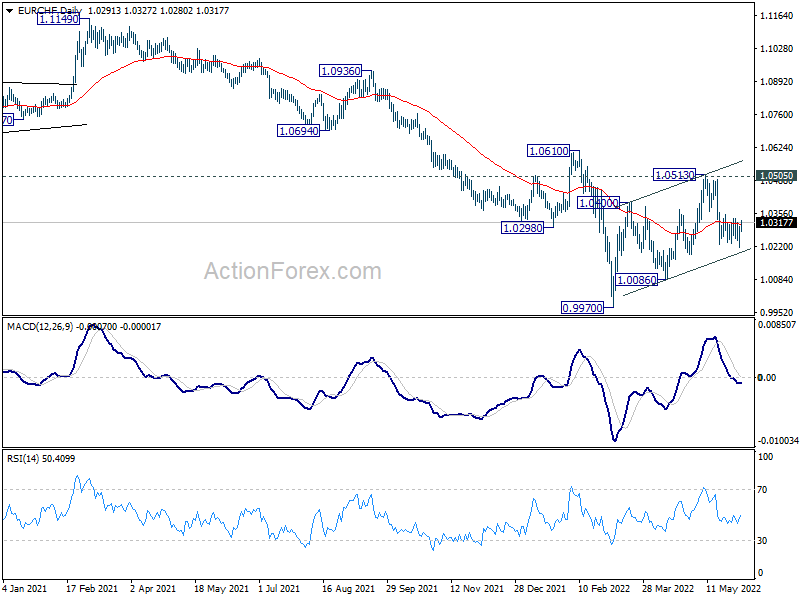
In the bigger picture, as long as 1.0505 support turned resistance (2020 low) holds, long term down trend from 1.2004 (2018 high) is expected to continue. Next target is 100% projection of 1.2004 to 1.0505 to 1.1149 at 0.9650. However, firm break of 1.0505 will suggest medium term bottoming, and bring stronger rebound towards 1.1149 structural resistance.
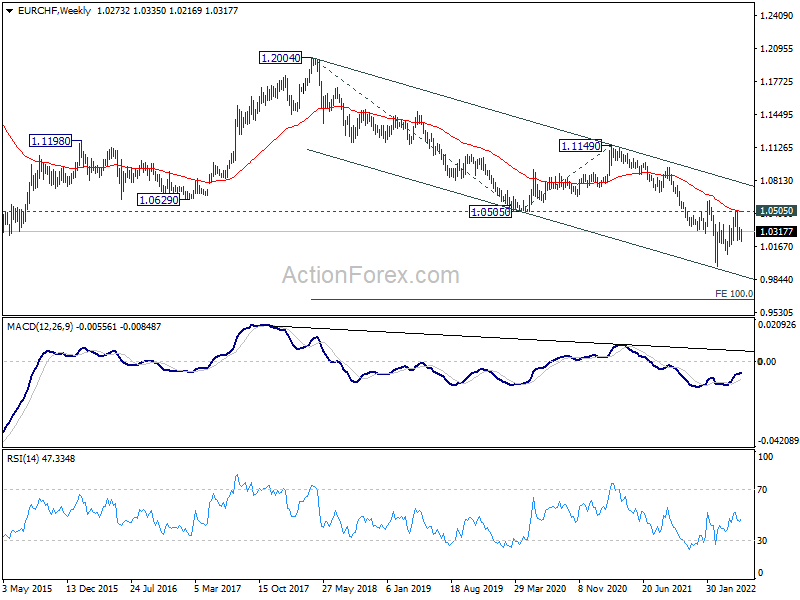
In the long term picture, capped below 55 month EMA, EUR/CHF is seen as extending the multi-decade down trend. There is no prospect of a bullish reversal until some sustained trading above the 55 month EMA (now at 1.0851).
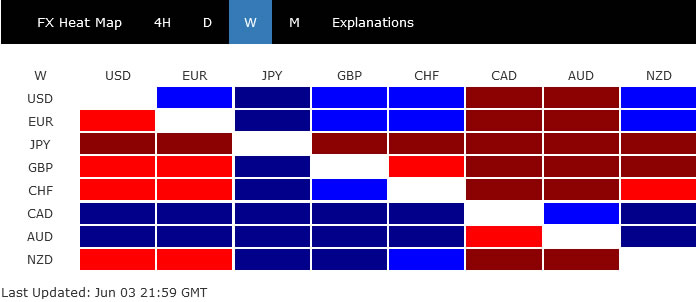
Yen Bearishness Persists on Rising Yields, Loonie Strong on BoC and Oil
It's another poor week for Yen following the rally in benchmark treasury yields in US and Europe. It should be noted again that BoJ has a 0.25% cap on 10-year JGB yield, and thus, gaps are widening. Sterling was a distant second weakest, on risks of stagflation while Swiss Franc also softened.
Canadian Dollar was the best performer following BoC's hawkish rate hike and rhetoric, rally in oil prices. Aussie was the second strongest, as RBA would play catch up to other central banks. Dollar was not performing too badly, ended as the third, but it's upside is somewhat capped by widening yield spread with Germany.
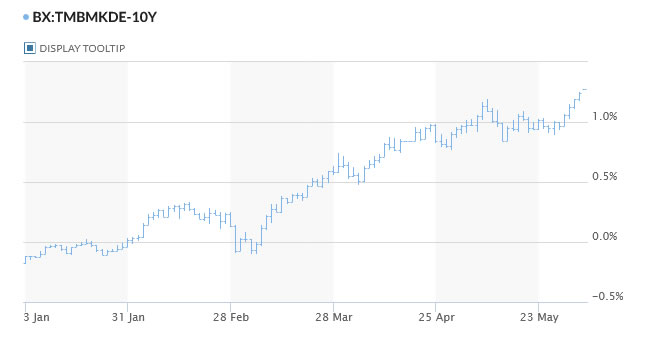
Germany 10-year yield hit 8-year, US yield also rebounded
Germany 10-year bund yield rose to a new 8-year high last week, before closing strongly at 1.279. The development came as markets are confident that ECB will announce the end of asset purchases this week, and set the stage for rate hike in July. The main question is whether the deposit rate would exit negative in July or in September. Opinions among ECB officials appeared to be divided.
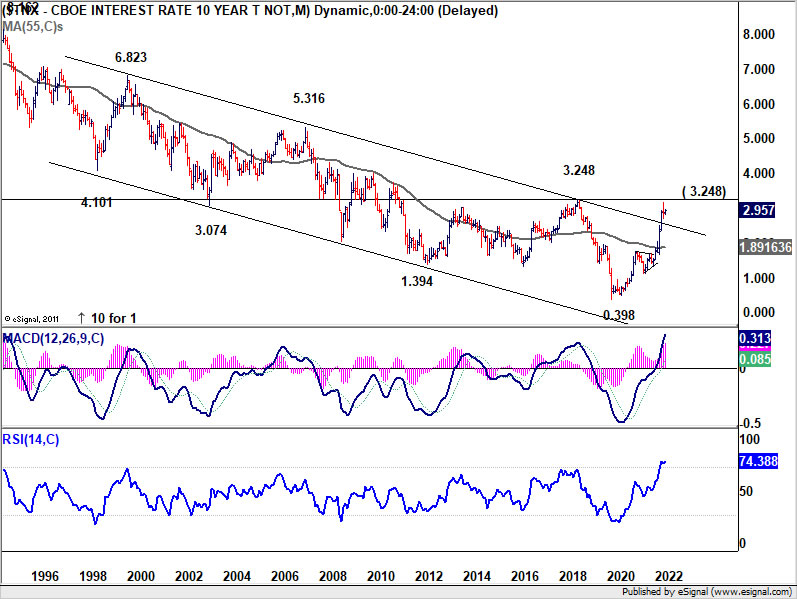
US 10-year yield also rebounded notably to close at 2.957. There were some talks about whether Fed should pause tightening in September to wait-and-see the impacts of the successive 50bps rate hikes. But hawks, who don't prefer a pause, seem to have a louder voice for now. Still, it would take some drastic development to push TNX through a key resistance level at 3.248 (2018 high). The diverged upside potential in German and US benchmark yield could keep Dollar's rally against Euro capped somewhat.
Dollar index recovered mildly after hitting 55 day EMA
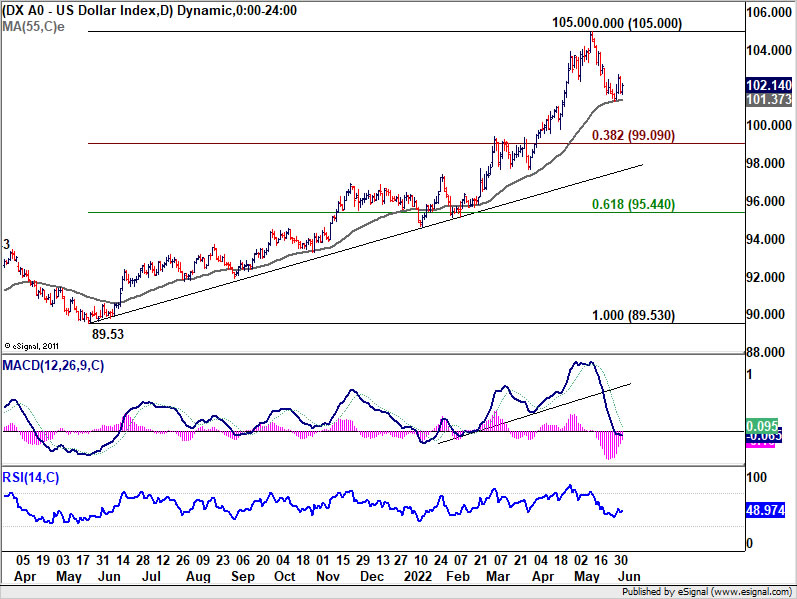
Dollar index recovered after hitting 55 day EMA. But that's mainly due to rally in USD/JPY. Upside momentum of DXY was limited by resilience in EUR/USD. While some volatility might be seen, the corrective pattern from 105.00 would take more time to complete. That is, barring some drastic development, upside of DXY should be limited below 105.00 even if there is a stronger rebound. But considering broad based weakness in Yen, 55 day EMA should hold for longer even if the recovery lost momentum further.
CAD/JPY resumes up trend on hawkish BoC
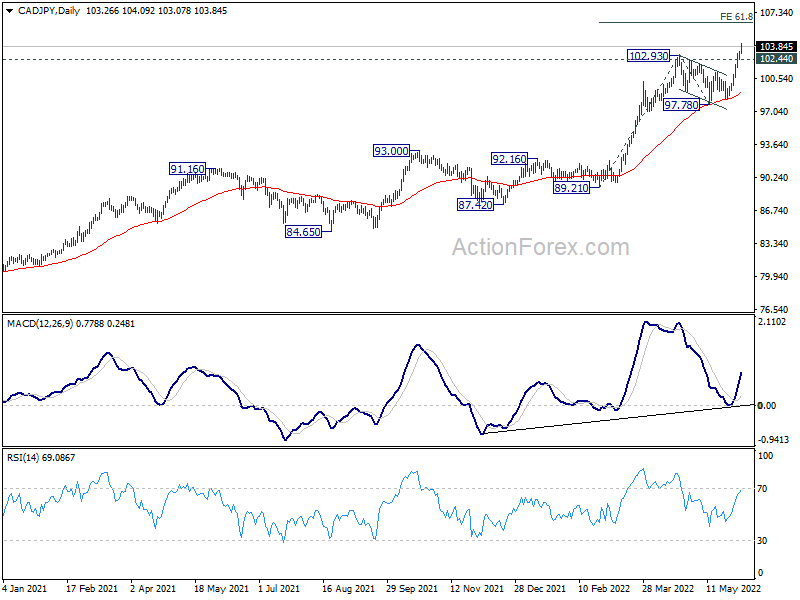
Canadian Dollar was the strongest one last week after hawkish BoC rate hike. Deputy Governor Paul Beaudry later indicated that the policy rate (currently at 1.50%) could need to go through the top end of neutral range of 2-3% to keep inflation expectations well anchored.
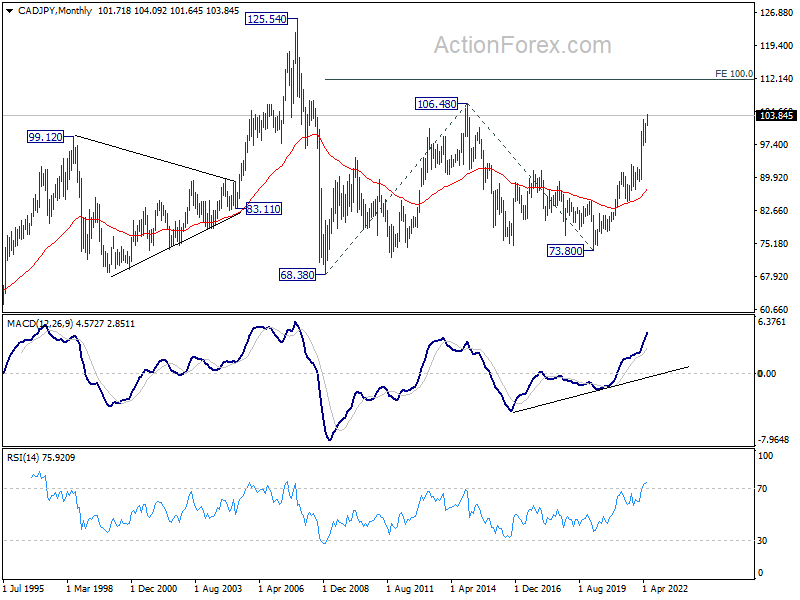
CAD/JPY led other yen pairs in upside breakout, surging through 102.93 resistance last week to resume the long term up trend. Further rally is expected as long as 102.44 minor support holds. Next near term target is 61.8% projection of 89.21 to 102.93 from 97.78 at 106.25. That is close to 106.48 long term resistance (2014 high). Nevertheless, the key hurdle would be at 100% projection of 68.38 to 106.48 from 73.80 at 111.90.
GBP/CAD broke 2016 low, extending down trend
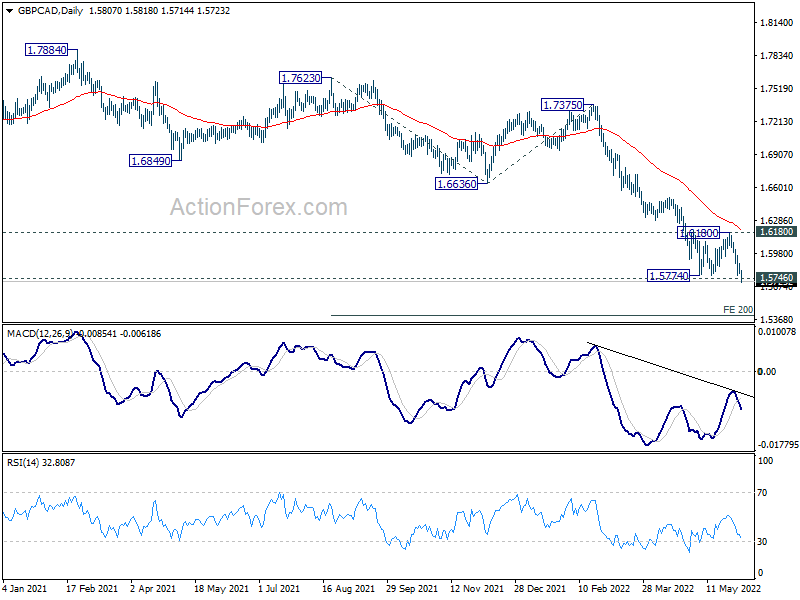
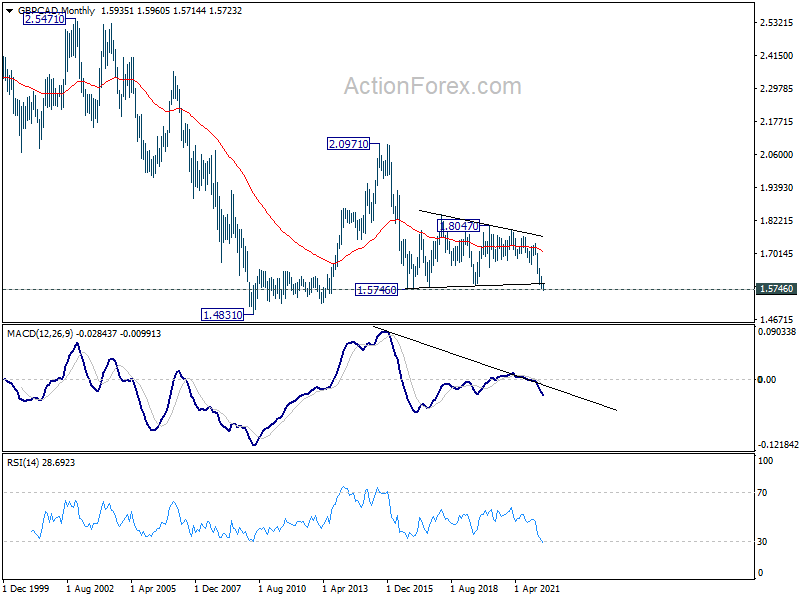
Canadian Dollar was also strong against European majors, in particular Sterling. It appears that British consumers are being more hit but strong inflation. Higher risk of stagflation could keep BoE's hands tied from aggressive tightening. GBP/CAD resumed recent down trend and broke 2016 low at 1.5746 to close at 1.5723.
Near term outlook will stay bearish as long as 1.6180 resistance holds. Next near term target is 300% projection of 1.7623 to 1.6636 from 1.7375 at 1.5401. The real important level, however, is 2010 low at 1.4831.
Gold struggled to extend rebound, capped below 55 day EMA
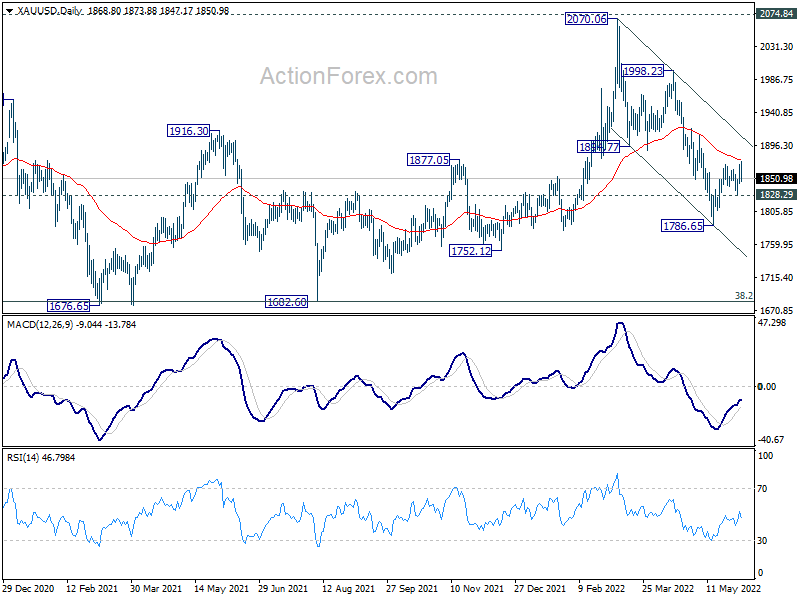
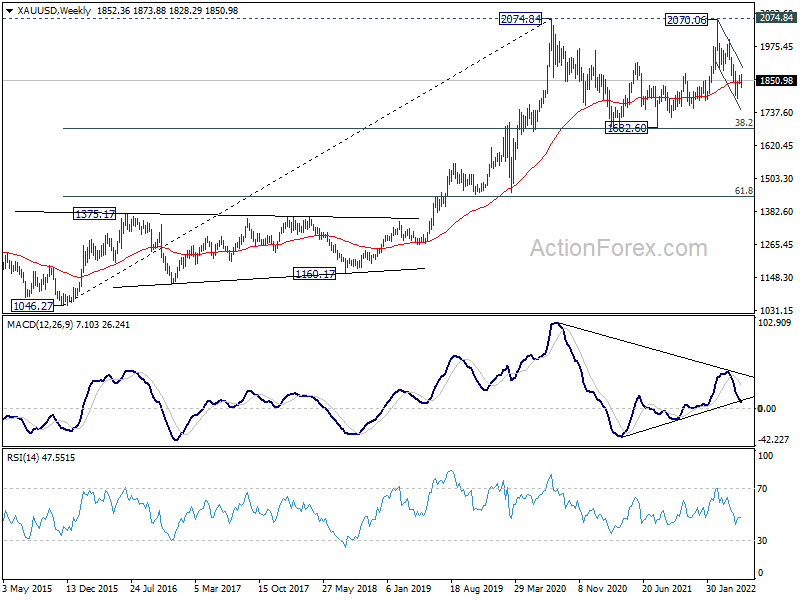
Gold struggled to extend the rebound from 1786.65, on the back of rising global yields and rate hike expectations. The failure to break through 55 day EMA (now at 1876.06) is a near term bearish sign. If benchmark yields continue to rise for the near term, there is prospect of Gold breaking through 1828.29 minor support, and then 1786.65 to resume the decline from 2070.06.
Such fall is seen as the third leg of the corrective pattern from 2074.84. It could extend lower to retest 1682.60 before bottoming, and completing the whole corrective pattern.
EUR/JPY Weekly Outlook
EUR/JPY rose to as high as 140.36 last week and the break of 139.99 resistance should confirm up trend resumption. Initial bias stays on the upside this week for 61.8% projection of 124.37 to 139.99 from 132.63 at 142.28. On the downside, below 138.18 minor support will turn intraday bias neutral and bring consolidations first, before staging another rally.
In the bigger picture, up trend from 114.42 (2020 low) is in progress. Such rise is seen as the third leg of the pattern from 109.30 (2016 low). Next target will be 100% projection of 114.42 to 134.11 from 124.37 at 144.06. In any case, outlook will now remain bullish as long as 132.63 support holds, in case of deep pull back.
In the long term picture, current rally could be resuming whole rise from 94.11 (2012 low). Further rally would be seen to 149.76 resistance (2014 high) and above. This will remain the favored case as long as 132.63 support holds.
Summary 6/6 – 6/10
Monday, Jun 6, 2022
[php_everywhere instance="1"]
Tuesday, Jun 7, 2022
[php_everywhere instance="2"]
Wednesday, Jun 8, 2022
[php_everywhere instance="3"]
Thursday, Jun 9, 2022
[php_everywhere instance="4"]
Friday, Jun 10, 2022
[php_everywhere instance="5"]
Weekly Economic & Financial Commentary: Economic Storm Clouds or Just a Brisk Inflationary Headwind?
Summary
United States: Economic Storm Clouds or Just a Brisk Inflationary Headwind?
- Nonfarm payroll growth exceeded expectations in May, with employers adding 390,000 jobs. The unemployment rate was unchanged at 3.6%, but labor force growth edged higher and wages rose only modestly. Most of this week's other reports also came in above expectations, with the ISM manufacturing index rising 0.7 points to 56.1 and factory orders posting solid, broad-based gains.
- Next week: Trade Balance (Tues), CPI (Fri), U. of Mich. Sentiment (Fri)
International: Hawkish Hike from the Bank of Canada, Mixed Data in the Emerging Markets
- The Bank of Canada delivered a 50 bps policy rate hike to 1.50%, and the accompanying statement was more hawkish than market participants expected. In emerging markets, data from China this week suggest the worst may be behind, as May PMI data revealed a modest uptick in sentiment. While China's economy is showing tentative signs of stabilization, Brazil is showing signs that activity is decelerating.
- Next week: European Central Bank (Thurs), Mexico Inflation (Thurs), Brazil Inflation (Thurs)
Credit Market Insights: Federal Student Loans Brought to the Forefront Again
- On Wednesday, the Federal Department of Education announced that it will discharge $5.8B in federal student loans. These targeted actions do not broadly effect American balance sheets or the macroeconomy—$5.8B in federal student loans is a small fraction of the $1.6T in total student loan debt.
Topic of the Week: The Growing Economic Influence of the LGBTQ+ Community
- Organized protests like the "Stonewall Uprising" have brought attention to the countless injustices that have been, and continue to be, inflicted on individuals identifying as LGBTQ+. The events that transpired 53 years ago were a pivotal moment in the long fight for equal rights. To commemorate Pride Month in 2022, we explore the growing economic influence of the LGBTQ+ community.
The Weekly Bottom Line: GDP and BoC Headline Huge Week
U.S. Highlights
- The U.S. economy continued to add jobs in May, though at a slower pace than in the previous month. The unemployment rate held steady at 3.6% and the labor force participation rate edged up by 0.1 percentage point.
- Job openings remained elevated at 11.4 million, even while workers continued to quit their jobs. With job openings exceeding the number of unemployed workers, labor market conditions may remain tight for some time yet.
- Both manufacturing and services activity continued to expand in May, though services did so at a slower rate. Both sectors also felt the hiring pinch, as the availability of workers dwindled.
Canadian Highlights
- The Canadian economy posted a 3.1% annualized gain in the first quarter, disappointing expectations, but better than global peers like the U.S. and the European Union.
- There were some bright spots in the details of the GDP report that bode well for Q2 growth, including a 0.7% m/m gain in March. The household savings rate also increased, which adds some cushion for spending.
- The Bank of Canada lifted their policy rate by 50 basis points (bps) this week, taking it to 1.5%. The accompanying statement was aggressively hawkish, and we anticipate another 100 bps of tightening this year.
U.S. - Jobs Abound but Too Few Workers Around
This week marks the start of a new month and with it, the start of the Fed’s quantitative tightening program. As it tightens monetary policy to fight inflation, the Fed will allow up to $47.5 billion of its treasury and mortgage-backed securities holdings to mature this month without reinvesting the proceeds. The net effect should help to push rates higher and tighten financial conditions, helping ease price pressures.
The Fed’s Beige Book also reported that companies continued to struggle with rising prices and labor shortages during the spring, resulting in modest economic growth. The report notes however, that consumers are starting to push back on higher prices, thereby limiting companies’ ability to fully pass on cost increases. To deal with labor shortages some businesses implemented greater automation, offered more job flexibility, and/or increased wages.
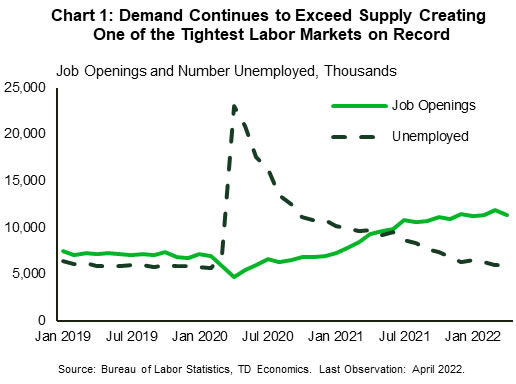
Job opening data for April further reinforced the tight labor market narrative. There were 11.4 million job openings in April, a pullback from the 11.9 million record attained in the previous month, but still well above pre-pandemic figures. Churn in the market remained elevated with workers quitting their jobs 4.4 million times, little changed from the prior month. The number of job openings has exceeded the number of unemployed persons looking for work for much of the past year (Chart 1) as fewer persons are seeking employment relative to before the pandemic.
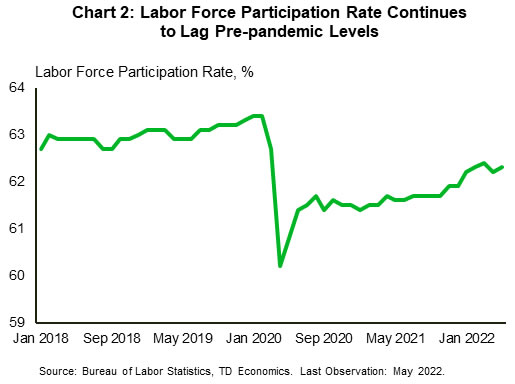
The trend is set to continue as the U.S. added 390k jobs in May, lower than the 436k in April but ahead of market expectations for 325k. Job gains were notable in leisure and hospitality, professional and business services, and in transportation. Notably, employment in retail trade declined. The unemployment rate held steady at 3.6% – close to the 50-year low of 3.5%. While the labor-force participation rate continued to recover at 62.3%, it was still below the 63.4% attained prior to the pandemic, thereby contributing to the labor supply slump (Chart 2).
The ISM manufacturing survey showed that activity in the sector continued to accelerate in May despite supply-chain and pricing challenges. The index came in at 56.1, exceeding April’s 55.4 print. New orders, backlogs of orders and the production index all rose, reflecting manufacturers’ struggles to keep up with above-trend demand for goods.
Conversely, while still in growth territory, activity in the services sector decelerated in May to 55.9 from 57.1. Despite new orders being higher on the month, business activity pulled back 4.6 points to a two-year low of 54.5. Services activity is expected to pick-up speed as summer progresses, though rising prices present challenges.
Despite current strong economic conditions, consumer confidence took a hit for the second consecutive month as high inflation soured the outlook. The Conference Board consumer confidence index dipped to 106.4 in May, from 108.6 in April, with both the present situation and the expectations index declining. Rising inflation, and measures to counteract it, may be putting a damper on consumers as they brace for the possible fallout.
Canada - GDP and BoC Headline Huge Week
It was huge week in Canada with the release of the first quarter GDP report, and the Bank of Canada's interest rate decision. Canada's economy managed a solid 3.1% annualized gain in the first quarter, supported by robust growth in household spending and surging residential investment. The gain was even more impressive when stacked against global peers, with real GDP contracting by 1.5% in the U.S. in Q1, and the EU squeaking out a 1.1% gain.
The print did disappoint market expectations, which called for even stronger growth. Still, there are plenty of signs pointing to another solid quarter in Q2. For starters, the household savings rate increased 1.2 ppts to 8.1%. This suggests a larger buffer for household spending to hold up in the face of inflation pressures and higher interest rates. In addition, service spending was restrained early in the quarter by lockdowns, and higher frequency data tracking lockdown-sensitive spending improved as the quarter progressed. In addition, GDP advanced 0.7% month-on-month in March – over three times faster than what is typically considered trend growth. If we assumed 0.2% growth in April (in line with Statistics Canada's flash estimate) and flat output in May, and June, second quarter GDP would still be up more than 3% annualized (Chart 1).
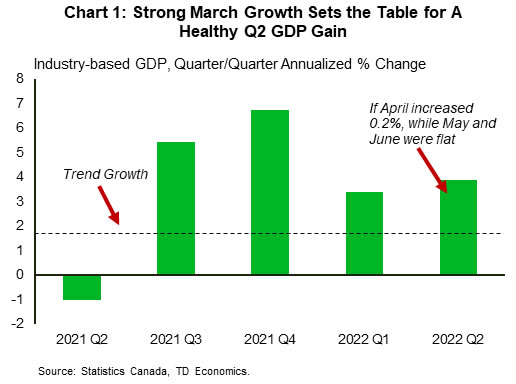
Of course, not everything's coming up roses in terms of second quarter growth prospects. The near 20% annualized surge in residential investment should give way to a decline in Q2, as higher interest rates have hit home sales hard. Meantime, net trade subtracted from growth in the first quarter. While exports declined, their monthly pattern indicates improving momentum heading into the second quarter. However, this story is even more pronounced for imports, suggesting they could outperform, which is negative from a GDP accounting perspective.
The Bank of Canada's interest rate decision co-starred this week. To no one's surprise, they lifted their policy rate by 50 basis points (bps) to 1.5%. What may have been slightly more eyebrow raising was the aggressively hawkish tone struck in the accompanying statement. Markets certainly took it that way, with bond yields climbing in the wake of the statement. Inflation was forecast to move even higher in the near-term. The Bank also noted that the risk of elevated inflation becoming entrenched had risen. On the economy, it was characterized as operating in excess demand with tight job markets leading to wage growth picking up and broadening out across sectors.
Policymakers didn't mince words, noting that "interest rates will need to rise further". We think another 50 bps of tightening will happen in July (even with some chatter of a possible 75 bps move), taking the Bank's policy rate to the low end of its neutral range (Chart 2). Afterwards, a slower cadence is likely as the Bank assesses the impact of its tightening campaign.
Week Ahead – ECB to Set Up a July Hike and US Inflation Nears Peak
A strong nonfarm payroll report means that the Fed won’t be pausing their interest rate hiking campaign anytime soon. The May employment report was impressive, but it will likely be the last strong one we will see in a while. The focus shifts to the May inflation report which should show inflation on monthly basis is rising, which should force some Fed members to agree pricing pressures will remain sticky for the next couple of quarters.
The upcoming week is filled with important central bank rate decisions, with the ECB being the main event. The ECB will boost their inflation forecast and prepare currency traders for a July rate hike. ECB President Lagarde’s press conference will probably be determining factor for whether traders price in a 25 or 50 bps rate increase in July.
It seems the cryptoverse has been stuck following the action on Wall Street, but that could change if the 2022 Consensus festival unveils any major breakthroughs with blockchain technology, Web 3, the metaverse, and crypto investment commitments.
Countries
US
The labor market is showing signs of deceleration and now Wall Street wants to see if inflation has peaked. The May inflation report will still be hot and even if prices come down a little bit more than economists expectations, the Fed will most likely stay locked into delivering half-point rate increases over the next couple of Fed policy decisions. Consumer prices are expected to ease slightly to an 8.2% annual gain in May, while a surge is forecasted for the month-over-month basis with a gain of 0.7%. If inflation shows signs that demand destruction is happening, calls for a 50bps hike in September may decline.
The other key economic release in the US will be June’s preliminary University of Michigan sentiment report. The headline index is expected to improve from the decade low of 58.4 to 58.9. Traders will care if the deterioration of buying conditions is worsening. Inflation expectations might not improve significantly as the recent surge with oil prices and persistent supply chain issues will continue to weigh on prices.
The blackout period for the Fed begins so we won’t hear comments until after the June 15th policy decision. The Summit of the Americas will last all week and President Biden and Brazilian President Bolsonaro will have their first bilateral meeting.
UK
Brexit isn’t over. Tensions are rising over the Northern Ireland protocol, which governs post Brexit trade rules between the EU and the UK. The protocol requires inspections of some goods entering Northern Ireland from the rest of the UK, in order to avoid a hard border between Northern Ireland and Ireland, which is part of the EU.
British Prime Minister Boris Johnson is threatening to make changes to the protocol, saying that the present inspection mechanism is too cumbersome and is hurting the UK economy. The UK government may table legislation to amend the protocol, a move which is sure to draw EU retaliation.
The UK releases Services PMI on Tuesday.
EU
The ECB holds a policy meeting on Thursday, in the shadow of the war in Ukraine. The EU announced it will ban all Russian oil imports by sea, while allowing pipeline imports to continue. The move, which could result in as much as 90% of Russian oil imports being banned from Europe, is meant to deal a crippling blow to Russia, but will also have a negative impact on the EU economy.
The ECB has signalled that it will increase the deposit rate starting in July and end its asset purchase programme (QE). It remains unclear whether liftoff will take the form of a 25-bps or 50-bps hike. The markets will be closely monitoring President Lagarde’s press conference for any hints on the size of the rate increase.
Germany releases Factory Orders on Tuesday expected to improve by 0.3% from a month ago and Industrial Production on Wednesday.
Russia
The war in Ukraine rages on, and Ukrainian President Zelensky stated this week that Russia controls about 20% of Ukrainian territory. The EU’s ban on most oil imports from Russia will squeeze Russia’s economy even further, although record-high oil prices are relieving some of the pressure from sanctions.
The Bank of Russia holds a policy meeting on Wednesday and is expected to cut the benchmark rate. The Bank slashed the rate on May 26th at an extraordinary meeting, lowering the rate from 14% to 11%. The move was made to support the Russian economy, which has contracted as a result of sanctions. The markets had expected a 200-point cut and the Russian rouble fell sharply after the decision.
Russia will release CPI for May on Wednesday Inflation remains very high and is expected to tick lower to 17.4%, down from 17.8% in April.
South Africa
South Africa releases GDP for Q1 on Tuesday. Economic growth is expected to tick higher to 1.8% in the first quarter.
South Africa’s economy has benefited from the recent boom in commodity prices, but inflation has been rising, with food inflation being a particular concern.
Turkey
The Turkish lira continues to lose ground and has fallen to its lowest level since December 2021. The lira has become the worst performer in the emerging markets, and the slide is expected to continue. Inflation remains high and growth is slowing, yet the central bank is defiantly pursuing its unorthodox, ulta-loose monetary policy, which continues to put downward pressure on the fragile Turkish lira.
China
The most important data release this week is the Caixin Services PMI on Monday. Having been pummelled by covid zero lockdowns, it is probably too soon to expect a sharp recovery with Shanghai and Beijing still inthe reopening process. Nevertheless a sharp jump back to near 50 would likely spark an immediate rally in China stocks and put downward pressure on USD/CNY.
Inflation data due on Thursday should be a non-event, with slumping domestic demand keeping inflation around 2.0%, even though PPI is expected to print near 8.0% YoY.
The PBOC continues to draw a line on further Yuan weakness, having started announcing stronger fixes as USD/CNY moved near to 6.8000.
India
Recent inflation data has shown it to be well above the RBI’s 2-6% band, and it seems certain that the RBI will hike rates once again at its meeting on Wednesday. How much impact that will have will depend on the statement afterwards, but I expect the RBI to maintain its hawkish rhetoric as PMIs indicate an economic recovery is under way. A hawkish RBI is likely to be a headwind for local equities.
Elsewhere, the Indian Ruppee continues to trade on the weaker side, with USD/INR stuck at 77.600. Part of the reason may be India’s soaring energy bill pressuring the current account and if Brent crude rises through $120.00 this week or next, I expect to see INR come under more selling pressure.
Australia
Australia has a packed data week with ANZ Job Advertisments Monday, adn NAB Business COnfidence on Wednesday. Undoubtably the highlight though is the latest RBA Interest Rate Decision on Tuesday, with markets pricing in a 25bps hike to 0.60%. The accompanying statement, be it hawkish, or less hawkish, will be felt mostly by equity markets. A bigger than 0.25bps hike would be a huge surprise and see a sharp AUD rally, while local equities will fall aggressively.
The Australian dollar has ridden the US dollar correction higher but despite data, elections, and monetary policy changes, the short-term direction of the currency continues to be dominated by the swings in risk sentiment day-to-day.
New Zealand
No significant data next week. Like the Australian dollar, the New Zealand dollar remains hostage to the daily swings we are seeing in investor risk sentiment from North American markets.
Japan
Japan releases Household Spending, Final Q1 GDP and PPI next week, but realistically, the Nikkei will continue to tightly track the US Nasdaq, at least until the BOJ policy meeting which usually follow the US FOMC.
USD/JPY has rallied back to 130.00 in the past week as US yields moved higher and Japanese official reiterated the BOJ’s super-easy monetary stance. That proves that the primary driver of Yen direction continues to be the US/Japan rate differential and nothing should change regarding that in the week ahead.
Singapore
No significant data or events.
Markets
Energy
Crude prices remain supported as energy traders digest a modest ouptut boost by OPEC+ and have renewed optimism for the US economy following a better-than-expected nonfarm payroll report. Oil’s rally now stands at six weeks, so that might be why bullish exhaustion is settling in and not reacting more positively to this week’s decision by OPEC+ that will still keep the oil market tight throughout this summer.
If any details emerge about what President Biden is looking to accomplish with his trip to Saudi Arabia, that could weigh on prices.
Gold
Gold’s little bullish streak has run into some resistance as the dollar stabilizes over expectations that the Fed won’t be changing up their rate hiking campaign anytime soon. Doom and gloom calls are growing, but what right now that is mainly benefffitng global bond yields. The yellow metal has consolidated between $1,830 and $1,880 this week and that might continue until the latest inflation report confirms pricing pressures are easing.
Cryptos
Bitcoin remains in consolidation mode as it has for the last few weeks. It remains anchored around the $30,000 level but that could change if the bond market selloff intensifies or if Consensus 2022 triggers some trading off of crypo fundamentals. The Austin, Texas event by CoinDesk could provide some major announcements for blockchain projects, Web3, or NFTs
Sunday, June 5
Economic Data/Events:
- UK continues celebration of Platinum Jubilee Holiday
- Australia’s new prime minister Albanese visits Indonesia
Monday, June 6
Economic Data/Events:
- Australia inflation gauge, job advertisements
- China Caixin services PMI
- Czech Republic industrial output, trade
- Thailand CPI
- Summit of the Americas: President Joe Biden and Brazilian President Jair Bolsonaro will hold their first bilateral meeting
Tuesday, June 7
Economic Data/Events:
- US trade, consumer credit
- Australia rate decision: Expected to raise rates by 25bps to 0.60%
- China Foreign reserves
- Australia Foreign reserves
- Singapore Foreign reserves
- Germany factory orders
- Greece GDP
- Japan household spending, labor cash earnings, leading index
- Mexico international reserves
- New Zealand commodity prices
- South Africa GDP
- Spain industrial production
- UK services PMI
- World Bank’s “Global Economic Prospects” report
- ECB’s Wunsch presents Belgium’s financial stability review.
- Riksbank Governor Ingves speaks on monetary policy.
- Russian Foreign Minister Sergei Lavrov speaks in Serbia
Wednesday, June 8
Economic Data/Events:
- US wholesale inventories
- India central bank (RBI) Rate decision: Expected to raise rates by 50bps to 4.90%
- Poland central bank rate decision: Expected to raise rates by 75bps to 6.00%
- Thailand central bank (BOT) rate decision: Expected to keep rates steady at 0.50%
- Russia Foreign Min Lavrov visits Turkey
- Irish PM Martin speaks to European Parliament
- Eurozone GDP, employment
- France trade
- Japan GDP
- Hungary CPI, industrial output, trade
- Germany Industrial production Germany
- Japan trade, BoP, bank lending, bankruptcies
- Russia CPI
- Switzerland unemployment
- Taiwan trade
- OECD Economic outlook released
- EIA crude oil inventory report
Thursday, June 9
Economic Data/Events:
- US initial jobless claims
- ECB Rate Decision: To end ECB net asset purchases and signal a rate hike in July
- Bank of Canada Financial System Review
- China trade, new yuan loans, money supply, aggregate financing
- Greece CPI
- Japan money stock, machine tool orders
- Mexico CPI
- South Africa manufacturing production, current account
- Thailand consumer confidence
- UN Food & Agriculture Organization’s “Food Outlook,” focusing on developments affecting global food and feed markets.
- Consensus by CoinDesk festival in Austin, TX
- The Bank of Canada delivers an assessment of risks and vulnerabilities in Canada’s financial system.
Friday, June 10
Economic Data/Events:
- US CPI, University of Michigan consumer sentiment
- Canada unemployment
- BOE/Ipsos Inflation Survey
- China CPI, PPI
- Czech CPI
- Denmark CPI
- Norway CPI
- India Industrial production
- Mexico Industrial production
- Japan PPI
- New Zealand manufacturing activity, card spending, home sales
- Russia rate decision: Expected to cut rates by 100bps to 10.00%
- Thailand forward contracts, foreign reserves
- IISS Shangri-La Dialogue, Asia’s biggest defense summit, in Singapore
- European Leaders prepare for NATO summit.
Sovereign Rating Updates:
- Spain (Fitch)
- United Kingdom (Fitch)
- EFSF (Moody’s)
- ESM(Moody’s)
- Netherlands (Moody’s)
New Beginning for the Canadian Dollar
Recently, the Bank of Canada hiked the interest rates by 50 basis points. It is now 1.5%, and it’s only the beginning. The policy rate may directly go to the top, or even above, what the Bank of Canada considers its “neutral range,” estimated at 2-3%. These measures can push the CAD higher against other currencies.
Moreover, Canada’s economy recorded a surge in trade with the rest of the world in March, as rising prices for commodities coupled with strong domestic demand and a smoother global supply chain drove imports and exports.
Imports jumped 7.7 per cent in March to $61.1 billion (US$47.7 billion), while exports were up 6.3 per cent to $63.6 billion, Statistics Canada reported on Wednesday. The nation’s surplus narrowed to $2.5 billion, from a revised $3.1 billion in February.
Technical analysis
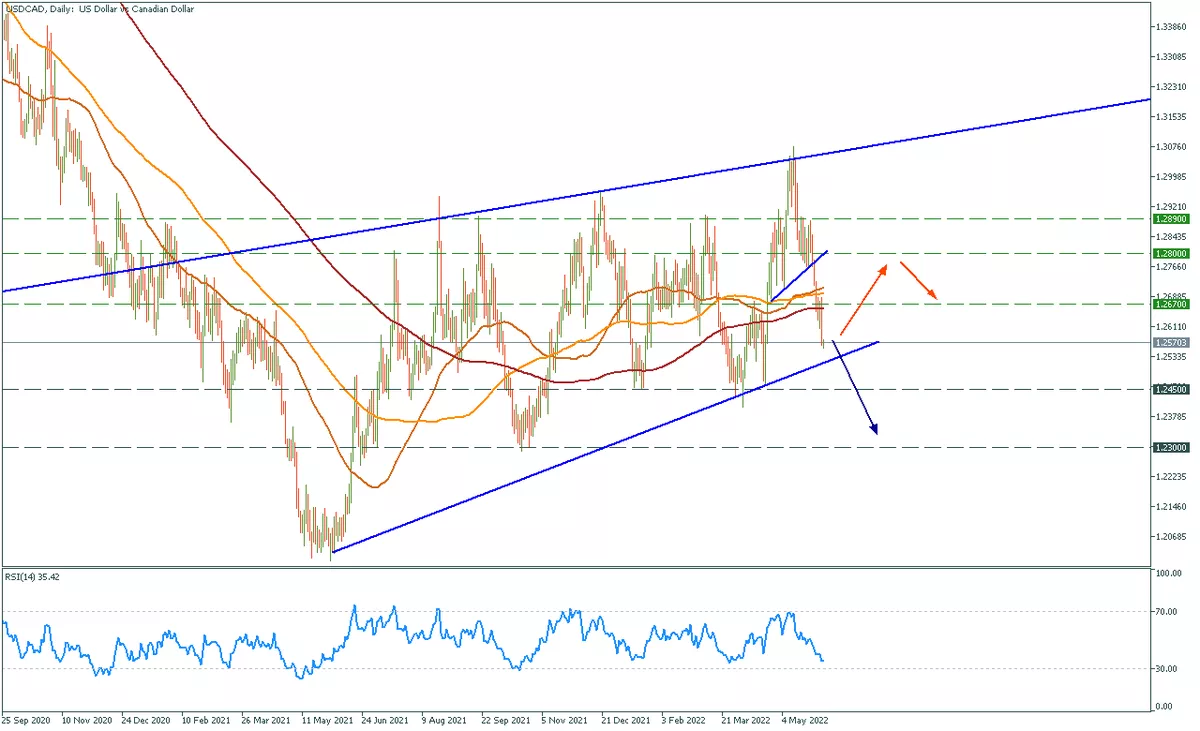
We’ll take a look at two pairs. First is USDCAD. The pair is near the support trendline, which prevents the USD from falling for more than a year. We can expect another touch of the line, but the breakout is not a must-have right now. The bounce from the trendline will probably result in the consolidation for another month or two. If the price breaks through the support, the downtrend for the USD will continue.
USDCAD daily chart
- Resistance: 1.2370, 1.2800, 1.2890
- Support: 1.2450, 1.2300
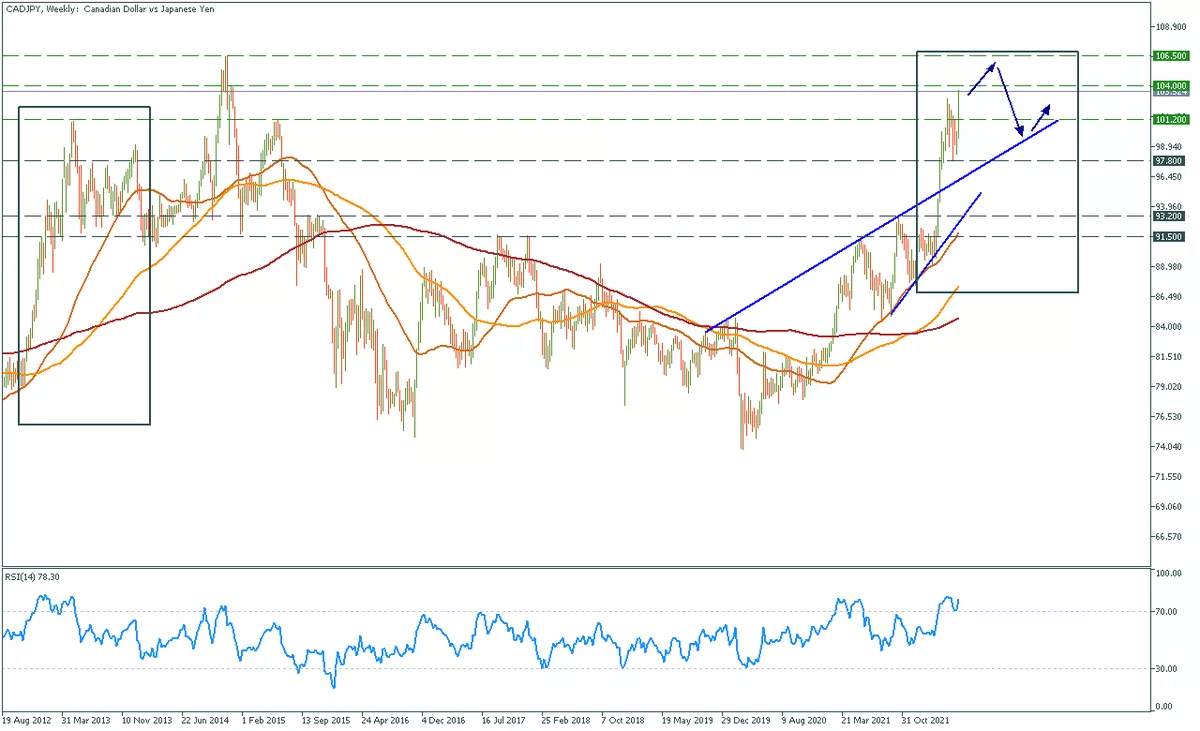
Another chart worth looking at is CADJPY. We can clearly see a fractal that happened in 2012; the movement seems similar, and we can expect the pair to move higher. CADJPY may reach 106.50 before the end of the uptrend. That aligns with our prospects for the Canadian dollar.
CADJPY Weekly chart
- Resistance: 101.20, 104.00, 106.50
- Support: 97.80, 93.20, 91.50