Sample Category Title
Forward Guidance: Scorching Inflation Eating into Household Wage Gains
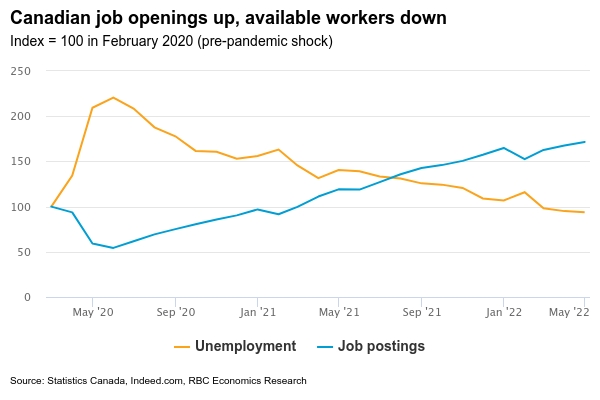
Canadian employment likely didn’t change much in May. We expect a gain of 15,000 jobs—matching the increase in April. Employment growth has slowed dramatically in recent months, but not due to any shortfall in labour demand. The number of job openings in Canada was still running ~70% above pre-pandemic levels in May. But the number of workers available for hire is now very small, with the unemployment rate at 5.2% in April, its lowest level since at least 1976. And labour shortages are widespread by sector. That means additional demand for workers from now on will show up more in wage growth than in employment counts.
Meantime, wages have shown signs of drifting higher, and that likely continued in May. Wage increases have emerged more quickly in the U.S., but surging inflation is eating into household purchasing power at the same time. Next week’s U.S. inflation report is expected to show the headline year-over-year rate little changed after edging lower for the first time in almost a year in April, falling to 8.3% from 8.5% in March. Gasoline prices jumped to almost $4.50 per gallon on average in May—up 49% from a year ago and over 4% (seasonally adjusted) from April. That should push energy inflation even higher.
Food prices are expected to have risen at a faster rate again, driven by more expensive farm products and rising processing and transport costs. Higher food and energy prices alone would be enough to make consumers feel the pinch of higher prices, but pressures have been far broader than that. Ex-food and energy (core) CPI growth likely moved a touch lower year-over-year but should still hold at around 6%. Wages in comparison have still increased more compared to pre-pandemic levels—at 4.7%, annualized growth in average hourly earnings in the U.S. from 2019 still remains above the annualized inflation increase over the same period (4.2%). But the gap is closing, quickly.
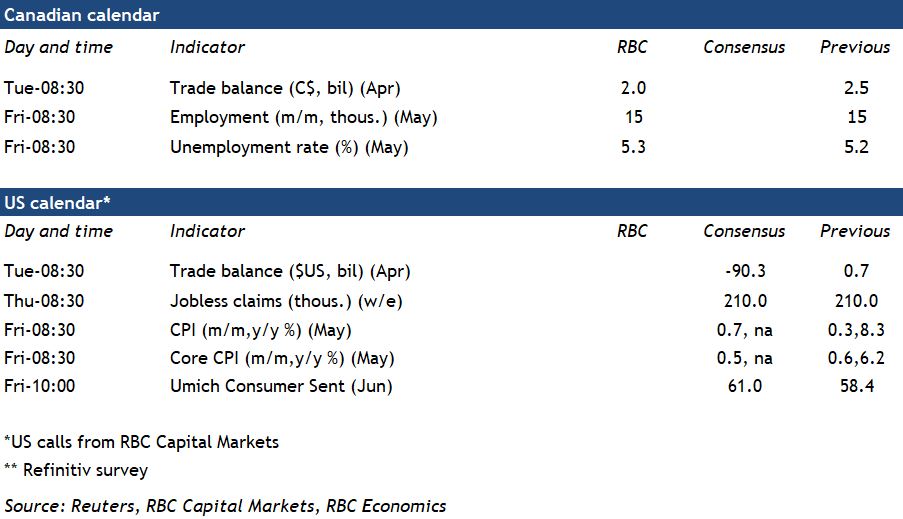
Week ahead data watch:
We expect the Canadian (merchandise) trade surplus narrowed to $2 billion in April. A pull-back in oil prices will lower exports more than imports. North American vehicle assemblies increased, and that should support further improvement in motor vehicle trade flows. Pandemic lockdowns and port disruptions in China likely weighed on trade flows from Asia. Chinese exports fell sharply in April, although shipments to Canada held up relatively well.
RBA to Hike Again, But by How Much?
The Reserve Bank of Australia is set to hike interest rates on Tuesday when it announces its decision at 04:30 GMT. But after surprising with a bigger-than-expected 25-basis-point increase at the last meeting, by what increment will policymakers raise rates this time? Recent data out of Australia has been mixed, but the long-awaited easing of virus curbs in China’s largest city – Shanghai – may have given the RBA the green light to be even bolder in June. The size of the rate hike, as well as any updated guidance on the projected rate path could determine whether or not the Australian dollar is able to stretch its recent rebound.
The economy is mostly strong
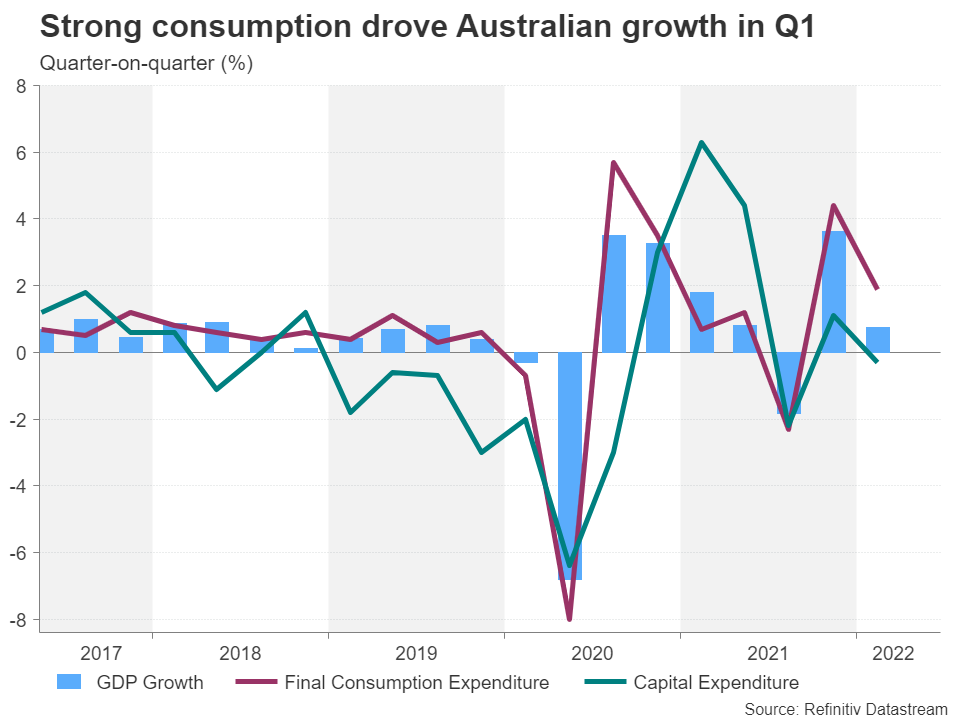
The Australian economy grew a solid 0.8% in the first three months of the year, beating estimates. Growth was surprisingly resilient despite a smaller current account surplus and a drop in business investment. However, the narrower trade surplus was down to exceptional demand for imports rather than a fall in exports as consumers splashed out. Hence, although some aspects of the recovery have been disappointing and there were the added challenges of Omicron and heavy flooding across parts of Australia to contend with in Q1, the economy is generally in good shape.
Just as relevant, if not more, is that virus restrictions in Shanghai are finally being relaxed and the recent easing of some curbs in other Chinese cities has already started to boost manufacturing activity. Moreover, the Chinese government just announced a comprehensive fiscal package to support regional economies and promote investment in infrastructure and tech industries. Whilst there’s a high risk that lockdowns could be re-imposed on the first sign of a fresh outbreak, the decline in infections for now does at least clear some of the fog in the growth outlook for China, which absorbs a large chunk of Australia’s exports.
A recipe for big rate hikes?
More to the point, however, for the RBA, the country’s consumer price index jumped to a 20-year high of 5.1% year-on-year in the first quarter, and the labour market remains tight. Wage growth has only picked up moderately, but it may only be a matter of time before it accelerates. Thus, given that it’s been rather late to the game, the RBA no longer has a strong case to go slow when it comes to tightening policy.
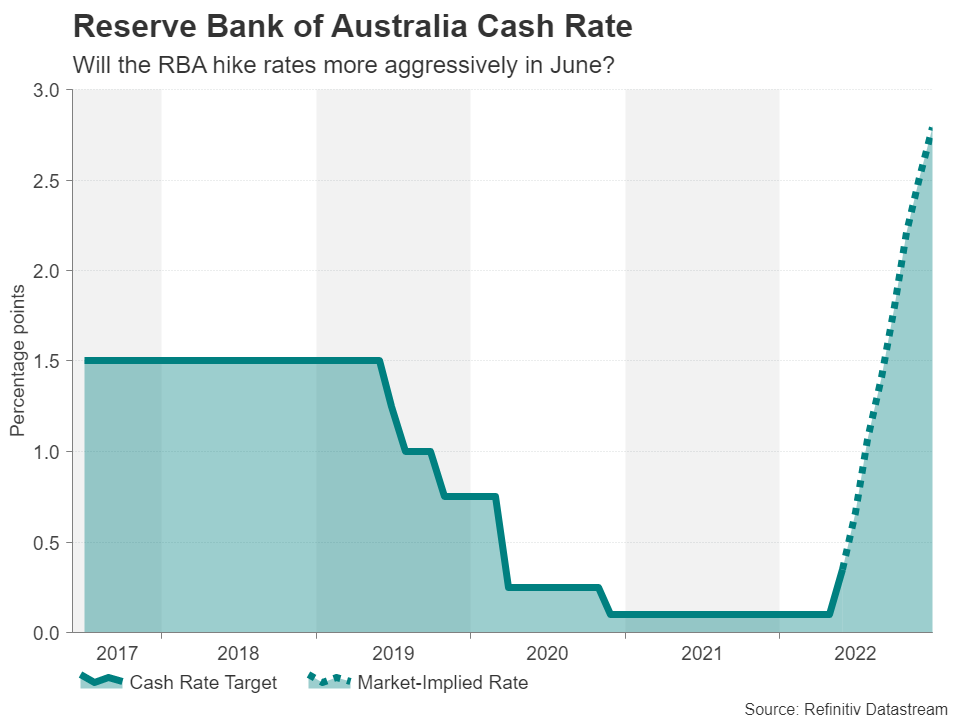
A 25-bps rate hike is fully priced in by the markets for June but there’s a substantial chance of an even bigger increase. Having taken the unusual step of lifting the cash rate from 0.1% to 0.35% at the last meeting, policymakers could decide to raise it by 40 bps to 0.75%.
Aussie rebound might stall without RBA boost
A 40-bps increase or more could add fresh steam to the aussie’s latest uptrend against the US dollar, which appears to be stalling near the 200-day moving average. The $0.7250 region also contains the 50% Fibonacci retracement of the April-May downtrend at $0.7244 so it might prove to be a tough resistance point. A hawkish tone would help overcome this hurdle, opening the way for the 61.8% Fibonacci of $0.7342, before aiming for the $0.7450 level.
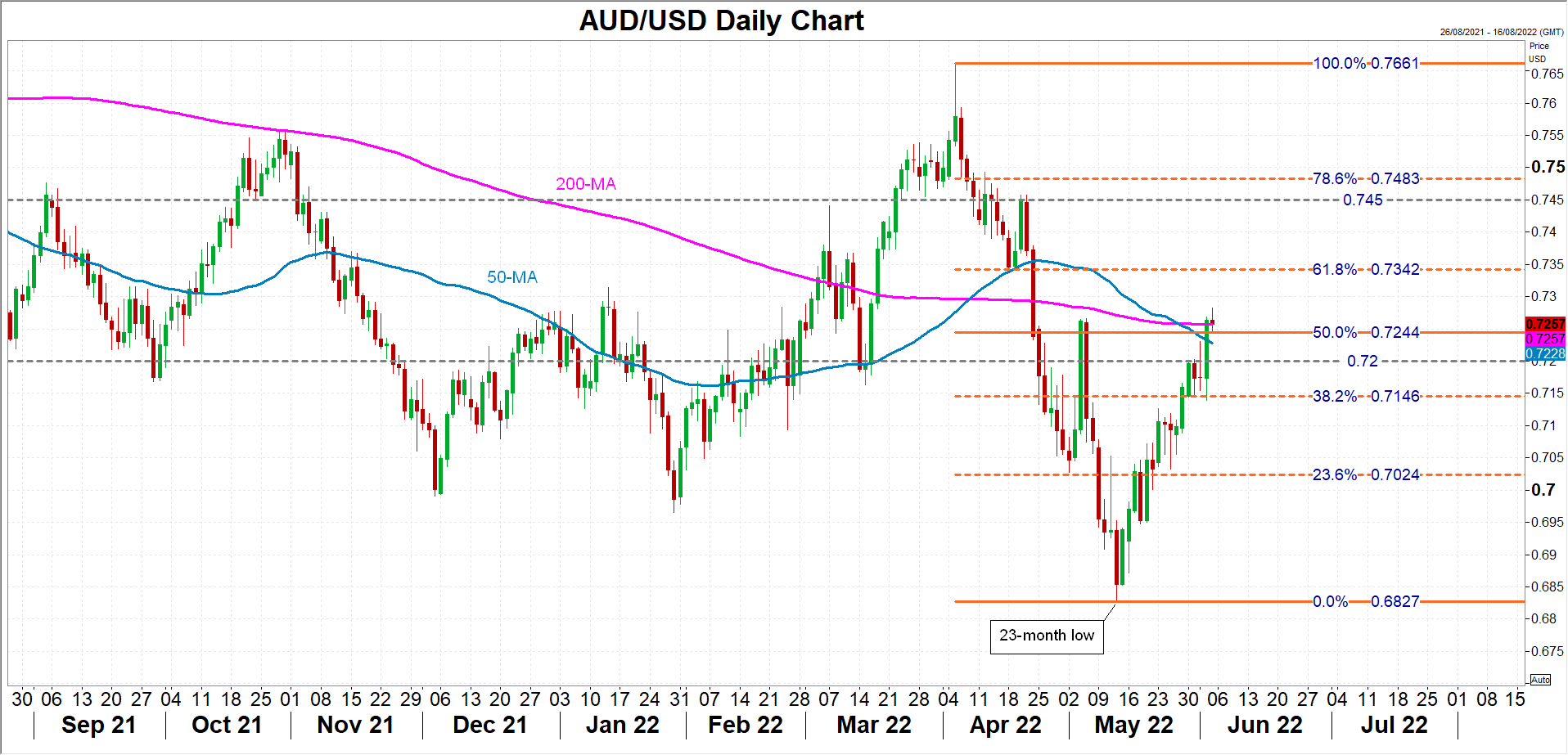
However, if the RBA raises rates by only 25 bps and does not signal its willingness to get more aggressive in the upcoming meetings, the aussie could come under selling pressure. The 38.2% Fibonacci of $0.7146 is the key support to the downside. If breached, the 23.6% Fibonacci of $0.7024 could next be targeted before the losses reach the 23-month low of $0.6827 set in mid-May.
Beyond the June meeting, investors are heavily betting that the cash rate will rise by at least a further eight times (of 25-bps increments) by year-end. Now that the tightening cycle is getting well and truly underway, there is a risk that the RBA’s hawkish rhetoric will not match the aggressive pricing by investors – something that could thwart the aussie’s comeback bid.
Week Ahead – ECB and RBA Meetings: Playing Catchup
The European Central Bank is set to flag its first rate hike in more than a decade this week, while the Reserve Bank of Australia might step on the brakes harder. But as the laggards of the central bank world finally get their stakes on when it comes to tightening policy, investors will be on the lookout for more evidence that inflation may already be peaking in the United States. China’s economy will be in the spotlight too as trade and inflation readings are due as growth fears persist even after the easing of Shanghai’s lockdown.
ECB about to do the unthinkable
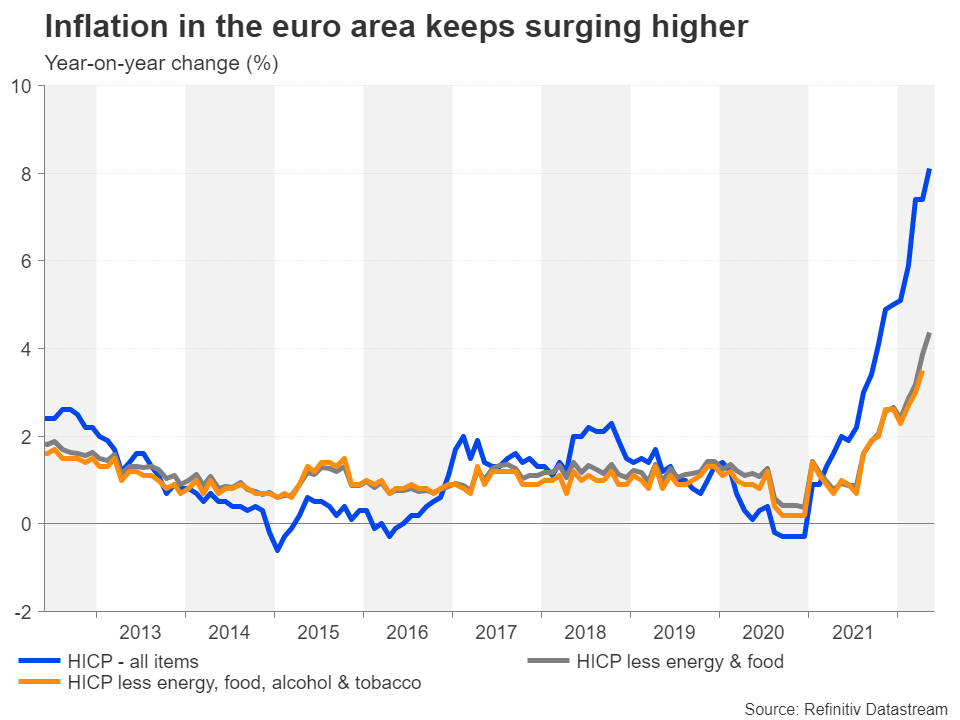
Inflation in the euro area surged to a new record high of 8.1% y/y in May, adding pressure on the ECB to end its long-running asset purchase programme as quickly as possible and lift the deposit rate out of negative territory, where it’s been since 2014. The policy decision on June 9 will therefore be a highly significant one even though the outcome has been well telegraphed by now.
Policymakers have signalled that they want to wrap up their bond purchases by early July and begin raising rates later that month when they meet on the 21st. There is some uncertainty as to the size of the initial rate increase and most likely, President Christine Lagarde will want to set the record straight on that in June rather than encourage speculation in the run up to the July meeting.
Having already made several policy U-turns this year, it’s difficult to imagine Lagarde will endorse a move bigger than 25 basis points. She will probably want to keep her options open for September but will prefer to provide investors with explicit guidance about the summer liftoff.
But even in this ‘least hawkish’ scenario, the turnaround in policy in such a short time has been dramatic, as only a few months ago, a 2022 rate rise was unthinkable for many at the ECB, including Lagarde herself.
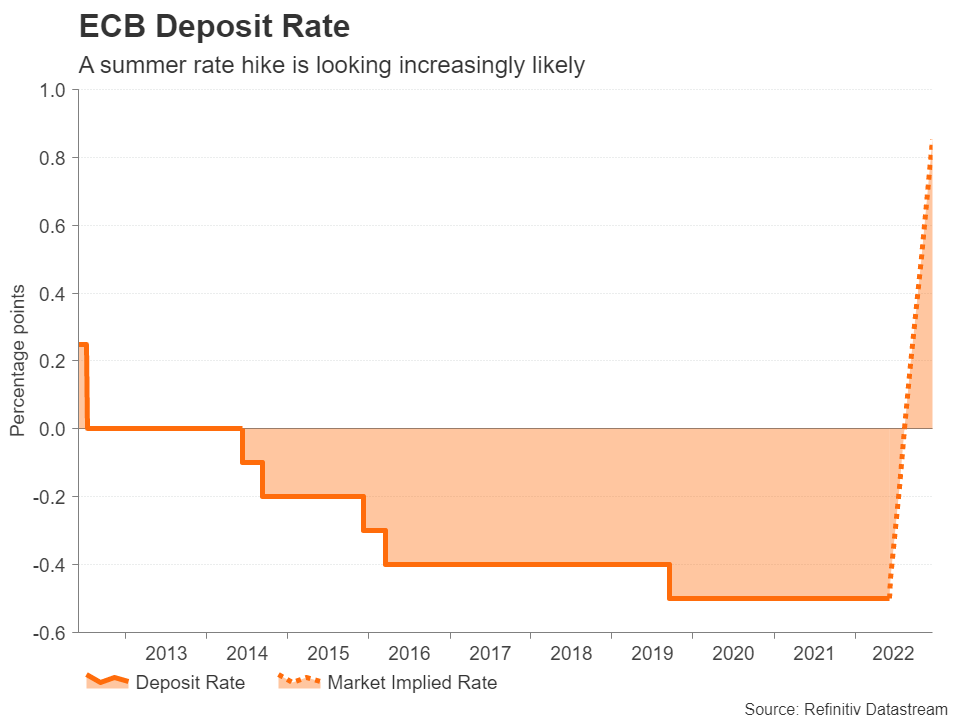
All the talk of rate hikes has bolstered the euro, giving it a leg up against the US dollar and other majors. However, with at least a 25-bps increase at each of the July and September meetings already priced in, investors will be looking for hints that the ECB is willing to go faster. Otherwise, the euro will struggle to extend its recovery without further weakness in the dollar.
On the data front, German industrial orders and industrial production figures for May out on Tuesday and Wednesday, respectively, might attract some attention amid worries about the Eurozone’s growth outlook.
Will the RBA surprise again?
Ahead of the ECB’s decision, the RBA is expected to announce its second rate hike on Tuesday. The RBA raised rates by 25 bps in May, taking some investors by surprise not just with the timing, but also with the size of the increase. After China’s relaxation of lockdown restrictions in Shanghai and the robust GDP growth in the first quarter, the RBA has been given the green light to go full steam ahead with policy tightening.
Money markets are quite aggressively priced for the RBA. Investors are betting almost 10 rate hikes of 25 bps in the remaining seven meetings of 2022. This leaves the Australian dollar highly exposed to disappointments should the RBA not live up to the hawkish expectations. A 25-bps rate rise would almost certainly be seen as overly cautious by the markets and probably by policymakers too. Hence, there’s a good chance the RBA will opt for a 40-bps increase, which would take the cash rate to 0.75%, although another unexpectedly larger move cannot be ruled out given the central bank’s unpredictability in the past.
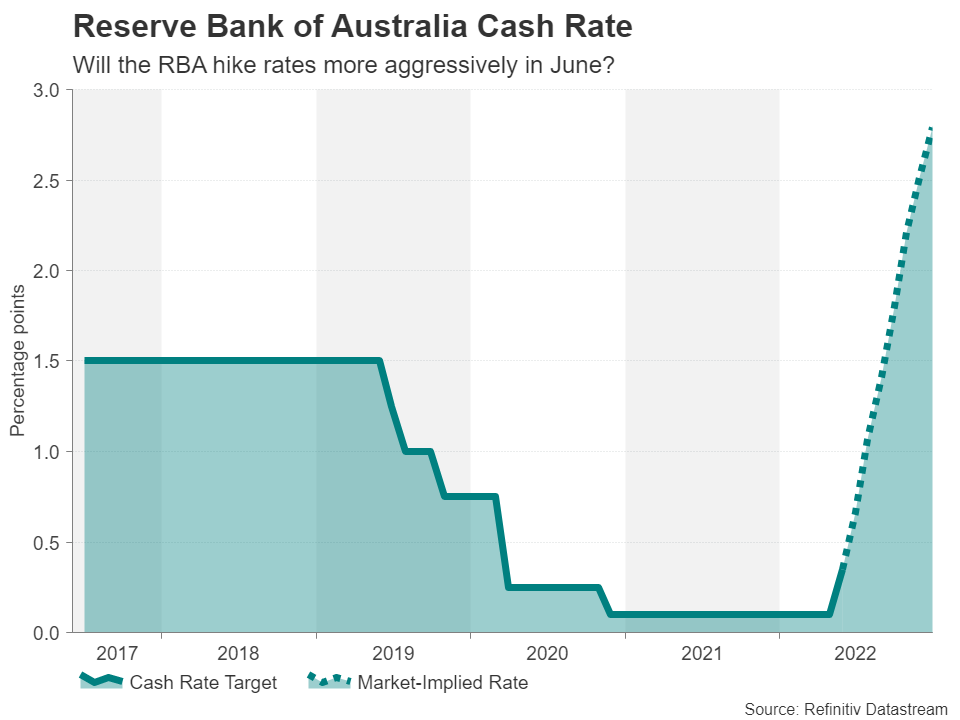
The aussie has just surpassed the $0.72 level as it continues to recover from May’s almost two-year trough. But the bulls might need to see some signs that more aggressive tightening is on the cards later in the year to maintain the positive momentum.
Keeping one eye on China’s slowdown
China has been a major concern for the markets lately as the timing of the recent lockdowns with the heightened geopolitical tensions couldn’t have been worse. Although some sense of normality is re-emerging in the worst hit region Shanghai, the fact that authorities are not letting up on their zero-Covid strategy means that the draconian measures could return at the first hint of a fresh outbreak.
This might explain why the subsequent relief rally in risk assets has been somewhat patchy. But the incoming data will likely show an improving economic picture, so there is scope for further boosts to risk appetite in the coming week.
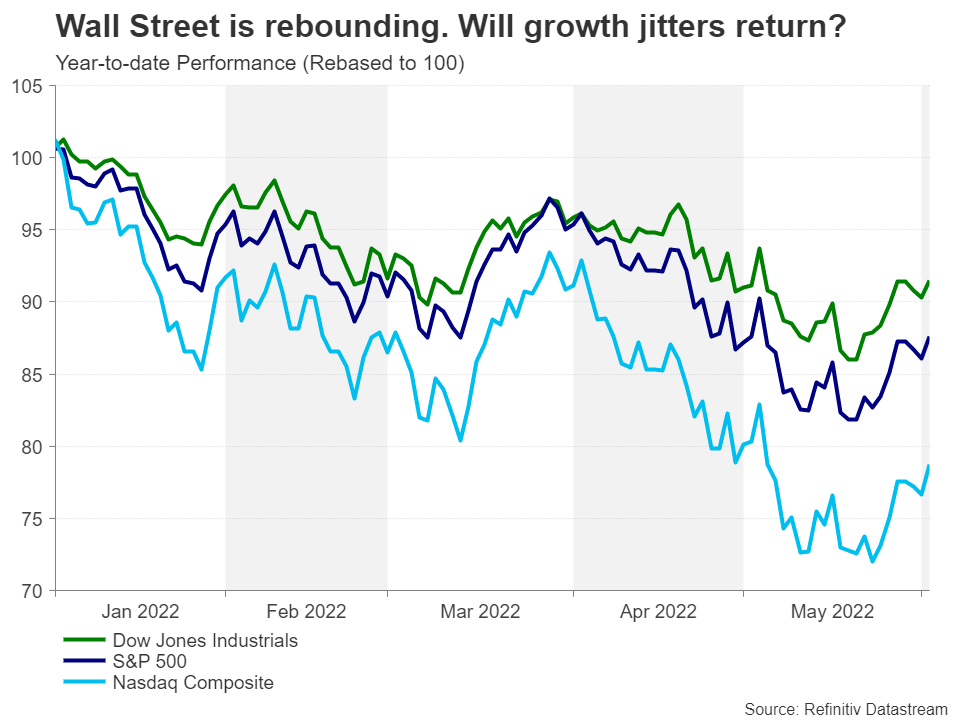
Investors will be eager to see a solid rebound in both exports and imports when China reports May trade data on Thursday. The consumer and producer price indices released on Friday will be important too as any pickup in inflationary pressures would dampen expectations of more forceful policy easing in the future, and this could in turn weigh on equities and the aussie.
US inflation: obsessing about the peak
Excitement is building that inflation in America is peaking or has already peaked following some moderation in both the CPI and PCE measures recently. There could be further good news on this front on Friday when the consumer price index for May is due.
The headline rate is expected to have stayed unchanged at 8.3% y/y in May and the core rate is also projected to have held steady, at 6.2%.
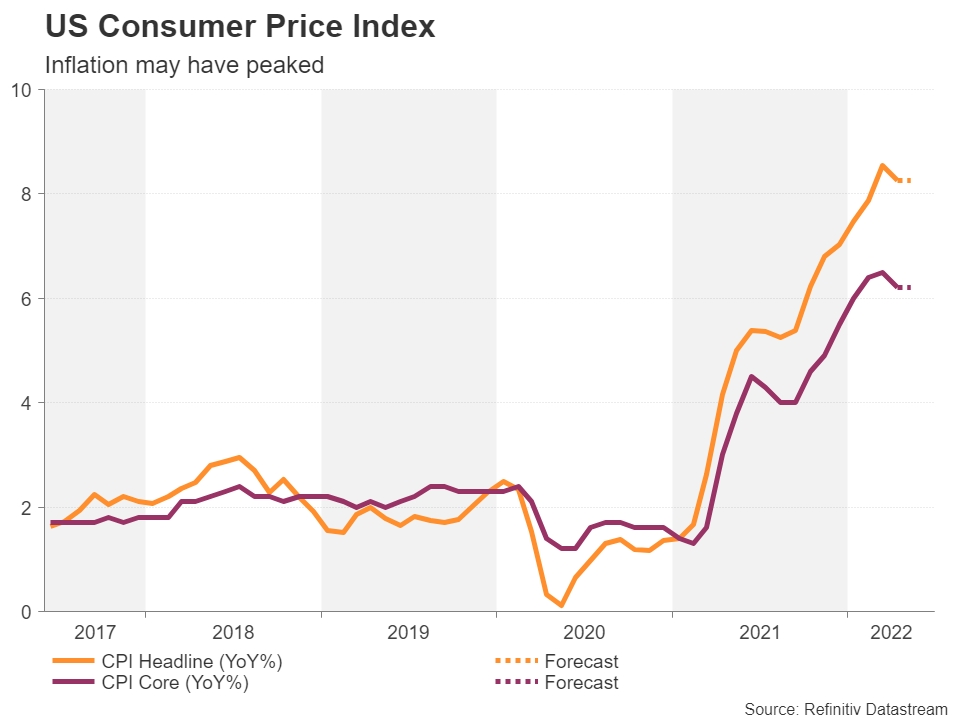
If the numbers indeed provide more indication that price pressures are levelling off and inflation will only head downwards from hereon, Treasury yields might start pulling back again, having just managed to recoup some of the May losses. The US dollar could slip again too as it’s been struggling to back on the front foot despite halting a two-week slide.
The problem, however, is that peak inflation won’t solve all the Fed’s problems. Policymakers will want to be confident that inflation is on a sustained path towards the 2% target before calling time on rate hikes. Thus, it could be a while still before there is a clearer picture on the direction that inflation is travelling.
Nevertheless, any softness in the CPI prints next week would be greeted with cheer by the markets, potentially sparking a rally on Wall Street but bruising the dollar.
Aside from the inflation data, there will be little else on the US agenda apart from the University of Michigan’s preliminary reading of consumer sentiment for June on Friday.
Canadian jobs and Japanese data on the way
Canada’s employment report is due on Friday and most likely the labour market kept growing in May. The strong jobs market is one reason why the Bank of Canada turned more hawkish at the June meeting, warning that it may have to “act more forcefully” to fight inflation. Following the hawkish tilt, the latest employment numbers are unlikely to bring anything new to the table with regards to the policy outlook.
Nonetheless, a strong report would be supportive of the loonie in the face of lower oil prices. Though so far, OPEC’s decision to pump more crude to compensate for reduced Russian supply has only brought about a relatively modest downside reversal in oil futures.
In Japan, there’s a raft of key indicators on the release schedule, including household spending and average cash earnings on Tuesday, the revised Q1 GDP estimate on Wednesday and corporate goods prices on Friday.
However, with the Bank of Japan not thinking about exiting its massive stimulus programme anytime soon, the data won’t be impacting the yen just yet even if there are some early clues that price pressures are ramping up in Japan.
ECB Preview – Ready for Lift-Off
Next week's ECB meeting is set to be the formal end of ECB net asset purchases and a clear signal to hike rates in July, although without a specific guidance of the size of the first rate hike. We expect ECB net purchases to end on the 1 July, thereby in line with previous guidance for Q3.
With inflation pressures continuing to build and the economic backdrop still supported by services, we do not expect the inflation problem to solve itself in the near future. On the other hand, inflation expectations should gradually decline to the 2% mark in late 2024/early 2025, which leaves a narrow window for ECB to hike between now and the coming 12m.
Market focus will be on the discussion if a 50bp hike is possible, and if so when, as well as to any hints about tools that ECB may take to address fragmentation. We expect ECB to hike 25bp each meeting until Mar23, but risks are clearly skewed for a 50bp rate hike in H2 this year (July or Sep most likely).
Weekly Focus – ECB Preparing for a Lift-Off in July
Euro area inflation once again exceeded expectations in May, sparking further speculation of faster ECB rate hikes. With core inflation rising to 3.8% y/y and seasonally adjusted m/m rate still around 0.5%, we now expect core inflation to peak only after the summer. Consequently, we have lifted our expectations for ECB rate hikes ahead of next Thursday's meeting, and now look for 25bp hikes in every meeting from July to March (which would bring the deposit rate to 1.00%). Next week's meeting will likely mark the formal end to ECB's net asset purchases, and the focus will be on the possibility of 50bp rate hikes in the coming meetings, as markets are pricing in around 30% risk of such a hike in July. Read our full ECB Preview - Ready for lift-off, 2 June.
Today, we published Big Picture: A (mild) recession in western economies seems unavoidable, 3 June, with our latest economic forecasts. We now expect US economy to fall into a mild recession during H1 2023, with euro area following suit in H2 2023. The combination of weakening real purchasing power and tighter financial conditions will weigh on economic growth, even though pent-up demand, savings and the re-opening of economies will continue to support activity especially in the service sector in the near-term. Chinese growth will likely recover towards 2023 on the back of renewed stimulus, but with the latest lockdowns and no signs of easing the 'zero-covid' strategy for now, we have downgraded our growth forecast for 2022. As global demand outlook weakens towards 2023, we also expect the current inflation pressures to ease. That being said, we still expect euro area and US core inflation to remain above central banks' target levels even in 2023, supporting the case for further rate hikes.
OPEC+ failed to stabilise rising oil prices after EU announced the embargo on Russian oil. OPEC+ agreed to hike production by 648 thousand barrels per day (bpd) in July and August, above the initial plan of 432 bpd, but it did not yet address Russia's status within the group. While the larger production increases ease the supply situation in the near-term, they also mean less potential production capacity in the future, leaving the oil market vulnerable to new supply shocks. We expect prices to remain elevated in the coming months, and maintain our forecast for Brent at USD115/bbl towards Q3.
In China, Shanghai was able to end its two-month long lockdown this week. PMIs rebounded in May, and the recovering Chinese demand outlook is another factor supporting commodity prices. New stimulus was also announced this week, as policy banks are funding increasing number of infrastructure projects for the central government. Next week, focus remains on the Covid-situation, while the trade data released on Thursday will likely remain weak due to the disruptions caused by the pandemic.
In terms of economic data, next week's highlight will be the US CPI on Friday. We expect the figures to continue illustrating strong and broad-based price pressures. Aside from the ECB, we expect the Reserve Bank of Australia (RBA) to continue its hiking cycle with another 25bp hike, but following recent 50bp hikes by the Fed, Bank of Canada and the RBNZ, risks are tilted towards a larger hike also in Australia.
Sunset Market Commentary
Markets
Trading in the run-up to the US payrolls release had a lot in common with Wednesday, when markets were snoozing until a stronger-than-expected manufacturing ISM brutally woke them up. Today perhaps was even a bit worse with UK markets closed for day two of celebrating seven decades Queen Elizabeth. But unlike Wednesday, the American labour market report came in very close to expectations. A net 390k jobs were created in May, more than the 318k consensus. The goods-producing sector added 59k and the services 274k with the bulk still in leisure & hospitality (84k), education & health (74k) and business services (75k). The unemployment rate stabilized at 3.6% and the participation rate inched higher to 62.3%. Pay growth amounted to 0.3% m/m, a little less than the 0.4% forecast and equaling the previous month which saw a downward revision. US workers on average now earn a strong 5.2% more compared to the some month in 2021. Markets mainly reacted to the headline job creation figure. Perhaps the psychological consensus beat was even higher after the ADP report earlier this week tempered enthusiasm for today’s release. Anyway, it definitely does not contain any element that would allow the Fed to retrace on guidance for 50 bps hikes in June and July. Markets even increased bets for such a move in September with the labour market still going strong despite financial conditions having tightened quite substantially already in recent months. US yields add 3.9 bps to 5.8 bps. German yields rise another 3.4 bps at the medium and long end, aiming for a 5-day winning streak. The 10y yield (1.275%) builds on yesterday’s break above the 1.236% resistance level. European swap yields too are on track for new (closing) cycle highs across the curve. The underperformance of US Treasuries gives the dollar only a slight edge. The trade-weighted index (DXY) secured the 102 handle again but it’s not very convincing. EUR/USD dipped towards the 1.07 big figure in the immediate aftermath of the publication before paring losses to around 1.073 currently. That’s down from 1.075 at the open. It seems like the couple/euro won’t go down so easily ahead of the all-important ECB June policy meeting next week. USD/JPY is able to take out the 130, unlike previous days. The two-decade high of 130.85 is within striking distance. Equities reacted negatively. European stocks trade almost flat and US futures markets extended losses, resulting in a cash open of -1.60% (Nasdaq). Markets now have their eyes set the US services ISM to be published later today. Next week will be crucial as well, with a new US CPI print due.
News Headlines
The Food and Agriculture Organization of the United Nations published the monthly update its Food Price Index. The benchmark dipped slightly for a second consecutive month, from 158.27 in April to 157.36 in May. This remains the third highest level since the series started in 1990 though. The Cereal Price Index increased by 2.2%, led by wheat prices, which were up 5.6% from April and 56.2% Y/Y. The Vegetable Oil Price Index declined by 3.5%. Prices dropped for palm, sunflower, soy and rapeseed oils, due in part to the removal of Indonesia’s short-lived export ban on palm oil. The Dairy Price Index also dropped by 3.5%. Prices of milk powders declined the most, linked to market uncertainties from the continued COVID-19 lockdowns in China. The Sugar Price Index declined by 1.1%, as a bumper crop in India buoyed global availability prospects. The Meat Price Index set a new all-time high.
Turkish inflation rose by 2.98% M/M in May to a 23-y high of 73.5% Y/Y (from 69.97% Y/Y in April). Details showed food prices at a mind-blowing 91.6% Y/Y. Energy prices (121.21% Y/Y) hurt as well with the country being a huge net importer. Underlying core inflation rose from 52.37% Y/Y to 56.04% Y/Y. In a sign that the worst might still be ahead, producer price inflation accelerated by 8.76% M/M to 132.16% Y/Y in May. The Turkish central bank defied common knowledge so far this year by keeping policy rates stable at 14% (following 500 bps rate cuts end of last year). It meets next on June 23. The Turkish lira remains near the weakest levels of the year around EUR/TRY 17.75. Only for a brief spell in December last year traded the local currency even worse.
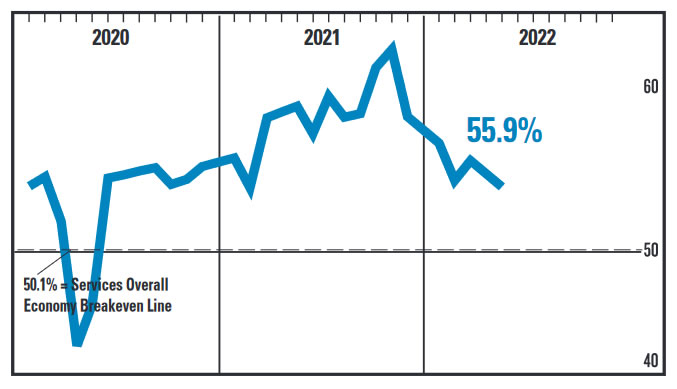
US ISM services dropped to 55.9, corresponds to 2.1% annualized GDP growth
US ISM Services PMI dropped from 57.1 to 55.9 in May, below expectation of 56.7. Business activity/production dropped -4.6 to 54.5. New orders rose 3.0% to 57.6. Employment rose 0.7 to 50.2. Prices dropped -2.5 to 82.1.
ISM said: "The past relationship between the Services PMI and the overall economy indicates that the Services PMI for May (55.9 percent) corresponds to a 2.1-percent increase in real gross domestic product (GDP) on an annualized basis."
U.S. Job Momentum Remains Strong in May
The U.S. economy added 390k jobs in May, coming in above the market consensus forecast of 325k. Revisions subtracted a total of 22k jobs from the two prior months. As of May, total payroll employment remains 0.5% below February 2020 levels.
On an industry basis, notable job gains occurred in leisure and hospitality (84k), professional and business services (75k), and in transportation and warehousing (47k). Employment in retail trade pulled back on the month (-61k). Hiring in goods producing (59k) industries was largely concentrated in construction (36k). Government (57k) hiring was also strong in May.
The unemployment rate held steady at 3.6% for the third month in a row, as both the labor force (+330k) and number of people employed (+321k) rose by roughly the same amount. The participation rate ticked up 0.1 percentage points to 62.3%. The participation rate among the 25-54 age group also ticked up (+0.2 percentage points to 82.6%).
Average hourly earnings rose 0.3% month-on-month (m/m), and were up 5.2% on a year-on-year basis – easing slightly from 5.5% y/y in April.
Key Implications
The U.S. economy started off 2022 on strong footing, with payroll gains averaging 540k per month in the first quarter. While the hiring trend has slowed a bit recently, it remains strong near 400k per month, with today's report playing into that theme. Looking through the details, there were both positive developments, such as the uptick in the labor force participation rate, and less desirable developments, such as a slight deceleration in wage growth. On the whole, however, this was a very solid report.
The U.S. labor market remains on very decent footing – a message echoed by plenty of other labor market indicators. For instance, job openings, which pulled back in April, but remained well north of 11 million, still outnumber unemployed workers by nearly two to one. In this vein, today's report provides further justification for the Fed to continue to remove monetary stimulus 'expeditiously', with at least two more jumbo hikes of 50 basis points in the cards.
The labor market has recovered the bulk of the jobs lost during the pandemic, with payrolls down only 0.5% from February 2020. Meanwhile, the unemployment rate is holding at 3.6% – just a hair above its pre-pandemic low. With the easy gains behind us and the labor market drum tight, we believe that the strong performance at the start of the year is unlikely to be repeated, and that payroll gains are poised to slow further in the quarters ahead.
Aussie Slips after Strong NFP Report
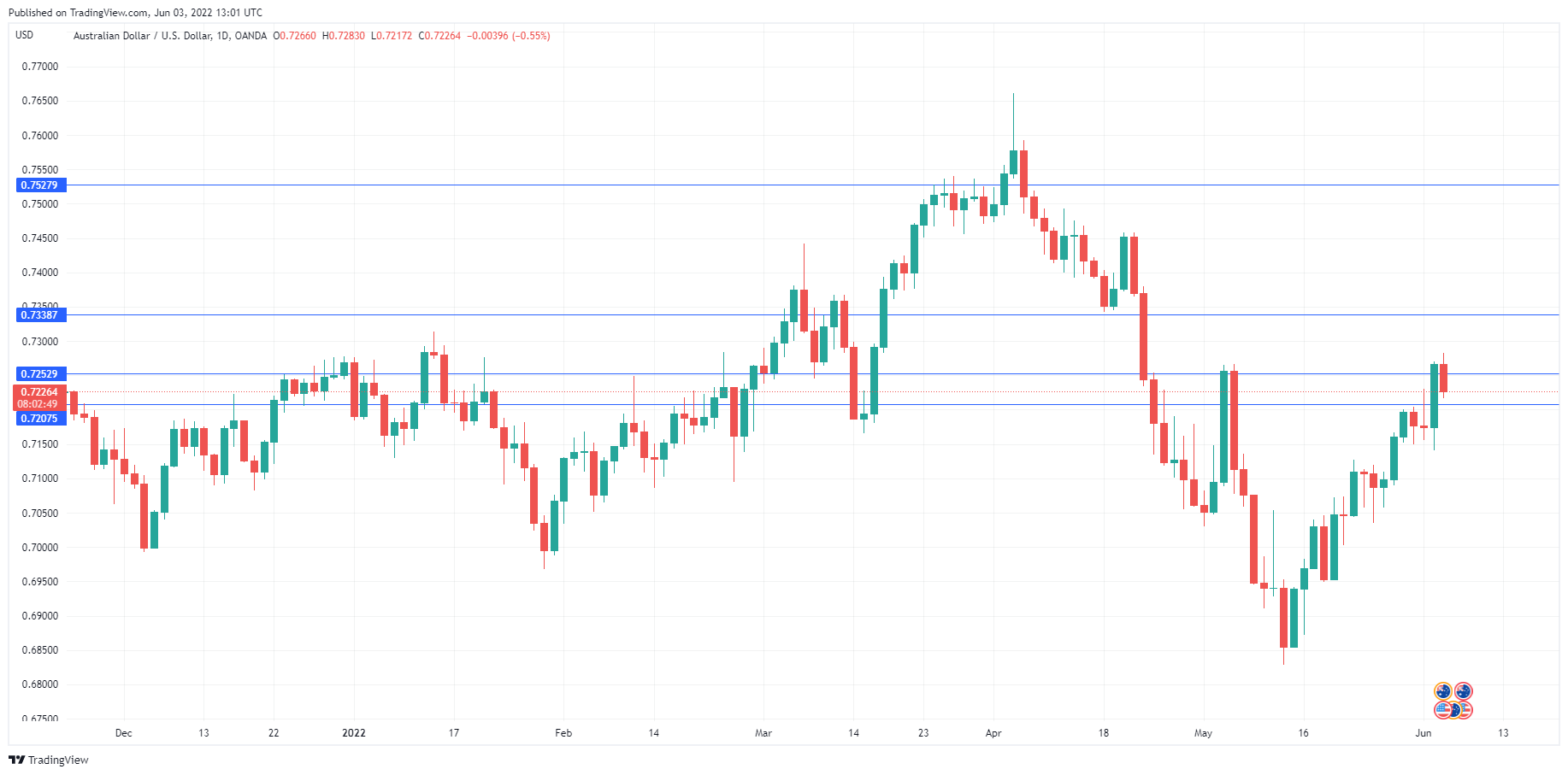
The Australian dollar has reversed directions on Friday. AUD/USD is trading at 0.7225, down 0.55% on the day.
US nonfarm payrolls are traditionally the highlight of the week, but the Ukraine war, spiralling inflation and surging oil prices have taken up much of the market’s attention. This has reduced some of the hype around recent NFP releases, but they still have the potential to move markets, as we’re seeing today with the US dollar.
Aussie falls as NFP beats expectations
The May nonfarm payrolls report outperformed expectations, with a gain of 390 thousand, above the forecast of 325 thousand. We’ll have to give the markets some time to digest the reading, but it’s certainly possible that the strong numbers will see investors price in more Fed tightening, which will give the US dollar a boost, especially against the risk-sensitive Australian dollar. AUD/USD has already reacted to the NFP with considerable losses. It will be interesting to see how Fed policy members react to the nonfarm payrolls release, and whether some Fed members call for the Fed to increase the pace or extent of tightening.
The Reserve Bank of Australia holds its policy meeting on Tuesday and will continue its rate-tightening cycle. The current benchmark rate is only 0.35% and the Bank is widely expected to hike by 0.35%, which would represent a compromise between a 0.25% and a 0.50% move. With inflation continuing to accelerate, the RBA is expected to raise rates to 3% or even higher, which means that we will likely see the RBA raising rates throughout the second half of the year and into 2023.
AUD/USD Technical
- AUD/USD is testing resistance at 0.7207. Above, there is resistance at 0.7252
- There is support at 0.7121 and 0.7076
EUR/USD Mid-Day Outlook
Daily Pivots: (S1) 1.0677; (P) 1.0715 (R1) 1.0784; More...
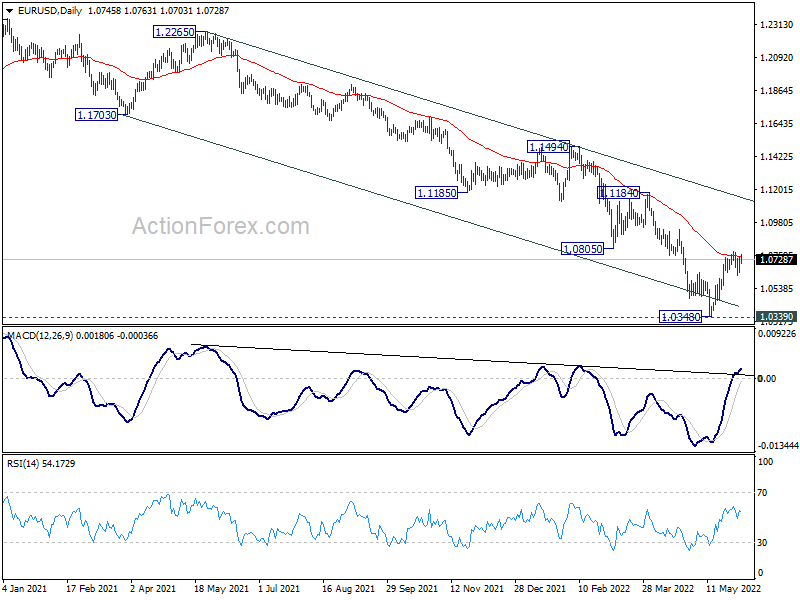
Intraday bias in EUR/USD stays neutral and outlook is unchanged. On the upside, break of 1.0786, and sustained trading above 55 day EMA (now at 1.0757) will target 1.0935 resistance next. On the downside, however, break of 1.0626 minor support will indicate rejection by 55 day EMA, and turn bias back to the downside for retesting 1.0348 low instead.
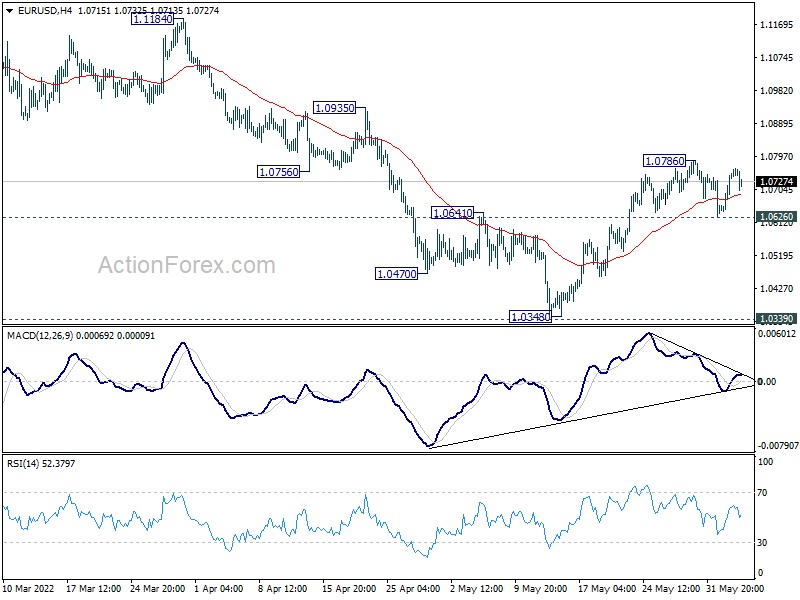
In the bigger picture, focus stays on 1.0339 long term support (2017 low). Decisive break there will resume whole down trend from 1.6039 (2008 high). Next target is 61.8% projection of 1.3993 to 1.0339 from 1.2348 at 1.0090. However, firm break of 1.0805 support turned resistance will delay this bearish case and bring medium term corrective rebound first.