

Sample Category Title
USD/CHF Daily Outlook
Daily Pivots: (S1) 0.9590; (P) 0.9625; (R1) 0.9665; More...
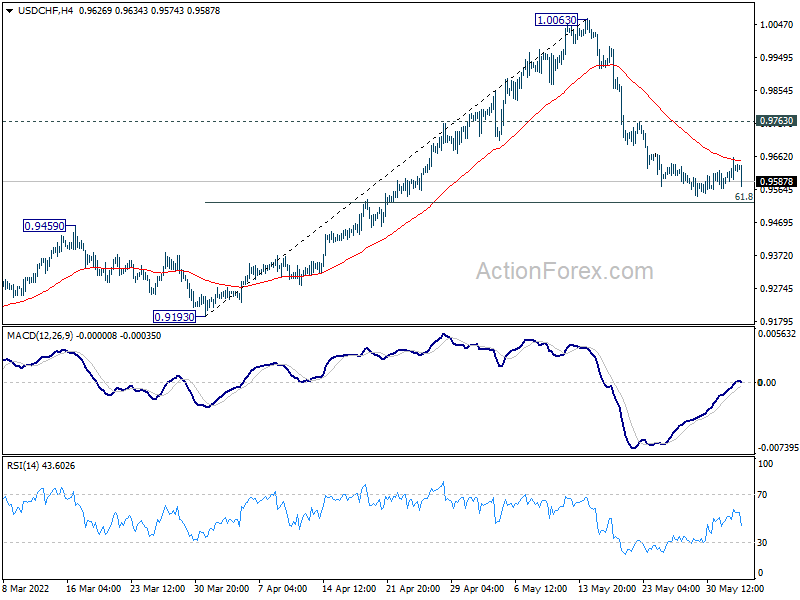
Intraday bias in USD/CHF remains neutral and outlook is unchanged. Strong support is expected from 61.8% retracement of 0.9193 to 1.0063 at 0.9525 to complete the pull back from 1.0063. On the upside, above 0.9763 minor resistance will turn bias back to the upside for retesting 1.0063 high. However, sustained break of 0.9525 will bring deeper decline to 0.9193 support.
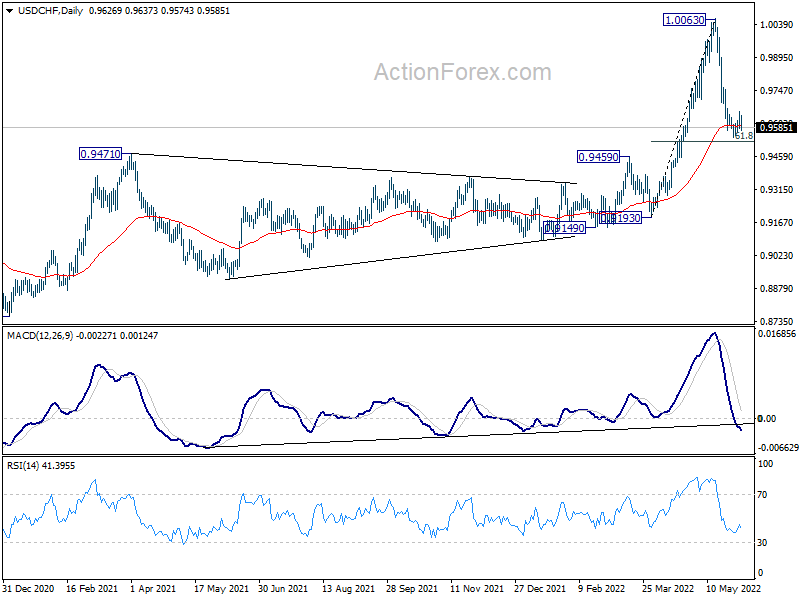
In the bigger picture, down trend from 1.0342 (2016 high) should have completed with three waves down to 0.8756 (2021 low) already. Rise from 0.8756 is likely a medium term up trend of its own. Next target is 1.0237/0342 resistance zone. This will remain the favored case as long as 0.9471 resistance turned support holds. However, sustained break of 0.9471 will extend long term range trading with another falling leg.
Daily Technical Analysis
EUR/USD
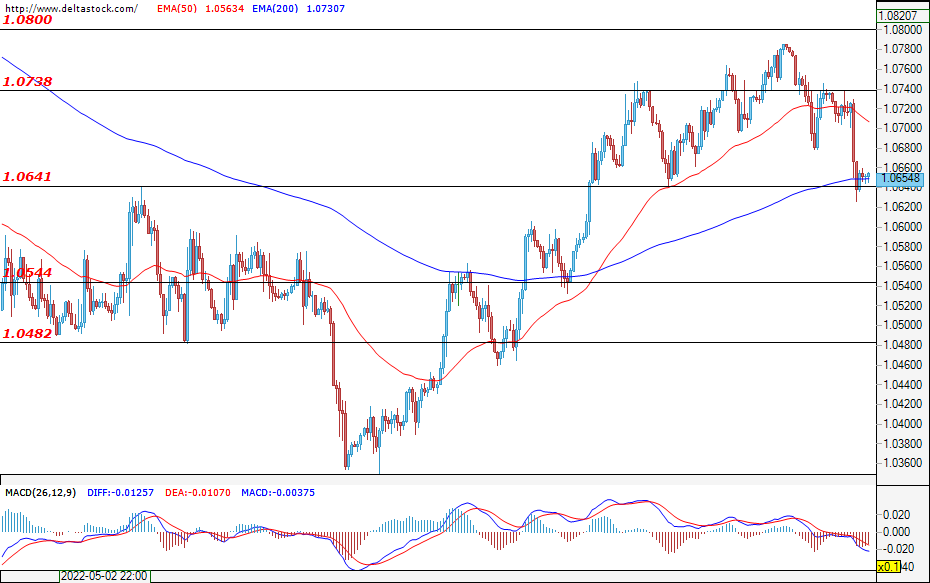
During yesterday’s trading session, the currency pair retraced from the support at 1.0740 and the single European currency lost quite a bit of ground against the U.S. dollar, reaching the support level at 1.0640. During the early hours of today`s trading, the pair is hovering just above the mentioned zone, but if the bearish attack continues, then a successful breach of this level could easily lead to new losses and strengthen the negative expectations for the future path of the EUR/USD. In case this scenario is realised, then the sell-offs may deepen and the pair would most probably head towards the next important support at 1.0544. On the other hand, if the bulls enter the market and the support at 1.0640 manages to resist the bearish pressure, then the first target for the buyers could be considered the zone at 1.0738, followed by the psychological level of 1.0800. The most important news for investors today is the data regarding the change in the ADP non-farm employment data for the United States (12:15 GMT) and the initial jobless claims data (12:30 GMT), which may lead to higher volatility.
USD/JPY
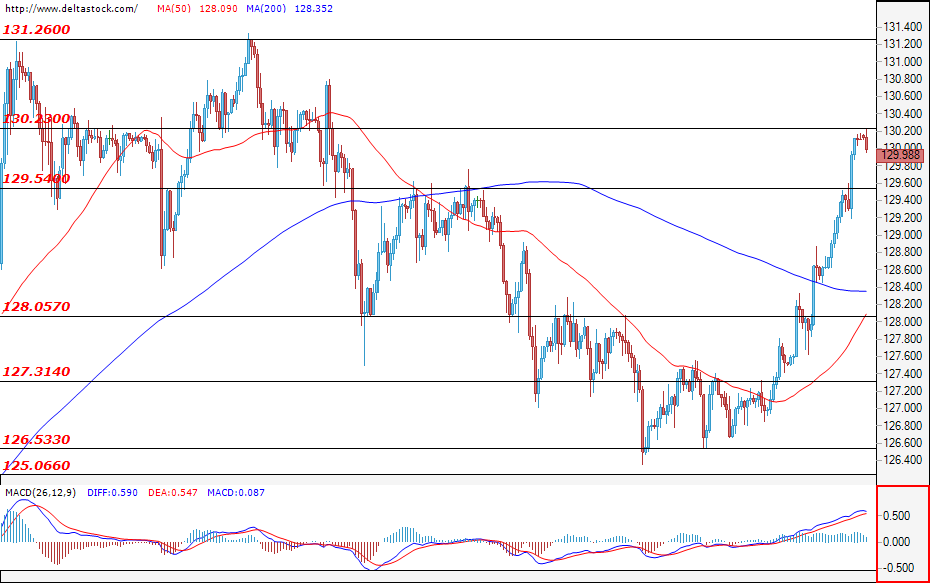
The rally against the U.S. dollar continued during yesterday's trading session, but the attack of the bulls was thwarted around the resistance level at 130.23. In the early hours of today's session, the bulls seem to be losing momentum and the expectations going forward are for the pair to enter in a corrective phase and to head towards a test of the support at 129.54. Only a confirmed breach of the mentioned level, however, would pave the way for the USD/JPY towards the local support at 129.30, followed by the key level at 128.05. If the bulls regain control over the market and successfully overcome the resistance at 130.23, then the upward movement can be expected to be restored and the pair is to head towards the next significant resistance at 131.26.
GBP/USD
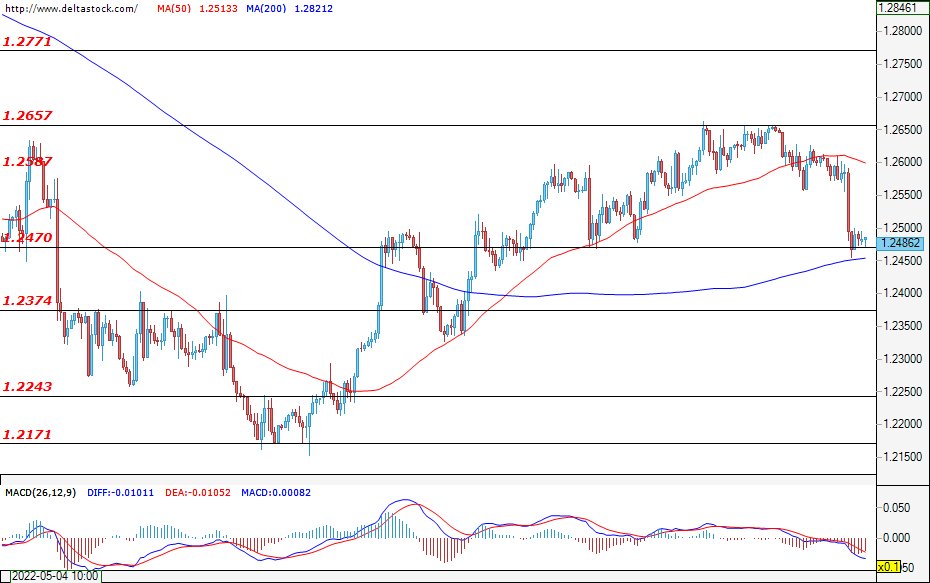
At the time of writing, the bulls are managing to keep on trading slightly above the support at 1.2470 after we initially witnessed a strong impulsive downward move from 1.2590 to 1.2470. The forecasts for today's trading session are for this support level to resist the bearish pressure and for trading activity to remain limited above it. A potential upward movement would most probably be limited to the resistance level at 1.2657. However, an alternative scenario, in which this level is violated, is not to be excluded as well. If this does indeed happen, then we could expect the uptrend to be restored and the resistance at 1.2771 could be considered as a next target for the buyers.
EUGERMANY40
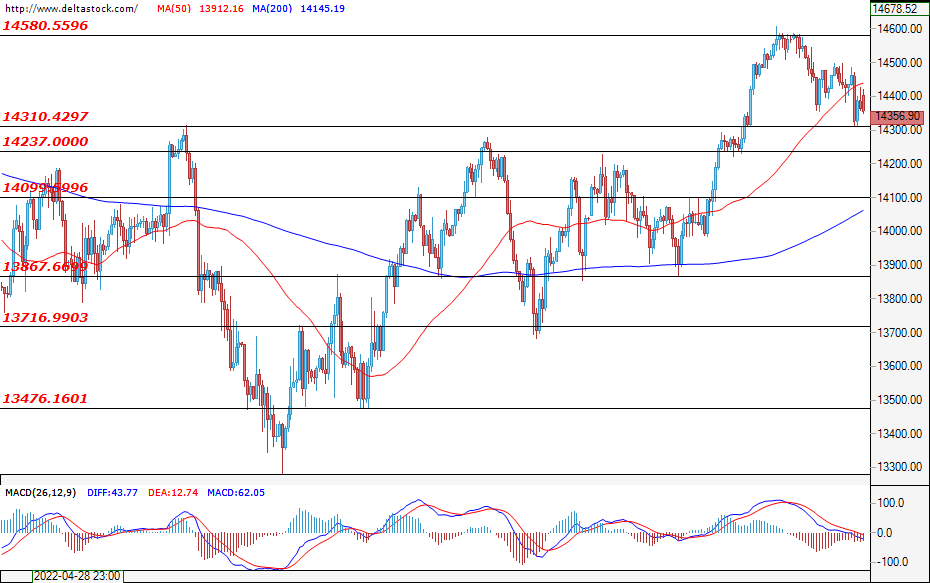
The rally against the U.S. dollar continued during yesterday's trading session, but the attack of the bulls was thwarted around the resistance level at 130.23. In the early hours of today's session, the bulls seem to be losing momentum and the expectations going forward are for the pair to enter in a corrective phase and to head towards a test of the support at 129.54. Only a confirmed breach of the mentioned level, however, would pave the way for the USD/JPY towards the local support at 129.30, followed by the key level at 128.05. If the bulls regain control over the market and successfully overcome the resistance at 130.23, then the upward movement can be expected to be restored and the pair is to head towards the next significant resistance at 131.26.
US30
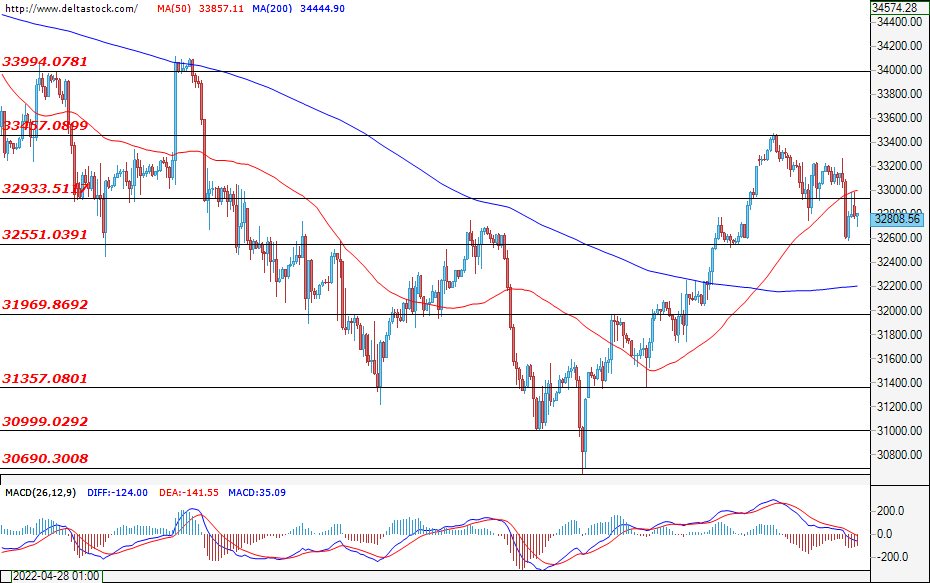
After the unsuccessful test of the resistance at 33457, the U.S. blue-chip stock index is remaining locked in the range of 32551 – 33457. The expectations are for the bulls to try and take control over the market by nudging the price towards another test of the key resistance at 33457, where a confirmed breach would suggest a further appreciation towards the psychological level at 34000. A decline towards the support at 31969 could be expected only after a confirmed breach of the support at 32551.
Investors Ramped Up Bets for Fed Tightening
Markets
We had to wait for some US figures to spice up yesterday’s trading session a little bit. ISM manufacturing confidence unexpectedly accelerated from 55.4 to 56.1, mainly as new orders kept flowing in strongly (55.1). Supplier deliveries eased only marginally to a still-lofty 65.7 and employment fell (49.6), both highlighting ongoing supply disruptions, material shortages and personnel-related capacity constraints. Near-record JOLTS with, give or take, two openings per unemployed American served as another point in case. The strong data caused the US yield curve to bear flatten with changes from 1.2 bps (30y) to 9.7 bps (3y, 5y). Investors ramped up bets for Fed tightening with markets just a few bps shy of pricing in another 50 bps hike in September after June and July. European yields rose in lockstep, adding between 4.9 and 7.3 bps across the curve. The German 10y (+6.5 bps) yield closed at a new cycle high at 1.187%, surpassing 1.127% resistance from the 2012/2013 interim lows. UST underperformance and lacklustre stocks (about -0.7%) swung the dollar higher. The trade-weighted index jumped beyond 102(.49), EUR/USD retreated from 1.073 to 1.065. USD/JPY tested the 130 big figure. Sterling was unable to benefit from a sharp(er) rise in Gilt yields ahead of a 4-day weekend. EUR/GBP instead eked out a gain beyond 0.8512 resistance to the 0.853.Stocks in the Asian-Pacific region fall with Hong Kong underperforming (-1.8%) as it reinstated some Covid Zero measures by quarantining patients even with mild symptoms. Rating agency S&P reaffirmed China’s rating at A+ with a stable outlook. The yuan declines nonetheless with USD/CNY nearing 6.70. Most other dollar pairs trade stable. EUR/USD hovers sideways around 1.066. Core bonds trade listless. Oil prices ease (Brent -1.7%) following reports that Saudi Arabia is ready to raise production should Russian output decline materially.Today serves as a transition day before US payrolls are released tomorrow. The unofficial ADP jobs report (300k exp.) and jobless claims may give some taste but probably won’t be defining for trading. OPEC+ holding its monthly meeting is worth watching too following the latest reports (see above and yesterday). There are some ECB speeches scheduled but the central bank’s quiet period starts today. The Fed’s kicks off this Saturday. On markets, the core bond yield correction lower was showing signs of bottoming out over the past few days from a technical perspective. Inflation data in the eurozone and yesterday’s strong numbers in the US added a fundamental layer to that. We see no reason for that to change for the time being. It may bring equities back in a tougher spot, making it difficult for EUR/USD to take out first resistance around 1.0758 on a sustained basis. UK markets are closed today and tomorrow.
News Headlines
The Bank of Canada yesterday as expected raised its policy rate by 50 bps to 1.5%. It also continues its quantitative tightening. CPI in April reached a higher-than-expected 6.8% and the BOC expects it to move even higher in the near term. Inflation is broadening with measures of underlying inflations rising and 70% of the CPI categories printing above 3%. The global economy will probably slow down but growth in Canada in Q1 was solid (3.1%) and the BOC expects this to continue in Q2 on consumer spending and exports. Job vacancies are elevated and wage growth is rising across sectors. With the economy remaining in excess demand and inflation seen moving further above target, rates will need to rise further and the governing council is prepared to act more forcefully if needed. USD/CAD traded quite volatile after the policy announcement. The possibility of a faster and more protracted rate hike cycle is CAD-supportive. However, at the time of the BOC announcement, the USD dollar also jumped sharply higher on a strong US ISM. At the end of the day, USD/CAD even traded marginally stronger at 1.2657.
US Jobs, OPEC and the Fed
US indices kicked off the new month on a negative note. The S&P500 fell 0.75% and Nasdaq closed 0.72% lower, on Jamie Dimon’s ‘hurricane’ warnings, a stronger-than-expected ISM manufacturing PMI, and higher-than-expected job openings, that fueled the hawkish Federal Reserve (Fed) expectations.
The US 10-year yield bounced above the 2.90% mark, the dollar index gained, as gold tipped a toe below the 200-DMA, $1842 per ounce on the back of rising US yields.
Bitcoin, on the other hand, fell as fast as it rose earlier this week, as investors’ appetite for risk fell sharply over the past sessions.
And oh, Janet Yellen said she was ‘wrong’ about inflation, as the war in Ukraine was an unexpected event that sent the energy prices soaring and boosted inflation. BUT, inflation was soaring well before the war started. The US policymakers were simply so happy in a configuration where they could pump as much as money in the system without seeing any negative impacts for years that they only woke up when the reality hit the fan, and it was, simply, too late.
The thing is, the Fed started shrinking the size of its balance sheet yesterday, and the QT should technically lead to a further steepening of the curve. However, the yields react also, and perhaps more to the Fed expectations, and because the QT must have already been fully priced in, we may not see the concrete start of the QT send the US 10-year yield above the 3% mark. However, it is hard to tell accurately how the QT would impact markets, as this is the first time the Fed will let the size of its balance sheet drop significantly.
Jobs data won’t change the Fed’s plan
Today’s ADP report is important, but unless we have a decent surprise, it’s mostly unlikely to give a fresh direction to the market. The US economy is expected to have added 300’000 new private jobs, which is a strong number if we go back to the pre-pandemic times. A lower-than-expected figure will hardly revive the Fed doves, while a positive read could boost the Fed hawks – and further dampen the market mood.
Bye bye Russia?
Crude oil couldn’t extend gains above the $120pb, after Europeans broke the news that they would ban oil. That’s positive news, but it doesn’t solve the problem of higher oil prices.
In fact, the price of a barrel of WTI rallied more than 70% since last year, but the US production increased by a 7% only. One of the reasons for that is, oil prices are just too volatile since the beginning of the pandemic. We went from negative price for a barrel to historically high levels in a matter of months, and producers don’t necessarily want to overreact changing their long-term production plans. Even less so when there is so much pressure about shifting to green energy sources. So many producers simply prefer cashing in and enjoying the ride rather than using that cash for future investments.
Therefore, the structurally tighter supply, the OPEC’s reluctance to increase production in a way to ease the price pressure, and of course, the end of the lockdown in Shanghai and the prospects of Chinese opening will likely continue a throw a floor under the price pullbacks in oil prices. Though the upside seems limited around the $120pb for now.
Speaking of OPEC, OPEC will likely stick to its production increase plan and won’t make miracles at this week’s meeting, but the Wall Street Journal reported that they could suspend the OPEC+ deal with Russia earlier than set. Normally, the co-production regime should continue until the end of this year, but it is now possible that the deal ends by the end of September as the quota system doesn’t make sense when Russia is held back from increasing its production due to the fresh European sanctions. Good news is Saudi and United Arab Emirates might fill in the gap. Bad news is, Saudi and United Arab Emirates might not fully fill in the gap.
OPEC+ Meeting in Focus
Market movers today
OPEC+ is meeting today, where a boost to production targets will be in focus following indications yesterday that Saudi Arabia is prepared to increase its oil output earlier than expected.
The US ADP private sector employment report will be released today ahead of the May Jobs Report on Friday. Despite the weaker ISM manufacturing employment index released yesterday, continuing high labour demand points towards another month of strong employment gains. In addition, US factory orders and the Euro Area PPI will be released for April.
From central banks, ECB's Villeroy and Fed's Mester will be on the wires today.
The 60 second overview
Generally strong US data: US ISM manufacturing rose with new orders moving higher. However, the employment index fell below 50, e.g. intro contractionary territory. At the same time prices paid by companies remain extremely high. JOLTS data on job openings were slightly lower in April but remains at record-high levels, pointing to very high labour demand, clearly outpacing labour supply. These data reaffirm the pressure on the Fed to tighten monetary policies to rein in inflation pressures.
Chinese PMIs rebound in May: Both the official and private versions of PMI rebounded in May. The official PMI manufacturing saw the biggest rebound from 47.4 to 49.6, while the private version increased from 46.0 to 48.1. The employment indices were very weak, which will be a big concern for Beijing but they have already responded by clearly stepping up stimulus. With the lockdown ending by the end of May, we expect a further increase in PMI's in June but it is mainly an effect of the economy fully reopening. The economy should also be supported by the increased stimulus but to what extent it feeds into higher GDP growth will depend on how China manages future Covid outbreaks.
The oil price falls following report that Saudi Arabia will boost production earlier than expected: Oil briefly fell below USD113 a barrel (about 3% drop), but later this morning recovered somewhat following a report that Saudi Arabia is ready to pump more should Russian output decline substantially due to increasing sanctions over its invasion of Ukraine. More concretely, Saudi Arabia and some of the other OPEC+ members are contemplating bringing forward supply increases scheduled for September to July and August, the report said according to a Bloomberg story. Yesterday, a report also emerged that US president Joe Biden is likely to visit Saudi Arabia later this month as part of an international trip for NATO and Group of Seven meetings, as US gas prices are record high.
FI: Sour risk sentiment dominated markets yesterday, with spread widening across the EGB space as curves bear steepened. With Holzmann saying 50bp is clearly needed following the high inflation print and the 50bp rate hike from the BoC, Bunds touch 1.18% yesterday.
FX: Oil markets are in focus as OPEC+ meeting is set to start Thursday. For EUR/USD, increased production would be positive
Credit: Yesterday, credit markets had a mixed session and concluded in a mild risk-off mode. Two European deals were postponed due to the volatile market. CDS indices were both wider with iTraxx Main 1.8bp higher at 89.3bp, while Xover was 8.5bp higher at 446bp.
What’s the Good Oil?
Oil markets are on the move this morning, with oil prices dipping by 2.0% in early trading after the Financial Times reported that Saudi Arabia has indicated to western allies it could raise production to cover any substantial fall in Russian production. That follows on from my comments yesterday that this week's OPEC+ meeting later today could be a pivotal one if Russia is given an exemption from its production quotas, which would allow the two main swing producers, Saudi Arabia, and the UAE, to ramp up exports to fill the gap.
None of that will alleviate the refining bottleneck/crunch that is causing petrol and diesel prices to soar globally, but it would be a rare piece of good news for the global economy and the inflation fight. It certainly isn’t in OPEC’s interests to send the world into a recession, and probably the only loser would be Russia which is making more money today than pre-Ukraine invasion thanks to soaring oil prices. The cynic in me wonders if some back-room horse-trading has gone on between the West and Saudi Arabia/UAE to get to this point. It's amazing how US gasoline prices and mid-term elections focus the mind. That aside, today's OPEC+ meeting may even overshadow the US Non-Farm Payrolls release this week, and if it results in sharply lower oil prices, look for a potential rally in equity and bond markets globally as hiking outlooks are pared.
Overnight, exactly the opposite occurred, after mostly robust US data had markets rolling back their over-optimistic expectations that the Federal Reserve wouldn’t have to hike as much as indicated. US JOLTS Job Openings in April eased slightly to 11.4 million, just above expectations and two job openings for every unemployed American. JOLTS Job Quits remained steady at just above 4.4 million. Following on from firm Retail Sales recently, ISM Manufacturing shrugged off the gloom in Asia and Europe by unexpectedly rising to 56.1 versus an expected drop to 54.5. ISM Manufacturing Orders also rose to 55.1, although ISM Manufacturing Prices slipped to 82.2. ISM Employment fell to 49.6 but the JOLTS data suggests that is because of a lack of workers, not easing labour market requirements.
So, despite concerns around the housing market, and rightly so, the US economy continues to fire on all cylinders. Nothing in that data will give the Fed any concerns about the trajectory of rate hikes, so 0.50% hikes until September it is, and quantitative tightening proceeds. The biggest beneficiary was the US Dollar, which soared against the Sterling and Euro overnight, given their soft data this week. That was helped along by US yields along the curve firming modestly. Wall Street equity markets retraced, but I believe the only modest reaction by the bond market, limited the damage. Probably the most head-scratching move was by gold, which rose slightly despite a higher US Dollar. That said, I remain concerned about the recent underwhelming price action by gold.
In Asia today, the calendar is fairly thin with the Manufacturing PMIs now out of the way. Australia’s April Balance of Trade outperformed, rising to AUD 10.495 billion. Retail Sales fell slightly as expected but printed right on forecasts at 0.90%. At midday (SGT), Indonesian Inflation for May is released and is expected to rise slightly YoY to 3.60%. That probably won’t be enough to force Bank Indonesia’s hand and hike rates at the June meeting, and nor has a slightly wobbly Rupiah detracted them from supporting Indonesia’s post-pandemic recovery. A print above 4.0% may change that stance though.
Eurozone PPI will be a non-event after the PMI and GDP prints earlier in the week signalled already, that stagflation is alive and well in the war-time economy of Europe. US Factory Orders will grab some attention, especially if the figure is weaker, and market pundits will try and extrapolate tomorrow’s US Non-Farm release from today’s ADP Employment, usually a fool’s errand. But none of this really matters, because as I have said early, today will all be about the outcome of today’s OPEC+ meeting.
Asian follows the leader
Asian equity markets are lower today as a thin data calendar and slow news ticker leave them content to produce another follow-the-leader session, coat-tailing the direction of overnight US markets. Robust US data overnight reinforced Fed hiking expectations which saw US equities fall once again. Although I note, that the recent rallies have been much larger in percentage terms than the falls have been, suggesting that bottom-fishing momentum is building as slowdown outlooks increase.
Overnight, the S&P 500 fell by 0.75%, the Nasdaq fell by 0.72%, and the Dow Jones eased by 0.54%. In Asia, US futures remain unchanged today, with the usual counter-trend move to the overnight session almost absent. The fall in oil prices in Asia today has limited the fallout in Asian markets though, with Japan’s Nikkei 225 recouping early losses to be down just 0.05%, although the Kospi has fallen by 0.95%.
Mainland China markets have also pared losses, the Shanghai Composite is down just 0.05%, while the CSI 300 is down just 0.15%. Local markets may also be finding support from the news that the central government has ordered state-owned banking heavyweights to set up a CNY 800 bio ($120 bio) line of credit for infrastructure projects according to Bloomberg. Hong Kong’s Hang Seng is down by 1.20% though, perhaps reacting negatively to a tightening of covid-19 policies once again.
Across regional markets, Singapore has eased by 0.35%, with Taipei losing 0.50%, Kuala Lumpur falling 0.30%, and Jakarta remaining unchanged. Bangkok has lost 0.45%, with Manila retreating by 0.75%. Australian markets are in full retreat, the All Ordinaries and ASX 200 tumbling by 1.10%, with local markets continuing to mirror Wall Street’s price action.
European equity markets should open slightly lower this afternoon by today could be a big day for Eurozone markets, although activity will be diminished with UK markets closed today and tomorrow, and everybody stuck at an airport trying to go on holiday. Everything rests on the OPEC+ meeting today. If Russia is side-lined, I mean exempted from its production quotas, with other members stepping up, European markets could find themselves with a decent tailwind today. A business as usual outcome is likely to see a disappointing reaction.
US dollar soars versus euro and sterling
The dollar index leapt higher overnight, thanks in part to the heavy weighting of the Euro and Yen in it, which slumped against the greenback. Robust US data and an ensuing extinguishing of hopes that the Fed would need to ease hiking expectations were behind the US Dollar rally. The soggy data from Europe and the UK this week, in contrast to US releases, reinforcing greenback strength.
The dollar index soared 0.75% to 102.54, rising above the long-term triangle line once again, today at 102.35. In Asia prices have remained steady, the index edging up to 102.57. The 100 point move higher has left support distant at 101.75, while the close above 102.50 suggests the index could retest 103.00, especially if US yields rise again today, putting more downward pressure on the Yen, which also has a large index weighting.
EUR/USD fell by 0.75% overnight, with US data leaving Fed hiking expectations on track, while soft GDP data from the Eurozone this week continues to darken its outlook. EUR/USD fell 70 pips to 1.0652, where it remains in Asia. The 1.0800 to 1.0830 region ahead of the multi-decade breakout line looks like an insurmountable barrier for now. Risks are now skewed towards a retest of 1.0600, although if OPEC opens the pumps, the single currency could receive a boost.
GBP/USD is in the same boat as the Euro and fell by 0.93% to 1.2485 overnight, closing below support at 1.2500 which become immediate resistance. The series of daily highs just below 1.2670 has become a formidable barrier now, particularly with the challenging economic environment in the UK staying the BOE’s rate-hike hand. Risks have shifted towards a test of 1.2400. Liquidity will be severely reduced today and tomorrow with UK holidays, meaning Sterling volatility could track higher.
USD/JPY rallied 1.13% higher to 130.13 after US data put the Fed hiking path back on track and US bond yields firmed. With the Bank of Japan and government officials still vehemently sticking to a no rate hike outlook, the US/Japan rate differential and outlook spurred a powerful rally by USD/JPY. The USD/JPY correction looks over for now unless US yields suddenly move lower. Resistance at 130.00 broke overnight and becomes nearby support, followed by 129.00. Resistance lies just above 131.00.
AUD/USD failed ahead of the 0.7250 zone overnight, which contains its 50, 100 and 200-day moving averages. (DMA) As US data hit the wires, AUD/USD retreated to finish almost unchanged at 0.7175. A souring of sentiment could see AUD/USD testing support at 0.7150, opening a potentially deeper correction. Having traced out a series of tops at 0.6560, NZD/USD continued to underperform overnight as sharp economic slowdown fears increase. NZD/USD fell 0.50% to 0.6480 where it remains this morning. Failure of 0.6400 signals an outright reversal and a return to the low 0.6200s.
While currency markets in the DM space remain barely changed in Asia, traders are content to wait and see, there is pronounced weakness in the Asia FX space today. Asian currencies retreated overnight as the Fed’s hike path was confirmed by US data releases, and that has continued in Asia. USD/KRW has risen 0.45%, USD/TWD is up 0.80%, while USD/CNY, USD/SGD, USD/THB, and USD/SGD are all around 0.20% higher. I believe most of the sharp reversals seen overnight and today are due to the amount of risk-seeking hot money that has piled into EM recently, running for the door. The fall by the Euro, AUD and NZD also suggests the same. As such, I do not believe we are at the start of another major move lower by Asia FX yet. That likely requires US 10-year yields to creep above 3.0% again, although gains will be limited as well. Asian FX should also get an OPEC+ boost today if the grouping side-lines Russia and opens the taps.
Oil sinks in Asia on FT/OPEC+ story
Oil prices have fallen in Asia today after the Financial Times ran a story that Saudi Arabia has indicated to western allies that it could raise oil production if Russian out fell substantially. Overnight, oil gave back all its gains after a WSJ story released yesterday morning suggested that OPEC+ might exempt Russia from its production quotas.
Taken in totality, today's OPEC+ meeting is assuming far greater importance for global markets than the US Non-Farm payrolls tomorrow. We can expect a very binary outcome from today’s meeting. If OPEC+ does nothing but raise production by the 433,000bpd already planned, oil prices are likely to rally sharply, with knock-on impacts in Asia and Europe equity markets. If Russia is exempted and Saudi Arabia and the UAE (the only two real swing producers), signal they will step up production, we can expect oil prices to fall sharply.
Overnight, Brent crude finished just 0.33% lower at $115.85, having tested $118.50 a barrel intraday. In Asia, is has gapped lower, falling by 1.505 to $114.15 a barrel. The overnight close at $115.85 is immediate resistance, with support at 112.00. There is a very well defined rising 6-month support line on Brent crude at $104.50, with the 100-DMA also nearby. A daily close below this point should allow Brent crude to retest $100.00 a barrel.
WTI also tested higher overnight, rising to $117.85 a barrel, before giving back all its gains to close 0.40% lower at $114.80 a barrel. In Asia, WTI has also fallen by 1.50% to $113.00 a barrel. Immediate resistance is the overnight close at $114.80, with support at $111.60 and then 108.00 a barrel. WTI's 6-month support line lies at $102.50, followed by the 100-DMA at 101.00. Failure of these levels signals a move back to the mid-90s in the first instance.
Gold defies a stronger US dollar
Gold defied expectations overnight, shrugging of slightly firmer US yields and a higher US Dollar to record a 0.50% gain to $1846.65 an ounce. The price action has left me scratching my head a bit, and I can only assume some risk aversion flows lifted gold as the hot money retreated from other asset classes. In the context of gold’s overall performance, I would need to see quite a few more days like this before changing my bearish outlook, with the gains overnight, insignificant in scope. In Asia, gold has eased infinitesimally to $1845.00 an ounce.
Overall, gold remains confined to a $1830.00 to $1870.00 range, and one could argue a $1840.00 to $1860.00 an ounce range. Gold’s inability to rally on recent US Dollar weakness remains a primary concern. Gold has resistance at $1870.00 and then $1900.00, where I suspect there will be plenty of options-related selling. Support is at $1830.00 and then $1780.00 an ounce, and I do not discount a disorderly retreat if the latter fails.
Elliott Wave View: Near Term CADJPY Should Continue Higher
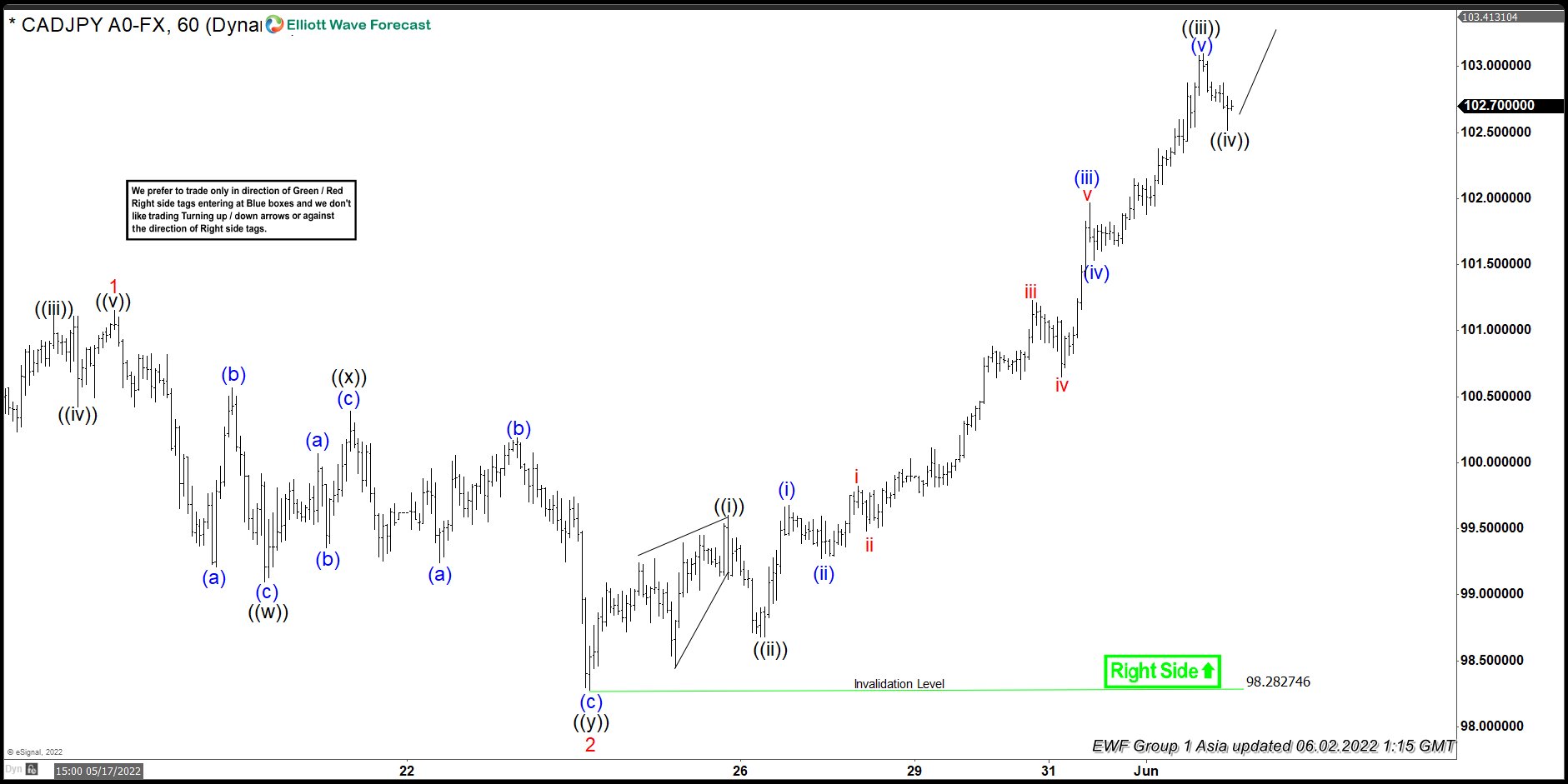
Short Term Elliott Wave View in CADJPY suggests cycle from April 20, 2022 high has ended with wave ((2)) at 97.73. Pair rallies from that level building an impulsive structure as wave 1 ended at 101.16. Then we saw a zigzag Elliott Wave structure as wave 2. Down from wave 1 high, wave ((a)) ended at 99.10, pullback in wave ((b)) ended at 100.39. Then pair drop again in wave ((c)) ended at 98.28 and complete wave 2.
Pair continued with a rally doing a leading diagonal as wave ((i)) ended at 99.59 and wave ((ii)) correction ended at 99.27. Wave ((iii)) has been extended. In lesser degree wave (i) of ((iii)) completed at 99.67. Small pullback as wave (ii) ended at 99.27. Then a strong rally appeared finishing wave (iii) at 101.96. Wave (iv) was shallow at 101.53 and the last rally to complete wave (v) of ((iii)) ended at 103.11. Near term, wave ((iv)) pullback could be done already at 102.50 and we should continue the rally to look for complete wave ((v)) of 3 and wave 3. If pair breaks lower 102.50, then ((iv)) should enter in a double correction before continue with the rally.
CADJPY 60 Minutes Elliott Wave Chart
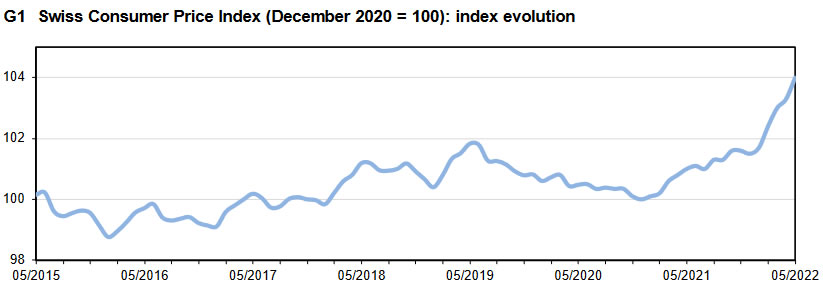
Swiss CPI accelerated to 2.9% yoy in May, import pries up 7.4% yoy
Swiss CPI rose 0.7% mom in May, above expectation of 0.3% mom. The monthly rise was due to factors including housing rentals, heating oil and food. Core CPI rose 0.5% mom. Domestic prices rose 0.5% mom while imported prices rose 1.1% mom.
For the 12-month period, CPI accelerated from 2.5% yoy to 2.9% yoy, above expectation of 2.6% yoy. Core inflation CPI came in at 1.7% yoy. Domestic prices rose 1.5% yoy while imported prices rose 7.4% yoy.
USD/JPY Daily Outlook
Daily Pivots: (S1) 129.15; (P) 129.67; (R1) 130.69; More...
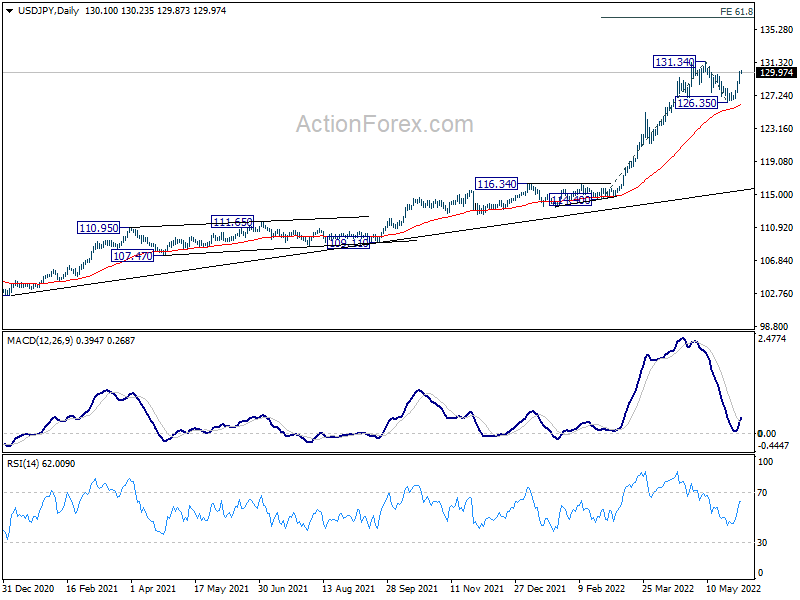
USD/JPY's break of 129.77 minor resistance indicates that pull back from 131.34 has completed with three waves down to 126.35. Intraday bias stays on the upside for 131.34 first. Firm break there will confirm up trend resumption. Next target is 61.8% projection of 114.40 to 131.34 from 126.35 at 136.81. On the downside, below 128.45 minor support will delay the bullish case and turn bias neutral first.
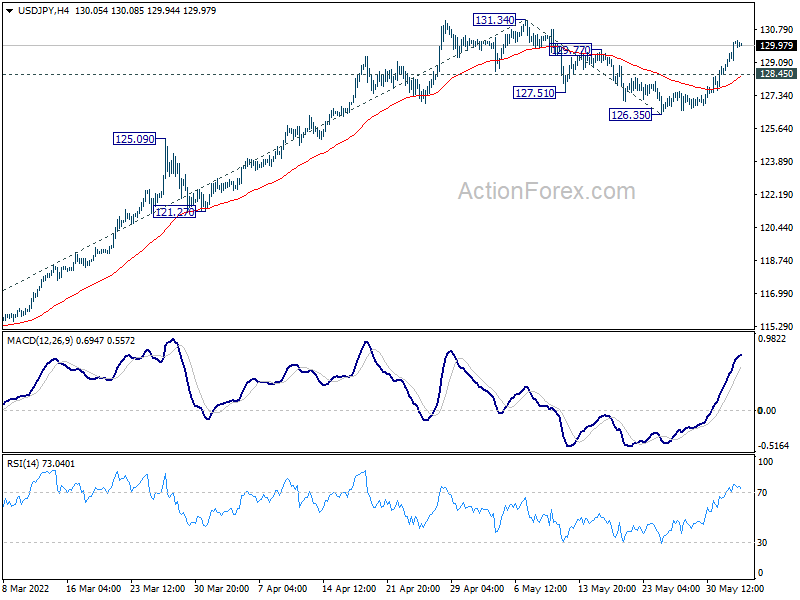
In the bigger picture, current rally is seen as part of the long term up trend form 75.56 (2011 low). Sustained trading above 61.8% projection of 75.56 (2011 low) to 125.85 (2015 high) from 98.97 at 130.04 will pave the way to 100% projection at 149.26, which is close to 147.68 (1998 high). For now, this will remain the favored case as long as 121.27 support holds.
Yen Falls Further on Rising Yields, Euro and Sterling Soften Too
Yen's selloff continued overnight together with strong rebound in US 10-year yield. The Japanese currency remains pressured in Asian session and remains vulnerable. At the same time, Euro and Sterling are also weakening notably. Dollar is rebounding, but for now, Canadian and Australian are still the strongest one for the week. There is prospect for the greenback to overtake the first place, but that might need some strong non-farm payroll data tomorrow.
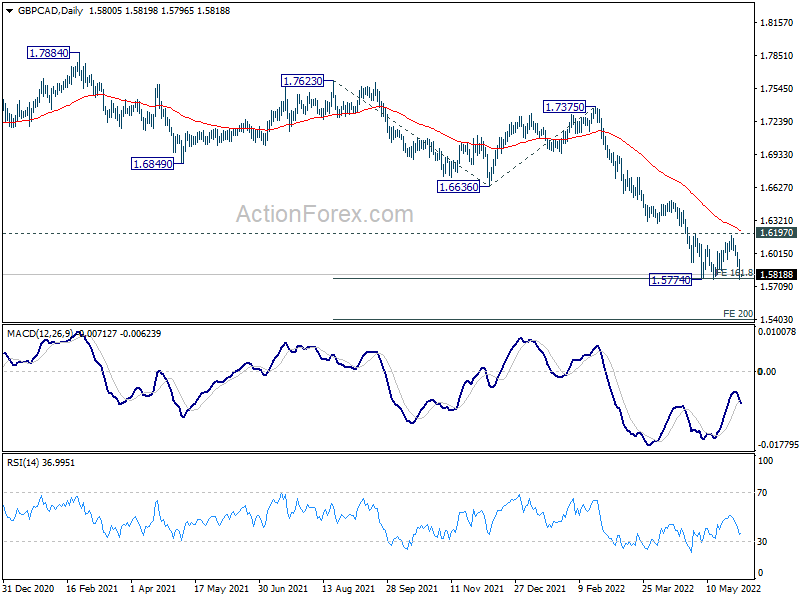
Technically, both GBP/CAD and EUR/CAD appear to be ready for down trend resumption, as part of the reaction to yesterday's hawkish BoC rate hike. As for GBP/CAD, immediate focus is on 1.5774 support. Firm break there will confirm this bearish case and target 200% projection of 1.7623 to 1.6636 from 1.7375 at 1.5401. That might also be accompanied by deeper decline in GBP/USD back to 1.2154 short term bottom.
In Asia, at the time of writing, Nikkei is down -0.11%. Hong Kong HSI is down -1.57%. China Shanghai SSE is up 0.11%. Singapore Strait Times is down -0.46%. Japan 10-year JGB yield is up 0.0059 at 0.242. Overnight, DOW dropped -0.54%. S&P 500 dropped -0.75%. NASDAQ dropped -0.72%. 10-year yield rose 0.087 to 2.931.
Fed Daly: Let's get to neutral as quickly as we can
San Francisco Fed President Mary Daly told CNBC yesterday, "I see a couple of 50-basis-point hikes immediately in the next couple of meetings to get there. And then we need to look around and see what else is going on." She estimates that neutral rate is at around 2.50%, and said , "let's get there as quickly as we can."
"I'm looking for both supply to recover somewhat and demand to come back down a little bit. If neither of those things cooperate, then we need to go into restrictive territory," Daly added.
Fed Bullard: We have a good plan with 50bps per meeting
St. Louis Fed President James Bullard reiterated yesterday, "I think we have a good plan for now. This 50 basis point per meeting increase is twice the normal pace that the committee has used in recent years which shows that there's a lot of unanimity around expeditiously moving to neutral in this high-inflation environment that we're in."
Bullard also repeated that he wants to get rates to 3.5% by the end of the year. Then some of the rate hikes could be reversed late next year or in 2024. He pointed to the pre-pandemic rates, with Fed rates at 1.55%, 10-year yield at 1.86% and mortgage rates well below 4%. "This may provide a practical benchmark for where the constellation of rates may settle once inflation comes under control in the U.S.," he said.
Fed Barkin: It makes perfect sense to normalize policy
Richmond Fed President Barkin said "it's time both on rates and on the balance sheet to normalize where we are". He added, with "inflation this elevated and the economy still this strong, it just makes perfect sense to do that."
"When we get to the fall, I think we're going to have a lot more information on the strength of the economy, we'll have a lot more information on the pace of inflation. Those are the two things I'm paying the most attention to, and the stronger inflation and the stronger the economy, the more the case to do more, and to the extent that the two are weaker, the better the case is to do less," he said.
BoJ Adachi: We should not forget strong yen led to two lost decades
BoJ board member Seiji Adachi said, "with the impact of the pandemic continuing, shifting to tighter monetary policy now would inflict huge damage to business and household activity... It's premature to move toward tighter policy."
"If the bank uses monetary policy to respond to short-term fluctuations (in exchange rates) before achieving its goal for underlying inflation, it would bring negative effects on the Japanese economy," he said.
"We should not forget that a strong yen was among factors that led to Japan's prolonged deflation and two 'lost' decades" of economic stagnation, he added.
On the data front
New Zealand terms of trade index rose 0.5% in Q1, below expectation of 1.3%. Australia trade surplus widened to AUD 10.5B in April, above expectation of AUD 9.0B. Japan monetary base rose 4.6% yoy in May, above expectation of 2.3% yoy.
Looking ahead, Swiss CPI and Eurozone PPI will be released in European session. Later in the day, US will release ADP employment, jobless claims, non-farm productivity and factory orders.
USD/JPY Daily Outlook
Daily Pivots: (S1) 129.15; (P) 129.67; (R1) 130.69; More...
USD/JPY's break of 129.77 minor resistance indicates that pull back from 131.34 has completed with three waves down to 126.35. Intraday bias stays on the upside for 131.34 first. Firm break there will confirm up trend resumption. Next target is 61.8% projection of 114.40 to 131.34 from 126.35 at 136.81. On the downside, below 128.45 minor support will delay the bullish case and turn bias neutral first.
In the bigger picture, current rally is seen as part of the long term up trend form 75.56 (2011 low). Sustained trading above 61.8% projection of 75.56 (2011 low) to 125.85 (2015 high) from 98.97 at 130.04 will pave the way to 100% projection at 149.26, which is close to 147.68 (1998 high). For now, this will remain the favored case as long as 121.27 support holds.
Economic Indicators Update
| GMT | Ccy | Events | Actual | Forecast | Previous | Revised |
|---|---|---|---|---|---|---|
| 22:45 | NZD | Terms of Trade Index Q1 | 0.50% | 1.30% | -1.00% | -0.90% |
| 23:50 | JPY | Monetary Base Y/Y May | 4.60% | 2.30% | 6.60% | |
| 01:30 | AUD | Trade Balance (AUD) Apr | 10.50B | 9.02B | 9.31B | 9.74B |
| 06:30 | CHF | CPI M/M May | 0.30% | 0.40% | ||
| 06:30 | CHF | CPI Y/Y May | 2.60% | 2.50% | ||
| 09:00 | EUR | Eurozone PPI M/M Apr | 2.30% | 5.30% | ||
| 09:00 | EUR | Eurozone PPI Y/Y Apr | 38.60% | 36.80% | ||
| 11:30 | USD | Challenger Job Cuts Y/Y May | 6.00% | |||
| 12:15 | USD | ADP Employment Change May | 280K | 247K | ||
| 12:30 | USD | Initial Jobless Claims (May 27) | 205K | 210K | ||
| 12:30 | USD | Nonfarm Productivity Q1 | -7.50% | -7.50% | ||
| 12:30 | USD | Unit Labor Costs Q1 | 11.60% | 11.60% | ||
| 12:30 | CAD | Building Permits M/M Apr | 0.50% | -9.30% | ||
| 14:00 | USD | Factory Orders M/M Apr | 0.80% | 2.20% | ||
| 14:30 | USD | Natural Gas Storage | 86B | 80B | ||
| 15:00 | USD | Crude Oil Inventories | -3.0M | -1.0M |