Sample Category Title
Eco Data 6/2/22
[php_everywhere instance="1"]
ISM Manufacturing Index Registers 24th Consecutive Month of Expansion
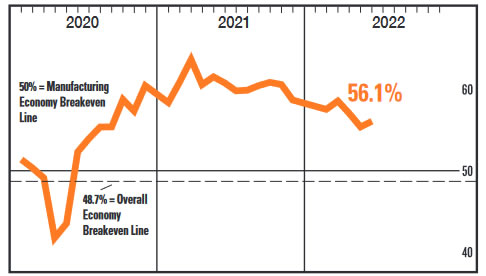
The May ISM manufacturing index registered 56.1, topping expectations of a 54.5 print. The index rose 0.7 percentage points from the April reading of 55.4.
New orders rose by 1.6 percentage points to 55.1, while new export orders rose by 0.2 percentage points to 52.9.
The backlog of orders sub-index came in at 58.7, rising 2.7 percentage points from April's 56.0 print.
The production index increased 0.6 percentage points to 54.2 while the employment index fell 1.3 percentage points to 49.6.
The supplier deliveries sub-index fell to 65.7 from 67.2 in April. The sub-index continues to reflect difficulties in improving delivery rates due to production issues related to the pandemic.
15 of 18 manufacturing industries reported growth in May. Growth was led by Apparel, Leather & Allied Products; printing & Related Support Activities; Machinery; Nonmetallic Mineral Products; Computer Electronic Products; and Food, Beverage & Tobacco Products.
Key Implications
May marks two straight years of expansion for the U.S. manufacturing sector as the PMI registered above the 50-print signifying growth for a 24th consecutive month.
Growth has slowed as the initial bounce from the pandemic shock has faded. Despite the uptick in May, decelerations in new orders and new export orders point to slowing demand going forward. This was to be expected as the economy re-opens and consumer demand shifted from goods and back to services spending.
Supply side concerns persist as supplier delivery times remain elevated despite notching an improvement in May. In the coming months, a raft of goods deliveries from China could test port infrastructure once again as lockdowns are eased in Shanghai. That said, with easing demand, manufacturers should be able to work through order backlogs. Indeed, the order backlogs index has been trending downward in fits and starts since last May.
Softer demand and easing supply congestion for goods should take some fuel off the inflationary fire through the back half of 2022, despite pressure from rising input prices. For the manufacturing sector, the risks to the outlook skew to the downside as global growth falters and central banks look to aggressively counter surging inflation.
BoC Hikes Policy Rate to 1.5%
The Bank of Canada raised the overnight rate 50 basis points to 1.5% and stated it would continue its Quantitative Tightening (QT) policy.
On the state of the economy, the Bank noted that "Canadian economic activity is strong and the economy is clearly operating in excess demand. National accounts data for the first quarter of 2022 showed GDP growth of 3.1 percent, in line with the Bank’s April Monetary Policy Report (MPR) projection. Job vacancies are elevated, companies are reporting widespread labour shortages, and wage growth has been picking up and broadening across sectors."
On inflation, it stated that "CPI inflation reached 6.8% for the month of April – well above the Bank’s forecast – and will likely move even higher in the near term before beginning to ease."
On future policy action, the BoC stated that "with the economy in excess demand, and inflation persisting well above target and expected to move higher in the near term, the Governing Council continues to judge that interest rates will need to rise further."
Key Implications
The BoC hit 'repeat' as it delivered on its second consecutive supersized rate hike and signaled more to come. With economic growth continuing at an above-trend clip, a labour market that keeps tightening, and a broadening in inflation, the current policy stance of the BoC is still too loose.
Our expectation is for the BoC to execute on another 50 basis point hike on July 13th. That would get the policy rate to the low end of neutral. Looking at the bond market reaction today, it is clear that market participants are preparing for even more from the BoC, with the Canada 2- and 10-year yields up 15 basis points and 10 basis points, respectively this morning.
BoC Hikes by 0.50%, Canadian Dollar Yawns
The Canadian dollar is almost unchanged in Wednesday trading. The loonie has reeled off five consecutive winning sessions and is trading at a 5-week high.
BoC delivers a 50-bps hike
As expected, the BoC raised the benchmark rate 50-bps at today’s meeting, bringing the rate to 1.5%. This marked a second straight 50-bps hike, as the BoC continues to aggressively tighten policy in order to curb soaring inflation. CPI has ballooned to 6.8%, its highest level in 30 years.
The Bank of Canada has targeted inflation with front-loading force, with markets expecting one more 50-bps salvo before the BoC slows down the pace of tightening. The plan is to continue to raise rates three or four times in 25-bps increments, which would bring rates to around 3 per cent, which is considered the neutral rate.
The kicker in this carefully laid-out plan is, of course, how inflation will behave. If inflation doesn’t begin to ease and there is no sign of an inflation peak, the Bank may have to hold the course with further 50-bps moves. There is also the spectre of inflation actually getting worse, which would lead to calls to resort to the heavy ammunition, in the form of a massive 75-bps increase.
The BoC is well aware that its credibility is on the line in its titanic battle with inflation. If the Bank is viewed as not doing enough, inflation expectations could become unanchored and move higher, which is a nightmarish scenario for BoC policy makers.
Canada’s GDP climbed in March by 0.7% MoM, higher than expectations. This marked a 10th straight monthly expansion. However, on an annualized basis, first-quarter growth fell to 3.1%, down sharply from 6.6% in Q4 and below the forecast of 5.4%. Exports were down, as the chilly global economic picture has hurt demand for Canadian exports.
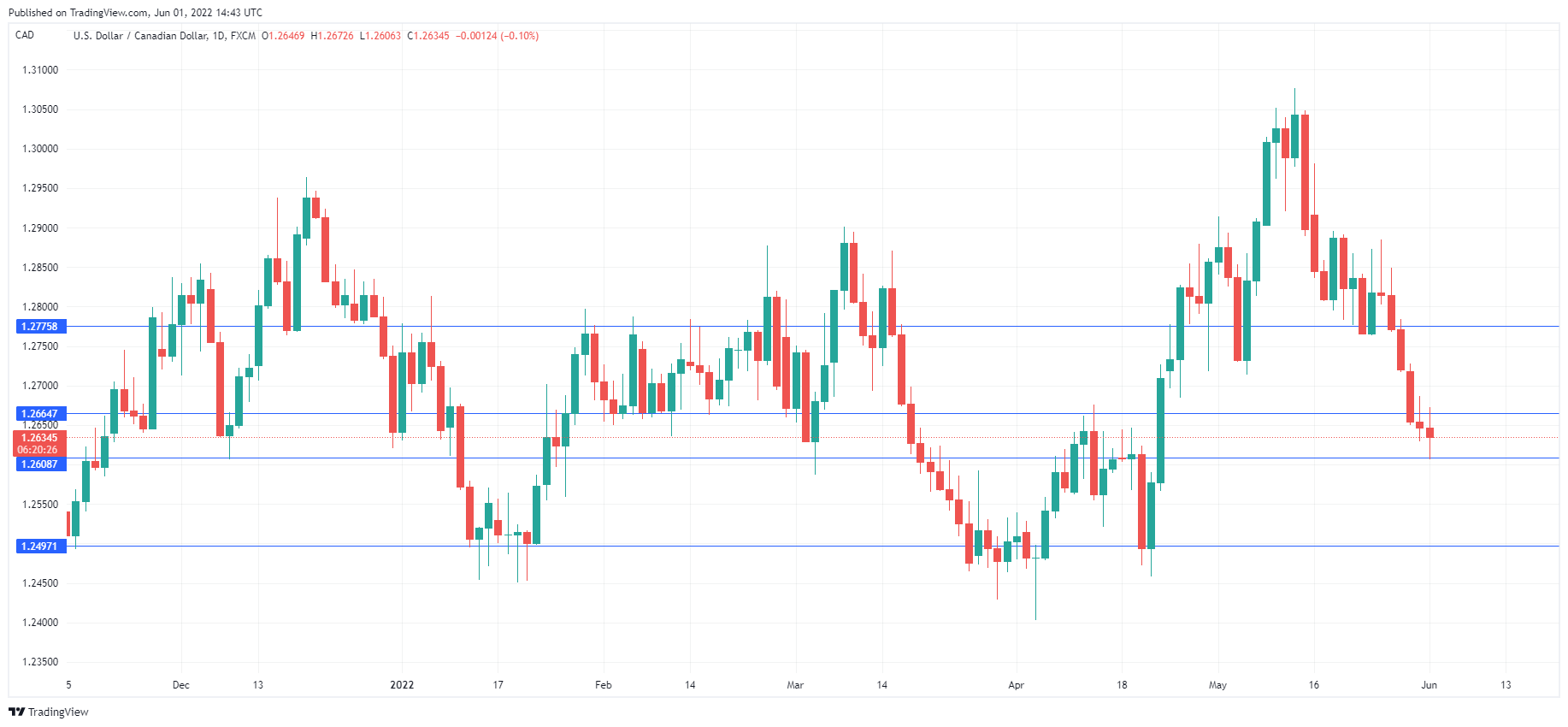
USD/CAD Technical
- There is support at 1.2608 and 1.2548
- USD/CAD is testing resistance at 1.2664. Above, there is resistance at 1.2775
Sunset Market Commentary
Markets
Today’s main data/events with market moving potential still have to be published after finishing this report with the US manufacturing ISM and, to a lesser extent, the Fed Beige Book, bringing a first input for the June 14-15 Fed policy meeting. Still, European investors preferred to err to the side of caution. The astonishing spike in May EMU inflation (8.1%) as published yesterday continues fueling the debate whether the ECB has the room to continue on the path of gradualism as advocated by chair Lagarde and ECB chief economist Lane (who is scheduled to speak this evening). In an e-mail comment to Bloomberg, ECB arch Hawk Holzmann, evidently ‘was obliged’ to use yesterday’s data to highlight the case for a 50 bps lift-off at the July meeting. He considers this a necessary signal that the ECB is serious about fighting inflation and it could support the weak euro exchange rate, which is not helpful to tame inflation. At the same time, a big miss in April German retail sales (-5.4% M/M), admittedly a very volatile series, was a hard reminder that tightening will have to take place in an environment of decelerating growth and fragile confidence. European equities initially struggled to avoid further losses after yesterday’s setback, but sentiment improved in the run-up to US trading. The EuroStoxx50 is gaining about 0.4%. US equities are outperforming, opening with gains of up to 1.1% (Nasdaq). Both US and European interest rate markets stay focused on inflation rather than on growth. German yields are trending further north even after sharp increases yesterday and Monday, gaining between 1 bp (5-y) and 4 bps (30-y). The German 30-y yield continues setting new cycle highs north of 1.40%. At the short end of European curves, the 2-y swap is extensively testing the early May top (1.10% area). US yields show a similar picture with the 2-y yield gaining 3 bps while the 30-y is trading little changed.
The relative calm on interest rate markets is causing directionless trading in the major FX cross rates. The DXY USD trades little changed near 101.90. Similar consolidation is visible in the EUR/USD cross rate (marginally lower at 1.072). Recent rise in US and European yields after a temporary rebound again puts the yen in the defensive (USD/JPY 129.34 and EUR/JPY 138.72). Sterling underperforms the euro (EUR/GBP 0.8540) and the dollar (cable 1.2565) as UK markets are preparing for a long weekend. News Headlines
The euro area unemployment rate stabilized at 6.8% in April, matching the lowest level on record. The unemployment rate for men decreased from 6.5% to 6.4% with the metric for woman stable at 7.2%. Youth employment (under 25) declined from 14% to 13.9%. On a national level, Germany has the lowest tally in EMU with 3%. Outside the currency union, Czech Republic has an even tighter labour market with an unemployment rate of 2.4%. Spain is at the opposite end with 13.3%. The Belgian unemployment rate ticked up from 5.6% to 5.7%. The Federal Reserve will this month start its quantitative tightening process. They aim to shrink the elevated balance sheet ($8.9tn) to more “normal” levels. In practice, they’ll stop reinvesting proceeds of maturing bonds from their QE portfolios. From June until September, they’ll cap the monthly run-off at $47.5bn, consisting of $30tn US Treasuries and $17.5bn mortgage-backed securities. Afterwards, the caps will double to a combined amount of $95bn/month. That compares with a $50bn peak pace in the 2017-2019 period when the Fed shrank its balance sheet slowly from around $4.5tn to about $3.8tn. The Fed has a total amount of $48.5bn Treasury redemptions this month, starting June 15, implying $30tn run-off and $18.5bn reinvestments.
US ISM manufacturing index rose to 56.1, but employment back in contraction
US ISM manufacturing index rose from 55.4 to 56.1 in May, above expectation of 54.5. Looking at some details, new orders rose 1.6 to 55.1. Production rose 0.6 to 50.9. But employment dropped -1.3 to 49.6, in contraction region. Prices dropped -2.4 to 82.2.
ISM said: "The past relationship between the Manufacturing PMI and the overall economy indicates that the Manufacturing PMI for May (56.1 percent) corresponds to a 2.6-percent increase in real gross domestic product (GDP) on an annualized basis."
BoC hikes 50bps, interest rates will need to rise further
BoC raises overnight rate by 50bps to 1.50% as widely expected. The bank rate and deposite rate are now at 1.75% and 1.50% respectively. The central bank also maintains tightening bias. It said, "with the economy in excess demand, and inflation persisting well above target and expected to move higher in the near term, the Governing Council continues to judge that interest rates will need to rise further."
Full statement below.
Bank of Canada increases policy interest rate by 50 basis points, continues quantitative tightening
The Bank of Canada today increased its target for the overnight rate to 1½%, with the Bank Rate at 1¾% and the deposit rate at 1½%. The Bank is also continuing its policy of quantitative tightening (QT).
Inflation globally and in Canada continues to rise, largely driven by higher prices for energy and food. In Canada, CPI inflation reached 6.8% for the month of April - well above the Bank's forecast - and will likely move even higher in the near term before beginning to ease. As pervasive input price pressures feed through into consumer prices, inflation continues to broaden, with core measures of inflation ranging between 3.2% and 5.1%. Almost 70% of CPI categories now show inflation above 3%. The risk of elevated inflation becoming entrenched has risen. The Bank will use its monetary policy tools to return inflation to target and keep inflation expectations well anchored.
The increase in global inflation is occurring as the global economy slows. The Russian invasion of Ukraine, China's COVID-related lockdowns, and ongoing supply disruptions are all weighing on activity and boosting inflation. The war has increased uncertainty and is putting further upward pressure on prices for energy and agricultural commodities. This is dampening the outlook, particularly in Europe. In the United States, private domestic demand remains robust, despite the economy contracting in the first quarter of 2022. US labour market strength continues, with wage pressures intensifying. Global financial conditions have tightened and markets have been volatile.
Canadian economic activity is strong and the economy is clearly operating in excess demand. National accounts data for the first quarter of 2022 showed GDP growth of 3.1 percent, in line with the Bank's April Monetary Policy Report (MPR) projection. Job vacancies are elevated, companies are reporting widespread labour shortages, and wage growth has been picking up and broadening across sectors. Housing market activity is moderating from exceptionally high levels. With consumer spending in Canada remaining robust and exports anticipated to strengthen, growth in the second quarter is expected to be solid.
With the economy in excess demand, and inflation persisting well above target and expected to move higher in the near term, the Governing Council continues to judge that interest rates will need to rise further. The policy interest rate remains the Bank's primary monetary policy instrument, with quantitative tightening acting as a complementary tool. The pace of further increases in the policy rate will be guided by the Bank's ongoing assessment of the economy and inflation, and the Governing Council is prepared to act more forcefully if needed to meet its commitment to achieve the 2% inflation target.
Information note
The next scheduled date for announcing the overnight rate target is July 13, 2022. The Bank will publish its next full outlook for the economy and inflation, including risks to the projection, in the MPR at the same time.
(BOC) Bank of Canada increases policy interest rate by 50 basis points, continues quantitative tightening
The Bank of Canada today increased its target for the overnight rate to 1½%, with the Bank Rate at 1¾% and the deposit rate at 1½%. The Bank is also continuing its policy of quantitative tightening (QT).
Inflation globally and in Canada continues to rise, largely driven by higher prices for energy and food. In Canada, CPI inflation reached 6.8% for the month of April - well above the Bank's forecast - and will likely move even higher in the near term before beginning to ease. As pervasive input price pressures feed through into consumer prices, inflation continues to broaden, with core measures of inflation ranging between 3.2% and 5.1%. Almost 70% of CPI categories now show inflation above 3%. The risk of elevated inflation becoming entrenched has risen. The Bank will use its monetary policy tools to return inflation to target and keep inflation expectations well anchored.
The increase in global inflation is occurring as the global economy slows. The Russian invasion of Ukraine, China's COVID-related lockdowns, and ongoing supply disruptions are all weighing on activity and boosting inflation. The war has increased uncertainty and is putting further upward pressure on prices for energy and agricultural commodities. This is dampening the outlook, particularly in Europe. In the United States, private domestic demand remains robust, despite the economy contracting in the first quarter of 2022. US labour market strength continues, with wage pressures intensifying. Global financial conditions have tightened and markets have been volatile.
Canadian economic activity is strong and the economy is clearly operating in excess demand. National accounts data for the first quarter of 2022 showed GDP growth of 3.1 percent, in line with the Bank's April Monetary Policy Report (MPR) projection. Job vacancies are elevated, companies are reporting widespread labour shortages, and wage growth has been picking up and broadening across sectors. Housing market activity is moderating from exceptionally high levels. With consumer spending in Canada remaining robust and exports anticipated to strengthen, growth in the second quarter is expected to be solid.
With the economy in excess demand, and inflation persisting well above target and expected to move higher in the near term, the Governing Council continues to judge that interest rates will need to rise further. The policy interest rate remains the Bank's primary monetary policy instrument, with quantitative tightening acting as a complementary tool. The pace of further increases in the policy rate will be guided by the Bank's ongoing assessment of the economy and inflation, and the Governing Council is prepared to act more forcefully if needed to meet its commitment to achieve the 2% inflation target.
Information note
The next scheduled date for announcing the overnight rate target is July 13, 2022. The Bank will publish its next full outlook for the economy and inflation, including risks to the projection, in the MPR at the same time.
BTCUSD Exits Tight Range But Risks Remain
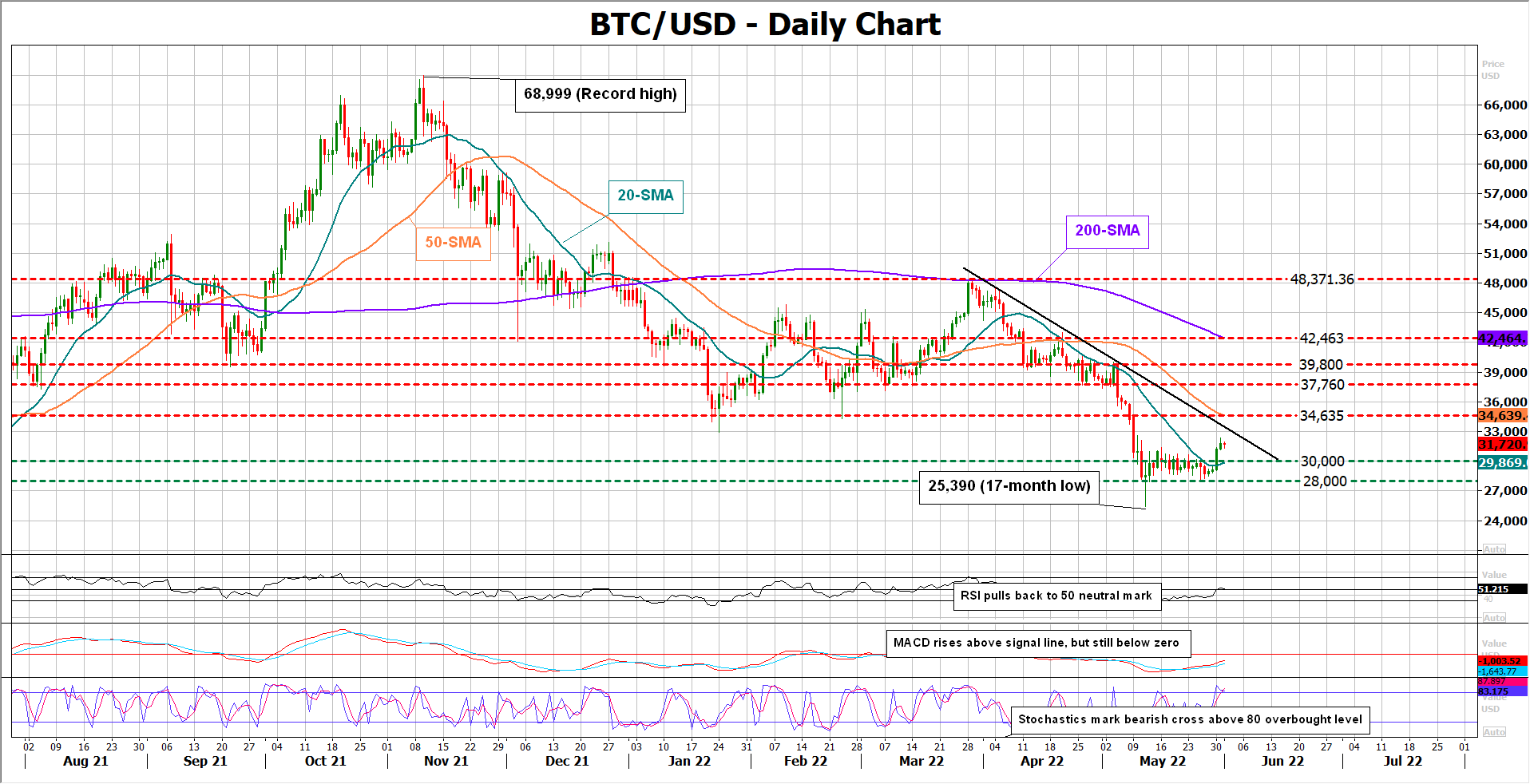
BTCUSD (Bitcoin) returned to a consolidation mode near $31,500 after Monday’s dynamic bullish breakout pushed the price out of the two-week-old tight range and above the 20-day simple moving average (SMA).
Although the positive adjustment in the neutral structure looks promising, the technical indicators keep feeding some pessimism. The RSI has returned to its 50 neutral mark after barely climbing above it, while the MACD is still within the negative zone despite improving above its red signal line. Meanwhile, the Stochastics are printing a bearish cross in the overbought zone, adding some caution as well.
Should the bulls regain control, immediate resistance could come near the tentative descending trendline ahead of the 50-day SMA at $34,635, which corresponds with the lows from the first quarter. The next target might be the area between 37,760 and $39,800, while higher, a close above the 200-day SMA at $42,463 could produce sharper increases.
On the downside, the 20-day SMA and the $30,000 level could be critical. If the crypto slides below that threshold, cracking the floor at $28,000 too, all eyes will turn to the more than a year-low of $25,390. Failure to bounce on the latter could generate another bearish extension to $24,000.
Summing up, the popular crypto has somewhat upgraded its short-term outlook, though the technical picture suggests that it’s not out of the woods yet. Nearby resistance could occur around $34,636, while a flip back below $30,000 is expected to bring sellers back into play.
EUR/USD outlook: Directionless Action Expected ahead of Release of Key US Data
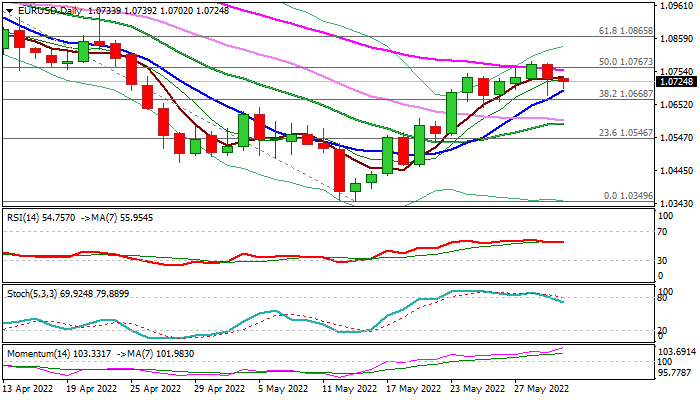
The Euro is trading within a tight range on Wednesday, as recovery rally from 1.0349 low failed to clear pivotal barriers at 1.0767 (55DMA/50% retracement of 1.1184/1.0349), but subsequent pullback was strongly rejected and contained by rising 10DMA, keeping the downside protected for now.
Daily studies are mixed and lack clearer direction signal, while traders await releases of key US data/ADP private-sector payrolls and non-farm payrolls in coming days, which are expected to provide fresh signals.
Res: 1.0767; 1.0786; 1.0800; 1.0865.
Sup: 1.0694; 1.0668; 1.0642; 1.0592.